by Joe Thwaites
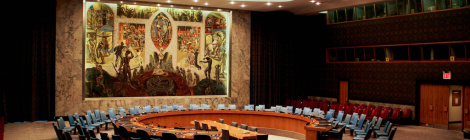
 Last Wednesday, the United Nations Security Council held its second ever debate on climate change, at the request of Germany, who holds the monthly presidency. UN Secretary General Ban Ki-Moon, Director of the UN Environment Program Achim Steiner, President of Nauru Marcus Stephen, and Australia’s Parliamentary Secretary for Pacific Island Affairs Richard Marles all addressed the Council, along with representatives of 62 member states.
Stephen wrote powerfully in the New York Times last week about the threat rising sea levels pose to his Pacific island country’s existence, and did not hold back in the Council, usually a place of diplomatic stoicism. Speaking on behalf of the Pacific Small Island Developing States, he said they were facing “the single greatest security challenge of all – that is, our survival” and put the question: “Where would we be if the roles were reversed? What if the pollution coming from our island nations was threatening the very existence of the major emitters? What would be the nature of today’s debate under those circumstances?”
As it happened, the nature of the debate was twofold. On the ostensible subject, “Maintenance of international peace and security: impact of climate change”, most states agreed that it would have – and in some cases already is having – profound implications for international peace and security, and that the UN had a key role to play coordinating efforts on mitigation and adaptation to climate change. But discussion on this remained secondary to complex political wrangling over the role of the Security Council in addressing the topic. Whilst this is the case for any issue before the body – in discussions on whether to mandate armed intervention into a specific country, for example, the debate focuses not just on the rights and wrongs in that instance, but also the wider precedent it may set – there were added complexities with climate change.
China and Russia displayed their usual reticence about extending the Security Council’s competencies into new areas. They were joined by Brazil, India, and many developing countries in the G77 bloc, who opposed attempts to move the issue away from the General Assembly-mandated UN Framework Convention on Climate Change (UNFCCC), in which all member states have equal footing and decisions are made by consensus, and into the 15 member body where China, Russia, France, the UK and U.S. hold veto power, and are some of the biggest greenhouse gas emitters, on either cumulative or per capita bases. The underlying fear of developing countries was that such a move would circumvent the core principles which make the existing climate change regime palatable – namely, the recognition of states’ “common but differentiated responsibilities” to act on climate change, and the right to sustainable development.
Indeed, if the Security Council were to take overall control of climate action, this would be a regressive step, potentially allowing developed countries off the hook for their failure to meet existing targets under the Kyoto Protocol, and removing the impetus to agree a further UNFCCC commitment period. States proposing that the Security Council address the issue (primarily the EU, U.S. and small island states) were therefore at pains to stress that it would be complementary to existing UN bodies and processes, and should not encroach upon their remits. They argued that as a major security threat, it was right that the Council afford these dimensions of climate change due consideration. But as the UN body with the most diplomatic bite – only the Security Council has the power to authorise military force – it is easy to see why there are concerns that it could dominate the issue.
During the debate there was related apprehension about the excessive securitisation of climate change. Many states pointed out that climate change was a cross-cutting issue, as much related to sustainable development and humanitarian relief as security, and that looking at it as a security issue would not address the underlying causes of the problem. Bolivia noted that developed countries gave $10 billion in climate change finance annually, which amounted to just 1% of defence spending, and suggested the Council adopt a resolution to cut defence and security spending by 20%, using the money saved to address the impacts of climate change. Papua New Guinea echoed Nauru’s Marcus Stephen, pointing out that if the Security Council could address issues such as development and HIV/AIDs as security problems (without them becoming militarised), then why not climate change?
The non-binding Presidential Statement which was finally agreed did not include mention of a Special Representative on Climate Change and Security, which had been one of Germany’s original proposals. Many countries remained open to the idea of a representative, but opposed them being answerable to the Security Council, instead suggesting they be appointed by the General Assembly.
On one level, the outcome was disappointing. Russia initially vetoed adoption of the statement, later agreeing to a watered down version merely noting the “possible security implications” of climate change. Ambassador Susan Rice of the U.S. lambasted the lack of stronger action as “pathetic”, “short sighted” and “a dereliction of duty”. However, given that the first Council debate on climate change in 2007 was unable to agree any formal outcome, getting a Presidential Statement was something of a success.
There remains wide disagreement between states over whether climate change merely exacerbates conflict, or is a distinct threat itself. Academic opinion is still divided, and the Security Council’s position often lags a good ten years behind the latest research on peacebuilding and conflict prevention, so this is not hugely surprising. It is also difficult to untangle the opposition to climate-security links on conceptual grounds from opposition for political reasons related to Security Council ‘mission creep’, as discussed above.
In 2009, the General Assembly requested that the Secretary General produce a report on the possible security implications of climate change. A few states strongly disputed its findings on Wednesday. Nevertheless, the Presidential Statement recommended that in his regular reports to the Council, the Secretary General begin to include information on the possible influence of climate change upon conflict situations around the world. These are important first steps towards mainstreaming climate change in conflict assessments, even if we are a long way from any legally binding resolution.
Another reason for optimism is the level of participation in the debate. I followed many Security Council meetings whilst working in the UN community last year, and never saw so many member states request to speak. Most countries took the discussion seriously, and even where they disagreed on whether the Council had a mandate to act, they spoke strongly on the devastating impacts of climate change.
The question now is: how long will it take for states to take this rhetoric seriously; to realise the gravity of the situation, break the cycle of mistrust in international negotiations and commit to unified multilateral action to address this issue – in whatever forum they choose? The answer is unclear.
There is one thing we can be confident about – this won’t be the last time the Security Council discusses climate change.
Joe Thwaites is a graduate in politics from the University of York, UK. He has worked on conflict prevention at the Quaker United Nations Office and represented Friends of the Earth at the UNFCCC.
Image Source: United Nations Photo
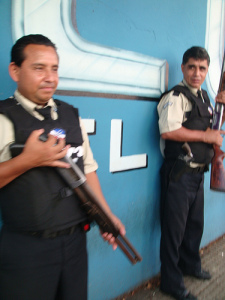 El Salvador’s gang history dates back to the 1960s. At the time, numerous neighbourhood-based groups provided marginalised urban youths with the means to hang out, party, take drugs, and fight their rivals. These gangs constituted a nuisance for the affected residents but did not represent a public security threat. The situation drastically changed when the Central American civil wars ended and the United States stepped up its deportations of offending non-citizens, including members of Mara Salvatrucha (or MS-13) and Calle Dieciocho (18th Street). Both gangs had been formed in Los Angeles’ immigrant barrios, a haven for Central American refugees some of whose children responded to difficult circumstances by joining existing gangs (such as the Dieciocho) or forming their own group (Mara Salvatrucha). Tired of the stresses of gang life, many deportees arrived in their country of origin hoping to make a fresh start. Faced with poor reinsertion opportunities, however, they continued with what they knew best. Their comparatively nice dress, money, and tales of gang exploits held a fascination that local adolescents found hard to resist. Soon the imported gangs absorbed their smaller counterparts and continued to grow, since widespread social exclusion made El Salvador fertile ground for gang proliferation. Over time gang members resorted to greater levels of violence and drug activity, but the country long lacked a full-fledged gang policy.
 In Colombia there are many regions where poverty and the absence, or weak presence, of the state has facilitated the emergence of violence by armed groups. Among these are the Afro-Colombian communities of the Curvaradó and Jiguamiandó in the Urabá region