Category: 10

  • Sustainable Security

    Why has the US failed so dramatically in Afghanistan since 2001? Dominant explanations have ignored the impact of bureaucratic divisions and personality conflicts on nation-building in Afghanistan. These divisions meant the battle was virtually lost before it even began.

    This article presents alternative findings about US efforts to construct a stable and prosperous Afghan state. It concentrates on the bureaucratic conflict surging beneath the surface of the mission, which compromised state-building goals and bedevilled the implementation of policies across a wide range of issues linked to law and order, development, governance and counter-narcotics. The fact that internal bureaucratic problems were an important explanation for the lack of progress has been underestimated in the current scholarship. With this in mind it is stressed here that the machinations of the agencies and individuals who make up the US foreign policy bureaucracy must be recognised alongside external factors in order to provide a complete picture of the difficulties and frustrations characteristic of US state-building in Afghanistan.

    Afghanistan: a twenty-first century state-building project
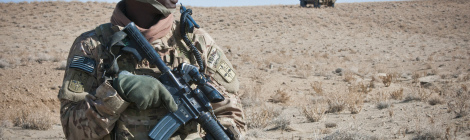
    taskforce-stan

    Image by DVIDSHUB via Flickr.

    Afghanistan has been considered the first major test case for state-building in the twenty-first century. From 2001 onwards, there were some significant achievements as a result of efforts on the part of the United States and its allies. A variety of actors collaborated to sink hundreds of wells and construct many health clinics. According to some estimates, death rates among adult males have declined, and access to clean water has helped to curb disease and improve life expectancy. Millions of Afghan children are now enrolled in schools.

    But given the vast expenditure of the international community these achievements are underwhelming. Close to a quarter of Afghanistan’s population still do not have access to clean water, and nearly half of Afghan children are malnourished. Hunger is widespread and there is rampant unemployment. Schools lack equipment and sometimes even a schoolroom, and sewerage or electricity infrastructure outside of Kabul is practically non-existent.  Corruption is endemic at all levels of government and brutal strongmen, such as the capricious Gulbuddin Hekmatyar, continue to play a central role in national politics. Afghanistan also remains a narcostate that produces an alarming 90% of the world’s heroin with the Taliban now functioning a veritable drug cartel.

    What, then, explains this lack of progress? A smooth transition to Western-style democracy was always an unlikely, given Afghanistan’s ethno-sectarian fissures, economic underdevelopment and institutional fragility. It is now widely accepted that the strength of cultural, religious, and political traditions was underestimated. US insouciance in the years immediately after the invasion, thinly disguised beneath the euphemistic language of having a ‘light footprint’, also contributed to the rise of a ferocious and destabilizing insurgency. This heralded the return of the Taliban as a violent, tenacious and seditious force. In a more general sense, externally generated state-building would have been an ambiguous and difficult process in any country, let alone Afghanistan; the graveyard of empires.

    A bureaucratic tangle

    All of the above issues have been mentioned in media reports and scholarly works. Less attention, however, has been directed to the fact that the responsibilities of the various actors within the US state remained undefined or ambiguous. State-building was compromised by each agency’s unique culture, interests, norms and past experiences; all of which encouraged particular patterns of behaviour. In Afghanistan bureaucratic conflict circumscribed the capacity of the US government to act as a homogeneous and purposeful unit. The impact of this disorder was widespread, but it was particularly problematic in respect to counter-narcotics, law & order and infrastructure projects.

    The US government was not paralysed by the complexity of Afghanistan’s drug problem; however, there was no common conception or understanding of that problem between the relevant parties. During the Bush Administration’s time in office in particular, eradication, interdiction, and the Alternative Livelihoods Program were not subjected to a single calculated counter-narcotics policy, nor was there consensus in regards to the strengths and weaknesses of the three strategies. A lack of leadership from the White House and Congress augmented the capacity of agency rivalry to ensure that the United States failed to pursue a counter-narcotics effort that was united or reflective of Afghanistan’s needs.

    The Bush Administration’s approach to Afghanistan’s drug problem was not only ambiguous but also sporadic, and congressional engagement was not simply selective but also obsessive, advocating short-term solutions that revealed a limited knowledge of the situation on the ground (akin to the 10,000 mile screwdriver). Meanwhile, elements within the civilian wing of the US foreign policy bureaucracy, meanwhile, had their own ideas about Afghanistan’s drug problem. The Bureau of International Narcotics and Law Enforcement Affairs (INL) was influenced by its previous experiences in Columbia and elsewhere, so it prioritized eradication above all else.

    The Drug Enforcement Administration (DEA) favoured interdiction, but much like the INL, the agency struggled to convince other bureaucratic factions that its conceptualization of Afghanistan’s drug problem was the most accurate one. The United States Agency for International Development (USAID) is an actor not normally associated with drug prevention, and it was more concerned with the preservation and protection of its developmental mandate than using agricultural projects to prevent poppy farming. For the US military, counter-narcotics was only valid if it was subordinate to counterinsurgency, and even then both the Defense Department and the US Armed Forces were reluctant to commit resources and manpower to the task.

    The disharmony that plagued the US counter-narcotics program was also characteristic of US efforts to promote the rule of law. US agencies were placed under no significant pressure to initiate rule of law projects by the White House, nor was it in the interest of any agency to spearhead legal reform, given the array of other (often competing) responsibilities that they had already accepted. Other issues took priority: development projects for USAID; diplomacy for the State Department and counterinsurgency for the military. The State Department employed separate contractors and also paid prosecutors on loan from the Department of Justice, who operated independently; while USAID ran its programs through separate contractors. No effort was undertaken by any agency to identify duplicate or conflicting programs and none of them could provide a clear picture of US expenditures.

    Competing ideas about how infrastructure development should be undertaken engendered another web of conflict. Namely, USAID’s perspective clashed with that of the rest of the State Department and US military. USAID considered projects that were conducted by the State Department and the military to be out of tune with the ‘developmental reality.’ Its preference for long-term initiatives coupled with a perceived lack of man-power fostered the impression among military officials that it was ineffective and unreliable. Similarly, the relationship between the State Department and USAID was often characterized by indecision and competing priorities, which precluded the two agencies from establishing a united development front.

    As the insurgency intensified, the US military and the State Department used their influence in Washington to convince USAID to prioritize road-building and agriculture projects in Afghanistan’s most dangerous provinces: Helmand and Kandahar. Often, but not always, USAID yielded to the pressure of more powerful bureaucratic forces and implemented projects that it perceived to be cosmetic. But in order to fulfil these obligations, USAID relied on contractors. These contractors operated in a nebulous area between the private sphere and the foreign policy bureaucracy. They added another layer of confusion to already divided development efforts. Many of the contractors left an array of unfinished school, roads, power supplies and medical clinics. USAID was criticized by the State Department and the US military for delegating projects to Berger, Chemonics and other contractors, but then failing to sufficiently monitor their activities.

    Lessons learned

    No single US official or agency is to blame for the problems outlined in this article, but it meant the battle in Afghanistan was virtually lost before it began. To overcome such bureaucratic conflict, more effort—both in Washington and the field—must be directed toward encouraging a whole-of-government approach to complex foreign policy issues. This should involve staff exchange programs, compulsory inter-departmental meetings and a greater emphasis on aligning interests with policy platforms from senior figures within each agency and, most importantly, the White House. Political will and dedication from the US leadership is certainly essential, but government-based training programs must also infuse prospective US public servants with an understanding of the structure and nuances of the foreign policy bureaucracy in order to promulgate practices that encourage empathy and flexibility. Given the criticism the United States has faced for its state-building efforts in Afghanistan and Iraq, it is unlikely that a similar mission will be attempted in the near future. However, US policy-makers should be careful not to forget these experiences; as was the case following the Vietnam war. The United States still considers ‘fixing’ failed states to be an important foreign policy goal. With is in mind, it is probable a situation will arise requiring the mobilisation of resources and agencies towards state-building. In such a scenario, a cohesive intra-governmental front will be help the US to avoid the bureaucratic disorder that pervaded state-building in Afghanistan.

    Dr Conor Keane has degrees in law and politics, and a doctorate on nation-building in Afghanistan from Macquarie University. His research interests include counter terrorism, state building, bureaucratic politics and US foreign policy. He has published several articles on these topics in journals such as Armed Forces & Society and International Peacekeeping.

  • Sustainable Security

    RC_long_logo_small_4webThis article is part of the Remote Control Warfare series, a collaboration with Remote Control, a project of the Network for Social Change hosted by Oxford Research Group.


    Islamic State (IS) has used aerial drones for reconnaissance and battlefield intelligence in Iraq and Syria and has attempted to use aerial and ground drones with explosive payloads to attack Kurdish troops. IS-directed or -inspired attacks in Australia, Canada, Denmark, the United States and France and failed or foiled attacks elsewhere, including the United Kingdom, have demonstrated the group’s desire to attack targets outside the Middle East. Given that threat is a function of capability and intent, should we therefore be concerned about the possibility of Islamic State or another terrorist group using drones to attack Western cities? A recent report from the Remote Control project and Open Briefing examined this scenario, among others.

    The Drone Threat

    For Hostile drones, the Open Briefing team assessed the capabilities of over 200 commercial and consumer/hobbyist drones capable of operating in the air, on the ground or on or under the sea. Although limited at present, they found that there are consumer drones available today that are capable of delivering an explosive payload equivalent to a pipe bomb (1-4 kilograms) or a suicide vest (4-10 kilograms). Many more could be modified with readily-available components to increase their stated payload capacity. If used in a swarm against the crowd at a major sporting event, for example, they would cause serious injury and multiple fatalities. If one or more of the drones carried on-board cameras to record the event, it would also provide a group such as Islamic State with prime propaganda material.

    Using drones for terrorist attacks has several advantages over conventional methods, including removing the need to convince a suicide bomber to carry out an attack and opening up targets a bomber would not usually be able to access due to security. An attacker would not even necessarily need to weaponise a drone, as the vehicle itself could be used as a projectile to target a light aircraft’s engines on take-off or landing, for example. In addition to attack, Open Briefing identified intelligence gathering as another major capability that drones offer terrorists or insurgents, as demonstrated by Hezbollah, Hamas and Donetsk separatists. For example, Donetsk People’s Republic militias reportedly possess and deploy sophisticated Russian-made Eleron-3SV drones for intelligence, surveillance and reconnaissance (ISR) in eastern Ukraine. Drones provide insurgent groups with an excellent level of battlefield awareness and provide terrorist groups the ability to reconnoitre a target before an attack These same capabilities are also of interest to criminal, corporate and activist threat groups. For example, aerial drones have been used to transport illicit drugs over the Mexico-US border and in April 2015 a man protesting over the Japanese government’s nuclear energy policy landed a drone containing radioactive sand on the roof of the prime minister’s office in Tokyo.

    The same technology Western militaries have been controversially employing to target terrorists in Afghanistan, Pakistan, Yemen, Iraq and elsewhere for years is now being used by various threat groups to target Western interests. This is a prime example of how the tactics and technologies of remote-control warfare have created unintended consequences for those countries that have embraced them.

    Towards Drone Countermeasures

    No single countermeasure is completely effective at limiting the hostile use of drones by non-state actors. Open Briefing therefore proposes the United Kingdom adopt a hierarchy of countermeasures encompassing regulatory, passive and active countermeasures, which provides a layered defence. Regulatory countermeasures include point of sale regulations, civil aviation rules and manufacturing standards and restrictions. Passive countermeasures include early warning systems and signal jamming. Active countermeasures include kinetic defence systems, such as missiles, rockets and bullets, and less-lethal systems, such as projectile weapons and net guns. Each stage of the hierarchy of countermeasures requires government action, but it is the regulatory countermeasures upon which it can affect the greatest change.

    Any changes to the laws surrounding the use of drones need to be proportionate to the risks and balance interests relating to privacy, individual freedoms, safety and commercial interest. In addition to the existing regulations around drones needing to be flown within visual line of sight, below 400 feet and not within 50 metres or a person, vehicle or building, there have been calls from airline pilots and politicians for a registration scheme for consumer drones and for the adoption of firmware limitations that restrict the ability of drones to travel near geofenced no fly zones around sensitive sites, such as airports or nuclear power stations. These are reasonable demands that should be implemented as soon as possible.

    However, these regulations may have limited impact beyond reducing accidental incidents. Unless coupled with some kind of identification/tracking technology built in to drones, a registration scheme would not remove consumer drones from the terrorist arsenal altogether (in any case, such technology would be a step too far in terms of state surveillance and could be easily disabled). What registration would do is impose some control on a presently uncontrolled market and impress upon drone operators the responsibility they must take for their actions. It may also reduce the supply of readily-available drones that could be used for nefarious purposes. In the case of geofenced no fly zones, those wishing to carry out an intentional attack could still purchase open-source controllers that can bypass geofencing, and inertial navigation systems (using dead reckoning) would allow a drone to continue to a static target with reasonable accuracy even if it were possible to jam controller frequencies and GPS signals within the target perimeter. What geofencing would allow is for security to assume that any drone operating within the no fly zone is unauthorised and potentially hostile, allowing them to react appropriately (evacuation and/or deploying active defences).

    Beth Cortez Neavel

    Image of drone by Beth Cortez-Neavel via Flickr.

    There are two further regulations that have received little attention but which should also be considered. Firstly, the payload capacity of the consumer drones available for purchase or import in the United Kingdom without licence should be legally limited to that reasonably required to carry a camera and nothing else. This would mean these types of drones could not be used to carry explosive payloads without further modification. Secondly, owners of commercial drones capable of carrying heavier payloads for legitimate reasons (such as in agriculture or search and rescue) should be legally required to store them securely (in the same way fertiliser must be appropriately secured to prevent its use in homemade bombs, for example). This would prevent the theft and use of drones capable of carrying considerable explosive payloads by terrorists and other threat groups.

    A Layered Defence

    The current regulatory regime around drones in the United Kingdom is very limited. The adoption of the four regulations outlined above would balance the various interests and address specific risks without being unduly restrictive. However, regulations are not a panacea – they would merely limit the ability of terrorists and others to acquire drones with the capabilities needed for attack or intelligence gathering. That is why the government must also work with the police, security services and industry to explore the passive and active countermeasures that are needed to protect VIPs or sensitive sites and ensure that procurement and R&D funding is made available to purchase or develop the required systems. This should include the development of less-lethal systems for destroying or disabling hostile drones in urban environments, where little warning of an attack and the risk of collateral damage limits the usefulness of conventional kinetic countermeasures, such as missiles or bullets. Again, though, this will not be a panacea: the less-lethal systems currently available are of limited effectiveness against one or more fast-moving, small drones. As with all the possible countermeasures, such systems – if coupled with early-warning – would form part of an effective layered defence.

    Ultimately, the regulations and technology needed to reduce the threat from the hostile use of drones are either available now or are under development. The British government has to act now to bring drone regulations up to date and invest in the technologies needed to keep us safe. In the meantime, the threat from the malicious use of civilian drones is only going to increase.

     Chris Abbott is the founder and executive director of Open Briefing (www.openbriefing.org). Matthew Clarke is an associate researcher at Open Briefing. Hostile drones: The hostile use of drones by non-state actors against British targets was published by the Remote Control project on 11 January 2016.

  • Sustainable Security

    RC_long_logo_small_4webThis article is part of the Remote Control Warfare series, a collaboration with Remote Control, a project of the Network for Social Change hosted by Oxford Research Group.

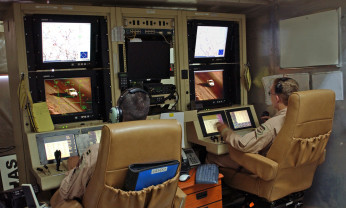
    Capt. Richard Koll, left, and Airman 1st Class Mike Eulo perform function checks after launching an MQ-1 Predator unmanned aerial vehicle Aug. 7 at Balad Air Base, Iraq. Captain Koll, the pilot, and Airman Eulo, the sensor operator, will handle the Predator in a radius of approximately 25 miles around the base before handing it off to personnel stationed in the United States to continue its mission. Both are assigned to the 46th Expeditionary Reconnaissance Squadron. https://en.wikipedia.org/wiki/General_Atomics_MQ-1_Predator#/media/File:MQ-1_Predator_controls_2007-08-07.jpg

    Drone pilots perform function checks after launching an MQ-1 Predator unmanned aerial vehicle Aug. 7 at Balad Air Base, Iraq. Source: Wikipedia

    Over-burdened in its requests for continuous surveillance of an expanding battlefield, the US military is increasingly turning to private contractors to fill key roles in its drone operations.

    In March this year, US Air Force Secretary Deborah James appeared before the Senate Armed Services Committee, looking for a $10 billion funding hike. “I can tell you the number one thing that the combatant commanders say they want from our Air Force is more ISR, ISR, ISR,” she told the committee. “That is the number one priority.”

    ISR is Intelligence, Surveillance, Reconnaissance, and encompasses a complex array of functions. It includes spyplanes and drones with special sensors and cameras, the satellites which control them, and the analysts who turn this information into “products”.  It also includes the “distributed common ground system”, an unwieldy term for the network of devices which allows personnel to access this information and the “products” derived from it.

    The volumes of data being passed back from surveillance flights is now so vast that the military can no longer deal with it in-house. So, The Bureau of Investigative Journalism (‘The Bureau’) found in a six-month investigation, the Pentagon has turned to the private sector to plug the gaps, employing contractors as imagery analysts or “screeners”.

    Screening

    The screener’s task is not a simple one. Like much of military life, it involves long spells of tedium – twelve hour shifts in front of a screen – interspersed with occasional spikes of activity. But it demands high and continuous levels of concentration. As one screener told us: “A misidentification of an enemy combatant with a weapon and a female carrying a broom can have dire consequences.”

    Screeners can have an important safety function in reducing collateral damage – the proverbial “busload of nuns” which appears out of nowhere into the field of fire. But their interpretations of video imagery – “calls”, in military parlance – can also influence drone pilots to take shots. As one screener commented, once you’ve influenced the mentality of the pilot by indicating the presence of something hostile, it’s hard to retract it.

    In one notorious incident, the crew of a MQ-1 Predator drone flying over Afghanistan’s Uruzgan province in February 2010 ignored ambiguities in their screeners’ assessments as to whether the trucks they were tracking contained combatants. As a result, at least 15 civilians were killed.

    “When you mess up,” The Bureau was told, “people die.”

    Contractors

    The companies being paid to undertake this work range from industry leviathans like BAE to specialist tech firms like Zel Technologies and Advanced Concepts Enterprises.

    Finding out who was performing this work was itself an arduous task. The Department of Defense records thousands of procurement transactions most days every year. From 2009 to the end of 2014 there have been over 8 million transactions between the Pentagon and the private sector. The Bureau analysed these transactions through its own specially constructed database, which allowed it to identify activities relating to ISR and then build up profiles of the contracts and companies carrying out those activities.

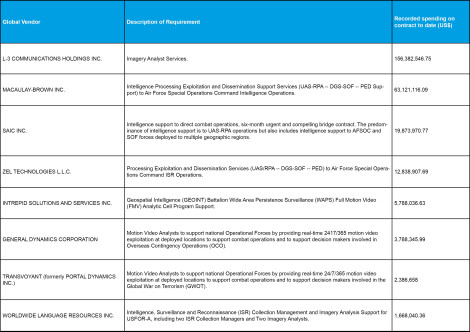
    Table: US Military Imagery Analysis Contracts since 2010 (click to enlarge)

    Data in this table is drawn from public sources including the Federal Procurement Data System (fpds.gov), Federal Business Opportunities (fbo.gov) and contractual material released under the Freedom of Information Act. Business information is taken from Bloomberg, Hoovers and Orbis. Companies named in the reporting but not included in this table are BAE, Booz Allen Hamilton and Advanced Concepts Enterprises. The Bureau has documented evidence of their involvement in ISR from sources other than contracts and transaction records. For the full dataset please see https://docs.google.com/spreadsheets/u/1/d/1WpSvDKGyraU5koQheFIgO7fUCIrSUxG5o7R9cS042_I/pubhtml

    Data in this table is drawn from public sources including the Federal Procurement Data System (fpds.gov), Federal Business Opportunities (fbo.gov) and contractual material released under the Freedom of Information Act. Business information is taken from Bloomberg, Hoovers and Orbis.
    Companies named in the reporting but not included in this table are BAE, Booz Allen Hamilton and Advanced Concepts Enterprises. The Bureau has documented evidence of their involvement in ISR from sources other than contracts and transaction records.
    Click here for the full dataset

    The Bureau identified over $260 million of screening transactions. But this is a niche market compared to the wider outsourced ISR effort. The private sector has been operating smaller surveillance drones over Afghanistan and other countries, managing communications between drones and their bases in the US and elsewhere, maintaining data collection systems and servicing sensors, to name just some functions. Procurement costs for these services run into billions of dollars.

    Questions of accountability come to the fore in this type of outsourced warfare. Following considerable pressure, the military now publishes figures of contractors on the ground in Iraq and Afghanistan. But this transparency does not extend to ISR missions conducted in those countries – or elsewhere – from behind computer screens in Florida and Nevada.

    From Screening to Targeting?

    Although contractors are so far not supposed to have their fingers on the drones’ triggers, fears have been expressed that this distinction might be harder to maintain in practice. One military outsourcing specialist, Laura Dickinson, told us that if the ratio of contractors to government personnel swells, “oversight could easily break down, and the current prohibition on contractors making targeting decisions could become meaningless.”

    Shortly after The Bureau published its investigation in The Guardian, the Pentagon announced that it would ramp up the number of ISR missions with ten new contractor-operated MQ-9 Reaper Combat Air Patrols. This puts contractors into the driving seat of large, combat-capable drones for the first time, although the Pentagon says these will be “ISR only”. The private sector’s involvement in drone warfare, it seems, is just taking off.


    Crofton Black is a researcher, journalist and writer with extensive experience of complex investigations in the field of human rights abuses and counter-terrorism. He is a leading expert on the CIA’s rendition, detention and interrogation programme and a specialist in military and intelligence corporate contracting. He has a PhD in the history of philosophy from the University of London.

    Crofton completed a report for the Remote Control Project last year on the use of contractors in US special forces operations.

  • Sustainable Security

    This post by Oxford Research Group’s Global Security Consultant, Paul Rogers, was originally posted by openSecurity on 3 July, 2014.

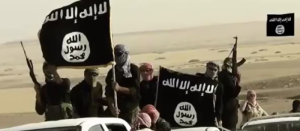
    An image grab taken from a propaganda video by jihadist group ISIL shows ISIL militants gathering Iraq. Source: Screenshot from World News Online

    An image grab taken from a propaganda video by jihadist group ISIL shows ISIL militants gathering Iraq. Source: Screenshot from World News Online

    The recharged war in Iraq that got underway in June 2014 is moving towards its second month. A remarkable feature of this phase is the formation of a largely unacknowledged coalition of four states opposed to the advance of the extremeSunni paramilitaries across much of northwestern Iraq.

    Iran’s involvement is clear enough: senior Iranian Revolutionary Guard Corps (IRGC) officers are active in Baghdad, and Iranian reconnaissance-drones are being used to aid Iraq’s troubled armed forces. Syria too is active, with Bashar al-Assad’s air-force conducting intermittent (and perhaps largely symbolic) strikes against jihadist Islamic State in Iraq and the Levant (ISIL) targets inside Iraq.

    This reflects a shift in the Assad regime’s position. As long as ISIL could be considered little more than an irritant in Syria (even if occupying substantial ground), the group had a propaganda value for Damascus, which could project an image of being steadfast in the face of radical Islam and even secure tacit acceptance by western governments in the process.

    Now that ISIL is getting stronger and more confident – symbolised in itsdeclaration of an “Islamic State” in the territory it controls – the potential challenge to Damascus’s as well as Baghdad’s security is evident. Assad may therefore continue to encourage periodic cross-border air-raids, but he will also work harder to damage ISIL within Syria.

    The late shift

    The two other states in this extraordinary anti-ISIL confluence are the United States and Russia. United States forces in the region are being steadily expanded, though it remains difficult to discern the full extent of personnel deployment in Iraq. This is partly because several thousand Americans in Iraq were already in Iraq before the new war erupted –  including diplomats, weapons-technicians and private military contractors. It is sure, however, that three further groups of military personnel are now entering Iraq.

    The first is composed of security people (probably around 300 in total) assignedto guard diplomats and civilians; the second (at least 100) to safeguard Baghdad airport, among them probably specialist helicopter-crews available to retrieve aircrew (the potential need is highlighted by the US navy’s regular F-18 reconnaissance sorties off the USS George HW Bush carrier in the Persian Gulf). The third group is troops, mostly special-forces personnel, sent to Baghdad and elsewhere to boost Iraqi government forces in their operations. The key point here is that the overall authority, US Central Command, calculates that its operation is unlikely to yield results for several weeks (see Daniel Wasserbly, “US assesses mission in Iraq, considers military options”, Jane’s Defence Weekly, 2 July 2014). US personnel may already be advising Iraqi army troops in their stalled attempt to retake the city of Tikrit, a political necessity for Nouri al-Maliki’s government to demonstrate that it was seen to be doing something to address a military disaster. But the US military is taking a longer-term view of its work in Iraq.

    Russia completes this unlikely anti-ISIS coalition. Its main involvement so far is the provision of a number of Su-25 Frogfoot ground-attack aircraft. The Su-25 is a robust if relatively slow-flying aircraft of the 1970s, roughly analogous to the US’s A-10 Warthog (though less heavily armed). It was widely deployed by the Iraqi air-force in the war with Iran (1980-88), and used by the Soviet air-force in the two Chechen wars (1994-96 and 1999-2002). Few if any survived in Iraqi air-force service after the 1991 war; so it is close to a quarter-century since any Iraqi pilots flew this aircraft – which like all ground-attack planes requires particular skills and much practice. The implication is that if Su-25s are used against ISIL and other militias in the coming weeks, it is near-certain that Russian pilots will fly them.

    Thus, both US and Russian forces are preparing to aid the Maliki government at a quite significant level, and may even cooperate more closely than either Washington or Moscow will want to acknowledge. Indeed, that may already be happening: the hundred US troops inserted to help protect Baghdad’s airport will be guarding the very same base from which Su-25s are already flying, no doubt with Russian pilots.

    The weeks ahead

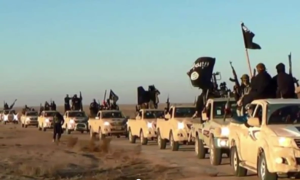
    An image grab taken from a propaganda video by the Islamic State of Iraq and the Levant shows the group travelling through Iraq. Source: World News Online (Youtube with Creative Commons license)

    An image grab taken from a propaganda video by the Islamic State of Iraq and the Levant shows the group travelling through Iraq. Source: World News Online (Youtube with Creative Commons license)

    If the war is creating strange alliances, a question of timescales may also become relevant as events unfold. Neither US and Russian support for Iraq, nor any from Iran, will have much effect on the situation until mid-July. This means that ISIL’s planners have a short window of opportunity to consolidate their recent gains. Several sources indicate that ISIL already has groups in place in western Baghdad to aid any assault on the city (see “The Iraq Crisis [Part 111]: Is Baghdad at Risk?“, 30 June 2014).

    The next two weeks, then, are an acutely dangerous period (see Borzou Daragahi, “Iraqi capital nervously awaits Isis attack“, Financial Times, 1 July 2014). The aim of any ISIS attack will not be to take control of the whole city, for Shi’a militias in the eastern Baghdad districts are strong enough to contest that; instead it will be to damage and demoralise the regime to an extent that Baghdad can’t prevent the Islamic State consolidating itself.

    That outcome would give ISIS a further lease of life. It would also be welcomed by many in the region, not least Saudi Arabia. But it would also be no more than a temporary gain in a war which may yet have far more dreadful human consequences.

    Paul Rogers is professor in the department of peace studies at Bradford University and Global Security Consultant at Oxford Research Group.  He is the author of numerous books including Why We’re Losing the War on Terror (Polity, 2007), and Losing Control: Global Security in the 21st Century (Pluto Press, 3rd edition, 2010). He is on twitter at: @ProfPRogers

  • Sustainable Security


    National Guard smallMax G. Manwaring, a Professor of Military Strategy in the Strategic Studies Institute (SSI) of the U.S. Army War College has written an interesting piece on what he calls the “new security reality in which business-as-usual approaches are of little use.

    Manwaring focuses particularly on the changing nature of threats posed by non-state actors (insurgents, transnational criminal organizations, terrorists, private armies, state proxies etc.) who are able to exploit trends and circumstances such as poverty, social exclusion, environmental degradation, and political economic-social expectations for violent ends. He argues that from a US military point of view, “the enemy has now become a state or nonstate political actor that plans and implements the long-term multidimensional kinds of indirect and direct, nonmilitary and military, nonlethal and lethal, and internal and external activities that threaten a given society’s general well-being and exploits the root causes of internal and external instability.”

    Such a change in the global security environment must surely result in changes in our risk analysis and threat assessments. In a piece for the International Relations and Security Network, Myriam Dunn Cavelty writes that “In order to identify risks, elaborate scenario-based approaches combining expert-knowledge from various fields are used. The aim of these undertakings is to develop a concrete basis for political action by ranking the identified risks by their estimated probability and severity: the more likely and the more damaging, the more urgent the response.” Yet while many governments around the world have begun to place a greater emphasis on understanding the factors that drive conflict (rather than just the instances in which conflicts are expressed in forms of violence around the world), not enough is being done to bridge the gap between threat analysis and policy response. It is one thing to accurately identify new drivers of insecurity, but quite another to find ways of mitigating them through preventive public policies. Central to this must be a greater emphasis on prevention in civil service training and recruitment programmes across a number of areas.

    For example, a report by the Center for American Progress released last year noted that “While there have been a number of well-received conflict prevention trainings by and for U.S. government officials, they are too few in number and insufficiently available to all interested foreign affairs officials.”

    Of course, for militaries, the changed threat environment that Manwaring and others are pointing to means not only a need for new training but also for a cultural shift in the way they think about the utility of their traditional tool – the use of force. For Manwaring, “…power has changed. It is no longer combat firepower. Power is multidimensional, and more often than not, is nonkinetic (soft). It is directed at the causes as well as perpetrators of violence.”

    Addressing the causes of insecurity requires what groups such as Saferworld and others refer to as ‘upstream conflict prevention.’ This can easily become a catch-phrase used by governments and NGOs with little effect on actual policies, a point picked up on by Saferworld in their excellent new briefing on what upstream prevention actually looks like in practice.

    Thinking through the consequences of the changing nature of global security, both in terms of threat assessments and policy responses to those threats (military and non-military), will certainly require new approaches at the broad conceptual level. The fact that this is being touched upon by think tanks, NGOs and even army war colleges is surely a good sign – is sustainable security an idea whose time has come?

    Ben Zala is a Lecturer in International Politics at the University of Leicester.

    Image source: Utah National Guard.