Category: 06

  • Sustainable Security

    Donald Trump has recently been critising his democratic allies, but he has been eager to revive the special relationship with the UK. Likewise, Theresa May has pledged to “renew the special relationship for this new age”. What are the drivers behind this development?

    Donald Trump has a thing for rebuking America’s democratic allies and their leaders—his latest target being Australia’s Prime Minister, Malcolm Turnbull. The UK appears to be an exception to this trend. In his first interview with the British press as president-elect, Trump explained that the UK has a “special place” in his half-Scottish heart and pledged to support a post-Brexit UK-US trade deal. Reportedly a big fan of Winston Churchill—and of Boris Johnson’s Churchill Factor—he also asked the UK government to loan him a Churchill bust that his Republican predecessor George W. Bush kept in the Oval Office.

    This got some people in the UK excited—and not just Trump’s old friends like Nigel Farage. Indeed, shortly after Trump’s inauguration, Downing Street announced that Prime Minister Theresa May would be the first world leader to visit America’s new president. On January 23, four days ahead of May’s visit, Sean Spicer, the White House press secretary, confirmed that two leaders would talk trade (of course he called May “the British head of state”) and that the US has “always had that special relationship with Britain.” He then added, with a peculiar giggle: “We can always be closer.”

    Looking at the visual images the media coverage left behind in isolation, you might think that May’s visit was a roaring success—the beginning of a beautiful Conservative-Republican friendship à la Margaret Thatcher and Ronald Reagan. Image one depicts the two leaders shaking hands against the background of Trump’s main Oval Office redecorations—the Churchill bust and the portrait of Andrew Jackson. Image two shows Trump and May holding hands while walking from the Oval Office to the press conference. Image three: a well-attended, convivial press conference.

    These images now depict a day that will live in infamy in the history of British foreign policy. A day after May left Washington—that is, on the Holocaust Remembrance Day—Trump’s “Muslim ban” came into force, causing worldwide shock and pain. Now even her supporters had to wonder: How did we ever think we could we do business with this misogynistic, racist man? And why was the prime minister prevaricating instead out outright condemning Trump’s policy?

    The standard answer is cold realpolitik. Scheduled to formally take the country outside the EU’s single market in 2019, the UK government is desperately searching for new trade deals. The U.S. market is the primary target—this was implicit in May’s Lancaster House speech (“We will continue to be reliable partners, willing allies and close friends”) and explicit in her speech at the Republican Party conference in Philadelphia (“I am delighted that the new Administration has made a trade agreement between our countries one of its earliest priorities”). Viewed from this perspective, hugging Trump close, while doing so in an extremely unedifying manner, is in Britain’s best interest—it is certainly in the best of interest of some Britons, as George Monbiot pointed out in his latest weekend column for The Guardian.

    Most Conservatives and probably at least a third of the British voters are in quiet support of staying the course. On the same day Trump’s press secretary giggled about the need for an ever closer special relationship. William Hague, former British foreign secretary and no supporter of Brexit, penned in The Daily Telegraph that the special relationship was Britain’s only “indispensable alliance.” Subsequent events did little to make him change his mind. To Hague, rather than retaliating against Trump’s policies—which is a minority demand anyway—the UK government should host the American president this summer as planned. As for the image of the queen being “within grabbing distance of America’s helmsman,” Britons would do well to recall that she has dealt with thugs before, wrote Hague on January 31.

    theresa-may-donald-trump-900

    Image (modified) by UK Home Office and Gage Skidmore.

    Bannon’s rules

    The special relationship has always been asymmetric, with the Americans acting as rule-makers and the British as rule-takers. That said, the rules have never before been made by Stephen Bannon, the American president’s “chief strategist.” Having likened himself to revolutionaries such as Lenin and Thomas Cromwell (and also figures like Darth Vader and Satan)  Bannon appears to be bent on remaking international order by moving the US away from “multilateralism”, “liberalism” and “democracy” and towards America First-styled “sovereignty” and “traditional values.” In practice, this means that the US is now openly hostile to the UN, WTO, NATO, the Five Eyes, to say nothing of the fragile global governance regimes on climate, human rights and arms control—while simultaneously being “open-minded” about Putin’s Russia and Europe’s far right.

    Related, Bannon, former executive chairman of Breitbart News, an information hub for conspiracy theorists, ultra-conservatives, authoritarians, fascists, white supremacist and other “alt-right” aficionados, seems to think of international relations are fundamentally inter-racial relations. American politics and American foreign policy textbooks cannot shed light on this particular America. A combination of Samuel Huntington, Carl Schmidt and Jared Taylor’s White Identity might.

    In every generation for the past seventy years there were those who saw the special relationship as a Faustian bargain for Britain. Their arguments usually never made it into the mainstream, however. As of last week, this has changed—compare the aforementioned Monbiot or Paul Mason in The Guardian to Gideon Rachman in The Financial Times, for example.

    As thousands of Londoners surrounded the US embassy this past Saturday under the banner “Make America Think Again,” it is worth asking where May’s Trump policy might take Britain. Among several memorable statements the prime minister made in her Philadelphia speech, one that received no media scrutiny was the claim that the UK and the US together “defined the modern world.” Not a diplomatic thing to say, but not necessarily wrong either. The British Empire, in its many forms and iterations, transformed the globe by making Britain and “Neo-Britains” rich, and those on the outside poor. Britain also never challenged the rise of the U.S. the way it challenged other imperial rivals—before the democratic peace came the Anglo-Saxon peace. And once the US moved to establish the so-called liberal international order after World War II, a special role was reserved for Britain. “Whenever we want to subvert any place, we find the British own an island within an easy reach,” said one American spook in 1952. The statement has aged well—it helps explain British foreign policy after Suez, after East-of-Suez, after the end of the Cold War and after 9/11. It may well be valid in the Trump era as well, albeit this time the island in question is likely to be Britain itself—Oceania’s “Airstrip One,” as depicted by Orwell in 1984.

    Srdjan Vucetic is Associate Professor at the Graduate School of Public and International Affairs. His research interests involve American and Canadian foreign and defence policy and international security. Prior to joining the GSPIA, Srdjan was the Randall Dillard Research Fellow in International Studies at Pembroke College, University of Cambridge.

  • Sustainable Security

    by Caroline Donnellan and Esther Kersley

    This article was originally published on openSecurity’s monthly Sustainable Security column on 22 June 2014. Every month, a rotating network of experts from Oxford Research Group’s Sustainable Security programme explore pertinent issues of global and regional insecurity.

    RC_long_logo_small_4webThis article is part of the Remote Control Warfare series, a collaboration with Remote Control, a project of the Network for Social Change hosted by Oxford Research Group.

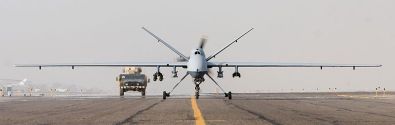
    An MQ-9 Reaper takes off on a mission from Afghanistan. Source: Wikimedia

    An MQ-9 Reaper takes off on a mission from Afghanistan. Source: Wikimedia

    The past week has marked ten years since the first reported US drone strike in Pakistan. It has also seen the resumption of strikes following a five-month pause. So how effective has the covert programme been and what impact have drones had on Pakistani society?

    Since 2004, the US has launched more than 380 strikes in the Federally Administrated Tribal Areas (FATA). As part of its “war on terror”, they were intended to eliminate mainly al-Qaeda and the Pakistani Taliban from the region. But a report by Dr Wali Aslam, commissioned by the Remote Control project, has found that drone strikes, rather than eliminating “terrorists”, have instead caused militants to leave FATA for other parts of the country to avoid being hit. Although the US deems its programme a success—indeed it has pursued some “high-value” targets and decreased the number of fighters in FATA—this is short-term at best, as drones have simply displaced the problem. In turn, this relocation has brought radicalisation, violence and crime to the regions of Pakistan where the militants have resettled.

    Unintended consequences

    Drones are deeply unpopular in Pakistan, due to the civilian casualties, psychological damage and infringement of sovereignty they entail. Growing anti-American sentiment has provided an effective recruitment tool for extremists, fuelling rather than minimising radicalisation. And relocation as a result of drone strikes has widened that recruitment pool, as militants have spread to regions with which they previously had no connection.

    In the Punjab, for example, there has been increased radicalisation among some Sunni Muslims. In Karachi, countless madrasas have provided a stream of potential recruits, undermining secular political parties such as Muttahida Qaumi Movement (MQM) and the Awami National Party (ANP). The attack on Karachi international airport on 8-9 June, in which at least 28 people were killed—supposedly in retaliation for a US drone attack—is a further example of the penetration of the Pakistani Taliban there.

    There has also been an escalation in violence more broadly in Pakistan since 2007. There have been an estimated 50,000 deaths due to suicide bombings, improvised explosive devices and gun attacks—an incidence of paramilitary activity unprecedented in the country’s history. Is this upsurge linked to US drone strikes? The Remote Control report shows a correlation between violence in Karachi, the FATA’s Kurram Agency and Punjab province since 2007 and US drone attacks in FATA during this period.

    Zooming in, in Karachi, attacks on secular parties, kidnapping and petty crime increased after 2010, coinciding with a dramatic rise in drone attacks in the same year (122, compared with 36 and 54 in 2008 and 2009 respectively). In Kurram Agency, the flight of large numbers of militants from neighbouring North Waziristan coincided with an increase in sectarian violence there (since 2007 the Turi Shia tribe has lost an estimated 2,000 members as a result). And in Punjab, an increase in attacks on Ahmadi, Shia and Christian communities since 2007 again coincided with many militants relocating from FATA.

    Of course, the Pakistan army’s own operations in parts of FATA and the north-west have contributed to the relocation of militants but the role played by US drones has been largely neglected. Yet they have exacerbated a delicate, vulnerable and complex socio-political environment.

    Remote-control warfare

    The decade-long experience can teach us important lessons. It highlights the failure of drone warfare as a “counter-terrorism” strategy and thus the limitations of remote-control methods more broadly to resolve conflict. As armed drones are increasingly used by the US in Somalia, Yemen and Afghanistan—and by the UK in Afghanistan—with more reliance also being placed globally on special forces and private military companies, so the remote-control trend spreads.

    The latest monthly briefing from the civil intelligence agency Open Briefing illustrates the proliferation of drone activity. The US is facing demands for access to drone technology from security partners—such as Algeria, Niger and Iraq—as well as intelligence, surveillance and reconnaissance capacity. Iran has unveiled its reverse-engineered version of the US drone, the RQ-170 Sentinel, and its maturing drone-development programme is benefiting from operations in Syria. Meanwhile, the Israeli Air Force has been carrying out drills to prepare pilots to shoot down more advanced potential Hezbollah and Hamas drones, expected to be faster and able to stay airborne longer.

    The volatile north-east Asia region is also seeing a rapid proliferation of unmanned technologies. The US Air Force will be deploying two Global Hawk drones from Misawa air base in Japan, for surveillance of North Korean and Chinese military activities. The Japanese Air Self-Defence Force is expected to procure three Global Hawks in 2015. South Korean officials have confirmed that drones found near the North Korean border in early April were most likely owned by North Korea. China has a vigorous armed-drone development programme, which appears to be prioritised for maritime security.

    Global insecurity

    As the military technology for remote-control warfare spreads, there is a need to question whether drones provide significant tactical advantage or whether their proliferation could lead to greater long-term global insecurity. A RAND report in April concluded that medium-range, non-stealth drones only deliver advantage in limited military contexts. Yet rapid growth is forecast in the drone market: in the same month, Forecast International predicted expansion of drone exports from $942m to $2.3 billion per year between 2013 and 2023. It estimated that, by 2017, the Aviation Industry Corporation of China would be the largest manufacturer and, by 2030, half of the aircraft fleets of some militaries could consist of drones.

    The use of drones in Pakistan has spread the threat of violence to other parts of the country and detrimentally affected Pakistani society. Rapid drone proliferation raises serious concerns as technological developments and exports widen the range of deployers. Avoiding “boots on the ground” through remote warfare appears an attractive new means of “counter-terrorism”, for obvious reasons. But the unforeseen consequences which could render this counter-productive need to be factored into the equation.

    Caroline Donnellan manages of the Remote Control project of the Network for Social Change, which examines and challenges the new ways of modern warfare, including the use of Unmanned Aerial Vehicles (UAVs), Private Security Companies, Special Forces, aspects of cyber warfare and surveillance methods. Caroline has a background in multilateral diplomacy and has worked on international security and human rights issues for a number of years. Before joining ORG, she was Senior Policy Advisor to the Ambassador, Irish Permanent Representation to the Organization for Security and Cooperation in Europe (OSCE) in Vienna. 

    Esther Kersley is the Communications Assistant for Remote Control. Prior to joining ORG, Esther worked in Berlin for the anti-corruption NGO Transparency International as an editorial and online communications officer. She has a particular interest in counter-terrorism and conflict resolution in the Middle East, having previously worked with the Quilliam Foundation and IPCRI (Israel/Palestine Center for Research and Information), a Jerusalem based think tank.

  • Sustainable Security


    Welcome back! We’ve just re-launched with a brand new look, great new authors and, as always, lots to say!

    Sustainablesecurity.org is space to debate, discuss and develop understandings of modern insecurity within a  ‘sustainable security’ framework, which realises the interconnected underlying drivers of challenges to global security and seeks to counter them with preventive policy solutions.

    The blog is a project of the Sustainable Security programme of Oxford Research Group, originally launched in September 2009.

    Sustainablesecurity.org is space to debate, discuss and develop understandings of modern insecurity within a  ‘sustainable security’ framework, which realises the interconnected underlying drivers of challenges to global security in the 21st century. Through topical discussion pieces, we aim to explore the integrated, preventive policies that are needed to solve these threats at source.

    As well as covering a range of pertinent modern security challenges, the website highlights four key interconnected drivers of global insecurity:

    • Climate Change
    • Competition over natural resources
    • Global militarisation
    • Marginalisation

    Articles and resources are allocated to one or more of these headings, but the overall emphasis is on the interconnected nature of these threats and the need for comprehensive, multilateral approaches to them. For a wider range of topics, try our ‘Hot Topics’ tag cloud in the sidebar to the right.

    Don’t forget, you can sign up for updates about new blog posts and special features.

    We hope you enjoy exploring the new site!

    SusSec Team

    Image source: John Martinez Pavliga