Category: 08

  • Sustainable Security

    Mali - Another Long War(This piece was originally published by Channel 4 News on Tuesday 22 January 2013, and is the second of two parts by Ben Zala and Anna Alissa Hitzemann)

    There is a stark warning today the western intervention strategy in Mali is “flawed”. Part two of a special paper also says France and others are likely to be involved in the conflict “for some time”

    Not unlike the United States in both Afghanistan and Iraq, the French government has begun the intervention with talk of short timelines and minimal troops on the ground before quickly changing its tune, write Anna Alissa Hitzemann and Ben Zala for the Oxford Research Group.

    The initial deployment of 800 French troops may end up numbering more than 2,500 and President François Hollande has stated France’s mission is to ensure that “when we end our intervention, Mali is safe, has legitimate  authorities, an electoral process and there are no more terrorists threatening its territory”. This does not seem to tally with the earlier statement by the French Foreign Minister that the current level of French involvement in the country would last for “a matter of weeks”.

    The latest reports are that the Islamist fighters have been preparing for this intervention by carving a network of caves and tunnels into cliff faces to house bases and supplies of fuel and ammunition. This, combined with the concerns about the roles of both the Malian security forces and a number of potential contributors to the ECOWA force in relation to the abuse of civilian populations (and the likely blowback effect of such actions), mean that stability in Mali will be almost impossible achieve with military force alone.

    It is also far from clear whether the African states that are set to join the intervention will be able commit forces for a drawn-out insurgency. After Chad, the second biggest promised contributor of troops is Nigeria, which has pledged a contingent of 900.

    Yet the Nigerian government itself is fighting its own Islamist-inspired insurgency with the Boko Haram group in the country’s north. Despite a relative decline in Boko Haram attacks in recent months and even the potential for Saudi-backed peace talks between the rebels and the government, fighting could easily intensify once more, in which case Nigeria is unlikely to remain involved in Mali in any significant way.

    Without taking serious action to address the sense of marginalisation and disenfranchisement of those who were willing to join one of the rebel groups… there are few reasons to think the current intervention will produce a durable peace in Mali.

    Not only have France and its allies underestimated the difficulty of fighting the northern rebels among civilian populations in which bombing from above is of little use, there appears to be no sign of a plan as to how the factors underlying the uprising (including the original Tuareg rebellion) can be addressed.

    Without taking serious action to address the sense of marginalisation and disenfranchisement of those who were willing to join one of the rebel groups — Tuareg, Islamist or otherwise — there are few reasons to think the current intervention will produce a durable peace in Mali.

    Ongoing conflict

    While military force is considered the only option, feelings of resentment amongst elements of the population of northern Mali are likely to increase. Not only this, it will provide ample encouragement to other anti-Western paramilitary groups across North and Sub-Saharan Africa, the Middle East, and Central, South and Southeast Asia.

    The central lesson of the western interventions and small-scale military operations (including Pakistan, Yemen, Somalia and elsewhere) of the post 9-11 era, has been that reacting to the symptoms of insecurity once they are deeply manifested, and few options other than military force remain, is a fundamentally flawed strategy for global security. This means that France and others are likely to now be involved in an ongoing conflict in Mali for some time.

    Not only do the (so far conspicuously absent) plans for a post-conflict stabilisation process need to be settled between France and its coalition partners now, a serious commitment to assisting the Malian government to going much further in addressing the marginalisation of the north will be crucial.

    Until the focus shifts from military control to working towards solving the root causes of the conflict, no viable sustainable security will be found for Mali.

    Anna Alissa Hitzemann is a  Peaceworker with Quaker Peace and Social Witness. She currently works with Oxford Research Group as a Project Officer for the Sustainable Security Programme, with a focus on our ‘Marginalisation of the Majority World’ project.

    Ben Zala is a Lecturer in International Politics at the University of Leicester.

    Image source: Malian Airfield Protection Vehicle and Crew at Bamako, Mali. Source: UK Ministry of Defence.


  • Sustainable Security

    Summary

    The dramatic recent escalation of rhetoric and military posturing on the Korean peninsula has reawakened suggestions that the United States could use relatively low-yield nuclear weapons in a limited or tactical operation to neutralise North Korea. Indeed, both the idea of nuclear ‘first strike’ and their ‘flexible’ usage on and off the ‘battlefield’ are deeply rooted in historic and current NATO and UK doctrine on nuclear weapons. Given the extraordinarily militarised nature of the inter-Korean border and, increasingly, that between NATO and Russia, the potentially cataclysmic nature of any nuclear exchange must be urgently recalled and avoided at all costs.

    Introduction

    One of the most common misunderstandings about nuclear weapons in general and Britain’s nuclear weapons in particular is that nuclear strategy is solely about deterring an opponent from attacking you by threatening that opponent with all-out destruction in response. Given the growing risk of a nuclear confrontation over North Korea it is appropriate to point out that this has never been the case. Ever since the start of the nuclear age nuclear weapons have been seen as useable weapons and appropriate in certain circumstances for fighting limited nuclear wars.

    As a member of NATO Britain retains the option of using nuclear weapons first and has the means to do so. This briefing is intended to serve as a reminder of this. It will do so by concentrating specifically on British policy, both within NATO and out-of-area, but this applies just as much to the other seven full nuclear powers and, no doubt, to North Korea as well. It applies very much to the United States in particular and its current president, Donal J Trump, who has made it clear that the United States will not allow North Korea to develop the ability to target the continental United States with nuclear weapons.

    Early history

    When Hiroshima and Nagasaki were destroyed in August 1945 these weapons were seen in air force circles as direct descendants of the mass bombing of cities with conventional weapons using a thousand bombers or more. The raids on Hamburg and Dresden and especially the firestorm raid on Tokyo each killed tens of thousands of people so the perception after Hiroshima and Nagasaki was that the primary difference between conventional and nuclear weapons was one of cities being destroyed by one atom bomb from a single plane rather than five thousand tons of high explosive bombs from many planes. Indeed the US Army Air Corps and the nuclear weapon industry had already set in motion the industrial structures to destroy two Japanese cities every month until surrender.

    By 1948 the United States had an arsenal of fifty atom bombs and was already starting to develop the far more powerful thermonuclear weapon or H-bomb. Britain came on the scene rather later. While it first tested a nuclear weapon in 1952, it was not until the late 1950s and early 1960s that it could start deploying its Valiant, Vulcan and Victor strategic bombers in large numbers. These, too, were seen in the context of the British involvement in the area bombing of German cities, but Britain was also an early adherent of the idea of fighting limited nuclear wars, an issue that was seen as particularly relevant in the Middle East and Eastern and South Eastern Asia.

    Thus there were nuclear-capable Canberra bombers and nuclear weapons deployed to RAF Akrotiri in Cyprus from 1961 to 1969 to support the Central Treaty Organisation (CENTO), the South West Asian equivalent of NATO. These were replaced by Vulcans until 1975. From the mid-1960s there were regular detachments of V-bombers to RAF Tengah in Singapore and the Royal Navy had nuclear-capable Scimitar and Buccaneer strike aircraft on aircraft carriers such as Eagle, Ark Royal, Centaur and Victorious over a 16-year period from 1962 to 1978.

    From the early days of the deployment of nuclear weapons  by states such as the Soviet Union, the United States and Britain there is ample evidence that both military and political leaders accepted the possibility of limited nuclear war. It was expressed in Britain, for example, by the then Minister of Defence, Harold Macmillan, speaking in the House of Commons in 1955:

    “…the power of interdiction upon invading columns by nuclear weapons gives a new aspect altogether to strategy, both in the Middle East and the Far East. It affords a breathing space, an interval, a short but perhaps vital opportunity for the assembly, during the battle for air supremacy, of larger conventional forces than can normally be stationed in those areas.” (Hansard, volume 568, column 2182, 2 March 1955).

    NATO and nuclear first use

    As one of the founder members of NATO, and the second to develop nuclear weapons, Britain was involved in NATO nuclear planning from the very early years of the mid-1950s. In those early years and until the late 1960s, NATO nuclear policy was codified in document MC14/2 known as the “tripwire” policy which planned a massive nuclear response to the initiation of war by the Soviet bloc.

    While the United States maintained massively greater nuclear forces, and a wide variety of weapon types, Britain also had a significant arsenal which eventually developed to include an array of strategic and tactical systems. These included the Polaris submarine-launched ballistic missiles, free-fall bombs of variable power and anti-submarine nuclear depth bombs as well as nuclear-capable 155mm and 203mm artillery and Lance short-range nuclear missiles, the last three utilising US nuclear warheads under a dual control system. Thus, for several decades, all three branches of the British Armed Forces focused their operational planning around use of forward-deployed tactical nuclear weapons.

    By the latter part of the 1960s the Soviet Union had developed its own array of tactical systems and NATO responded by modifying “tripwire” and developing “flexible response”. This was encoded in MC14/3 of 16 January 1968 and envisaged the limited use of mostly low-yield warheads early in a conflict against Warsaw Pact troops and their immediate logistic support in the belief that they might be “stopped in their tracks”. If that failed, a more general nuclear response might ensue.

    Britain was very much part of this move, its nuclear forces were normally committed to NATO and UK personnel played significant roles within the NATO Nuclear Planning Group. This move away from deterrence through massive assured destruction was rarely publicised by the British government, one exception being an exposition of the policy offered to the House of Commons Select Committee on Foreign Affairs two decades after the transition to flexible response:

    “The fundamental objective of maintaining the capability for selective sub-strategic use of theatre nuclear weapons is political – to demonstrate in advance that NATO has the capability and will to use nuclear weapons in a deliberate, politically-controlled way with the objective of inducing the aggressor to terminate the aggression and withdraw. The role of TNF [Theatre Nuclear Forces] is not to compensate for any imbalance in conventional forces. The achievement of conventional parity could have very positive consequences for the Alliance’s strategy of deterrence. But it would not, of itself, obviate the need for theatre nuclear forces.”    (Third Report of the House of Commons Select Committee on Foreign Affairs 1987-88, p.35, para. 6.)

    What was very little understood at the time in the public domain was that NATO’s flexible response approach was not just the preparedness to use nuclear weapons first in response to a conventional military attack from the Soviet bloc but to do so at an early stage in such a conflict. This was made clear by SACEUR (the Supreme Allied Commander, Europe), General Bernard Rogers, in an interview published in early 1986:

    “Before you lose the cohesiveness of the alliance – that is, before you are subject to (conventional Soviet military) penetration on a fairly broad scale – you will request, not you may, but you will request the use of nuclear weapons”. (International Defence Review, February 1986)

    NATO’s flexible response policy remains broadly in place to the present day and nuclear planning allows for many different targeting options. This also applies to the United States where such options are constantly updated to allow for changing political situations. In an interesting reflection on relative economic and political strength, Russia also sees nuclear weapons as intrinsically of greater relevance given the low capabilities of its conventional military forces compared with those of the Warsaw Pact at the height of the Cold War.

    Britain’s out-of-area operations and nuclear weapons

    Since the end of the Second World War the United Kingdom has been one of the most active countries to be involved in overseas wars. The majority of these were wars of the late colonial period, but many others have been more broadly based, from Korea through to former Yugoslavia as well as the more recent and intensive post-9/11 conflicts across the Middle East and North Africa. Throughout all this period the UK has maintained its wide-ranging tactical and strategic nuclear options, even though the size of the arsenals is smaller than thirty years ago.

    Two of the most controversial conflicts, the Falklands/Malvinas War of 1982 and the first Gulf War of 1991 have both had a nuclear connection. After Argentina occupied the Falkland Islands in early 1982 the UK government under Margaret Thatcher despatched a substantial naval task force and six days after it left Britain The Observer reported that

    “It is almost certainly carrying tactical nuclear naval weapons – atomic depth charges carried by Sea King helicopters and free-fall bombs carried by Harrier jump jets – as part of NATO equipment.” (11 April 1982)

    Later reports indicated that many of the weapons from the smaller warships were transferred en route to an auxiliary supply ship, the RFA Resource which proceeded to the South Atlantic with the rest of the fleet but was deployed away from the most intense areas of action during the subsequent war. It is not clear whether this also applied to the nuclear weapons that may have been deployed on the two aircraft carriers, HMS Invincible and Hermes and there were also multiple if unconfirmed reports that the Thatcher government was prepared to deploy a Polaris missile submarine to the mid-Atlantic to bring it within range of Argentina. (Paul Rogers, “Sub-Strategic Trident: A Slow Burning Fuse”, London Defence Papers 34, Brasseys, 1996)

    Nine years after that war the UK government committed substantial forces to a US-led multinational military coalition to evict the Iraqi forces that had invaded and occupied Kuwait in August 1990. At the time there was considerable concern that Iraq had a useable arsenal of chemical weapons and a clear indication of UK willingness to use nuclear weapons in response came in an interview with a senior army office attached to the 7th Armoured Brigade which was leaving for the Gulf. He confirmed that an Iraqi chemical attack on UK forces would be met with a tactical nuclear response. (Observer, 30 September 1990).

    Deliberate ambiguity

    During the 1990s, after the end of the Cold War, the UK government, under the leadership of the Conservative Prime Minister John Major, scaled down Britain’s nuclear arsenals in a series of unilateral moves, ceasing to deploy dual-control US nuclear artillery and missiles and withdrawing the WE.177 tactical nuclear bombs and depth bombs between 1992 and 1998. US-owned B61 tactical nuclear bombs continued to be deployed at RAF Lakenheath for another decade and still are based in Belgium, Germany, Italy, Netherlands and Turkey under enduring nuclear sharing arrangements with those host countries.

    In order to preserve a British “sub-strategic” capability, a low-yield variant of the standard high-yield Trident thermonuclear warhead has since been deployed, although terms such as “tactical Trident” or “Sub-Strategic Trident” are no longer used in government publications. Neither is there any specific reference in official publications to the UK maintaining a policy of potential first-use of nuclear weapons.

    Instead a generic description of the UK nuclear posture appears in successive defence white papers, the 2015 statement being an example:

    Only the Prime Minister can authorise the launch of nuclear weapons, which ensures

    that political control is maintained at all times. We would use our nuclear weapons only in extreme circumstances of self-defence, including the defence of our NATO Allies. While our resolve and capability to do so if necessary is beyond doubt, we will remain deliberately ambiguous about precisely when, how and at what scale we would contemplate their use, in order not to simplify the calculations of any potential aggressor. (National Security Strategy and Strategic Defence and Security Review 2015, para 4.68, page 34, November 2015)

    It should be borne in mind that, while British ambiguity on nuclear first use is echoed by its NATO allies in Washington and Paris, as well as its assumed adversary in Moscow, there is nothing intrinsic about such a posture. China has consistently maintained a policy of no first use and normally stores its warheads separately from its delivery systems to prevent any accidental or malicious usage. India and Pakistan are also formally committed to no first use.

    Conclusion

    This brief summary of elements of the UK nuclear posture is intended as a reminder that such a posture is far more complex than simply providing a last-ditch deterrence against nuclear attack. Moreover, this applies very much for the United States which has a far wider array of nuclear weapon types and has been at the forefront of NATO nuclear planning, including the first use posture.

    Should a conflict arise between the United States and North Korea it is by no means certain that Britain would be involved, given public attitudes within the UK, although a joint RAF/US Air Force/Korean Air Force exercise was held in South Korea late last year for the first time in several decades. Even so, at a time of heightened tensions over North Korea’s nuclear ambitions the concern should be that a crisis could escalate to the use of nuclear weapons, especially with an unpredictable incumbent in the White House.

    Given Britain’s propensity for considering the idea of out-of-area nuclear first use and limited nuclear war, one would hope that there is also a full understanding of the considerable dangers of such a posture. If so, what should follow is a determination to do everything possible to advise President Trump against even considering this option in the case of North Korea.


    Image credit: Neil Hinchley. 


    About the Author

    Paul Rogers is Global Security Consultant to Oxford Research Group and Professor of Peace Studies at the University of Bradford. His ‘Monthly Global Security Briefings’ are available from our website. His new book Irregular War: ISIS and the New Threats from the Margins will be published by I B Tauris in June 2016. These briefings are circulated free of charge for non-profit use, but please consider making a donation to ORG, if you are able to do so.


  • Sustainable Security

    In recent years, the Mexican government has been struggling to deal with a dramatic rise in crime and violence, with state responses largely failing to effectively resolve these problems. But there are some grounds for optimism.  

    Over the course of too many years of elevated crime and violence, the Mexican government has been visibly struggling to identify the best possible course to improve public security and a more effective administration of justice. This article examines the magnitude of Mexico’s still ongoing security crisis, as well as the measures that the Mexican government has employed to try to resolve it. Drawing from an ample body of academic and policy research, there are some clear indications of what has not worked, as well as some bright spots for Mexico moving forward.

    The State of Play in Mexico

    For the past decade, the Justice in Mexico program based at the University of San Diego has studied the proliferation of crime and violence in Mexico, the country that has seen the greatest increase in homicides among all Latin American countries. Notably, following a marked decline in violent crime from the mid-1990s to the mid-2000s, Mexico experienced a dramatic increase in homicides during the five year period from 2007 to 2011, when homicide rates rose threefold nationally, from 8.1 to 24 per 100,000 inhabitants, according to official homicide statistics. (Based on the author’s own elaboration from Mexico’s national statistical clearinghouse, the National Institute of Statistics, Geography, and Information; see here also). The net result during that period alone was a total of nearly 100,000 homicides, and the subsequent four years through 2015 added roughly 90,000 more. Many of these homicides—an estimated 30-40%—bear characteristics frequently associated with the country’s powerful drug cartels and other organized crime groups: use of high caliber weapons, mutilation and dismemberment, execution style killings, publicly displayed bodies, and chilling messages and threats authored by the perpetrators.

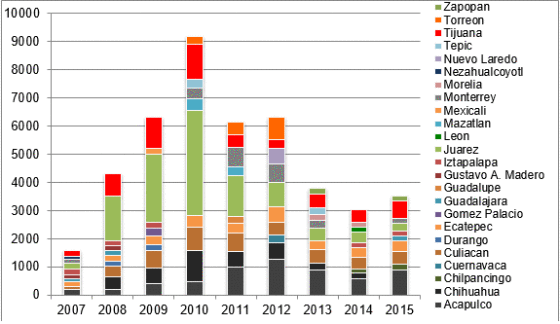
    While casual observers might assume that Mexico’s violence was widespread and pervasive throughout the country, the phenomenon was highly concentrated in certain regions and localities, primarily in the northern border region and in the country’s Pacific coastal states. In 2007, a Mexican city with more than 100 homicides could easily make it onto the country’s “top ten” list for total homicides; in fact, that same year, only Tijuana—the quintessential Mexican border city—reported more than 200 homicides (206 to be exact). Yet, just two years later, no city among the top ten most violent cities in Mexico had fewer than 200 homicides, and the top five had at least 400 homicides (as illustrated in Figure 1). Indeed, by 2010, arguably the peak of the violence, there were 18 Mexican cities with more than 200 homicides: now Mexico had many “Tijuanas.” Indeed, some of Mexico’s most violent cities—such as Acapulco, Ciudad Juárez, and Nuevo Laredo—saw rates more than triple the national homicide rate.

    Homicides Mexico data

    Figure 1: Number of Homicides in Mexico’s Top Ten Most Violent Municipalities by Year. Source INEGI.


    In a country unaccustomed to the civil wars and brutal dictatorships that plagued other parts of Latin America in the 20th century, such an explosion of violence was unexpected and previously unfathomable. The Mexican government’s apparent inability to resolve the problem triggered an international debate on the problems and limits of the Mexican state. A 2008 worst-case assessment by the U.S. Joint Forces Command named Mexico as one of two countries—along with Pakistan—that could suffer a sudden collapse into a “failed state.” Specifically, the report asserted, “In terms of worst-case scenarios for the Joint Force and indeed the world, two large and important states bear consideration for a rapid and sudden collapse: Pakistan and Mexico…”. Pronouncements by U.S. officials—including Secretary of State Hillary Clinton in 2010—asserted that Mexico’s woes were comparable to Colombia’s long-standing problems of domestic insurgency, or even on par with a civil war. Others sensationalized Mexico’s recent violence as a new hybrid threat of “criminal insurgency” or suggested that the power and infiltration of such groups had turned Mexico into a “narcostate” overrun by violence, corruption, and “narco- terrorism.”

    The merits of such assertions were quite debatable then and have proved false with time, as they tended to exaggerate and misconstrue Mexico’s current security situation. The methods and organizational forms of Mexican organized crime groups are arguably terrifying and sometimes truly mimic those of terrorists and insurgents. Yet, Mexico’s organized crime groups have shown no ambition to govern or supplant the state. They have no record or evident intention of disrupting the state’s capacity to deliver basic services. Moreover, the Mexican state maintains substantial democratic legitimacy, and has successfully deterred would-be insurgents in recent decades. Lastly, by the various measures used by the Fund for Peace to compile the Fragile States Index (formerly known as the Failed State Index), the health of the Mexican state ranks about average for Latin American countries, and its capacity is far greater than in war-torn countries like Afghanistan, Central African Republic, Iraq, Somalia, Syria, or Yemen.

    The Mexican State Response

    police mexico

    Image by Presidencia de la República Mexicana via Flickr.

    There is no doubt that Mexico’s recent security crisis presented—and continues to present—a major challenge for the Mexican state, and raises serious questions about its limits and failings. It is true that, like any other individuals who violate the law, the goal of organized crime groups is to minimize the state’s ability to detect, prevent, and/or punish their illicit activities. Yet, unlike other criminal actors, organized crime groups—and particularly drug trafficking organizations—in Mexico have demonstrated a remarkable capacity to secure protection from the state to support and sustain their criminal activities, with corrupt officials on their payrolls at all levels of government. Also, to varying degrees, such groups have at least temporarily attained a stronger presence and degree of control than the government in some limited geographic areas. Moreover, in some places, organized crime groups have capitalized on anti-government sentiments to achieve a degree of popularity or even legitimacy that seriously undermines state capacity. What, then are the sources of Mexico’s recent violence, and why have state responses failed to resolve the problem in a timely manner?

    The rise of Mexico’s most powerful organized crime groups—commonly referred to as drug trafficking organizations, or “cartels”—came amid a severe economic crisis in the 1980s. While other industries faltered, illicit drug production and trafficking enjoyed a major boom and substantial impunity, thanks in part to the complicity of government and law enforcement personnel. By the late 1990s, growing problems of crime and violence contributed to a crisis of “public insecurity,” characterized also by a feeling of widespread fear and frustration on the part of the general public due to the inability of the Mexican government to maintain order. Following a major political transition in 2000—the ouster of the PRI, Mexico’s long-time ruling party, from the presidency—the administration of Vicente Fox (2000-06) disrupted the leadership of two of the country’s four main organized crime groups.

    This tactic of arresting, extraditing, or otherwise eliminating the top leaders of major criminal organizations has been commonly referred to as the “kingpin” strategy. Fox’s successor, President Felipe Calderón (2006-12), deployed the kingpin strategy vigorously. Calderón and other proponents of the kingpin strategy argued that taking out the top leadership would help to disrupt their operations and convert a national security threat into a more localized public security problem. In some cases, at least, the government succeeded in reducing the functional capacity of some of the country’s major criminal organizations, but the unintended result was the creation of internal power vacuums and incentives for regionally based drug trafficking organizations to clash over turf and expand into rival territories. The subsequent conflicts within and among these groups were responsible for tens of thousands of organized crime-style killings that made up nearly the entire increase in homicides noted above, especially in major drug trafficking production and transit zones.

    In December 2012, a new president, Enrique Peña Nieto, took office and restored the PRI to power. His government continued to deploy the kingpin strategy, arresting high-ranking members of the Zeta and Sinaloa cartels. Remarkably, these arrests did not produce the same kind of violent aftershock that occurred under previous administrations, perhaps because of a new equilibrium among organized crime groups (there were few large cartels left standing) or perhaps more effective accommodation strategies (such as negotiations with the leaders next in line to take control of criminal operations). Whatever the reason, during 2013 and 2014, Peña Nieto’s first two full years in office, levels of homicide actually declined by around 8 and 12%, respectively (author’s own calculations from INEGI data. http://www.inegi.org.mx). However, statistics on homicide investigations for 2015 suggest that there was slight increase—about 10%—in the number of homicides nationwide, reversing the modest downward trend and provoking concerns that Mexico’s violence would ramp up again in the coming years. Final figures for 2015 likely to be released by Mexico’s national statistics agency sometime in late summer 2016, but as of mid-2016 there are troubling signs that violence is on the rise. (As this article went to press, INEGI statistics were unavailable for 2015, so the figures referenced here are Mexican law enforcement investigations into homicides tabulated by the Mexican National Public Security System – Sistema Nacional de Seguridad Pública, SNSP).

    Conclusion

    Looking toward the future, Mexico’s security situation will likely be affected by a number of important international and domestic factors. International factors could also significantly shape Mexico’s prospects. As a growing number of leaders and civic organizations push for the legally regulated production, distribution, and consumption of drugs (including the legalization of marijuana in two U.S. states in November 2012), this shift in discourse and policy could have major implications for Mexican organized crime groups. A loss of illicit revenues will likely reduce the capacity of these organizations to challenge the state, but it will also result in a painful restructuring of black market industries, pushing drug traffickers to increase exports of other drugs (like heroin) and further diversify into other violent criminal activities (e.g., kidnapping, extortion, robbery, etc.). This has already caused an abrupt increase in violence in some states, like Guerrero. In terms of drug policy, there are no quick and easy fixes to the problem of organized crime and violence in Mexico.

    However, there are some reasons for optimism in Mexico. Changing demographic trends (including a declining population of under-educated, underpaid, and underemployed young males) and an improvement of the country’s overall economic situation could facilitate a reduction of various societal ills, including both violent crime and large-scale external migration. At the same time, with the right mix of fiscal and political reforms, Mexico’s rising economic fortunes could also bolster the state’s capacity to respond more effectively to these problems, thanks to investments and reforms in the criminal justice system, as well as public education and social programs to strengthen the social fabric. Fortunately, in recent years, the Mexican government has begun to implement major economic, social and judicial sector reforms that could greatly strengthen both state and societal capacity to reduce the power of violent organized crime groups. The main question is whether these reforms will be rapid and adequate enough to substantially reduce the number of violent deaths in Mexico over the next decade.

    Dr. David A. Shirk is graduate director of the Master of Arts in International Relations program at the University of San Diego, director of Justice in Mexico, and a global fellow at the Woodrow Wilson International Center for Scholars. He is the co-author of Contemporary Mexican Politics, with Emily Edmonds-Poli.

  • Sustainable Security

    South Sudan, the world’s newest country, currently risks slipping into a violent malaise. The crisis in South Sudan highlights very clearly some of the key problems surrounding the practical implementation of the Responsibility to Protect. 

    Five years after seceding from Sudan, South Sudan is about to collapse into its second civil war since 2013. Marauding bands of informally constituted ethnic groups contribute to a climate of vigilantism.  UN diplomats debate the utility of an arms embargo in a state awash in arms.  The threat is meant to leverage Juba’s permission to allow a four thousand peacekeeper regional protection force into the country.  But Juba’s complaint about its exclusion from negotiations, contributes to a climate of distrust about the international community and its intentions. The crisis represents a serious challenge for the Responsibility to Protect (R2P) doctrine and the international community to forestall a humanitarian disaster that is well underway.

    The Responsibility to Protect

    A 2001 report by the International Commission on Intervention and State Sovereignty introduced the idea of R2P, creating a new international norm that made the formerly autonomous allowances of absolute sovereignty contingent on each state’s responsibility to protect its population from genocide, war crimes, crimes against humanity, and ethnic cleansing.  Its controversial pillar two seized the international community with subject matter jurisdiction to intervene as the residual stop-gap agency to prevent internal abuse when states were incapable or unwilling to do the same.  Two other pillars addressed a responsibility to prevent (addressing root causes of catastrophe) and a responsibility to rebuild (to assist with reconstruction and reconciliation).

    The development of the norm has been controversial and it has been reworked, principally along lines of nurturing states to live up to their internal responsibilities and tethering it to actions of the UN Security Council.  But its proactive charge of intervention has also been embraced by scholars and norm entrepreneurs as a progressive development. In its 2007 judgment in the Prevention and Punishment of Genocide Case, the International Court of Justice (ICJ) supported the duty of states to prevent atrocity beyond their borders if they have the capacity to influence persons likely to commit such acts; the ICJ acknowledged that this obligation extended beyond the competent organs of the UN.  The International Law Commission’s 2001 Draft Articles on State Responsibility provided that states cooperate to end through lawful means serious and systematic breaches of peremptory norms.  R2P’s normative development indicates that the idea of a collective responsibility to protect now informs the legalect of international courts and tribunals, suggesting a growing receptivity to and maturation of the doctrine.

    R2P, Africa and South Sudan

    UN Juba

    Image of peacekeepers in Juba by UN Photo via Flickr.

    Africa was the first region where the R2P was meant to be applied.  It grew out of the idea of responsible sovereignty, first articulated by Francis Deng and others in 1996.  Responsible sovereignty suggested benefits to cooperation among states.  These benefits went beyond the avoidance of international conflict or the mere ‘tending to’ of sovereign fences.  Responsible sovereignty suggested sovereignty could imply joint action and joint benefits.  It grew into the idea of R2P.

    Nowhere has R2Ps reception been stronger than in Africa, having been well received by the African Union, the Economic Community of West African States, (ECOWAS), the Southern African Development Community (SADC), and a litany of African elites, including South Africa’s Thabo Mbeki, Nigeria’s Olusegun Obasanjo, Tanzania’s Salim Ahmed Salim, South Sudan’s Francis Deng, Ghana’s former UN Secretary-General Kofi Anan, and Algeria’s Mohamed Sahnoun.  Cases within the African context indicated its time had come: The UN Security Council validated ECOWAS’ interventions in Liberia (1990/92) and Sierra Leone (1997), offering praise in the face of its own inaction to these humanitarian crises.  R2P received the unanimous support of one hundred and seventy Heads of State in two provisions of the 2005 UN World Summit final document, presaging the incorporation of the doctrine by the African Union in its 2005 Ezulwini Consensus report.

    But nowhere has its implementation been more problematic than in the world’s newest country, South Sudan.  Sudan, and now South Sudan, have been beset by internecine violence over the last sixty years.  South Sudan teetered on implosion almost immediately after achieving statehood in July 2011.  South Sudan devolved into civil war in December 2013, when its President Salva Kiir Mayardit accused former Vice President Riek Machar of plotting against the regime.  An improbable rapprochement, fortified by an internationally mediated agreement, was signed in August 2015, resulting in Machar’s much delayed return to the capital, Juba in April 2016, and the formation of a most tenuous unity government, which collapsed in July in a wave of bloodshed and atrocity in Juba.  Kiir has now rejected a US proposal to insert the four thousand peacekeepers, claiming it is an attempt to turn South Sudan into a UN protectorate.

    Kiir and Machar’s mutual distrust until the most recent violence in July was outweighed only by a common need for more money to support their factions and a mutual interest in avoiding a personal accounting of atrocities allegedly committed by their respective factions.  Interpreted alternatively as an explanation or a threat to the international community, the two allegedly wrote on the Op Ed page of the New York Times in June 2016 that any disciplinary justice meted out “even under international law” would destabilize unity efforts.  Translation:  If you try to bring us to justice, we will bring back war.  They invoked the name of the international community, calling on it to back their non-punitive plan for a mediated reconciliation.   Four days after publication, the New York Times appended an Editor’s Note to the South Sudan leaders’ world-wide call for reconciliation; Machar had disavowed the Op Ed piece, claiming his views had been fabricated. But not completely.  One month later, he and Kiir brought back bloodshed.

    The episode highlights the complexities facing South Sudan.  If the international community is to facilitate a solution to the ongoing crisis, only cosmetically concealed by an unravelling claim of unity, the fundamental normative problem of R2P must be addressed:  where in the international community does R2P reside?

    Transmuting the international community’s abstract but coercive cause of action to prevent domestic abuse into something other than high-minded rhetoric requires either a fully functioning UN Security Council or another agency with the legitimacy and authority to pierce sovereignty’s veil.  The UN Charter system created a jus ad bellum regime that placed monopoly power over all uses and threats of force (except in cases of self-defense) in the hands of the Security Council.  But that authority is often addled by inaction due to the veto-wielding interests of the big powers, exposing the fundamental weakness of the UN system and provoking the elusive international legal and political pursuit for a better or supplementary normative solution.

    Internationalists have wrestled with the poor choice between supporting the legality of the Charter system, which often stood silent in the face of atrocity, or supporting the legitimacy of humanitarian intervention, which only problematized consideration of hidden agendas pertaining to regime change, remedial secession, and self-determination.  Establishing the international community as the ex ante entity vested with such a remedial power came as something of a surprise, and, after fifteen years of ontological development, remains in dispute.  In theoretical terms, R2P marked a return to and modern expression of Christian Wolff’s eighteenth century Republican idea of the civitas maxima (a ‘grand republic’ of nations), the meta-expression of community virtue that upholds the common good, secures the pluralistic interests of the state, and protects the solidarist interests of humanity by presenting a means to prevent internal atrocity.  But even Wolff, who had no understanding of the modern state system as we know it, thought it could not function without a rector.

    Kiir and Machar embrace this much of Wolff’s eighteenth century mindset; they view the international community as a rhetorical trope that lacks a headmaster; they invoke its name to lend a fictive air of moral authority to their pieties on reconciliation, when they do not employ it as blackmail.  Much of the doctrinal disarray surrounding R2P’s non-appearance in South Sudan conforms to an uncertainty about the international community itself:  Is it an unwitting continuation of the mission civilisatrice – the persistently failed and resented attempt to make sub-Saharan Africa more European; does it embrace or dismiss African notions of community, which present a humanistic understanding different than contractarian models of liberal institutionalism (Ubuntu); is it an updated form of colonialism?  Perhaps it is an expression of Carl Schmitt’s Political Theology (1922), allowing its claimants the power to decide on the exceptions to legal rules.  Schmitt was wary of the keepers of humanity’s interests.  Paraphrasing Proudhon, he wrote:  whoever invokes humanity’s name wants to cheat.  Kiir and Machar would doubtless agree.

    Equally problematic has been locating the international community’s headmaster amid South Sudan’s turmoil.  Does the international community fundamentally reduce to a sanctions policy orchestrated by the US and its allies?  Should it claim a regional identity in the form of mediations sponsored by the Intergovernmental Authority for Development (IGAD) or IGAD-Plus (an amalgam of states associated with the African Union Peace and Security Council), or non-African agencies of the EU, the so-called Troika (US, UK, and Norway), or perhaps China?

    An Emergent Dark Side

    South Sudan’s misery teaches us something about the emergent dark side of R2P.  It reveals a heteronomous will of a fragmented international community, which, in South Sudan’s case finds expression in a variety of cross-cutting alliances.  Tensions exist within IGAD, certainly between Uganda and Sudan and possibly due to reports of Eritrean and Sudanese military support of South Sudanese opposition forces.  These tensions diminish IGAD’s mediation efforts and reputation as an honest broker.  Key sectors of South Sudan’s limited civil society (specifically Church leaders) are overlooked; an array of venues and sponsors compete for influence, contributing to complaints of forum-shopping, which allow Kiir and Machar to play components of the international community against each other.  The center of this unity government in South Sudan has not held; war is around the corner and famine is spreading.

    Conclusion

    Locating R2P within the international community would be daunting enough were questions of its authorization or operationalization in South Sudan settled matters of fact; but its non-appearance in the continuing misery of the country suggests the doctrine, fifteen years in the making, is neither thickly representative of historical process nor thinly embodied as an aspiration.  R2P, in the context of South Sudan, turns the international community into an ethical referent, a conceptual archetype that satisfies saints and sinners alike.

    Christopher Rossi has a Ph.D. in international relations from The Johns Hopkins University School of Advanced International Studies and an LL.M in public international law from the University of London.  He lectures on international law and relations at the University of Iowa College of Law.

  • Sustainable Security

    Authors’ Note: The opinions expressed by the writers are theirs alone and not necessarily those of the United States government or any of its departments.

    As a response to the attacks by violent extremists around the world, policymakers have invested considerable effort into comprehending terrorists’ use of the Internet and initiating counter-measures.

    The internet is undeniably an important factor in understanding the radicalization trajectories of many violent extremists. A senior official at the U.S. Department of Homeland Security recently observed that extremists’ “deft use of Internet propaganda, together with that content’s wide availability, has broadened the population of potentially vulnerable individuals, and shortened the timespan of their recruitment.” Supporting this statement, terrorism expert Magnus Ranstorp lists social media as one of nine factors that may exacerbate causes of an individual’s radicalization, including individual and social factors as well as cultural and ideological motivators.

    Research has also shown that the internet facilitates both early engagement with violent ideologies and opportunities for learning and sharing criminal information. For instance, a study by the University of Maryland’s START terrorism consortium found that “the internet played a primary or contributing role in the radicalization of 86%” in the cases of over 200 U.S.-based foreign fighters. These individuals used the internet to “view extremist materials, research conflicts, groups and attack methods, and participated in online communities of like-minded individuals.” Moreover, results from the same dataset show that the internet “may be speeding up the radicalization timeframe” as compared to radicalization before the advent of the internet. Similar findings from a study of over 200 terrorist offenders in the United Kingdom found that 54% of the perpetrators used the internet to learn about their intended criminal activities and, in 44% of the cases, extremist media (e.g., videos, audio lectures and photographs) were found, viewed, or downloaded by the perpetrators.

    The authors of the UK study, however, recognize that terrorists’ use of the internet “is perhaps unsurprising given the ubiquity of Internet usage in the most benevolent activities across wider society.” Indeed, a good deal of research has examined terrorists’ expansive use of the internet, such as the terrorist organization known as the Islamic State of Iraq and Syria (ISIS) to build a network of ideological conformity through social media platforms like Twitter. A report from the Institute for Strategic Dialogue has shown not only how life under the Islamic State is romanticized through social media postings, but also how important digital connectivity can be to those in the field, describing young women in ISIS controlled territory who resort to “climbing pine trees to gain Internet reception.”

    Countering extremism online

    Image credit: Andres Eldh/Flickr.

    These studies shed light on the particular ways that terrorists use the internet and underscore the importance of law enforcement intervention into online criminal activities. However, an ongoing challenge for researchers and policymakers engaged in preventing and countering violent extremism (CVE) is how to proactively address the role of the internet and social media in the context of violent extremism before criminal activity has occurred. To respond to that challenge, two broad policy approaches have emerged.

    One approach advocates for online content removal and account suspension in order to reduce the supply of non-criminal but potentially extremist content. The European Commission recently instituted content-flagging mechanisms modelled after an initiative by the British government’s Counter Terrorism Internet Referral Unit. Outside of government, technology companies also have taken steps to remove terrorist content. In December 2016, social media companies announced their own cooperative efforts to use hashing techniques to quickly identify and take down extremist images and content that violate terms of service agreements. In their latest annual transparency report, Twitter suspended around 636,000 accounts between August 2015 and December 2016 for promoting extremist content.

    Research studies that have assessed whether content removal and account suspension efforts work to curb the propagation of violent extremist messages suggest promising outcomes. For instance, a report from the George Washington’s Program on Extremism found that “over time, individual users who repeatedly created new accounts after being suspended suffered devastating reductions in their followers.” While ISIS users quickly learn how to overcome account suspensions and restore some followers, the study suggests these actions to reestablish followers have only “limited benefits” once a suspension has occurred.

    Yet, as technology companies like Twitter, Microsoft, and Facebook become more effective at detecting extremist content with tools that recognize unique “fingerprints” of extremist content, terror groups have also become more agile in how they use the internet to facilitate their work. Terrorism researcher Audrey Alexander describes how attempts to limit terrorist content online have pushed extremists away from public platforms and to encrypted tools like WhatsApp, Telegram, and ProtonMail. Indeed, Telegram now “appears to be the top choice among both individual jihadists and official jihadist groups.” The covert nature of these platforms poses significant barriers to researchers and authorities seeking to understand, track, and measure the terrorist threat.

    Another method for combatting online violent extremist content suggests creating counter narratives to refute terrorist claims. The idea is to craft messages that will appeal to vulnerable individuals to persuade them that violence is not the answer.  To explore this approach, the U.S. government has sponsored an initiative along with support from Facebook that known as the Peer to Peer: Challenging Violent Extremism program to engage young people, who may be most vulnerable to violent extremist messages, to create credible counter message for their own peers. Since the program launched in 2015, over 5,000 students have taken part. The 2016 winning team from Rochester Institute of Technology developed an awareness campaign called “Ex-Out Extremism” to “open people’s eyes” to violent extremism and to encourage them to take a stand against it. While initiatives like Peer to Peer typically reach broad audiences, foster educational engagement and increase public awareness, researchers have pointed out that continued work is needed to understand what can inoculate or prevent radical ideologies from taking root in the first place.

    A more targeted approach for reaching at-risk individuals online has been piloted at Jigsaw, Alphabet’s technology incubator focusing on geopolitical challenges, to redirect users from ISIS propaganda to curated YouTube videos that credibly debunk ISIS recruiting themes. Similarly, the Institute for Strategic Dialogue conducted a pilot study to direct individualized online intervention services to those demonstrating affinity to violent extremist groups through their online activities. The results found that intervention messages that reached at-risk individuals were “highly likely” to cause behavior change, either by prompting radicalizing individuals to change their privacy settings or to send direct messages to the intervenors for more engagement.  While these results are based on a very small sample, directed intervention programs may offer options for providing “off ramps” to individuals at critical points.

    The value of partnerships

    Whether intervening online to remove content and suspend accounts or developing credible counter messages or intervention options, effectively addressing violent extremism will require innovative partnerships inside and outside government.  To this end, in 2016 the United States government launched an interagency task force to address countering violent extremism with representation from both security and non-security agencies along with engagement from civil society groups.  While these multidisciplinary partnerships are challenging bureaucratically, they underscore the need for developing networked approaches to emerging security challenges. Similar cooperative agreements might span across national boundaries, not only for the purposes of information sharing between law enforcement officials, but also to include cooperation, such as the recent announcement by the Netherlands and Kenya to build a comprehensive partnership around a range of security related issues including deradicalization efforts.

    Although some have suggested that there is little evidence that terrorism prevention works, there is a small but growing literature providing support for the application of prevention science to the problem of violent extremism. Without question, more attention is needed for rigorous assessment of these programs, especially with regard to evaluating the effectiveness of online campaigns. To fill this gap, the RAND Corporation recently released an evaluation toolkit for countering violent extremism, which includes guidelines for assessing programs’ social media metrics. The London-based Royal United Services Institute has published a guide to CVE program design and evaluation, which provides guidance for articulating relevant impact measures. Ultimately, these resources, coupled with innovative public and private sector partnerships, will contribute to preventing radicalization to violence both online and offline.

    Tackling online radicalization will undoubtedly be a major security priority for policymakers in the future. Following the deadly May 22, 2017 bomb explosion in Manchester, leaders of the G7 convened in Taormina, Italy to reaffirm their efforts to counter terrorism and violent extremism.  In a statement, members underscored several areas for continued engagement, not only through traditional counterterrorism measures like “knowledge-sharing” and cutting off “sources and channels of terrorist financing,” but also through technology sector engagement “to substantially increase their efforts to address terrorist content” and well as civil society engagement to promote “alternative and positive narratives rooted in our common values.” The future war against online extremism may prove to be a long and difficult one, but it is a fight that must be won.   

    Dr. Susan Szmania has served in government and academic positions addressing violent extremism.  She is currently a senior research analyst at the U.S. Department of Homeland Security in the Office for Community Partnerships.  In this capacity, she leads the research and analysis line of effort on the U.S. government’s interagency Countering Violent Extremism Task Force.  Prior to this work, Dr. Szmania was a senior researcher at the University of Maryland’s National Consortium for the Study of Terrorism and Responses to Terrorism, and she served in government positions at U.S. Embassies in Sweden and Spain to implement programs to counter violent extremism. She received her Ph.D. in Communication Studies from the University of Texas at Austin in 2004.

    Matthew Conway has served in various research capacities focusing on conflict and extremism, both independently and with two London-based think-tanks. He is currently a research adviser for the Department of Homeland Security’s Office for Community Partnerships, where he focuses on Countering Violent Extremism research. He received his Master’s in Conflict, Security and Development from King’s College London in 2015 and his Bachelor’s in Political Science and International Studies from the University of Wisconsin-Madison in 2013.

  • Sustainable Security

    Whether the UN Security Council should address climate change is a highly politicized issue. But a more fundamental question has been lost in this debate—what exactly could the Council do about climate change?

    Given growing concerns about the links between climate change, instability and conflict, it is no surprise that the issue has spilled over into the UN Security Council. Since 2007, the Council has conducted two formal and several informal (“Arria-formula”) sessions on the topic. Bringing the climate issue into the Council has been contentious: proponents, including several European member-states, small island developing states, and other vulnerable developing countries, have sought to use the Council’s agenda-setting power and inject a sense of urgency into global climate politics, particularly at moments when global progress on climate action seems stalled.

    Opponents have raised a range of concerns, including longstanding objections to the Council’s composition and procedures; fears of stretching the Council’s mandate beyond recognition, such that anything could be regarded as a security issue; and concerns about negatively impacting the “legitimate” forum for climate discussions, the UN Framework Convention on Climate Change (UNFCCC) and the Paris Agreement. These objections almost blocked a 2011 thematic debate on the issue, leading the Obama administration to rebuke reluctant Council members for “dereliction of duty”. Only informal sessions have been held since then. At the most recent, in May of this year, several member-states urged that the Council revisit the issue in formal session.

    Too often lost in such political maneuvering is a fundamental question: what might the Council actually do on climate, peace and global security? Surveying the record, one finds a range of different ideas that have been floated by academics, advocates, and some individual member-states. These include relatively modest add-ons, such as keeping the Council apprised of how climate change affects current peacekeeping operations or developing better early-warning capabilities. Bolder roles have also been floated: engaging the Council in proactive, preventive diplomacy on emergent challenges such as competition for Arctic resources or water in international river basins, or even creating a climate analogue to the Responsibility to Protect. There have also been calls to inject the Council into complex political challenges for which no obvious institutional home exists within the UN system, such as the existential plight facing several small-island states and the challenge of climate-driven displacement and refugees.

    There are real questions about whether the Council, as currently constituted, can play such roles productively. One basic challenge is how the Council manages information. Conceptually, early warning fits well with current Council efforts around issues such as famine and human rights emergencies. But in practice, past efforts to extend the gaze of early warning into new issue areas, such as conflict-related sexual violence, have met with opposition, narrow framing, and poor follow-through. There are also many practical challenges yet to be resolved, including how to effectively incorporate environmental variables into conflict-assessment tools, or even deciding which variables matter and by what mechanisms they operate. For an early-warning mechanism to have foreseen the role of drought in the Syrian conflict (a causal role about which there remains no consensus among scholars), it would have had to be able to see not just rainfall or run-off data, but also the water-policy choices of the Syrian regime and the impacts of declining rural subsidies on smallholder farmers.

    Challenges facing the Security Council on climate change

    Image credit: The White House/Wikimedia.

    Even the seemingly straightforward exercise of informing the Council about aspects of climate change directly relevant to its ongoing activities around peacekeeping and fragile states has been challenging. The contentious 2011 session yielded a compromise that called on the Secretary-General to use his reporting function to keep the Council apprised about relevant “contextual information” on climate-conflict links. A review my colleagues and I conducted of 446 subsequent Secretary-General reports to the Council (through January 2016) found only 12 references linking climate change to some aspect of conflict or security (with 11 focused on Africa). Most of the content was highly generalized, noting general contextual trends such as urbanization, land tenure conflicts, or farmer-pastoralist tensions that might bear a climate signature. Even the handful of instances of specific reporting lacked the fine-grained subnational and temporal detail necessary for it to be of any operational or decision-making use. Climate-related references were also highly sporadic, with only one in 2012 and none in 2013.

    A second challenge resides in the Council’s largely reactive nature (when it can agree to react at all). Conflict prevention falls squarely within the Council’s mandate, and the high monetary cost of peacekeeping operations creates a strong incentive for prevention. The concept notes circulated by Council chairs for the 2007 and 2011 thematic debates (the UK and Germany, respectively) stressed conflict prevention as a key rationale for conflict engagement on climate. But for interstate preventive diplomacy, such as might be needed in shared river basins, the Secretary-General’s office has generally been a more effective tool than the Council. And on intrastate conflict, the Council has historically been reluctant to take preventive action. Efforts beginning in 2016 to implement a ‘horizon scan’ briefing from the Secretariat, focused on instability and emergent conflict, revealed the great reluctance of many member-states to appear on the Council agenda as ‘fragile’.

    A third problem is the tricky challenge of managing the political division of labor with the UNFCCC. Proponents of Council climate action have used past debates to try to jump-start sluggish climate diplomacy, even as opponents have warned about encroachment on or perturbation of the institutionalized process of global climate negotiations. Initial optimism around the Paris Agreement cooled such polarization, but was blunted by the Trump administration’s recent withdrawal from the accord. The deeper problem is that the Paris process seems to be half-heartedly engaging some of the critical challenges that would most resonate within the Council: blocking space for the Council while failing to really address the issues. On the looming problem of sea-level rise and the existential threat to small-island nations, the Paris Agreement’s provisions on loss and damage explicitly created an opening to address several relevant challenges, including early warning, emergency preparedness, slow-onset events, risk management, and the resilience of communities, livelihoods, and ecosystems (Article 8.4). This may limit political space for the Council on the issue of small-island statelessness, even as the weakness of the UNFCCC process on “liability and compensation” makes it a poor vehicle for serious movement on the problem. A similar dynamic of blunting political momentum through half-hearted response may be shaping up on climate-induced displacement; the UNFCCC’s 21st Conference of the Parties authorized a task force to develop recommendations on how to address the issue, scheduled to make a preliminary report in 2018.

    What can be done?

    Given such challenges, it may be that the relevant question is not “What climate role for the Council?” but rather “How can climate be part of the process of transforming the Council into a more effective body for sustainable security?” A first step in that direction would be to improve the Secretary-General’s reporting function, as agreed to during the 2011 debate. The most useful information for the Council is probably neither localized crisis briefings nor long-range climate-change scenarios, but rather regional-scale, medium-term assessments. Working on those spatial and temporal scales is most likely to yield forward-looking initiatives that can be supported by those member-states that find themselves most directly affected or vulnerable, as in the case of the Integrated Strategy for the Sahel. The strategy stressed building long-term resilience as one of its three pillars, along with inclusive governance and managing cross-border threats. A Security Council briefing in this context, on links among climate trends, migration, and conflict across the region, was well-received for both its specificity and the backing it had from member states in the region.

    A second step would be to challenge countries seeking a seat on the Council to articulate a specific vision of how the Council should move forward on the issue. Several aspirants for an elected seat have raised the issue in recent campaigns, but the question is also pertinent for those countries aspiring to a permanent seat on an expanded, reformed Council—notably, Japan, Germany, Brazil, and India. How, precisely, do they see the climate issue in relation to the Council’s mandate, with particular reference to preventive diplomacy, disaster vulnerability and displacement?

    Finally, while it may seem challenging in the current political moment, a symbolic gesture from the five permanent members (P5) would acknowledge member-states’ multiple roles across the UN system. Done properly, this could help legitimize an active (but not overreaching) Council role as part of a system-wide response. During the 2011 debate, Nigeria noted the P5’s dual role: “Seated around the table are those who could encourage developed countries to implement their commitments to reducing emissions and supporting developing countries with the requisite technological and financial assistance to address climate change effectively.” Imagine the legitimizing value that would have resulted if the US-China climate deal of 2014 had identified conflict prevention as part of its rationale for cutting emissions. Going forward, such commitments could be incorporated into the Nationally Determined Contributions that states offer under the Paris Agreement, and as action on the Sustainable Development Goals.

    The purpose of such measures is to begin to use climate engagements as a vehicle to transform the Council—into a body that is more capable of legitimate action, more proactive in peacebuilding and conflict prevention, and better able to take the long view of risks and responses.

    Ken Conca is a Professor of International Relations at American University in Washington, DC. His most recent book is An Unfinished Foundation: The United Nations and Global Environmental Governance (Oxford University Press). A more detailed version of the arguments here may be found there, and also in Ken Conca, Joe Thwaites, and Goueun Lee, “Climate Change and the UN Security Council: Bully Pulpit or Bull in a China Shop?” Global Environmental Politics 17/2: 1-20. Conca has been a member of the Scientific Steering Committee on Global Environmental Change and Human Security (GECHS) and is a founding member of the UN Environment Programme’s Expert Advisory Group on Conflict and Peacebuilding. He is, with collaborator Geoffrey Dabelko, the 2017 recipient of the Al-Moumin Environmental Peacebuilding Award.

  • Sustainable Security

    The Islamic State’s loss of the territory does not mean that has been defeated. Rather, it presents several new challenges to those trying to contain the threat of the Islamic State.

    After months of a sustained, international military campaign against the organization, the Islamic State is now in retreat, relinquishing towns, territories and populations once under its control across Iraq and Syria. At its height, the organization was estimated to control or influence a territorial space between 12,000 to 35,000 square miles, areas approximating the size of Belgium or Jordan, respectively.

    Though the crumbling of a self-proclaimed caliphate represents a victory in many ways to many different actors—the Assad Regime, the Iraqi government, the Russian government and the United States—IS’ significant loss of the territory and populations does not mean that the Islamic State has been defeated. Instead, the loss of territorial control presents several new challenges to those seeking to contain the IS threat.

    The importance of territory in conflict

    Today, as in previous civil wars, control of territory has fundamentally shaped the nature of conflict. Not only is territorial control a preliminary objective and launch pad for many rebel groups globally and historically, it also influences insurgent behavior in several significant ways. From shaping how rebels deploy violence, the targets of said violence, whether rebels provide some sorts of services or develop governing institutions, and the beneficiaries of these services, territorial control, or the lack thereof, is a profound shaper of conflict dynamics. As the Islamic State shifts from being in control of significant swathes of land and peoples, to a landless network of raiders, the organization’s behavior seems increasingly likely to change, and in some ways, has changed already.

    In a recent paper published in the Journal of Politics, my co-author, Yu-Ming Liou, and I argue that the reason for this is that territorial control in and of itself is a military resource. Beyond simply influencing the politics and people in a region or town, the control of territory means the ability to defend and hold a place from counterinsurgent attack. The absence of the state is critical for rebels. With a space for themselves, free of enemy interference, insurgents can train and move around freely. They can begin unhindered propaganda campaigns that may have local or global reach. They can initiate contacts with supportive foreigners or foreign governments abroad. They can stash equipment and materiel for later use. They can recoup and recover in relative safety after a raid or ambush. Territorial control on its own serves to boost the military strength of an insurgent organization.

    But territorial control is not simply about the acquisition of space: it frequently includes the acquisition of people, under control of the rebel group, but not a part of the insurgency. The relationship between rebels and civilians living within the territory rebels control are inherently intertwined, and as Mao famously quipped, civilians are the sea in which the insurgent fish should swim. Where territory is itself a military resource, civilians can also provide intelligence and information, medicine, technical expertise, weapons or financial aid, compliance, and importantly, recruits.

    The resources civilians offer, however, are not always so easily won. Rebels may use coercion or violence to get what they wish from civilians, generating resentment and shrinking the pool of potential recruits and resources providers. On the other hand, insurgents can incentivize cooperation by limiting violence and predation of civilians, as well as providing goods or services, quasi-state institutions, education, health care, security and justice. When rebels control territory and civilians, they move from being roving bandits to stationary bandits, incentivized to provide some form of governance.

    Thus, when rebels capture territory and control civilians, it generally affects their behavior in two key ways: rebel predation of civilians, and rebel governance to civilians. Strong rebels and rebels that control territory are less likely to rely on indiscriminate violence. They also tend to avoid terrorism. Similarly, given that most rebels want to eventually rule over the civilians they control as a legitimate sovereign, many insurgent groups are more likely to provide social services and develop governing institutions once they capture territory and populations. In fact, according to an original dataset on rebel education and health care provision, about one-third of all insurgencies provide some form of governance.

    Among rebel groups that control territory, however, this figure almost doubles. Though not all rebel groups want to rule over all civilians living in the territory they capture (for instance, IS engaged in mass killing and genocide against the Yazidis, and allegedly offered Christians a chance to pay taxes or flee), for those civilians who rebels view as being future citizens of the state its creating or leading, the foundations of governance are frequently established in the roots of war. As an example, those who lived within IS territory claimed they were living in a “golden era,” better than the governance that had preceded the Islamic State’s control. These services ranged from running utilities and hospitals, to building schools and developing a curriculum that comports with the Islamic State’s ideological precepts.

    The Islamic State and territory

    Image credit: Dying Regime/Flickr.

    Over the past several months, the Islamic State has consistently lost territory across both Iraq and Syria. Facing incursions from the Iraqi military as well as the Syrian government and its allies, the Islamic State’s grasp on space and domination over people has diminished. As a result of this change, several IS behaviors may also begin to shift, and the lack of territory does not correspond to a lack of threat.

    The governance IS provides will likely dissipate. It is challenging to provide governance without some form of territorial control, and with the Islamic State on the run from military forces bearing down, IS will increasingly face challenges to providing services within the remaining spaces it controls. Though the lack of services for civilians may not seem particularly consequential, clean water and electricity are essential for healthful and hygienic living and the practice of more advanced medical treatment, like surgeries.

    The rise of the Islamic State and its initial popularity was also tied to the lack of sufficient goods and services—a lack of governance by the Iraqi government. Without the Islamic State’s organization and provision of goods, people’s needs might not only go underserved, triggering a humanitarian crisis, but the governance vacuum could be filled by equally ruthless and dangerous actors, and terrorism expert Bruce Hoffman has suggested that a blow to the Islamic State could be a boon to Al-Qaeda operatives in the region. Foreign governments and domestic actors ought to be acutely aware of making the day-to-day living of civilians as normal as possible, as quickly as possible.

    Second, civilians may increasingly find themselves as the targets of violence, rather than state military or security forces. The underground, clandestine nature frequently associated with a lack of territorial control makes IS movements harder and harder to track, and has been linked to terrorist violence. As an example, the Islamic State, which does not territorial control in Europe, typically relies on attacks on civilian targets by affiliates as a means of attack there. Just last week, the Islamic State killed over a dozen people in Barcelona by using a car to mow down a busy street of pedestrians (a style of attack replicated by white supremacist terrorists in the United States).

    On the other hand, in Syria and Iraq, the Islamic State has been able to rely on conventional or guerrilla tactics to achieve its goals. Consequently, the lack of territorial control and potential increase in the use of terrorism by the Islamic State, civilians may increasingly find themselves in the crossfire of IS attacks. Already, Though the Islamic State endeavors to survive and endure, and can do so by moving its operations online and underground despite territorial losses, it nevertheless keeps the image of the caliphate alive by repurposing videos and media that “depict the ­Islamist state it sought to establish as an idyllic realm destined to be restored.”

    The Islamic State might also create or be given some form of Just like controlling territory in the country a rebel group seeks to one day rule, a sanctuary or foreign base is also a safe space that confers military benefits to the insurgency. However, when rebels have foreign sanctuary, they are removed from the civilians they might some day hope to govern, and incentives to moderate their behavior declines. Ultimately, then, when rebels control territory separated from those they wish to govern, it has all the benefits of acquiring territory, without any of the costs (or benefits) of also acquiring civilians. In our paper, we find that when civilians have access to a sanctuary in a foreign territory, they are more likely to engage in violence against civilians, killing over twice as many civilians than the average rebel group.

    Conclusion

    In sum, as IS transitions from controlling territory to a more clandestine network, civilians’ lives and livelihoods remain in the crosshairs. Weak rebel organizations and rebel organizations that lack territorial control are more likely to engage in terrorism and indiscriminate violence.

    Civilians could lose access to critical goods and infrastructure services, thereby putting them at risk for a humanitarian crisis. Unbound by territorial space, IS could prioritize deadly terrorist attacks outside the realm of Syria and Iraq, focusing instead on Europe and North America, in addition to the Middle East and North Africa. Military forces may have wrested the Islamic State from its self-proclaimed caliphate, but the battle may be far from over.

    Megan A. Stewart, Ph.D., is an Assistant Professor of Transnational and International Security at American University’s School of International Service. Her research lies at the nexus of two distinct areas: civil war processes and state formation. Megan is currently completing her book manuscript, Governing for Revolution, which explains variation in rebel governance and incorporates both quantitative and qualitative methods, including the creation and analysis of an original dataset, elite interviews held in Lebanon, and archival research and fieldwork conducted in East Timor, Australia and the United Kingdom. In 2016, her paper “Civil War as State-Building” received honorable mention for the Best Paper Award by APSA Conflict Processes Section and is forthcoming at International Organization. Her research has been published at Conflict Management and Peace Science and the Journal of Politics, and has also been featured in the Washington Post, Political Violence at a Glance, and the Project on Middle East Political Science (POMEPS).

  • Sustainable Security

    As activists around the world participate in a Global Day of Action against criminalisation of drug use, evidence from the multi-billion dollar War on Drugs in Colombia suggests that militarized suppression of production and supply has displaced millions of people as well as the problem, not least to Mexico. The wrong lessons are being exported to Central America and beyond, but a groundswell of expert and popular opinion internationally is calling for alternative approaches to regulating the use and trade in drugs.

    The arrest of the Mexican drug kingpin Joaquin ‘El Chapo’ Guzman on 22 February was cheered by US and Mexican officials as the most important success against narco-trafficking since the killing of Pablo Escobar two decades earlier. Designated in 2013 by the Chicago Crime Commission as the ‘public enemy number one’ and featured among the ‘most powerful’ by Forbes, he was the leader of the Sinaloa Federation. This is considered the most powerful drug trafficking group worldwide, responsible for around 25% of the cocaine that enters the US market and enjoying connections in various continents.

    UH-60 Black Hawk fotografiádo después del desfile militar del 15 de septiembre de 2009 en la ciudad de méxico

    Mexican UH-60 Black Hawk lands in the Zocalo, Mexico City’s main square, 15 September 2009. (Source: Wikipedia)

    If the ‘War on Drugs’ logic is followed, the event should mark the beginning of the end of drug-related violence in Mexico. But the lessons from the elimination of Pablo Escobar and the defeat of the Medellín (and later Cali) cartels in Colombia suggest otherwise. Whether El Chapo continues to run operations from jail, full leadership is assumed by the remaining commander, or the group breaks into smaller factions, the drug business is likely to survive.

    What could be reinforced is the trend to fragmentation already in place, which does not necessarily means less violence, at least in the short and medium term, and could give birth to a decentralized and networked drug business. In this sense, Mexico could well be now where Colombia was 15-20 years ago.

    Colombia’s success narrative

    Despite their different insertion into the global political economy of drugs, both countries are remarkable examples of militarized approaches to the drug war promoted by the US in Latin America (and beyond). The focus is almost entirely on the supply side: criminalization, eradication and aggressive enforcement with the aim to put a halt to the global supply of illegal drugs. The burden is mostly assumed by countries of production and transit that are evaluated on an annual basis against compliance with those prescriptions.

    The terms of the debate about this issue have until recently been limited and based on partial evidence in at least two aspects. Success is measured by the figures of crops eradication, detentions and seizures of drugs, not by net impact on the trade (drug availability and market prices). And the consequences in violence, violations of human rights, marginalization, corruption and institutional failure, have been exclusively attributed to illegal drugs and organized crime and not to the war on drugs itself. Fortunately, those terms are changing and a range of new voices, including at highest political levels, are joining a necessary and urgent discussion.

    Colombia has undertaken an amazing journey in this regard. Once criminalized in the international arena through its identification with the drug trade, in recent years it has been promoted as the brightest example of success in the drug war. The narrative of success is based on two main elements: the defeat of the big cartels in the 1990s and Plan Colombia in the 2000s.

    However, the story has critical under-reported angles. What followed the demise of Medellin and Cali was not elimination of the drug trade but the decentralization and fragmentation of the market into around 300 smaller, flatter and networked groups. The Revolutionary Armed Forces of Colombia (FARC) – and, to a lesser extent, National Liberation Army (ELN) insurgents and United Self-Defense Forces of Colombia (AUC) paramilitaries – furthered their involvement in the drug business and provided the armed ‘muscle’ in order to finance their nation-wide expansions.

    Moreover, the biggest cocaine profits shifted from Colombia to Mexico, contributing to the financial and armed power of its drug trafficking groups as the smaller rings and armed actors in Colombia lacked the power, contacts and/or will to control international logistics and operations, not to mention distribution in the US. The vacuum was filled by the Mexican cartels that established a direct buying presence in Colombia (and later Peru), logistic bases in the Caribbean and Central America for transportation, and distribution networks in the US market.

    Plan Colombia

    The largest counter-drugs programme ever launched, Plan Colombia was funded by the US with more than $7 billion to conduct massive aerial spraying of illicit crops and provide equipment and training to the Colombian armed forces.

    The focus of Plan Colombia was counter-insurgency against the FARC, particularly after the US Congress unblocked in 2002 the use of counter-drug funds for counter-terrorism. The group was weakened by increased state military power and mobility, and is currently involved in peace talks with the government. But it retains 8,000 combatants and has increasingly relied on urban militias. More importantly, despite the propaganda, the FARC was never the only (nor main) group involved in drug trafficking.

    The AUC paramilitaries had a mixed criminal-political character from their beginnings. Born out of an array of self-defence groups and narco-trafficking interests, these two ‘souls’ coexisted for years but the drug trade eventually prevailed. The demobilization of more than 31,000 AUC combatants in 2006 was immediately followed by the emergence of 30 new criminal groups that drew membership from former AUC members and mid-level commanders and sought (and eventually won) control of cultivation and trade in areas and routes formerly under paramilitary control.

    With an estimated initial membership of 4,000 members, these new criminal groups later expanded throughout the territory and are now present in 17 out of 32 departments. Those groups have never been a unified project but an array of decentralized criminal networks. Infighting and shifting alliances are the norm among them and with sectors of the FARC and the ELN also involved in drug trafficking. According to the Colombian police, they were responsible for half the total murders committed in 2010.

    Uncounted costs

    The Colombian success in the war on drugs has been partial at best and come at a high price. Taking the accumulated figures of the US International Narcotics Control Strategy Report, around 2 million hectares have been fumigated to eradicate crops since 2000. Massive herbicide spraying destroyed coca, but also livelihoods and protected natural areas, and impacted food security, health and the environment. The complex marginalization problems of rural communities that resort to coca as a livelihood strategy were addressed through securitization and criminalization (coca farmers have often been identified with the FARC). The result, for many, was forced displacement and further vulnerability. Cultivation expanded to new areas and departments, and fragmented as a result.

    The levels of violence have decreased slightly nowadays, but the homicide rate stayed at 32 for 100,000 in 2013, well above Mexico in its worst year of violence (2011, with 24 for 100,000). Also in 2013, between 140,000 and 219,000 persons (depending on the sources) were forcibly displaced in Colombia. Those figures are lower than in the past but nonetheless immense and add to a total of 6 million people forcibly displaced since 1985. The specialized agency Insight Crime interprets the current high incidence of this phenomenon in the Pacific regions and intra-urban settings as an indicator of displacement by criminal –not political- violence.

    Mexico’s War on Drugs

    Regardless of the real situation on the ground, those policies (and apparently, the high levels of popular support enjoyed by then Colombian president Alvaro Uribe) inspired President Felipe Calderón to launch an all-out war against drugs in Mexico in 2007. Around 100,000 soldiers and thousands of marines were deployed to fight the cartels in an effort to overcome the problems of corruption and ineffectiveness of the police forces, a policy later backed by the US under the Merida Initiative. The strategy got results, with relevant high and mid-level commanders of drug trafficking groups captured or killed, and seizures of illegal drugs soaring amidst the crackdown.
    Mexican Special Forces with Barrett M82 sniper rifles.

    Mexican Special Forces with Barrett M82 sniper rifles. (Source: Wikipedia)

    But the destabilization of the drug market triggered an escalation of violence. Violent competition for power erupted within the groups and coalitions as leaders were eliminated, coupled with fierce battles for territorial control among groups. The response against the state scaled up with the cartels creating militarized wings and using sophisticated military weaponry and tactics to fight the military and the police. The process of fragmentation and decentralization accelerated and the six big cartels of 2006 have split into around 15 today, coupled with a diversification of transnational criminal activities and soaring incidences of kidnapping and extortion. The Sinaloa Federation and the Zetas remain the most powerful cartels but have also suffered splits and setbacks.

    More than 60,000 people have died and 26,000 ‘disappeared’ in just six years. The formerly respected military have been accused of grave human rights violations including extrajudicial killings and forced disappearances. More than 4,000 complaints for human rights violations by military personnel were filed in 2006-2010 This was more than the total figure for the previous 15 years.

    Mexico has come under close scrutiny by the Inter-American Court on Human Rights and other international institutions. On June 12, the UN Special Rapporteur on extrajudicial, summary or arbitrary executions warned about unacceptable levels of violations to the right to life and impunity. Although recognizing some positive steps by the government of Enrique Peña Nieto, he warned that “a heavy-handed military approach is unlikely to improve the situation” and what is needed is “systematic, holistic and comprehensive strengthening of the rule of law”.

    As in Colombia, the Mexican victims of violence face further victimization as the government and sectors of the media dismiss them as criminals. Families and civil society groups claiming for justice may become targeted themselves. Unabated violence and institutional failure are the factors behind the emergence of armed self-defence groups, first in Michoacán and Guerrero and currently in around 10 states, as civilians take up arms to face lawlessness and fight the cartels (and sometimes corrupt authorities). This adds a new layer of armed actors whose evolution may not be easily put under control.

    Challenging the Colombian success narrative

    In Colombia, and later in Mexico, the militarized drug wars have proved ineffective in halting the drug trade but their impact is hugely negative on security and human rights, development and governance. While marginalization feeds the illegal economy, the securitized responses criminalize communities and add abuses and institutional failure to the problem of exclusion. The focus on the military also delays the hugely needed efforts to establish functioning justice systems and effective rule of law. Meanwhile, the drug business learns and adapts, moving from strict hierarchies to networked configurations.

    Despite those evidences, growing international debates about drug policies and a shifting internal public opinion, the US continues to promote a securitized approach to drugs that is most evident now in Central America. The use of Colombia as a symbol of success for Mexico and others, and as an actual ‘proxy’ to provide support in counter-narcotics and counter-insurgency to third parties including West Africa, should raise some basic questions about the premises, effectiveness and potential consequences of those policies.

    This month, the West African Commission on Drugs – an expert panel convened by Kofi Annan and chaired by former Nigerian president Olusegun Obasanjo – has called for decriminalization of drug use and to “avoid militarisation of drug policy and related counter-trafficking measures, of the kind that some Latin American countries have applied at great cost without reducing supply.”

    This potentially brings West Africa into line with the Organisation of American States, which in a report of May 2013 proposed “alternative legal and regulatory regimes” for tackling drugs, starting with cannabis”. Uruguay has already decriminalized cannabis and Colombia’s President Juan Manuel Santos, re-elected this month, has at times advocated drug policy reform. Enrique Peña Nieto has recently called on the US to start an open debate and a revision of ‘failed’ hemispheric policies whose outcome has been the rise of drug production and consumption.

    There are growing calls internationally to open a global debate over drug use and the policies needed to address it, including addressing demand in consumer countries. No less a figure than Sir William Patey, British Ambassador to Afghanistan from 2010 to 2012, has called for legalization of the heroin trade as the war on drugs in Afghanistan fails to address the complex problems at the roots of opium cultivation. Dozens of high profile British individuals and organisations, including the Prison Governors Association, have also called for decriminalization of drug use.

    The debate seems to be reaching a tipping point as the numbers and diversity of the sceptical and critical voices grow worldwide. Now it is the turn of policy makers to listen and act.

    Mabel González Bustelo is a journalist, researcher and international consultant specialized in international peace and security, with a focus on non-state actors in world politics, organized violence, conflict and peacebuilding. You can follow her at her blog The Making of War and Peace, her webpage, and Twitter (@MabelBustelo).
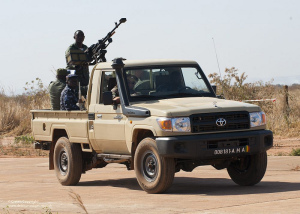
  • Sustainable Security

    Following the 1998 peace agreement, Northern Ireland has been promoted as a model for peacemaking. Human rights discourse played a role as a cause and cure of the conflict.

    Since the civil rights movement of the 1960s, the Northern Irish conflict has captivated imaginations far beyond the island. Following the 1998 peace agreement, the region has been internationally promoted as a model for peace-making. Politicians from the region have shared wisdom of the Northern Ireland peace process in far-flung countries in conflict, including the Philippines, Sri Lanka, Iraq, and Afghanistan. Some of the lessons exported from Northern Ireland’s peace process are general prescriptions, such as the necessity of engaging with enemies or the need for multi-party talks to include even the smallest parties. Broader lessons promoted about Northern Ireland’s peace process are claims about the role of human rights in conflict resolution. During the peace process, a popular history emerged with rights—political, economic, and human— occupying a central role as a cause and cure of the conflict.

    Human Rights as Political Narrative

    The broad outlines of this narrative are: after partition in 1921, the new state in Northern Ireland systematically denied civil and economic rights to Catholics and maintained Protestant dominance. In the late 1960s, when peaceful civil rights demands were met with both loyalist and state violence and state reforms failed, the republican movement was forced into armed struggle. During the conflict, the British state engaged in human rights violations, further compromising the legitimacy of UK governance. In the late 1990s, republicans, unionists, and the British state settled the conflict by agreeing to new political institutions that ensured equal rights for all.

    However, human rights lessons from Northern Ireland’s peace process are not quite as tidy as this narrative suggests. My longstanding ethnographic and historical research in the region suggests caution about the comforting certainties of this causal account. In the 1960s, grassroots advocates protested that nationalists’ civil rights were systematically undermined since partition, and throughout the conflict, “first generation” rights to speech and association, or freedom from torture, were violated and remain deeply contentious. At the same time, human rights were absorbed into the conflict, and became another arena for ethnopolitical contest. In the Good Friday Agreement (GFA), an explicit commitment to human rights was envisioned for the new political arrangements. Yet as the agreement was implemented, rights politics have often been vehicles for the claims of nationalists and unionists, rather than universal human subjects.

    Ethnopolitics and Human Rights

    Time_for_Peace

    “Time for Peace” mural, Whiterock Road, Belfast. Image available under the GNU Free Documentation License via Wikimedia Commons.

    Since the GFA, the tendency to argue ethnopolitical conflicts in terms of human rights has intensified, to the detriment of both wronged parties and broader understandings of human rights. A compelling example of how human rights were an incomplete solution to the conflict emerged early in the post-GFA era, in 2001, when a dispute in Ardoyne, north Belfast, resulted in shocking, violent loyalist protests at the Holy Cross Primary school (a Catholic girls’school). In June 2001, loyalists from the Glenbryn estate began picketing Holy Cross Primary School in nationalist Ardoyne, north Belfast. The school entrance was located just on the Glenbryn side of a famous “peace line.” Police in riot gear were deployed to protect small girls as they walked to school past lines of enraged adults. The dispute continued for four months, with violent conflicts during the summer break and a resumption of the pickets when the new term began in the autumn. Riots spread throughout north Belfast that autumn and winter, along with attacks on children travelling to other schools.

    Families of the distressed children eventually backed an unsuccessful challenge of police conduct under the Police (Northern Ireland) Act 2000, and under Articles 3, 8, 13, and 14 of the European Convention. That case, P.F. and E.F. v. the United Kingdom (Application no. 28326/09), was eventually ruled inadmissible by the European Court of Human Rights. Its long legal journey ended in 2010, when the European declared that, horrific as the protests were, there was no evidence of European convention breach.

    The dispute and legal proceedings very nearly derailed the new Human Rights Commission formed under the GFA.  In 2002-3, six members resigned or withdrew from the commission, citing multiple reasons related to the commission’s lack of authority and resources, its approach to drafting a Bill of Rights, and, most notably, its approach to handling the Holy Cross protests. Although the commission as a whole voted not to become involved, its casework committee committed the commission to supporting the families’ lawsuit. Individual commissioners took contradictory public positions and became increasingly divided. Meanwhile, the commission was perceived as part of an ethnopolitical conflict rather than as public advocates for either the protection of vulnerable people or fundamental rights.

    The Holy Cross protest was not resolved by human rights institutions or advocacy; some might argue that it has never been resolved. The situation revealed several problematic dimensions of treating human rights as a cure for conflict. One difficulty is that human rights laws concern the conduct of state actors. Paramilitary organizations, neighborhood associations, and transnational corporations do not sign human rights treaties.

    Human Rights in the Good Friday Agreement

    Another issue making it difficult for human rights law or advocacy to provide a resolution to conflict was how the GFA itself situates human rights principles in relation to power-sharing as a means to manage conflict. One innovation of the GFA is that it makes human rights central to the settlement, with the entirety of section 6 devoted to “Rights, Safeguards and Equality of Opportunity.” However, the GFA is more strongly oriented by political scientist Arend Lijphart’s consociational model. This model prescribes the management of conflict through power sharing among parties defined in ethnic or communal terms. Thus, the GFA situates human rights within a broader logic that privileges collective political rights. This conceptual maneuver mirrors the way political rhetoric and everyday life absorb human rights claims into regional ethnopolitics, rather than creating a transformative alternative to ethnopolitics.

    In the Holy Cross conflict, protagonists framed the dispute in terms of collective rights and alleged that these rights were being differentially allocated by the state. Families of the girls argued that the protests subjected them to inhuman and degrading treatment—violations of their human rights. Furthermore, they said, police did not use force to stop the protests because the girls were Catholic, but they would have ended any such protest by nationalists. Loyalists claimed that free assembly was an unconditional right, irrespective of sectarian content or whether violence might be a consequence.

    Unfortunately, the kinds of conflicts and challenges for human rights politics raised in the Holy Cross conflict are neither unusual nor uncommon in Northern Ireland. For example, in Donaldson v. the United Kingdom (Application no. 56975/09) the European Court of Human Rights refused to hear the complaint of a republican prisoner that his human rights were violated when the prison service did not allow him to wear a lily (a symbol of the republican struggle for a unified Ireland) outside his cell. Disputes over rights to display emblems may appear frivolous outside the region, but they are part of a broader process, in which human rights laws and institutions have been insufficient to resolve the disputes that emerge from Northern Ireland’s longstanding political conflict.

    Enduring Lessons and the Everyday Life of Rights

    In my 2014 monograph, I explore at length how rights politics have often functioned war by other means over time, rather than providing a comprehensive resolution to conflict. I conclude that advocacy such as the lesbian, gay, bisexual, and transgender (LGBT) equality movement have been more transformative in human rights terms than attempts to balance ethnopolitical rights. This cautionary point about how human rights politics have been received, reinterpreted, and transformed in the Northern Ireland context is not intended to dismiss the peace process’ significant achievements, including the profound diminution of political violence, paramilitary demobilizations, and decommissioning.

    Nevertheless, the successes of the process also require recognition that throughout the fitful implementation of the GFA, political polarization intensified, past violence and political symbols have been repeatedly contested, and riots surrounding parades and symbolic matters like flags have become dangerous and costly recurrent events, intimating, for some, a return to conflict. Violence casts a long shadow across the present peace; prosecutions and re-investigations of past murders and atrocities continue, recent killings like the murder of Kevin McQuigan last summer destabilize power-sharing institutions, and ministers continue to warn of resurgent paramilitary activity – such as a recent upsurge in bomb attacks.

    Understanding the role of human rights in everyday politics in both the past and present is necessary for making nuanced claims for human rights advocacy and law in conflict resolution. Northern Ireland’s tremendous reduction in violence must not be dismissed, but it is important to recognize that the settlement also sustains a form of ethnopolitics that is not always congruent with the goals of human rights advocacy. As the politics of the conflict continue to structure the settlement, it is fair to ask how transformative human rights politics have been. Such an approach can make us conscious of perilous conditions that constrain the present fragile peace, and highlight achievements that are durable and transferrable for the future.

    Dr. Jennifer Curtis is Honorary Fellow in Social Anthropology at the University of Edinburgh. She is the author of Human Rights As War By Other Means:  Peace Politics in Northern Ireland, published by the University of Pennsylvania Press. Her work focuses on how grassroots social movements appropriate and alter rights advocacy and law. She has conducted long-term ethnographic research in Belfast, Northern Ireland and in the United States.  She is currently completing an ethnographic monograph on race, sexuality, and civil rights in red state America, based on fieldwork in Missouri. The book explores the local and national significance of #BlackLivesMatter, movements for LGBT equality, and anti-equality movements, within the broader historical context of racialized violence, slavery, and inequality in the American South.

  • Sustainable Security

    Historically, permanent members of the UN Security Council have variously rejected the idea that it was the proper venue to address international cooperation on climate change. The notable cooperation between China and the United States to secure the Paris Agreement, however, may signal a greater openness to UNSC climate securitization, including the creation of a UNSC-enforced Climate Court.

    Paris and Binding-Voluntary Climate Obligations

    The UNFCCC was finalized at the 1992 Rio Summit amidst significant North/South contestation. The 1997 Kyoto Protocol codified this arrangement with legally binding obligations for the global North, and no clear schedule for obligations for the global South. The US Senate made it clear, however, that it would not agree to treaty obligations that exempted the emerging economies. This, coupled with the continued refusal by the developing world to accept legal obligations, produced an entrenched diplomatic gridlock.

    Initiated by the voluntary 2009 Copenhagen Accord, the 2011 Durban Platform saw agreement on the need for obligations “applicable to all,” which framed the 2015 negotiations that culminated in Paris this past December.

    UN Photo

    Image of closing ceremony of the twenty-first session of the UN Framework Convention on Climate Change, December 2015. Image by UN Photos.

    Agreed by a consensus of 196 nations at the 21st Conference of the Parties to the UNFCCC, the Paris Agreement (COP 21) provides no legally binding emissions reduction obligations. However, it did produce a hybrid agreement (with a mix of voluntary and binding obligations) that is applicable to all parties (breaking the firewall between developed and developing states) for the post-Paris climate regime.

    The architecture is remarkably simple; all states are asked to volunteer the emissions targets they are able to meet, and then agree to be bound by transparency obligations and to take stock of their commitments at regular intervals. These legal responsibilities provide a ratchet mechanism for states to increase ambition in the knowledge their competitors’ commitments will also be monitored.

    The Paris Agreement creates a solid foundation upon which to build a strong climate regime because it assumes that all states finally share an interest in participating in the reduction of global carbon emissions.

    Frustration, Securitization, and the Judicial Route to Climate Obligations

    In response to the frustration of many years of gridlock, norm entrepreneurs have argued that the security threat from climate change is sufficiently large that we should impose obligations on uncooperative polluters. The international community should, in other words, set aside traditional notions of sovereignty (not unlike the Responsibility to Protect) and impose international obligations on the domestic regulatory policies of nation states.

    With multilateral negotiations unable to allocate a suitable distribution of climate rights and responsibilities, numerous proposals have argued that we should delegate that legislative authority to international courts.

    Bolivia, for example, proposes a Climate Justice Tribunal that punishes climate criminals for their historic carbon emissions. It would strenuously enforce the “common but differentiated responsibilities” approach of the UNFCCC and the Kyoto Protocol. As such, China and the other high-emitting emerging economies would remain exempt from prosecution.

    There are a number of groups calling for the crime of Ecocide to be included in the Rome Statute of the ICC. This mechanism would seek to prosecute individual corporations, and potentially states, for environmental damage and presumably excessive carbon emissions. Jurisdiction over corporations garners support for this initiative from many in the environmental movement, but as it would apply equally to state-owned enterprises in the developing world this amendment is unlikely to be ratified by two thirds of the ICC membership. Crucially, of course, the largest carbon emitters (the United States and China) are not parties to the ICC.

    As an alternative to contentious cases, the ICJ may be called upon to provide advisory opinions at the request of the UN General Assembly. In theory, this route may offer valuable clarification of general principles of international law, but advisory opinions are not considered binding, perhaps especially on great powers.

    The geopolitical reality ignored by these proposals is that, unless states consent to be bound, the only existing international institution with the power to impose binding obligations on all states and enforce them in a credible manner is the UNSC.

    Climate Securitization and UNSC Legislation

    While unable to force states to ratify entire treaties, the UNSC is able to impose binding obligations on the global community as a response to threats to international peace and security. This ability to act as a climate legislator offers a solution to the horizontal nature of the international legal order, if the P-5 can agree to securitize climate obligations.

    Much of the gridlock of climate diplomacy has been a result of the US and China disagreeing on an equitable distribution of responsibility for addressing climate mitigation. As such, the Paris Agreement represents considerable diplomatic efforts to overcome calcified negotiating positions between these major powers.

    It is worth noting that Russia remains a UNSC wild card on climate change. Kyoto offered Russia an allocation far in excess of its post-Soviet needs and the recent Russian INDC voluntary pledge is to reduce carbon emission 30% below a 1990 baseline. A conservative assessment that they are currently at 35% below baseline suggests a weak commitment to mitigation.

    However, Russian leadership in reducing the production of oil within the G-20 may become a necessary condition for similar coordination among OPEC states. Credible coordination of global production quotas is increasingly a high priority of Russian foreign policy, as it is for the future of the climate regime.

    If the P-5 could agree on a suitable regulatory standard, obstacles to G-7 and NATO members accepting binding obligations would be greatly reduced. If the G-20 could be persuaded to voluntarily accept this proposed agreement, this would represent 76 percent of global carbon emissions and the combined market power of 85 percent of global GDP.

    Forced to respond to an unanticipated climatic disaster the interests of the P-5 could align even further to initiate an institutional response to the crisis. Although doing so may stretch its delegatory powers, to increase the legitimacy of any UNSC climate legislation, it could, and perhaps should, create a Climate Court to address non-compliance within the post-Paris climate regime.

    A UNSC-enforced Climate Court

    Created by the UNSC, a legitimate and effective Climate Court would benefit from (1) compulsory jurisdiction; (2) a specialized judiciary able to digest complex scientific evidence and supported by issue-area expert advisors; and (3) legal standing for both state and non-state actors to challenge the non-compliance of state obligations.

    • Compulsory jurisdiction is rare in international law but in theory as the cost of legal obligations grow, so do incentives to shirk responsibility. States making good faith sacrifices to comply with specific obligations will only support strong enforcement mechanisms as long they see standards enforced on everyone. The UNSC has more tools than any other international institution to credibly ensure the enforcement of international legal obligations.
    • When environmental disputes arise, a scientifically literate judiciary is better able to weigh the importance of scientific evidence among competing factors: economic, human rights, security, etc… In the same way that complex biotechnology litigation requires very specific judicial expertise, so will transboundary climate disputes.
    • Regarding standing, the potential fallout from a weaker state pursuing litigation against a great power is significant. Allowing non-state actors standing to bring cases before an international court begins to address this problem, as long as there are minimum thresholds to prevent spurious litigation. Moreover, this “access to justice” approach supports the concept of erga omnes obligations (“owed to all”). If all states have clear, specific, and actionable climate obligations, litigation needn’t be bilateral. Each state’s responsibility is owed to the international community.

    Judicial determinations of willful non-compliance would be enforced by the UNSC acting in the interests of the international community to address a collective threat to international peace and security.

    Conclusion

    Historically, mirroring the firewall between developed and developing states in the UNFCCC negotiations, there has been considerable resistance within the P-5 to using the power of the UNSC to securitize the climate regime. However, with increasing recognition of climate change as a significant human and systemic security threat multiplier, the likelihood of UNSC intervention in the enforcement of the climate regime may now be moving from impossibility to inevitability. The increased alignment within the P-5, as reflected in the Paris Agreement, may represent a clearer path to the UNSC acting as a climate legislator and creating a corresponding Climate Court.

    The Paris Agreement, in other words, may have broken the UNSC climate firewall.

    Murray Carroll is a co-founder and director of the International Court for the Environment Coalition. He has a law degree from the London School of Economics, and is a graduate student of international relations at Harvard University and international law at the University of London. Responsibility for the views expressed in this commentary rest exclusively with the author. An expanded version of this commentary is available in the latest issue of the Journal of Energy and Natural Resources Law.