Category: 21

  • Sustainable Security

    In 2008, media outlets declared that a new Cold War was unfolding in the Arctic. This story was centred on a small, titanium Russian flag, fixed to the seabed below the North Pole.

    Planted in 2007 by a modest team of explorers and scientists, the flag triggered angry responses from Western politicians and media commentators, with the most vociferous coming from the then Canadian Foreign Minister, Peter MacKay, who declared: ‘This isn’t the 15th Century…You can’t go around the world and just plant flags and say “We’re claiming this territory”’.

    Nearly a decade later, this story remains emblematic of the geopolitical intrigue that refuses to go away in the Arctic, which continues to be stoked by uncertainties over sovereignty, ownership and access in the region.

    Carving up the Arctic, Carefully

    The Arctic Ocean, like every ocean, is governed by the UN Convention on the Law of the Sea’s (UNCLOS) provisions. The US has not ratified this treaty, but considers its provisions relevant as customary international law of the sea.

    Under UNCLOS, the Arctic Ocean littoral states are entitled to Exclusive Economic Zones (EEZ) stretching up to 200 nautical miles (nm) from their Arctic coastlines. Article 234 allows littoral states to develop and administer special regulations dealing with human activities in ice-covered waters. Russia and Canada use this to regulate shipping activity in their Arctic waters through environmental protection measures.

    UNCLOS also entitles a coastal state to extend the outer limit of its sovereign rights over the continental shelf (the seabed and subsoil of submarine areas–including, any oil and gas resources contained) beyond 200nm, if it can prove the shelf is a natural prolongation of the coastal states’ land mass. This has led Denmark and Russia to submit evidence (with Canada expected to follow this year) to the UN to support claims reaching all the way to the North Pole. Norway settled its continental shelf limits in 2009.

    As their claims overlap, the UN Commission on the Limits of the Continental Shelf (CLCS) is responsible for reviewing the evidence and issuing a final recommendation on where the borders should be drawn according to Articles 76 and 77. However, the CLSC has no legal authority or personality meaning it will be up to Canada, Denmark and Russia to reach an international agreement which will settle their claims. Any remaining space will be considered part of ‘the Area’ (see below), and falls under the purview of the International Seabed Authority.

    Although the decision on ‘who owns the North Pole’ will ultimately be determined by an agreement between Canada, Denmark and Russia,wherein lies a latent potential for conflict, the five Arctic littoral states’ public commitment to use UNCLOS as the basis for settling any sovereignty disputes is an important step towards ‘sustainable security’. It will take three to five years just for the CLCS to review the latest evidence submitted by Russia on 9 February 2016.The CLCS is already overwhelmed by the number of applications received globally. Since the prospects for oil and gas development further from shore are still highly uncertain, and claims to the North Pole are primarily symbolic, the CLCS arguably has time on its side.

    As long as the Arctic states maintain their trust in the process, UNCLOS should be able to prevent any ‘race’ to carve up the Arctic seabed, which could lead to tension between the littoral states.

    High Seas and the Area: Accommodating New Interests

    Where UNCLOS reaches its limits is in the parts of the Central Arctic Ocean (CAO), we will be dealing with High Seas,parts of the water column beyond the EEZs of coastal states,and ‘the Area’– seabed areas which cannot be claimed by any state (see map). Theoretically, anyone can fish and mine in these parts of the Arctic, but such activity is likely to be limited for the time being by the continued prevalence of thick sea-ice covering the surface of the ocean (and other environmental factors).

    In another step towards ‘sustainable security’, the five Arctic coastal states have initiated a process to create a governance framework to manage future fishing activity in the CAO.

    In July 2015, the littoral states signed a ‘Declaration’ preventing unregulated high seas fishing in the CAO, and promising to only authorise their own fleets to conduct commercial fishing in the CAO if it was in accordance with recognised international standards.

    The littoral states’ problem is that they do not have the authority to dictate the terms under which the rest of the international community can access CAO high seas fisheries. China’s, Japan’s, Korea’s, Iceland’s, and the EU’s finishing fleets are entitled under international law to fish in the CAO.

    Consequently, the littoral states took another preventative step by calling a second meeting in December 2015, where negotiations for fisheries agreement for the CAO’s high seas was opened up to these other parties. Other nations such as Taiwan are expected to join future deliberations, eventually ensuring buy-in for a governance framework from all nations with an interest in future Arctic fisheries.

    Again, this is a long-term process, providing another example of how governance structures developed now can prevent certain unwanted futures from becoming present, including, for exampletension and conflict over fisheries and continental shelves.

    Navigating Arctic Waters

    Can similar preventative steps be taken to ensure that disputes do not flare up over the problem of maritime activity in the Arctic? There are two issues to address. Firstly, the status of two ‘international straits’ in the Arctic: the North West Passage and the Northern Sea Route. Secondly, the regulating of ice-covered waters in littoral state EEZs as addressed by Article 234 of UNCLOS.
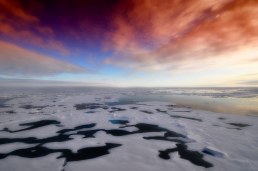
    Science team in the Arctic Sea. Image by NASA Goddard Space Flight Center.

    Science team in the Arctic. Image by NASA Goddard Space Flight Center.

    Canada and Russia do not consider the North West Passage (passing through the Canadian archipelago) and the Northern Sea Route (across northern Russia) to be ‘international straits’. Consequently, foreign vessels have no right of ‘transit passage’ through these waters–a right that entitles foreign ships to pass through without coastal state permission, and foreign submarines may remain submerged. Both countries claim that their sovereignty over nearby islands effectively means these waters should be considered ‘internal waters’, requiring foreign vessels to seek permission before entering.

    The US and the EU contest Canada and Russia’s claims, not least because of concerns about setting a legal precedent that could be applied to more important southerly shipping routes.

    There seems to be little ambition to settle the disagreement, because Arctic transit shipping is still a niche activity. Several uncertainties remain about whether large-scale transit shipping will ever become commercially viable, not least because of the competition posed by more southerly trade routes and the general unpredictability of seasonal sea-ice retreat that makes seasonal passages possible without expensive icebreaker escorts.

    The problem with the current stance is that Russia is actively investing in icebreakers, port infrastructure, marine services, search and rescue facilities and constabulary forces with the ambition of turning NSR into a viable shipping route. The more Russia builds up infrastructure around the route and offers to accommodate shipping on Russian terms, the greater the historical precedent it will set that the NSR is part of Russian-controlled waters. This feeds Western fears about Russian militarization of the Arctic building a security dilemma.

    While US and EU lawyers might question the validity of such a precedent, the de facto claim will remain and Russia will likely continue resisting attempts to change the status quo. It might therefore be worthwhile considering preventative steps sooner rather than later to resolve the NSR and the NWP’s legal status, before marine activity in the Arctic increases further and positions become more deeply entrenched.

    The issue is complicated by the second issue referred to above–the regulating of ice-covered waters by Arctic littoral states, notably Canada and Russia. As already noted, under Article 234 of UNCLOS, Arctic littoral states are entitled to regulate marine activities in ice-covered waters within their EEZs. Both the NSR and the NWP fall within these provisions, allowing Canada and Russia to regulate marine activity beyond their territorial waters regardless of whether they have the status of ‘international straits’ (see, for example, Canada’s Arctic Waters Pollution Prevent Act).

    So what happens when these waters are no longer ice-covered for a large part of the year? Article 234 indicates that ice-cover must be present for most of the year (i.e. 6 months and one day), while other points of contest exist in determining exactly what is meant by ‘severe climatic conditions’ and ‘exceptional hazards to navigation’ and who would decide whether such conditions prevailed (littoral states, non-littoral states, international organisations?).

    This remains a longer-term issue, but if as most scientists predict the amount of sea-ice cover each year continues to spiral downwards, the issue of whether littoral states can regulate in Arctic waters beyond 12 nm could become a significant point of tension with those seeking to benefit from new opportunities for regional marine activity. Currently, unlike in the cases of fisheries and continental shelves, few preventative steps are being taken to resolve this outstanding issue, despite its potential to cause future confrontation in Arctic waters. The situation is exacerbated by the deterioration of relations between Russia and the West over the Ukraine and Syria crises, likely making dialogue difficult.

    Prospects for Sustainable Security

    On the issues of resource competition and militarisation sustainable security’s prospects, in the Arctic for the most part look good. Since the end of the Cold War, international cooperation on various scientific and environmental protection initiatives have provided the basis for constructive engagement between the Arctic states and other interested actors (such as the UK) on many issues.

    Bilateral and multilateral arrangements have provided a governance structure that all Arctic states, and other interested actors, have indicated provides a firm basis for resolving inter-state disputes peacefully in accordance with international law, especially concerning fisheries and the delineation of the continental shelf. However,access to the NWP and NSR could lead to future contention. Potential flashpoints remain over how regional marine activity should be governed in EEZs where the sea-ice is in fast retreat, especially if Russia and Canada refuse to accept that Article 234 might lose purchase in the future.

    Whether preventative action is politically possible on this issue remains to be seen, but the sooner a constructive dialogue begins between Russia, Canada and potential users of the NWP and NSR, the more likely it will be to find a sustainable solution. Speculatively, an Arctic agreement on shipping activity negotiated under the Arctic Council’s auspices (but accommodating interested non-Arctic states as seen in the fisheries discussions) to complement the International Maritime Organisation’s Polar Code (due 2017) could be one way of consolidating international understanding that these waterways are to some extent shared spaces requiring the international community’s shared stewardship.

    An important dimension of sustainable security not discussed in this state-centric article is that of human security–especially of indigenous peoples and other local communities that live and work in the Arctic. The decline of traditional cultures, environmental pollution and other threats to human health and well-being are prevalent in nearly all of the Arctic states, and there has been a long history of marginalisation of Arctic residents. However, all of the Arctic states have readily admitted the need to address the challenges facing Arctic indigenous peoples and other local communities, and the Arctic Council is somewhat unique to the extent that it invites representatives of indigenous people’s organisations to sit at the table with government ministers.

    The sustainable security outlook is also weaker with regards to climate change. Huge uncertainty remains over how soon we are likely to see an ice-free Arctic in the summertime. The temperature spikes witnessed in January and February this year suggest this event horizon might be closer than we think. The impacts of climate change pose a particular risk to human security in the Arctic, threatening food, housing, infrastructure and livelihoods. It remains to be seen whether these communities will be able to adapt to the drastic changes that are being observed.

    Duncan Depledge is a Teaching Fellow in the Department of Politics and International Relations at Royal Holloway, University of London, and director of the secretariat to the UK All-Party Parliamentary Group for Polar Regions. He received his PhD from Royal Holloway for his research investigating contemporary developments in U.K. policy toward the Arctic.
  • Sustainable Security

    One year after violent conflict began, information is now emerging on the specific environmental impact of war in Ukraine’s highly industrialised Donbas region. Although obtaining accurate data is difficult, indications are that the conflict has resulted in a number of civilian health risks, and potentially long-term damage to its environment. In order to mitigate these long-term risks, international and domestic agencies will have to find ways to coordinate their efforts on documenting, assessing and addressing the damage.

    The environmental legacy of conflict and military activities is rarely prioritised in post-conflict response, in spite of the short and long-term impact of damage on civilian health and livelihoods. At times relationships between incidents and harm may be complex, often requiring detailed and lengthy analysis. Warfare in highly industrialised areas has the potential to generate new pollution incidents and exacerbate existing problems; the conflict in Ukraine has done both, as well as damaging the area’s natural environment.

    The chronology of the Donbas conflict is widely accessible and there is no need to repeat it here. More important is the current uncertainty. With the signing of the second round of Minsk agreements in February 2015, hope re-emerged that a peaceful solution might be possible. For the moment the truce is holding but remains fragile. Should it collapse, it is likely that new and grave risks to the region’s people and environment will emerge.

    Scope of environmentally damaging incidents

    Prior to the outbreak of the war, more than 5,300 industrial enterprises were operating in the pre-war Donetsk and Luhansk oblasts (provinces). Damage to the region’s industry is widespread, and ranges from direct damage to industrial installations, to enterprises simply stopping production because of the lack of raw materials, energy, workforce or distribution channels.

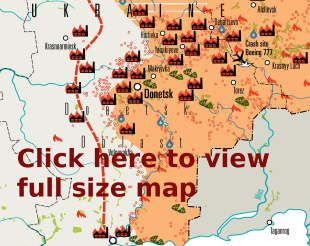
    A map produced by Geneva’s Zoi environment network and the East Ukraine Environment Institute based on official information, media reports, assessments and interviews shows environmental damage in the region. Click here to view full size map

    It is this disruption of the region’s industry that is likely to be primarily responsible for the environmental side-effects of the conflict. In some cases, the disruption has led to accidental releases of pollutants from shelled or bombed facilities. In others, facilities have been forced to shift to more polluting technologies that have impacted regional air quality. Among dozens of facilities damaged by fighting are the Zasyadko coal mine, a chemicals depot at Yasynivskyi, coke and chemical works in Makiyvka, the Lysychyansk oil refinery, an explosives factory at Petrovske and a fuel-oil storage facility at Slavyansk thermal power plant.

    Coal mining has been the backbone of the economy of the Donbas region since the nineteenth century. With the intermittent collapse of the electricity supply across the entire conflict area, ventilation systems and water pumps in coal mines failed, resulting in the release of accumulated gases after ventilation restarted. The often irreparable flooding of mines not only damages installations but also waterlogs adjacent areas and pollutes groundwater. At the time of writing, permanent or temporary flooding has been reported at more than ten mines, yet due to the lack of uninterrupted monitoring and fieldwork to assess the damage, the exact extent of the risks to environmental and public health is unclear.

    The Zasyadko mine in Donetsk used to produce 4 million tonnes of coal annually and was one of the region’s economic flagships. A release and explosion of methane in March 2015 killed 33 of the 200 miners underground at the time. Even though this was not the first such accident at the mine (it is considered among the most lethal in the area’s risky mining industry), the chair of the mine’s board attributed the incident to heavy shelling at nearby Donetsk airport, where fighting continued until late January 2015.

    There have been numerous media reports about war damage caused to Donbas’ water supply, including in and around Luhansk and Donetsk – cities that had a combined pre-war population of 1.5 million. Repair work to the water infrastructure is still carried out, often under direct fire, but periods of irregular supply are common. Less well documented is the impact of the conflict on drinking water quality but one can reasonably assume widespread deterioration as a result of the disruption.

    At the moment, relatively little is known about the direct chemical impact of the war on the environment and people. Limited sampling by the Ukraine-based NGO Environment-People-Law confirmed the expected range of some ‘war chemicals’ from the use of conventional weapons in impact zones. Similarly, large quantities of damaged military equipment and potentially hazardous building rubble will require disposal. The Ukrainian Ministry of Defence also raised concerns that depleted uranium weapons may have been used in the fighting around Donetsk airport, and proposed to determine whether this was the case when conditions allowed.

    The region’s nature has also suffered. Already prone to fires because of the dry summer climate, steppes and forests have burnt more often than would have been expected. According to an as yet unpublished analysis of NASA satellite data, the Eastern European branch of the Global Fire Monitoring Centre showed that in 2014, the incidence per unit area of forest and grass fires in the Donetsk oblast was up to two to three times higher than in the surrounding regions of Ukraine and Russia.

    The conflict has also damaged the region’s numerous nature protection areas, from armed groups occupying their administrative buildings to the impact of fighting and the movement of heavy vehicles within nature reserves. The restoration of large tracts of agricultural and other land for normal cultivation and use will require considerable effort too, and will be complicated by the presence of new minefields and unexploded ordnance.

    Challenges in determining the extent of damage

    The prevailing media narrative over environmental damage from the conflict has sought to link it directly to the fighting, but the information currently available is too fragmented to fully confirm the extent of the relationship. Such simplifications can also mask the indirect effects of warfare on environmental quality.

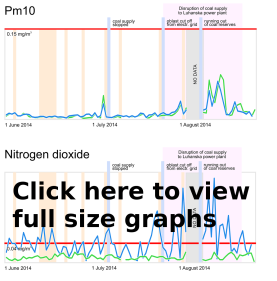
    Graphs produced by the East-Ukraine Environment Institute shows a decrease in air quality in eastern Ukraine in summer 2014. Click here to view full size graphs

    As is common for armed conflicts in heavily developed areas, a large proportion of the pollution impact may not come directly from the fighting but from damage to industrial infrastructure and to the disruption of everyday economic activities. A good example from the Donbas region can be seen in data from its only functioning (until November 2014) automated air quality monitoring station. Located in the town of Schastya in the Luhansk oblast, the data demonstrate that peak concentrations are not obviously associated with periods of combat; instead, they correlate with a reduction in the supply of high-grade coal for the Luhanska power plant in August 2014.

    Coal supplies were first restricted when a bridge in Kondrashevskaya-Novaya was destroyed. Then an electrical substation was shelled, which disconnected the area from the rest of Ukraine’s electricity grid. As a result, the Luhanska power plant, which was responsible for supplying more than 90% of the oblasts’ electricity, was forced to simultaneously increase production while turning to lower-grade coal from its reserve stock. This caused a clear deterioration in air quality.

    Coverage of the conflict has also claimed that the fighting has caused 20 times more wildfires than in 2013. While 2014 had seen more fires in comparison to the previous year, 2013 was relatively wet so this comparison is hardly informative. Assessing the exact area affected by fires in the territories remains difficult and imprecise, requiring the use of more refined data and techniques. The task is further complicated by the fact that forest fire statistics, which would normally be used to verify the findings from satellite data, are not being collected at the moment as the conflict has rendered large areas unsafe for ground surveys.

    What next?

    In spite of the fragile Minsk agreement, the half-frozen conflict continues. At present it is impossible to predict whether further damage will be wrought on the people and the environment of Donbas. Insecurity continues to impact basic environmental governance on both sides of the line of contact, while cooperation across the frontline, even on urgent humanitarian issues, remains a remote prospect. Therefore expectations for cooperation over environmental issues at the current stage in the conflict are low.

    Based on the available evidence, it is clear that there is great potential for long-term civilian health risks from the pollution generated by the conflict. Efforts to collect systematic data on both pollution and health outcomes should start immediately, as must preparations for remediation. The financial and technical requirements for the comprehensive assessment and remediation of contaminated sites are considerable.

    These are problems common to many conflicts affected by toxic remnants of war and, as the ICRC noted in 2011, consideration should be given to whether a new system that ensures environmental assistance is required in order to protect both civilians and the environment from conflict pollution:

    “given the complexity, for example, of repairing damaged plants and installations or cleaning up polluted soil and rubble, it would also be desirable to develop norms on international assistance and cooperation… Such norms would open new and promising avenues for handling the environmental consequences of war.

    The broader context for the eventual remediation of the environmental damage should include the radical modernisation of the region’s notoriously unsustainable industry, much of which has for years presented direct and grave risks for its environment and people (see Zoi’s 2011 report Coalland). In this way, quite unexpectedly, the highly unwelcome conflict may in the end offer a rare and welcome opportunity to eventually ‘green’ the black and brown coalfields of Donbas.

    This blog was prepared by Nickolai Denisov and Otto Simonett of Zoi environment network together with Doug Weir of the Toxic Remnants of War Project and Dmytro Averin of the East-Ukrainian Environment Institute. The authors thank Serhiy Zibtsev, Victor Mironyuk and Vadym Bohomolov, National University of Life and Environmental Sciences of Ukraine / Regional Eastern European Fire Monitoring Center, for help with the analysis of forest and grassland fires data.

    Zoi environment network is a non-profit organisation in Geneva, Switzerland, with the mission to reveal, explain and communicate connections between the environment and society and a long record of working on environmental issues in and with the countries of Eastern Europe.

    Featured image: A barricade burns in Kiev, Ukraine in January 2014. Source: Flickr | Sasha Maksymenko

  • Sustainable Security

    Kristian Skrede Gleditsch is Professor in the Department of Government at the University of Essex, director of the Michael Nicholson Centre for Conflict and Cooperation, and a research associate at the International Peace Research Institute, Oslo (PRIO). His research interests include conflict and cooperation, democratization, and spatial dimensions of social and political processes. He is the author of All International Politics is Local: The Diffusion of Conflict, Integration, and Democratization (University of Michigan Press, 2002), Spatial Regression Models (Sage, 2008, with Michael D. Ward), Inequality, Grievances, and Civil War (Cambridge University Press, 2013, with Lars-Erik Cederman and Halvard Buhaug), and journal articles in the American Journal of Political Science, American Political Science Review, Annals of the Association of American Geographers, Biological Reviews, Comparative Political Studies, Conflict and Cooperation, Defence and Peace Economics, Economic History Review, European Journal of International Relations, International Interactions, International Organization, Internasjonal Politikk, International Studies Quarterly, Journal of Conflict Resolution, Journal of Peace Research, Journal of Politics, PLOS One, Political Analysis, Political Psychology, R Journal, and World Politics.

    In this interview, Professor Gleditsch discusses the global decline of violence since World War II and some of the challenges to this trend.

    Recently, several authors have declared that there has been a decline in armed conflict since the end of World War II. From your research on this topic, what does the data say about the global patterns of violence and is war really waning?

    On the question, yes, I think war is declining in most common data sources, although the causes remain contested. For civil wars there is at least some evidence that accommodation and conflict management has promoted a decline of war. Although Syria is a sever conflict, it is not by itself sufficient to say that we have a clear reversal. Perhaps the greatest current challenge is the alleged increase in terrorism. However, it is not obvious why we should see an increase in less severe and less organized conflict, and there is also some evidence that ethic terrorism has declined following accommodation in ways similar to civil war.

    You mention that the causes of this decline in war remain contested. What are some of the main explanations offered by scholars for this development and what do you feel are the main areas of disagreement on this issue?

    I think some of the key explanations include more democratization, less ethnic discrimination, globalization/increase in trade, and greater scope for conflict management by the UN and other regional organizations. All of these in my view are plausible and likely to be part of the explanation, but I think it is also fair to say that none of these alone provide a clear explanation for the decline in conflict.

    There has been a great deal of skepticism about some of these factors, especially democratization, as many point to examples where conflict has followed after elections. However, some of this research takes a very binary approach to violence, where any conflict is regarded as a failure even if the level of conflict declines or fewer actors engage in violence. To use another example, although some dissident republicans in Norther Ireland continue to use terrorist tactics, it would be absurd to say that there has been no decline in the volume terrorism after the Good Friday agreement.

    Do you feel that there has been a gradual shift in the attitudes of people towards war and, if so, that this might have also contributed to this decline of war?

    I think there has been a dramatic shift in attitudes to war. At least a 100 years ago it was common to glorify war as heroic and character forming. Countries had ministries of war. Now war tends to be seen as a regrettable last resort, and we have ministries of defense, and literature on the horrors of war. All of this contributes to make war a much harder sell. That is not to say that aversion to war is universal or that people have never approve of conflict, and attitudes can influenced, in both directions. Moreover, attitudes are probably influenced by views on the costs of war and feasibility of alternatives.

    I have been involved in some experiments on support for escalatory actions in territorial conflict with China among Japanese respondents, and there is some evidence that although people are generally quite hard line they become less belligerent when provided with information on the military or economic costs of conflict.

    With regards to democratization, why do you feel that democracy reduces the risk of war?

    For interstate war, then I think it is fairly well established that democracies rarely fight severe wars with each other. Of course, the risk of interstate conflict is low in general, at least for severe conflicts. Moreover, democracies may fight other states, and the democratic major superpowers are much more likely to be involved in conflict. However, I think there is also some evidence that the increased role of public opinion can constrain the use of force more generally, and that democratic states have supported a liberal order with emphasis on stronger international institutions and conflict management approaches that have helped reduce the risk of conflict more generally.

    I also believe that transitions to democracy reduce the risk of civil war, despite widespread pessimism and fears of democracies increasing conflict. Democracies provide alternative political avenues for conflict, and decrease the motivation to use violence compared to autocracies. Transitions to democracy may not eradicate all domestic violence. Many democracies have inherited ethnic separatist conflicts that started before democratization, and established organizations may remain active after transitions (ETA in Spain and the IRA can be interpreted in this perspective). Moreover, we may see violence around elections, under a climate of mistrust. However, the overall magnitude of civil violence tends to be lower under democracies.

    Whilst civil war is in decline, it became the principle form of armed conflict after the end of the Second World War. What were the main drivers for civil war becoming the main form of conflict?

    Civil wars became particularly common with decolonialization. Some anti-colonial movements turned violent, and, in some cases, competing factions continued to fight each other after independence (e.g., Angola). Moreover, after independence, many colonial states were prone to violence for a host of reasons. One the one hand, state weakness can by itself encourage violence as the barriers for taking on the state are lower. Moreover, the post-colonial states often had various features that could encourage violence such as ethnic nepotism, poor governance, or lack of legitimacy. Finally, although the Cold War did not escalate to a direct confrontation between the superpowers, many civil wars escalated as the opposing sides could obtain support from the superpowers.

    The end of the Cold War coincided with a spike in civil wars for somewhat similar reasons. Many weak states faced a loss of external support that weakened the central government (e.g., Somalia), and some larger federal units faced challenges form ethnic groups who sought independence and who might be willing to use violence (e.g., former USSR and Yugoslavia). However, other factors such as democratizations, decrease ethnic discrimination and powersharing, as well as more active UN conflict management efforts have likely all helped reduce the incidence of civil war from the immediate post cold war peak.

    Some studies have discussed an apparent revolution in warfare in the post-Cold War world, described using terms such as ‘new wars’, ‘hybrid wars’, and ‘post-modern wars’. Some of the characteristics of these wars include blurred distinctions between public and private combatants, warlords, and criminals; regular targeting of civilians and other war atrocities; war economies sustained by illegal trade in drugs, weapons, resources such as oil or diamonds; and violence being driven more by identity than ideology. Do you feel that these so called ‘new wars’ represent a revolution in warfare and have they also marked a shift in the nature of warfare?

    I am actually very skeptical of whether the concept of new wars is very helpful or whether the alleged trends exist at all. It is certainly not the case that targeting of civilians is a new feature – recall the shelling of cities during sieges in the 30 years war. The opium war was thus named for a reason. And the blurred lines between criminal gangs and warfare cannot be a new thing – the North African coast was known as the barbary coast due to the endemic piracy and the Mongol hordes probably picked up some things along the way too.

    I suppose this raises the question of why some find this concept so compelling. I can only speculate on this since I do not share this myself, but I believe that the decline of a master narrative of conflict after the Cold War increases people’s sense of new wars as different from old war. However, all systematic research that I have seen raises serious question over this.

    In addition to the alleged increase in terrorism, what do you see as the other greatest challenges to the decline in violence in the near and distant future?

     I actually think the long-term outlooks is relatively favorable, but I can imagine some cases that may contribute to long-term challenges

    1. increasing tension between the major power is unlikely to lead to direct conflict, but it may increase support to opposing sides in civil war and decrease the prospects for the UN to become involved.
    2. globalization has in all likelihood increased the costs of conflict and increased the value of peace, but there is a chance that globalization could be rolled back with increasing protectionism. This can make it more difficult to contain some territorial conflicts, such as the ones seen in Asia
    3. global challenges such as refugees change require cooperation, and if states fail to cooperate on these then poorer relations may weaken the ties that prevent conflict
    4. the consequences of climate change could increase the risk of conflict by undermining livelihoods and increasing competition between states. My own reading of the evidence says that there is little evidence of this happening so far, but skeptics would argue that dramatic consequences would move us into a new scenario.

    These are serious concerns, but at best indicate risk, and none of them imply that the decline of violence must be reversed.

  • Sustainable Security

    With conflict causing much political instability and human suffering in parts of the world, there is a need for preventive diplomacy which stops the outbreak, relapse or escalation of organized violence. Frontline diplomats have potentially crucial roles to play in early preventive efforts.

    Conflict prevention is popular in international political circles these days. In April 2016, the UN Security Council and General Assembly passed concurring resolutions on the review of the UN peacebuilding architecture in which they confirmed the essential role of the UN in “preventing the outbreak, escalation, continuation and recurrence of conflict”. On 5 July, the German Federal Foreign Office launched a public outreach process for the development of new guidelines on civilian crisis prevention, an area for which it increased its funds by 260% from 2015 to 2016 to 248.5 million €. Last year, the British government announced plans to increase its Conflict, Stability and Security Fund from 1 to 1.3 billion pounds by 2019/20.

    The political reasoning behind the call for prevention is simple: if the escalation of political disputes into organized violence or even outright civil war can be stopped in its tracks, it not only saves lives, but also keeps refugee flows created by war at bay and helps leaders avoid making difficult and potentially unpopular decisions about whether to launch military interventions to quell conflicts. Despite what seemed like a long-term decline of organized violence, the number of armed conflicts has ticked up again in the past few years: 2014 saw 40 armed conflicts, the highest number since 1999, and 126,059 conflict-related fatalities, the highest number since 1994, according to the Uppsala Conflict Data Program. At the end of 2015, 65.3 million people were either internally displaced or international refugees, the highest number since the Second World War. Yet many UN member states tend to view conflict prevention with suspicion, as they fear international meddling in what they perceive to be their domestic political affairs.

    Putting high-flying international commitments to conflict prevention into practice and “sustaining peace” throughout the conflict cycle, as the SC and GA affirmed in their parallel resolutions, requires an astute handling of sensitive matters with intelligence and tact, prudence and patience. In short: diplomacy. While government ministries can, of course, reach out to their foreign counterparts directly and permanent representatives negotiate mandates for international organisations in New York or Geneva, frontline diplomats, i.e. members of the foreign service posted abroad, have potentially crucial roles to play in early preventive efforts. Preventive diplomacy aims at the short- to medium-term prevention of the outbreak, relapse or escalation of organized violence, through both coercive and non-coercive means serving a political purpose. Taking preventive diplomacy seriously requires a different, more active and principled kind of diplomacy. In order to do adjust to this profile, frontline diplomats need to be better equipped, trained, and organisationally empowered.

    Frontline preventive diplomacy: benefits and risks

    100612-F-7713A-171

    Image via U.S. Army via Flickr.

    Frontline diplomats may be able to resort to thematic expertise, funds or international networks that they can employ to tweak political dynamics in a country. As some diplomats are repeatedly posted to conflict regions, they may draw comparative conclusions and show domestic parties the risky trajectories of their actions. And diplomats are, theoretically at least, trained in the very skills of facilitation, brokering and negotiation that might be needed to cool down heated tensions.

    As the International Crisis Group lays out in an excellent recent report, preventive diplomacy is fraught with dilemmas and considerable challenges. Usually, the elites in a given country carry the main responsibility for the escalation of political conflicts, and even high-level officials of major powers have limited entry points when positions have become deeply polarized and parties are entrenched in a zero-sum logic. As the Crisis Group succinctly observes: “Outsiders must tread carefully when pursuing these goals. All early action involves engaging in fluid political environments. There is a high chance of political friction, with misunderstandings and miscalculations derailing plans. No form of crisis response is neutral.”

    Frontline diplomats may grant insurgent groups unwarranted legitimacy simply by meeting them. Officially mediating between parties may raise expectations about peaceful conflict resolution, that, when disappointed, may embolden domestic actors to pursue their goals by violent means. Short-term goals of stabilization may conflict with long-term goals of democratisation and transitional justice. Thus, preventive engagements must be based on continuing political analysis and do-no-harm principles.

    A different diplomacy

    More fundamentally, an active pursuit of conflict prevention requires a different kind of diplomacy. Conventionally, diplomats pursue a narrowly conceived “national interest”, acting on explicit instructions from the capital. They concentrate on the governing authorities as official partners in their bilateral relations. As a result, their engagement is reactive and ad hoc, while preventive diplomacy requires a forward-looking and principled approach, as David Hamburg already wrote in 2003.

    “I am not the person who sits all day at the office. I want to see how people live out there,” is how German Ambassador to South Africa Walter Lindner introduces himself in a video message on the embassy’s website. It sums up the kind of spirit diplomats need to embrace are they to further the ambitious objective of conflict prevention. Christopher J. Stevens, the US Ambassador to Libya murdered in 2012, represented the skills of a “guerrilla diplomat” (Daryl Copeland): multilingual, frequently speaking to people on the street, and showing respect and compassion for local cultures, traits which President Obama highlighted in his speech at the UN General Debate in September 2012.

    Yet these diplomats are usually seen as “unconventional”. If governments want to take their stated objective of crisis prevention seriously, they need to embrace the following policies that support and empower their agents in the field. Political leaders and senior officials need to foster an organisational culture that grants ambassadors and other frontline diplomats more autonomy, based on frequent reporting on their activities. Leaders need to highlight bold behaviour, even when diplomats encounter hostility from host governments despite their most sensitive efforts; rewarding best practices can start horizontal socialization processes. Ministries need to provide frontline diplomats with the authority to quickly disperse small development funds and include them in internal discussions on government-wide country strategies.

    Lastly, they need to offer training to their diplomats in conflict analysis, mediation and critical thinking. The German Federal Foreign Office, for example, only started to provide dedicated mediation courses to its attachés and more senior diplomats a few weeks ago. Similarly, a recent reform report of the British Foreign and Commonwealth Office argued to increase training in stabilisation and mediation as core skills for diplomats posted to fragile areas. Many intra-state conflicts are based on disputes within a country’s political elite; foreign diplomats trained in peace mediation may be able to facilitate conversations between polarized parties. As external third parties, they may help local stakeholders to identify mutually acceptable ways that lead out of their conflicts.

    Conclusion

    Historically, Western biases and wilful ignorance of domestic politics and cultures have marred international engagement in conflict prevention and resolution. A healthy dose of scepticism towards a renewed push for preventive diplomacy is therefore warranted. Diplomats need to overcome a rigid binary of local stakeholders whose actions need to be prevented and international actors who conduct preventive diplomacy.

    If foreign services embrace a bolder, innovative style of (preventive) diplomacy that rewards local sensitivity, autonomy and innovation, however, they may improve the implementation of their foreign policy overall. Frontline diplomats need to travel in their host country extensively, collecting information about local grievances through first-hand observation. They need to reach out to the host population directly, through personal use of social media, as many British diplomats already do. And they need to maintain reliable relationships with key political actors that continue to function in crisis situations. If diplomats do that, they will find that an increased attention towards conflict prevention entails benefits – a deeper understanding of elite politics, influence beyond the capital and credibility with a broad spectrum of a country’s society – that continue to exist when a crisis ends.

    Gerrit Kurtz is a postgraduate research student at the War Studies Department of King’s College London, where he researches the role of frontline diplomats in conflict prevention. He is also a non-resident fellow with the Global Public Policy Institute in Berlin, where he worked between 2012 and 2015 on the policies of emerging powers on a responsibility to protect populations from mass atrocity crimes. He also conducted research in South Sudan on local conflict management by UN peace operations. Aside from preventive diplomacy, conflict management and peacekeeping, his research interests include protection of civilians, transitional justice in the conflict in Sri Lanka, the conflict in South Sudan, as well as German and Indian foreign policy.

  • Sustainable Security

    Author’s Note: This post is based on a journal article which first appeared in International Peacekeeping in 2016.

    During the Cold War, Denmark was a staunch supporter of UN peacekeeping. Following the fall of the Berlin Wall, however, Denmark gradually turned its back on peacekeeping. More recently, Denmark has given priority to NATO- and US-led operations. This shift was driven by a number of interweaving factors. 

    In its 2015 input to the High-Level Independent Panel on Peace Operations (HIPPO) chaired by Ramos-Horta, Denmark characterized itself as ‘a dedicated and engaged contributor to United Nations (UN) Peace Operations’. It also stated that ‘UN peace operation activities remain a central pillar of Denmark’s foreign and security policy’, and that Denmark since 1948 has provided more than 84,000 soldiers and staff members to more than 30 UN peacekeeping operations. The input to HIPPO did not mention that since 2001 Denmark has primarily made symbolic contributions of some 40-60 military observers, staff officers and advisors to UN operations, or that Denmark since 1995 has prioritized military operations led by other actors, notably the North Atlantic Treaty Organization (NATO) and the United States (US).

    Two drivers have shaped Denmark’s evolving support for UN-led blue helmet peace operations since the beginning: a national interest in preserving Denmark’s security and welfare and an altruistic desire to do good. The mutually reinforcing interaction between interests and altruism meant that peacekeeping became internalized into Denmark’s foreign policy identity. As a result, a third driver materialized by the late 1950s: an identity-driven urge to contribute to peacekeeping because it was the ‘natural’ thing, which constituted a source of national pride and made Danish policy makers feel good.

    When these three drivers “clicked” and reinforced one another, support for UN peace operations was strong and internalized as a major component of Danish foreign policy. When they stopped doing that, support for UN peacekeeping fell dramatically. This is the situation now, and it seems unlikely to change in the near future.

    Denmark’s history of peacekeeping during and after the Cold War

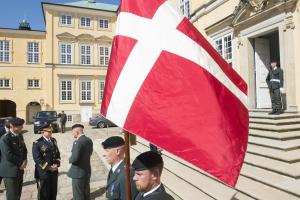
    Image credit: Danish Government.

    Denmark began supporting UN peacekeeping during the Cold War because it allowed Danish decision makers to promote their interests and values at the same time. UN peacekeeping was regarded as good for national security because it lowered international tension and provided a way of supporting Denmark’s key NATO allies without angering the Soviet Union. UN peacekeeping was also good for Danish values as it supported Denmark’s vison of a rule-based international society characterized by peaceful conflict resolution. The successful peacekeeping operation launched in 1956 in order to defuse the Suez crisis strengthened Denmark’s support for peacekeeping.

    The praise earned for the participation in this mission made Danish decision-makers realize that UN peacekeeping also provided an effective way of enhancing Denmark’s international prestige and influence. By the late 1950s peacekeeping had been internalized as part of Denmark’s foreign policy identity. Danish governments now portrayed UN peacekeeping as something ‘natural’ that Denmark should be proud to support. In 1964, Danish Foreign Minister Per Haekkerup even stated that it was a ‘duty’ for small nations like Denmark to support UN peacekeeping. This was not mere rhetoric. A feeling that one could not turn down a UN request thus influenced the 1964-decision to provide 1,000 personnel for a new UN peacekeeping operation on Cyprus.

    This mutually reinforcing interaction between interests, values and identity meant that Danish support for UN peacekeeping operations became routine. The absence of operational setbacks and casualties allowed this routine to produce a steady supply of Danish peacekeepers for the remainder of the Cold War. 34,100 Danish soldiers served on UN operations in the 1948-1989 period. Denmark had an average of 811 soldiers continuously deployed abroad and contributed eight percent of the total number of UN peacekeepers (419,100) during this period, making it one of the largest UN troop contributors per capita.

    The operational difficulties that the UN encountered in the Balkans in the early 1990s broke this routine. They served as an external shock undermining Denmark’s positive perception of UN peace operations. NATO’s successful bombing campaign and subsequent takeover of the UN operation in Bosnia in 1995 made the UN less attractive from an interest perspective. Denmark had always used UN peacekeeping as a way supporting its great power allies in NATO, and when they chose to abandon the UN in favour of NATO, Denmark followed suit.

    The strategic failure of the UN operation in Bosnia, culminating in the Srebrenica massacre, also gave rise to the perception in Denmark that UN peacekeeping was ill-suited for ‘doing good’ in the post-Cold War era. The tactical success enjoyed by the Danish tank squadron in Bosnia in 1994 reinforced this perception. One engagement (Operation Hooligan Buster) made international headlines. On 29 April 1994, the Danish tanks successfully fought their way out of a Serb ambush firing their 105 mm canons 72 times. They also blew up an ammunitions depot killing an estimated 150 Serb soldiers. This skirmish became a watershed. Denmark’s great power allies showered Denmark with praise, and the Danish use of tanks influenced NATO’s and UN approaches to ‘robust peacekeeping’. The charismatic Danish tank commander, Lars R. Møller, became a national hero, and Danish decision makers became convinced that peacekeeping was best conducted with combat capable units; a perception subsequently reinforced by NATO’s successful enforcement missions in the Balkans.

    Operation Hooligan Buster set in motion a process that in the course of the next two decades transformed Denmark’s foreign policy identity. The Danish peacekeeper, hailed for his ability to keep the peace without firing his weapon, was replaced by a new hero: the Danish warrior who made a difference on the battlefield. After Operation Hooligan Buster Danish politicians displayed far greater willingness to use force beyond self-defence. Denmark made large army contributions to NATO’s enforcement operations in the Balkans, advocated military invention in Albania as OSCE chairman in 1997, and allowed Danish fighter aircraft to conduct strike missions during NATO’s Kosovo War in 1999. Public support for the Kosovo war was higher in Denmark than anywhere else, and a large majority favoured contributing to a land war in case the air campaign failed. The strong public support for the war took Danish decision makers by surprise. Danish Minister of Defence Hans Haekkerup interpreted it as ‘a breakthrough in the history of Denmark’ and as proof that the Danish foreign policy identity had changed.

    Denmark and the War on Terror

    The US-led war on terror launched in response to the September 11 attacks in 2001 reinforced the Danish preference for NATO- and US-led operations and the emerging warrior identity. Denmark provided forces for the US-led wars against the Taleban and Iraq as well as the subsequent stabilization missions. The lion’s share of the approximately 20,000 Danish military personnel serving on international missions in the decade following 9/11 served in these two missions.

    The Danish participation in the NATO and US missions in Afghanistan proved very costly. Denmark lost more soldiers in Afghanistan (43) than on all other international missions conducted by the Danish armed forces since World War Two, and a 20 billion DDK price tag (2001-2017) made it the most expensive international operation ever conducted by Denmark.

    Surprisingly, the high costs and the less than satisfactory outcome of the Afghanistan war did not undermine domestic support for the mission. By 2011 when all 43 fatalities had occurred and it was clear that the mission would not succeed, 46% of the Danish population and a large majority in parliament continued to support it.

    The predominant understandings of Danish interests, altruism and foreign policy identity explain why. The government narrative portrayed the war as being in Denmark’s interest because it supported the United States and NATO and reduced the risk of terror attacks on Danish soil. The narrative also emphasized that the operation enhanced Denmark’s standing and influence in NATO and in Washington. The mission was portrayed as the right thing to do in altruistic terms, because it helped the Afghan people and in particular the Afghan women. Finally, the war reinforced the warrior ethos in the armed forces and their martial prowess, highlighted in a series of bestselling books, was a source of considerable national pride.

    Conclusion

    The current high level of Danish support for NATO- and US-led operations is driven by a mutually reinforcing combination of interest, altruism and identity that resembles the one that underpinned Denmark’s strong support for UN peace operations during the Cold War. An interest in supporting Denmark’s great power allies was an important driver then and now. A major Danish return to UN peace operations NATO has enhanced its military presence in Eastern Europe significantly since then, and it is currently asking Denmark to make a greater army commitment to deter Russia in Eastern Europe than it ever made in Afghanistan. This makes it impossible for Denmark to contribute to UN-led operations with anything but small personnel contributions officers and critical enables. In sum, all indications are that Denmark’s military support for UN peacekeeping will remain at the low level that has characterized it since 2001.

    Dr. Peter Viggo Jakobsen is an Associate Professor at the Royal Danish Defence College and a Professor (part-time) at the Center for War Studies at University of Southern Denmark. His is the author of Nordic Approaches to Peace Operations: A New Model in the Making? (London and New York: Routledge, 2009) and several other publications on (UN) peace and stabilization operations.

  • Sustainable Security


    Food insecurity small

    The United Nations Development Programme (UNDP) defines food security as “all people at all times having both physical and economic access to the basic food they need”. However, due to a complex range of interconnected issues from climate change to misguided economic policies, political failure and social marginalisation, over 2 billion people across the world live in constant food Insecurity. It is important to take a sustainable security approach to look at the importance of “physical and economic access to basic food” by exploring the links between food insecurity and violence.

    A recent article published by the journal Conflict, Security & Development examines food riots as representations of insecurity and looks at the relationship between contentious politics and human security.

    Thomas O’Brien, author of the article, argues “the upheaval caused by a food riot can lead to lasting instability and violence as social and political structures are challenged”. Global rises in basic food prices triggered demonstrations and often violent protests in “over 30 countries across Africa, Asia, Latin America and the Middle East in 2007-08”. The article puts recent food riots and the current global food crisis in historical perspective. Food riots are about more than “just access to food”.  They represent dissatisfaction with political structures and perceived injustices.

    It is important to note that “the extreme nature of the rise in food price in the absence of much evidence of food shortages, left a sense of something unnatural about the way food markets were working”. Although poverty, weak states, ineffective civil society and lack of political freedom all contribute to food insecurity and the possibility of violent food riots, we cannot ignore to challenge underlying transnational and global power structures: “146 protests in 39 countries over the 1976-92 period were linked to the imposition of International Monetary Fund and World Bank structural adjustment policies.” Food security is fundamental to human security and needs to be approached by addressing underlying causes and drivers. A sustainable response to food insecurity would take global cooperation, justice and equity as key requirements.

    An often mentioned driver of food insecurity is climate change. Climate change already has a great impact on global security concerns and the physical, social and economic effects will undoubtedly only be exacerbated in the near future. Increasingly high temperatures and little or inconsistent rainfall have devastating effects on crop yields in places such as India, Africa’s Sahel region and the mid-western United States.

    The catastrophic food crisis in Niger in 2005 for example was largely attributed to the effects of climate change and competition over limited resources. Years of too little and too inconsistent rainfall have meant devastating droughts and diminishing harvests in this Sahel country of west Africa which has the highest birth rate in the world. Increasingly advanced desertification due to climate change means competition and potentially violent conflict, over limited resources such as water and arable land, intensifies.

    In the 2005 food crisis however, although thousands of children died of malnourishment, Niger had produced enough food to feed its population. The real issue was a food shortage in neighbouring Nigeria. Nigeria has an economy based primarily on oil exports with a significantly weakened agricultural sector. Instead of Niger feeding its own population, much of the harvest was sold to wealthier Nigeria at prices much higher than anyone in Niger could have afforded. This is a good example of why free market economy and trade liberalisation do not necessarily benefit all parties involved. Writing about the great famines of the last century, Nobel laureate Amartya Sen noted “a drought is natural but famine is man-made”. What this tells us is that although the challenges we face by climate change are serious threats, there is much that can be done to ensure more food security through political and economic policies.

    Farmers in Niger are struggling. But so are farmers in Jamaica. In contrast to Niger, Jamaica has a wealth of fruit, vegetables, fish and an abundance of fertile land. About one fifth of this island’s population is employed in the agricultural sector. Still, farmers are struggling to survive because they cannot compete with the much lower prices of subsidised agricultural imports from the USA. As cheap foreign products flood the market, Jamaican prices are driven down which makes local food production by and large unprofitable. As they rely more on foreign food imports, Jamaicans will be increasingly vulnerable to price volatility on the global marketplace. With the average Jamaican spending about half of household income on food, such vulnerability to price changes is a real danger to food security.

    Importing less foreign food products is a difficult matter for Jamaica because of the strict trade liberalisation policies imposed on the country through its debt relief agreements. One could also argue that if it is cheaper for Jamaica to import food than to produce its own, why should it still encourage its local agricultural sector? When a country is dependent on food imports, it cannot assure food security for its population.

    So far US imports have been much cheaper than local Jamaican produce. 2012 however has seen the “worst US drought in 50 years” according to last month’s Aljazeera article entitled Food riots predicted over US crop failure. “Grain prices have skyrocketed and concerns abound the resulting higher food prices will hit the world’s poor the hardest- sparking violent demonstration” says the newspaper. Corn is a primary staple in Sub-Saharan Africa, Central and South America, and prices have already gone up 60 per cent since June because “the United States accounts for 39 per cent of global trade in corn and stockpiles are now down 48 per cent” due to the drought.

    Price fluctuations on the global food market do not affect all people in the same way as “people in wealthy industrialised countries spend between 10 to 20 per cent of their income on food. Those in the developing world pay up to 80 per cent. According to Oxfam, a one per cent jump in the price of food results in 16 million more people crashing into poverty.”

    A sustainable approach to food security would address underlying forces such as climate change, economic and political policies and social marginalisation.

    Paul Rogers, expert on global conflict and consultant to the Oxford Research Group on global security, was recently featured on the BBC Radio 4 programme Costing the Earth. When asked whether free markets can help feed us, he replied:

    “It will contribute in some way, but I think it is fairly minimal. There are far more important things to consider. Look at it this way: Back in the world food crisis in the early 1970s, which was the worst for about 80 years, there were about 450 million people malnourished.  Now the figure is closer to 800 million. Now, that malnourishment and lack of food is not generally because there isn’t enough food to go around. Even at the height of that crisis there was still half the normal reserve. It is because people cannot afford to get the food or to buy the food. […]  If you are looking at the situation of poor people across the majority world, there has to be some way in which we can actually improve the production of food in and around those areas to provide greater resilience in the face of what is coming because beyond all of this is the whole issue of climate change. I think we will have a wakeup call this year in terms of what might come.”

    Anna Alissa Hitzemann is a  Peaceworker with Quaker Peace and Social Witness. She currently works with Oxford Research Group as a Project Officer for the Sustainable Security Programme, with a focus on our ‘Marginalisation of the Majority World’ project.

    The Conflict, Security and Development article Food riots as representations of insecurity is available for paid download here
    The AlJazeera article Food riots predicted over US crop failure is available here
    The Pulitzer Center for Crisis Reporting project Agriculture and Jamaica’s rural poor is available here
    Paul Rogers’ Monthly Global Security Briefings can be read and subscribed to here
    Image source: Dioversity International