Category: 18

  • Sustainable Security

    Chemical weapons elicit a very specific emotive and political response from populations, namely, anxiety. What are the drivers behind the fears surrounding chemical weapons? 

    “War, like revolution, is founded upon intimidation. A victorious war…destroys only an insignificant part of the conquered army, intimidating the remainder and breaking their will…Terror…kills individuals, and intimidates thousands”.

    Writing in 1920, Leon Trotsky thus attributed the power of war and terrorism to its psychological effect. The ability to intimidate and coerce is the key strategy in a world in flux; fear and uncertainty are the weapons of choice for terrorist groups. The observation that terrorists endeavour to kill few and create fear among many has been woven tightly into the fabric of terrorism discourse for decades.  

    But the current century has witnessed an evolved threat paradigm in which the aim of a new type of terrorist group is to achieve “a lot of people watching and a lot of people dead”. Chemical weapons are often presented as the apex of such a goal. Yet increasingly it is argued that chemical weapons are merely a tool to elicit fear that far exceeds their actual destructive clout. This fear is a very human response. The psychological power of chemical weapons is intrinsically linked to their contaminant nature, indiscriminate harm and ability to undermine an individual’s sense of security.

    Are chemical weapons really weapons of mass destruction, with a devastating impact on infrastructure, life, and property? Or, are they weapons of terror? Distinguishing between the two, this article queries how uncertainty feeds the fears surrounding chemical weapons. To what extent does the weapon of terror moniker depend on the concept of mass destruction?

    The enduring power of contamination

    new-york-national-guard

    Image credit: New York National Guard/Flickr.

    Chemical weapons have an ancient history. Early hunter-gatherers learned to poison their arrows to ensure an effective kill. Poison gas as a weapon of war was recorded by Thucydides in 428 BCE. The scorched earth tactic of poisoning wells using the rotten corpses of people who had died from infectious disease was used across the Ottoman era and Middle Ages. Chemical weapons have been utilised – or attempted – in many conflicts since then. The British government, for example, approved the use of sulphur fumes at the siege of Sebastopol during the Crimean War. Even in Afghanistan and Iraq, the US Army used white phosphorous grenades, as did the British.

    As scientific advances began to allow a greater multiplicity of chemical agents in industrial quantities, concerns mounted over potential consequences. In recognition of the sentiment that injury or death by poison is inhumane, the Hague Conventions (1899 & 1907) outlawed the battlefield use of poisoned weapons and toxic gas via projectiles. The declaration prohibiting the dissemination of asphyxiating and deleterious gases was ratified by all major powers except the US which refused to sign, arguing that projectiles as detailed in the convention had not yet been fully developed.

    The use of poison has long been regarded as morally reprehensible. This harks back to disdain inherent to poisoning and its associations with chemical weapons: in contrast to the hero’s death by sword in battle, poisoning is regarded as cowardly and secretive. Yet this became more acute in the aftermath of the Hague Conventions: moral indignation follows the breaking of accepted conventions, shattering indoctrinated agreement as to non-use. In the early 20th century, both Allies and Axis powers were reluctant to be the first to breach the law.

    Even General John Pershing, having established the U.S. military’s first gas warfare unit in 1917, denounced chemical weapons as “abhorrent to civilization…a cruel, unfair and improper use of science…fraught with the gravest danger to non-combatants”. By the end of WWI, over 124,000 tonnes of chlorine, phosgene and mustard gases had been dispersed, causing approximately 90,000 deaths and 1,230,853 injuries and earning WWI the moniker, “the chemist’s war”. Though the development of gas masks reduced the number of casualties in the later years, the scale of chemical warfare had set the precedent for a lingering psychological and moral response. That even Hitler refused to use chemical weapons on the battlefield (if not in the gas chambers) cemented their standing as a wholly unacceptable weapon of war.

    For decades, the threat from chemical weapons remained largely in the hands of states. Almost two decades since the Chemical Weapons Convention came into force outlawing the production, stockpiling, and use of chemical weapons, the threat of non-state actors obtaining or producing chemical weapons has become of increasing concern. Large quantities of improperly disposed unconventional weapons have been unearthed in recent decades. After WWII, for instance, tons of mustard gas, sarin, soman, tabun, hydrogen cyanide and many other agents were left in storage facilities near towns and cities, buried in landfills across the world or dumped at sea. During the Cold War, chemical weapons facilities proliferated across the world, shrouded in secrecy. Throughout this time, in the Soviet Union thousands of tonnes of chemical materials were simply dumped in undisclosed, unchartered locations. With the collapse of the Soviet Union, some chemical research units were abandoned, leaving available a mass of untraced and unacknowledged weaponry.

    Chemical weapons and non-state actors

    Various terrorist organisations have spent years working on developing chemical weapons, of which the so-called Islamic State (IS) is but one. The eleventh volume of al-Qaida’s Encyclopaedia of Jihad provides instructions on how to construct chemical and biological weapons, although al-Qaida seems to have balked at actually using such weapons. Where groups have succeeded in their use, they have created vast shockwaves, with minimal outlay. In 1978, a Palestinian group injected non-lethal quantities of mercury into Jaffa oranges leading many countries to cease imports, jeopardising a market worth $172 million to Israel at the time. In 1989, terrorists reportedly laced Chilean grapes with cyanide, costing the Chilean fruit industry $333 million, despite the chemical only having been identified in two grapes.

    In 1995, Aum Shinrikyo unleashed the largest gas attack in peacetime history on several lines of the Tokyo subway, killing 12 people and injuring thousands. Though the proportion of people killed was relatively low compared to numbers injured, the attack demonstrated the ability of non-state actors to obtain and use significant quantities of non-conventional weapons. It has subsequently been cast as a “crossing of the Rubicon” (to pass a point of no return), foreshadowing further similar attacks.

    Chemical anxieties

    Chemical weapons elicit a very specific emotive and political response. When the threat and impact of terrorist attacks using conventional weapons against Western targets is so real, why does the as-yet unrealised potential for chemical terror attacks in the West retain a particular power over our thinking?

    Attempts to explain the anxieties surrounding chemical weapons remain incomplete when considered alongside conventional weapons with similarly cruel capabilities. Why, as in Aleppo or Homs, do we regard using explosives to tear people apart as more humane than burning or asphyxiating them to death? Weapons such as “soft nosed” bullets (which disintegrate upon entry to the body) were banned alongside asphyxiating gases by the 1899 Hague Conventions, yet they do not receive such global censure.

    Part of the concern specifically attributed to chemical weapons lies in the human fear of unpredictable, adverse events such as the potential to develop illness after exposure. The most terrifying threats are those perceived not just as lethal but as dehumanising. The fear of chemical weapons is therefore, at least partially, a result of their potential to cause insidious harm.

    So the potency of chemical weapons lies in the unknown and in how they fester in the imagination of those who have felt threatened by them. Chemical weapons attacks are distinguished by the propagation of functional somatic – medically unexplained – physical symptoms, bestowing unconventional weapons a “psychogenic” hallmark. A result of the potential for chemical weapons to yield psychiatric illness, the notion that the long-term psychological consequences of unconventional weapons may be worse than acute physical, is popular in psychological circles. The many chemical incidents in which low-risk patients far outnumbered those whose exposure could be confirmed, contribute to this “weapon of terror” epithet: the perception of exposure to a toxin is a greater determinant of health status and anxiety than actual exposure. After the Aum Shinrikyo attack, over 4,000 people with no sign of exposure sought medical care.

    Many chemicals are perceived by the public as having a high to extreme degree of uncertainty; many, too, elicit strong anxiety, which can drive somatic symptoms. In order to form judgement under uncertainty, people form intuitive assessments upon relevant information. Attempting to decrease their uncertainty, people may apply preconceived beliefs (for instance, that chemicals are dangerous) to symptoms, even if benign, constructing a causal link between symptom and event.

    Consider, for instance, cases in Israel, a nation so subject to the corollaries of war that it has been termed a natural station for the study of stress. During the 1991 Gulf War, Israel endured 18 Scud ballistic missile attacks from Iraq. The stress of conventional bombardment was compounded by the fear that the missiles contained nerve agents; residents had been instructed to carry gas masks and prepare for Iraqi use of biological or chemical weapons. Fearing contamination, over 1,000 patients attended medical facilities with symptoms such as tremors and breathing difficulties. Only 22% of patients had been genuinely injured: none by biochemical agents. 27% of casualties had mistakenly injected themselves with atropine, an antidote to nerve agents.

    Conclusion

    There are two schools of thought explaining the power of chemical weapons. On one hand is the argument that chemical weapons can be harnessed as weapons of mass destruction. This bears significant political pull. On the other, there is scepticism as to their capabilities, where instead they are branded weapons of psychological terror. The schism between “weapon of terror” and “weapon of mass destruction” is rarely acknowledged. Conflation of the two allowed Tony Blair to drawn upon their psychological power to justify the 2003 invasion of Iraq, which shattered the Middle East.

    The truth lies somewhere in between. The psychological and physical fallout of chemical weapons are, essentially, two sides of the same coin. Feared or sustained physical harm gives rise to short-term anxiety and long-term psychological distress. Chemical weapons victims may never be definitively free from the physical effect, thus the psychological effects may endure. Uncertainty directly impacts upon fear, and is thus one of the most influential features of human history. As human experience is a complex nexus of affect, behaviour, cognition and physiology, chemical weapons are disturbing for their ability to bear upon each, fracturing this integration. Uncertainty can become visceral. While war does not accommodate certainty, the potential use of chemical weapons will feed doubt and continue to draw substantial political influence.

    Clare Henley divides her time between acting as Assistant to the Director of the Oxford Process, and as Project Officer at Refugee Trauma Initiative. She previously worked on the Humanitarian Impact of Nuclear Weapons Initiative at Chatham House, and at the Maudsley Hospital’s Centre for Anxiety Disorders and Trauma. Prior to this, she interned on a decontamination project with the Behavioural Science team at Porton Down, Public Health England. Clare has an MSc in War and Psychiatry from King’s College London, where her thesis focused on the psychological impact of chemical, biological, radiological and nuclear weapons. Her other work focused on topics such as the impact of war on child soldiers and of being held hostage. She also has a BSc in Psychology from the University of Exeter.
  • Sustainable Security

    Author’s Note: This contribution is a shorter version of the article “Resilience and environmental security: towards joint application in peacebuilding” by Schilling et al. 2017

    Resilience is a widely used concept among development, environmental, security and peacebuilding organisations. However, it has rarely been applied together with the concept of environmental security, despite the obvious ways in which the concepts complement each other. These concepts can be jointly applied in the peacebuilding sector. Environmental security sharpens the scope of resilience, while resilience allows for taking issues into account that a traditional environmental security perspective might miss.

    ‘Resilient communities’, ‘climate-resilient pathways’, ‘resilient future’, ‘resilient planet’: there are hardly any key terms in the development, climate change, security, and peacebuilding sectors that have not been combined with ‘resilience’. Due to the malleability of and enthusiasm for this concept, it has been depicted as the ‘new superhero in town’ replacing sustainability as the key guiding concept and buzzword in the international development community.

    Less prominent but still widely used, at least implicitly, is the concept of environmental security. The term can relate to the absence of risks posed by environmental changes or events to individuals, groups or nations. But it can also focus on the environment itself and how human behaviour, including conflict, affects the security and integrity of the environment.

    Several international organisations, including International Alert, adelphi, and the United States Agency for International Development (USAID) are working on combined approaches to environment, conflict and security issues. However, resilience has hardly ever been applied in conjunction with the concept of environmental security, despite their potential complementarity. Particularly in the peacebuilding sector, joint application of the concepts is promising because it could help to create an understanding of the extent to which people are at risk due to environmental factors (environmental security), and the extent to which people are able to adapt to environmental risks (resilience).  Further, a joint application could help to understand the impacts of environmental factors on conflict dynamics and vice versa. Against this background, develop a framework which allows non-governmental organisations (NGOs) working to implement peacebuilding projects in developing countries to jointly apply resilience and environmental security.

    Joint framework for environmental security and resilience in peacebuilding

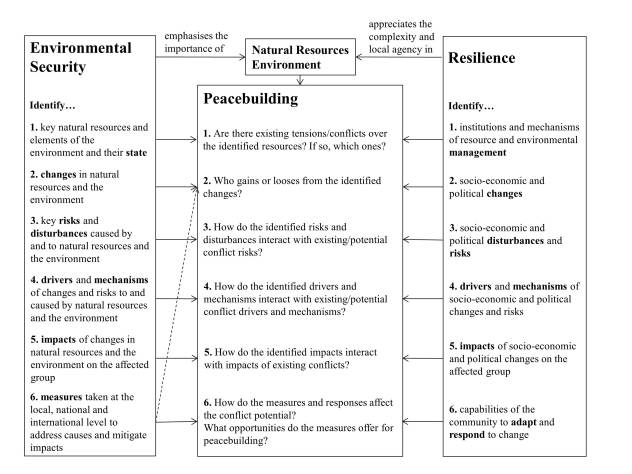
    Natural resources and the environment are the key elements linking environmental security and resilience to peacebuilding (see figure). Based on a six-step process, we combine the key strength of environmental security, its emphasis on the importance of the environment, and the key strength of resilience, namely the appreciation of complexity and local agency. The purpose of the process is to identify the states, changes, risks and disturbances, drivers and mechanisms, impacts, and measures and responses from an environmental security and resilience perspective to gain a better understanding of conflict dynamics and identify entry points for peacebuilding.

    Figure 1 – Framework for Environmental Security and Resilience in Peacebuilding.

    In step one we use the environmental security perspective to determine the key elements of the environment and natural resources that are important to a specific community or group of people, while the resilience perspective identifies how and by whom natural resources and the environment are managed. Together the environmental security and resilience perspectives help to answer the question of whether tensions or conflicts over the identified resources exist.

    In step two, we determine changes in natural resources and the environment before identifying the losers and winners of these changes. The resilience perspective allows us to take the overall complexity of the socio-economic and political context into account.

    The objective of step three is to understand the interaction of different risks. The environmental security perspective pays particular attention to risks to the environment as well as risks caused by the environment. The resilience perspective adds socio-economic and political considerations, such as strong increases in food prices, regime changes and social instability.

    Step four aims to identify the key drivers and mechanisms of the changes and risks, identified under step 2 and 3. For example, if a reduction of rainfall is identified under step 2 and in step 3 an increased drought risk is noted, then step 4 explores whether the reduction of rainfall and drought risk can be attributed to global climate change or local factors such as deforestation.

    Step five focuses on impacts. For example, one can ask whether the droughts and loss of harvest identified on the environmental security side and/or the increases in food prices identified on the resilience side, lead to hunger and how hunger in turn interacts with impacts of existing conflicts identified in the peacebuilding column.

    Step six is particularly important because at that point we consider the actual measures and responses to environmental, socio-economic and political changes at different scales in order to determine the effects on conflict potential as well as to identify entry points for peacebuilding.

    For example, if we identify hunger as a key impact under step five, the government could invest into irrigation schemes or (temporarily) subsidise staple food. This could reduce the conflict potential and strengthen the social contract between the government and the affected communities. However, for each measure taken, consideration must be given to who is affected, either positively or negatively (see dashed arrow connecting step six and two). On the resilience side, the capabilities (including knowledge, technology, networks and financial assets) and responses of the communities strongly depend on the social capital of the group concerned. For example, a loss of harvest might not result in hunger because the affected community might receive remittances from family members living outside the drought affected area. Our framework enables peacebuilding organisations and other stakeholders from development organisations and humanitarian assistance to identify core risks to environmental security without losing sight of the wider political and cultural structures into which these insecurities are embedded.

    In Practice: Palestine’s Good Water Neighbor’s Project

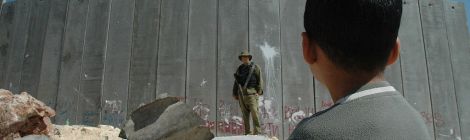
    The Good Water Neighbors (GWN) project in Palestine shows the advantages of combining a resilience and an environmental security perspective in peacebuilding. Palestine suffers from a number of environmental insecurities, most of which are related to water scarcity and pollution. But these insecurities are embedded in and interact with wider political contexts, such as the Israeli occupation of the West Bank, tensions between various Palestinian groups, and dominance of technocratic, liberal peacebuilding approaches. In order to address this complex reality, GWN facilitates cooperation on environmental issues between Israeli and various Palestinian groups, thus increasing resilience to socio-political and environmental shocks simultaneously. Examples of such activities include transnational environmental education, establishing water infrastructure shared between both sides, and common protests against environmentally harmful infrastructure (such as the Israeli separation barrier).

    Conclusion

    Image credit: Traynor Tumwa.

    Overall, the framework offers a possibility for environmental security to sharpen the scope of resilience, while resilience allows for taking issues such as governance into account that a traditional environmental security perspective might miss. The framework helps identifying the states, changes, risks and disturbances, drivers and mechanisms, impacts, and measures and responses from an environmental security and resilience perspective to gain a better understanding of conflict dynamics. However, when applying the framework continuous attention should be also paid to ambivalent effect of depoliticisation which is a risk both concepts entail.

    On the one hand, steering away from contentious political debates, such as those related to the wider Israeli-Palestinian conflict, provides an entry point for peacebuilding projects. Social groups and even official actors can be involved without taking a stance on contentious political questions. On the other hand, avoiding discussions on structural inequalities means that some root causes of environmental insecurities, such as the unequal distribution of water resources between Israel and Palestine, are difficult to address. When applying the framework further attention needs to be paid to other pitfalls of resilience and environmental security, namely the redistribution of responsibility to the local level and potentially justifying external intervention. If these issues are kept in mind, the framework can be a useful tool, especially when analysing conflicts where natural resources and the environment play key roles.

    Rebecca Froese is a PhD candidate in the Department of Earth System Sciences at the University of Hamburg and a member of the research group Climate Change and Security (CLISEC) at the University of Hamburg. Her research focuses on development cooperation and the role of non-party stakeholders in implementing and financing climate action.

    Janpeter Schilling holds a Klaus Töpfer Junior Professorship for Landuse Conflicts at the University of Koblenz-Landau. He is an associated researcher at the research group Climate Change and Security (CLISEC) at the University of Hamburg, the peacebuilding organisation International Alert in London and the Peace Academy Rhineland-Palatinate in Landau. His research focuses on environmental security, conflict and resilience.  

    Tobias Ide is head of the Research Field Peace and Conflict at the Georg Eckert Institute and currently a visiting researcher at the School of Geography, University of Melbourne. He is an associated researcher with the reserach group Climate Change and Security (CLISEC) at the University of Hamburg. He works on environmental conflicts, climate security, environmental peacebuilding, and the representation of peace and conflict, especially in school textbooks.

    Sarah Louise Nash is a 2016/17 Mercator-IPC fellow at Istanbul Policy Center, Sabanci University and an associated researcher with the research group Climate Change and Security (CLISEC) at the University of Hamburg. Her research focuses on the politics of climate change and human mobility.

    Jürgen Scheffran is professor of geography and head of the Research Group Climate Change and Security (CLISEC) at the University of Hamburg, Cluster of Excellence ‘Integrated Climate System Analysis and Prediction (CliSAP) and the Center for Earth System Research and Sustainability (CEN). His research specialities are climate and conflict research, sustainability science, resilience and energy and human security.

  • Sustainable Security

    NASA main1_kuwait-compare670

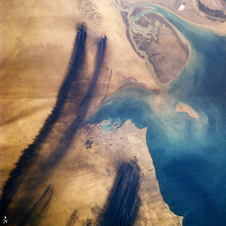
    Whilst withdrawing from Kuwait at the end of the first Gulf War, Iraqi troops set fire to over 700 oil wells  south of the Iraq border (yellow line). These images show before, during and after the release of 1.5 billion barrels of oil into the environment, the largest oil spill in human history. Image by NASA’s Goddard Space Flight Center.

    February marked the 25th anniversary of the Gulf War’s end. The intensity and magnitude of the allied coalition’s offensive, followed by the systematic destruction of Kuwaiti oil wells by retreating Iraqi troops, led to an unprecedented environmental disaster. Yet within two months, and in a first for international armed conflict, a post-war claims and remediation mechanism ─ the United Nations Compensation Commission (UNCC) ─ was in place. Its aim was to not only help neighbouring states recover from the personal and financial losses inflicted during the war, but also to help repair the environmental damage caused. With protection for the environment in armed conflict under increasing scrutiny, it seems useful to re-examine how this mechanism worked.

    Following the conflict, there was an expectation that reparations were due to neighbouring countries and Iraq’s oil revenues offered a ready source of finance. The UNCC was established and mandated to: “…process claims and pay compensation for losses and damage suffered as a direct result of Iraq’s unlawful invasion and occupation of Kuwait”. The 2.69 million claims it processed were categorised according to claimant and type of compensation sought. These ranged from individuals’ personal injury, deaths and financial losses, to costs incurred to neighbouring countries in housing refugees, to damage to businesses and governmental property. Last but not least, was the “F4” sub-category for “Environmental damage and depletion of natural resources”.

    Using expert panels, the UNCC assessed 170 F4 claims from 12 States (Australia, Canada, Germany, Iran, Jordan, Kuwait, the Netherlands, Saudi Arabia, Syria, Turkey, UK and USA) and awarded US$5,261m ─ just 6.2% of that claimed ─ to 10 States in five instalments over as many years: the Dutch and Turkish claims were unsuccessful. Oversight of payments was strict, with regular reporting to establish that funds were used as specified. All payments have now been completed, although some projects will run until at least 2020.

    Environmental Damage on a Massive Scale

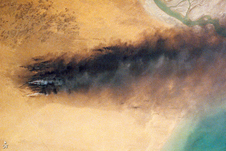
    Black smoke plumes stream into the skies around Kuwait City in April 1991 five weeks after the fires were set. Credit: NASA's Earth Observator

    Smoke plumes in the skies around Kuwait City in April 1991. Image by NASA’s Earth Observator.

    The recognition of the F4 claims for remediation and restoration was unquestionably due to the highly visible environmental damage the conflict caused. Aside from the unexploded ordnance covering 3,500km2, the footprint of the 700,000 allied troops, and the effect of millions of Iraqi, Kuwaiti and other refugees relocating to Jordan, Iran, Turkey and Syria; Kuwait and its neighbours suffered from the unique impact of the calculated use of oil as a weapon of war.

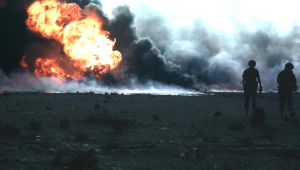
    More than 700 oil wells were blown up, with most igniting, burning 6m barrels per day for nearly ten months. Damaged oil wells spewed crude oil, forming lakes covering at least 50km2. Fallout from dispersing smoke plumes created a thick deposit known as tarcrete over 1,000km2 of Kuwait’s deserts. Meanwhile, 11m barrels of crude oil from storage units, sabotaged pipelines and oil tankers spilled into the Persian Gulf, damaging 800km of coastline. The impact of the oil on air and land quality, terrestrial and marine habitats and biodiversity was immediate, severe and long-lasting, damaging natural resources and threatening human health.

    Putting a Price on the Environment

    Placing a financial value on the environment is no easier than defining what the environment is. As they counted the cost, affected countries submitting UNCC claims were clear that economic, social, public health and biodiversity concerns were all linked to environmental quality. States not only wanted to reinstate pre-war environmental conditions in heavily polluted areas, they also wanted to address the damage to land and natural resources, and the footprints of the military and refugees. Concerned about the health implications for their populations from pollution, they also sought acknowledgment of the risks, and funds for health monitoring.

    The difficulty in assessing the monetary value of the damage was evident throughout the process. Both Iraq and the UNCC demanded that claims be supported by precise estimates, detailed costs and clear scientific evidence. The difficulties this presented, in the absence of an agreed framework to quantify damage, and debates over the quantity and quality of evidence, led to 94% of claims being dismissed.

    The bulk of the claims from Jordan, Iran, Kuwait and Saudi Arabia related to either oil spills or damage from oil well fires. Because of the visibility and immediacy of the damage, and the necessity for data gathering, monitoring and assessment claims were often upheld and remediation claims, which were reviewed later in the process, were considered favourably. Nevertheless the remediation costs, area calculations and baseline comparisons of pre-war environmental conditions were still debated and individually re-negotiated by the UNCC’s experts.

    Claims for the degradation of natural resources such as groundwater, and the loss or damage of habitats due to population displacement proved less successful. This was partly due to the difficulties in quantifying the harm caused, and the uncertainty in assessing refugee numbers and their collective behaviour. The few non-regional States’ claims related to technical and expert services provided to Kuwait and its neighbours; these were just as hotly debated as other claims.

    Claims linking the oil fires to human health risks considered the financial impact of long-term health problems and the additional deaths expected due to inhalation of the fires’ toxic fumes. However, due to the difficulty in meeting the evidentiary standard requiring harms to be the “the direct result of the invasion and occupation” these proved unsuccessful. Health monitoring and assessment projects were awarded funds, although the expert panels contested the methodologies and models they used to assess exposure, morbidity and mortality in Kuwait and Iran. Similarly, other claims relating to the impact of airborne particulates on land and heritage sites, including virtually all Syrian claims under “Transport and Dispersion of Air Pollution”, were also unsuccessful.

    Post-war Remediation and Restoration are Still Incomplete

    NASA 3

    The oily plumes climbed three to five kilometers into the atmosphere and hundreds of kilometers across the horizon. Image by NASA’s Earth Observatory. 

    Although capping the oil wells took only nine months, damage has proved long-lasting. The varied composition of soils caused different contamination problems. Wet oil, dry oil and solid tarcrete remained depending on absorption levels, length and severity of exposure. Oil spills covered coastlines and invaded mudflats, killing wildlife and transforming habitats. Remediation was highly specialised, often complicated by weather and the saline conditions, and necessitated preliminary monitoring and assessment work. The technologies and remediation techniques used varied, including chemical oxidation, soil washing, tilling in mudflats, soil excavation, transportation, landfills and thermal treatment.

    The necessary assessments slowed the claims process; Kuwait was still processing and awarding tender applications in 2013. Often, delays led to natural environmental changes in habitats, for example the colonisation of coastlines by algal mats, preventing their return to pre-war conditions. Such changes led to questions over what constituted successful remediation for these degraded and altered habitats, especially when remediation had not been initiated by the affected States prior to claims being filed – for instance Saudi Arabia’s duty to prevent and mitigate environmental damage was examined.

    Recognising the long-term and technical nature of environmental remediation work, the UNCC mandated further monitoring until 2013 through the Follow-up Programme for Environmental Awards – now completed and wound up. Some national projects are still underway, relating to ordnance removal, the damage and stresses caused by refugee settlements and military camps and health monitoring. Other long-term works, including irrigation improvements, livestock management, soil improvements, re-vegetation, marine reserves, saltmarsh clear-up, wildlife re-introduction and protection continue in Iran, Jordan, Kuwait and Saudi Arabia.

    Learning from the UNCC

    More than 600 Kuwaiti oil wells were set on fire by retreating Iraqi forces, causing massive environmental and economic damage to Kuwait.

    Image of oil well on fire from the ground by US Army Corps of Enginners.

    That the UNCC process included the F4 environmental damage category at all was a step in the right direction, setting a precedent and demonstrating the importance of post-conflict environmental restoration. Although influenced by well-established peacetime environmental norms, the UNCC claims and awards process had limitations. But could its lessons be developed for environmental restoration after future conflicts?

    One starting point would be to develop a common legal definition of the environment, derived from environmental and humanitarian principles. This could be used to help frame the necessity of preventing harm, and ensuring environmental restoration. Complementing this with a common framework for damage assessment could accelerate recovery and reduce harm by avoiding further damage resulting from delays in remediation. The framework would need to be developed as part of a post-conflict environmental mechanism, with claims and operations processed through an independent institution with a clear mandate.

    To be successful, monitoring and clean-up operations should neither be dependent on the affected State’s finances, nor limited to post-conflict reparations. Ideally an international fund would be established and made available, not only to support public and environmental health monitoring throughout the conflict cycle, but also to ensure that urgent remediation and clean-up operations begin quickly.

    Another lesson from the UNCC is that it is essential to go beyond the purely financial implications of damage and loss. A more comprehensive approach would also consider the direct and indirect consequences of environmental damage, linking environmental health with humanitarian protection, promoting ongoing health monitoring and re-instating post-war environmental governance.

    Most of the UNCC decision-making process was not public, when instead it should have been accessible and transparent. “Non-claimant states, civil society and the media had no access at all. The panel’s proceedings were not open to public scrutiny”[1]. Today such opacity would run counter to the principles of the Aarhus Convention on access to information and participation in environmental decision-making, and act as a barrier to external scrutiny.

    In spite of the UNCC, and the precedent that it set, the fact that 25 years on the environmental legacy of the Gulf War has still not been fully addressed is a stark reminder of the long-term impact that wartime environmental damage can have. Armed conflict not only degrades the natural environment and damages human health, it also harms environmental governance. While the UNCC model may not be applicable to all conflicts, its lessons highlight serious limitations in how the international community currently responds to the environmental consequences of conflict: limitations that must be addressed in the growing debate on strengthening the protection of the environment from the impact and legacy of armed conflict.

    Laurence Menhinick is a research assistant with the Toxic Remnants of War Project, which studies the humanitarian and environmental impact of conflict pollution. The Project is a founding member of the Toxic Remnants of War Network, which advocates for a greater standard of environmental protection in armed conflict: @TRWNetwork. The author thanks Prof. Cymie Payne for her clarifications for this article.

    [1] De Silva, A. L. M. (2014), Conflict Related Environmental Claims – A Critical Analysis of the UN Compensation Commission, Faculty of Law, University of Sydney, Australia p70 http://ses.library.usyd.edu.au/handle/2123/10426

  • Sustainable Security

    A version of this article was originally published on openSecurity’s monthly Sustainable Security column on 18 November 2014. Every month, a rotating network of experts from Oxford Research Group’s Sustainable Security programme explore pertinent issues of global and regional insecurity.

    RC_long_logo_small_4webThis article is part of the Remote Control Warfare series, a collaboration with Remote Control, a project of the Network for Social Change hosted by Oxford Research Group.

    While the world’s attention has been focused on the US-led military interventions in Iraq and Syria a quieter build-up of military assets has been ongoing along the newer, western front of the War on Terror as the security crises in Libya and northeast Nigeria escalate and the conflict in northern Mali proves to be far from over. In the face of revolutionary change in Burkina Faso, the efforts of outsiders to enforce an authoritarian and exclusionary status quo across the Sahel-Sahara look increasingly fragile and misdirected.

    The New Frontier

    In early August, coinciding with the restructuring of French military operations in the Sahel and the US-Africa Leaders Summit, Oxford Research Group and the Remote Control Project published a comprehensive assessment of counter-terrorist operations targeting jihadist groups in the Sahel-Sahara region of north-west Africa. That report found extensive and growing evidence of combat, intelligence, surveillance and reconnaissance (ISR), training and equipment, abduction and rendition programmes on this new frontier. While France and the US were easily the most active foreign actors, the UK, Canada, the Netherlands and several other NATO states were also found to be increasingly involved in special forces and ISR operations.

    The launch coincided with the onset of air attacks on Islamic State targets, initially by the US in northern Iraq and latterly by a broad coalition of Western and Arab states in Iraq and Syria. In a context of worsening security crises in Libya, Nigeria and northern Mali and Niger since, US and UK ISR activity is increasing, French deployments in Mali have been reinforced, a new configuration of Arab states has provided impetus for foreign intervention in Libya’s civil war and a “black spring” backlash is emerging against the west’s authoritarian allies in the region.

    Libya on the frontline

    Libya is at the core of the security crisis in the Sahel-Sahara. Since the NATO-led military intervention which overthrew the Qaddafi regime in 2011, Libya has become a security and political vacuum and a major exporter of weapons and insecurity in the region. This has included the return home to the Sahel of hundreds of combatants formerly given refuge or employment by the Libyan state.

    Libya’s civil war reignited in May with the launch of “Operation Dignity” by secular forces from eastern Cyrenaica, seeking to wrest control of Benghazi and Tripoli, the two main cities, from Islamist militia. This has been largely a failure. Most diplomatic missions evacuated Libya in late July and Tripoli and its burnt-out international airport fell to militia from Misrata (Libya’s third city) and allied Islamist groups on 23 August. Benghazi has fallen increasingly into the hands of Salafist groups and the nearby city of Derna is run as an Islamic emirate by Ansar al-Shari’a. Much of the rest of Libya is dominated by local tribal leaders or armed factions, beyond any state control.

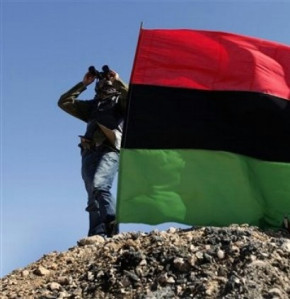
    Anti-Gaddafi rebel looks to the sky in the oil town of Ras Lanouf, eastern Libya, Sunday, March 6, 2011. Source: Cropped version of BRQ Network image (via Flickr)

    Anti-Gaddafi rebel looks to the sky in the oil town of Ras Lanouf, eastern Libya, March 6, 2011. Source: cropped version of BRQ Network image (via Flickr)

    Indeed, there are now two rival, elected Libyan governments. The one recognised internationally meets in a Tobruk hotel. It controls little beyond this Egyptian border outpost and its electoral mandate was recently invalidated by the Tripoli-based Supreme Court. The revived General National Council in Tripoli governs the capital and north-west and is dominated by an affiliate of the Muslim Brotherhood and other Islamist factions.

    Libya has thus become a new frontline in the proxy war between the international proponents and opponents of the brotherhood. Qatar and the United Arab Emirates (UAE) were the two main Arab sponsors of the anti-Qaddafi rebellion and contributed to the air attacks on Qaddafi’s forces. They now find themselves backing different sides in Libya. On 17 and 23 August, days after the Tobruk parliament called for foreign military intervention, Emirati aircraft based in and refuelled from Egypt launched unclaimed attacks on pro-Islamist militia around Tripoli airport.

    Despite official denials, it appears that air attacks on Salafist groups in Benghazi in mid-October were launched by Egyptian aircraft. Egypt and the UAE accuse Qatar, the primary sponsor of the brotherhood in Egypt, and Sudan, long ruled by a military affiliate of the brotherhood, of funnelling arms to the various Libyan Islamist militias.

    While the US has condemned all post-2011 foreign intervention in Libya, it is likely that it was aware of the movement of UAE aircraft to Egypt, given that fighters presumably left from Al-Dhafra air base in Abu Dhabi, which is shared by US and French squadrons. Emirati refuelling aircraft are based at Al-Minhad in Dubai, where the UK Royal Air Force (RAF) has an expeditionary wing. These aircraft presumably were cleared by Saudi Arabia (another great opponent of the brotherhood) to overfly its territory. The aircraft and weapons used were supplied by the US and/or France.

    France stands apart among Western allies in its advocacy of, and preparedness for, renewed military intervention in Libya. Since the fall of Tripoli, its defence minister, Jean-Yves Le Drian, has several times advocated a UN mandate for intervention against Islamist groups in Libya and hinted that France may need to act unilaterally sooner or later. Whereas Egypt is most concerned about Salafist groups in Derna and Benghazi, France is focused on al-Qaida affiliates in south-west Libya. Already this year it has opened bases near the Niger-Libya and Chad-Libya borders and revived ISR operations from its air base at Faya-Largeau in northern Chad.

    Northern Mali and Niger

    France cares about southern Libya primarily because of its security commitments to Mali, Burkina Faso, Chad and Niger, the latter hosting multi-billion-euro French investments in uranium production. Since France reorganised its forces in the Sahel from the Mali-focused Opération Serval to the pan-Sahel deployments of Opération Barkhane in mid-2014, security in northern Mali has worsened significantly. This relates partly to the decline in French troop numbers there but also to the reorganisation of regional jihadist groups and the deterioration in relations between the Malian state and local armed separatists. Twenty UN peacekeepers from the Multidimensional Integrated Stabilisation Mission in Mali (MINUSMA) have been killed in at least five jihadist attacks in the north of the country since September. In response, France has had to reinforce its deployments in Kidal district, pulling in troops and equipment from its base in Côte d’Ivoire.

    On 9 October, French forces under Barkhane mounted their first publicly acknowledged offensive action outside of Mali, attacking a convoy supposedly transporting militants and weapons from Libya through Niger towards the country. Militants apparently moving from north-eastern Mali attacked Nigerien security forces in Ouallam three weeks later, freeing dozens of Islamist prisoners and attacking a refugee camp. Citing increased activity, the huge Algerian military is also reported to have moved thousands of troops to its borders with Niger and Mali since last month.

    The US has also sought to extend its own ISR deployment in Niger, announcing in early September that it would be moving its two MQ-9 Reaper unmanned aerial vehicles from Niamey airport, where they have been deployed since early 2013, to Agadez, the main town in the desert north. As with French redeployments in 2014, the objective appears to be to bring more of southern Libya into range of ISR assets.

    Humanitarian opportunity

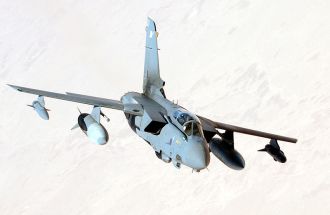
    RAF Panavia Tornado GR4 fighter over Iraq during a combat mission in support of Operation

    RAF Panavia Tornado GR4 fighter over Iraq during a combat mission in support of Operation “Iraqi Freedom”, on 16 August 2004. Source: SSgt. Lee O. Tucker – Official U.S. Air Force Photo no. DF-SD-07-05791 (via Wikipedia)

    Perhaps least analysed of recent military deployments to west Africa have been those associated ostensibly with humanitarian, rather than security, crises. In late August, following Boko Haram’s seizure of territory and declaration of its own caliphate in northern Nigeria, the RAF deployed a number (three is reported) of Tornado GR4 aircraft from the UK to the French air base in N’Djamena, Chad. This base is also used by US drones.

    Unusually, the Ministry of Defence issued almost no comment on this and refuses to disclose how many aircraft were involved, where they operated from or exactly when and why they were deployed. Officially, they were on an ISR mission in support of attempts to locate the more than 200 girls abducted by Boko Haram from a boarding school in Chibok in north-eastern Nigeria in April. All aircraft had officially returned to the UK by 15 October. While the Tornado GR4 is often deployed as a reconnaissance aircraft, it is dual use and its primary role—for example, in Iraq—is as a medium-range strike aircraft.

    Also very little reported was the US Marine Corps’ establishment during September of three new “co-operative security locations” in Senegal, Ghana and Gabon, along the west African coast. These are to be bases permanently prepared and supplied, but not necessarily manned, to support US interventions under the Obama administration’s “New Normal” doctrine, which facilitates defence or evacuation of US interests and citizens under (terrorist) attack in any country. While marines and their V-22 Osprey aircraft may continue to be based in Spain, Italy and Djibouti, these new west African bases are specifically launch pads for future US military interventions. US military contractors have been stockpiling aviation fuel at these and many other African airports for several years.

    Interestingly, the Senegal facility has been specifically referred to as an “interim staging base”—the usual terminology for a Special Purpose Marine Air-Ground Task Force base—in the context of the US military’s humanitarian mission to control the Ebola epidemic in Liberia. As with previous Obama-era deployments against the Lord’s Resistance Army in and around Uganda and in support of the Chibok abductees, the escalation of a US military presence appears to have been achieved under the cover of humanitarian imperatives and initiatives.

    Towards a Black Spring?

    All this matters because if there is one thing that we should have learned since 2001 it is that Western military interventions to oppose terrorism on foreign soil do not work: they tend to destroy the “host” country while amplifying the threat to the “far enemy”. And proxy wars between the Arab states so lavishly armed by the US, France, the UK and Russia tend to end in something worse than tears. Neither the “war on terror” nor the “Arab spring” (counter-)revolution has yet run its course.

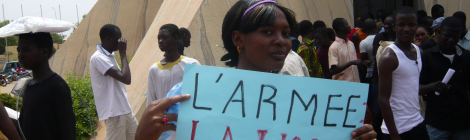
    “The Army: National Shame” caption held by protester in Mali against the 2012 coup. Source: Wikipedia

    The political crisis in Burkina Faso, in which the authoritarian president of 27 years, Blaise Compaoré, was overthrown in a popular uprising turned military coup on 31 October, provides ample warning of the toxic relationships Western states are forging in the Sahel-Sahara in the name of counter-terrorism. As in Mali in 2012, the coup leader in Burkina was an ambitious, US-trained officer. French and US special-operations forces will probably retain their semi-secret bases but their political masters have again been embarrassed by their own role as props to the hated old regime.

    Protesters in Burkina Faso—a remarkably civil, peaceful, articulate and internationalist society that belies the Sahel’s reputation for isolation—have talked up the precedent of their revolution for a “black spring” that would sweep away the Western-armed and educated tyrants whose misrule blights the south of the Sahara. They have chosen a very different path to the eschatological nihilism of Boko Haram but their hunger for change is similarly derived from generations of stultifying and systematic marginalisation under a corrupt, militarised and foreign-sponsored elite.

    Like Tunisia before it, Burkina Faso may be the clear-sighted vanguard that has the self-belief and self-discipline to manage a successful transition from autocracy. It is hard to hold such hope for the supposedly firmer pillars of western Sahel strategy, Chad and Mauritania, which have known almost nothing but rule by armed clans. Nor for Algeria—where the “printemps noir” epithet was coined during a forgotten 2001 Berber uprising—the last of whose mid-century revolutionary leaders yo-yos, paralysed and dying, between Algiers and French clinics.

    Sahara bores are wont to remind outsiders that the great desert is a crossroads, not a cul-de-sac, composed far more of enduring rock than shifting sands. The opposite can perhaps be said of the region’s militaries. Viewed within fragile states, military institutions may look rock-strong but they are built on sand and bound to fickle alliances. As in Burkina, it is society that is the bedrock with the power and permanence to anchor a sustainable strategy for peace and stability.

    Trying to contain a revolution in the Sahel-Sahara is not a long-term option but channelling it may be. Change is coming, one way or another.

    Richard Reeve is the Director of Oxford Research Group’s Sustainable Security programme. He has researched African peace and security issues since 2000, including work with ECOWAS, the AU and the Arab League.

  • Sustainable Security

    In this talk for the Food Systems Academy, Paul Rogers puts the challenges of transforming food systems in a global, human security context. He argues that food is at the centre of the third great transition humankind has to go through.

    Running order:

    Part 1. Why 1945?: 0 – 2 minutes 45 seconds

    Part 2. Proxy wars to the end of the cold war: 2 min 45 sec – 5 min 42 sec

    Part 3. The big issues: 5 min 42 sec – 20 min 45 sec

    Part 4.  The third great transition: 20 min 45 sec – 28 min 49 sec

    Part 5 – Looking ahead: 28 min 49 sec – end

    Paul Rogers is professor in the department of peace studies at Bradford University and Global Security Consultant at Oxford Research Group.  He is the author of numerous books including Why We’re Losing the War on Terror (Polity, 2007), and Losing Control: Global Security in the 21st Century (Pluto Press, 3rd edition, 2010). He is on twitter at: @ProfPRogers 

    The Food Systems Academy is an open educational resource aiming to transform our food systems. This video can also be viewed on their website.

    Featured Image: U.S. Army Huey helicopter spraying Agent Orange over Vietnamese agricultural land (Originally from U.S. Army Operations in Vietnam R.W. Trewyn, Ph.D. , (11) Huey Defoliation National Archives: 111-CC-59948, originally found in Box 1 Folder 9 of Admiral Elmo R. Zumwalt, Jr. Collection: Agent Orange Subject Files. – Item Number: VA042084; via Wikipedia)

  • Sustainable Security

    Music and dance can be useful means to engage youth in a dialogue for peace.  Music and dance can also provide many unique insights into transforming conflicts and achieving change.


    “As a musician who works for peace, “unity” holds less interest for me than “harmony.” Unity is when we all sing the same note. Harmony is when we sing different notes, and they are beautiful together.”

    – David Lamotte, musician and peace activist

    At the same time, as David goes on to say in his book World Changing 101, “Harmony is not homogeneity.” Moreover, he says, “Of course, it is also true that many notes playing together may clearly not be in harmony with one another. Creating that confluence takes attention, patience, and work. It is a beautiful thing when we achieve it, though. And it is not achieved by eliminating difference, but instead by finding ways to work together that are mutually nourishing, that honor and reveal each other’s gifts.” (LaMotte 2014: 113).

    In these ways, artistic approaches to building peace like music and dance can offer us the means to embrace pluralism through working together to co-create knowledge rather than attempting to determine one ‘right’ way upheld by those a particular society may deem to be experts.

    On Music and Peacebuilding

    Image credit: Hernan Pinera/Flickr.

    In the research for my first book, Youth Peacebuilding: Music, Gender and Change I used qualitative case comparison to explore the use of music as a tool for engaging youth in reducing and preventing violence.  More specifically, the research for that book included participant observation and semi-structured interviews with young people involved in musical peacebuilding programs in Australia and Northern Ireland, providing a uniquely deep look at young people’s experiences of everyday violence and how they approached peacebuilding in their local cultural contexts.

    In Australia this involved a peace program in a major city engaging Indigenous, non-Indigenous, and migrant and refugee background young people in a collaborative process of music making in order to build understanding across difference, challenge racism, and create safe spaces for recovering from violence already experienced. Similarly, the program in Northern Ireland shared similar goals around addressing both racism and sectarianism in its efforts at peacebuilding through participatory music practice.

    This project contributed to theoretical and practical debates and discussions around: youth political participation, the gendered landscape of conflict environments, and creative approaches to pursuing peace. In particular, I explored how music could foster peacebuilding through offering an alternative means for dialogue, helping people create and recreate identities of themselves and others, and offering a tool that could help create safe spaces for such dialogue and identity work, often in challenging circumstances.

    While my research has taken me in many directions in the decade since I began the study that underpinned that first book, I always feel drawn to return to reflections on creative approaches to peace, especially the ways they can engage youth. At present, this has taken the form of working to further analyse and share the findings from my research on dance and peacebuilding. While my earlier work dealt with dance to a degree as part of a broader range of musical practices for peacebuilding, since then I have taken up opportunities to explore dance more specifically.

    Researching Dance and Peacebuilding

     As Nicole Krauss writes in her latest book,

    “More and more it seems to me…that when I write, what I am really trying to do is dance, and because it is impossible, because dancing is free of language, I am never satisfied with writing…to dance is to make oneself available  (for pleasure, for an explosion, for stillness)…The abstract connections it provokes in its audience, of emotion with form, and the excitement from one’s world of feelings and imagination—all of this derives from its vanishing…But writing, whose goal is to achieve a timeless meaning, has to tell itself a lie about time; in essence, it has to believe in some form of immutability…” (Krauss 2017: 136).

    While recognizing these challenges, I continue to find meaning in attempting to write about dance or perhaps to dance writing. As such, during my time as a McKenzie Research Fellow at the University of Melbourne I designed and embarked on a comparative study looking at the use of dance in peacebuilding programs across a range of contexts, including Colombia (now commonly deemed a post-conflict site); the US (in inner city locations in Washington, DC and Baltimore, MD where violence is commonly seen as widespread) and in the Philippines, which, despite a peace agreement being signed, continues to face conflict in Mindanao.

    Using ethnographically informed methods, including participant observation, interviews, and document analysis, I designed the project and methodological approach and gathered data in the US and Colombia, while a research assistant gathered the data in the Philippines case. This type of intensive data gathering, which included participating in the full global training of the trainers for the program involved, as well as months of participant observation of the programs, offered rich insights into how dance and creative movement can and does engage young people in peacebuilding across a range of diverse contexts.

    While the process of writing this into a book proposal and eventually a book is ongoing, over the past several years of working on the project some key themes have started to emerge.

    The role of dance in peacebuilding

    How, if at all, did dance function as a useful way for youth to take part in peacebuilding? Firstly, participant statements indicated, “that dance can be useful in engaging youth in peacebuilding but that it must be applied in sensitive, reflexive and culturally relevant ways to appeal to and include both young men and young women.” Most if not all participants articulated one or more ways dance had been useful for peacebuilding. Some noted, for example, that dance could serve as a nonviolent means of communication and a way to connect with one’s feelings in a peace education context. Moreover, dance was seen as something that is culturally relevant and familiar, thus many youth could relate to it, and it was also something that did not require lots of expensive equipment or training. At the same time, dance was also seen as a way to release and reduce stress, an important aspect of recovering from violence already witnessed or experienced.

    Of course, participants also noted a variety of limitations to what dance could do and how, including pointing to how short term funding cycles, which are common across global peacebuilding initiatives, can at times mean short sighted programs. They also noted that without attention to access and inclusion, efforts to engage youth in dance and creative movement for peacebuilding might overlook the needs of people with disability or people who speak a different language from the one deployed in the dance programs. Still these limitations are not inherent to dance or always present, as seen by the work of VisAbility in Sri Lanka, a country recovering from conflict and where dance programming has been used to engage people with and without disabilities in coordination with a rights empowerment initiative.

    Conclusion

    Overall, it appears music and dance, when applied in thoughtful ways, can help foster peacebuilding. This is not to say they may not also be used ineffectively or to create exclusions, but when used appropriately they can have much to offer. As one facilitator in programs using dance and creative movement for peacebuilding the Washington, DC and Baltimore programs said when speaking about stepping out of one’s comfort zone to engage within a group:

    “When one person takes a positive risk, it shows the rest of us that we can take a positive risk and encourages us to do that also.  So hopefully, after a while they will be able to see that if they can just do one thing that makes them uncomfortable or kind of step outside their comfort zone that it actually helps other people to do the same and get the most out of the experience.”

    Surely such steps can be a useful means for reflecting on ways of finding harmony in the dissonance of conflict.

    Author’s Note: The research assistant involved with the Philippines work, Erica Rose Jeffrey is a fantastic scholar and dance practitioner in her own right and will soon be awarded her PhD for her own practice-led research in Fiji and the Philippines. More on her work can be found at: http://peacemoves.org

    Lesley Pruitt is a Senior Lecturer in International Relations at Monash University and a member of the Monash GPS (Gender, Peace and Security) Centre. Lesley’s research focuses on peace and conflict studies, especially recognising and enhancing youth participation in peacebuilding and advancing gender equity in peacekeeping. A Truman Scholar and Rotary Ambassadorial Scholar, Lesley received her Masters & PhD from the University of Queensland. Lesley’s books include The Women in Blue Helmets: Gender, Policing & the UN’s First All-Female Peacekeeping Unit and Youth Peacebuilding: Music, Gender & Change. She is also an author of Young People, Citizenship and Political Participation: Combatting Civic Deficit?

  • Sustainable Security

    Originally set up the mid-1980s, the temporary village guard system’s purpose was to act as a local militia in towns and villages, protecting against attacks and reprisals from the insurgents of the Kurdistan Workers Party (PKK). Has this system been successful as a counter-terrorism strategy and does it still have a role in the Turkey of today?

    In any counterinsurgency strategy, the separation of “bad guys” from the rest of the population is a significant objective which has a direct impact on the effectiveness of the campaign. To achieve this objective, forming, arming and using local militias may be a viable strategy, particularly in rural, remote, harshly mountainous and tribal contexts in which security forces face difficult challenges to reach the local population. In recent years, the “Sons of Iraq” or the “Anbar Awakening” case in Iraq and the “Tribal Security Forces (Arbakai)” case in Afghanistan are contemporary examples of this strategy.

    Does the strategy of forming local militias yield successful results? The existing, yet limited, literature on this subject has opened the door to speculations and interpretations that are more journalistic than scholarly. To better elucidate the effectiveness of forming local militias, this article presents the case of the “Temporary Village Guard System” (Geçici Köy Koruculuğu Sistemi)” in Turkey, which was first initiated in 1985 and has been fully active since.

    Turkey’s Village Guards System

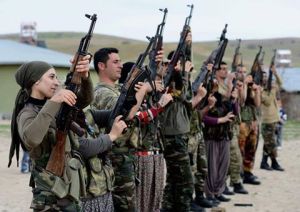
    armed-guards

    Image via Facebook.

    Since being founded in 1978, Turkey’s Kurdistan Workers’ Party (PKK) has caused approximately 20,000 fatalities, including about 11,000 civilians and 9,000 security personnel. In the meantime, about 20,000 PKK members were killed and about 6000 were captured and imprisoned. In order to thwart PKK-initiated violence, Turkish authorities have implemented many different countermeasures ranging from repressive to accommodative strategies, including the village guard system. As of January 2016, the monthly salary is approximately the equivalent of U.S. $400, along with clothing expenses and some social security benefits that came with passage of the amendments between the 74th article and 82nd article of the Village Law on March 26, 1985.

    With this legally founded, centrally appointed, and state-paid “security force,” the Turkish government created a civilian militia in the Kurdish populated southeast provinces of Turkey. Except for 300 Ulupamir Guards, who immigrated to the Van province from Kyrgyzstan, all village guards are ethnically Kurd. To supplement the employed village guard system, a “voluntary village guard” program was added in 13 more provinces, which led to the expansion of this system to 22 provinces in 1993, the year in which violence reached its peak level over the course of the conflict with the PKK. The difference between the two programs is that, while the employed village guards receive monthly salary and health benefits, the voluntary village guards do not receive a salary but are entitled to health compensation and benefits. The size of temporary and voluntary civilian armed force reached almost 60,000 by the end of the 1990s, accounting for almost one-third of the armed forces in the Kurdish region.

    As of August 2013, Muharrem Güler, then the Interior Minister of Turkey, announced that there are currently 65,456 village guards, 46,113 of whom are employed (interestingly 337 of them are women) and 19,343 of whom are voluntary (161 of them are women). Currently, the village guard system is implemented in 23 provinces. Most of the village guards are employed on the border between Iraq, Iran, and in the extremely mountainous provinces of Hakkari, Sirnak and Van because PKK has been using safe heavens in Iraq and Iran for years.

    All village guards, whether voluntary or hired, work under the supervision of the provincial Gendarmerie Commands and receive two weeks of basic military training from their provincial governor immediately after joining.

    To better understand the debate, it may be useful to examine the existing arguments for and against the Village Guard System.

    Arguments Favoring the System

    1. The village guard system has been seen a success story in Turkey’s strategy against the PKK-initiated violence to such an extent that it has become one of the main pillars of counterterror strategy. If the village guard system had not been initiated, the state authority in the region would have eventually collapsed.
    2. The village guards have first denied the mobility of the PKK both by separating them from the rest of the population as a bottom-up means of isolating them, and then prevented them from gaining territorial control.
    3. The village guards have provided intelligence to the security forces both on the territory and the activities of the PKK.
    4. The village guards have not been forced by the security forces to join this system. The existence of more than 25,000 voluntary village guards, who are not paid by the government, is a proof of this.
    5. PKK’s numbers has never exceeded the number of the village guards, even during the early 1990s, the period in which the number of the armed terrorists reached its peak level of 11,000. This is an indicator showing the low level of popular support to the PKK.

    Arguments against the System

    1. The state pitched brother against brother. If it hadn’t been for the village guards, this conflict would have never reached this intensity.
    2. The village guard system is a typical reflection of state tradition on the Kurdish issue. Enmeshed in the Kurds’ tribal networks, it exacerbated the tensions in the region. The equipping of the village guards, who were without even basic military training, increased instability in the entire region. The guard system introduced virtually extinguished social order in Kurdish daily life.
    3. The village guard system was used by the state officials as a repressive mechanism to recruit villagers.
    4. The village guards are poorly disciplined and inadequately trained.
    5. The village guards have been accused repeatedly in past years of drug trafficking, corruption, theft, rape, and other abuses. Inadequate oversight exacerbated the problem, and in many cases the security forces allegedly protected village guards from prosecution.
    6. Several reports document concerns regarding human rights violations resulting from the village guard system in Turkey.
    7. The village guard system has been responsible for deepening mistrust and ethnic divisions in an already troubled region.
    8. The village guards have moved with their families into villages that were evacuated in the 1990s and now the original villagers are returning to their villages to find the Village Guards already living there.
    9. The establishment of village guards made civilians more vulnerable to attacks.

    Has the village guard system in Turkey really worked as a counterterror strategy?

    In military terms, and despite its drawbacks and unintended consequences, the village guard system in Turkey worked well as a counter-terror strategy between 1985 and 1993 and achieved the objectives of separation of the local population from the terrorists and denying the PKK control of their hoped-for secessionist territory. Early success gained just after the implementation of the militia system needed a follow-up before the insurgency adapts. In the following years, however, it gradually waned in effectiveness when considering the increased number of PKK attacks in the period of 1993-1999, and caused increasing socio-economic and political micro-level cleavages in the region. As the big inertia in a dispersed system means resistance to change, the guards system could not easily be modified, meaning the strengthening of the existing micro-cleavages and the emergence of the new ones.

    Reasons for the decline in effectiveness

    The village guard system in Turkey was originally initiated under the assumption that the emergent threat (PKK bandits) was so local and small that it was not considered to require commitment of national security forces. This perception of PKK fighters as “a few bandits” led the Turkish government officials to the authoritization of the system in a temporally (initially, the system was designed for a two-years long period ) and spatially (only in three provinces) limited setting. However, there emerged many institutional problems as the number of village guards was enormously expanded from 800 men to 40,000 men only within a one-year-long period. The primary sources of these shortfalls would be sorted as follows: the absence of comprehensive vision at the national level and the implementation of the planning and recruitment strategy of the system at the provincial level. The absence of a national-level institutional framework which would standardize the system led to the differentiating practices in the provinces. The dramatic rise within a short period of time, when combined with the attempt of government to micro-manage the village guard system at the provincial level, led not only to confusion about the rights, missions and responsibilities of the village guards but also caused different (sometimes contradicting) practices in the following years. Fast expansion meant both weak control at the national level and different interpretations of the operational use of the guards at the provincial level.

    Furthermore, the formation of local militias may not only have pros and cons in the sphere of security but also may lead to implications in the socio-cultural sphere. The persistent characterization of the village guards as “traitor,” and the prevalent use of the term “Jash” (a Kurdish slang word for donkey) by PKK supporters to refer to Kurdish village guards, indicates the significance of the local political structure when analyzing the local dynamics of the conflict in Turkey. It is not hyperbole to suggest that the system has also changed the nature of conflict by first pushing the conflict into new areas and creating new micro-cleavages (whether tribal or at the family level) in the provinces.  These results, which clearly emphasize the explanatory power of local political structures in an ethnic conflict, confirm Stathis Kalyvas’s theorization. That is, when examining the dynamics of an ethnic conflict in a comparative perspective, Kalyvas points out that local political structures and rivalries among local groups have a great impact on shifting alliances, which are considered as acts of treason by rival factions.

    The allegation of human rights violations by militias seem to be inevitable. The absence or lack of sufficient legal mechanisms to investigate accusations, especially in combination with low levels of transparency and accountability, may lead to structural legal problems and emotional conflicts over justice in the Afghan and Iraq cases as in the Turkish case.

    To demobilize or not to demobilize?

    The Turkish government has been in a dilemma when deciding on the fate of the village guard system. Opinions about this issue highlight two options for the government, each of which can take two forms.

    The first option is demobilization. One form of this option is “honorable demobilization,” which implies that the government will end the guard system after providing all material and social rights and benefits to the retired and serving guards, and publicly elevating the history of the guards for their role in the Turkish state’s armed struggle against the PKK.  The other form, “dishonorable demobilization,” implies that the government will end the guard system with few rights and benefits for retired and serving guares, and will meticulously search the history of the guards to bring to justice those who allegedly committed crimes.  Interviewees who favor dishonorable demobilization argue the need to establish memorial sites for those crimes and brutalities allegedly committed by the guards, with periodic visits by government officials to these sites to keep the collective memory fresh.

    The second option is to maintain and continue the guards system. With this option, there again appear to be two alternative forms.  One form is the maintainance of the system after a comprehensive revision that examinines the strengths, drawbacks and conseuqences of the system in the domains of security, law and politics so as to make it more effective and efficient. The other form is the maintainance of the status-quo which implies the continuation of the village guards as an open-ended commitment not restrained by definite limits, restrictions, or structure.

    Currently, the Turkish government seems to embrace the last altenative; that is, maintainance of the system as it is in an open-ended process. With the information at hand, it is difficult to predict which option the Turkish government will embrace in the near future. Sooner or later, however, when the government decides on the village guard system, this decision will surely be a strategic one which directly affects the evolution of ongoing clashes.

    Metin Gurcan is an Istanbul Policy Center Researcher specializing in security issues.

  • Sustainable Security

    There are a number of pressing global problems that we need to address in order to attain sustainable security, such as climate change, increasingly scarce resources, and the surge of violence by globally interconnected non-state actors. If not dealt with, these issues will lead to increased regional instability and perpetual political violence. Although these issues are recognized as pressing concerns, we have not been able to find effective solutions. Underlying this failure is the exclusion of the majority of the global community from policy-making processes. This marginalization can lead to ineffective policies as they fail to consider the interests and values of a large part of the world’s population. Furthermore, given the results of social science research examining the role of values in decision making and in motivated action, policies that are ignorant of core values of the stakeholders will not only fail to garner popular support, they may, in fact, spark resistance and ignite violence.

    Background

    Most current approaches to negotiation and policy making assume that people make rational decisions – they weigh the benefits and costs of decisions and act in a way that maximizes their payoff. The values people try to maximize can be different for each party but they are assumed to be fungible: people may give up one value for achieving the other. Following these assumptions, policies and interventions often use incentives (e.g., tax breaks) or disincentives (e.g., sanctions) in order to influence the decision making of the stakeholders.

    This business-like approach to policy making and interventions has led to the successful resolution of many problems, even very difficult ones. For instance, the Egypt-Israel peace treaty of 1979. In general, as long as the values of the stakeholders can be identified, incentives and disincentives can be designed effectively, leading to successful policies.

    However, despite numerous attempts and the best efforts by the parties involved, this approach has been attempted in vain in an increasing number of contexts, and it has failed so frequently that some issues are now assumed to be intractable. A prime example is the Israeli-Palestinian conflict, where the majority of the people involved seem to have lost all hope: according to a 2015 poll by the Konrad-Adenauer-Stiftung, 51% of Israelis and 38% of Palestinians believe that the conflicting parties will not even return to the negotiation table. In other contexts, like the Northern Ireland or Kosovo conflicts, solutions devised with current approaches may prove to be unsustainable as they have neglected to address underlying concerns.

    Sacred Values

    The lack of success of current approaches is due to the underlying assumption that all values are in principal fungible: that they are mutually interchangeable. Social science research over the last 20 years suggests that this is not the case. Instead, people consider some values as so important or absolute that they refuse to even measure them on the same metric as material values. Consider, for instance, how parents may react were one to offer them money for selling their child. Most parents will decline the offer no matter how much money in involved. They will regard even considering the value of their child in monetary terms as immoral. Moreover, they will likely feel insulted and disgusted by the offer. One would get thrown out of the house if not directly reported to the authorities. This result is due to the fact that the offer fails to consider the duty most parents feel towards their child; business-like negotiation will not only be futile but will most likely backfire leading to moral anger and a breakdown of relationships. Such core values that seem to be resistant to tradeoffs with material values (e.g., monetary gains or job security), have been termed “sacred values”.

    As the name suggests, sacred values can be religious (e.g., holy land or sanctity of life) but they need not to be (e.g., equality or racial purity). However, religious ritual can transform material values into sacred ones. For example, when land is transformed from an agricultural and residential resource into “holy land.” This seems to be particularly the case in existential conflict between groups when people feel that their very existence is threatened, as is the case in the conflict between the Israelis and the Palestinians. Studies conducted before the Iran nuclear deal also found that under high pressure from other countries, a politically meaningful minority of Iranians (14%) have come to consider the nuclear program as a sacred right suggesting that material values can become sacralized in a relatively short time. The process of sacralization, however, is not well understood yet.

    When it comes to reasoning over sacred values, neuroscience studies show that decisions relating to sacred values are processed differently in the brain from material cost-benefit calculations. When people reason over sacred values as compared to material values, they are more concerned with the rectitude of their actions than with prospects. In other words, they are more concerned with morality and duties than with expected outcomes. If policy proposals that affect sacred values fail to consider this different mode of reasoning, the expected outcome is not only failure to achieve the intended aims but also resistance by the affected people, which can result in violence.

    Seemingly Intractable Issues

    Boy_and_soldier_in_front_of_Israeli_wall

    A Palestinian boy and Israeli soldier in front of the Israeli West Bank Barrier. Picture taken by Justin McIntosh. Image via Wikimedia Commons.

    Research shows that the core issues in a number of seemingly intractable conflicts are indeed considered sacred values by sizable parts of the populations involved, who show counterintuitive reactions to proposed solutions leading to a failure to resolve the issue. For instance, one research study on the support of peace deals in the Israeli-Palestinian conflict presented a peace proposal that required giving up core demands (e.g., the right of return for Palestinians). It found that “sweetening” deals with material incentives can actually backfire and exacerbate the situation. When presented with the peace deals, only a minority of Palestinians showed increased support when deals were sweetened with material incentives such as compensation payments in the form of development aid for a Palestinian state resulting from the agreement. However, the vast majority of Palestinians (more than 4 in 5) considered their core demands as sacred values and reacted with moral outrage when the deal included material compensation. They also predicted increased violent resistance if such a deal was to be agreed to by their leaders. This “backfire effect” of material incentives has since been demonstrated by Israeli Settlers when asked about giving up settling in Gaza and the West Bank (land they believe was promised to them by God) and in other seemingly intractable conflicts such as the Iranian nuclear ambitions (right to development of nuclear energy), the Hindu-Muslim conflict in India (Kashmir), and militant Jihad in Indonesia (Sharia law).

    In addition, across a number of different contexts, sacred values have been shown to incite strong emotions and spur extreme actions in their defense. People are willing to fight for their sacred values well beyond the prospect of success, seemingly disregarding self-interest. The concern for sacred values seems also to be a driving factor for the droves of young people who have been joining Islamists in Syria and Iraq, exchanging the relative comfort of their home countries for a war zone risking life and limb. For instance, a study among potential Jihadis in Morocco – one of the countries with the highest levels of foreign fighters leaving for Syria and Iraq – showed that people who considered Sharia law as sacred, expressed heightened support for militant Jihad and willingness to fight and die for the implementation of Sharia in Morocco.

    Achieving Sustainable Security

    The reality that sacred values are not fungible with material values and that otherwise reasonable policies and interventions can badly backfire does not mean we need to completely refrain from dealing with sacred values altogether. Conflicts over sacred values are not unsolvable. In fact, the very study that first demonstrated the backfire effect of business-like approaches in the Israeli-Palestinian conflict also found a reason for hope: people who considered the core demands in the conflict as sacred did show willingness to compromise if the other side made some painful concession relating to their deeply held sacred values. In particular, Israelis and Palestinians showed more flexibility regarding their sacred values when the deal included mutual recognition; that is, Palestinians would recognize Israel as a Jewish state and Israelis would recognize the role of Israel in the Nakba (Arabic for “catastrophe,” a term that relates to the expulsion and flight of Palestinians from what now is Israel). However, identifying these kinds of resolutions requires knowledge of the sacred values of all involved parties and thoughtful consideration of them in devising solutions. Unfortunately, our knowledge of sacred values held by communities worldwide is scarce.

    Just like the global clusters of values shown by the recurring World Value Survey, we can expect sacred values to differ considerably across communities and cultures and to change over time. At the minimum, we need to systematically assess sacred values across the world (similar to the World Value Survey), so decision-makers can have access to this knowledge. But for security to be sustainable in the long run, we will also need to bring communities with different sacred values to the table when we seek solutions to the most pressing issues we face today. The world cannot afford a policy-making process with global impact that is dominated by a small exclusive group of countries (e.g., the permanent member states of the UN security council) without regard for the multitude of cultures and values in the world. Because of this ignorance about the core concerns of large parts of the global community, our policies and interventions may not only fail to successfully address the issues at hand, but may actually badly backfire – by accidentally violating sacred values of the people they impact – and lead to more unrest and instability.

    Hammad Sheikh is an ARTIS research fellow at the New School for Social Research and a visiting scholar at the Centre for the Resolution of Intractable Conflicts (Harris Manchester College, Oxford University). He received a Psycholgie Diplom from the Free University of Berlin and a PhD in social psychology from the New School for Social Research. Prior to his studies at the New School, he conducted research at the Max-Planck-Institute for Human Development in Berlin, the University College Dublin, and the Free University of Berlin. His research focuses on the psychology of intergroup conflict, and uniquely brings together field research (e.g., interviews with combatants in war zones) with traditional psychological methods like questionnaires and cognitive experiments. He is currently examining how commitments to groups and values can lead people to become willing to make extremely costly sacrifices for a cause, including fighting and dying for it.