Sustainable Security programme Director Richard Reeve discusses our latest report ‘From New Frontier to New Normal: Counter-terrorism operations in the Sahel-Sahara’. The report, commissioned by the Remote Control project, finds that 2014 is a critical year for militarisation of the Sahel-Sahara and the entrenchment of foreign powers there.
Category: 2014
-
Sustainable Security
By Wim Zwijnenburg and Doug Weir
Is the US backpedalling on its use of depleted uranium (DU) rounds? There are indications that the use of these highly toxic munitions could increasingly be a political liability for the US, with countries affected by DU, like Iraq, other UN Member States, and populations in contaminated areas all expressing concerns over its use and impact. But stigmatisation, although important, is not enough on its own – in order to make sustained progress on accountability and in reducing civilian harm, a broader framework that addresses all toxic remnants of war is needed.
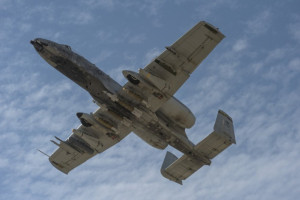
A US Air Force A-10 being deployed to support Operation Inherent Resolve. Credit: US Air Force
In a recent policy change, the Pentagon stated that it has not, and will not use DU in Iraq and Syria during Operation Inherent Resolve. The decision, which was cautiously welcomed by campaigners, contrasted with a statement made in October 2014, when the US announced the deployment of A-10 gunships to the conflict. The standard combat load for the A-10’s cannon includes a 30mm DU armour-piercing incendiary round, and in autumn 2014 a US Air Forces spokesperson said that the Air Force was ready to use DU again in Iraq and Syria.
Iraq is no stranger to DU: at least 404,000kg of the radioactive and chemically toxic heavy metal was fired in the country in 1991 and 2003. The fine dust created by DU impacts presents a hazard to civilians if inhaled, and both the dust and fragments of the ammunition can contaminate soil, vehicles and buildings. As DU particles are environmentally persistent, DU’s legacy can last long after conflicts end. Exposure to DU has been linked to increases of cancers and congenital birth defects in areas of Iraq that saw heavy fighting.
Yet despite long-running concerns voiced by Iraqi civilians and international advocates, no robust civilian health studies have ever been undertaken in Iraq to determine this link. Progress on clean-up operations has been slow, and has been hindered by the US’ refusal to provide comprehensive targeting data to UN organisations and the Iraqi government.
The evolving use of DU
The A-10 gunship has long been promoted as a “tank killer”, with the US arguing that DU ammunition is crucial for this function. Justifying the apparent U-turn over Inherent Resolve, a US public affairs official explained that: “The ammunition is developed to destroy tanks on a conventional battlefield. Daesh [Islamic State] does not possess large numbers of tanks.”
While its original Cold War close air support role did primarily concern the destruction of Soviet tanks and armoured vehicles, even then there were questions over the legality of DU. As a result, a 1976 legal review undertaken by the United States Air Force of the A-10’s DU ammunition sought to ensure that it was not used in populated areas and to restrict its use to armoured targets.
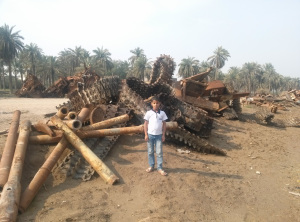
A boy standing in front of military scrap metal in Shat’l arab, near Basrah. Credit: Wim Zwijnenburg
However, the role of the A-10 has evolved since the 1970s, as has its range of targets. This was clear from data from the 2003 Iraq War, acquired by PAX in 2014. It revealed DU use by A-10s against anti-aircraft guns, buildings, trucks and un-mounted troops. Data on targets from the conflicts in the Balkans painted a similar picture. With the A-10s role evolving from attacks on armour to more general close air support, aircraft were often called in for a broader range of operations, this led to DU being used against other targets, even in densely populated areas. Once loaded with the standard combat mix, a mixture of DU and high explosive rounds, it is impossible to change the type of munitions in flight for attacks against non-armoured targets of opportunity, thus heightening the risk of exposure to civilians close to other targets.
Recently published figures on the 4,817 targets selected by US CENTCOM show that more than 120 tanks and armoured vehicles were destroyed in the first six months of the air campaign. There was therefore ample opportunity for the A-10 and its DU rounds to “kill tanks”, yet the US subsequently chose not to equip its A-10s with DU. Could this change in posture have more to do with a changing political environment, and in particular the growing stigmatisation of DU, than military calculations alone?
Stigmatisation
More than two decades after its first use in Kuwait and Iraq in the 1991 Gulf War, concern over the humanitarian and environmental legacy of DU has gradually increased.
In recent years, legislation banning the weapons has been introduced in Belgium and Costa Rica. The European Parliament has also issued a number of resolutions calling for a moratorium on use and, most recently, a common EU position in favour of a ban. Since 2007, five UN General Assembly resolutions have been passed by large majorities. These have highlighted DU’s potential health risks, called for the release of targeting data to allow clean-up, for a precautionary approach to DU’s post-conflict management and, in 2014, for international assistance for states affected by DU use. This last resolution was supported by 150 states and opposed by just four, including the US. In addition to establishing soft law norms on DU, the process has also created a platform for an increasing number of states to voice their concerns over the weapons.
Perhaps the most influential of these was from Iraq in March 2014, where its government expressed:
[D]eep concern over the harmful effects of the use in wars and armed struggles of armaments and ammunitions containing depleted uranium, which constitute a danger to human beings and the environment.
The Iraqi government called for the UN, its specialised agencies, member states and civil society to take a proactive approach to the issue and to condemn DU use. They also argued for:
[A] binding and verifiable international treaty prohibiting the use, possession, transfer and trafficking of such armaments and ammunitions.
Clearly then, the further use of DU munitions by the US in Iraq would have been viewed as unacceptable by the Iraqi government, and would have been likely to result in further criticism of the increasingly controversial munitions.
Leaving through the back door?
Could the changing political climate be influencing US policy on DU? The US had previously come under pressure from civil society campaign the International Coalition to Ban Uranium Weapons (ICBUW) in 2011 over fears that DU would be used against Gaddafi’s tanks in Libya. Recent evidence of DU’s international stigmatisation has come, ironically, from the Joint Strike Fighter, which is supposed to replace the ageing A-10 in its close air support role – a decision that is proving controversial in the US. During the fighter’s development, project partners including Australia, Norway and Denmark expressed concern over the US proposal that it would use a DU round, insisting that an alternative material be found. DU was eventually ruled out, as were other toxic metals such as beryllium. Elsewhere there are signs of shift away from DU in the US’s other medium-calibre ammunition.
In 2008, just a year after the first UN General Assembly resolution, the US Army Environmental Policy Institute (AEPI) argued that alternatives were needed, stating that ‘the military should continue pursuing R&D for substitutes and be prepared for increased political pressure for current and past battlefield cleanup’. The Massachusetts Institute of Technology is one of several bodies researching less toxic materials, and in December 2014, published a new advance in manufacturing nanocrystalline tungsten alloys, which results in a material with similar properties to DU. DU’s toxicity is a key driver for this research.
While changes in procurement policies are slow, decisions like that taken over Inherent Resolve are tangible signs that international pressure is changing DU policy. Nevertheless, the emerging threshold of acceptability for DU use remains poorly defined and it is unlikely that the US will seek to clarify it any time soon. Operation-specific factors – such as Iraq’s clear position in favour of a ban – are also likely to remain important in determining whether DU is used or not. Backlash over veteran exposure, community opposition and financial liabilities associated with former testing ranges may also influence policy within the US.
The way forward
Welcome as these developments are, they serve to highlight the current lack of formal obligations for post-conflict DU clearance and victim assistance. Unlike explosive remnants of war, and in spite of the soft norms developing at the UN General Assembly, accountability and assistance for past DU use is underdeveloped and requires attention from both civil society and the international community.
As was the case with anti-personnel landmines, it will not be enough to simply stop DU being deployed. Protecting civilians requires that its legacy is also dealt with. DU remediation is costly and technically challenging, and states recovering from conflict require assistance to implement effective programmes.
More broadly, DU is just one of a number of toxic munitions constituents, and munitions just one of a wide range of pollutants generated by conflict. These toxic remnants of war pose a threat to human and environmental health before, during and after conflict. Efforts to minimise the practices that generate them and work to ensure that their impact is properly assessed and responded to could contribute greatly to not only the protection of civilians but also of the environment upon which they depend. Tackling the causes and legacy of conflict pollution also provides a welcome opportunity to creatively merge the environment, public health, human rights and humanitarian disarmament in response to the toxic footprint of modern warfare.
Wim Zwijnenburg works as a Program Leader Security & Disarmament for PAX, a Dutch peace organisation. He has a research program in Iraq on the impact of depleted uranium munitions, works on Toxic Remnants of War in Syria, emerging military technologies such as (armed) drones, and is supporting the Control Arms campaign in regulating the global arms trade.
Doug Weir is the Coordinator of the International Coalition to Ban Uranium Weapons, a global coalition seeking a ban on the use of DU and for assistance to communities affected by its use. He also manages the Toxic Remnants of War Project, which explores state responsibility for the toxic legacy of military activities.
Featured image: A tank destroyed and contaminated with DU in 2003 near Basrah. Credit: UK Ministry of Defence
-
Sustainable Security
Democratic Republic of Congo’s sexual violence epidemic is not only a weapon of ongoing violent conflict but an expression of entrenched systemic problems. Indeed, sexual and gender-based violence (SGBV) is most commonly perpetrated by the security services in place to protect civilians. In Quartier Panzi in South Kivu province, innovative processes of security sector reform and strengthened police-civilian channels of communication may be providing an opportunity for change.

Meeting of victims of sexual violence in South Kivu, Democratic Republic of the Congo. Source: Wikipedia (from USAID)
Quartier Panzi—the populous, restive neighborhood of Bukavu, South Kivu province—is renowned in international development circles as the ground zero of the Democratic Republic of Congo’s sexual violence epidemic. Rape as a weapon of war is not so much perpetrated by enemy forces but, most often, by the very parties sent by Kinshasa to protect and serve civilians. Much as Selma, Alabama was to the American civil rights movement, Panzi’s ongoing tragedy has transformed the area into a vibrant arena for grassroots opposition and international solidarity in the fight to restore women’s bodies and lives. Women’s organizations have formed to denounce continued abuses and government denial, to reverse cultural stigmas around female culpability in rape, and to demand trial for Congolese security forces suspected of sexual abuses.
The courage and commitment of Dr. Denis Mukwege, chief gynecologist at Panzi Hospital and twice nominated for the Nobel Peace Prize, is emblematic of this resilience. International networks like V-Day and Women for Women International support these local actions and fund sanctuaries for survivors, such as the City of Joy. These innovations aim to be restorative and empowering for survivors, focusing on the crisis as experienced by women and girls, offering healing and vocational training options otherwise non-existent. However, the causes of this specific form of cruelty and degradation, rooted in violent masculinities and impunity among security actors, remain unaddressed.
Rewiring the security sector
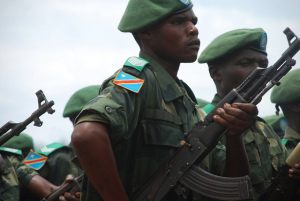
Congolese soldiers march in Walikale, DRC, 2011. Source: ENOUGH (Flickr)
Like any deep malaise, Congo’s rape crisis is but one expression of entrenched, systemic problems. Local witnesses, security analysts and medical professionals who treat survivors present overwhelming evidence that the primary perpetrators are uniformed Congolese security actors. A weak justice system may be responsible for the failure to discipline or punish perpetrators, but the sources of this behavior lie within the security sector itself. Accessing the security elite, Congo’s infamous ‘black box’, is notoriously difficult. As a result, very little analysis exists of the problem from the perpetrators’ perspective: analysis and evidence that deciphers the institutional culture and internal organization of the security sector, or that maps relations between senior officers, politicians and economic actors. By design, opacity reigns supreme.
A variety of international donors support the national army and police with numerous ‘train and equip’ initiatives, an international cooperation model unchanged since the Cold War.These ‘security development’ partnerships aim to strengthen national capacity through field and classroom training and equipment upgrades; behavior change and public accountability are not part of the approach. Within the security services, there is typically an absence of civilian oversight, and widespread rent-seeking and illicit trade in protected flora, fauna and minerals, but no questions are asked by international partners, as diplomacy and formality dominate.
Supply-side approaches such as these long pre-date the advent of ‘security sector reform’ among development actors, which does seek behavior change and greater accountability. The older aid modality remains popular with the Congolese leadership because it expressly avoids any calling to account or inculcation of security as a public service and legal right.
There is state and donor complicity in all of this. Strength without constraint or accountability defines the DRC’s security sector today. Its predatory practices range from unchecked rape and pillage in the East to the repression of free speech and public inquiry, as witnessed by the 2010 murder in Kinshasa of prominent human rights activist, Floribert Chebeya. To placate critics, a military tribunal mounted a kangaroo court in the wake of the murder; the film documenting and exposing its empty theatrics, L’Affaire Chebeya, Un Crime d’Etat, remains banned in Congo.
Such officially sanctioned practices and attitudes are salient features of the Congolese state since independence, and well known to all Congolese. In the early 1970s, President Mobutu Sese Seko began encouraging civil servants and security forces to ‘feed on the population’ (“Population baza bilanga ya bino”). Anecdotes such as these are more than flippant asides; they explain the persistent appeal of this patrimonial compact (across four chapters of Congolese leadership: Mobutu, Kabila père, transitional government, Kabila fils) as a declaration of complicity between political elites and the entire public sector. In its truncated audacity, this single utterance reconfigures and reduces the entire means and ends of the state to elite enrichment and group impunity.
In Panzi, armed crime and physical/sexual assault reached unprecedented levels in the aftermath of the primary war in South Kivu province. State security had long colluded with local armed gangs, and popular recourse options ranged from individual vengeance to military tribunals, as civil courts are unreliable. Mob justice is also widely practiced. The formation of neighborhood watch groups raised local hopes for improved safety (e.g. SAJECEK–Forces Vives). Despite their initial popularity, they soon joined local police and armed gangs in perpetrating the very crimes they first sought to oppose.
How urban police understand this license to extort and harass the population, and the higher interests these practices serve, has been well captured and analyzed by Maria Eriksson Baaz and Ola Olsson. Transforming Congo’s security sector from inside is an elusive challenge, and donors are struggling to develop the programmatic savvy, influence and access to inspire the necessary political will.
Demand for reform
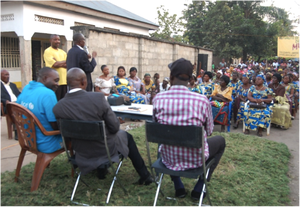
Community meeting in Kananga, DRC, where security officials and civilian leaders converse directly with local community leaders. Source: DAI Europe (with permission)
The UK’s Department for International Development (DFID) has experimented with alternative supply-and-demand models of public sector reform, and is applying these to the Congolese National Police (PNC). According to this strategy, supply-side ‘train and equip’ assistance targets weak service areas, including the prevention of and response to sexual and gender-based violence (SGBV). This is complemented by efforts to mobilize popular demand for more responsive policing at the community level.
A particular understanding of the partner institution, the PNC, informed this theory of change. This included the hypothesis that payment of regular salaries would not end extortion and rent-seeking (’tracasseries’) by the PNC, given the scale of these rackets and the enormous sums they generate. With no compelling alternative on offer, and as long as ‘reform’ is understood to involve replacing tracasseries with ‘protecting and serving’, change will elude would-be reformers. Given that such arrangements will not change in the forseeable future, the more nuanced strategy accommodates the reality of low, irregular salaries and uniformed extortion for the foreseeable future, and seeks behavior change through increased public-police interaction. Faster paced improvements in human security and responsive policing began emerging on the demand side of the pilot sites, including Bukavu and Quartier Panzi in particular.
Launched in Bukavu, Matadi and Kananga in 2009, the Security Sector Accountability and Police Reform Programme (SSAPR) is distinct for coupling its community policing approach with regular neighborhood meetings (forums du quartier) where locally appointed representatives voice their security concerns, identify emerging threats and suspects. It is common for community policing programs to seek a more responsive, service-oriented local police, but SSAPR is distinguished by its effort to cultivate citizen networks at the most local level to identify and articulate their fears, threats and suspicions forward to the actors most able to respond. Police officers, urban administrators, local community and neighborhood leaders then meet regularly in informal, local security councils to discuss proposals for containing a threat or resolving a violent dispute, as equipment and manpower are often lacking. Initiated entirely informally, these experiments in public relations gradually began to change expectations, reinforce collaboration and gain momentum.
Concurrently, the National Parliament submitted a motion to formalize the Conseils Locaux pour la Sécurité de Proximité(or CLSP, finally passed in late 2013), which recognizes the right of civilian representatives to participate in official security discussions at the municipal level. Over three years, SSAPR legal advisers worked with national parliamentarians to build support and draft a bill. Given the long-standing animosity between politicians and civil society, this new décret was a highly significant opening. The platform has since been incorporated into other police reform efforts (such as the European Union’s EUPOL) that also understand SSR in the Congolese context as primarily a governance challenge requiring civilian involvement.
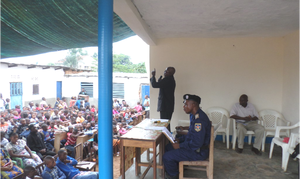
Community meeting in Kananga, DRC, where security officials and civilian leaders engage directly with local community leaders. Source: DAI Europe (with permission)
Raising security problems through the CLSP increased dialog between communities and security officials, but who would represent the civilian side? In rough urban neighborhoods like Panzi, citizens experience a host of threats, not all of them equally or in the same way. The SSAPR helped Panzi neighborhood chiefs and community leaders coordinate an informal system whereby youth, women and men would alternately represent their community concerns first to a forum de quartier, then directly on to the CLSP. This neighborhood dynamic continues today across Bukavu’s three communes.
Making Progress?
These are small steps toward a more accountable security sector and restored public trust, but has sexual assault around Panzi declined as a result? Recently the SSAPR helped a women’s NGO organize a nocturnal walk through several Bukavu neighborhoods, including Panzi, to record their own safety concerns as well as those of women and girls met along the way. In a recent meeting, NGO members insisted they would never before have visited these neighborhoods, particularly at night, but that the chance to report their findings to a receptive and interested police commisariat justified the risk.
In response, new light fixtures are planned in darkened alleys where assaults have occurred, and patrols redirected to suspicious areas noted by the NGO delegation. In another pilot city, Kananga (Kasai Occidental), assaults on women and girls who were walking long distances to fetch water, often at night, decreased dramatically after local women lobbied for regular police patrols in these areas. This, in itself, was indicative of a greater local confidence in the police as protectors.
Community police units are involved in implementing these changes, but they represent a small minority of the PNC. It is unknown if these lower rates of sexual violence are attributable to behavior change among uniformed security or if the increased patrols and better lighting are deterring other possible assailants. Retrospective studies have been conducted, but no consensus exists on the total quantitative extent of SGBV in DRC, where just one in twenty cases is thought to be reported to authorities. Nor are cases raised with the police guaranteed to be registered or pursued. Impunity persists due to a weak national justice system, as well.
Other insights emerge from this experience, particularly around ‘bottom-up’ approaches to renewed legitimacy in fragile states. In the DRC, where central government continues to stall on commitments to decentralization and provincial institutions exploit this limbo (enrichment via parallel markets; legal and financial opacity) leaving communities in the breach, these small successes show that by investing at the periphery—that most-local interface where citizens and public service providers meet in person—bridges of trust and respect can be built through participatory problem solving. Communities can show resilience and security services can prove they are responsive and effective.
Edward Rackley is a Security and Governance consultant for the World Bank, based in Washington DC. He provides periodic technical and strategic advice to the SSAPR program via DAI Europe, one of the program’s managing agents. (The views expressed in this article are not necessarily those of these institutions.)
-
Sustainable Security
This article was originally published on openSecurity’s monthly Sustainable Security column on 27th January, 2014. Each month, a rotating network of experts from Oxford Research Group’s Sustainable Security programme and their partners explore on-going issues of global and regional insecurity.
Sustainable Security is a concept that has been around for almost a decade now. It was first conceptualised by my colleagues Chris Abbott and Paul Rogers, whose thoughts on the subject have appeared many times in these pages. In 2000, Paul summed up what looked to many commentators like a surprisingly quiet decade of US hegemony as characterised by an unsustainable ‘control paradigm’, in which the symptoms of global insecurity were suppressed with force while their root causes were ignored and left to fester. The 9/11 attacks and subsequent ‘war on terror’ served to confirm Paul’s hypothesis that military domination would not be sufficient to ‘keep a lid’ on security challenges, even in the world’s most powerful states.
The Sustainable Security paradigm has been developed by the Oxford Research Group as an alternative lens through which to view global security, identifying the underlying drivers of conflict and insecurity rather than its symptoms, such as violence, organised crime or radicalisation. The point is to understand how unmet human needs and feelings of insecurity interrelate and lead to violence, then to work to prevent conflict by addressing its root causes. The aim of this new monthly column on openSecurity is to facilitate precisely this kind of understanding through contributions from the Sustainable Security Programme’s network of experts on non-traditional security issues.
Taking a sustainable security approach requires some thought about the future of our planet as well as its current unsustainable state. Changes to climate, demography, economic production and consumption, political and national identity, access to information and military technology will all condition the future security of our world. What, then, does 2014 hold in the way of challenges and opportunities?
2014: the end of the war on terror?

British Soldier with 1 Welsh Guards returns from patrol in Zarghun Kalay, Afghanistan Source: Ministry of Defence (Flickr)
By the end of 2014, the last NATO combat troops should have withdrawn from Afghanistan. Does this mean that the alliance’s war on terror will end where it began 13 years earlier? I doubt it. Billions of dollars and thousands of lives later, Afghanistan looks about as stable as Iraq. Pakistan, India, Iran and other powerful actors will continue to play their own cards at the Afghan table and it is barely conceivable that the US and its allies will not seek to use their own military influence and proxies to keep the Taliban down, however appalling the post-Karzai elections this April.
As much as President Obama has sought to distance himself from the toxic Bush legacy of overt and unilateral interventionism, the nature of the ‘Obama doctrine’ is war on terror-lite. It is covert, stealthy, and still the wrong side of international law. Obama’s strategy relies on the use of ‘remote control’ warfare: special forces, private military contractors and, above all, armed drones, or unmanned combat air vehicles (UCAVs). Since 2009, US drone attacks have escalated dramatically and killed hundreds, including civilians, in Pakistan, Yemen, Somalia and Afghanistan, where the UK also increasingly uses UCAVs. Withdrawing combat units does not mean that NATO states will cease to pursue war by remote control in Afghanistan.
Arguments that UCAV systems and operators are more offensive or inclined to kill civilians miss the larger legal point that the US is increasingly pursuing undeclared wars and targeted assassinations, whether it employs drones, special forces, mercenaries, manned gunships or cruise missiles. The backlash to such action is demonstrable through the further radicalisation of communities living in fear of constant surveillance and attack from the unseen. It is employing terror against terror.
2013 was something of a break-out year for UCAVs. Israel set many of the precedents that the US has followed in drone warfare as well as targeted killings. The technology is simple and easy to imitate. While the UK and France invest in US systems and test indigenous prototypes, China and Iran have flown their own first UCAVs. Russia and others are not far behind. Even very modest air forces like Nigeria’s have built their own rudimentary drones. Non-state constructors cannot be far behind. Drone proliferation may define this decade as wireless communications defined the last.
Militarisation of the greater Middle East
If 2013 was the year that the democratic hopes of the Arab Spring unravelled, 2014 may be the year that it turns to regional war. Libya appears to be at the vanguard, although there remains a chance that it could follow Yemen’s path of dialogue and isolate its increasingly prominent radical fringe. Egypt’s generals have learned nothing from Algeria’s tragic past and the leaden Mubarak years. Iraq’s Maliki regime still believes it has nothing to learn from Syria’s sectarian implosion, continuing to marginalise a Sunni minority.
Neither the US, UK nor France is likely to want to overtly intervene in the inferno of Syria or the escalating crises of Iraq, Libya and Egypt; plenty of others will. Meanwhile, the Sahara is becoming steadily more militarised. France has just announced a major repositioning of its forces in Africa out of their urban and coastal bases and into the Sahel to hunt and destroy al-Qaida affiliates. Ever since 2009, US special forces, drone operators and private contractors have been quietly moving from Djibouti across the Sahel and Horn, increasingly sharing facilities with France.
Transition tensions
Away from the Middle East, 2014 could be a year of democratic consolidation among rising powers. No less than eight of the 15 largest emerging economies expect to hold elections this year and a couple more are already polarising around polls due in early 2015.
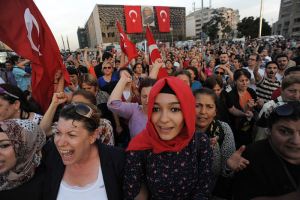
Taksim Sqaure protestors, Istanbul, Turkey, 16 June, 2013. Source: Wikimedia
India, Brazil, Turkey, South Africa, Thailand and Egypt all plan to hold elections this year, in the wake of major protest movements in 2013. New parties from the margins are shaking up politics in India and South Africa, potentially increasing instability as the establishment fights back. Thailand is already politically paralysed as its metropolitan establishment lashes back at the populist aspirations of the rural majority. Turkey could see something similar if, as expected, conservative premier Erdogan seeks the presidency in August. Emerging giants Brazil and Indonesia will probably weather their elections better but nonetheless will be distracted.
While 2014 may not be a peak year for economic growth or political stability among regional powers, overall the longer-term trend looks positive – marginalised groups, whether from the middle or working classes, asserting their rights and taking a stand against corruption and environmental degradation. With notable exceptions in Egypt, Thailand and perhaps Turkey, there is a deepening of democratic culture, whether or not civil society is fully respected, in many major developing states and significant incidences of demilitarisation and respect for rights. However, many of the biggest of them – Brazil, Mexico, Indonesia, Argentina to name just the democracies – are major oil, food and timber exporters with structural incentives to resist, for example, international efforts to restrict carbon emissions.
Elections to the European Parliament in May and the US Congress in November may be less encouraging. The Tea Party trend and the rise of populist nationalism will continue squeezing progressive policy options on both sides of the North Atlantic.
2014 as prelude to 2015
Finally, 2014 is the year in which much of the work has to be done to prepare for the potentially landmark policy processes of 2015, each of which will have significant impact on future global security. For the UK, this includes the political parties setting their manifesto commitments ahead of the May 2015 general election and preparations for the ensuing review of National Security Strategy and Defence and Security Review. Three international processes also stand out.
For arms reduction there is the quinquennial Nuclear Non-Proliferation Treaty Review Conference, due next May. Difficult debates are expected given the Obama administration’s focus on superiority in strategic conventional weapons.
For climate change the UN Framework Convention on Climate Change is to set a new universal climate agreement to replace the 1997 Kyoto Protocol on carbon emissions after 2020. This will extend emissions targets from industrialised to developing countries but faces huge hurdles in overcoming resistance from energy lobbies and climate change sceptics in the most powerful states.
To address development there is also the culmination of the Post-2015 Development Agenda process to supersede the Millennium Development Goals and forge a new agenda with the Sustainable Development Goals. This is a massive project and there remains much to be done to ensure that conflict-affected states are not left behind, as they have been by the MDGs, and that the new agenda tackles inequality as a crucial part of achieving sustainable human security and development.
2014, then, is a time for looking backwards and forwards. While the dynamics of the war on terror are still very much in play, the withdrawal from Afghanistan and the re-escalation of violence in Iraq and Libya present an opportune context for sincere reflections on the disastrous consequences of war without borders. Such inquiry needs to look forward too, to the implications of the current administration’s ‘war-lite’ and the unstoppable proliferation of remote control technologies.
This is also the year where we have the chance to get the agenda right for the big international policy decisions of 2015. Looming elections may make it a difficult year for politicians in the US, Europe and many emerging powers to show leadership on such controversial issues. Thus, 2014 will be an important year in deciding whether we continue to control the symptoms of global insecurity or whether we begin to address seriously the inequalities and injustices that underlie it.
Richard Reeve is the Director of Oxford Research Group’s Sustainable Security programme. He works across a wide range of defence and security issues and is responsible for the strategic direction of the programme. Richard has particular expertise in global security, Sub-Saharan Africa, peace and conflict analysis, and the security role of regional organisations.
-
Sustainable Security
This article was originally published on openSecurity’s monthly Sustainable Security column on 7 August 2014. Every month, a rotating network of experts from Oxford Research Group’s Sustainable Security programme explore pertinent issues of global and regional insecurity.
 This article is part of the Remote Control Warfare series, a collaboration with Remote Control, a project of the Network for Social Change hosted by Oxford Research Group.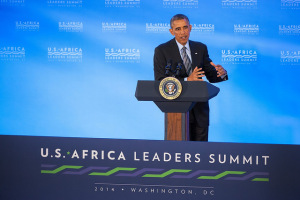
President Obama Holds a News Conference at Conclusion of U.S.-Africa Leaders Summit. Source: US State Department (Flickr)
This week, Africa’s leaders have congregated in Washington, D.C. for the first US-Africa Leaders Summit, with talks on trade, investment and security aimed at establishing stronger ties between the US and countries across the continent. President Obama has been widely criticised for the late timing of this summit, 14 years after China started holding its regular Africa summits, and his failure to prioritise the continent earlier in his presidency. In the eyes of many commentators, this is Obama’s attempt to etch out a legacy in Africa.
But, as African leaders sit down to discuss peace and stability, the Obama administration need not fear a lack of a legacy. Indeed, as a recent report from Oxford Research Group and the Remote Control project shows, for all the talk of the US lacking engagement with Africa, military forces under the new US Africa Command (AFRICOM, a legacy of the late Bush administration) have been pursuing a quiet but sustained “pivot to Africa” under the Obama administration. In the wake of recurrent security crises in the region this decade, the remote Sahel-Sahara region of northwest Africa has become the laboratory for experiments that will define counter-terrorism operations in the 21st century.
The global ‘war on terror’ has come to the Sahel, but not with the lengthy, embedded military campaigns we have seen in Iraq and Afghanistan. Instead, AFRICOM and its allies are testing an open-ended, “light-touch” approach, with few boots-on-the-ground and a reliance on special forces, drones and private military companies. This emphasis on covert and deniable operations makes it inherently difficult to gauge the full extent of the war in the Sahel-Sahara. It also raises many questions about its effectiveness in countering violent extremism and what the long-term impact will be on regional stability.
The Quiet Pivot to Africa
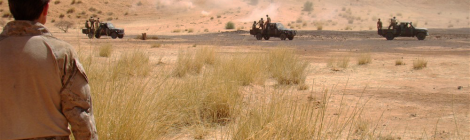
A U.S. Navy SEAL advisor watches a Malian special operations vehicle unit run through immediate action drills for counter-terrorism missions during training, February 26, 2010 near Gao, Mali. Source: Max R. Blumenfeld, Joint Special Operations Task Force Trans-Sahara, via AFRICOM.
The evolving importance of the Sahel-Sahara in the counter-terrorism strategies of the US, France and other western states cannot be understated. Following the 2011 Arab uprisings, NATO-assisted overthrow of Libya’s Gaddafi regime and 2012-13 Mali crisis, the Sahel-Sahara has become the “new frontier” in global counter-terrorism operations. With three main active jihadist groups – Al-Qaida in the Islamic Maghreb (AQIM), Boko Haram and Ansar al-Shari’a – it has risen high in US priorities.
September 11 is the key date for US engagement in the Sahel-Sahara, but 2012 not 2001. This was the date that jihadist militants stormed US diplomatic compounds in Benghazi, Libya, killing the US Ambassador and three other citizens. The result of Benghazi has been a battle over blame in the US Congress and a profound rethinking of crisis response capabilities in remoter, high threat parts of the world. Called the “New Normal”, the new US concept calls for heavily armed air-mobile Marines to be able to deploy anywhere within hours to respond to threats to US citizens and interests.
US Marines already operate out of bases in Spain, Italy and Djibouti but, since Africa is a vast continent with scores of “high risk” US facilities, more bases will be needed to support the “New Normal”. Recent visits by Marines in their MV-22 Osprey vertical landing aircraft to Senegal and Ghana were part of this base-scouting process.
The US is also likely to seek more facilities to operate its intelligence, surveillance and reconnaissance (ISR) drones in the Sahel-Sahara, both to track terrorists and to support the “New Normal”. Its one drone base in Niamey, Niger can cover most of West Africa – and North Africa is covered by drones operating from Sicily – but there are gaps, notably around Senegal and Chad. Responding to the humanitarian outcry over Boko Haram’s kidnapping of schoolgirls from Chibok, Nigeria, has already seen US drones deployed from Chad. A web of drone bases in and off the Horn of Africa already surrounds Somalia.
Covert Operations
These are the kind of current and future operations that we can broadly expect to know about because their bases and impacts are highly visible. The “New Normal” has already been tested in embassy evacuations in South Sudan (December 2013) and Libya (late July). But there is much more happening beneath the radar. Covert operations using Special Operations Forces appear to be an increasing feature of the US approach in the Sahel-Sahara. Several hundred are believed to be present in the region on undisclosed “contingency operations”.
Increased ISR capabilities have also depended on use of private military and security contractors (PMSCs), who have run key elements of AFRICOM’s covert counter-terrorism operations in the region. Using unmarked, civilian-registered aircraft, they provide ISR operations, transport special operations forces, and provide medical evacuation and search and rescue capacities.
Partnerships and Alliances
Finally, US influence on counter-terrorism in the region extends to training regional security forces under AFRICOM’s Trans-Sahara Counterterrorism Partnership (TSCTP) and is likely to be expanded significantly under the Counterterrorism Partnerships Fund, announced by Obama in May, and as more Special Operations Forces are released from duty in Afghanistan. The EU, Canada and a number of more controversial US allies like Israel, Colombia and Morocco are also increasingly involved in counter-terrorism training programmes in the Sahel.
But it is France – the old colonial power, Saharan gendarme or legionnaire – that has most at stake in the Sahel-Sahara and on which the US so-far depends. Last week, France formally redeployed its military forces under Opération Barkhane, which sees French land, air and special forces establish an indefinite regional presence at eight bases and several other forward operating locations across five or more Sahel states. US forces and aircraft have a presence at least three of these bases (Niamey, N’Djamena and Ouagadougou) and probably use several others for “contingencies”.
Barkhane and the recently renewed mandate of the UN Multidimensional Stabilization Mission in Mali (MINUSMA) entrench the presence of over 9,000 external security forces in the Sahel-Sahara with mission and mandate to combat terrorist groups. Remarkably, Dutch special forces and intelligence agents are embedded in MINUSMA with responsibility to track jihadist groups. UN-mandated French forces have carte blanche to seek and destroy whomever they decide is a threat to security in Mali. Not surprisingly, AQIM and its allies rarely distinguish in their targets between France and the UN.
Repercussions
Just as there is little mention of this rapidly expanding presence, so too is there little discussion of the effectiveness this new approach to counterterrorism and the impact it will have on stability, governance, and accountability in a fragile region.
The 2013 French and African intervention in Mali stopped the southwards advance of jihadist groups and returned control of much of the north to the Malian government. However, this displaced AQIM and its allies into Libya, Niger and possibly Nigeria, threatening wider regional stability. Moreover, the intervention has done little to address the political and social nature of Mali’s northern rebellion and French and African forces have limited ability to protect civilians against a terrorist rather than insurgent threat. The heightened visibility of US and French forces in the Sahel-Sahara and the strengthening of Islamist militia during the Libyan civil war have significantly increased the profile and activity of jihadist groups. As the foreign militarisation of the region continues, the motivation for retaliatory attacks is likely to increase.
While AFRICOM and Washington have established a regular military presence in all regional countries through its TSCTP, there is little recognition of the often toxic nature of these partnerships. The US has made sure this week not to be seen to engage with selected authoritarian African regimes, withholding invitations to Sudan’s ICC indicted Omar el Bashir, Zimbabwe’s Robert Mugabe and Eritrea’s Somalia-meddling Isaias Afewerki. Yet, in a nod to similarly uncritical alliances of the Cold War era, its expanding military engagement across Africa has depended on relationships with similarly dubious governments. Djibouti, Uganda and Ethiopia, the increasingly undemocratic pillars of US campaigns against Somalia’s al-Qaida franchise, are the most blatant examples.
In the Sahel-Sahara, the US and, to a larger extent, France, rely hugely on Chad’s authoritarian government for basing and combat support. Military-based governments in Algeria and Mauritania have also been able to normalise their international relations, including arms imports, as crucial partners in Saharan counter-terrorism operations. To be fair, the US is choosier than France where it locates its overt bases – Niger and, potentially, Senegal and Ghana are among the best ruled West African states – but its covert operations and military-to-military partnerships span every country in the region.
Perceived international protection may discourage some regional governments from seeking internal political settlements. The elected Malian government seems to have interpreted its post-2013 French and UN guarantees of security enforcement as reason not to pursue a peace process with northern separatists. Similarly, Côte d’Ivoire’s President Alassane Ouattara has shown no urgency in seeking reconciliation with supporters of the former regime since French and UN troops helped him to power in 2011. Governance, human rights and non-military solutions to existing conflict are thus considerably undermined by the securitisation of policy in the Sahel-Sahara.
A lasting legacy
With all of this in mind, US outreach efforts at this week’s Summit seem readily undermined by the lack of ability to monitor – and thus hold accountable – its military expansion across Africa. While President Obama has stated that partnership with Africa must be ‘grounded in mutual responsibility and mutual respect’, his willingness to leave a legacy of low accountability and low-key military support for undemocratic regimes suggests that this responsibility and respect is not intended for the people of Africa.
Outside of the limits of this week’s Summit, the trend towards covert or “plausibly deniable” counter-terrorism – PMSCs, drones, rapid reaction special forces – and barely restrained mandates to wage war is indicative of the real and increasing power over Africa policy exercised by Defense departments in both Washington and Paris. In turn, securitisation of approaches to the region will undermine non-military approaches to insecurity and conflict resolution, moving regional autocrats further from domestic accountability and buoying the extremist ideology it seeks to discredit. For all the west may seek to tread lightly, there is a large footprint in the sands of the Sahara – one which will not be erased any time soon.
Richard Reeve and Zoë Pelter are authors of From New Frontier to New Normal: Counter-terrorism in the Sahel-Sahara, released on 5 August.
Zoë Pelter is the Research Officer of the Sustainable Security Programme at Oxford Research Group. Previously, she worked with the International Security Research Department at Chatham House and the Associate Parliamentary Group for Sudan and South Sudan in the UK Parliament.
Richard Reeve is Director of the Sustainable Security Programme at Oxford Research Group. He has worked as an analyst of conflict and security issues in Africa since 2000, including for Jane’s Information Group, Chatham House, King’s College London and as Head of Research at International Alert. He has worked on conflict prevention, warning and management systems with ECOWAS, the African Union, the Arab League and many local organisations.
-
Sustainable Security
Author’s Note: This contribution is a shorter version of the article “Resilience and environmental security: towards joint application in peacebuilding” by Schilling et al. 2017
Resilience is a widely used concept among development, environmental, security and peacebuilding organisations. However, it has rarely been applied together with the concept of environmental security, despite the obvious ways in which the concepts complement each other. These concepts can be jointly applied in the peacebuilding sector. Environmental security sharpens the scope of resilience, while resilience allows for taking issues into account that a traditional environmental security perspective might miss.
‘Resilient communities’, ‘climate-resilient pathways’, ‘resilient future’, ‘resilient planet’: there are hardly any key terms in the development, climate change, security, and peacebuilding sectors that have not been combined with ‘resilience’. Due to the malleability of and enthusiasm for this concept, it has been depicted as the ‘new superhero in town’ replacing sustainability as the key guiding concept and buzzword in the international development community.
Less prominent but still widely used, at least implicitly, is the concept of environmental security. The term can relate to the absence of risks posed by environmental changes or events to individuals, groups or nations. But it can also focus on the environment itself and how human behaviour, including conflict, affects the security and integrity of the environment.
Several international organisations, including International Alert, adelphi, and the United States Agency for International Development (USAID) are working on combined approaches to environment, conflict and security issues. However, resilience has hardly ever been applied in conjunction with the concept of environmental security, despite their potential complementarity. Particularly in the peacebuilding sector, joint application of the concepts is promising because it could help to create an understanding of the extent to which people are at risk due to environmental factors (environmental security), and the extent to which people are able to adapt to environmental risks (resilience). Further, a joint application could help to understand the impacts of environmental factors on conflict dynamics and vice versa. Against this background, develop a framework which allows non-governmental organisations (NGOs) working to implement peacebuilding projects in developing countries to jointly apply resilience and environmental security.
Joint framework for environmental security and resilience in peacebuilding
Natural resources and the environment are the key elements linking environmental security and resilience to peacebuilding (see figure). Based on a six-step process, we combine the key strength of environmental security, its emphasis on the importance of the environment, and the key strength of resilience, namely the appreciation of complexity and local agency. The purpose of the process is to identify the states, changes, risks and disturbances, drivers and mechanisms, impacts, and measures and responses from an environmental security and resilience perspective to gain a better understanding of conflict dynamics and identify entry points for peacebuilding.
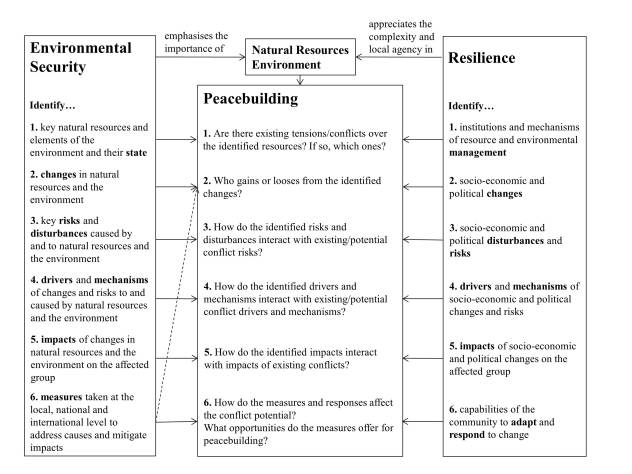
Figure 1 – Framework for Environmental Security and Resilience in Peacebuilding.
In step one we use the environmental security perspective to determine the key elements of the environment and natural resources that are important to a specific community or group of people, while the resilience perspective identifies how and by whom natural resources and the environment are managed. Together the environmental security and resilience perspectives help to answer the question of whether tensions or conflicts over the identified resources exist.
In step two, we determine changes in natural resources and the environment before identifying the losers and winners of these changes. The resilience perspective allows us to take the overall complexity of the socio-economic and political context into account.
The objective of step three is to understand the interaction of different risks. The environmental security perspective pays particular attention to risks to the environment as well as risks caused by the environment. The resilience perspective adds socio-economic and political considerations, such as strong increases in food prices, regime changes and social instability.
Step four aims to identify the key drivers and mechanisms of the changes and risks, identified under step 2 and 3. For example, if a reduction of rainfall is identified under step 2 and in step 3 an increased drought risk is noted, then step 4 explores whether the reduction of rainfall and drought risk can be attributed to global climate change or local factors such as deforestation.
Step five focuses on impacts. For example, one can ask whether the droughts and loss of harvest identified on the environmental security side and/or the increases in food prices identified on the resilience side, lead to hunger and how hunger in turn interacts with impacts of existing conflicts identified in the peacebuilding column.
Step six is particularly important because at that point we consider the actual measures and responses to environmental, socio-economic and political changes at different scales in order to determine the effects on conflict potential as well as to identify entry points for peacebuilding.
For example, if we identify hunger as a key impact under step five, the government could invest into irrigation schemes or (temporarily) subsidise staple food. This could reduce the conflict potential and strengthen the social contract between the government and the affected communities. However, for each measure taken, consideration must be given to who is affected, either positively or negatively (see dashed arrow connecting step six and two). On the resilience side, the capabilities (including knowledge, technology, networks and financial assets) and responses of the communities strongly depend on the social capital of the group concerned. For example, a loss of harvest might not result in hunger because the affected community might receive remittances from family members living outside the drought affected area. Our framework enables peacebuilding organisations and other stakeholders from development organisations and humanitarian assistance to identify core risks to environmental security without losing sight of the wider political and cultural structures into which these insecurities are embedded.
In Practice: Palestine’s Good Water Neighbor’s Project
The Good Water Neighbors (GWN) project in Palestine shows the advantages of combining a resilience and an environmental security perspective in peacebuilding. Palestine suffers from a number of environmental insecurities, most of which are related to water scarcity and pollution. But these insecurities are embedded in and interact with wider political contexts, such as the Israeli occupation of the West Bank, tensions between various Palestinian groups, and dominance of technocratic, liberal peacebuilding approaches. In order to address this complex reality, GWN facilitates cooperation on environmental issues between Israeli and various Palestinian groups, thus increasing resilience to socio-political and environmental shocks simultaneously. Examples of such activities include transnational environmental education, establishing water infrastructure shared between both sides, and common protests against environmentally harmful infrastructure (such as the Israeli separation barrier).
Conclusion
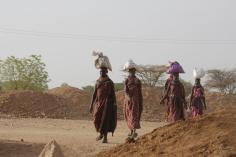
Image credit: Traynor Tumwa.
Overall, the framework offers a possibility for environmental security to sharpen the scope of resilience, while resilience allows for taking issues such as governance into account that a traditional environmental security perspective might miss. The framework helps identifying the states, changes, risks and disturbances, drivers and mechanisms, impacts, and measures and responses from an environmental security and resilience perspective to gain a better understanding of conflict dynamics. However, when applying the framework continuous attention should be also paid to ambivalent effect of depoliticisation which is a risk both concepts entail.
On the one hand, steering away from contentious political debates, such as those related to the wider Israeli-Palestinian conflict, provides an entry point for peacebuilding projects. Social groups and even official actors can be involved without taking a stance on contentious political questions. On the other hand, avoiding discussions on structural inequalities means that some root causes of environmental insecurities, such as the unequal distribution of water resources between Israel and Palestine, are difficult to address. When applying the framework further attention needs to be paid to other pitfalls of resilience and environmental security, namely the redistribution of responsibility to the local level and potentially justifying external intervention. If these issues are kept in mind, the framework can be a useful tool, especially when analysing conflicts where natural resources and the environment play key roles.
Rebecca Froese is a PhD candidate in the Department of Earth System Sciences at the University of Hamburg and a member of the research group Climate Change and Security (CLISEC) at the University of Hamburg. Her research focuses on development cooperation and the role of non-party stakeholders in implementing and financing climate action.
Janpeter Schilling holds a Klaus Töpfer Junior Professorship for Landuse Conflicts at the University of Koblenz-Landau. He is an associated researcher at the research group Climate Change and Security (CLISEC) at the University of Hamburg, the peacebuilding organisation International Alert in London and the Peace Academy Rhineland-Palatinate in Landau. His research focuses on environmental security, conflict and resilience.
Tobias Ide is head of the Research Field Peace and Conflict at the Georg Eckert Institute and currently a visiting researcher at the School of Geography, University of Melbourne. He is an associated researcher with the reserach group Climate Change and Security (CLISEC) at the University of Hamburg. He works on environmental conflicts, climate security, environmental peacebuilding, and the representation of peace and conflict, especially in school textbooks.
Sarah Louise Nash is a 2016/17 Mercator-IPC fellow at Istanbul Policy Center, Sabanci University and an associated researcher with the research group Climate Change and Security (CLISEC) at the University of Hamburg. Her research focuses on the politics of climate change and human mobility.
Jürgen Scheffran is professor of geography and head of the Research Group Climate Change and Security (CLISEC) at the University of Hamburg, Cluster of Excellence ‘Integrated Climate System Analysis and Prediction (CliSAP) and the Center for Earth System Research and Sustainability (CEN). His research specialities are climate and conflict research, sustainability science, resilience and energy and human security.
-
Sustainable Security
There are strong calls to give UN peacekeeping operations more robust mandates to engage in counter-terrorism tasks. But the idea of UN peacekeepers conducting counter-terrorism operations is not without its problems.
Terrorist attacks have been increasing rapidly over the last decade. According to the Global Terrorism Index, 29,376 people were killed in terrorist attacks in 2015. This was the second deadliest year after 2014, when 32,765 people were killed. The spike in 2014 and decline in 2015 is largely a result of the rise and subsequent weakening of Boko Haram and the Islamic State (IS).
Fatigue after long engagements in Afghanistan and Iraq and the continued impact of the financial crisis has significantly dampened the interest in new out-of-area operations among Western member states. At the same time, the threats of terrorism and migration remain at the top of the foreign policy agenda. It is in this environment that policy makers are turning to the UN, to see what role it can play in the global security burden-sharing. This means a more transactional relationship with the UN, not necessarily considering the longer-term impact of undermining its impartiality and legitimacy.
UN peacekeeping operations have, during the last decade, been deployed to protect civilians in increasingly unstable conflicts, most often without a peace to keep. However, although the conflicts have been asymmetrical in nature, armed groups have seldom perceived the UN as a party to the conflict, and pursued a strategy of strategic targeting of its troops, police and civilians.
The Case of Mali

Image credit: MINUSMA/Flickr.
In March 2012, a coalition of rebel and Islamist groups took control of the north of Mali in the wake of a coup. On April 6, 2012, the rebels proclaimed the independence of the ‘Republic of Azawad’ and the imposition of sharia law in northern Mali. 412,000 persons had fled their homes and had become internally displaced or moved across the border to Mauritania, the Niger and Burkina Faso. By November 2012, Al Qaida in the Islamic Maghreb (AQIM) had taken control of Timbuktu and Tessalit, the Movement for Unity and Jihad in West Africa (MUJAO) had taken control of Douentza, Gao, Menaka, Ansongo and Gourma, and Kidal was under the control of the Islamist group Ansar Dine (“defenders of the faith”).
The Islamists and rebel groups were quickly conquered and fled to the far north of Mali after a short and swift intervention in the beginning of 2013 by the French Opération Serval, in cooperation with the African-led International Support Mission in Mali (AFISMA). To avoid being stuck in a long and bloody counterinsurgency, the French had pushed for a swift handover to the UN.
On 1 July 2013, AFISMA handed over authority to the UN multidimensional integrated stabilisation mission in Mali (MINUSMA). However, the Islamist groups have proven resilient and the operation has been struggling to deploy and implement its mandate. From its inception in 2013 until 31 January 2017, it has endured 72 fatalities due to hostile actions, including suicide attacks, mortar attacks and improvised explosive devices (IEDs). The mission has been given increasingly robust mandates, and its most recent mandate ordered the mission to “…to stabilize the key population centres and other areas where civilians are at risk, notably in the North and Centre of Mali, and, in this regard, to enhance early warning, to anticipate, deter and counter threats, including asymmetric threats…”.
The mission is actively supporting counter-terrorism actions, as it has been preparing “targeting packs” and has been informally sharing information with the French parallel counter-terrorism operation Barkhane (the French follow-on mission from Serval). This follows a trend towards peace enforcement that started with MONUSCO, where the UN peacekeeping mission in the Democratic Republic of Congo (DRC) is now being mandated to “neutralize” identified rebel groups.
Future missions may be deployed to Libya, Syria and Yemen – countries that are also marked by asymmetric conflict and violent religious extremism. Against this backdrop, many member states are now arguing that UN peacekeeping operations need to reform to not only deal better with the challenges it faces in Mali, but also in future operations.
The high-level panel on peace operations, nominated by former UN Secretary-General Ban Ki-moon, strongly underscored that UN peacekeeping operations should not undertake “counter-terrorism operations”. However, the report left the back-door open, insofar as it argued that “UN peacekeeping missions, due to their composition and character, are not suited to engage in military counter-terrorism operations. They lack the specific equipment, intelligence, logistics, capabilities and specialized military preparation required, among other aspects.” Disregarding the principled arguments against moving UN peacekeeping in such a direction, this could indeed be read as a list of areas where reform is needed to enable UN peacekeeping to take on counter-terrorism tasks.
A Desirable Shift?
But what may the consequences be of taking UN peacekeeping operations in such a direction? First, UN peacekeeping missions are not likely to be able to perform counter-terrorism tasks in a satisfactory manner, militarily speaking. They are composed of troops from many different countries, and although they should provide a military deterrent against armed groups, they are not likely to be able to protect themselves against asymmetric attacks. Even small attacks can lead to the withdrawal of troops by troop-contributing countries, as most of these do not have the political interest needed to be able to sustain losses. The exception to this are neighbouring countries, as these may have a political interest in the conflict, but precisely because of this fact they may also be interested to use force only against some and not all parties that threaten the peace.
The UN has been strongly criticised for not taking action to protect civilians, and the continued inaction has been used as an argument to make the UN more robust, as well as able to take on counter-terrorism tasks. However, this argument confuses the ability of the UN to protect civilians with counter-terrorism. In Mali, the mission is much busier protecting itself than protecting civilians. In fact, the recruitment to the terrorist groups is increasingly moving south in the country, as local populations are not experiencing a peace dividend or improving levels of participation and inclusion after the deployment of MINUSMA. Rather, they are experiencing a government that is continuing to marginalize significant groups of the population such as the Tuaregs in the North and the Fulani (also known as Peul) in the central regions of the country, and employ draconian counter-terrorism tactics.
The inclusion of neighbouring countries’ troops in UN peacekeeping missions was previously considered a red line. As seen with the example of MINUSMA, as well as UN peacekeeping missions in the Democratic Republic of Congo and South Sudan (to mention a few), this principle has fallen by the wayside. Taken together with the move towards UN peacekeeping missions taking on counter-terrorism tasks, this shows a trend towards a more partial UN in these situations, which may increasingly be rendered unable to play its vital good offices and humanitarian roles, and be a UN for all the people, not only the government of the day. The UN and member states should reverse this trend, and make sure that UN peacekeeping operations can serve in their most effective way – as a tool to keep the peace while institutions, service delivery and an inclusive and participatory state is being built.
John Karlsrud is the Manager of the Training for Peace program. He is on Twitter at @johnkarlsrud.
-
Sustainable Security
This article is part of a two-part series discussing Britain’s Trident nuclear programme and the influence it may be having on the country’s energy policy. Read part 2 here.
Following a majority vote of 355 in the House of Commons in July 2016, the UK Government took the key decision to renew the Trident nuclear weapons system. Yet the issue remains controversial, with a wide variety of aspects persistently under scrutiny. At the forefront are debates over the costs of Trident renewal, which range from £31 billion (for the lowest estimates of submarine build costs alone) to over £200 billion when lifetime costs are considered.
With a host of other ethical, technical and strategic issues also abounding, controversy around UK nuclear weapons policy has intensified in recent years and months, including on the future vulnerability of nuclear submarines, the growing influence that the Atomic Weapons Establishment (AWE) has over university research, the malfunction of a Trident missile test, and Theresa May’s decision to withhold this information from parliament ahead of the July 2016 vote. Not for the first time, support for Trident has come into tension with democratic transparency and accountability.
In this two-part article we focus on another non-military sector in which developments may be strongly – but nearly invisibly – conditioned, by ambitions to renew UK strategic nuclear weapons capabilities. The issue here is a widely identified ‘puzzle’ in UK energy policy – the persistent intensity of UK Government enthusiasm for what is actually in energy terms the seriously under-performing option of civil nuclear power. Based on official defence policy documents, it seems clear that UK commitments to nuclear energy are significantly influenced by pressures to sustain the skills and expertise perceived to be necessary for the country’s naval nuclear propulsion programme. Crucially, these military connections remain almost entirely unacknowledged in energy policy literatures. The implications thus extend beyond military and energy policy alone, to raise questions about British democracy more widely.
The ‘puzzle’ of UK energy policy
In September 2016, after many years of setbacks, the decision was finally taken by UK Prime Minster Theresa May to give the green light for the construction of Hinkley Point C (HPC) nuclear power station in Somerset. This £24.5 billion initiative, largely financed by French and Chinese state-owned firms, constitutes one of the largest single infrastructure investments in British history. The announcement came less than a year after enactment of a “new direction” in UK energy policy, withdrawing support from several renewable and energy efficiency schemes and entrenching commitments to nuclear power. The relative scale and intensity of this British nuclear enthusiasm is a point of growing curiosity among international observers. Al Gore is “puzzled” by this and he is not the only one.
Official UK rationales for these persistent nuclear commitments are indeed puzzling. As government analyses have repeatedly shown, nuclear power is far from being the most favourable low carbon UK energy option. Britain is blessed with what the Department for Energy and Climate Change called “the best wind, wave and tidal resources in Europe”. Official figures repeatedly show HPC to be more expensive than comparable tranches of energy from wind and solar power. Arguments over the value of “base load” generation are repudiated by the National Grid. With nuclear construction times also massively longer and relative costs dropping radically for renewables, the mismatch looks set to exacerbate by the time HPC comes online.
Originally set for completion by Christmas 2017, HPC is now unlikely even to have started construction by then. Associated plans for a massive 16 GWe programme of new nuclear power by 2025 look even less likely. With UK renewable energy capacities in the meantime burgeoning despite a relative dearth of official support, energy security arguments would logically also favour a switch towards these “Cinderella options” to fill the gap left by nuclear delays. Yet, as prospects for resolving underperforming nuclear plans get ever more distant, increasingly favourable renewable projects remain paradoxically ever more threatened by cut-backs, leading to serious problems in that sector. Taken at face value, these patterns are difficult to explain.
The comparative weakness of UK civil nuclear

Image credit: Defence Imagery/Wikimedia.
Looking at key international comparators, our research has illuminated these anomalies in more detail. The scale of the planned 16 GWe UK “nuclear renaissance” relative to the existing size of the national energy system, is unsurpassed anywhere in the world. With global investments in non-hydro renewables outstripping nuclear and fossil fuels combined, authoritative observers – including a UN Chief Scientist – argue that the world is moving in one direction (towards a renewables future), whilst the UK is moving in another. As a country with an unrivalled record of success in industrial policy, Germany offers a particularly compelling contrast. Despite hosting one of the best-performing nuclear industries in the world, the German Energiewende (energy transition policy) aims entirely to phase out nuclear power by 2022. Why should a country like the UK, with a far more attractive renewable resource and a far less competitive nuclear industry, persist in the reverse strategy?
Our research also finds that conventional theories concerning innovation and technological transitions predict, on the basis of economic and industrial considerations, Britain (not Germany), would be most expected to phase out nuclear power. Germany was a leader in nuclear innovation with German companies leading in reactor construction projects around the globe. The UK no longer has the industrial capability to construct new conventional civil nuclear reactors. German nuclear reactors have traditionally been some of the best performing in the world, while (as noted by the Environmental Audit Committee), the UK performs badly in international comparisons. The history of UK nuclear power is replete with a number of historic failures including the “major blunder” of the Advanced Gas-cooled Reactor (AGR) programme, a 15 GW new build programme announced in 1979 where only one reactor was built, and the “financial collapse” of privatised nuclear signalled by the bailing out of British Energy.
Factors that may explain why British and German policies have pursued such counter-intuitive trajectories go well beyond energy-specific issues – involving (for instance) the relative strengths of democracy in the two countries. Disembedding an entrenched industrial system like nuclear power requires enormous political leverage. This is difficult to achieve without strongly democratic institutions and wider capacities for vigorous critical debate. German levels of participation, subsidiarity, civic responsiveness and central accountability are repeatedly rated in international surveys to surpass corresponding qualities of democracy in the UK.
The UK as a military nuclear power
There is, however, another key difference between these two countries which arguably helps explain this pattern: the two countries’ contrasting enthusiasm for military nuclear capabilities. Although it hosts US air-launched nuclear weapons under NATO nuclear-sharing agreements, Germany has no apparent commitments or ambitions to develop its own nuclear-armed or nuclear-powered military capabilities. Conversely, the UK has retained a remarkable industrial and technological infrastructure for maintaining a ‘continuous-at-sea-nuclear-deterrent’ since the late 1960s. Even a cursory familiarity with UK politics shows how essential this capability is perceived to be, under a particular post-colonial vision of an ‘outsized power’ that ‘punches above its weight’ on the world stage.
This cherished feature of elite UK national identity comes at significant cost. Nuclear-powered submarines are a particularly burdensome element of these ambitions. With their stealth, range and robustness viewed as essential to the military credibility of strategic nuclear weapons, these are among the most complex and demanding of manufactured artefacts – each comparable in complexity to the space shuttle. Yet security sensitivities preclude much of the kind of specialist outsourcing of production that is routine in other industries, as made explicit in the (still current) 2005 Defence Industrial Strategy. So despite a diminishing, ever more globally-integrated manufacturing base, Britain must somehow finance exclusive national capabilities in this most demanding of areas.
With the sensitive nature of the military nuclear sector, obviously limiting opportunities directly to cover these costs through exports, it is becoming ever more difficult to maintain the national reservoirs of specialist expertise, education, training, skills, production, design and regulatory capacities necessary to sustain UK nuclear submarine infrastructures. It is here that even second- and third-tier roles for British submarine industry firms in parallel supply chains for civilian nuclear power, could make all the difference. Perhaps it is a particular militaristic vision of national prestige on the world stage, then, that might help explain why the UK Government is evidently so relaxed about the otherwise insupportable additional costs of civil nuclear power?
Here, further illumination may be found in another UK energy policy puzzle: the Blair government’s unexplained ‘U-turn’ on nuclear energy policy where the technology went from being declared “unattractive” in 2003 to being firmly back on the agenda in 2006 in one of the most abrupt policy turnarounds in UK history. It is during this period that the obscure imperatives around national submarine capabilities come to the fore. We explore this critical juncture in Part 2.
Phil Johnstone is Research Fellow at the Science Policy Research Unit (SPRU), the University of Sussex. His current research is focussed on disruptive innovation in the energy systems of Denmark, the UK and Germany. Previously Phil worked on the Discontinuity in Technological Systems (DiscGo) project and is a member of the Sussex Energy Group (SEG).
Andy Stirling is a professor in SPRU and co-directs the STEPS Centre at Sussex University. An interdisciplinary researcher with a background in natural and social science, he has served on many EU and UK advisory bodies on issues of around science policy and emerging technologies.
-
Sustainable Security
A version of this article was originally published on Paul Roger’s column on openDemocracy on 11 September 2014.
Soon after the start of the Iraq war in March 2003, I wrote of the risk of a “thirty-year war” in the Middle East. More than eleven years on – and after thirteen years of the “war on terror” – Barack Obama has now committed the United States to “degrade and ultimately destroy” the Islamic State with “a comprehensive and sustained counter-terrorism strategy”.
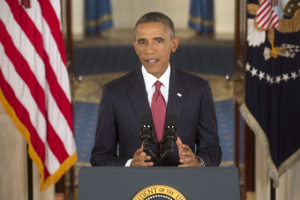
President Barack Obama delivers an address to the nation on the U.S. Counterterrorism strategy to combat ISIL, in the Cross Hall of the White House, Sept. 10, 2014. (Official White House Photo by Chuck Kennedy)
This will be a long-term project that goes way beyond Obama’s own second term, and thus his 10 September Address to the Nation may be the most important speech of his presidency. Beyond that, it is likely to be the prelude to two more decades of war – and perhaps even on to that thirty-year timescale.
The BBC summarises the strategy as Obama outlined it:
* A systematic campaign of airstrikes against IS targets “wherever they are”, including in Syria;
* Increased support for allied ground forces fighting against IS – but not President Assad of Syria;
* More counter-terrorism efforts to cut off the group’s funding and help stem the flow of fighters into the Middle East;
* Continuing humanitarian assistance to civilians affected by the IS advance.
The Iraq element of this strategy has already been underway for a month, with at least 154 airstrikes by 10 September. An initial analysis of the targets attacked shows that the Islamic State paramilitaries are lightly armed, highly mobile and prone to use commercial vehicles for much of their mobility. They have acquired US weapons, not least from overrunning Iraqi army bases, but they use these sparingly. A Breaking Defense analysis suggests that their capabilities would be limited against well-protected and well-armed defenders, but that their versatility would make it difficult for air-strikes to degrade and ultimately destroy them.
Tip-toeing back into Iraq
The United States intention is to work with other states, including the Iraqi government and the Iranian (though that is not admitted in public). Also it already has its own substantial forces in the region, primarily air and naval power. The latter includes the George H W Bush carrier battle-group in the Persian Gulf and the USS Cole cruise-missile-armed destroyer in the eastern Mediterranean. The USS Cole itself was an early victim of an al-Qaida-linked operation when it was bombed in Aden harbour in October 2000, killing seventeen American sailors and injuring thirty-nine.
The US airforce has even stronger forces available: air-bases in Kuwait, Qatar, the United Arab Emirates and Turkey as well as facilities in Jordan. It could also utilise the large UK base at RAF Akrotiri in Cyprus. President Obama has stated that the US operations will differ greatly from the “boots-on-the-ground” wars in Iraq and Afghanistan, with their deploymernt of huge numbers of ground troops. More indicative of what is intended are the operations in Yemen and Somalia, with their heavy reliance on armed-drones, special forces, and aid to local militias.
In each of these examples, though, early successes have been followed by regroupings of opponents. The Yemeni government is currently struggling to cope with a resurgent al-Qaida in the Arabian Peninsula (AQAP). Al-Shabaab in Somalia may have been excluded from some of the country’s few large urban areas, but it has influence across swathes of countryside as well as regional abilities through to Kenya and beyond.
In any case, the US secretary of state John Kerry has acknowledged – in a revealing comment at a Baghdad press conference on 9 September – that in extreme circumstances, the United States might commit combat-troops on the ground in Iraq. Indeed, several hundred more US troops are already heading for Iraq, albeit reportedly for defensive purposes only; but special-forces units are likely to be already in the country, many of them involved directly in combat (though again this would never be acknowledged officially).
In the labyrinth
All this raises the issue of why the Islamic State’s paramilitary capabilities have come to the fore so rapidly and lethally. It remains a central question. The answer will determine how deeply the US and its coalition partners gets immersed in a new war, and relates quite strikingly to how the United States conducted the previous war in Iraq before the withdrawal of most of its forces in 2011.
The well-informed Guardian journalist Martin Chulov reports that at the core of the Islamic State’s paramilitary force is a tightly-knit group around its leader Abu Bakr al-Baghdadi. Many of them are Iraqis who fought the American and British special forces in perhaps the most vicious phase of that singularly dirty war, which lasted for three years from late 2004.
At that time, the US joint special-operations command (JSOC) under General Stanley McChrystal was facing a relentless and capable insurgency inflicting huge US casualties. In response it developed a new form of network-centric warfare focusing on mobile special-force groups that were highly autonomous yet connected in “real time” to a wide range of intelligence capabilities.
The operation reached its peak in 2005 in the form of Task Force 145 (TF 145), comprising four groups working in four geographical locations around central Iraq. Three of the groups were based on US forces – SEAL Team 6 from the navy, a Delta squadron and a Ranger battalion. The fourth, Task Force Black, was organised around a British SAS squadron.
The entire JSOC operation was centred on rapid night-raids that killed or captured insurgent suspects. Those captured would often be subject to intensive interrogation (a.k.a. torture) – the results immediately used, sometimes within hours, to prompt further raids. Steve Niva, in his remarkable academic paper “Disappearing violence: JSOC and the Pentagon’s new cartography of networked warfare” in the journal Security Dialogue (June 2013) recounts: “By the summer of 2005, JSOC teams undertook an estimated 300 raids per month, hitting targets every night, eventually turning their focus to suspected local players and middle managers in insurgent networks”. A further valuable source is Mark Urban’s book Task Force Black (2010).
The learning game
The full death-toll among the insurgents is not known but believed to be in the thousands. More significant in this context, however, is that many tens of thousands of insurgents were detained by JSOC units and others. Some of them were kept for years in squalid conditions in huge prison-camps such as Camp Bucca, south of Basra – which at its peak had 20,000 inmates. Some of the prisoner abuse came to light at Abu Ghraib, but other centres were engaged as well in straightforward torture (one was the infamous “Black Room” at Camp Nana near Baghdad).
By 2009, Barack Obama had been elected president in the US and the war began to wind down. Most of the prisoners were released, including the current Islamic State leader, Abu Bakr al-Baghdadi, who may himself have been radicalised partly by his time in Camp Bucca. Nouri al-Maliki, prime minister of Iraq since 2006, was marginalising the Sunni minority. From the Sunni ranks arose a renewed extreme lslamist group in Iraq which developed into the Islamic State, linking increasingly from 2011 onwards with paramilitaries fighting Bashar al-Assad’s regime in Syria.
The Islamic State is thus part of a long-term evolution of a process that originated in Iraq in 2003, was badly knocked back by McChrystal’s JSOC forces by 2008, but has now re-emerged to provide the hardline core of a revived movement – veterans of urban conflict against well-trained and heavily-armed US troops, marines, and special forces.
These are people likely to have an intense hatred of the United States and its forces – coupled with a cold ability to avoid that hatred clouding their judgment. They will be people, including Abu Bakr al-Baghdadi himself, who will positively welcome US military action, especially when it extends to the greater use of special forces and the even more welcome possibility of regular troops. These are individuals who survived intense air-attacks and special-force operations for years in Iraq. They will be prepared for what now, following Obama’s speech, is likely to ensue: a new phase in a very long war.
Paul Rogers is professor in the department of peace studies at Bradford University and Global Security Consultant at Oxford Research Group. He is the author of numerous books including Why We’re Losing the War on Terror (Polity, 2007), and Losing Control: Global Security in the 21st Century (Pluto Press, 3rd edition, 2010). He is on twitter at: @ProfPRogers
Featured Image: Iraqi troops run through a smoke screen in Baqubah, central Iraq, 22 June 2007, followed by US troops from the 3rd Stryker Brigade Combat Team. The action was part of Operation Arrowhead Ripper against al-Qaida in Iraq (precursor of Islamic State) as part of the 2006-07 Diyala Campaign. Source: Sgt. Armando Monroig, 5th Mobile Public Affairs Detachment, Tikrit (via Wikipedia)
-
Sustainable Security
 There is no region of the world that faces more threats from climate change than South Asia. Of particular concern is the littoral surrounding the Bay of Bengal, including the Eastern Indian states of West Bengal and Odisha, Bangladesh, and coastal Burma. This region is uniquely vulnerable to a changing climate because of a combination of rising sea levels, changing weather patterns, and uncertain transboundary river flows. Away from the seashore, China holds the high ground in the Tibetan Plateau and the Himalayas, and complicates the geopolitical picture further by acting as the source of the region’s fresh water.
On the Bay of Bengal’s coast these problems of a changing climate combine with already existing social problems like religious strife, poverty, political uncertainty, high population density, and rapid urbanization to create a very dangerous cocktail of already security threats. Climate change has been called a “threat multiplier” or “an accelerant of instability” by military and intelligence communities because of how it will impact these already existing threats. With a population of more than 300 million people (91 million in West Bengal, 42 million in Odisha, 142 million in Bangladesh, 52 million in Burma), tense militarized borders, overlapping ethnic and religious communities, and uncertainty about the future, there is no region in the world that faces a more dangerous combination of threatsfrom climate change than here.
Rising Sea Levels
One of the key tenets of national security is the ability of a country to ensure the integrity of its sovereign territory. Yet, as glaciers far from South Asia melt, the sea rises and encroaches upon its farms, villages, and cities. As Hemingway wrote about going bankrupt, sea level rise happens “gradually, then suddenly.” Slowly, a rising ocean brings increasing intrusion of brackish water into groundwater, harming costal agriculture. Moreover, gradual ocean encroachment harms the coast’s natural protections, whether dunes, reefs, barrier islands, or mangrove forests. Then, suddenly, when a major cyclone blows in a storm surge will overcome previously unsurmountable barriers.
The shorelines of the Bay of Bengal stand to lose swaths of territory from sea level rise. Bangladesh, as a country predominantly composed of river delta, is most at risk. It stands to lose 11% of its territory – home to 15 million people – from a sea level rise of only 1 meter, a level that is not a particularly extreme prediction over the next 4 decades. Few invading armies could do worse damage.
Oddly enough, the world’s oceans do not rise at the same rate. With rising global sea levels, in some areas the sea level could actually fall while it rises in others. A recent study from the National Center for Atmospheric Research (NCAR) found that sea level rise will be particularly high along the Bay of Bengal, due to changes in currents caused by rapid surface warming of the Indian Ocean.
In the region, the cities of Dhaka, Kolkata, and Yangon all lie in major river deltas and are vulnerable to storm surges. In its 2007 report, the Intergovernmental Panel on Climate Change (IPCC) specifically listed cities in Asian mega deltas as “hotspots for vulnerability” because of sea level rise and changing patterns of river flow. Already straining at their infrastructure limits, these densely packed cities are becoming more vulnerable in a warming world.
Changing Transboundary Water Flow
Water does not stay within lines on a map. Instead, gravity draws it inexorably from the mountains to the sea. China, through its control of Tibet, controls the headwaters of almost all of the major rivers of Asia – only the Ganges lies outside of China’s control, originating in India. Of the major rivers that empty into the Bay of Bengal, all cross borders. Water is only plentiful during the monsoon season, so these rivers provide much-needed sustenance to agriculture, people, and ecosystems throughout their trip to the sea during the dry season – when they are fed by glacier and snow melt. Competition and tension over that flow is evident around the world when water crosses borders.
This is true of Bangladesh and India, for which the flow of the Ganges are a source of tension. The Farakka Barrage on the Ganges River, just 10 miles upriver from the Bangladesh border, allows India a measure of control over the river. The dam allows India to divert the flow of the Ganges down a canal to the Hooghly River and into the port of Kolkata. Since the dam was built in 1975, there have been allegations from Bangladesh that India diverts water in the dry season and releases too much in the monsoon season. In 1996, the two countries agreed to a 30 year treaty to share the Ganges’ flow, but tensions still remain.
The Brahmaputra River, meanwhile, provides a source of tension between the two regional powers, India and China. China recently announced that they are building a series of hydroelectric dams along the Brahmaputra’s upper reaches in Tibet, but they have forsworn any attempt to divert or hold back the great river’s flow. However, these assurances have not quieted all voices in India, who point to plans in China’s South-North Water Diversion Project to divert water from the Brahmaputra in order to ensure water for industry and the cities of China’s parched north. China’s leaders have denied these extravagant plans, but their engineers have lobbied for such a project. It would complete a dream of Chairman Mao’s, who said: “Southern water is plentiful, northern water scarce. If at all possible, borrowing some water would be good.”
Climate change exacerbates these concerns about transboundary water management in the region. Climate change is threatening both the glaciers that sit at the top of these mighty rivers, feeding them during the dry season, and the very viability and predictability of the Indian Monsoon rains. Temperatures in the Tibetan Plateau and the Himalayas have risen 1.5 degrees Celsius since 1982, a rate more than three times as fast as the global average. Meanwhile, changes in weather patterns due to climate change could cause repeated failures in the monsoon. While there is little likelihood of an immediate and total melting of the glaciers, uncertainty about their future flows is enough to stoke tension in the region.
The Potential for Conflict
Climate change is altering the environment of the region; the glaciers are retreating, the rivers’ flows are becoming more unpredictable, and the seas are rising. However, whether those changes manifest themselves into either civil or interstate conflict will depend upon how both the populations and the governments in the region react to those changes. How long governments have to adapt depends upon unpredictable weather and climate patterns – but as the Stern Review bore out, earlier action is almost always cheaper and more effective than waiting. How governments adapt is important as whether; some adaptations, like capturing water that would otherwise flow across borders in new reservoirs could actually make the threat of conflict worse. If countries do not work cooperatively, they could stoke conflict.
Throughout history, one of the most effective ways to deal with climate change has been migration – from a climate that is no longer hospitable to one where living is easier. However, modern borders do not reflect the historical ties between the regions. Migration is a natural response. However, in areas with already high population density and an overlapping patchwork of ethnic and religious communities, new immigrant communities often come into direct conflict with established communities. Last year saw ethnic strife in the Indian state of Assam between indigenous Bodos and immigrant Muslims, many of whom hailed from over the nearby border in Bangladesh. Over 75 people died, and over 400,000 people were temporarily displaced. In this region, it is impossible to say whether a group of migrants are “climate refugees” or simply moving to a place with better economic opportunity, but this is what we should expect in the future.
It is difficult to find examples of any interstate wars fought directly over water; to the contrary, water has been a catalyzer of cooperation. However, as countries realize that they can control and shape water flow through mega dams and water diversion projects, there is a danger that the claims of downstream countries could be ignored. Along the Mekong River, for example, China has proceeded to dam and control the river’s flow through its territory – leading downstream neighbors to complain that China is causing droughts. Yet because of the power imbalance between China and smaller countries like Laos and Cambodia, the Chinese have little to fear. Similar thinking by Chinese leadership over dam building along the Brahmaputra, their shared river with India, could lead both countries to stumble into a conflict that neither of them want.
In the age of climate change, conflict is more likely as threats are multiplied. Nowhere is this truer than around the Bay of Bengal. However, war is never pre-ordained. Instead, the threat of conflict is determined by how countries react. Good international governance can encourage countries to not simply pull up the drawbridge and think only of themselves, but will encourage them to see what their actions will mean for regional neighbors. Climate change is increasing the threat of wars and unrest around the Bay of Bengal; but foresight about its impacts can help the region’s leaders work together to solve a problem that knows no boundaries.
Andrew Holland is Senior Fellow for Energy and Climate at American Security Project, a Washington D.C based think tank. He is an expert on energy, climate change, and infrastructure policy. He has over seven years of experience working at the center of debates about how to achieve sustainable energy security and how to effectively address climate change.
Image source: amioascension