Blog

  • Sustainable Security

    by Isabelle Geuskens, Executive Director of Women Peacemakers Program

    Almost 15 years after the first resolution to address women, peace and security, the agenda’s implementation is increasingly subverted by the militarised security paradigm. Implementing UNSCR 1325 has been interpreted as being about fitting women into the current peace and security paradigm and system; rather than about assessing and redefining peace and security through a gender lens. As a result, the opportunity to create a new recipe for peace and security, based on taking women’s perspectives into account, is being lost.
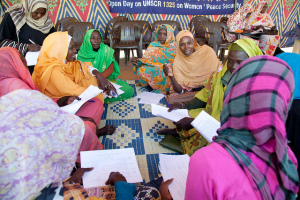
    North Darfur Committee on Women session on the UN Security Council Resolution 1325 on women, peace and security in Dar El Salaam, Darfur Source: UNAMID (Flickr)

    North Darfur Committee on Women session on the UN Security Council Resolution 1325 on women, peace and security in Dar El Salaam, Darfur, 2011 Source: UNAMID (Flickr)

    Next year we will be celebrating the 15th anniversary of United Nations Security Council Resolution (UNSCR) 1325, the first resolution of seven addressing Women, Peace & Security. In 2000, UNSCR provided the world with a groundbreaking message – providing an important recognition of the crucial role that women have to play in processes of conflict prevention, resolution and peacebuilding, as well as the specific impact of war on women’s and girls’ lives.

    The years following its adoption have borne witness to an increase in the amount of interest in the Resolution, as well as in the number of activities dedicated to “1325”, both at civil society and governmental level. However, almost 15 years into actual implementation of UNSCR 1325, we are still facing many challenges. Women’s participation in peace negotiations and peace agreements has remained low. Though some progress has been made in the adoption of UNSCR 1325 National Action Plans (NAPs) and in terms of legal and judicial reforms in some countries; implementation of these policies is often not enforced. Conflict related sexual violence as a deliberate weapon of war still occurs on a large scale and with impunity

    Peace and security from a holistic gender perspective

    Analyzing and addressing these challenges requires us to go back to the bigger picture. Over the years, the women’s peace movement has observed a growing, and worrying, trend. To a large extent, implementing UNSCR 1325 seems to be interpreted as being about fitting women into the current peace and security paradigm and system; rather than about assessing and redefining peace and security through a gender lens. In other words, “Just Add Women and Stir” has become the maxim as the way to move forward, instead of coming up with a new recipe for peace and security altogether, based on taking women’s perspectives into account.

    Such a new recipe would not only impact the lives of women, it would also provide important alternatives for men. The dominant peace and security paradigm is heavily militarized, normalizing the use of armed force and violence as a means to address conflict. This process of militarization incorporates specific gender dynamics, among others pushing men to engage in armed and violent action to solve conflict. Redefining this peace & security paradigm from a holistic gender perspective not only brings in women’s perspectives of what makes up real human security, it also addresses the normalization of violence in patriarchal society and prioritizes conflict prevention as well as nonviolent conflict resolution.

    Militarization of Women, Peace & Security
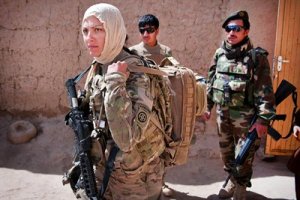
    Member of a female engagement team, Ghazni province, Afghanistan. Source: US Department of Defense

    Member of a US Marine Female Engagement Team, Ghazni province, Afghanistan. Source: US Department of Defense

    UNSCR 1325 is increasingly being used as a tool to support women’s recruitment into militarized institutions and environments. Though some actors in the women’s movement view the increase of women’s participation in the armed forces as a sign of women’s empowerment and emancipation, others see it as a sign of the increased militarization of society. It is not the question whether women are capable of taking up arms and engaging in military action; for many of us, the discussion is about whether the militarization of women’s lives is beneficial for women and society in general.

    Often, the call to increase women’s participation in militarized institutions is backed up by essentialist arguments. One of the arguments given is that “adding women” will somehow challenge its hyper-masculine culture and contribute to both a more humane and a more women-friendly environment. The assumption at work here is that women are naturally less violent than men, and hence might have a soothing effect on the inside and the outside. However, using violence against the enemy is part and parcel of every militarist system. Some of the women combatants WPP has spoken to over the years – whether active within state armies or guerrilla movements – indicated that in order to be taken seriously as a woman fighter, they often presented an even tougher front towards the enemy. They made it clear: a woman in the armed forces is, first and foremost, a fighter. Within any military system – state or non-state – unity is key, and many women in armed forces most certainly do not want to be viewed as special category, because they are working hard to be taken seriously in their role of fighters.

    It is also often argued that women’s inclusion will benefit the military mission, as their presence provides access to previously untapped sources of intelligence: women in the community. However, referring to local women in such a manner can be dangerous, as in many situations of conflict, anyone (and in particular women’s groups, whose women’s rights activism might already challenge existing traditional notions around gender) seen interacting closely with (foreign) armed forces is at risk of being labelled a traitor or enemy agent.

    A major concern for us is that the above lines of argumentation completely instrumentalize women’s lives and experiences. The arguments also fail to challenge the – patriarchal – status quo by any means: conflict continues to be framed and solved by armed intervention, hence promoting the use of violence to overcome and dominate the enemy “other”.

    Missing an opportunity for change

    With the 15th anniversary of UNSCR 1325 around the corner, there are some big questions to be asked. Is the world becoming a safer place if UNSCR 1325 implementation merely focuses on integrating the female half of the population in upholding and promoting militarization? If the focus is narrowed to embedding women firmly within existing systems, are we not missing out on an opportunity for real change? Should UNSCR 1325 not also be about stretching the current peace and security paradigms, about addressing the gendered way that humanity frames and addresses conflict itself, and about investing in disarmament, conflict prevention, human security and alternative conflict resolution mechanisms? As UNSCR 1325 is about gender and peacebuilding, should we not also explore and address men’s gendered experiences of violence and war? Is it not time to  lay bare the connections between war and hyper-masculinity, and thereby show the importance of investing in alternative masculinities to address violent conflict at its roots?

    Many women peace activists – some of whom laid the ground work for UNSCR 1325 via the Beijing Declaration and Platform for Action and their continued mobilizing during the late 90s – have presented us with powerful feminist perspectives on peace and security that challenge current patriarchal paradigms. Their peace work is inextricably linked to calls for disarmament; investment in nonviolent conflict resolution and the prevention of policies of aggression; the need to divert excessive military expenditures to social development, and the promotion of women’s leadership in order to advance a culture of peace.

    Now is the time for their claims to be taken serious: violent intervention is not bringing about the desired impact. In their publication “Gender, Conflict and Peace” (2013), Dyan Mazurana and Keith Proctor state: “Contrary to popular belief, the academic literature increasingly argues that a strategy of non-violence is more effective than violence in achieving policy goals. According to data analyzed by Stephan and Chenoweth, between 1900 to 2006 non-violent campaigns were successful in achieving their policy goals 53 percent of the time, whereas violent campaigns only had a success rate of 26 percent.

    Nonviolence provides an important alternative to our current thinking about peace and security. Often also referred to as “people power” or “civil courage”, it recognizes that conflict is a fact of life, and can even provide an important opportunity for positive change. The challenge lies in how to frame and address conflict. Instead of the current “Power Over” security model – which is rooted in the use and legitimacy of armed violence to overcome and eliminate the opponent – nonviolence operates on the principle of “Power With”: empowering the people with the idea that peace and security ultimately has to come from the people, which implies that injustice can be successfully addressed when people organize themselves into a nonviolent collective.

    For decades now, women peace activists have presented us with feminist analysis and viable alternatives to secure peace for all, challenging the current patriarchal security and peace paradigm. Despite their efforts, their claims and peace work tend to still be largely overlooked– even after 15 years of USNCR 1325. If we truly want to engender peace, we need to broaden and diversify UNSCR 1325 implementation. For only by going back to the bigger picture and applying a holistic gender analysis to peace and security, can we become successful in securing peace and security for all.

    Isabelle Geuskens serves as Executive Director of  Women’s Peacemakers Program, a Dutch NGO that works for the nonviolent resolution of conflict, and the inclusion of women’s voice and leadership in nonviolent conflict resolution processes. From 2002-12, she acted as program Manager of WPP at the International Fellowship of Reconciliation (IFOR). Under her leadership, WPP started pioneering a program on engaging men for gender sensitive peacebuilding. Prior to taking up this position, Isabelle was active in peacebuilding initiatives in Belfast and in Srebrenica, where she worked for the Working Group Netherlands-Srebrenica. Isabelle holds a Master of Arts from the University of Maastricht.

    Featured Image: Female soldier at a shooting range during IDF training, southern Israel  Source: Wikipedia

  • climate change

    Food security will remain out of reach for many people, especially women and children, in the Lao People’s Democratic Republic, or Laos, if the country continues to emphasize commodities and resources development at the expense of the environment and livelihoods while ignoring global trends for food and energy. Read more »

  • Marginalisation of the majority world

    For some years, the Oxford Research Group (ORG) has been analysing the likely underlying drivers of global insecurity over the coming years, and ways to develop sustainable responses to these threats. This analysis has focused on four trends that are expected to foster substantial global and regional instability, and large-scale loss of life, of a magnitude unmatched by other potential threats. These are climate change, competition over resources, marginalisation of the ‘majority world’ and global militarisation.

    Read the full article here.

    Author: Hannah Brock

    Image source: WorldIslandInfo.com

    Read more »

  • Defense Department Reports Project Mixed Impressions of Climate Threats

    The 2010 Joint Operating Environment report, recently released by the U.S. Joint Forces Command, rightly recognizes climate change as one of 10 trends “most likely to impact the Joint Force.” The JOE is a periodic planning document created by USJFCOM, the military command responsible for developing ideas to better integrate and coordinate the work of our nation’s individual armed services. The report does not have the stature of the Defense Department’s Quadrennial Defense Review, but it does serve as “an intellectual foundation” for future force development. It is therefore heartening to see the report draw attention to this serious and understudied national security concern. Yet in this case the old aphorism isn’t quite true: well begun isn’t nearly half done.

    Including climate security issues is important, but the new report does not reflect the Defense Department’s own progress in mapping out the national security consequences of climate change since the last JOE was released in 2008. This is serious cause for concern for an issue as potentially wide-ranging as climate security that will push our military beyond traditional operations and familiars notions of national security, and DOD should have a consistent strategy to move forward in this 21st century operating environment.

    The Defense Department’s Quadrennial Defense Review acknowledged for the first time this year that climate change is an “accelerant of instability.” This essentially means that planning for climate security challenges requires understanding and anticipating a wide spectrum of the second- and third-order effects of climate change. For example, a climate event will likely not cause conflict in itself, but it might worsen food shortages, drive people to migrate internally or internationally, and consequently exacerbate existing conflicts or political instability. This idea is already accepted wisdom in the United Kingdom. As Rear Admiral Neil Morisetti, the U.K.’s climate and energy security envoy noted in a recent op-ed with U.S. Deputy Assistant Secretary of Defense Amanda Dory, “climate change will amplify the impact of some of the world’s most difficult and common challenges.”

    Yet the 2010 JOE climate section appears to be just an elaboration of the ideas outlined in the 2008 report—in some cases whole sentences were transferred verbatim. The 2010 report recognizes climate change as a threat because of “global warming and its potential to cause natural disasters and other harmful phenomena such as rising sea levels.” And it notes several potential consequences of the changing climate, including resource competition in new areas as arctic ice recedes, pressure on coastal populations as saltwater threatens fresh water supplies, and the potential for natural disasters to overwhelm already weak states. But it overlooks the essential recognition of climate change as an accelerant of instability, or threat multiplier.

    This designation is important because it would demand than the JOE offer a broader vision for how climate change will interact with a wide variety of security trends, as well as examine how climate-induced challenges may influence and build on each other. This missing perspective is particularly evident in the case of two issues, pandemic disease and migration.

    The Center for Naval Analyses called in 2007 for the next QDR to “examine the capabilities of the U.S. military to respond to the consequences of climate change, in particular, preparedness for natural disasters from extreme weather events, pandemic disease events, and other related missions.” And the New York Academy of Sciences last month held a symposium to examine “emerging infectious diseases in response to climate change.” Yet the JOE report misses this key causal connection. Unlike the QDR, it addresses infectious diseases and pandemics entirely in isolation of its discussion of climate security challenges.

    The JOE report also seems to miss the depth of the connection between migration and climate change. It acknowledges that coastal populations are growing quickly and that “local population pressures will increase as people move away from inundated areas and settle farther up-country,” but the section on climate change misses the essence of why these movements should influence the way we structure our armed forces.

    The demographics section gets the idea right: migrations, particularly those in already troubled areas, not only cause population pressures, but can “disrupt patterns of culture, politics, and economics and in most cases carry with them the potential of further dislocations and troubles.” Some estimates predict that the world will see 200 million climate migrants by 2050 in places like Northwest Africa, Bangladesh and India, and China—areas that the Center for American Progress will explore in a series of upcoming reports on climate security issues. But the rest of the report misses the extent of this connection.

    It will be increasingly important as the Pentagon continues its work on climate security issues for reports such as the QDR and JOE to consistently reflect the latest thinking on the issue within the Defense Department. Such consistency and clear messaging are particularly important because DOD cannot and should not handle climate security policy alone. The State Department and the U.S. Agency for International Development will have leading roles to play in managing and mitigating the effects of climate change, and DOD should speak with one voice in this vital interagency conversation. Our armed forces will be better prepared to deal with the security implications of climate change in the future if they can institutionalize meaningful, clearly defined cooperation with interagency partners now.

  • Climate change and conflict: lessons from community conservancies in northern Kenya

    The devastating drought that affected large areas of Kenya in 2009 and the upsurge in inter-community violence in the north of the country highlighted an apparent connection between climate change and conflict. However, the evidence-base for this connection is limited and it is therefore imperative to analyse how these factors interact in reality rather than to make assumptions.

    This report is based on the findings of research carried out in two community wildlife conservancies in northern Kenya in 2009. It illustrates how climate change is affecting the distribution and prevalence of natural resources in Kenya but makes clear that this is not the only factor contributing to resource scarcity.

    It emphasises that competition for natural resources is a key driver of conflict, but also that it interacts with a range of other factors, and that violence is not inevitable. The research finds that local governance mechanisms, especially natural resource management, are crucial in determining whether competition over scarce resources will turn into violent conflict.

    Based on the research findings, the report makes a series of practical policy recommendations targeted at relevant Kenyan Government Ministries and other stakeholders. The recommendations focus on conflict-sensitising Kenya’s climate change response strategy, as well as related policies concerned with natural resource management, peacebuilding and security.


    The full report is available here.

  • South Sudan: Conflict is ‘fact of life’

    In a radio interview for the BBC, Dr Sara Pantuliano of the Overseas Development Institute highlights a tribal conflict in Jonglei State that has grown particularly violent. The conflict between the Murle and Luo-Nuer groups has traditionally centred on cattle-raiding (cattle being a vital element of the region’s economy for centuries), but recently it has taken on the character of a ‘military assault’ along ethnic lines. Dr Pantuliano attributes this change to both the sheer number of weapons flooding the region, and to the anonymity and consequent remoteness of modern warfare. Compounding these factors is the diminished status of chiefs and elders and the effectiveness of the traditional checks and balances that they enforce, compromised as they have been by the protracted civil wars of the past.

    This case is symptomatic of the general lack of security in South Sudan, which is overwhelming the small UN security presence put in place after independence last summer. It is therefore extremely important that the causes of insecurity are targeted because the symptoms are already causing serious damage in this young country.


    BBC Radio4 Today Programme, 03 January 2012

    Tens of thousands of South Sudanese people are fleeing from their homes, after inter-ethnic clashes around the town of Pibor.

    The United Nations is warning villagers to run for their lives ahead of advancing fighters from a rival tribe.

    Parthrsary Rajendran, head of mission for Medecins Sans Frontieres in South Sudan, speaks on the phone from the capital Juba.

    Dr Sara Pantuliano, Sudan analyst at the Overseas Development Institute, says that this is part of a “long-standing conflict” in the region.

    Conflict is a “fact of life” between these two social groups, she adds, but the cattle wars have now become more like “military assaults” as the authority of the elders and chiefs has diminished as a result of the “massive proliferation” of weapons in the region.

    To hear the interview, click here


    Article Source: BBC

    Image Source: Oxfam International

  • What is Sustainable Security?

    Current approaches to national and international security are dominated by the ‘control paradigm’: an approach based on the premise that insecurity can be controlled through military force or balance of power politics and containment, thus maintaining the status quo. The most obvious recent example of this approach has been the so-called ‘war on terror’, which essentially aims to ‘keep the lid’ on terrorism and insecurity, without addressing the root causes. Oxford Research Group (ORG) argues that such approaches to security are deeply flawed and are distracting the world’s politicians from developing realistic and sustainable solutions to the new threats facing the world in the 21st century.

    An alternative approach is needed: that of ‘sustainable security’. The central premise of sustainable security is that we cannot successfully control all the consequences of insecurity, but must work to resolve the causes. In other words, ‘fighting the symptoms’ will not work, we must instead ‘cure the disease’. Such a framework must be based on an integrated analysis of security threats and a preventative approach to responses.

    Sustainable security focuses on the interconnected, long-term drivers of insecurity, including:

    • Climate change: Loss of infrastructure, resource scarcity and the mass displacement of peoples, leading to civil unrest, intercommunal violence and international instability.  
    • Competition over resources: Competition for increasingly scarce resources – including food, water and energy – especially from unstable parts of the world.
    • Marginalisation of the majority world: Increasing socio-economic divisions and the political, economic and cultural marginalisation of the vast majority of the world’s population.
    • Global militarisation: The increased use of military force as a security measure and the further spread of military technologies (including CBRN weapons).

    Sustainable security makes a distinction between these trends and other security threats, which might instead be considered symptoms of the underlying causes and tend to be more localised and immediate (for example terrorism or organised crime). It promotes a comprehensive, systemic approach, taking into account the interaction of different trends which are generally analysed in isolation by others. It also places particular attention on how the current behaviour of international actors and western governments is contributing to, rather than reducing, insecurity.

    Sustainable security goes beyond analysis of threats to the development of a framework for new security policies. It takes global justice and equity as the key requirements of any sustainable response, together with progress towards reform of the global systems of trade, aid and debt relief; a rapid move away from carbon-based economies; bold, visible and substantial steps towards nuclear disarmament (and the control of biological and chemical weapons); and a shift in defence spending to focus on the non-military elements of security. This takes into account the underlying structural problems in national and international systems, and the institutional changes that are needed to develop and implement effective solutions.
     
    By aiming to cooperatively resolve the root causes of threats using the most effective means available, sustainable security is inherently preventative in that it addresses the likely causes of conflict and instability well before the ill-effects are felt.

    The sustainable security framework is being developed and promoted by Oxford Research Group. Please read the About page for more information.

  • Sustainable Security

    Many researchers have focused on how the institutions of the nation-state can help build peace. Though useful, this focus can often ignore how institutions older than those of the nation-state can contribute to peacebuilding processes.

    Can the introduction of “right” institutions facilitate peace in fragile states? Conflict researchers grappling with this question have mostly focused on the institutions of the nation-state. From this perspective, states can exit the conflict trap by introducing fair elections, capable national bureaucracies, independent judiciaries and constitutional protections against misrule. However, this state-centric perspective ignores the reality that national political institutions are far from the “only game in town” in many of the world’s most conflict prone states. Recent research suggests that institutions older than those of the nation-state can contribute to peace.

    African pre-colonial institutions

    ashanti_yam_ceremony_1817

    Image via Public Domain.

    A powerful example of how non-national political institutions contribute to peacemaking is found in the case of pre-colonial “customary” institutions in Africa.  As students of African history should know, post-colonial national institutions were layered on top of a pre-existing mosaic of kingdoms and state-like entitities, many of which have roots to the pre-colonial era.

    Consider the Ashanti Kingdom in Ghana. This political structure existed prior to colonialism, endured numerous conflicts with British colonizers, and was eventually recognized as a subnational political entity with special prerogatives. Today, after decolonization, several Ashanti institutions remain, such as the King, the customary court system and the council of elders. These institutions of the Ashanti Kingdom have served as an important platform for bargaining with the Ghanaian state, as well as in dispute resolution between conflicting parties in Ashantiland.  A similar pattern is found in the Buganda Kingdom in Uganda, where Buganda pre-colonial institutions have been incorporated into the constitution and serve as the main focal point for interactions between the Buganda ethnic group and the government.

    While some have pointed to customary institutions in Africa as a source of ethnic tension and conflict, this view is not correct. Recent research suggests that customary institutions play important roles as arbiters of conflict in state peripheries where central governments are weak. In a recent article in the Journal of Peace Research, I argue and demonstrate that this is an instance of a more general relationship. In Africa, where customary institutions are plentiful and many states have low capacity, strong pre-colonial institutions can serve as tools for peaceful bargaining and thus conflict reduction.

    To evaluate this claim, I collected data on the pre-colonial institutional affiliation of over 243 politically relevant ethnic groups as listed in the Ethnic Power Relations database. The data was collected from the ethnographic atlas, a collection of comparative ethnographic data on over 800 ethnic groups. Combining these data sources enabled a comparison of the degree to which contemporary ethnic groups inherited centralized pre-colonial political institutions such as kingdoms, chieftaincies and empires.

    Within this sample of ethnic groups, I investigated whether groups that were excluded from political power – which a decade of research suggests are the most conflict-prone ethnic groups – were less likely to experience armed conflict if they had inherited strong pre-colonial institutions. The results clearly show that ethnic groups who are excluded from power, but inherit pre-colonial institutions, are less likely to be involved in civil conflict in the period between 1945-2010. This is consistent with the claim that these groups can rely on their pre-colonial institutions to bargain with governments, avoiding armed conflict.

    Reasons for the success

    Why are ethnic groups with inherited political structures more adept at avoiding conflict? I argue that strong centralized customary institutions improve their capacity to engage in non-violent bargaining that avoids costly conflict. When groups have centralized customary institutions they can make their promises to respect agreements more credible by enshrining them in centralized political authorities, such as the Ashanti King (in Ghana). When agreements are guaranteed by a customary institution, such as a king or a traditional legislature, this raises the cost of violating the agreement, since reneging will have reputation costs for the customary institutions themselves, and since customary authorities can sanction violators. Furthermore, having strong centralized authority in customary institutions minimizes the risk of  “spoilers” to an agreement, i.e. factions of the given ethnic group that will not abide by the will of group leaders.

    For these reasons,  groups with decentralized customary institutions face greater constraints on their bargaining credibility since no preeminent authority can be used to guarantee that agreements will be respected. This is exemplified in the roles of centralized customary authorities in striking non-violent bargains with central governments in Africa. In Uganda, the institutions of the Buganda kingdom, such as the traditional authority of the King himself and the traditional Buganda legislature, have been relied on in deals made with the Ugandan regime. In Ghana, the Ashanti Kingdom has been pivotal in brokering with the Ghanean state, and has used its centralized customary court system to ratify land-rights acts and to adjudicate land-disputes in Ashantiland. In South Africa, Zulu authorities have used their customary institutions, such as the office of the Zulu king, to extract concessions from the South African government, regarding their role as traditional rulers in Kwazulu province.

    Conclusion

    This research on pre-colonial institutions has implications for how we approach the link between political institutions and peacebuilding in fragile states. First, it prompts the recognition that political institutions other than those related to national governments are vital to ensuring civil peace at the local level. Instead of seeing national institutions as the most vital to peace, we should see them as one category of a rich institutional mosaic. Crucially, in states where national institutions fail to penetrate the periphery, customary political institutions will be more central to building peace and good governance.  Second, it shows that traditional or “customary” institutions in Africa should not be seen as obsolete remnants of a forgotten era, but as vital parts of Africa’s institutional mosaic when it comes to building peace. Instead of inducing conflict and fueling ethnic antagonisms, these institutions play vital roles in containing conflict. Their local presence and importance to peace should be recognized by policymakers and scholars alike.

    Tore Wig is a post-doctoral fellow at the Department of Political Science at the University of Oslo.  He is currently affiliated with the project Disentangling the Economic Effects of Political Institutions (DEEPI), which seeks to study the historical (and contemporary) causal links between aspects of democratic institutions, economic growth and inequality.

  • Sustainable Security

    by Amira Armenta

    Colombia 2011 article smallIn Colombia there are many regions where poverty and the absence, or weak presence, of the state has facilitated the emergence of violence by armed groups. Among these are the Afro-Colombian communities of the Curvaradó and Jiguamiandó in the Urabá region

    The Urabá is located in the Northwest of Colombia, near the border with Panama. It is a region of great biodiversity, rich in minerals, oil, water, and timber, amongst other natural resources. Urabá is also one of the regions with the highest poverty rates, and lowest rates of schooling in the country. The region is inhabited by many indigenous peoples and Afro-Colombians, who are the traditional owners of hundreds of thousands of hectares of land. Collective ownership of these territories is supported by Colombian Law 70 of 1993.

    With the rise of drug trafficking in the country in the 80s, the region became a point of export of illegal narcotic drugs. At the same time, the illegal import of weapons soared to meet the growing demand of Colombian armed groups. Various increasingly powerful criminal groups (known as ‘paramilitaries’) began to invest money earned from their illegal activities in profitable lawful sectors such as the agribusiness – palm oil, bananas and cattle. In a few years Urabá went from being a marginal and sparsely populated region to a place where settlers converged, and multinational corporations and armed groups of all stripes were vying for control of territory and a stake in the business.

    In this context, poor rural communities such as bold”>Curvaradó and Jiguamiandó were sucked into the violence unleashed between the different armed groups. As the collective ownership of land was an obstacle to the economic interests of the new sectors (farmers and landowners whose funds often had an illicit origin), these groups used threats and harassment to banish the native people and appropriate their land. This violence and banishment was possible given the state of marginalization of the population, totally unprotected by the central government. Large palm oil plantations installed since then in the area have been financed largely with the laundered drug money. They use land violently obtained by the forced displacement.

    Since the 1990s, the Curvaradó and Jiguamiandó communities have specifically been the target of violence and subsequent displacement. They have lost their few belongings and have helplessly seen the powerful economic groups systematically seize their land.

    The Colombian government has recently begun a process of returning land to the inhabitants of the river basins of Curvaradó and Jiguamiandó and reparation for victims of violence. The move is encouraging, but it might not be enough to solve the problems. The history of violence can repeat itself any moment, as long as the causes that led to the banishment and violence are not addressed and those responsible are not punished. Standards of justice must apply, not just to those still operating outside the law, but also to those who now operate legally but whose past is murky.

    Whilst the Colombian government fails to fully develop social development programs (including education, health and infrastructure) and sustainable economic development policies to assist marginalised communities, the people of Curvaradó and Jiguamiandó will remain poor, uneducated, vulnerable, and at risk of lose their territories once again.

    Amira Armenta is a Researcher with the Drugs & Democracy Programme of the Transnational Institute (TNI), with a particular focus on Colombia.

    Image source: Yuliam Gutierrez

    Some Useful References

    Murder in Curvaradó: http://www.cipcol.org/?p=682  Bajo Atrato

    UNHCR on the situation of Colombian Afro Descendants: http://www.acnur.org/t3/fileadmin/scripts/doc.php?file=t3/fileadmin/Documentos/RefugiadosAmericas/Colombia/EN/Colombia_Situation_-_2011_International_Year_of_Afrodescendants

    Alternative Developments, Economic Interests and Paramilitaries in Uraba : http://www.tni.org/sites/www.tni.org/files/download/brief27fin.pdf

    El caso de Jiguamiandó y Curvaradó: http://www.lasillavacia.com/historia-invitado/22660/yamile-salinas-abdala/el-caso-de-jiguamiando-y-curvarado-estrategia-criminal

    Coca y violencia en el Chocó BiogeográficoL: http://www.tni.org/es/archives/archives_armenta_cocachoco

    Comisión Intereclesial de Justicia y Paz – Jiguamiandó y Curvaradó: http://justiciaypazcolombia.com/-Consejo-comunitario-de-Jiguamiando-

    Las tierra de Curvaradó de nuevo invadidas – Verdad Abierta : http://www.verdadabierta.com/paraeconomia/tierras/2944-las-tierras-de-curvarado-de-nuevo-invadidas

    Bajo Atrato se resiste a la violencia y a la pobreza: http://www.elcolombiano.com/BancoConocimiento/B/bajo_atrato_se_resiste_a_la_violencia_y_a_la_pobreza/bajo_atrato_se_resiste_a_la_violencia_y_a_la_pobreza.asp

  • Monitoring disaster displacement in the context of climate change

    Climate change is already increasing the frequency and  intensity of natural hazards, and the numbers of natural disasters reported and people affected are rising. Although it is clear that natural disasters are one of the principal causes of forced displacement, data on disaster-related displacement has not been consistently collected and analysed. The lack of reliable baseline data on disaster-related forced displacement has prevented adequate evaluation of the scale of the phenomenon and the patterns of displacement. It also makes it difficult to extrapolate potential human mobility based on existing climate change models or scenarios, or to develop realistic assessments to be taken into account in climate
    change adaptation policy formation.

    This study looks at natural disasters and forced displacement in the context of climate change. It has two aims: firstly, to provide an estimate of forced displacement related to disasters in 2008, specifically climate-related disasters; and secondly, to propose a methodology that could be applied to monitor disaster-related displacement on an ongoing basis. The study uses existing data sets on the impacts of natural disasters in 2008, crossreferences various sources, and individually investigates a number of events to estimate the numbers of persons displaced by disasters in 2008.

    The findings show that at least 36 million people were displaced by sudden-onset natural disasters in 2008. Of those, over 20 million were displaced by sudden-onset climate-related disasters. As a reference, the total population of people living in forced displacement due to conflict, including IDPs and refugees, was 42 million in 2008, with 4.6 million having been newly internally displaced during the year. It is likely that many more are displaced due to the other climate change-related drivers, including slow-onset disasters, such as drought and sea level rise; however the study does not present an estimate of their number.

    The methodology proposed in this study could be applied with relatively limited additional resources to monitor disaster-related displacement on an ongoing basis. Monitoring of disaster-related displacement could be significantly enhanced through additional steps to collect data on the duration of displacement, returns, local integration and relocation and the needs of displaced populations.

    The full report can be downloaded here.