With right-wing populism growing across Europe, Germany was thought to be an exemption to this trend. However, the rise of Alternative for Germany could potentially change this.
While far right parties have been on the rise throughout Europe for decades, it seemed like Germany was immune to the seduction of the far-right. Whereas, among others, the National Front in France, the Dansk Folkeparti, Flemish Interest in Belgium and the Freedom Party in Austria recorded growing electoral results, parties such as the Republicans (REP), the National Democratic Party (NPD) or the German People’s Union (DVU) were unable to overcome the electoral threshold. Although successful at the national level and represented in several regional parliaments (Landtage), no party to the right of the Christian Democrats has managed to gain seats in the Bundestag since 1949. Why has this been the case in Germany?
Germany’s “special status”
Political scientists and other observers both in and outside the country were puzzled by the ‘special status’ of the German party system, all the more so because the key conditions for the electoral success of right-wing populist and radical right parties were not that different from the European neighbors. Several studies have shown a small but relatively stable presence of nativist, even xenophobic attitudes within the German society. However, although right-wing populist parties profited from these preconditions in several state elections – e.g. in Baden-Württemberg in the early 1990s and some East German states from the beginning the new millennium onwards – they were not able to establish at the federal level. One can hardly identify one single reason for this mismatch, but according to most scholars, the answer lies in three German characteristics.
Firstly, the German political right was divided and fractioned. While in France, Austria, Switzerland and other European countries, major far right parties were able to unify the right beyond the Conservatives, the right spectrum in Germany was distinguished by a high degree of competition. For instance, with NPD and DVU, two main players of the extreme right competed against each other in several Land elections until their consolidation in 2011. At the same time, the populist radical right spectrum was marked by the coexistence of various small parties, such as The Freedom or the so-called ‘Pro’ Movement, a minuscule group that basically operates in North Rhine-Westphalia.
Secondly, the yearlong strategy of the Christian Democrats, which consisted in the integration of conservative streams within the German society, might have had a negative impact on newcomers on the right. Especially the Bavarian CSU, an autonomous party that is embedded in the Christian Democratic Union at the federal level—the CDU, in turn, holds no regional branch in Bavaria—was able to address conservative voters beyond the Bavarian borders and helped to maintain the strategy of the Union.
The third reason relates to German history. Since the end of World War II, radical or extreme right parties have been dealing with stigmatization and exclusion from the political discourse. While far right parties are treated as outsiders in almost all countries, in Germany, they are suspected of standing in the tradition of historical Nazism and thus barred. For instance, when the NPD found its way into the state parliament of Mecklenburg-West Pomerania in 2006, the other parties decided to not to support any of the NPD’s parliamentary initiatives (so-called ‘Schweriner Weg’ – ‘Way of Schwerin’).
These unfavorable conditions contributed a great deal to keeping far right parties out of the German party system for more than six decades. At the beginning of 2017, however, it seems like the ‘anti-fascist consensus’ of the German post-war era has begun to totter. Violent acts against refugees have risen. In 2015, the German Federal Office of Criminal Investigation (Bundeskriminalamt) had registered a right-wing populist political movement (‘Pegida’), although solely a regional phenomenon in the city of Dresden, has dominated media coverage on East Germany. The most impressive evidence for the establishment of a far right stream is the ongoing success of a new right-wing populist party: the Alternative for Germany (AfD).
Accounting for the AfD’s rise
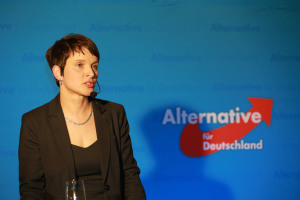
Image credit: Metropollco.org/Flickr.
Since its foundation in the first quarter of 2013, the AfD has been denoting growing electoral support. Whereas it had failed to jump over the electoral threshold in the 2013 general election, the party won seats in every state election since that time. With partly extremely high results—such as 24.3 percent in Saxony-Anhalt and 20.8 percent in Mecklenburg-West Pomerania—the AfD is already the most successful new party in the history of the Federal Republic.
To some scholars—including the author of this piece—one crucial reason for the popularity of the AfD are the arbitrary features of its ideology in the first two years of its existence. While clearly Eurosceptic and populist in terms of its anti-elitist appeal, the official program of the AfD in 2013/2014 did not include any nativist or xenophobic components.
However, studies diagnose a clearly right-wing populist profile for both the sympathizers and the members of the AfD from the start. Other inquiries illustrate that in 2013, the public opinion as well as the first studies on the party located the AfD firmly at the right of CDU and CSU but did not imply a far right profile. The party therefore profited from its moderate but populist program while at the same time, as it was slightly more conservative than the Christian Democrats, the AfD was attractive for far right voters and activists from the very beginning. At the same time, the success of the AfD mirrors the evolution of the Christian Democrats, which have turned to a more liberal party under the leadership of Chancellor Angela Merkel. While this strategy has clearly marginalized the SPD, which scores just under 21 percent in the national polls, it has annoyed a great deal of more conservative voters, who now lean towards the AfD.
It is not surprising that that the agenda of the AfD changed after the 2014 European election. Whereas anti-Euro and anti-EU positions had dominated its program until May or so, the party highlighted its conservative social values in the face of the state elections in autumn 2014. During this phase of the party’s history, growing tensions about the leadership of its founder Bernd Lucke, an economist from the University of Hamburg and the ideological direction of the AfD, including its relationship to Pegida, occurred. In summer 2015, Mr Lucke lost the election to the party executive against the leader of the Saxonian regional branch and parliamentary party, Frauke Petry, who chairs the party until today together with co-speaker Jörg Meuthen. Even though scandals and internal conflicts have been shattering the party, some observers’ expectation that the party will break down did not prove true. At the beginning of the election year 2017, the polls indicate high electoral support (around 12 percent) for the AfD at the general election in September.
While it is right that a successful far right party in Germany mirrors a normalcy in Europe, it is also a benchmark for the crisis of representative democracy and the elites and the parties that underpin it. Populist far right parties—including Donald Trump in the United States by the way—benefit from growing contempt towards the political elites and the perception of individual powerlessness in the political process. In that sense, parties like the FPÖ in Austria, the French Front National or the AfD in Germany are phenomena of modernization, although they do not directly profit from its negative economic consequences (e.g. unemployment), as scholars have argued for years.
Not surprisingly, recent studies show that electoral support for the AfD is not entirely based on protest—in fact, there is a great deal of convergence between the political positions of the voters and the ideology of the party. Empirical results also illustrate that the share of losers of the modernization process within the AfD electorate is high, but they do not represent the majority of their voters. In other words, the AfD is at least as much the exponent of a latent new right movement as it is the vehicle of discontent. At the same time, it represents to a certain extent an invisible coalition of middle-class and lower-class voters.
In contrast to its predecessors in the far right spectrum, the AfD faces hardly any competitors in its niche. Founded by both neo-liberal, Eurosceptical economists (e.g. former party leader Bernd Luck and Joachim Starbatty) and socially conservative activists (e.g. Beatrix von Storch), the AfD became the center of attraction for right-wing networks without being right-wing extremist on its own terms. Due to its electoral successes, the AfD became a much more attractive player in the spectrum than other, much less successful parties did.
The political public, especially the established parties, still seem somehow paralyzed and helpless. Strategies oscillate between stigmatization—the approach that embossed the exposure to the far right for sixty years—and dispute. While some argue that the—in part—extreme ideology of the party prohibits its inclusion in the democratic discourse, approaches that are more pragmatic allude to three crucial facts.
First, they highlight the ‘normative power of the factual’: by being represented in more than half of the state parliaments and likely to master the electoral threshold in the upcoming federal election, the AfD is already an established actor, at least in the medium term. Ignoring is thus no strategic option. Secondly, while it was easy to demonize other right-wing parties, such as the NPD, due to their extremist ideology and appeal, the AfD, although clearly part of the far right, is not a fascist party. Even if the party has evolved from a moderate conservative-Eurosceptic to a far right party, it still lacks a clear racist and anti-system agenda. Neither its anti-elitist appeal to the people nor its Islamophobia resemble the neo-Nazi agenda of the NPD or other parties of this spectrum. It is thus not surprising that the anti-fascist reflexes of the political public failed.
Finally, the common strategy of demonization (or stigmatization) could even prove to be counterproductive: populist far right parties feed on their perception as political outsiders. Therefore, any attempt to exclude the AfD from the political discourse can be interpreted as another move by the ‘aloof’ political class and strengthen the bond between the party and its supporters.
Outlook
In the face of the increasing establishment of the AfD and constantly high results in the polls, the prospects for the newcomer party are auspicious. The AfD will almost certainly be represented in the next German Bundestag. This will pose a challenge to the established parties. As to parliamentary strategies, a strong far right fraction could prevent the realization of preferred coalitions. While the SPD is unlikely to gain enough seats to claim the chancellorship, the CDU/CSU might become the strongest party but without the perspective of a two-party alliance other than a grand coalition. However, the only possible outcome might as well be the worst.
Not only is the grand coalition highly unpopular among Social Democrats. As the case of Austria shows, grand coalitions in persistence lead to the increasing perception of the ‘cartelization’ of the political class, which fosters support for the far right. Considering the options of government formation after the 2017 general election, the AfD might well become the beneficiary of the situation it contributed to: political sclerosis. In that case, Germany might face a long period of bounded competition between the major mainstream parties and growing polarization in terms of increasing successes of the far right.
Dr. Marcel Lewandowsky (* 1982) is a political scientist and research fellow and the University of the Federal Armed Forces in Hamburg, Germany. His current research focuses on right-wing populism in Europe with special consideration to the AfD in Germany.

 Delicious
 Digg
Digg StumbleUpon
 Reddit






 As the long running tensions over the Senkaku/Diaoyu islands in the East China Sea appear to be coming to a head, the time for thinking through the alternatives to the militarisation of this conflict seems to be well and truly upon us. The conflict raises interesting issues about sovereignty claims based on offshore territories, particularly as we face a climate-constrained future as well as the increasing importance of competition over scarce resources. The latter is fast becoming one of the most important global trends if one thinks about the potential ‘drivers’ of conflict and even war.
 Thinking through the consequences of the changing nature of global security, both in terms of threat assessments and policy responses to those threats (military and non-military), will certainly require new approaches at the broad conceptual level. Max G. Manwaring, a Professor of Military Strategy in the Strategic Studies Institute (SSI) of the U.S. Army War College has written an interesting piece on what he calls the “new security reality” in which business-as-usual approaches are of little use.
  There will be no sustainable security if we do not equally value the needs, experiences and input of men and women. A new report published by the Institute of Development Studies (IDS), funded by ActionAid and Womankind Worldwide, examines the role women play in local community peacebuilding in Afghanistan, Liberia, Nepal, Pakistan and Sierra Leone. The report states “despite the increased international attention to women’s participation in peacebuilding, the achievements and challenges facing women building peace at the local level have been largely overlooked”.
 The Norwegian Peacebuilding Resource Centre (NOREF) recently published a Policy brief by Tani Marilena Adams, proposing and outlining the concept of “chronic violence” to “characterise the crisis of escalating social violence that currently affects about one-quarter of the world’s population”.
 Writing for SustainableSsecurity.org, Elizabeth Wilke argues that a new conceptualization of insecurity and instability is needed in a world with greater and freer movement of goods, services and people – both legal and illicit – greater demands on weakening governments and the internationalization of local conflicts. The new insecurity is fundamentally derived from the responses of people and groups to greater uncertainty in an increasingly volatile world. Governments, and increasingly other actors need to recognize this in order to promote sustained stability in the long-term, locally and internationally.
 Author and former High Commissioner of Trinidad and Tobago to the Court of St. James, Serena Joseph-Harris writes that China’s increasing regional profile in the Caribbean highlights the challenges now posed to American exceptionalism as Beijing defines its own course in the region. This article focuses on the potential within the Caribbean Basin for the burgeoning proceeds presently derived from increases in the legitimate investment, trade, and commerce emanating from Beijing and Washington to become entwined with illicitly derived funds generated from transnational crime activities, specifically the trafficking of drugs.
 In the Lowy Institute’s latest Strategic Snapshot, International Security Program Associate Ashley Townshend explores the strategic dynamics between China and India in the Indian Ocean.
 In this Peace Research Institute Oslo (PRIO) Policy Brief, Kaja Borchgrevink & Kristian Berg Harpviken explore claimed links between Taliban militancy and religious education in Afghan and Pakistani madrasas.
 A new SIPRI report highlights the limitations of United Nations attempts to control the flows of arms into Somalia, and the role of potential arms-supplying states.
 Taken from the article:
 Delicious
 Digg
Digg StumbleUpon
 Reddit

 Climate-related displacement is one of the key challenges facing South Asia in the coming decades. Although there is considerable debate about the salience of the term ‘climate refugees’ and extent to which climate change is a primary cause of forced displacement, there is no doubt that large numbers of people are already having to cope with the impact of environmental changes on their livelihoods and everyday life.
 On February 25, 2009, the International Institute for Strategic Studies (IISS) launched the “Transatlantic Dialogue on Climate Change and Security”, funded by a grant from the European Commission, with the purpose of analyzing the impact of climate change on global security and stability.
 Persistent calls for clear and transparent information on Sudan’s oil revenues have yet to yield satisfactory information, says a new report published by Global Witness today. With a referendum on independence for southern Sudan just days away, oil sector transparency is now more important than ever to preserving the fragile peace between north and south.
 In the Lowy Institute’s latest Strategic Snapshot, International Security Program Associate Ashley Townshend explores the strategic dynamics between China and India in the Indian Ocean.
 In this Peace Research Institute Oslo (PRIO) Policy Brief, Kaja Borchgrevink & Kristian Berg Harpviken explore claimed links between Taliban militancy and religious education in Afghan and Pakistani madrasas.
 In this recent article, Mariano Aguirre, Director of the Norwegian Peacebuilding Centre in Oslo, examines the complex and unpredictable challenges to peace and security.
 A new SIPRI report highlights the limitations of United Nations attempts to control the flows of arms into Somalia, and the role of potential arms-supplying states.
 The article investigates the inter-relation between armed conflict and natural resources and its implications for conflict resolution and peacebuilding.
Comments
Post new comment