Blog

  • Deforestation: REDD-y for peace or fuelling conflict?

    Deforestation: REDD-y for peace or fuelling conflict?

    REDD forestry efforts don’t pay enough attention to their influence on local conflict dynamics. For REDD+ to be an effective mechanism to curb deforestation and strengthen peace opportunities, it has to pay more attention to pre-existing land and forest conflicts linked to tenure, take into account the interests of the local communities and be more sensitive to the local context

    Read Article →

  • Brazil and the “Responsibility While Protecting” Initiative

  • Prevention and Militarization in Africa’s Security Governance: Mirror Images?

  • Gender and Private Security

  • Interview – Tara McCormack

    This interview was conducted by the Remote Control project. 

    Tara McCormack is Lecturer in International Politics at the University of Leicester.

    In this interview, Dr McCormack discusses the British military interventions in Libya, Iraq and Syria, the shift that these interventions mark away from the longstanding Royal Prerogative on war-making and how the use of remote warfare is effecting the democratic oversight of the use of military assets in conflict.


    Q. In Britain, the power to declare war and deploy troops in conflict is one of the few remaining Royal Prerogatives. Recently, however, British military interventions in Iraq, Syria and Libya were all first put to a vote in the House of Commons. Did these cases mark a move towards greater democratic oversight of the decision to go to war in Britain?

    The Royal Prerogative (RP) is a set of (not fully defined) powers that used to belong to the Monarch but are exercised by the government and Prime Minister. In essence, the RP allows the Prime Minister to make a decision without consulting Parliament or even his/her Cabinet. The power to commit armed forces to a conflict is one important RP power. Since the end of the Cold War the RP has been seen to be increasingly problematic for a number of reasons to do with a decline in trust in government and broader problems of legitimacy.

    The power to take the country to war has been seen as particularly problematic and during the 90s and 00s there were a number of Parliamentary debates and reports that considered this question of the Prime Minister’s power to declare war without broader Parliamentary authorisation.

    However, historically when Britain has gone to war, although Parliament has not voted on the decision it has been customary for some kind of debate to take place, often as the military action has begun. This was so for the Kosovo (1999) war. In March 2003, under pressure from a number of MPs, Tony Blair agreed to a vote on a motion about British military intervention in Iraq on the eve of the American invasion.

    The Conservative Party pledged that if they came to power would make it a matter of course that Parliament would have a substantive vote on taking Britain to war, and this was done over the Libyan intervention and then Syria. The debate and vote to go to war in Syria received a great deal of media coverage and was reported on hour by hour as indeed was the vote to go to war and even the first military planes that flew.

    This new parliamentary convention on authorising military intervention is now well established.  It is a very important convention as, in principle, this new parliamentary convention gives democratic authority and legitimacy to decisions to commit British armed forces to war.

    However, at the same time there has been another significant trend in warfare, and that is that governments are increasingly using methods of intervention that are in essence ‘off the books’, for example the increasing use of special forces, or drones. Paul Rogers has called these modes of intervention ‘security by remote control’. This is an excellent phase as it highlights the way in which these methods of intervention allow governments to intervene militarily but without the clear lines of public and democratic accountability that more traditional methods entail.

    Q. Why do you think there was this shift towards making the process of going to war more democratic under the Conservative Party?

    The shift away from the Royal Prerogative (RP) has been an on-going process since the end of the Cold War for the reasons I mentioned in my first answer, in particular questions of trust and legitimacy combined with a number of observable changes in voting behaviour, e.g. falling voter turnout, increased voter volatility and so on. What we see from the mid-90s are a number of parliamentary debates and reports about what is perceived to be the problem of the RP in this context. Of course, the decision to take a country to war is something that is particularly problematic in a context in which there seems to be a loss of trust in the government.

    I think that the reason why the Conservative Party made it an explicit pledge was not that Hague and Cameron (for example) were greater democrats than Blair and New Labour, but because of this on-going debate within the political elite about the RP.

    Q. Could the high financial, human and regional geopolitical costs of the Iraq War may have also contributed to the shift away from the Royal Prerogative?

    I do think that the Iraq War has been significant in terms of British politics certainly. The Iraq War, the ‘dodgy dossier’ and Blair’s claims exacerbated the problem of trust and raised a question over British military intervention.

    However, I do want to stress that the underlying dynamics behind the new parliamentary convention are pre-Iraq, e.g. loss of trust in government, as is clear from the debates and discussions in the House of Commons.

    I think it is also worth remembering that many of our politicians have ‘mis-remembered’ the Iraq debate and the immense political support there was for this most disastrous intervention.   Tony Blair did hold a debate and vote on the Iraq intervention (albeit on the eve of military action). There was strong support for the intervention. But there were some brave voices arguing against the intervention whatever the ‘evidence’.

    It is easy now to blame Tony Blair and his ‘dodgy dossier’ for all the ills in British politics.

    Q. So how is this use of ‘remote warfare’ affecting the democratic oversight of armed conflict in the UK?

    I think that the shift towards what Paul Rogers has called ‘remote control warfare’ means that there is less democratic oversight of armed conflict in the UK. This is because methods of intervention such as the use of special forces, drones and also cyber warfare are carried out with little public scrutiny or political debate.

    It is not that information about these methods of intervention is impossible to find out, it can be found out through Freedom of Information requests, and sometimes Parliamentary questions and similar. However, compared to the very public political debate and media coverage about what might be called traditional modes of military intervention, there is very little public knowledge or scrutiny or indeed, crucially, parliamentary debate.

    Q. Due to remote warfare often being highly secretive, public knowledge of the UK’s use of this tactic may be limited. But is there any reliable data on the British public’s views of remote warfare and the democratic oversight of this practice? For example, are there any opinion polls on the British public’s attitudes to security, armed forces and democratic oversight?

    That is a really important question. As far as I am aware this is not something that has been fully investigated yet but it is something that needs to be looked at.

    There are polls and surveys that look at public attitudes to armed conflict. Basically, British people are reluctant to intervene militarily (the idea of the ‘post-heroic’ West is more or less true) in particular for ‘wars of choice’.  So for example, a recent Gallup International poll found that only 27% percent of British people would be willing to fight for their country. A YouGov poll found a minority in favour of Britain attempting to influence events around the world.

    Interestingly, however, the YouGov poll has found that whilst the majority of people oppose sending regular troops to somewhere like Syria, 60% support airstrikes or use of drones (note this is against ISIS not Assad).

    This suggests that public perception is that intervention by remote control is less consequential than conventional intervention. However, I would suggest that this is not the case and that the consequences of warfare by remote control need to be more openly discussed.

    Q. The Foreign Affairs Committee’s (FAC) recent report on the 2011 Libyan military intervention acknowledged the presence of UK special forces currently operating in Libya, which is arguably a surprising move given the ‘culture of no comment’ surrounding UK special forces. Looking to the future, do you feel that this may offer some grounds for optimism or do you think that the erosion of the democratic oversight of Britain’s military actions will continue?

    Yes I noticed that and also that the FAC report specifically mentioned that this is not really publicly scrutinised. The thing about ‘remote control warfare’ is not that it is totally unacknowledged, information does come out in reports (such as the FAC report on Libya), FoI requests (the website Drone Wars is very good on this) but it is very limited. Compare, for example, the high level of debate and discussion given to Britain’s decision to launch airstrikes on Syria, and of course the vote under the new Parliamentary Convention.

    I just do not know the answer to the final part of the question, it depends on so many factors. Certainly it is something that I think is very important to get into the public realm as much as possible.

  • The Costs of Security Sector Reform: Questions of Affordability and Purpose

    The Costs of Security Sector Reform: Questions of Affordability and Purpose

    In considering security sector reform, questions of affordability have often been subordinated to questions of effectiveness and expediency. A recent series of reviews of security expenditures by the World Bank and other actors in Liberia, Mali, Niger and Somalia has highlighted several emerging issues around the (re)construction of security institutions in fragile and conflict-affected states.

    Read Article →

    The United States, Niger & Jamaica: Food (In)Security & Violence in a Globalised World

    due to a complex range of interconnected issues from climate change to misguided economic policies, political failure and social marginalisation, over 2 billion people across the world live in constant food insecurity. Anna Alissa hitzemann takes a sustainable security approach to look at the importance of “physical and economic access to basic food” by exploring the links between food insecurity and violence.

    Read Article →

  • The Threat of Nuclear Disconnect: Engaging the Next Generation

    Young people walk past an anti-nuclear weapons protest outside the NPT Review Conference, Geneva, 2008 Source: BANG (Flickr)

    Young people walk past an anti-nuclear weapons protest outside the NPT Review Conference, Geneva, 2008 Source: BANG (Flickr)

    The dropping of atomic weapons on Hiroshima and Nagasaki is now almost 70 years behind us and, current rhetoric over Ukraine aside, the Cold War ended almost a quarter-century ago. This is how we now understand nuclear weapons – as a threat of the past, more important in history class than in the headlines. But this is not the case. While we have made admirable progress on disarming and dismantling, particularly the arsenals of the US and Soviet successor states, thousands of nuclear weapons still exist and progress on disarmament is too sporadic for comfort. The threat of nuclear proliferation is high and many current nuclear weapons exist within hostile regions or on trigger alert. Nuclear risks are more prevalent than we’d like to believe. Whether we like or not, accidents can happen.

    The dramatic decrease in public awareness and engagement in the nuclear weapons debate since the 1980s poses a risk to our future, as younger generations and future policy shapers are less familiar with the challenges posed by nuclear weapons and will be as they start to take over the reins of governance. But nuclear weapons are too dangerous for a disconnect of this magnitude.

    It wasn’t always this way

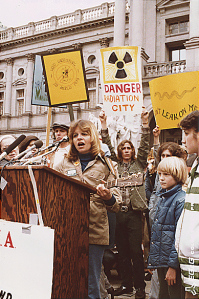
    Anti-nuclear rally outside the Pennsylvania State Capitol, 1979. Source: Wikipedia

    Anti-nuclear rally Pennsylvania, USA 1979. Source: Wikipedia

    We haven’t always been so disconnected from the bomb. US arms control expert William Hartung describes:

    There was a time when nuclear weapons were a significant part of our national conversation. Addressing the issue of potential atomic annihilation was once described by nuclear theorist Herman Kahn as “thinking about the unthinkable,” but that didn’t keep us from thinking, talking, fantasizing, worrying about it, or putting images of possible nuclear nightmares (often transmuted to invading aliens or outer space) endlessly on screen.

    Perhaps it was the imminent threat during the Cold War that compelled millions across the world to actively protest against nuclear weapons. For example, in the United Kingdom, the Greenham Common Women’s Peace Camp was established in 1981 to protest the deployment of US nuclear-armed cruise missiles at the Greenham Common Air Force base. While in June 1982 in the United States, one million people came together in New York’s Central Park to call for an end to the nuclear arms race in the “Nuclear Freeze” protest.

    The looming nuclear threat seemed to fade away after the Cold War. Progress on arms control led to complacency with the international treaties that were in place to protect us against nuclear dangers. Under the Nuclear Non-Proliferation Treaty (NPT), for example, the nuclear weapon states (UK, US, China, France, Russia) are obligated to work towards disarmament. However, as absurd as it sounds, there is no universal agreement on what that would quite look like, or how to get there.

    Moreover, we’ve witnessed three countries become overtly nuclear armed states since the Cold War: India, Pakistan and North Korea. It’s a small percentage in comparison to states that don’t have the bomb, but when it comes to nuclear weapons, even a small percentage is a terrifying one.

    International norms of non-use and the “nuclear taboo” have led us not to worry about that small percentage of states. Eric Schlosser’s recent book Command and Control, however, alarmingly points out that there have been several nuclear “near misses” in the United States alone that we as a public have little to no knowledge of. Schlosser writes:

    Right now thousands of missiles are hidden away, every one of them is an accident waiting to happen, a potential act of mass murder. They are out there waiting, soulless and mechanical, sustained by our denial – and they work.

    Is it simply that the public is in denial about nuclear weapons? A diverse range of psychological studies conducted in the 1980s – including Nuclear attitudes and reactions: Associations with depression, drug use, and quality of life; Nuclear War as a Source of Adolescent Worry; and Gender, sex roles, and attitudes toward war and nuclear weapons – demonstrate a desire to understand society’s feelings about nuclear weapons at the height of the Cold War.

    In more recent years, there have been similar studies conducted in reference to climate change, another somewhat abstract and imminent global threat. And yet, while the nuclear threat is the still around, we’re not as concerned about nuclear weapons as we were 30 years ago. It could be, as Schlosser suggests, denial. It seems that we have forgotten, don’t understand, or are simply indifferent.

    Why we should care

    Beyond the obvious threat of obliteration posed by nuclear weapons, they also undermine essential international co-operation between states and become a liability in certain situations. For example, in the recent Russian invasion of Ukraine, many media sources were keen to point out that any Western military intervention would put nuclear armed states up against each other. It could be argued that the diplomatic actions taken towards the crisis, resulting in economic sanctions and a recent shift of the G8 meeting away from Sochi, can be partly attributed to the looming presence of nuclear arsenals. As such, the continued presence of these weapons will continue to affect the cooperation and relationship between Russia and the West, for better or for worse.

    Nuclear weapons, or efforts taken to prevent their proliferation, can also affect a range of industries and economies. The threat of nuclear proliferation in Iran led to the implementation of economic sanctions that affected trade in a range of countries (including the UK, US and other European states) and a range of industries such as banking, insurance, oil, pharmaceuticals, and food. UN Resolution 1540 also calls upon states to implement export controls and regulations on materials that could be used for WMD proliferation, which affects such industries as shipping and transport, and manufacturing firms.

    It is naïve to assume that any spending on nuclear weapons or related programmes would or could be simply or entirely allocated to spending in other areas, such as healthcare or other threat reduction initiatives, but the stark contrast in the spending is noteworthy: In 2002, the World Bank estimated that $40-60 billion USD annually would be enough to meet the internationally agreed Millennium Development Goals, which range from providing universal primary education to eradicating poverty and hunger. Between FY2008 – FY2013, the US spent $77 billion to address global climate change in total, with the President’s request for $11.6 billion for FY2014. At the same time, it was estimated in 2012 that the US was on track to spend an average of $64 billion per year on nuclear weapons and related programmes over the following decade.

    Continued reliance on nuclear deterrence is a divisive issue. Whether one believes that it brings security and stability, or that the risks (and monetary costs) are too high, reliance on nuclear weapons for security is among the most pressing issues of our time and we need to be aware that the decisions we make today will have implications on the future and the uncertain threats that we will face. With public interest in nuclear issues waning, policy shapers and the emerging leaders of tomorrow are increasingly focusing their attention elsewhere. As a result, nuclear policy is being pushed back to those who have been making these decisions for decades and the circular debate rooted in Cold War perspectives continues. Fresh perspectives and a renewed interest in the nuclear debate are needed to address these security challenges of the future.

    The way forward

    Now is the time to engage the next generation on these issues if we are ever going to find a long term solution to this long term problem. The debate on nuclear weapons needs new ideas and help to shift nuclear weapons out of their isolated silo and back to the heart of security debate. This requires building a security narrative that includes nuclear weapons in a broader context, approaching them as a part of a bigger problem, and not as the problem itself. This also involves bringing in a wider range of disciplines into the nuclear weapons debate including businesses, creative communities, environmental and health groups, and social scientists, because nuclear weapons have an effect on all of us.

    If we are going to make progress on the nuclear weapons debate, we need continued engagement from all sides, along with a deeper understanding of the motivations behind what drives people to think about (or not think about) nuclear weapons. In essence, we need to reconnect with the nuclear debate and start thinking about a sustainable future.

    BASIC has launched a new Next Generation project to inspire a next generation of thinking on nuclear weapons.

    Rachel Staley is currently the Programme Manager for the British American Security Information Council (BASIC) in their London office. Since 2011, Rachel has managed the operations of the office and assisted in developing the organisation’s programmes working on nuclear non-proliferation and disarmament in the Middle East, as well as engaging directly in the Trident renewal debate in the United Kingdom. Rachel holds an MA with Distinction in Non-Proliferation and International Security from King’s College London and a BA with Honours in International Affairs and Anthropology from Northeastern University.

  • Climate Change, Security, and Indigenous Peoples: Inuit in Northern Canada

  • Honduras, the Perfect Storm?

    Privatising the War on Drugs: PMSCs in Colombia and Mexico

    US drug policy has become increasingly privatised in recent years as the US government contracts private military and security companies (PMSCs) to provide intelligence, logistical support and training to state security forces in drug-producing and –transit states. As the cases of Colombia and Mexico illustrate, this privatisation strategy is having a damaging impact on these already fragile environments.

    Read Article →

    Belize: challenges and contradictions in gang policy

    Like its neighbours in the northern triangle (El Salvador, Honduras and Guatemala), Belize has a high murder rate that is closely connected to the strong presence of gangs. But the character of gang activity in Belize is quite different from its Central American neighbours. Belize has pioneered some innovative solutions to the problem it is facing. But it will need to overcome the challenges of internal resistance and an acute lack of resources in order to address the political, economic and social issues that marginalise Belize’s large youth population.

    Read Article →

    Colombia and Mexico: The Wrong Lessons from the War on Drugs

    As activists around the world participate in a Global Day of Action against criminalisation of drug use, evidence from the multi-billion dollar War on Drugs in Colombia suggests that militarized suppression of production and supply has displaced millions of people as well as the problem, not least to Mexico. The wrong lessons are being exported to Central America and beyond, but a groundswell of expert and popular opinion internationally is calling for alternative approaches to regulating the use and trade in drugs.

    Read Article →

    Mexico’s Conflicting Migration Policy Goals: National Security and Human Rights

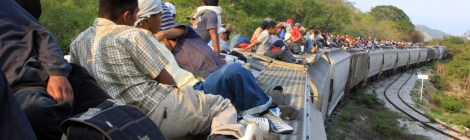
    Mexico has rapidly become a major site of transmigration from Central America to the United States, as people move in search of employment opportunities or escape from social violence. This rise in migrant flows from Mexico’s southern border overlaps with problems of control of contraband, organised crime, and the trafficking of drugs and arms. However, the government’s militarised approach to the phenomenon means that the use of force and human rights violations go unresolved and military approaches to preserving public order go unchecked. As long as migration remains a security issue, instead of a developmental and human rights matter, it will not be tackled appropriately. Instead, the government must start to view the matter through a citizen, not national, security lens.

    Read Article →

    Exporting (in)Security? Questioning Colombian Military Engagement in West Africa

    With skills and expertise in fighting insurgencies and drug trafficking networks, Colombia’s armed forces are increasingly being sought for engagement in similar security challenges in West Africa. But increasing Colombian engagement gives rise to a number of important questions – not least of which is the goal and expected outcomes of replicating militarised approaches to the war on drugs that have already failed in Latin America.

    Read Article →

    Militarised Public Security in Latin America in Venezuela

    Across Latin America, governments are sending their militaries into the streets to act as de facto police forces in the face of disproportionally high crime and violence rates. This trend has been going on for several years, but has accelerated in 2013. With the move to deploy over 40,000 troops for citizen security in Venezuela, President Nicolás Maduro joined a growing list of leaders throughout the region that have relied on their militaries to carry out police duties. In the first of our two-part discussion ‘Countering Militarisation of Public Security in Latin America’, Sarah Kinosian discusses the conditions that are causing the trend to thrive.

    Read Article →

    Countering Militarised Public Security in Latin America: Lessons from Nicaragua

    Facing a myriad of public security challenges that have provoked some of the highest indices of crime and violence in the world, authorities in Central America have followed a variety of different responses, ranging from repressive and reactive policies to grass roots prevention. Of these approaches, the Nicaraguan National Police’s Proactive Community Policing model stands out due to the results it has achieved. In the second of our two-part discussion, ‘Countering Militarisation of Public Security in Latin America’, Matt Budd explores the lessons that Latin American countries can extract from Nicaragua’s unique approach to public security.

    Read Article →

  • Syria’s Uneven Aid Distribution Threatens Future Peace

    The significant imbalances in the distribution of aid between different geographical areas in the current Syrian war threaten not only the immediate survival of civilians, but also the future prospects for peace.

    The Syrian crisis counts among the direst of our times, and never has there been a humanitarian emergency reaching comparable volumes of assistance. Formerly a relatively prosperous middle income country of about 21 million people, more than five years of war have plunged Syria into staggering poverty. Having lost their livelihoods, 13.5 million people are dependent on humanitarian aid.

    Irrespective of International Humanitarian Law (IHL), belligerents have targeted residential areas and vital infrastructure such as water and electricity supplies, as well as medical facilities. In a desperate effort to survive, half the country’s population have been forced to leave their homes, not knowing whether they will ever be able to return. Of these, 4.8 million have crossed the borders as refugees, while a further 6.1 million people remain uprooted within the country.

    While humanitarian assistance such as food and water, shelter, and medical aid are indispensable, it is deeply problematic that the distribution of aid in different areas in the country is highly uneven. Needs are estimated to be greatest in territory controlled by opposition forces – yet it is here that least aid is being delivered. In 2015, for example, only 27% of World Health Organisation administered medical aid reached opposition areas, as did the same share of food aid delivered by the World Food Programme only last month. Under the umbrella of the UN, both are the biggest humanitarian actors in their fields. Why are these imbalances occurring, and why are they critical for future peace negotiations and reconstruction?

    The Syrian war

    In Syria, the multitude of armed groups, estimated to number several hundred, complicates the distribution of aid as much as the fact that the country is now engulfed in not one, but two wars. Since 2011, civilians have been caught up in the original conflict between the regime and opposition groups seeking a change of government. But another battle is being fought between these opposition groups and Daesh, which proclaimed the establishment of their so-called Islamic State in July 2014. In areas controlled by the latter, the US-led international alliance is attacking Daesh positions across Syria and Iraq, while the Syrian and Russian air forces target other opposition-held areas.

    Given that the presence of armed groups, their alliances and infighting differ significantly at the local level, humanitarian actors are thus operating in a highly fragmented terrain that requires often daily negotiations and re-evaluation of safety concerns for their own staff.

    An aid system controlled by the government
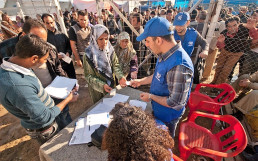
    eu-aid

    Image credit: IOM Iraq/Flickr.

    To some extent, aid imbalances occur in war zones anywhere in the world. Generally, humanitarian aid can only be delivered when belligerents grant aid organisations permission to access people in need and guarantee for the security of their staff. Syria is exceptional, however, in the severity and persistence of aid imbalances. Although belligerents on all sides have interfered with aid deliveries, the Syrian government still controls about half the Syrian territory, thus presenting the single largest threat to impartial aid. By claiming to uphold Syrian sovereignty, it has quietly retained tight control over the aid system in place.

    Only 17 INGOs are permitted to operate in designated areas of the country with limited reach, and their choice of local partners is limited to NGOs licensed by the government. Even after more than five years, the UN are still not allowed to carry out needs assessments in the country independently of the government, and they have remained obliged to issue the annual Syrian Humanitarian Response Plan (SHARP) – which is the basis for planning and monitoring the response each year – jointly with them. Even if convoys are approved for deliveries into opposition areas through rapidly changing bureaucratic procedures which can stretch over months, they are regularly stripped of surgical equipment and even delivery kits at government checkpoints.

    Contravening the Hippocratic Oath and IHL, anti-terrorism legislation has rendered the medical treatment of anyone associated with the opposition a crime since June 2012. Intimidation, arrests and killings of medical staff, such as ambulance drivers, doctors and nurses were common at the beginning of the war, while medical facilities including hospitals, blood banks and coordination centres are regularly being subjected to targeted attacks.

    Horrifying accounts have emerged from those trapped in such conditions, such as in Eastern Aleppo, where the remaining population was evacuated over the past week after years of heavy assault. By designating all opposition-held areas as being controlled by “terrorists” – an expression which is by no means limited to Daesh – the regime has portrayed the populations in these territories as undeserving of aid. In so doing, it puts the lives of millions in need at risk.

    Fear of losing access

    Although the UN have long denounced the blockade of aid to opposition areas as an illicit  war tactic, they have continued to compromise for fear of losing access, which is becoming more and more restricted. Today, 5.47 million live in hard-to-reach areas and 861,200 are trapped in areas under siege in Syria alone. Although, again, it is not only the government conducting sieges, 15 out of 18 areas are currently besieged by its armed forces. Sieges seek to enforce surrender – just as as Darayya did after 2.5 years without aid to civilians. Where humanitarian aid does reach opposition areas, airstrikes by Syrian and Russian government forces destroy residential neighborhoods and carry out targeted strikes on medical facilities, leaving not only wounded fighters, but also civilians without resort.

    Conversely, not only has the government ensured that the vast majority of aid is channeled towards areas under its own control, but it has also used its leverage to strengthen its economy. Citing a lack of alternatives, the UN have paid tens of millions of US-dollars to implementing organisations and suppliers owned or run by individuals associated with the government who are under EU sanctions. These are not legally binding for the UN – yet current practice render them devoid of meaning. All these measures are without consequences for the government.

    A parallel system: the unofficial humanitarian response

    While opposition areas are systemically being deprived of direly needed humanitarian aid, an unofficial response has quietly emerged in parallel to the UN-led response which is co-ordinated with the government through SHARP. Early in the conflict, hundreds of local NGOs and expat-founded NGOs abroad sought to fill the gap the UN-led response left in opposition-held territory. From the conflict’s onset, the government refused to licence local NGOs in these areas, knowing full well that these are indispensable partners for major INGOs, most of whom had no prior experience of working in the country.

    While it is impossible to establish the actual financial volume of the unofficial deliveries, which are not accounted for in the annual SHARPs, they are highly unlikely to reach levels anywhere near that of the official UN-led response. Although Médecins Sans Frontières (Doctors without Borders) warned that since the beginning of the war that opposition-areas were being strongly disadvantaged in life-saving aid, it took three years until UN resolution 2156 was implemented, which allowed for additional cross-border deliveries mainly from Turkey – with deeply insufficient results, as present figures show. If local NGOs are permitted to work with the official response at all, strict monitoring processes are put in place on money spent, and rightly so. In the view of some, however, the recent revelations on UN-suppliers render these requirements into a farce.

    Why do belligerents seek to control aid?

    Where belligerents can ensure access to aid in areas under their own control, a resemblance of normality can be maintained in which former state services are being replaced by external assistance. Before the war, the Syrian government implemented socialist-inspired welfare programmes over the course of decades, including needs assessments, which aimed to maintain political consent even within a highly repressive dictatorship. It is now drawing on humanitarian aid as a substitute. In a similarly systemic manner, Daesh have sought to control humanitarian actors, of which only very few are managing to uphold access and operational independence. In areas controlled by Kurdish forces and different groups affiliated with the Free Syrian Army, aid deliveries are often facilitated and coordinated by the Local People’s Committees or Local Administrative Councils, respectively.

    While these are often credited for their efficiency, they are nonetheless political bodies who should not seek to monopolise aid deliveries for political gain. Belligerents seek to portray access to aid as a testimony to their ability to fulfill basic needs and protect survival. Where they manage to secure regular access to aid, the result is an order which is functional and might appear as either a continuation of the previous status quo or as a credible alternative to the latter. It is that perception which, by blocking aid deliveries to populations in territories under the control of the enemy, is sought to be destroyed with the aim of undermining their respective quest for legitimacy.

    The dangers of Syria’s aid imbalances

    Aid imbalances are dangerous not only because they raise the question as to who is most disadvantaged in receiving aid, but also because other wars have shown that access to social services and aid influence the directions in which people move. Demographic changes are a decisive factor in the outcome of war. From the viewpoint of belligerents, deserted neighborhoods are more difficult to defend because they lower the morale amongst fighters. For civilians, aid imbalances which privilege areas under the control of a given warring party over others deepen existing divides. Populations in areas less reached – especially if imbalances occur over long periods of time – will be physically and mentally weaker, exposed to poorer living conditions, and with comparatively fewer options to reach out for assistance. Violence, and in the Syrian case aerial bombardments in particular, prompt populations to flee; access to life-saving resources influence where they seek refuge.

    In Syria, data on population movements within the country are still scarce, but the key question is whether those who cannot afford to leave the country are drawn from opposition- into government-held areas out of sheer need. If so, the international aid system threatens to not only enhance social fragmentation, but also further depopulation. In a country where a third of the population has been forced to flee, how will peace negotiations allow for their voices to be heard? For those who remain in the country, in which areas are residents still strong enough to engage, where do factories and business remain functioning that can stem the unfathomable project of future reconstruction, and how will the divides that have been deepening for so long now be bridged?

    Future outlook

    With every day passing, the aid delivered contributes to shaping the conditions under which peace will be concluded and reconstruction will begin. Aid imbalances are no new phenomenon, but the scale at which opposition-held areas are being disadvantaged in the Syrian case is. The present war has plunged organisations in the official response into a most severe crisis.

    In an unprecedented decision, 73 local NGOs declared stopping all collaboration with the UN in October this year in protest against their perceived partiality. It has long been argued that in line with IHL, humanitarian aid must be carried out independently and it must be neutral and impartial in intent, but it is inevitably political in effect. In the Syrian war, however, humanitarian aid has become politicised to the point that it may severely impact on the outcome of the war.

    The idea that delivering some aid is better than no aid at all thus represents a dangerous approach. Although slow progress has been made in raising awareness of government interference over the course of this year, the struggles of the unofficial response in opposition areas in particular remain underestimated and underreported. With added pressures resulting from chronic shortages of funding, humanitarian organisations on all sides are caught up in having to reach as many recipients as possible – regardless of where they are located – to meet donor expectations. As a result, there is little room for self-critical reflection, and internal divides on the present responses remain largely invisible for the public.

    In contrast to these trends, concrete measures to counter present imbalances are urgently required. These could mean greater numbers of aid drops — similar to those recently resumed in Dayr al-Zur — in areas under siege, hard-to-reach areas, and others where ground access cannot be secured. They also require a coherent approach which does not tolerate interference by any warring party – including the government. For cases where belligerents insist on unacceptable compromises, protocols are needed which allow for humanitarian deliveries to be stopped as result.

    If it comes to a point where these measures are being taken, it must be clear that responsibility does not lie with the humanitarian system, but the warring party refusing to abide by the very principles on which humanitarian aid  is based. Addressing these challenges remains an indispensable condition for ensuring even and fair access to humanitarian aid for those in dire need now, and for their prospects of living in the country in the future.

    Dr. Esther Meininghaus is a Senior Researcher at the Bonn International Center for Conversion.