Blog

  • Sustainable Security

    Deforestation: REDD-y for peace or fuelling conflict?

    REDD forestry efforts don’t pay enough attention to their influence on local conflict dynamics. For REDD+ to be an effective mechanism to curb deforestation and strengthen peace opportunities, it has to pay more attention to pre-existing land and forest conflicts linked to tenure, take into account the interests of the local communities and be more sensitive to the local context

    Read Article →

  • New UN Resolution on Uranium Weapons

    New UN Resolution on Uranium Weapons

    Issue:Global militarisation

    148 states have supported a United Nations General Assembly resolution calling on state users of depleted uranium weapons to reveal where the weapons have been fired when asked to do so by affected countries.

    The resolution was passed by a huge majority, with just four countries opposing the text. As with previous UN resolutions in 2007 and 2008, the UK, US, Israel and France voted against. The number of abstentions was down on previous years after Belgium, Bosnia-Herzegovina, Greece, Luxembourg and Slovenia voted in favour. Nevertheless, abstentions were still registered by Australia, Canada, Denmark and Sweden amongst others. The Russian Federation also abstained, while China declined to vote.

    The resolution was triggered by growing concern over the US’s failure to release information on the whereabouts of at least 400,000kgs depleted uranium munitions used in Iraq. Question marks also remain over whether the weapons have been used in Afghanistan, Somalia and Chechnya. Research by ICBUW has shown that the rapid release of targeting data after conflicts is crucial in reducing avoidable civilian exposures; recommendations that national authorities monitor soil and water contamination and, where necessary, decontaminate sites, are also reliant on this data.

    The UK, US and France maintain that it is up to the users of the weapons to release this data at a time and in a manner of their own choosing. While the UK has shared information on their use of the weapons in Iraq in 2003 with UN agencies, the US has made no effort to do so. It is now 19 years since the first major use of depleted uranium in Iraq.

    In a joint statement explaining their position during the first round of voting at the First Committee, the UK, US and France wrote: “[Operative paragraph 6] requests that states that have used depleted uranium in armed conflict to provide information about its use. We have serious doubts on the relevance of such a request, according to IHL [International Humanitarian Law]. We consider that it is up to each state to provide data at such a time and in such a manner as it deems appropriate.

    The attempt by these countries to try and conflate the resolution with IHL has been challenged by legal specialists, who pointed out that it is not a question of whether it is appropriate under IHL but rather whether the request in itself is reasonable. It is clear that 148 states felt that it was.

    Reacting to the vote, an ICBUW spokesperson said: “It is abundantly clear that even the most conservative mitigation measures are made much more difficult by the failure of states to promptly identify where the weapons have been used.

    “The US, UK and France’s ongoing apparent policy of non or limited disclosure is outrageous and at odds with their legal obligations to protect civilians and the environment during and after conflict.

    “The feebleness of their attempted justification for their position makes clear that they have few concerns over the long-term impact of these munitions on civilians, and are instead solely interested in protecting their toxic and outdated weapons. This is the strongest level of support for a resolution on this issue yet and we believe it reflects a growing impatience with the users of these weapons.”

    On learning of the results, UK campaigners reacted angrily, accusing the UK government of hypocrisy and of ignoring the wishes of its own parliament. In the run up to the vote, 90 Members of Parliament had signed a motion calling on the government to support the resolution, while representatives from all the main UK parties had written to the press to highlight the text.

    A spokesperson for the UK Uranium Weapons Network said: “The UK’s decision to vote against the resolution is extremely disappointing. Sites contaminated by land mines, cluster munitions or depleted uranium all represent a post-conflict hazard to civilians.

    “All these sites require remedial work and, as a vast majority of states recognise, including those states that have had to endure the impact of these weapons, this work is impossible without full transparency over where the weapons have been used.”

    As with previous years, the resolution was submitted by Indonesia on behalf of the Non-Aligned Movement. In addition to the general call for transparency, it also recognised the importance of implementing recommendations by UN agencies to help mitigate the hazards from depleted uranium. Discussion over the long-term impact of these weapons is ongoing but the World Health Organisation and International Atomic Energy Agency both call for sites to be marked, and where necessary decontaminated. The United Nations Environment Programme has called for a precautionary approach to the use of the weapons due to ongoing uncertainties about the environmental behaviour of uranium contamination.

    Resolutions passed in 2007 and 2008 accepted the potential risk from depleted uranium weapons and called for more focused research on affected states. This research has been hindered the lack of transparency from users.

    The full list of abstainers is as follows: Albania, Andorra, Australia, Bulgaria, Canada, Croatia, Czech Republic, Denmark, Estonia, Georgia, Hungary, Kazakhstan, Kyrgyzstan, Latvia, Lithuania, Micronesia, Palau, Poland, Portugal, Rep of Korea, Rep of Moldova, Romania, Russian Federation, Sao Tome and Principe, Slovakia, Spain, Sweden, TFYR Macedonia, Turkey and Ukraine.

    Article source: International Coalition to Ban Uranium Weapons

    Image source: BlatantWorld.com

    Comments

    Post new comment


  • Mano Dura: Gang Suppression in El Salvador

    Mano Dura: Gang Suppression in El Salvador

    Sonja Wolf | Exclusively written for sustainablesecurity.org | March 2011

    Issues:Global militarisation, Marginalisation

    El Salvador’s gang history dates back to the 1960s. At the time, numerous neighbourhood-based groups provided marginalised urban youths with the means to hang out, party, take drugs, and fight their rivals. These gangs constituted a nuisance for the affected residents but did not represent a public security threat. The situation drastically changed when the Central American civil wars ended and the United States stepped up its deportations of offending non-citizens, including members of Mara Salvatrucha (or MS-13) and Calle Dieciocho (18th Street). Both gangs had been formed in Los Angeles’ immigrant barrios, a haven for Central American refugees some of whose children responded to difficult circumstances by joining existing gangs (such as the Dieciocho) or forming their own group (Mara Salvatrucha). Tired of the stresses of gang life, many deportees arrived in their country of origin hoping to make a fresh start. Faced with poor reinsertion opportunities, however, they continued with what they knew best. Their comparatively nice dress, money, and tales of gang exploits held a fascination that local adolescents found hard to resist. Soon the imported gangs absorbed their smaller counterparts and continued to grow, since widespread social exclusion made El Salvador fertile ground for gang proliferation. Over time gang members resorted to greater levels of violence and drug activity, but the country long lacked a full-fledged gang policy.

    In 2003 – eight months before the 2004 presidential elections – President Francisco Flores of the conservative ARENA party launched Plan Mano Dura (“Strong Hand”), ostensibly to dismantle the gangs and curb the number of homicides, most of which had been attributed to these groups. Backed by considerable media publicity, the measure entailed not only area sweeps and joint police-military patrols, but was also accompanied by a temporary anti-gang law that permitted the arrest of suspected gang members on the basis of their physical appearance alone. Both the nature and the timing of the initiative suggested that it had been designed to improve the ruling party’s electoral position rather than to ensure effective gang control. Plan Mano Dura enjoyed huge support among a population that had become weary of permanent insecurity, but human rights defenders, judges, and opposition politicians criticised it for its abuses and neglect of prevention and rehabilitation. The measure helped ARENA win the elections, but the incoming administration of Antonio Saca responded to the earlier criticism by incorporating prevention and rehabilitation into his Plan Super Mano Dura. These alternative approaches, however, were a largely rhetorical concession since suppression remained the dominant strategy. Contrary to the official discourse of success, Mano Dura was spectacularly ineffective: the homicide rate escalated, and the gangs adapted to the climate of repression by toughening their entry requirements, adopting a more conventional look, and using heavier weaponry. More importantly, confinement in special prisons allowed gang members to strengthen group cohesion and structure. Moreover, the large-scale incarceration of gang members fuelled the need for more resources for both the inmates and their families and resulted in an upsurge in extortions, particularly in the transport sector.

    By June 2009, when the government of ex-journalist Mauricio Funes and the FMLN (the former guerrilla army) came into power, the gang problem had become intractable. MS-13 and Dieciocho clicas (subgroups) sprawled hundreds of marginal urban communities, their members committed a variety of crimes – ranging from threats, robbery, injuries, auto theft, and the illegal carrying of firearms to drug sales, extortions, rapes, kidnappings, and homicides – and their violence had become increasingly diffuse and brutal. The Funes government announced a comprehensive crime policy comprising social prevention, law enforcement, rehabilitation, victim support, and institutional and legal reforms. The strategy, however, is underfunded (state coffers had been plundered by previous administrations), and gangs are being tackled through the overall crime policy rather than a specific gang programme. The police – now under a new command – has stopped conducting mass raids in gang-affected zones and begun to strengthen its investigative capacity. These are promising steps, but events on the ground soon pushed policy in another direction. Public demands for a quick reduction of homicides and media coverage alleging government incompetence led President Funes in November 2009 to deploy the army. Military participation in public security tasks is no recent development. At present, however, the army has been given broader powers, permitting it to conduct patrols, perform searches, and arrest criminals caught red-handed as well as to maintain perimeter security at the prisons. In what appears to be a face-saving gesture, the Funes administration adopted a gang strategy that exhibits ominous parallels with the earlier Mano Dura policies. Meanwhile, prevention and rehabilitation have once again taken the backseat.

    Sonja Wolf is a Post-doctoral Fellow at the Universidad Nacional de Mexico, Mexico City where she conducts research on street gangs and organised crime in Central America.

    Image source: VCK xD

    Comments

    Post new comment


  • Sustainable Security

    Carefully Managing Water Resources to Build Sustainable Peace

    Carefully planned interventions in the water sector can be an integral part to all stages of a successful post-conflict process, from the end of conflict, through recovery and rebuilding, to […]

    Read Article →

  • Sustainable Security

    Western states are growing increasingly reliant on private military and security companies. Fully understanding the privatization of security and its effects on sustainable security requires the inclusion of a critical gender lens.

    Introduction

    In 1999, the American private military contractor Dyncorp hired Kathryn Bolkovac as UN International Police Task Force monitor in Bosnia-Herzegovina. In the course of her work Bolkovac raised allegations that private contractors and UN employees were trafficking and sexually exploiting young girls. In 2002, a UK court acknowledged that Bolkovac was wrongfully dismissed for bringing the story to light, but nobody was ever prosecuted for the alleged sex trafficking.

    Bolkovac’s story — dramatized in the movie The Whistleblower  — captures perfectly some of the challenges to accountability when security functions are outsourced to the private sector and performed by transnational security forces. Security privatization reduces transparency and accountability in ways that exacerbate and make less visible the gender inequalities and gender-based violence that pervade militarized security contexts. Moreover, security privatization increases the profitability of insecurities, making it more difficult to tackle the causes, including gendered causes, of insecurity. Understanding the privatization of security and its effects on sustainable security requires the inclusion of a critical gender lens.

    PMSCs and gender: an emerging challenge

    15245844288_2026206f77_o--1-

    Image by chuck holton via Flickr.

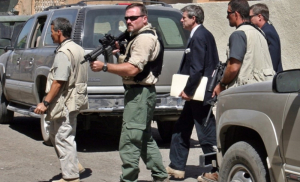
    Over the past three decades a new challenge to sustainable security has emerged: the growing reliance on private military and security companies (PMSCs) by Western states, international organizations, non-governmental organizations, and transnational corporations. PMSCs offer a wide range of services from logistical support, intelligence, training, armed and unarmed guarding and protection, to reconstruction and more. The US-led wars in Afghanistan and Iraq have shown that today waging war is contingent on heavy involvement from the private sector. Private contractor numbers have trailed and at times outpaced US troop levels in the wars in Afghanistan and Iraq. In February 2010, the US DoD employed more than 100,000 private contractors each in Afghanistan and Iraq.

    A number of high-profile cases have highlighted the problems associated with the use of private contractors in Iraq and Afghanistan. Private contractors were involved in the abuse of prisoners at Abu Ghraib and the 2007 shooting and killing of Iraqi civilians in Nisour Square. Allegations of war crimes, poor working conditions, sexual harassment and human trafficking, and disregard for local populations have come to shape the public image of the private security industry over the past two decades.

    In this context, gender has become part of the industry’s attempts to improve its reputation. Gender considerations have made it into the voluntary International Code of Conduct for Private Security Providers that came into effect in November 2010. The International Code of Conduct explicitly addresses gender in three paragraphs on gender-based violence, selection of personnel, and harassment-free work environments. Gender has also been declared ‘good for business‘ by the private security industry. Female employees of PMSCs are seen as useful to conduct security checks on women or to foster positive interactions with local populations, and thus seen as instrumental to operational effectiveness. This attention to gender, while positive on the surface, has mostly served the purpose of creating greater legitimacy for the industry. It has not addressed the larger impacts that outsourcing have on women’s claims to greater and equal participation in the military sphere and the gendered impacts of the use of private forces in local contexts.

    A critical gender lens on private security

    Gender is not just a ‘problem to be solved’ for private contractors, but is fundamental to the reorganization of force through privatization, to the functioning of the private security industry, and to how the industry legitimizes itself. The greater use of private force is part of the broader neoliberal transformation of militarized citizenship that has also entailed a shift from conscription to all-volunteer forces in many Western states. This reorganization of public force has meant an end to the male citizen-soldier model and the greater integration of women into all-volunteer forces. The greater reliance on private security has occurred alongside to the greater integration of women into Western public militaries. While some decry the feminization of public militaries, others have shown how PMSCs actively rely on hyper-masculinity in portraying themselves as more effective security forces vis-a-vis the public sector.

    PMSCs that provide security services primarily recruit from the army and special forces. In doing so, they replicate and even reinforce the gendered division of labour present in the public military sphere. However, PMSCs have also made a concerted effort to distance themselves from the hyper-masculine images of trigger-happy burly ‘cowboys’ and shift towards a softer and more legitimate image of masculinity, shedding the hyper-masculine militarized image for one emphasizing humanitarianism, protection, professionalism, and expertise. At the same time, privatization sidelines and depoliticizes questions of gender equality in the military sphere. There is neither publicly available data on women in the private security industry nor public debate on their marginalization within the industry. By its very logic, profitability drives the private security sector and not questions of citizenship and equal participation.

    Gender also intersects with race and citizenship to shape the division of labour in the globally operating private security sector. A large segment of the workers hired or subcontracted by PMSCs comes from the Global South. The globally operating private security industry can be thought of as a hierarchy of masculinities. Western contractors are at the top of this hierarchy, and so-called third-country nationals (TCNs) from the Global South sit at the bottom. Profitability is in part achieved through the exploitation of this vulnerable migrant labour force.

    The outsourcing of military security functions to private companies has allowed a global rescaling of labour recruitment in support of Western military operations. As data from the US wars in Iraq and Afghanistan show, a majority of contractor labour is made up by ‘third-country’ and host-country nationals and not by US citizens. For example, of the more than 200,000 DoD contractors working in Iraq and Afghanistan in February 2010 (mentioned above), less than 40,000 were US citizens. The racialized hierarchy among contractors of different citizenship is evident not only in pay and working conditions, but also in the kind of work performed. While local and migrant workers perform much of the logistical support work, their proportion is particularly high when it comes to the more dangerous armed security work.

    Conclusion

    Simply bringing consideration of gender into the private security industry is not a sufficient enough means of addressing the problems that security privatization poses for sustainable security. Conflict is often justified and waged by appealing to gendered notions of security: masculinized protectors and defenders, and feminized and vulnerable populations in need of protection. Private actors feed into this gendered discourse, portray themselves as masculinized protectors, and benefit from continuing insecurities and global inequalities. As insecurities create new market opportunities for the private security industry, gendered discourses of protection and gendered divisions of labour are being reinforced while sustainable security becomes more elusive. We need to be mindful of security privatization and the fundamental ways in which it is gendered as we work towards remaking security in more sustainable ways.

    Maya Eichler is Canada Research Chair in Social Innovation and Community Engagement and Assistant Professor of Political Studies and Women’s Studies at Mount Saint Vincent University.

  • Global militarisation

    Global militarisation

    The current priority of the dominant security actors is maintaining international security through the vigorous use of military force combined with the development of both nuclear and conventional weapons systems. Post-Cold War nuclear developments involve the modernisation and proliferation of nuclear systems, with an increasing risk of limited nuclear-weapons use in warfare – breaking a threshold that has held for sixty years and seriously undermining multilateral attempts at disarmament. These dangerous trends will be exacerbated by developments in national missile defence, chemical and biological weapons and a race towards the weaponisation of space.

    India’s Defexpo 2010 and the Global Arms Trade

    Nitasha Kaul | openDemocracy | March 2010

    Issue:Global militarisation

    The recently held  Indian Defexpo 2010 (described as “Asia’s biggest arms bazaar”) illustrates the increasing levels of militarisation both in India but also globally writes Nitasha Kaul.


    Read more »

    The nuclear-weapons moment

    Paul Rogers | openDemocracy | March 2010

    Issue:Global militarisation

    The global effort to extinguish the nuclear peril needs to regain momentum. A bold act of leadership and imagination by one of the weapons-states could provide it.

    Photo courtesy of thepretenda.

    Read more »

    Three connected conflicts – Iraq, Afghanistan and Pakistan

    Paul Rogers | Oxford Research Group | February 2010

    Issue:Global militarisation

    Tagss:Afghanistan, Conflict, Iraq, Pakistan

    At the beginning of February, ISAF sources announced that a major military offensive was about to be mounted in Helmand Province in southern Afghanistan. This was Operation Moshtarak (“together”), involving 15,000 US, British and Afghan National Army troops, and would concentrate on clearing Taliban and other paramilitary groups from two areas, one of them centred on the town of Marja. The publicity given to the operation appeared designed partly to encourage civilians to evacuate areas under Taliban influence, but would also serve to highlight the capabilities of coalition forces at a time when support for the war in the United States and Britain was fragile.

    Given the size of the operation, it is likely that it will provide a major focus for western media attention for some weeks, but to get a full measure of its significance requires seeing it in the wider context of the conflicts in Iraq and Pakistan, and of the Status of the al-Qaida Movement. There have, in particular, been significant developments in both Iraq and Pakistan, with each likely to have an impact on what is now happening in Afghanistan.

    Photo courtesy of Helmandblog.

    Read more »

    A new approach to ballistic missile defence in Europe? Demystifying the end of the ‘third site’

    Andrew Futter | Oxford Research Group | February 2010

    Issue:Global militarisation

    ORG Exclusive

    The new “Phased, Adaptive Approach” to ballistic missile defence announced by the Obama Administration will provide the US with a considerable defensive architecture in Europe, potentially incorporating numerous radars and tracking facilities twinned with hundreds of interceptor missiles, which will be far superior in terms of size and capability than the Bush Administration’s proposal writes Andrew Futter.

    Read more »

    Afghanistan: propaganda of the deed

    Paul Rogers | openDemocracy | February 2010

    Issue:Global militarisation

    Tagss:Afghanistan, International politics, Taliban

    The deluge of publicity about a large-scale military operation against the Taliban must be set against Afghan realities that tell a different story. The task of reaching an accurate assessment of the real state of the conflict must look beyond such public-relations campaigns from military sources.

    Image source: Reuters

    Read more »

    Iraq’s shadow over Afghanistan

    Paul Rogers | openDemocracy | February 2010

    Issue:Global militarisation

    Tagss:global security, globalisation, International politics

    The current surge in United States military forces in Afghanistan part of a strategy designed to bring the war to an end from a position of strength. The great strains within the US military mean that the deployment of 30,000 troops to Afghanistan can be sustained only if forces can be withdrawn from Iraq at the scheduled rate: that is, all combat-forces out by August 2010 and the remaining (approximately 50,000) personnel by the end of 2011. The dynamics of violence in Iraq present a serious challenge to this strategy.

    Washington is thus engaged in a delicate balancing-act: managing disengagement from Iraq while ensuring that the United States will retain a significant military presence in the country well beyond 2011 in order to exercise a maximum degree of influence.

    Read more »

  • Sustainable Security

    Chemical Weapons Use in Syria: a Test of the Norm

    Recent events in the Syrian civil war have proved an unparalleled test of the norm against the use of chemical weapons. At its core this was a test of the willingness of countries to uphold the norm, in this case in the face of a flagrant violation, and a response that in the end stumbled upon a satisfactory conclusion—reaffirming the special category of chemical arms—but which in the process said a great deal about current attitudes to the use of military force as a means of humanitarian intervention.

    Read Article →

    Beyond crime and punishment: UK non-military options in Syria

    The defeat of the UK government’s parliamentary motion on support in principle for military action against the Syrian regime means that Britain will play no part in any direct attack on Syria. What then are its options for resolving the Syrian conflict, protecting civilians and punishing those responsible for war crimes there? This article assesses what the UK can do in terms of pushing for a negotiated peace settlement and to hold accountable those responsible for using chemical weapons and any other war crimes committed during this century’s worst humanitarian crisis.

    Read Article →

  • World Development Report 2010: Development and Climate Change

    World Development Report 2010: Development and Climate Change

    Issue:Climate change

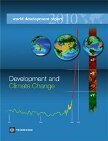
    The World Development 2010 climate Change Report published in September outlines how a 2 degree centigrade rise in global temperature would likely cost Africa 4% of GDP whilst the impact on India would be %5 of GDP. Developing countries are already disproportionately impacted by climate change with 80% of the worlds population located in the developing world.

    As the report states:

    “Solving the climate problem requires a transformation of the world’s energy systems in the coming decades.   Research and Development investments on the order of US$100 – $700 billion annually will be needed—a major increase from the modest $13 billion a year of public funds and $40 billion to $60 billion a year of private funds currently invested. 

    Developing countries, particularly the poorest and most exposed, will need assistance in adapting to the changing climate. Climate finance must be greatly expanded, since current funding levels fall far short of foreseeable needs. Climate Investment Funds (CIFs), managed by the World Bank and implemented jointly with regional developing banks, offer one opportunity for leveraging support from advanced countries, since these funds can buy-down the costs of low-carbon technologies in developing countries.”

    The report is published at an important juncture as world leaders begin positioning themselves in the run-up to negotiations at Copenhagen.

    The full report can be downloaded here. 

  • Sustainable Security

    The Ukraine conflict’s legacy of environmental damage and pollutants

    One year after violent conflict began, information is now emerging on the specific environmental impact of war in Ukraine’s highly industrialised Donbas region. Although obtaining accurate data is difficult, indications are that the conflict has resulted in a number of civilian health risks, and potentially long-term damage to its environment. In order to mitigate these long-term risks, international and domestic agencies will have to find ways to coordinate their efforts on documenting, assessing and addressing the damage.

    Read Article →

  • Sustainable Security

    In June,  a judicial review into the legality of UK arms sales to Saudi Arabia was announced. This will be the first time that UK arms export policy has been put under the spotlight and scrutinised in this way. Campaign Against Arms Trade discuss this historic decision.

    On 30th June there was a heavy silence in the moments before High Court Judge Justice Gilbart announced that he was granting a judicial review into the legality of UK arms sales to Saudi Arabia. A quiet relief fell over those of us in the public gallery. Decorum ensured that the response was muted, but the decision was historic. This will be the first time that UK arms export policy has been put under the spotlight and scrutinised in this way. It is an unprecedented step that is likely to focus on not just the extent of UK arms sales to Saudi, but also the scale of collusion and government support that goes with it.

    Our claim calls on the government to suspend all extant licences and stop issuing further arms export licences to Saudi Arabia for use in Yemen while the court holds a full review into whether the weapons sales are compatible with UK and EU legislation. The UK’s arms export policy will thus now undergo a full three-day investigation in front of two judges, which must take place before February 1st 2017.

    Fuelling the flames in Yemen
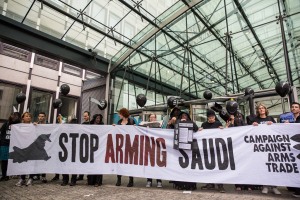
    London, UK. 11th July, 2016. Human rights campaigners protest against arms sales to Saudi Arabia outside the Defence and Security Organisation (DSO), the Government department responsible for arms export promotions.

    London, UK. 11th July, 2016. Human rights campaigners protest against arms sales to Saudi Arabia outside the Defence and Security Organisation building. Image by CAAT via Flickr.

    UK arms exports have been central to the ongoing Saudi-led bombardment of Yemen. As we write this, UK-licensed Eurofighter jets may well be over Yemeni airspace, guided by UK-trained military personnel and dropping UK-made bombs from the skies. It would be hard to overstate the humanitarian crisis that has been unleashed, with the UN having ranked the humanitarian situation in the war-torn country as a “Level 3” emergency – the highest possible emergency ranking. The bombing campaign has lasted over 15 months following a Saudi Arabian-led intervention into Yemen’s civil war. Saudi forces are acting alongside Yemen’s government against forces led by the former president, Ali Abdullah Saleh, and the Houthis, a northern Shia militia. There is no question that atrocities have been committed on all sides, although the UN has accused Saudi forces of killing twice as many civilians as all other forces.

    More than 2.5 million people have been displaced, and vital infrastructure, including schools, hospitals and cultural heritages sites have been destroyed. Of those who remain in Yemen, millions have been left without access to clean water or electricity, and 80% of the population has been left in need of aid. Even the Home Office has acknowledged the scale of the destruction, concluding that to allow people to return to Yemen could be a breach of their human rights.

    The need for legal accountability

    The destruction hasn’t only been immoral, it has also been illegal. A UN panel of experts, the European Parliament and many of the most respected humanitarian NGOs in the world, including Human Rights Watch and Amnesty International, have accused Saudi forces of serious breaches of international humanitarian law (IHL).

    The UN report “documented 119 sorties relating to violations of international humanitarian law” and reported “starvation being used as a war tactic.” More recently, Human Rights Watch has linked UK arms to specific attacks on businesses and civilian targets. The reports have been thorough and in-depth and their evidence has been compelling, but they have fallen on deaf ears in Whitehall.

    Arms exports control regulations are very clear: a licence should not be granted in the circumstances where there is a “clear risk” that it “might” be used to violate IHL. In spite of this, the UK has licensed over £3.3 billion worth of arms sales to Saudi Arabia since the bombing began, including fighter jets, bombs and missiles.

    There can be little, if any, control over how and when these arms will be used. A recent report from Amnesty International found that cluster bombs sold decades ago by the UK are being used in Yemen, a terrible reminder that the shelf life of arms is very often longer than the two year licence under which they are sold.

    Moreover, even if such control was possible, there is no reason to believe it would be applied. This is because if arms were found to be used in a way that violated the terms of their sale agreement this would result in licences being cancelled—which could affect the profitability of exports.

    Burying the truth

    In the last hours of the last day of the most recent session of parliament, the government performed a major U-turn by publishing written corrections that reveal, contrary to earlier claims, that there has been no oversight of how arms are being used. At best it represented staggering incompetence on the part of government ministers— at worst it was a cynically timed admission of how they had previously distorted the truth.

    Either way, it underpins the point that the Saudi government hasn’t just bought arms and military support, it has also bought silence, compliance and a seal of political approval. That’s why, only nine months ago, we saw the despicable, but ultimately unsurprising, revelations that UK diplomats had lobbied and campaigned behind the scenes for Saudi Arabia to Chair the UN Human Rights Council.

    So who benefits from the current situation? Certainly not the Yemeni people living under bombs, or the Saudi people being persecuted and oppressed. One obvious beneficiary is the arms companies. BAE Systems, for example, enjoys the full support of the UK government in its arms sales to Saudi. Earlier this year, BAE Chairman Roger Carr told Channel 4 News that he sees Saudi Arabia as “a very important customer with which we have a very strong relationship.” This point is alluded to in the last BAE annual report. The ‘principal risks’ section of the report identifies the commercial risk that state buyers may consider cutting their military budgets, before suggesting this will be mitigated in part because “in Saudi Arabia regional tensions continue to dictate that defence remains a high priority.”

    BAE and the UK’s special relationship

    For decades now, UK governments of all political colours have worked hand in glove with the arms companies and Saudi authorities, continuing to sell arms and provide political support while turning a blind eye to the grotesque human rights abuses that are being carried out every single day.

    Regardless of who has been in charge, the Saudi Royal Family’s influence and interests have been core to Whitehall’s approach to arms sales and the Middle East. Over recent years we have seen Tony Blair intervening to stop a corruption investigation into arms exports to Saudi, David Cameron flying out to Riyadh to meet with Royalty, and the outlandish and humiliating spectacle of Prince Charles sword dancing to secure sales for BAE Systems.

    The government’s inability to uphold its responsibility in regards to human rights and domestic law is evidence of just how far it is willing to go to maintain this toxic relationship. Despite the legal action, there has been no change to the government’s policy. Only two weeks after the judicial review was ordered, Saudi military representatives were in the UK for the Farnborough Airshow where they were shopping for weapons.

    Stop arming Saudi Arabia

    At a time when the UK should be using its close relationship with Saudi to apply pressure and push for meaningful peace negotiations and vital reform, it is instead carrying on with business as usual. The government’s refusal to act responsibly underlines the enormous power of the arms trade lobby and the pernicious nature of the UK-Saudi relationship, a relationship that fuels instability and repression and corrupts our political system.

    Whatever the outcome of the review, the campaign will go on. As long as terrible crimes are being committed with UK weapons and with our government’s support, we will continue. The UK’s shameful relationship with Saudi Arabia and the terrible examples above show just how far (and how low) the machinery of government will go to protect the Saudi Royal Family’s interests.

    The UK-Saudi alliance has boosted the Saudi regime while lining the pockets of arms company executives, but it has had devastating consequences for the people of Saudi Arabia and Yemen. For the sake of those people, the UK government must finally stop arming and empowering the brutal Saudi monarchy.


    Andrew Smith and Vyara Gylsen are writing on behalf of Campaign Against Arms Trade (CAAT). Andrew Smith is Head of Media for Campaign Against Arms Trade. Vyara Gylsen is an anti arms-trade campaigner that volunteers and works with Campaign Against Arms Trade. You can follow CAAT on Twitter at
    @CAATuk.