Blog

  • VIDEO – Transforming Food Systems in a Global Context

    Getting Older But Not Wiser: the Arms Trade Treaty’s First Birthday

    April 2nd marked the first anniversary of the adoption of the much celebrated Arms Trade Treaty (ATT), the world’s first treaty to establish common standards of international trading in conventional weapons and which in turn aims to ‘ease the suffering caused by irresponsible transfers of conventional weapons and munitions’. But with the continued irresponsible arms trading and an overall rise in the global arms trade, it seems that some states have yet to put the ideals of the ATT into practice.

    Read Article →

    The New Insecurity in a Globalized World

    Writing exclusively for SustainableSsecurity.org, Elizabeth Wilke argues that a new conceptualization of insecurity and instability is needed in a world with greater and freer movement of goods, services and people – both legal and illicit – greater demands on weakening governments and the internationalization of local conflicts. The new insecurity is fundamentally derived from the responses of people and groups to greater uncertainty in an increasingly volatile world. Governments, and increasingly other actors need to recognize this in order to promote sustained stability in the long-term, locally and internationally.

    Read Article →

    Human Security and Marginalisation: A case of Pastoralists in the Mandera triangle

    This paper seeks to bring out the relevance of human security in pastoral areas of Mandera triangle and the relationships and contradictions that exist between it and national security. The “Mandera Triangle” encompasses a tri-border region of Ethiopia, Somalia, and Kenya that exemplifies, in a microcosm, both a complex and a chronic humanitarian crisis that transcends national boundaries.

    Read Article →

  • Expanding Contracting: The Private Sector’s Role in Drone Surveillance and Targeting

    RC_long_logo_small_4webThis article is part of the Remote Control Warfare series, a collaboration with Remote Control, a project of the Network for Social Change hosted by Oxford Research Group.

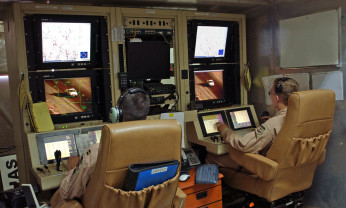
    Capt. Richard Koll, left, and Airman 1st Class Mike Eulo perform function checks after launching an MQ-1 Predator unmanned aerial vehicle Aug. 7 at Balad Air Base, Iraq. Captain Koll, the pilot, and Airman Eulo, the sensor operator, will handle the Predator in a radius of approximately 25 miles around the base before handing it off to personnel stationed in the United States to continue its mission. Both are assigned to the 46th Expeditionary Reconnaissance Squadron. https://en.wikipedia.org/wiki/General_Atomics_MQ-1_Predator#/media/File:MQ-1_Predator_controls_2007-08-07.jpg

    Drone pilots perform function checks after launching an MQ-1 Predator unmanned aerial vehicle Aug. 7 at Balad Air Base, Iraq. Source: Wikipedia

    Over-burdened in its requests for continuous surveillance of an expanding battlefield, the US military is increasingly turning to private contractors to fill key roles in its drone operations.

    In March this year, US Air Force Secretary Deborah James appeared before the Senate Armed Services Committee, looking for a $10 billion funding hike. “I can tell you the number one thing that the combatant commanders say they want from our Air Force is more ISR, ISR, ISR,” she told the committee. “That is the number one priority.”

    ISR is Intelligence, Surveillance, Reconnaissance, and encompasses a complex array of functions. It includes spyplanes and drones with special sensors and cameras, the satellites which control them, and the analysts who turn this information into “products”.  It also includes the “distributed common ground system”, an unwieldy term for the network of devices which allows personnel to access this information and the “products” derived from it.

    The volumes of data being passed back from surveillance flights is now so vast that the military can no longer deal with it in-house. So, The Bureau of Investigative Journalism (‘The Bureau’) found in a six-month investigation, the Pentagon has turned to the private sector to plug the gaps, employing contractors as imagery analysts or “screeners”.

    Screening

    The screener’s task is not a simple one. Like much of military life, it involves long spells of tedium – twelve hour shifts in front of a screen – interspersed with occasional spikes of activity. But it demands high and continuous levels of concentration. As one screener told us: “A misidentification of an enemy combatant with a weapon and a female carrying a broom can have dire consequences.”

    Screeners can have an important safety function in reducing collateral damage – the proverbial “busload of nuns” which appears out of nowhere into the field of fire. But their interpretations of video imagery – “calls”, in military parlance – can also influence drone pilots to take shots. As one screener commented, once you’ve influenced the mentality of the pilot by indicating the presence of something hostile, it’s hard to retract it.

    In one notorious incident, the crew of a MQ-1 Predator drone flying over Afghanistan’s Uruzgan province in February 2010 ignored ambiguities in their screeners’ assessments as to whether the trucks they were tracking contained combatants. As a result, at least 15 civilians were killed.

    “When you mess up,” The Bureau was told, “people die.”

    Contractors

    The companies being paid to undertake this work range from industry leviathans like BAE to specialist tech firms like Zel Technologies and Advanced Concepts Enterprises.

    Finding out who was performing this work was itself an arduous task. The Department of Defense records thousands of procurement transactions most days every year. From 2009 to the end of 2014 there have been over 8 million transactions between the Pentagon and the private sector. The Bureau analysed these transactions through its own specially constructed database, which allowed it to identify activities relating to ISR and then build up profiles of the contracts and companies carrying out those activities.

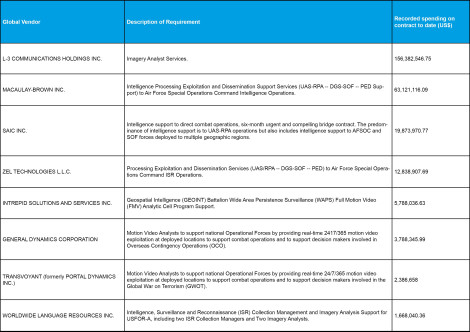
    Table: US Military Imagery Analysis Contracts since 2010 (click to enlarge)

    Data in this table is drawn from public sources including the Federal Procurement Data System (fpds.gov), Federal Business Opportunities (fbo.gov) and contractual material released under the Freedom of Information Act. Business information is taken from Bloomberg, Hoovers and Orbis. Companies named in the reporting but not included in this table are BAE, Booz Allen Hamilton and Advanced Concepts Enterprises. The Bureau has documented evidence of their involvement in ISR from sources other than contracts and transaction records. For the full dataset please see https://docs.google.com/spreadsheets/u/1/d/1WpSvDKGyraU5koQheFIgO7fUCIrSUxG5o7R9cS042_I/pubhtml

    Data in this table is drawn from public sources including the Federal Procurement Data System (fpds.gov), Federal Business Opportunities (fbo.gov) and contractual material released under the Freedom of Information Act. Business information is taken from Bloomberg, Hoovers and Orbis.
    Companies named in the reporting but not included in this table are BAE, Booz Allen Hamilton and Advanced Concepts Enterprises. The Bureau has documented evidence of their involvement in ISR from sources other than contracts and transaction records.
    Click here for the full dataset

    The Bureau identified over $260 million of screening transactions. But this is a niche market compared to the wider outsourced ISR effort. The private sector has been operating smaller surveillance drones over Afghanistan and other countries, managing communications between drones and their bases in the US and elsewhere, maintaining data collection systems and servicing sensors, to name just some functions. Procurement costs for these services run into billions of dollars.

    Questions of accountability come to the fore in this type of outsourced warfare. Following considerable pressure, the military now publishes figures of contractors on the ground in Iraq and Afghanistan. But this transparency does not extend to ISR missions conducted in those countries – or elsewhere – from behind computer screens in Florida and Nevada.

    From Screening to Targeting?

    Although contractors are so far not supposed to have their fingers on the drones’ triggers, fears have been expressed that this distinction might be harder to maintain in practice. One military outsourcing specialist, Laura Dickinson, told us that if the ratio of contractors to government personnel swells, “oversight could easily break down, and the current prohibition on contractors making targeting decisions could become meaningless.”

    Shortly after The Bureau published its investigation in The Guardian, the Pentagon announced that it would ramp up the number of ISR missions with ten new contractor-operated MQ-9 Reaper Combat Air Patrols. This puts contractors into the driving seat of large, combat-capable drones for the first time, although the Pentagon says these will be “ISR only”. The private sector’s involvement in drone warfare, it seems, is just taking off.


    Crofton Black is a researcher, journalist and writer with extensive experience of complex investigations in the field of human rights abuses and counter-terrorism. He is a leading expert on the CIA’s rendition, detention and interrogation programme and a specialist in military and intelligence corporate contracting. He has a PhD in the history of philosophy from the University of London.

    Crofton completed a report for the Remote Control Project last year on the use of contractors in US special forces operations.

  • Denmark’s Foreign Fighters – An Interview with Jakob Sheikh

    Award-winning reporter Jakob Sheikh talks about his work interviewing the Danes who travelled to Iraq and Syria to join the jihad. 

    Q. Since 2001, there has been much written on terrorism and more specifically the global jihadi movement, and this trend has continued with the rise of Islamic State. Your research is quite unique as it has involved interviewing those who have joined the Jihad. Why did you decide to take this approach to understanding jihadism and what did you hope to learn from talking to jihadis?

    When I started covering militant Islamism in 2012, I noticed that the great bulk of articles written on this topic dealt with jihadists quite superficially. Most often, reporters where talking about jihadists; not with jihadists. So I began building trustful relations with Danish militant Islamists. I put a lot of time and effort in meeting consistently with figures—even rather unimportant ones— in the Danish militant Islamists milieu, enabling me to get access to  otherwise unavailable sources and interview foreign fighters in Denmark, in Syria during their time with the Islamic State, and even back in Denmark when some of them had returned.

    The goal of my reporting is quite simple. In order to deal with a challenge that is generally considered a threat to national security in most Western countries, we need to understand the very nature of this challenge.

    Sadly, we often tend to simplify or generalize when it comes to foreign fighters. We alienate radical Islamists from ourselves as if they have nothing to do with our society. However, the fact is that most European foreign fighters are born—or at least raised—in Europe. They are shaped by upbringings in European societies; they attend public schools, play in the local football club and so forth. By many measures, they are products of modern Europe.

    This leads to a very important question: How does modern Europe deal with this ever-evolving problem? I hope that my reporting has shed light on the backdrop of this question.

    Q. In your research, have you noticed any common traits in the backgrounds of Denmark’s foreign fighters (age, gender, profession, geographical location) and their pathways into joining the Jihad?

    Image credit: CREST Research/Flickr.

    This is an interesting question as some of the foreign fighter traits are in fact quite counter intuitive. It’s easy to state the obvious: most foreign fighters are young men and the vast majority have family roots outside the European continent.

    But there are other interesting traits to mention. When I started collecting socioeconomic background data on Danish foreign fighters, I was expecting to find individuals from poor families who were economically and educationally marginalised. However, while the main part had struggled with social challenges of some sort—their parents’ divorce, a mental diagnosis, deaths in the near family, etc.—I discovered that a great number of Danish foreign fighters were average middle class kids, not raised at the bottom of society (one even played the cello and lived in a sumptuous villa with his well-educated parents).

    Also, I would have assumed that most foreign fighters would come from strictly conservative Muslim families. But in fact, a significant number of Danish foreign fighters with non-Western backgrounds came from families that were remarkably secular and liberal. I find this particularly interesting as it says something important about the way we deal with the notion of converts. We generally consider converts to be ethnic Danes or ethnic Swedes or ethnic Brits who suddenly converts to Islam and get radicalised—as opposed to individuals with Muslim family backgrounds. But what we see now is that most foreign fighters are in fact converts—some may just have Muslim family roots. In many ways, these converts from Muslim families share their pathway into the jihadist milieu with that of “regular” ethnic Danish converts; they do not feel strongly about religion, something happens along the way, they are socially marginalized, perhaps they enter a criminal environment, and at a certain point in time they are intrigued by Islam as a way out of their problems. Often, the radicalisation process that follows completely changes their approach to Islam—just as with the Danish converts who have no previous experience with Islam whatsoever.

    To me, this shows that we need to study the inner motivations of jihadists. Common socioeconomic traits simply doesn’t do the job when it comes to explaining why foreign fighters decide to wage jihad. Despite many so-called experts’ attempts to tell you otherwise.

    Q. In terms of the motivations of Denmark’s foreign fighters, you’ve previously stated that grievance over Denmark’s activist foreign policy has been an important driver. Yet one of the things that stands out in your interviews with foreign fighters is this idea of “the state” as a cause. What does this concept of “the state” mean to the foreign fighters you spoke to and why is it such a powerful idea that it is worth travelling many miles across the world to fight and die for? 

    As mentioned, many of the things the foreign fighters told me during interview ran counter to common assumptions. My own, at least.

    The very idea of a state was a recurrent narrative among IS fighters. In fact, several fighters consider this notion a direct motivation for joining the battlefield.

    They stress the fact that they are not just joining an insurgency; they are joining a state. As much as they see themselves as fighters, they see themselves as immigrants who want to settle down and build a future.

    As I have pointed out before, when jihadists use the term “dawla” [“state” or “nation”] they are often not referring to the group, but rather to the so-called caliphate itself. They speak of a place that represents a home to them. This also explains why foreign fighters usually are more likely to refer to propaganda videos released by IS about the daily life in IS held areas rather than brutal executions and so on.

    A Danish born Salafi with Pakistani roots named Shiraz Tariq, who is perhaps the most prominent jihadi figure in Denmark, often spoke of the state as a goal in itself.

    “My goal is to fight the infidels until the state is implemented,” he told me in an interview from Syria.

    To at least some parts of Danish foreign fighters, institutional aspects such as economic systems, schools, and legal systems are key in their justification of violent jihad. They talk about “protecting the state” rather than protecting Islam, or protecting the group.

    That said, the fall of Raqqa completely changes this motivation. In many ways, I see the fall of Raqqa as way more decisive than the fall of Mosul. It is a major blow to IS’ ability to mobilize and recruit soldiers to the local war in Syria and Iraq. Not just because of the military defeat but even more so because the defeat destroyed the notion of state building that IS offers to its followers.

    Q. How did the fighters you interviewed describe life inside the state and what sort of roles did they undertake?

    Like in many other countries, Denmark has foreign fighters in the upper ranks of IS and regular foot soldiers in the fields. I spoke to jihadists who were very close to the local “emir” or “wali” and to jihadists who were not even taking part in the fighting.

    I’ve met with returnees who’ve returned further radicalized in terms of both ideology and fighting skills. But—and this is important—I’ve also met several jihadists who’ve returned to Denmark deeply disillusioned about what they experienced in Syria and Iraq. A prominent 28 year old jihadist told me upon his return to Denmark that he’d “never seen anything that un-Islamic”. The notion of “takfir” is taken to a level where some jihadists—despite the official IS narrative about jihadists having no scruples killing non-IS-fighters—are left in deep disagreement with the strategy.

    To me, this disillusion upon return may be the best chance in terms of aiding counter-radicalisation efforts.

    Another important aspect we need to be aware of is the mindset of foreign fighters. Before and after our talks, several jihadists would often send me pictures and videos that would somewhat glorify the daily life in the caliphate. Here, we’re talking about videos of children fooling around and playing in a fountain, women shopping in the bazaar, pictures of toyshops, and so on.

    What’s striking about these pictures and videos is that they often ran counter to the actual situation and reality of life inside the IS-held territories. While IS as a group were losing ground and were severely hit by drone strikes, the propaganda spoke of harmony and almost heavenly peace.

    The question, then, is: Were the jihadists I interviewed consciously neglecting the fact that they were on the verge of losing their war? Or were they simply not aware of what was going on?

    In my opinion, the answer is none of the two. In fact, it seemed to me—though psychiatrists may need to study this further—that the “real” world and the “imaginary” world of peace and harmony existed side by side, next to each other. In the mind of a jihadist, it is not necessarily contradictive to live in a real world of fighting and a virtual world that enables you to dream about how a perfect caliphate should look like or how a new Islamic golden age should look like. These two perceptions actually seem to complement each other. The frightening thing, however, is that when the border between these two perceptions gets blurred, some jihadists don’t seem to be able to separate the two.

    Q. There has been a lot of discussion about the role of religion as a driver of the foreign fighters, including the role played by mosques. How influential have Danish mosques been in the radicalisation of foreign fighters?

    Interestingly, very few militants mention that they get their religious inspiration from the mosques. In fact, militant Islamists—at least in Denmark—are quite skeptical towards the mosques, especially mosques that are considered to be “moderate” by mainstream society. I would assume this goes for other European countries as well. This is due to widespread conspiracies that the mosques are in fact right-hand men for the Danish government or the intelligence service.

    Rather than trusting what is preached in the mosque, many Danish foreign fighters rely almost exclusively on their close friends—and certainly not open communities such as mosques where rumors are spread quickly.

    That said, I think it would be a huge mistake to underestimate the role of religion when it comes to foreign fighter mobilization. While you can argue that the social and political dimension were more prevalent driving factors during the first years of the Syria civil war, I find religion—or at least arguments rooted in Islamic texts—to play a quite decisive role today and even since early 2015.

    The fundamental ideology of IS is deeply Islamic.

    Jakob Sheikh is a multi-award-winning investigative reporter who worked as staff writer with Danish daily Politiken, one of Scandinavia’s leading newspapers. Since 2012, he has focused on radicalization and foreign fighters. In 2015, he released his book on Danish Islamic State fighters based on numerous interviews with returned and current jihadists as well as key figures in the militant Islamist environment in Scandinavia. In February 2017, he joined the Danish Ministry of Justice as a special advisor to the minister.

  • Nitrogen: a driver of global food insecurity?

    Nitrogen largeWith nearly 870 million people chronically undernourished, and progress towards the Hunger Millennium Development Goal ebbing since 2008, feeding the world will continue to be a major global challenge. The limitations of arable land availability, water accessibility, and humanity’s increasing population trajectory further compound the problem. Addressing the challenges to global food security while ensuring the sustainability of the planet will require changes to the way we interact with agriculture and a clear understanding of the driving factors behind it.
    Food and Energy Price Volatility

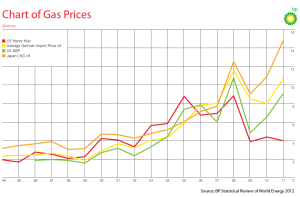
    World-Energy-PricesThe industrialisation of agriculture over the last five decades has contributed to massive gains in productivity, but it has also made food increasingly susceptible to energy supply and price fluctuations. Energy in the form of oil and gas is needed to run industrial farm equipment and to ship food around the world. Fertilizers, the driving factor behind most yield increases, are intimately tied to energy and therefore price volatility. Nitrogen fertilizers are particularly significant and are created through a process that combines natural gas and inert nitrogen from the atmosphere in a high-energy reaction to create ammonia. Fertilizer production is estimated to account for more than 50 per cent of total energy use in commercial agriculture (Woods, et al 2010). While shale gas has had a significant impact on the US natural gas market, globally, energy prices are expected to rise in the long term and become increasingly volatile, as shown by the graph to the right. Fertilizer costs will follow a similar trend, leading to variability in cost and availability. This can be especially difficult for small farmers in developing countries, whose resilience to price fluctuations is low.
    Locking Ourselves In to Volatility

    Natural means of increasing agricultural yields are possible through recycling manures and planting crops that add nutrients to the soil. However, barring a radical change in agricultural practices, globally we are locked into chemical fertilizer use, especially nitrogen fertilizers in the short and medium term. Approximately 45 per cent of the world’s food supply is grown using chemical fertilizers, and that number is growing. Meat consumption, which requires large amounts of grain for animal feed, is on the rise. Consumption of animal protein in Europe and the United states together is double the world average (FAO 2006), and is expected to grow 10 per cent between 2005 and 2030. However, demand in developing countries for animal proteins is projected to increase 60 per cent in the same period (Reay 2011). Pressure from biofuel legislation in Europe and the United States puts further pressure on land and drives up global food prices.

    Global land deals have increased dramatically in the last ten years, with an area of land eight times the size of the UK sold off globally in that time (Geary 2012). In addition to causing landlessness and poverty for local communities, the land is often used to grow large areas of single-species crops such as soy or eucalyptus, which use industrial agricultural methods requiring a high amount of chemical fertilizer, thus increasing dependence on global energy markets and locking new land into fertilizer dependence. Furthermore, nutrients and pesticides can make their way into local water supplies, degrading the environment upon which local communities depend. For example, water contamination from agricultural runoff can force communities to buy bottled or trucked water at higher prices, reducing their resilience to price fluctuations even further.

    Fertilizer as a Means of Reducing Poverty

    But fertilizers are not evil. Increasing yields (either through better access to fertilizers or implementing natural yield improvement practices) can greatly impact poverty and inequality. There are many regions of the world in which more nutrients are urgently needed in order to ensure the land is not degraded. When fertilizer is introduced to degraded soils, it can have enormous trickle down effects for poverty reduction, health, and education. In the early stages of development, when a country is primarily agrarian, the most consistently effective methods to reduce poverty and improve equality involve the agriculture sector, particularly through methods that raise small farm productivity (Berry 2010, Deininger and Byerlee 2011). For example, a recent review of coffee grower data from Mexico and Peru, published in the World Development journal, found that increasing yields are most important for growers (Barham and Weber 2011).

    Nitrogen: The Missing Link

    So where does that leave us? The very thing that reduces poverty and hunger through increasing yields can cause insecurity through energy price volatility. Add increasing pressure from consumption choices, land degradation, population pressure and climate change and we have a situation of increasing food insecurity globally.

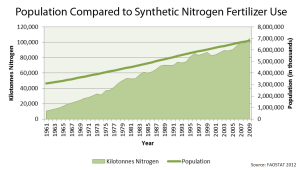
    Population-and-Fertilizer-UseThere is no silver bullet answer to this conundrum. However, the solution will likely be a combination of improving the efficiency of chemical fertilizer use and increasing the productivity and adoption of natural methods. Cross-cutting all of these solutions is the main driver of yields: nitrogen. Phosphorous and potash are also important elements of fertilizer, but nitrogen is the nutrient needed in the largest quantities. Just as a basic knowledge of how CO2 impacts climate change is important for developing solutions to the problem, so is knowledge of nitrogen important for developing solutions to food security.
    Nitrogen is critical for all plants and animals to grow. Some plants build it naturally into the soil through a symbiotic process between bacteria and their roots called ‘biological nitrogen fixation’ (beans and clover, for example), but the majority comes from chemical fertilizers and as a by-product of burning fossil fuels.

    For those that remember the nitrogen cycle from science class, we know that 78.1% of the atmosphere is inert nitrogen (N2). In the 20th century, we developed a way to convert this inert, atmospheric nitrogen into a form of nitrogen accessible to plants and animals (known as “reactive nitrogen”). This has enabled food production to roughly keep pace with the explosion of population growth over the last fifty years. Whether through fertilizers or biological fixation, nitrogen will play a key role in meeting the food needs of the future.

    When there is not enough nitrogen in the soil, loss of soil productivity and degradation occur. Because it is small farmers that often lack access to nitrogen, their yields decline year over year, reducing their annual income and thus exacerbating inequality within the global food system. This pushes them further into poverty, and in many cases can force them to purchase food when they cannot grow enough. Degraded land forces them to go in search of new, more fertile land, breaking apart families and communities.

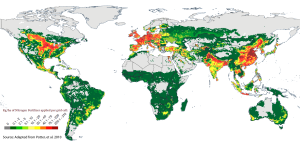
    However, the solution is not as easy as simply adding more nitrogen in areas where there is not enough. Too much nitrogen can cause serious problems for human health and the environment. While nitrogen is required by plants in order to grow, there is a limit to how much any plant can use. Beyond this “critical load”, nutrients that cannot be absorbed by plants will leach into the water and air. Once in the environment, nitrogen can change forms over an extremely long life (average of 120 years) and detrimentally affect many different systems before finally becoming denitrified back into atmosphere. Nitrogen exacerbates climate change, depletes the ozone layer and drives biodiversity loss. It causes low-oxygen zones in water systems that weaken or kill fish and marine habitats (known as eutrophication or hypoxia). Reactive nitrogen can also be very detrimental to human health through air and water contamination. It is a major contributor to smog, which is estimated to take six months off the life expectancy of over half the population in Europe (Sutton et al 2011). It is even worse in areas like China, where the density of air particulates have registered at twice the level considered “dangerous” in metropolitan centres like Beijing. Ingesting high levels of water-borne nitrates has been associated with cancer, diabetes and adverse reproductive outcomes (Ward et al. 2005).

    The graph below shows nitrogen fertilizer application globally. In the red areas of the graph, many of the main water bodies suffer the detrimental effects of too much nitrogen, and the people that live in those areas suffer as a result of nitrogen pollution. Many of the green areas could benefit from more nitrogen to increase soil productivity.

    WorldFertilizerApplication

    The key is balance. On the one hand, improving the efficiency of fertilizer use will maintain crop yields while protecting the ecosystems humans and animals depend upon. On the other hand, developing biological nitrogen fixation methods or pro-poor fertilizer programmes to increase yields for small farmers will improve their situation economically and strengthen their resilience to price shocks and weather events. In both cases, proper nitrogen management will be a crucial part of solving our global hunger crisis while ensuring sustainability for future generations.

    Lisa Dittmar is the CEO and founder of NitrogenWise,  a website that brings together research and straightforward communication to explain the complexities of nitrogen in a meaningful and relevant way.


    Citations

    Barham, B. L., & Weber, J. G. (2011). The Economic Sustainability of Certified Coffee: Recent Evidence from Mexico and Peru. World Development, 1269-1279.

    Berry, A. (2010). What type of global governance would best lower world poverty and inequality? In J. Clapp, & R. Wilkinson, Global Governance, Poverty and Inequality (pp. 46-68). London: Routledge.

    Deininger, K., & Byerlee, D. (2011). Rising global interest in farmland. Washington DC: World Bank. Retrieved November 30, 2012, from http://siteresources.worldbank.org/INTARD/Resources/ESW_Sept7_final_final.pdf

    FAO. (2006). Livestock Report 2006. Rome: Food and Agriculture Organization of the United Nations.

    Geary, K. (2012). Our Land, Our Lives: Time out on the global land rush. Oxford: Oxfam. Retrieved November 2, 2012, from http://www.oxfam.org/sites/www.oxfam.org/files/bn-land-lives-freeze-041012-en_1.pdf

    Reay, D. S. (2011). Societal choice and communicating the European nitrogen challenge. In M. Sutton, The European Nitrogen Assessment (pp. 585-602). Cambridge: Cambridge University Press.

    Sutton, M. (2011). Too much of a good thing. Nature, 472, 159-161

    Ward, M. (2005). Workgroup report: Drinking-water nitrate and health-recent findings and research needs. Environmental Health Perspectives, 113, 1607-1614

    Woods, J., Williams, A., Hughes, J. K., Black, M., & Murphy, R. (2010). Energy and the food system. Philosophical Transactions of the Royal Society B, 2991-3006

    Front page image source: Organic Fertiliser for sugar cane – Shell

  • Nomadism, Land Disputes and Security

  • The United States, Niger & Jamaica: Food (In)Security & Violence in a Globalised World


    Food insecurity small

    The United Nations Development Programme (UNDP) defines food security as “all people at all times having both physical and economic access to the basic food they need”. However, due to a complex range of interconnected issues from climate change to misguided economic policies, political failure and social marginalisation, over 2 billion people across the world live in constant food Insecurity. It is important to take a sustainable security approach to look at the importance of “physical and economic access to basic food” by exploring the links between food insecurity and violence.

    A recent article published by the journal Conflict, Security & Development examines food riots as representations of insecurity and looks at the relationship between contentious politics and human security.

    Thomas O’Brien, author of the article, argues “the upheaval caused by a food riot can lead to lasting instability and violence as social and political structures are challenged”. Global rises in basic food prices triggered demonstrations and often violent protests in “over 30 countries across Africa, Asia, Latin America and the Middle East in 2007-08”. The article puts recent food riots and the current global food crisis in historical perspective. Food riots are about more than “just access to food”.  They represent dissatisfaction with political structures and perceived injustices.

    It is important to note that “the extreme nature of the rise in food price in the absence of much evidence of food shortages, left a sense of something unnatural about the way food markets were working”. Although poverty, weak states, ineffective civil society and lack of political freedom all contribute to food insecurity and the possibility of violent food riots, we cannot ignore to challenge underlying transnational and global power structures: “146 protests in 39 countries over the 1976-92 period were linked to the imposition of International Monetary Fund and World Bank structural adjustment policies.” Food security is fundamental to human security and needs to be approached by addressing underlying causes and drivers. A sustainable response to food insecurity would take global cooperation, justice and equity as key requirements.

    An often mentioned driver of food insecurity is climate change. Climate change already has a great impact on global security concerns and the physical, social and economic effects will undoubtedly only be exacerbated in the near future. Increasingly high temperatures and little or inconsistent rainfall have devastating effects on crop yields in places such as India, Africa’s Sahel region and the mid-western United States.

    The catastrophic food crisis in Niger in 2005 for example was largely attributed to the effects of climate change and competition over limited resources. Years of too little and too inconsistent rainfall have meant devastating droughts and diminishing harvests in this Sahel country of west Africa which has the highest birth rate in the world. Increasingly advanced desertification due to climate change means competition and potentially violent conflict, over limited resources such as water and arable land, intensifies.

    In the 2005 food crisis however, although thousands of children died of malnourishment, Niger had produced enough food to feed its population. The real issue was a food shortage in neighbouring Nigeria. Nigeria has an economy based primarily on oil exports with a significantly weakened agricultural sector. Instead of Niger feeding its own population, much of the harvest was sold to wealthier Nigeria at prices much higher than anyone in Niger could have afforded. This is a good example of why free market economy and trade liberalisation do not necessarily benefit all parties involved. Writing about the great famines of the last century, Nobel laureate Amartya Sen noted “a drought is natural but famine is man-made”. What this tells us is that although the challenges we face by climate change are serious threats, there is much that can be done to ensure more food security through political and economic policies.

    Farmers in Niger are struggling. But so are farmers in Jamaica. In contrast to Niger, Jamaica has a wealth of fruit, vegetables, fish and an abundance of fertile land. About one fifth of this island’s population is employed in the agricultural sector. Still, farmers are struggling to survive because they cannot compete with the much lower prices of subsidised agricultural imports from the USA. As cheap foreign products flood the market, Jamaican prices are driven down which makes local food production by and large unprofitable. As they rely more on foreign food imports, Jamaicans will be increasingly vulnerable to price volatility on the global marketplace. With the average Jamaican spending about half of household income on food, such vulnerability to price changes is a real danger to food security.

    Importing less foreign food products is a difficult matter for Jamaica because of the strict trade liberalisation policies imposed on the country through its debt relief agreements. One could also argue that if it is cheaper for Jamaica to import food than to produce its own, why should it still encourage its local agricultural sector? When a country is dependent on food imports, it cannot assure food security for its population.

    So far US imports have been much cheaper than local Jamaican produce. 2012 however has seen the “worst US drought in 50 years” according to last month’s Aljazeera article entitled Food riots predicted over US crop failure. “Grain prices have skyrocketed and concerns abound the resulting higher food prices will hit the world’s poor the hardest- sparking violent demonstration” says the newspaper. Corn is a primary staple in Sub-Saharan Africa, Central and South America, and prices have already gone up 60 per cent since June because “the United States accounts for 39 per cent of global trade in corn and stockpiles are now down 48 per cent” due to the drought.

    Price fluctuations on the global food market do not affect all people in the same way as “people in wealthy industrialised countries spend between 10 to 20 per cent of their income on food. Those in the developing world pay up to 80 per cent. According to Oxfam, a one per cent jump in the price of food results in 16 million more people crashing into poverty.”

    A sustainable approach to food security would address underlying forces such as climate change, economic and political policies and social marginalisation.

    Paul Rogers, expert on global conflict and consultant to the Oxford Research Group on global security, was recently featured on the BBC Radio 4 programme Costing the Earth. When asked whether free markets can help feed us, he replied:

    “It will contribute in some way, but I think it is fairly minimal. There are far more important things to consider. Look at it this way: Back in the world food crisis in the early 1970s, which was the worst for about 80 years, there were about 450 million people malnourished.  Now the figure is closer to 800 million. Now, that malnourishment and lack of food is not generally because there isn’t enough food to go around. Even at the height of that crisis there was still half the normal reserve. It is because people cannot afford to get the food or to buy the food. […]  If you are looking at the situation of poor people across the majority world, there has to be some way in which we can actually improve the production of food in and around those areas to provide greater resilience in the face of what is coming because beyond all of this is the whole issue of climate change. I think we will have a wakeup call this year in terms of what might come.”

    Anna Alissa Hitzemann is a  Peaceworker with Quaker Peace and Social Witness. She currently works with Oxford Research Group as a Project Officer for the Sustainable Security Programme, with a focus on our ‘Marginalisation of the Majority World’ project.

    The Conflict, Security and Development article Food riots as representations of insecurity is available for paid download here
    The AlJazeera article Food riots predicted over US crop failure is available here
    The Pulitzer Center for Crisis Reporting project Agriculture and Jamaica’s rural poor is available here
    Paul Rogers’ Monthly Global Security Briefings can be read and subscribed to here
    Image source: Dioversity International
  • The New New Civil Wars

    Author’s note: This article is a shorter version of a journal article published in the Annual Review of Political Science, 2017. A shorter version of this piece can be read at the Monkey Cage.

    There is a new trend currently underway in the way civil wars are conducted. Dubbed the “new new” civil wars, these conflicts are a source of serious concern for several reasons.

    Something new is happening in the world of civil wars.  After declining in the 1990s, the number of active civil wars has significantly increased since 2003.  Over the past thirteen years, large-scale civil wars have broken out in Iraq, Syria, Libya, Yemen, Chad, the Democratic Republic of Congo, Nigeria, Pakistan, Rwanda, Somalia, Sri Lanka, South Sudan, Chad, Mali, the Central African Republic and Ukraine, while new civil wars threaten to break out in Turkey, Egypt, and Lebanon.

    Post-2003 civil wars are different from previous civil wars in three striking ways. First, most of them are situated in Muslim majority countries.  Second, a majority of the rebel groups fighting these wars espouse radical Islamist ideas and goals.  Third, of the radical groups fighting these wars, most are pursuing transnational rather than national aims.  These three patterns are striking and suggest that we are in the midst of a new wave of civil wars that we do not fully understand.

    In a new article, “The New New Civil Wars”, I argue that these trends are the result of a new and evolving information and communication (ICT) environment.  We now live in a world where citizens and elites operate in an interactive Internet environment, where anyone with a smartphone can easily produce and disseminate material from almost anywhere on the globe.

    The role of the evolving ICT environment

    Image credit: Voice of America News/Wikimedia.

    Instantaneous, global communication is likely to have at least six major implications for civil wars. First, information technology is likely to benefit individual citizens (especially citizens in highly repressive countries) more than political elites in those countries.  Dictators and autocrats will face greater difficulty limiting and controlling the flow of information and the messages their citizens receive. Government elites will also have greater difficulty preventing individuals from coordinating their protest activity.  Citizens are likely to be better informed about the behavior of government officials, the well being of their particular ethnic or sectarian group relative to other groups, and the level and extent of dissatisfaction in society.  The result could be a boon for popular demonstrations and grass roots organizing.

    Second, global Internet campaigns are likely to make it more feasible for rebel groups to form, leading to civil wars with a greater number of warring factions. It used to be that rebel entrepreneurs required a base of local support and financing to make mobilization possible. The Internet has changed this.  Internet media campaigns make it easier for rebel entrepreneurs, especially those with limited local backing, to solicit the soldiers and financing necessary to start a war. This is likely to lead to greater external involvement in civil wars and a larger number of warring factions. The evidence seems to support this: the average number of rebel groups fighting in civil wars has increased over time. In 1950 the average number or rebel groups in civil wars was 8; in 2010 it was 14.

    Third, the new information environment also means that rebel groups are likely to have greater incentives to frame their objectives in global terms, something we have observed with the proliferation of Salafi-Jihadist groups.  First, the Internet allows warring factions to be more ambitious, ignore international borders, and set their sights on affecting large-scale change by drawing on the resources of a globalized world.  Second, the Internet is likely to reward groups such as al Qaida and ISIS with global aims, since they will have a wider audience from which to generate revenue and recruits.  Thus, the new information environment has shifted the advantage from homegrown groups with local bases of support to transnational groups with global networks and connections.

    Fourth, the Internet is likely to make it possible for rebel groups to sustain themselves longer in war.  The decentralized nature of the Internet means that rebel groups will be less dependent on a single source of income or a single patron. If they lose access to one source of income (i.e., coca) or one patron (i.e., Iran), they still have access to millions of potential individual donors.

    Fifth, the Internet is likely to make the spread of civil war more likely. Research has found the civil wars produce a contagion effect (see here, here, and here); once one civil war breaks out, it increases the risk that civil war breaks out in neighboring countries.  One of the implications of a Web 2.0 world is that ideas and ideology are likely to spread more rapidly and more widely.  This occurs in two ways.  The first is directly through the dissemination of information via the web, and the second is indirectly through the recruitment of foreign soldiers.  ISIS and al Qaida, for example, use Internet propaganda to recruit foreign fighters from around the world.  These fighters then receive indoctrination and training, and eventually return home, creating new networks in their native countries.

    Finally, the Internet could potentially eliminate the restraints rebel and government leaders have to target local citizens with abuse.  Studies have found that rebel groups that are reliant on the local population for support or financing are less likely to commit human rights violations.  Conversely, rebel groups that receive significant material support from external patrons are more likely to use violence toward civilians.  Rebel groups in the current civil wars appear to be following this pattern.  In Iraq, ISIS and the al-Mahdi Army both enjoyed significant external financing and all have been significantly more likely to target civilians with violence than groups that did not.  By freeing combatants from the need to solicit local support, the Internet may also be freeing them to engage in more civilian abuse.

    The drivers behind these “new new” civil wars in Muslim countries

    So why has there been a rise in civil wars in Muslim countries, fought by multiple Islamist groups, many seeking transnational aims?  Globally-oriented groups such as al Qa’ida and ISIS formed and prospered in countries that had previously been some of the most information-poor countries of the world.  It was in these countries where the new-found flow of information allowed for an opening for individuals to organize, for rebel groups to link to other groups, and for human capital and war financing to begin to flow.

    Combatants in Muslim countries were also quick to figure out how to exploit ICT to their advantage. They discovered that framing their movement based on an identity that was large (Sunni), wealthy (oil-rich), and ideologically extreme (Salafi-Jihadist) allowed them to utilize the web in ways that brought in more money and recruits than had previously been possible. In fact, the trans-border nature of both the Sunni population and Persian Gulf financing was tailor-made for the Internet age.

    This does not mean that other groups in other regions of the world will not learn how to exploit the advantages of ICT.  My guess is that any group with a large number of international kin (especially wealthy kin) will pursue similar strategies.  Sunnis are leading the way because the benefits of a Web 2.0 world have been easiest for them to tap, but others will follow.

    Conclusion

    The “new new” wars” are characterized by the rise of rebel groups pursuing extreme ideologies, a rise in the number of transnational actors involved in these wars, and the use of goals and strategies directed at global rather than local audiences. These trends are a precursor to a series of changes that are likely to be seen as actors civil war adapt to a new and evolving ICT environment.

    Whilst this piece has outlined the importance of the evolving ICT environment in these “new new” civil wars and theorized about why we are observing the wars in predominantly Muslim countries, much more work needs to be done on this phenomenon.

    Looking forward, a major challenge for scholars and analysts will be to understand the full range of implications that emerging technologies will have on every aspect of civil war and to decipher which groups are most likely to harness this technology, when they are likely to do so, and the conditions under which these new strategies are more or less likely to succeed.

    It is not known exactly how this third wave of civil wars will evolve and which additional groups and countries will best exploit these advances. There is also uncertainty regarding which strategies will turn out to be the most successful and how these strategies are likely to change over time. Nevertheless, what we do know is that the internet will play a bigger, not smaller role, in every decision that is made. Ultimately, gaining a more comprehensive understanding of these “new new” wars be a crucial research enterprise in the future.

    Barbara F. Walter is Professor of Political Science at the School of Global Policy and Strategy at the University of California San Diego. She is an authority on international security, with an emphasis on civil wars, terrorism, and unconventional violence. She received her Ph.D. in political science from the University of Chicago, and held post docs at Harvard University and Columbia University. Walter is on the editorial board of the American Political Science ReviewInternational OrganizationJournal of Politics, Journal of Conflict ResolutionInternational Studies Quarterly, and World Politics. She is also the recipient of numerous grants and fellowships, including awards from the National Science Foundation, Carnegie Corporation of New York, Guggenheim, and Smith Richardson Foundations.

  • Human Security and Marginalisation: A case of Pastoralists in the Mandera triangle

    Human Security and Marginalisation: A case of Pastoralists in the Mandera triangle

    This paper seeks to bring out the relevance of human security in pastoral areas of Mandera triangle and the relationships and contradictions that exist between it and national security. The “Mandera Triangle” encompasses a tri-border region of Ethiopia, Somalia, and Kenya that exemplifies, in a microcosm, both a complex and a chronic humanitarian crisis that transcends national boundaries.

    Read Article →

  • When the Strong Weaponize the Weak: States and Guerrilla Warfare

    Often seen as a tactic harnessed by the weak, guerrilla warfare can also be a employed by the strong. States have at times used guerrillas in inter-state and civil conflict.

    Guerrilla warfare is widely viewed as a weapon of the weak. To Mao Tse-tung, it was the optimum strategy of those “inferior in arms and military equipment.” He drew inspiration from the Russian troops accomplishing, in 1812, what their militarily superior European counterparts could not: drive Napoleon’s Grand Army out of their country. They did this not only by taking advantage of Russia’s distinctive geography and climate, but also by using guerrillas – Cossacks and peasants – to go after the French troops “as unconsciously as dogs bite to death a rabid stray dog.”

    But, guerrilla warfare can also be a weapon of the strong. States with robust conventional military capabilities at times use guerrillas in inter-state and civil conflict.

    Guerrilla Warfare

    pkk-guerilla

    Image by kurdishstruggle via Flickr.

    Guerrillas’ advantages stem from their organization and local ties. They typically operate as small, independent units, thereby exercising more maneuverability, alertness, concealment, and access to the local population than their regular counterparts. Carl von Clausewitz recommended supplementing a regular army with bands of armed civilians. He observed that, when faced with adversity, soldiers typically “cling together like a herd of cattle,” while civilians “scatter and vanish in all directions, without requiring a special plan.” But, he emphasized that the latter should not be used “to pulverize the core but to nibble at the shell and around the edges” of regular armies.

    Both Clausewitz and Mao viewed guerrillas as useful for weakening a conventionally strong rival through harassment and psychological warfare, but recognized that they are “but one step in the total war.” It is the regular troops that must, in the end, directly confront and defeat the enemy. Thus, for example, the recent U.S. strategy of sponsoring local rebels in Syria against Bashar al-Assad’s (Russia-supported) army was likely to fail not least because of the difficulties inherent in using nonstate proxies. The U.S. strategists – presumed students of Clausewitz – failed to recognize the necessary role of the regular forces, or else significantly underestimated their capacity to form a regular army out of irregulars while in the midst of a war. Or, they were simply constrained by the political unfeasibility of setting regular U.S. soldiers’ boots on the ground.

    In addition to weakening (or hopelessly trying to defeat) a rival’s regular forces, states often use guerrillas – or “counter-guerrillas” – against guerrilla rivals. The latter are typically rebels fighting to gain, maintain, or reclaim territorial control from an established government or occupying power. The former are sometimes also referred to as “pro-government militias.”

    In a recent article published in the Journal of Strategic Studies, I closely examine and disaggregate the different types of counter-guerrillas states use in counterinsurgency operations. I identify two types of counter-guerrillas: self-defense militias and death squads. Self-defense militias typically comprise ordinary civilians, such as peasants, while death squads are usually manned by experienced militants, such as turned rebels or violent criminals.

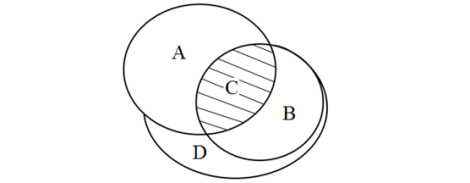
    I argue that states make proxy choices based on the latter’s comparative advantage, availability, and controllability. The state’s ideal partners are highly skilled fighters with deep knowledge of the insurgent network and links to the local population. Regular soldiers are highly skilled fighters, but possess limited local and insurgent knowledge. Partnering with nonstate actors means tackling the classic principal-agent problem, and the state’s capacity to do so is significantly shaped by its spatial reach (i.e. territorial control) across the theater of war. Figure 1 illustrates the different configurations of territorial control.

    Figure 1. Zones of Control

    figure-1-zones-of-control


    In Zone A, the state exercises full control. Zone B represents the insurgent-dominated area, whereas Zone C is the contested region where both sides actively compete for influence. Zone D represents an area that has been largely neglected in the burgeoning civil war literature. It is a zone that is neither fully controlled nor, for the time being, actively contested.

    Among the nonstate alternatives, the ideal partner for the state is a skilled fighter with insider knowledge of the insurgency and its logistics network. The disadvantage of using this type of proxy is that his fighting skills make him dangerous and difficult to control. The cost of losing control of skilled fighters can be unpalatably high. Unless they are weak or collapsed, modern states will prefer to use skilled fighters when and where they can supervise them.

    Nonstate actors that possess the desired local knowledge and have significant experience wielding extra-institutional violence, whether of criminal or rebel nature, may be harnessed to counter the insurgents. Their comparative advantage is in performing specialized, offensive, and highly targeted tasks (e.g. assassinations) that take advantage of their high mobility and combat skills. Consequently, they are likely to be used where the insurgents are actually located (Zones B and C). We should expect them in Zone C, where the state can exercise control over their activities. Using death squads in Zone B requires the state to create robust control mechanisms, such as embedding these groups firmly within special operations units of regular military or police forces. Where the state exercises full control (Zone A), or where the insurgents are not yet present (Zone D), states do not require highly targeted offensive operations and, consequently, death squads.

    While the comparative advantage of death squads is in highly targeted offensive operations, self-defense militias are best at performing static defensive tasks, such as guarding villages, communication lines, transportation networks, and vital installations. They are, consequently, more likely to be used to facilitate the operation of state forces in contested regions (Zone C) or to deny the insurgency access to areas where neither side has effective control (Zone D). In Zone B, self-defense militias are helpless against the insurgents. Not only can their government-provided weapons easily fall into rebel hands, but also, given the high rates of defection in insurgent-dominated areas, they may become a fertile source of rebel recruits. Remnants of self-defense militias (once created in Zone C or D) may persist in Zone A, but only because demobilization of nonstate actors is usually slow and costly.

    The Kashmir Case

    India’s use of counter-guerrillas in Kashmir illustrates the logic of the argument. In response to an insurgency breaking out in the late 1980s in the Indian state of Jammu and Kashmir (here referred to as “Kashmir”), the Indian army used former rebels (i.e. “renegades”) and villagers to combat the insurgents. Initial efforts relied on local police enforcement, treating the insurgency as an issue of “law and order.” However, the local policemen proved ineffective and were supplemented by three paramilitary forces (the Central Reserve Police Force, the Border Security Force, and the Indo-Tibetan Border Police). The Indian army’s role expanded further in 1993 with the introduction of the Rashtriya Rifles, an elite army unit created specifically for counterinsurgency operations.

    Former rebels were used mostly in the contested areas (Zone C) and, under the supervision of the Rashtriya Rifles, in Zone B. Kashmiri ex-insurgents, who were also popularly known as “Ikhwanis,” were used to eliminate rebels and their sympathizers. In Zone D – the mountainous areas of the Jammu region – the state instituted the civilian-manned Village Defense Committee (VDC) system. Figure 2 illustrates the distribution of the “renegades” and the VDCs. Official statements place the number of VDC volunteers at 6,000, but a prominent Kashmiri journalist I interviewed in Srinagar (the summer capital of Kashmir) estimated the figure to be closer to 23,000.

    Figure 2. Zones of Control in Kashmir

    zone-of-control-in-kashmir-figure-2


    Costs of Counter-Guerrillas

    Counter-guerrillas may be good for war, but they are bad for peace. Weaponizing turned rebels, criminals, and civilians offers tempting tactical benefits, but it also carries significant post-conflict costs. The conventional wisdom is that outsourcing violence lowers the cost of conflict and provides states with plausible deniability. However, as I learned from my fieldwork in Kashmir and other conflict zones, the local population quickly becomes aware of the illicit links between the counter-guerrillas and the government, as does the international community.

    The “renegades” may have helped the Indian army achieve military victory over the insurgents, but they also significantly boosted the widespread and enduring resentment against the Indian government. The arming of a select ethnic group (mostly Hindus and some Sikhs) in Jammu generated “intermittent outburst of communal violence” as well as incidents of looting, abduction, and rape.

    Playing local groups against one another is a classic strategy of colonialism, with a lasting impact on the peace and prosperity of many postcolonial states. Perhaps India’s Supreme Court said it best. It described the arming of over 6,000 young men in the tribal tracts by the central Indian state of Chhattisgarh to fight the Naxalite-Maoist insurgents as “tantamount to sowing of suicide pills that could divide and destroy society.”

    Yelena Biberman is an Assistant Professor of Political Science at Skidmore College and Nonresident Fellow at the Atlantic Council’s South Asia Center.

  • Boko Haram – An Interview with Alexander Thurston

    It’s hard to deny the fact that turning to essay writing services online is always stressful as one trusts certain academic challenges and research to another person willing to offer help. As the majority of British students these days are forced to study remotely or combine physical and online education, the role of academic assistance online became more important than ever. It also brings up certain security concerns among students and educators as one focuses on data privacy and academic integrity issues as the assistance is being provided. Aiming to provide assistance in the field of academic development, writing services, and online safety in general, Sustainablesecurity.org belongs to those unique campaigns where you can debate, discuss, and develop your skills as you deal with modern insecurities. Choosing writing services UK, we strive to help you create a sustainable security framework that can help you approach global security issues differently as you know how to choose what’s safe and reliable.

    Understanding Security Matters

    Before you continue reading our blog related to the Sustainable Security programme that has been made possible with the help of Oxford Research Group, first starting in 2009, and then rebranded in 2013, you should understand that we provide you with a special environment where you can discuss your concerns, take part in debates, and help develop a much better understanding of security concerns. Our aim is to create a sustainable security framework together when you bring your academic or essay writing challenges online. For example, when you are looking for a custom essay service, our interconnected actions and unity will help you to determine what can be considered as a custom essay writing service and what factors make it safe. Knowing global security challenges in the 21st century, you will be able to deal with numerous issues that pose an importance today, including:

    • Online (Remote) Learning Challenges and Accessibility.
    • Climate Change Concerns.
    • Competition Over Natural Resources.
    • A Negative Impact of Technology.
    • Global Militarisation.
    • Poverty and Marginalisation.

    As you can see, we strive for solving the global threats at the source by focusing on numerous issues. When you are looking for a reliable essay writing website, you also approach it all from technology to personal safety issues. Just share your concerns by contacting our specialists and we shall guide you towards the most efficient solutions!

    How to Write a Quality Essay In The UK? 5 Helpful Steps.

    Learn Your Service Provider.

    When looking for a reliable university essay writing service, you should remember that starting with a safe option that you know well will help you to avoid mistakes, late delivery, payment issues, or lack of refunds when things go wrong. We provide you with safe methods and experts that will help you write a quality essay from scratch, thus avoiding plagiarism risks.

    Aim For Direct Communication With Your Writer.

    Another important step is looking for a custom essay writing service that makes it possible to talk to your expert directly by discussing your thoughts and making sure that a person understands the subject and has good writing skills. It’s one of those security framework tips you should always consider. We are happy to offer direct contact with a chosen expert as you place your order.

    Focus On Grading Rubric Analysis.

    Remember that it’s not possible to write a quality essay without prior analysis and study of the grading rubric. The majority of instructions already have the answers or prompts to most questions, which is the starting point to good essay writing.

    Sources and Originality.

    Every good essay will contain well-documented sources that act as evidence and proof that you have done a clever synthesis of available information. The same relates to originality issues and the formatting of your sources according to a specified style. Our writing service has access to the latest databases, which will play an essential role in your academic success.

    Professional Proofreading and Editing.

    It’s what helps to tell a weak piece of academic research from the one that is perfect as it contains no grammar, style, formatting, or readability issues. Always take your time to proofread your written content!

    The Factors That Make Our Academic Assistance Research Services Safe

    Regardless of whether you are looking for an essay writing service in UK or would like to receive consulting services regarding one of the global security issues, we are happy to offer professional assistance that will meet your vision and professional requirements. As a team of trained experts and British natives, we work hard to address every security issue and offer safe academic services for educational, business, research, or personal purposes.

    The factors worth mentioning regarding our academic research services and creation of the sustainability safety framework include:

    • Always working from scratch, which helps to avoid plagiarism in your works.
    • Direct communication with a chosen expert helps to eliminate misunderstanding or any other issues.
    • Our college essay writing service will help you to find the safest and most reliable solutions based on the current security standards as you research various academic subjects with our help.
    • A great platform that focuses on global security threats and solutions.
    • 24/7 customer support and refunds in case you are not happy with the final results.

    Still, we are certain that you will be pleased with our platform and will add to the number of satisfied clients and our colleagues.

    We provide you with articles and resources to help you research your subject and discuss things with fellow specialists in the UK and beyond. As we help to eliminate global security threats and provide every member of society with safety in all regards, helping you learn in a safe environment is one of our top priorities. Therefore, our online essay writing service is based on online safety and academic integrity principles, which means that you are working only with native speakers with verified academic credentials and experience in every relevant field. We care for your safety as we work towards global security together!