Category: Article

  • Multiple Futures Project – Navigating Towards 2030

      The following is an excerpt from Multiple Futures Project (MFP) Findings and Recommendations:

    The Multiple  Futures  tell  the  story  of  four  plausible worlds  in  2030, and  are  constructed  to  reflect  their  underlying  logic  and  reasoning.  None of these is what the future actually will be, but each provides a common  ground  for  structured  dialogue  on  the  risks  and vulnerabilities  that  will  potentially  endanger  Alliance  populations, territorial integrity, values and ideas. 

    The  first  future  is  called Dark  Side  of  Exclusivity,  and  describes  how globalization, climate change and resource scarcity significantly affect the  capacity  of  states  outside  the  globalized  world  to  function effectively and meet the needs of their populations. Weak and failed states are sources of instability, and the states of the globalized world are faced with strategic choices on how to react. 

    The second future, called Deceptive Stability, refers to a world where advanced nations are preoccupied with  societal  change and how  to manage the coming demographic shift as native populations age and young migrants  fill  the  void.   States  in  this world of  relative benign stability are preoccupied.  They focus inward on social cohesion, legal and  illegal migration,  and  transnational  issues  related  to  diasporas.  This leaves them ill-prepared to deal with geopolitical risk. 

    Clash of Modernities, the third future, sketches a world where a strong belief  in  rationalism,  coupled  with  ingenuity  and  technological innovation,  fuels  and  promotes  horizontal  connections  between advanced  networked  societies  across  the  globe.  This  network  is challenged  from  the  outside  by  authoritarian  regimes  of  the hinterlands,  and  from within  by  a  precarious  balance  between  civil liberties and oversight by the state. 

    The  fourth  future  is  called  New  Power  Politics,  in  which  growing absolute wealth, including the widespread proliferation of WMD, has
    increased the number of major powers, between whom there  is now a  tenuous  balance.  Globalization  through  trade  integration  and
    internationally  agreed  standards  is  undermined  as  these  powers compete  for  and  impede global  access  to  resources  and  spheres of
    influence.

    Each  of  the  futures  provides  a  backdrop  for  conceptual  analysis.  Together  they present  a  canvas on which  to  evaluate  risks,  threats,
    potential  strategic  surprises,  implications  and,  of  course, opportunities.  The  study  has  yielded  a  rich  set  of  Risk  Conditions, ranging  from  ‘failed  states’  and  ‘disruption  of  access  to  critical resources,’  to  ‘increasing  ethnic  tension’  and  the  ‘challenge  of conflicting  values  and  world  views.’  When  linked  with  the  six potential  Sources  of  Threat  identified  in  the  MFP,  the  resulting Threatening Actions  or  Events  yield  33  Security  Implications  and  26 Military Implications.

    All Multiple Futures Project documents can be found here.

  • The Other Resource Wars

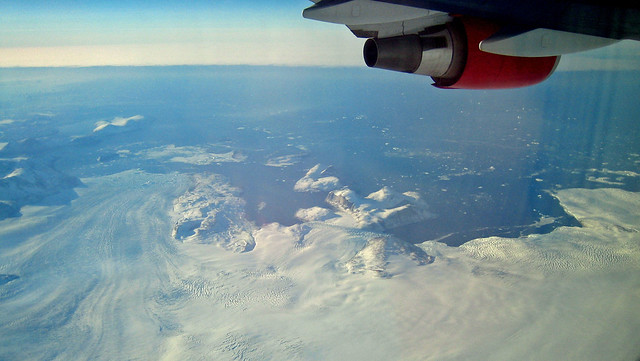
    At mysterious pace, and for reasons that remain hotly disputed, the ice of the Arctic Ocean appears to be steadily retreating. The latest estimates by the National Snow and Ice Data Centre at the University of Colorado, which use remote sensing data from Nasa satellites to make their findings, suggest that this year’s ice levels are well below their long-term average: in mid-August ice covered 2.30 million square miles in the Ocean, which is nearly 650,000 square miles less than the average 1979-2000 figure, even if it marginally exceeded the record-breaking lows of 2007 and 2008(1).


    Exactly when the Arctic Ocean will become ice-free for much of the year is impossible to judge, and estimates have varied widely: some experts argue that by the year 2020 trans-Arctic shipping could well be commonplace in the months of late summer, when ice reaches its annual minimum, while others think that, if present trends continue, such an eventuality is only likely to come about decades later. But what is certain is that the region is becoming much more accessible than ever before: there is now more human interaction in places, on both land and sea, that were once considered wholly remote and hostile.


    This heightening level of activity poses a very different threat to international stability than is commonly supposed. In recent years there has been speculation about growing rivalry for control over the Arctic’s natural resources, notably the large deposits of oil and natural gas that independent bodies, such as the US Geological Survey, think are located there. But there is no convincing reason why any country would want to risk open conflict over these reserves, even if they exist in such voluminous quantities: for example, there are other parts of the world where oil and natural gas can be recovered with a far greater ease, and at a far lower cost, than the Arctic region is likely to offer for decades to come. By the time the region does become more accessible, alternative fuel sources are likely to have been pioneered in any case.


    The presence of valuable natural resources in the Arctic region, or even the mere possibility of finding them, instead poses a subtly different challenge to international peace than usually supposed. For instead of fighting over resources, governments could instead feel threatened by the heightened foreign presence that the search, or exploitation, of these resources will bring to places that are important for other, quite independent, reasons. This is potentially a recipe for international mistrust that could conceivably spill over.


    One such example is Greenland. In the eyes of American military planners, this huge, frozen land mass occupies a vital strategic location whose fate cannot be ignored. This is because it would potentially make a natural vantage point for any hostile power seeking to exercise control over the trans-Atlantic sea lanes upon which the American economy heavily depends. So during the Second World War, for example, Washington was deeply concerned by Nazi efforts to establish bases along Greenland’s warmer southern coasts and deployed the US Navy to track and eliminate any putative threat. In April 1941, the exiled Danish government then signed a treaty with the Americans allowing Washington “almost unlimited rights to establish bases and military installations in Greenland”, leading to the establishment of thirteen army and four navy bases, one of which, at Thule, remains in active use today.


    Nearly seven decades on, Greenland is regarded as a very important source of highly valued natural resources, including oil, natural gas and the rare earth metals that are used in mobile phones, hybrid cars and missile guidance systems. In the years ahead, the island is certain to attract large-scale investment by foreign companies and, in the case of state-owned enterprises, their governmental sponsors.


    In some, perhaps many cases, this will lead to a series of company mergers and acquisitions that do not bring any foreign boots onto local soil, just as Chinese companies have in recent years sought to acquire stakes in companies like Unocal and Rio Tinto. But equally foreign nationals can sometimes undertake the search for, and exploitation of, some natural resources: the oilfields at Cabinda in Angola, for example, are home to thousands of expatriate Chinese workers. So it is possible to imagine mistrust, tension and destabilisation between Washington and Beijing if, for example, the Chinese should in the years ahead establish a strong presence in Greenland.


    This is a danger presented not just by the exploitation of natural resources but by the growing human interaction in parts of the world that, until recently, were too climatically hostile to be accessible. So as the waters of the Arctic Ocean steadily become more navigable, Russia and the United States may start to feel threatened by the growing presence of commercial and, more obviously, military vessels as they exercise their right, under international law, to make “innocent passage” through the territorial seas that lie adjacent to every coastal state.


    This is partly because they would be both unaccustomed to such military movements and, in all likelihood, relatively unprepared for them, even if, over the past two years, both countries have released internal documents that emphasise the need for greater defence spending on the Arctic region.(2) But their alarm would also reflect, more importantly, the strategic importance of the area: for example, Russia’s northern coasts are home to several key ports and industrial complexes, and also provide a potentially major shipping route that would link east and west


    So the presence of natural resources within existing borders, in places like Siberia and Alaska, will heighten the strategic fears of each respective country: both Russia and the United States will fear an attack on their resources as the region becomes more accessible and an increasing number of foreign ships make their way, quite legitimately, into surrounding waters. But these areas would have strategic value- as shipping routes, for example- even if they were devoid of resources.


    In other words, instead of being a prize over which competing nations will be tempted to fight, natural resources in the Arctic region will have a destabilising influence only in an indirect sense.


    Such mistrust and suspicion can only be alleviated by more international dialogue. For example, NATO ships could avoid straying into Russian territorial waters without giving Moscow prior notice, even though international law puts them under no such obligation, and large areas of the Arctic region could realistically be demilitarised.


    End notes:

    1 – ‘North by Northwest’, report by the National Snow and IceDataCenter, University of Colorado 17 August 2010

    2 – NSPD 66, January 2009; ‘Russian National Security Strategy Until 2020’, 20 February 2009


    Image Source: psd

  • Hot and Cold Wars


    Climate change will do more than just raise the temperature. Around the equator, rising temperatures and declining precipitation will lower agricultural production. People in this area (especially Africa and the Middle East) are particularly reliant on agriculture to support income and livelihoods. This trend (Hot Wars), coupled with rapidly increasing populations, will create conditions for livelihood wars. 
    At the Arctic Pole especially, the increasing temperature will lead to a vastly different outcome. Warming there will make it increasingly likely that resources (energy, minerals, timber, etc.) will become economically viable both on land and offshore. New transportation routes may come into common use with the disappearance of sea ice. This trend (Cold Wars) will set the stage for resource conflict.
    These two distinct behaviors will orient a kaleidoscope of impacts from climate change rather than a uniform one.  Even within Hot and Cold zones, there will be differences in climate change, demographic and industrial change, and adaptation capacity that will produce a myriad of differing consequences.
    Out of the Hot and Cold Zones, increased tension due to instances of declining and expanding resources will set the stage for conflict, given sustained trends and conflict triggers (see Figure 1). Climate and conflict has long been a reality in the “Old Tension Belt” and impacts will focus on developing countries. Conflict has been rare in the Arctic, but that may change in the race to control new resources. This conflict will include developed countries.
     
    Figure 1: The Two Tension Belts
     
    Now that the debate on the existence of climate change is over, the time is to move to the next question. What will be the social consequences of climate change? This effort will require a commitment of resources equal to that devoted to building climate models. So far, it has not been on the agenda for climate talks.
    My book on Climate Change and Armed Conflict: Hot and Cold Wars (Routledge Press) was recently released in paperback.  The book examines historic and forecast cases of climate change and conflict.
    http://www.routledge.com/books/details/9780415592512/
    The book builds on my project the “Inventory of Conflict and Environment” or ICE, an online collection of more than 200 categorically coded case studies. There are also search and expert options exploring and applying the case database.  There will be new cases focusing on climate change and conflict added in January 2011.

    http://www1.american.edu/ted/ICE/index.html

    Image source: James Lee
  • Louisiana is Sinking

    The devastating nexus of climate change, competition over resources and marginalisation

    Hurricane Katrina and the sinking of coastal Louisiana stand as a reminder that we must address climate change, competition over resources and marginalisation as the root causes of conflict before it is too late.

    Most will remember the horrific pictures on the news in 2005 when Hurricane Katrina struck New Orleans. Nearly 2,000 people died, thousands more were left homeless and displaced, the material destruction was catastrophic with damages well over $100 billion.

    The aftermath of Hurricane Katrina once again proved that marginalised people have the least resources to cope with environmental constraints and natural disasters. Nowhere in New Orleans was the devastation greater than in the Lower Ninth Ward, a predominantly poor African American neighbourhood. Most residents of the Lower Ninth Ward had fewer options of where to go, did not want to leave their homes behind and lost everything due to the damage caused by Katrina and their lack of financial resources to rebuild the community.

    Katrina was not the last and probably not the most destructive disaster to hit Louisiana. Over the past years, a significant discovery has been made: Coastal Louisiana is sinking, at a rapid rate. Some estimate that an area the size of a football field is lost roughly every half hour.

    Once again, this will affect already marginalised communities the most. Science Illustrated argues “something drastic must be done” because “the current state of affairs means that they [the affected communities] may soon be the first climate refugees in United States history”.

    CLIMATE CHANGE

    Climate change sceptics appear to be fighting a losing battle in the face of greater levels of sound scientific data. Yet, governments are still reluctant to take necessary steps like drastically cutting carbon emissions and switching to green renewable energy sources. Hopefully this will change as addressing climate change will be essential in tackling the security challenges of an increasingly interconnected world.

    At the World Economic Forum in Davos, Lord Stern, author of a 2006 UK government review on climate change, admitted he had got it wrong: “Looking back, I underestimated the risks. The planet and the atmosphere seem to be absorbing less carbon than we expected, and emissions are rising pretty strongly. Some of the effects are coming through more quickly than we thought then. This is potentially so dangerous that we have to act strongly. These risks for many people are existential”.

    The risks are indeed existential for many people living in the coastal communities of Louisiana. Rising sea levels, mainly due to melting ice caps, are threatening those who live in the Louisiana Delta.

    When interviewed by PBS, Torbjörn Törnqvist, geoscientist at Tulane University who studies Louisiana’s wetlands, said: “there is no doubt that the sinking land is a direct implication of climate change, because it actually reflects what we see worldwide. And if we go forward, we know that sea-level (rise) will continue to accelerate. The only thing there is uncertainty about is how large that continued acceleration will be. But I think the important thing we know now is that, even in the past century, accelerated sea-level rise has already contributed to the loss of these wetlands […] ultimately it [climate change] could very well become the single most important factor.”

    Although climate change and the consequent rising sea levels are an important reason why coastal Louisiana is rapidly losing land, there is more to it. To prevent flooding, extensive levees have been built (some more than 100 years ago) around the edges of the Mississippi river and channels and water ways have been carved to redirect flows. However, the levees prevent the land in that area from receiving sufficient sediments to stay above water, and the manmade channels through the wetlands have weakened the buffer zone for hurricanes and storms. So sea levels are rising and the land is sinking.

    These factors combined account for “the largest land loss currently on the planet”, says Val Marmillon, the managing director of America’s Wetland Foundation. “The massive land loss is not only threatening to destroy an entire ecosystem, including dozens of endangered animal species, but it could also severely affect local residents. Up to 2 million people are at risk of having to leave their homes.”

    DRILLING FOR OIL

    In addition to rising oceans, manmade levees and diversions, oil drilling along the coast has also contributed to rapid subsidence of the marshlands. The oil and natural gas industry, with annual revenue of approximately US $325 billion, started drilling in Louisiana in 1901. This has caused the wetlands to collapse and erode as channels are being dug for oil pipes. The process of removing oil from beneath the land is causing it to further sink, letting in salt water which destroys much of the natural habitat.

    The Sustainable Security Programme at Oxford Research Group (ORG) sees “competition over resources” as one of the main drivers of global conflict: “there will be greater scarcity of three key resources: food, water and energy. Demand for all three resources is already beyond that which can be sustained at current levels.” A recent ORG publication states that “a narrow resource base for these energy reserves is at the root of the strategic importance of the Persian Gulf and does much to explain recent and current conflicts, but the even greater global concern stems from the potential impact of climate change”.

    Oil drilling in the Gulf of Mexico off the coast of Louisiana is detrimental to the environment, impedes addressing the causes of climate change and most importantly further marginalises already disenfranchised coastal communities.

    MARGINALISATION

    The political, social and economic marginalisation of the people of New Orleans and coastal Louisiana plays a central part of this story. Frances Fox Pivan in her article Marginalization and American Politics argues that in the case of Katrina “many of the victims had been marginalized before the hurricane and the floods overwhelmed them, which is surely part of the reason that the danger of hurricane and the ensuing floods was ignored. As is amply evident, this was not simply a natural disaster.”

    She goes on to link marginalisation, poverty, the effects of natural disaster and violent crime: “Behind those images [of Katrina] was an intricate story of marginalization in the United States. The population of the city [New Orleans] was overwhelming black, and poor. The median income was only 70 percent of the national average, and poverty rates were twice the national average. The main jobs were low wage jobs in the hotels, casinos, restaurants and bars that catered to the tourist industry. Government income support programs, including welfare and food stamps and subsidized housing, that sometimes supplemented the earnings of some poor people, had been whittled away for several decades, and especially under the presidency of George W. Bush. The schools were bad, with high dropout and suspension rates, and the illiteracy rate of the city hovered at about 40 percent. Homicide rates were extraordinarily high, roughly ten times those of New York City.”

    In the current situation of the sinking wetlands, most of the 2 million people who are directly affected are also living on the margins of society. According to 2011 US Census data the poverty rate in Louisiana is the second highest in the nation at 20.4% and 9.4% are living in extreme poverty. 14.1% of the population are affected by food insecurity and over 33% are in low-wage jobs as Louisiana is one of the five US states without a minimum wage law.

    Small island communities in the Mississippi Delta, such as the Isle de Jean Charles, are inhabited by members of various Native American tribes. Some tribes do not have recognised status from the US government and hence have no access to any help from the state. Many people in the area live off the land they live on and sustain themselves through fishing and other subsistence activities. What will they do when their land disappears? Where will they go?

    Marginalised people have much fewer resources to cope with a changing environment. They do not have options. Desperate people are also more willing to turn to desperate means. The case of Louisiana exemplifies the dangerous nexus of climate change, competition over resources and marginalisation. Working towards sustainable security will mean addressing those underlying factors in order to prevent violent conflict.

    In President Obama’s second inaugural address, he put climate change centre stage as one of his top three priorities: “Some may still deny the overwhelming judgment of science, but none can avoid the devastating impact of raging fires, and crippling drought, and more powerful storms. The path towards sustainable energy sources will be long and sometimes difficult. But America cannot resist this transition; we must lead it.”

    Words will no longer be enough. We must see action, now.

    Image source: Brother O’Mara

  • Afghanistan: propaganda of the deed

    The military campaign now being waged in the Afghan province of Helmand is being described in much of the world’s media as the biggest such operation since the one which secured “regime-change” in Kabul in October-November 2001. A coordinated military assault involving 15,000 troops – from the United States, Britain and Afghanistan itself – aims to seize the town of Marjah and surrounding areas, which are described as the Taliban’s last stronghold in Helmand.

    Operation Moshtarak (the word means “together” in the Dari language), even before its launch, has been the subject of a series of high-profile news stories with an almost uniformly positive “spin”. Their consistent core is that the operation’s purpose is to curb Taliban influence over Helmand as a whole; that the province is, alongside neighbouring Kandahar, the pivot of Taliban power in Afghanistan; and, therefore, that victory would be likely to turn the whole course of the war in Afghanistan in favour of the Nato/Isaf project.

    The herald of success

    The task of reaching an accurate assessment of the real state of the conflict must look beyond such public-relations campaigns from military sources. The starting-point here is to acknowledge that after a long process of internal deliberation the Barack Obama administration has embarked on a policy markedly different from its predecessor. Washington’s new approach combines a readiness to negotiate and compromise (even with significant elements of the Taliban leadership) in order to end the war with a belief that it needs to do so from a position of clear military strength. Operation Moshtarak is the first major step in this military-diplomatic process.

    Why, though, is the assault getting so much advance publicity? At first sight this seems puzzling, for it evidently gives Taliban strategists detailed warnings of what they are about to face. The rationale is fourfold: to intimidate some militants into abandoning the fight; to encourage civilians to evacuate the area (thereby reducing casualties); to make the best of the fact that the Afghan security services are so penetrated by Taliban sympathisers that it is pointless to keep operations secret; and – a crucial domestic consideration in the United States and Britain – to wring some positive publicity from a situation of diminishing popular support for the war. For Nato’s military planners and their political overlords, it is essential to demonstrate that the war can be won; what better way than to depict Operation Moshtarak as the instrument that breaks Taliban control of a key province?

    The problem is that this narrative of anticipatory semi-triumphalism in no way corresponds to current signals from elsewhere in Afghanistan, including Helmand. For example, a new report from the Center for A New American Security co-authored by Major-General Michael T Flynn (Isaf’s director of intelligence) highlights the remarkable capabilities of the Taliban and is very cautious about progress (see Fixing Intel: A Blueprint for Making Intelligence Relevant in Afghanistan, 4 January 2010). A number of other recent reports similarly point to a versatile and resilient opponent (see CJ Chivers, “As Marines Move In, Taliban Fight a Shadowy War”, New York Times, 1 February 2010).

    Two senior military officers – Major-General Andrew Mackay, a former commander of Britain’s task-force in Helmand, and Steve Tatham – make an especially potent criticism of the country’s war-fighting approach. They argue that “a fresh ‘hearts and minds’ strategy is required which focuses less on winning bloody battles against the enemy, and more on understanding their culture, economy and psychology” (see Eddie Barnes, “MoD ‘is not capable’ of winning war”, Scotland on Sunday, 3 January 2010).

    Such critical, topical and ground-level analyses at least suggest that the intense and positive publicity devoted to Moshtarak is more a public-relations exercise than a realistic estimate of the current situation. In this respect, the experience of an earlier military operation of comparable scale – the attempt to send a giant turbine to the Kajaki dam in northern Helmand in August-September 2008 – casts an interesting light.

    What comes after

    This operation received huge publicity in the British media, most of which hailed it as one of the great successes of the war. The plan was to supplement the dam’s already working turbine with another that would be divided into seven large sections (of over twenty tonnes each), then carried by road from Kandahar airbase to Kajaki through 280 kilometres of largely hostile territory. No less than 5,000 troops were involved to ensure the safe transfer of the turbine: from Britain (3,000), the United States, Australia, Denmark and Canada (a total of 1,000), and Afghanistan (1,000).

    The logistics were enormous: a 4-kilometre convoy of 100 vehicles – supported by fifty Viking armoured vehicles and constant air-cover from British, American, French and Dutch planes and American drones – took six days to travel the route, deliver the turbine, and (again over six days) return to secure bases. Along the way, one Canadian soldier and a reported 200 Taliban were killed. The way was now ready to import Chinese technicians to instal the turbine (which was a Chinese design), and for Nato/Isaf to bask in the secure knowledge that this part of Helmand province had been made safe and was on the development path.

    The British ministry of defence (MoD) was upbeat about the result:

    • “With the delivery of the turbine complete, work can now begin on its installation and the much larger programme of the rejuvenation of the electrical distribution network needed to pass the extra power to the areas of Sangin, Musa Qaleh, Kandahar and the provincial capital of Helmand, Lashkar Gah. The new turbine is capable of producing 18.5MW of economically viable, renewable energy, which will be in addition to the dam’s current 16.5MW output”

    • “The additional electricity it will eventually provide will light up classrooms, allowing Afghans across southern Afghanistan to learn to read and write in evening classes; farmers to store their produce in chilled storage, allowing greater export opportunities for the booming wheat markets; and clinics to provide improved health services” (see “Kajaki dam troops return to base”, Military Operations [Ministry of Defence, 8 September 2008]).

    The MoD concluded its report on the successful operation by quoting George Wilder, a contractor working on the USAID contract to upgrade the power- plant:

    • “There’s still a lot to do, but I’ve been waiting for this for a long time. It’s a great day for Afghanistan and it feels like my birthday.”

    The entire operation was portrayed both as a success in itself and as the start of a process that would have a ripple-effect across much of southern Afghanistan. It could, it was claimed, be a turning-point in the war.

    What happened next? By March 2009, six months on, there were reports that the turbine was still waiting to be unpacked (yet alone installed); and that security concerns were delaying progress in the work. Now the whole project has been abandoned (see “US postpones Afghan dam project”, BBC News, 14 December 2009).

    The immediate trigger of the decision was that the Chinese contractor charged with installing the turbines withdrew overnight because of poor security. The job was always going to be huge; it would have involved the deployment of several hundred tonnes of cement and other supplies, and the mobilisation of a large team of engineers, technicians and labourers. At last, USAID has accepted that a further operation on this scale across land still controlled by the Taliban is unfeasible. It has reluctantly arranged for the turbine sections to be put into storage, and is now seeking energy projects elsewhere in Afghanistan in which it can invest.

    A complex reality

    The Kajaki power-plant experience has implications, direct and indirect, for Operation Moshtarak. First, it reveals the possibility of Nato using its huge firepower advantages to push Taliban paramilitaries out of larger towns – but being unable to prevent the Taliban from retaining control of many rural areas, to the degree that the movement can prevent the completion of an important infrastructure project.

    Second, what might come after the impending operation is likely to be much more significant than what happens during it. As Moshtarak unfolds, it is almost certain that the Taliban will be evicted from Marjah and the surrounding areas; indeed, there may even be relatively little fighting as local Taliban commanders avoid localised conflicts that they cannot win. The great risk then is that Taliban rule will be replaced by regional governance of a kind that is all too typical of the Hamid Karzai regime’s record elsewhere: corrupt, dysfunctional, incompetent, with a police force that may be be infiltrated by Taliban sympathisers.

    This is not to denigrate the efforts of defence ministries and departments yet again to represent the current operation as a decisive turning-point. Such efforts are, from their perspective, a necessary part of their work that becomes especially important at a time when support for the war is diminishing.

    But it has always to be remembered is that the official representation of Afghanistan’s condition is just one part of a much wider picture; and that any worthwhile assessment of what is happening in the country must take into account many other factors. In this respect, the dismaying outcome of the Kajaki operation may be a more accurate reflection of Afghan realities than the publicity accompanying Operation Moshtarak.

  • Climate Change and the Military

    The Climate Change and The Military (CCTM) project initially consists of  two elements. The first  is the recent report Climate Change and The Military: The State of Debate.

    “It  is  the belief  of  the  authors  of  this  text  that recent evidence of  abrupt climate  change  and threatening  tipping points has brought the challenge of  climate change into the urgent timescale of  military  contingency  planning. Climate  change  is  a common  security  problem  that  requires global co-operation in which the defence and security community have an important role to play.   It  is  our  fear  that  if  COP 15  fails  to  deliver  an effective, predictable  and  institutionally  robust climate  protection  system,  that preserving  security  and  stability  at  current  levels  will  become increasingly difficult. 

    It is clear to us that on issues of  climate change and security,  the past is not an adequate guide to the future.   The broader climate policy making world needs to hear from the defence and security community  about  the  concerns  of  the military.    If  the military were  to be  excluded  from  the discussion at this stage on  the spurious grounds that they would be “securitising”  the debate,  we should  not  be  surprised  if  individual  national  militaries  developed  separate  and  potentially conflicting approaches to the subject. 

    This  paper aims to describe the state of  the current debate on  climate  change and security, and provide  a framework  for discussion  in which the military can play  a clear  role  in  the debate on climate change mitigation and delivering sustainable human security, while starting  to address  the direct  impacts  of  climate  change  on  its  core  aims  of  national  security,  regional  and  global stability.”
     

    The full full report is available here.

     The second element, a statement by the Project Military Advisory Council calling for effective action at Copenhagen, is avaiable here.

  • Exploring the security implications of climate change in South Asia – International Alert co-hosts South Asia Climate and Security Expert Roundtable in Dhaka

    International Alert, together with the Bangladesh Institute for Peace and Security Studies (BIPSS) and  the Regional Centre for Security Studies and the Peacebuilding and Development Institute in Sri Lanka, co-hosted an expert roundtable on the Security Implications of Climate Change in South Asia in Dhaka, Bangladesh on 29th-30th March 2010.

    The two-day event brought together experts from Bangladesh, India, the Maldives, Nepal, Pakistan and Sri Lanka for an important regional exchange on issues related to climate change and security. International Alert’s recent work on climate change, fragility and conflict has shown that the security implications of climate change are a very real but relatively unexplored issue worldwide and in this region. This event marked the start of a significant process, creating a space for a critical discussion on the interlinkages between climate change and conflict in South Asia.

    Participants discussed the various and interconnected ways in which climate change is affecting fragile communities in the region. Case studies from the experts offered insights from each country – from the impacts of climate-related changes on rice and wheat yields, and thence on health and livelihoods in Bangladesh, to tensions arising from dam construction diverting water between upstream industry and downstream agricultural users in the Sindh province of Pakistan, to disputes over access to ground water in rural communities in India.  

    In many of these communities, the failure of governance structures to address risks such as food shortages and reduced access to drinking water erodes peoples’ trust in their governments. In certain contexts, this mistrust and diminished support can lead to an increased risk of political instability and violent conflict. The case studies showed how the impacts of climate change increase the risk of armed conflict in the poorest and least well-governed countries. At the same time, the shadow of conflict and the background condition of state fragility make it harder for communities to deal with the impact of climate change.

    The two-day meeting underlined the fact that these inter-related problems demand inter-related solutions. The triangle of climate change, conflict and fragility needs to be addressed by a unified approach – building resilience.

    This approach can be operationalised by taking forward five policy objectives:

    – Adaptation to climate change needs to be conflict-sensitive. In fragile contexts, all interventions must respond to the needs of the people, involve them in consultation, take account of power distribution and social order, and avoid pitting groups against each other.

    – Development needs to be climate-proof.

    – Shifts towards low-carbon economies must be supportive of development and peace.

    – Steps must be taken to strengthen social capacity to understand and manage climate and conflict risks. This means communicating the knowledge available on the issue in an open and honest manner to enable understanding, awareness and response.

    – Greater efforts are needed to support regional responses to these regional challenges.

    Acknowledging the importance of addressing climate and security in the region, the participants of the expert workshop initiated the South Asia Network on Security and Climate Change (SANSaC) – the first network to address this dual problem and its interlinked solutions in South Asia.

    The SANSaC network will share a communiqué from the roundtable with the Heads of Governments at the next meeting of the SAARC in Bhutan. The group intends to meet in the future to advance the dialogue on the key themes emerging from this event, including promoting regional approaches, institutional reform and building stronger relationships between the state and the citizens.


    Source: International Alert

    Image source: Orangeadnan

  • The Climate Security Council?

    Last Wednesday, the United Nations Security Council held its second ever debate on climate change, at the request of Germany, who holds the monthly presidency. UN Secretary General Ban Ki-Moon, Director of the UN Environment Program Achim Steiner, President of Nauru Marcus Stephen, and Australia’s Parliamentary Secretary for Pacific Island Affairs Richard Marles all addressed the Council, along with representatives of 62 member states.

    Stephen wrote powerfully in the New York Times last week about the threat rising sea levels pose to his Pacific island country’s existence, and did not hold back in the Council, usually a place of diplomatic stoicism. Speaking on behalf of the Pacific Small Island Developing States, he said they were facing “the single greatest security challenge of all – that is, our survival” and put the question: “Where would we be if the roles were reversed? What if the pollution coming from our island nations was threatening the very existence of the major emitters? What would be the nature of today’s debate under those circumstances?”

    As it happened, the nature of the debate was twofold. On the ostensible subject, “Maintenance of international peace and security: impact of climate change”, most states agreed that it would have – and in some cases already is having – profound implications for international peace and security, and that the UN had a key role to play coordinating efforts on mitigation and adaptation to climate change. But discussion on this remained secondary to complex political wrangling over the role of the Security Council in addressing the topic. Whilst this is the case for any issue before the body – in discussions on whether to mandate armed intervention into a specific country, for example, the debate focuses not just on the rights and wrongs in that instance, but also the wider precedent it may set – there were added complexities with climate change.

    China and Russia displayed their usual reticence about extending the Security Council’s competencies into new areas. They were joined by Brazil, India, and many developing countries in the G77 bloc, who opposed attempts to move the issue away from the General Assembly-mandated UN Framework Convention on Climate Change (UNFCCC), in which all member states have equal footing and decisions are made by consensus, and into the 15 member body where China, Russia, France, the UK and U.S. hold veto power, and are some of the biggest greenhouse gas emitters, on either cumulative or per capita bases. The underlying fear of developing countries was that such a move would circumvent the core principles which make the existing climate change regime palatable – namely, the recognition of states’ “common but differentiated responsibilities” to act on climate change, and the right to sustainable development.

    Indeed, if the Security Council were to take overall control of climate action, this would be a regressive step, potentially allowing developed countries off the hook for their failure to meet existing targets under the Kyoto Protocol, and removing the impetus to agree a further UNFCCC commitment period. States proposing that the Security Council address the issue (primarily the EU, U.S. and small island states) were therefore at pains to stress that it would be complementary to existing UN bodies and processes, and should not encroach upon their remits. They argued that as a major security threat, it was right that the Council afford these dimensions of climate change due consideration. But as the UN body with the most diplomatic bite – only the Security Council has the power to authorise military force – it is easy to see why there are concerns that it could dominate the issue.

    During the debate there was related apprehension about the excessive securitisation of climate change. Many states pointed out that climate change was a cross-cutting issue, as much related to sustainable development and humanitarian relief as security, and that looking at it as a security issue would not address the underlying causes of the problem. Bolivia noted that developed countries gave $10 billion in climate change finance annually, which amounted to just 1% of defence spending, and suggested the Council adopt a resolution to cut defence and security spending by 20%, using the money saved to address the impacts of climate change. Papua New Guinea echoed Nauru’s Marcus Stephen, pointing out that if the Security Council could address issues such as development and HIV/AIDs as security problems (without them becoming militarised), then why not climate change?

    The non-binding Presidential Statement which was finally agreed did not include mention of a Special Representative on Climate Change and Security, which had been one of Germany’s original proposals. Many countries remained open to the idea of a representative, but opposed them being answerable to the Security Council, instead suggesting they be appointed by the General Assembly.

    On one level, the outcome was disappointing. Russia initially vetoed adoption of the statement, later agreeing to a watered down version merely noting the “possible security implications” of climate change. Ambassador Susan Rice of the U.S. lambasted the lack of stronger action as “pathetic”, “short sighted” and “a dereliction of duty”. However, given that the first Council debate on climate change in 2007 was unable to agree any formal outcome, getting a Presidential Statement was something of a success.

    There remains wide disagreement between states over whether climate change merely exacerbates conflict, or is a distinct threat itself. Academic opinion is still divided, and the Security Council’s position often lags a good ten years behind the latest research on peacebuilding and conflict prevention, so this is not hugely surprising. It is also difficult to untangle the opposition to climate-security links on conceptual grounds from opposition for political reasons related to Security Council ‘mission creep’, as discussed above.

    In 2009, the General Assembly requested that the Secretary General produce a report on the possible security implications of climate change. A few states strongly disputed its findings on Wednesday. Nevertheless, the Presidential Statement recommended that in his regular reports to the Council, the Secretary General begin to include information on the possible influence of climate change upon conflict situations around the world. These are important first steps towards mainstreaming climate change in conflict assessments, even if we are a long way from any legally binding resolution.

    Another reason for optimism is the level of participation in the debate. I followed many Security Council meetings whilst working in the UN community last year, and never saw so many member states request to speak. Most countries took the discussion seriously, and even where they disagreed on whether the Council had a mandate to act, they spoke strongly on the devastating impacts of climate change.

    The question now is: how long will it take for states to take this rhetoric seriously; to realise the gravity of the situation, break the cycle of mistrust in international negotiations and commit to unified multilateral action to address this issue – in whatever forum they choose? The answer is unclear.
    There is one thing we can be confident about – this won’t be the last time the Security Council discusses climate change.


    Joe Thwaites is a graduate in politics from the University of York, UK. He has worked on conflict prevention at the Quaker United Nations Office and represented Friends of the Earth at the UNFCCC.

  • Selling Nature to Save Nature, and Ourselves

    THE HAGUE, Jul 5, 2011 (IPS) – Avoiding the coming catastrophic nexus of climate change, food, water and energy shortages, along with worsening poverty, requires a global technological overhaul involving investments of 1.9 trillion dollars each year for the next 40 years, said experts from the U.N. Department of Economic and Social Affairs (UN-DESA) in Geneva Tuesday.

    “The need for a technological revolution is both a development and existential imperative for civilisation,” said Rob Vos, lead author of a new report, “The Great Green Technological Transformation”. 

    Absent in the U.N. report is a call for the other necessary transformation: what to do with the market-driven economic system that has put humanity on this catastrophic collision course? Attempts to “green” capitalism are failing and will fail, according to many of the more than 200 social science researchers at a groundbreaking international conference in The Hague titled “Nature Inc?” Jun. 30 to Jul. 2. 

    “We must start tackling and questioning some core capitalist dictums, such as consumerism, hyper-competition, the notion that ‘private’ is always better, and especially economic growth,” says Bram Büscher, the conference co-organiser and researcher at the Institute of Social Studies (ISS) at Erasmus University in The Hague, Netherlands. 

    Equally important is to stop looking at nature as a collection of economic objects and services that “must only benefit some specific idea of human economic progress”, Büscher told IPS. 

    Governments, the World Bank, the United Nations and development agencies, international conservation organisations and others have all come to see markets as the only way to mobilise enough money to end deforestation, increase the use of alternative energy, boost food production, alleviate poverty, reduce pollution and solve a host of other serious and longstanding problems. 

    Started as a small gathering of academics, Nature Inc? became a major event as hundreds of experts from around the world wished to participate. Büscher believes the main reason for this is that many are actively doing research on environmental and conservation issues and are increasingly running into new market schemes like carbon credit trading, payments for ecosystem services, biodiversity derivatives and new conservation finance mechanisms, and so on. 

    “Payments for ecosystem services are the newest tropical ‘miracle’ crop,” said Kathleen McAfee of San Francisco State University. 

    The market is putting new values on tropical forests as carbon sinks, reservoirs of biodiversity or ecotourism destinations, McAfee said during the conference. 

    The World Bank, U.N. and others say that the only way to generate large corporate sector and private investment to protect tropical forests is by payments for ecosystem services such as carbon and biodiversity offset markets such as Reduced Deforestation and Degradation for biodiversity known as REDD+. These are also touted as the way out of poverty for communities living in or near forests. 

    “However, markets are preconditioned on inequality and will only make matters worse,” McAfee said. 

    Markets will look for the cheapest land available, which means the poorest will be displaced because they don’t have formal land tenure or they will be persuaded by promises of large payments. In order to secure the investment, carbon traders will place restrictions on the use of the land for decades. 

    Technical assessments and monitoring will also be needed, which results in high costs as was the case for a project in Costa Rica, McAfee said. “The poor got very little…it didn’t even cover their costs,” she noted. 

    When the European Union committed to reduce its carbon emissions by 20 percent by 2020, some European multinational industries with high carbon footprints simply moved to countries like the United States where there were no restrictions, said Yda Schreuder of the University of Delaware. 

    “Europe going it alone on carbon reductions has resulted in higher overall emissions globally,” said Schreuder, author of “The Corporate Greenhouse”, a critical look at the political economy of the climate change debate. 

    Globalisation greatly enables companies to quickly shift their operations to where costs or restrictions are lower. To meet its 2020 target, Europe reduced its use of coal 35 to 50 percent by switching to renewable energy like wind, but mainly through much higher use of natural gas obtained from Russia. 

    Natural gas emits much less carbon than coal. However, over the same time period, Russia increased its use of coal for domestic energy because it could make more money selling natural gas to Europe, Schreuder said. 

    “The World Trade Organization encourages all this to happen. Markets are a driving force behind increasing emissions of carbon,” she added. 

    Digging deeper into these schemes reveals their inherent contradictions and unintended consequences, but they are “often promoted in lyrical win-win language”, said Büscher. 

    Many believe the green technology transformation that the new U.N. report calls for is unlikely to succeed without a move away from the economic growth-at-all-costs paradigm that dominates nearly everyone’s thinking. There is an overwhelming need to find alternatives and stop promoting an economic system that has created the crisis. 

    “These are incredibly complex problems and there are no simple solutions,” Büscher concluded. 

    Article source: Terraviva

    Image source: Paul Keller

  • NGOs Call for Immediate and Full Reporting of Every Casualty in Libya

    Fifteen humanitarian and human rights organisations have this week called on the states implementing the no-fly zone in Libya to commit to recording and reporting on civilian casualties in that country.

    Their call comes in an open letter (text below) sent to all members of the UN Security Council, the Arab League and the African Union.

    The international communitys intervention in Libya, mandated by UNSC 1973 and based on civilian protection, lacks any means by which such protection can be evaluated. In addition to the protection of civilians by all necessary measures, Resolution 1973 and 1970 mandate that those responsible for attacks on civilians ought to be held accountable, and that the Libyan authorities should comply with the international legal regime. Without a serious casualty reporting mechanism, it is hard to see how any of these mandates could be met to the satisfaction of all parties.


    The co-signatories of the letter call for states to commit to: immediate and comprehensive recording of all civilian casualties whether children, women, or men, who have been killed injured, displaced, or who are missing. Monitoring should be done using all means presently available and be followed-up by full on-the-ground, incident-level investigations as soon as is feasible. 

    The signatories further urge that the mechanisms employed be transparent and open to public scrutiny, in particular to Libyans.

    The letter will remain open for further signatories.


    Full text of the joint letter

    To: The President of the UN Security Council
          UN Ambassadors of States within the Security Council
          Governments represented on the UN Security Council
          Governments of Coalition forces involved in Libya
          The Secretary General of the United Nations
          The Secretary General of the Arab League
          The Chairman of the African Union Commission

    Casualty Recording in the Libya Conflict

    We, the undersigned organisations, call on all parties to the armed conflict in Libya that, along with exercising every possible restraint in their conduct of military operations, they commit to recording and reporting on the civilian casualties of conflict from military operations in that country.


    We define this as the immediate and comprehensive monitoring and documentation of all civilian casualties whether children, women, or men who have been killed, injured, displaced, or who are missing. Monitoring should be done using all means presently available and be followed-up by full on-the-ground, incident-level investigations as soon as is feasible. We further urge that the mechanisms employed be transparent and open to public scrutiny, in particular to Libyans.

    As a key element of humanitarian protection obligations, as well as the accountability that underpins good governance, whether by domestic parties to conflict or international state actors, it is of the utmost importance that civilian casualties are carefully and conscientiously monitored in any military action. This remains equally true when military intervention is proposed to protect civilians from further harm. Credible information on the nature and extent of civilian casualties is a crucial means by which to guide and to assess the efficacy of such interventions, including any operational precautions taken to minimise harm to civilians.

    The UN Security Council Resolution 1973 on Libya passed on the 17th of March 2011 expresses grave concern at heavy civilian casualties in that country, asserts that its purpose is the protection of civilians, and demands a complete end to violence against them. Given its objectives and its implementation, SC Resolution 1973, by its own terms, requires a full and thorough investigation of its consequences for civilians.

    Detailed monitoring and documentation of civilian casualties is also central to investigations into accountability as well as possible violations of international human rights and humanitarian law which are also objectives in both SC Resolutions 1970 and 1973. This accountability applies to all parties to the armed conflict, including the Libyan armed forces under Muammar Gaddafi, Libyan opposition armed forces, and state armed forces acting under SC Resolution 1973.

    A commitment to monitoring and fully documenting casualties would therefore be in accordance with, and of benefit to, the goals expressed in both SC Resolutions 1970 and 1973, as well as being consistent with the general principle of responsibility to protect. Specifically, it would safeguard:

    Accounting for violence against civilians

    Stressing the need to hold to account those responsible for attacks, including by forces under their control, on civilians… (SC Res. 1970)

    Compliance with the international legal regime

    Considering that the widespread and systematic attacks currently taking place in the Libyan Arab Jamahiriya against the civilian population may amount to crimes against humanity. (SC Res. 1970)

    Demands that the Libyan authorities comply with their obligations under international law, including international humanitarian law, human rights and refugee law and take all measures to protect civilians…’ (SC Res.1973)

    Accountability of Intervention

    Authorizes Member States… to take all necessary measures to protect civilians and civilian populated areas under threat of attack in the Libyan Arab Jamahiriya… (SC Res. 1973)

    It should also be noted that the present lack of credible data on civilian casualties is compromising effective planning of a humanitarian response. Thus, thorough monitoring and documenting of casualties will serve the dual purpose of fulfilling those objectives built into SC Resolutions 1970 and 1973, whilst also informing humanitarian efforts when feasible.

    The undersigned believe that the protection of civilians, which is an expressed goal of SC Resolution 1973, must be underpinned by a commitment from the parties to the conflict to reliable monitoring of the impact on civilians monitoring which can only be achieved though the resolute and robust recording of casualties.

    References:
    UNSC 1970:
    http://www.un.org/News/Press/docs/2011/sc10187.doc.htm
    UNSC 1973:
    http://www.un.org/News/Press/docs/2011/sc10200.doc.htm

    Signatories:

    Seb Taylor
    Director, Action On Armed Violence, UK

    Ajmal Samadi
    Director, Afghanistan Rights Monitor, Afghanistan

    Sarah Holewinski
    Executive Director, Campaign for Innocent Victims in Conflict, USA

    Jorge A. Restrepo
    Director, Conflict Analysis Resource Center, Colombia

    Igor Roginek
    Human Losses Research Coordinator, Documenta, Croatia

    Fredy Peccerelli
    Executive Director, Guatemalan Forensic Anthropology Foundation, Guatemala

    Dr Ghassan Elkahlout
    Chief Executive Officer, Human Relief Foundation, UK

    Ucha Nanuashvili
    Executive Director, Human Rights Center, Georgia

    Tom Malinowski
    Washington Advocacy Director, Human Rights Watch, USA

    Hamit Dardagan
    Co-Founder, Iraq Body Count, UK

    Phil ya Nangoloh
    Executive Director, NamRights, Nambia

    Dr Ian Davis
    Director, NATO Watch, UK

    Chris Langdon
    Managing Director, Oxford Research Group, UK

    Mirsad Tokača
    President Managing Board, Research and Documentation Center, Bosnia and Herzegovina

    Abdullahi Sheikh Abukar
    Executive Director, Somali Human Rights Association, Somalia


    Article source: Oxford Research Group


    Image source: Defence Images

  • Myanmar: Peaceful Transition to Democracy or Storm Clouds on the Horizon?

    Published last week, Myanmar: Storm Clouds on the Horizon is International Crisis Group’s latest Asia report. It focuses on the potential for political violence and social instability as Mynamar’s leaders are undertaking reforms “to move the country decisively away from its authoritarian past”. For most of the past 50 years, the government of the Republic of the Union of Mynamar (also referred to as Burma) has been under direct or indirect control by the military. Since independence in 1948, the people of Myanmar have suffered civil wars which have mainly been struggles for ethnic and sub-national autonomy. The country has consistently been in the news for human rights violations. Perhaps one of the world’s most well-known political prisoners, the Nobel Peace Prize laureate and opposition politician Aung San Suu Kyi, also chairperson of the National League for Democracy (NLD) was released in 2010 after 21 years under house arrest.

    Thein Sein, current president of Myanmar, has put in place a far-reaching and radical reform agenda. The ICG’s report focuses on what reforms have been achieved and what this may mean for a possible resurrection of violence because “political prisoners have been released, blacklists trimmed, freedom of assembly laws implemented, and media censorship abolished. But widespread ethnic violence in Rakhine State, targeting principally the Rohingya Muslim minority, has cast a dark cloud over the reform process and any further rupturing of intercommunal relations could threaten national stability.” With former political prisoners being released, 2,000 high-profile activists and opposition politicians being allowed to return home, and further liberalization of the media, “social tensions are rising as more freedom allows local conflicts to resurface”.

    The report notes that “The easing of authoritarian controls has created the space for the population to air grievances, the ability to organise in a way that was not possible before, and the opportunity to have a real influence on government policies and decisions” which has led to an “exponential growth in civil society activity”. In order for the transition from authoritarian rule to democracy to be stable, and for peace and security to be sustainable, the government of Myanmar will have to face and resolve major challenges. Widespread militarization and the political and social marginalization (past and present) of ethnic and religious groups will have to be addressed. For example, it has been estimated that the recent 2012 violence between Rohingya Muslims and Rakhine Buddhists in Rakhine State led to an estimated 90,000 displaced people in addition to dozens of casualties. It will not be sufficient to react to past and present violence by allowing more freedom of speech and liberalizing the press. Trying to contain the violence and reducing state repression alone will not address the underlying drivers of insecurity. The government will have to take a sustainable security approach and make great efforts in order to actively address the causes of long-standing grievances. Addressing only the symptoms cannot lead to long-term stability and the rebuilding of trust between communities.

    The ICG offers several options to minimize the risks associated with single party dominance during Myanmar’s political transition. These include changing the electoral system to some form of proportional representation, building coalitions between the NLD and other political parties, and building bridges between the NLD and current president Thein Sein as well as other political forces- particularly the old guard. The ICG recommendations underscore the importance of all parties, and the majority of people, to feel involved in the political process. The marginalization of any political or ethnic/religious groups will most probably lead to further violence and insecurity in the future.

    ICG’s full report and details of the policy recommendations can be read here.

    Image source: Rusty Steward

  • New Films on Nuclear Threats and the Prospects for Disarmament

    Two new films in TalkWorks’ series about nuclear disarmament have been released. In the latest instalments, Baroness Shirley Williams and Sir Jeremy Greenstock give their personal perspectives on the current state of affairs regarding nuclear dangers and progress with the multilateral nuclear disarmament agenda.

    Baroness Williams is a Liberal Democrat Peer and former advisor to the British Prime Minister on Nuclear Proliferation. She is also a member of the UK Top Level Group and was part of the International Commission on Nuclear Non-Proliferation and Disarmament.

    Sir Jeremy Greenstock is the former British Ambassador to the United Nations and was the UK’s Special Representative for Iraq. He has recently taken over as chair of the United Nations Association of Britian and also joined BASIC’s newly formed independent Trident Commission.

    The two films can be viewed here.


  • Next Israeli-Lebanese war looms large

    Beirut is immersed in political squabbles while Tel Aviv is building international support on disputed sea borders

    Israel is preparing for its fifth war against Lebanon, as it believes that Beirut is not entitled to offshore natural gas deposits, allegedly falling outside non-demarcated maritime borders. This wild assertion is advanced allegedly because the 2007 marine boundary negotiations between Israel and Cyprus on the one hand, and those between Beirut and Nicosia separately, delineated offshore lines.

    On July 10, the Israeli government approved an updated demarcation of its territorial waters along the border with Lebanon, and submitted fresh plans to the UN that expanded its naval boundaries by more than 1,500 square kilometres of what were essentially Lebanese waters.

    Naturally, this drew the ire of several Lebanese officials, including President Michel Sulaiman, who warned Israel against “unilateral decisions” in the segregation of a shared maritime border. Energy Minister Jibran Bassil asserted that Beirut would not give up its nautical rights though the declaration was typically tangential since no one said that Lebanon was not entitled to its natural resources.

    In fact, and legitimate criticisms of Prime Minister Najeeb Mikati’s government notwithstanding, there were no differences between the Hezbollah-dominated cabinet with the Sa’ad Hariri national unity government that was toppled last January. Both prime ministers adopted similar stands in the growing conflict over offshore gas reserves. Rather, the dissimilarity was political because Hariri enjoyed some western support, whereas Hezbollah lacks any.

    That is why the dispute was bound to escalate as the Israeli proposed maps lay out sea borders that conflict significantly with those suggested by Lebanon in its own submission to the world body.

    Even if Lebanese authorities somehow managed to draw persuasive charts that confirmed Lebanon’s rights in the Special Economic Zone, as announced by Foreign Minister Adnan Mansour, Beirut was faced with a conundrum: how to dissuade Israel?

    Self-sufficient

    The quarrel is not minor as significant resources are at stake. Both Israel and Lebanon are energy dependant countries that must import oil and gas, which means that the two recent discoveries, the Tamar and Leviathan fields, could allow both to be self-sufficient and even enable them to export surplus production.

    The Tamar field, laying approximately 90 kilometres off the coast of northern Israel, was the world’s largest gas find in 2009 while the Leviathan field, 45 kilometres farther out to sea, was said to be the largest deep water natural gas find in a decade. The Tamar field potentially contained 8.4 trillion cubic feet (tcf) of natural gas, while Leviathan was estimated to contain an additional 16 tcf of natural gas, half of which belonged to Beirut. In fact, because the Leviathan field is located about 130 kilometers northwest of the city of Haifa, at a depth of 1,700 metres, it was largely inside Lebanese territorial waters. This is why Israel decided to redraw the map to get a hold of its contents.

    It thus behooves the Mikati government to remain vigilant and rise up to the dual challenges of avoiding a war with Israel while preserving Lebanon’s legitimate national rights. Despite his personal posture, both goals will require outside support, as Beirut must call in friendly chips in this high-stakes game, which are all found in the West.

    Mikati and Bassil ought to know that Israel plans to establish a pipeline to Greece, from where it could export gas to Europe, which will further endear it to European governments and, more important, to ordinary people who need heat in cold winters. Needless to say that Lebanon ought to adopt similar ‘friendly’ plans towards Europe and the West.

    Instead of considering such plans, Lebanon reportedly begun to explore its own undersea oil resources with Iran, which was bound to add to the country’s volatile conditions. Time will tell whether Mikati will preserve Lebanon or become the instrument of war that will set the country back by another few decades.

    For now, and since the only internationally enforced accord between Lebanon and Israel is the so-called Blue Line that was drawn up by the UN after Israel withdrew from Southern Lebanon in 2000, a maritime settlement will not be easy to reach. Israel will thus advance the notion that the West and especially Washington ought to side with it and reject any Hezbollah contentions. Few should be surprised if the Obama administration, which is already in election-mode, sides with the Israeli interpretations — despite perfunctory declarations to prevent a flare-up of hostilities.

    Today, Lebanon is confronted by an overlapping boundary question, which will require utmost attention if war is to be averted. Mired in interminable political squabbles that will never be resolved, Lebanon is wasting its time while Israel positions itself by fiat, further strengthening its international contacts that will automatically side with it.

    Consequently, the time has come for Beirut to hire the world’s top lawyers to argue its case at United Nations fora, for the looming battle is beyond the writ of Oriental machinations that may work in underground bunkers but need to be argued in the open.

    Either that or Lebanon should stop everything and prepare for the next war with its nuclear neighbour, a war that it cannot possibly win, and one that it need not contemplate.

     Dr Joseph A. Kechichian is a commentator and author of several books on Gulf affairs.

    Article source: Gulf News

    Image source: portland general

  • Policies for Renewable Energy in Developing Countries

    Q&A, December 2010

    Last month, the Heinrich Boell Foundation and WRI convened a group of international experts to discuss policies and incentives for increasing the use of renewable energy in the developing world. WRI’s Davida Wood and Lutz Weischer discuss the key lessons learned at the workshop and their work on helping developing countries make the transition to renewable energy.

    What are some of the key renewable energy success stories in developing countries?

    Lutz: There are many success stories, as many developing countries have scaled up renewable power in recent years. Of course, China gets a lot of attention, but the trend is much broader than that. The Renewables 2010 Global Status Report counts 45 developing countries with renewable energy targets and 42 with some sort of promotion policy.

    One approach that has worked well in many countries is the so-called “feed-in-tariff,” which is a guarantee that renewable energy producers will be able to sell the electricity they generate at a price set in advance by the government. To date, there are 78 countries, states, and provinces that have passed feed-in-tariffs for renewable energy, including a rising number of developing countries. These include major emerging economies such as China and India, as well as smaller countries such as Tanzania and Thailand. In all of them, the feed-in-tariffs have led to more investment in renewable energy generation and an increased share of renewables in the electricity mix.

    Davida: In India, electricity regulators at the state level have a mandate to set feed-in tariffs for a range of renewable energy technologies. Some of these state regulators have been very active and have succeeded in attracting considerable investment. For example, in the state of Gujarat, the regulatory commission set a tariff in January 2010 for photovoltaic solar power. Power purchase agreements for 500 megawatts (MW) were signed in just six months, backed up by financial guarantees.

    But there are other approaches. In Brazil, after experimenting with various incentive schemes for increasing investments in renewable energy, the National Agency for Electrical Energy held the country’s first wind-only power auction in December 2009. More than 1800 MW of wind power was contracted for.

    Lutz: One thing I’d like to add on India is that this has also been a success story for industry development and employment. India’s use of policies to create stable demand for wind power has led to development of a successful manufacturing base, making India the fifth largest wind power market in the world. An Indian company, Suzlon, which began in 1995 with just 25 people, is now the third largest wind turbine manufacturer in the world, employing over 16,000 people globally.

    What are the barriers to increased development of renewable energy in the developing world?

    Lutz: The number one barrier to renewable energy scale-up in the developing world is cost. Access to modern forms of electricity is crucial for both basic improvements in quality of life and for being able to develop a robust, modern economy. But most people in developing countries simply cannot afford the cost of electricity with increased renewables. They need policies that drive down the costs and increase the deployment of these technologies. Until clean power technologies reach full price parity with fossil fuels, even the best policies will come at an additional cost that can’t be borne by poor ratepayers in developing countries. That’s why international support is needed. For an international donor like the World Bank that’s committed to increasing energy access, you will get more renewable energy if instead of investing in individual wind farms, you invest in the policy environment that makes people want to build wind farms.

    Davida: An important element for this approach is access to data and methodologies. While feed-in-tariffs are widely adopted, regulators do not have sufficient access to information about the costs of renewable energy, and are dependent on project developers to provide these figures. At a forum convened by WRI and Prayas Energy Group, a commissioner from the Indian state of Gujarat I mentioned previously described the process by which his state’s tariff had arrived: a combination of technical inputs, public consultations, and artful guesswork. Participants at the renewable energy policy workshop we recently held at WRI also stressed that access to methodologies, benchmarking data and performance metrics, and techniques of competitive bidding are badly needed to support development of renewable energy resources. Independent oversight from civil society is a key ingredient here.

    Lutz: That’s right; feed-in-tariffs can be quite successful, but they’re only successful if you’re doing a good job in setting your rates. If you set rates too low, you get no deployment, but if you only rely on information from developers, you end up setting your rate too high and providing windfall profits. Even if there’s good policy in place, developing countries often don’t have the domestic investment capital for these projects. So, you need an international mechanism that mobilizes finance and investment for these projects at affordable interest rates.

    Davida: Furthermore, from a planning perspective, much more could be done to design off-grid renewable energy systems–in rural areas for example–that take advantage of the synergies between different forms of renewable energy. For energy on the grid, building capacity on integrated resource planning is key to integrating renewable and conventional energy sources.

    Lutz: Yes, that’s true; the challenge of managing a national grid with multiple intermittent sources of energy is greatest in developing countries. You need engineers who are able to install renewable energy technologies, maintain them, and manage the grid.

    Finally, some countries simply have not been able to replicate these success stories because they don’t know about them, or don’t know how to implement them in their own countries. So, one priority is facilitating the exchange between countries that have policies and those that don’t.

    What is WRI doing to help overcome these barriers?

    Lutz: We’re working with the World Bank on reforming their energy strategy, so that in the future, renewables will play a larger role in the Bank’s portfolio. We are also helping to disseminate information on successful policies, for example by convening a renewable energy policy workshop together with the Heinrich Boell Foundation North America. The workshop brought together 20 experts from developing countries that have implemented these policies or are currently considering them.

    In the context of the United Nations climate change negotiations, we are advocating for a technology mechanism that will support capacity building and knowledge sharing on regulatory and policy incentives for renewables. We’re also working with negotiators in parallel processes such as the Clean Energy Ministerial and bilateral initiatives. In the coming months, we’ll also be working closely with major emerging economies to develop low-carbon development strategies for their power sector.

    Davida: WRI’s Electricity Governance Initiative [EGI] is a joint project of WRI and Prayas Energy Group that works with civil society organizations in developing countries to analyze policy and regulatory decision-making processes. We are increasingly turning our attention to renewable energy. We have convened three forums that have brought regulators and civil society together to share experiences. Prayas has written a seminal paper on attempts to promote clean energy in five Indian states that holds lessons relevant to other countries. And our partners in South Africa and Thailand have used EGI methodology to intervene in national planning processes.

    What’s next for this issue? What signs of progress should we look for in the near future?

    Lutz: One thing we should look for is an increase in the number of countries that use these policies. There are also international moves in the works. Deutsche Bank has proposed a global feed-in-tariff mechanism. It will be interesting to see how that develops. The revised World Bank energy strategy will come out in 2011, and will hopefully give more weight to renewable energy. We should also look towards the technology mechanism that came out of the climate conference in Cancun, which will create a network of experts and clean technology centers that will help share experiences and build capacity. I’m also optimistic that the Clean Energy Ministerial next year in the United Arab Emirates will produce some more ambitious initiatives on renewable energy.

    Davida: There are a lot of promising signs to look for: countries developing a better understanding of best practices in clean energy regulation. These include standardized power purchase agreements; increased transparency of the methodologies used to assess resource capacity, costs, and performance (which will benefit both governments and civil society organizations); harmonization of renewable and conventional energy policy and planning. Most of all, though, the way you’ll know that these policies are working is when you see falling prices and improved reliability for electricity from renewable sources. Ultimately, that’s the real test of these policies.

    For further information see: the Heinrich Boell Foundation website.


  • Migration Due to Climate Change Demands Attention

    Governments in Asia and the Pacific need to prepare for a large increase in climate-induced migration in the coming years, says a forthcoming report by the Asian Development Bank (ADB).

    Typhoons, cyclones, floods and drought are forcing more and more people to migrate. In the past year alone, extreme weather in Malaysia, Pakistan, the People’s Republic of China, the Philippines, and Sri Lanka has caused temporary or longer term dislocation of millions. This process is set to accelerate in coming decades as climate change leads to more extreme weather.  

    “No international cooperation mechanism has been set up to manage these migration flows, and protection and assistance schemes remain inadequate, poorly coordinated, and scattered,” the report states. “National governments and the international community must urgently address this issue in a proactive manner.”

    ADB expects to issue the report, Climate Change and Migration in Asia and the Pacific, in early March as part of a broader ADB project aimed at increasing awareness of, and enhancing regional preparedness for, migration driven by changing weather patterns.

    The report highlights specific risks confronting climate change “hotspots”, including megacities in coastal areas of Asia. These hotspots of climate-induced migration face pressure from swelling populations as rural people seek new lives in cities. The problem is compounded by greater dislocation of people caused by flooding and tropical storms.

    Climate-induced migration will affect poor and vulnerable people more than others,” said Bart W. Édes, Director of ADB’s Poverty Reduction, Gender, and Social Development Division. “In many places, those least capable of coping with severe weather and environmental degradation will be compelled to move with few assets to an uncertain future. Those who stay in their communities will struggle to maintain livelihoods in risk-prone settings at the mercy of nature’s whims.”

    On the positive side, the report says that if properly managed, climate-induced migration could actually facilitate human adaptation, creating new opportunities for dislocated populations in less vulnerable environments.

    The ADB project, Policy Options to Support Climate-induced Migration, is the first international initiative that aims to generate policy and financing recommendations to address climate-induced migration in Asia and the Pacific.

    To obtain a copy of the draft report, contact  or +63 2 632 6643. For further information visit www.adb.org/SocialDevelopment/climate-migration.

    Article source: Asian Development Bank

    Image source: Hamed Saber

  • Mano Dura: Gang Suppression in El Salvador

    El Salvador’s gang history dates back to the 1960s. At the time, numerous neighbourhood-based groups provided marginalised urban youths with the means to hang out, party, take drugs, and fight their rivals. These gangs constituted a nuisance for the affected residents but did not represent a public security threat. The situation drastically changed when the Central American civil wars ended and the United States stepped up its deportations of offending non-citizens, including members of Mara Salvatrucha (or MS-13) and Calle Dieciocho (18th Street). Both gangs had been formed in Los Angeles’ immigrant barrios, a haven for Central American refugees some of whose children responded to difficult circumstances by joining existing gangs (such as the Dieciocho) or forming their own group (Mara Salvatrucha). Tired of the stresses of gang life, many deportees arrived in their country of origin hoping to make a fresh start. Faced with poor reinsertion opportunities, however, they continued with what they knew best. Their comparatively nice dress, money, and tales of gang exploits held a fascination that local adolescents found hard to resist. Soon the imported gangs absorbed their smaller counterparts and continued to grow, since widespread social exclusion made El Salvador fertile ground for gang proliferation. Over time gang members resorted to greater levels of violence and drug activity, but the country long lacked a full-fledged gang policy.

    In 2003 – eight months before the 2004 presidential elections – President Francisco Flores of the conservative ARENA party launched Plan Mano Dura (“Strong Hand”), ostensibly to dismantle the gangs and curb the number of homicides, most of which had been attributed to these groups. Backed by considerable media publicity, the measure entailed not only area sweeps and joint police-military patrols, but was also accompanied by a temporary anti-gang law that permitted the arrest of suspected gang members on the basis of their physical appearance alone. Both the nature and the timing of the initiative suggested that it had been designed to improve the ruling party’s electoral position rather than to ensure effective gang control. Plan Mano Dura enjoyed huge support among a population that had become weary of permanent insecurity, but human rights defenders, judges, and opposition politicians criticised it for its abuses and neglect of prevention and rehabilitation. The measure helped ARENA win the elections, but the incoming administration of Antonio Saca responded to the earlier criticism by incorporating prevention and rehabilitation into his Plan Super Mano Dura. These alternative approaches, however, were a largely rhetorical concession since suppression remained the dominant strategy. Contrary to the official discourse of success, Mano Dura was spectacularly ineffective: the homicide rate escalated, and the gangs adapted to the climate of repression by toughening their entry requirements, adopting a more conventional look, and using heavier weaponry. More importantly, confinement in special prisons allowed gang members to strengthen group cohesion and structure. Moreover, the large-scale incarceration of gang members fuelled the need for more resources for both the inmates and their families and resulted in an upsurge in extortions, particularly in the transport sector.

    By June 2009, when the government of ex-journalist Mauricio Funes and the FMLN (the former guerrilla army) came into power, the gang problem had become intractable. MS-13 and Dieciocho clicas (subgroups) sprawled hundreds of marginal urban communities, their members committed a variety of crimes – ranging from threats, robbery, injuries, auto theft, and the illegal carrying of firearms to drug sales, extortions, rapes, kidnappings, and homicides – and their violence had become increasingly diffuse and brutal. The Funes government announced a comprehensive crime policy comprising social prevention, law enforcement, rehabilitation, victim support, and institutional and legal reforms. The strategy, however, is underfunded (state coffers had been plundered by previous administrations), and gangs are being tackled through the overall crime policy rather than a specific gang programme. The police – now under a new command – has stopped conducting mass raids in gang-affected zones and begun to strengthen its investigative capacity. These are promising steps, but events on the ground soon pushed policy in another direction. Public demands for a quick reduction of homicides and media coverage alleging government incompetence led President Funes in November 2009 to deploy the army. Military participation in public security tasks is no recent development. At present, however, the army has been given broader powers, permitting it to conduct patrols, perform searches, and arrest criminals caught red-handed as well as to maintain perimeter security at the prisons. In what appears to be a face-saving gesture, the Funes administration adopted a gang strategy that exhibits ominous parallels with the earlier Mano Dura policies. Meanwhile, prevention and rehabilitation have once again taken the backseat.

    Sonja Wolf is a Post-doctoral Fellow at the Universidad Nacional de Mexico, Mexico City where she conducts research on street gangs and organised crime in Central America.

    Image source: VCK xD

  • The UK and the NPT: Rhetoric, Simulations and Reality

    The importance of distinguishing between nuclear weapon state’s rhetoric- and the reality of what they’ve actually accomplished- has been a recurring theme for disarmament activists at the Nuclear Non-Proliferation Treaty Review Conference (NPT), held at the United Nations in New York during May. There are long-standing benchmarks by which we may assess progress towards disarmament and the goal of a nuclear weapons free world. These benchmarks allow us to clearly assess what the UK has brought to the negotiating table- and what it continues to withhold, in defiance of international law, public opinion (the majority of whom wish to see Trident scrapped) and the many states calling for nuclear abolition now.[i]


    For example, at the NPT conference, civil society activists and several non-nuclear weapon states have repeatedly emphasised that nuclear weapons states are, under Article VI of the NPT, legally obliged to:


    ‘pursue negotiations in good faith on effective measures relating to cessation of the nuclear arms race at an early date and to nuclear disarmament, and on a Treaty on general and complete disarmament under strict and effective international control’.[ii]


    As unanimously affirmed by the International Court of Justice in its 1996 advisory opinion on the illegality of nuclear weapons, this means that NPT members must not only ‘pursue’ negotiations for disarmament- they must achieve that goal.[iii] Thus, by its continued deployment of nuclear weapons, Britain has, for decades, failed to comply with its NPT obligations. Furthermore, by planning to renew the Trident nuclear weapons system and breathe new life into the arms race, the government would not only waste tens of billions of pounds, but defy international law.[iv] The UK is acutely conscious of such perceived failings and has recently tried to fend off growing demands for disarmament by presenting itself as a paragon of nuclear virtue.


    For example, UK Ambassador for Arms Control and Disarmament John Duncan’s statement at the NPT cited ‘UK progress towards the “13 practical steps for the systematic and progressive efforts to implement Article VI”’.[v] As Rebecca Johnson observed, such recitations (similar in style to those of China, France, Russia and the US) are simply inadequate as they refer to ‘reductions and closures of nuclear facilities undertaken in response to the end of the cold war twenty years ago’.[vi] It is also important to recognise, as Ireland did in an open committee meeting, that ‘reductions in nuclear weapons…do not necessarily equate to a commitment to the complete elimination of nuclear weapons’. Thus, whilst nuclear weapons reductions are welcome, they ‘may be undertaken for a wide variety of reasons’, including ‘financial considerations, safety and security, preventing weapons from falling into the hands of terrorists, environmental reasons and so on’.[vii]


    The UK has also made much of the joint research project it has undertaken with Norway, to verify the dismantlement of nuclear weapons.[viii] Such simulations to achieve best practice are laudable and help prepare the UK for the strong verification and trust-building measures that will be necessitated by a global nuclear weapons abolition treaty. But they remain simulations, whereas the threat to international security posed by Trident- and its replacement- are all too real. Such concerns were reflected by Norway itself, when it argued, on Day 9 of the NPT, that states parties must ‘establish a new international nuclear agenda with an action plan for nuclear disarmament with clear benchmarks and deadlines holding us all accountable’.[ix]


    The realisation of nuclear weapons state’s commitments under the NPT to disarm and lift the nuclear shadow could indeed be achieved through a legally-binding, verifiable and time-bound treaty which will- irreversibly- abolish nuclear weapons. With this in mind, in addition to strong support from UN Secretary General Ban Ki-Moon, the nations supporting a Nuclear Weapons Convention have increasingly made themselves known at the 2010 NPT. They include, in no particular order- and to name but a few- Indonesia, Switzerland, Brazil, Chile, Mexico, Austria, New Zealand, Senegal, Iran, Yemen, Egypt, Costa Rica, Lebanon, Colombia and Malaysia. The reason why these countries and civil society groups from around the world back a Nuclear Weapons Convention is because they realise the need to, as Mexican Ambassador Claude Heller puts it, ‘prohibit these weapons with a timeframe that provides certainty to the international community’.[x]


    Certainty is, indeed, a rare commodity in international affairs. If agreements are to succeed, trust and confidence must be built, in order to construct relationships based on mutual interests and collective security. Multilateral mechanisms such as the treaties outlawing anti-personnel landmines, cluster munitions, biological weapons and chemical weapons should thus be held up as the truly ‘special’ relationships between states. Such successful examples of states legislating for security in a combined effort to make the world a safer place for all, requires us to ask- why should it not also be possible to negotiate a treaty banning nuclear weapons, the most destructive weapons ever invented?


    One answer is that many among the powerful elites who control nuclear arsenals feel threatened by the prospect of having to kick their nuclear weapon addiction. President Obama can say he wants a world free of nuclear weapons, and agree nuclear arms reductions with Russia, but what lessons will Iran, North Korea and other weaker states draw from his recent call for $80 billion to upgrade the US’s nuclear arms complex (described as the largest funding request since the Cold War) and the planned investment, over the next decade, of ‘well over $100 billion in nuclear delivery systems’?[xi] As Paul Rogers has noted, such a ‘fearful embrace of intense security measures’ is undertaken ‘in pursuit of the illusion of control’.[xii] An illusion also because nuclear weapons create insecurity and steal resources from spending on health, education and green energy.


    The addiction will therefore remain until the nuclear weapons states realise they must relinquish their drive for global power and control. The alternative is stark. If the majority of the 184 non-nuclear weapon states at the NPT, who want the review conference to agree to a legally-binding timeframe for disarmament, do not see sufficient progress, the current window of opportunity for nuclear abolition may not only close, but a new era of nuclear proliferation and terror may be opened.


    Tim Street is UK Co-ordinator of the International Campaign to Abolish Nuclear Weapons.


    For more information:

    www.icanw.org.uk


    Notes:
     
    [i]    Julian Glover, ‘Voters want Britain to scrap all nuclear weapons, ICM poll shows’, The Guardian, http://www.guardian.co.uk/politics/2009/jul/13/icm-poll-nuclear-weapons
     
    [ii]    ‘Treaty on the non-proliferation of nuclear weapons’, Federation of American Scientists, http://www.fas.org/nuke/control/npt/text/npt2.htm
     
    [iii]    ‘Legality of the threat or use of nuclear weapons’, The Lawyers Committee on Nuclear Policy, http://www.lcnp.org/wcourt/opinion.htm
     
    [iv]    Greenpeace UK, ‘Trident replacement may be illegal under international law’, http://www.greenpeace.org.uk/blog/peace/trident-replacement-may-be-illegal
     
    [v]    ‘UK statement to the 2010 Non-Proliferation Treaty Review Conference’, UK FCO, http://www.fco.gov.uk/en/news/latest-news/?view=News&id=22266131
     
    [vi]    Rebecca Johnson, ‘NPT conference: half time glass half full’, Open Democracy, http://www.opendemocracy.net/5050/npt-conference-half-time-glass-half-full
     
    [vii]    The Acronym Institute, ‘Day 9 at NPT’, http://acronyminstitute.wordpress.com/
     
    [viii]    John Duncan, ‘Arms Control Blog’, UK FCO, http://blogs.fco.gov.uk/roller/duncan/
     
    [ix]    Tim Wright, ‘If students can do it, why not the diplomats?’, International Physicians for the Prevention of Nuclear War, http://peaceandhealthblog.com/2010/05/12/if-students-can-do-it-why-not-the-diplomats/
     
    [x]    The Acronym Institute, ‘Day 9 at NPT’, http://acronyminstitute.wordpress.com/
     
    [xi]    Phil Stewart, ‘Obama wants $80 billion to upgrade nuclear arms complex’, Reuters, http://www.reuters.com/article/idUSTRE64C5KP20100513 and ‘The New START Treaty- Maintaining a Strong Nuclear Deterrent’, White House, http://www.whitehouse.gov/sites/default/files/New%20START%20section%201251%20fact%20sheet.pdf
     
    [xii]    Paul Rogers, ‘A world on the margin’, Open Democracy, http://www.opendemocracy.net/paul-rogers/world-on-margin
  • Mutually Assured Destruction: Fifty Years and Counting

    Writing for the BBC, Tom de Castella explores the reasons why the fear of a nuclear exchange has receded in the public imagination. Marking the fiftieth anniversary of Robert McNamara’s speech to the American Bar Foundation that outlined the official US position on mutually assured destruction (MAD), de Castella talks to a number of experts about the continuing threat from nuclear stockpiles around the world.

    Christopher Laucht from Leeds University reflects on the importance of the fact that under MAD (as opposed to a conventional war), the public had no control. “You were at the mercy of political decision makers. Apart from the fear that one side would do something stupid, there was also the fear of technology and the question of ‘what if an accident happened?’.”

    Professor Paul Rogers from the University of Bradford notes that the most serious stand-off today is “the prospect of a nuclear exchange between India and Pakistan in which tens of millions would die.”

    The article notes that “the end of the Cold War hasn’t removed the nuclear warheads. Relations between Russia and the West have deteriorated in recent years. China, whose nuclear programme is little understood in the West, is doubling its military spending. India and Pakistan remains a potential flashpoint. So why don’t people fear nuclear war as they used to?”

    The full article with some associated data is available here.

    Image source: Leeks.  

  • A Backwards Step for Sustainable Security in the US

    National Security Regressives: A New Vocal Constituency Among Conservatives

    The ratification of the New START nuclear arms treaty with Russia marked a defeat for an influential faction among America’s right that can best be described as national security regressives. These are “conservative” voices who oppose strengthening and utilizing the full range of traditional tools of American statecraft, including assertive diplomacy, smart and balanced national security spending, and precise and targeted measures to combat terrorist groups. They may have lost on New START, but they are not likely to go away anytime soon.

    The fact that a modest arms control measure such as New START took so much time to ratify is a harbinger of tensions to come in 2011—a year in which conservatives face significant challenges reconciling competing national security agendas in their ranks. The starting bell on the Republican presidential primary fight is about to ring, and more foreign policy regressives have joined the ranks of the new Congress—so look for some sharp battles to emerge among conservatives on national security. This internal conservative debate could have a major impact on how America conducts its foreign policy in 2011 and beyond.

    Conservatives today are more divided on foreign policy than they have been in decades. The 2010 Republican Party “Pledge” manifesto for the midterm elections, however, papered over these divisions, briefly mentioning national security as an afterthought. It contained few ideas on how to keep America secure and strong.

    The debate over the New START treaty exposed some of the conservative divisions on national security. Traditional foreign policy conservatives such as Sen. Richard Lugar (R-IN) and several former secretaries of state supported the treaty while other national security regressives such as Senate Minority Leader Mitch McConnell (R-KY) and former Massachusetts Gov. Mitt Romney, a likely 2012 presidential primary candidate, famously called the treaty “Obama’s worst foreign policy mistake” in this article for The Washington Post. Another key division exists on defense spending. Tea Party advocates, for example, are geared up to fight defense hawks.

    The biggest challenge for conservatives in reconciling the divisions on foreign policy in their ranks comes from the regressive camp. National security regressives are usually described as conservatives, but the positions they have staked out on foreign policy make them undeserving of the conservative label.

    The dictionary defines conservatives as “disposed to preserve existing conditions and institutions.” What sets regressives apart from traditional conservatives is that they are not interested in preserving existing foreign policy conditions and institutions. In fact, they have eschewed many of the key tools of statecraft that have made America a global leader—assertive diplomacy, smart and balanced national security spending, support for international institutions serving as force multipliers to address some of the world’s most pressing security challenges, and agreements like New START that demand other countries live up to commitments aimed at enhancing global security.

    Read the full article here.

  • How small arms and light weapons proliferation undermines security and development

    The proliferation of small arms and light weapons is an immediate security challenge to individuals, societies, and states around the world and an enormous hurdle to sustainable security and development. Small arms fuel civil wars, organized criminal violence, and terrorist activities. They also undermine multimillion dollar development programs and other assistance to fragile states. Fragile and failing states should be of particular strategic interest to the United States because even small insurgencies, if unchecked, can erupt into larger civil wars and possibly destabilize entire regions. In some cases fragile and failing states can also become bases for terrorist groups directly hostile to the United States.

    In many conflict zones small arms and light weapons are the weapon of choice, the main instrument of death and destruction, and are often used to forcibly displace civilians, impede humanitarian assistance, prevent or delay development projects, and hinder peace-keeping and peace-building efforts. When conflicts end or abate small arms often remain in circulation, which may lead to additional violence and suffering since fighting can resume or conflicts may erupt in neighboring regions. In nonconflict areas small arms may be used in criminal violence or may be used in homicides, suicides, and accidents. And they are frequently the primary tools of terrorists bent on sowing chaos and discord.

    The weapons can exact a staggering toll. For example, in January 2010 narco-traffickers armed with assault rifles massacred 16 people—mostly teenagers—attending a birthday party in Ciudad Juarez on the U.S. border. In November 2008 roughly two dozen terrorists from Lashkar-e-Taiba with AK-47-type assault rifles, 9 mm pistols, and grenades killed nearly 200 people and wounded 350 in Mumbai, India.

    Approximately 875 million small arms are in circulation worldwide, and only about a third are in the hands of legally constituted security forces. Because small arms are simple to use, durable, and easy to conceal they are especially prone to misuse, and their misuse directly and indirectly affects hundreds of thousands of people and severely undermines sustainable development in scores of countries around the world.

    As we’ll show in this report, the Horn of Africa exemplifies the challenges the proliferation of small arms and light weapons pose for sustainable regional security and development. Somalia is the quintessential failed state that illustrates the cost of small arms and light weapons proliferation and the challenges of recreating the conditions for sustainable development in a heavily armed environment. Despite numerous internationally sponsored peace conferences and billions of dollars in assistance, much of Somalia remains engulfed in civil war and has become a breeding ground for international terrorism.

    The insecurity also spreads across borders. In neighboring Kenya (a close ally of the United States), armed violence is common in the pastoralist areas of the northern and northeastern regions of the country. Access to guns has also exacerbated urban crime and political violence in Kenya.

    But small arms and light weapons are not only a problem for poor countries. Mexico is an example of how small arms can plague a medium-income country. Small arms are widely used there by organized criminal groups involved in the drug trade and kidnapping. Their use in Mexico has led to large numbers of homicides, undermined local authority, and greatly increased the cost of security for Mexican citizens. The violence is fed by a stream of readily available and powerful weapons from the United States—Mexico’s main source for small arms. At the same time, the U.S. government is spending hundreds of millions of dollars to help the Mexican government combat arms trafficking and criminal violence.

    A wide body of international and regional agreements and initiatives has been developed to tackle small arms proliferation, and national small arms policies, programs, and standards vary from country to country. The United States has wide-ranging small arms laws, regulations, and policies, and is often hailed as the “gold standard” for comprehensive policies and practice concerning the transfer, management, and control of small arms and light weapons produced, maintained, and exported within its borders.

    But even though the U.S. government has sophisticated laws, regulations, and controls for the legal arms trade, permissive gun ownership laws and lax supervision of certain gun markets have made the United States a significant source of illegally diverted guns, especially in Mexico and other countries in Central America.

    The Obama administration has ample opportunities to shape a new and more assertive U.S. position on small arms, but it must navigate the complex domestic political realities of small arms in the United States. A new approach should include greater engagement on small arms issues internationally and stronger domestic efforts to prevent illegal gun trafficking. The United States should actively participate in existing and proposed processes and negotiations and promote meaningful and practical approaches to countering small arms proliferation and misuse.

    The administration, Congress, and the public also need to be better educated about the costs and consequences of small arms proliferation and a commitment to develop appropriate U.S. programmatic and policy responses must be cultivated. Raising awareness would counter confusion and misinformation about efforts to address small arms proliferation and misuse and assist real and sustainable progress. Such awareness promotion would include increasing dialogue, through interagency meetings, reports, and statements, on how small arms proliferation and misuse can undermine U.S. security and development goals. This could then encourage policy initiatives and budgetary support for efforts to combat the illegal spread of small arms.

    There are four specific steps the United States can take in the short term at the national, regional, and global level to help promote strategic engagement on the small arms issue.

    First, at the national level, the United States should increase its assistance for programs that prevent the proliferation and misuse of small arms and light weapons. Export controls, responsibility, and appropriate vetting of end users are important steps, but it is equally important for the United States to ensure that surplus, obsolete, and potentially destabilizing weapons are removed from circulation. It is these weapons that are most often used in brutal conflicts in countries such as Colombia, Darfur, the Democratic Republic of the Congo, Sri Lanka, and Somalia.

    Second, at the regional level, the Senate should ratify the OAS Convention—the 1997 Inter-American Convention Against the Illicit Manufacturing of and Trafficking in Firearms, Ammunition, Explosives and other Related Materials, which aims to combat illicit small arms trafficking in the Western Hemisphere. The United States played a key role in drafting the OAS Convention and made sure it was in line with U.S. laws and regulations. But for more than a decade the convention has languished in the Senate. Ratifying it would send an important and powerful message to the Western Hemisphere that the United States is serious about halting illicit arms trafficking, and it would provide another tool to deal with the flow of weapons between the United States and Mexico.

    Third, at the global level, the United States should lead the development of a legally binding arms trade treaty that would establish common international standards at the highest level on the export of conventional weapons, including small arms. Under the Obama administration, the United States has already reversed the Bush administration’s position on small arms and demonstrated it is willing to be a constructive partner in developing a treaty and in the U.N. process to control small arms. U.S. laws and regulations comply with or exceed the vast majority of principles that have been proposed in a potential international arms trade treaty, and the United States should ensure its national arms export control system serves as an example for other states.

    Finally, the Obama administration should build small arms initiatives into development programs. When the United States undertakes programs on security sector reform and judicial sector reform, particularly in fragile states, the action plan should include steps to address small arms proliferation and misuse. General U.S. support for programs that address weapons demand is critical and requires several key integrated measures, starting with the reform of law enforcement agencies and military forces to ensure they are representative and provide security to all their citizens as well as adhere to international human rights and humanitarian laws.

    Download the full report here.

  • Wikileaks reveals Arctic could be the new cold war

    Submarine explorers planting Russian flags under the North Pole. Military tension between Nato and Russia. US diplomats manoeuvring in the wings. Aircraft carriers lurking and strike fighters changing hands.

    Sound like something from a James Bond plot? Unfortunately it’s not.

    New Wikileaks releases today have shown the Arctic oil rush is not just a threat to the environment and our climate, but also to peace.

    The documents show how deadly serious the scramble for Arctic resources has become.

    And the terrible irony of it is that instead of seeing the melting of the Arctic ice cap as a spur to action on climate change, the leaders of the Arctic nations are instead investing in military hardware to fight for the oil beneath it. They’re preparing to fight to extract the very fossil fuels that caused the melting in the first place. It’s like putting out fire with petrol.

    Here are some of the main points from the leaked cables but stay tuned – there are more to come.

    Increased military threats

    The Arctic oil rush risks instability and conflict. In one of the cables, US diplomats refer to “the potential of increased military threats in the Arctic”.

    Russian Ambassador to Nato is quoted as saying “The twenty-first century will see a fight for resources, and Russia should not be defeated in this fight… Nato has sense where the wind comes from. It comes from the North.”

    In April 2008, Russian Navy head and Admiral Vladimir Vysotsky said “While in the Arctic there is peace and stability, however, one cannot exclude that in the future there will be a redistribution of power, up to armed intervention.”

    Russian flag planting is Putin party’s idea


    Russia is manoeuvring to claim ownership over huge swathes of the Arctic, as a senior Moscow source reveals that a Russian explorer’s famous expedition to plant a flag on the seabed was ordered by Vladimir Putin’s United Russia party.

    Lobbying for the Greenlanders


    The US is going to great lengths to cosy up to Greenland, amid concerns over Chinese influence. One cable said: “Our intensified outreach to the Greenlanders will encourage them to resist any false choice between the United States and Europe. It will also strengthen our relationship with Greenland vis-à-vis the Chinese, who have shown increasing interest in Greenland’s natural resource.”

    Another cable says “with Greenlandic independence glinting on the horizon, the U.S. has a unique opportunity to shape the circumstances to which an independent nation may emerge. We have real security and growing economic interests in Greenland, for which existing mechanisms may no longer be sufficient. American commercial investments, our continuing strategic military presence, and new high-level scientific and political interest in Greenland argue for establishing a small and seasonal American Presence Post in Greenland’s capital as soon as practicable.”

    Tensions in Nato


    Canadian leaders are uneasy over Nato plans to project military force in the Arctic in the face of perceived Russian aggression. Steven Harper, Canadian PM is quoted as saying that a Nato presence in the region would give non-Arctic members too much influence in an area where “they don’t belong”.

    Justifying military spending


    The Norwegian foreign minister thanked his Russian counterpart Lavrov “for making it so much easier to justify the Joint Strike Fighter purchase to the Norwegian public, given Russia’s regular military flights up and down Norway’s coast.”

    The ‘benefits’ from global warming


    Another cable states that “behind Russia’s (Arctic) policy are two potential benefits accruing from global warming: the prospect for an (even-seasonally) ice-free shipping route from Europe to Asia, and the estimated oil and gas wealth hidden beneath the Arctic sea floor.”

    Stay out and miss out


    Danish foreign minister Moeller is reported saying to US diplomats that “if you stay out” [of a key maritime convention] “then the rest of us will have more to carve up in the Arctic.”

    They go on to report that “Moeller also mused that the new shipping routes [open because of ice melt] and natural resource discoveries would eventually place the region at the centre of world politics”

    The cables were published today at on the website www.wikileaks.ch

    Watch a BBC Newsnight video about the story here.

    Article source: Greenpeace UK

    Image source: U.S. Geological Survey


  • Rivers a source of rising tension between Pakistan and India

    A 1960 trans-boundary water sharing agreement between India and Pakistan has stood the test of two wars and various periods of unease. Climate change, however, may prove the toughest test of the Indus River deal, observers say. The two rival South Asian nations share the 190 billion cubic meters of Himalayan snowmelt that course through the Indus each year. The river originates from India’s Himalayan Hindu Kush mountains and flows through Jammu and Kashmir and then through Pakistan to reach the Arabian Sea. But experts say that climate change could alter the timing and rate of snow melt, with an initial increase in annual runoff followed eventually by a steep decrease that will severely curb river flows.

    CONFLICT OVER RIVERS?

    That could provoke conflict between the two nations, particularly as India develops dams along the upper riches of the Indus, raising questions in Pakistan over whether falling water availability is due to climate change or to India’s reservoirs. A 2009 World Bank report “South Asia: Shared views on Development and Climate Change,” says the two South Asian monsoon-dependant agri-economies may be in for big upsets as a result of climate change. “Upstream or downstream, we (India and Pakistan) are in the same boat,” said Hameed Ullah Jan Afridi, Pakistan’s federal minister for environment, at a recent workshop in Islamabad on cross-border water scarcity and climate change. The tortuously negotiated 1960 water-sharing treaty owes its roots to the 1947 separation of India and Pakistan into separate countries. It gives India rights to the natural flow of water of the Indus’ three eastern tributaries – the Ravi, Sutlej and Beas – while Pakistan controls the main Indus channel itself and two western rivers, the Jhelum and Chenab. But determining what amount of water constitutes a river’s natural flow is growing more difficult as climate change affects glacial runoff and the monsoon. Pakistan has increasingly raised concerns about data sharing and transparency, particularly because the upper reaches of all of the rivers lie in Indian-controlled territory, giving that nation greater scope for control of the entire Indus river system.

    LACK OF ALTERNATIVE SOURCES

    Pakistan’s anxieties stem in large part from its lack of alternative water resources. Seventy-seven percent of its population survives on water from the Indus basin. High levels of poverty and population density also render both countries particularly vulnerable to climate change-related water shortages, said Munawar Saeed Bhatti, of Pakistan’s ministry of foreign affairs. The changes threaten to have a strong impact on agriculture in both nations as well. Changes in temperature and precipitation patterns will alter crop yields and growing seasons, and a predicted increase in more extreme storms, rainfall and drought could cut harvests, according to the U.N. Environmental Programme. Experts believe new pests and diseases also will emerge, and could contribute to seriously impacting food security in both nations. Pakistan’s meteorological department has already recorded a 10 to15 percent decrease in winter and summer rainfall in the country’s coastal belt and arid plains, with a temperature rise of 0.6 to 1.0 degree Celsius over historical levels, officials said. Per capita water availability in Pakistan has dropped in last 50 years from 5,600 cubic metres to 1,038 cubic meters today. By 2025 it is predicted to be 809 cubic meters, according to the Pakistan government’s Water and Power Development Authority. Humid areas of Pakistan, meanwhile, have seen an 18 to 32 percent increase in monsoon rainfall. In India and Pakistan, 70 percent of rain falls during monsoon periods, which cover four months of the year.

    TAKING ACTION

    In Pakistan’s western Himalayan foothills, where farmers rely on glacial melt from the Karakoram range and year-round rainfall, both water sources are now reducing. Fruit farmers in the area, such as 65-year-old Muhamud Riyaz, have already responded by harvesting summer stream water into 3,000 litre gravity-fed storage tanks. “When I was a boy, summer came but mounds of snow at the foot of thick foliage trees would sit there, melting slowly, keeping the soil moist until the summer rains came. Since the last two years, the snow is just a thin layer and it rains only in monsoons,” Riyaz said. In other areas, flooding is the problem. Pakistan records floods almost every year now, and in India the area affecting by flooding more than doubled between 1953 and 2003, and currently represent about 11 percent of its geographic area, according to the World Bank. Even in areas that regularly flood, “high frequency, low intensity flood events have now turned into high intensity, high frequency floods,” said Daanish Mustafa, a water specialist and geography professor at London’s Kings College. River siltation is contributing to the problem, he said. The problems facing both sides of the India-Pakistan border are particularly bad because “water management is literally a little above Stone Age,” said Richard Garstang, national programme manager of Pakistan’s wetlands programme. Up to 30 percent of water is lost from the country’s unlined irrigation canals, experts said. The country has some 16 million hectares of irrigated farmland, one of the largest contiguous irrigated areas in the world. Poor water management is to a great extent responsible for Pakistan’s water woes, a 2006 World Bank report noted. It warned that ground water is being over exploited and 20 million tonnes of salt has accumulated in the water system.

    AQUIFERS BEING DEPLETED

    “Half a million vertical wells in the Indus basin are depleting aquifers faster than they can be replenished,” Mustafa said. Agriculture accounts for half of total fresh water use in Pakistan. “Due to a combination of age and ‘build/neglect/rebuild’ philosophy of public works, much of the infrastructure is crumbling,” the World Bank report said. Indian officials have attributed Pakistan’s water woes in part to a dearth of water storage infrastructure, noting that a huge 38 million acre-feet of fresh water goes un-utilized into the Arabian Sea every year.

    Manipadma Jena is a Reuters AlertNet correspondent and freelance development journalist based in Bhubaneswar, India

    Source: Reuters AlertNet

    Image source: stevehicks

  • Climate Change and Migration: An Asian Perspective

    The Asian Development Bank has recently published a report on the effects of climate change on migration in and from the continent. Although migration need not necessarily be a security concern, people can be propelled to move for reasons of personal safety, such as extreme weather events, or livelihood insecurity caused by long-term land degradation or river salination. This report provides a useful perspective on climate change, representing the conclusions drawn by an organisation from the region most likely to suffer the harshest consequences. The following is taken from the introduction. To read the full report, click here


    Addressing Climate Change and Migration in Asia and the Pacific

    This report concludes an Asian Development Bank (ADB) project initiated in 2010 to develop policy responses to climate-induced migration in Asia and the Pacific. It is one of a series of ADB publications shedding light on the forecasted impacts of climate change on the countries and people of Asia and the Pacific. The report examines how climate change will affect migration patterns in Asia and the Pacific, and identifies various policy interventions and funding vehicles that can help manage the emerging phenomenon of climate-induced migration.

    The displacement of people due to environmental events has received increased attention in recent years, yet much uncertainty remains about the way populations will actually react to long-term environmental change. The relationship between climate change and migration flows is often thought to be of a deterministic nature, where all populations living in regions affected by climate change would be forced to relocate. Many empirical studies show, however, that this relationship is far more complex, and is compounded by a wide range of social, economic, and political factors (Foresight 2011; Jäger et al. 2009).

    More than two decades ago, the Intergovernmental Panel on Climate Change (IPCC) warned that “one of the gravest effects of climate change may be those on human migration” (McTegart, Sheldon, and Griffiths 1990). Today, as the effects of climate change intensify, action is needed in two different directions. Mitigation of greenhouse gases needs to remain a priority, as it is the only way the challenge of climate change can be tackled at source. At the same time, it is important to recognize that some impacts of climate change are already happening, and will become more pronounced in the future.

    Environmental changes in general, and those associated with climate change in particular, are increasingly recognized as growing drivers of migration across the world. Because of the unavoidability of these impacts, mitigation alone will not suffice to fight climate change; it needs to be complemented by adaptation measures. Adaptation seeks to alleviate the impacts of climate change by increasing the resilience of people and communities to these impacts. Though mitigation and adaptation measures once used to be seen as two possible alternatives, it is now recognized that both will need to be implemented in order to fight climate change.

    In Asia and the Pacific, large numbers of people are displaced every year due to floods, droughts, soil degradation, typhoons, and cyclones. Poor people suffer a disproportionate share of deaths, displacement, and damage associated with such events. Forced by poverty to inhabit the low-lying coastal deltas, river banks, flood plains, steep slopes, and degraded urban environments where the impact is most severe, they are least able to rebuild when their homes and communities are battered by extreme weather. Though the region is expected to be profoundly impacted by climate change in the coming decades, it is also expected to undergo other significant social, political, and economic transformations. Thus, migration behaviors are likely to be influenced by this wide range of transformations, ranging from climate change to cheaper travel. Public policies, including adaptation strategies and migration management, will also play a determining role in the nature and extent of the movement of people.

    This report considers long-term environmental change as a growing driver of migration. Climate change will accentuate the impact of the environment on human displacement. Migration flows associated with the environment will be intertwined with broader migration dynamics, and therefore should not be considered in isolation. Understanding environmental migration as part of a global transformation process constitutes a major ambition of this work, as well as a necessary condition for sound migration and adaptation policies.

    Image Source: Amirjina

  • Middle East WMD-Free Zone Support from the CTBT

    Most of the States whose support would be required to establish a Middle East zone free of nuclear weapons and all other weapons of mass destruction have already signed the Comprehensive Nuclear-Test-Ban Treaty (CTBT), Tibor Tóth, Executive Secretary of the CTBTO told a seminar in Brussels, 7 July.

    The creation of such a zone would rest on “a tripod,” its legs consisting of a ban on nuclear weapons, no misuse of fissile material and no nuclear testing, said Tóth. The CTBT would meet the last requirement.

    And the “good news,” he told the seminar, organized by the European Union, is the almost complete endorsement in the region of the Treaty, which is approaching nearly complete global assent and becoming a universal norm.

    The “very good news” is that three of the last nine States whose ratification of the Treaty is required to bring it into force, Egypt, Israel and Iran, (the others are  China, the Democratic People’s Republic of Korea (DPRK), India, Indonesia, Pakistan and the United States) are in the region, he said.

    “None of these States have said no to the Treaty, all of them have signed and subscribed to the norm,” Tóth told the seminar, called to discuss the prospects for a Middle East WMD free zone. It was attended by representatives of Middle East States including Egypt, Iran and Israel. Other States represented included China, the Russian Federation and the United States.

    The CTBT is a confidence building tool

    “The CTBT with its multilateral democratic nature and highly valuable verification technologies stands as a practical and confidence building tool for the establishment of the zone,” Tóth said.

    He said the Treaty offers the Middle East “a big tent,” that enshrines a test ban in a global regime and the region can capture the spirit of partnership and collaboration that runs through the Treaty and its global verification system.

    The Treaty’s verification system is a “Swiss Army knife” with multiple uses, demonstrated after the March 2011 earthquake and tsunami in Japan. It provided warning of the tsunami and tracked radioactive fallout from the accident at the Fukushima Daiichi nuclear power plant.

    “It is an unprecedented universal investment of capital in a verification regime and it is owned by everyone,” Tóth said. 

    Article source: CTBTO Preparatory Commission

    Image source: United Nations Photo

  • New Report Highlights the Links between Poverty, Marginalisation and Terrorism

    New Report Highlights the Links between Poverty, Marginalisation and Terrorism

    A new report on the causes of terrorism has been released by the Norwegian Defence Research Establishment. The report provides a critical survey of the relevant academic literature and demonstrates the link between marginalisation and levels of political violence and terrorism. 

    The study focuses primarily on theories that seek to explain why some societies are more exposed to terrorism than others, i.e. theories on a national or societal level of analysis. It also examines theoretical frameworks for explaining terrorism on an international or world system level of analysis. The report underscores the importance of understanding terrorism in its political and societal contexts. 

    The report concludes: 

    The fact that terrorists themselves are often well-educated and even wealthy does not disprove any correlation between terrorism and poverty at a country-wide level. Furthermore, the recruitment of operatives and suicide bombers by a terrorist organisation involves a careful selection and screening process, which most likely favours well-educated middle class youth. This does not disprove widespread support for the same organisations among the poor. More importantly, ideologies embraced by terrorist organisations exhort the individual to act on behalf of the workers, the masses, the Islamic umma, the ethnic community in question, etc. Hence, societal ills and injustices suffered by the community, ranging from political oppression and humiliation to poverty and dispossession, become the driving forces for terrorist groups, even if the members themselves may be relatively prosperous within their own societies.

    The full report, Causes of Terrorism: An Expanded and Updated Review of the Literature can be accessed here.

  • How Climate Change Can Amplify Social, Economic, and Political Stresses

    “Rather than climate change being this single, direct causal factor which will spark conflict at the national level” Vivekananda said, these stressors “will shift the tipping point at which conflict might ignite”. In places that are already weakened by instability and conflict, climate change will simply be an additional challenge.

    Source: youtube

  • Global Security after the War on Terror

    In the months and years after the 9/11 attacks, a series of analyses published by Oxford Research Group offered a critical perspective on the war on terror, arguing that the forceful military response was both wrong and dangerous. It could even prove highly counterproductive to US security interests and would certainly do little to promote international peace and stability. While the response to 9/11 was readily understandable, given the appalling nature of the attacks but also the neoconservative overtones of the Bush administration, it was argued that it was deeply mistaken and would lead to a long period of war.

    This perspective has stood the test of time. Moreover, the experience of the eight years since 9/11 supports a wider ORG analysis of global security that argues that there is a need for a fundamental rethinking of those current approaches to security that focus primarily on military instruments. Instead, the major global trends of a wider socio-economic divide, mass marginalisation and environmental constraints all require an approach rooted in what is now being termed sustainable security.

    This paper examines the context of the decision to go to war after 9/11 and the anticipated results. It goes on to analyse the actual  consequences and seeks to explain why they have been so radically different to original expectations by the United States and its closest coalition partners such as the UK. The paper then updates the analysis of the major global challenges that Oxford Research Group has previously discussed and the need for a new paradigm focused on sustainable security. It concludes by assessing how the experience of the eight years that have followed the 9/11 atrocities might make a change of paradigm more likely.

    Excerpt from Global Security after the War on Terror.

     The full briefing is available here.

  • Rapid Climate Change, Short-lived Forcers & Geoengineering: IES at the European Parliament to discuss about geoengineering with Jason Blackstock

    On 9th November the Institute for Environmental Security organised the fourth in a series of events at the European Parliament run in collaboration with Nirj Deva, MEP, Vice President of the European Parliament Development Committee.

    The speaker was Jason Blackstock, a Fellow at the Centre for International Governance Innovation (CIGI) at the University of Waterloo in Ontario and Visiting Research Scholar at the International Institute for Applied Systems Analysis in Vienna. His subject was Towards Climate Security & Equity in 2020: Rapid Climate Change, Short-lived Forcers & Geoengineering.

    Jason Blackstock stressed the urgency of understanding rapid climate change and in particular the impact of short lived climate forcers other than the greenhouse gasses dealt with by the UNFCCC.

    Turning to geoengineering, Mr Blackstock argued that this could no longer be ignored by those negotiating on climate change. Technologies were now being developed that could cheaply alter aspects of the climate. He was at pains to point out that climate interactions are complex and difficult to predict. For example, spraying sulphates in the atmosphere would reduce the rise in global temperature, but it would be impossible to estimate the regional consequences on rainfall.

    “Because of their potential to radically alter the climate system in a matter of years, rather than decades, the lack of adequate international governance for short-lived forcers, such as black carbon, and geoengineering present among the most serious climate security challenges we face today. At this moment we have no plan for handling the global governance aspects”.

    Nirj Diva, MEP and Tom Spencer cross examined Mr Blackstock, who then answered lively questions from parliamentarians, parliamentary staff, NATO and the European Defence Agency.

    Source: Institute for Environmental Security

    Image Source: davedehetre

  • Space: the final frontier of Sino-US rivalry?

    China’s development of a space programme threatens to increase Sino-US tension as the latter’s dominance of space, with all its military and commercial potential, is undermined.

    China’s sky-high space ambitions have the potential to upset the current world order. Within the coming decade, China may become capable of challenging America’s dominance over space and its monopoly over global navigational systems.

    Over the past few years, China has engaged in completing high-profile, grand projects like high-speed rail, the world’s biggest airport terminal (since overtaken by Dubai) and the 2008 Beijing Olympics. Its space programme, like all else, is a matter of Chinese prestige. On successful completion, it will be yet another grand feather in China’s cap signalling its ambition of becoming a world power.

    China’s ambitious space programme has three tracks. Track one is the setting up of China’s own space station. The Chinese were successful in launching their first astronaut or taikonaut into space in 2003. Since then, China’s space programme has witnessed major breakthroughs. By summer 2011, it plans to launch its first unmanned space module called ‘Tiangong – 1’. The ‘Shenzhou – 8’, scheduled for later this year (2011), will attempt to dock with the ‘Tiangong – 1’. Both these launches are the initial stages of Chinese plans for setting up a space station by 2015. Once its space station is completed, China will become the third country in the world, after Russia and the US to do so with indigenous technology.

    The second track is China’s lunar ambitions, scheduled to be carried out over three phases. The first phase of this was successfully completed in October 2010 with the launch of the “Chang’e – 2” lunar orbiter. By 2020, China could actually land its first astronaut on the moon. The third track of its space programme involves the development of a Chinese global navigational system called ‘Beidou’. Until now, the US has had a monopoly over navigation systems with its global positioning system (GPS). China aims to make ‘Beidou’ available to Asia-Pacific by 2012, which will go global by 2020.

    China’s programme could have repercussions for the Sino-US relationship. Chinese President Hu Jintao’s recent US visit resulted in a number of trade and investment deals being inked between the two countries. However, space was not one of them even though according to Washington, the 4 main areas of potential cooperation with China include space alongside cyber-security, missile defense and nuclear weapons. But since mutual trust is important for any kind of cooperation between the two nations, space is a ‘no-go’.

    The US and Chinese space programmes cannot be compared directly. The American programme precedes China’s by at least 40 years and China has yet to land its first man on moon. The US satellite and spacecraft technology is still years ahead of China. But China is on the fast track right now. In 2011 alone, China aims to put more than twenty vehicles into space. Compared to this, the US space programme is in a state of inertia. It has had to scrap its ‘Constellation Program’ since the struggling American economy cannot afford the huge price tag attached to the programme at present.

    Details of the Chinese space programme remain undisclosed and even its civilian component is run primarily by its military. For the US, this limits strategic cooperation to a large extent. The US is also wary of China’s growing military ambitions. China has recently tested its first stealth fighter aircraft. Since space technology almost always has military uses like missile development and remote monitoring and control, it is likely that a successful space programme in China would bolster its military and naval prowess. Hence, the US is clearly uneasy about the programme even though the administration has downplayed reports of China’s goal of a manned moon mission.  

    For China, the US skepticism over its space programme as well as its ban on high-tech exports to China is a hurdle to cooperation in space. The navigational system ‘Beidou’ is crucial for the Chinese military as presently it has to depend on the US GPS. The Chinese fear is that this GPS could be blocked or manipulated in case of a conflict.

    The US is also jittery because of fears of technology proliferation since China’s allies include countries like Pakistan, Iran and North Korea. Supremacy in space would also aid China in elevating it to the status of a global superpower. Commercially too, an advanced space programme could eventually result in China being first in the race to extract lunar resources like uranium and titanium.

    Over the next few years, it is unlikely that the speed of China’s progress in its space programme will go down. Also, as it achieves its goals, China’s programme will definitely make many countries around the world nervous. Hence, with each of China’s successes, the world will see other countries taking frantic action to catch up with it. It is also possible that with a robust and thriving space programme in its kitty, China may be the next nation to be included in International Space Station (ISS). Such a situation may lessen the atmosphere of mutual suspicion to a certain degree.

    Image source: Matthew Simantov

    Article source: openDemocracy

  • Security Net: Nuclear Risk Reduction in Southern Asia

     “Security Net” is a scenario for a future Nuclear Risk Reduction Regime in Southern Asia.  It  explores what such a regime might look like, how it might come into existence, what are its central challenges, and what might be its ramifications for nuclear proliferation and non-proliferation policy in Southern Asia today.

    This study examines the idea of a “Southern Asia” itself and considers the differences between the relationship  of  regional identity  formation  to  nuclear  non-proliferation in Southern Asia in comparison  to  Southeast  Asia  and  Latin America.  It then considers what sort of internal drivers,  wild  cards,  or outside forces could create  incentives for regional cooperation on Nuclear RiskReduction in Southern Asia the future.  

    The full article can be accessed here.

    Image source:  jmuhles

  • Influential European Figures Issue Unprecedented Statement on Nuclear Dangers

    The recently signed arms control treaty between the United States and Russia brings welcome reductions in deployed nuclear warheads and an agreed ceiling on the number of delivery vehicles that each side may possess. We applaud the new agreement and the acts of political leadership required in both countries to bring it about. The breakthrough is all the more welcome, coming just weeks before both the Washington Summit on Nuclear Security and the Review Conference of the Non-Proliferation Treaty. Across Europe, and at this moment of diplomatic opportunity, we have joined together to declare our unequivocal support for President Obama’s vision of a world without nuclear weapons, to declare our desire to re-set the security relationship between Europe, the US and Russia, and to show strong European support for the measures necessary to deliver these goals.

    Let no-one doubt the importance of this endeavour. The risks of proliferation are growing. India, Israel and Pakistan have already entered the nuclear club. If Iran gets the bomb, others certainly will follow.  We know that terrorist groups want to acquire nuclear materials, making the security of those materials an issue of truly global significance. Nuclear armed states inside the NPT have not been disarming fast enough, straining the confidence of their non-nuclear partners in the credibility of the NPT grand bargain. Without further action, there is a real danger that the world will be overwhelmed by proliferation risks and incidents of nuclear weapons use, with all their catastrophic consequences.

    The strategic implications of this are profound. Nuclear deterrence is a far less persuasive strategic response to a world of potential regional nuclear arms races and nuclear terrorism than it was to the Cold War.

    The circumstances of today require a shift in thinking. We must, through further multilateral agreement, reduce the role and the number of nuclear weapons in the world, deepen confidence in the non-proliferation regime, and improve the security of existing nuclear weapons and materials. We must achieve these goals while at the same time helping those countries that wish to go down the civil nuclear energy route do so safely.

    The practical steps necessary to achieve our goals are clear. In Washington, we must demonstrate wider international ownership of the issue of nuclear security. This is not just a concern for those fearing a nuclear terrorist attack. Any major nuclear security incident anywhere is likely to derail the civil nuclear renaissance everywhere. Regardless of whether we as individuals support the idea of more nuclear power, this may ultimately undermine global attempts to meet the challenge of climate change, an outcome we all have a stake in avoiding.

    The Washington Summit also must agree practical action on programmes to control and destroy nuclear materials and ready-made weapons within four years; and participants must agree to rationalise the many complex overlapping international conventions, initiatives and resolutions that are the current institutional architecture aimed at addressing this issue.

    In May, at the NPT Review Conference in New York, the Treaty, for 40 years the foundation of counter-proliferation efforts, must be overhauled and reinforced. All signatory nations should accept the strengthened monitoring provisions of the Additional Protocol. The IAEA needs that strengthened inspection power if it is to provide effective monitoring of declared and undeclared nuclear material and activities. Nations wishing to develop a civil nuclear capability must first agree to proper verification procedures and unimpeded access for the IAEA.

    Progress of this nature will not be possible without a credible process for nuclear disarmament. Beyond START follow-on we need urgent and more radical initiatives from the nuclear weapons states. Increasingly it is becoming more challenging to explain why some countries should have, and others should not be allowed to possess nuclear weapons.

    All nuclear weapons, including tactical ones, must be included in disarmament talks. Where this necessitates discussion of conventional force imbalances, these too must be included. States that now possess nuclear weapons must work together to reduce their importance to national and international security.

    The establishment of nuclear free zones in Latin America, sub-Saharan Africa and Central Asia is very encouraging. By the end of the NPT Review Conference there must be a credible process for the discussion of a Weapons of Mass Destruction Free Zone in the Middle East.

    After May, attention must also return to other issues. The countries that have not yet ratified the Comprehensive Test Ban Treaty including the US, China, Israel, Pakistan, India and North Korea should do so urgently, allowing it to come into force. The stalemate in the Geneva Disarmament Conference on a Fissile Material Cut-Off Treaty must also be overcome. We need a treaty-sanctioned prohibition of the production of the basic materials required to manufacture nuclear explosive devices.

    Europe, through NATO, is central to the security relationship with Russia and can influence it through NATO diplomacy and the ongoing revision of NATO’s Strategic Concept. The UK and France, working with other nuclear weapons states, can play their full part in discussions on disarmament, and in efforts to implement any internationally agreed and verifiable reductions in warhead numbers. In addition to that leadership Europe is a key player in civil nuclear power and nuclear security.

    In short, Europe can and must play a vital role in building the cooperation necessary for meeting the global nuclear challenge. All our futures depend on it.

    Signed:

    Kåre Willoch, Former Prime Minister of Norway

    Kjell Magne Bondevik, Former Prime Minister of Norway

    Oddvar Nordli, Former Prime Minister of Norway

    Dr Gro Harlem Brundtland, Former Prime Minister of Norway

    Thorvald Stoltenberg, Former Minister of Defense and Minister of Foreign Affairs of Norway

    Wlodzimierz Cimoszewicz, Former Prime Minister and Foreign Minister of Poland

    Ruud Lubbers, Former Prime Minister of the Netherlands (author of “Moving beyond the stalemate”)

    Jean-Luc Dehaene, Former Prime Minister of Belgium and current MEP

    Guy Verhofstadt, Former Prime Minister of Belgium and current MEP,

    Lord Geoffrey Howe of Aberavon, Former British Deputy Prime Minister, Chancellor of the Exchequer and Foreign Secretary

    Laurens Jan Brinkhorst, Former Deputy Prime Minister and Minister of Economic Affairs of the Netherlands

    Jan Kavan, Former Deputy Prime Minister and Foreign Minister of the Czech Republic

    Volker Rühe, Former Defence Minister of Germany

    Elisabeth Rehn, Former Defence Minister of Finland, Former UN Under-Secretary-General, SRSG

    Hans Blix, Former Minister for Foreign Affairs of Sweden

    Wolfgang Ischinger, Former Deputy Foreign Minister of Germany

    General Bernard Norlain, Former French General, Former commander of the French Tactical Air Force and military counselor to the Prime Minister

    Lord George Robertson of Port Ellen, Former British Defence Secretary and Secretary General of NATO

    Sir Malcolm Rifkind, Former British Defence Secretary and Foreign Secretary

    Admiral the Lord Michael Boyce, Former British Chief of the Defence Staff

    Lord Charles Guthrie of Craigiebank Former British Chief of the Defence Staff

    Lord Douglas Hurd of Westwell Former British Foreign Secretary

    Margaret Beckett, Former British Foreign Secretary

    Des Browne, Former British Defence Secretary

    Lord Tom King of Bridgwater Former British Defence Secretary

    Louis Michel MEP Former, Minister for Foreign Affairs of Belgium

    Mogens Lykketoft MP, Former Minister for Foreign Affairs of Denmark

    Niels Helveg Petersen MP, Former Minister for Foreign Affairs of Denmark

    Uffe Ellemann-Jensen, Former Minister for Foreign Affairs of Denmark

    Frits Korthals Altes, Former President of the Senate and Minister of Justice of the Netherlands

    Michael Ancram, Former British Shadow Foreign Secretary and Shadow Defence Secretary

    Dr. John Reid, Former British Defence Secretary

    Sir Menzies Campbell, Former British Leader Liberal Democrat Party and Liberal Democrat Shadow Foreign Secretary

    Shirley Williams (Baroness Williams of Crosby) Former Adviser on Nuclear Proliferation to British Prime Minister Gordon Brown

    Charles Clarke, Former British Home Secretary

    James Arbuthnot, Former British Chair of the Defence Select Committee

    Adam Ingram, Former British Defence Minister of State (Armed Forces)

    Prof. Ivo Šlaus, Former Croatian MP, former member of Foreign Affairs Committee and current Emeritus Professor of Physics

    Francesco Calogero, Italian theoretical physicist & former Secretary General of Pugwash

    Giorgio La Malfa MP, Former Italian Minister of European Affairs

    Federica On. Mogherini Rebesani, Member of the Italian Parliament


    Source: Top Level Group of UK Parliamentarians For Multilateral Nuclear Disarmament and Non Proliferation

    Image source: BlatantNews.com


  • Copenhagen: the challenge ahead

    Copenhagen failed dismally to set firm targets either for greenhouse gas reductions and the aid offered to poorer countries to counter the impact of climate change was minimal. Scarcely anything was achieved other than most states accepting that the global temperature increase must be kept below 2ºC.


    As world leaders try to minimise the scale of the failure we have to remember that this was the biggest ever attempt to respond to the potential disaster of climate change and it needed to have resulted in:


    • Radical and legally-binding decreases in climate gas emissions, starting with the industrialised states where 40% cuts by 2020 are the absolute minimum required.

    • Agreement to limit temperature increases to a world average of just 1ºC.

    • Aid of at least $100 billion a year from 2011 to start preparing for the impact on the poorer countries of the South of climate changes that are already likely.


    These were the minimum requirements for two main reasons. One is that poorer states have very limited capabilities for combating the impact of climate change and the second is that the recent modelling of climate change demonstrates repeatedly that its impact is asymmetric.


    What is crucial here is that an average increase of 2ºC world-wide is likely to mean a much smaller increase for most of the oceans, apart from the Arctic, but very much larger increases for most of Central and South America, much of Africa and the Middle East and large parts of South and South-East Asia.


    Anticipated temperature increases above 6ºC for Amazonia will mean the destruction of the world’s largest rain forests, with massive additional releases of carbon. Similar increases for the Arctic and near-Arctic will mean loss of icecaps leading to substantial sea level rises flooding heavily populated coastal cities in the tropics and inundating of some of the most fertile croplands in the world’s great river deltas. Release of carbon from thawing Arctic permafrost vegetation will accelerate greatly if there is a 6ºC rise, making matters even worse.


    Copenhagen failed because of a lack of international leadership, determined efforts of trans-national corporations to denigrate the science of climate change and a world-wide failure to recognise that radical action is required in the next five years to prevent catastrophes in the coming decades.


    How can it all be turned round? The widespread recognition that Copenhagen failed is a start, as is the changing attitude of the United States – a McCain administration would have had little truck with the whole process. The spotlight on climate change provided by Copenhagen was also hugely welcome, and there was always the risk that a partial success might have lulled too many people into a false sense of security by covering up what really needs to be done.


    The Copenhagen outcome shows the political state of the world as it really is, and this reality must form the basis for what is going to have to be a sustained and concerted effort to make up for lost time. The first decade of this century was largely lost but the second decade offers more hope. The physical evidence of climate change is increasing by the year, growing numbers of younger activists are determined not to see the future ruined, and in think tanks and civil society groups across the world new ideas and approached are being developed.


    The blinkered political realities of Copenhagen may be discouraging but they remind us of how great the task is and we are beginning to get a clear idea of what has to be done. We have now to work intensively to make the second decade of this century the period of real change when we move decisively towards an idea of genuine security that is rooted in emancipation and environmental sustainability.


  • A top-down approach to sustainable security: The Arms Trade Treaty

    2012 was hailed as a potential landmark year in the push for greater regulation of the global trade in conventional arms. After more than a decade of advocacy to this end, negotiations took place throughout July towards the world’s first Arms Trade Treaty (ATT), which is intended to establish the highest possible common international standards for the transfer of conventional weapons.  However, although significant progress was made during the month of intense negotiations, the ATT is not yet open for signature. The future of possible work towards a treaty now lies with the First Committee of the UN General Assembly, as discussions continue about the possibility of a second round of negotiations. As the Committee’s session nears an end, this article explores what role a potential treaty – if reopened for further negotiation – could play in a move towards sustainable security.

    The scale of the arms trade is significant; it’s impact, devastating in many parts of the world. From 2006-10, the top five arms exporting countries – the United States, Russia, Germany, the United Kingdom and France – delivered nearly 92 million major conventional weapons* . The recipients of arms transfers include countries such as Sudan, Yemen, Egypt and Libya, where the use of government stockpiles against civilians over the past two years has been particularly abhorrent. However, even as the volume of international transfers continues to increase – by 24 per cent from 2002-2006 to 2007-2011 – there is still no overarching global regulation of the trade. Instead, there exists only a patchwork of national laws and regional agreements that fail to impose any consistent international standard of trade.

    This lack of comprehensive global standards to regulate transfers of conventional arms – which range from battle tanks, combat aircraft and missile launchers to small arms and light weapons – has allowed a flow of weapons to actors who use them in contravention of international humanitarian and human rights law, including terrorist groups and human rights abusers. This in turn prolongs conflict, undermining stabilisation and development efforts. Indeed, as 30 high-profile Oxfam and Amnesty International supporters stated in a letter to UN Secretary General Ban Ki-Moon in at the start of the July’s negotiation conference:

    “Every year an average of two bullets for every person on this planet is produced. With so few global rules governing the arms trade, no one really knows where all those bullets will end up – or whose lives they will tear apart. Under the current system, there are less global controls on the sales of ammunition and guns than on bananas and bottled water. It’s a ridiculous situation. The deadly and poorly regulated trade in arms leads to serious human rights abuses, armed violence, conflict, poverty and organized crime around the world. The lack of clear binding principles governing decisions on international arms transfers combined with patchy, diverse and poorly implemented national regulations are inadequate to deal with the increasingly globalised nature of the arms trade. As a result, irresponsible users are allowed to violate international humanitarian and human rights law.”

    If negotiated, the ATT would establish much needed internationally agreed norms of responsible state behaviour with regards to arms transfers; with criteria that aims to prevent the transfer of weapons to the aforementioned irresponsible actors.

    What would this mean in practice? An ATT would act to ensure that arms-exporting states have an obligation to conduct comprehensive risk assessments in line with international humanitarian and human rights law before approving international transfers of arms. In so doing, an ATT would provide a crucial delineation of the circumstances under which transfers should not be allowed.

    This has important implications. For example, following a government review of arms exports to the Middle East and North Africa in 2011, the United Kingdom revoked 158 licenses because the exports were found to violate two main criteria for the UK’s Consolidated Criteria for arms exports: respect of human rights and fundamental freedoms, and risk that the exported weapons might be used for internal repression. The impact of certain earlier UK export decisions had become clear in Bahrain in February 2011, when a British-supplied arsenal of crowd control weapons – including stun guns, shotguns, crowd control ammunition and canisters of teargas – was reportedly used by security forces in a brutal crackdown against popular protests**. Although some licenses were revoked, the UK has a further 600 extant licenses to countries such as Syria, Bahrain and Yemen, where rights abuses are notoriously continuing. The aim of the ATT is to ensure that exporting countries consider the dangers to civilians and human rights while deciding whether or not to transfer arms and to prevent transfers where abuse is likely. An ATT is therefore hoped to help stem the flow of arms to actors – state and non-state – who use violent action to undermine rule of law and the international humanitarian laws that seek to protect civilians and sustain security.

    The consequences of irresponsible arms transfers reverberate further than governmental misuse. For example, the 2008 Final Report of the UN Panel of Experts on Sudan stated that arms originating from the stockpiles of Sudan, Chad and Libya had been used in attacks by the Justice and Equality Movement (JEM) forces in Sudan, a militia group included in the UN Security Council arms embargo on Sudan (Darfur region) from 2005 onwards. In the case of JEM attacks on the city of Omdurman in 2008, chain-of ownership tracing by the Panel identified numerous weapons manufactured in Spain, Belgium and Bulgaria, which had originally been legitimately shipped to Libya . Although many of the weapons were formerly exported to Libya in the early 1980s, the report stood as a clear sign of the danger of legitimately transferred arms leaking into the illicit market from irresponsible end-users. By assessing the responsibility of end-users before transferring arms, the ATT might go some way towards encouraging states to stem the flow of weapons to illicit markets from the back-doors of irresponsible end-users. In turn, it is hoped that it will work against the militarisation of societies that threatens the stability of the majority of civilians. 

    Treaty negotiations keenly acknowledged the disproportionate impact of small arms and light weapons (SALW) on civilian populations during and after violent conflict and accordingly, SALW are covered in the scope of the treaty. As noted by the UN office for Disarmament Affairs (UNODA) ‘small arms are cheap, light, and easy to handle, transport and conceal. A build-up of small arms alone may not create the conflicts in which they are used, but their excessive accumulation and wide availability aggravates the tension. The violence becomes more lethal and lasts longer, and a sense of insecurity grows, which in turn lead to a greater demand for weapons…They are the weapons of choice in civil wars and for terrorism, organized crime and gang warfare.’  Including these weapons type in the treaty’s scope – and therefore extending beyond the UN Register of Conventional Arms – will increase the number of disarmament tools available to tackle the prolific spread of these weapons and their devastating impact and threat to sustained security during and following armed conflict.

    Each of these aims seeks to counter a pattern of increasing spread of arms and trend towards militarisation which, far from protecting societies, drives insecurity around the world. This is true for states – with the aforementioned trend towards increased spending for conventional arms and annual increases in world military expenditure from 1998-2010 – but also for civilian society. Around the world, millions of people face the direct and indirect consequences of increased militarisation on a daily basis, whether living under the constant threat of weapons held by local gangs or criminals, or direct trauma, injury or fatality as a result of use of weapons in conflict or terrorist action. In the face of these situations, both where the state abuses civil rights or where the state is unable to protect communities from armed non-state groups, communities often choose to seek further weapons as a means of protection, and so cycles of increased militarisation and violence continue to threaten the stability of societies. By stemming a downwards flow of weapons, and making assessments about the likelihood of irresponsible or abusive use of transferred arms, a treaty of this nature may serve to prevent violent conflict and/or help to make conflict less deadly.

    The current draft text does much towards these goals, by including provisions related to record keeping, international assistance and implementation, as well as creating a Secretariat to help signatory states implement the treaty, especially those who may lack the bureaucratic capacity to do so right away. More importantly, it clearly outlines the obligations that signatories would have to conduct comprehensive risks assessments in line with IHL and IHRL before approving transfers and effectively underlines the circumstances in which transfers should not be made.

    However, there are still a number of issues with the draft treaty, which at present leaves loopholes in regulation that would allow for on-going abuses as a result of arms transfers if it is used as a base for further negotiations. As outlined efficiently in Control Arms’ recent briefing ‘Finishing the Job: delivering a bullet-proof ATT’ , at present the draft treaty text falls short in a number of ways. Necessary improvements to the draft include: addressing the exclusion of ammunition from the scope of the treaty; the lack of a provision that requires state reports on transfers to be publically available; lack of provisions for states to consider risks that transferred arms may be diverted or used for corruption, against development or in gender-based violence; and current ambiguity about controls when dealing with states not party to the treaty. It will also be vital for key exporting nations such as the United States to be on board with the treaty for it to be effective. If negotiations are re-opened, negotiators must once again carefully navigate the need to sharpen the treaty scope and criteria with a need to have the participation from a majority of states.

    There is clearly quite some way to go before the treaty could come into force and be implemented effectively. The ATT clearly cannot act as a panacea for conflict-affected countries, nor will it hinder inter-state arms trade or domestic controls. However, if successfully negotiated and implemented, it could be an effective filter to curb the worst of irresponsible and illicit arms trading. The ATT may currently seem abstracted from the real impact of the arms trade, but in the end, as stated by the Control Arms Campaign, ‘the ATT will be judged according to its success in preventing transfers that risk contributing to or facilitating human suffering’. As UK Ambassador Jo Adamson said at the opening of the First Committee session, with the ATT ‘we have a real live example of where we can make a real difference in the real world to real people.’


    *(data on conventional weapons exports and military expenditure derived from SIPRI Yearbook 2012: http://www.sipri.org/yearbook/2012/06)
    **All information in this paragraph can be found in the UK Parliament Committees on Arms Export Controls report ‘Scrutiny of Arms Exports (2012)’  http://www.publications.parliament.uk/pa/cm201213/cmselect/cmquad/419/41902.htm 

     Image source: Oxfam


  • Turning swords into ploughshares: Environmental degradation and water poverty are reaching a tipping point after which serious instability and suffering will be unavoidable

    Good news does not sell newspapers. Nor, it seems, does the idea of respect for human dignity. In West Asia, where the majority of people have known little other than outright war or simmering conflict, it should come as little surprise that people have lost their faith in the possibility of real peace. Real peace can be a frightening prospect; it means burying the hatchet and beating swords into the proverbial ploughshares. No easy task when we are all burdened by historical and psychological baggage.

    Ours is a hungry region: hungry for development, for work, for freedom, for democracy, for dignity, for the essentials of energy and, above all, water. It is broadly accepted that states have a responsibility to protect their constituents; protection of and access to basic natural resources for all should be seen as a similar responsibility.

    According to figures released by the Strategic Foresight Group, the Middle East North Africa (Mena) region is set to experience a decline of per capita annual renewable water availability from approximately 750 cubic metres at present to approximately 500 cubic metres by 2025. Such general indicators hide bleak truths that are specific to individual societies. There are regions within Jordan, Syria, Israel and, apparently, water-rich Turkey, which already suffer from a serious deficit. Some of these countries (i.e. Jordan and Israel) have already crossed a water utilisation rate of 100 per cent, threatening not only future generations, but current wellbeing.

    With a projected decrease as dramatic as that, the governments of the Mena region should be urgently implementing a long-term regional strategy for water management and planning, and I welcome the numerous conferences now being held across the region in this respect. A new and more ethical paradigm is needed in which individual rights, states’ rights and international rights are seen as an indivisible and dynamic unity, not a source of polarisation and conflict. For too long people have come a poor second to investment considerations. This is particularly true when it comes to the privatisation of the commons. The nod is given to their needs by Corporate Social Responsibility, though these are substantially ignored. The people of the region must become the subject, not the object of development; the economy should serve them and not vice versa.

    One positive strategy, which has been implemented implicitly in India, and more explicitly and effectively in South Africa, focuses on access to water as a human right. States in the Mena region should come together and recognise water as justifiable, as a human right, enabling the people of the region to seek legal recourse when deprived of access to basic water resources.

    There is an urgent need for a supra-national water commission that looks thematically, on a non-partisan and inclusive basis, at water and energy for the human environment and develops a carrying capacity concept based on a factual analysis of the region’s human, natural and economic resources. We do not have to reinvent the wheel. A concept was evolved facilitated by the United States and in the context of peace and the Middle East North Africa Summit of 1994, of a plan for the Jordan Rift Valley which could be expanded to the Greater African Rift Valley. This would not be a corridor, rather a fully-integrated regional development plan. Naturally, it would include the Dead Sea — the possible imminent demise of which is the subject of much discussion.

    The point is that creative solutions, based on inter-regional collaboration across the West Asia-North Africa (Wana) region are required. The Euphrates, the Nile and other great rivers run through this region, the latter affecting 10 African states. Shared waters could mean shared opportunities, yet no agreements, partial or otherwise (such as the precedents in the Rhine or Indus Commissions) exist for these or for other important waterways.

    Culturally attuned empowerment

    The region needs to move away from heated rhetoric to forward thinking, consultation and conceptual mode. Of course, political issues must continue to be negotiated, yet in the interim, post-war reconciliation and reconstruction should continue for the sake of our people. Culturally attuned empowerment through the combination of modern technologies and authentic regional policies that have a traditionally proven record of success, such as the concept of al hima (Arabic for conservation) is within our reach when addressing the future water and energy needs of the region.

    The Desertec concept of Concentrated Solar Power, for example, which involves the creation of a ‘solar technology belt’ across the Mena region to harness the intense energy of the desert sun, could supply us with unlimited clean and affordable energy within the next 10 years. Another example is a plant, preferably on the Egyptian side of the Gaza border, which could provide clean drinking water and electricity for the people of Gaza. Likewise Yemen’s capital Sana’a is on the verge of a major crisis. It seems short-sighted in the extreme that while the country’s political volatility is the centre of international conferences, scant attention is being paid to recent projections suggesting Sana’a will run out of economically viable water supplies by 2017. The point is that while national grids may be able to reach large cities, small communities on the margins are all too often ignored by the official economy, and as a result, turn to the informal economy.

    Continuous instability has conditioned the very way in which we approach every-day tasks; the way we plan our interventions and the way we monitor and re-evaluate them. Ad hoc existence and short-termism are the norm. The most terrifying thing is that environmental degradation and water poverty are reaching a tipping point after which all the best intentioned dialogue in the world will be unable to prevent serious instability and suffering. We must realign our thinking now, galvanise decision makers now, change our direction now. Above all, we must rekindle hope, through positive, inclusive and participatory action to meet the challenges we face.


    Source: www.gulfnews.com

    Image source: Nino Jose Heredia/Gulf News

  • Drought in east Africa the result of climate change and conflict

    Aid agencies say that weather in the region has become more erratic and years of war leave populations especially vulnerable

    Prolonged drought in the Horn of Africa is the immediate cause of the severe food crisis already affecting around 10 million people in parts of Kenya, Ethiopia, Djibouti and Somalia. Rains have failed over two seasons, with a strong La Niña event having a dramatic impact across the east coast of Africa. Now this year’s wet season has officially ended, there is little prospect of rain or relief before September.

    How far the current conditions, classified by the UN as “pre-famine” – one step down from “catastrophe” – can be attributed to climate change is not clear. The last intergovernment panel on climate change reportsuggested that the Horn of Africa would get wetter with climate change, while more recent academic research has concluded that global warming will increase drought in the region. However, according to aid agencies, the weather has become more erratic and extreme in recent years. The same area suffered a drought in 2006 as well as flash floods.

    The structural causes of the crisis go deeper. The Horn of Africa has long been one of the most conflict-riven areas of the world and a focus of geopolitical struggles from the days of the British empire, through the cold war, to today’s the “war on terror”.

    Read the rest of the article here.

    Image source: Oxfam International 

  • The Securitisation of Aid?

    Both in countries where fragility is widespread and in those that are more stable, there is a moral case for ensuring aid effectively addresses the insecurity many poor people face.

    To date, the international community has had only mixed success in this regard and so the recent focus on conflict and security within the development agenda is to be welcomed. But many worry that the attention being given to these issues is motivated less by a concern for ordinary people and more by the perceived security interests of donors, one aspect of what is often referred to as the ‘securitisation’ of aid.

    This briefing is aimed at the UK’s development community and does two things:

    Firstly, it distinguishes between the potential for ‘securitisation’ to influence, on the one hand,where and why aid is allocated and, on the other, how that aid is used.

    Secondly, it sets out a ‘developmental’ approach to meeting poor people’s security needs and calls on the UK’s development community to champion such a positive vision through its advocacy and programming.

    Read the report here

    Image source: Demosh

  • Bridging the North-South divide: Sustainable Security for all

    For some years, the Oxford Research Group (ORG) has been analysing the likely underlying drivers of global insecurity over the coming years, and ways to develop sustainable responses to these threats. This analysis has focused on four trends that are expected to foster substantial global and regional instability, and large-scale loss of life, of a magnitude unmatched by other potential threats. These are climate change, competition over resources, marginalisation of the ‘majority world’ and global militarisation.

    What has become known as a ‘sustainable security’ paradigm rests on an understanding that we cannot successfully control all the consequences of these threats, but must instead work to resolve the causes. 

     The current security discourse in the West is dominated by what might be called the ‘control paradigm’: an approach based on the false premise that insecurity can be controlled through military force or balance of power politics and containment, thus maintaining the status quo. Such approaches to national, regional and international security are deeply flawed, and are distracting the world’s politicians from developing realistic and sustainable solutions to the most pressing threats facing the world.

    Sustainable security focuses on the interconnected, long-term drivers of insecurity, including: 

    • Climate change: loss of infrastructure, resource scarcity and the mass displacement of peoples, leading to civil unrest, intercommunal violence and international instability. 

    • Competition over resources: competition for increasingly scarce resources – including food, water and energy – especially from unstable parts of the world. 

    • Marginalisation of the majority world: increasing socio-economic divisions and the political, economic and cultural marginalisation of the vast majority of the world’s population. 

    • Global militarisation: the increased use of military force as a security measure and the further spread of military technologies (including chemical, biological, radiological and nuclear weapons). 

    In a globalised world in which no nation’s security is independent of their region or of the wider international community, the opinions of the majority world can no longer be neglected by global powers who seek to dictate global security policies. The likely future drivers of insecurity do not respect national boundaries, and will not be sustainably addressed by unilateral approaches. For example, as competition over energy resources increases with depleting supplies of fossil fuels, it will become more vital that positive collaboration between consumer nations in  the West and resource-rich nations in the South occurs. 

    It is in the interests of all parties, including Western superpowers, for the voices of the majority world to be brought to the table. To this end, ORG initiated four consultations to explore the reactions of analysts in the global South to the sustainable security framework: one each covering Latin America and the Caribbean, Asia and Australasia, the Middle East and North Africa, and Sub-Saharan Africa. This paper synthesises the results of these four consultations, uncovering areas of commonality, and highlighting issues peculiar to their regional context.

    Read the full article here.

    Author: Hannah Brock

    Image source: WorldIslandInfo.com

  • Environment, Energy, Economy: a threefold challenge to sustainable security

    As we turn a watchful eye toward COP16 it’s tempting to get sidetracked by other major events going on around the world. There are, after all, a host of developments which stand to have an impact on security in the immediate future and arguably, many of us have become perhaps too accustomed to placing economic and energy woes ahead of the environment on our individual lists of urgent priorities. We are, after all, in the middle of the worst global financial meltdown since the Great Depression and as banks stop lending, governments cut spending, unemployment rises, public outcry gathers momentum and as we’ve already seen in Ireland and Britain recently, even in highly-developed economies social unrest can translate into violence toward governments. We’re also running out of cheap and easy access to oil, which is “the lifeblood of modern civilization,” according to the 2005 Hirsch Report – not to mention modern militaries – and as developing countries continue to rapidly industrialise, Western governments grow weary of asymmetries in energy demand per capita as well as huge demographic shifts in population size and age, which tend to favour the East. That said, it helps to be reminded that economic and energy woes go hand-in-hand when it comes to addressing climate change. Therefore, in order for activists and government representatives alike to find common ground on which to build lasting and constructive partnerships for addressing major security threats, an interdisciplinary approach is needed that can help to elucidate how environmental, energy and economic dilemmas are deeply intertwined.  

    On April 11th, in a Joint Operating Environment report from the US Joint Forces Command, the announcement was made “that surplus oil production capacity could disappear within two years” and by 2015 “the shortfall in output could reach nearly 10 million barrels per day.” While the Department of Energy has shied away from making similar assessments, it’s significant to note the possible relationship between declining rates of extraction, erratic fluctuations in oil prices and volatility in the wider market. At the height of the financial crisis, oil prices swung from $147 in July 2008 to $32 in late December 2008 and then back up to $70-80 from late August 2009. Chris Skrebowski, adviser to the UK’s All Party Parliamentary Group on Peak Oil and Gas’ (APPGOPO) has said that “the credit crunch, the collapse of oil prices and uncertainty about the length and depth of recession” require investors to examine “how the recession stands to impact the trajectory of oil demand growth.”

    In his keynote address to the Chatham House Conference in London on February 1st 2010, OPEC Secretary General, Abdalla S. El-Badri highlighted the link between oil scarcity and economic recession as one in which government “concerns over security of supply” may come into conflict with “the need for a low-carbon future.” According to OPEC projections, demand for OPEC crude could be anywhere between 29 million and 37 million barrels per day by 2020. In response, El-Badri noted: “This translates into an uncertainty gap for upstream investments in OPEC Member Countries of over $250bn. There is therefore the very real possibility of wasting financial resources on unneeded capacity.”    

    How does a decline in cheap and easy access to oil coupled with an economic recession stand to impact the environment? Well, we all remember how COP15 failed to live up to the hype and while serious climate change practitioners and academics were and are perhaps too seasoned to expect miracles, Copenhagen served as an important reminder that the emergence of a legitimate international regulatory regime for GHG emissions is as far off as one to regulate cross-border capital flows or commercial and domestic fuel efficiency standards. The implications are that if leading governments and NGOs can’t broker a deal to cut carbon emissions and create incentives for renewable energy investments, private firms are left with the responsibility for generating a colossal $160 billion in capacity investment that will be required to meet rising global energy demand by 2015 and another $150 billion needed for capacity maintenance and replacement of lost capacity. Renewable energy, for many, holds the promise of a greener and brighter future in which coal, natural gas and even nuclear can be phased out. But in the context of economic stagnation in the West and rising energy demands in the East, it isn’t hard to imagine a large percentage of investment moving in the direction of what are at the moment and by comparison, low-risk endeavours.

    Whether or not ‘low risk’ to readers, can be ascribed to mountaintop removal mining in Appalachia, deep water drilling in the Gulf of Mexico or tar sands and oil shale extraction in Alberta, depends largely on one’s list of urgent priorities. If we can’t reach an intergovernmental deal to regulate GHG emissions and incentivise renewable investment (or by virtue of the same deal establish at least a regionally-competitive price for carbon that will help boost finance and innovation in carbon capture and storage), then firms are left with few options but to continue investing in fossil fuels in order to meet demand. If we can’t reach an intergovernmental deal to regulate speculative trading and irresponsible lending, then we can expect more erratic boom and bust cycles to follow after we’ve recovered from this one, standing to stifle what will become even more crucial investments in renewable technologies. Yet the present course of discourse, if you will, tends to view these issues as separate and distinct.

    Some analysts, representing both governmental and non-governmental organisations, appear convinced that economic matters have little to do with climate change and that the politics of energy supplies is not the domain of environmentalists. But if we take into consideration the myriad factors which tie energy supply and demand for fossil fuels in with rising GHG emissions and a recession that has stifled investment for much-needed innovation, then the case for a more interdisciplinary approach becomes readily apparent. From a national security standpoint, a lack of investment and innovation in renewable technologies challenges both the US and UK governments to make do with existing fossil fuel-intensive technologies, while under pressure to reduce overall expenditures. The US military in particular as the “largest single user of petrol in the world” according to BP, faces an overwhelming uphill battle in fighting two already costly wars. Meanwhile, the Joint Operating Environment report also reminds us of what has happened historically on occasions when there is serious economic upheaval: “One should not forget that the Great Depression spawned a number of totalitarian regimes that sought economic prosperity for their nations by ruthless conquest.”

    To complicate matters, a recent paper published by the Harvard Kennedy School cites ‘Mega Catastrophes,’ that may ensue in the event that average global temperatures increase by more than 4 degrees – putting pressure on both climate activists and government representatives to work more closely together in pursuit of a coordinated response. According to their most recent assessment, “melting and collapse of ice sheets in the West Antarctic or Greenland leading to drastic sea level rise (several meters over time)” could have significant and perhaps even irreversible consequences for vulnerable populations. The report goes on to note that: “Traditional responses to the risk of extreme events are of limited value in mitigating risks of a mega-catastrophe. The underlying changes in the climatic system could not be reversed over any time scale relevant for decision makers, limiting the efficacy of traditional recovery measures… Impacts could be difficult to smooth over time, even for governments.”

    Whether it’s the economy, energy or the environment which you value most, when it comes to security, each holds equal weight. If security can be defined in terms of what is or isn’t sustainable, then it must evolve to incorporate additional elements that transcend more traditional views on geopolitics. Depleting oil supplies and price volatility, vulnerability to economic shocks and climate change are all issues which are deeply interrelated. Any government in the West or the East that wishes to protect its citizens from further and/or ensuing trauma should devote ample time to coming up with more holistic models and methods for understanding the causal factors which interconnect all three. As such, I propose a new slogan for sustainable security: the three Es – ‘environment, energy, economy.’ In terms of priority, all are of equal importance to the future of modern civilizations.

    Phillip Bruner is Founder of the Green Investment Forum and a guest lecturer in global political economy at the University of Edinburgh

    Image source: NCPA Photos

  • Libya: lessons in controlling the arms trade

    In the current military air strikes against Libyan forces, nations that once supported Colonel Muammar Gaddafi’s regime are now—based on sanction by the United Nations—attacking the forces they were marketing and delivering arms to only weeks before. As the violence escalates and the international community examines how to respond to internal conflict and human rights violations, arms supply should be analysed as it implicates the international community as complicit in the violence it is now trying to end. 

    The United Nations Security Council has responded to the violence in Libya with remarkable speed and determination. Within two weeks of the start of the uprising in February, the Security Council unanimously denounced the gross and systematic violation of human rights by the Libyan regime and imposed sanctions, including an arms embargo. Contrary to past decisions on UN sanctions relating to internal conflicts, Russia and China did not delay in voting to support sanctions against Libya, thereby responding, in particular, to calls from regional organizations. More remarkably, in March Russia and China decided not to veto a Security Council resolution allowing the use of force to protect the civilian population, again counter to their usual votes. 

    Whatever the final impact of the UN sanction, the swiftness of the decisions and their wide international support distinguishes the Libyan response from earlier failed attempts to quickly enforce broad UN sanctions to protect civilians from political violence. For example, in 2007 and 2008 the Security Council could not agree on sanctions against Zimbabwe and Myanmar in response to human rights abuses. The key objections by Russia and China in these cases were that international sanctions were not appropriate to address internal situations. The unanimous condemnation of Gaddafi’s regime, however, contrasts starkly to the previously good relations it enjoyed with many governments. 

    Prior UN and European Union (EU) sanctions on Libya including arms embargoes were lifted in 2003 and 2004, after Libya announced that it had ended its nuclear, biological and chemical weapon programmes and had agreed to compensate the families of those who died in Libyan acts of terrorism. Libya’s return to the international community was welcomed owing to its oil resources, its geographical position as a buffer against unwanted migration from Africa to Europe and its potential role in fighting al-Qaeda related groups. 

    However, part of the process of inclusion was acceptance of Libya as a buyer of arms, which has implicated the supplier countries in the sustained oppressive military rule. After more than a decade of being cut off from arms supplies, Libya was expected to spend billions of dollars to modernize parts of its large arsenal of outdated arms. In anticipation to a lucrative market, many companies eagerly competed to supply arms to the wealthy state. In November 2010 the Libdex 2010 arms fair in Tripoli reportedly attracted 100 companies from at least 24 countries. Such sales efforts were often politically supported, with the leaders of France, Italy, Russia and the United Kingdom visiting Libya accompanied by representatives of arms companies. Competing with several EU countries, Russia laboured to sell combat aircraft and advanced S-300 long-range air defence systems and clinched deals for the overhaul of tanks and fast attack craft.

    Despite EU embargoes and arms supply restrictions having been imposed following human rights abuses in, for example, China, Myanmar and Zimbabwe, several EU states have until now seemingly overlooked Gaddafi’s 41-year track record as an authoritarian and unpredictable ruler with a well-documented lack of respect for human rights.  

    Although Italy is now a main base for operations against Libya, it had previously cornered the Libyan market for advanced border security and surveillance equipment. French President Nikolas Sarkozy was one of the first to reverse his position from actively supporting arms sales to denouncing the regime and calling for military action. This decision came immediately after the return from Libya of the last French engineers who had been working on military contracts with Libya. French Rafale combat aircraft, which France had been eagerly trying to sell to Libya, have now bombed Libyan howitzers, which an Italian company had planned to refurbish under a contract signed in 2010. The UK, also at the forefront of the military action against Libya, marketed advanced Jernas short-range air defence systems and supplied an advanced communication system for Libyan T-72 tanks which are now being targeted by UK combat aircraft. Over half of the exhibitors at Libdex 2010 were from the UK.

    Libya has also procured large quantities of small arms and light weapons. These are likely to proliferate throughout Libya, prolonging the violence, or they may leak to conflicts or armed groups elsewhere. In 2007–2008 Ukraine supplied over 100 000 rifles to Libya. Russia reportedly signed a major contract for small arms in 2010 and probably also delivered several compact Igla-S advanced anti-aircraft missiles. In 2009 an Italian company supplied about 10 000 handguns, and authorities in Belgium allowed the supply of a first small batch of high-tech rifles. The latter argued that the weapons were intended for use by Libyan troops protecting humanitarian aid convoys to Darfur. The UK did not allow an arms dealer to export 130 000 Kalashnikov rifles because of the risk that they would be diverted to Darfur, but it allowed the marketing of sniper rifles to Libya. 

    Despite the relentless sales efforts by arms companies, Libya held back on contracts for new major arms. Therefore, it is possible that restraint in supplies of major arms may not have stopped the current bloodshed. 

    However, it can also be argued that the eagerness of many states to supply weapons and so-called security equipment—symbols of power and tools of repression—signalled support of Gaddafi’s regime. Furthermore, if the violence had started later or if suppliers had succeeded earlier in convincing Gaddafi to procure advanced arms, the presence of these weapons in Libya could have complicated the decisions about and enforcement of the current UN sanctioned actions against Libya. In particular, if Russian S-300s and British Jernas Surface to Air Missile systems had been delivered, they would have been major obstacles in enforcing the no-fly zone.

    Soon after the First Gulf War, the international community reviewed their arms trade policies, realizing that supplying arms to Iraq may have strengthened Saddam Hussein’s belief that he could invade Kuwait without punishment. Guidelines for arms exports were formulated, and transparency in international arms flows increased. The role of arms supplies to Libya in the present conflict must be similarly examined. The swiftness with which an arms embargo was imposed as a first action is encouraging. However, to inform the debate on arms trade controls, a critical evaluation of arms supply policies towards Libya is paramount in order to assess how such policies risk emboldening authoritarian regimes and how commercial and national interests may blind governments to the repercussions involved in arms trade.

    Image source: B.R.Q.

    This article was originally published on SIPRI

  • Yemen: Latest U.S. Battle Ground

    The United States may be on the verge of involvement in yet another counterinsurgency war which, as in Iraq and Afghanistan, may make a bad situation even worse. The attempted Christmas Day bombing of a Northwest Airlines flight by a Nigerian apparently planned in Yemen, the alleged ties between the perpetrator of the Ft. Hood massacre to a radical Yemeni cleric, and an ongoing U.S.-backed Yemeni military offensive against al-Qaeda have all focused U.S. attention on that country.

    Yemen has almost as large a population as Saudi Arabia, yet lacks much in the way of natural resources.  What little oil they have is rapidly being depleted. Indeed, it’s one of the poorest countries in the world, with a per-capita income of less than $600 per year. More than 40 percent of the population is unemployed and the economic situation has worsened for most Yemenis, as a result of a U.S.-backed structural adjustment program imposed by the International Monetary Fund. 

    The county is desperate for assistance in sustainable economic development. The vast majority of U.S. aid, however, has been military. The limited economic assistance made available has been of dubious effectiveness and has largely gone through corrupt government channels.

    Al-Qaeda’s Rise

    The United States has long been concerned about the presence of al-Qaeda operatives within Yemen’s porous borders, particularly since the recent unification of the Yemeni and Saudi branches of the terrorist network. Thousands of Yemenis participated in the U.S.-supported anti-Soviet resistance in Afghanistan during the 1980s, becoming radicalized by the experience and developing links with Osama bin Laden, a Saudi whose father comes from a Yemeni family. Various clan and tribal loyalties to bin Laden’s family have led to some support within Yemen for the exiled al-Qaeda leader, even among those who do not necessarily support his reactionary interpretation of Islam or his terrorist tactics. Hundreds of thousands of Yemenis have served as migrant laborers in neighboring Saudi Arabia. There, exposure to the hardline Wahhabi interpretation of Islam dominant in that country combined with widespread repression and discrimination has led to further radicalization.

    In October 2000, al-Qaeda terrorists attacked the U.S. Navy ship Cole in the Yemeni port of Aden, killing 17 American sailors. This led to increased cooperation between U.S. and Yemeni military and intelligence, including a series of U.S. missile attacks against suspected al-Qaeda operatives.

    Currently, hardcore al-Qaeda terrorists in Yemen — many of whom are foreigners — probably number no more than 200. But they are joined by roughly 2,000 battle-hardened Yemeni militants who have served time in Iraq fighting U.S. occupation forces. The swelling of al-Qaeda’s ranks by veterans of Abu Musab al-Zarqawi’s Iraqi insurgency has led to the rise of a substantially larger and more extreme generation of fighters, who have ended the uneasy truce between Islamic militants and the Yemeni government.

    Opponents of the 2003 U.S. invasion and occupation of Iraq correctly predicted that the inevitable insurgency would create a new generation of radical jihadists, comparable to the one that emerged following the Soviet invasion and occupation of Afghanistan. Unfortunately, the Bush administration and its congressional supporters — including then-senators Joe Biden and Hillary Clinton — believed that a U.S. takeover of Iraq was more important than avoiding the risk of creating of a hotbed of anti-American terrorism. Ironically, President Obama is relying on Biden and Clinton — as well as Secretary of Defense Robert Gates, another supporter of the U.S. invasion and occupation — to help us get out of this mess they helped create.

    Not a Failed State

    Yemen is one of the most complex societies in the world, and any kind of overreaction by the United States — particularly one that includes a strong military component — could be disastrous. Bringing in U.S. forces or increasing the number of U.S. missile strikes would likely strengthen the size and radicalization of extremist elements. Instead of recognizing the strong and longstanding Yemeni tradition of respecting tribal autonomy, U.S. officials appear to be misinterpreting this lack of central government control as evidence of a “failed state.” The U.S. approach has been to impose central control by force, through a large-scale counterinsurgency strategy.

    Such a military response could result in an ever-wider insurgency, however. Indeed, such overreach by the government is what largely prompted the Houthi rebellion in the northern part of the country, led by adherents of the Zaydi branch of Shia Islam. The United States has backed a brutal crackdown by Yemeni and Saudi forces in the Houthi region, largely accepting exaggerated claims of Iranian support for the rebellion. There is also a renewal of secessionist activity in the formerly independent south. These twin threats are largely responsible for the delay in the Yemeni government’s response to the growing al-Qaeda presence in their country.

    With the United States threatening more direct military intervention in Yemen to root out al-Qaeda, the Yemeni government’s crackdown may be less a matter of hoping for something in return for its cooperation than a fear of what may happen if it does not. The Yemeni government is in a difficult bind, however. If it doesn’t break up the terrorist cells, the likely U.S. military intervention would probably result in a greatly expanded armed resistance. If the government casts too wide a net, however, it risks tribal rebellion and other civil unrest for what will be seen as unjustifiable repression at the behest of a Western power. Either way, it would likely increase support for extremist elements, which both the U.S. and Yemeni governments want destroyed.

    For this reason, most Western experts on Yemen agree that increased U.S. intervention carries serious risks. This would not only result in a widespread armed backlash within Yemen. Such military intervention by the United States in yet another Islamic country in the name of “anti-terrorism” would likely strengthen Islamist militants elsewhere as well.

    Cold War Pawn

    As with previous U.S. military interventions, most Americans have little understanding of the targeted country or its history.

    Yemen was divided for most of the 20th century. South Yemen, which received its independence from Great Britain in 1967 after years of armed anti-colonial resistance, resulted from a merger between the British colony of Aden and the British protectorate of South Arabia. Declaring itself the People’s Democratic Republic of Yemen, it became the Arab world’s only Marxist-Leninist state and developed close ties with the Soviet Union. As many as 300,000 South Yemenis fled to the north in the years following independence.

    North Yemen, independent since the collapse of the Ottoman Empire in 1918, became embroiled in a bloody civil war during the 1960s between Saudi-backed royalist forces and Egyptian-backed republican forces. The republican forces eventually triumphed, though political instability, military coups, assassinations, and periodic armed uprisings continued.

    In both countries, ancient tribal and modern ideological divisions have made control of these disparate armed forces virtually impossible. Major segments of the national armies would periodically disintegrate, with soldiers bringing their weapons home with them. Lawlessness and chaos have been common for decades, with tribes regularly shifting loyalties in both their internal feuds and their alliances with their governments. Many tribes have been in a permanent state of war for years, and almost every male adolescent and adult routinely carries a rifle.

    In 1979, in one of the more absurd episodes of the Cold War, a minor upsurge in fighting along the former border led to a major U.S. military mobilization in response to what the Carter administration called a Soviet-sponsored act of international aggression. In March of that year, South Yemeni forces, in support of some North Yemeni guerrillas, shelled some North Yemeni government positions. In response, Carter ordered the aircraft carrier Constellation and a flotilla of warships to the Arabian Sea as a show of force. Bypassing congressional approval, the administration rushed nearly $499 million worth of modern weaponry to North Yemen, including 64 M-60 tanks, 70 armored personnel carriers, and 12 F-5E aircraft. Included were an estimated 400 American advisers and 80 Taiwanese pilots for the sophisticated warplanes that no Yemeni knew how to fly.

    This gross overreaction to a local conflict led to widespread international criticism. Indeed, the Soviets were apparently unaware of the border clashes and the fighting died down within a couple of weeks.  Development groups were particularly critical of this U.S. attempt to send such expensive high-tech weaponry to a country with some of the highest rates of infant mortality, chronic disease, and illiteracy in the world.

    The communist regime in South Yemen collapsed in the 1980s, when rival factions of the Politburo and Central Committee killed each other and their supporters by the thousands. With the southern leadership decimated, the two countries merged in May 1990. The newly united country’s democratic constitution gave Yemen one of the most genuinely representative governments in the region.

    Later in 1990, when serving as a non-permanent member of the UN Security Council, Yemen voted against the U.S.-led effort to authorize the use of force against Iraq to drive its occupation forces from Kuwait. A U.S. representative was overheard declaring to the Yemeni ambassador, “That was the most expensive ‘no’ vote you ever cast.” The United States immediately withdrew $70 million in foreign aid to Yemen while dramatically increasing aid to neighboring dictatorships that supported the U.S.-led war effort. Over the next several years, apparently upset with the dangerous precedent of a democratic Arab neighbor, the U.S.-backed regime in Saudi Arabia engaged in a series of attacks against Yemen along its disputed border.

    Renewed Violence and Repression

    In 1994, ideological and regional clan-based rivalries led to a brief civil war, with the south temporarily seceding and the government mobilizing some of the jihadist veterans of the Afghan war to fight the leftist rebellion.  

    After crushing the southern secessionists, the government of President Ali Abdullah Saleh became increasingly authoritarian. U.S. support resumed and aid increased. Unlike most U.S. allies in the region, direct elections for the president and parliament have continued, but they have hardly been free or fair. Saleh officially received an unlikely 94 percent of the vote in the 1999 election. And in the most recently election, in 2006, government and police were openly pushing for Saleh’s re-election amid widespread allegations of voter intimidation, ballot-rigging, vote-buying, and registration fraud. Just two days before the vote, Saleh announced the arrest on “terrorism” charges a campaign official of his leading opponent. Since that time, human rights abuses and political repression — including unprecedented attacks on independent media — have increased dramatically.

    Obama was elected president as the candidate who promised change, including a shift away from the foreign policy that had led to such disastrous policies in Iraq and elsewhere. In Yemen, his administration appears to be pursuing the same short-sighted tactics as its predecessors: support of a repressive and autocratic regime, pursuit of military solutions to complex social and political conflicts, and reliance on failed counterinsurgency doctrines.

    Al-Qaeda in Yemen represents a genuine threat. However, any military action should be Yemeni-led and targeted only at the most dangerous terrorist cells. We must also press the Yemeni government to become more democratic and less corrupt, in order to gain the support needed to suppress dangerous armed elements. In the long term, the United States should significantly increase desperately needed development aid for the poorest rural communities that have served as havens for radical Islamists. Such a strategy would be far more effective than drone attacks, arms transfers, and counterinsurgency.

  • Is it Time for Sustainable Development Goals?

    From MDGs to… SDGs? That’s one of the ideas swirling around in discussions ahead of the Rio 2012 sustainable development summit next year, anyway.

    You can see the attraction. With less than a year to go, there are precious few concrete ideas on the table for what the summit might produce, especially in the area of “institutional framework for sustainable development”, one of two key themes for the event (sure, there’s much talk of a new World Environment Organisation, but colour me very unconvinced of the case for that). So might SDGs help to fill the gap?

    Well, that would depend on what they cover. The government of Colombia has set out a proposal for SDGs that would cover various sectors – atmosphere, climate resilience, land degradation, sustainable agriculture, biotech, waste and so forth. This would mainly be about ‘reaffirming’ (that awful word – who, other than diplomats, ever ‘reaffirms’ anything?) commitments made at Rio 1992. But you have to wonder: important though delivery of existing commitments undoubtedly is, is ‘reaffirmation’ of stuff agreed 20 years ago really going to set any pluses racing outside the sustainable development priesthood?

    Much more interesting, on the other hand, is the idea that SDGs could provide an institutional foundation for the nine planetary boundaries identified – and quantified – by the Stockholm Resilience Centre. The core idea in the boundaries approach is to define a ‘safe operating space for humanity’ – and, of course, the global economy. So if you’re looking for a serious synthesis of environment and economic development, this is ground zero.

    Of course, a host of questions would still need to be answered. One would be about what timeline the SDGs would span: 25 years, like the MDGs’ 1990-2015 timescale, or much longer than that?

    There’s also the small question of which countries would be covered, and how. The MDGs were basically about developing countries (Goal 8 notwithstanding) – an approach that clearly wouldn’t be possible with SDGs, given the huge sustainability impact of consumptions levels in rich countries. So would the SDGs apply globally, but not to specific countries – leaving them open to the charge that they’re rhetorical aspirations, not serious engines of change? Or would they apply to individual states – opening up the issue of how to differentiate countries’ commitments?

    Then, of course, we’d need to know how the SDGs would relate to the MDGs. Some (greens, especially) would like to see SDGs replace MDGs beyond 2015. But lots of developing countries would be deeply suspicious of any perceived dilution of focus on poverty reduction, or anything that looked like it might ‘pull the ladder up after developed countries’ by denying them space to develop – and large and influential aid donors might well agree.

    And we’d need to figure out an institutional home for the Goals, too. It would be crucial for them not to be ‘owned’ by the environment priesthood – if SDGs became seen as UNEP’s baby, they’d be stillborn at birth. Instead, it might be interesting to set up a new, independent, scientifically based international institution to monitor planetary boundaries – kind of like a global Congressional Budget Office for planetary boundaries. (Normally, I’m adamantly opposed to creating new international institutions, given how many we have already – but here, I think there’s a compelling case.)

    Finally, there’s the question of process. It’s almost certainly too late to define any set of SDGs in time for Rio. Instead, the best option now would be for Rio to provide a launch pad for a process to define a set of SDGs – perhaps leaving open, for now, how they might relate to post-2015 MDGs further down the line. This would create valuable time for some serious outreach, above all to developing countries – though not too much time, given that you’d want to have the SDGs finalised before the US slides back into Presidential election mode from 2015 onwards. 12-18 months would probably be about right – with the Goals signed off at a UN summit in, say, spring 2014.


    This article originally appeared on Global Dashboard. 

  • Debate Over the Relationship Between Climate Change and Security

    Two articles recently posted on the AlertNet Climate Conversations blog have highlighted a new framework for debating the issue of climate change. That it is a critically important issue is accepted, yet argument is now focused on the degree to which climate change is not only designated a key driver of conflict, but to what extent climate change and its impact should be defined through a security lens at all. Katie Harris of the Overseas Development Institute suggests that while the security narrative of climate change may have caught the attention of the political and security classes, it has the dangerous potential to undermine both the theoretical understanding of the complex factors underlying conflict, and any practical attempts to promote cooperation over resources in conflict-sensitive regions such as the Levant.

    Francesco Femia and Caitlin Werrell from the Center for Climate and Security broadly agree with Harris’ call for a nuanced approach to climate change and conflict, but take issue with the concept of a ‘climate-security narrative’ that interferes with specific cases of conflict-analysis. Rather than overwhelming this analysis, Femia and Werrell defend not only the sophistication of recent research into the relationship between climate change and conflict, but also its emphasis on the role of climate change as one conflict variable among many.


    Climate Conversations – Climate-security as agent provocateur
    By Katie Harris | February 18 2012

    I want to take you back to 2007. Margaret Beckett was UK Foreign Secretary and chairing a United Nations Security Council debate. Instigated by the UK, this was the first Security Council debate to link security to climate change.

    In the five years since Beckett stood before the Security Council, the topic of “climate-security” has been bounded around in all manner of debates.  It has been seized by government agencies, thinktanks, NGOs and the media. For some it is a “quick and dirty” way to grab the attention of those who are not normally interested in climate change, those who see it as a distant concern, of no concern of theirs, or simply a barrier to economic growth.

    In many ways, framing climate change as a security issue has helped to raise awareness of its critical importance. It may even have contributed to increased policy traction.

    But it is a dangerous tactic to gain popular attention. First, for those who want to identify the possible connections between a changing climate and the potential for increased violent conflict, nuance is key (as un-sexy as that may be). Second, it is unwise to promote such a narrative, given the role of perceptions in conflict. It is not, as conflict and security folk would say, “conflict sensitive”.

    Take the Levant (Syria, Lebanon, Israel, Jordan and the occupied Palestinian territory) as an example. Evidence shows that perceptions matter. As an International Institute for Sustainable Development report argues, “in the context of continuing distrust and political tension it is possible to imagine that allocations of resources could become increasingly tense. Control over them may become perceived as an increasingly key dimension of national security, and resource scarcity could be a pretext for their greater militarisation”.

    Using a play on words, Betsy Hartmann has coined the phrase “operation enduring narrative” to reflect the continued presence of the climate-security debate. Indeed, climate-security is being taken up by the UK Foreign Secretary William Hague as well as the UK’s Ministry of Defence.

    I want to stress that we must take seriously the challenges that climate change may present for security, the sharing of scarce natural resources and possible impacts on patterns of migration and food security. That said, I’m arguing that we need a more cautious approach to how we understand the role of climate change in such dynamics, and more caution in how we treat the issue overseas.

    In many parts of the world that have had the “climate-security” spotlight shone on them, climate change is unlikely to be the biggest thing affecting their immediate security. I’m referring specifically to those places currently experiencing violent conflict.

    So yes, it is important to recognise the need to act now on climate change, but we must do so in a way that helps us get a better handle on how we can support communities that are vulnerable to the impacts of climate change and conflict in ways that are positive, proactive and meaningful. As with many  other factors affecting peace and security, good governance is required to create the right institutional environment to handle tensions and conflict in peaceful ways.

    WATER SUCCESSES

    The water sector, for example, has led the way in showing how, with the right support, contested water sources can foster peace through cross-border cooperation. The Good Water Neighbors project is one such example.

    Working with 25 neighbouring communities from Israel, Jordan and the occupied Palestinian territory, the project has turned wise use of water into an entry point to promote cooperation, create trust, increase willingness to cooperate and change attitudes. While long-term sustainable change requires the support of wider governance and political systems, this has been at least a first step at the local level.

    The climate-security narrative continues to be pushed forward in 2012, without enough focus on the opportunities for collaboration, cooperation and negotiation that are vital to avoid the very doomsday scenarios that are being promoted.

    Yet, as my recent ODI report shows, it is welcome news that the UK government is maintaining its focus on the need to promote good governance, address the underlying causes of conflict and support communities at risk of climate change and conflict through the Department for International Development (DFID).

    To date, DFID funds for climate change are being delivered through the usual array of development channels, rather than being diverted to those more commonly associated with security and military interventions. Whether this will continue depends on how the climate-security narrative plays out this year – and the influence of new dialogue around issues from everything from the role of climate change in the Arab Spring to Arctic security.

    Katie Harris works on conflict and climate change issues for the London-based Overseas Development Institute.

    To read the original article, click here

    To read Katie Hariss’ ODI blog on climate change and security policy, click here


    Climate Conversations – Climate-security a reality, not a narrative
    By Francesco Femia and Caitlin Werrell | February 21 2012

    AlertNet posted an interesting piece recently titled “Climate-security as agent provocateur.” The author, Katie Harris of the London-based Overseas Development Institute, rightly calls for “nuance” in making the case for the potential security and conflict implications of climate change.

    The essence of the article is that though the “frame” or “narrative” of climate-security may have generated increased interest and action from the world’s policy-makers, it can be dangerous if done poorly. We couldn’t agree more.

    Also, as Harris states, “for those who want to identify the possible connections between a changing climate and the potential for increased violent conflict, nuance is key…” Indeed it is!

    However, despite these wise words of caution, the article omits a couple key points that may address some of the author’s concerns, including the significant evolution of climate and security scholarship in recent years, and how climate-security is actually defined in this space, specifically in relation to conflict.

    First, the climate and security discourse is evolving. More and more is being done to tease out the connections between climate change, security and conflict as additional regional and local climate data become available.

    There are too many reports to list here, but a number of recent studies from Busby et al., Hsiang et al., Mabey et al.,  Werz & Conley, and an entire special issue from the Journal of Peace Research, come to mind. In this work, “the security implications of climate change” is no mere frame, but a well-analyzed reality and probability, which factors in a number of specific human variables, in particular conflict-ridden and conflict-prone regions of the world, such as the Sahel and Central Asia.

    While more needs to be done to better incorporate non-environmental variables into such assessments (such as the numerous locale-specific social, political and economic drivers of conflict), the field has come a long way since the phrase “climate change is a security threat” was uttered late last century.

    Second, the article repeats a common misconception about the climate-security discourse which we would be remiss to not address (and which we discussed in a previous blog response to an AlertNet piece). Harris states:

    In many parts of the world that have had the ‘climate-security’ spotlight shone on them, climate change is unlikely to be the biggest thing affecting their immediate security. I’m referring specifically to those places currently experiencing violent conflict.

    This is a perfectly reasonable statement. However, the serious scholars and practitioners in the climate-security sphere rarely, if ever, refer to climate change as “the biggest thing affecting the immediate security” of people in countries experiencing, or likely to experience, conflict.

    A ‘THREAT MULTIPLIER’

    In most cases, climate change is treated as one serious variable among many, often defined as a “threat multliplier” or “accelerant of instability.” In other words, the discourse is indeed sensitive to the other drivers of conflict, despite Harris’ assertion that climate-security is not “conflict sensitive.”

    Among those who are serious about exploring the connections, climate change is a phenomenon that in many cases may exacerbate the current tensions that lead to conflict, whether it is resource scarcity, economic disparity, population mobility, or poor governance. Climate change is not an independent variable looming out there on its own (a recent panel discussion hosted by the Woodrow Wilson International Center for Scholars fleshes out this concept brilliantly).

    In this context, the assertion that climate change may be a security risk is not an alarmist tactic, by any means. It is the exploration of a very probable reality. And fully exploring this risk is a necessary prerequisite for developing solutions. As Harris states:

    The climate-security narrative continues to be pushed forward in 2012, without enough focus on the opportunities for collaboration, cooperation and negotiation that are vital to avoid the very doomsday scenarios that are being promoted.

    Once again, agreed. But in order to focus on opportunities for cooperation, it is important to fully flesh out the climate-security risks that such cooperation must address in order to avoid these so-called “doomsday scenarios.” Continued research on the climate-security nexus, more work on further incorporating the non-environmental drivers of conflict into climate-security studies, and a continued promotion of the excellent work that has already been done, will be key for devising the smart and “conflict sensitive” solutions that Harris is calling for.

    Nuance is, indeed, key.

    In short, we should not let the occasionally irresponsible use of the climate-security “frame” discredit the responsible scholarship addressing the climate-security “reality.” Harris’ article should be seen as a call to do more in this space, not less.

    Francesco Femia and Caitlin E. Werrell are founding directors of the Center for Climate and Security. This blog first appeared on the center website.

    To read the original article, click here

  • Israeli know-how helping to combat hunger in Africa

    Israel has been a leader in developing innovative drip-irrigation systems that reduce the amount of water needed for farming.

    Most of Israel is arid, with the Negev Desert spanning 60 percent of the country. Desertification, water scarcity and soil erosion makes it increasingly difficult to farm, endangering the livelihoods of those who depend on agriculture for both food and income.

    But Israel is not alone in facing these challenges – dry lands cover 47% of the Earth’s surface. With 60% of the world’s food insecure people living in dry areas, desertification and poverty go hand in hand, particularly in sub-Saharan Africa.

    But the simplest techniques can go a long way in strengthening food security, increasing incomes and improving the livelihoods of millions of people.

    Israel has been a leader in developing innovative drip-irrigation systems that reduce the amount of water needed for farming. Today, these innovations are empowering farmers in the dry Sahel region across sub-Saharan Africa to combat problems of water scarcity.

    One such example is the Family Drip Irrigation System (FDIS), developed by the International Program for Arid Land Crops at Ben-Gurion University of the Negev, in partnership with Israeli irrigation company Netafim (owned by three kibbutzim – Hatzerim, Magal and Yiftah – and two private equity funds – Markstone Capital and Tenne).

    FDIS is a simple irrigation technology, which is combined with gravity-powered low water pressure. The Foreign Ministry is partnering with local government agencies and NGOs to introduce FDIS in countries across Africa to deliver the advantages of drip-irrigation to small farmers at low costs.

    Dov Pasternak, a professor from Ben-Gurion University, and director of the International Center for Research in the Semi-Arid Tropics, developed the Africa Market Garden concept, which provides farmers with the tools to improve their livelihoods.

    In Niger, women in Tanka village are using low-pressure drip-irrigation systems to grow okra, tomatoes, eggplant and other vegetables. The women work together in a cooperative, meeting monthly to decide how the garden should be run. They manage their own plots, but share skills, tools and water with one another. By selling their vegetables at nearby markets, these women have tripled their incomes, enabling their families to eat better and their children to attend school.

    Based on the Africa Market Garden concept, MASHAV, the Foreign Ministry’s Center for International Cooperation, has developed Techno-Agriculture Innovation for Poverty Alleviation, or TIPA, a simple, innovative technique, which it is introducing in semi-arid regions in countries, such as South Africa and Senegal. The TIPA concept consists of a cooperative of approximately 100 farmers, based in a five hectare area, where farmers manage their own plots installed with the FDIS.

    In South Africa, the Israeli Embassy has worked with Ikamba Labantu, a local NGO, to introduce TIPA in the Eastern Cape, one of the country’s poorest provinces. This system enables farmers, who were otherwise at the mercy of the region’s erratic rainfall, to plant crops four times a year, leading to a 400% increase in output. And in Senegal, the embassy is collaborating with World Vision and Green Senegal, two NGOs that have worked with Senegalese Water Services to introduce TIPA in communities in the area of Bembay and Thies.

    Israeli institutions are leading the way by showing that sharing expertise and replicating innovative strategies can be a powerful tool in helping to sustain livelihoods of small farmers in dry areas.

    In addition to international partnerships, cooperation at the farmer level also gives power to small farmers by allowing access to a larger group and a stronger voice. There are numerous innovative projects being developing by research institutions, universities, NGOs and farmers groups worldwide that are helping to guarantee stable incomes, and alleviate hunger and poverty.

    As the overuse of scarce resources continues and pressures brought about by climate change intensify, we must ensure that successful innovations are replicated and scaled-up. These simple, yet innovative techniques give small farmers the skills and tools to improve their livelihoods, and can have a significant impact on alleviating hunger and poverty.

    Danielle Nierenberg is co-director of the Worldwatch Institute’s Nourishing the Planet project. Janeen Madan is a food and agriculture research intern with Nourishing the Planet. (www.NourishingthePlanet.org)


    Article Source: WorldWatch Institute

    Image Source: GregTheBusker

  • Strategic Thinking in a Resource-constrained World

    Two new reports surveying the strategic trends that are likely to shape the next few decades of global politics point very clearly to the prospect of a severely resource-constrained world. Released two days apart, both the new Chatham House report on Resource Futures and the US National Intelligence Council report on Global Trends 2030: Alternative Worlds raise a number of important questions relating to conflict and security. 

    According to the Chatham House report,

    “The spectre of resource insecurity has come back with a vengeance. The world is undergoing a period of intensified resource stress, driven in part by the scale and speed of demand growth from emerging economies and a decade of tight commodity markets. Poorly designed and short-sighted policies are also making things worse, not better. Whether or not resources are actually running out, the outlook is one of supply disruptions, volatile prices, accelerated environmental degradation and rising political tensions over resource access.”

    The report outlines what the authors refer to as volatility being “the new normal.” For this reason “High and fluctuating prices are spurring new waves of resource nationalism and making unilateral and bilateral responses more attractive.” This should be cause for concern, especially in relation to the ways in which the response of governments and other actors to scarcity (or at least perceptions of scarcity) can interact with existing tensions and conflicts between and within communities. As the report highlights, “In addition to efforts to reduce demand at home, governments and other actors have moved to ensure access to affordable resources, reshaping the landscape of international politics. The return to largely protectionist and beggar-thy-neighbour manoeuvres – often in reaction to short-term supply bottlenecks or perceptions of scarcities rather than actual ones – can act as fuel to the fire.”

    As well as mapping the consumption and trade trends across a series of important resources, the report also discusses the impact of external variables such as population growth and climate change. These are “multiple stress factors” which “render countries vulnerable to different types of shocks such as environmental disasters, political unrest, violent conflict or economic crises – increasing both local and systemic risks. Such factors can create new tensions and flashpoints as well as exacerbating existing conflicts and divisions along ethnic and political lines.”

    The report includes a section on resource conflict flashpoints (p. 114) which outlines fifteen different potential flashpoints relating to territorial/economic zone disputes in resource-rich areas, shared water resources and transboundary river systems and resource-related rebellion and insurgency. The report is also linked to an interactive website that maps some of these trends and potential flashpoints.

    The day after this report was released, the US National Intelligence Council released their own on the key trends over the next twenty years that the United States will need to adapt to or try and shape in order to “think and plan for the long term so that negative futures do not occur and positive ones have a better chance of unfolding.”

    Among other so-called mega trends such as urbanisation and changing demographics, the report echoes the Chatham House research by pointing to an increasingly complex situation in terms of global resources. The report argues that,

    “We are not necessarily headed into a world of scarcities, but policymakers and their private sector partners will need to be proactive to avoid such a future. Many countries probably won’t have the wherewithal to avoid food and water shortages without massive help from outside. Tackling problems pertaining to one commodity won’t be possible without affecting supply and demand for the others.”

    The key trend or ‘tectonic shift’ as the report calls it is that “demand for food is expected to rise at least 35 percent by 2030 while demand for water is expected to rise by 40 percent. Nearly half of the world’s population will live in areas experiencing severe water stress. Fragile states in Africa and the Middle East are most at risk of experiencing food and water shortages, but China and India are also vulnerable.”

    While this may lead some towards overly pessimistic conclusions about a world defined by instability, human insecurity and geopolitical tensions, it is refreshing to see the NIC emphasising the importance of how the US can respond now. In his forward, the Council’s Chairman Christopher Kojm states that “We are at a critical juncture in human history, which could lead to widely contrasting futures. It is our contention that the future is not set in stone, but is malleable, the result of an interplay among megatrends, game-changers and, above all, human agency.” It is worth noting the deliberate use of the phrase ‘alternative worlds’ in the repo

    While some degree of adaptation to these structural trends mapped out by both Chatham House and the National Intelligence Council will undoubtedly be necessary, the importance of both of these reports is that they remind us of the need for clear and far-sighted thinking on policy responses now. The worst case scenarios that these reports discuss are not inevitable and risks can be mitigated. National security policymakers will do well to study the scenarios outlined in these two impressive reports and to try and understand the drivers and ‘tipping points’ that lead to certain pathways. Both reports offer prescriptions for current decision makers (the Chatham House recommendations on ‘targeted resource dialogues’ and ‘coalitions of the committed’ are particularly worthwhile). While volatility and uncertainty might be the ‘new normal’ in global resource politics, one thing is entirely certain – inaction and ‘business-as-usual’ when facing “a critical juncture in human history” is a recipe for disaster.

    Image source: Stayraw 

  • Paul Rogers on Development, Climate Change, Conflict and Migration

    Paul Rogers, Professor of Peace Studies at Bradford University, and Oxford Research Group’s Global Security Consultant, talks to Action Aid about the issues that will dominate international security and world development over the coming decades.

    Source: youtube
  • A Sustainable Security Approach to the ‘War on Drugs’

    A new report from Open Briefing argues that the illicit drugs trade and the militarised government responses are the greatest threats to state and human security in the Americas. The report outlines the almost total failure of current strategies and calls for a sustainable security approach to address this. The report puts this failure in stark terms stating that “By focusing on ineffective supply reduction strategies, the war on drugs is destroying the countries of Latin America in order to protect those of North America.”

    The authors, Chris Abbott and Joel Vargas, conclude that decriminalising some drugs and legalising others should form the foundation of a sustainable security strategy to tackle the violent crime associated with the illicit drugs trade in the Americas. The report outlines the following integrated programmes that would constitute an effective strategy:

    • Decriminalising some drugs and legalising others in a staged process.
    • Separating the law enforcement and military elements of tackling drug-related organised crime.
    • Addressing citizen security challenges, including lack of personal safety.
    • Addressing police corruption through career-long training, supervision and assessment.
    • Disarmament, Demobilisation and Reintegration programmes for former cartel members.
    • Radically increasing funding for drug education and treatment programmes in North America.

    The report is well-timed as it comes just ahead of the Sixth Summit of the Americas on 14-15 April in Cartagena, Colombia. In fact the authors explicitly call for the Summit to allow for a proper debate on the potential legalisation of drugs so that Central American states can be “allowed to develop their own policy strategies rather than be pressured to continue strategies that only benefit others.”

    The 9-page report is available in English and Spanish here.

    Image source: truthout.org

  • “Mali: Another Long War?” – Sustainable security on channel 4 news

    (This piece was originally published by Channel 4 News on Tuesday 22 January 2013, and is the second of two parts)

    French soldierThere is a stark warning today the western intervention strategy in Mali is “flawed”. Part two of a special paper also says France and others are likely to be involved in the conflict “for some time”. 

    Not unlike the United States in both Afghanistan and Iraq, the French government has begun the intervention with talk of short timelines and minimal troops on the ground before quickly changing its tune, write Anna Alissa Hitzemann and Ben Zala for the Oxford Research Group. 

    The initial deployment of 800 French troops may end up numbering more than 2,500 and President François Hollande has stated France’s mission is to ensure that “when we end our intervention, Mali is safe, has legitimate authorities, an electoral process and there are no more terrorists threatening its territory”. This does not seem to tally with the earlier statement by the French Foreign Minister that the current level of French involvement in the country would last for “a matter of weeks”. 

    The latest reports are that the Islamist fighters have been preparing for this intervention by carving a network of caves and tunnels into cliff faces to house bases and supplies of fuel and ammunition. This, combined with the concerns about the roles of both the Malian security forces and a number of potential contributors to the ECOWA force in relation to the abuse of civilian populations (and the likely blowback effect of such actions), mean that stability in Mali will be almost impossible achieve with military force alone. 

    It is also far from clear whether the African states that are set to join the intervention will be able commit forces for a drawn-out insurgency. After Chad, the second biggest promised contributor of troops is Nigeria, which has pledged a contingent of 900. 

    Yet the Nigerian government itself is fighting its own Islamist-inspired insurgency with the Boko Haram group in the country’s north. Despite a relative decline in Boko Haram attacks in recent months and even the potential for Saudi-backed peace talks between the rebels and the government, fighting could easily intensify once more, in which case Nigeria is unlikely to remain involved in Mali in any significant way.     

    Without taking serious action to address the sense of marginalisation and disenfranchisement of those who were willing to join one of the rebel groups, there are few reasons to think the current intervention will produce a durable peace in Mali.

    Not only have France and its allies underestimated the difficulty of fighting the northern rebels among civilian populations in which bombing from above is of little use, there appears to be no sign of a plan as to how the factors underlying the uprising (including the original Tuareg rebellion) can be addressed. 

    Without taking serious action to address the sense of marginalisation and disenfranchisement of those who were willing to join one of the rebel groups — Tuareg, Islamist or otherwise — there are few reasons to think the current intervention will produce a durable peace in Mali.

    Ongoing conflict 

    While military force is considered the only option, feelings of resentment amongst elements of the population of northern Mali are likely to increase. Not only this, it will provide ample encouragement to other anti-Western paramilitary groups across North and Sub-Saharan Africa, the Middle East, and Central, South and Southeast Asia. 

    The central lesson of the western interventions and small-scale military operations (including Pakistan, Yemen, Somalia and elsewhere) of the post 9-11 era, has been that reacting to the symptoms of insecurity once they are deeply manifested, and few options other than military force remain, is a fundamentally flawed strategy for global security. This means that France and others are likely to now be involved in an ongoing conflict in Mali for some time. 

    Not only do the (so far conspicuously absent) plans for a post-conflict stabilisation process need to be settled between France and its coalition partners now, a serious commitment to assisting the Malian government to going much further in addressing the marginalisation of the north will be crucial. 

    Until the focus shifts from military control to working towards solving the root causes of the conflict, no viable sustainable security will be found for Mali. 

    Image source: Channel 4 News (from original article)

  • The heart of India is under attack

    The low, flat-topped hills of south Orissa have been home to the Dongria Kondh long before there was a country called India or a state called Orissa. The hills watched over the Kondh. The Kondh watched over the hills and worshipped them as living deities. Now these hills have been sold for the bauxite they contain. For the Kondh it’s as though god had been sold. They ask how much god would go for if the god were Ram or Allah or Jesus Christ.

    Perhaps the Kondh are supposed to be grateful that their Niyamgiri hill, home to their Niyam Raja, God of Universal Law, has been sold to a company with a name like Vedanta (the branch of Hindu philosophy that teaches the Ultimate Nature of Knowledge). It’s one of the biggest mining corporations in the world and is owned by Anil Agarwal, the Indian billionaire who lives in London in a mansion that once belonged to the Shah of Iran. Vedanta is only one of the many multinational corporations closing in on Orissa.

    If the flat-topped hills are destroyed, the forests that clothe them will be destroyed, too. So will the rivers and streams that flow out of them and irrigate the plains below. So will the Dongria Kondh. So will the hundreds of thousands of tribal people who live in the forested heart of India, and whose homeland is similarly under attack.

    In our smoky, crowded cities, some people say, “So what? Someone has to pay the price of progress.” Some even say, “Let’s face it, these are people whose time has come. Look at any developed country – Europe, the US, Australia – they all have a ‘past’.” Indeed they do. So why shouldn’t “we”?

    In keeping with this line of thought, the government has announced Operation Green Hunt, a war purportedly against the “Maoist” rebels headquartered in the jungles of central India. Of course, the Maoists are by no means the only ones rebelling. There is a whole spectrum of struggles all over the country that people are engaged in–the landless, the Dalits, the homeless, workers, peasants, weavers. They’re pitted against a juggernaut of injustices, including policies that allow a wholesale corporate takeover of people’s land and resources. However, it is the Maoists that the government has singled out as being the biggest threat.

    Two years ago, when things were nowhere near as bad as they are now, the prime minister described the Maoists as the “single largest internal security threat” to the country. This will probably go down as the most popular and often repeated thing he ever said. For some reason, the comment he made on 6 January, 2009, at a meeting of state chief ministers, when he described the Maoists as having only “modest capabilities”, doesn’t seem to have had the same raw appeal. He revealed his government’s real concern on 18 June, 2009, when he told parliament: “If left-wing extremism continues to flourish in parts which have natural resources of minerals, the climate for investment would certainly be affected.”

    Who are the Maoists? They are members of the banned Communist party of India (Maoist) – CPI (Maoist) – one of the several descendants of the Communist Party of India (Marxist-Leninist), which led the 1969 Naxalite uprising and was subsequently liquidated by the Indian government. The Maoists believe that the innate, structural inequality of Indian society can only be redressed by the violent overthrow of the Indian state. In its earlier avatars as the Maoist Communist Centre (MCC) in Jharkhand and Bihar, and the People’s War Group (PWG) in Andhra Pradesh, the Maoists had tremendous popular support. (When the ban on them was briefly lifted in 2004, 1.5 million people attended their rally in Warangal.)

    But eventually their intercession in Andhra Pradesh ended badly. They left a violent legacy that turned some of their staunchest supporters into harsh critics. After a paroxysm of killing and counter-killing by the Andhra police as well as the Maoists, the PWG was decimated. Those who managed to survive fled Andhra Pradesh into neighbouring Chhattisgarh. There, deep in the heart of the forest, they joined colleagues who had already been working there for decades.

    Not many “outsiders” have any first-hand experience of the real nature of the Maoist movement in the forest. A recent interview with one of its top leaders, Comrade Ganapathy, in Open magazine, didn’t do much to change the minds of those who view the Maoists as a party with an unforgiving, totalitarian vision, which countenances no dissent whatsoever. Comrade Ganapathy said nothing that would persuade people that, were the Maoists ever to come to power, they would be equipped to properly address the almost insane diversity of India’s caste-ridden society. His casual approval of the Liberation Tigers of Tamil Eelam (LTTE) of Sri Lanka was enough to send a shiver down even the most sympathetic of spines, not just because of the brutal ways in which the LTTE chose to wage its war, but also because of the cataclysmic tragedy that has befallen the Tamil people of Sri Lanka, who it claimed to represent, and for whom it surely must take some responsibility.

    Right now in central India, the Maoists’ guerrilla army is made up almost entirely of desperately poor tribal people living in conditions of such chronic hunger that it verges on famine of the kind we only associate with sub-Saharan Africa. They are people who, even after 60 years of India’s so-called independence, have not had access to education, healthcare or legal redress. They are people who have been mercilessly exploited for decades, consistently cheated by small businessmen and moneylenders, the women raped as a matter of right by police and forest department personnel. Their journey back to a semblance of dignity is due in large part to the Maoist cadre who have lived and worked and fought by their side for decades.

    If the tribals have taken up arms, they have done so because a government which has given them nothing but violence and neglect now wants to snatch away the last thing they have – their land. Clearly, they do not believe the government when it says it only wants to “develop” their region. Clearly, they do not believe that the roads as wide and flat as aircraft runways that are being built through their forests in Dantewada by the National Mineral Development Corporation are being built for them to walk their children to school on. They believe that if they do not fight for their land, they will be annihilated. That is why they have taken up arms.

    Even if the ideologues of the Maoist movement are fighting to eventually overthrow the Indian state, right now even they know that their ragged, malnutritioned army, the bulk of whose soldiers have never seen a train or a bus or even a small town, are fighting only for survival.

    In 2008, an expert group appointed by the Planning Commission submitted a report called “Development Challenges in Extremist-Affected Areas”. It said, “the Naxalite (Maoist) movement has to be recognised as a political movement with a strong base among the landless and poor peasantry and adivasis. Its emergence and growth need to be contextualised in the social conditions and experience of people who form a part of it. The huge gap between state policy and performance is a feature of these conditions. Though its professed long-term ideology is capturing state power by force, in its day-to-day manifestation, it is to be looked upon as basically a fight for social justice, equality, protection, security and local development.” A very far cry from the “single-largest internal security threat”.

    Since the Maoist rebellion is the flavour of the week, everybody, from the sleekest fat cat to the most cynical editor of the most sold-out newspaper in this country, seems to be suddenly ready to concede that it is decades of accumulated injustice that lies at the root of the problem. But instead of addressing that problem, which would mean putting the brakes on this 21st-century gold rush, they are trying to head the debate off in a completely different direction, with a noisy outburst of pious outrage about Maoist “terrorism”. But they’re only speaking to themselves.

    The people who have taken to arms are not spending all their time watching (or performing for) TV, or reading the papers, or conducting SMS polls for the Moral Science question of the day: Is Violence Good or Bad? SMS your reply to … They’re out there. They’re fighting. They believe they have the right to defend their homes and their land. They believe that they deserve justice.

    In order to keep its better-off citizens absolutely safe from these dangerous people, the government has declared war on them. A war, which it tells us, may take between three and five years to win. Odd, isn’t it, that even after the Mumbai attacks of 26/11, the government was prepared to talk with Pakistan? It’s prepared to talk to China. But when it comes to waging war against the poor, it’s playing hard.

    It’s not enough that special police with totemic names like Greyhounds, Cobras and Scorpions are scouring the forests with a licence to kill. It’s not enough that the Central Reserve Police Force (CRPF), the Border Security Force (BSF) and the notorious Naga Battalion have already wreaked havoc and committed unconscionable atrocities in remote forest villages. It’s not enough that the government supports and arms the Salwa Judum, the “people’s militia” that has killed and raped and burned its way through the forests of Dantewada leaving 300,000 people homeless or on the run. Now the government is going to deploy the Indo-Tibetan border police and tens of thousands of paramilitary troops. It plans to set up a brigade headquarters in Bilaspur (which will displace nine villages) and an air base in Rajnandgaon (which will displace seven). Obviously, these decisions were taken a while ago. Surveys have been done, sites chosen. Interesting. War has been in the offing for a while. And now the helicopters of the Indian air force have been given the right to fire in “self-defence”, the very right that the government denies its poorest citizens.

    Fire at whom? How will the security forces be able to distinguish a Maoist from an ordinary person who is running terrified through the jungle? Will adivasis carrying the bows and arrows they have carried for centuries now count as Maoists too? Are non-combatant Maoist sympathisers valid targets? When I was in Dantewada, the superintendent of police showed me pictures of 19 “Maoists” that “his boys” had killed. I asked him how I was supposed to tell they were Maoists. He said, “See Ma’am, they have malaria medicines, Dettol bottles, all these things from outside.”

    What kind of war is Operation Green Hunt going to be? Will we ever know? Not much news comes out of the forests. Lalgarh in West Bengal has been cordoned off. Those who try to go in are being beaten and arrested. And called Maoists, of course. In Dantewada, the Vanvasi Chetana Ashram, a Gandhian ashram run by Himanshu Kumar, was bulldozed in a few hours. It was the last neutral outpost before the war zone begins, a place where journalists, activists, researchers and fact-finding teams could stay while they worked in the area.

    Meanwhile, the Indian establishment has unleashed its most potent weapon. Almost overnight, our embedded media has substituted its steady supply of planted, unsubstantiated, hysterical stories about “Islamist terrorism” with planted, unsubstantiated, hysterical stories about “Red terrorism”. In the midst of this racket, at ground zero, the cordon of silence is being inexorably tightened. The “Sri Lanka solution” could very well be on the cards. It’s not for nothing that the Indian government blocked a European move in the UN asking for an international probe into war crimes committed by the government of Sri Lanka in its recent offensive against the Tamil Tigers.

    The first move in that direction is the concerted campaign that has been orchestrated to shoehorn the myriad forms of resistance taking place in this country into a simple George Bush binary: If you are not with us, you are with the Maoists. The deliberate exaggeration of the Maoist “threat” helps the state justify militarisation. (And surely does no harm to the Maoists. Which political party would be unhappy to be singled out for such attention?) While all the oxygen is being used up by this new doppelganger of the “war on terror”, the state will use the opportunity to mop up the hundreds of other resistance movements in the sweep of its military operation, calling them all Maoist sympathisers.

    I use the future tense, but this process is well under way. The West Bengal government tried to do this in Nandigram and Singur but failed. Right now in Lalgarh, the Pulishi Santrash Birodhi Janasadharaner Committee or the People’s Committee Against Police Atrocities – which is a people’s movement that is separate from, though sympathetic to, the Maoists – is routinely referred to as an overground wing of the CPI (Maoist). Its leader, Chhatradhar Mahato, now arrested and being held without bail, is always called a “Maoist leader”. We all know the story of Dr Binayak Sen, a medical doctor and a civil liberties activist, who spent two years in jail on the absolutely facile charge of being a courier for the Maoists. While the light shines brightly on Operation Green Hunt, in other parts of India, away from the theatre of war, the assault on the rights of the poor, of workers, of the landless, of those whose lands the government wishes to acquire for “public purpose”, will pick up pace. Their suffering will deepen and it will be that much harder for them to get a hearing.

    Once the war begins, like all wars, it will develop a momentum, a logic and an economics of its own. It will become a way of life, almost impossible to reverse. The police will be expected to behave like an army, a ruthless killing machine. The paramilitary will be expected to become like the police, a corrupt, bloated administrative force. We’ve seen it happen in Nagaland, Manipur and Kashmir. The only difference in the “heartland” will be that it’ll become obvious very quickly to the security forces that they’re only a little less wretched than the people they’re fighting. In time, the divide between the people and the law enforcers will become porous. Guns and ammunition will be bought and sold. In fact, it’s already happening. Whether it’s the security forces or the Maoists or noncombatant civilians, the poorest people will die in this rich people’s war. However, if anybody believes that this war will leave them unaffected, they should think again. The resources it’ll consume will cripple the economy of this country.

    Last week, civil liberties groups from all over the country organised a series of meetings in Delhi to discuss what could be done to turn the tide and stop the war. The absence of Dr Balagopal, one of the best-known civil rights activists of Andhra Pradesh, who died two weeks ago, closed around us like a physical pain. He was one of the bravest, wisest political thinkers of our time and left us just when we needed him most. Still, I’m sure he would have been reassured to hear speaker after speaker displaying the vision, the depth, the experience, the wisdom, the political acuity and, above all, the real humanity of the community of activists, academics, lawyers, judges and a range of other people who make up the civil liberties community in India. Their presence in the capital signalled that outside the arclights of our TV studios and beyond the drumbeat of media hysteria, even among India’s middle classes, a humane heart still beats. Small wonder then that these are the people who the Union home minister recently accused of creating an “intellectual climate” that was conducive to “terrorism”. If that charge was meant to frighten people, it had the opposite effect.

    The speakers represented a range of opinion from the liberal to the radical left. Though none of those who spoke would describe themselves as Maoist, few were opposed in principle to the idea that people have a right to defend themselves against state violence. Many were uncomfortable about Maoist violence, about the “people’s courts” that delivered summary justice, about the authoritarianism that was bound to permeate an armed struggle and marginalise those who did not have arms. But even as they expressed their discomfort, they knew that people’s courts only existed because India’s courts are out of the reach of ordinary people and that the armed struggle that has broken out in the heartland is not the first, but the very last option of a desperate people pushed to the very brink of existence. The speakers were aware of the dangers of trying to extract a simple morality out of individual incidents of heinous violence, in a situation that had already begun to look very much like war. Everybody had graduated long ago from equating the structural violence of the state with the violence of the armed resistance. In fact, retired Justice PB Sawant went so far as to thank the Maoists for forcing the establishment of this country to pay attention to the egregious injustice of the system. Hargopal from Andhra Pradesh spoke of his experience as a civil rights activist through the years of the Maoist interlude in his state. He mentioned in passing the fact that in a few days in Gujarat in 2002, Hindu mobs led by the Bajrang Dal and the VHP had killed more people than the Maoists ever had even in their bloodiest days in Andhra Pradesh.

    People who had come from the war zones, from Lalgarh, Jharkhand, Chhattisgarh and Orissa, described the police repression, the arrests, the torture, the killing, the corruption, and the fact that they sometimes seemed to take orders directly from the officials who worked for the mining companies. People described the often dubious, malign role being played by certain NGOs funded by aid agencies wholly devoted to furthering corporate prospects. Again and again they spoke of how in Jharkhand and Chhattisgarh activists as well as ordinary people – anyone who was seen to be a dissenter – were being branded Maoists and imprisoned. They said that this, more than anything else, was pushing people to take up arms and join the Maoists. They asked how a government that professed its inability to resettle even a fraction of the 50 million people who had been displaced by “development” projects was suddenly able to identify 1,40,000 hectares of prime land to give to industrialists for more than 300 Special Economic Zones, India’s onshore tax havens for the rich. They asked what brand of justice the supreme court was practising when it refused to review the meaning of “public purpose” in the land acquisition act even when it knew that the government was forcibly acquiring land in the name of “public purpose” to give to private corporations. They asked why when the government says that “the writ of the state must run”, it seems to only mean that police stations must be put in place. Not schools or clinics or housing, or clean water, or a fair price for forest produce, or even being left alone and free from the fear of the police – anything that would make people’s lives a little easier. They asked why the “writ of the state” could never be taken to mean justice.

    There was a time, perhaps 10 years ago, when in meetings like these, people were still debating the model of “development” that was being thrust on them by the New Economic Policy. Now the rejection of that model is complete. It is absolute. Everyone from the Gandhians to the Maoists agree on that. The only question now is, what is the most effective way to dismantle it?

    An old college friend of a friend, a big noise in the corporate world, had come along for one of the meetings out of morbid curiosity about a world he knew very little about. Even though he had disguised himself in a Fabindia kurta, he couldn’t help looking (and smelling) expensive. At one point, he leaned across to me and said, “Someone should tell them not to bother. They won’t win this one. They have no idea what they’re up against. With the kind of money that’s involved here, these companies can buy ministers and media barons and policy wonks, they can run their own NGOs, their own militias, they can buy whole governments. They’ll even buy the Maoists. These good people here should save their breath and find something better to do.”

    When people are being brutalised, what “better” thing is there for them to do than to fight back? It’s not as though anyone’s offering them a choice, unless it’s to commit suicide, like some of the farmers caught in a spiral of debt have done. (Am I the only one who gets the feeling that the Indian establishment and its representatives in the media are far more comfortable with the idea of poor people killing themselves in despair than with the idea of them fighting back?)

    For several years, people in Chhattisgarh, Orissa, Jharkhand and West Bengal – some of them Maoists, many not – have managed to hold off the big corporations. The question now is, how will Operation Green Hunt change the nature of their struggle? What exactly are the fighting people up against?

    It’s true that, historically, mining companies have often won their battles against local people. Of all corporations, leaving aside the ones that make weapons, they probably have the most merciless past. They are cynical, battle-hardened campaigners and when people say, “Jaan denge par jameen nahin denge” (We’ll give away our lives, but never our land), it probably bounces off them like a light drizzle on a bomb shelter. They’ve heard it before, in a thousand different languages, in a hundred different countries.

    Right now in India, many of them are still in the first class arrivals lounge, ordering cocktails, blinking slowly like lazy predators, waiting for the Memorandums of Understanding (MoUs) they have signed – some as far back as 2005 – to materialise into real money. But four years in a first class lounge is enough to test the patience of even the truly tolerant: the elaborate, if increasingly empty, rituals of democratic practice: the (sometimes rigged) public hearings, the (sometimes fake) environmental impact assessments, the (often purchased) clearances from various ministries, the long drawn-out court cases. Even phony democracy is time-consuming. And time is money.

    So what kind of money are we talking about? In their seminal, soon-to-be-published work, Out of This Earth: East India Adivasis and the Aluminum Cartel, Samarendra Das and Felix Padel say that the financial value of the bauxite deposits of Orissa alone is $2.27 trillion (more than twice India’s GDP). That was at 2004 prices. At today’s prices it would be about $4 trillion.

    Of this, officially the government gets a royalty of less than 7%. Quite often, if the mining company is a known and recognised one, the chances are that, even though the ore is still in the mountain, it will have already been traded on the futures market. So, while for the adivasis the mountain is still a living deity, the fountainhead of life and faith, the keystone of the ecological health of the region, for the corporation, it’s just a cheap storage facility. Goods in storage have to be accessible. From the corporation’s point of view, the bauxite will have to come out of the mountain. Such are the pressures and the exigencies of the free market.

    That’s just the story of the bauxite in Orissa. Expand the $4 trillion to include the value of the millions of tonnes of high-quality iron ore in Chhattisgarh and Jharkhand and the 28 other precious mineral resources, including uranium, limestone, dolomite, coal, tin, granite, marble, copper, diamond, gold, quartzite, corundum, beryl, alexandrite, silica, fluorite and garnet. Add to that the power plants, the dams, the highways, the steel and cement factories, the aluminium smelters, and all the other infrastructure projects that are part of the hundreds of MoUs (more than 90 in Jharkhand alone) that have been signed. That gives us a rough outline of the scale of the operation and the desperation of the stakeholders.

    The forest once known as the Dandakaranya, which stretches from West Bengal through Jharkhand, Orissa, Chhattisgarh, parts of Andhra Pradesh and Maharashtra, is home to millions of India’s tribal people. The media has taken to calling it the Red corridor or the Maoist corridor. It could just as accurately be called the MoUist corridor. It doesn’t seem to matter at all that the fifth schedule of the constitution provides protection to adivasi people and disallows the alienation of their land. It looks as though the clause is there only to make the constitution look good – a bit of window-dressing, a slash of make-up. Scores of corporations, from relatively unknown ones to the biggest mining companies and steel manufacturers in the world, are in the fray to appropriate adivasi homelands – the Mittals, Jindals, Tata, Essar, Posco, Rio Tinto, BHP Billiton and, of course, Vedanta.

    There’s an MoU on every mountain, river and forest glade. We’re talking about social and environmental engineering on an unimaginable scale. And most of this is secret. It’s not in the public domain. Somehow I don’t think that the plans afoot that would destroy one of the world’s most pristine forests and ecosystems, as well as the people who live in it, will be discussed at the climate change conference in Copenhagen. Our 24-hour news channels that are so busy hunting for macabre stories of Maoist violence – and making them up when they run out of the real thing – seem to have no interest at all in this side of the story. I wonder why?

    Perhaps it’s because the development lobby to which they are so much in thrall says the mining industry will ratchet up the rate of GDP growth dramatically and provide employment to the people it displaces. This does not take into account the catastrophic costs of environmental damage. But even on its own narrow terms, it is simply untrue. Most of the money goes into the bank accounts of the mining corporations. Less than 10% comes to the public exchequer. A very tiny percentage of the displaced people get jobs, and those who do, earn slave-wages to do humiliating, backbreaking work. By caving in to this paroxysm of greed, we are bolstering other countries’ economies with our ecology.

    When the scale of money involved is what it is, the stakeholders are not always easy to identify. Between the CEOs in their private jets and the wretched tribal special police officers in the “people’s” militias – who for a couple of thousand rupees a month fight their own people, rape, kill and burn down whole villages in an effort to clear the ground for mining to begin – there is an entire universe of primary, secondary and tertiary stakeholders.

    These people don’t have to declare their interests, but they’re allowed to use their positions and good offices to further them. How will we ever know which political party, which ministers, which MPs, which politicians, which judges, which NGOs, which expert consultants, which police officers, have a direct or indirect stake in the booty? How will we know which newspapers reporting the latest Maoist “atrocity”, which TV channels “reporting directly from ground zero” – or, more accurately, making it a point not to report from ground zero, or even more accurately, lying blatantly from ground zero – are stakeholders?

    What is the provenance of the billions of dollars (several times more than India’s GDP) secretly stashed away by Indian citizens in Swiss bank accounts? Where did the $2bn spent on the last general elections come from? Where do the hundreds of millions of rupees that politicians and parties pay the media for the “high-end”, “low-end” and “live” pre-election “coverage packages” that P Sainath recently wrote about come from? (The next time you see a TV anchor haranguing a numb studio guest, shouting, “Why don’t the Maoists stand for elections? Why don’t they come in to the mainstream?”, do SMS the channel saying, “Because they can’t afford your rates.”)

    Too many questions about conflicts of interest and cronyism remain unanswered. What are we to make of the fact that the Union home minister, P Chidambaram, the chief of Operation Green Hunt, has, in his career as a corporate lawyer, represented several mining corporations? What are we to make of the fact that he was a non-executive director of Vedanta – a position from which he resigned the day he became finance minister in 2004? What are we to make of the fact that, when he became finance minister, one of the first clearances he gave for FDI was to Twinstar Holdings, a Mauritius-based company, to buy shares in Sterlite, a part of the Vedanta group?

    What are we to make of the fact that, when activists from Orissa filed a case against Vedanta in the supreme court, citing its violations of government guidelines and pointing out that the Norwegian Pension Fund had withdrawn its investment from the company alleging gross environmental damage and human rights violations committed by the company, Justice Kapadia suggested that Vedanta be substituted with Sterlite, a sister company of the same group? He then blithely announced in an open court that he, too, had shares in Sterlite. He gave forest clearance to Sterlite to go ahead with the mining, despite the fact that the supreme court’s own expert committee had explicitly said that permission should be denied and that mining would ruin the forests, water sources, environment and the lives and livelihoods of the thousands of tribals living there. Justice Kapadia gave this clearance without rebutting the report of the supreme court’s own committee.

    What are we to make of the fact that the Salwa Judum, the brutal ground-clearing operation disguised as a “spontaneous” people’s militia in Dantewada, was formally inaugurated in 2005, just days after the MoU with the Tatas was signed? And that the Jungle Warfare Training School in Bastar was set up just around then?

    What are we to make of the fact that two weeks ago, on 12 October, the mandatory public hearing for Tata Steel’s steel project in Lohandiguda, Dantewada, was held in a small hall inside the collectorate, cordoned off with massive security, with an audience of 50 tribal people brought in from two Bastar villages in a convoy of government jeeps? (The public hearing was declared a success and the district collector congratulated the people of Bastar for their co-operation.)

    What are we to make of the fact that just around the time the prime minister began to call the Maoists the “single largest internal security threat” (which was a signal that the government was getting ready to go after them), the share prices of many of the mining companies in the region skyrocketed?

    The mining companies desperately need this “war”. They will be the beneficiaries if the impact of the violence drives out the people who have so far managed to resist the attempts that have been made to evict them. Whether this will indeed be the outcome, or whether it’ll simply swell the ranks of the Maoists remains to be seen.

    Reversing this argument, Dr Ashok Mitra, former finance minister of West Bengal, in an article called “The Phantom Enemy”, argues that the “grisly serial murders” that the Maoists are committing are a classic tactic, learned from guerrilla warfare textbooks. He suggests that they have built and trained a guerrilla army that is now ready to take on the Indian state, and that the Maoist “rampage” is a deliberate attempt on their part to invite the wrath of a blundering, angry Indian state which the Maoists hope will commit acts of cruelty that will enrage the adivasis. That rage, Dr Mitra says, is what the Maoists hope can be harvested and transformed into an insurrection.

    This, of course, is the charge of “adventurism” that several currents of the left have always levelled at the Maoists. It suggests that Maoist ideologues are not above inviting destruction on the very people they claim to represent in order to bring about a revolution that will bring them to power. Ashok Mitra is an old Communist who had a ringside seat during the Naxalite uprising of the 60s and 70s in West Bengal. His views cannot be summarily dismissed. But it’s worth keeping in mind that the adivasi people have a long and courageous history of resistance that predates the birth of Maoism. To look upon them as brainless puppets being manipulated by a few middle-class Maoist ideologues is to do them a disservice.

    Presumably Dr Mitra is talking about the situation in Lalgarh where, up to now, there has been no talk of mineral wealth. (Lest we forget – the current uprising in Lalgarh was sparked off over the chief minister’s visit to inaugurate a Jindal Steel factory. And where there’s a steel factory, can the iron ore be very far away?) The people’s anger has to do with their desperate poverty, and the decades of suffering at the hands of the police and the Harmads, the armed militia of the Communist Party of India (Marxist) that has ruled West Bengal for more than 30 years.

    Even if, for argument’s sake, we don’t ask what tens of thousands of police and paramilitary troops are doing in Lalgarh, and we accept the theory of Maoist “adventurism”, it would still be only a very small part of the picture.

    The real problem is that the flagship of India’s miraculous “growth” story has run aground. It came at a huge social and environmental cost. And now, as the rivers dry up and forests disappear, as the water table recedes and as people realise what is being done to them, the chickens are coming home to roost. All over the country, there’s unrest, there are protests by people refusing to give up their land and their access to resources, refusing to believe false promises any more. Suddenly, it’s beginning to look as though the 10% growth rate and democracy are mutually incompatible.

    To get the bauxite out of the flat-topped hills, to get iron ore out from under the forest floor, to get 85% of India’s people off their land and into the cities (which is what Chidambaram says he’d like to see), India has to become a police state. The government has to militarise. To justify that militarisation, it needs an enemy. The Maoists are that enemy. They are to corporate fundamentalists what the Muslims are to Hindu fundamentalists. (Is there a fraternity of fundamentalists? Is that why the RSS has expressed open admiration for Chidambaram?)

    It would be a grave mistake to imagine that the paramilitary troops, the Rajnandgaon air base, the Bilaspur brigade headquarters, the unlawful activities act, the Chhattisgarh special public security act and Operation Green Hunt are all being put in place just to flush out a few thousand Maoists from the forests. In all the talk of Operation Green Hunt, whether or not Chidambaram goes ahead and “presses the button”, I detect the kernel of a coming state of emergency. (Here’s a maths question: If it takes 600,000 soldiers to hold down the tiny valley of Kashmir, how many will it take to contain the mounting rage of hundreds of millions of people?)

    Instead of narco-analysing Kobad Ghandy, the recently arrested Maoist leader, it might be a better idea to talk to him.

    In the meanwhile, will someone who’s going to the climate change conference in Copenhagen later this year please ask the only question worth asking: Can we leave the bauxite in the mountain?

  • Assessing the Security Challenges of Climate Change

    At the outset of the twenty first century, climate change has become one of the greatest challenges to international peace and security. It is seriously affecting hundreds of millions of people today and in the coming decades those affected will likely more than double, making it the greatest emerging humanitarian and security challenge of our time. Climate change acts as a threat multiplier for instability in some of the most volatile regions of the world. Projected climate change will seriously aggravate already marginal living standards in many Asian, African, and Middle Eastern nations, causing widespread political instability and conflict.

    A crucial new quality of current climate change is its speed and extent. The matter is thus not one of individually occurring, monocausal crises and conflicts, but rather one of a great number of destabilising, mutually amplifying factors. To comprehend the danger of climate change, the CNA report on “National Security and the Threat of Climate Change” released in April 2007 has clearly stated that-

    “When climates change significantly or environmental conditions deteriorate to the point that necessary resources are not available, societies can become stressed, sometimes to the point of collapse.”

    Recent Scientific Assessment Regarding Climate Change

    The recent scientific assessment presents a worrisome picture regarding climate change. The evidence of the scientific community clearly suggests that the scale of climate change has continued to widen at an accelerated pace. According to the Fourth Assessment Report of IPCC, eleven of the last twelve years (1995-2006) rank among the twelve warmest years in the instrumental record of global surface temperature (since 1850). The report presents a statistical idea about this trend where it suggests that the 100-year linear trend (1906-2005) of 0.74 °C is larger than the corresponding trend of 0.6 °C (1901-2000) given in the Third Assessment Report (TAR). The linear warming trend over the 50 years from 1956 to 2005 (0.13 °C per decade) is nearly twice that for the 100 years from 1906 to 2005.

    The IPCC in its Fourth Assessment Report also concludes that some extreme weather events have changed in frequency and intensity over the last 50 years. It has been observed that:

    – Cold days, cold nights and frosts have become less frequent over most land areas, while hot days and hot nights have become more frequent.

    – Heat waves have become more frequent over most land areas.

    – The frequency of heavy precipitation events (or proportion of total rainfall from heavy falls) has increased over most areas.

    – The incidence of extreme high sea level has increased at a broad range of sites worldwide since 1975.

    Regarding future climate change, IPCC projected that continued Green House Gas (GHG) emissions at or above current rates would cause further warming and induce many changes in the global climate system during the 21st century that would very likely be larger than those observed during the 20th century.

    Security Implications of Climate Change

    Climate change is a very complex phenomenon that affects many aspects of international politics and acts as a stressor making situations of instability, conflict and humanitarian crises more likely and severe. Climate change presents both direct and indirect threat to the security and stability of the society and the state. This has been discussed below in detail:

    Primary threats of climate change

    Resource scarcity and conflict

    Climate induced resource scarcity always has the potential to be a contributing factor to conflict and instability. Over the past centuries there have been various instances in which climate change has exerted a highly negative influence on societies, in some cases triggering crises or aggravating conflicts and, in combination with other factors, leading to the collapse of entire societies. Some recent examples include: the 1994 genocide in Rwanda that was furthered by violence over agricultural resources; the situation in Darfur, Sudan, which had land resources at its root and which is increasingly spilling over into neighbouring Chad; the 1970s downfall of Ethiopian Emperor Haile Selassie through his government’s inability to respond to food shortages; and the 1974 Nigerian coup that resulted largely from an insufficient response to famine (CNA Report, 2009)

    Water crises

    Climate change aggravates water quality and availability in regions that are already struggling hardest with water scarcity: Africa, South Asia, the Middle East and the Mediterranean. 1.1 thousand million people are currently without access to safe drinking water (German Advisory Council on Global Change, 2008) and the situation is likely to be aggravated through climate change. This global crisis may in turn fuel existing internal or inter-state conflicts and social conflict and heighten competition among different users of the scarce water resources. The Indus water dispute is a glaring example of how water can complicate relations between states. It is predicted that unresolved water issue could trigger Indo-Pak war which would have unpredictable consequences in the international arena.

    Migration

    Large scale migration is another consequence of climate change which has deep security implications. Changes in local and regional climatic conditions in the form of sea level rise, heat stress, desertification, flooding and drought severely restrict livelihood options for large groups in developing countries. On the one hand, these changes may directly challenge basic subsistence of already disadvantaged communities in the region, thereby further increasing their vulnerability across social, economic and institutional settings. On the other hand, increasing local vulnerability could potentially trigger large-scale internal displacement and migration in search of new avenues for employment and settlement that can further lead to destabilization and violence. Such destabilization may take place at various levels: local (group vs. group), national (group vs. state) and international (state vs. state) level. For instance, an exercise at the National Defense University, published in the New York Times in August 2009, explored the potential impact of a destructive flood in Bangladesh that sent hundreds of thousands of refugees streaming into neighbouring India, touching off religious conflict, the spread of contagious diseases and vast damage to infrastructure. Indicating the severity of the problem, the Deputy assistant secretary of defenSe for strategy Amanda J. Dory commented that:  “It gets real complicated real quickly.”

    Climate shock

    Climate change is expected to increase the intensity and frequency of climatic shocks. In recent years, abrupt climatic disasters are increasing in frequency and touching the lives of more people. Such abrupt disaster which is also termed as ‘climate pearl harbour’ is reinforcing wider risks and vulnerabilities, leading to short and long-term setbacks to human security.

    Melting of Himalayan Glacier

    The fast melting of Himalayan glacier due to climate induced global warming also present severe security challenges to countries like Bangladesh. The expanding volume of water is causing higher sea levels which in turn can submerge a significant portion of land area. For instance, a rise above one metre, which could be reached by 2050, means Bangladesh could lose 15 per cent to 18 per cent of its land area, turning 30 million people into “environmental refugees”.

    Natural Disaster

    Another consequence of climate change that has the potential to undermine the security of the state and individuals is related to natural disasters. Global warming is predicted to increase the frequency and intensity of various natural disasters e.g. tropical storms, flash floods, landslides etc. For instance, according to the Bangladesh Ministry of Environment and Forests, between 1991 and 2000, 93 major disasters were recorded in Bangladesh, resulting in nearly 200,000 deaths and causing US $ 5.9 billion in damages with high losses in agriculture and infrastructure. As a result, governments and individuals are still dealing with the effect of one event when another hazard strikes. Impacts of global warming and climate change thus challenge our development efforts, our human security and our future.

    However, climate change not only leads to primary security challenges, but also presents a number of secondary threats.

    Secondary Threats of Climate Change

    Possible increase in the number of weak and fragile states

    Climate change is likely to lead to an increase in the number of weak and fragile states. Weak and fragile states have inadequate capacities to guarantee the core functions of the state, notably the state’s ability to deliver basic services and maintain public order, and therefore already pose a major challenge for the international community. The impacts of unabated climate change would hit these countries especially hard, further limiting and eventually overstretching their problem-solving capacities. This is particularly relevant to regions like South Asia (the most crisis-ridden in the world -World Bank, 2006) and Africa, whose state institutions and intergovernmental capacities are weak. It is therefore foreseeable that climate change will overwhelm political structures and will further complicate economic and social problems of these regions.

    Health Risks

    Current weather conditions heavily impact the health of poor people in developing nations, and climate change has a multiplying effect. It is estimated that the health of 235 million people a year is likely to be seriously affected by gradual environmental degradation due to climate change (Human Impact Report, Global Humanitarian Forum, 2009). This is based on the assumption that climate change will increase malnutrition, diarrhoea and malaria. Malnutrition is the biggest burden in terms of deaths. Climate change is projected to cause over 150,000 deaths annually and almost 45 million people are estimated to be malnourished because of climate change, especially due to reduced food supply and decreased income from agriculture, livestock and fisheries. (Human Impact Report, Global Humanitarian Forum, 2009).

    Threat to global economic development

    Climate change slows – and in the worst cases reverses – progress made in fighting poverty and disease, and threatens the long terms sustainability of development progress. Climate change can lead to the destruction and devaluation of economic capital, as well as the loss of skilled and productive workers through environmentally induced migration and an increase in climate-induced diseases and malnutrition. Furthermore, economic resources that would normally be channelled directly into the production process instead have to be spent on adaptation measures, e.g. preparing for extreme events, or on reconstruction or the delivery of additional health services. Unabated climate change thus results in reduced rates of growth which will increasingly limit the economic scope, at national and international level. According to the Stern Review, which was commissioned by the British government, climate change impacts could cost 5-20% of global GDP each year (Stern, 2006) which can halt progress in meeting the Millennium Development Goals.

    Increases in Poverty

    Climate change compounds existing poverty by destroying livelihoods. Specifically, rising temperatures, changing rainfall patterns, floods, droughts and other weather-related disasters destroy crops and weaken or kill livestock. The majority of the people suffering from the impacts of climate change are already extremely poor. Currently about 2.6 billion people – two thirds of them women – live in poverty (below $2 a day) with almost 1 billion living in extreme poverty (less than $1 a day). About 12 million additional people are pushed into poverty today because of climate change (Human Impact Report, Global Humanitarian Forum, 2009).

    Energy, infrastructure and transport

    In view of the predicted climate trends and their associated socio-economic processes, key infrastructures are facing new demands. Climate induced consequences negatively affect the key infrastructures and make it more vulnerable which has wide ranging security implications such as:

    – The impacts of climate change may damage key infrastructures, such as energy supply, and consequently destabilise public order.

    – Wide-ranging destruction of the coastal infrastructure may lead to mass migration movements and trigger tensions in regions of destination.

    – The decline in hydroelectric power generation may additionally reinforce competition/conflicts over fossil energy sources.

    – New supply channels may additionally increase GHG emissions and thus aggravate problems-including the drivers of conflict.

    Food crisis

    Reduced or constrained agricultural productivity is often conceived as potentially the most worrisome consequence of climate change which reduces food security – especially in the poorest part of the world where hunger is already an issue. As a result, more than 850 million people worldwide are currently undernourished (German Advisory Council on Global Change, 2008) and the situation is likely to worsen in future as a result of climate change. Such impacts are particularly severe in developing regions such as South Asia, Sub-Saharan Africa and the dry land belt that stretches across the Sahara and the Middle East. This situation can trigger regional food crisis and further undermine the economic performance of weak and unstable states, thereby encouraging or aggravating destabilization, the collapse of social systems and violent conflicts.

    Gender and climate change

    Though climate change affects everyone, it is not gender neutral. Women are, in particular, more vulnerable to the effects of climate change as they represent 70% of those living below the poverty line. Consequently, they are most likely to bear the heaviest burdens when natural disasters strike. When poor women lose their livelihoods, they slip deeper into poverty and the inequality and marginalization they suffer from because of their gender, increases. In this way, climate induced disaster presents a very specific threat to their security.

    North-South Conflict

    Climate change can fuel conflict between the industrialized north and the developing south over the sharing of burden caused by unabated climate change. Though the industrialized countries have been primarily responsible for climate change, developing countries are bearing the main burden of the rising costs associated with climate change impacts. This reality has also been reflected through the words of Kofi Annan, the former Secretary General of the UN, as he stated that: “The countries most vulnerable…contribute least to the global emissions of greenhouse gases. Without action they will pay a high price for the actions of others.”

    The unabated climate change thus herald the onset of a diplomatic freeze between the main drivers of climate change and a substantial number of developing countries that are especially hard hit by its impacts.

    Radicalization and terrorism

    Radicalization and terrorism may be increased in many developing societies due to the climate induced social and economic deprivation. Many developing countries do not have the government and social infrastructures in place to cope with the types of stressors that could be brought on by global climate change. When a government can no longer deliver services to its people, conditions are ripe for the extremists and terrorists to fill the vacuum. The radical and terrorist exploit this condition as a recruiting ground by offering various social services to the people. Lebanon’s experience with the militant group Hezbollah is a glaring example of how the central governments’ inability to provide basic services has led to the strengthening of a radical organization.

    Undermining the Conditions of Human Rights

    Climate change affects the situation of human rights adversely. Food security and access to drinking water could be challenged by the impacts of climate change in affected countries and regions, destruction caused by rising sea levels and extreme weather conditions could put people’s livelihoods at risk. In this way, climate change can endanger the human dignity to a large number of people by denying them the conditions in which they will not be able to safeguard their human rights.

    Cultural Threat

    Climate change can jeopardise the cultural heritage of people and society. As people are losing their places and livelihoods, increasing number of people are becoming climate refugees – leaving their history and tradition behind. It is predicted that some of the endangered groups in Africa which are coming under further stress due to climate impacts will be disappeared in future, thereby posing a threat to the cultural security of the society and the state.

    Limiting the prospect of international cooperation

    Climate change can also put additional stretch on international system by limiting the potential of cooperation over the management of scarce resources. When the countries come under further stress caused by climate change, they will become more insular and may take in-ward approach, thereby limiting the prospect of international cooperation in managing natural resources.

    International Legal Complications

    It is predicted that climate change could deepen the international legal complications. If the prediction of the scientific community becomes true, then countries like Maldives will be nowhere in the global Map in the foreseeable future. This could completely destabilize international maritime boundaries, and fuel tensions between maritime countries.

    Concluding thoughts

    At this juncture of history, it needs to be recognized that environmental crisis potentially has more pervasive and more security implications than any other crisis. For this reason, environmental challenges should be placed at the core of security considerations in a rapidly changing world. Hence, effective international cooperation should occur to address the unpredictable consequences of climate change.

    Finally, I would like to conclude quoting the Obama’s Noble Peace Prize acceptance speech where he clearly states that:

    ‘It is undoubtedly true that development rarely takes root without security; it is also true that security does not exist where human beings do not have access to enough food, or clean water, or the medicine they need to survive…This is why the world must come together to confront climate change. There is little scientific dispute that if we do nothing, we will face more drought, famine and mass displacement that will fuel more conflict for decades.’

    Image source: Oland0 7

    Obayedul Hoque Patwary is a graduate of the department of Peace and Conflict Studies of Dhaka University, Bangladesh. He is working as a Research Analyst at the Bangladesh Institute of Peace and Security Studies. His research mainly focuses on the issue of ‘climate change and security’ and the ‘transnational security threats’.

  • Climate Change and Security Threats: Time to Call a Spade a Spade?

    When does a serious environmental problem become a security threat?

    Professor Tim Flannery, a leading scientist and public intellectual in Australia wrote a piece in the Guardian newspaper a few days ago reflecting on the links between climate change and the extreme temperatures and bushfires ravaging Australia at present. He notes that “Australians are used to hot summers. We normally love them. But the conditions prevailing now are something new. Temperature records are being broken everywhere.” What is important for thinking about the security consequences of climate change is that towards the end of the article, Flannery reflects:

    “Australia’s average temperature has increased by just 0.9 of a degree celsius over the past century. Within the next 90 years we’re on track to warm by at least another three degrees. Having seen what 0.9 of a degree has done to heatwaves and fire extremes, I dread to think about the kind of country my grandchildren will live in. Even our best agricultural land will be under threat if that future is realised. And large parts of the continent will be uninhabitable, not just by humans, but by Australia’s spectacular biodiversity as well.”

    Conditions in which large parts of the continent are threatened in such a way would appear to raise some pretty serious questions about Australia’s national security (let alone the human security of those individuals living in areas where agriculture has failed or fires threaten homes and livelihoods). Yet recently a number of commentators have become particularly concerned about the so-called ‘securitisation’ of climate change, largely due to a sense of there being “alarmist views about climate change on conflict risk.” This has led some to argue that rather than helping to raise the profile of the issue in terms of the need for urgent policy change, we in fact now need to “disconnect security and climate change.” According to Professor Betsy Hartmann of Hampshire College, “A fear of imminent doom runs deep in popular culture and, like the grim reaper, stalks the environmental movement.” This, she argues allows “security agencies and analysts” to distract us from feelings of empathy towards those affected by climate change and to instead cause us to fear them and to “turn to the military to protect us.” According to Professor Mike Hulme of the University of East Anglia,

    “What climate change means to us and means to the world is conditioned by what we do, by the way we govern, by the stories we tell. Presenting climate change as the ultimate security crisis is crudely deterministic, detached from the complexities of our world, and invites new and dangerous forms of military intervention.”

    All of this matters as the potential world in which Flannery is imagining that his grandchildren might have to live in is becoming more and more likely the longer multilateral efforts drag on. Richard Haass, the President of the Council on Foreign Relations, when asked to look ahead to the big global governance challengers for 2013 recently stated that: “It is becoming increasingly clear that efforts at mitigation are not just falling short but that the gap between what is needed and what is likely to happen is widening.”

    The whole notion of the ‘securitisation’ of climate change pre-supposes that we get to choose whether climate change is a security threat or not – it emphasises what political scientists refer to as human agency. Of course we can choose to label something as a threat or not (yes, perhaps it may even not be the end of the world if we use the dreaded T word!). But in the face of increasingly extreme weather and related natural disasters (let alone serious discussions about whether states such as Kiribati can survive within their own national borders), it does seem that we can sensibly talk about the security threats posed by climate change in the decades to come regardless of whether we can specifically link particular instances of conflict and climate change in the past.

    The point is that simply because something may pose a security threat does not mean that we have to respond in the traditional way – to throw military force at it. It’s abundantly clear that there is no military solution to climate change and that addressing the problem at source means changing (among other things) the ways we use energy. But that doesn’t mean that our current energy policies are not a fundamental security threat. They are. And why can’t we use better energy policies to ensure our security?

    Image source: HighExposure