Blog

  • Sustainable Security

    Bay of bengal Climate InsecurityThere is no region of the world that faces more threats from climate change than South Asia. Of particular concern is the littoral surrounding the Bay of Bengal, including the Eastern Indian states of West Bengal and Odisha, Bangladesh, and coastal Burma. This region is uniquely vulnerable to a changing climate because of a combination of rising sea levels, changing weather patterns, and uncertain transboundary river flows. Away from the seashore, China holds the high ground in the Tibetan Plateau and the Himalayas, and complicates the geopolitical picture further by acting as the source of the region’s fresh water.

    On the Bay of Bengal’s coast these problems of a changing climate combine with already existing social problems like religious strife, poverty, political uncertainty, high population density, and rapid urbanization to create a very dangerous cocktail of already security threats. Climate change has been called a “threat multiplier” or “an accelerant of instability” by military and intelligence communities because of how it will impact these already existing threats. With a population of more than 300 million people (91 million in West Bengal, 42 million in Odisha, 142 million in Bangladesh, 52 million in Burma), tense militarized borders, overlapping ethnic and religious communities, and uncertainty about the future, there is no region in the world that faces a more dangerous combination of threatsfrom climate change than here.

    Rising Sea Levels

    One of the key tenets of national security is the ability of a country to ensure the integrity of its sovereign territory. Yet, as glaciers far from South Asia melt, the sea rises and encroaches upon its farms, villages, and cities. As Hemingway wrote about going bankrupt, sea level rise happens “gradually, then suddenly.” Slowly, a rising ocean brings increasing intrusion of brackish water into groundwater, harming costal agriculture. Moreover, gradual ocean encroachment harms the coast’s natural protections, whether dunes, reefs, barrier islands, or mangrove forests. Then, suddenly, when a major cyclone blows in a storm surge will overcome previously unsurmountable barriers.

    The shorelines of the Bay of Bengal stand to lose swaths of territory from sea level rise. Bangladesh, as a country predominantly composed of river delta, is most at risk. It stands to lose 11% of its territory – home to 15 million people – from a sea level rise of only 1 meter, a level that is not a particularly extreme prediction over the next 4 decades. Few invading armies could do worse damage.

    Oddly enough, the world’s oceans do not rise at the same rate. With rising global sea levels, in some areas the sea level could actually fall while it rises in others. A recent study from the National Center for Atmospheric Research (NCAR) found that sea level rise will be particularly high along the Bay of Bengal, due to changes in currents caused by rapid surface warming of the Indian Ocean.

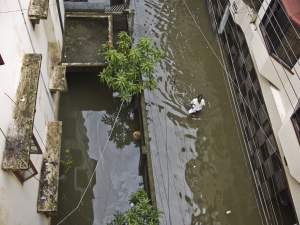
    In the region, the cities of Dhaka, Kolkata, and Yangon all lie in major river deltas and are vulnerable to storm surges. In its 2007 report, the Intergovernmental Panel on Climate Change (IPCC) specifically listed cities in Asian mega deltas as “hotspots for vulnerability” because of sea level rise and changing patterns of river flow. Already straining at their infrastructure limits, these densely packed cities are becoming more vulnerable in a warming world.

    Changing Transboundary Water Flow

    Water does not stay within lines on a map. Instead, gravity draws it inexorably from the mountains to the sea. China, through its control of Tibet, controls the headwaters of almost all of the major rivers of Asia – only the Ganges lies outside of China’s control, originating in India. Of the major rivers that empty into the Bay of Bengal, all cross borders. Water is only plentiful during the monsoon season, so these rivers provide much-needed sustenance to agriculture, people, and ecosystems throughout their trip to the sea during the dry season – when they are fed by glacier and snow melt. Competition and tension over that flow is evident around the world when water crosses borders.

    This is true of Bangladesh and India, for which the flow of the Ganges are a source of tension. The Farakka Barrage on the Ganges River, just 10 miles upriver from the Bangladesh border, allows India a measure of control over the river. The dam allows India to divert the flow of the Ganges down a canal to the Hooghly River and into the port of Kolkata. Since the dam was built in 1975, there have been allegations from Bangladesh that India diverts water in the dry season and releases too much in the monsoon season. In 1996, the two countries agreed to a 30 year treaty to share the Ganges’ flow, but tensions still remain.

    The Brahmaputra River, meanwhile, provides a source of tension between the two regional powers, India and China. China recently announced that they are building a series of hydroelectric dams along the Brahmaputra’s upper reaches in Tibet, but they have forsworn any attempt to divert or hold back the great river’s flow. However, these assurances have not quieted all voices in India, who point to plans in China’s South-North Water Diversion Project to divert water from the Brahmaputra in order to ensure water for industry and the cities of China’s parched north. China’s leaders have denied these extravagant plans, but their engineers have lobbied for such a project. It would complete a dream of Chairman Mao’s, who said: “Southern water is plentiful, northern water scarce. If at all possible, borrowing some water would be good.”

    Climate change exacerbates these concerns about transboundary water management in the region. Climate change is threatening both the glaciers that sit at the top of these mighty rivers, feeding them during the dry season, and the very viability and predictability of the Indian Monsoon rains. Temperatures in the Tibetan Plateau and the Himalayas have risen 1.5 degrees Celsius since 1982, a rate more than three times as fast as the global average. Meanwhile, changes in weather patterns due to climate change could cause repeated failures in the monsoon. While there is little likelihood of an immediate and total melting of the glaciers, uncertainty about their future flows is enough to stoke tension in the region.

    The Potential for Conflict

    Climate change is altering the environment of the region; the glaciers are retreating, the rivers’ flows are becoming more unpredictable, and the seas are rising. However, whether those changes manifest themselves into either civil or interstate conflict will depend upon how both the populations and the governments in the region react to those changes. How long governments have to adapt depends upon unpredictable weather and climate patterns – but as the Stern Review bore out, earlier action is almost always cheaper and more effective than waiting. How governments adapt is important as whether; some adaptations, like capturing water that would otherwise flow across borders in new reservoirs could actually make the threat of conflict worse. If countries do not work cooperatively, they could stoke conflict.

    Throughout history, one of the most effective ways to deal with climate change has been migration – from a climate that is no longer hospitable to one where living is easier. However, modern borders do not reflect the historical ties between the regions. Migration is a natural response. However, in areas with already high population density and an overlapping patchwork of ethnic and religious communities, new immigrant communities often come into direct conflict with established communities. Last year saw ethnic strife in the Indian state of Assam between indigenous Bodos and immigrant Muslims, many of whom hailed from over the nearby border in Bangladesh. Over 75 people died, and over 400,000 people were temporarily displaced. In this region, it is impossible to say whether a group of migrants are “climate refugees” or simply moving to a place with better economic opportunity, but this is what we should expect in the future.

    It is difficult to find examples of any interstate wars fought directly over water; to the contrary, water has been a catalyzer of cooperation. However, as countries realize that they can control and shape water flow through mega dams and water diversion projects, there is a danger that the claims of downstream countries could be ignored. Along the Mekong River, for example, China has proceeded to dam and control the river’s flow through its territory – leading downstream neighbors to complain that China is causing droughts. Yet because of the power imbalance between China and smaller countries like Laos and Cambodia, the Chinese have little to fear. Similar thinking by Chinese leadership over dam building along the Brahmaputra, their shared river with India, could lead both countries to stumble into a conflict that neither of them want.

    In the age of climate change, conflict is more likely as threats are multiplied. Nowhere is this truer than around the Bay of Bengal. However, war is never pre-ordained. Instead, the threat of conflict is determined by how countries react. Good international governance can encourage countries to not simply pull up the drawbridge and think only of themselves, but will encourage them to see what their actions will mean for regional neighbors. Climate change is increasing the threat of wars and unrest around the Bay of Bengal; but foresight about its impacts can help the region’s leaders work together to solve a problem that knows no boundaries.

    Andrew Holland is Senior Fellow for Energy and Climate at American Security Project, a Washington D.C based think tank. He is an expert on energy, climate change, and infrastructure policy. He has over seven years of experience working at the center of debates about how to achieve sustainable energy security and how to effectively address climate change.

    Image source: amioascension
  • Sustainable Security

    The Responsibility to Protect (R2P) is a significant, if controversial, development in international affairs. China has proposed its own semi-official version of R2P called “Responsible Protection”.

    Author’s Note: This article highlights issues discussed in more depth in various publications, including Andrew Garwood-Gowers, ‘China’s “Responsible Protection” Concept: Reinterpreting the Responsibility to Protect (R2P) and Military Intervention for Humanitarian Purposes’ (2016) 6 Asian Journal of International Law 89 and Andrew Garwood-Gowers, ‘R2P Ten Years after the World Summit: Explaining Ongoing Contestation over Pillar III’ (2015) 7 Global Responsibility to Protect 300.

    Introduction

    Over the last decade and a half the Responsibility to Protect (R2P) principle has emerged as a significant normative development in international efforts to prevent and respond to genocide and other mass atrocity crimes. Yet it has also been controversial, both in theory and in practice. R2P’s legal status and normative impact continue to be debated in academic and policy circles, while its implementation in Libya in 2011 reignited longstanding concerns among many non-Western states over its potential to be misused as a smokescreen for regime change. These misgivings prompted Brazil to launch its “Responsibility while Protecting” (RwP) concept as a means of complementing and tightening the existing R2P principle. China, too, has proposed its own semi-official version of R2P called “Responsible Protection” (RP). This contribution explores the key features and implications of the lesser known Chinese initiative.

    The R2P Principle

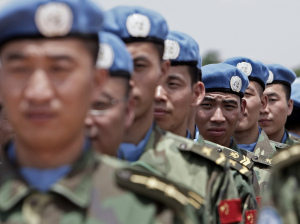
    Peacekeeping - UNAMID

    Image by UN Photo via Flickr.

    R2P first appeared in a 2001 report by the International Commission on Intervention and State Sovereignty (ICISS), a body set up by the Canadian government to consider how the international community should address intra-state humanitarian crises. However, after the initial concept proved contentious a modified version of R2P – labelled “R2P-lite” by one commentator – was unanimously endorsed by states at the 2005 World Summit. In its current form R2P consists of three mutually reinforcing pillars. The first is that each state has a responsibility to protect its populations from the four mass atrocity crimes (genocide, war crimes, crimes against humanity and ethnic cleansing). Pillar two stipulates that the international community should encourage and assist states in fulfilling their pillar one duties. Finally, pillar three provides that if a state is manifestly failing to protect its populations the international community is prepared to take collective action in a timely and decisive manner on a case-by-case basis, in accordance with Chapter VII of the UN Charter.

    Action under pillar three can encompass non-coercive tools such as diplomacy and humanitarian assistance, as well as coercive means including sanctions and the use of force. The international community’s pillar three responsibility is framed in conservative terms, creating only a duty to consider taking appropriate action, rather than a positive obligation to actually respond to a state’s manifest failure to protect. Crucially, the UN Security Council remains the only body that can authorise coercive, non-consensual measures under pillar three. R2P does not grant states a right to undertake unilateral humanitarian intervention outside the Charter’s collective security framework. Overall, R2P is best characterised as a multi-faceted political principle based on existing international law principles and mechanisms.

    The most well-known instance of pillar III action to date is the international community’s rapid and decisive response to the Libyan crisis in early 2011. The Security Council initially imposed sanctions and travel bans on members of the Gaddafi regime before passing resolution 1973 authorising the use of force to “protect civilians and civilian populated areas under threat of attack’’. China, Russia, Brazil and India each abstained on the vote to mandate military force against Libya. As the extent of NATO’s military targets and support for the Libyan rebels became apparent, many non-Western powers criticised the campaign for exceeding the terms of the Security Council resolution. For these states, the eventual removal of the Gaddafi regime confirmed their perception that R2P’s third pillar could be manipulated for the pursuit of ulterior motives such as the replacement of unfriendly governments.

    The post-Libya backlash against R2P was at least partly responsible for Security Council deadlock over Syria. Russia and China have exercised their vetoes on four separate occasions to block resolutions that sought to impose a range of non-forcible measures on the Syrian regime. At the same time, there has been renewed debate about the strengths and weaknesses of R2P’s third pillar. In late 2011 Brazil’s RwP initiative proposed a series of decision-making criteria and monitoring mechanisms to guide the implementation of coercive pillar three measures. While RwP initially attracted significant attention and discussion, Brazil’s foray into norm entrepreneurship was short-lived and R2P has remained unaltered.

    Reframing R2P as “Responsible Protection”

    China’s traditional insistence on a strict interpretation of sovereignty and non-intervention has made it uncomfortable with the coercive, non-consensual aspects of R2P’s third pillar. As a result, Beijing has consistently emphasised the primacy of pillars one and two, while downplaying the scope for pillar three action. In this respect, its decision not to veto resolution 1973 on Libya came as something of a surprise.

    China’s contribution to the post-Libya debate over R2P’s third pillar is less widely documented than Brazil’s efforts. In mid-2012 the notion of “Responsible Protection” was floated by Ruan Zongze, the Vice President of the China Institute for International Studies (CIIS),  which is the official think tank of China’s Ministry of Foreign Affairs. Although China has not explicitly adopted the concept as a formal policy statement on R2P, its implicit endorsement means it can be described as a “semi-official” initiative.

    RP is primarily concerned with R2P’s third pillar and, in particular, providing a set of guidelines to constrain the implementation of non-consensual, coercive measures. It consists of six elements or principles, which are drawn from just war theory and earlier R2P proposals such as the 2001 ICISS report and Brazil’s RwP. In this respect, RP represents a repackaging of previous ideas, rather than an entirely original initiative. However, by reframing these concepts in stricter terms it reflects a distinctive Chinese interpretation of R2P that seeks to narrow the circumstances in which non-consensual use of force can be applied for humanitarian purposes.

    The first element draws on the just war notion of “right intention”. It provides that the purpose of any intervention must be to protect civilian populations, rather than to support “specific political parties or armed forces”. This conveys Beijing’s concerns over the motives and objectives of those intervening under the banner of R2P, as expressed during the Libyan experience. Element two relates to the “right authority” criterion. It reiterates the longstanding Chinese position that only the Security Council can authorise the use of coercive measures, and that there is no right of unilateral humanitarian intervention granted to states.

    RP’s third element is based on the traditional principle that military intervention should be a “last resort”. Its call for “exhaustion of diplomatic and political means of solution” is consistent with Beijing’s broader policy preference for diplomacy and dialogue over forcible measures. However, insisting on a strict, chronological sequencing of responses may deprive the international community of the flexibility needed to ensure timely and decisive action on humanitarian crisis. For this reason, some clarification or refinement of element three may be needed. The fourth element of RP draws on aspects of the just war principles of “right intention” (like element one) and “reasonable prospects”. In relation to the latter, it provides that “it is absolutely forbidden to create greater humanitarian disasters” when carrying out international action. This stipulation reflects Beijing’s position that external intervention often exacerbates humanitarian crises and can ultimately cause more harm than good.

    Element five of RP provides that those who intervene “should be responsible for the post-intervention and post-protection reconstruction of the state concerned”. Although the notion of a responsibility to rebuild appeared in the original 2001 ICISS report it was not included in the text of the World Summit Outcome document in 2005 and therefore does not form a component of the current concept of R2P. It is unclear whether China’s RP concept is explicitly seeking to resurrect this dimension or whether this element is simply intended to emphasise Beijing’s broader perspective on peacebuilding and development in post-conflict societies. Finally, element six calls for greater supervision and accountability of those carrying out UN authorised civilian protection action. This is a similar demand to that made in Brazil’s RwP proposal, though little detail is given as to what form any such monitoring mechanism would take.

    Conclusion

    Overall, the Chinese notion of RP is an attempt to reinterpret and tighten the content of R2P’s third pillar so that it aligns more closely with Beijing’s own normative preferences and foreign policy objectives. Compared to RwP and the ICISS report, RP outlines a narrower set of circumstances in which military intervention for humanitarian purposes would be appropriate. Some aspects of the proposal would certainly benefit from clarification and refinement.

    However, it is notable that despite strongly criticising the way R2P was implemented in Libya, China has chosen to engage with, and actively shape, the future development of the norm. This illustrates the extent to which China, as a permanent member of the Security Council, is enmeshed in the ongoing debate over R2P. In fact, RP is explicitly framed as an example of China “contributing its public goods to the international community”. In the future we can expect China and other non-Western powers to play increasingly influential roles in the development of international security and global governance norms.

    Andrew Garwood-Gowers is a lecturer at the Faculty of Law at Queensland University of Technology (QUT) in Brisbane, Australia. He has written extensively on R2P and the law governing the use of military force, with publications in leading journals including Global Responsibility to Protect, the Asian Journal of International Law, Journal of Conflict and Security Law and the Melbourne Journal of International Law.

  • Editors and Associate Editors

    Editors and Associate Editors

    Editor

     
    Ben Zala

    Ben Zala is the Manager of the Sustainable Security Programme at the Oxford Research Group. He is also a PhD candidate in International Relations and Graduate Teaching Assistant at the University of Birmingham and holds a Bachelor of International Relations with first class honours from La Trobe University, Melbourne. He has previously worked at Chatham House (Royal Institute of International Affairs) in the Energy, Environment and Development Programme and the La Trobe University Centre for Dialogue where he was also the editorial assistant for the scholarly journal Global Change, Peace and Security.  He has also previously worked for the Medical Association for Prevention of War (Australia). He has worked on security issues for a number of years and has published and spoken at conferences on issues of nuclear proliferation, arms control and disarmament and multilateral institutions.


    Associate Editors


    Chris Abbott

    Chris AbbottChris Abbott is a freelance writer and researcher and Executive Director of Open Briefing. He is an honorary Sustainable Security Consultant at Oxford Research Group, where he was the organisation’s Deputy Director and Director of their sustainable security programme until June 2009 (a programme he initiated in 2006 and remains on the advisory board for). During his time at ORG he founded SustainableSecurity.org and was the author or co-author of numerous sustainable security publications, including An Uncertain Future: Law Enforcement, National Security and Climate Change (ORG, 2008), Beyond Terror: The Truth About the Real Threats to Our World (Rider, 2007) and Global Responses to Global Threats: Sustainable Security for the 21st Century (ORG, 2006). Since leaving ORG he has been appointed as an Honorary Visiting Research Fellow in the Department of Peace Studies at the University of Bradford and written a second book, 21 Speeches That Shaped Our World: The People and Ideas That Changed the Way We Think (Rider, 2010).

    Paul Rogers

    Paul RogersPaul Rogers is Professor of Peace Studies at the University of Bradford and Global Security Consultant to Oxford Research Group. Much of the sustainable security analysis is based on three decades of Professor Rogers’ work in the field of international security, arms control and political violence. He lectures at universities and defence colleges in several countries and has written or edited 26 books, including Global Security and the War on Terror: Elite Power and the Illusion of Control (Routledge, 2008) and Losing Control: Global Security in the Twenty-first Century (Pluto Press, 2002). Paul is also a regular commentator on global security issues in both the national and international media, and is openDemocracy’s International Security Editor.
      

    John Sloboda

    John SlobodaJohn Sloboda is Director of Oxford Research Group’s Recording Casualties in Armed Conflict programme. He is also Emeritus Professor of Psychology at the University of Keele, and an Honorary Professor in the School of Politics and International Relations at Royal Holloway, University of London. Since 2003, he has been co-director of the Iraq Body Count project. He is the co-author of Beyond Terror: The Truth About the Real Threats to Our World (Rider, 2007) and Global Responses to Global Threats: Sustainable Security for the 21st Century (ORG, 2006). He undertakes regular speaking engagements, and is an occasional author for openDemocracy. In July 2004, John was elected to the Fellowship of the British Academy.
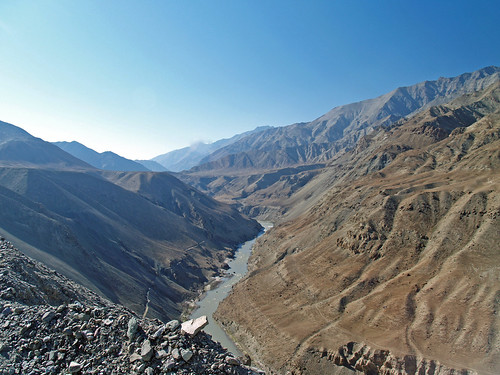
     

  • Rivers a source of rising tension between Pakistan and India

    Rivers a source of rising tension between Pakistan and India

    Manipadma Jena | Reuters AlertNet | April 2010

    Issues:Climate change, Competition over resources

    A 1960 trans-boundary water sharing agreement between India and Pakistan has stood the test of two wars and various periods of unease. Climate change, however, may prove the toughest test of the Indus River deal, observers say. The two rival South Asian nations share the 190 billion cubic meters of Himalayan snowmelt that course through the Indus each year. The river originates from India’s Himalayan Hindu Kush mountains and flows through Jammu and Kashmir and then through Pakistan to reach the Arabian Sea. But experts say that climate change could alter the timing and rate of snow melt, with an initial increase in annual runoff followed eventually by a steep decrease that will severely curb river flows.

    CONFLICT OVER RIVERS?

    That could provoke conflict between the two nations, particularly as India develops dams along the upper riches of the Indus, raising questions in Pakistan over whether falling water availability is due to climate change or to India’s reservoirs. A 2009 World Bank report “South Asia: Shared views on Development and Climate Change,” says the two South Asian monsoon-dependant agri-economies may be in for big upsets as a result of climate change. “Upstream or downstream, we (India and Pakistan) are in the same boat,” said Hameed Ullah Jan Afridi, Pakistan’s federal minister for environment, at a recent workshop in Islamabad on cross-border water scarcity and climate change. The tortuously negotiated 1960 water-sharing treaty owes its roots to the 1947 separation of India and Pakistan into separate countries. It gives India rights to the natural flow of water of the Indus’ three eastern tributaries – the Ravi, Sutlej and Beas – while Pakistan controls the main Indus channel itself and two western rivers, the Jhelum and Chenab. But determining what amount of water constitutes a river’s natural flow is growing more difficult as climate change affects glacial runoff and the monsoon. Pakistan has increasingly raised concerns about data sharing and transparency, particularly because the upper reaches of all of the rivers lie in Indian-controlled territory, giving that nation greater scope for control of the entire Indus river system.

    LACK OF ALTERNATIVE SOURCES

    Pakistan’s anxieties stem in large part from its lack of alternative water resources. Seventy-seven percent of its population survives on water from the Indus basin. High levels of poverty and population density also render both countries particularly vulnerable to climate change-related water shortages, said Munawar Saeed Bhatti, of Pakistan’s ministry of foreign affairs. The changes threaten to have a strong impact on agriculture in both nations as well. Changes in temperature and precipitation patterns will alter crop yields and growing seasons, and a predicted increase in more extreme storms, rainfall and drought could cut harvests, according to the U.N. Environmental Programme. Experts believe new pests and diseases also will emerge, and could contribute to seriously impacting food security in both nations. Pakistan’s meteorological department has already recorded a 10 to15 percent decrease in winter and summer rainfall in the country’s coastal belt and arid plains, with a temperature rise of 0.6 to 1.0 degree Celsius over historical levels, officials said. Per capita water availability in Pakistan has dropped in last 50 years from 5,600 cubic metres to 1,038 cubic meters today. By 2025 it is predicted to be 809 cubic meters, according to the Pakistan government’s Water and Power Development Authority. Humid areas of Pakistan, meanwhile, have seen an 18 to 32 percent increase in monsoon rainfall. In India and Pakistan, 70 percent of rain falls during monsoon periods, which cover four months of the year.

    TAKING ACTION

    In Pakistan’s western Himalayan foothills, where farmers rely on glacial melt from the Karakoram range and year-round rainfall, both water sources are now reducing. Fruit farmers in the area, such as 65-year-old Muhamud Riyaz, have already responded by harvesting summer stream water into 3,000 litre gravity-fed storage tanks. “When I was a boy, summer came but mounds of snow at the foot of thick foliage trees would sit there, melting slowly, keeping the soil moist until the summer rains came. Since the last two years, the snow is just a thin layer and it rains only in monsoons,” Riyaz said. In other areas, flooding is the problem. Pakistan records floods almost every year now, and in India the area affecting by flooding more than doubled between 1953 and 2003, and currently represent about 11 percent of its geographic area, according to the World Bank. Even in areas that regularly flood, “high frequency, low intensity flood events have now turned into high intensity, high frequency floods,” said Daanish Mustafa, a water specialist and geography professor at London’s Kings College. River siltation is contributing to the problem, he said. The problems facing both sides of the India-Pakistan border are particularly bad because “water management is literally a little above Stone Age,” said Richard Garstang, national programme manager of Pakistan’s wetlands programme. Up to 30 percent of water is lost from the country’s unlined irrigation canals, experts said. The country has some 16 million hectares of irrigated farmland, one of the largest contiguous irrigated areas in the world. Poor water management is to a great extent responsible for Pakistan’s water woes, a 2006 World Bank report noted. It warned that ground water is being over exploited and 20 million tonnes of salt has accumulated in the water system.

    AQUIFERS BEING DEPLETED

    “Half a million vertical wells in the Indus basin are depleting aquifers faster than they can be replenished,” Mustafa said. Agriculture accounts for half of total fresh water use in Pakistan. “Due to a combination of age and ‘build/neglect/rebuild’ philosophy of public works, much of the infrastructure is crumbling,” the World Bank report said. Indian officials have attributed Pakistan’s water woes in part to a dearth of water storage infrastructure, noting that a huge 38 million acre-feet of fresh water goes un-utilized into the Arabian Sea every year.

    Manipadma Jena is a Reuters AlertNet correspondent and freelance development journalist based in Bhubaneswar, India

    Source: Reuters AlertNet

    Image source: stevehicks

    Comments

    Post new comment


  • Competition over resources

    Competition over resources

    In the environmentally constrained but more populous world that can be expected over the course of this century, there will be greater scarcity of three key resources: food, water and energy. Demand for all three resources is already beyond that which can be sustained at current levels. Once population growth and the effects of climate change are factored in, it is clear that greater competition for such resources should be expected, both within and between countries, potentially leading in extreme cases to conflict.

    The United States, Niger & Jamaica: Food (In)Security & Violence in a Globalised World

    Anna Alissa Hitzemann | | September 2012

    Issues:Climate change, Competition over resources, Marginalisation

    The United Nations Development Programme (UNDP) defines food security as “all people at all times having both physical and economic access to the basic food they need”. However, due to a complex range of interconnected issues from climate change to misguided economic policies, political failure and social marginalisation, over 2 billion people across the world live in constant food Insecurity. It is important to take a sustainable security approach to look at the importance of “physical and economic access to basic food” by exploring the links between food insecurity and violence.

    Image source: Bioversity International

    Read more »

    National security and the paradox of sustainable energy systems

    Phillip Bruner | Exclusively written for sustainablesecurity.org | August 2012

    Issue:Competition over resources

    The transition away from a centralised global economy built around conventional energy sources to a decentralised global economy mostly fuelled by renewable resources is one we must make for the sake of our children’s futures and that of our planet. Writing for sustainablesecurity.org, Phillip Bruner asks if national security is at present, deeply concerned with preserving access to conventional energy, then how would national security for a decentralised renewable energy Internet be managed? Who would manage it? And what role, if any, could the public play in helping to alleviate some of the burdens of 21st century threat mitigation?   
    Image source: Truthout

    Read more »

    The Global Land Rush: Catalyst for Resource-Driven Conflict?

    Michael Kugelman | Exclusively written for sustainablesecurity.org | July 2012

    Issue:Competition over resources

    Writing exclusively for SustainablseSecurity.ORG, Michael Kugelman of the Woodrow Wilson International Center, argues that the factors that first sparked many of the land acquisitions during the global food crisis of 2007-08 — population growth, high food prices, unpredictable commodities markets, water shortages, and above all a plummeting supply of arable land — remain firmly in place today. He writes that land-lusting nations and investors are driven by immediate needs, and they have neither the incentive nor the obligation to slow down and adjust their investments in response to the wishes of distant international bureaucrats. This, he argues, has serious consequences for global security.

    Image source: Planète à vendre

    Read more »

    Moving Beyond Crisis: Survival 2100 and Sustainable Security

    William Rees | Movement for a Just World | June 2012

    Issues:Climate change, Competition over resources, Global militarisation, Marginalisation

    In a piece for the International Movement for a Just World, William Rees maps out a vision for what he calls ‘Survival 2100.’ The goal of such a strategy would be “to engineer the creation of a dynamic, more equitable steady-state economy that can satisfy at least the basic needs of the entire human family within the means of nature.” The alternative, Rees argues is to “succumb to more primitive emotions and survival instincts abetted by cognitive dissonance, collective denial, and global political inertia.”

    Image source: hundrednorth.

    Read more »

    The Costs of Water Insecurity

    Issue:Competition over resources


    The post-Rio +20 discussion has focused a great deal on trade-offs between the global environment and the global economy. This sort of thinking obscures the extent to which global trends like increasing competition over scarce resources not only threatens both national and human security but actually threatens long-term economic stability as well. In an interview for the Woodrow Wilson Center, explorer and a co-founder of Earth Eco International, Alexandra Cousteau explains how this relates to the global use of water.


    Image source: Oxfam International.

    Read more »

    The Security Implications of the Current Resource Scramble

    Issue:Competition over resources

    Respected security analyst and author Michael Klare’s new book ‘The Race for What’s Left’ discusses the growing competition for resources across the globe driven by the depletion of fossil fuels, minerals, water and arable land. Klare argues that the full extent of the political, economic and security implications of this trend are yet to be fully understood in mainstream political circles. The alternative to this, Klare contends, is a coming race to adapt to a resource and climate-constrained world which can offer a way out of war, widespread starvation and environmental catastrophe. 

    Image source: thelGl

    Read more »

  • Climate change

    Climate change

    Climate change is high on both domestic and international political agendas as countries face up to the huge environmental challenges the world now faces. Whilst this attention is welcome, less energy is being focused on the inevitable impact climate change will have on security issues. The well-documented physical effects of climate change will have knock-on socio-economic impacts, such as loss of infrastructure, resource scarcity and the mass displacement of peoples. These in turn could produce serious security consequences that will present new challenges to governments trying to maintain stability.

    Risk of extreme weather events highlighted by the Intergovernmental Panel on Climate Change

    Marlowe Hood | AFP | November 2011

    Issue:Climate change

    As reported by Agence France Presse, the UN Intergovernmental Panel on Climate Change has produced a draft summary of a report that warns of a predicted increase in the number and intensity of extreme weather events.  The 800-page report goes some way to addressing a subject largely untouched by their landmark 2007 report on climate change, and adds to the growing body of evidence outlining the potential security implications of a warmer planet.

    Article Source: AFP

    Image Source: Nasa

    Read more »

    Governments Must Plan for Migration in Response to Climate Change, Researchers Say

    This story is reprinted from materials provided by University of Florida. The original article was written by Donna Hesterman | ScienceDaily | October 2011

    Issue:Climate change

    Governments around the world must be prepared for mass migrations caused by rising global temperatures or face the possibility of calamitous results, say University of Florida scientists on a research team reporting in the Oct. 28 edition of Science.

    Image Source: Meredith James Johnstone

    Read more »

    Security is not simply the absence of conflict

    John L Smith | UK Foreign and Commonwealth Office – Climate Change Team | September 2011

    Issue:Climate change

    Blog entry from the Foriegn and Commonwealth Office on climate change and security:

    What the scientific modelling makes clear is that if global temerepature continues to rise unabated, it will place significant additional stress on ALL economies, but that the emerging economies on this continent will be among the first to take real strain.  Unchecked climate change will make the poorest even more vulnerable, with related food and water stress and climate migration.   It will raise tension levels over access to diminishing resources, particularly water.

    Climate change is therefore a threat mutliplier, and governments must be alive to the potential it has to disrupt sustainable growth and stability and exacerbate tensions within and between countries.

    Article source: FCO Climate change team blog

    Image source: climatesafety

    Read more »

    Conflict, Climate Change, and Water Security in Sub-Saharan Africa

    Oluwole Akiyode | peace and conflict monitor | September 2011

    Issues:Climate change, Competition over resources

    The paper is a review of literatures on conflict, climate change and water security on Sub-Saharan Africa. It identifies poverty as a threat in Sub-Saharan African countries that may have effect on its water security. It analyses in Sub-Saharan Africa region, the conflict trend of water security in correlation with climate change impacts. It advocates sustainable water management as the ameliorative and mitigation approaches to the negative effects of climate change on water security in Sub-Saharan Africa.

    Article source: peace and conflict monitor

    Image source: Abdurrahman Warsameh for the International Relations and Security Network

    Read more »

    Climate Cycles Are Driving Wars, Says Study

    Columbia University | The Earth Institute | August 2011

    Issue:Climate change

    In the first study of its kind, researchers have linked a natural global climate cycle to periodic increases in warfare. The arrival of El Niño, which every three to seven years boosts temperatures and cuts rainfall, doubles the risk of civil wars across 90 affected tropical countries, and may help account for a fifth of worldwide conflicts during the past half-century, say the authors.

    Image source: The U.S. National Archives

    Article source: The Earth Institute

    Read more »

  • Sustainable Security

    The centenary of the First World War also marks the anniversary of the practice of recording and naming casualties of war. But a century on, new forms of ‘shadow warfare’ limit the ability to record casualties of conflict and thus threaten to allow states a free hand to employ dangerous new tactics without threat of individual or international accountability. Without verifiable casualty figures – including information on who is being killed and how – we cannot evaluate the acceptability, effectiveness or impact of ‘remote control’ tactics as they are rolled out among civilian populations.

    A Humanizing Legacy

    Image of the name of Sgt. Robert O'Connor of The Leinster Regiment on the Menin Gate wall, who was killed on 31 July 1917 during the First World War. Source: Wikipedia

    Image of the name of Sgt. Robert O’Connor of The Leinster Regiment on the Menin Gate wall, killed on 31 July 1917 during the WWI. WWI saw the start of practice of recognizing by name each and every soldier killed during battle. Source: Wikipedia

    As the world marks the centenary of the commencement of the First World War,  we remember not the war that ended all wars, but instead the war that changed them forever. Introducing new forms of mechanized warfare – including the machine gun, u-boat, tank and airplane – WWI increased exponentially the lethal force of the individual soldier, bringing about an era of death and destruction on an industrial scale.  Yet, even as it ushered in the means of mass and impersonal killing, the ‘Great War’ also initiated the humanizing practice of recognizing by name each and every soldier who lost their lives, burying them in marked graves alongside those of their officers. Not only does such identification and public acknowledgement of victims dignify their memory, in today’s conflicts it can also provide vital information for humanitarian response and for monitoring compliance with – or tracking violations of – international law.

    Today we are again witnessing the introduction of new forms of warfare – including armed drones, lethal autonomous weapons, special operations forces and use of private military and security companies.  Like their WWI counterparts, these new tactics will reshape the face of conflict, yet as they do so they also threaten to destroy the humanizing legacy of casualty recording. Pushing global warfare deep into the shadows, these new ‘remote-control’ tactics are replacing public military campaigns with covert and contracted force. This shift to a ‘light-footprint’ approach, primarily by the United States, but also by France, Russia and the United Kingdom, reflects not only the changing nature of security threats, which have become mercurial at best, but also the lessening appetite for long military campaigns with high military casualties. A recent report from the Every Casualty Programme at Oxford Research Group and the Remote Control Project finds that the prioritisation of ‘remote control’ tactics presents serious obstacles to the recording of casualties, and subsequently, accountability for the civilians impacted by their use.

    Issues of capacity, political will, and access challenge efforts to record the casualties of any type of conflict. Yet, in conventional warfare, where identifiable or recognised conflict parties conduct attacks, such recording is not impossible: militaries generally record their own fatalities in these instances, while civilian deaths are often recorded by small civil society organizations around the world.  One need only look to the names of the hundreds of civilians killed in recent conflict in Gaza published by major news outlets to see the result of such efforts. In covert conflicts, however, or in conflicts where ‘remote control’ tactics are used, the ability to record casualties – including information on who is killed and how – is greatly diminished.

    The merging of intelligence operations with the use of force – seen currently in countries such as Yemen, Pakistan and Afghanistan with the use of armed drones and special operations forces by the United States – is a particularly problematic trend for casualty recorders. By greatly increasing the opacity – or outright deniability – of state force, covert operations erect a seemingly impenetrable wall of ‘classified information’, impeding recorders’ ability to conduct field investigations and verify their data. In 2010, the United Nations Mission in Afghanistan (UNAMA), which has conducted systematic casualty recording since 2007, reported that due to “tactical reasons and deliberate lack of information about such operations” they found it “very difficult to monitor and adequately document the activities of Special Forces” operating in the country. Gathering data on civilian and combatant casualties of drone strikes has also proved problematic – with ORG’s report finding that recorders are challenged by a lack of official disclosure of information about strikes, blocking of access to strike sites, and a near monopoly of information by anonymous officials on information coming from affected areas.

    The consequent lack of reliable casualty data impedes the impartial evaluation of the tactics’ impacts on civilian populations. It also limits the ability to scrutinise the tactics acceptability and effectiveness using evidence-based analysis. The United States – the primary user of armed drones – has repeatedly claimed that drones allow for precision targeting, capable of surgically eliminating targets with minimal civilian casualties. Yet, as a recent report from the Bureau of Investigate Journalism on drone use in Afghanistan has shown, “the armed forces that operate drones publish no data on casualties to corroborate these claims.” Although the United States claims to record data on casualties itself, its failure to make such records transparent not only prevents an analysis of the acceptability of drone strikes, but also denies the victims and their families the opportunity for accountability or redress.

    Bringing Remote-Control warfare out of the shadows

    People of Narang district mourning for the students killed in a night raid in the village Ghazi Khan on December 27, 2009. Although the operation was authorised by NATO, it is still not publicly known who carried out the attack. Source: Wikipedia

    People of Narang district mourning for the students killed in a night raid in the village Ghazi Khan on December 27, 2009. Although the operation was authorised by NATO, it is still not publicly known who carried out the attack. Source: Wikipedia

    Data documenting the casualties of particular weapons – from chemical gas in WW1 to landmines and cluster munitions more recently – has been instrumental in evaluating these weapons’ impact and acceptability, and ultimately ensuring their regulation through international treaty. Yet, as new tactics are employed under the cloak of ‘covert action’, the ability of the international community to measure and regulate their impact is increasingly limited. Without verifiable casualty figures, states may be given a free hand to employ dangerous new tactics without threat of individual or international accountability. Indeed a recent report from Amnesty International has found that as a result of an almost complete lack of transparency from the US government regarding civilian casualties in Afghanistan – specifically around those killed in night raids by SOFs or by missiles from drones strikes – victims are already facing a major accountability vacuum.

    States must take greater responsibility for recording and acknowledging the casualties – both civilian and combatant – of these new tactics. They must not seek to block public investigation and accountability, even though these tactics may be adopted for the lower profile they afford armed force. Furthermore the United Nations, alongside civil society groups or other entities, must enhance their recording efforts so as to provide independently verifiable data on casualties. Such data is essential for developing an accurate, complete and impartial record, and for facilitating scrutiny in circumstances where casualties are highly politicized. Civil society-led casualty recording and analysis, despite its limitations, has already highlighted policies within the use of remote control tactics that need greater examination: for example, the practice of ‘double-tap’ or rescuer drone strikes in Pakistan on those coming to the assistance of individuals at the site of a previous strike. Only by ensuring that casualty recording is conducted systematically and to a high standard can we bring the impact of remote control warfare out of the shadows and into the public eye.

    If we are to take a lesson from the commemoration ceremonies resounding across Europe it is simply that to learn from the past, and to honor it, we must first know that past. Details regarding the identites of those killed in conflict, both on the battlefield and in their homes, are essential to understanding the impact of violence, and to telling the full story of a conflict, to both current and future generations. The risks, then, of wars waged in secret, their battles and casualties concealed, are profound. Not only will there be no monuments at which to mourn their dead, there will be no lessons to be gleaned from their history: the wisdom of hindsight – both for policymakers deploying force and the public – may be lost completely.

    Kate Hofstra is Research and Communications Consultant of the Every Casualty Programme at Oxford Research Group and co-author of Losing Sight of the Human Cost: Casualty Recording and Remote Control Warfare. Kate previously worked for TLG,a London-based communications consultancy, where she was the editor of a digital magazine on business and development. She has also worked with the OSCE Mission to Bosnia and Herzegovina in Sarajevo and hasa background in transitional justice. Kate has an MSc in Human Rights from the London School of Economics.

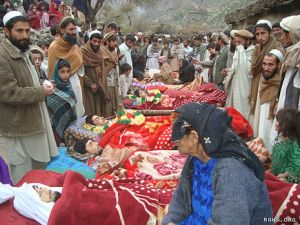
    Featured Image: Deputy chief minister of Pakistan’s North West Frontier Province and tribesmen offer funeral prayers in front of dead bodies who were killed in army operation in Khar, the main town in Bajaur tribal agency, 30 October 2006. Source: The Bureau of Investigative Journalism, Naming the Dead Project

  • Sustainable Security

    It’s hard to deny the fact that turning to essay writing services online is always stressful as one trusts certain academic challenges and research to another person willing to offer help. As the majority of British students these days are forced to study remotely or combine physical and online education, the role of academic assistance online became more important than ever. It also brings up certain security concerns among students and educators as one focuses on data privacy and academic integrity issues as the assistance is being provided. Aiming to provide assistance in the field of academic development, writing services, and online safety in general, Sustainablesecurity.org belongs to those unique campaigns where you can debate, discuss, and develop your skills as you deal with modern insecurities. Choosing writing services UK, we strive to help you create a sustainable security framework that can help you approach global security issues differently as you know how to choose what’s safe and reliable.

    Understanding Security Matters

    Before you continue reading our blog related to the Sustainable Security programme that has been made possible with the help of Oxford Research Group, first starting in 2009, and then rebranded in 2013, you should understand that we provide you with a special environment where you can discuss your concerns, take part in debates, and help develop a much better understanding of security concerns. Our aim is to create a sustainable security framework together when you bring your academic or essay writing challenges online. For example, when you are looking for a custom essay service, our interconnected actions and unity will help you to determine what can be considered as a custom essay writing service and what factors make it safe. Knowing global security challenges in the 21st century, you will be able to deal with numerous issues that pose an importance today, including:

    • Online (Remote) Learning Challenges and Accessibility.
    • Climate Change Concerns.
    • Competition Over Natural Resources.
    • A Negative Impact of Technology.
    • Global Militarisation.
    • Poverty and Marginalisation.

    As you can see, we strive for solving the global threats at the source by focusing on numerous issues. When you are looking for a reliable essay writing website, you also approach it all from technology to personal safety issues. Just share your concerns by contacting our specialists and we shall guide you towards the most efficient solutions!

    How to Write a Quality Essay In The UK? 5 Helpful Steps.

    Learn Your Service Provider.

    When looking for a reliable university essay writing service, you should remember that starting with a safe option that you know well will help you to avoid mistakes, late delivery, payment issues, or lack of refunds when things go wrong. We provide you with safe methods and experts that will help you write a quality essay from scratch, thus avoiding plagiarism risks.

    Aim For Direct Communication With Your Writer.

    Another important step is looking for a custom essay writing service that makes it possible to talk to your expert directly by discussing your thoughts and making sure that a person understands the subject and has good writing skills. It’s one of those security framework tips you should always consider. We are happy to offer direct contact with a chosen expert as you place your order.

    Focus On Grading Rubric Analysis.

    Remember that it’s not possible to write a quality essay without prior analysis and study of the grading rubric. The majority of instructions already have the answers or prompts to most questions, which is the starting point to good essay writing.

    Sources and Originality.

    Every good essay will contain well-documented sources that act as evidence and proof that you have done a clever synthesis of available information. The same relates to originality issues and the formatting of your sources according to a specified style. Our writing service has access to the latest databases, which will play an essential role in your academic success.

    Professional Proofreading and Editing.

    It’s what helps to tell a weak piece of academic research from the one that is perfect as it contains no grammar, style, formatting, or readability issues. Always take your time to proofread your written content!

    The Factors That Make Our Academic Assistance Research Services Safe

    Regardless of whether you are looking for an essay writing service in UK or would like to receive consulting services regarding one of the global security issues, we are happy to offer professional assistance that will meet your vision and professional requirements. As a team of trained experts and British natives, we work hard to address every security issue and offer safe academic services for educational, business, research, or personal purposes.

    The factors worth mentioning regarding our academic research services and creation of the sustainability safety framework include:

    • Always working from scratch, which helps to avoid plagiarism in your works.
    • Direct communication with a chosen expert helps to eliminate misunderstanding or any other issues.
    • Our college essay writing service will help you to find the safest and most reliable solutions based on the current security standards as you research various academic subjects with our help.
    • A great platform that focuses on global security threats and solutions.
    • 24/7 customer support and refunds in case you are not happy with the final results.

    Still, we are certain that you will be pleased with our platform and will add to the number of satisfied clients and our colleagues.

    We provide you with articles and resources to help you research your subject and discuss things with fellow specialists in the UK and beyond. As we help to eliminate global security threats and provide every member of society with safety in all regards, helping you learn in a safe environment is one of our top priorities. Therefore, our online essay writing service is based on online safety and academic integrity principles, which means that you are working only with native speakers with verified academic credentials and experience in every relevant field. We care for your safety as we work towards global security together!

  • Sustainable Security

    This post is based on Paul Rogers’ Monthly Global Security Briefings and was originally posted by Oxford Research Group on 29 April, 2014.

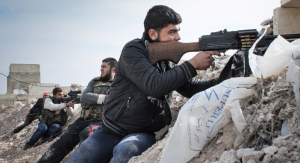
    Free Syrian Army rebels fighting Assad militias on the outskirts of the northwestern city of Maraat al-Numan, Idlib - Syria Source: Freedom House (Flickr)

    Free Syrian Army rebels fighting Assad militias on the outskirts of the northwestern city of Maraat al-Numan, Idlib – Syria Source: Freedom House (Flickr)

    The Syrian War is now in its fourth year and the indications are that the regime will survive and consolidate its position in 2014. This is radically different from early last year when many analysts thought it was under serious pressure, and it should be recalled that in mid-2011, a few months into the war, the prevailing view was that the regime would not last to the end of that year. The costs have been huge, with around 140,000 killed, twice that number injured and more than a third of the population displaced, millions of them refugees in other countries.  This article seeks to put this appalling conflict in a longer term regional context as an aid to looking at possible policy options in attempting to bring the war to an end.

    The Regional Context in 2011

    At the start of 2011 the region was struck by remarkable political upheavals as people in a number of countries reacted against autocratic rule and demanded political change. It commenced with the rapid and unexpected fall of the Ben Ali regime in Tunisia on 14 January and was followed on 11 February by the quite startling collapse of the Mubarak regime in Egypt. Across the region there were public uprisings of varying intensities in Oman, Bahrain, Yemen, Libya and Syria and political uncertainty in several countries including Kuwait, Jordan and Morocco.

    In broad terms, those political authorities that did not immediately collapse reacted in different ways that may be summarised as concession or repression or a mixture of both. In Oman, demonstrations were repressed with force but concessions were also offered and the innate wealth of the authorities was available to “buy off” resentment. In Bahrain the royal house opted for repression, aided by army and police support from Saudi Arabia and the UAE.  Saudi Arabia treated Shi’a opponents harshly but distributed many billions of dollars of resources across most of the population.

    In Morocco, King Mohammed sped up the pace of reform with some effect, and across the border in Algeria some economic concessions, including increased food subsidies, were made.  In Libya, Gaddafi used repression but western, and a few Gulf Arab, states intervened on the part of the rebels; a six-month war ended with regime collapse and Gaddafi’s lynching. This has been followed by huge insecurity, including rise of Islamist and local tribal militias.

    The Syrian regime faced extensive nonviolent demonstrations, most commonly after Friday prayers, and faced an escalation in dissent at a time when two regimes in the region had already fallen and in the same week that Saudi and Emirati forces intervened in Bahrain and the UN approved foreign intervention in Libya. The fate of Mubarak was particular striking for the Assad regime given Syria’s long-term historical relationship with Egypt, and it is probable that this meant the regime believed its only course of action was vigorous repression. It became progressively more vigorous and determined in its pursuit of control.

    Underlying Causes

    Although most of the individual anti-government actions across the Arab World were responses to persistent and long-term autocracy, these were in the context of a number of other factors:

    • Outside of a small cluster of oil-rich states, the wealth-poverty divide has become huge, often with the majority of populations marginalised.
    • Even in countries of modest wealth, much of the economic power has been concentrated in the hands of small groups of elites, often less than a tenth of the population. The world economic downturn from 2007 onwards exacerbated these socio-economic divisions.
    • The demographic transition is still in progress across much of the Middle East, meaning that a large proportion of the population is under the age of 30.
    • Although educational standards are highly variable and there is a still a marked gender gap, in most countries most people now go through high school and there is an increasing proportion of graduates among people under 30. There is frequently a serious lack of job opportunities, not least for well-educated young people. At the time of the changes in Tunisia it was reported to have 140,000 unemployed or seriously underemployed graduates out of a population of 11 million.
    • The surge in world grain prices in the late 2000s, not least following China’s harvest difficulties, added to the economic problems for many, not least in Egypt. Syria had a specific problem of drought stretching over many years, leading to an influx of the rural poor into urban areas.

    As a whole, these factors mean that there are trends across the region that point to the risk of longer-term social upheavals. These will persist and must be factored into any policy formulation that might relate primarily to Syria. Instability is highly likely to be a feature of the region in the coming years.

    Syria’s Perspective

    In the light of the regional upheavals, the Assad regime used high levels of violent repression from the start, which led to a transition from nonviolent to violent protest. From the start the regime presented itself as the guardian of stability against opponents that were essentially terrorists. This may have been a travesty of reality at that time, but in the context of the extraordinary upheavals and uncertainties across the region – as well as a keen understanding of the shared sectarian and geopolitical rivalries that tore Lebanon apart within recent memory – the need for a strong regime was more widely accepted within Syria than most diplomats and external analysts appreciated.

    The regime’s stance was aided by internal and external factors. Internally it had the strong support of the Alawi minority but most other Shi’a, Christians and Druze were also willing to accept the regime as guardian of the security of the state. In combination this represented close to a quarter of the population but there was also support from many in the Sunni business community who feared that regional upheavals would spread to Syria. By and large these elements persist, although the great majority of Syrians just want an end to the war.

    Externally, the regime has had support from three quarters. One is the Hezbollah movement in Lebanon that has long been heavily dependent on Syria for weapons and other support.  Hezbollah militias have become a crucial part of the paramilitary support base of the regime.  Second has been the continuing support of Iran, including weapons, training and supplies, and an important sub-set of this has been the increase in paramilitaries from Iraqi Shi’a communities, backed by Iran. Finally there has been the long–term relationship with Russia, with the Putin government seeing Syria as the key centre for remaining Russian influence in the Middle East.  In the past year Russia has been particularly useful in its support for repairing and upgrading military equipment, especially aircraft and related weapons systems.

    The Islamist Dimension

    In the past year, radical Islamist paramilitary groups such as ISIS, the Islamic Front and al-Nusrah have come to the fore among the rebellion, offering the strongest opposition to the regime. There has thus been an element of self-fulfilling prophecy for the regime. In 2014, internal conflicts among the Islamists have weakened them. They may still offer the strongest resistance but their relative decline is one reason why the regime is likely to survive long-term.  Western states, whatever their public stance, would now prefer to see the regime survive than lose control to al-Qaida-linked Islamists. This is clearly the case for Putin, where fear of an Islamist spill-over to the Caucasus is now considered less likely following the safe conclusion of the Winter Olympics and the internal Islamist conflicts within Syria.

    Policy Implications

    In a very pessimistic environment, there are two more positive elements. One is that relations between Iran and Saudi Arabia are showing signs of improvement, including reports of unofficial Saudi/Iranian discussions on Syria. The second is that a number of local ceasefires have been developed, not least in some parts of Damascus.  There may be scope for these to develop further, especially in parts of the country where Islamist groups are not prominent.

    The international community must seek to increase pressure on the UN to enhance multilateral processes, and specifically seek to engage Tehran and Riyadh. In addition, given that this war has many months and possibly years to run, states must commit to improve aid to refugees and to any initiatives that increase the possibility of gaining and embedding local ceasefires – not least by immediate aid for those districts where ceasefires take hold. Approaches to the region must now take a much longer-term view, based on the likely survival of the regime and the fact that the underlying elements behind changes in the region will persist.

    Paul Rogers is Global Security Consultant to Oxford Research Group and Professor of Peace Studies at the University of Bradford.