Blog

  • Sustainable Security

    ‘Petropolitics’ and the price of freedom

    “As the price of oil goes down, the pace of freedom goes up… As the price of oil goes up, the pace of freedom goes down…” So says New York Times columnist Thomas Friedman, who argues that the first law of ‘petropolitics’ is that the price of oil and the pace of freedom are inversely correlated in countries “totally dependent on oil” for economic growth. However, the correlation between recent oil price spikes and anti-authoritarian action – particularly in the Arab Spring – challenges this assessment. But if this pattern of change is to continue, Western states must curb their hypocritical dependence on authoritarian oil-exporting governments by developing more sustainable sources of energy.

    Read Article →

  • Sustainable Security

  • Sustainable Security

  • Competition over resources

    Competition over resources

    In the environmentally constrained but more populous world that can be expected over the course of this century, there will be greater scarcity of three key resources: food, water and energy. Demand for all three resources is already beyond that which can be sustained at current levels. Once population growth and the effects of climate change are factored in, it is clear that greater competition for such resources should be expected, both within and between countries, potentially leading in extreme cases to conflict.

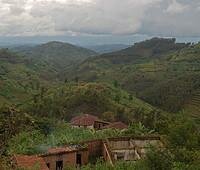
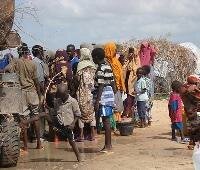
    East Africa’s Albertine Rift: Competition for land and resources in one of Africa’s most fertile and densely populated regions.

    Robert Draper | National Geographic | October 2011

    Issue:Competition over resources

    As the global population soars toward nine billion by 2045, this corner of Africa shows what’s at stake in the decades ahead. The Rift is rich in rainfall, deep lakes, volcanic soil, and biodiversity. It is also one of the most densely populated places on Earth. A desperate competition for land and resources—and between people and wildlife—has erupted here with unspeakable violence. How can the conflict be stopped? Will there be any room left for the wild?

    Image Source: DFID

    Read more »

    Competition over resources: Drivers of insecurity and the Global South

    Hannah Brock | Oxford Research Group | October 2011

    Issue:Competition over resources

    ‘By 2050, the global population is expected to peak at 9 billion. In an environment already constrained and changed by human activities, we can expect greater scarcity of three resources vital to the maintenance of both the economic order as it now stands, and the preservation of human life in general: energy, water and food. At current population levels, demand for some key resources is already unsustainable. As the number of people on the planet – and the number of people living “affluent” lifestyles – increases, and the effects of climate change are factored in, greater competition over resources is highly probable – affecting individuals, communities and states.’

    Article source: Oxford Research Group

    Image source: Maks Karochkin

    Read more »

    A Thai Perspective on Proposed Mainstream Mekong Dams

    Teerapong Pomun | The Stimson Center | September 2011

    Issues:Competition over resources, Marginalisation

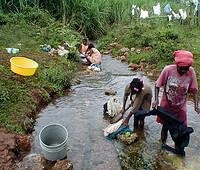
    The Mekong River is very important for millions of local communities along the mainstream and its tributaries who depend heavily on the river’s natural ecosystem functions. The health of the river is the health of the communities. Changes in the river basin mean a lot to those marginalized people who too often have no voice and have limited alternatives for sustaining their livelihoods.

    Article source: Stimson Center

    Image source: Roberto Moretti

    Read more »

    The Fight for Libya’s Oil

    David Anderson | Politics in Spires | September 2011

    Issue:Competition over resources

    While the remaining forces loyal to Muammar Gaddafi still hold out against the rebel militia and its NATO allies in the coastal town of Sirte, the fight for Libya’s oil has already begun. Europe’s oil companies are hovering like a flock of carrion birds over the carcass of Gaddafi’s regime writes David Anderson for the Politics in Spires blog.

    Image source: Imahornfan.

    Read more »

    Conflict, Climate Change, and Water Security in Sub-Saharan Africa

    Oluwole Akiyode | peace and conflict monitor | September 2011

    Issues:Climate change, Competition over resources

    The paper is a review of literatures on conflict, climate change and water security on Sub-Saharan Africa. It identifies poverty as a threat in Sub-Saharan African countries that may have effect on its water security. It analyses in Sub-Saharan Africa region, the conflict trend of water security in correlation with climate change impacts. It advocates sustainable water management as the ameliorative and mitigation approaches to the negative effects of climate change on water security in Sub-Saharan Africa.

    Article source: peace and conflict monitor

    Image source: Abdurrahman Warsameh for the International Relations and Security Network

    Read more »

  • US Security Establishment not Prepared for Climate Change

    US Security Establishment not Prepared for Climate Change

    Issues:Climate change, Competition over resources

    In a three-month investigation, a team of Northwestern University student reporters has found that the US security establishment is not adequately prepared for many of the environmental changes that are coming faster than predicted and that threaten to reshape demands made on the military and intelligence community. This is despite the fact that the Defense Department has called climate change a potential “accelerant of instability.”

    The 10 Medill School of Journalism graduate students interviewed more than 200 current and former national security officials and experts and reviewed scores of official documents and reports. While reporting, they used social media to create a community of people interested in the intersection of national security and climate change, informing them of their work through Tweets, blog posts and an e-newsletter.

    Among the project’s findings:

    • The government lacks critical information about where and when climate changes will happen and what effect they will have on the U.S. military, intelligence and national security communities.

    • In a major strategy review last year, the Pentagon acknowledged the challenge that climate change poses to its operations, including a dramatically increased need for intervention in future humanitarian crises. While military branches have begun global assessments of their vulnerabilities, many security experts say the work lacks senior level support in Congress and the administration and that military service preparations are not keeping up with environmental changes.

    •  Work by the CIA and environmental scientists during the Clinton administration was largely ignored in the years of George Bush’s presidency. Although the CIA is now spearheading intelligence assessments to determine where climate change could affect global stability, that work may be in jeopardy as Republicans skeptical of climate control take control of key congressional committees.

    • The nation’s satellite system, which provides the lifeblood of climate information, is in disrepair after years of inadequate funding and, in the past two decades, the intelligence community has struggled both internally and politically to respond to the challenges posed by climate change.

    •  At home, critical infrastructure along the Gulf of Mexico is vulnerable to the stronger storms and more frequent flooding that are predicted due to climate change.

    Stories in the series also explore how the U.S. defense and intelligence community is preparing for a melting Arctic, shifting disease vectors, altered glacial melt in the Andes and rising seas in South Asia.

    In addition to traditional print and online pieces, the project allows audiences to explore the impact of climate change through creative interactive graphics that:

    • demonstrate the impact of rising seas on domestic military installations;

    •  visualize the cascade of consequences that could turn climate changes into national security threats and crises;

    •  cast users as decision makers in a war game that plays out the consequences of climate change in four regional scenarios;

    •  convey the interrelated history of scientific findings, extreme weather events and  political and defense policy as they relate to a changing climate through an interactive timeline;

    • let users hear from the experts themselves and engage in the conversation; and

    •  provide an online library of dozens of government, academic and think tank documents related to climate change and national security.


    For more information on this timely initiative please visit the project’s Global Warning website. Further information about the Medill National Security Journalism Initiative can be found here.  

    Comments

    Post new comment


  • Sustainable Security

    This article was first posted on 15 October 2012 and has been featured this week in light of renewed tensions in the region.

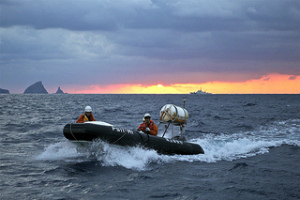
    East China Sea smallAs the long running tensions over the set of islands in the East China Sea appear to be coming to a head, the time for thinking through the alternatives to the militarisation of this conflict seems to be well and truly upon us.

    The conflict raises interesting issues about sovereignty claims based on offshore territories, particularly as we face a climate-constrained future as well as the increasing importance of competition over scarce resources. The latter is fast becoming one of the most important global trends if one thinks about the potential ‘drivers’ of conflict and even war.

    Spiralling naval spending in the region has been tracked by analysts for some years now, and flashpoints such as the dispute over the Senkaku/Diaoyu islands could show rampant military spending and arms racing for the dangerous trends that they are if things deteriorate rapidly. Arms racing helps to reinforce security dilemmas (the problems of interpreting the motives of potential adversaries and responding in-kind by arming yourself thus creating a spiral towards ever increasing militarisation). Arms racing also discourages the development of what Ken Booth and Nicholas Wheeler refer to as ‘security dilemma sensibility’ – the ability to “perceive the motives behind, and to show responsiveness towards, the potential complexity of the military intentions of others. In particular, it refers to the ability to understand the role that fear might play in their attitudes and behaviour, including, crucially, the role that one’s own actions may play in provoking that fear.”

    But what is particularly important to note in relation to this crisis is the interaction between the trends of increasing militarisation and competition over resources. The potential hydrocarbon resources beneath the ground around the islands as well as the rich fishing grounds in the surrounding waters gives the competing claims to sovereignty a particular strategic bite.

    Imposed on top of this is the effect of unresolved historical tensions and fierce nationalist sentiment in some quarters of both Japan and China. The coverage of the dispute in the media has been particularly important. Kevin Clements and Ria Shibata have noted that “this might be expected in China, which has a state-run media. In democratic Japan and Taiwan, however, the media have also promoted official and unofficial nationalist positions on the conflict. This has been accompanied by a marginalising or silencing of moderate voices favouring negotiated non-violent solutions to the conflict.” Interestingly, the most constructive voices calling for calm who have been able to cut through the jingoism and sabre rattling have been the business community concerned with the bigger picture issues of losing trade and tourism between China, Taiwan, Japan and South Korea.

    Clements and Shibata have outlined five initial steps that could be used to de-escalate the issue and begin the difficult but unavoidable process of a negotiated solution. In the longer-term, both regional powers and important external players will need to put addressing the inter-linked trends of militarisation and increasing competition over strategic resources at the heart of any attempts to avoid the worst case scenarios playing out.

    Ben Zala is a Lecturer in International Politics at the University of Leicester.

    Image source: Al Jazeera English.

  • Competition over resources

    Competition over resources

    In the environmentally constrained but more populous world that can be expected over the course of this century, there will be greater scarcity of three key resources: food, water and energy. Demand for all three resources is already beyond that which can be sustained at current levels. Once population growth and the effects of climate change are factored in, it is clear that greater competition for such resources should be expected, both within and between countries, potentially leading in extreme cases to conflict.

    A New Strategy for the US: From the Control Paradigm to Sustainable Security

    Schuyler Null | The New Security Beat | May 2011

    Issues:Climate change, Competition over resources, Global militarisation, Marginalisation

    Writing for the New Security Beat, Schuyler Null discusses a recent event on creating a new national security narrative for the US held at the Woodrow Wilson Center. The event was based on a white paper by two active military officers writing under the pseudonym “Mr. Y” (echoing George Kennan’s famous “X” article). In “A National Strategic Narrative,” Captain Wayne Porter (USN) and Colonel Mark Mykleby (USMC) argue that the United States needs to move away from an outmoded 20th century model of containment, deterrence, and control towards a “strategy of sustainability.”

    Image source: LizaP.

    Read more »

    Sustainable Security and Environmental Limits

    Rachel Tansey | Quaker Council for European Affairs | May 2011

    Issues:Climate change, Competition over resources, Global militarisation, Marginalisation

    The Quaker Council for European Affairs publicises a briefing on the topic of Sustainable Security, specifically highlighting environmental concerns:

    “The treatment of the natural world by humankind has contributed towards the two related major trends that are likely to drive insecurity in the coming decades: climate change and competition over natural resources.”

    Article source: Quaker Council for European Affairs

    Image source: kretyen

    Read more »

    Human Security and Marginalisation: A case of Pastoralists in the Mandera triangle

    Abdul Ebrahim Haro | Exclusively written for sustainablesecurity.org | May 2011

    Issues:Competition over resources, Marginalisation

    This paper seeks to bring out the relevance of human security in pastoral areas of Mandera triangle and the relationships and contradictions that exist between it and national security. The “Mandera Triangle” encompasses a tri-border region of Ethiopia, Somalia, and Kenya that exemplifies, in a microcosm, both a complex and a chronic humanitarian crisis that transcends national boundaries. The resident Somali pastoral population is highly vulnerable to periodic droughts and floods; high levels of poverty; long-term disruption to the traditional systems of livelihood; ongoing inter-clan conflicts and border tensions between states. 

    Image source: TURKAIRO

    Read more »

    World Not Prepared for Climate Conflicts

    Laurie Goering | AlertNet | May 2011

    Issues:Climate change, Competition over resources

    Accelerating climate change and competition for limited supplies of water, food and energy are poised to ignite long-simmering conflicts in fragile states, monopolising the world’s military resources and hampering development efforts, security experts say. Defusing these new 21st century conflicts – or at least preparing governments and citizens to cope with them – will require a broad range of innovative interventions, a gathering at Britain’s Department for International Development (DFID) heard earlier this month.

    Image source: Images.Defence.Gov.au

    Read more »

    The Arab World’s Next Battle: Water Supply and Population Growth on Collision Course

    Lester Brown | The Guardian | April 2011

    Issue:Competition over resources

    Population growth and water supply are on a collision course. Hunger is set to become the main issue writes Lester Brown for the Guardian.

    Image source: UN Photo. 

    Read more »

    How the Competing Security Needs of Caribbean Community Members have Crystallized Through Multilateralism and Consensual Decision-Making

    Serena Joseph-Harris | Exclusively written for sustainablesecurity.org | April 2011

    Issues:Competition over resources, Global militarisation, Marginalisation

    In a paper exclusively written for sustainablesecurity.org, Serena Joseph-Harris (former High Commissioner for Trinidad and Tobago) focuses on competition over natural resources, the role of maritime routes in the Caribbean, and the importance of multilateral approaches to finding sustainable solutions in the Caribbean.

    Image source: Len@Loblolly

    Read more »

  • Beyond dependence and Legacy: Sustainable Security in Sub-Saharan Africa

    Beyond dependence and Legacy: Sustainable Security in Sub-Saharan Africa

    Chris Abbott and Thomas Phipps | Oxford Research Group | June 2009

    Issues:Competition over resources, Marginalisation

    Tag:report

    Sub-Saharan Africa is too readily dismissed from the outside, but the regional perception is often one of optimism. It is an area rich in natural resources: ranging from oil and natural gas to other minerals such as chrome, nickel and zinc. Nearly half the population are under the age of 14, making the region free from the demographic burden of an ageing workforce prevalent in other parts of the world. There are also promising beginnings to regional approaches to tackling shared security problems; with the draft framework for a Common African Defence and Security Policy being a good example of this.

    However, it is undeniable that sub-Saharan Africa does face considerable difficulties. It contains only 10% of the world’s population but is the location of 90% of world malaria cases and home to 67% of world HIV sufferers. Conflict, famine, genocide and disease have all plagued the region over recent decades. Of all the regions of the developing world, sub-Saharan Africa remains the most marginalised and least likely to achieve the Millennium Development Goals. Colonial powers, corrupt leaders and, to an extent, the NGO/aid complex have all contributed to the region’s difficulties.

    This report is based on the outcomes of a consultation that Oxford Research Group (ORG) and the Institute for Security Studies (ISS) held in South Africa in December 2008. Bringing together security experts, academics, former government officials and civil society leaders from across sub-Saharan Africa, the two-day meeting explored the implications of the sustainable security framework for the region.

    Download as PDF

  • Sustainable Security

    Summary

    Despite considerable disarray continuing into its third month, the new US administration is showing more consistent, if not coherent, signs of how it will try to implement Donald Trump’s campaign proposals. In large part, these may be assessed as antithetical to a more sustainable security agenda, given that they promote military confrontation, undermine attempts to address climate change, and are, at best, incoherent in their response to economic inequality. Little of this translation to reality is likely to endear Trump to voters or his party. Greater policy turbulence, at home and abroad, should be expected ahead of mid-term elections next year.

    Introduction

    The Trump administration has been in power for 75 days; following the election campaign and the post-election transition it is now possible to get a reasonably clear picture of how its policies relating to security are taking shape. There has been much speculation that the United States will take a very different path to that of the Obama era, not least in relation to security and climate change, and since the United States is the world’s most powerful state it is appropriate to make an initial assessment of the changes as they may affect the sustainable security thinking with which ORG has been concerned for the last decade. Is the Trump era likely to make a major difference to the global security outlook or is it more likely that realities of international relations will limit the capacity for the change Trump seeks?

    Sustainable Security

    The ORG approach to security may be summarised:

    Security challenges such as terrorism, crime and weapons proliferation cannot be successfully contained or controlled without understanding and addressing their root causes. ORG’s Sustainable Security concept takes a comprehensive, long-term approach that encompasses climate change, resource scarcity, militarisation, poverty, inequality and marginalisation.

    As the thinking has developed it has tended to group the challenges into three main areas, economic relations, climate change, and militarisation, and these are convenient headings with which to make an initial assessment of the Trump era.

    The issue of economic relations is seen as having as its greatest challenge the failure of the neoliberal approach to deliver economic justice, equity and emancipation, and the consequent growing divide between a relatively small minority of rather more than a billion people and the majority of the world’s population, with a clear rise in frustration and resentment among that majority at relative marginalisation and lack of life prospects.

    In the environmental context, while a number of resource limitations and regional environmental impacts are important, the emphasis in the ORG analysis has to be on the most significant trend – climate change and especially its impact on human well-being especially as a result of severe effects on food production.

    Finally, militarisation is seen partly in terms of a particularly entrenched and powerfully influential economic sector but most significantly as a culture in which the early use of military force is essential in maintaining the status quo, however unequal, unjust or unstable that order is.

    In all cases, the ORG view is that these approaches are thoroughly inappropriate if we wish to avoid an unstable and violent world, and much more emphasis must be placed on the underlying causes of the problems and how they may be addressed. The failure of the current 15-year war on terror is the most grievous example, having led to hundreds of thousands of deaths, millions of displaced people, at least three failed or failing states and a continuing perception of the threat of political violence in western countries. The question, simply, is how does the new Trump era affect the possibility of taking the wider view?

    Economic Issues
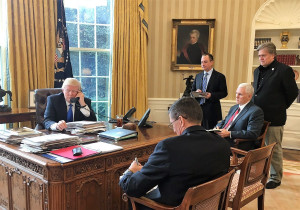
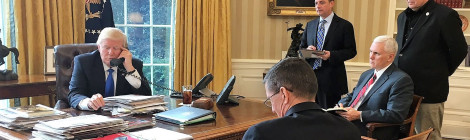
    Image credit: PressSec/Wikimedia.

    The early indications are that the Trump administration is a potentially unstable mix of those best described as economic nationalists and others, especially in the wider Republican Party, who are convinced neoliberals. The latter may be dubious about any trend towards protectionism and believe that in a free market which already favours the wealthy such protectionism may turn out to be counter-productive. In this view, transnational corporate organisation is a fact of life and no country, not even the United States, can go its own way for long.

    The economic nationalists, who are dominant within Trump’s inner policy circle, are very strongly convinced that the United States has sufficient power to dominate the markets that matter most. Furthermore, the whole Trump election platform was predicated on strong opposition to the perceived elite, an establishment that “ran” Washington. His appeal to those left behind, especially in the post-industrial American Mid-West, was probably the most important element in his successful election and it is an approach that will not readily be abandoned. At the same time, he was committed to policies that would reduce taxes while scaling down the Obamacare reforms – initially both popular with his supporters.

    In the short-term Trump’s policies may be popular but it may be as little as a year before those left behind find that their predicament simply does not ease. Indeed, it is already becoming clear that health provision reforms will lead to many millions of Americans facing higher costs, including many of those who voted for Trump. More generally, economic nationalism may turn out to provide little gain for the country as the power of China and other major economies becomes more apparent. “America first” is simply not sustainable in a globalised world.

    Even so, what has to be faced is that the Trump era will not see any fundamental challenge to the neoliberal system, precisely in a period when that system is proving unfit for purpose. What may perhaps be more relevant is how long the Trump approach in its present form persists. The degree of disorganisation currently apparent in so many areas within the White House is hardly encouraging in terms of stability, and it may well be that as the 2018 mid-sessional elections to the House and Senate draw nearer, Trump’s singularly soft Republican majority support in both Houses of Congress will lead to sudden changes of policy. These may not directly address core issues of inequality but could take much of the remaining lustre off the Trump approach.

    Climate Change

    This month has seen the very clear enactment of a number of policies that confirm that the Trump approach on climate change is one of denial coupled with the strong promotion of domestically-sourced fossil fuel resources. This is a highly negative approach for two reasons – there will be an increase in carbon emissions from the United States and a lack of leadership within the international community for addressing the considerable dangers stemming from climate change. This would seem disastrous for any hope of effectively preventing climate change but there are other very interesting factors at work.

    Firstly, the reality of the dangers of uncontrollable climate change is far more recognised across the world than a decade ago. Many more states are accelerating their moves towards renewable energy sources, with the biggest emitter, China, making remarkable strides. Indeed, China may well see its way to playing a global leadership role. Secondly, the rapid developments in renewable energy technologies are making renewable sources far more economic, with many further developments coming closer to fruition. The effect of this is that renewable energy utilisation is now competing much more closely with fossil carbon sources and, as a consequence, there is a rapid increase in investment in renewables. More than half of all investment in electricity generation is now in renewables and in the United States and elsewhere there is far greater potential for employment in renewables than in fossil carbon sources.

    Major problems remain including historic underinvestment in energy storage technologies and the need to cut carbon emissions by even more than most states currently accept, but the point here is that this is one area where there is every sign that Trump’s policies are obsolete and likely to ensure that the United States is left high and dry. Even in the face of that, though, the ideological certitude of the climate change deniers close to Trump means that the administration is unlikely to change. In short, the advent of the Trump era may limit the prospects for countering climate disruption but at least this will be another area where the Trump approach may be singularly counterproductive to any aim to make the United States the world leader.

    Security

    As with climate change, the first two-and-a-half months of the Trump administration have shown the translation of rhetoric into policy: control of migration, increased military spending and the more frequent use of force. Here, though, it is necessary to recall that the eight years of the Obama administration may have seen the withdrawal of US troops from substantial parts of the Middle East and Afghanistan but also saw the quiet transition to remote warfare with much greater use of air power, armed drones and Special Forces, not least in Libya and Iraq. The early signs are that Trump is expanding such operations rather than radically changing the posture and this includes even greater use of air power in the war against Islamic State (IS), as well as the deployment of even more Special Forces in Iraq, Syria and Yemen.

    These kinds of changes are being reflected in the manner in which the Pentagon is being given a much freer hand to conduct operations, but there are already consequences. A major raid in Yemen in late January failed to achieve its objective while also killing many civilians, and the much-expanded use of air strikes in Mosul in the past month has led to such an increase in civilian casualties that they are even being reported in the mainstream western media. Even so, such consequences are unlikely to carry any weight with Trump unless there are serious disasters involving US military personnel.

    The risk of this has been limited until now but one factor that has received little attention is that Trump’s Pentagon is advocating, and indeed already initiating, a substantial increase in the number of “boots on the ground”. In Iraq this is no longer just Special Forces but regular troop deployments which include, for example, units from the 82nd Airborne Division. Trump has also just agreed to give US forces in East Africa much more open powers to operate assaults on suspected al-Qaida-linked groups in southern Somalia, and there are also repeated calls for the Pentagon to expand its deployments in Afghanistan.

    As with economic issues, such actions may be popular with Trump supporters in the short term, examples of forceful action in the task of “Making America Great Again”, but based on the failures of the last fifteen years, the longer-term impact may be very different. What it does mean, though, is that as the United States seriously expands in overseas military operations then its close allies such as Britain will have to face up to whether they are willing to maintain their commitments.

    Conclusion

    These are, indeed, different times and with all three aspects of the sustainable security challenge the election of Trump is likely to exacerbate ingrained problems. At the same time, his policies may become increasingly irrelevant concerning climate change and his economic popularity with his supporters may also erode quickly. This may well increase the temptation to use foreign military action to distract voters from domestic discontents. However, even in the military dimension there are unlikely to be any quick wins and Trump’s direction of travel means that his allies could quickly come under domestic political pressure if they were to stay closely aligned with the United States. In any case, the need to rethink our attitudes to security remains critical and it is best to see the advent of the Trump era as a period when even more opportunity for creative, critical and independent rethinking of security will be essential.

    Paul Rogers is Global Security Consultant to Oxford Research Group and Professor of Peace Studies at the University of Bradford. His ‘Monthly Global Security Briefings’ are available from our website. His new book Irregular War: ISIS and the New Threats from the Margins will be published by I B Tauris in June 2016. These briefings are circulated free of charge for non-profit use, but please consider making a donation to ORG, if you are able to do so.