Blog

  • Sustainable Security

    This post by Oxford Research Group’s Global Security Consultant, Paul Rogers, was originally posted by openSecurity on 3 July, 2014.
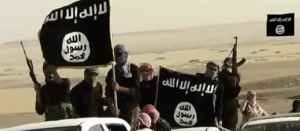
    An image grab taken from a propaganda video by jihadist group ISIL shows ISIL militants gathering Iraq. Source: Screenshot from World News Online

    An image grab taken from a propaganda video by jihadist group ISIL shows ISIL militants gathering Iraq. Source: Screenshot from World News Online

    The recharged war in Iraq that got underway in June 2014 is moving towards its second month. A remarkable feature of this phase is the formation of a largely unacknowledged coalition of four states opposed to the advance of the extremeSunni paramilitaries across much of northwestern Iraq.

    Iran’s involvement is clear enough: senior Iranian Revolutionary Guard Corps (IRGC) officers are active in Baghdad, and Iranian reconnaissance-drones are being used to aid Iraq’s troubled armed forces. Syria too is active, with Bashar al-Assad’s air-force conducting intermittent (and perhaps largely symbolic) strikes against jihadist Islamic State in Iraq and the Levant (ISIL) targets inside Iraq.

    This reflects a shift in the Assad regime’s position. As long as ISIL could be considered little more than an irritant in Syria (even if occupying substantial ground), the group had a propaganda value for Damascus, which could project an image of being steadfast in the face of radical Islam and even secure tacit acceptance by western governments in the process.

    Now that ISIL is getting stronger and more confident – symbolised in itsdeclaration of an “Islamic State” in the territory it controls – the potential challenge to Damascus’s as well as Baghdad’s security is evident. Assad may therefore continue to encourage periodic cross-border air-raids, but he will also work harder to damage ISIL within Syria.

    The late shift

    The two other states in this extraordinary anti-ISIL confluence are the United States and Russia. United States forces in the region are being steadily expanded, though it remains difficult to discern the full extent of personnel deployment in Iraq. This is partly because several thousand Americans in Iraq were already in Iraq before the new war erupted –  including diplomats, weapons-technicians and private military contractors. It is sure, however, that three further groups of military personnel are now entering Iraq.

    The first is composed of security people (probably around 300 in total) assignedto guard diplomats and civilians; the second (at least 100) to safeguard Baghdad airport, among them probably specialist helicopter-crews available to retrieve aircrew (the potential need is highlighted by the US navy’s regular F-18 reconnaissance sorties off the USS George HW Bush carrier in the Persian Gulf). The third group is troops, mostly special-forces personnel, sent to Baghdad and elsewhere to boost Iraqi government forces in their operations. The key point here is that the overall authority, US Central Command, calculates that its operation is unlikely to yield results for several weeks (see Daniel Wasserbly, “US assesses mission in Iraq, considers military options”, Jane’s Defence Weekly, 2 July 2014). US personnel may already be advising Iraqi army troops in their stalled attempt to retake the city of Tikrit, a political necessity for Nouri al-Maliki’s government to demonstrate that it was seen to be doing something to address a military disaster. But the US military is taking a longer-term view of its work in Iraq.

    Russia completes this unlikely anti-ISIS coalition. Its main involvement so far is the provision of a number of Su-25 Frogfoot ground-attack aircraft. The Su-25 is a robust if relatively slow-flying aircraft of the 1970s, roughly analogous to the US’s A-10 Warthog (though less heavily armed). It was widely deployed by the Iraqi air-force in the war with Iran (1980-88), and used by the Soviet air-force in the two Chechen wars (1994-96 and 1999-2002). Few if any survived in Iraqi air-force service after the 1991 war; so it is close to a quarter-century since any Iraqi pilots flew this aircraft – which like all ground-attack planes requires particular skills and much practice. The implication is that if Su-25s are used against ISIL and other militias in the coming weeks, it is near-certain that Russian pilots will fly them.

    Thus, both US and Russian forces are preparing to aid the Maliki government at a quite significant level, and may even cooperate more closely than either Washington or Moscow will want to acknowledge. Indeed, that may already be happening: the hundred US troops inserted to help protect Baghdad’s airport will be guarding the very same base from which Su-25s are already flying, no doubt with Russian pilots.

    The weeks ahead
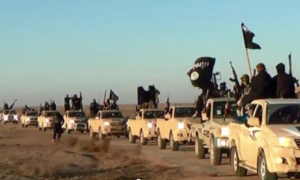
    An image grab taken from a propaganda video by the Islamic State of Iraq and the Levant shows the group travelling through Iraq. Source: World News Online (Youtube with Creative Commons license)

    An image grab taken from a propaganda video by the Islamic State of Iraq and the Levant shows the group travelling through Iraq. Source: World News Online (Youtube with Creative Commons license)

    If the war is creating strange alliances, a question of timescales may also become relevant as events unfold. Neither US and Russian support for Iraq, nor any from Iran, will have much effect on the situation until mid-July. This means that ISIL’s planners have a short window of opportunity to consolidate their recent gains. Several sources indicate that ISIL already has groups in place in western Baghdad to aid any assault on the city (see “The Iraq Crisis [Part 111]: Is Baghdad at Risk?“, 30 June 2014).

    The next two weeks, then, are an acutely dangerous period (see Borzou Daragahi, “Iraqi capital nervously awaits Isis attack“, Financial Times, 1 July 2014). The aim of any ISIS attack will not be to take control of the whole city, for Shi’a militias in the eastern Baghdad districts are strong enough to contest that; instead it will be to damage and demoralise the regime to an extent that Baghdad can’t prevent the Islamic State consolidating itself.

    That outcome would give ISIS a further lease of life. It would also be welcomed by many in the region, not least Saudi Arabia. But it would also be no more than a temporary gain in a war which may yet have far more dreadful human consequences.

    Paul Rogers is professor in the department of peace studies at Bradford University and Global Security Consultant at Oxford Research Group.  He is the author of numerous books including Why We’re Losing the War on Terror (Polity, 2007), and Losing Control: Global Security in the 21st Century (Pluto Press, 3rd edition, 2010). He is on twitter at: @ProfPRogers
  • Sustainable Security

    by Isabelle Geuskens, Executive Director of Women Peacemakers Program

    Almost 15 years after the first resolution to address women, peace and security, the agenda’s implementation is increasingly subverted by the militarised security paradigm. Implementing UNSCR 1325 has been interpreted as being about fitting women into the current peace and security paradigm and system; rather than about assessing and redefining peace and security through a gender lens. As a result, the opportunity to create a new recipe for peace and security, based on taking women’s perspectives into account, is being lost.

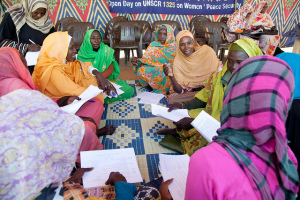
    North Darfur Committee on Women session on the UN Security Council Resolution 1325 on women, peace and security in Dar El Salaam, Darfur Source: UNAMID (Flickr)

    North Darfur Committee on Women session on the UN Security Council Resolution 1325 on women, peace and security in Dar El Salaam, Darfur, 2011 Source: UNAMID (Flickr)

    Next year we will be celebrating the 15th anniversary of United Nations Security Council Resolution (UNSCR) 1325, the first resolution of seven addressing Women, Peace & Security. In 2000, UNSCR provided the world with a groundbreaking message – providing an important recognition of the crucial role that women have to play in processes of conflict prevention, resolution and peacebuilding, as well as the specific impact of war on women’s and girls’ lives.

    The years following its adoption have borne witness to an increase in the amount of interest in the Resolution, as well as in the number of activities dedicated to “1325”, both at civil society and governmental level. However, almost 15 years into actual implementation of UNSCR 1325, we are still facing many challenges. Women’s participation in peace negotiations and peace agreements has remained low. Though some progress has been made in the adoption of UNSCR 1325 National Action Plans (NAPs) and in terms of legal and judicial reforms in some countries; implementation of these policies is often not enforced. Conflict related sexual violence as a deliberate weapon of war still occurs on a large scale and with impunity

    Peace and security from a holistic gender perspective

    Analyzing and addressing these challenges requires us to go back to the bigger picture. Over the years, the women’s peace movement has observed a growing, and worrying, trend. To a large extent, implementing UNSCR 1325 seems to be interpreted as being about fitting women into the current peace and security paradigm and system; rather than about assessing and redefining peace and security through a gender lens. In other words, “Just Add Women and Stir” has become the maxim as the way to move forward, instead of coming up with a new recipe for peace and security altogether, based on taking women’s perspectives into account.

    Such a new recipe would not only impact the lives of women, it would also provide important alternatives for men. The dominant peace and security paradigm is heavily militarized, normalizing the use of armed force and violence as a means to address conflict. This process of militarization incorporates specific gender dynamics, among others pushing men to engage in armed and violent action to solve conflict. Redefining this peace & security paradigm from a holistic gender perspective not only brings in women’s perspectives of what makes up real human security, it also addresses the normalization of violence in patriarchal society and prioritizes conflict prevention as well as nonviolent conflict resolution.

    Militarization of Women, Peace & Security

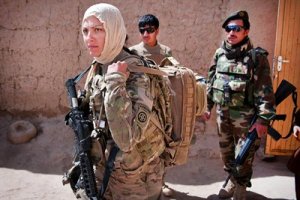
    Member of a female engagement team, Ghazni province, Afghanistan. Source: US Department of Defense

    Member of a US Marine Female Engagement Team, Ghazni province, Afghanistan. Source: US Department of Defense

    UNSCR 1325 is increasingly being used as a tool to support women’s recruitment into militarized institutions and environments. Though some actors in the women’s movement view the increase of women’s participation in the armed forces as a sign of women’s empowerment and emancipation, others see it as a sign of the increased militarization of society. It is not the question whether women are capable of taking up arms and engaging in military action; for many of us, the discussion is about whether the militarization of women’s lives is beneficial for women and society in general.

    Often, the call to increase women’s participation in militarized institutions is backed up by essentialist arguments. One of the arguments given is that “adding women” will somehow challenge its hyper-masculine culture and contribute to both a more humane and a more women-friendly environment. The assumption at work here is that women are naturally less violent than men, and hence might have a soothing effect on the inside and the outside. However, using violence against the enemy is part and parcel of every militarist system. Some of the women combatants WPP has spoken to over the years – whether active within state armies or guerrilla movements – indicated that in order to be taken seriously as a woman fighter, they often presented an even tougher front towards the enemy. They made it clear: a woman in the armed forces is, first and foremost, a fighter. Within any military system – state or non-state – unity is key, and many women in armed forces most certainly do not want to be viewed as special category, because they are working hard to be taken seriously in their role of fighters.

    It is also often argued that women’s inclusion will benefit the military mission, as their presence provides access to previously untapped sources of intelligence: women in the community. However, referring to local women in such a manner can be dangerous, as in many situations of conflict, anyone (and in particular women’s groups, whose women’s rights activism might already challenge existing traditional notions around gender) seen interacting closely with (foreign) armed forces is at risk of being labelled a traitor or enemy agent.

    A major concern for us is that the above lines of argumentation completely instrumentalize women’s lives and experiences. The arguments also fail to challenge the – patriarchal – status quo by any means: conflict continues to be framed and solved by armed intervention, hence promoting the use of violence to overcome and dominate the enemy “other”.

    Missing an opportunity for change

    With the 15th anniversary of UNSCR 1325 around the corner, there are some big questions to be asked. Is the world becoming a safer place if UNSCR 1325 implementation merely focuses on integrating the female half of the population in upholding and promoting militarization? If the focus is narrowed to embedding women firmly within existing systems, are we not missing out on an opportunity for real change? Should UNSCR 1325 not also be about stretching the current peace and security paradigms, about addressing the gendered way that humanity frames and addresses conflict itself, and about investing in disarmament, conflict prevention, human security and alternative conflict resolution mechanisms? As UNSCR 1325 is about gender and peacebuilding, should we not also explore and address men’s gendered experiences of violence and war? Is it not time to  lay bare the connections between war and hyper-masculinity, and thereby show the importance of investing in alternative masculinities to address violent conflict at its roots?

    Many women peace activists – some of whom laid the ground work for UNSCR 1325 via the Beijing Declaration and Platform for Action and their continued mobilizing during the late 90s – have presented us with powerful feminist perspectives on peace and security that challenge current patriarchal paradigms. Their peace work is inextricably linked to calls for disarmament; investment in nonviolent conflict resolution and the prevention of policies of aggression; the need to divert excessive military expenditures to social development, and the promotion of women’s leadership in order to advance a culture of peace.

    Now is the time for their claims to be taken serious: violent intervention is not bringing about the desired impact. In their publication “Gender, Conflict and Peace” (2013), Dyan Mazurana and Keith Proctor state: “Contrary to popular belief, the academic literature increasingly argues that a strategy of non-violence is more effective than violence in achieving policy goals. According to data analyzed by Stephan and Chenoweth, between 1900 to 2006 non-violent campaigns were successful in achieving their policy goals 53 percent of the time, whereas violent campaigns only had a success rate of 26 percent.

    Nonviolence provides an important alternative to our current thinking about peace and security. Often also referred to as “people power” or “civil courage”, it recognizes that conflict is a fact of life, and can even provide an important opportunity for positive change. The challenge lies in how to frame and address conflict. Instead of the current “Power Over” security model – which is rooted in the use and legitimacy of armed violence to overcome and eliminate the opponent – nonviolence operates on the principle of “Power With”: empowering the people with the idea that peace and security ultimately has to come from the people, which implies that injustice can be successfully addressed when people organize themselves into a nonviolent collective.

    For decades now, women peace activists have presented us with feminist analysis and viable alternatives to secure peace for all, challenging the current patriarchal security and peace paradigm. Despite their efforts, their claims and peace work tend to still be largely overlooked– even after 15 years of USNCR 1325. If we truly want to engender peace, we need to broaden and diversify UNSCR 1325 implementation. For only by going back to the bigger picture and applying a holistic gender analysis to peace and security, can we become successful in securing peace and security for all.

    Isabelle Geuskens serves as Executive Director of  Women’s Peacemakers Program, a Dutch NGO that works for the nonviolent resolution of conflict, and the inclusion of women’s voice and leadership in nonviolent conflict resolution processes. From 2002-12, she acted as program Manager of WPP at the International Fellowship of Reconciliation (IFOR). Under her leadership, WPP started pioneering a program on engaging men for gender sensitive peacebuilding. Prior to taking up this position, Isabelle was active in peacebuilding initiatives in Belfast and in Srebrenica, where she worked for the Working Group Netherlands-Srebrenica. Isabelle holds a Master of Arts from the University of Maastricht.

    Featured Image: Female soldier at a shooting range during IDF training, southern Israel  Source: Wikipedia

  • Sustainable Security

    RC_long_logo_small_4webThis article is part of the Remote Control Warfare series, a collaboration with Remote Control, a project of the Network for Social Change hosted by Oxford Research Group.

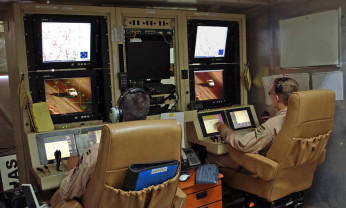
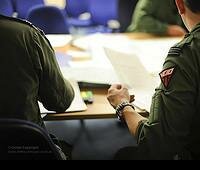
    Capt. Richard Koll, left, and Airman 1st Class Mike Eulo perform function checks after launching an MQ-1 Predator unmanned aerial vehicle Aug. 7 at Balad Air Base, Iraq. Captain Koll, the pilot, and Airman Eulo, the sensor operator, will handle the Predator in a radius of approximately 25 miles around the base before handing it off to personnel stationed in the United States to continue its mission. Both are assigned to the 46th Expeditionary Reconnaissance Squadron. https://en.wikipedia.org/wiki/General_Atomics_MQ-1_Predator#/media/File:MQ-1_Predator_controls_2007-08-07.jpg

    Drone pilots perform function checks after launching an MQ-1 Predator unmanned aerial vehicle Aug. 7 at Balad Air Base, Iraq. Source: Wikipedia

    Over-burdened in its requests for continuous surveillance of an expanding battlefield, the US military is increasingly turning to private contractors to fill key roles in its drone operations.

    In March this year, US Air Force Secretary Deborah James appeared before the Senate Armed Services Committee, looking for a $10 billion funding hike. “I can tell you the number one thing that the combatant commanders say they want from our Air Force is more ISR, ISR, ISR,” she told the committee. “That is the number one priority.”

    ISR is Intelligence, Surveillance, Reconnaissance, and encompasses a complex array of functions. It includes spyplanes and drones with special sensors and cameras, the satellites which control them, and the analysts who turn this information into “products”.  It also includes the “distributed common ground system”, an unwieldy term for the network of devices which allows personnel to access this information and the “products” derived from it.

    The volumes of data being passed back from surveillance flights is now so vast that the military can no longer deal with it in-house. So, The Bureau of Investigative Journalism (‘The Bureau’) found in a six-month investigation, the Pentagon has turned to the private sector to plug the gaps, employing contractors as imagery analysts or “screeners”.

    Screening

    The screener’s task is not a simple one. Like much of military life, it involves long spells of tedium – twelve hour shifts in front of a screen – interspersed with occasional spikes of activity. But it demands high and continuous levels of concentration. As one screener told us: “A misidentification of an enemy combatant with a weapon and a female carrying a broom can have dire consequences.”

    Screeners can have an important safety function in reducing collateral damage – the proverbial “busload of nuns” which appears out of nowhere into the field of fire. But their interpretations of video imagery – “calls”, in military parlance – can also influence drone pilots to take shots. As one screener commented, once you’ve influenced the mentality of the pilot by indicating the presence of something hostile, it’s hard to retract it.

    In one notorious incident, the crew of a MQ-1 Predator drone flying over Afghanistan’s Uruzgan province in February 2010 ignored ambiguities in their screeners’ assessments as to whether the trucks they were tracking contained combatants. As a result, at least 15 civilians were killed.

    “When you mess up,” The Bureau was told, “people die.”

    Contractors

    The companies being paid to undertake this work range from industry leviathans like BAE to specialist tech firms like Zel Technologies and Advanced Concepts Enterprises.

    Finding out who was performing this work was itself an arduous task. The Department of Defense records thousands of procurement transactions most days every year. From 2009 to the end of 2014 there have been over 8 million transactions between the Pentagon and the private sector. The Bureau analysed these transactions through its own specially constructed database, which allowed it to identify activities relating to ISR and then build up profiles of the contracts and companies carrying out those activities.

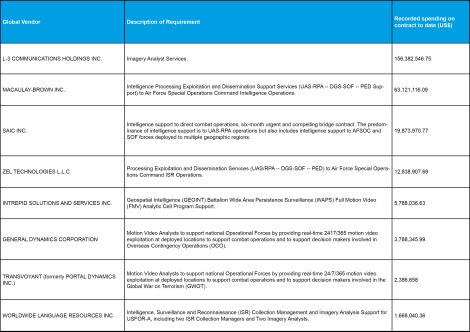
    Table: US Military Imagery Analysis Contracts since 2010 (click to enlarge)

    Data in this table is drawn from public sources including the Federal Procurement Data System (fpds.gov), Federal Business Opportunities (fbo.gov) and contractual material released under the Freedom of Information Act. Business information is taken from Bloomberg, Hoovers and Orbis. Companies named in the reporting but not included in this table are BAE, Booz Allen Hamilton and Advanced Concepts Enterprises. The Bureau has documented evidence of their involvement in ISR from sources other than contracts and transaction records. For the full dataset please see https://docs.google.com/spreadsheets/u/1/d/1WpSvDKGyraU5koQheFIgO7fUCIrSUxG5o7R9cS042_I/pubhtml

    Data in this table is drawn from public sources including the Federal Procurement Data System (fpds.gov), Federal Business Opportunities (fbo.gov) and contractual material released under the Freedom of Information Act. Business information is taken from Bloomberg, Hoovers and Orbis.
    Companies named in the reporting but not included in this table are BAE, Booz Allen Hamilton and Advanced Concepts Enterprises. The Bureau has documented evidence of their involvement in ISR from sources other than contracts and transaction records.
    Click here for the full dataset

    The Bureau identified over $260 million of screening transactions. But this is a niche market compared to the wider outsourced ISR effort. The private sector has been operating smaller surveillance drones over Afghanistan and other countries, managing communications between drones and their bases in the US and elsewhere, maintaining data collection systems and servicing sensors, to name just some functions. Procurement costs for these services run into billions of dollars.

    Questions of accountability come to the fore in this type of outsourced warfare. Following considerable pressure, the military now publishes figures of contractors on the ground in Iraq and Afghanistan. But this transparency does not extend to ISR missions conducted in those countries – or elsewhere – from behind computer screens in Florida and Nevada.

    From Screening to Targeting?

    Although contractors are so far not supposed to have their fingers on the drones’ triggers, fears have been expressed that this distinction might be harder to maintain in practice. One military outsourcing specialist, Laura Dickinson, told us that if the ratio of contractors to government personnel swells, “oversight could easily break down, and the current prohibition on contractors making targeting decisions could become meaningless.”

    Shortly after The Bureau published its investigation in The Guardian, the Pentagon announced that it would ramp up the number of ISR missions with ten new contractor-operated MQ-9 Reaper Combat Air Patrols. This puts contractors into the driving seat of large, combat-capable drones for the first time, although the Pentagon says these will be “ISR only”. The private sector’s involvement in drone warfare, it seems, is just taking off.


    Crofton Black is a researcher, journalist and writer with extensive experience of complex investigations in the field of human rights abuses and counter-terrorism. He is a leading expert on the CIA’s rendition, detention and interrogation programme and a specialist in military and intelligence corporate contracting. He has a PhD in the history of philosophy from the University of London.

    Crofton completed a report for the Remote Control Project last year on the use of contractors in US special forces operations.

  • Three Killings: an analysis of the ideologies driving Mohamed Merah, George Zimmerman, and the murderer of Shaima Alawadi

    Three Killings: an analysis of the ideologies driving Mohamed Merah, George Zimmerman, and the murderer of Shaima Alawadi

    John Feffer | Foreign Policy in Focus | April 2012

    Issue:Marginalisation

    This article by Foreign Policy in Focus co-director John Feffer powerfully explores three recent and geographically diverse killings in the context of marginalisation. Feffer links the fatal beating of an Iraqi-born American woman in California, the shooting of Trayvon Martin in Florida, and Mohamed Merah’s killing spree in Toulouse to the notion of trespass: “The message behind all three is this: you should not be here, you are not one of us, and your death shall serve as a warning.”

    Merah himself was a member of a minority in France that is still yet to fully realise its place in French society, but that is only part of the context in which he operated: his own sense of trespass came from an intolerant ideology shared with a borderless fringe, dictating that Muslims who join the western ‘enemy’ armed forces (or who simply become too western) put themselves beyond the pale in doing so. As such, the concept of trespass is not merely a question of geography but also incorporates trespass of the mind, which is equally deserving of punishment. Feffer notes that the vast majority of Al-Qaeda’s victims are Muslims, a clear example of self-appointed leaders punishing disloyal or failed members of their own group. Other examples of this conception of trespass include honour killings and the 2011 terrorist attack by Anders Behring Breivik, who believed that Norway had betrayed its Christian European roots and so was motivated to punish the young liberal inheritors of that transgressive philosophy.


    Three Killings

    The note left next to the bloodied body of Shaima Alawadi read “go back to your country, you terrorist.” Alawadi, who died on March 24 after being taken off life support, was an Iraqi-born mother of five living outside of San Diego. Someone had delivered a similar note to the family earlier in the month. It was likely the same person who returned with a tire iron and struck her repeatedly on the head. Alawadi had lived in the United States for 17 years. Several family members reportedly provided cultural training to U.S. soldiers deployed to the Middle East. In a very sad coda, Alawadi is indeed going back to her country – to be buried.

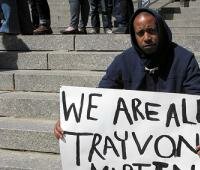
    There were no notes that accompanied Trayvon Martin’s death at the end of February. But he was also killed for a perceived trespassing. An African-American teenager, Martin was guilty of “walking while black” as he carried iced tea and Skittles through the Florida community of Sanford. The self-appointed head of the community’s neighborhood watch, George Zimmerman, identified Martin as a threat. Zimmerman didn’t wait for the police to arrive. He chased after the young man and, in circumstances still very murky, shot him dead. Because of the “stand your ground” law that permits shooting in self-defense, the police did not arrest Zimmerman.

    In the middle of March, Mohamed Merah went on a killing spree in Toulouse, France that left seven people dead. The victims were a rabbi, three Jewish children, and three French soldiers. Two of the soldiers were Muslim. Merah, who identified with Islamic extremism, specifically targeted Muslim soldiers for being “traitors.” The French-born Merah better fit the profile of a serial killer than a political extremist. But his Muslim victims are an important reminder that ordinary, everyday Muslims, even more so than Jews or Americans, figure as the most potent threats to the worldview promoted by al-Qaeda and its ilk. The overwhelming majority of al-Qaeda and Taliban victims are Muslims.

    These murders are, on the face of it, quite different: a hate crime, a serial killing, and an act of vigilantism. But underlying these three tragedies is a notion of violated borders, of trespass. The message behind all three is this: you should not be here, you are not one of us, and your death shall serve as a warning.

    Trespass is originally an economic term intimately connected to evolving concepts of public and private space. In the late medieval period in England, wealthy landholders began to fence off common lands to increase the pasturage for their flocks of sheep. This enclosure movement, privatization avant la lettre, created a new class of dispossessed, of those who did not belong. The word “trespass” – to enter private property without permission – comes from this period of late Middle Ages. Fences marked off the newly enclosed property. You could not enter without the permission of the owner or his agents. And scaffolds appeared throughout England to punish those thrown off the land who were forced to steal because they had no other means of subsistence.

    In his captivating book The Swerve, Stephen Greenblatt describes how the violence and oppression of this system drove theologian Thomas More to create his famous “utopia” of commonly held property.

    “Utopia begins with a searing indictment of England as a land where noblemen, living idly off the labor of others, bleed their tenants white by constantly raising their rents,” Greenblatt writes, “where land enclosures for sheep-raising throw untold thousands of poor people into an existence of starvation or crime, and where the cities are ringed by gibbets on which thieves are hanged by the score without the slightest indication that the draconian punishment deters anyone from committing the same crimes.” Greenblatt cites the statistic of 72,000 thieves hanged during the reign of Henry the VIII, when More was composing his tract.

    We too are living at a time of gibbets and enclosures, of death penalties and gated communities, of state violence and privatization. The United States has become a country of wealthy enclaves, neighborhood watches, and charter schools. Widening inequality has directly contributed to the deterioration of any sense of the public good. The drive for minimal government has reduced the capacity of public servants to ensure basic services and security. The erosion of the middle class has not only reduced the tax base, it has weakened political support for programs that aspire to universality. “Ill fares the land,” wrote Oliver Goldsmith in his 1770 poem “The Deserted Village,” “to hast’ning ill a prey/Where wealth accumulates, and men decay.”

    Colorado Springs, a sort of anti-Utopia, is a case in point. There, the city council responded to state and federal budget cuts by radically reducing public services. In its place, the city set up an extortion racket. If you want the electricity restored to all the streetlamps in your neighborhood or the Parks Department to take care of your local park, you have to pony up the dollars yourself. Most disturbingly, as a recent This American Life episode on Colorado Springs detailed, residents are willing to pay more money to maintain services in their own little patch of earth than they would have paid in additional taxes to keep the services running for everybody in the city.

    Trayvon Martin was killed in a modest gated community in Sanford, Florida, a suburb of Orlando hard hit by the recession. The name of the community, tellingly, is The Retreat. As in Colorado Springs, the residents of Sanford must band together to compensate for what a diminished public sector fails to provide. The Retreaters, who live in townhouses priced around $100,000, have recently been concerned about a rash of burglaries. According to one resident, there had been eight cases in 15 months, and the culprits were mostly African-American males (or so he said). There are no signs at The Retreat that read: No Poor People or No African-Americans or No People Wearing Hoodies. The rules regarding trespass are unstated, shaped by fear and subject to the worst kind of stereotyping. Trayvon Martin was a victim of profiling but also of the insecurity that accompanies the decline of the middle class, an insecurity that especially plagues those of modest means, for they cannot afford all the perquisites of the wealthy. Vigilantism is the byproduct of a failed state. And the austerity measures promoted during our current mean season result in such a failed state.

    Shaima Alawadi and her family recently moved from Detroit to the San Diego suburb of El Cajon, home to the second-largest Iraqi community in the country. Alawadi, like so many Iraqis living in El Cajon, took refuge in America from the human rights violations and the subsequent sectarian violence of Iraq. But they also found themselves in a city close to the Mexican border and therefore on the frontlines of the immigration debate in the United States. The economic crisis has produced a spike in anti-immigrant sentiment: “they” are taking “our” jobs; “they” are a burden on “our” city services; “they” are not assimilating into “our” culture. Hate crimes against immigrants have been on the rise. Alawadi was not only an immigrant. She wore a headscarf and so was identifiably Muslim. As such, she was a target for all those who conflate Islam with terrorism. Religious freedom and respect for ethnic diversity are still core American values. But a certain tribalism has crept into American discourse. A tribe of xenophobic Christians is fearful that demographic shifts and economic malaise will undermine their precarious cultural status. A small but growing minority within this tribe will resort to violence to maintain this status.

    The politics of immigration, multiculturalism, and Islamophobia take on a very different character in France. In this election year, President Nicolas Sarkozy has tried to steal the fire from an unabashedly xenophobic right wing. He has stated that there are “too many foreigners” in the country. He has strenuously backed the French ban on the hijab. He has gone after halal meat (which has also raised concerns in France’s Jewish community that Kosher food will likewise be stigmatized). What had once been on the margins of French debate is now in the very mainstream. Muslims are somehow under suspicion for challenging a mythical unitary French identity through what they eat, what they wear, and how they pray. Mohamed Merah, meanwhile, believed that some Muslims had become too French and should be punished for their transgression. French Muslims find themselves in an increasingly difficult position. They trespass on French culture if they attempt to retain their identity. Or they trespass in the imaginations of religious extremists if they identify too closely as French — by, for instance, joining the army. If France and the European Union were enjoying an economic uptick, these culture wars would retreat into the background. As it is, Muslims have become a convenient scapegoat.

    The European Union was supposed to be a borderless space. But the old dream of an ever more prosperous and economically equitable regional arrangement has come up hard against economic downturn and polarization. The United States was supposed to be a country without the class barriers of feudal Europe. But the old dream of a growing middle class and the relatively stable politics that accompany it cannot survive in the austerity liberalism and anti-government conservatism of the 21st century. When our notion of the common good, of commonwealth, begins to disintegrate, all that is left are tribes defending their turf, standing their ground, enclosing their land.

    We are living now in a new world of enclosures. We are building our fences ever higher. We are patrolling our borders with ever more sophisticated weaponry. And we are punishing any and all who trespass. The victims of these recent killings are the collateral damage of these border wars.


    To read the original article, click here

    Image Source: Lightgraph

    Comments

    Post new comment


  • Sustainable Security

  • NGOs Call for Immediate and Full Reporting of Every Casualty in Libya

    NGOs Call for Immediate and Full Reporting of Every Casualty in Libya

    NGO coalition | Oxford Research Group | April 2011

    Issues:Global militarisation, Marginalisation

    Fifteen humanitarian and human rights organisations have this week called on the states implementing the no-fly zone in Libya to commit to recording and reporting on civilian casualties in that country.

    Their call comes in an open letter (text below) sent to all members of the UN Security Council, the Arab League and the African Union.

    The international communitys intervention in Libya, mandated by UNSC 1973 and based on civilian protection, lacks any means by which such protection can be evaluated. In addition to the protection of civilians by all necessary measures, Resolution 1973 and 1970 mandate that those responsible for attacks on civilians ought to be held accountable, and that the Libyan authorities should comply with the international legal regime. Without a serious casualty reporting mechanism, it is hard to see how any of these mandates could be met to the satisfaction of all parties.


    The co-signatories of the letter call for states to commit to: immediate and comprehensive recording of all civilian casualties whether children, women, or men, who have been killed injured, displaced, or who are missing. Monitoring should be done using all means presently available and be followed-up by full on-the-ground, incident-level investigations as soon as is feasible. 

    The signatories further urge that the mechanisms employed be transparent and open to public scrutiny, in particular to Libyans.

    The letter will remain open for further signatories.


    Full text of the joint letter

    To: The President of the UN Security Council
          UN Ambassadors of States within the Security Council
          Governments represented on the UN Security Council
          Governments of Coalition forces involved in Libya
          The Secretary General of the United Nations
          The Secretary General of the Arab League
          The Chairman of the African Union Commission

    Casualty Recording in the Libya Conflict

    We, the undersigned organisations, call on all parties to the armed conflict in Libya that, along with exercising every possible restraint in their conduct of military operations, they commit to recording and reporting on the civilian casualties of conflict from military operations in that country.


    We define this as the immediate and comprehensive monitoring and documentation of all civilian casualties whether children, women, or men who have been killed, injured, displaced, or who are missing. Monitoring should be done using all means presently available and be followed-up by full on-the-ground, incident-level investigations as soon as is feasible. We further urge that the mechanisms employed be transparent and open to public scrutiny, in particular to Libyans.

    As a key element of humanitarian protection obligations, as well as the accountability that underpins good governance, whether by domestic parties to conflict or international state actors, it is of the utmost importance that civilian casualties are carefully and conscientiously monitored in any military action. This remains equally true when military intervention is proposed to protect civilians from further harm. Credible information on the nature and extent of civilian casualties is a crucial means by which to guide and to assess the efficacy of such interventions, including any operational precautions taken to minimise harm to civilians.

    The UN Security Council Resolution 1973 on Libya passed on the 17th of March 2011 expresses grave concern at heavy civilian casualties in that country, asserts that its purpose is the protection of civilians, and demands a complete end to violence against them. Given its objectives and its implementation, SC Resolution 1973, by its own terms, requires a full and thorough investigation of its consequences for civilians.

    Detailed monitoring and documentation of civilian casualties is also central to investigations into accountability as well as possible violations of international human rights and humanitarian law which are also objectives in both SC Resolutions 1970 and 1973. This accountability applies to all parties to the armed conflict, including the Libyan armed forces under Muammar Gaddafi, Libyan opposition armed forces, and state armed forces acting under SC Resolution 1973.

    A commitment to monitoring and fully documenting casualties would therefore be in accordance with, and of benefit to, the goals expressed in both SC Resolutions 1970 and 1973, as well as being consistent with the general principle of responsibility to protect. Specifically, it would safeguard:

    Accounting for violence against civilians

    Stressing the need to hold to account those responsible for attacks, including by forces under their control, on civilians… (SC Res. 1970)

    Compliance with the international legal regime

    Considering that the widespread and systematic attacks currently taking place in the Libyan Arab Jamahiriya against the civilian population may amount to crimes against humanity. (SC Res. 1970)

    Demands that the Libyan authorities comply with their obligations under international law, including international humanitarian law, human rights and refugee law and take all measures to protect civilians…’ (SC Res.1973)

    Accountability of Intervention

    Authorizes Member States… to take all necessary measures to protect civilians and civilian populated areas under threat of attack in the Libyan Arab Jamahiriya… (SC Res. 1973)

    It should also be noted that the present lack of credible data on civilian casualties is compromising effective planning of a humanitarian response. Thus, thorough monitoring and documenting of casualties will serve the dual purpose of fulfilling those objectives built into SC Resolutions 1970 and 1973, whilst also informing humanitarian efforts when feasible.

    The undersigned believe that the protection of civilians, which is an expressed goal of SC Resolution 1973, must be underpinned by a commitment from the parties to the conflict to reliable monitoring of the impact on civilians monitoring which can only be achieved though the resolute and robust recording of casualties.

    References:
    UNSC 1970:
    http://www.un.org/News/Press/docs/2011/sc10187.doc.htm
    UNSC 1973:
    http://www.un.org/News/Press/docs/2011/sc10200.doc.htm

    Signatories:

    Seb Taylor
    Director, Action On Armed Violence, UK

    Ajmal Samadi
    Director, Afghanistan Rights Monitor, Afghanistan

    Sarah Holewinski
    Executive Director, Campaign for Innocent Victims in Conflict, USA

    Jorge A. Restrepo
    Director, Conflict Analysis Resource Center, Colombia

    Igor Roginek
    Human Losses Research Coordinator, Documenta, Croatia

    Fredy Peccerelli
    Executive Director, Guatemalan Forensic Anthropology Foundation, Guatemala

    Dr Ghassan Elkahlout
    Chief Executive Officer, Human Relief Foundation, UK

    Ucha Nanuashvili
    Executive Director, Human Rights Center, Georgia

    Tom Malinowski
    Washington Advocacy Director, Human Rights Watch, USA

    Hamit Dardagan
    Co-Founder, Iraq Body Count, UK

    Phil ya Nangoloh
    Executive Director, NamRights, Nambia

    Dr Ian Davis
    Director, NATO Watch, UK

    Chris Langdon
    Managing Director, Oxford Research Group, UK

    Mirsad Tokača
    President Managing Board, Research and Documentation Center, Bosnia and Herzegovina

    Abdullahi Sheikh Abukar
    Executive Director, Somali Human Rights Association, Somalia


    Article source: Oxford Research Group


    Image source: Defence Images

    Comments

    Post new comment


  • Sustainable Security

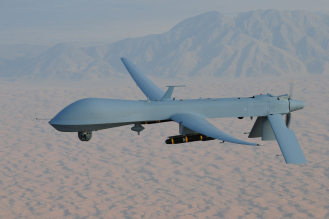
    by Shazad Ali and Chris AbbottMQ1 Predator Drone

    Strikes by unmanned combat air vehicles, or armed drones, have become the tactic of choice in US counterterrorism efforts in Yemen, Somalia and Pakistan. But lack of transparency, dubious effectiveness, civilian casualties and negative consequences for US national security means that Washington needs to re-evaluate its approach.

    It is the controversy over drone strikes in northwest Pakistan that has bought the issue to public attention. Leaving aside the wider issue of the extrajudicial nature of these killings and the questions over the legality of repeatedly breaching Pakistani airspace, it is the level of civilian casualties that is prompting the most concern.

    In a 23 May 2013 national security speech, President Barack Obama asserted that only terrorists are targeted by drones and that ‘there must be near-certainty that no civilians will be killed or injured’ before any strike is taken. However, independent reports contradict his claims.

    From 2004 to date, there have been 376 known US drone strikes in Pakistan. According to the UK-based Bureau of Investigative Journalism (BIJ), 407 to 926 civilians, including 168 to 200 children, have been killed in these strikes. According to a leaked Pakistani government report cited by the BIJ, at least 147 of 746 people killed in the 75 drone strikes in Pakistan between 2006 and 2009 were civilians. Of those killed, about 94 were children.

    Controversial tactics

    The high level of civilian casualties is attributable to two key elements of the US drone strike programme: double-tap strikes and signature strikes.

    Double-tap strikes use follow up strikes to deliberately target rescuers and first responders who are coming to the aid of those injured in an initial strike. The UN special rapporteur on extrajudicial executions, Christof Heyns, and the UN special rapporteur on counterterrorism and human rights, Ben Emmerson, have described the use of double-tap strikes as a possible war crime. Ironically, terrorists in Pakistan are now using their own version of the double-tap strike to target law enforcement personnel in cities such as Karachi: an initial low-intensity blast is used to draw in the emergency services, who are then targeted in a second much larger explosion.

    Signature strikes target individuals based on predetermined ‘signatures’ of behaviour that US intelligence links to militant activity. In other words, people are targeted merely on the basis of their behaviour patterns. This is different to personality strikes, which use intelligence to target specific terror suspects. In a June 2013 report that cited classified documents, NBC News revealed that one in four people killed in drone strikes in Pakistan between 3 September 2010 and 30 October 2011 were classified as ‘other militants’ by CIA. This means the CIA were unable to determine the affiliation, if any, of those killed.

    Intelligence failures

    However, even those strikes directed by intelligence are fallible. Such strikes rely on a mixture of signals intelligence and human intelligence from assets on the ground in Pakistan. The local CIA operatives are notoriously unreliable sources of intelligence.

    The doubts over the accuracy of US intelligence have some credence, as there are several cases in which a militant was reported killed in a drone strike only to be declared dead again following a later strike.

    For example, the alleged al-Qaeda leader in Pakistan, Ilyas Kashmiri, was reportedly killed in a drone strike in January 2009 and then again in September 2009, though he gave an interview to a Pakistani journalist the next month. Civilians are known to have been harmed in these unsuccessful attacks. In the January attack, 14-year-old Fahim Quershi lost an eye and suffered multiple injuries. In the September 2009 attack, 15-year-old Sadaullah Wazir lost his both legs and an eye. Three of his relatives died in the same attack. Kashmiri was again declared dead in July 2011, which is also contested.

    The United States has indeed managed to kill many militants in drone strikes in Pakistan, but these have been mostly low-level targets. According to a September 2012 study by Stanford Law School and New York University’s School of Law, only 2% of militant casualties in drone strikes between 2004 and 2012 were high-value targets.

    Justification

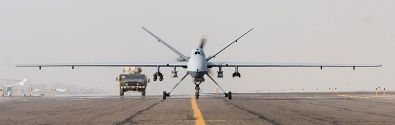
    MQ9 Reaper (used in Pakistan)There is an important question over congressional oversight of US drone strikes. The Obama administration has refused to provide legal justification of drone strikes to the Senate Select Committee on Intelligence despite several requests, according to committee chair Senator Dianne Feinstein. This has created an accountability vacuum and is a significant hurdle in congressional debate on the use of drones.

    Following the 9/11 attacks, the US Congress gave the president sweeping powers through the Authorisation to Use Military Force (AUMF). It allows the president to:

    ‘use all necessary and appropriate force against those nations, organisations, or persons he determines planned, authorised, committed, or aided the terrorist attacks that occurred on September 11, 2001, or harboured such organisations or persons.’

    In that context, drone strikes against al-Qaeda and the Afghan Taliban are authorised under US law. But it is hard to justify under the AUMF attacks in Pakistan against organisations not involved in 9/11, such as the Tehrik-i-Taliban Pakistan and the Haqqani network – notwithstanding the transnational nature of and blurred boundaries between some of these groups.

    It is also difficult to justify such attacks under the right to self-defence, which cannot be applied prospectively without limit. Nor does it warrant the repeated violations of Pakistan’s airspace, as Pakistan has not been shown to be responsible for any attacks against US interests. According to a leaked US diplomatic cable, Pakistan had, at one point, consented to drone strikes but it is not known whether Washington continues the strikes with Islamabad’s tacit agreement. Publicly, the Pakistani government has denounced the drone strikes, saying they are illegal and a violation of their country’s sovereignty. In September 2013, Pakistani Prime Minister Nawaz Sharif told the UN General Assembly that US drone strikes violated his country’s borders and were detrimental to Pakistani counterterrorism efforts. But, in reality, Pakistan has at times been deliberately ambiguous on the issue and the complex nature of civil-military relations in Pakistan and the known links between the ISI and various militant networks make things more complicated.

    Unintended consequences

    Whatever the legal status of the US drone strike programme in Pakistan, it is clear that it risks several unintended consequences. The United States might have made a prudent military choice in using armed drones rather the special forces for counterterrorism strikes in Pakistan. But the use of drones has backfired in a strategic sense and resulted in serious ‘blowback’.

    Chief among these is the radicalising impact US drone strikes are having in Pakistan. Repeated strikes are stoking anti-American sentiments and are a propaganda and recruitment gift to the extremist groups. Pakistan is being destabilised, as the strikes are undermining chances of peace talks between the state and Taliban groups. There are now increasing numbers of terrorist attacks against the Pakistani government by Taliban militants who believe Islamabad has failed to maintain the country’s sovereignty. Furthermore, the United States may be risking further attacks in its own backyard along the lines of the failed 2010 Times Square attack by Pakistani-born US citizen Faisal Shahzad.

    Drone strikes in Pakistan may also be complicating the US withdrawal from Afghanistan, as they have resulted in attacks on US forces. The 2009 Camp Chapman attack is a case in point. The al-Qaeda and Tehrik-i-Taliban Pakistan suicide attack used a double agent to target CIA personnel and contractors inside Forward Operating Base Chapman who were responsible for providing intelligence for drone strikes against targets in Pakistan. The attack on the base in Khost province was in revenge for the deaths of three al-Qaeda and Pakistani Taliban leaders who were killed in US drone strikes.

    The use of drones by the US has increased the danger of proliferation. Seventy six countries are known to have unmanned aerial vehicles, with approximately 20 countries possessing armed drones (though estimates vary widely). The United States has lowered the threshold for the use of lethal force and pushed back the limits of counterterrorism efforts to include the targeted killing of its enemies abroad. In doing so, they have set a dangerous precedent – one that could easily be followed by other countries. In a September 2013 study, Open Briefing identified 29 different models of armed drone in use with China, India, Iran, Israel, Russia and Turkey – each of which have external security concerns that could justify drones strikes under doctrine modelled on the US approach.

    Time for change

    The use of double-tap and signature strikes must be ended, as they result in unjustifiably high numbers of civilian casualties. They are the most controversial elements within the already controversial US drone strike. Beyond that, it is time to begin winding in Washington’s unchecked ability to target individuals around the world without due process. Central to this is the revocation of the post-9/11 Authorisation to Use Military Force. For 12 years this has allowed the spread of US military and intelligence operations around the world without accountability and transparency. These operations are increasingly straying from targeting those who ‘planned, authorised, committed, or aided the terrorist attacks that occurred on September 11, 2001’ to simply targeting suspected militants, regardless of their links to al-Qaeda or the Taliban.

    Washington can address the democratic deficit inherent in its drone programme by moving responsibility for it from the CIA to the usual chain of command within the US Department of Defense. There must also be proper congressional and judicial oversight of the drone programme, with monitoring by Congress’s intelligence and armed services select committees, in order to remove absolute executive power for the targeted killings.

    For its part, Pakistan can retract any tacit approval of US drone strikes and be unequivocal in its opposition to further strikes. This will allow the United Nations and key US allies to use whatever influence they have to press the United States to enact the much needed changes to its drone programme.

    Shazad Ali is a contributing analyst at Open Briefing. He is a journalist in Pakistan and pursuing a PhD in European Studies at the University of Karachi. He has been the assistant editor of the Vienna-based journal Perspectives on Terrorism and now serves as a member of its editorial board.

    Chris Abbott is the founder and executive director of Open Briefing. He is an Honorary Visiting Research Fellow in the School of Social and International Studies at the University of Bradford and the former deputy director of Oxford Research Group. http://www.openbriefing.org

    Featured image: MQ-1 Predator on patrol  Source: Air Force Reserve Command

    Image: An MQ-9 Reaper takes off on a mission from Afghanistan. Source: Wikimedia

  • Climate change

    Climate change

    Climate change is high on both domestic and international political agendas as countries face up to the huge environmental challenges the world now faces. Whilst this attention is welcome, less energy is being focused on the inevitable impact climate change will have on security issues. The well-documented physical effects of climate change will have knock-on socio-economic impacts, such as loss of infrastructure, resource scarcity and the mass displacement of peoples. These in turn could produce serious security consequences that will present new challenges to governments trying to maintain stability.

    Articles EXCLUSIVELY written for sustainablesecurity.org

    Issues:Climate change, Competition over resources, Global militarisation, Marginalisation

    To browse a list of all of the articles EXCLUSIVELY written for sustainablesecurity.org – follow this link

    Read more »

    Louisiana is Sinking

    Anna Alissa Hitzemann | | January 2013

    Issues:Climate change, Competition over resources, Marginalisation

    Hurricane Katrina and the sinking of coastal Louisiana stand as a reminder that we must address climate change, competition over resources and marginalisation as the root causes of conflict before it is too late.

    Most will remember the horrific pictures on the news in 2005 when hurricane Katrina struck New Orleans. Nearly 2,000 people died, thousands more were left homeless and displaced, the material destruction was catastrophic with damages well over $100 billion.

    Image source: Brother O’Mara

    Read more »

    Climate Change and Security Threats: Time to Call a Spade a Spade?

    Ben Zala | | January 2013

    Issue:Climate change

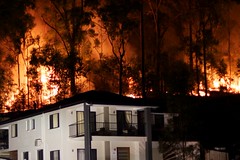
    As the devastating bushfires in Australia sharpen questions about the need for urgent action on climate change in that country, is it time to abandon the debate over the pitfalls of viewing climate change through a ‘security lens’?

    Image source: HighExposure

    Read more »

    Greener Cities: What We Can Do

    Anna Alissa Hitzemann | | October 2012

    Issues:Climate change, Competition over resources

    A recent article on this website entitled The United States, Niger & Jamaica: Food (In)security & Violence in a Globalised World explored some of the possible links between climate change, food insecurity and violence. Many current articles in the media warn of growing food insecurity as global warming and climate change have devastating effects on crops, livestock and even fisheries. A piece in yesterday’s Guardian states that if extreme weather becomes the norm (which it has) then “starvation awaits”.
    Image source: Gates Foundation

    Read more »

    The United States, Niger & Jamaica: Food (In)Security & Violence in a Globalised World

    Anna Alissa Hitzemann | | September 2012

    Issues:Climate change, Competition over resources, Marginalisation

    The United Nations Development Programme (UNDP) defines food security as “all people at all times having both physical and economic access to the basic food they need”. However, due to a complex range of interconnected issues from climate change to misguided economic policies, political failure and social marginalisation, over 2 billion people across the world live in constant food Insecurity. It is important to take a sustainable security approach to look at the importance of “physical and economic access to basic food” by exploring the links between food insecurity and violence.
    Image source: Bioversity International

    Read more »

    Moving Beyond Crisis: Survival 2100 and Sustainable Security

    William Rees | Movement for a Just World | June 2012

    Issues:Climate change, Competition over resources, Global militarisation, Marginalisation

    In a piece for the International Movement for a Just World, William Rees maps out a vision for what he calls ‘Survival 2100.’ The goal of such a strategy would be “to engineer the creation of a dynamic, more equitable steady-state economy that can satisfy at least the basic needs of the entire human family within the means of nature.” The alternative, Rees argues is to “succumb to more primitive emotions and survival instincts abetted by cognitive dissonance, collective denial, and global political inertia.”
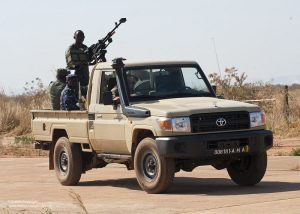
    Image source: hundrednorth.

    Read more »

  • Sustainable Security

    Mali - Another Long War(This piece was originally published by Channel 4 News on Tuesday 22 January 2013, and is the second of two parts by Ben Zala and Anna Alissa Hitzemann)

    There is a stark warning today the western intervention strategy in Mali is “flawed”. Part two of a special paper also says France and others are likely to be involved in the conflict “for some time”

    Not unlike the United States in both Afghanistan and Iraq, the French government has begun the intervention with talk of short timelines and minimal troops on the ground before quickly changing its tune, write Anna Alissa Hitzemann and Ben Zala for the Oxford Research Group.

    The initial deployment of 800 French troops may end up numbering more than 2,500 and President François Hollande has stated France’s mission is to ensure that “when we end our intervention, Mali is safe, has legitimate  authorities, an electoral process and there are no more terrorists threatening its territory”. This does not seem to tally with the earlier statement by the French Foreign Minister that the current level of French involvement in the country would last for “a matter of weeks”.

    The latest reports are that the Islamist fighters have been preparing for this intervention by carving a network of caves and tunnels into cliff faces to house bases and supplies of fuel and ammunition. This, combined with the concerns about the roles of both the Malian security forces and a number of potential contributors to the ECOWA force in relation to the abuse of civilian populations (and the likely blowback effect of such actions), mean that stability in Mali will be almost impossible achieve with military force alone.

    It is also far from clear whether the African states that are set to join the intervention will be able commit forces for a drawn-out insurgency. After Chad, the second biggest promised contributor of troops is Nigeria, which has pledged a contingent of 900.

    Yet the Nigerian government itself is fighting its own Islamist-inspired insurgency with the Boko Haram group in the country’s north. Despite a relative decline in Boko Haram attacks in recent months and even the potential for Saudi-backed peace talks between the rebels and the government, fighting could easily intensify once more, in which case Nigeria is unlikely to remain involved in Mali in any significant way.

    Without taking serious action to address the sense of marginalisation and disenfranchisement of those who were willing to join one of the rebel groups… there are few reasons to think the current intervention will produce a durable peace in Mali.

    Not only have France and its allies underestimated the difficulty of fighting the northern rebels among civilian populations in which bombing from above is of little use, there appears to be no sign of a plan as to how the factors underlying the uprising (including the original Tuareg rebellion) can be addressed.

    Without taking serious action to address the sense of marginalisation and disenfranchisement of those who were willing to join one of the rebel groups — Tuareg, Islamist or otherwise — there are few reasons to think the current intervention will produce a durable peace in Mali.

    Ongoing conflict

    While military force is considered the only option, feelings of resentment amongst elements of the population of northern Mali are likely to increase. Not only this, it will provide ample encouragement to other anti-Western paramilitary groups across North and Sub-Saharan Africa, the Middle East, and Central, South and Southeast Asia.

    The central lesson of the western interventions and small-scale military operations (including Pakistan, Yemen, Somalia and elsewhere) of the post 9-11 era, has been that reacting to the symptoms of insecurity once they are deeply manifested, and few options other than military force remain, is a fundamentally flawed strategy for global security. This means that France and others are likely to now be involved in an ongoing conflict in Mali for some time.

    Not only do the (so far conspicuously absent) plans for a post-conflict stabilisation process need to be settled between France and its coalition partners now, a serious commitment to assisting the Malian government to going much further in addressing the marginalisation of the north will be crucial.

    Until the focus shifts from military control to working towards solving the root causes of the conflict, no viable sustainable security will be found for Mali.

    Anna Alissa Hitzemann is a  Peaceworker with Quaker Peace and Social Witness. She currently works with Oxford Research Group as a Project Officer for the Sustainable Security Programme, with a focus on our ‘Marginalisation of the Majority World’ project.

    Ben Zala is a Lecturer in International Politics at the University of Leicester.

    Image source: Malian Airfield Protection Vehicle and Crew at Bamako, Mali. Source: UK Ministry of Defence.


  • Sustainable Security

    Nuclear Weapons: From Comprehensive Test Ban to Disarmament

    Despite not yet entering into force, the 1996 Comprehensive Test Ban Treaty has succeeded in almost eliminating nuclear weapons testing and in establishing a robust international monitoring and verification system. A breakthrough in its ratification by the few hold-out states could have important positive repercussions for the Nuclear Non-Proliferation Treaty or nuclear disarmament in the Middle East.

    Read Article →

    Can the Nuclear Non-Proliferation Treaty outrun its double standard forever?

    The recent walkout by Egyptian negotiators at UN talks have demonstrated that, like a building with rotten foundations, the nuclear non-proliferation regime is far less stable than many believe it to be. Egypt’s actions make clear that anything less than a regime specifically geared towards addressing the reasons why some states seek nuclear weapons is a regime existing on borrowed time.

    Read Article →

    Bay of Bengal: a hotspot for climate insecurity

    The Bay of Bengal is uniquely vulnerable to a changing climate because of a combination of rising sea levels, changing weather patterns, and uncertain transboundary river flows. These problems combine with already existing social problems like religious strife, poverty, political uncertainty, high population density, and rapid urbanization to create a very dangerous cocktail of already security threats. Andrew Holland argues that foresight about its impacts can help the region’s leaders work together to solve a problem that knows no boundaries.

    Read Article →