Blog

  • Iraq

    Iraq

    Three connected conflicts – Iraq, Afghanistan and Pakistan

    Paul Rogers | Oxford Research Group | February 2010

    Issue:Global militarisation

    Tagss:Afghanistan, Conflict, Iraq, Pakistan

    At the beginning of February, ISAF sources announced that a major military offensive was about to be mounted in Helmand Province in southern Afghanistan. This was Operation Moshtarak (“together”), involving 15,000 US, British and Afghan National Army troops, and would concentrate on clearing Taliban and other paramilitary groups from two areas, one of them centred on the town of Marja. The publicity given to the operation appeared designed partly to encourage civilians to evacuate areas under Taliban influence, but would also serve to highlight the capabilities of coalition forces at a time when support for the war in the United States and Britain was fragile.

    Given the size of the operation, it is likely that it will provide a major focus for western media attention for some weeks, but to get a full measure of its significance requires seeing it in the wider context of the conflicts in Iraq and Pakistan, and of the Status of the al-Qaida Movement. There have, in particular, been significant developments in both Iraq and Pakistan, with each likely to have an impact on what is now happening in Afghanistan.

    Photo courtesy of Helmandblog.

    Read more »

    Iraq: the path of war

    Paul Rogers | open Democracy | December 2009

    Issues:Competition over resources, Global militarisation

    Tagss:global security, globalisation, Iraq

    Most analysts agree that the security situation across Iraq as a whole has improved in 2008-09. The lower incidence of violence owes something to the consolidated sectarian geography of Baghdad and its environs as a result of the ferocious conflict of the mid-2000s. In any event the decline is relative rather than absolute, for Iraq continues to be a perilous place for many of its citizens.

    In conjunction with the opening of the official inquiry in Britain into the circumstances of the then prime minister Tony Blair’s decision to join the United States-led military campaign against Saddam Hussein’s regime in 2003, the persistent violence in Iraq reopens the question of the impulse of the war and whether other decisions with better outcomes could have been taken.


    Originally published in openDemocracy.

    Read more »

  • Sustainable Security

    Nitrogen largeWith nearly 870 million people chronically undernourished, and progress towards the Hunger Millennium Development Goal ebbing since 2008, feeding the world will continue to be a major global challenge. The limitations of arable land availability, water accessibility, and humanity’s increasing population trajectory further compound the problem. Addressing the challenges to global food security while ensuring the sustainability of the planet will require changes to the way we interact with agriculture and a clear understanding of the driving factors behind it.

    Food and Energy Price Volatility
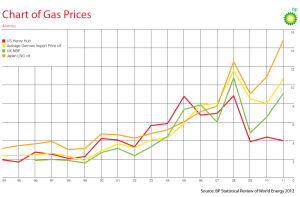
    World-Energy-PricesThe industrialisation of agriculture over the last five decades has contributed to massive gains in productivity, but it has also made food increasingly susceptible to energy supply and price fluctuations. Energy in the form of oil and gas is needed to run industrial farm equipment and to ship food around the world. Fertilizers, the driving factor behind most yield increases, are intimately tied to energy and therefore price volatility. Nitrogen fertilizers are particularly significant and are created through a process that combines natural gas and inert nitrogen from the atmosphere in a high-energy reaction to create ammonia. Fertilizer production is estimated to account for more than 50 per cent of total energy use in commercial agriculture (Woods, et al 2010). While shale gas has had a significant impact on the US natural gas market, globally, energy prices are expected to rise in the long term and become increasingly volatile, as shown by the graph to the right. Fertilizer costs will follow a similar trend, leading to variability in cost and availability. This can be especially difficult for small farmers in developing countries, whose resilience to price fluctuations is low.

    Locking Ourselves In to Volatility

    Natural means of increasing agricultural yields are possible through recycling manures and planting crops that add nutrients to the soil. However, barring a radical change in agricultural practices, globally we are locked into chemical fertilizer use, especially nitrogen fertilizers in the short and medium term. Approximately 45 per cent of the world’s food supply is grown using chemical fertilizers, and that number is growing. Meat consumption, which requires large amounts of grain for animal feed, is on the rise. Consumption of animal protein in Europe and the United states together is double the world average (FAO 2006), and is expected to grow 10 per cent between 2005 and 2030. However, demand in developing countries for animal proteins is projected to increase 60 per cent in the same period (Reay 2011). Pressure from biofuel legislation in Europe and the United States puts further pressure on land and drives up global food prices.

    Global land deals have increased dramatically in the last ten years, with an area of land eight times the size of the UK sold off globally in that time (Geary 2012). In addition to causing landlessness and poverty for local communities, the land is often used to grow large areas of single-species crops such as soy or eucalyptus, which use industrial agricultural methods requiring a high amount of chemical fertilizer, thus increasing dependence on global energy markets and locking new land into fertilizer dependence. Furthermore, nutrients and pesticides can make their way into local water supplies, degrading the environment upon which local communities depend. For example, water contamination from agricultural runoff can force communities to buy bottled or trucked water at higher prices, reducing their resilience to price fluctuations even further.

    Fertilizer as a Means of Reducing Poverty

    But fertilizers are not evil. Increasing yields (either through better access to fertilizers or implementing natural yield improvement practices) can greatly impact poverty and inequality. There are many regions of the world in which more nutrients are urgently needed in order to ensure the land is not degraded. When fertilizer is introduced to degraded soils, it can have enormous trickle down effects for poverty reduction, health, and education. In the early stages of development, when a country is primarily agrarian, the most consistently effective methods to reduce poverty and improve equality involve the agriculture sector, particularly through methods that raise small farm productivity (Berry 2010, Deininger and Byerlee 2011). For example, a recent review of coffee grower data from Mexico and Peru, published in the World Development journal, found that increasing yields are most important for growers (Barham and Weber 2011).

    Nitrogen: The Missing Link

    So where does that leave us? The very thing that reduces poverty and hunger through increasing yields can cause insecurity through energy price volatility. Add increasing pressure from consumption choices, land degradation, population pressure and climate change and we have a situation of increasing food insecurity globally.
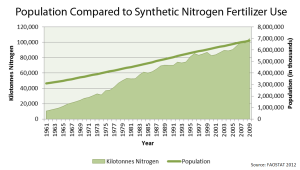
    Population-and-Fertilizer-UseThere is no silver bullet answer to this conundrum. However, the solution will likely be a combination of improving the efficiency of chemical fertilizer use and increasing the productivity and adoption of natural methods. Cross-cutting all of these solutions is the main driver of yields: nitrogen. Phosphorous and potash are also important elements of fertilizer, but nitrogen is the nutrient needed in the largest quantities. Just as a basic knowledge of how CO2 impacts climate change is important for developing solutions to the problem, so is knowledge of nitrogen important for developing solutions to food security.

    Nitrogen is critical for all plants and animals to grow. Some plants build it naturally into the soil through a symbiotic process between bacteria and their roots called ‘biological nitrogen fixation’ (beans and clover, for example), but the majority comes from chemical fertilizers and as a by-product of burning fossil fuels.

    For those that remember the nitrogen cycle from science class, we know that 78.1% of the atmosphere is inert nitrogen (N2). In the 20th century, we developed a way to convert this inert, atmospheric nitrogen into a form of nitrogen accessible to plants and animals (known as “reactive nitrogen”). This has enabled food production to roughly keep pace with the explosion of population growth over the last fifty years. Whether through fertilizers or biological fixation, nitrogen will play a key role in meeting the food needs of the future.

    When there is not enough nitrogen in the soil, loss of soil productivity and degradation occur. Because it is small farmers that often lack access to nitrogen, their yields decline year over year, reducing their annual income and thus exacerbating inequality within the global food system. This pushes them further into poverty, and in many cases can force them to purchase food when they cannot grow enough. Degraded land forces them to go in search of new, more fertile land, breaking apart families and communities.

    However, the solution is not as easy as simply adding more nitrogen in areas where there is not enough. Too much nitrogen can cause serious problems for human health and the environment. While nitrogen is required by plants in order to grow, there is a limit to how much any plant can use. Beyond this “critical load”, nutrients that cannot be absorbed by plants will leach into the water and air. Once in the environment, nitrogen can change forms over an extremely long life (average of 120 years) and detrimentally affect many different systems before finally becoming denitrified back into atmosphere. Nitrogen exacerbates climate change, depletes the ozone layer and drives biodiversity loss. It causes low-oxygen zones in water systems that weaken or kill fish and marine habitats (known as eutrophication or hypoxia). Reactive nitrogen can also be very detrimental to human health through air and water contamination. It is a major contributor to smog, which is estimated to take six months off the life expectancy of over half the population in Europe (Sutton et al 2011). It is even worse in areas like China, where the density of air particulates have registered at twice the level considered “dangerous” in metropolitan centres like Beijing. Ingesting high levels of water-borne nitrates has been associated with cancer, diabetes and adverse reproductive outcomes (Ward et al. 2005).

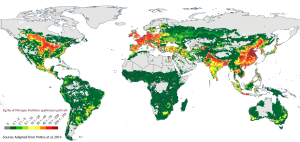
    The graph below shows nitrogen fertilizer application globally. In the red areas of the graph, many of the main water bodies suffer the detrimental effects of too much nitrogen, and the people that live in those areas suffer as a result of nitrogen pollution. Many of the green areas could benefit from more nitrogen to increase soil productivity.
    WorldFertilizerApplication

    The key is balance. On the one hand, improving the efficiency of fertilizer use will maintain crop yields while protecting the ecosystems humans and animals depend upon. On the other hand, developing biological nitrogen fixation methods or pro-poor fertilizer programmes to increase yields for small farmers will improve their situation economically and strengthen their resilience to price shocks and weather events. In both cases, proper nitrogen management will be a crucial part of solving our global hunger crisis while ensuring sustainability for future generations.

    Lisa Dittmar is the CEO and founder of NitrogenWise,  a website that brings together research and straightforward communication to explain the complexities of nitrogen in a meaningful and relevant way.


    Citations

    Barham, B. L., & Weber, J. G. (2011). The Economic Sustainability of Certified Coffee: Recent Evidence from Mexico and Peru. World Development, 1269-1279.

    Berry, A. (2010). What type of global governance would best lower world poverty and inequality? In J. Clapp, & R. Wilkinson, Global Governance, Poverty and Inequality (pp. 46-68). London: Routledge.

    Deininger, K., & Byerlee, D. (2011). Rising global interest in farmland. Washington DC: World Bank. Retrieved November 30, 2012, from http://siteresources.worldbank.org/INTARD/Resources/ESW_Sept7_final_final.pdf

    FAO. (2006). Livestock Report 2006. Rome: Food and Agriculture Organization of the United Nations.

    Geary, K. (2012). Our Land, Our Lives: Time out on the global land rush. Oxford: Oxfam. Retrieved November 2, 2012, from http://www.oxfam.org/sites/www.oxfam.org/files/bn-land-lives-freeze-041012-en_1.pdf

    Reay, D. S. (2011). Societal choice and communicating the European nitrogen challenge. In M. Sutton, The European Nitrogen Assessment (pp. 585-602). Cambridge: Cambridge University Press.

    Sutton, M. (2011). Too much of a good thing. Nature, 472, 159-161

    Ward, M. (2005). Workgroup report: Drinking-water nitrate and health-recent findings and research needs. Environmental Health Perspectives, 113, 1607-1614

    Woods, J., Williams, A., Hughes, J. K., Black, M., & Murphy, R. (2010). Energy and the food system. Philosophical Transactions of the Royal Society B, 2991-3006

    Front page image source: Organic Fertiliser for sugar cane – Shell

  • Development in Lao PDR: The food security paradox

    Development in Lao PDR: The food security paradox

    Issues:Climate change, Competition over resources

    Tags:climate change, food security, human security, Lao PDR, SDC working paper

    Food security will remain out of reach for many people, especially women and children, in the Lao People’s Democratic Republic, or Laos, if the country continues to emphasize commodities and resources development at the expense of the environment and livelihoods while ignoring global trends for food and energy. Development might be expected to improve food security, but the indications and trends suggest otherwise. This is the paradox of food security in Laos.

    This working paper was conceived as a meta-study to provide a strategic view of the situation in the Lao PDR drawing on data and findings from dozens of field studies, which were subsequently analyzed in the light of local and global trends and developments to synthesize fresh insights and an assessment of the outlook for food security plus scenarios and options. Boundaries drawn up for the study precluded consideration of the complexities of climate change.

    To receive the full report, please email the Swiss Agency for Development and Cooperation (SDC): [email protected]

    Image source: danou_info

  • Marginalisation of the majority world

    Marginalisation of the majority world

    A complex interplay of discrimination, global poverty, inequality and deepening socio-economic divisions, together make for key elements of global insecurity. While overall global wealth has increased, the benefits of this economic growth have not been equally shared. The rich-poor divide is actually growing, with a very heavy concentration of growth in relatively few parts of the world, and poverty getting much worse in many other regions. The ‘majority world’ of Asia, Africa and Latin America feel the strongest effects of marginalisation as a result of global elites, concentrated in North America and Europe, striving to maintain political, cultural, economic and military global dominance.

    From Within and Without: Sustainable Security in the Middle East and North Africa

    Chris Abbott and Sophie Marsden | Oxford Research Group | March 2009

    Issues:Climate change, Competition over resources, Global militarisation, Marginalisation

    Tag:report

    The Middle East and North Africa is a region of great diversity. It encompasses Arab and many other ethnic populations, theocratic and secular states, democracies and authoritarian regimes. A region of immense wealth and crippling poverty; it is blessed (some might say cursed) with vast resources, not least oil, but has not always proved able to manage them for the benefit of ordinary people. Read more »
    Global Responses to Global Threats: Sustainable Security for the 21st Century

    Chris Abbott, Paul Rogers and John Sloboda | Oxford Research Group | June 2006

    Issues:Climate change, Competition over resources, Global militarisation, Marginalisation

    Tag:report

    This major report was the result of an 18-month long research project examining the various threats to global security, and sustainable responses to those threats. Read more »

    Al-Qaeda: The True Story of Radical Islam

    Issues:Global militarisation, Marginalisation

    Tag:book

    Image of Al-Qaeda: The True Story of Radical Islam

    • Purchase from Amazon:
    • Al-Qaeda: The True Story of Radical Islam
    • Author: Jason Burke
    • Publisher: Penguin ()
    • Binding: Paperback, pages
    • Price: £8.99

    Losing Control: Global Security in the Twenty-first Century

    Issues:Climate change, Competition over resources, Global militarisation, Marginalisation

    Tag:book

    Image of Losing Control: Global Security in the Twenty-first Century

    • Purchase from Amazon:
    • Losing Control: Global Security in the Twenty-first Century
    • Author: Paul Rogers
    • Publisher: Pluto Press ()
    • Binding: Paperback, pages
    • Price: £15.99

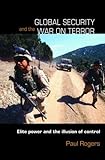
    Global Security and the War on Terror: Elite Power and the Illusion of Control

    Issues:Climate change, Competition over resources, Global militarisation, Marginalisation

    Tag:book

    Image of Global Security and the War on Terror: Elite Power and the Illusion of Control (Contemporary Security Studies)

    • Purchase from Amazon:
    • Global Security and the War on Terror: Elite Power and the Illusion of Control (Contemporary Security Studies)
    • Author: Paul Rogers
    • Publisher: Routledge ()
    • Binding: Paperback, pages
    • Price: £22.99

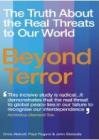
    Beyond Terror: The Truth About the Real Threats to Our World

    Chris Abbott, Paul Rogers and John Sloboda | Rider | April 2007

    Issues:Climate change, Competition over resources, Global militarisation, Marginalisation

    Tag:book

    Many leading military analysts in the United States are increasingly alert to the link between security and climate change. Is international terrorism really the single greatest threat to world security? Read more »
  • Sustainable Security

    Belize: challenges and contradictions in gang policy

    Like its neighbours in the northern triangle (El Salvador, Honduras and Guatemala), Belize has a high murder rate that is closely connected to the strong presence of gangs. But the character of gang activity in Belize is quite different from its Central American neighbours. Belize has pioneered some innovative solutions to the problem it is facing. But it will need to overcome the challenges of internal resistance and an acute lack of resources in order to address the political, economic and social issues that marginalise Belize’s large youth population.

    Read Article →

  • Sustainable Security

    One year on from the French intervention in Mali, Saharan jihadist groups continue to threaten not only Mali but Algeria, Libya, Niger, Nigeria and Tunisia. Will French and US plans to expand their military presence in the Sahel combat, contain or exacerbate the threat from militants displaced from Mali?

    Fragmentation, Displacement and Reconsolidation:  The AQIM Threat in 2014

    French General Pillet, Chief of Staff of the MINUSMA Kidal, during the visit of the Joint Security Committee in charge of the observance of the cease-fire between the Malian army and armed groups from the north. Source: MINUSMA (Flickr)

    French General Pillet, Chief of Staff of MINUSMA, Kidal, during the visit of the Joint Security Committee in charge of the observance of the cease-fire between the Malian army and armed groups from the north. Source: MINUSMA (Flickr)

    Last January, the French military, supported by African troops and 10 non-African air forces, intervened militarily in Mali at the request of its transitional government. Over the following four weeks they recaptured all of the towns in the northern half of Mali. This vast desert region had been seized by Islamist and separatist militia in March-April 2012 and declared independent as the ‘State of Azawad’, the Tuareg name for their homeland in northeast Mali. Since then, French troops have continued to conduct security operations across northern Mali to locate and ‘neutralise’ militants associated with Al-Qaida in the Islamic Maghreb (AQIM), a jihadist group of Algerian origin, and its West African splinter groups. Reduced numbers of French forces now support Malian and African forces within the United Nations Multidimensional Integrated Stabilization Mission in Mali (MINUSMA).                                                                                                                                                                                                                                                                                                                                                                                                                                                                                                                                                                                                                                                                                             However, the final quarter of 2013 saw an increase in violence in northern Mali, including terrorist attacks, violent protests and inter-communal violence. Moreover, the French advance into northern Mali displaced rather than destroyed AQIM and its two local allies, the Movement for Unity and Jihad in West Africa (MUJAO) and Ansar Dine, a Tuareg Islamist group. Their impact has been particularly felt in Niger and Libya and may also have bolstered jihadist groups operating in northern Nigeria, Tunisia and Egypt’s Sinai. The lawless desert of southwest Libya is believed to be the new stronghold of AQIM.

    A new group, al-Murabitun, combining MUJAO and the most active elements of AQIM’s Saharan front, now appears to pose more of a threat to western and West African interests than AQIM. This is because its strategic direction is towards the weak states of West Africa, including Niger, Mali and Mauritania, where critical infrastructure and individuals are more difficult to protect. It is also better connected to the kidnapping and trafficking enterprises that fund Saharan militancy, and more deadly. During 2013, its militants were behind frequent raids on Gao (northern Mali’s main town), on a prison, garrison and French-owned mine in Niger, and on the Algerian gas plant at In-Amenas. These audacious operations attest to its range, training, discipline and cosmopolitan membership. If it finds common purpose with the larger jihadist groups in northern Niger, as some analysts suggest, it could represent a severe threat to stability in the already shaky regional power.

    French Repositioning in the Sahel

    In recognition of the expansion of jihadist groups, France announced a major repositioning of its forces in Africa in January. The new French military posture will refocus from large coastal bases, designed to train, transport and supply African Union and regional rapid reaction forces, to smaller forward deployments in the Sahel and Sahara. 3,000 French troops will now be based indefinitely in Mali, Niger and Chad.

    U.S. soldiers and French commandos marine conduct a reconnaissance patrol during a joint-combined exercise in Djibouti. Source: Wikipedia

    U.S. soldiers and French commandos marine conduct a reconnaissance patrol during a joint-combined exercise in Djibouti. Source: Wikipedia

    The new posture is heavily influenced by US ‘War on Terror’ strategy in Africa, Yemen and south-west Asia, relying heavily on Special Forces, air strike capacities and unmanned aerial vehicles (UAVs). French and US forces (including contractors) already share facilities in Djibouti, Niger, Burkina Faso and Mauritania, and there is a small US liaison detachment with the French Combined Air Operations Centre in Chad. The French repositioning is explicit about confronting Islamist terrorist groups and the threat to regional security posed by the security vacuum in southern Libya. While the repositioning focuses on Mali, Niger and Chad, supplied via a coastal base in Côte d’Ivoire, it will actually include deployments to over a dozen small bases and elite detachments in the Sahel and Sahara, covering at least seven countries. In some cases it will mean French Special Forces reoccupying desert forts long abandoned by the Foreign Legion.

    There will also be greater use of aerial reconnaissance and targeting. French Navy patrol aircraft already criss-cross the Sahara and two MQ-9 Reaper UAVs arrived with French forces at Niamey airport in December after the US fast-tracked French acquisition of and training on these ‘hunter-killer’ drones. These double the effective range of the Harfang target-acquisition UAVs formerly used by the French in the Sahel, bringing all of Mali, Niger, almost all of the rest of West Africa and much of Algeria, Chad and southwest Libya into range.

    France also makes greater use of combat aircraft in the Sahel-Sahara, deploying fighter aircraft from its long-term base in N’Djamena, Chad to Bamako and Niamey airports. This brings northern Mali into range. Since October, French fighter-reconnaissance aircraft have deployed to Faya-Largeau in northern Chad, which brings southern Libya well within range. French Special Forces and armed helicopters have also operated from Burkina Faso, Niger and Mauritania in pursuit of AQIM.

    US and China Extend Their Presence

    French and US Reapers now operate from the same facility at Niamey airport, set up by the US in February 2013. While US UAVs in Niger are unarmed, it is unclear if French Reapers will be used for strike missions. US armed UAV bases in Djibouti, Ethiopia and Seychelles currently bring all of the Horn of Africa, East Africa and most of Arabia within range. US private military contractors have also flown unarmed, unmarked light aircraft on surveillance flights all across the Sahel belt since at least 2007. Using covert hubs in Burkina Faso and Uganda and smaller airfields in Mauritania, Niger and South Sudan, they have sought AQIM and the Ugandan Lord’s Resistance Army (LRA).

    Since 2011, US Special Forces have established small bases in the Central African Republic (CAR), South Sudan and the Democratic Republic of Congo (DRC) to assist Ugandan forces seeking the LRA there. They also provide training to several African militaries countering the LRA. As with programmes in Mauritania, Mali, Niger and Chad, these programmes have focused on creating elite counter-terrorism units. Unfortunately, all of these countries plus the CAR and South Sudan have experienced coups d’état or major army mutinies since this assistance began.

    In order to combat Boko Haram, a Nigerian Special Operations Command was announced on 14 January with the US military providing advice, training and equipment. Massive attacks by Boko Haram since December suggest that the Nigerian army’s use of indiscriminate force in the northeast has not weakened the insurgency. Rather, the state of emergency is likely to have strengthened the recruitment base of Boko Haram since May.

    China and Japan are also increasingly active in the Sahel. Chinese parastatals are the dominant actors in the oil industries of Sudan/South Sudan, Chad/Cameroon and Niger. They also mine uranium in Niger, and China is the primary buyer of iron ore from Mauritania’s vast desert complexes. So far, China is the only non-African state to deploy more than a few dozen troops with MINUSMA.  Japan, which saw ten of its nationals killed in the January 2013 militant attack on Algeria’s In-Amenas gas plant, has pledged $1 billion to stabilise the Sahel, including training of counter-terrorism units.

    Compromised Alliances

    This expansion of deployments and offensive operations relies on the status of forces agreements between western powers and’ friendly’ states such as Algeria. France, for example, depends on an air corridor across the Algerian Sahara. Securing such access puts host governments in a position of greater power. The highly authoritarian regime in Algiers – the world’s fifth or sixth largest arms importer – no longer faces western pressure to improve its dismal human rights record. Indeed, it has received friendly visits from the leaders of France and the UK and the US Secretary of State since late 2012. Mauritania’s military-based government faced little criticism over its unfair elections in November.

    Chad, Uganda and Ethiopia may be the biggest regional beneficiaries of the militarisation of the Sahel. Each has been governed for a quarter-century by a former armed movement. They face little censure of their authoritarian and undemocratic internal policies and have become more assertive as regional military powers. Ethiopia has forces in Somalia while Uganda now has combat troops in operation (by agreement) in Somalia (under AU command), South Sudan, the DRC and the CAR.

    Boosted by expanding oil revenues, French alliance and the demise of Libya’s Gaddafi regime, Chad has greatly expanded its military reach into Mali, Niger and the CAR, where its troops and citizens now face a violent backlash. It is also a Security Council member for the next two years and will be expected to help guide decisions on UN peacekeeping operations in Mali, South Sudan and potentially the CAR and Libya.

    Burkina Faso, long relied on by Paris to negotiate with armed groups in francophone West Africa, is also facing unaccustomed turbulence in 2014 as its president seeks to permit himself an additional term of office. Algeria, which is wary of France’s military deployments on its southern border, is set to take over from Burkina the mediation of talks between Mali’s government and secular Tuareg and Arab rebels.

    Foundations in Sand

    In some respects, the eviction of AQIM and its allies from northern Mali has made the wider Sahara a less safe place, without obviously impeding the capacity of jihadist groups to threaten Europe. In 2014, southwest Libya and parts of Niger are not necessarily less safe havens than northern Mali was in 2012. The insurgency has moved closer to the Mediterranean and closer to critical European energy infrastructure in Algeria, Libya, Tunisia and Niger (uranium). Unlike heterodox Mali, controlling Libya’s chaotic state is likely to be of interest to Arab Salafist groups, including AQIM.

    As elsewhere, the western military approach to countering Islamist insurgency in the Sahel rests on very unsteady foundations. This applies to the political legitimacy of allied regimes, the stability and security of locations hosting French and US bases, the traumatic historical legacy of France as the former colonial power, and the potential for counter-insurgency tactics to provoke wider alienation and radicalisation. However asymmetric its military technology, reinforcing a new line of castles in the Saharan sand may be as futile a gesture in France’s long retreat from empire as the UK’s last stand in Afghanistan.

    Richard Reeve is the Director of the Sustainable Security Programme at Oxford Research Group. He has researched African peace and security issues since 2000, including work with ECOWAS and the AU. Richard’s most recent security briefing ‘Security in the Sahel (Part II): Militarisation of the Sahel is available here.

  • Sustainable Security

  • The economies of violence

    The economies of violence

    The Economist | The Economist | June 2011

    Issue:Marginalisation

    Are countries poor because they are violent or violent because they are poor?

    Yesterday it was Afghanistan and Congo. Today it is Côte d’Ivoire and Libya. Violence, it seems, is always with us, like poverty. And that might seem all there is to be said: violence is bad, it is worse in poor countries and it makes them poorer.

    But this year’s World Development Report, the flagship publication of the World Bank, suggests there is a lot more to say. Violence, the authors argue, is not just one cause of poverty among many: it is becoming the primary cause. Countries that are prey to violence are often trapped in it. Those that are not are escaping poverty. This has profound implications both for poor countries trying to pull themselves together and for rich ones trying to help.

    Many think that development is mainly hampered by what is known as a “poverty trap”. Farmers do not buy fertiliser even though they know it will produce a better harvest. If there is no road, they reason, their bumper crop will just rot in the field. The way out of such a trap is to build a road. And if poor countries cannot build it themselves, rich donors should step in.

    Yet the World Development Report suggests that the main constraint on development these days may not be a poverty trap but a violence trap. Peaceful countries are managing to escape poverty—which is becoming concentrated in countries riven by civil war, ethnic conflict and organised crime. Violence and bad government prevent them from escaping the trap.

    Read the full article here.

    Image source: B.R.Q.

    Comments

    Post new comment


  • podcast

    podcast

    Climate Wars

    Gwynne Dyer | CBC Radio One | January 2009

    Issue:Climate change

    Tag:podcast

    Global warming is moving much more quickly than scientists thought it would. Even if the biggest current and prospective emitters – the United States, China and India – were to slam on the brakes today, the earth would continue to heat up for decades. Read more »

  • Obama

    Obama

    Analysing President Obama’s Address to the United Nations General Assembly

    Issue:Climate change

    Tagss:Copenhagen, Obama

    There were many positives in Barrack Obama’s speech to the United Nations on the 24th September. The US President outlined the importance of the UN as an institution and more importantly its function as a forum through which the nations of the world can collectively address shared problems. He reaffirmed America’s commitment to an “era of engagement based on mutual interest and mutual respect” and to seeking “the goal of a world without nuclear weapons”.

    However…

    Read more »