The types of mediation techniques used by an international organization (IO) to settle an international crisis are crucial. The North Atlantic Treaty Organization’s (NATO) mediation during the Cod Wars represents an interesting case.
The Cod Wars were a series of disputes between Britain and Iceland lasting from the 1950s to the 1970s over fishing rights in Icelandic waters. The two states were part of NATO and this was the first time two NATO member states had come close to armed war. During the crisis, NATO adopted a combination of both formal and informal mediation techniques, which proved to be instrumental in resolving the Cod Wars conflict. This episode carries important lessons regarding the role of mediation in international relations and conflict.
War, mediation and international organisations
War primarily occurs when states perceive that the likely calculated benefits of combat outweigh the expected costs. In turn, scholars and practitioners have paid extensive attention to identifying the mechanisms that alleviate a crisis. The Democratic Peace, institutionalism, trade agreements and economic cooperation are some of the mechanisms that foster peace, because they tend to improve states’ relations by creating interdependence give incentives to cooperate rather than fight.
Also, ties that states create between themselves or through third-party actors help in crisis alleviation because of the strong network structure that is thereby created. This is where the role of international organizations (IOs) comes into play. States can lower their military tensions in favor of expectations of future gains, based on the cooperation with their co- members in the same IO. If a crisis escalates between co-members of the same IO, the latter seeks to assist its members and restore peace and thus, the IO is turning to a mediator.
A member state usually agrees to abide by the rules of the IO. For instance, members in NATO should commit to the following article:
“The Parties will contribute toward the further development of peaceful and friendly international relations by strengthening their free institutions, by bringing about a better understanding of the principles upon which these institutions are founded, and by promoting conditions of stability and well-being. They will seek to eliminate conflict in their international economic policies and will encourage economic collaboration between any or all of them.”
(North Atlantic Treaty; official texts; 1949)
A mediator that enters a conflict aims to become part of the conflict by manipulating the actors’ behavior and, thus, the choices of the opposing parties.
We do not know what would have happened if NATO had not mediated the Cod Wars. Nonetheless, we learned lessons from NATO’s approach in the Cod Wars that could potentially be used in other instances.
The Cod Wars
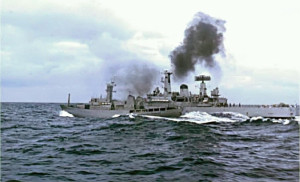
Image credit: Issac Newton/Wikimedia.
The UK and Iceland share waters over the Atlantic Ocean in the north. Both the UK and Iceland became charter members of NATO in 1949, with the reservation that they would never take part in offensive action against another NATO nation. Note, though, that the UK and Iceland have had interactions over fishery rights starting even before the 17th century. The Cod Wars comprised of a protracted series of conflicts between Iceland and the UK that began in 1945. The conflict was initially triggered by Iceland’s one-sided extension of its territorial waters.
There was variation in NATO’s responses towards the crises. For instance, NATO did not intervene in the first crisis of the Cod Wars (1952-1956). NATO only intervened in later instances, but with different techniques. That is, NATO employed a series of formal and informal mediation techniques over the course of the Cod Wars. A “formal technique” is any official action taken by the mediator that is visible to the public, for instance, all the actors involved in the conflict are aware of that action. Transparency can help the mediator increase their leverage in the conflict and help credibility. An “informal technique” is any action by the mediator that is not visible to the public and to one or both of the disputants. Formal and informal mediation techniques clearly have different advantages.
Public (formal) actions can pose threats to the disputants’ reputations to convince them to stop fighting. On the other hand, informal techniques can improve parties’ mutual understanding and improve their relationship. This usually occurs when the mediator provides a neutral, low-key, safe, and non-judgmental environment. Informal mediation can also give parties opportunities to have earliest talks before reaching an agreement. But while formal mediation by an IO has more leverage and salience, it can also be restraining because it is limited by the organization’s rules, norms, and regulations. And while informal mediation is more flexible, it lacks credibility and thus leverage, as “power through the public” is not used in informal mediation. Mingling both techniques would then seem to be the most successful strategy.
The Cod Wars comprised of four distinct crises, with mostly low tensions on both sides. NATO obliges its co-signers to resolve any mutual conflict peacefully. If the parties are not able to resolve the issue bilaterally, NATO intervenes. Different techniques generated different outcomes to a crisis: either recurrence or non-recurrence of the crisis. A failure to sufficiently address the issues arising from the belligerents’ incompatible goals at the post-conflict stage can ultimately lead to a recommencement of conflict. This happened in the case of the Cod Wars in the first three crises. The first pre-conflict incidents occurred between 1945 and 1948 when Iceland gained the control of its territorial waters. The situation then escalated to clash in the 1950s and became a higher-level crisis in 1952, without NATO intervention. In 1952, the crisis was initially “resolved” and the post-conflict period commenced in 1954. The second crisis began in 1955 and was resolved in 1961, following NATO’s use of formal and informal mediation techniques, with peace lasting for almost eleven years. When tensions exploded again in the early 1970s, NATO used informal mediation to resolve the crisis, but peace was short-lived and conflict recurred beginning in 1975. On this occasion, NATO intervened using both formal and informal mediation. The final crisis ended in 1976, and peace has endured.
A combination of formal and information mediation techniques proved effective for the Cod Wars settlement. When NATO employed formal and informal mediation techniques in a combined manner, it was able to help the parties achieve the most durable resolution. Formal and informal techniques enabled NATO to be flexible (informal) and build trust among the parties but still use the legitimacy (formal) of its organization to gain leverage in the bargaining process.
Conclusion
NATO’s mediation efforts in the first three crises can be seen as failures because the peace that followed each intervention was of short duration. Of course, mediation success is not only determined by the mediator’s strategy, but also by the disputants’ desire to end the crisis. In the case of the Cod Wars, the UK faced risks to its international reputation. Iceland arguably had more leverage because of the strategic significance of its military base and because of the Soviet Union’s interest in developing an alliance with the country. Iceland triggered each crisis of the Cod Wars and eventually achieved all its claims. Nonetheless, in the final crisis, it was Iceland — economically troubled and politically volatile — that requested NATO’s intervention.
Mediation strategies previously employed are to be considered as lessons for future instances, not only to not repeat the same mistakes but also learn from previous success. Take, for example, the Beagle Conflict of 1978 between Argentina and Chile with the Vatican as the eventual mediator. Although the Cod Wars is another isolated conflict that pertains to specific circumstances and features, one could consider relevant generalizations that apply to other/future instances, mostly regarding the mediation strategies used. It is indeed the case that co-members of IOs do not experience frequent conflicts. That said, strategies followed by NATO in the Cod Wars can be employed by individual mediators, countries that act as third party interveners, or other IOs regardless of the shared ties among the countries. Third party interveners who benefit from leverage and resources should have the flexibility to address the issue at stake under different mediation strategies which will depend on the interests, the positions, and the needs of the belligerents.
Zorzeta Bakaki is a Lecturer in the Government Department at the University of Essex. She studied Political Science and Public Administration at the Law School of the University of Athens. She received a Master of Science in International Relations from the University of Essex. Zeta also obtained her PhD from the University of Essex. Her research interests are international relations, the quantitative and qualitative analysis of conflict management and resolution, international cooperation and environmental politics.











 The United Nations Development Programme (UNDP) defines food security as “all people at all times having both physical and economic access to the basic food they need”. However, due to a complex range of interconnected issues from climate change to misguided economic policies, political failure and social marginalisation, over 2 billion people across the world live in constant food Insecurity. It is important to take a sustainable security approach to look at the importance of “physical and economic access to basic food” by exploring the links between food insecurity and violence.
 Many leading military analysts in the United States are increasingly alert to the link between security and climate change. Is international terrorism really the single greatest threat to world security?
  A three-part BBC documentary series, written and produced by Adam Curtis. The films compare the rise of the neo-conservative movement in the United States and the radical Islamist movement, making comparisons on their origins and claiming similarities between the two.