Blog

  • Sustainable Security

    Sustainable Finance and Energy Security

    General volatility in financial markets – fuelled by irresponsible lending and trading practices, as well as evidence of market manipulation – have had an effect on oil prices. Although the specific effects of the finance sector on oil prices requires further investigation, we can already understand that a sustainable and secure future will require the development of a wider energy mix to meet rising demand. To this end, more sustainable financial systems must be developed to service the real needs of citizens

    Read Article →

    National security and the paradox of sustainable energy systems

    The transition away from a centralised global economy built around conventional energy sources to a decentralised global economy mostly fuelled by renewable resources is one we must make for the sake of our children’s futures and that of our planet. Writing for sustainablesecurity.org, Phillip Bruner asks if national security is at present, deeply concerned with preserving access to conventional energy, then how would national security for a decentralised renewable energy Internet be managed? Who would manage it? And what role, if any, could the public play in helping to alleviate some of the burdens of 21st century threat mitigation?

    Read Article →

    Environment, Energy, Economy: a threefold challenge to sustainable security

    Whether it’s the economy, energy or the environment which you value most, when it comes to security, each holds equal weight. If security can be defined in terms of what is or isn’t sustainable, then it must evolve to incorporate additional elements that transcend more traditional views on geopolitics.

    Read Article →

  • Sustainable Security

    For various reasons, South Sudan faces serious problems of food insecurity. What are the possible solutions to this issue? 

    South Sudan faces serious problems of food insecurity due to low per capita levels of domestic food production, periodic droughts, widespread poverty, political unrest, and, since late 2013, renewed armed conflict between the central government and rebel forces led by former vice-President Riek Machar.  Moreover, large fiscal deficits and expansionary monetary policy have led to high rates of inflation, balance of payments deficits and a sharp depreciation of the South Sudanese pound. This in turn has resulted in an economic crisis that has further worsened household welfare. In this context, enhancing food security (physical, social and economic access to sufficient, safe and nutritious food for all people at all times) will require a multi-faceted set of public and private investments, sound policies and targeted interventions for especially vulnerable households.

    South Sudan’s Food Insecurity                   

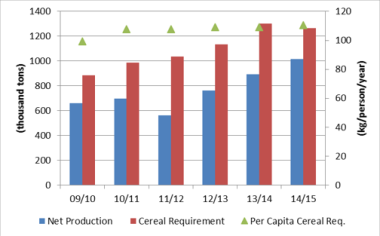
    Much of South Sudan receives little rainfall and only 5 percent of the arable land is currently cultivated. Nonetheless, the country has significant potential for increased cereal production, especially in the southern regions with the highest annual rainfall. Sorghum and maize account for most of the country’s domestically produced cereal, but there is little marketable surplus due to small farm size, low productivity and weak market incentives for sales.  Accurate data on crop area and production for South Sudan are scarce, and there is considerable uncertainty in the estimates, particularly since the renewal of armed conflict. According to annual FAO/WFP supply estimates, food production increased rapidly in recent years, from 660 thousand tons in 2009/10 to nearly 900 thousand tons in 2014/15, an average growth rate of 9.6 percent per year, due mainly to expansion of area harvested by 5.5 percent per year.

    Figure 1—South Sudan Cereal Production, 2009/10 – 2014/15
    sudan-figure-1

    Source: Based on FAO/WFP data.

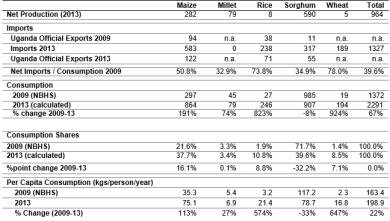
    Alternative estimates of production derived from the household consumption data (2009 NBHS) suggest cereal production was 21 percent higher than the 2008/90 FAO/WFP estimate. Estimates of trade flows derived from the 2009 National Baseline Household Survey consumption figures, suggest that imports were a major source of supply just prior to Independence, reaching perhaps 700 thousand tons in that year.

    Independence and the nearly complete disruption of trade with northern Sudan resulted in a major shift in the composition of cereal imports between 2009 and 2013, however. In 2009, cereal imports (mainly sorghum) totaled about 700 thousand tons, mostly from northern Sudan. By 2013, cereal imports had risen to nearly one million tons, with sorghum imports following from about 450 thousand tons to 320 thousand tons, while maize imports rose to 580 thousand tons, with imports of rice and wheat each totaling about 200 thousand tons.

    Table 1—South Sudan Estimated Cereal Production, Consumption and Imports (‘000 tons), 2009 and 2013
    Source: Adapted from Table 2 in Dorosh et al., 2016.

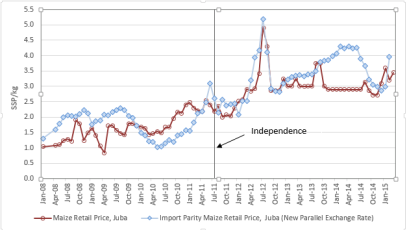
    Perhaps not surprisingly given the large private sector import flows, maize and sorghum prices in South Sudan are closely linked with prices in northern Uganda.

    Figure 2—South Sudan: Domestic and Import Parity Prices of Maize, 2008-15
    Notes: The exchange rate of the South Sudanese Pound (SSP) to the US Dollar in January, 2015 was 2.95. Source: Adapted from Figure 3 (Dorosh et al., 2016).

    Notes: The exchange rate of the South Sudanese Pound (SSP) to the US Dollar in January, 2015 was 2.95.
    Source: Adapted from Figure 3 (Dorosh et al., 2016).

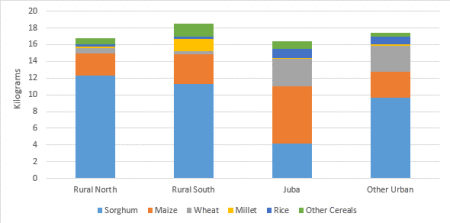
    Consumption of maize was nearly to that of sorghum (75.1 and 78.7 kgs/capita per year, respectively), as per capita maize consumption rose by 113 percent, while per capita sorghum consumption fell by 33 percent. Rice and wheat consumption also increased sharply, from 3.2 and 2.3 kgs/capita per year, respectively, in 2009 to 21.4 and 16.8 kgs/capita per year in 2013 – a 574 percent increase in per capita rice consumption and a 647 percent increase in per capita wheat consumption. The 2009 NHBS data, still the only source for detailed information on consumption patterns in South Sudan, show significant variation in consumption patterns across households. Throughout South Sudan, sorghum and maize are generally the major cereals consumed. Sorghum is the predominant cereal in rural areas, particularly in the north, while in Juba, maize and wheat are more widely consumed.

    Figure 3—South Sudan Average Monthly Kilogram Cereal Consumption Per Person
    south-sudan-figure-3

    Source: Calculated using data from South Sudan National Baseline Household Survey, 2009.

    Livestock are also a major source of income and food consumption in South Sudan, as well as a store of wealth, but the data on livestock are even more uncertain than the cereal data. Nationally, there were an estimated 11.74 million cattle in 2009, an average of 1.34 animals per person. Ownership is higher in the northern regions than in the south (1.58 and 0.88 animals per person, respectively). In 2013, approximately 45 percent of the population lived in households that consumed dairy products; consumption per capita in the northern regions is twice that of the south.

    Looking ahead
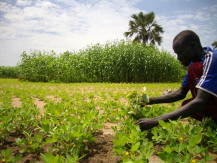
    oxfam-south-sudan

    Image credit: Oxfam International.

    In the medium term, increasing production of both crops and livestock is essential for food security in South Sudan, not only to reduce reliance on imports, but also to raise incomes of farmers. Rapid expansion of agricultural extension services, provision of improved seeds and increased fertilizer availability have led to large increases in agricultural production in neighboring Ethiopia, and have the potential to do likewise in South Sudan. Complementary investments in rural roads and other road infrastructure are also required, along with funds for maintenance.

    In the short term, though, food aid and targeted relief programs are badly needed to reduce the high levels of malnutrition in for the country as currently 31 percent of children under five are stunted and 23 percent are wasted. A national food security reserve system that ultimately would be supplied by domestic procurement of cereals was also proposed before the recent unrest, but such a system may take years to develop.

    In addition, maintaining incentives for the private sector import trade is essential to boost availability of cereals and minimize large spikes in prices. This would require a return to macro-economic stability in terms of both domestic inflation and exchange rates, as well as availability of foreign exchange. Keeping border controls and tariffs on cereal imports to a minimum could also help minimize transactions costs. Finally, none of these policies and investments will be effective in substantially improving food security without an end to armed conflict. Food security is possible for the people of South Sudan, but only with a restoration of peace, major new investments and sound government policies.

    Paul A. Dorosh is the Division Director of IFPRI’s Development Strategy and Governance Division. His previous positions include IFPRI Senior Research Fellow and Program Leader of the Ethiopia Strategy Support Program in Addis Ababa (2008-2010), Senior Economist at the World Bank (2003-2008), senior research fellow with IFPRI in Dhaka, Bangladesh (1997-2001) and Associate Professor at Cornell University (1994-97). He holds a Ph.D. in Applied Economics from the Food Research Institute, Stanford University and a B.A. in Applied Mathematics from Harvard University, and has published research on agricultural markets, food policy, international trade, economy-wide modeling and the rural-urban transformation.


  • Sustainable Security

    Belize: challenges and contradictions in gang policy

    Like its neighbours in the northern triangle (El Salvador, Honduras and Guatemala), Belize has a high murder rate that is closely connected to the strong presence of gangs. But the character of gang activity in Belize is quite different from its Central American neighbours. Belize has pioneered some innovative solutions to the problem it is facing. But it will need to overcome the challenges of internal resistance and an acute lack of resources in order to address the political, economic and social issues that marginalise Belize’s large youth population.

    Read Article →

  • Sustainable Security

    It seems we can’t find what you’re looking for. Perhaps searching can help.

  • Security is not simply the absence of conflict

    I wrote a blog a few weeks ago on climate and security, following the discussion at the UN Security Council sponsored by the German Presidency.  Last Friday I took part in a related workshop and thought I would return to theme briefly with one comment and one message.

    Comment – At the event, the AU representative raised a legitimate question – why, when the AU sees southern Africa as a model of peace on the continent, do consultants supported by developed countries focus on the threat of climate induced instability and insecurity? Are we simply using the climate issue as a stick to beat the region again because we have a different view of governance and a more pessimistic take on the region’s political direction?

     No.  I underlined the many challenges the region was already tackling – from building sustainable growth into their economies, through creating jobs to improving health and education services. And on top of that, governments are already managing elements of climate stress today, both within countries and increasingly through co-operation at the regional level.

    What the scientific modelling makes clear is that if global temerepature continues to rise unabated, it will place significant additional stress on ALL economies, but that the emerging economies on this continent will be among the first to take real strain.  Unchecked climate change will make the poorest even more vulnerable, with related food and water stress and climate migration.   It will raise tension levels over access to diminishing resources, particularly water.

    Climate change is therefore a threat mutliplier, and governments must be alive to the potential it has to disrupt sustainable growth and stability and exacerbate tensions within and between countries.  The Hadley Centre brought out an interactive 4-degree map to demonstrate where the threats come from – I commend this to people who wonder what I am writing about.

    Now the message – the story around climate change can be relentlessly pessimistic, so I ended the workshop on two positive notes.  First is that there are strong examples of improving regional co-operation, for example on regional water management.  And second  that there is a way to avoid the more extreme climate security threats – a legally binding international framework for reducing global emissions and keeping average temperature rise under 2 degrees.

    So rather than dismiss the climate security argument, I encourage Africa to be open-minded about the real threat climate change poses to human and national security.  And then use this as a strong argument for all major emitters to come to the negotiating table with more ambition.

    John L Smith – Head, Climate Change Team

    Article source: FCO Climate change team blog

    Image source: climatesafety

  • Sustainable Security


    National Guard smallMax G. Manwaring, a Professor of Military Strategy in the Strategic Studies Institute (SSI) of the U.S. Army War College has written an interesting piece on what he calls the “new security reality in which business-as-usual approaches are of little use.

    Manwaring focuses particularly on the changing nature of threats posed by non-state actors (insurgents, transnational criminal organizations, terrorists, private armies, state proxies etc.) who are able to exploit trends and circumstances such as poverty, social exclusion, environmental degradation, and political economic-social expectations for violent ends. He argues that from a US military point of view, “the enemy has now become a state or nonstate political actor that plans and implements the long-term multidimensional kinds of indirect and direct, nonmilitary and military, nonlethal and lethal, and internal and external activities that threaten a given society’s general well-being and exploits the root causes of internal and external instability.”

    Such a change in the global security environment must surely result in changes in our risk analysis and threat assessments. In a piece for the International Relations and Security Network, Myriam Dunn Cavelty writes that “In order to identify risks, elaborate scenario-based approaches combining expert-knowledge from various fields are used. The aim of these undertakings is to develop a concrete basis for political action by ranking the identified risks by their estimated probability and severity: the more likely and the more damaging, the more urgent the response.” Yet while many governments around the world have begun to place a greater emphasis on understanding the factors that drive conflict (rather than just the instances in which conflicts are expressed in forms of violence around the world), not enough is being done to bridge the gap between threat analysis and policy response. It is one thing to accurately identify new drivers of insecurity, but quite another to find ways of mitigating them through preventive public policies. Central to this must be a greater emphasis on prevention in civil service training and recruitment programmes across a number of areas.

    For example, a report by the Center for American Progress released last year noted that “While there have been a number of well-received conflict prevention trainings by and for U.S. government officials, they are too few in number and insufficiently available to all interested foreign affairs officials.”

    Of course, for militaries, the changed threat environment that Manwaring and others are pointing to means not only a need for new training but also for a cultural shift in the way they think about the utility of their traditional tool – the use of force. For Manwaring, “…power has changed. It is no longer combat firepower. Power is multidimensional, and more often than not, is nonkinetic (soft). It is directed at the causes as well as perpetrators of violence.”

    Addressing the causes of insecurity requires what groups such as Saferworld and others refer to as ‘upstream conflict prevention.’ This can easily become a catch-phrase used by governments and NGOs with little effect on actual policies, a point picked up on by Saferworld in their excellent new briefing on what upstream prevention actually looks like in practice.

    Thinking through the consequences of the changing nature of global security, both in terms of threat assessments and policy responses to those threats (military and non-military), will certainly require new approaches at the broad conceptual level. The fact that this is being touched upon by think tanks, NGOs and even army war colleges is surely a good sign – is sustainable security an idea whose time has come?

    Ben Zala is a Lecturer in International Politics at the University of Leicester.

    Image source: Utah National Guard.

  • Marginalisation of the majority world

    Writing for SustainableSsecurity.org, Elizabeth Wilke argues that a new conceptualization of insecurity and instability is needed in a world with greater and freer movement of goods, services and people – both legal and illicit – greater demands on weakening governments and the internationalization of local conflicts. The new insecurity is fundamentally derived from the responses of people and groups to greater uncertainty in an increasingly volatile world. Governments, and increasingly other actors need to recognize this in order to promote sustained stability in the long-term, locally and internationally.

    Image source: bass_nroll

    Read more »

  • Arms Flows and the Conflict in Somalia

    A new SIPRI report highlights the limitations of United Nations attempts to control the flows of arms into Somalia, and the role of potential arms-supplying states.


    In Somalia, the UN has imposed arms embargoes designed to prevent rebel groups from accessing arms. In addition, countries wanting to send arms and ammunition to government forces must notify specially created Sanctions Committees―which, in the case of Somalia, has the authority to block the transfer.  This report show that enforcing these embargoes has proved problematic. And even arms supplies that do not violate the embargoes can have undesirable consequences.

    ‘Arms flows and the conflict in Somalia’ examines arms supplies to Somalia and to African countries that have been involved in the conflict there: Eritrea and Ethiopia―two states that are widely believed to be fighting a proxy war in Somalia―and Burundi and Uganda, which provide peacekeepers to the African Union Mission in Somalia (AMISOM). 

    As the paper shows, there is a real risk that arms supplied to Somali government forces and the AMISOM contributors could fall into the wrong hands and could be used in human rights abuses or aggravate tensions between Eritrea and Ethiopia.


    Author: Pieter D. Wezeman

    Source: SIPRI

    Image source: Michael

     
  • Sustainable Security

  • Sustainable Security

    ‘Petropolitics’ and the price of freedom

    “As the price of oil goes down, the pace of freedom goes up… As the price of oil goes up, the pace of freedom goes down…” So says New York Times columnist Thomas Friedman, who argues that the first law of ‘petropolitics’ is that the price of oil and the pace of freedom are inversely correlated in countries “totally dependent on oil” for economic growth. However, the correlation between recent oil price spikes and anti-authoritarian action – particularly in the Arab Spring – challenges this assessment. But if this pattern of change is to continue, Western states must curb their hypocritical dependence on authoritarian oil-exporting governments by developing more sustainable sources of energy.

    Read Article →

    Sustainable Finance and Energy Security

    General volatility in financial markets – fuelled by irresponsible lending and trading practices, as well as evidence of market manipulation – have had an effect on oil prices. Although the specific effects of the finance sector on oil prices requires further investigation, we can already understand that a sustainable and secure future will require the development of a wider energy mix to meet rising demand. To this end, more sustainable financial systems must be developed to service the real needs of citizens

    Read Article →

    National security and the paradox of sustainable energy systems

    The transition away from a centralised global economy built around conventional energy sources to a decentralised global economy mostly fuelled by renewable resources is one we must make for the sake of our children’s futures and that of our planet. Writing for sustainablesecurity.org, Phillip Bruner asks if national security is at present, deeply concerned with preserving access to conventional energy, then how would national security for a decentralised renewable energy Internet be managed? Who would manage it? And what role, if any, could the public play in helping to alleviate some of the burdens of 21st century threat mitigation?

    Read Article →

    Environment, Energy, Economy: a threefold challenge to sustainable security

    Whether it’s the economy, energy or the environment which you value most, when it comes to security, each holds equal weight. If security can be defined in terms of what is or isn’t sustainable, then it must evolve to incorporate additional elements that transcend more traditional views on geopolitics.

    Read Article →