Blog

  • In piaffe: multilateral nuclear disarmament dialogue in the year of the horse

    Shortly after the lunar New Year, UN Secretary-General Ban Ki-moon challenged the Conference on Disarmament to run with the ‘spirit of the blue horse’ towards substantive engagement on multilateral nuclear disarmament in 2014. While the regime may not achieve this speed, there are initiatives underway this year that may well help nuclear disarmament dialogues pick up speed ahead of the 2015 NPT review conference.  

    Secretary-General Ban Ki-Moon speaks at the first plenary session the 2014 Conference on Disarmament. Source: UN Geneva

    Secretary-General Ban Ki-Moon speaks at the first plenary session the 2014 Conference on Disarmament.
    Source: UN Geneva

    On 21 January, on his way to the Geneva Conference on Syria, UN Secretary-General Ban Ki-moon stopped in at the Palais des Nations to address the Conference on Disarmament (CD). In doing so, the UNSG affirmed his support for multilateralism and encouraged the CD—the single multilateral disarmament forum—to break the deadlock and commence substantive negotiations. On the occasion of the lunar New Year, the Secretary-General challenged the CD delegations to ‘arm yourself with the spirit of [the] blue horse and…run fast and run far’.  But instead of running fast or far, the current status of the multilateral global nuclear disarmament dialogue is ‘in piaffe’ – trotting elaborately on the spot.

    However, some, including Angela Kane, the UN’s High Representative for Disarmament Affairs, question whether a nuclear disarmament regime even exists. In her prepared speech to the 2013 EU Non-proliferation and Disarmament Conference, Kane argued that the current “system of institutions and norms to prevent the spread of nuclear weapons, coupled with a promise to pursue the elimination of such weapons at some uncertain but distant time—if ever—subject to preconditions” should be more accurately called a ‘Partial Nuclear Arms Control Regime’ rather than a nuclear disarmament regime.

    Kane posited that the “negotiated ceilings on deployments of strategic nuclear weapons of two countries, with no international verification, and no participation by the other three recognized nuclear-weapons States…or the non-NPT states” are not global, nor constitute disarmament or a regime. The sustainability of the nuclear non-proliferation regime and the credibility of the NPT review process is often questioned in light of efforts which ‘seek just to tighten non-proliferation controls’ and address horizontal proliferation. In her September 2013 speech, Kane warned that such an approach ‘would erode what is left of the legitimacy of the regime’.

    The CD’s impasse continues…

    In 2014, the continuing deadlock in the CD may lead to such erosion of legitimacy, as well as frustration with existing forums for dialogue and progress. This year’s President of the first session of the CD, Israeli Ambassador Eviatar Manor, met with lack of consensus on a programme of work for 2014, due to diverging views. The formal programme of work at the CD remains deadlocked over the inclusion of a call for measures to start negotiation for a Fissile Materials Cut-off Treaty (FMCT), a proposed international agreement that would prohibit the production of highly-enriched uranium and plutonium. Pakistan objects to this as it would cap its fissile material stocks at a disadvantageous level vis-à-vis India.

    As US Acting Under-Secretary of State for Arms Control and International Security, Rose Gottemoeller, declared at the CD on 4 February, the FMCT is ‘the next logical – and necessary – step in creating the conditions for a world without nuclear weapons’ and remains ‘an essential prerequisite for global nuclear disarmament’. Gottemoeller reminded the CD that Action 15 of the 2010 NPT Review Conference (RevCon) Action Plan mandated that the CD begin immediate negotiation of the FMCT. As the 2015 NPT RevCon approaches, this Action seems to remain aspirational.

    The Nayarit Conference on the Humanitarian Impact of Nuclear Weapons

    Many NPT non-nuclear weapon states (NNWS) remain frustrated with the lack of transparency and progress around the P5’s implementation of NPT Article VI commitments. These stipulate that all NPT states parties shall pursue negotiations towards ending the arms race and to nuclear disarmament ‘in good faith’. They see the ‘humanitarian dimension’ initiative on nuclear disarmament and the Open Ended Working Group, a UN General Assembly initiative to develop proposals for multilateral nuclear disarmament, as alternative means to address such concerns. The lack of engagement with —and arguable outright dismissal of – such initiatives by the P5 will continue to widen existing fissures and discord in the NPT review process.

    Oslo nuclear conference

    ICAN and BANg! campaigners thank delegates at the Oslo conference in 2013 Source: Peaceboat

    The Second Conference on the Humanitarian Impact of Nuclear Weapons was held in Nayarit, Mexico on 13-14 February. The conference aimed to deepen ‘our understanding of the effects of nuclear weapons, by approaching the global and long-term consequences of a nuclear detonation, accidental or deliberate, from the perspective and variables of the 21st Century society’. As in its 2013 inaugural conference in Oslo, government officials, IGOs and civil society participated with ‘multi-sectorial delegations, at expert-level, with specialists in areas such as public health, humanitarian assistance, environmental issues, and civilian protection, among others, as well as diplomats and military experts’. As clarified on the official website, the Nayarit Conference did ‘not produce a negotiated outcome, but a factual summary under the responsibility of the Chair’.

    146 states participated in the Nayarit Conference, including India and Pakistan. Notably, as in the Oslo conference, the five NPT nuclear weapons states did not attend.  In 2013, the P5, in solidarity and following consultations amongst each other, boycotted the conference in what could be described as bloc policy, claiming the Oslo conference would ‘divert discussion away from practical steps to create conditions for further nuclear reductions’. This P5 declaratory rationale is also expressed in relation to the Open Ended Working Group and the humanitarian initiative more broadly. Many perceive the lack of P5 engagement with such initiative as a P5 concern that the initiative is a fast-track to a ban on nuclear weapons – as advocated by many civil society groups and some NNWS.

    This concern was confirmed by the UK FCO Minister Hugh Robertson who on 12 February elaborated that the UK remains ‘concerned that some efforts under the humanitarian consequences initiative appear increasingly aimed at pursuing a Nuclear Weapons Convention prohibiting nuclear weapons outright’. UK MPs, including James Arubuthnot, the Chairman of the Commons Defence Committee, and Sir Nick Harvey have already strongly criticized the UK government’s decision not to participate in Nayarit.

    Nayarit

    Chair of the Second Conference on the Humanitarian Impacts of Nuclear Weapons Chair, Juan Manuel Gómez Robledo, presenting his factual summary of the Conference. Source: Ministry of Foreign Affairs, Mexico

    The final five paragraphs of the Chair’s “factual” summary from the Nayarit conference, which veer off to include the chair’s perceptions certainly lend some validity to the perceptions, confusion, and concerns voiced by the P5 about the aims of the initiative. However, to be clear, such support for pre-emptive ‘outlawing’ of nuclear weapons was not representative of views and interventions voiced by several states that participated in the Nayarit conference, including Germany, Australia, the Netherlands and Canada. Such mixed signalling and conflicting narratives about the conferences and the broader purpose of the initiative may have implications for the future continued—and broader engagement—by those NNWS who support the ethos of the humanitarian dimension initiative but who are not on board the ‘ban-express’.

    In a January 2014 statement to the CD by Ambassador Alexey Borodavkin, the Russian perspective is expressed clearly: ‘the catastrophic character and unacceptability of any use of nuclear weapons is self-evident and requires no further discussions’. Ambassdor Borodavkin, further warned that ‘we should not be distracted by the discussion of humanitarian consequences from the primary goal of creating due conditions for further nuclear reductions’. Highlighting the diverse perspectives on what constitutes obstacles to progress towards dialogue on nuclear disarmament, Russia, as outlined by Borodavkin last month, considers plans to build a global missile defence system as a ‘negative factor which is undermining strategic stability’, and ‘the most tremendous challenge standing in the way to [a] nuclear-free world’.

    P5 preference for the ‘step-by-step’ process

    Amb. Rose Gottemoeller, speaking at a joint press conference by the five Nuclear Non-Proliferation Treaty (NPT) nuclear-weapon states at the United Nations. Source: United States Mission Geneva

    Amb. Rose Gottemoeller, speaking at a joint press conference by the five Nuclear Non-Proliferation Treaty (NPT) nuclear-weapon states at the United Nations. Source: United States Mission Geneva

    The consensus among the P5 is that progress in fulfilling NPT Article VI commitments, is via the P5 ‘step-by-step’ process in line with the 2010 NPT Action Plan.  As Rose Gottemoeller, declared in February at the CD, ‘there are no shortcuts to reaching our shared goal of a world without nuclear weapons’ and the pathway is an ‘incremental process’. She describes these P5 conferences as ‘essential means for laying the foundation for future agreements’ that could envelope NWS beyond the bilateral arms control process. The Chinese government will host the fifth conference of the P5 process in April 2014 ahead of the third Preparatory Committee to the 2015 NPT RevCon.

    The P5 are developing a common glossary of nuclear weapons-related terms. Gottemoeller admits this ‘may not sound important or interesting, until you consider that verifiable multilateral nuclear disarmament will require clear agreement on the definitions and concepts for the vital aspects that must be covered in future treaties.’

    Transitioning from piaffe to trot

    While dialogue on nuclear disarmament is currently in piaffe, and Ban Ki-moon’s ‘fast run’ in 2014 may remain aspirational, engagement and confidence-building measures could yet advance dialogue to a forward ‘trot’ ahead of the 2015 NPT Review Conference. Significant regime measures which could catalyse a shift towards improved dialogue and consensus-building on multilateral nuclear disarmament include:

    • Comprehensive Nuclear Test Ban Treaty (CTBT) ratifications (or overtures towards ratification) by Annex 2 states—the eight states remaining (China, Egypt, India, Iran, Israel, North Korea, Pakistan, US) for CTBT entry into force;
    • Adoption of a programme of work at the CD; or even
    • Progress on the Helsinki conference for an establishment for a Weapons of Mass Destruction-Free Zone in the Middle East (including CWC accession by Israel).

    In support of restoring legitimacy and boosting credibility in the non-proliferation regime beyond this NPT review cycle, there is an underlying need to bridge existing divides and boost engagement between the two separate constituencies on the nuclear weapons policy debate: those advocating for nuclear deterrence postures and those advocating for nuclear disarmament. Both constituencies ultimately seek security, but there is a distinct lack of informed, respectful and frank dialogue.

    The two constituencies rarely engage in sincere dialogue on core issues at the basis of each posture, including on how security is provided. Their discourses remain distinct and divergent. One could characterise them as being engaged only in ‘enclaved deliberation’. By addressing key assumptions, social constructs and understandings of each policy posture on the nuclear weapons debate — including an assessment of notions of what constitutes strategic stability and options for security not based on an ultimate reliance on nuclear weapons—perhaps honest dialogue can take shape instead of mere regurgitation and mutual dismissal of postures.

    Jenny Nielsen is a Research Analyst with the Non-proliferation and Disarmament Programme at the International Institute for Strategic Studies (IISS). Previously, she was a Programme Manager for the Defence & Security Programme at Wilton Park and a Research Assistant for the Mountbatten Centre for International Studies (MCIS) at the University of Southampton. At MCIS, Jenny was tasked with the co-editing the 2004-2012 editions of the NPT Briefing Book. She holds a PhD from the University of Southampton which focused on US nuclear non-proliferation policy vis-à-vis Iran in the 1970s.

    Featured image:   UN Secretary-General Ban Ki-Moon speaks at the  High Level review Conference of the Parties to the Treaty on the Non-proliferation on Nuclear Weapons (NPT) Source: United Nations Photo


  • Deer Poaching and Food Insecurity

    In the UK, tens of thousands of deer are poached annually. This has significant implications for the sustainability of British deer populations and human health.

    Recessions and economic slumps have effects on various aspects of people’s security and presumably, people’s food security is a part of this. In order to cope with food insecurity, some people may steal food or other items for money to buy food, but there is also the possibility that some people will turn to poaching. The British Deer Society places the number of poached deer in the UK as high as 50,000 each year yet in 2009 only 335 incidents were reported to the police.

    In 2013, I undertook a study to gather information as to whether deer poaching in the UK is linked purely to economics or if people who poach deer have other motivations beyond food or money. I sent online questionnaires to all police constabularies and the questionnaire was advertised in the monthly publication of the British Association for Shooting and Conservation. I received responses from 27 wildlife crime officers and six gamekeepers. Drawing on Nurse’s (2013) typologies of wildlife crime offenders, I asked respondents about the change in poaching around the time of the 2008 recession and about their perspective on the motivations of poachers. The four typologies consist of traditional profit motive, external economic pressure, masculinity and as a hobby. In particular, the traditional profit-driven motivation of offenders was explored by attempting to uncover if there is, as suspected, a black market in venison. From this data, I hoped to create a more detailed picture of deer poaching and to further inform wildlife law and poaching prevention.

    UK deer poaching: why it matters

    Image credit: Peter Trimming

    Understanding more about deer poaching is important for two main reasons. The first is in relation to human health. Presumably, experienced hunters are trained to inspect the deer they kill or poach for diseases. There is the possibility though of poachers infecting themselves with Bovine Tuberculosis or Foot and Mouth disease, which are known to occur in deer in the UK, though no data indicating deer meat has been found with these diseases. Additionally, if the poacher is selling the meat on the black market, there is the further possibility that any disease could be passed on to other people and the public.

    The respondents suspected some poached deer meat makes it way to pubs and restaurants, so disease transmission to the public, whilst unlikely, is not impossible. The second point is in regards to the sustainability of deer populations. It is difficult to manage wildlife populations where there is a significant amount of poaching, such as is suspected in the UK. Hunting licences and potentially other management strategies, like culling, need to be grounded in accurate population numbers in order to not over exploit the species in question. If too many individuals are killed through hunting and poaching, this could endanger the stability and survival of the population. With tens of thousands of deer potentially being poached each year, it is difficult to see how deer populations can be properly estimated and therefore managed.

    The police and gamekeepers who responded stated there are individual poachers and groups of poachers who do so for profit and financial reasons. As suspected, poachers personally consume the poached deer, but probably also sell the meat to make money. This fits Nurse’s (2013) first typology, ‘Model A’, where offenders are driven by traditional profit motives. ‘Model B’ wildlife crime offenders are also financially driven, but the pressure on the offender is from an external source like an employer. In the context of deer poaching, this helps to explain the poaching undertaken by some gamekeepers. Landowners pressure gamekeepers to maintain the landscape in particular way. The respondents indicated though there is more driving poaching than simply economics. Nurse (2013) proposes there are also offenders who do so to maintain or assert their masculinity, ‘Model C’, and those who offend as a hobby, ‘Model D’. The data confirm these typologies. Men carry out nearly all poaching. Apparently, often these men poach together as a form of male bonding, as a form of ‘sport’, or as one respondent stated ‘just for the hell of it!’.

    Each of Nurse’s (2013) typologies then were found within the respondents’ answers. The implications of this are two-fold. First, deer poaching, and presumably other poaching, is not only driven by food insecurity and money and therefore the motivations, and uncovering those motivations, are complex. Even when money is at the heart of the motivation, there are further distinctions to be made. The food and/or profit from the poaching may be for an individual, for an organized crime group or for an employer. For non-profit driven poaching such as for status, sport and/or fun, the motivations can be equally challenging to uncover.  Uncovering motivations though is an important and useful endeavour as this data can be used to improve policy and prevention strategies. Second, that motivations are varied means that policy and prevention strategies also need to be varied. To have policy interventions and wildlife law enforcement strategies targeted solely at food insecurity or profit motivations are likely to be ineffective.

    Addressing the problem

    Poaching, of deer and other non-human animals, must then be addressed through a multi-faceted approach. In the first instance, the punishment for poaching in the UK is not a deterrent and the risk of being caught or prosecuted is low (Nurse 2013). This is partly because wildlife crime is not a concern for most police constabularies and not an offense that is prioritized. Making the fines higher, sentences harsher and confiscation of poaching equipment mandatory may help to address this aspect. Nurse (2013) suggests banning hunters and gamekeepers who are caught poaching from being able to receive licences in the future and/or from working in the industry. Second, wildlife crime is viewed as a victimless crime. This is not the case. Deer are shot by bullets and arrows, trapped in snares and/or torn apart by dogs. People can potentially eat uninspected diseased venison.

    The environment as a whole or at least the ecosystem where deer live can be disrupted by overexploitation – people and non-human animals are victims of this too from the loss of a healthy environment. Public awareness needs to be raised through concentrated media campaigns as to the value and impact of biodiversity and the environment. Whereas regard for the environment has increased in recent years, there is still much more to be done to increase the knowledge of our connection to the planet. Additionally, there should be wide spread information about the danger of consuming uninspected meat and venison. In conjunction with these strategies in times of particular economic hardship, extra support should be put in place to assist people who may poach because of food insecurity. Addressing the enforcement side of deer poaching can help to impact upon economic motivations. Changing the view that poaching is victimless may help to alter motivations related to status and sport.

    Deer poaching and wildlife crime are worthy of being made more of a priority not only because of the victimisation to the non-human animals and the environment, but also because these crimes impact upon people and communities. A multi-faceted approach increasing the attention on and penalties for wildlife crime as well as educating the public to the nature and risks associated with wildlife crime are necessary first steps to reducing the harm and suffering linked to wildlife crime in general and poaching in particular.

    Tanya Wyatt is a lecturer at the University of Northumbria.

  • The UK’s foreign fighters in Syria: rethinking the threat

  • The UK’s foreign fighters in Syria: rethinking the threat

  • Climate Change – Migration – Conflict. What’s the Connection?

  • Climate Change – Migration – Conflict. What’s the Connection?

  • Mali: Another Long War? (Part 2)

    Myanmar: peaceful transition to democracy or storm clouds on the horizon?

    Analysing a recent report by International Crisis Group, Anna Alissa Hitzemann argues that in order for the transition from authoritarian rule to democracy to be stable, and for peace and security to be sustainable, the government of Myanmar will have to face and resolve major challenges such as idespread militarization and the political and social marginalization (past and present) of ethnic and religious groups.

    Read Article →

    No Sustainable Peace and Security Without Women

    There will be no sustainable security if we do not equally value the needs, experiences and input of men and women. A new report published by the Institute of Development Studies (IDS), funded by ActionAid and Womankind Worldwide, examines the role women play in local community peacebuilding in Afghanistan, Liberia, Nepal, Pakistan and Sierra Leone. The report states “despite the increased international attention to women’s participation in peacebuilding, the achievements and challenges facing women building peace at the local level have been largely overlooked”.

    Read Article →

    The United States, Niger & Jamaica: Food (In)Security & Violence in a Globalised World

    due to a complex range of interconnected issues from climate change to misguided economic policies, political failure and social marginalisation, over 2 billion people across the world live in constant food insecurity. Anna Alissa hitzemann takes a sustainable security approach to look at the importance of “physical and economic access to basic food” by exploring the links between food insecurity and violence.

    Read Article →

    “Chronic Violence”: toward a new approach to 21st-century violence

    The Norwegian Peacebuilding Resource Centre (NOREF) recently published a Policy brief by Tani Marilena Adams, proposing and outlining the concept of “chronic violence” to “characterise the crisis of escalating social violence that currently affects about one-quarter of the world’s population”. The report approaches “chronic violence” from a sustainable security standpoint, arguing that violence itself should not be seen as the disease to be controlled, but rather as a symptom of many complex underlying issues that need to be addressed.

    Read Article →

  • Militarising Conservation: A Triple ‘Fail’ for Security, People and Wildlife

    Biodiversity conservation is becoming increasingly militarised. Conservationists are learning from the strategies of contemporary warfare, and this is highly problematic for both wildlife and global security.

    Biodiversity conservation and security are becoming increasingly integrated. The recent rises in poaching, especially of high profile charismatic species such as elephants, rhinos and tigers has led to the development of more militarised approaches towards conservation. Rather than producing the claimed win-win-win outcome for wildlife, security and people, it is producing a triple fail. While we are more accustomed to debates around climate change and water wars as the main security risks related to the environment, biodiversity conservation is also increasingly being identified as a critical contributor to national and global security, and biodiversity losses constitute a critical security threat. This is especially the case in current debates about poaching and wildlife trafficking. Conservationists, it seems, are learning from the strategies of contemporary warfare.  This is highly problematic for wildlife and global security.

    Does wildlife trafficking produce threat finance or not?

    Achim Steiner, UN Under-Secretary General and Executive Director of UNEP, recently stated ‘the scale and role of wildlife and forest crime in threat finance calls for much wider policy attention’. The argument that wildlife trafficking constitutes a significant source of ‘threat finance’ takes two forms: first, as a lucrative business for organised crime networks in Europe and Asia, and second as a source of finance for militias and terrorist networks, particularly Al Shabaab, Lord’s Resistance Army and Janjaweed. Yet, a recent report from UNEP and INTERPOL on environmental crime questions the accuracy of the links between ivory and Al Shabaab. The report points out that ivory may be a source of income for some militia groups including Janjaweed and Lord’s Resistance Army; however it also notes that claims Al Shabaab was trafficking 30.6 tonnes of ivory per annum (representing 3600 elephants per year) through southern Somalia are ‘highly unreliable’ and that the main sources of income for Al Shabaab remain charcoal trading and ex-pat finance. In spite of this, the argument persists that there is a link between the illegal wildlife trade and global security.

    Although the value of the global illegal trade in wildlife is difficult to determine due to its clandestine nature, it has been estimated at around US$7.8–$10 billion.  It ranks as the third biggest global illicit activity (after trafficking drugs and weapons). Transnational environmental crimes are often not taken seriously within the broader policy and enforcement community, and so they are perceived as a low-risk and high-reward activity for organised crime networks. However, this is changing, and environmental crimes are rapidly gaining greater attention, and the increasing sophistication of wildlife trafficking networks is a reflection of their link with other serious offences, including theft, fraud, corruption, drugs and human trafficking, counterfeiting, firearms smuggling, and money laundering.

    Major donors are also taking this issue seriously, and funding has been made available for anti-poaching and anti-trafficking initiatives. In 2013 the Clinton Global Initiative announced a commitment to raise US$80 million to combat trafficking and poaching as a security threat in Africa. Private philanthropic foundations have also become involved, as indicated by the US$25 million donation to South Africa from the Howard G. Buffett Foundation to support rhino protection efforts in Kruger National Park. The rise in poaching has also intersected with US security concerns, prompting President Obama to issue Executive Order 13648 on Combating Wildlife Trafficking in July 2013, and in 2014 USAID allocated more than US$55 million for activities to combat wildlife trafficking, up from US$13 million in 2012. These concerns have emerged as a major policy initiative of the UK government, beginning in May 2013 when Prince Charles convened a high level meeting to ‘kick start’ a government response to the rise in elephant and rhino poaching – followed in 2014 by the London Declaration on the Illegal Wildlife Trade, and the development of a DfID/DEFRA £13 million ‘Illegal Wildlife Trade Challenge Fund’.

    Why is conservation being militarised?

    Enough Project Ivory

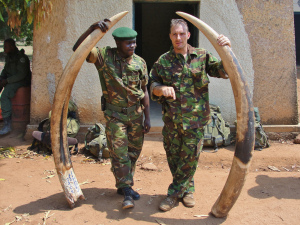
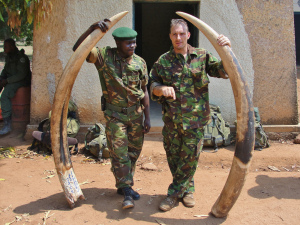
    Elephant ivory seized from poachers in Garamba. Image by Enough Project via Flickr.

    Conservation practice is being increasingly militarised as a result of this new interest in the security implications of poaching and trafficking. Militarisation can be briefly defined as the extension of military approaches, equipment and techniques to wildlife protection, as well as the deployment of armed forces in conservation activity. Countries with elephant, rhino and tiger populations also regularly invoke the argument that wildlife constitutes an emblematic natural resource, which is central to national heritage. For example, on World Ranger Day in 2015 South African Minister of Environmental Affairs Edna Molewa paid tribute to park rangers by stating that they were protecting rhinos as a key part of the country’s natural heritage. Such appeals to natural or national heritage are also frequently overlain with the argument that states have a moral obligation to protect wildlife. The interesting question is: why is there an increased interest in countering wildlife poaching and trafficking with more militarised responses?

    War on Terror

    First, the integration of security and biodiversity conservation has been extended by the development of a global context centred on security concerns, and this is most obvious in the US-led War on Terror. For states (especially parks and wildlife departments), conservation NGOs, and private conservation organisations, the ability to claim that their activities will contribute to national and global security has provided an important opportunity to justify their continued existence, and to leverage additional funding from donors, governments and private sector. The development of a global context in which security is a leading concern has opened new opportunities to leverage significant resources for conservation. During the 1990s, NGOs in the humanitarian relief sector were increasingly engaged in a competitive market to secure funding and contracts with donors. This dynamic was mirrored in the conservation sector, as detailed by Mac Chapin’s high profile piece for WorldWatch on how the ‘big three’ conservation NGOs of WWF, Conservation International and The Nature Conservancy, had managed to secure the majority of available funding. Competition between NGOs and the dominance of the big three partly explains why conservation NGOs have been so keen to promote the idea that conservation is critical to security. The assumption is that by rendering conservation a security issue, it will allow them to tap in to the greater resources available for security and anti-terrorism initiatives.

    Technological Innovations

    Second, recent innovations in military technology, especially for surveillance purposes, have also driven a demand to find new markets to expand its use (and profitability). This includes the use of drone technology to monitor wildlife populations in areas hit by poaching. The drones can also collect important information on human activity in the area – which is especially welcome in regions where there are concerns about the activity of rebel groups and militias that threaten state (or even international) security. The growing intersections between the two are evident in the development of a new range of surveillance networks which draw together government agencies, international intelligence agencies, wildlife conservation NGOs and private sector risk analysis companies. Such surveillance techniques are used to gather data on individuals and networks suspected of engaging in illegal hunting and trafficking of wildlife products; these use the same techniques associated with counter-insurgency operations, including the extraction of mobile communications data, development of informant networks and use of covert surveillance.

    The rise of private security

    Third, the rise in privatised forms of security in the post-Cold War era is also reflected in biodiversity conservation: private security companies provide training for anti-poaching operations as well as direct enforcement. This can be placed in the context of the growing use of private military companies in international interventions, including Afghanistan and Iraq. This is especially significant because it heralds a new era in conservation, in which national governments permit direct contracts between conservation NGOs and private security companies, with an authorisation to use deadly force under certain circumstances. A good example is the ways WWF has turned to the private sector to deliver security operations in protected areas that they manage on behalf of states. In Dzangha-Sanga National park in Central African Republic, funding from WWF-Netherlands, WWF-US and WWF-International is used to pay for anti-poaching operations and training under the auspices of Maisha Consulting. The company describes itself as a provider of environmental security via special investigations, training and operations in complex security situations. Numerous conservation NGOs have to grapple with complex security situations, especially if they seek to continue their projects and support when conflicts break out, or when militias move into the same area, and PMCs are regarded useful allies.

    The triple fail

    The rise of these approaches is deeply problematic for two reasons: they produce responses that are not effective for countering terrorism and insecurity, and equally they do not help us tackle poaching effectively. Instead they act as counterproductive distractions. The militarisation of anti-poaching including the growth of surveillance techniques and ‘intelligence-led’ approaches, fails to address the dynamics that drive poaching. These include a powerful mix of demand from wealthy communities around the world, poverty, inequality and the lack of opportunities in poorer source countries, the collusion of officials, organised crime networks and private transport companies. Simply focusing on military-style protection of wildlife from poaching is not effective: it can produce short term protection, but ultimately undermines wildlife conservation because it pits local communities against wildlife, reducing support for wildlife amongst people who live with it: the very people conservation ultimately relies on.

    Rosaleen Duffy is professor of the political ecology of development at SOAS, University of London. In September 2016 she joins the Politics Department in the University of Sheffield and will begin a major research project ‘BIOSEC: Biodiversity and Security: understanding environmental crime, illegal wildlife trade and threat finance’, (EURO 1.8 million funded by an ERC Advanced Investigator Award).

  • Militarising Conservation: A Triple ‘Fail’ for Security, People and Wildlife

    Biodiversity conservation is becoming increasingly militarised. Conservationists are learning from the strategies of contemporary warfare, and this is highly problematic for both wildlife and global security.

    Biodiversity conservation and security are becoming increasingly integrated. The recent rises in poaching, especially of high profile charismatic species such as elephants, rhinos and tigers has led to the development of more militarised approaches towards conservation. Rather than producing the claimed win-win-win outcome for wildlife, security and people, it is producing a triple fail. While we are more accustomed to debates around climate change and water wars as the main security risks related to the environment, biodiversity conservation is also increasingly being identified as a critical contributor to national and global security, and biodiversity losses constitute a critical security threat. This is especially the case in current debates about poaching and wildlife trafficking. Conservationists, it seems, are learning from the strategies of contemporary warfare.  This is highly problematic for wildlife and global security.

    Does wildlife trafficking produce threat finance or not?

    Achim Steiner, UN Under-Secretary General and Executive Director of UNEP, recently stated ‘the scale and role of wildlife and forest crime in threat finance calls for much wider policy attention’. The argument that wildlife trafficking constitutes a significant source of ‘threat finance’ takes two forms: first, as a lucrative business for organised crime networks in Europe and Asia, and second as a source of finance for militias and terrorist networks, particularly Al Shabaab, Lord’s Resistance Army and Janjaweed. Yet, a recent report from UNEP and INTERPOL on environmental crime questions the accuracy of the links between ivory and Al Shabaab. The report points out that ivory may be a source of income for some militia groups including Janjaweed and Lord’s Resistance Army; however it also notes that claims Al Shabaab was trafficking 30.6 tonnes of ivory per annum (representing 3600 elephants per year) through southern Somalia are ‘highly unreliable’ and that the main sources of income for Al Shabaab remain charcoal trading and ex-pat finance. In spite of this, the argument persists that there is a link between the illegal wildlife trade and global security.

    Although the value of the global illegal trade in wildlife is difficult to determine due to its clandestine nature, it has been estimated at around US$7.8–$10 billion.  It ranks as the third biggest global illicit activity (after trafficking drugs and weapons). Transnational environmental crimes are often not taken seriously within the broader policy and enforcement community, and so they are perceived as a low-risk and high-reward activity for organised crime networks. However, this is changing, and environmental crimes are rapidly gaining greater attention, and the increasing sophistication of wildlife trafficking networks is a reflection of their link with other serious offences, including theft, fraud, corruption, drugs and human trafficking, counterfeiting, firearms smuggling, and money laundering.

    Major donors are also taking this issue seriously, and funding has been made available for anti-poaching and anti-trafficking initiatives. In 2013 the Clinton Global Initiative announced a commitment to raise US$80 million to combat trafficking and poaching as a security threat in Africa. Private philanthropic foundations have also become involved, as indicated by the US$25 million donation to South Africa from the Howard G. Buffett Foundation to support rhino protection efforts in Kruger National Park. The rise in poaching has also intersected with US security concerns, prompting President Obama to issue Executive Order 13648 on Combating Wildlife Trafficking in July 2013, and in 2014 USAID allocated more than US$55 million for activities to combat wildlife trafficking, up from US$13 million in 2012. These concerns have emerged as a major policy initiative of the UK government, beginning in May 2013 when Prince Charles convened a high level meeting to ‘kick start’ a government response to the rise in elephant and rhino poaching – followed in 2014 by the London Declaration on the Illegal Wildlife Trade, and the development of a DfID/DEFRA £13 million ‘Illegal Wildlife Trade Challenge Fund’.

    Why is conservation being militarised?

    Enough Project Ivory

    Elephant ivory seized from poachers in Garamba. Image by Enough Project via Flickr.

    Conservation practice is being increasingly militarised as a result of this new interest in the security implications of poaching and trafficking. Militarisation can be briefly defined as the extension of military approaches, equipment and techniques to wildlife protection, as well as the deployment of armed forces in conservation activity. Countries with elephant, rhino and tiger populations also regularly invoke the argument that wildlife constitutes an emblematic natural resource, which is central to national heritage. For example, on World Ranger Day in 2015 South African Minister of Environmental Affairs Edna Molewa paid tribute to park rangers by stating that they were protecting rhinos as a key part of the country’s natural heritage. Such appeals to natural or national heritage are also frequently overlain with the argument that states have a moral obligation to protect wildlife. The interesting question is: why is there an increased interest in countering wildlife poaching and trafficking with more militarised responses?

    War on Terror

    First, the integration of security and biodiversity conservation has been extended by the development of a global context centred on security concerns, and this is most obvious in the US-led War on Terror. For states (especially parks and wildlife departments), conservation NGOs, and private conservation organisations, the ability to claim that their activities will contribute to national and global security has provided an important opportunity to justify their continued existence, and to leverage additional funding from donors, governments and private sector. The development of a global context in which security is a leading concern has opened new opportunities to leverage significant resources for conservation. During the 1990s, NGOs in the humanitarian relief sector were increasingly engaged in a competitive market to secure funding and contracts with donors. This dynamic was mirrored in the conservation sector, as detailed by Mac Chapin’s high profile piece for WorldWatch on how the ‘big three’ conservation NGOs of WWF, Conservation International and The Nature Conservancy, had managed to secure the majority of available funding. Competition between NGOs and the dominance of the big three partly explains why conservation NGOs have been so keen to promote the idea that conservation is critical to security. The assumption is that by rendering conservation a security issue, it will allow them to tap in to the greater resources available for security and anti-terrorism initiatives.

    Technological Innovations

    Second, recent innovations in military technology, especially for surveillance purposes, have also driven a demand to find new markets to expand its use (and profitability). This includes the use of drone technology to monitor wildlife populations in areas hit by poaching. The drones can also collect important information on human activity in the area – which is especially welcome in regions where there are concerns about the activity of rebel groups and militias that threaten state (or even international) security. The growing intersections between the two are evident in the development of a new range of surveillance networks which draw together government agencies, international intelligence agencies, wildlife conservation NGOs and private sector risk analysis companies. Such surveillance techniques are used to gather data on individuals and networks suspected of engaging in illegal hunting and trafficking of wildlife products; these use the same techniques associated with counter-insurgency operations, including the extraction of mobile communications data, development of informant networks and use of covert surveillance.

    The rise of private security

    Third, the rise in privatised forms of security in the post-Cold War era is also reflected in biodiversity conservation: private security companies provide training for anti-poaching operations as well as direct enforcement. This can be placed in the context of the growing use of private military companies in international interventions, including Afghanistan and Iraq. This is especially significant because it heralds a new era in conservation, in which national governments permit direct contracts between conservation NGOs and private security companies, with an authorisation to use deadly force under certain circumstances. A good example is the ways WWF has turned to the private sector to deliver security operations in protected areas that they manage on behalf of states. In Dzangha-Sanga National park in Central African Republic, funding from WWF-Netherlands, WWF-US and WWF-International is used to pay for anti-poaching operations and training under the auspices of Maisha Consulting. The company describes itself as a provider of environmental security via special investigations, training and operations in complex security situations. Numerous conservation NGOs have to grapple with complex security situations, especially if they seek to continue their projects and support when conflicts break out, or when militias move into the same area, and PMCs are regarded useful allies.

    The triple fail

    The rise of these approaches is deeply problematic for two reasons: they produce responses that are not effective for countering terrorism and insecurity, and equally they do not help us tackle poaching effectively. Instead they act as counterproductive distractions. The militarisation of anti-poaching including the growth of surveillance techniques and ‘intelligence-led’ approaches, fails to address the dynamics that drive poaching. These include a powerful mix of demand from wealthy communities around the world, poverty, inequality and the lack of opportunities in poorer source countries, the collusion of officials, organised crime networks and private transport companies. Simply focusing on military-style protection of wildlife from poaching is not effective: it can produce short term protection, but ultimately undermines wildlife conservation because it pits local communities against wildlife, reducing support for wildlife amongst people who live with it: the very people conservation ultimately relies on.

    Rosaleen Duffy is professor of the political ecology of development at SOAS, University of London. In September 2016 she joins the Politics Department in the University of Sheffield and will begin a major research project ‘BIOSEC: Biodiversity and Security: understanding environmental crime, illegal wildlife trade and threat finance’, (EURO 1.8 million funded by an ERC Advanced Investigator Award).

  • Boko Haram: Completing the circle of liberal interventionism?

    This article was originally published on openSecurity’s monthly Sustainable Security column on 29 May, 2014. Every month, a rotating network of experts from Oxford Research Group’s Sustainable Security programme explores pertinent issues of global and regional insecurity.

    First Lady Michelle Obama holding a sign with the hashtag

    First Lady Michelle Obama holding a sign with the hashtag “#bringbackourgirls” in support of the 2014 Chibok kidnapping. Posted to the FLOTUS Twitter account on May 7, 2014. Source: Wikipedia

    The abduction of over 200 school girls from Chibok has radically changed not only the popular profile of the Boko Haram insurgency but also the narrative of the war in northeast Nigeria. This was probably not intended by the insurgents or the ham-fisted Nigerian government, neither of which seemed to recognise this apparent gear-shift in the insurgency. After this fumble, it was civil society, through the #BringBackOurGirls social media campaign that picked up and ran with the call for action. Now that the US and its allies have channelled this urge to “do something now” into security assistance, caution is due in monitoring how and why the energy from this new burst of liberal interventionism will be channelled.

    Responding to Chibok

    Boko Haram has a long and undiscriminating record of terrorist violence. My analysis of data compiled by Nigeria Watch suggests that about 9,000 Nigerians (including combatants) have died in related violence since 2009, most of them since the federal government declared a localised state of emergency a year ago. That rate has been rising fast; 1,043 were recorded killed in March 2014 alone. Nevertheless, the 14 April Chibok mass abduction and Boko Haram leader Abubakar Shekau’s subsequent threat to forcibly marry pre-teen girls to his supporters or sell them into slavery were extraordinary, crossing multiple red lines around protection of civilians, girls’ right to education and sexual violence.

    The #BringBackOurGirls campaign has tapped into a social movement last and best exploited through the Stop Kony 2012 viral video campaign. That campaign influenced the African Union to establish its Regional Cooperation Initiative for the Elimination of the Lord’s Resistance Army (LRA) in April 2012 and was a major driver of post-facto public support for the Obama administration’s October 2011 commitment of US special forces to Uganda and central Africa to hunt LRA leader Joseph Kony. Those troops remain in four countries and haverecently been reinforced. Kony has not been caught but the LRA menace to children, women and other civilians has been contained and reduced.

    The state-level response to Chibok has been belated but even stronger. Since 7 May, the US, UK, France, China and Israel have all sent teams to Nigeria to help search for and rescue the abducted girls, and France has hosted a summit of Nigeria, its four neighbours and the US, UK and EU. In fact, all these states already played a role in training, equipping or supporting Nigerian forces against Boko Haram. However, they were reluctant about going public with a counter-insurgency campaign previously linked to the increasingly unpopular and divisive ‘war on terror’, the toxic human rights reputation of the Nigerian security forces, and an entirely reasonable confusion over the political nature and linkages of the ostensibly Islamist rebellion.

    Response and replication

    Whether this foreign assistance is useful in the search for the missing girls is both highly questionable and a moot point. The US certainly has formidable aerial, satellite and signals reconnaissance technology to employ but it is struggling to coordinate with Nigeria, and unwilling to share raw data with the Nigerian security agencies. Other countries’ contributions probably only replicate Nigerian and US capabilities, and risk over-complicating the search.

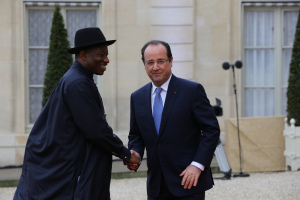
    French President Francois Hollande greets Nigerian President Goodluck Jonathan. Source: France Diplomatie (Flickr)

    French President Francois Hollande greets Nigerian President Goodluck Jonathan. Source: France Diplomatie (Flickr)

    The French summit on 17 May was a classic case of replicating initiatives in order to bolster perceptions of French concern, consultation and action. Nigeria, which desperately wants to revel in its new status as Africa’s economic superpower, was humiliated that Paris – Abuja’s great rival for influence in West Africa – assumed its regional leadership role. The summit outcome commitments to bolster security cooperation in the Lake Chad basin replicated those that Nigeria and its neighbours had already made. Those sanctioning Boko Haram replicated UN-led measures.

    The Elysée Summit was more useful in redirecting attention to the gendered aspects of Boko Haram’s campaign of violence, issues of particular importance to the EU and the UK, whose Global Summit to End Sexual Violence in Conflictconvenes on 10 June. Both sides of the conflict have made tactical use of abducting and (separately) raping women and children linked to the other side as a means of exerting pressure or retaliation. Nigerian security forces and their civilian allies increasingly harass local women suspected of working for the militants. Boko Haram is accused of abducting girls and women to marry to its young, poor male combatants. Shekau has put his view on video record that girls above puberty should not be educated. This may be the most convincing explanation for the Chibok kidnapping: women as an economic and sexual resource.

    Intervention narratives

    The goal of securing the safe release of the abducted girls – and the security of their peers – must be paramount at this time. But, if the foreign assistance being pledged and provided makes little impact on this task, we must ask whether there are other goals motivating western governments to cooperate with Nigerian forces. Clearly, the political urge to assuage activists by responding with action is one of these, although we should not doubt that the Obama or Cameron families share the revulsion of other families around the world united behind #BringBackOurGirls.

    The social media shaming of the Nigerian and foreign governments’ inactivity and inability to resolve the crisis has propelled foreign military forces across the rubicon. US, and perhaps British, French, Canadian, Israeli and other states’, special forces and reconnaissance aircraft and drones may stay on in Nigeria well beyond the current abduction crisis; this should not be surprising.

    French forces are currently consolidating their redeployment from coastal Africa to a string of remote bases in Mali, Burkina Faso, Niger and Chad. Their main base in N’djamena is just 40 km from Boko Haram’s stronghold in northeast Nigeria. US special and private military forces operate covertly in most countries of the Sahel-Sahara belt. Until this month, Nigeria appeared to be the exception.

    The quiet reinforcement of these several thousand French and US troops across the western Sahel since 2012 – linking up to similar strings of mostly US bases in the eastern Sahel and Horn –is justified through the on-going international campaign against al-Qaida. US African Command openly uses the Operation Enduring Freedom tag for its operations in the Horn and Trans-Sahara. In Mali, Niger and Mauritania, French forces have joined battle against the al-Qaida in the Islamic Maghreb (AQIM), an Algerian-origin group with regional aspirations. Yet Boko Haram is rather different. While it professes a common Salafism, it is not an al-Qaida affiliate and appears uninterested in controlling territory or attacking state assets outside of Nigeria.

    This matters in the Nigerian context for two reasons. The first is in the way that the humanitarian impulse of #BringBackOurGirls – which diplomats can recognise as Protection of Civilians, Responsibility to Protect, or Ending Sexual Violence – shades into the realities of the war on terror. I would count four or five distinct narratives used to justify foreign military interventions in the last 15-20 years:

    1. Liberal interventionism – following the ostensibly humanitarian urge to protect civilians and uphold human rights, notably in Kosovo and Sierra Leone.
    2. The War on Drugs – an old idea reinvigorated with Plan Colombia in 1999.
    3. The War on Terror – the idea that homeland security begins abroad, notably in Afghanistan, but lately in Yemen, Somalia, Pakistan, Mali and elsewhere.
    4. Proliferation of WMDs – actively in Iraq, and as a threat to Iran, Syria and others.
    5. Protection of civilians – controversial used to pursue regime change in Libya, less so in pursuit of Kony thereafter.
    U.S. President George W. Bush and British Prime Minister Tony Blair at the White House, July 2003. Source: White House (via Wikipedia)

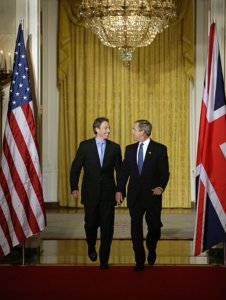
    George W. Bush and Tony Blair at the White House, July 2003. Blair’s enthusiasm for foreign military intervention changed in tone after the 9/11 attacks on the US. Source: White House (via Wikipedia)

    Clearly, there are overlaps; the Bush administration’s Axis of Evil concept linked state sponsors of terrorism and WMD. ‘Narco-terrorism’ links the wars on drugs and terrorism. Whatever their muddy political and religious ideologies, Kony and Shekau do lead terrorist movements. With the failed war on terror increasingly unpopular among a cynical and war-weary populace, the post-2011 shift back to humanitarian criteria completes the circle back to liberal interventionism.

    While applauding the global public’s shift from retribution to humanitarianism, we should be wary of politicians’ and generals’ intent in getting involved in northern Nigeria. The signs are that future ‘humanitarian’ interventions will be fought with the tactics of the war on terror, minus its rhetoric. Perhaps we should call these ‘Protection from Terror’ operations?

    Self-fulfilling prophecy

    If this shift in narrative represents the new Anglo-American take on intervention, the second reason for concern about the international fallout from Chibok is the Nigerian and French imperative to rebrand Boko Haram as part of al-Qaida. Nigeria’s successful addition of Boko Haram to the UN Security Council’s Al-Qaida Sanctions Committee list on 22 May was a step in this direction. For Abuja, this may help to isolate Boko Haram and justify the disastrous escalation of the war since France pushed AQIM and its allies out of Mali in early 2013. For France, it creates a common bond and removes a potentially powerful voice of dissent in the AU and regional organisations about its own military presence in the Sahel.

    Yet al-Qaida, for all its strategic interest in Nigeria’s 90 million Muslims, has shown little interest in Boko Haram and its use of indiscriminate violence against mostly Muslim civilians. Boko Haram has, in rhetoric and action, showed limited interest in a wider struggle beyond Islamicising Nigeria. It almost certainly has links to AQIM and splinter groups in Mali and Niger but these are not obviously strong. Al-Qaida and Boko Haram are not natural bedfellows, but post-Chibok dynamics, including US and Israeli military in northern Nigeria, are pushing them together, potentially consolidating a regional insurgency that is as much anti-western as anti-Nigerian.

    Richard Reeve is the Director of Oxford Research Group’s Sustainable Security programme. He has researched African peace and security issues since 2000, including work with ECOWAS and the AU. His most recent security briefing ‘The Internationalisation of Nigeria’s Boko Haram Campaign’ is available here.