Blog

  • Is Trident Influencing UK Energy Policy? Part 2

    This concluding part of a two-part article series continues the discussion on the UK’s naval nuclear power programme and its potential impact on Britain’s energy policy. Read part 1 here.

    In Part 1, we described the intensity of UK commitments to new civil nuclear power and why this is so hard to fully explain. The proposed 16GWe of new nuclear capacity is a difficult policy to justify based on economics, energy security and conventional approaches to understanding innovation and technological transitions. There are serious problems with the UK nuclear power programme, including significant delays, rising costs, and uncertainty surrounding essential foreign investment. The UK government’s own figures show renewables, including onshore wind and solar, to be cheaper than nuclear. As the prospects of resolving underperforming nuclear plans get ever more distant and unlikely, increasingly favourable renewable projects remain ever more threatened by cut-backs. This has led to serious problems in that sector. Taken at face value, these patterns are very difficult to explain.

    What drives these counter-intuitive trends? Many factors will be at play, but, as discussed in Part 1, there is a particular major driver that remains almost entirely unexamined in analysis of UK energy policy. This concerns the pressure to sustain UK nuclear submarine infrastructures by maintaining  more general national reservoirs of specialist nuclear expertise, education, training, skills, production, design and regulatory capacities.

    Could these pressures to maintain capabilities, perceived to be necessary for the country’s naval nuclear propulsion programme, be influencing the intensity of UK commitments to new civil nuclear power? We now examine a crucial period in UK civil nuclear policy during which concerns around defence-related nuclear skills came to the fore shortly after a key policy moment when, for the first time since 1955, UK policy was considering an energy trajectory that did not include new nuclear.

    2003–2006: the unexplained nuclear ‘U-turn’
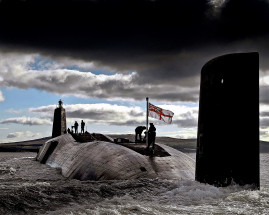
    Image credit: Thomas McDonald/Flickr.

    For a brief period between 2003 and 2006, nuclear energy seemed to fall out of high-level favour in the UK. The nuclear firm, British Energy was bailed out and brought back into state control in 2002 and nuclear privatisation was widely recognised to have failed. The UK civil nuclear industry was dogged by scandals and cases of costs overrunning. . Meanwhile, New Labour’s earlier efforts to democratise decision-making helped free one initially minor policy initiative from the shackles of bureaucratic inertia and industrial interests. For the first time, nuclear energy strategy escaped the domain of the dedicated ministry.

    Approaching energy policy by the indirect route of “resources”, the new Performance and Innovation Unit (PIU) – reporting directly to the Cabinet Office – was charged with undertaking an extensive reappraisal. This marked a significant departure from the traditional practice where energy policy assessments were closely guarded by the relevant ministry. The PIU review was staffed entirely by civil servants, with half of the review team comprised of leading independent energy analysts recruited from outside government. Freed from the incumbent pressures which constrained earlier UK energy reviews, the 2002 PIU study found that unresolved nuclear waste and economic problems meant that the UK should move towards a more decentralised electricity grid based around renewables and energy efficiency. The February 2003 White Paper Our energy future: Creating a low carbon economy upheld these recommendations. While it did not entirely rule out future investment in nuclear energy, it did find nuclear power to be economically and environmentally “unattractive” for Britain.

    What came next was one of the most abrupt policy turnarounds in UK history. For reasons never officially declared, Prime Minister Tony Blair launched another energy review in November 2005. This second review was not conducted in a transparent and independent way like the PIU process. Instead, it was undertaken by a few partially identified individuals inside the Cabinet Office under the leadership of Blair’s close personal associate, John Birt. According to nuclear advocate Simon Taylor, this involved a select group that most other civil servants in the Cabinet Office did not know even existed, working “in secret” to “re-examine” the case for nuclear energy. Managed by the former Atomic Energy Authority, the consultative part of this exercise was much shallower and shorter than before. Amid other widespread criticism, Greenpeace successfully took the Government to the High Court, where this second review was declared “unlawful” and “deeply flawed”. Yet Blair’s reaction was that this court ruling would “not affect policy at all”. With a further round of consultation, again alienating NGOs, the January 2008 White Paper Meeting the Energy Challenge duly announced a British ‘nuclear renaissance’.

    Among those questioning these events was the Parliamentary Environmental Audit Committee, which in March 2006 asked (without receiving an official answer) why a second energy review was deemed necessary so soon after such a comprehensive predecessor. Four months later, the House of Commons Trade and Industry Select Committee branded the second review a “rubber stamping” exercise designed to give legitimacy to a pre-ordained decision rather than being an ‘open’ consultation.

    It still remains unexplained what (or even who) could have driven this rethink. It is in this light that nuclear expert Steve Thomas has highlighted the ambiguities around exactly what ‘the UK nuclear lobby’ consists of.  With the UK civil nuclear engineering industry so weak and historically unsuccessful (as discussed in part 1), it is unclear where in this languishing domestic sector sufficient political-economic capital might have accumulated to force such an unprecedented and poorly justified national policy turnaround.

    Investment and skills concerns around the UK’s Naval Nuclear Propulsion Programme

    This is where the  imperatives around national submarine capabilities comes into play. It is in exactly this same critical juncture between 2003 and 2006 that an unprecedented intensification can be observed in concerns around the UK’s nuclear submarine capability. Significant problems emerged with the construction of British ‘Astute’ class of submarines. Policies related to nuclear submarines were unveiled in rapid succession – with the December 2003 Defence Review White Paper followed by the December 2006 White Paper on the Future of the UK’s nuclear deterrent, leading up to the ‘initial gate’ House of Commons vote to proceed with a replacement to the nuclear-powered Vanguard-class ballistic missile submarines in March 2007. Inconveniently, it was just prior to this marked intensification of activity on the military side, that civil nuclear power was officially acknowledged to be “unattractive”.

    One notable development emerging at the beginning of this period was an intense lobbying campaign started in March 2004. The well-funded Keep Our Future Afloat Campaign (KOFAC) emanated from the Barrow shipyards, BAE Systems’ construction site for all UK submarines. Trade unions, local councils, county councils and KOFAC relentlessly targeted politicians, party conferences and governmental consultations. Closely connected with KOFAC and lobbying in support of the submarine industry at this time was then MP for Barrow-in-Furness and close ally of Tony Blair, John Hutton, also one of the most significant supporters of civil nuclear power. KOFAC’s lobbying campaign was recognised by parliamentarians as being “one of the most effective” ever seen.  Focusing resolutely on how to protect UK nuclear submarine manufacturing interests, KOFAC highlighted the importance of supporting integrated civil and defence-related nuclear capabilities. For its part, BAE Systems was also evidently busy in other ways behind the scenes – positioning itself (rather extraordinarily) in a memorandum of understanding of 2006 with the ailing US civil reactor vendor Westinghouse to extend its own military submarine focus to a role in civil nuclear supply chains.

    Although internal government reactions to this pressure were invisible, the public response was strikingly accommodating. In 2005, the MoD funded the RAND Corporation to conduct an in-depth two-volume report: “The United Kingdom’s Nuclear Submarine Industrial Base”. The report endorsed crucial links between key skills and capabilities relevant both to submarine and civil nuclear industries. A series of Select Committee consultations and reports ensued, with influential stakeholders in the nuclear submarine supply chain raising many concerns. Lead submarine nuclear propulsion contractors, Rolls Royce, claimed that the depletion of nuclear skills in the civil sector would reduce the support network available to the military programmes. The Royal Academy of Engineering noted that “the skills required in the design, build, operation and disposal of Naval Nuclear Propulsion Plant … are in short supply and increasingly expensive… Overall, the decline of the civil nuclear programme has forced the military nuclear programme, and in particular the nuclear submarine programme, to develop and fund its own expertise and personnel in order to remain operational”.

    Recognising that links between the civil and naval sector need to be encouraged” , a key witness to a 2008 Parliamentary Innovation and Skills Select Committee inquiry noted: “The UK is not now in the position of having financial or personnel resources to develop both programmes in isolation”. In a rare acknowledgement of this relationship from the civil energy side, a detailed low-key Government consultancy report later amplified the same message: “the naval and civil reactor industries are often viewed as separate and to some extent unrelated from a government policy perspective. However, the timeline of the UK nuclear industry has clear interactions between the two, particularly from a supply chain development point of view.”  It was apparently in this crucial period 2003-2006 that this longstanding but under-appreciated industrial dependency between military and civil nuclear sectors finally commanded intense – albeit undeclared – attention at the highest political levels.

    It is remarkable that these patterns were so obvious to see on the military side of UK policy making, but so virtually invisible on the energy side. Yet this selective discretion is hardly surprising. There are strong incentives to keep these kinds of links as invisible as possible. As the National Audit Office has ominously noted of the costs of Trident: “[o]ne assumption of the future deterrent programme is that the United Kingdom submarine industry will be sustainable and that the costs of supporting it will not fall directly on the future deterrent programme.” Acknowledging this – and reflecting implied industrial practice in the military sector – a seconded BAE Systems Submarine Solutions employee writing in a 2007 report for the Royal United Services Institute, discussed the desirability and difficulty of absorbing or ‘masking’ costs of submarine construction in ostensibly civilian supply chains.   Connections between civil and military nuclear infrastructures are also sensitive internationally, with serious tensions surrounding global nuclear proliferation regimes. This is why one Parliamentary witness emphasised that civil-military nuclear links must be carefully managed to avoid the perception that they are one and the same”.

    It was arguably for such reasons that the UK Government response to the nuclear policy crisis of 2003-2006 was so fast and energetic – with the reasons well acknowledged on the defence side, but virtually invisible on the energy side. Corresponding with the unprecedented U-turn on civil nuclear power was an equally unprecedented intensification in efforts to preserve nuclear skills for the military sector. In 2006, a key suppliers group was set up by BAE Systems involving firms in both military and civil nuclear supply chains. The following year the Department of Trade and Industry expanded the National Nuclear Laboratory (NNL) and established a new National Nuclear Skills Academy.

    Since then, the UK Government has gone on to reserve key parts of the HPC contracts for Rolls Royce. BAE Systems has consolidated its interest in civil nuclear construction as well as defence. A huge programme of publicly-funded research has been announced in small modular civil power reactors to build on Rolls Royce’s experience with submarines. And most recently – against a backdrop of massive overcapacity among global nuclear power vendors in what is evidently one of the most economically perilous of sectors – Roll Royce has announced an especially remarkable initiative. Notwithstanding strong pressures for international integration in this overcrowded sector – and a national history in this field of sustained industrial failure – Rolls Royce is now seeking to lead an entirely new industrial consortium branded as distinctively British and dedicated to an untested submarine-derived civil power reactor design. Despite the acknowledged incentives for concealment, these clear linkages between submarine and civil nuclear reactor construction interests provide a key missing link to decipher the otherwise unexplained abrupt reversal in UK nuclear power policy in 2006.

    Submerged drivers of UK energy policy?

    So, what is the role of UK military nuclear commitments in driving a national low-carbon energy strategy that is manifestly more costly and less effective than it otherwise could be? The complexity and secrecy in this field inevitably makes it difficult to be definite. Nevertheless, the wealth of official documentation on the military side and the remarkable conjunction of events around and beyond the period 2003-2006 do seem to present a plausible case. The UK Government’s commitments to military nuclear capabilities do seem to be a significant (albeit undeclared) factor in civil energy strategies, and of industrial policy more generally.

    There are broader questions here over what the military influences on wider British Government policy say about the current state of the UK’s democratic system. It is not necessary to invoke simplistic “conspiracies”. Just as iron filings line up in magnetic fields, so these kinds of institutional pressures can – without any single controlling actor – instil exactly these kinds of patterns. If massive UK civil infrastructure investments really are being shaped to the degree implied by these kinds of perceived military imperatives, then the most important issue is why they are almost completely absent from any kind of discussion or scrutiny – let alone accountability – either in energy policy literatures, or in wider political and media debates. If these institutional forces are as powerful and concealed as they seem, then very serious questions are posed for the health of British democracy in general.

    Phil Johnstone is Research Fellow at the Science Policy Research Unit (SPRU),  the University of Sussex. His current research is focussed on disruptive innovation in the energy systems of Denmark, the UK and Germany. Previously Phil worked on the Discontinuity in Technological Systems (DiscGo) project and is a member of the Sussex Energy Group (SEG). 

    Andy Stirling is a professor in SPRU and co-directs the STEPS Centre at Sussex University. An interdisciplinary researcher with a background in natural and social science, he has served on many EU and UK advisory bodies on issues of around science policy and emerging technologies.


  • Brexit or Bremain for British Security?

    It should come as no surprise that David Cameron and the campaign for the UK to remain in the EU have argued that Britain’s continued membership of the EU will benefit the UK’s security. Britain’s EU membership has always had a security side to it. Membership has never been entirely about trade or jobs. And whatever the result of the referendum, the security relationship with the EU will remain vital for the UK.

    Those campaigning for the UK to leave the EU do not dispute that relations with the EU, along with European security in general, are not of central concern for the UK. For them, however, not only does the EU make the UK and Europe less safe (for example by allowing free movement of criminals and terrorists), but putting international relations ahead of domestic politics, especially economic and democratic needs, weakens Europe’s nation states and their ability to combat the full range of problems facing them.

    The UK government itself is clear that traditional security threats to the UK do not figure as highly as they once did, although they have certainly not disappeared. As successive national security strategies and strategic security and defence reviews have made clear, security challenges to the UK range from nuclear war to environmental disasters, with many not recognising the borders of nation states. While British governments are often reticent to admit to the EU playing a positive role in security cooperation, or admit that the UK has led in such cooperation, there is no denying that tacking these security challenges has been an important part in UK-EU relations.

    From the start, European integration has had a security side to it, whether this be about managing the reintegration into Europe of West Germany and later a united Germany, or integrating former Eastern European Communist or Southern European Fascist states into a liberal European mainstream. The EU itself has not been sufficient to keep the peace. The argument by some Eurosceptics that it has been NATO that has kept the peace in Europe is as selective a reading of history as any pro-European that claims it has all been down to the EU. Nevertheless, for successive British governments, especially at the height of Britain’s retreat from empire in the 1960s, Britain’s declining ability to shape the world and the security challenges it posed meant membership of the European Economic Community and later EU was a necessary step for both British, European and transatlantic security cooperation.

    Today, Cameron and others in the Remain campaign trumpet Britain’s ability to use the EU to boost Britain’s still substantial but reduced economic and military capabilities to give it the full range of tools and opportunities to face the full range of security challenges. Whether in facing a newly assertive Russia, dealing with Iran or tacking climate change, the UK’s EU membership has been cited as crucial to allowing the UK to shape its security. This is not to argue that EU cooperation is without its problems. Finding consensus amongst 28 states is never easy, even when you have the institutions and familiarity that EU membership offers.

    jeffdvevdit

    Image by Djevdet via Flickr.

    The referendum poses the question of what options the UK has beyond working through or with the EU. Talk of the UK rebuilding the Commonwealth is often oblivious to how strategically marginal that organisation can appear to most of its members. Britain’s NATO membership will remain important to it and Europe. NATO, however, is not the whole story when it comes to European security and the UK should not bet on the alliance being as solid as it was once. Close bilateral relations with the likes of the USA or France will remain, not least in the military fields. But this should not blind us to how the US and European states will continue to cooperate through a range of EU-US forums and that this could leave Britain outside the EU as something of an awkward in-betweener in the transatlantic relationship.

    The US in particular is aware of the wider implications of a Brexit for Europe’s geopolitics. As Condoleezza Rice, former Bush Administration Secretary of State and National Security Advisor, told Chatham House: ‘It is a very different Europe if it is a continental one’. Accusations that the UK is a US ‘Trojan Horse’, sent to weaken EU cooperation from within, display an ignorance of how the USA – a European power since 1945 – has had a hand in European integration and security from the very start and doesn’t wholly depend on the UK for relations with the rest of the EU.

    Britain’s departure from the EU could change the Union in any number of ways, with far-reaching geopolitical implications that will shape Europe’s security. That some Leave campaigners such as Michael Gove have spoken of Britain setting an example that could lead other states to follow gives a hint to the wider geopolitical changes to Europe some Eurosceptics hope a Brexit will bring about.

    Such disintegration or radical reconfiguration of the EU has not been set out or anlaysed in any document or strategy. As such this half-baked approach risks a dangerous case of strategic overreach by the UK. Any changes to Europe would rely less on Britain’s willingness to offer the ways and means of managing such changes and more on encouraging a collapse of the EU. Losing control of such a development should not be overlooked. An uncontrolled collapse of the Eurozone, for example, would inflict significant costs on the UK, Europe, the USA and the wider world economy. As HM the Queen warned in June 2015 during a state visit to Germany, Europe’s division is in nobody’s interests.

    It is possible that a Brexit will cause the opposite reaction, with an EU rid of ‘an awkward partner’ going forward by unifying further. One of Britain’s longest standing international aims has been to prevent any single power dominating Europe. The EU would be a benign power compared to previous attempts, but such an outcome warrants careful consideration by the UK. Whatever the outcome, the EU’s status quo is unsustainable. The question for those concerned with Europe’s security is whether changes – whether triggered by Brexit of not – can happen in a stable, cooperative way or bring about a collapse into nationalism and parochialism.

    The best hope for UK and EU security is that whatever the result of the referendum both sides seek ways of cooperating, if only to rebuild trust. The initiative here will rest with the UK whose recent approach to the EU in the eyes of many elsewhere in Europe has been an unwanted distraction from the many other challenges facing the EU. A UK in search of cooperation with its European neighbours will find it can offer little to help with the problems in the Eurozone or Schengen. Instead, whether in or out of the EU, it will find itself playing its only trump card: security and defence cooperation.

    Whether in facing a resurgent Russia – and therefore the continued relevance of hard power in European and international relations – or the more nuanced but potentially far more catastrophic global environmental challenges, the UK and EU could find common ways forward that help both sides realise their mutual interdependence. The UK and the rest of the EU must appreciate that instability or division in Europe limits their options to shape security in the wider world.

    Last, but not least, we should not overlook that if the first priority of any state is its own survival then alarm bells should be ringing about how the referendum could lead to the end or weakening of the UK itself. The vote could throw into doubt the place in the Union of Scotland and Northern Ireland, both bringing with them a host of traditional security concerns whether they be terrorist related or the future of the UK’s nuclear weapons. Tensions within England should not be overlooked. Immigration and economic changes have made London the UK’s undiscovered country, much to the chagrin of some elsewhere in England and Britain who feel a Europeanised and globalised capital city has left them behind. Arguments over identity, immigration, radicalisation, race, equality and standards of living rumble beneath the surface of the EU referendum. A reminder, if any were needed, of how sustaining the UK’s own stability and security will be no easy challenge after the 23 June.

    Dr Tim Oliver is the Dahrendorf Fellow for Europe–North American relations at the London School of Economics and Political Science. He is also a non-resident fellow at the Center for Transatlantic Relations of the Johns Hopkins University Paul H. Nitze School of Advanced International Studies, Washington DC. He has worked in the House of Lords, the European Parliament, the German Institute for International and Security Affairs (SWP), RAND Corporation, and taught at the Royal Military Academy Sandhurst, the London School of Economics and University College London. 

  • Challenges Facing Women in Peacekeeping

  • VIDEO – Transforming Food Systems in a Global Context

    The United States, Niger & Jamaica: Food (In)Security & Violence in a Globalised World

    due to a complex range of interconnected issues from climate change to misguided economic policies, political failure and social marginalisation, over 2 billion people across the world live in constant food insecurity. Anna Alissa hitzemann takes a sustainable security approach to look at the importance of “physical and economic access to basic food” by exploring the links between food insecurity and violence.

    Read Article →

    The Global Land Rush: Catalyst for Resource-Driven Conflict?

    Michael Kugelman of the Woodrow Wilson International Center, argues that the factors that first sparked many of the land acquisitions during the global food crisis of 2007-08 — population growth, high food prices, unpredictable commodities markets, water shortages, and above all a plummeting supply of arable land — remain firmly in place today. He writes that land-lusting nations and investors are driven by immediate needs, and they have neither the incentive nor the obligation to slow down and adjust their investments in response to the wishes of distant international bureaucrats. This, he argues, has serious consequences for global security.

    Read Article →

  • Mission Impossible: The Elusive Search for Peace in Syria

  • Mission Impossible: The Elusive Search for Peace in Syria

  • The Ukraine conflict’s legacy of environmental damage and pollutants

    The Ukraine conflict’s legacy of environmental damage and pollutants

    One year after violent conflict began, information is now emerging on the specific environmental impact of war in Ukraine’s highly industrialised Donbas region. Although obtaining accurate data is difficult, indications are that the conflict has resulted in a number of civilian health risks, and potentially long-term damage to its environment. In order to mitigate these long-term risks, international and domestic agencies will have to find ways to coordinate their efforts on documenting, assessing and addressing the damage.

    Read Article →

  • UN Peacekeeping and Counter-Terrorism

  • Can Former Combatants Assist in Preventing Violence?

    Former combatants can play a powerful role in preventing violence, as the case of former combatants in Northern Ireland shows. Former Islamic State fighters could have a role to play in counter-terrorism, however there are potential limits to this.

    The value in re-integrating former combatants in post-conflict environments has been widely recognised in terms of reducing the risk of recidivism and fostering stability in a peace process. While there are examples of former combatant in larger scale post-conflict environments following the path of a de-politicised re-integration into society, there are also examples of former combatants – or ‘former terrorists’ – taking a much more active role in preventing future violence.  Former combatants in Northern Ireland, for example, have had some notable success in delivering restorative justice programmes, de-militarising communities, preventing inter-communal violence and articulating counter-narratives against the use of violence. If former combatants are having some success in preventing terrorism and political violence in Northern Ireland, what are the criteria for successfully utilising former combatants, and does this point to a potential role for former Islamic State combatants in the UK?

    Utilising Former Islamic State Combatants

    The question of utilising former Islamic State combatants is not entirely left-field as there has been a range of voices expression different potential ways of their utilisation to serve preventative ends. One emerging perspective has emphasised how former combatants can play a preventative role, with former MI5 and MI6 chief, Richard Barrett, arguing that they can help explain “why going to fight abroad is a bad idea” and that ex-extremists are often the most successful at “undermining the terrorist narrative.” The ability to use extremists who “renounce violence” and are “genuinely remorseful,” according to this perspective, can provide a credible and persuasive message to stop the flow of people engaging in IS-related terrorism. Terrorism expert Peter Neumann argues that IS defector narratives can encourage others to leave the group and deter others from joining on the basis of their experience and credibility. Subsequently, he has recommended that the U.K. government needs to provide defectors the opportunity to speak out, assist them in their resettlement, and to remove legal disincentives that prevent them going public. An alternative would be to do nothing or continue with the current approach; however former Islamic State combatants are already returning and not all of them are prosecuted. In other words, these former combatant networks exist, they risk solidifying, and will be sharing their views and experiences, therefore it may be more effective in the long-run to co-opt and utilise them for positive ends.

    There is clearly a potential role for former Islamic State combatants in preventing others engaging in such activities. The nature of utilisation could be minimalist (narrative-based), whereby third parties disseminate former combatant narratives. For example, one UK counter-terrorism official mentioned how they have distributed one specific article on Islamic State defector narratives to help people play a preventative role. A more controversial role would be a maximalist approach (narrative and network-based) like in Northern Ireland, whereby former combatants themselves engage in activities with the goal of prevention. Should the UK government consider enabling or facilitating former Islamic State combatants in a preventative capacity?

    Former Combatants as a Conveyor-Belt to Terrorism?

    isis

    Image by Day Donaldson via Flickr.

    One of the potentially biggest arguments against a maximalist approach is that such activities could be counter-productive and could risk serving as a conveyor-belt to engaging in violence rather than act as a fire-wall. A common trend with former combatants is they often do not de-radicalise: while they may disengage from terrorism because of dissatisfaction, disillusionment or burnout, they tend to maintain their ideological views. From this perspective – and endorsed by the UK government’s counter-terrorism policy – even non-violent extremist ideology can encourage others to engage in violence. While the conveyor-belt perspective has been heavily critiqued, the experiences of former combatants in Northern Ireland actually points to a middle-ground between these two perspectives. This consequently contributes to the debate on radicalisation but also on the potential role of former combatants in a preventative capacity.

    The findings of my own research on former combatants in Northern Ireland placed emphasis, not on ideology or attitudes to violence, but the framing process – in other words, how is violence and non-violence represented by actors and how it resonates with an audience, and what structural factors facilitate this resonance. Former combatants in Northern Ireland interact on a regular basis with young people through a number of programmes. Interestingly, despite the former combatants having maintained an ideology similar to violent groups, and despite the former combatants not supporting violence in the current conditions, it was realised that the interaction between former combatants and young people led the latter to view the use of violence positively. However, while this may seem to corroborate the conveyor-belt perspective, it actually showed that it was how former combatants framed violence that produced the conveyor-belt effect, not ideology on its own but also not simply that the former combatants were anti-violence.

    Re-Framing Violence

    In the past, former combatants explained their transition away from violence by framing violence it as conditionally acceptable during the 1960s civil rights protest period and that since these grievances were addressed in today’s conditions that violence was no longer legitimate. There are many reasons why the former combatants re-framed violence in this particular way, and it was particularly effective at ensuring the majority of the Provisional IRA disengaged; however this particular framing of violence to a younger audience without such experiences interpreted the framing as glamourising violence. Reflecting upon this, former combatants actively reframed violence when in dialogue with young people by emphasising the less glamorous aspects of violence more. One study showed that the former combatant reframing of violence in this manner has discouraged young people in engaging in violence. Former combatants were persuasive because they had credibility in the ‘hard to reach’ areas and they maintained narrative fidelity with audiences on ideology and identity.

    The point here is that there is some truth to the conveyor-belt perspective – that former combatants opposed to violence can encourage young people to engage in violence – but it has little to do with the ideology more broadly and much more to do with the framing process between the former combatants and the audience. Those who advocate the conveyor-belt perspective underplay the organisational interests in not having potential members becoming violent. In the Northern Irish case, former combatants had the time to reflect upon the effects of interacting with the younger generation and to engage in a re-framing process. Their reflexivity was encouraged by organisational interest as well as network structures which ensured they would be in regular interaction with young people and an environment in which funding was available to engage in projects.

    Empowering Reflexive Networks

    Thus, ideology is a crude means of determining the success of former combatants in a preventative role. Former combatants can be utilised in this capacity – or at the very least not discouraged – and the enablement of reflexive networks which resonate with young people can act as a firewall to participation in violence. However, there are a number of potential constraints and objections when this is applied to former Islamic State combatants. Working on the assumption that the purpose of counter-terrorism is to ‘counter terrorism’ and not to counter ideologies which a state does not like, and leaving aside the normative dimension of the rights of victims which Alonso excellently covers, the article focuses on two main points on the pragmatism and efficacy of using former combatants to prevent violence.

    Firstly, the UK government’s wholesale adoption of the conveyor-belt perspective makes the provision of funding much more rigid than in Northern Ireland. Interestingly, Northern Ireland’s very own prevent policy in the 1980s curtailed which organisations could receive funding on the basis of their ideology, but this was gradually dropped in recognition that the development of the community route could help to facilitate disengagement. The funding former combatants receive in Northern Ireland is detached from the government, thus increasing buy-in across communities, and the conditions of the funding are pragmatically based (often turning a blind eye to paramilitary behaviour in anticipation that funding and accreditation would incentivise moving away from such behaviour). Ideology is not factored in – alternative identities are strengthened and shown they can be non-violent rather than trying to encourage the ‘centrefication’ of political identities. In the current UK context, similar changes would be required before former combatants and former extremists could be fully utilised.

    A second objection is that the network and community structure – while a crucial factor in determining the efficacy of former combatants in a preventative role – is completely different in the Islamic State context. Former Islamic State combatants are smaller in numbers, they are set apart from their returning communities, and they may be politically disengaged (so why not just leave them like that). However, the size of networks is not important – a network of about a dozen former combatants in Belfast has been sufficient in preventing interface violence. Indeed, following the conveyor-belt logic limits the number of potential partners for the government to work with, in addition to its policies eroding trust through creating the perception of ‘suspect communities’. While the utilisation of former combatants (and extremists) can challenge and disrupt moderate communities, the target audience of these initiatives are individuals this moderate community struggle to meet. Finally, while we don’t know what former Islamic State combatants are doing upon their return, political passivism should not be viewed as a boat not to be rocked. In the case of Northern Ireland, it was the lack of active framing in combination with stories of the Troubles (often told in a social environment) in the context of parents and teachers not actively speaking about the Troubles, which led young people to view violence as attractive.

    Minimalist and Maximalist Roles for Forrmer Combatants

    In conclusion, former combatants can play a powerful role in preventing violence. The factors which determine whether this will be successful is not based on ideology but neither is it solely on whether they are non-violent. The network structure and incentivising environment can enable former combatants to be reflexive of the narratives they impart and how to best re-frame anti-violence narratives to ensure these resonate with young people in ‘hard to reach areas’. Former Islamic State combatants also have a potential role to play, however the lack of an enabling environment would limit this to minimalist interventions in the short term until the infrastructure for maximalist interventions are developed. Maximalist interventions are more effective at resonating with ‘hard to reach’ audiences as they decrease the likelihood of a conveyor belt effect, an effect which is likely to occur without interventions.

    Gordon Clubb is Lecturer in International Security at the University of Leeds and is co-leading the interdisciplinary Radicalisation and Violent Extremism Network. His recent book focuses on Social Movement De-Radicalisation and he has also written on the role of former combatants in preventing violence, how militant groups frame disengagement, and on whether non-violent radical ideology acts as a conveyor-belt to terrorism.

  • Drugs and Drones: The Crime Empire Strikes Back

    RC_long_logo_small_4webThis article is part of the Remote Control Warfare series, a collaboration with Remote Control, a project of the Network for Social Change hosted by Oxford Research Group.

    Editor’s note: Remote Warfare and the War on Drugs mini-series: This series of articles explores how remote warfare is being used in the war on drugs. To date, much of the debate on remote warfare has focused on its use in the war on terror. However, the use of drones, private military and security companies (PMSCs), special forces and mass surveillance are all emerging trends found in the US’s other long standing war, the War on Drugs. The articles in this series seek to explore these methods in more depth, looking at what impact and long term consequences they may have on the theatre in which they’re being used. Read other articles in the series.

    Ever advancing remote warfare technology is being increasingly used by law enforcement agencies to counter drug trafficking. In response, drug cartels are also adopting new technology to smuggle and distribute drugs. However, the technological superiority of law enforcement-military actors is also causing criminal and militant groups to adapt by employing the very opposite tactic, by resorting to highly primitive technology and methods. In turn, society is doing the same thing, adopting its own back-to-the-past response to drug trafficking and crime.

    The history of drug trafficking and crime more broadly is a history of adaptation on the part of criminal groups in response to advances in methods and technology on the part of law enforcement agencies, and vice versa. Sometimes, technology trumps crime: The spread of anti-theft devices in cars radically reduced car theft. The adoption of citadels (essentially saferooms) aboard ships, combined with intense naval patrolling, radically reduced the incidence of piracy off Somalia. Often, however, certainly in the case of many transactional crimes such as drug trafficking, law enforcement efforts have tended to weed out the least competent traffickers, and to leave behind the toughest, meanest, leanest, and most adaptable organized crime groups.

    Increasingly, organized crime actors have adopted advanced technologies, such as semi-submersible and fully-submersible vehicles to carry drugs and other contraband, and cybercrime and virtual currencies for money-laundering. Adaptations in the technology of smuggling by criminal groups in turn lead to further evolution and improvement of methods by law enforcement agencies. However, the use of ever fancier-technology is only a part of the story. The future lies as much behind as ahead (to paraphrase J.P. Wodehouse), with the asymmetric use of primitive technologies and methods by criminal groups to counter the advanced technologies used by law enforcement.

    The Seduction of SIGINT and HVT

    The improvements in signal intelligence (SIGINT) (information gained by the collection and analysis of the electronic signals and communications of a given target) and big-data mining (the extracting of useful information from large datasets or streams of data) over the past two decades have dramatically increased tactical intelligence flows to law enforcement agencies and military actors, creating a more transparent anti-crime, anti-terrorism, and counterinsurgency battlefield than before. The bonanza of communications intercepts of targeted criminals and militants that SIGINT has come to provide over the past decades in Colombia, Mexico, Iraq, Pakistan, Afghanistan, and other parts of the world has also strongly privileged high-value targeting (HVT) and decapitation policies-i.e., principally targeting the presumed leaders of criminal and militant organizations.

    JJprogects

    Artwork of drone warfare by JJprojegts.

    The proliferation of SIGINT and advances in big-data trawling, combined with some highly visible successes of HVT, has come with significant downsides. Although high-value targeting has been effective, this has only occurred under certain circumstances. In many contexts, such as in Mexico, HVT has been counterproductive, fragmenting criminal groups without reducing their proclivity to violence; in fact, exacerbating violence in the market. Other interdiction (the targeting of opponent’s organizational structures or disrupting their logistical chains) patterns and postures, such as middle-level targeting and focused-deterrence, would be more effective policy choices.

    A large part of the problem is that the allure of signal intelligence has led to the discounting of other key intelligence techniques, including developing a strategic understanding of criminal groups’ decision-making in order to anticipate the responses of targeted nonstate actors to law enforcement actions (here Mexico provides a disturbing example). It also requires the cultivation of human intelligence assets (sorely lacking in Somalia, for example) and obtaining a broad and comprehensive understanding of the motivations and interests of local populations that interact with criminal and insurgent groups (notably deficient in Iraq, Afghanistan, and Pakistan). Finally, establishing good relationships with local populations to advance anti-crime and counterinsurgency policies is essential. In Colombia, for example, drug eradication policy antagonized local populations from national government and strengthened the bonds between them and rebel groups.

    In other words, the tactical tool, technology – in the form of signal intelligence and big-data mining – has trumped strategic analysis. Instead, strategic intelligence analysis needs to be brought back, to drive interdiction targeting patterns, instead of letting the seduction of signal data drive intelligence, analysis and targeting action. Indeed, the political effects, as well as the anticipated responses by criminal and militant groups, and any other outcomes of targeting patterns, need to be incorporated into the strategic analysis. Questions to be assessed need to include: Can interdiction hope to incapacitate – arrest and kill – all of the enemy or should it seek to shape the enemy? What kind of criminals and militants, such as how fractured or unified, how radicalized or restrained in their ambitions, and how closely aligned with local populations against the state, does interdiction want to produce?

    Dogs Fights or Drone Fights: Remote Lethal Action by Criminals

    Criminal groups have used technology not merely to foil law enforcement actions, but also to fight each other and dominate the criminal markets and control local populations. In response to the so-called Pacification (UPP) policy in Rio de Janeiro through which the Rio government has sought to wrestle control over slums from violent criminal gangs, the Comando Vermelho (one of such gangs), for example, claimed to deploy remote-sensor cameras in the Complexo do Alemão slum to identify police collaborators, defined as those who went into newly-established police stations. Whether this specific threat was credible or not, the UPP police units have struggled to establish a good working relationship with the locals in Alemão.

    The new radical remote-warfare development on the horizon is for criminal groups to start using drones and other remote platforms not merely to smuggle and distribute contraband, as they are starting to do already, but to deliver lethal action against their enemies – whether government officials, law enforcement forces, or rival crime groups.

    Eventually, both law enforcement and rival groups will develop defenses against such remote lethal action, perhaps also employing remote platforms (drones to attack the drones). Even so, the proliferation of lethal remote warfare capabilities among criminal groups will undermine deterrence, including deterrence among criminal groups themselves over the division of the criminal market and its turfs. This is because remotely delivered hits will complicate the attribution problem – i.e., who authorized the lethal action — and hence the certainty of sufficiently painful retaliation against the source and thus a stable equilibrium.

    More than before, criminal groups will be tempted to instigate wars over the criminal market with the hope that they will emerge as the most powerful criminal actors and able to exercise even greater power over the criminal market – the way the Sinaloa Cartel has attempted to do in Mexico even without the use of fancy technology. Stabilizing a highly violent and contested – dysfunctional – criminal market will become all the more difficult the more remote lethal platforms have proliferated among criminal groups.

    Back to the Past: The Ewoks of Crime and Anti-Crime

    In addition to adopting ever-advancing technologies, criminal and militant groups also adapt to the technological superiority of law enforcement-military actors by the very opposite tactic — resorting asymmetrically to highly primitive deception and smuggling measures. Thus, both militant and criminal groups have adapted to signal intelligence not just by using better encryption, but also by not using cell phones and electronic communications at all, relying instead on personal couriers, for example, or by flooding the e-waves with a lot of white noise. Similarly, in addition to loading drugs on drones, airplanes, and submersibles, drug trafficking groups are going back to very old-methods such as smuggling by boats (including through the Gulf of Mexico), by human couriers, or through tunnels.

    Conversely, society sometimes adapts to the presence of criminal groups and intense, particularly highly violent criminality by adopting its own back-to-the-past response – i.e., by standing up militias (which in a developed state should have been supplanted by state law enforcement forces). The rise of anti-crime militias in Mexico, in places such as Michoacán and Guerrero, provides a rich example of such populist responses and the profound collapse of official law enforcement. The inability of law enforcement there to stop violent criminality – and in fact, the inadvertent exacerbation of violence by criminal groups as a result of HVT – and the distrust of citizens toward highly corrupt law enforcement agencies and state administrations led to the emergence of citizens’ anti-crime militias. The militias originally sought to fight extortion, robberies, theft, kidnapping, and homicides by criminal groups and provide public safety to communities. Rapidly, however, most of the militias resorted to the very same criminal behavior they purported to fight – including extortion, kidnapping, robberies, and homicides. The militias were also appropriated by criminal groups themselves: the criminal groups stood up their own militias claiming to fight crime, where in fact, they were merely fighting the rival criminals. Just as when external or internal military forces resort to using extralegal militias, citizens’ militias fundamentally weaken the rule of law and the authority and legitimacy of the state. They may be the ewoks’ response to the crime empire, but they represent a dangerous and slippery slope to greater breakdown of order.

    In short, technology, including remote warfare, and innovations in smuggling and enforcement methods are malleable and can be appropriated by both criminal and militant groups as well as law enforcement actors. Often, however, such adoption and adaptation produces outcomes that neither criminal groups nor law enforcement actors have anticipated and can fully control. Technology cannot fix defecting anti-crime and anti-drug policies, such as preoccupation with drug seizures , or absent rule of law and culture of lawfulness. Advances in technology do not obviate the need to strengthen bonds between citizens and the state and to create law enforcement and socio-economic conditions which allow citizens to internalize laws. Nonetheless, crime and some illegal economies will always persist and law enforcements and criminals will compete with each other in adopting improving technologies and finding measures to counter them, including most primitive but effective ones. The criminal landscape and military battlefields will thus increasingly resemble the Star Wars moon of Endor: drone and remote platforms battling it out with sticks, stones, and ropes.

    Dr. Vanda Felbab-Brown is a senior fellow in Foreign Policy at the Brookings Institution and co-director of the Brookings projects on Improving Global Drug Policy: Comparative Perspectives and UNGASS 2016 and Reconstituting Local Orders. Dr. Felbab-Brown is an expert on illicit economies and organized crime and international and internal conflicts and their management, including counterinsurgency and statebuilding. Her research focuses particularly on South Asia, Burma, the Andean region, Mexico, and Somalia, and she has conducted fieldwork in some of the most dangerous parts of the world. Dr. Felbab-Brown has an extensive publication list of books, policy reports, academic articles, and opinion pieces, including Poached: Combating Wildlife Trafficking, with Lessons from the War on Drugs (forthcoming 2016); Narco Noir: Mexico’s Cartels, Cops, and Corruption (forthcoming 2016); Aspiration and Ambivalence: Strategies and Realities of Counterinsurgency and State-building in Afghanistan (2013); and Shooting Up: Counterinsurgency and the War on Drugs (2010). Dr. Felbab-Brown is a frequent consultant for national, multilateral, and non-governmental organizations and a frequent commentator in U.S. and international media. She also regularly provides expert testimony to the US Congress. Prior to joining the Brookings Institution, Dr. Felbab-Brown was an Assistant Professor at the Georgetown University School for Foreign Service. She received her PhD in political science from MIT and her BA from Harvard University.