As established by UN General Assembly resolution 64/35 of 2009, the 29th of August marked the International Day Against Nuclear Tests. This date serves to enhance public awareness about the harmful effects of nuclear weapon test explosions (of which at least 2,046 were conducted between 1945 and 1996: an average of one every nine days) on people and the environment, and reminds the international community about the importance of banning nuclear tests through the Comprehensive Test Ban Treaty (CTBT).
CTBT: Verification outpaces Ratification
Opened for signature in September 1996, the CTBT has yet to enter into force, pending the final eight ratifications by all of the Annex II states. These are the 44 states which participated in the negotiations on the CTBT and possessed nuclear power or research reactors at the time. Although five – China, Egypt, Iran, Israel, the US – of these final eight states have signed the Treaty, three have not: North Korea (DPRK), India and Pakistan.
While some argue that CTBT ratification by the US would be a “game changer” and trigger a cascade of ratifications, it may rest on President Obama’s successor to invest domestic political capital and concerted engagement to shepherd through a successful ratification. With recent studies such as the 2012 National Research Council’s updated assessment of technical issues related to the CTBT serving to inform and allay previously voiced national security and verification concerns, strategic efforts to educate Congress, media and the US public could assist in highlighting the benefits of ratifying the CTBT.
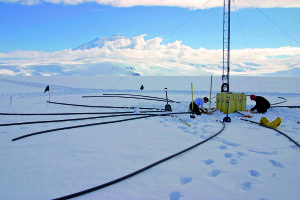
Performing maintenance at CTBTO infrasound station IS55, Windless Bight, Antarctica. (Source: CBTBO via Wikipedia)
Pending those eight ratifications for the CTBT entry into force, the Preparatory Commission for the CTBT Organization (CTBTO) is building up an extensive and sophisticated global International Monitoring System (IMS) which will serve to monitor and verify compliance with the Treaty. With over 85% of the IMS’ facilities in operation, the CTBT is already providing ‘a firm barrier against a qualitative and quantitative development of nuclear weapons for both nuclear weapon-capable states and then would-be possessors‘.
Proof of the partially complete verification regime’s detection capability has been showcased by the three nuclear tests conducted since 2006 by the DPRK, the only remaining state defying the established international anti-testing norm. Since the international community unanimously condemned the 1998 round of tests by India and Pakistan, defying the non-testing norm and global de facto moratorium established by the CTBT, the two states in South Asia have implemented and observed unilateral moratoria on nuclear testing.
Concerns about a DPRK fourth test
The urgency of reaffirming the importance of the CTBT and re-energizing efforts to bring the Treaty into force, should be ever present with concerns about a possible fourth nuclear test as threatened by the DPRK earlier this year. The DPRK is the only state that has disregarded the testing moratorium and non-testing norm since 1998 with its three successively larger nuclear tests (in 2006, 2009 and 2013). South Korean Foreign Minister Yun Byung-se warned earlier this year that a fourth test by North Korean would be a “game changer” for the region.
Even with the DPRK remaining a wildcard on prospects for ratification, not least given the shaky political conditions for regional resumption of dialogue on the nuclear issue while Kim Jong Un consolidates his regime, the other seven Annex II states can lead in responsibly committing to shore up their legal commitment to the non-testing norm.
Improving regime atmospherics for the 2015 NPT Review Conference
The CTBT and the NPT are interlinked and thus progress on the CTBT would serve to garner positive atmospherics for the NPT review process, in 2015 and beyond. The 1995 NPT Review Conference (RevCon) indefinite extension of the NPT and the 2000 NPT RevCon’s ‘13 steps’ (steps 1 and 2) called on states for action and commitment to a CTBT. More recently, five of the 64 action points in the 2010 NPT RevCon’s Action Plan stress bringing the Treaty into force. Given the growing discontent within the NPT review process due to the perceived lack of progress on disarmament commitments, a renewed and reinvigorated commitment to the CTBT by NPT states parties could ameliorate the atmosphere and help to build confidence and momentum.
Two initiatives within the nuclear non-proliferation and disarmament regime—the Helsinki Conference for discussing the establishment of a Weapons of Mass Destruction-Free Zone (WMDFZ) in the Middle East, and the humanitarian consequences initiative concerning the impact of nuclear weapons—could provide an impetus for renewed focus to the importance of legally committing to the CTBT. Both of these initiatives, which continue to enjoy a broad divergence of views, could serve to channel attention on ratification of the CTBT as a key trust- and confidence-building measure and a foundational first-step for progress on the aims of the two initiatives.
Given the active civil society engagement of the humanitarian initiative, some of these agents could focus efforts on promoting the entry into force of the CTBT, channelling campaigns to lobby and engage their elected parliamentarians on the importance of the CTBT.
If any of the three remaining Annex II states from the Middle East region – Egypt, Iran and Israel – were to legally commit to refrain from nuclear testing, it would be a hugely significant political and confidence-building gesture for the high-profile efforts to convene a conference which was mandated by the 2010 NPT Review Conference to take place in 2012. Given the ongoing P5+1 talks with Iran, such a step by Iran would further serve to reassure the international community about the intent and peaceful nature of its nuclear programme.
Multilateral initiatives
UN High Representative for Disarmament Affairs Angela Kane encouraged states to seize the high-profile opportunity to sign or deposit their instruments of ratification at an event held on the margins of the UN General Assembly this month. As an interim step, short of signing or ratifying the CTBT, other proposals to further consolidate the anti-testing norm and moratorium include a suggested UN Security Council resolution condemning nuclear tests as a threat to international peace and security, and regional pledges committing member states to refrain from nuclear tests or even sub-critical experiments not prohibited by the CTBT.
Notably, the Community of Latin American and Caribbean States (CELAC) endorsed such a regional commitment in its declaration on nuclear disarmament at a meeting in Buenos Aires in August 2013. Such effort could be replicated by other regions or via multilateral negotiating groupings operating in the nuclear non-proliferation regime. Regional and other groupings could pledge to highlight this issue at every nuclear-relevant forum and opportunity in efforts to cross-germinate this message.
Annex II states particularly, as well as other states and groupings, should welcome, engage and promote the efforts of the CTBTO’s Group of Eminent Persons (GEM), comprised of high-profile experts and former officials aiming to promote the CTBT’s entry into force. Through the support of such initiatives, awareness can be raised. Further to raising awareness and educating civil society, efforts such as the CTBTO’s public training courses and NGOs’ public information and awareness efforts should be supported, promoted and even replicated regionally as force multipliers.
J. Robert Oppenheimer recounted of those witnessing the Manhattan Project’s first atom bomb test (the 1945 Trinity test), “we knew the world would not be the same; a few people laughed; a few people cried; most people were silent.” Indeed, the world has not been the same and the proverbial nuclear genie cannot be put back in the bottle. But states can make the legal commitment to ban all nuclear tests, anywhere. 18 years after the CTBT opened for signatures, responsible states should commit efforts to facilitate the ratification of this Treaty.
Jenny Nielsen is a Postdoctoral Research Fellow in the School of Political Science and International Studies at the University of Queensland. Previously, she was a Research Analyst with the Non-proliferation and Disarmament Programme at the International Institute for Strategic Studies (IISS), a Programme Manager for the Defence & Security Programme at Wilton Park, and a Research Assistant for the Mountbatten Centre for International Studies (MCIS) at the University of Southampton, where she co-edited the 2004-2012 editions of the NPT Briefing Book.









 This case study explores the potential impact of climate change on security and conflict in Bangladesh. As international researchers have started to make the link between climate change, insecurity and conflict, they have raised concerns that Bangladesh’s extreme vulnerability to the environmental effects of climate change may create conditions that put it at risk of greater insecurity and possible conflict.
 The Middle East and North Africa is a region of great diversity. It encompasses Arab and many other ethnic populations, theocratic and secular states, democracies and authoritarian regimes. A region of immense wealth and crippling poverty; it is blessed (some might say cursed) with vast resources, not least oil, but has not always proved able to manage them for the benefit of ordinary people.
  This excellent report by International Alert examines the growing risk of armed conflict as a result of climate change now being experienced by some of the most fragile regions of the world, and reveals the alarming consequences of continued inaction to enable affected countries to adapt to the consequences of climate driven changes on their populations.
 Asia is a region in transition, and transition creates uncertainty. The political, economic and societal landscape is shifting, with major new powers emerging and smaller states attempting to protect their interests in this changing dynamic. At the same time, climate change and the other long-term emerging threats to security will require regional responses and thus a degree of regional unity.
  Climate change will have serious environmental, socio-economic and security consequences for both developed and developing nations alike. This report explores these consequences and demonstrates that they will present new challenges to governments trying to maintain domestic stability.
  CNA Corporation, a US Department for Defense funded think-tank, published this report in April 2007. The report was produced by CNA’s writers and researchers under the guidence of a Military Advisory Board (MAB) consisting of retired admirals and generals.
  Many leading military analysts in the United States are increasingly alert to the link between security and climate change. Is international terrorism really the single greatest threat to world security?