Blog

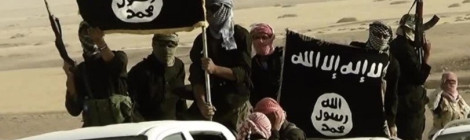
  • Muslim Paranoia? Ideology and the Limits of Engagement

  • Can Former Combatants Assist in Preventing Violence?

  • Conservation as a Tool for Post-War Recovery

  • Countering Militarised Public Security in Latin America: Understanding the trend in Venezuela

    Countering Militarised Public Security in Latin America: Understanding the trend in Venezuela

    Across Latin America, governments are sending their militaries into the streets to act as de facto police forces in the face of disproportionally high crime and violence rates. This trend has been going on for several years, but has accelerated in 2013. With the move to deploy over 40,000 troops for citizen security in Venezuela, President Nicolás Maduro joined a growing list of leaders throughout the region that have relied on their militaries to carry out police duties. In the first of our two-part discussion ‘Countering Militarisation of Public Security in Latin America’, Sarah Kinosian discusses the conditions that are causing the trend to thrive.

    Read Article →

  • Gaza: Context, Consequences and the Utility of Force

    This post is based on Paul Rogers’ Monthly Global Security Briefings for Oxford Research Group and was originally posted  on 31 July, 2014. At the time of writing (31 July), Israeli Operation Protective Edge had exceeded the previous major operation, Cast Lead of 2008-9. Both operations have involved intensive use of air strikes combined with major ground incursions. The current war is already longer than the 2008-9 war, with no end in sight. Indeed, by the end of July, positions were hardening and prospects for anything longer than brief further humanitarian pause seemed remote. This briefing provides some context for the conflict together with a preliminary analysis of possible consequences.

    The War So Far

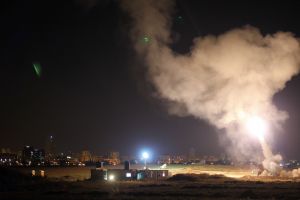
    Iron Dome in Operation Protective Edge Source: Wikipedia

    Iron Dome in Operation Protective Edge Source: Wikipedia

    The current war started on 8 July with intensive Israeli air and artillery assaults on Hamas paramilitary targets, intended primarily to destroy or greatly limit the Hamas ability to fire unguided rockets over much of Israel. In spite of the level of force used, the rocket fire continued, amidst growing concern within the Israeli Defence Forces (IDF) that paramilitaries had constructed many more infiltration tunnels than had been realised. A ground assault followed the initial air assault, with this being intended to destroy rocket launch facilities and stores and also interdict tunnels. As a consequence of this assault, the IDF suffered many casualties, including the deaths of 13 men from the elite Golani Brigade in a single day (20 July). Even after 10 days of conflict, with intensive IDF operations against the infiltration tunnels, Hamas paramilitaries managed to get under the border and in a brief attack killed five young IDF sergeants on a leadership training course. One Hamas paramilitary was killed but others appear to have returned to Gaza. Over the course of the war so far, Israeli forces have struck at over 3,700 targets in Gaza while more than 2,700 rockets have been launched by Hamas and other groups from Gaza towards Israel. The death toll among Palestinians exceeds 1,350 and is rising markedly each day. At least 6,000 people have been injured. Israel has lost 56 soldiers and three civilians, and more than 400 soldiers have been wounded. On 31 July, the 24th day of the war, Israel announced the calling up of a further 16,000 reservists, to bring the total call-up to 86,000. There has been considerable controversy over the numbers of civilian casualties in Gaza, especially the hitting of schools, hospitals and a market. UN figures indicate that at least 70% of those killed are civilians, and nongovernmental international support for Hamas has increased substantially. Public opinion in Israel remains very strongly in favour of continuing the war as a means of stopping the rockets and destroying the infiltration tunnels.

    Support for the Adversaries

    Hamas: In the past three years, Hamas has lost much of its international support from governments in the region, even though Gaza has existed in what amounts to an open prison controlled by Israel. The Egyptian government of President Sisi is strongly opposed to the Muslim Brotherhood and regards Hamas as a part of this wider movement. The consequent near-total closure of the common border with Gaza and the control of access tunnels has had a marked economic effect on Gaza, exacerbating its siege status. Furthermore, Hamas’s support for Islamist paramilitaries in Syria has lost it the support of the Assad regime in Syria and, to an extent, of the Iranian government. The recent rapprochement between Hamas and Fatah survives, if currently strained, but causes the Israeli government considerable concern. In spite of all the limitations, Hamas’s paramilitary wing has been able to assemble many thousands of rockets and mortar rounds and has also built a network of robust infiltration tunnels that has greatly exceeded Israel’s pre-war estimates. Hamas as a movement retains considerable support in Gaza, with even the impact of the Israeli air and ground assaults having little effect. Israel: Israel retains a measure of support of many western governments but there are growing concerns at the civilian losses in Gaza. The IDF and the defence industry as a whole have very close connections with their US counterparts. The key missile defence system, Iron Dome, is essentially a US-Israeli joint production, including current plans to set up a new production line in the US. Israel is also able to use US munitions stored in Israel. The US is in a position to put very heavy pressure on Israel but is deeply reluctant to do this at present, mainly because of domestic support for Israel. This support remains high but is declining

    Cast Lead and Protective Edge

    Both the 2008-09 and 2014 Israeli operations have had similar aims – to so damage Hamas that it is massively restricted as a threat to Israeli security. A comparison of the operations so far is indicative. Cast Lead lasted 23 days and ended with a ceasefire brokered largely by Egypt. During that period, Hamas and other groups launched 750 rockets and mortars, all relatively short-range. Israelis lost 13 lives, four of them to friendly fire. Israel killed 1,440 people in Gaza, claiming that half were militants, though Hamas denied this. Since the 2008-09 operation, Israel has deployed the Iron Dome system, and this has intercepted the great majority of approximately 2,700 rockets and mortars fired during Protective Edge.  Hamas has, though, hugely increased its capabilities over the past six years, in spite of its recent political isolation, and has exacted a much higher toll on IDF soldiers during the current ground assault than in 2008-09: 56 so far compared with 13 before. In this sense, the aim of Cast Lead – to substantially degrade Hamas’s crude offensive systems – was a singular failure. Even with the Iron Dome system, vulnerabilities have been demonstrated by the closure of Ben Gurion Airport to several international carriers for several days last week, following a rocket which penetrated the missile shield and landed within a mile of what is Israel’s gateway airport. The loss of so many Israeli soldiers may still seem small compared with the huge losses in Gaza, but the IDF is held in very high regard in Israel.  Indeed, support for the war has likely increased because of these losses and the partial closure of the airport. These appear to have combined to convince many Israelis that, though Hamas is weak and hugely restricted in its location, it represents such a threat to Israel that a protracted war is, if need be, fully justified. The phrase “impregnable in its insecurity” has sometimes been applied to Israel and it is useful in understanding the outlook of a very powerful country that still feels vulnerable.

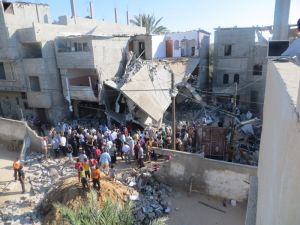
    The home of the Kware' family, bombed by IDF forces. 8 civilians, including 6 minors, were killed. Gaza, 8 July, 2014. Source: B’Tselem

    The home of the Kware’ family, bombed by IDF forces. 8 civilians, including 6 minors, were killed. Gaza, 8 July, 2014. Source: B’Tselem

    What Now?

    At the time of writing (31 July) it is possible that another humanitarian pause might be agreed and might lead to something more substantial. Assuming that this does now happen, the indications are that the IDF will continue its operations to destroy rockets and tunnels, and Hamas paramilitaries will resist. Given the IDF casualties to date, a pattern is likely to emerge in which urban counter-paramilitary operations will prove both difficult and costly, and the IDF will rely much more on its huge firepower advantage. This is very much what happened with US and coalition forces in Iraq from 2003, and even more so with the Israeli siege of West Beirut in 1982 when at least 10,000 people were killed, the great majority of them civilians. It is already evident that targeting has moved on to the more general Hamas infrastructure, but the very nature of the densely populated Gaza Strip means that the infrastructure for the whole community is also hugely affected. Given the existing impoverishment of the area, the human consequences will be severe, as UN staff have been pointing out repeatedly.

    Consequences

    In all of its operations against Hamas – Cast Lead in 2008-09, the more limited air assault in 2012, and the current war – Israel has sought to severely damage Hamas’s paramilitary capabilities, and decrease its domestic support. In the first two conflicts that objective was not achieved, and it is unlikely that Israel’s current operation will succeed this time around. In spite of Hamas’s greater international isolation, its paramilitaries have this time had a substantial impact on the IDF, and the movement retains domestic support. Moreover, international public opinion has moved heavily against Israel. One of the major changes in comparing the current war with the two previous wars is that the use of social media has hugely expanded, resulting in graphic images being distributed across the region and beyond in near-real time. One effect of this, in turn, is that the more conventional western media reporting is itself becoming more graphic. In spite of a very efficient Israeli information operation, this change is working against Israel’s interests. It also means that Islamist propagandists across the Middle East and beyond are easily able to present the war as a further example of “Zionist aggression”. Indeed, they will also relentlessly point to close US-Israel links, further developing their long-term image of a “Crusader-Zionist war on Islam”, in spite of Secretary of State Kerry’s undoubted personal commitment to achieving a ceasefire. The long-term consequences of this are difficult to read, but could give a boost to radicalisation well beyond Israel and the occupied territories. That alone is an added reason why a ceasefire at the earliest opportunity is not only desirable but essential.

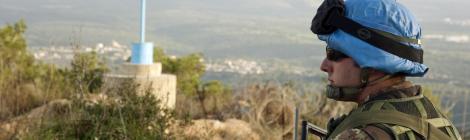
  • Walking the Blue Line: Lebanon’s Security Sector Reform

  • The Environment and Conflict in 2016: A Year in Review

    Breaking the silence: Protecting civilians from toxic remnants of war

    Toxic remnants of war and their legacy of civilian harm is seriously under-explored as an area of conflict. There is a growing consensus that the current legal framework governing conflict and the environment is not fit for purpose – so how could new international norms that merge environmental protection with civilian protection come into effect?

    Read Article →

    Environment, Energy, Economy: a threefold challenge to sustainable security

    Whether it’s the economy, energy or the environment which you value most, when it comes to security, each holds equal weight. If security can be defined in terms of what is or isn’t sustainable, then it must evolve to incorporate additional elements that transcend more traditional views on geopolitics.

    Read Article →

  • Deforestation: REDD-y for peace or fuelling conflict?

    by Janani Vivekananda and Shreya Mitra

    REDD forestry efforts don’t pay enough attention to their influence on local conflict dynamics. For REDD+ to be an effective mechanism to curb deforestation and strengthen peace opportunities, it has to pay more attention to pre-existing land and forest conflicts linked to tenure, take into account the interests of the local communities and be more sensitive to the local context .

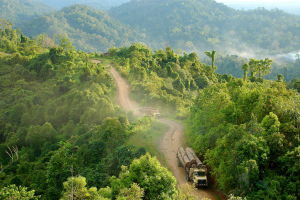
    trucks carrying logs in Gunung Lumut, Kalimantan Timur, Indonesia, November 2005. Source: CIFOR (Flickr)

    Trucks carrying logs in Gunung Lumut, Kalimantan Timur, Indonesia, November 2005. Source: CIFOR (Flickr)

    Indonesia has for the first time surpassed Brazil’s historical record of being at the forefront of deforestation suggests a new study published in the journal Nature Climate Change. Despite a government-signed moratorium in 2011 to slow down the pace of deforestation, the study reveals that Indonesia has lost virgin forests of 60,000 sq. km, an area roughly the size of Ireland, over a period of 12 years.

    The accelerated rate of deforestation raises concerns about the governance of forests in Indonesia and the effectiveness of the moratorium. It also highlights the missed opportunities to preserve the forests and bring about greater peace dividends, especially in a context where peace remains fragile and unequal forest rights remain unresolved. In conflict-affected areas, availability and access to forest resources can either make conflict worse or contribute to peace. If you accept the case, as many do, that the impacts of climate change make it harder to build peace, there is also a compelling argument that mitigating climate change by reducing deforestation, if done right, could offer significant peace opportunities by addressing inequalities and grievances of marginalised forest-dependent communities.

    REDD Programmes and Peacebuilding

    Yet despite the importance of forests to both climate change mitigation and peace, deforestation continues at an alarming rate as seen in the case of Indonesia. To combat deforestation and preserve forests as carbon sinks, the United Nations Framework Convention on Climate Change (UNFCCC) in 2005 introduced a mechanism called Reducing Emissions from Deforestation and Forest Degradation (REDD). Under REDD, more developed countries pay for programmes in less developed countries to preserve forests. Later, a ‘plus’ was added to REDD introducing the elements of conservation, sustainable forest management and enhancement of forests as carbon sinks. The financial dimensions are significant. For example, Norway as the biggest contributor has pledged over $1.4 billion to REDD+ funds. Most of the money targets Latin America and the Caribbean, sub-Saharan Africa and Asia. For Indonesia alone, $156 million of REDD+ funding has been approved.

    From a peacebuilding perspective, REDD+ and other efforts to promote sustainable forest management offer both peace opportunities and conflict risks. The conflict risks of REDD+ often have to do with land ownership and forest access. The peace opportunities associated with REDD+ are wider recognition of the multiple economic, social and cultural values of forests and a strengthening of the rights of local communities that depend on the forest. Poverty may also be reduced if the financial benefits of REDD+ are shared, and income opportunities created for local residents, who may work as forest monitors and guards.

    In 2006, in Aceh, Indonesia, initiatives by the newly formed government on forest protection and supporting smallholder plantations, as well as the social opportunities offered by REDD investment, showed real promise for building a sustainable peace in the conflict-affected region. The REDD investment fell through after investors withdrew, but this experience hints at the potential for REDD to exert a positive influence on politics and power relations in a post-conflict context.

    Short-Term Gains

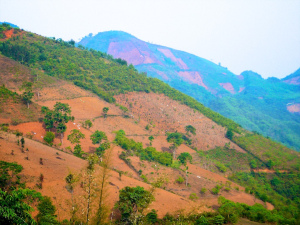
    Patchwork mountain landscape of agriculture, forestry, and deforested terrain, Tianlin County, Guangxi Zhuang Autonomous Region, China. Source: CIFOR (Flickr)

    Patchwork mountain landscape of agriculture, forestry, and deforested terrain, Tianlin County, Guangxi Zhuang Autonomous Region, China. Source: CIFOR (Flickr)

    Yet given the prospect of sums of money to be gained (in the short-run at least), there is a very real risk that communities can make decisions based on short-term profit or be bought off by entrepreneurs hoping to capitalise on REDD+. This means that while community involvement is critical, it alone is not sufficient and should certainly not be viewed as a silver bullet for equitable forestry that supports peace.

    As a member of the Dhankuta District Community Forest Management committee explained during International Alert’s research in Nepal: “Forest-user groups might plant trees but don’t always protect them. How can a forest grow if you just plant trees and don’t protect them? People have begun to misuse resources. There is too much freedom and too little responsibility. Poverty is also a factor. People want an immediate return, instead of a better long-term gain.” In Papua New Guinea, many landowners are not aware of their rights, leaving them vulnerable to exploitation by ‘carbon cowboys’ who gain control of land and forests to capitalise on REDD+ funding. While REDD+ caused this problem, the mechanism also drew international attention to the issue, which in turn helped push the government to improve its policy on revenue-sharing.

    During International Alert’s research in Odisha in India, respondents reported that forest degradation is a key challenge for them. Forest conservation projects could help here to develop a forest management that is beneficial to both communities and carbon reduction. On the other hand, there is a risk that governments use REDD+ as an instrument to restrict the access of local communities to forests and thereby undermine their livelihoods. In addition, incoming finance can fuel existing corrupt structures or cause grievances if it is not shared in a transparent and balanced manner.

    Striking a balance

    Our research in Bangladesh showed that restrictions on access to the Sundarbans mangrove forest may be useful for conservation purposes but local communities perceived them as a direct obstacle to sustain their livelihood, in the short term at least. This highlights the challenge between balancing conservation and community interests. As with the case of Bangladesh, poor Indonesians dependent on forests for their livelihoods have not been provided a viable alternative source of income, which is one reason why deforestation continues.

    Compared with Indonesia, Brazil has been much more proactive on the issue of land and forest tenure and therefore better placed to manage issues of illegal logging and deforestation. Brazil has through REDD+ initiatives been recognising and delineating customary lands and creating new protected areas though these have been beset with some problems.

    For REDD+ to be an effective mechanism to curb deforestation and strengthen peace opportunities in Indonesia, Brazil and elsewhere, it has to pay more attention to pre-existing land and forest conflicts linked to tenure, take into account the interests of the local communities and be more sensitive to the local context

    Janani Vivekananda is Environment, Climate Change and Security Manager at International Alert. Her specific interests include the implications of climate change policies on peace, the links between climate change and community resilience, and opportunities for positive responses to climate and environmental change and disasters.

    Shreya Mitra Programme Officer with the Environment, Climate Change and Security team at International Alert. She previously worked as a Research Consultant for ODI, Save the Children and Social Development Direct. 

    Featured image: Patchwork mountain landscape of agriculture, forestry, and deforested terrain, Tianlin County, Guangxi Zhuang Autonomous Region, China. Source: CIFOR (Flickr)

  • UN Peacekeeping and Counter-Terrorism

    There are strong calls to give UN peacekeeping operations more robust mandates to engage in counter-terrorism tasks. But the idea of UN peacekeepers conducting counter-terrorism operations is not without its problems.

    Terrorist attacks have been increasing rapidly over the last decade. According to the Global Terrorism Index, 29,376 people were killed in terrorist attacks in 2015. This was the second deadliest year after 2014, when 32,765 people were killed. The spike in 2014 and decline in 2015 is largely a result of the rise and subsequent weakening of Boko Haram and the Islamic State (IS).

    Fatigue after long engagements in Afghanistan and Iraq and the continued impact of the financial crisis has significantly dampened the interest in new out-of-area operations among Western member states. At the same time, the threats of terrorism and migration remain at the top of the foreign policy agenda. It is in this environment that policy makers are turning to the UN, to see what role it can play in the global security burden-sharing. This means a more transactional relationship with the UN, not necessarily considering the longer-term impact of undermining its impartiality and legitimacy.

    UN peacekeeping operations have, during the last decade, been deployed to protect civilians in increasingly unstable conflicts, most often without a peace to keep. However, although the conflicts have been asymmetrical in nature, armed groups have seldom perceived the UN as a party to the conflict, and pursued a strategy of strategic targeting of its troops, police and civilians.

    The Case of Mali

    Image credit: MINUSMA/Flickr.

    In March 2012, a coalition of rebel and Islamist groups took control of the north of Mali in the wake of a coup. On April 6, 2012, the rebels proclaimed the independence of the ‘Republic of Azawad’ and the imposition of sharia law in northern Mali. 412,000 persons had fled their homes and had become internally displaced or moved across the border to Mauritania, the Niger and Burkina Faso. By November 2012, Al Qaida in the Islamic Maghreb (AQIM) had taken control of Timbuktu and Tessalit, the Movement for Unity and Jihad in West Africa (MUJAO) had taken control of Douentza, Gao, Menaka, Ansongo and Gourma, and Kidal was under the control of the Islamist group Ansar Dine (“defenders of the faith”).

    The Islamists and rebel groups were quickly conquered and fled to the far north of Mali after a short and swift intervention in the beginning of 2013 by the French Opération Serval, in cooperation with the African-led International Support Mission in Mali (AFISMA). To avoid being stuck in a long and bloody counterinsurgency, the French had pushed for a swift handover to the UN.

    On 1 July 2013, AFISMA handed over authority to the UN multidimensional integrated stabilisation mission in Mali (MINUSMA). However, the Islamist groups have proven resilient and the operation has been struggling to deploy and implement its mandate. From its inception in 2013 until 31 January 2017, it has endured 72 fatalities due to hostile actions, including suicide attacks, mortar attacks and improvised explosive devices (IEDs). The mission has been given increasingly robust mandates, and its most recent mandate ordered the mission to “…to stabilize the key population centres and other areas where civilians are at risk, notably in the North and Centre of Mali, and, in this regard, to enhance early warning, to anticipate, deter and counter threats, including asymmetric threats…”.

    The mission is actively supporting counter-terrorism actions, as it has been preparing “targeting packs” and has been informally sharing information with the French parallel counter-terrorism operation Barkhane  (the French follow-on mission from Serval). This follows a trend towards peace enforcement that started with MONUSCO, where the UN peacekeeping mission in the Democratic Republic of Congo (DRC) is now being mandated to “neutralize” identified rebel groups.

    Future missions may be deployed to Libya, Syria and Yemen – countries that are also marked by asymmetric conflict and violent religious extremism. Against this backdrop, many member states are now arguing that UN peacekeeping operations need to reform to not only deal better with the challenges it faces in Mali, but also in future operations.

    The high-level panel on peace operations, nominated by former UN Secretary-General Ban Ki-moon, strongly underscored that UN peacekeeping operations should not undertake “counter-terrorism operations”. However, the report left the back-door open, insofar as it argued that “UN peacekeeping missions, due to their composition and character, are not suited to engage in military counter-terrorism operations. They lack the specific equipment, intelligence, logistics, capabilities and specialized military preparation required, among other aspects.” Disregarding the principled arguments against moving UN peacekeeping in such a direction, this could indeed be read as a list of areas where reform is needed to enable UN peacekeeping to take on counter-terrorism tasks.

    A Desirable Shift?

    But what may the consequences be of taking UN peacekeeping operations in such a direction? First, UN peacekeeping missions are not likely to be able to perform counter-terrorism tasks in a satisfactory manner, militarily speaking. They are composed of troops from many different countries, and although they should provide a military deterrent against armed groups, they are not likely to be able to protect themselves against asymmetric attacks. Even small attacks can lead to the withdrawal of troops by troop-contributing countries, as most of these do not have the political interest needed to be able to sustain losses. The exception to this are neighbouring countries, as these may have a political interest in the conflict, but precisely because of this fact they may also be interested to use force only against some and not all parties that threaten the peace.

    The UN has been strongly criticised for not taking action to protect civilians, and the continued inaction has been used as an argument to make the UN more robust, as well as able to take on counter-terrorism tasks. However, this argument confuses the ability of the UN to protect civilians with counter-terrorism. In Mali, the mission is much busier protecting itself than protecting civilians. In fact, the recruitment to the terrorist groups is increasingly moving south in the country, as local populations are not experiencing a peace dividend or improving levels of participation and inclusion after the deployment of MINUSMA. Rather, they are experiencing a government that is continuing to marginalize significant groups of the population such as the Tuaregs in the North and the Fulani (also known as Peul) in the central regions of the country, and employ draconian counter-terrorism tactics.

    The inclusion of neighbouring countries’ troops in UN peacekeeping missions was previously considered a red line. As seen with the example of MINUSMA, as well as UN peacekeeping missions in the Democratic Republic of Congo and South Sudan (to mention a few), this principle has fallen by the wayside. Taken together with the move towards UN peacekeeping missions taking on counter-terrorism tasks, this shows a trend towards a more partial UN in these situations, which may increasingly be rendered unable to play its vital good offices and humanitarian roles, and be a UN for all the people, not only the government of the day. The UN and member states should reverse this trend, and make sure that UN peacekeeping operations can serve in their most effective way – as a tool to keep the peace while institutions, service delivery and an inclusive and participatory state is being built.

    John Karlsrud is the Manager of the Training for Peace program. He is on Twitter at @johnkarlsrud.

  • Mano Dura: Gang Suppression in El Salvador

    Mano Dura: Gang Suppression in El Salvador

    Widespread social exclusion makes El Salvador fertile ground for gang proliferation and, over time, gang members have resorted to greater levels of violence and drug activity. Yet, government approaches have proved spectacularly ineffective: the homicide rate escalated, and gangs have adapted to the climate of repression by toughening their entry requirements, adopting a more conventional look, and using heavier weaponry. Sonja Wolf argues for approaches which focus on prevention and rehabilitation and looks at why such approaches have been continually sidelined.

    Read Article →