Blog

  • Resilience and Hope: Youth and Peacebuilding in Palestine

    Today’s younger generations of Palestinians desperately need to become more engaged in community peacebuilding activities to end the division of Palestinian society.

    The engagement of the younger generation in civil society work to promote peacebuilding concepts and practices at both grassroots and political levels is necessary for restoring order and security in societies divided by conflict and violence. This is particularly true of Gaza in Palestine where the inhabitants live in an environment where there is violence, extreme poverty and a lack of freedom.

    Palestinian youth and civil society face many challenges related to the harsh circumstances imposed by a lack of peace, security and economic development since the failure of the so called ‘Peace Process’ in 2000 between the Palestine Liberation Organization (PLO) and Israel. There have, however, been a variety of projects and programmes installed to raise youth awareness and the importance of civil society values and practices to achieve human rights, peacebuilding and good governance that help bring hope to a young generation, despite some of the local cynicism.

    Cynicism towards youth

    I always remember the cynical questions raised by many Palestinian citizens while engaging in civil society activities at different levels: “What kind of civil society under occupation are you talking about?” “How will civil society promote and advocate the values of peacebuilding under a territory experiencing foreign occupation?” There are still some Palestinian intellectuals, leaders and activists who do not believe in education for peacebuilding in a country under occupation, but they believe strongly in community peacebuilding to restore the order and security of their own society, after years of division and the failure of the ‘peace process’.

    They also go beyond just cynicism and move into absolute pessimism and defeatism by asking: “How can empowering youth in peacebuilding be effective, while they still suffer from the violence under Israeli occupation and a lack of freedom?” “How will civil society organisations promote and persuade youth to become engaged in activities while an overwhelming majority are poor, jobless and losing hope in the future?”

    An example is often raised that during the last five years, several young people committed suicide in the Gaza Strip, owing to the harsh economic and social circumstances. This society, however, has little experience of suicide, as it is known for its spirit of religious education and social solidarity, which have always prevailed and are considered to be the highest in the region.

    Cynics believe that talking about the empowerment of youth involvement in peacebuilding activities in Gaza is a matter of ‘idealism’ and ‘luxury’, a waste of resources and time because they see such pursuits as being only achievable through  concurrently obtaining freedom and national independence in a viable Palestinian state. Cynics often point out that there were many peacebuilding activities implemented in the Green Line between 1995 and 2000.

    Many Palestinian citizens from the various health, NGOs and environmental sector participated at capacity building development courses inside the Green Line. They enjoyed education, trips and nice food, but not sustained peace or security, as the main cause of the problems, the need to establish of a Palestinian state, had not yet been solved. These activities passed without any glimpse of hope or peace after the failure of the ‘peace process’ that led to the breakout of various cycles of violence including the latest war in the Gaza Strip in the summer of 2014 and changed both the context and style of life, after massive destruction.

    Life Style
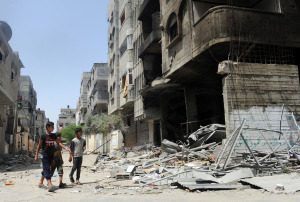
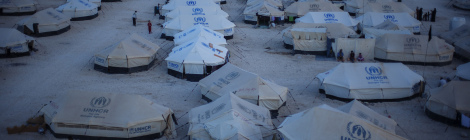
    Image credit: UN Photo/Flickr.

    The Palestinian people are used to the daily life style of suffering and the absence of human security; they lost their top priority of securing their own basic human, needs during the failure of the 2000 ‘peace process’ and the collective punishment policies exercised by the occupation. They have lost their own economic, food, health, environmental, personal, community, political and human security. In 1994, the UNDP defined human security, which is achieved when people can exercise their choices safely and freely, and when they can be relatively confident that the opportunities they have today will not be entirely lost tomorrow.

    The Gazan people cannot plan their own day without any interruption, owing to the circumstances imposed by a lack of electricity, pollution and a devastated economy. As Mohammed Srour, a field researcher at a human rights organisation in Gaza says

    “The Palestinian people now busy with their own daily affairs, living without electricity and facing the entire closure on the strip and the invasion of pollution of their environment and beaches, owing to the lack of electricity. The citizens have no place to go in Gaza to escape the heat of the summer because of the lack of electricity. The sewage flows into the sea as the pumps and wasting stations do not work without electricity. The beaches are fully polluted and people cannot enjoy swimming in the sea to escape from the extreme heat any more in most coastal areas”.

    Gaza’s economy has actually been virtually stagnant for the past ten years, with an average annual real GDP growth rate over the decade not exceeding 1.44%, while Gaza’s population has grown by 38.4% over the same period.

    Today’s younger generations of Palestinians desperately need to become more engaged in community peacebuilding activities to end the division of Palestinian society. But the dire circumstances have deepened the wounds of Gazan society and made the life of the younger generation almost unbearable and impossible. Consequently, many young Palestinians have decided to leave rather than stay and help build peace.

    The Brain Drain of Palestinian Youth

    Many young minds have already left Palestine to find a new environment and hope. More than 21 young people who attempted to find their way to Europe lost their lives in the Mediterranean in 2014 when one of their boats was wrecked and their fate is still unknown to this day. However, the rest of the youth who could not leave after the full closure of the tunnels between the Gaza Strip and Egypt spend their time navigating social media and the internet.

    They enjoy their chats which help them escape from the harsh politics and economic realities, attempting to watch any developments posted by other fellows or friends online. Facebook, in particular, is considered their own ideal ‘city’ of information and it is a way of ‘killing the time’, as many young people are always informing me when I have a conversation with them. They have lost hope in local politicians, political groups, the international community and civil society organisations in helping them to change their circumstances. There are many who accuse these actors of lying, trading off and using the suffering of the Gazans to increase their power, wealth and business. But not all have abandoned hope.

    Resilience and Hope

    Despite the seemingly dire straits of life, the youths of Palestine are still resilient enough to try change the de facto situation, by engaging in community initiatives. They have, for example, on different occasions, engaged in non-violent and peaceful protests to contribute to the ending of the circumstances in the West Bank and the Gaza Strip. For example, the youth march movement in 2012 during ‘the Arab Spring’ to end the Palestinian division. After 2014 war in Gaza, they also participated actively, in non-violent activities to end the siege in the Gaza Strip by protesting close to the ‘buffer zone’ or in front of the ‘security fence’ with Israel in the Gaza Strip.

    Now, in 2017, the Palestinian youth, across their homeland, have seized the initiative again to protest peacefully against the closure of Al Aqsa. They are still seeking a better future and attempting to find any opportunity for hope and change. They attempt to find out about the latest leaks of reconciliation between Hamas and a Fatah wing in the Gaza Strip to end the conflict between the two sides that has divided the Palestinian house. If reconciliation takes place between the two sides, it will contribute to changing the social and political circumstances of the entire society and of youth in particular.

    In addition to these political developments, there have been a number of community activities to help keep youth hopeful for a better future. For example, the Gaza youth UNRWA Football team that won the Norway Cup last year continued preparation and already left the Strip for Denmark and Norway to participate in two different international football tournaments in the last week of July and the First week of August. This kind of participation always gives youth and the whole society hope that there is still a bright future coming soon where they can achieve justice, peace and freedom.

    Dr Ibrahim Natil is a Fellow at the Institute for International Conflict Resolution and Reconstruction, Dublin City University http://iicrr.ie/people/fellows/dr-ibrahim-natil/. He is an international human rights campaigner, nominee for the Tällberg Foundation Global Leadership Prize, 2016 and the founder of Society Voice Foundation http://www.mbialumniassociation.org/alumni-news/news-folder/year-of-publication/2016/qa-ibrahim-natil/

  • China and the Responsibility to Protect

  • Kurdish Questions: An Interview With Yaniv Voller

    voller

    Dr. Yaniv Voller is a Lecturer in the Politics of the Middle East at the School of Politics and International Relations, University of Kent. Prior to that he was a Leverhulme Early Career Fellow at the School of Social and Political Science, University of Edinburgh. He gained his PhD in International Relations at the London School of Economics and Political Science, his MSc in Middle East Politics at the School of Oriental and African Studies, University of London, and his undergraduate degree at Tel Aviv University. His current research examines the impact of colonial-era legacies and practices on the strategies of the liberation movements and the governments involved in these wars, focusing on the liberation wars in Iraqi Kurdistan and Southern Sudan. His previous book, The Kurdish Liberation Movement in Iraq: From Insurgency to Statehood, was published in 2014 as part of Routledge’s Studies in Middle East Politics series. His articles have been published in International Affairs, the International Journal of Middle East Studies and Democratization, among other journals.

    Dr. Voller discusses the history of, and recent developments in, the Kurdish struggle for a homeland.

    Q. Numbering approximately 35 million worldwide, the Kurds are often referred to as the largest group of stateless people in the world. Today, the Kurdish nationalist movement is often seen as one of the largest worldwide campaigns for self-determination. Who are the Kurds and what are the origins of their struggle for a homeland?

    The Kurdish people are a distinct ethnic group, concentrated mostly in a broad region which is often referred to as Kurdistan. Most of the Kurds are Sunni Muslims, but there are large Shi’i, Yezidi and other Kurdish-speaking communities.

    Already during the time of the Ottoman and the different Iranian empires there existed semi-autonomous Kurdish kingdoms that served as a buffer between the two empires.

    Modern Kurdish nationalism emerged in the late 19th and early 20th century, along with other nationalist movements, such as Arab and Turkish nationalism. After the end of the First World War, Kurdish leaders were promised an independent state as part of the Paris Peace Conference. However, following the establishment of the Republic of Turkey under Mustafa Kemal Ataturk, this promise was overturned. By the mid-s, Kurdistan ended up divided between Turkey, Iraq, Syria and Iran.

    The Kurds protested this decision and there were some uprisings in different parts of Kurdistan. In there was even an autonomous Kurdish republic, known as the Mahabad Republic, which survived for a year.

    The first major Kurdish uprising erupted in Iraq in . This uprising lasted until when, after years of brutal, even genocidal, Iraqi counter-insurgency campaign, the Kurds in Iraq gained complete autonomy over their territory.

    In Turkey, Kurdish insurgency emerged primarily during the late s, with the formation of the Kurdistan Workers Party (PKK) by Abdullah Ocalan. The PKK is still active today, though it formally renounced its aspiration for independence and is now calling for an autonomy for the Kurds within a democratic Turkey.

    In Iran, too, there has been a long conflict taking place. The Islamic Republic has not been less brutal than the Turkish Republic or Saddam Hussein’s Iraq in suppressing Kurdish demands for self-determination.

    The Kurdish struggle in Syria has been the least organised, although sporadic uprisings had occurred. The Assad regimes, both father and son, not only oppressed Kurdish nationalism, but denied the Kurds in Syria their most basic rights, including citizenship. The Syrian civil war provided the Kurds in Syria with an unprecedented opportunity to fight for their rights, although they too officially demand autonomy rather than independence.

    Q. Looking at the Kurds in Iraq, did Saddam Hussein’s counterinsurgency campaign actually help create a strong sense of Kurdish nationalism?

    Yes, it did. Particularly the Anfal Campaign, which took place between and , served to foster Kurdish national identity and desire for self-determination. The Iraqi army’s use of chemical weapons made it clear to most Kurds that living under Baghdad’s rule is impossible in the long term. Even Kurds who openly collaborated with the regime, the so-called National Defence Battalions, seemed to have come to this conclusion after their own towns and villages came under attack. National tragedies often serve to foster national identities, and even though the Ba’th regime’s genocidal campaign devastated Kurdish society, it did strengthen Kurdish national identity.

    Q. In Turkey, there has been much systematic discrimination against Kurds and historic attempts to eradicate Kurdish identity. Did these repressive measures in Turkey also help Kurdish nationalism gain momentum?

    Yes, to some extent. Government repression and discrimination often foster a national identity among persecuted groups. But this is only one factor among others. Other factors that have contributed to the strengthening of Kurdish identity include Kurdish activism, whether in Turkey or in the diaspora; urbanisation; modernisation; greater access to education. And the experience of Kurds in other parts of Kurdistan, and especially in Iraq.

    Q. Western powers over the past century have used Kurdish fighters when it suited their purposes, and then arguably abandoned them. There have been promises from Western leaders of establishing a Kurdish homeland only for those promises go unfulfilled. Why do you feel Western powers have treated the Kurds this way? Is it simply a matter of realist interests and Western leaders wanting to appease regional powers?

    The only time that Western powers made a clear promise about a Kurdish homeland was at the Paris Peace Conference. The US supported the KDP in the early s as proxies in Iran’s conflict against Iraq, but they didn’t make an explicit promise about a Kurdish homeland. The Americans also implicitly encouraged the Kurds and Shi’is to rise against Saddam after the First Gulf War – but again, without promising them independence.

    Undoubtedly, the West has abandoned the Kurds many times in the past. But we have to remember that the International community has traditionally been suspicious of separatist movements, because changes in state boundaries are considered a source of regional and global instability. And of course, there has also been the realist aspect of keeping good relations with Turkey. Turkey is a key ally of the West in the region and a NATO member. And it has traditionally objected to Kurdish independence.

    Q. The Kurds have been a vital part of the war against the Islamic State (IS). Through a combined effort of Peshmerga, PKK, YPG, and Yazidi militias, the Kurds became the most effective fighters by far on the ISIS frontier. Why do you feel the Kurds have proven to be such an effective force against IS?

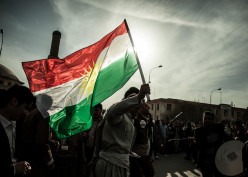
    kurd-flag

    Image by Mustafa Khayat/Flickr (cropped).

    There are several factors that have turned the Kurdish militias into the most effective fighting force in the war against the Islamic State. The first is familiarity with the area and the terrain. The Kurds, and especially the Peshmerga and the YPG, are natives of the region. They know it well and are aware of the challenges they are facing. The second factor is experience. The Peshmerga has years of experience fighting against the Iraqi army, Islamist militias and even each other. The PKK has been leading a guerrilla warfare against the Turkish security forces for decades. The third factor is motivation. The Kurds are fighting in and for their homeland. The Islamic State has attacked the Kurds in their own lands. The Yazidis are particularly motivated, not just by vengance, but also because many Yazidis are still in captivity. But there is also an ideological motivation. Especially for the Peshmerga, fighting along the West has meant greater legitimacy for their autonomy and sovereignty. The KRG is a de facto state. And states establish alliances. The KRG has considered itself an ally of the West for many years now. For the PKK, fighting IS has meant challenging its status as a terrorist organisation. In short, these are highly trained, disciplined and motivated fighters, who are fighting for their home and for recognition. They outweigh most other forces involved in the fighting in these parameters.

    Q. How far do you feel that the fight against IS will help the cause for a Kurdish homeland?

    This is a difficult question to answer, because we need to define what we mean when we say a Kurdish homeland. If we mean a scenario in which a Kurdish state is established in Iraqi Kurdistan then the answer is probably positive. The KRG’s fight against IS has once again proved to the West, but also to Turkey and other regional states the viability of the KRG and its ability to function as a sovereign actor. The Peshmerga has been one of the most reliable forces in the conflict, and in essence functions as the West’s “boots on the ground.” But if we talk about a Kurdish homeland that spreads over other parts of Kurdistan then I am in doubt. Ankara, which is still the most important veto actor when it comes to the idea of a Kurdish state, will not allow the formation of a Kurdish state in Rojava and even more so in Turkey. Even the PKK’s contribution to the fighting would not change Turkey’s mind – if anything, it will make Ankara even more intransigent about it.

    Q. Looking at the Iraqi case, Massoud Barzani, President of the Iraqi Kurdistan Region has recently called for a referendum on a Kurdish state in northern Iraq. Would the fight against ISIS at least help strengthen the case for a referendum?

    Yes I believe so. The Peshmerga’s participation in the war against ISIS has demonstrated once again to the International community, and especially Washington and Ankara, that the KRG is indispensable for regional security and that the Kurdish leadership could contribute to regional stability. The Peshmerga has proven able not only to protect the KRG’s domestic sovereignty, but also to participate as an equal partner in regional counterterrorism campaigns. This could play in the KRG’s favour when time comes.

    Q. Turkey’s shooting down of a Russian jet last year resulted in dramatic swifts in relations between those two states. The Kurdish question has also entered into this complicated relationship as Russia has shown some support for Kurdish groups in Syria and Iraq. How do you feel the Kurdish question will effect relations between the two in the future?

    This is more challenging for me to respond to, because I am not an expert on Russian foreign policy, and am not sure on how much Russia is committed to the Kurds. From a Turkish perspective, the question of Syrian Kurds has been something of a red line. Any support perceived as helping the Syrian Kurds toward independence is bound to make Ankara extremely nervous. And while Moscow has its own interests in Syria, which may clash with Ankara’s, I don’t believe that Moscow would cross this particular line. After all, Russia also prefers a unified Syria.

    Q. In regards to Turkey, would simply a change in leadership to a more liberal position help the case for a Kurdish state or is the issue of what has been described as anti-Kurdism or ‘Kurdophobia’ far more deep seated in Turkey?

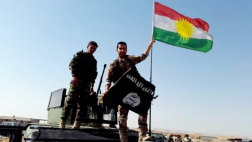
    peshmerga

    Image of Peshmerga by Kurdishstruggle/Flickr.

    A change of leadership wouldn’t have much impact on Ankara’s approach to the Kurdish question. I am afraid that there is no liberal opposition in Turkey – certainly not toward the Kurdish question. The People’s Republican Party (CHP) may be more secular than the AKP. However, its agenda has been based for many years on Turkish nationalism and objection to any hint of Kurdish nationalism and separatist desires. The other, much smaller, Turkish opposition party is the Nationalist Movement Party (MHP). This is an ultra-nationalist party with a neo-fascist ideology. Militias associated with the party were involved in attacking and assassinating Kurdish activists in previous decades. Ironically, in its early days, the AKP had been considered more liberal than most other parties with relation to the Kurdish question, and therefore gained many Kurdish votes. The most liberal party in Turkey nowadays is the predominantly Kurdish People’s Democratic Party (HDP). But not only that I don’t see the party ever elected for power in Turkey, its actual existence is under threat nowadays, with the arrest of its leaders in the last few weeks.

    Undoubtedly, anti-Kurdish sentiments are entrenched in the Turkish public and political discourse. But even if a change takes place, I don’t see it affecting party politics, amid the absence of genuine opposition on the subject among the main Turkish parties.

    Q. What impact do you think Trump’s presidency will have on the Kurdish question, if any?

    Based strictly on Trump’s statements, I don’t think the Kurds should be overly optimistic. Trump has hinted that he is after an isolationist foreign policy. This means, in my opinion, that Trump will, at best, will not intervene against Turkish repression of the opposition, including the Kurdish opposition. As for other parts of the Middle East, such an isolationist approach may also result in a regional chaos. Such chaos could have disastrous implications for regional stability, but also opportunities for a change in the status quo.

  • Walking the Blue Line: Lebanon’s Security Sector Reform

    Carefully Managing Water Resources to Build Sustainable Peace

    Carefully planned interventions in the water sector can be an integral part to all stages of a successful post-conflict process, from the end of conflict, through recovery and rebuilding, to […]

    Read Article →

  • Sustainable Security and Sacred Values

  • The 9/11 Generation: Life in the Surveillance State

    Since the attacks of 9/11, the banner of national security has led to intense monitoring of the politics of Muslim and Arab Americans. Young people from these communities have come of age in a time when the question of political engagement is both urgent and fraught.

    Since the events of September 11, 2001, Muslim and Middle Eastern communities have increasingly been viewed through the prism of national security, and young Muslim, South Asian, and Arab Americans in particular have become objects of heightened scrutiny and surveillance. The U.S.-led global War on Terror has defined Muslim youth as objects of the counterterrorism regime, based on the presumption that young people are a cohort that is vulnerable to “radicalization” by Islamist movements and so they are increasingly in the crosshairs of intelligence agencies. The racialization of Muslims and Middle Easterners as terrorists is not new, however; there is a long history of constructing the Muslim and Arab as the “enemy” of the U.S. state, given its strategic interests in the Middle East during the Cold War and its enduring alliance with Israel. Post-9/11 repression also extends the imperial state’s policies of surveilling and containing radicals or leftist “subversives,” especially during wartime and the Cold War.

    The 9/11 generation

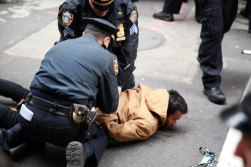
    occupr-arrest

    Image via Coco Curranski/Flickr.

    My new book, The 9/11 Generation: Youth,  Rights, and Solidarity in the War on Terror, is an ethnographic study of the forms that politics takes for South Asian, Arab, and Afghan American college-age youth in Silicon Valley who have come of age in the post-9/11 era. It examines the range of political critiques and identifications among South Asian, Arab, and Afghan American youth and explores the new, cross-racial alliances forged through civil rights and antiwar activism in northern California. The identities of these youth have been shaped by the racial and religious profiling of Muslim and Arab Americans under the PATRIOT Act, which has continued under the Obama administration, with Islamophobic and anti-Arab discourse persisting in the U.S. mainstream media. The politics of Muslim Americans, more than that of any other religious group, are viewed as necessary to surveil and contain. This constitutes the “new order of War on Terror” under the Obama regime, which relies on mass surveillance, clandestine cooperation between law enforcement and intelligence agencies, and programs that police political and social lives ( see Deepa Kumar 2012). Repression in the domestic War on Terror often remains invisible, however, for it is conducted through covert means, such as the use of undercover FBI informants, infiltration, and entrapment.

    Youth politics is a central target of the counterterrorism regime as the religious and political “radicalization” of youth variously defined as Muslim, Middle Eastern, Arab, Afghan, or South Asian has come to represent a threat to Western, secular, liberal democracy and to U.S. military and economic interventions. The framework of securitization defines Muslims as always a potential threat to U.S. homeland security and views this generational cohort as bedeviled by disaffection, cultural and political alienation, and psychological and social maladjustment. Muslim and Arab American youth, in particular, are viewed as susceptible to indoctrination and recruitment by Islamist movements, that is, as ripe for becoming enemies of the state. Muslim youth are also perceived as being vulnerable to “self-radicalization,” as in the case of the Chechen youth charged with the Boston marathon bombings in 2013. This is also a gendered form of surveillance as young Muslim males have been the major focus of counterterrorism programs, but young Muslim women are also, increasingly, objects of surveillance, especially in the wake of incidents such as the San Bernardino shootings.

    The focus on “homegrown terrorism” was ratcheted up after the July 7, 2005 bombings by British Muslims in London and occurred in tandem with shifts in U.S. wars and counterterrorism operations in Afghanistan, Pakistan, and Yemen. In 2007, Senator Joe Lieberman, Chairman of the Senate Committee on Homeland Security, held a series of hearings on the “homegrown threat of violent Islamic extremist terrorism,” focusing almost exclusively on Arab and Muslim Americans and dwelling on the role of the Internet in fostering Islamic “extremism”; in 2011, hearings on radicalization were also held by Congressman Peter King ( see American-Arab Anti-Discrimination Committee 2008, 39). Yet strikingly, the very real threat posed by white supremacist organizations and right-wing paramilitary movements is not at the center of debates about “homegrown” extremist violence, despite events such as the Oklahoma City bombings of 1995.

    Racial, religious and political profiling

    The homeland war on terror has increasingly focused on monitoring and prosecuting ideological and religious beliefs of Muslim and Arab Americans, not just terrorist activities, so this is a form of political, not just racial and religious, profiling. This strategy of pre-emptive prosecution and preemptive surveillance mirrors the doctrine of “pre-emptive war.” One problem with ideological profiling and the criminalization of beliefs is that political dissent is increasingly fragile and risky, especially for Muslim and Arab American youth. Despite this repression, youth in the 9/11 generation have mobilized in response to the War on Terror and the experience of collective profiling has, inevitably, politicized Muslim, South Asian, and Arab Americans. It has propelled new, cross-racial coalitions based on shared experiences of Islamophobia and racism. New cross-ethnic categories have emerged, such as AMSA (Arab, Muslim, and South Asian) and MESA (Middle Eastern and South Asian), as Muslim and Arab Americans became engaged in or led civil rights campaigns and antiwar organizing. For example, the Council on American-Islamic Relations (CAIR), the Islamic Network Group, the Muslim Public Affairs Council, and the American Arab Anti-Discrimination Committee have all led national civil rights efforts, in addition to numerous grassroots groups and coalitions, for example, the Arab Resource and Organizing Committee  (AROC) and the Asian Law Caucus in the San Francisco area, in which youth have been involved. Progressive-left campaigns against the wars in Iraq and Afghanistan and drone wars in Pakistan have also involved Muslim and Arab American activists and connected Muslim and Middle Eastern communities to overseas homelands, U.S. war zones in Iraq and Afghanistan, and the U.S-backed occupation in Palestine.

    There has also been a major push to engage in interfaith coalitions, focused on Muslim-Jewish-Christian dialogue and outreach, on the one hand, and in transnational solidarity activism, on the other. Campaigns have linked communities with shared experiences of police violence and surveillance, for example, during the Black Lives Matter movement and the Ferguson 2 Gaza campaign. So the racial profiling by the state has provoked new forms of racialization and affiliation on the ground, even if some of these are not entirely new but recreate earlier forms of cross-racial and international solidarity.

    The surveillance state

    The surveillance and counter-radicalization regime that has emerged in the U.S., as well as in the UK and Europe, is increasingly preoccupied with Muslim youth cultures and with cultural codes that presumably signify “radical dissent” and “youth alienation” (see Kundnani 2014). Obama’s domestic War on Terror drew on counter-radicalization practices in Britain in a transnational circuit of ideas and policies that focused on surveilling and entrapping Muslim American youth, through programs such as Countering Violent Extremism. While the emergence of ISIS/ISIL may have somewhat reconfigured this, it has long been the case that vocal critics of Israel were associated with “terrorist” movements and subject to surveillance. It is important to note, as Arun Kundnani has observed, that the template for the War on Terror was manufactured in the 1980s to demonize those resisting U.S. hegemony and U.S. allies in the Middle East, particularly Israel.

    In the current moment, as my research demonstrates, Palestine solidarity activism is a fraught terrain where youth have to contend with surveillance, censorship, including on college campuses, as well as harassment, allegations of anti-Semitism, smear campaigns, and blacklisting by right-wing organizations such as David Horowitz’ Freedom Center and Canary Mission. At the same time, this encounter with the exceptional lockdown on open discussion of Palestine-Israel leads to a process of what I call “Palestinianization,” that is, a process of politicization and racialization that is endemic to U.S. national culture given unconditional U.S. support for Israel and the power of the Israel lobby. Palestine solidarity is also a unifying hub for Muslim, South Asian, and Arab American youth and activism.

    I consider surveillance a technology of disciplining and managing racialized populations within neoliberal capitalism. The culture of surveillance highlights the tension that emerges between the police state’s repression and exceptionalist notions of U.S. democracy and “freedom” in the War on Terror. This tension is deeply felt by those who experience the brunt of policing and the curtailment of freedom in their daily lives. Nearly all the young people I spoke to as part of my research talked about the climate of permanent surveillance and the chilling effect it had on understandings of what it meant to be “political” and also “social.” Arab, South Asian, and Afghan American youth have to self-consciously regulate, or re-narrate, their social and political lives, including on social media. Given the state engages in warrantless wiretapping, monitors private emails and Facebook, and infiltrates mosques and activist groups with undercover informants, it is not just not those who are involved with formal political organizations who have reason to be anxious and self-conscious about their identities and sociality.

    In 2012, the stunning investigation by Associated Press of the NYPD’s surveillance program revealed that “mosque crawlers” and undercover informants, called “rakers,” (generally Muslim or Arab themselves), had been deployed to ferret out suspicious Muslim and Arab Americans, including students and youth, “monitoring daily life in bookstores, bars, cafes, and nightclubs” in “suspect neighborhoods”; this was part of a “human mapping program” in cooperation with the CIA and drawing on Israeli surveillance techniques, with a reach extending beyond New York state (Associated Press 2012, 5). The NYPD also infiltrated the Occupy Wall Street movement and Palestine solidarity rallies. The revelation of this infamous “demographics unit” sparked the first mainstream discussion of surveillance since 9/11, which increased with the revelations by WikiLeaks and Edward Snowden’s expose in 2013 of mass surveillance by the NSA and CIA. Some youth at campuses that had been surveilled by the NYPD used social media, including Twitter, and subversive humor to challenge this secret program; the Yale MSA created a Facebook page, “Call the NYPD,” with photos of Muslim college students holding signs declaring, “I am a . . . Blonde, Call the NYPD” (cited in Khabeer and Alhassen 2013, 308).

    Surveillance effects

    The social and cultural registers through which surveillance becomes a part of daily life are what I describe as surveillance effects, through which surveillance becomes normalized, even as it is resisted. Surveillance effects shape political culture and also ideas of selfhood. Many youth are aware that they are the exemplary objects of surveillance, because they fit a racial, religious, political or national profile. Law enforcement agencies, such as the New York City Police Department, have used behavioral models of “radicalization” based on profiles of youth subcultures, including markers such as clothing, religiosity, and activism (see American-Arab Anti-Discrimination Committee 2008, 39). This surveillance of everyday life has inevitably alienated many Muslim Americans even further while creating more distrust and divisions within targeted communities.

    In a surveillance state, many engage in self-regulation and self-censorship because they believe that they must sacrifice their freedoms for the sake of defending the nation, and that “national security” is, indeed, their own security. Some Muslim Americans engage in self-surveillance or the surveillance of others, hoping to avoid profiling or prove they are patriotic, “good” Muslim citizens. Yet my research also uncovered “surveillance stories” about life in the everyday of surveillance that demonstrate that the surveillance regime also provokes the opposite effect, producing challenges to intelligence-gathering and tactics of counter-surveillance that enable survival. Youth who negotiate these tensions expose the contradictions that animate life in the post-9/11 security state, and the fragility as well as the radical possibility of living life as the “enemy within.”

    The culture wars

    Surveillance is key to the post-9/11 culture wars, focused on Islam, gender, race, and nationalism. In my book, I argue these culture wars are also racial wars and class wars as they rest on racial and class struggles and fissures in U.S. society. These culture wars have evolved since the Cold War and in the  “new Cold War,” as well as the many hot wars waged by the U.S. from Iraq and Afghanistan to Pakistan and Yemen. Trump’s presidential campaign and election has inflamed the culture wars, and brought renewed attention to the already existing fault lines of race, class, and religion with the nation. As Americans debate the horrifying possibilities of a “Muslim registration,” some may not be aware that this actually already occurred in the U.S. with the Special Registration targeting Muslim immigrant men after 9/11 and that mass surveillance was intensified under the Obama administration. The generation that came of age since 9/11, especially those from communities targeted in the War on Terror and from immigrant communities, were already aware of the “white rage” and extremism that existed within the U.S. and that has now provoked shock and horror among those critical of Trump’s racism, Islamophobia, xenophobia, and misogyny. There is much to be learned from the stories of the 9/11 generation.

    Sunaina Maira is Professor of Asian American Studies, and is affiliated with the Middle East/South Asia Studies program and with the Cultural Studies Graduate Group. Her research and teaching focus on Asian American youth culture and the politics of cultural production as well as political mobilization and transnational movements challenging militarization, imperialism, and settler colonialism. She is the author of Desis in the House: Indian American Youth Culture in New York City and Missing: Youth, Citizenship, and Empire After 9/11. She co-edited Contours of the Heart: South Asians Map North America, which won the American Book Award in 1997, and Youthscapes: The Popular, the National, and the Global. Maira’s recent publications include a book based on ethnographic research, Jil [Generation] Oslo: Palestinian Hip Hop, Youth Culture, and the Youth Movement (Tadween), and a volume co-edited with Piya Chatterjee, The Imperial University: Academic Repression and Scholarly Dissent (University of Minnesota Press). Her new book project is a study of South Asian, Arab, and Afghan American youth and political movements focused on civil and human rights and issues of sovereignty and surveillance in the War on Terror. Maira launched a new section on West Asian American Studies in the Association for Asian American Studies and coedited a special issue of the Journal of Asian American Studies on Asian/Arab American studies intersections. She has been involved with various civil and human rights campaigns and antiwar groups in the Bay Area and nationally.

  • The Responsibility to Protect and the Refugee Crisis

  • Interview: Jon Moran

    This interview was conducted by the Remote Control project. 

    Dr. Jon Moran is Reader in Security and the School of History, Politics and International Relations at the University of Leicester. He is interested in the role of the state and military and intelligence agencies both domestically and internationally. He has conducted field research with police and security agencies and civil society activists in Western Europe, Eastern Europe, South Africa and East Asia. For three years he conducted training for the EU for security professionals on the reform of intelligence agencies as part of a programme on Security Sector Reform. He wrote a Briefing Paper on understanding and evaluating Remote Warfare in 2015 for the project. It is available here and organised a conference on remote Warfare in conjunction with the Remote Control project in February 2015.

    Dr. Moran’s last book was ‘From Northern Ireland to Iraq: British Military Intelligence Operations, Ethics and Human Rights’ which covers the role of army intelligence and special forces since the 1970s. He is currently working on a book concentrating on the use of intelligence and special forces in the most recent phase of the War on Terror.

    In this interview, Dr. Moran discusses the use of remote warfare in Libya, its effectiveness and some of the key problems yielded by the use of this tactic.

    Q. In 2011, the UK took part in the NATO military intervention in Libya which led to the overthrow of Gaddafi. Official government statements suggest that the UK’s military operations in Libya both began and ended with this campaign. Since then, however, evidence has gradually surfaced suggesting that the UK has been conducting ‘remote warfare’ in Libya. What is remote warfare and how has this tactic been used in the case of Libya?

    Remote warfare is a term used to describe a group of tactics that allow states to prosecute military activities from a distance rather than using conventional warfare. These tactics include:

    1. the use of special operations forces (SOF) either directly, or as trainers or mentors to local forces
    2. the use of airpower (including drones)
    3. the use of intelligence assets to direct forces on the ground and
    4. the use of local security forces, either official forces or militias or paramilitaries.

    One important thing to note about remote warfare is that it is a set of tactics that can be very effective. Remote warfare was employed in Libya in 2011. United Nations Resolution 1973 called for the protection of civilians against threats by the Gaddafi regime. However, the use of airpower for this purpose was then expanded by Western and other powers into remote warfare in order to overthrow the Gaddafi regime.

    In 2011 the civil war between Gaddafi and the rebels was in a stalemate. It was not just airpower that made the difference to the rebels. In addition to airpower, special forces from France, the UK and Qatar were deployed not just for forward air control, but to help the rebels become a more professional force. Special forces and UK intelligence assets were used to support the rebels as they advanced. This involved assistance to them in developing combat plans, gaining tactical skills, identifying Gaddafi forces, and supporting them with air strikes on Gaddafi forces. Foreign intelligence support was particularly important in the final operation to take Tripoli. It is my assessment that without this remote warfare support the rebels would have been unable to defeat Gaddafi.

    However, this also highlighted one problem with remote warfare. Although as a set of tactics it can be very effective, it cannot by its nature involve long term planning. Following the overthrow and execution of Gaddafi, Libya descended into chaos. This chaos, involving the development of militias, organised crime, widespread general crime and the collapse of public services led to such instability that Islamic State (IS) identified Libya as a suitable base for its operations outside Iraq and Syria. Such has been the instability in Libya since 2011 that the West is now engaging in a second round of remote warfare to defeat IS forces in Libya and promote one of the competing governments as a stable political actor. This is having success in defeating IS but it still leaves the future of Libya in doubt.

    Remote warfare can have strategic effect (in overthrowing Gaddafi and defeating IS) but it is not a strategy in itself. If it is not part of a long term strategy it may end up creating more problems than it solves.

    Q. So what are the problems that remote warfare can create?

    Remote warfare can have a short term strategic effect (e.g. in stabilising or overthrowing a regime). But by its nature it cannot have a long term strategic effect. Remote warfare involves small numbers of specialist troops (special forces, intelligence, air control) and air power which by their nature cannot be deployed over the long term and can only have a limited effect. Even if remote warfare operatives work with local security forces or militias they cannot control them over the long term since they are small in number and that is not the point of a remote warfare mission. With this is mind remote warfare can create a number of problems:

    • Long term instability. The overthrow of Gaddafi in Libya in 2011 was a classic example of a successful remote warfare operation. But the operation had no plans for the aftermath. Libya descended into political and security chaos with rival governments, militias and criminal groupings all contributing to a situation in which citizens became more insecure. By 2016 Western and other states were again engaging in remote warfare in Libya, this time to try and stabilise the area and defeat IS – aiming to solve the problems created by the first phase of remote warfare in 2011.
    • Perpetuating conflict. In places such as Yemen remote warfare may assist local forces but not in a game changing (strategic) way. It may end up creating a stalemate where no side is strong enough to prevail and ongoing conflict continues to cost civilian lives and create insecurity.

    Overall, remote warfare is no substitute for a long term commitment, either politically (though aid and diplomacy) or militarily (large scale deployment in conjunction with local forces – itself a serious decision).

    Q. Given the problems that remote warfare can create, why is the use of remote warfare by states on the rise?

    For a number of reasons. One is the lack of success of long term deployments of regular troops by Western countries in Iraq and Afghanistan. In Iraq approximately 4500 US military troops were killed and over 30,000 wounded. In Afghanistan the casualties were fewer but the conflict dragged on for a long time. Both conflicts have to be judged as a failure. Iraqi security was only evident for a period after the surge in 2007 and then the rise of Islamic State showed how weak public security was, and is, in Iraq. In Afghanistan the Taliban remain undefeated and indeed the period after 2010 saw the UK and US negotiating with the Taliban and redefining them as insurgents rather than terrorists in the global jihad against the US. Remote warfare is a way for the US to maintain its pressure on jihadist groups without necessitating massive troop deployments and long term counter insurgency operations. It saves money also – both wars cost the US perhaps $3 trillion dollars.

    For the UK, remote warfare is way of keeping up its security profile and assisting the US as its conventional power has declined. The UK military was, in a sense, exhausted after Iraq and Afghanistan and then military cuts imposed by the Coalition government further reduced its capacity for large scale deployments. Further, the UK public would not support any large scale ground force deployment for the next few years or in the absence of direct major terrorists attacks on the UK. They are more inclined to support remote warfare.

    The French have used remote warfare in Mali and Libya because again it is way to maintain a security presence without the large deployment of troops that the French public might not support even after the IS attacks in France. The French already had a crucial experience with large scale troop deployments and drawn out conflict in Indochina and Algeria in the 1950s and 1960s, and since then have often relied on airpower and paratroopers to support friendly local regimes in Africa.

    It should also be pointed out that although remote warfare by Western states has been patchy in its success, elsewhere countries are using remote warfare very effectively. The Russians have used remote warfare very effectively in Ukraine. They have used special operations forces, military advisers and local militias supported where necessary to take the Crimea and parts of eastern Ukraine under effective Russian control.  Remote warfare seems to have been a success in Syria. The Iranians developed remote warfare against the Coalition forces in Iraq after 2003 and have been involved in remote warfare in the Lebanon supporting Hezbollah for a long period.  Recently, they have joined with Russia in using local or other forces (such as Lebanese Hezbollah) and their own operatives to stabilise the Assad regime, while Russia has employed surveillance, reconnaissance and airpower to batter the rebels. These are successful operations because they have been used by Russia and Iran not as an antidote to the failure of large scale operations – they have seen what disasters this can bring and they also want to avoid direct conflict with the USA. Rather, for them, remote warfare allows them to achieve their objectives – it’s a useful way of achieving foreign policy objectives. For the West, remote warfare is often a reaction to previous failures at invasion, occupation and nation building.

    Q. So is remote warfare better at achieving political stabilisation or destabilisation?

    I think overall remote warfare is better at destabilisation. This is not to say that remote warfare cannot stabilise countries. There are examples including the US in Afghanistan (2001-02), the UK in Sierra Leone (2001), and the French in Mali (2011) where remote warfare successfully defeated local militias or terrorist groupings and prevented the further development of conflict. In Afghanistan the Taliban, never viewed as legitimate and not in full control of the country, was deposed and a fragile democracy imposed; in Sierra Leone remote warfare helped to defeat the militias who were opposed to the UN brokered peace agreement; and in Mali remote warfare prevented the overthrow of the government by a combination of insurgent and terrorist groups.

    However, remote warfare only started these processes. In all three cases extra support in the areas of security, aid, civilian assistance etc. was provided to make sure the stabilisation was secured in the longer term. In areas where remote warfare has been the start and the finish of the operation it has created far more instability. Libya is the prime example, where intervention successfully overthrew Gaddafi but left the country in anarchy. In Yemen it is also the case as is the remote warfare conducted on the Pakistan-Afghanistan border. Remote warfare operations in these two areas have ‘managed’ conflict and have not reduced it.

    Remote warfare is only the start of any process of intervention. It might be seen as useful tactic but it cannot operate in a vacuum. Russian remote warfare has been effective because the Russians have been working with strong local forces to effectively wrest parts of the Ukraine away; these territories will now need continuing Russian support (like other breakaway areas such as Transdnistria). In Syria the Russians (and Iranians) have been able to bolster Assad’s exhausted but still coherent national army. But a long term peace process will determine the future of Syria and Russia and Iran realise this – they have just used remote warfare to ensure Assad will be a big player in this and that rebel forces will not be negotiating from a position of strength. In Iraq, the rise of IS exposed the weakness of the Iraqi security forces. The US could only work with the Kurdistan Peshmerga and the reliable US-trained Iraq Special Operations Forces, assisted by Shia militias. The disparate group of local forces has been able to stop Islamic State’s advance but with far more difficulty than should have been the case. US and UK remote warfare support has allowed this but this is not any long term solution to the weakness of the Iraqi state.

    Q. Taking into consideration the mixed results of remote warfare, how do you see its use evolving in the future?

    Remote warfare will not replace conventional warfare but it is likely to be the dominant form of warfare for the next decade at least. There are differing reasons for this depending on the country involved. In the USA, the UK and France there is little public support for any large scale conventional intervention in other countries. So remote warfare remains the main way that countries such as these can maintain some sense of control. Taking into consideration the limits of remote warfare, this will probably remain reactive and have limited success. (It will remain a response to the long term problems of the West ‘Losing Control’ of international security as Paul Rogers pointed out in his book of the same name some years ago). For other countries such as Russia and Iran remote warfare has been effective and is a sign of their gaining more control as the West loses it. Russia used remote warfare effectively in Ukraine and now controls a substantial part of the east of the country and will likely use remote warfare to intervene where it feels necessary to protect its security interests. Iran effectively used remote warfare to destabilise the US intervention in Iraq after 2003 and to support the Assad regime in Syria. Other countries like Saudi Arabia and Qatar have employed remote warfare techniques in Yemen and Libya. It is possible that countries like China in its territorial disputes in Southeast Asia may use remote warfare to gain control of the islands involved.

  • Mali: Why Western Intervention is destined to fail (Part 1)

     (This piece was originally published by Channel 4 News on  January 22, 2013 and is the first of two parts by Anna Alissa Hitzemann and Ben Zala)

    France Mali smallBritain is on standby and the US is already transporting French troops into Mali. But a new paper says the west is “betting on the wrong horse” by intervening in the region.

    Now well over a decade after the beginning of the so-called war on terror, yet again, another western nation is leading a military intervention against Islamist paramilitaries based in a largely ungoverned region of a state in the Global South, write Anna Alissa Hitzemann and Ben Zala for the Oxford Research Group.

    The hostage situation in Algeria that developed late last week is just the latest in a series of western hostage takings in recent years, demonstrating the increasing radicalisation of elements in the region.

    The French-led intervention in Mali is only one of many in a growing list of attempts to control outbreaks of political violence and terrorism with military means.

    As the intervention gathers pace, it is worth reflecting on the lessons from similar operations over the past decade or so. From the US-led interventions in Afghanistan and Iraq to the attempts to control Islamist-inspired political violence in Yemen, Nigeria and Somalia and separatist rebellions in Burma, Indonesia and elsewhere, the resort to military force has singularly failed to achieve the aims set for it.

    Common to all of these examples is the reluctance to match military operations against rebel groups and insurgents with serious, long-term efforts to address the factors that underlie the feelings of resentment and marginalisation that drive such conflicts.

    As the commentary and analysis of events in Mali follow the fortunes of the military battles of France and its other western and African allies, it is worthwhile examining the political, socio-economic and cultural divisions which have sparked the uprising in the north of Mali.

    Background to the northern uprising

    The factors that led to the current Malian crisis are complex but can largely be attributed to unintended consequences of the war against Gaddafi. It is clear that the 2011 crisis in Libya, followed by foreign intervention and Nato’s military involvement, and the consequent fall of Gaddafi‘s regime, had a crucial role to play.

    After losing the war in Libya, hundreds of Malian mercenaries (many of whom had been recruited among former Tuareg rebels) who had been an integral part of Gaddafi’s army, returned home. They brought with them an arsenal of weapons and ammunition as well as experience.

    These soldiers who returned to Mali from Libya played a key role in the formation of the largely Tuareg-led secular MNLA (Azawad National Liberation Movement), which in a matter of months, took over several key towns in the north of Mali, declaring an independent Azawad state.

    The situation in the north of Mali led to widespread frustration within the military over the government’s incompetence or unwillingness to deal with the issue and reclaim their territory. Ultimately, it led to the April 2012 military coup by Amadou Sanogo against Mali’s elected government and president Amadou Toumanie Touré.

    Interestingly enough, Sanogo himself had received extensive training by the United States as part of the $600m (£380m) spent by the US government in efforts to train military of the region to combat Islamic militancy.

    The actions of the separatist MNLA group and the consequent military coup and inability of the Malian government and military forces to control the situation led to a violent conflict in Mali’s north which includes four main groups: the secular MNLA and the religiously motivated AQMI (Al-Qaeda of the Islamic Maghreb), Ansar Dine and MUJAO (Movement for Unity and Jihad in West Africa).

    AQIM, the group most closely linked to the international terrorist network Al-Qaeda, has been present in Mali for several years now, has taken several European hostages over the last few years and is said to be made up of mostly Algerians and Mauritanians with much financial support from abroad.

    Tuareg rebellion and the paths not taken

    The formation of the Tuareg-led MNLA movement and its desire for an independent Azawad state has in fact deep roots and a history going back to the first Tuareg rebellion of 1963. Tuaregs led significant armed struggle and resistant movements against colonisation by the French and later the central Malian government.

    Long-term sustainable security and stability for Mali will not be possible without seriously addressing the long-standing and deep-seated grievances that stem from the marginalisation of the northern territories and their peoples.

    The political, socio-economic, educational and cultural marginalisation of the north cannot be ignored. With the effects of climate change, increasing desertification and the government’s reluctance to implement meaningful development programmes, Tuareg and other nomadic communities see no viable future and feel abandoned by the Malian state.

    Grievances also stem from past brutal repressions of Tuareg movements, as well as the state’s failure to adhere to the Algerian brokered peace agreements between Tuareg rebels and the government.

    Even after the Tuareg rebellions of the early to mid 1990s, the Malian government still remained unwilling or unable to implement the education programmes and development projects which were promised and are necessary to alleviate poverty and a deep sense of disenfranchisement.

    The political, socio-economic, educational and cultural marginalisation of the North cannot be ignored.

    It would have been wise to negotiate and come to an agreement with the MNLA at the early stages of the current crisis. Both Burkina Faso and Algeria pushed for a diplomatic solution to this crisis instead of military intervention.

    Burkina Faso’s president, Blaise Compaore, West Africa’s mediator on the Malian crisis, had organised talks between MNLA, Ansar Dine and the Malian government in Ouagadougou in December. A ceasefire was agreed and all parties approved to adhere to further peaceful negotiations.

    The talks which had been planned to continue this January have now been interrupted due to the French military intervention in Mali.

    The chance of finding a solution to combating Islamic extremism in northern Mali would be significantly better if the Malian and French military sought a way of collaborating with the Tuaregs. This is a challenging task but a task that is unavoidable over the long-term.

    It is the resentment towards the central government over the marginalisation of the northern territories and its population that in part has helped Islamists gain strength.

    Dr Ben Zala is Ben Zala is a Lecturer in International Politics at the University of Leicester.

    Anna Alissa Hitzemann is a  Peaceworker with Quaker Peace and Social Witness. She currently works with Oxford Research Group as a Project Officer for the Sustainable Security Programme, with a focus on our ‘Marginalisation of the Majority World’ project.

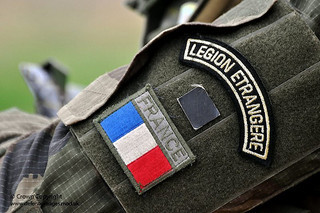
    Image source: Defence Images

  • The NYPD’s Post-9/11 Counterterrorism Programme