Blog

  • Too Quiet on the Western Front? The Sahel-Sahara between Arab Spring and Black Spring

    A version of this article was originally published on openSecurity’s monthly Sustainable Security column on 18 November 2014. Every month, a rotating network of experts from Oxford Research Group’s Sustainable Security programme explore pertinent issues of global and regional insecurity.

    RC_long_logo_small_4webThis article is part of the Remote Control Warfare series, a collaboration with Remote Control, a project of the Network for Social Change hosted by Oxford Research Group.

    While the world’s attention has been focused on the US-led military interventions in Iraq and Syria a quieter build-up of military assets has been ongoing along the newer, western front of the War on Terror as the security crises in Libya and northeast Nigeria escalate and the conflict in northern Mali proves to be far from over. In the face of revolutionary change in Burkina Faso, the efforts of outsiders to enforce an authoritarian and exclusionary status quo across the Sahel-Sahara look increasingly fragile and misdirected.

    The New Frontier

    In early August, coinciding with the restructuring of French military operations in the Sahel and the US-Africa Leaders Summit, Oxford Research Group and the Remote Control Project published a comprehensive assessment of counter-terrorist operations targeting jihadist groups in the Sahel-Sahara region of north-west Africa. That report found extensive and growing evidence of combat, intelligence, surveillance and reconnaissance (ISR), training and equipment, abduction and rendition programmes on this new frontier. While France and the US were easily the most active foreign actors, the UK, Canada, the Netherlands and several other NATO states were also found to be increasingly involved in special forces and ISR operations.

    The launch coincided with the onset of air attacks on Islamic State targets, initially by the US in northern Iraq and latterly by a broad coalition of Western and Arab states in Iraq and Syria. In a context of worsening security crises in Libya, Nigeria and northern Mali and Niger since, US and UK ISR activity is increasing, French deployments in Mali have been reinforced, a new configuration of Arab states has provided impetus for foreign intervention in Libya’s civil war and a “black spring” backlash is emerging against the west’s authoritarian allies in the region.

    Libya on the frontline

    Libya is at the core of the security crisis in the Sahel-Sahara. Since the NATO-led military intervention which overthrew the Qaddafi regime in 2011, Libya has become a security and political vacuum and a major exporter of weapons and insecurity in the region. This has included the return home to the Sahel of hundreds of combatants formerly given refuge or employment by the Libyan state.

    Libya’s civil war reignited in May with the launch of “Operation Dignity” by secular forces from eastern Cyrenaica, seeking to wrest control of Benghazi and Tripoli, the two main cities, from Islamist militia. This has been largely a failure. Most diplomatic missions evacuated Libya in late July and Tripoli and its burnt-out international airport fell to militia from Misrata (Libya’s third city) and allied Islamist groups on 23 August. Benghazi has fallen increasingly into the hands of Salafist groups and the nearby city of Derna is run as an Islamic emirate by Ansar al-Shari’a. Much of the rest of Libya is dominated by local tribal leaders or armed factions, beyond any state control.
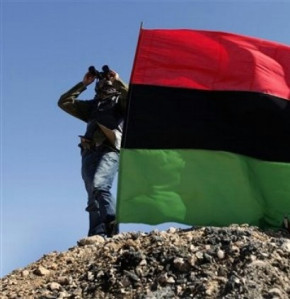
    Anti-Gaddafi rebel looks to the sky in the oil town of Ras Lanouf, eastern Libya, Sunday, March 6, 2011. Source: Cropped version of BRQ Network image (via Flickr)

    Anti-Gaddafi rebel looks to the sky in the oil town of Ras Lanouf, eastern Libya, March 6, 2011. Source: cropped version of BRQ Network image (via Flickr)

    Indeed, there are now two rival, elected Libyan governments. The one recognised internationally meets in a Tobruk hotel. It controls little beyond this Egyptian border outpost and its electoral mandate was recently invalidated by the Tripoli-based Supreme Court. The revived General National Council in Tripoli governs the capital and north-west and is dominated by an affiliate of the Muslim Brotherhood and other Islamist factions.

    Libya has thus become a new frontline in the proxy war between the international proponents and opponents of the brotherhood. Qatar and the United Arab Emirates (UAE) were the two main Arab sponsors of the anti-Qaddafi rebellion and contributed to the air attacks on Qaddafi’s forces. They now find themselves backing different sides in Libya. On 17 and 23 August, days after the Tobruk parliament called for foreign military intervention, Emirati aircraft based in and refuelled from Egypt launched unclaimed attacks on pro-Islamist militia around Tripoli airport.

    Despite official denials, it appears that air attacks on Salafist groups in Benghazi in mid-October were launched by Egyptian aircraft. Egypt and the UAE accuse Qatar, the primary sponsor of the brotherhood in Egypt, and Sudan, long ruled by a military affiliate of the brotherhood, of funnelling arms to the various Libyan Islamist militias.

    While the US has condemned all post-2011 foreign intervention in Libya, it is likely that it was aware of the movement of UAE aircraft to Egypt, given that fighters presumably left from Al-Dhafra air base in Abu Dhabi, which is shared by US and French squadrons. Emirati refuelling aircraft are based at Al-Minhad in Dubai, where the UK Royal Air Force (RAF) has an expeditionary wing. These aircraft presumably were cleared by Saudi Arabia (another great opponent of the brotherhood) to overfly its territory. The aircraft and weapons used were supplied by the US and/or France.

    France stands apart among Western allies in its advocacy of, and preparedness for, renewed military intervention in Libya. Since the fall of Tripoli, its defence minister, Jean-Yves Le Drian, has several times advocated a UN mandate for intervention against Islamist groups in Libya and hinted that France may need to act unilaterally sooner or later. Whereas Egypt is most concerned about Salafist groups in Derna and Benghazi, France is focused on al-Qaida affiliates in south-west Libya. Already this year it has opened bases near the Niger-Libya and Chad-Libya borders and revived ISR operations from its air base at Faya-Largeau in northern Chad.

    Northern Mali and Niger

    France cares about southern Libya primarily because of its security commitments to Mali, Burkina Faso, Chad and Niger, the latter hosting multi-billion-euro French investments in uranium production. Since France reorganised its forces in the Sahel from the Mali-focused Opération Serval to the pan-Sahel deployments of Opération Barkhane in mid-2014, security in northern Mali has worsened significantly. This relates partly to the decline in French troop numbers there but also to the reorganisation of regional jihadist groups and the deterioration in relations between the Malian state and local armed separatists. Twenty UN peacekeepers from the Multidimensional Integrated Stabilisation Mission in Mali (MINUSMA) have been killed in at least five jihadist attacks in the north of the country since September. In response, France has had to reinforce its deployments in Kidal district, pulling in troops and equipment from its base in Côte d’Ivoire.

    On 9 October, French forces under Barkhane mounted their first publicly acknowledged offensive action outside of Mali, attacking a convoy supposedly transporting militants and weapons from Libya through Niger towards the country. Militants apparently moving from north-eastern Mali attacked Nigerien security forces in Ouallam three weeks later, freeing dozens of Islamist prisoners and attacking a refugee camp. Citing increased activity, the huge Algerian military is also reported to have moved thousands of troops to its borders with Niger and Mali since last month.

    The US has also sought to extend its own ISR deployment in Niger, announcing in early September that it would be moving its two MQ-9 Reaper unmanned aerial vehicles from Niamey airport, where they have been deployed since early 2013, to Agadez, the main town in the desert north. As with French redeployments in 2014, the objective appears to be to bring more of southern Libya into range of ISR assets.

    Humanitarian opportunity
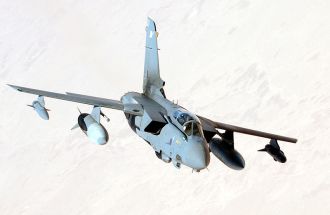
    RAF Panavia Tornado GR4 fighter over Iraq during a combat mission in support of Operation

    RAF Panavia Tornado GR4 fighter over Iraq during a combat mission in support of Operation “Iraqi Freedom”, on 16 August 2004. Source: SSgt. Lee O. Tucker – Official U.S. Air Force Photo no. DF-SD-07-05791 (via Wikipedia)

    Perhaps least analysed of recent military deployments to west Africa have been those associated ostensibly with humanitarian, rather than security, crises. In late August, following Boko Haram’s seizure of territory and declaration of its own caliphate in northern Nigeria, the RAF deployed a number (three is reported) of Tornado GR4 aircraft from the UK to the French air base in N’Djamena, Chad. This base is also used by US drones.

    Unusually, the Ministry of Defence issued almost no comment on this and refuses to disclose how many aircraft were involved, where they operated from or exactly when and why they were deployed. Officially, they were on an ISR mission in support of attempts to locate the more than 200 girls abducted by Boko Haram from a boarding school in Chibok in north-eastern Nigeria in April. All aircraft had officially returned to the UK by 15 October. While the Tornado GR4 is often deployed as a reconnaissance aircraft, it is dual use and its primary role—for example, in Iraq—is as a medium-range strike aircraft.

    Also very little reported was the US Marine Corps’ establishment during September of three new “co-operative security locations” in Senegal, Ghana and Gabon, along the west African coast. These are to be bases permanently prepared and supplied, but not necessarily manned, to support US interventions under the Obama administration’s “New Normal” doctrine, which facilitates defence or evacuation of US interests and citizens under (terrorist) attack in any country. While marines and their V-22 Osprey aircraft may continue to be based in Spain, Italy and Djibouti, these new west African bases are specifically launch pads for future US military interventions. US military contractors have been stockpiling aviation fuel at these and many other African airports for several years.

    Interestingly, the Senegal facility has been specifically referred to as an “interim staging base”—the usual terminology for a Special Purpose Marine Air-Ground Task Force base—in the context of the US military’s humanitarian mission to control the Ebola epidemic in Liberia. As with previous Obama-era deployments against the Lord’s Resistance Army in and around Uganda and in support of the Chibok abductees, the escalation of a US military presence appears to have been achieved under the cover of humanitarian imperatives and initiatives.

    Towards a Black Spring?

    All this matters because if there is one thing that we should have learned since 2001 it is that Western military interventions to oppose terrorism on foreign soil do not work: they tend to destroy the “host” country while amplifying the threat to the “far enemy”. And proxy wars between the Arab states so lavishly armed by the US, France, the UK and Russia tend to end in something worse than tears. Neither the “war on terror” nor the “Arab spring” (counter-)revolution has yet run its course.
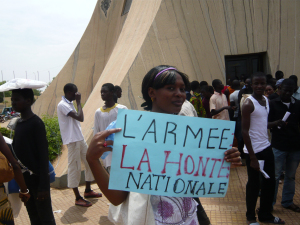
    “The Army: National Shame” caption held by protester in Mali against the 2012 coup. Source: Wikipedia

    The political crisis in Burkina Faso, in which the authoritarian president of 27 years, Blaise Compaoré, was overthrown in a popular uprising turned military coup on 31 October, provides ample warning of the toxic relationships Western states are forging in the Sahel-Sahara in the name of counter-terrorism. As in Mali in 2012, the coup leader in Burkina was an ambitious, US-trained officer. French and US special-operations forces will probably retain their semi-secret bases but their political masters have again been embarrassed by their own role as props to the hated old regime.

    Protesters in Burkina Faso—a remarkably civil, peaceful, articulate and internationalist society that belies the Sahel’s reputation for isolation—have talked up the precedent of their revolution for a “black spring” that would sweep away the Western-armed and educated tyrants whose misrule blights the south of the Sahara. They have chosen a very different path to the eschatological nihilism of Boko Haram but their hunger for change is similarly derived from generations of stultifying and systematic marginalisation under a corrupt, militarised and foreign-sponsored elite.

    Like Tunisia before it, Burkina Faso may be the clear-sighted vanguard that has the self-belief and self-discipline to manage a successful transition from autocracy. It is hard to hold such hope for the supposedly firmer pillars of western Sahel strategy, Chad and Mauritania, which have known almost nothing but rule by armed clans. Nor for Algeria—where the “printemps noir” epithet was coined during a forgotten 2001 Berber uprising—the last of whose mid-century revolutionary leaders yo-yos, paralysed and dying, between Algiers and French clinics.

    Sahara bores are wont to remind outsiders that the great desert is a crossroads, not a cul-de-sac, composed far more of enduring rock than shifting sands. The opposite can perhaps be said of the region’s militaries. Viewed within fragile states, military institutions may look rock-strong but they are built on sand and bound to fickle alliances. As in Burkina, it is society that is the bedrock with the power and permanence to anchor a sustainable strategy for peace and stability.

    Trying to contain a revolution in the Sahel-Sahara is not a long-term option but channelling it may be. Change is coming, one way or another.

    Richard Reeve is the Director of Oxford Research Group’s Sustainable Security programme. He has researched African peace and security issues since 2000, including work with ECOWAS, the AU and the Arab League.
  • Of Ruptures and Continuities: Sexual Violence in Conflict

  • From Sandline to Bottom line: The Regulation of PMSCs in the UK

    The UK is the state of registration for a large number of land-based and maritime PMSCs. How compatible is the UK regulation model for PMSCs with international norms, especially those concerning human rights?

    Author’s note: this commentary draws upon work found in a previous article written by the author – ‘Regulation of the Private Military and Security Sector: Is the UK Fulfilling its Human Rights Duties?’ in (2016) 16(3) Human Rights Law Review 585-599.

    There are a large number of Private Military and Security Companies (PMSCs) registered in the UK. In 2011 the Security in Complex Environments Group (SCEG) was appointed by the UK government as its partner for the development and accreditation of standards for the UK private security industry when operating overseas. SCEG is a special interest group within Aerospace Defence and Security (ADS), a trade organisation advancing the UK aerospace, defence, and security industries. SCEG lists nearly 60 UK-registered PMSCs as members. Separately, 21 UK-registered PMSCs are currently listed as members of the International Code of Conduct Association (ICoCA), set up in 2013 to oversee the implementation of a non-binding international code for private security companies, although a much larger number of UK PMSCs, over 150, had signed up to the International Code of Conduct for Private Security Providers of 2010. This emerging system of national and international self-regulation was a political choice by the UK government based on free-market thinking and limited resistance to a powerful and profitable industry.

    Options for Regulation

    Image credit: chuck holton/Flickr.

    The post-Cold War peace dividend, which led to a surplus of well-trained former armed forces personnel, combined with the damage done to the UK’s reputation in the late 1990s by Sandline International, led to some soul searching about the regulation of the overseas operations of an emergent private military and security industry. Sandline was a private military company with a previous history of involvement in conflicts in Africa, headed by former British Army Officer Tim Spicer, that had breached a UN and UK arms embargo against Sierra Leone by supplying arms to President Kabbah. The recommendations of the Legg Report of 1998, that the government consider introducing a system of licensing for PMSCs operating out of the UK, were a direct outcome of the ‘Sandline Affair’.  The UK Foreign and Commonwealth Office’s (FCO) Green Paper, ‘Private Military Companies: Options for Regulation’ of 2002, provided a thoughtful examination of the reasons for growth of the industry, including a convincing rationale for regulating what was at the time still a fledgling industry:

    Bringing non-state violence under control was one of the achievements of the last two centuries. To allow it again to become a major feature of the international scene would have profound consequences. Although there is little risk of a return to the circumstances of the 17th and 18th centuries when privateers were hard to distinguish from pirates, and Corporations commanded armies that could threaten states, it would be foolish to ignore the lessons of the past. Were private force to become widespread there would be risks of misunderstanding, exploitation and conflict. It would be safer to bring PMCs and PSCs within a framework of regulation while they are a comparatively minor phenomenon.

    In outlining the options for regulation, the Green Paper clearly favoured a system of government licencing over a system of self-regulation based on a voluntary code of conduct. The Montreux Document (on Pertinent International Legal Obligations and Good Practices for States Related to Operations of Private Military and Security Companies During Armed Conflict) of 2008, a non-binding document agreed to by a number of countries (mainly those with a PMSC industry such as the UK or those that were hoisting significant number of contractors such as Iraq), also expressed a preference for a licensing system. The Montreux Document identifies exiting legal obligations incumbent upon states in their relationships with PMSCs when either acting as the host state, home state (state of registration) or contracting state, but it did not take the form of a binding treaty. It also recommends good practices for governments to adopt when engaging with PMSCs, but there is no supervision or enforcement of any aspect of the Document.

    Given this support, the creation of a system of licensing seemed likely, particularly as such a regime had been introduced for UK domestic private security operators in the 2001 Private Security Industry Act, after a period of ineffective self-regulation. Indeed, when considering the Green Paper later in 2002 the Foreign Affairs Committee stated that, while self-regulation would establish better standards of PMSC conduct, it would not by itself prevent rogue or disreputable UK companies from acting against or, indeed, damaging UK interests or policies. Therefore, the Committee recommended a mixed system of general and specific licences.

    However, the UK’s experience with contractors during its involvement in conflicts in Afghanistan from 2001 and Iraq from 2003 had significant effects. By the time the government came to reconsider the matter in 2009, a much more powerful PMSC industry in terms of reach, capability and lobbying influence, combined with a new climate of austerity following the financial crisis beginning in 2008, to push  the Conservative-led government rapidly towards the least burdensome, least interventionist and, moreover, least expensive option of self-regulation.

    Despite further consultations revealing concern with a system of self-regulation, when the government re-engaged with the issue of regulation, it proceeded to create a system in which government backing for a national system of self-regulation was keyed into voluntary international codes. Concerning the latter, the UK government has been a keen supporter of the Montreux Document 2008, which provides a non-binding framework for states, as well as the International Code of Conduct for Private Security Providers of 2010. The latter contains a set of standards for security companies to respect human rights and humanitarian law, and which provides for a non-binding international form of self-regulation for the companies themselves. On the other hand, the UK has opposed any form of binding treaty requiring states to legislate for the regulation of PMSCs as proposed by the UN Working Group on Mercenaries, an item that has been on the agenda of the UN’s Human Rights Council since 2010.

    Flaws in Self-Regulation

    Ignoring the Rogue Traders

    In 2009 the FCO optimistically estimated that in time 90% of PMSCs would opt-in to a system of voluntary self-regulation. Even if this happened, it would still leave 10% of unregulated rogue companies, potentially trading on their willingness to engage in shady operations rather than on their corporate social responsibility. A voluntary system may raise standards in the industry as a whole but it ignores the central point of regulating the industry: to deter and punish those most likely to commit abuses.

    Nemo Judex in Causa Sua (no-one should be a judge in his own cause)

    Self-regulation in its pure form means that the industry is essentially being given the task of acting as a judge in its own cause. This basic injustice has been partly addressed in the regime within the UK by creating a national system of monitoring, inspection and enforcement through SCEG, separated from the industry association (ADS). This has also been duplicated at the international level, with PMSC membership of the International Code of Conduct being separate from the system of monitoring and enforcement in the hands of the ICoCA. At national level, the SCEG consists of a mixture of PMSCs, with some legal and insurance industry membership, as well as representatives from the FCO and the Department of Transport. At the international level, the ICoCA comprises states (Australia, Norway, Sweden, Switzerland, UK, US), civil society and industry representatives, with equal representation of the three pillars in the Board of Directors. Clearly it is not solely a case of the industry judging the actions of its members, but a truly independent body would not include the industry at all.

    Under the voluntary system put in place in the UK, the auditors comprise individuals from bodies accredited by the UK Accreditation Service (UKAS) as being able to measure the management, performance and activities of PMSCs against national (PSC1 US National Standard, 2012), and international standards (ISO 18788/28007, 2015), and these individuals and bodies are presumably approved because they are independent of PMSCs.

    Limited Sanctions for Non-Compliance

    Sanctions are limited, the main one comprising exclusion of a non-compliant PMSC, a sanction that ultimately does not stop the company in question from trading, as shown by the US experience of transition from ostracised ‘Blackwater’ (responsible for the 2007 Nisour Square lethal shooting of 17 civilians in Iraq), to the renamed ‘Xe Services’ in 2009, and then to ’Acedemi’ in 2011.

    Applicable Standards?

    The question of what standards are to be applied is not as straightforward as the documents (International Code of Conduct, PSC and ISO standards) suggest; that this system will be upholding human rights, humanitarian law and other applicable principles of international law. Given that these laws are not directly applicable to PMSCs, indeed most are designed to cover states not business actors, there is a certain amount of picking and choosing, adapting and interpreting, of standards. This is found at the international level, where the International Code of Conduct (ICoCA) covers some human rights but not others; and in the adoption of PSC1 (2012) as the national standard and ISO 18788/28007 (2015) as the international standards. These standards are not formulated in inter-governmental fora where the development and application of international norms normally take place. PSC1 was formulated by ASIS (an organisation for security professionals), and approved by the American National Standards Institute (ANSI); while ISO 18788/28007 was produced within the International Organization for Standardization (ISO), a non-governmental international organisation consisting of national standard-setting bodies.

    Failure to Close the Accountability Gap

    The UK government shows limited willingness to engage with its positive responsibilities under international law to ensure that private actors within its jurisdiction respect relevant national and international laws in foreign countries in which they operate. Arguably, the government’s presence on both the SCEG at national level and the ICoCA at the international level may address this deficiency, but its critical scrutiny of the practices of PMSCs in these fora is difficult to ascertain or gauge. In any case, it is certainly not as robust as a system of licencing that would require all UK-registered PMSCs to demonstrate to the licensing authorities due diligence in vetting, training, deploying and controlling personnel in conflict zones and other fragile situations. This must be backed up by a system of penalties and fines on companies and their directors for breach of the licence conditions and, ultimately, punishment for individual contractors committing serious crimes over which the UK authorities can, despite government protestations to the contrary, exercise criminal jurisdiction.

    The rapid implementation of soft voluntary standards that might have been expected does not appear to have materialised as the number of certified UK registered companies is low (at just over 40 land and maritime PMSCs according to the SCEG website). This means that a majority of UK-registered companies remain unregulated. Given that such companies often operate in unregulated spaces in other countries, there remains a major accountability gap. In these circumstances it is very difficult to see how the government’s backing for a system of voluntary self-regulation for UK-registered PMSCs, no matter how sophisticated the system appears to be, has worked to close this gap.

    Nigel D. White is Professor of Public International Law at University of Nottingham.

  • Beaux Gestes and Castles in the Sand: The Militarisation of the Sahara

    One year on from the French intervention in Mali, Saharan jihadist groups continue to threaten not only Mali but Algeria, Libya, Niger, Nigeria and Tunisia. Will French and US plans to expand their military presence in the Sahel combat, contain or exacerbate the threat from militants displaced from Mali?

    Fragmentation, Displacement and Reconsolidation:  The AQIM Threat in 2014

    French General Pillet, Chief of Staff of the MINUSMA Kidal, during the visit of the Joint Security Committee in charge of the observance of the cease-fire between the Malian army and armed groups from the north. Source: MINUSMA (Flickr)

    French General Pillet, Chief of Staff of MINUSMA, Kidal, during the visit of the Joint Security Committee in charge of the observance of the cease-fire between the Malian army and armed groups from the north. Source: MINUSMA (Flickr)

    Last January, the French military, supported by African troops and 10 non-African air forces, intervened militarily in Mali at the request of its transitional government. Over the following four weeks they recaptured all of the towns in the northern half of Mali. This vast desert region had been seized by Islamist and separatist militia in March-April 2012 and declared independent as the ‘State of Azawad’, the Tuareg name for their homeland in northeast Mali. Since then, French troops have continued to conduct security operations across northern Mali to locate and ‘neutralise’ militants associated with Al-Qaida in the Islamic Maghreb (AQIM), a jihadist group of Algerian origin, and its West African splinter groups. Reduced numbers of French forces now support Malian and African forces within the United Nations Multidimensional Integrated Stabilization Mission in Mali (MINUSMA).                                                                                                                                                                                                                                                                                                                                                                                                                                                                                                                                                                                                                                                                                             However, the final quarter of 2013 saw an increase in violence in northern Mali, including terrorist attacks, violent protests and inter-communal violence. Moreover, the French advance into northern Mali displaced rather than destroyed AQIM and its two local allies, the Movement for Unity and Jihad in West Africa (MUJAO) and Ansar Dine, a Tuareg Islamist group. Their impact has been particularly felt in Niger and Libya and may also have bolstered jihadist groups operating in northern Nigeria, Tunisia and Egypt’s Sinai. The lawless desert of southwest Libya is believed to be the new stronghold of AQIM.

    A new group, al-Murabitun, combining MUJAO and the most active elements of AQIM’s Saharan front, now appears to pose more of a threat to western and West African interests than AQIM. This is because its strategic direction is towards the weak states of West Africa, including Niger, Mali and Mauritania, where critical infrastructure and individuals are more difficult to protect. It is also better connected to the kidnapping and trafficking enterprises that fund Saharan militancy, and more deadly. During 2013, its militants were behind frequent raids on Gao (northern Mali’s main town), on a prison, garrison and French-owned mine in Niger, and on the Algerian gas plant at In-Amenas. These audacious operations attest to its range, training, discipline and cosmopolitan membership. If it finds common purpose with the larger jihadist groups in northern Niger, as some analysts suggest, it could represent a severe threat to stability in the already shaky regional power.

    French Repositioning in the Sahel

    In recognition of the expansion of jihadist groups, France announced a major repositioning of its forces in Africa in January. The new French military posture will refocus from large coastal bases, designed to train, transport and supply African Union and regional rapid reaction forces, to smaller forward deployments in the Sahel and Sahara. 3,000 French troops will now be based indefinitely in Mali, Niger and Chad.

    U.S. soldiers and French commandos marine conduct a reconnaissance patrol during a joint-combined exercise in Djibouti. Source: Wikipedia

    U.S. soldiers and French commandos marine conduct a reconnaissance patrol during a joint-combined exercise in Djibouti. Source: Wikipedia

    The new posture is heavily influenced by US ‘War on Terror’ strategy in Africa, Yemen and south-west Asia, relying heavily on Special Forces, air strike capacities and unmanned aerial vehicles (UAVs). French and US forces (including contractors) already share facilities in Djibouti, Niger, Burkina Faso and Mauritania, and there is a small US liaison detachment with the French Combined Air Operations Centre in Chad. The French repositioning is explicit about confronting Islamist terrorist groups and the threat to regional security posed by the security vacuum in southern Libya. While the repositioning focuses on Mali, Niger and Chad, supplied via a coastal base in Côte d’Ivoire, it will actually include deployments to over a dozen small bases and elite detachments in the Sahel and Sahara, covering at least seven countries. In some cases it will mean French Special Forces reoccupying desert forts long abandoned by the Foreign Legion.

    There will also be greater use of aerial reconnaissance and targeting. French Navy patrol aircraft already criss-cross the Sahara and two MQ-9 Reaper UAVs arrived with French forces at Niamey airport in December after the US fast-tracked French acquisition of and training on these ‘hunter-killer’ drones. These double the effective range of the Harfang target-acquisition UAVs formerly used by the French in the Sahel, bringing all of Mali, Niger, almost all of the rest of West Africa and much of Algeria, Chad and southwest Libya into range.

    France also makes greater use of combat aircraft in the Sahel-Sahara, deploying fighter aircraft from its long-term base in N’Djamena, Chad to Bamako and Niamey airports. This brings northern Mali into range. Since October, French fighter-reconnaissance aircraft have deployed to Faya-Largeau in northern Chad, which brings southern Libya well within range. French Special Forces and armed helicopters have also operated from Burkina Faso, Niger and Mauritania in pursuit of AQIM.

    US and China Extend Their Presence

    French and US Reapers now operate from the same facility at Niamey airport, set up by the US in February 2013. While US UAVs in Niger are unarmed, it is unclear if French Reapers will be used for strike missions. US armed UAV bases in Djibouti, Ethiopia and Seychelles currently bring all of the Horn of Africa, East Africa and most of Arabia within range. US private military contractors have also flown unarmed, unmarked light aircraft on surveillance flights all across the Sahel belt since at least 2007. Using covert hubs in Burkina Faso and Uganda and smaller airfields in Mauritania, Niger and South Sudan, they have sought AQIM and the Ugandan Lord’s Resistance Army (LRA).

    Since 2011, US Special Forces have established small bases in the Central African Republic (CAR), South Sudan and the Democratic Republic of Congo (DRC) to assist Ugandan forces seeking the LRA there. They also provide training to several African militaries countering the LRA. As with programmes in Mauritania, Mali, Niger and Chad, these programmes have focused on creating elite counter-terrorism units. Unfortunately, all of these countries plus the CAR and South Sudan have experienced coups d’état or major army mutinies since this assistance began.

    In order to combat Boko Haram, a Nigerian Special Operations Command was announced on 14 January with the US military providing advice, training and equipment. Massive attacks by Boko Haram since December suggest that the Nigerian army’s use of indiscriminate force in the northeast has not weakened the insurgency. Rather, the state of emergency is likely to have strengthened the recruitment base of Boko Haram since May.

    China and Japan are also increasingly active in the Sahel. Chinese parastatals are the dominant actors in the oil industries of Sudan/South Sudan, Chad/Cameroon and Niger. They also mine uranium in Niger, and China is the primary buyer of iron ore from Mauritania’s vast desert complexes. So far, China is the only non-African state to deploy more than a few dozen troops with MINUSMA.  Japan, which saw ten of its nationals killed in the January 2013 militant attack on Algeria’s In-Amenas gas plant, has pledged $1 billion to stabilise the Sahel, including training of counter-terrorism units.

    Compromised Alliances

    This expansion of deployments and offensive operations relies on the status of forces agreements between western powers and’ friendly’ states such as Algeria. France, for example, depends on an air corridor across the Algerian Sahara. Securing such access puts host governments in a position of greater power. The highly authoritarian regime in Algiers – the world’s fifth or sixth largest arms importer – no longer faces western pressure to improve its dismal human rights record. Indeed, it has received friendly visits from the leaders of France and the UK and the US Secretary of State since late 2012. Mauritania’s military-based government faced little criticism over its unfair elections in November.

    Chad, Uganda and Ethiopia may be the biggest regional beneficiaries of the militarisation of the Sahel. Each has been governed for a quarter-century by a former armed movement. They face little censure of their authoritarian and undemocratic internal policies and have become more assertive as regional military powers. Ethiopia has forces in Somalia while Uganda now has combat troops in operation (by agreement) in Somalia (under AU command), South Sudan, the DRC and the CAR.

    Boosted by expanding oil revenues, French alliance and the demise of Libya’s Gaddafi regime, Chad has greatly expanded its military reach into Mali, Niger and the CAR, where its troops and citizens now face a violent backlash. It is also a Security Council member for the next two years and will be expected to help guide decisions on UN peacekeeping operations in Mali, South Sudan and potentially the CAR and Libya.

    Burkina Faso, long relied on by Paris to negotiate with armed groups in francophone West Africa, is also facing unaccustomed turbulence in 2014 as its president seeks to permit himself an additional term of office. Algeria, which is wary of France’s military deployments on its southern border, is set to take over from Burkina the mediation of talks between Mali’s government and secular Tuareg and Arab rebels.

    Foundations in Sand

    In some respects, the eviction of AQIM and its allies from northern Mali has made the wider Sahara a less safe place, without obviously impeding the capacity of jihadist groups to threaten Europe. In 2014, southwest Libya and parts of Niger are not necessarily less safe havens than northern Mali was in 2012. The insurgency has moved closer to the Mediterranean and closer to critical European energy infrastructure in Algeria, Libya, Tunisia and Niger (uranium). Unlike heterodox Mali, controlling Libya’s chaotic state is likely to be of interest to Arab Salafist groups, including AQIM.

    As elsewhere, the western military approach to countering Islamist insurgency in the Sahel rests on very unsteady foundations. This applies to the political legitimacy of allied regimes, the stability and security of locations hosting French and US bases, the traumatic historical legacy of France as the former colonial power, and the potential for counter-insurgency tactics to provoke wider alienation and radicalisation. However asymmetric its military technology, reinforcing a new line of castles in the Saharan sand may be as futile a gesture in France’s long retreat from empire as the UK’s last stand in Afghanistan.

    Richard Reeve is the Director of the Sustainable Security Programme at Oxford Research Group. He has researched African peace and security issues since 2000, including work with ECOWAS and the AU. Richard’s most recent security briefing ‘Security in the Sahel (Part II): Militarisation of the Sahel is available here.

  • The 9/11 Generation: Life in the Surveillance State

  • Beyond crime and punishment: UK non-military options in Syria

    This piece by sustainablesecurity.org’s Zoë Pelter and Richard Reeve was originally published on 5 September, 2013 on openDemocracy 

    4815774738_b9962f4875_b

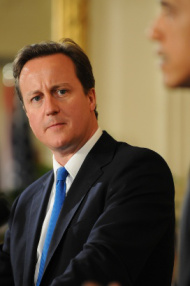
    Image: The Prime Minister during a joint press conference with US President Barack Obama. Source: The Prime Minister’s Office

    The narrow defeat on 29th August of the UK government’s parliamentary motion on support in principle for military action against the Syrian regime has forced Prime Minister David Cameron to concede that Britain will play no part in any direct attack on Syria. If the UK is to play no military role in ‘punitive’ responses to the regime’s alleged use of chemical weapons, what options are open to the UK in terms of resolving the Syrian conflict, protecting civilians and punishing those responsible for war crimes there? And how does Cameron’s overt preference for the military option, with or without UN mandate, condition these non-military options?

    Pushing for peace

    The possibility of a negotiated peace in Syria should not be dismissed. Neither the regime’s military, militia and foreign allies, nor the variety of armed factions ranged against them (and, increasingly, each other) are exhausted. Nor do the Assad regime’s mid-year successes in central Syria presage any imminent likelihood of it regaining control of the north and east. The strategic stalemate that appeared to set in to the conflict in June, after pro-Assad forces retook al-Qusayr, arguably presented a breathing space for negotiations and the so-called Geneva II conference, proposed by the US and Russia, with UN and Arab League backing, the previous month. As recently as mid-August, the Geneva talks were expected to resume in September.

    But even convening these talks will now prove far harder. Expectation of Western intervention against President Bashar al-Assad, as well as their own increasing divisions, gives the Western-backed armed opposition groups an incentive to delay talks. Jihadist groups that have proved effective militarily are largely excluded. US and Russian facilitation of the Geneva process, however fraught, also tends to exclude the voices of regional actors like Turkey, Iran, Iraq and Saudi Arabia, each of which feels its interests very directly threatened in Syria and gives active support to one or more armed faction.

    This calls for a rethinking of the Geneva process, if not the 2012 transition roadmap, to bring in the full range of actors, not the abandonment of peace talks. Threat of US-led intervention and its own increasing international marginalisation, should it be proved to have launched a chemical attack on 21st August, could incline the Assad regime towards a negotiated settlement, perhaps even an exit and exile strategy.

    Cameron and Putin

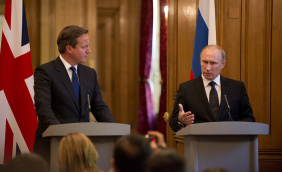
    Image: The Prime Minister welcomes President Vladimir Putin to Downing Street ahead of the G8 Summit. Source: The Prime Minister’s Office

    This will not happen without pressure from Iran and Russia. Both have much to lose in Syria, but neither is entirely closed. Iran is still in its post-electoral opening and under severe economic pressure, looking to cut a wider deal with the West. Russia may not be comfortable with its isolated position defending the alleged user of chemical weapons. Like the US, it fears the growing influence of jihadi groups while the current stalemate continues. While there is little hope of Moscow abandoning its Security Council veto over action against Syria, it will be embarrassed if it stands almost alone defending Assad in the Council or against a General Assembly resolution. Neutrally collected and analysed evidence of Syrian regime culpability for chemical weapons attack will be crucial to shifting Russia’s position.

    Having made clear its preference for ‘punitive’ military action, and been frustrated by parliament in pursuing such action, the UK government is not ideally placed to broker negotiations. Yet the UK does have influence with Syrian opposition groups, in the Gulf States and, when it acts in concert with its less interventionist EU partners, with Russia, Turkey and Iran.

    Fighting impunity

    Again, the importance of due investigative and legal process through UN Fora is crucial. When asked on 29 August if he agreed that Assad should be prosecuted at the International Criminal Court (ICC), David Cameron replied curtly that these processes take time. Yes, the wheels of institutional responses turn slowly, not least justice institutions. Yet the most obvious response to any breach of customary international law on the use of chemical weapons (Syria is one of just five states not to have signed the 1993 Chemical Weapons Convention) is a war crimes prosecution through the ICC. It is not important that Syria has not signed the Court’s establishing Rome Statute. Assad and any responsible commanders could still be subject to international prosecution if the Security Council referred Syria formally to the ICC.

    The UN has been investigating a wide range of alleged crimes committed by both sides with a view to future prosecutions. Clearly, the presence on the Security Council of Syrian allies and a majority of non-signatories to the Rome Statute presents obstacles to referral, but the Council has overcome such obstacles before, notably China’s reluctance to see its Sudanese allies prosecuted over actions in Darfur. With France and other allies, the UK should take the lead within the Security Council in pushing to refer Syria to the ICC based on the same ‘moral minimum’ or red line that has been deployed in favour of armed intervention. This, in turn, may provide leverage to persuade pro- and anti-Assad factions alike to take peace negotiations more seriously.

    Notwithstanding the heavy shadow of its past action in Iraq, the UK’s moral standing is bolstered by commitment to legal and democratic process. The UK should take a breath, step back from punitive reaction and recommit itself to a multilateral, inclusive and legally rigorous approach to resolving the war in Syria and its many affiliated regional conflicts. No other form of intervention will effectively protect the lives and rights of Syrian civilians either in the current war or the difficult peace that must follow.

    Richard Reeve is the Director of Oxford Research Group’s Sustainable Security Programme. He works across a wide range of defence and security issues and has particular expertise in Sub-Saharan Africa, peace and conflict analysis, and the security role of regional organisations.

    Zoë Pelter is the Research Officer of Oxford Research Group’s Sustainable Security Programme. She works on a number of projects across the programme, including Rethinking UK Defence and Security Policies and Sustainable Security and the Global South.

  • Syria’s Uneven Aid Distribution Threatens Future Peace

  • The Global Land Rush: Catalyst for Resource-Driven Conflict?

    The Global Land Rush: Catalyst for Resource-Driven Conflict?

    Michael Kugelman of the Woodrow Wilson International Center, argues that the factors that first sparked many of the land acquisitions during the global food crisis of 2007-08 — population growth, high food prices, unpredictable commodities markets, water shortages, and above all a plummeting supply of arable land — remain firmly in place today. He writes that land-lusting nations and investors are driven by immediate needs, and they have neither the incentive nor the obligation to slow down and adjust their investments in response to the wishes of distant international bureaucrats. This, he argues, has serious consequences for global security.

    Read Article →

  • US Foreign Policy Bureaucracy in Afghanistan

  • A Success Story? The British Intervention in Sierra Leone Revisited

    Carefully Managing Water Resources to Build Sustainable Peace

    Carefully planned interventions in the water sector can be an integral part to all stages of a successful post-conflict process, from the end of conflict, through recovery and rebuilding, to […]

    Read Article →