Blog

  • Sustainable Security

    Too Quiet on the Western Front? The Sahel-Sahara between Arab Spring and Black Spring

    While the world’s attention has been focused on the US-led military interventions in Iraq and Syria a quieter build-up of military assets has been ongoing along the newer, western front of the War on Terror as the security crises in Libya and northeast Nigeria escalate and the conflict in northern Mali proves to be far from over. In the face of revolutionary change in Burkina Faso, the efforts of outsiders to enforce an authoritarian and exclusionary status quo across the Sahel-Sahara look increasingly fragile and misdirected.

    Read Article →

    Beaux Gestes and Castles in the Sand: The Militarisation of the Sahara

    Whatever the benefits for Mali, the French-led eviction of jihadist groups from northern Mali may have made the wider Sahara a less safe place, and has done little to lower the capacity of such groups to threaten European interests.. In 2014, France is implementing a major redeployment of its forces in Africa into the Sahel and Sahara. Meanwhile, the US has been quietly extending its military reach from Djibouti to Mauritania. However, as elsewhere, the western military approach to countering Islamist insurgency in the Sahel rests on very unsteady foundations and the potential to provoke wider alienation and radicalisation is strong.

    Read Article →

    Sustainable Security and the Challenges of 2014

    2014 is a time for looking backwards and forwards. While the dynamics of the war on terror are still very much in play, the withdrawal from Afghanistan and the re-escalation of violence in Iraq and Libya present an opportune context for sincere reflections on the disastrous consequences of war without borders. Such inquiry needs to look forward too, to the implications of the current administration’s ‘war-lite’ and the unstoppable proliferation of remote control technologies.

    Read Article →

    Geneva II: Prospects for a Negotiated Peace in Syria

    The recent announcement that the so-called Geneva II conference would finally convene on 22 January 2014 is overdue but good news. What are the chances of it bringing peace? With an interim deal signed on Iran’s nuclear programme, Richard Reeve discusses what chance the great powers, Middle Eastern diplomats and the mediators of Geneva have as they turn their attention to ending the war in Syria.

    Read Article →

  • Climate change and conflict: lessons from community conservancies in northern Kenya

    Climate change and conflict: lessons from community conservancies in northern Kenya

    Issues:Climate change, Competition over resources

    The devastating drought that affected large areas of Kenya in 2009 and the upsurge in inter-community violence in the north of the country highlighted an apparent connection between climate change and conflict. However, the evidence-base for this connection is limited and it is therefore imperative to analyse how these factors interact in reality rather than to make assumptions.

    This report is based on the findings of research carried out in two community wildlife conservancies in northern Kenya in 2009. It illustrates how climate change is affecting the distribution and prevalence of natural resources in Kenya but makes clear that this is not the only factor contributing to resource scarcity.

    It emphasises that competition for natural resources is a key driver of conflict, but also that it interacts with a range of other factors, and that violence is not inevitable. The research finds that local governance mechanisms, especially natural resource management, are crucial in determining whether competition over scarce resources will turn into violent conflict.

    Based on the research findings, the report makes a series of practical policy recommendations targeted at relevant Kenyan Government Ministries and other stakeholders. The recommendations focus on conflict-sensitising Kenya’s climate change response strategy, as well as related policies concerned with natural resource management, peacebuilding and security.


    The full report is available here.

    Comments

    Post new comment


  • Sustainable Security

  • Sustainable Security

    National security and the paradox of sustainable energy systems

    The transition away from a centralised global economy built around conventional energy sources to a decentralised global economy mostly fuelled by renewable resources is one we must make for the sake of our children’s futures and that of our planet. Writing for sustainablesecurity.org, Phillip Bruner asks if national security is at present, deeply concerned with preserving access to conventional energy, then how would national security for a decentralised renewable energy Internet be managed? Who would manage it? And what role, if any, could the public play in helping to alleviate some of the burdens of 21st century threat mitigation?

    Read Article →

    Causes of Conflict: A Strategic Perspective on US–Sino Relations in the Caribbean

    Author and former High Commissioner of Trinidad and Tobago to the Court of St. James, Serena Joseph-Harris writes that China’s increasing regional profile in the Caribbean highlights the challenges now posed to American exceptionalism as Beijing defines its own course in the region. This article focuses on the potential within the Caribbean Basin for the burgeoning proceeds presently derived from increases in the legitimate investment, trade, and commerce emanating from Beijing and Washington to become entwined with illicitly derived funds generated from transnational crime activities, specifically the trafficking of drugs.

    Read Article →

  • Sustainable Security

  • Strategic Thinking in a Resource-constrained World

    Strategic Thinking in a Resource-constrained World

    Ben Zala | | December 2012

    Issue:Competition over resources

    Two new reports surveying the strategic trends that are likely to shape the next few decades of global politics point very clearly to the prospect of a severely resource-constrained world. Released two days apart, both the new Chatham House report on Resource Futures and the US National Intelligence Council report on Global Trends 2030: Alternative Worlds raise a number of important questions relating to conflict and security. 

    According to the Chatham House report,

    “The spectre of resource insecurity has come back with a vengeance. The world is undergoing a period of intensified resource stress, driven in part by the scale and speed of demand growth from emerging economies and a decade of tight commodity markets. Poorly designed and short-sighted policies are also making things worse, not better. Whether or not resources are actually running out, the outlook is one of supply disruptions, volatile prices, accelerated environmental degradation and rising political tensions over resource access.”

    The report outlines what the authors refer to as volatility being “the new normal.” For this reason “High and fluctuating prices are spurring new waves of resource nationalism and making unilateral and bilateral responses more attractive.” This should be cause for concern, especially in relation to the ways in which the response of governments and other actors to scarcity (or at least perceptions of scarcity) can interact with existing tensions and conflicts between and within communities. As the report highlights, “In addition to efforts to reduce demand at home, governments and other actors have moved to ensure access to affordable resources, reshaping the landscape of international politics. The return to largely protectionist and beggar-thy-neighbour manoeuvres – often in reaction to short-term supply bottlenecks or perceptions of scarcities rather than actual ones – can act as fuel to the fire.”

    As well as mapping the consumption and trade trends across a series of important resources, the report also discusses the impact of external variables such as population growth and climate change. These are “multiple stress factors” which “render countries vulnerable to different types of shocks such as environmental disasters, political unrest, violent conflict or economic crises – increasing both local and systemic risks. Such factors can create new tensions and flashpoints as well as exacerbating existing conflicts and divisions along ethnic and political lines.”

    The report includes a section on resource conflict flashpoints (p. 114) which outlines fifteen different potential flashpoints relating to territorial/economic zone disputes in resource-rich areas, shared water resources and transboundary river systems and resource-related rebellion and insurgency. The report is also linked to an interactive website that maps some of these trends and potential flashpoints.

    The day after this report was released, the US National Intelligence Council released their own on the key trends over the next twenty years that the United States will need to adapt to or try and shape in order to “think and plan for the long term so that negative futures do not occur and positive ones have a better chance of unfolding.”

    Among other so-called mega trends such as urbanisation and changing demographics, the report echoes the Chatham House research by pointing to an increasingly complex situation in terms of global resources. The report argues that,

    “We are not necessarily headed into a world of scarcities, but policymakers and their private sector partners will need to be proactive to avoid such a future. Many countries probably won’t have the wherewithal to avoid food and water shortages without massive help from outside. Tackling problems pertaining to one commodity won’t be possible without affecting supply and demand for the others.”

    The key trend or ‘tectonic shift’ as the report calls it is that “demand for food is expected to rise at least 35 percent by 2030 while demand for water is expected to rise by 40 percent. Nearly half of the world’s population will live in areas experiencing severe water stress. Fragile states in Africa and the Middle East are most at risk of experiencing food and water shortages, but China and India are also vulnerable.”

    While this may lead some towards overly pessimistic conclusions about a world defined by instability, human insecurity and geopolitical tensions, it is refreshing to see the NIC emphasising the importance of how the US can respond now. In his forward, the Council’s Chairman Christopher Kojm states that “We are at a critical juncture in human history, which could lead to widely contrasting futures. It is our contention that the future is not set in stone, but is malleable, the result of an interplay among megatrends, game-changers and, above all, human agency.” It is worth noting the deliberate use of the phrase ‘alternative worlds’ in the repo

    While some degree of adaptation to these structural trends mapped out by both Chatham House and the National Intelligence Council will undoubtedly be necessary, the importance of both of these reports is that they remind us of the need for clear and far-sighted thinking on policy responses now. The worst case scenarios that these reports discuss are not inevitable and risks can be mitigated. National security policymakers will do well to study the scenarios outlined in these two impressive reports and to try and understand the drivers and ‘tipping points’ that lead to certain pathways. Both reports offer prescriptions for current decision makers (the Chatham House recommendations on ‘targeted resource dialogues’ and ‘coalitions of the committed’ are particularly worthwhile). While volatility and uncertainty might be the ‘new normal’ in global resource politics, one thing is entirely certain – inaction and ‘business-as-usual’ when facing “a critical juncture in human history” is a recipe for disaster.

    Image source: Stayraw 

    Comments

    Post new comment


  • Sustainable Security

    Golden Dawn, a Greek Neo-Fascist party, has gradually enjoyed greater success in Greek and European parliamentary elections. What are the drivers behind this development?

    The Greek Golden Dawn, a violent neo-Nazi party, has remained in the margins of the Greek political system for most of its political life. However, within the context of the emerging economic crisis both in Europe and in Greece, the party marked an electoral breakthrough in May and June 2012, receiving 7 per cent of the vote in May and 6.9 per cent in June, translating into 21 and 18 parliamentary seats out of 300 respectively. As the economic crisis unfolded, and societal upheaval in Greece became reinforced by the emerging migration crisis, the party retained its support in the 2014 European Parliament Elections receiving 9.38 per cent of the vote; and in the January and September 2015 general elections, when it retained third place in the party system with 6.28 and 6.99 per cent of the vote respectively.

    The ideology of Golden Dawn
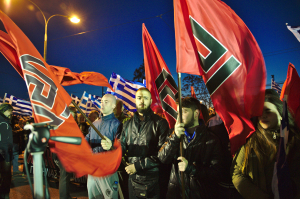
    golden_dawn_members_at_rally_in_athens_2015

    Image by Wikimedia Commons.

    The Golden Dawn is unlike all other parties in the Greek parliament; and most other far right parties in Europe. While the party itself rejects the fascist label, it nonetheless espouses all core fascist- and more specifically Nazi- principles. In our book, we show the party rejects liberalism and socialism and endorses what it terms the ‘third biggest ideology in history’, i.e. nationalism, combined with support for an all-powerful state premised on ‘popular sovereignty’. In its manifesto the party states that being a member of the Golden Dawn entails the acceptance of the following principles: the establishment of the state in accordance to nationalism; the moral obligations that derive from this ideology including the rejection of any authority that perpetuates societal decline; the acceptance of nationalism as the only authentic revolution; the establishment of the popular state in which there are no inequalities on the basis of wealth; racial supremacy and more specifically the belief in the continuation of the ‘Greek race’ from antiquity to the modern day; the idea that the state must correspond and be subservient to the nation/race; and the nationalization of all institutions.

    The fascist myth of palingenetic ultra-nationalism constitutes a key ideological premise underpinning the party’s discourse. The ideology of the Golden Dawn may indeed be categorised within the ‘ethnic nationalism’ variant, emphasising blood, geneaology and the perennial nature of the Greek nation. The party emphasises ties with ancient Greece, past wars, imperial experience during the Ottoman years and invasion in the 1940s. In this context, the party makes frequent references to ancient Greece, emphasising the heroic traits of those belonging to the Greek nation. Historical figures, whether heroes of ancient Greece, Byzantium, the Greek War of Independence, the Second World War or Cyprus are glorified for their heroism, bravery and sacrifice. By referring to a very large array of officially recognised historical events, personalities and national identity traits and placing them within the ethnic election framework, the Golden Dawn successfully integrates them into its ultra-nationalist palingenetic ideology.

    The Golden Dawn seeks ‘catharsis’. The party’s key goal is to eliminate all political divisions and cleanse the nation from outsiders. Communists are identified as those internationalists that seek the annihilation of the Greek nation. Contributing to this ethnocide are also Greece’s external enemies, which include all foreigners who according to the Golden Dawn contribute to the moral and cultural decay of Greece, for example people of Jewish origin and all immigrants.

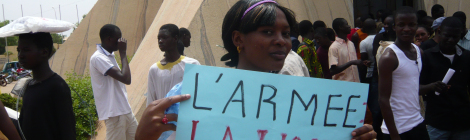
    Militarism hence is the key to both the Golden Dawn’s ideology and organizational structures. The army is the ultimate value, they claim. A value that encloses within it ‘blood, struggle and sacrifice’. The party’s members see themselves as ‘street soldiers’ fighting for the nationalist cause. This places violence at the heart of Golden Dawn’s activities and illustrates their distinctive view of democracy as a bourgeois construct only to be used as a means for achieving their ultimate goal: its abolition, as its leader Nikolaos Michaloliakos claims. It also explains the link between Golden Dawn members and army officials, as well as the organization of ‘paramilitary orders’ or ‘battalions’.

    Therefore the party should be understood as neo-Nazi, not because of its past use of Nazi paraphernalia, but rather because its ideology and organizational structures fulfil the criteria of what constitutes a neo-Nazi group. Its association with a large number of violent acts resulted in the imprisonment of the majority of its MPs including the party leader in 2013/2014. 70 defendants, which include the party leader and the party’s MPs, went on trial in Spring 2015 on charges including murder, grievous bodily harm and sustaining a criminal organization. The trial remains on-going.

    Accounting for the rise of Golden Dawn

    How may we explain the rise and sustained support for the Golden Dawn? The Golden Dawn’s electoral fortunes have coincided with both the economic and migration crises that have affected Europe as a whole. For example, in 2012 during the peak of Greece’s economic crisis, the country’s unemployment was at 24.5 per cent with youth unemployment at 55.3 per cent. In 2013 these figures increased to 27.5 and 58.3 respectively. The government deficit was -8.6, which increased in 2013 to -12.1. In addition, Greece experienced the bulk of the migration crisis as the entry point for a high number of refugees who travel from Turkey to the islands of Kos, Chios, Lesvos and Samos. For example, an estimated number of 856.723 refugees arrived by sea in 2015 and 169.459 in 2016.  It would make sense to seek causal links between the economic and migration crises on the one hand, and the rise of the Golden Dawn on the other. However, the adoption of a comparative logic suggests that this argument does not hold when subjected to empirical scrutiny. Other European countries that were also severely affected by the Eurozone and/or migration crises have not experienced a comparable rise in support for the far right. For example, Spain’s unemployment levels are second in the EU after Greece with 24.8 per cent in 2012 and 26.1 per cent in 2013. Youth unemployment in Spain is also very high at 52.9 per cent in 2012 and 55.5 in 2013. Portugal’s somewhat lower unemployment rates at 15.8 per cent in 2012 and 16.4 per cent in 2013 are still above the EU average. The same goes for the country’s youth unemployment rates at 37.9 per cent in 2012 and 38.1 in 2013.

    We posit an alternative explanation that takes into account the broader implications of the crises of Greek society. We understand the rise of the Golden Dawn as a response to a perceived breach of the social contract in Greece. Therefore, we see this rise not as question of intensity of economic and/ or migration crisis, but rather as a question of the nature of the crisis, i.e. economic and/migration versus overall crisis of democratic representation. Extreme right parties such as the Golden Dawn are more likely to experience an increase in their support when a societal crisis culminates into an overall crisis of democratic representation. This is likely to occur when severe issues of governability impact upon the ability of the state to fulfil its social contract obligations. The perceived inability of the state to mediate the effects of the crisis and to deliver services based on the redistribution of the collective goods of the state. When state capacity is limited or perceived to be limited, then the result is the delegitimization of the party system as a whole. This is because the system is perceived as incapable to address the crisis and mediate its socioeconomic effects. This breach of the social contract is accompanied by declining levels of trust in state institutions, resulting in party system collapse.

    Conclusion

    If we are right, then the Golden Dawn is a specific symptom of a broader institutional pathology. Therefore in order to contain this phenomenon, political actors should focus on institutional reform in order to restore the domestic social contract and reintegrate key social groups back into the political mainstream. More specifically:

    1. Empower the middle class: because the middle class is key to both economic prosperity and democratic stability. Weak democratic institutions and widespread corruption have resulted in the weakening of the middle ground and this is what allows extremist groups to co-opt middle-class voters. Unless we address this institutional pathology at its core, extremism will keep recurring.
    2. Welfare reform: because the appropriation of key social groups into the mainstream depends on social security. The greater the insecurity, and the broader the populace it affects, the greater the potential of extremist elements to co-opt these social groups that would otherwise support mainstream alternatives.
    3. Strengthen civil society institutions: Because civil society fosters tolerance. Greek civil Society is weak at all levels: weak structure, limited impact and limited membership. There is a wider sentiment of public distrust towards this type of organisations in Greece because of the long tradition of corruption and clientelistic relations that prevail.
    4. Reform the education system: Because education is a key means of socialisation that institutionalises political culture. The type of socialisation that occurs from an early age at the school level is the one that becomes most embedded. And, because people of a younger age are more easily moulded into violence and extremism, they tend to occupy a large portion of far right party membership. As long as the Greek education system promotes exclusion and vilifies the other through official textbooks, it will continue to offer opportunities for right-wing extremism.

    Dr Sofia Vasilopoulou is a Senior Lecturer in Politics at the University of York.

    Dr Daphne Halikiopoulou is an Associate Professor in Comparative Politics at the University of Reading.

  • Sustainable Security

  • Sustainable Security

    Losing control over the use of force: fully autonomous weapons systems and the international movement to ban them

    Later this month, governments will meet in Geneva to discuss lethal autonomous weapons systems. Previous talks – and growing pressure from civil society – have not yet galvanised governments into action. Meanwhile the development of these so-called “killer robots” is already being considered in military roadmaps. Their prohibition is therefore an increasingly urgent task.

    Read Article →

    Nuclear Weapons: From Comprehensive Test Ban to Disarmament

    Despite not yet entering into force, the 1996 Comprehensive Test Ban Treaty has succeeded in almost eliminating nuclear weapons testing and in establishing a robust international monitoring and verification system. A breakthrough in its ratification by the few hold-out states could have important positive repercussions for the Nuclear Non-Proliferation Treaty or nuclear disarmament in the Middle East.

    Read Article →

  • Climate change

    Climate change

    Climate change is high on both domestic and international political agendas as countries face up to the huge environmental challenges the world now faces. Whilst this attention is welcome, less energy is being focused on the inevitable impact climate change will have on security issues. The well-documented physical effects of climate change will have knock-on socio-economic impacts, such as loss of infrastructure, resource scarcity and the mass displacement of peoples. These in turn could produce serious security consequences that will present new challenges to governments trying to maintain stability.

    Monitoring disaster displacement in the context of climate change

    Issue:Climate change

    An IPI policy forum launched a new joint study by a UN office and a prominent Norwegian group showing that 36 million people were displaced in 2008 by sudden onset natural disasters — 20 million of them by climate-related disasters such as storms and floods.

    Read more »

    India’s 21st-century war

    Paul Rogers | Open Democracy | November 2009

    Issues:Climate change, Global militarisation, Marginalisation

    Tagss:India, Maoists, Naxalite insurgency

    In an age of climate change and deepening inequality, the spreading Naxalite insurgency in India – not al-Qaida – may show the world its future.

    This article was originally posted on openDemocracy.

    Read more »

    The heart of India is under attack

    Arundhati Roy | guardian.co.uk | October 2009

    Issues:Climate change, Competition over resources, Marginalisation

    Odd, isn’t it, that even after the Mumbai attacks of 26/11, the government was prepared to talk with Pakistan? It’s prepared to talk to China. But when it comes to waging war against the poor, it’s playing hard

    This article was originally posted in the guardian.co.uk’s comment is free section.

    Picture: Dongria Kondh’s Sacred Mountain in Orissa (angryindian.blogspot.com)

    Read more »

    Climate Change: Impact on Agriculture and Costs of Adaptation

    Various | International Food Policy Research Institute | September 2009

    Issues:Climate change, Competition over resources

    This Food Policy Report presents research results that quantify climate-change impacts, assess the consequences for food security and estimate the investments that would offset the negative consequences for human well-being. Read more »

    Impact of Climate Change on Agriculture

    Issues:Climate change, Competition over resources

    A report published on the 30th September by the International Food Policy Research Institute (IFPRI) estimates that 25 million more children will be malnourished by 2050 due to the effects of climate change. The report predicts that climate change will lead to price increases for the most important agricultural crops: rice, wheat, maize and soybeans. Wheat prices are projected to increase globally by 170 – 191% whilst rice prices may increase by 113 – 121%.

    Photo: Bluemoose Official License

    Read more »

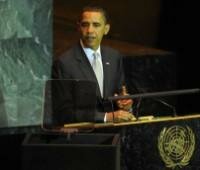
    Analysing President Obama’s Address to the United Nations General Assembly

    Issue:Climate change

    Tagss:Copenhagen, Obama

    There were many positives in Barrack Obama’s speech to the United Nations on the 24th September. The US President outlined the importance of the UN as an institution and more importantly its function as a forum through which the nations of the world can collectively address shared problems. He reaffirmed America’s commitment to an “era of engagement based on mutual interest and mutual respect” and to seeking “the goal of a world without nuclear weapons”.

    However…

    Read more »