Blog

  • Beyond Disarmament, Demobilization and Reintegration of Ex-combatants

  • Mexico’s Conflicting Migration Policy Goals: National Security and Human Rights

    Mexico has quickly become a major site of transmigration from Central America to the United States, as people move in search of employment opportunities or escape from social violence. This rise in migrant flows from Mexico’s southern border overlaps with problems of control of contraband, organised crime, and the trafficking of drugs and arms. However, the government’s militarised approach to the phenomenon means that the use of force and human rights violations go unresolved and military approaches to preserving public order go unchecked. As long as migration remains a security issue, instead of a developmental and human rights matter, it will not be tackled appropriately. Instead, the government must start to view the matter through a citizen, not national, security lens.
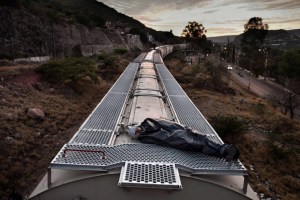
    Celaya - Mexico On the freight train that drive along the south states of Mexico towards north regions, every years thousands of central -american illegal migrants, travel on the wagon roofs. risking so their life for reach the United States border. Source: The Borderland Chronicles

    Celaya – Mexico: On the freight trains that drive along the southern states of Mexico towards northern regions, every year thousands of central -american illegal migrants travel on the roofs of moving trains. Source: The Borderland Chronicles

    Mexico has rapidly developed into a major country of origin, destination, return and transit for migrants. The situation of undocumented transmigrants, most of them Central Americans headed for the United States in search of dignified job opportunities or fleeing social violence back home, has lately attracted particular attention. With limited resources and no permit to enter Mexico, they are required to cross the country clandestinely and vulnerable to abuse by criminal groups and corrupt state agents. The National Commission of Human Rights and civil society groups have for years been documenting the violence, exploitation and humiliations facing transmigrants, including robberies, sexual violence, torture, homicides, and especially kidnappings and extortion.

     Human rights on shaky grounds

    Coatzacoalcos, Veracruz, Mexico, 2011 A family from Honduras rest in a church in the outskirts of the city of Coatzacoalcos as they wait for the next train to pass by. Source: The Borderland Chronicles

    A family from Honduras rest in a church in the outskirts of the city of Coatzacoalcos, Mexico, as they wait for the next train to pass by. Source: The Borderland Chronicles

    One of the milestones for human rights in Mexico was set with the 2011 constitutional reform that granted constitutional status to all human rights enshrined in the international treaties to which Mexico is party. For migrants, however, the panorama has not brightened much. The massacre of 72 migrants that had occurred in San Fernando, in the northern state of Tamaulipas, in August 2010, provided the impetus for the adoption of a new Migration Law. Published in May 2011, it entered only tardily into force with the publication of its Regulations in September 2012.

    Initially, the legislation was hailed as an advance for migrant rights. Unlike the previously applicable General Population Law, it establishes that irregular entry into Mexico is not a crime. But its structural flaw is that while it demands the authorities respect the rights of all migrants, irrespective of their legal status, it also deems migration an issue of national security. The latter, according to the National Security Law, is to be understood as the actions designed to maintain the integrity, stability, and permanence of the Mexican state. In other words, the Migration Law maintains a criminalising approach towards undocumented migrants and effectively paves the way for racial and ethnic profiling in migration checks; corruption; and migrant detention as an instrument for the preservation of public order.

    Mexico’s migration policy, designed by the Secretariat of the Interior (SEGOB), has direct bearing on migration management, carried out by the National Migration Institute (INM). The latter has adhered to the perspective of national security since its 2005 designation as a national security agency. In practice this has meant that INM agents receive training in human rights as well as in national security and subjects related to interrogation and the use of force; abuse and humiliate undocumented migrants during control operations; and administer migrant detention centres that are prison-like installations with very limited access for civil society groups and journalists interested in documenting the human rights situation in these facilities.

    If anything, this stance has hardened with the current Commissioner, former police and intelligence official Ardelio Vargas, who was appointed in January 2013 and has vouched to implement the migration policy from a national security lens. For the authorities it is necessary to apply this perspective, because migration flows have diversified over time and now comprise not only persons seeking better job opportunities, but also individuals who smuggle migrants or collaborate with criminal gangs. Managing migration from a national security standpoint, therefore, allows Mexico to shield both its borders and honest migrants against unsavoury elements.

    Edging closer to national security?

    The 2012 presidential victory of Enrique Peña Nieto marked the return to power of the Institutional Revolutionary Party (PRI) that had ruled Mexico between 1929 and 2000 and left an indelible mark on state-society relations. Alarmingly, the current administration appears determined to defend the nexus between migration and national security. For the authorities this approach is warranted, because migration flows are unfolding in the context of organised crime, which found in undocumented migration a new criminal niche once the Felipe Calderón administration (2006-2012) had declared its war on drug trafficking. The fight against organised crime, however, has blended with migration control such that the social phenomenon of migration is now considered and tackled as a security threat, not as a human rights issue.

    The rhetorical intent to do so, at least, is expressed in the sectorial plans, planning instruments that contain the objectives and strategies that seek to strengthen government actions and respond to the needs and policies outlined in the National Development Plan, itself the blueprint that governs  the programme and budget formulation of the entire Federal Public Administration. The sectorial plans that are of particular interest for this discussion are those of the SEGOB and the Secretariat of National Defense (SEDENA).

    The SEGOB document adopts a multidimensional approach to national security that is meant to identify external and internal dynamics that might come to constitute risks and threats to the integrity and stability of the Mexican state. These dynamics are of a social, environmental, economic, political, technological, and demographic nature and include examples such as organised-crime-related violence, terrorism, migration, the trafficking of arms, persons and drugs, and the proliferation of weapons of mass destruction.

    For the SEGOB, the need to respond effectively to migration to and from Mexico requires the government to foster inter-institutional cooperation through a comprehensive migration policy (set out in the forthcoming Special Migration Programme 2014-2018), one that is able to take into account the multiple dimensions of migration, to leverage its development potential, and to minimise its costs. As the phrasing suggests, the country is prepared to welcome skilled migrants, but will deter undocumented ones. The plan acknowledges that Mexico faces the difficult task of balancing national sovereignty with migrant rights, yet it has little more to say on the subject than reiterating the need to transform the INM. The latter, it is worth pointing out, has been an oft-stated yet never accomplished ambition.

    The second text affirms that the SEDENA has an essential role to play in preserving internal security and strengthening democratic institutions. In view of the unprecedented insecurity associated with organised crime, which also found a criminal niche in migrant kidnappings, the Armed Forces responded to the civilian authorities’ call for assistance by maintaining nationwide deployments, particularly the country’s most sensitive areas.

    Of particular relevance is the plan’s commitment to boosting border security, given the vulnerability that arises especially at the southern border with multidimensional problems such as the control of contraband and migrant flows, organised crime, and the trafficking of drugs and arms. These dynamics, the SEDENA believes, require it to maintain a permanent of some 30,000 troops and to cooperate with the Armed Forces of Belize and Guatemala as well as with the Federal Police and the Attorney General’s Office in the country’s crucial zones. The SEDENA document, more than its SEGOB equivalent, suggests that far from making greater strides towards respecting migrant rights, Mexico will perpetuate the circle of exclusion, violence, and corruption. Rather than moving towards a human rights perspective, Mexico chooses to embrace wealthier, skilled migrants while closing its doors to poorer, untrained ones.

    The United States, Mexico, and Central America are partnering to promote border security, but these efforts not only fail to impede migration flows, but also expose migrants to greater danger and –given the ineffective fight against corruption–to continued abuse by state agents who know they can prey on migrants with impunity. At the same time, the creation of a militarised security corridor stretching from the Central American isthmus up to the United States can also be deployed to suppress social dissent against the expansion of infrastructure projects that primarily serve the interests of transnational enterprises or against mining projects that have a devastating impact on the environment and local communities’ access to water.

    Towards a citizen security framework

    In order for its migration policy and management to be more effective and humane, Mexico will need to undertake a host of changes, starting with the professionalisation, transparency, and accountability of the INM. However, irrespective of the extent to which this may be achieved, the treatment of migrants is unlikely to change as long as migration is linked to national security and Mexico acts as a filter for undocumented migration to the United States. Instead, the latter will need to be understood as a development and human rights issue. Above all, it will need to be approached from the perspective not of national security, but of citizen security.

    According to the Inter-American Commission on Human Rights, citizen security is the “social situation in which all persons are free to enjoy their fundamental rights and public institutions have sufficient capacity…to guarantee the exercise of those rights and respond effectively when they are violated.” This definition leaves no doubt that the central objective must be to protect the person, rather than the state. The application of a citizen security approach to migration would require the Mexican state not only to avoid military participation in internal security and migration control, but also to take seriously the professionalisation of the INM (including adequate recruitment and training, the creation of a human rights culture, decent remuneration, and an effective sanctions system) and to establish oversight mechanisms that will foster transparency and accountability.

    As long as the Mexican government remains unprepared to pursue a different migration policy, citizens will need to play a greater role in pressuring it to do so. Civil society groups have a relevant role to play in sensitising the population and creating the political will to prioritise the human rights and development aspects of migration over security.

    Sonja Wolf is a researcher at the Institute for Security and Democracy (INSYDE), Mexico City. She has acted as project coordinator and principal investigator of INSYDE’s Assessment Study of Mexico’s National Migration Institute (INM), the first comprehensive study to examine the INM’s institutional and migration management and the ways in which it facilitates corruption and migrant abuse.

    Featured image: Migrants traveling on the roof of a freight train near Ixtepec, Oaxaca. Source: CIP Americas
  • Brexit or Bremain for British Security?

  • Sustainable Security in the Trump Era

    Summary

    Despite considerable disarray continuing into its third month, the new US administration is showing more consistent, if not coherent, signs of how it will try to implement Donald Trump’s campaign proposals. In large part, these may be assessed as antithetical to a more sustainable security agenda, given that they promote military confrontation, undermine attempts to address climate change, and are, at best, incoherent in their response to economic inequality. Little of this translation to reality is likely to endear Trump to voters or his party. Greater policy turbulence, at home and abroad, should be expected ahead of mid-term elections next year.

    Introduction

    The Trump administration has been in power for 75 days; following the election campaign and the post-election transition it is now possible to get a reasonably clear picture of how its policies relating to security are taking shape. There has been much speculation that the United States will take a very different path to that of the Obama era, not least in relation to security and climate change, and since the United States is the world’s most powerful state it is appropriate to make an initial assessment of the changes as they may affect the sustainable security thinking with which ORG has been concerned for the last decade. Is the Trump era likely to make a major difference to the global security outlook or is it more likely that realities of international relations will limit the capacity for the change Trump seeks?

    Sustainable Security

    The ORG approach to security may be summarised:

    Security challenges such as terrorism, crime and weapons proliferation cannot be successfully contained or controlled without understanding and addressing their root causes. ORG’s Sustainable Security concept takes a comprehensive, long-term approach that encompasses climate change, resource scarcity, militarisation, poverty, inequality and marginalisation.

    As the thinking has developed it has tended to group the challenges into three main areas, economic relations, climate change, and militarisation, and these are convenient headings with which to make an initial assessment of the Trump era.

    The issue of economic relations is seen as having as its greatest challenge the failure of the neoliberal approach to deliver economic justice, equity and emancipation, and the consequent growing divide between a relatively small minority of rather more than a billion people and the majority of the world’s population, with a clear rise in frustration and resentment among that majority at relative marginalisation and lack of life prospects.

    In the environmental context, while a number of resource limitations and regional environmental impacts are important, the emphasis in the ORG analysis has to be on the most significant trend – climate change and especially its impact on human well-being especially as a result of severe effects on food production.

    Finally, militarisation is seen partly in terms of a particularly entrenched and powerfully influential economic sector but most significantly as a culture in which the early use of military force is essential in maintaining the status quo, however unequal, unjust or unstable that order is.

    In all cases, the ORG view is that these approaches are thoroughly inappropriate if we wish to avoid an unstable and violent world, and much more emphasis must be placed on the underlying causes of the problems and how they may be addressed. The failure of the current 15-year war on terror is the most grievous example, having led to hundreds of thousands of deaths, millions of displaced people, at least three failed or failing states and a continuing perception of the threat of political violence in western countries. The question, simply, is how does the new Trump era affect the possibility of taking the wider view?

    Economic Issues

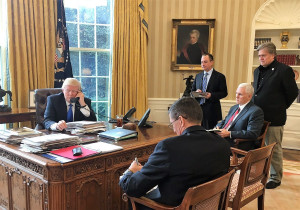
    Image credit: PressSec/Wikimedia.

    The early indications are that the Trump administration is a potentially unstable mix of those best described as economic nationalists and others, especially in the wider Republican Party, who are convinced neoliberals. The latter may be dubious about any trend towards protectionism and believe that in a free market which already favours the wealthy such protectionism may turn out to be counter-productive. In this view, transnational corporate organisation is a fact of life and no country, not even the United States, can go its own way for long.

    The economic nationalists, who are dominant within Trump’s inner policy circle, are very strongly convinced that the United States has sufficient power to dominate the markets that matter most. Furthermore, the whole Trump election platform was predicated on strong opposition to the perceived elite, an establishment that “ran” Washington. His appeal to those left behind, especially in the post-industrial American Mid-West, was probably the most important element in his successful election and it is an approach that will not readily be abandoned. At the same time, he was committed to policies that would reduce taxes while scaling down the Obamacare reforms – initially both popular with his supporters.

    In the short-term Trump’s policies may be popular but it may be as little as a year before those left behind find that their predicament simply does not ease. Indeed, it is already becoming clear that health provision reforms will lead to many millions of Americans facing higher costs, including many of those who voted for Trump. More generally, economic nationalism may turn out to provide little gain for the country as the power of China and other major economies becomes more apparent. “America first” is simply not sustainable in a globalised world.

    Even so, what has to be faced is that the Trump era will not see any fundamental challenge to the neoliberal system, precisely in a period when that system is proving unfit for purpose. What may perhaps be more relevant is how long the Trump approach in its present form persists. The degree of disorganisation currently apparent in so many areas within the White House is hardly encouraging in terms of stability, and it may well be that as the 2018 mid-sessional elections to the House and Senate draw nearer, Trump’s singularly soft Republican majority support in both Houses of Congress will lead to sudden changes of policy. These may not directly address core issues of inequality but could take much of the remaining lustre off the Trump approach.

    Climate Change

    This month has seen the very clear enactment of a number of policies that confirm that the Trump approach on climate change is one of denial coupled with the strong promotion of domestically-sourced fossil fuel resources. This is a highly negative approach for two reasons – there will be an increase in carbon emissions from the United States and a lack of leadership within the international community for addressing the considerable dangers stemming from climate change. This would seem disastrous for any hope of effectively preventing climate change but there are other very interesting factors at work.

    Firstly, the reality of the dangers of uncontrollable climate change is far more recognised across the world than a decade ago. Many more states are accelerating their moves towards renewable energy sources, with the biggest emitter, China, making remarkable strides. Indeed, China may well see its way to playing a global leadership role. Secondly, the rapid developments in renewable energy technologies are making renewable sources far more economic, with many further developments coming closer to fruition. The effect of this is that renewable energy utilisation is now competing much more closely with fossil carbon sources and, as a consequence, there is a rapid increase in investment in renewables. More than half of all investment in electricity generation is now in renewables and in the United States and elsewhere there is far greater potential for employment in renewables than in fossil carbon sources.

    Major problems remain including historic underinvestment in energy storage technologies and the need to cut carbon emissions by even more than most states currently accept, but the point here is that this is one area where there is every sign that Trump’s policies are obsolete and likely to ensure that the United States is left high and dry. Even in the face of that, though, the ideological certitude of the climate change deniers close to Trump means that the administration is unlikely to change. In short, the advent of the Trump era may limit the prospects for countering climate disruption but at least this will be another area where the Trump approach may be singularly counterproductive to any aim to make the United States the world leader.

    Security

    As with climate change, the first two-and-a-half months of the Trump administration have shown the translation of rhetoric into policy: control of migration, increased military spending and the more frequent use of force. Here, though, it is necessary to recall that the eight years of the Obama administration may have seen the withdrawal of US troops from substantial parts of the Middle East and Afghanistan but also saw the quiet transition to remote warfare with much greater use of air power, armed drones and Special Forces, not least in Libya and Iraq. The early signs are that Trump is expanding such operations rather than radically changing the posture and this includes even greater use of air power in the war against Islamic State (IS), as well as the deployment of even more Special Forces in Iraq, Syria and Yemen.

    These kinds of changes are being reflected in the manner in which the Pentagon is being given a much freer hand to conduct operations, but there are already consequences. A major raid in Yemen in late January failed to achieve its objective while also killing many civilians, and the much-expanded use of air strikes in Mosul in the past month has led to such an increase in civilian casualties that they are even being reported in the mainstream western media. Even so, such consequences are unlikely to carry any weight with Trump unless there are serious disasters involving US military personnel.

    The risk of this has been limited until now but one factor that has received little attention is that Trump’s Pentagon is advocating, and indeed already initiating, a substantial increase in the number of “boots on the ground”. In Iraq this is no longer just Special Forces but regular troop deployments which include, for example, units from the 82nd Airborne Division. Trump has also just agreed to give US forces in East Africa much more open powers to operate assaults on suspected al-Qaida-linked groups in southern Somalia, and there are also repeated calls for the Pentagon to expand its deployments in Afghanistan.

    As with economic issues, such actions may be popular with Trump supporters in the short term, examples of forceful action in the task of “Making America Great Again”, but based on the failures of the last fifteen years, the longer-term impact may be very different. What it does mean, though, is that as the United States seriously expands in overseas military operations then its close allies such as Britain will have to face up to whether they are willing to maintain their commitments.

    Conclusion

    These are, indeed, different times and with all three aspects of the sustainable security challenge the election of Trump is likely to exacerbate ingrained problems. At the same time, his policies may become increasingly irrelevant concerning climate change and his economic popularity with his supporters may also erode quickly. This may well increase the temptation to use foreign military action to distract voters from domestic discontents. However, even in the military dimension there are unlikely to be any quick wins and Trump’s direction of travel means that his allies could quickly come under domestic political pressure if they were to stay closely aligned with the United States. In any case, the need to rethink our attitudes to security remains critical and it is best to see the advent of the Trump era as a period when even more opportunity for creative, critical and independent rethinking of security will be essential.

    Paul Rogers is Global Security Consultant to Oxford Research Group and Professor of Peace Studies at the University of Bradford. His ‘Monthly Global Security Briefings’ are available from our website. His new book Irregular War: ISIS and the New Threats from the Margins will be published by I B Tauris in June 2016. These briefings are circulated free of charge for non-profit use, but please consider making a donation to ORG, if you are able to do so.

  • Challenging UK Arms Sales to Saudi Arabia in the Courts

    In June,  a judicial review into the legality of UK arms sales to Saudi Arabia was announced. This will be the first time that UK arms export policy has been put under the spotlight and scrutinised in this way. Campaign Against Arms Trade discuss this historic decision.

    On 30th June there was a heavy silence in the moments before High Court Judge Justice Gilbart announced that he was granting a judicial review into the legality of UK arms sales to Saudi Arabia. A quiet relief fell over those of us in the public gallery. Decorum ensured that the response was muted, but the decision was historic. This will be the first time that UK arms export policy has been put under the spotlight and scrutinised in this way. It is an unprecedented step that is likely to focus on not just the extent of UK arms sales to Saudi, but also the scale of collusion and government support that goes with it.

    Our claim calls on the government to suspend all extant licences and stop issuing further arms export licences to Saudi Arabia for use in Yemen while the court holds a full review into whether the weapons sales are compatible with UK and EU legislation. The UK’s arms export policy will thus now undergo a full three-day investigation in front of two judges, which must take place before February 1st 2017.

    Fuelling the flames in Yemen

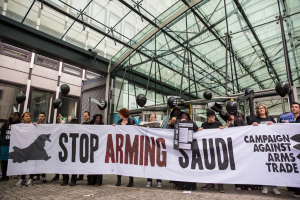
    London, UK. 11th July, 2016. Human rights campaigners protest against arms sales to Saudi Arabia outside the Defence and Security Organisation (DSO), the Government department responsible for arms export promotions.

    London, UK. 11th July, 2016. Human rights campaigners protest against arms sales to Saudi Arabia outside the Defence and Security Organisation building. Image by CAAT via Flickr.

    UK arms exports have been central to the ongoing Saudi-led bombardment of Yemen. As we write this, UK-licensed Eurofighter jets may well be over Yemeni airspace, guided by UK-trained military personnel and dropping UK-made bombs from the skies. It would be hard to overstate the humanitarian crisis that has been unleashed, with the UN having ranked the humanitarian situation in the war-torn country as a “Level 3” emergency – the highest possible emergency ranking. The bombing campaign has lasted over 15 months following a Saudi Arabian-led intervention into Yemen’s civil war. Saudi forces are acting alongside Yemen’s government against forces led by the former president, Ali Abdullah Saleh, and the Houthis, a northern Shia militia. There is no question that atrocities have been committed on all sides, although the UN has accused Saudi forces of killing twice as many civilians as all other forces.

    More than 2.5 million people have been displaced, and vital infrastructure, including schools, hospitals and cultural heritages sites have been destroyed. Of those who remain in Yemen, millions have been left without access to clean water or electricity, and 80% of the population has been left in need of aid. Even the Home Office has acknowledged the scale of the destruction, concluding that to allow people to return to Yemen could be a breach of their human rights.

    The need for legal accountability

    The destruction hasn’t only been immoral, it has also been illegal. A UN panel of experts, the European Parliament and many of the most respected humanitarian NGOs in the world, including Human Rights Watch and Amnesty International, have accused Saudi forces of serious breaches of international humanitarian law (IHL).

    The UN report “documented 119 sorties relating to violations of international humanitarian law” and reported “starvation being used as a war tactic.” More recently, Human Rights Watch has linked UK arms to specific attacks on businesses and civilian targets. The reports have been thorough and in-depth and their evidence has been compelling, but they have fallen on deaf ears in Whitehall.

    Arms exports control regulations are very clear: a licence should not be granted in the circumstances where there is a “clear risk” that it “might” be used to violate IHL. In spite of this, the UK has licensed over £3.3 billion worth of arms sales to Saudi Arabia since the bombing began, including fighter jets, bombs and missiles.

    There can be little, if any, control over how and when these arms will be used. A recent report from Amnesty International found that cluster bombs sold decades ago by the UK are being used in Yemen, a terrible reminder that the shelf life of arms is very often longer than the two year licence under which they are sold.

    Moreover, even if such control was possible, there is no reason to believe it would be applied. This is because if arms were found to be used in a way that violated the terms of their sale agreement this would result in licences being cancelled—which could affect the profitability of exports.

    Burying the truth

    In the last hours of the last day of the most recent session of parliament, the government performed a major U-turn by publishing written corrections that reveal, contrary to earlier claims, that there has been no oversight of how arms are being used. At best it represented staggering incompetence on the part of government ministers— at worst it was a cynically timed admission of how they had previously distorted the truth.

    Either way, it underpins the point that the Saudi government hasn’t just bought arms and military support, it has also bought silence, compliance and a seal of political approval. That’s why, only nine months ago, we saw the despicable, but ultimately unsurprising, revelations that UK diplomats had lobbied and campaigned behind the scenes for Saudi Arabia to Chair the UN Human Rights Council.

    So who benefits from the current situation? Certainly not the Yemeni people living under bombs, or the Saudi people being persecuted and oppressed. One obvious beneficiary is the arms companies. BAE Systems, for example, enjoys the full support of the UK government in its arms sales to Saudi. Earlier this year, BAE Chairman Roger Carr told Channel 4 News that he sees Saudi Arabia as “a very important customer with which we have a very strong relationship.” This point is alluded to in the last BAE annual report. The ‘principal risks’ section of the report identifies the commercial risk that state buyers may consider cutting their military budgets, before suggesting this will be mitigated in part because “in Saudi Arabia regional tensions continue to dictate that defence remains a high priority.”

    BAE and the UK’s special relationship

    For decades now, UK governments of all political colours have worked hand in glove with the arms companies and Saudi authorities, continuing to sell arms and provide political support while turning a blind eye to the grotesque human rights abuses that are being carried out every single day.

    Regardless of who has been in charge, the Saudi Royal Family’s influence and interests have been core to Whitehall’s approach to arms sales and the Middle East. Over recent years we have seen Tony Blair intervening to stop a corruption investigation into arms exports to Saudi, David Cameron flying out to Riyadh to meet with Royalty, and the outlandish and humiliating spectacle of Prince Charles sword dancing to secure sales for BAE Systems.

    The government’s inability to uphold its responsibility in regards to human rights and domestic law is evidence of just how far it is willing to go to maintain this toxic relationship. Despite the legal action, there has been no change to the government’s policy. Only two weeks after the judicial review was ordered, Saudi military representatives were in the UK for the Farnborough Airshow where they were shopping for weapons.

    Stop arming Saudi Arabia

    At a time when the UK should be using its close relationship with Saudi to apply pressure and push for meaningful peace negotiations and vital reform, it is instead carrying on with business as usual. The government’s refusal to act responsibly underlines the enormous power of the arms trade lobby and the pernicious nature of the UK-Saudi relationship, a relationship that fuels instability and repression and corrupts our political system.

    Whatever the outcome of the review, the campaign will go on. As long as terrible crimes are being committed with UK weapons and with our government’s support, we will continue. The UK’s shameful relationship with Saudi Arabia and the terrible examples above show just how far (and how low) the machinery of government will go to protect the Saudi Royal Family’s interests.

    The UK-Saudi alliance has boosted the Saudi regime while lining the pockets of arms company executives, but it has had devastating consequences for the people of Saudi Arabia and Yemen. For the sake of those people, the UK government must finally stop arming and empowering the brutal Saudi monarchy.


    Andrew Smith and Vyara Gylsen are writing on behalf of Campaign Against Arms Trade (CAAT). Andrew Smith is Head of Media for Campaign Against Arms Trade. Vyara Gylsen is an anti arms-trade campaigner that volunteers and works with Campaign Against Arms Trade. You can follow CAAT on Twitter at
    @CAATuk.

  • Deforestation: REDD-y for peace or fuelling conflict?

    Deforestation: REDD-y for peace or fuelling conflict?

    REDD forestry efforts don’t pay enough attention to their influence on local conflict dynamics. For REDD+ to be an effective mechanism to curb deforestation and strengthen peace opportunities, it has to pay more attention to pre-existing land and forest conflicts linked to tenure, take into account the interests of the local communities and be more sensitive to the local context

    Read Article →

    The ‘High Politics’ of Sustainable Security

    If events like those in Ukraine have taught us anything it is that, despite the predictions of many, the potential for conflict between the major powers is still one of the defining characteristics of world politics. Crisis diplomacy and inter-state rivalry is back on the global agenda. But if policymakers, analysts and civil society actors are to try and come up with ways of reversing the trend towards an increasingly competitive, militarised and crisis-driven inter-state order, then thinking carefully through the implications of a sustainable security approach to great power politics would appear to be a most useful starting point.

    Read Article →

    National Security, Climate Change and the Philippine Typhoon

    Super Typhoon Haiyan made landfall in the Philippines on 8 November, and is possibly the most powerful tropical cyclone on record. Beyond the immediate impact of the typhoon, the natural disaster is already proving to be a threat to national security, with reports surfacing of massive looting and military engagement following attacks on government relief convoys. As US and UK naval convoys head to support the situation, Andrew Holland discusses climate change’s impact as a threat multiplier and what plans militaries and governments must make to prevent the insecurity that will come with future disasters of this scale.

    Read Article →

    Can the Nuclear Non-Proliferation Treaty outrun its double standard forever?

    The recent walkout by Egyptian negotiators at UN talks have demonstrated that, like a building with rotten foundations, the nuclear non-proliferation regime is far less stable than many believe it to be. Egypt’s actions make clear that anything less than a regime specifically geared towards addressing the reasons why some states seek nuclear weapons is a regime existing on borrowed time.

    Read Article →

    Myanmar: peaceful transition to democracy or storm clouds on the horizon?

    Analysing a recent report by International Crisis Group, Anna Alissa Hitzemann argues that in order for the transition from authoritarian rule to democracy to be stable, and for peace and security to be sustainable, the government of Myanmar will have to face and resolve major challenges such as idespread militarization and the political and social marginalization (past and present) of ethnic and religious groups.

    Read Article →

  • Challenges Facing Women in Peacekeeping

  • Chemical Weapons Use in Syria: a Test of the Norm

    Chemical Weapons Use in Syria: a Test of the Norm

    Recent events in the Syrian civil war have proved an unparalleled test of the norm against the use of chemical weapons. At its core this was a test of the willingness of countries to uphold the norm, in this case in the face of a flagrant violation, and a response that in the end stumbled upon a satisfactory conclusion—reaffirming the special category of chemical arms—but which in the process said a great deal about current attitudes to the use of military force as a means of humanitarian intervention.

    Read Article →

    Beyond crime and punishment: UK non-military options in Syria

    The defeat of the UK government’s parliamentary motion on support in principle for military action against the Syrian regime means that Britain will play no part in any direct attack on Syria. What then are its options for resolving the Syrian conflict, protecting civilians and punishing those responsible for war crimes there? This article assesses what the UK can do in terms of pushing for a negotiated peace settlement and to hold accountable those responsible for using chemical weapons and any other war crimes committed during this century’s worst humanitarian crisis.

    Read Article →

  • Militarising Conservation: A Triple ‘Fail’ for Security, People and Wildlife