Blog

  • ‘Petropolitics’ and the price of freedom

    ‘Petropolitics’ and the price of freedom

    “As the price of oil goes down, the pace of freedom goes up… As the price of oil goes up, the pace of freedom goes down…” So says New York Times columnist Thomas Friedman, who argues that the first law of ‘petropolitics’ is that the price of oil and the pace of freedom are inversely correlated in countries “totally dependent on oil” for economic growth. However, the correlation between recent oil price spikes and anti-authoritarian action – particularly in the Arab Spring – challenges this assessment. But if this pattern of change is to continue, Western states must curb their hypocritical dependence on authoritarian oil-exporting governments by developing more sustainable sources of energy.

    Read Article →

  • The Resilience of the Lord’s Resistance Army

    The Lord’s Resistance Army is seriously depleted as a fighting force, but it still continues to exist as an armed group. This resilience is driven by several key factors.  

    The Lord’s Resistance Army (LRA) has carved a path of violence and disorder throughout East and Central Africa for nearly three decades. Led by Joseph Kony, the rebel group has directly and indirectly killed more than 100,000 civilians, has abducted upwards of 66,000 children, and has displaced hundreds of thousands more across five countries. While formidable in the past, the LRA is now a threadbare non-threat from a conventional military standpoint. With the group’s numbers at less than 200 (down from at least 5,000 active fighters in the 1990s), attacks and abductions are steadily trending downwards.

    Yet the LRA has also proven to be distinctly resilient, surviving as a collection of semi-autonomous units in sparsely populated peripheries that put up no resistance. Nevertheless, LRA fighters still pose a tangible threat as they loot and harass civilians, while Kony evades detection in Sudan’s Kafia Kinji region. While many observers describe the group’s current behavior as “survival mode,” its complex history shows this to be its modal pattern of organization and behavior based on an on-going ability of the group to adapt to shifts in its politico-military environment through distinct organizational endowments and resource acquisition strategies.

    Understanding LRA Resilience

    Most of the prevailing literature on the LRA has provided key insights into its history, organization, and behavior. However, the research that has focused on the group’s motives and the drivers of its violence has not addressed the distinct question of its resilience. The LRA’s resilience comes down to its organizational structure and shrewd resource strategies that have developed within autonomous bush sanctuaries and vis-à-vis the group’s wider political environment.

    Its organizational structure is based on a distinct combination of two factors. First, LRA recruitment and retention strategies relied on Acholi beliefs in spiritual and cultural symbols, such as viewing Kony as a medium for the “holy spirit,” and the common use of rituals. Such beliefs and practices, undergirded by violence, helped socialize Acholi youths familiar with them into fighters. Second, a more traditional military hierarchy was built around an initial committed core, which formed the basis for a flexible, decentralized structure that, while slowly degrading over time, has remained remarkably sturdy. In addition, the group’s resource acquisition strategies have adapted to periods of both abundance and scarcity. This configuration of factors has remained more-or-less intact for more than three decades as the LRA has interacted with regional geopolitical shifts and in the face of multiple challenges of maintaining an insurgency.

    LRA Resilience Over Three Phases

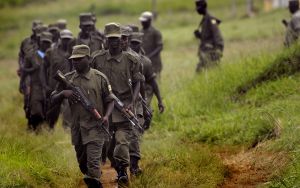
    Uganda soldiers part of the 2008–09 Garamba offensive against LRA. Image credit: Sgt. Jeremy T. Lock/Wikimedia.

    The LRA grew directly from a homegrown Ugandan People’s Democratic Army (UPDA), made up from the dominant Acholi faction of the national army overthrown by the National Resistance Army (NRA) in 1986. Led by Bazilio Olara-Okello and other military strongmen, the UPDA rebellion ended with the Pece Peace Accord of 1988. Yet senior officer Odong Latek and intransigent junior officers from the former military remained in the bush fearing criminal punishment. While this rump of the UPDA retained a military structure, it began to rely on alternative strategies for mobilization. During the UPDA’s war, head of the Holy Spirit Movement Alice Lakwena and Joseph Kony developed factions that attracted fighters with an appeal to the salvation for the Acholi people through military victory, using unorthodox military practices (e.g. believing shea butter would make fighters bullet-proof and that rocks would explode as hand grenades). Following the 1987 defeat of Lakwena’s Holy Spirit Mobile Forces (HSMF), Kony’s faction became dominant. By late 1988, Latek’s more conventional force merged with the sizable “cosmological” faction controlled by Kony, signaling the rise of his absolutist vision of Acholi society that sought to purify through violence anyone deemed government loyalists. This vision, which drew heavily on elements of elements of Acholi spiritual identity, quickly became an organizing principle and a source of resilience.

    With Latek killed in 1989, Kony asserted authority, rebranding the rebellion several times until it became the LRA in September 1993. Here the group established its organizational structure, with “Control Altar” directing its operational brigades – named Gilva, Sinia, Trinkle, and Stockree – which remained intact for years and adapted to changes in manpower and resource availability. Yet the decline of the LRA’s first phase began as the Ugandan state expanded into northern Uganda. The counterinsurgency campaign Operation North weakened the LRA while militarizing Acholiland. The government also expanded the Resistance Council (RC) administrative system while recruiting Local Defence Units (LDUs) as the RC’s coercive arm. However, when military action failed to eliminate the group, peace talks began in late 1993. These talks broke down in early 1994 amidst boycotts and accusations of dishonesty. Tired of the LRA’s mounting demands, President Museveni gave the group seven days to surrender or face a military solution. Meanwhile, Kony had used the talks to conceal clandestine negotiations with Sudanese intelligence. Following Museveni’s ultimatum, the LRA withdrew into southern Sudanese garrison towns for reorganization and training. By February 18th 1994, the group re-emerged heavily armed and newly equipped.

    Thus began the LRA’s second phase in the mid-1990s when it became part of a proxy war as the Sudanese government provided it with weapons and military training to fight the Sudan People’s Liberation Army and territorial sanctuaries from which to attack Uganda. The LRA’s experience in southern Sudan consolidated the group’s structure, hardened its fighters (largely abducted Acholi youth as young as 12), and taught them how to survive in borderlands for years of operations that kept northern Uganda in almost permanent humanitarian crisis. Yet, while Sudanese support was a decisive factor in the LRA’s military strength and the intensification of the conflict, it was not always seamless. Kony’s priorities in Uganda often put him at odds with Khartoum and this led to periodic ruptures in the LRA’s resource pipeline, and the group was often expected to fend for itself in terms of day-to-day survival. As such, the LRA developed a diversified strategy of resource acquisition – maintaining military stockpiles while creating self-sustaining agrarian communities. These experiences with intermittent access to resources promoted the LRA’s self-sufficiency and resilience.

    The decline of this period began with the December 1999 Nairobi Agreement, which committed Sudan and Uganda to end their proxy war. Attacks in northern Uganda declined, but the LRA remained in southern Sudan. At times, the group received Sudanese support. But Khartoum signaled its commitment to push the LRA from its territory in early 2002 when it authorized the UPDF to launch Operation Iron Fist, designed to dislodge the LRA from its Sudanese bush camps. While Iron Fist delivered some tactical successes, it did not deliver the desired knockout blow to the LRA. Instead, in 2003 the group re-entered Uganda and started a fresh conflict characterized by high profile violence and a humanitarian crisis that the Ugandan government largely outsourced to international aid agencies. The 2005 Comprehensive Peace Agreement (CPA) ended the civil war in Sudan and ejected the LRA while a revitalized UPDF blocked the group’s re-entry into Uganda.

    From 2005, the LRA shifted into its third phase, best described as roving banditry. Facing military threats and the geopolitical closure of northern Uganda and southern Sudan, the group shifted to DRC’s Garamba National Park. For the following two years, the Juba peace process allowed the LRA to regroup while coalescing more tightly around Kony’s security. During this period, there was a relative lull in LRA violence, limited abductions, and the suspension in abductee training. Yet while support from Khartoum had ended, the LRA’s military capacity remained intact. Juba ultimately collapsed in 2008 due to ceasefire violations, walkouts, the LRA’s refusal to gather in the assembly areas, and Kony’s repeated failure to sign the accord’s final documents of the accord. The LRA soon resumed violence in DRC as the UPDF led Operation Lightening Thunder against Kony’s Garamba hideout. Intelligence failures led to an unsuccessful operation, and UPDF ground troops arrived at an empty camp. Shortly thereafter, the LRA unleashed a series of reprisal killings against civilians.

    The LRA’s sanctuaries in DRC, CAR, and Sudan have provided permissive conditions for survival – few state institutions and a new set of resources. As such, the group has since engaged its resilience strategies in two key ways. First, the LRA has managed to maintain its hierarchy despite the outflow senior commanders, extended periods of geographical separation, and sporadic communication between units, which are expected to act independently and fend for themselves. Although this organizational structure is decentralized, core members still carry out Kony’s long-term strategic orders while maintaining an explicit LRA identity. Second, while looting remains a way of obtaining resources, the LRA has become a small player in regional illicit networks in natural resources, particularly ivory, diamonds, and gold. The group’s renewed informal relationship with Sudanese officials in the Kafia Kinji border region shelters Kony and his inner retinue and provides markets for looted items and commodities.

    Conclusion

    In sum, the LRA has survived by virtue of its organizational cohesion, resource use, and the ability to read its political terrain in order to exploit regions without state structures. However, such strategies may not be sufficient to sustain the LRA indefinitely. The Ugandan-led Regional Task Force (RTF) has killed and captured senior commanders from the battlefield and increased fighter defections. To be sure, the hunt for the LRA has been hamstrung by logistical and political difficulties. Above all, RTF operations are currently at risk of losing their logistical support from the U.S. Special Forces, which have larger consequences for regional peace and security in central and eastern Africa.

    Christopher Day is an Associate Professor at the College of Charleston. He joined the Department of Political Science in August 2012. His teaching and research interests are in Comparative Politics, with a particular emphasis on African politics, political violence, and civil wars. His research interests extend to international security, counterinsurgency, proxy warfare, and the institutional role of different armed state actors in Africa. A former disaster relief worker with Médécins Sans Frontières, he is also interested in humanitarian affairs. He offers courses on the Politics of Africa, the Model African Union, Global Political Theory, and World Politics.

  • The Environment and Conflict in 2016: A Year in Review

    DU-turn? The changing political environment around toxic munitions

    Is the US backpedalling on its use of depleted uranium (DU) rounds? There are indications that the use of these highly toxic munitions could increasingly be a political liability for the US, with countries affected by DU, like Iraq, other UN Member States, and populations in contaminated areas all expressing concerns over its use and impact. But stigmatisation, although important, is not enough on its own – in order to make sustained progress on accountability and in reducing civilian harm, a broader framework that addresses all toxic remnants of war is needed.

    Read Article →

  • Learning the Lessons: 11 Years of Drones in Pakistan

    Nuclear Weapons: From Comprehensive Test Ban to Disarmament

    Despite not yet entering into force, the 1996 Comprehensive Test Ban Treaty has succeeded in almost eliminating nuclear weapons testing and in establishing a robust international monitoring and verification system. A breakthrough in its ratification by the few hold-out states could have important positive repercussions for the Nuclear Non-Proliferation Treaty or nuclear disarmament in the Middle East.

    Read Article →

    10 years of US Drone Strikes in Pakistan – What Impact Has it Had?

    This week marks 10 years since the first reported US drone strike in Pakistan. It has also seen the resumption of US drone strikes in the country following a five-month pause. Considering the length of time the CIA-led programme has been running, a number of questions deserve consideration: namely, how effective has the decade long covert drone programme been in Pakistan and what impact have drones had on wider Pakistani society? As the military technology for remote-control warfare spreads, there is a need to question whether drones provide significant tactical advantage or whether their proliferation could lead to greater long-term global insecurity.

    Read Article →

    US Drone Strikes in Pakistan: ineffective and illegitimate

    Strikes by unmanned combat air vehicles, or armed drones, have become the tactic of choice in US counterterrorism efforts in Yemen, Somalia and, the topic of current controversy, Pakistan. The lack of transparency, dubious effectiveness, civilian casualties and negative consequences for US national security being highlighted by current debate means that Washington needs to re-evaluate its approach.

    Read Article →

    Can the Nuclear Non-Proliferation Treaty outrun its double standard forever?

    The recent walkout by Egyptian negotiators at UN talks have demonstrated that, like a building with rotten foundations, the nuclear non-proliferation regime is far less stable than many believe it to be. Egypt’s actions make clear that anything less than a regime specifically geared towards addressing the reasons why some states seek nuclear weapons is a regime existing on borrowed time.

    Read Article →

  • Fatal Attraction: The Lure of Islamic State

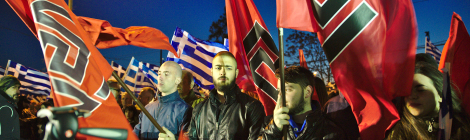
  • Rising Golden Dawn: Inside Greece’s Neo-Nazi Party

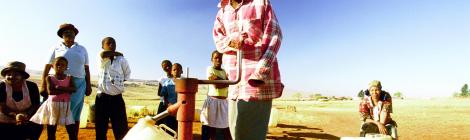
  • Water Security in South Africa: The need to build social and ecological resilience

    Water Security in South Africa: The need to build social and ecological resilience

    Tackling South African water insecurity will require addressing the technical deficiencies, governance gaps and social inequality that are currently having a dangerous and environmentally devastating impact. The links between environmental health and socio-political stability are clear in South Africa, where there has been an exponential increase in violent protests over poor or privatized service delivery, social marginalization, and unequal access to water. South Africa must act to solidify the links between resilient societies and resilient ecosystems.

    Read Article →

    Environmental security in the Arctic: the ‘Great Game’ vs. sustainable security

    Arctic security remains wedded to traditional, state-centric military threats despite the fact that the threat of outright conflict is as remote as the farthest reaches of the Arctic region itself. These approaches are predictable, but they will contribute little to alleviating the complex, interrelated, and underlying drivers of insecurity in the Arctic region. Cameron Harrington argues that if our understanding of both Arctic security and the Arctic environment continues to be reduced to the international scramble for untapped resources and for newly opened “shipping lanes”, it is unlikely that the hugely alarming and damaging environmental effects of climate change will ever be truly overcome.

    Read Article →

  • Resilience and Hope: Youth and Peacebuilding in Palestine

    Today’s younger generations of Palestinians desperately need to become more engaged in community peacebuilding activities to end the division of Palestinian society.

    The engagement of the younger generation in civil society work to promote peacebuilding concepts and practices at both grassroots and political levels is necessary for restoring order and security in societies divided by conflict and violence. This is particularly true of Gaza in Palestine where the inhabitants live in an environment where there is violence, extreme poverty and a lack of freedom.

    Palestinian youth and civil society face many challenges related to the harsh circumstances imposed by a lack of peace, security and economic development since the failure of the so called ‘Peace Process’ in 2000 between the Palestine Liberation Organization (PLO) and Israel. There have, however, been a variety of projects and programmes installed to raise youth awareness and the importance of civil society values and practices to achieve human rights, peacebuilding and good governance that help bring hope to a young generation, despite some of the local cynicism.

    Cynicism towards youth

    I always remember the cynical questions raised by many Palestinian citizens while engaging in civil society activities at different levels: “What kind of civil society under occupation are you talking about?” “How will civil society promote and advocate the values of peacebuilding under a territory experiencing foreign occupation?” There are still some Palestinian intellectuals, leaders and activists who do not believe in education for peacebuilding in a country under occupation, but they believe strongly in community peacebuilding to restore the order and security of their own society, after years of division and the failure of the ‘peace process’.

    They also go beyond just cynicism and move into absolute pessimism and defeatism by asking: “How can empowering youth in peacebuilding be effective, while they still suffer from the violence under Israeli occupation and a lack of freedom?” “How will civil society organisations promote and persuade youth to become engaged in activities while an overwhelming majority are poor, jobless and losing hope in the future?”

    An example is often raised that during the last five years, several young people committed suicide in the Gaza Strip, owing to the harsh economic and social circumstances. This society, however, has little experience of suicide, as it is known for its spirit of religious education and social solidarity, which have always prevailed and are considered to be the highest in the region.

    Cynics believe that talking about the empowerment of youth involvement in peacebuilding activities in Gaza is a matter of ‘idealism’ and ‘luxury’, a waste of resources and time because they see such pursuits as being only achievable through  concurrently obtaining freedom and national independence in a viable Palestinian state. Cynics often point out that there were many peacebuilding activities implemented in the Green Line between 1995 and 2000.

    Many Palestinian citizens from the various health, NGOs and environmental sector participated at capacity building development courses inside the Green Line. They enjoyed education, trips and nice food, but not sustained peace or security, as the main cause of the problems, the need to establish of a Palestinian state, had not yet been solved. These activities passed without any glimpse of hope or peace after the failure of the ‘peace process’ that led to the breakout of various cycles of violence including the latest war in the Gaza Strip in the summer of 2014 and changed both the context and style of life, after massive destruction.

    Life Style

    Image credit: UN Photo/Flickr.

    The Palestinian people are used to the daily life style of suffering and the absence of human security; they lost their top priority of securing their own basic human, needs during the failure of the 2000 ‘peace process’ and the collective punishment policies exercised by the occupation. They have lost their own economic, food, health, environmental, personal, community, political and human security. In 1994, the UNDP defined human security, which is achieved when people can exercise their choices safely and freely, and when they can be relatively confident that the opportunities they have today will not be entirely lost tomorrow.

    The Gazan people cannot plan their own day without any interruption, owing to the circumstances imposed by a lack of electricity, pollution and a devastated economy. As Mohammed Srour, a field researcher at a human rights organisation in Gaza says

    “The Palestinian people now busy with their own daily affairs, living without electricity and facing the entire closure on the strip and the invasion of pollution of their environment and beaches, owing to the lack of electricity. The citizens have no place to go in Gaza to escape the heat of the summer because of the lack of electricity. The sewage flows into the sea as the pumps and wasting stations do not work without electricity. The beaches are fully polluted and people cannot enjoy swimming in the sea to escape from the extreme heat any more in most coastal areas”.

    Gaza’s economy has actually been virtually stagnant for the past ten years, with an average annual real GDP growth rate over the decade not exceeding 1.44%, while Gaza’s population has grown by 38.4% over the same period.

    Today’s younger generations of Palestinians desperately need to become more engaged in community peacebuilding activities to end the division of Palestinian society. But the dire circumstances have deepened the wounds of Gazan society and made the life of the younger generation almost unbearable and impossible. Consequently, many young Palestinians have decided to leave rather than stay and help build peace.

    The Brain Drain of Palestinian Youth

    Many young minds have already left Palestine to find a new environment and hope. More than 21 young people who attempted to find their way to Europe lost their lives in the Mediterranean in 2014 when one of their boats was wrecked and their fate is still unknown to this day. However, the rest of the youth who could not leave after the full closure of the tunnels between the Gaza Strip and Egypt spend their time navigating social media and the internet.

    They enjoy their chats which help them escape from the harsh politics and economic realities, attempting to watch any developments posted by other fellows or friends online. Facebook, in particular, is considered their own ideal ‘city’ of information and it is a way of ‘killing the time’, as many young people are always informing me when I have a conversation with them. They have lost hope in local politicians, political groups, the international community and civil society organisations in helping them to change their circumstances. There are many who accuse these actors of lying, trading off and using the suffering of the Gazans to increase their power, wealth and business. But not all have abandoned hope.

    Resilience and Hope

    Despite the seemingly dire straits of life, the youths of Palestine are still resilient enough to try change the de facto situation, by engaging in community initiatives. They have, for example, on different occasions, engaged in non-violent and peaceful protests to contribute to the ending of the circumstances in the West Bank and the Gaza Strip. For example, the youth march movement in 2012 during ‘the Arab Spring’ to end the Palestinian division. After 2014 war in Gaza, they also participated actively, in non-violent activities to end the siege in the Gaza Strip by protesting close to the ‘buffer zone’ or in front of the ‘security fence’ with Israel in the Gaza Strip.

    Now, in 2017, the Palestinian youth, across their homeland, have seized the initiative again to protest peacefully against the closure of Al Aqsa. They are still seeking a better future and attempting to find any opportunity for hope and change. They attempt to find out about the latest leaks of reconciliation between Hamas and a Fatah wing in the Gaza Strip to end the conflict between the two sides that has divided the Palestinian house. If reconciliation takes place between the two sides, it will contribute to changing the social and political circumstances of the entire society and of youth in particular.

    In addition to these political developments, there have been a number of community activities to help keep youth hopeful for a better future. For example, the Gaza youth UNRWA Football team that won the Norway Cup last year continued preparation and already left the Strip for Denmark and Norway to participate in two different international football tournaments in the last week of July and the First week of August. This kind of participation always gives youth and the whole society hope that there is still a bright future coming soon where they can achieve justice, peace and freedom.

    Dr Ibrahim Natil is a Fellow at the Institute for International Conflict Resolution and Reconstruction, Dublin City University http://iicrr.ie/people/fellows/dr-ibrahim-natil/. He is an international human rights campaigner, nominee for the Tällberg Foundation Global Leadership Prize, 2016 and the founder of Society Voice Foundation http://www.mbialumniassociation.org/alumni-news/news-folder/year-of-publication/2016/qa-ibrahim-natil/

  • China and the Responsibility to Protect

  • Kurdish Questions: An Interview With Yaniv Voller

    voller

    Dr. Yaniv Voller is a Lecturer in the Politics of the Middle East at the School of Politics and International Relations, University of Kent. Prior to that he was a Leverhulme Early Career Fellow at the School of Social and Political Science, University of Edinburgh. He gained his PhD in International Relations at the London School of Economics and Political Science, his MSc in Middle East Politics at the School of Oriental and African Studies, University of London, and his undergraduate degree at Tel Aviv University. His current research examines the impact of colonial-era legacies and practices on the strategies of the liberation movements and the governments involved in these wars, focusing on the liberation wars in Iraqi Kurdistan and Southern Sudan. His previous book, The Kurdish Liberation Movement in Iraq: From Insurgency to Statehood, was published in 2014 as part of Routledge’s Studies in Middle East Politics series. His articles have been published in International Affairs, the International Journal of Middle East Studies and Democratization, among other journals.

    Dr. Voller discusses the history of, and recent developments in, the Kurdish struggle for a homeland.

    Q. Numbering approximately 35 million worldwide, the Kurds are often referred to as the largest group of stateless people in the world. Today, the Kurdish nationalist movement is often seen as one of the largest worldwide campaigns for self-determination. Who are the Kurds and what are the origins of their struggle for a homeland?

    The Kurdish people are a distinct ethnic group, concentrated mostly in a broad region which is often referred to as Kurdistan. Most of the Kurds are Sunni Muslims, but there are large Shi’i, Yezidi and other Kurdish-speaking communities.

    Already during the time of the Ottoman and the different Iranian empires there existed semi-autonomous Kurdish kingdoms that served as a buffer between the two empires.

    Modern Kurdish nationalism emerged in the late 19th and early 20th century, along with other nationalist movements, such as Arab and Turkish nationalism. After the end of the First World War, Kurdish leaders were promised an independent state as part of the Paris Peace Conference. However, following the establishment of the Republic of Turkey under Mustafa Kemal Ataturk, this promise was overturned. By the mid-s, Kurdistan ended up divided between Turkey, Iraq, Syria and Iran.

    The Kurds protested this decision and there were some uprisings in different parts of Kurdistan. In there was even an autonomous Kurdish republic, known as the Mahabad Republic, which survived for a year.

    The first major Kurdish uprising erupted in Iraq in . This uprising lasted until when, after years of brutal, even genocidal, Iraqi counter-insurgency campaign, the Kurds in Iraq gained complete autonomy over their territory.

    In Turkey, Kurdish insurgency emerged primarily during the late s, with the formation of the Kurdistan Workers Party (PKK) by Abdullah Ocalan. The PKK is still active today, though it formally renounced its aspiration for independence and is now calling for an autonomy for the Kurds within a democratic Turkey.

    In Iran, too, there has been a long conflict taking place. The Islamic Republic has not been less brutal than the Turkish Republic or Saddam Hussein’s Iraq in suppressing Kurdish demands for self-determination.

    The Kurdish struggle in Syria has been the least organised, although sporadic uprisings had occurred. The Assad regimes, both father and son, not only oppressed Kurdish nationalism, but denied the Kurds in Syria their most basic rights, including citizenship. The Syrian civil war provided the Kurds in Syria with an unprecedented opportunity to fight for their rights, although they too officially demand autonomy rather than independence.

    Q. Looking at the Kurds in Iraq, did Saddam Hussein’s counterinsurgency campaign actually help create a strong sense of Kurdish nationalism?

    Yes, it did. Particularly the Anfal Campaign, which took place between and , served to foster Kurdish national identity and desire for self-determination. The Iraqi army’s use of chemical weapons made it clear to most Kurds that living under Baghdad’s rule is impossible in the long term. Even Kurds who openly collaborated with the regime, the so-called National Defence Battalions, seemed to have come to this conclusion after their own towns and villages came under attack. National tragedies often serve to foster national identities, and even though the Ba’th regime’s genocidal campaign devastated Kurdish society, it did strengthen Kurdish national identity.

    Q. In Turkey, there has been much systematic discrimination against Kurds and historic attempts to eradicate Kurdish identity. Did these repressive measures in Turkey also help Kurdish nationalism gain momentum?

    Yes, to some extent. Government repression and discrimination often foster a national identity among persecuted groups. But this is only one factor among others. Other factors that have contributed to the strengthening of Kurdish identity include Kurdish activism, whether in Turkey or in the diaspora; urbanisation; modernisation; greater access to education. And the experience of Kurds in other parts of Kurdistan, and especially in Iraq.

    Q. Western powers over the past century have used Kurdish fighters when it suited their purposes, and then arguably abandoned them. There have been promises from Western leaders of establishing a Kurdish homeland only for those promises go unfulfilled. Why do you feel Western powers have treated the Kurds this way? Is it simply a matter of realist interests and Western leaders wanting to appease regional powers?

    The only time that Western powers made a clear promise about a Kurdish homeland was at the Paris Peace Conference. The US supported the KDP in the early s as proxies in Iran’s conflict against Iraq, but they didn’t make an explicit promise about a Kurdish homeland. The Americans also implicitly encouraged the Kurds and Shi’is to rise against Saddam after the First Gulf War – but again, without promising them independence.

    Undoubtedly, the West has abandoned the Kurds many times in the past. But we have to remember that the International community has traditionally been suspicious of separatist movements, because changes in state boundaries are considered a source of regional and global instability. And of course, there has also been the realist aspect of keeping good relations with Turkey. Turkey is a key ally of the West in the region and a NATO member. And it has traditionally objected to Kurdish independence.

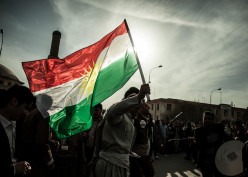
    Q. The Kurds have been a vital part of the war against the Islamic State (IS). Through a combined effort of Peshmerga, PKK, YPG, and Yazidi militias, the Kurds became the most effective fighters by far on the ISIS frontier. Why do you feel the Kurds have proven to be such an effective force against IS?
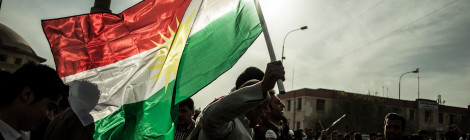
    kurd-flag

    Image by Mustafa Khayat/Flickr (cropped).

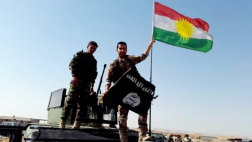
    There are several factors that have turned the Kurdish militias into the most effective fighting force in the war against the Islamic State. The first is familiarity with the area and the terrain. The Kurds, and especially the Peshmerga and the YPG, are natives of the region. They know it well and are aware of the challenges they are facing. The second factor is experience. The Peshmerga has years of experience fighting against the Iraqi army, Islamist militias and even each other. The PKK has been leading a guerrilla warfare against the Turkish security forces for decades. The third factor is motivation. The Kurds are fighting in and for their homeland. The Islamic State has attacked the Kurds in their own lands. The Yazidis are particularly motivated, not just by vengance, but also because many Yazidis are still in captivity. But there is also an ideological motivation. Especially for the Peshmerga, fighting along the West has meant greater legitimacy for their autonomy and sovereignty. The KRG is a de facto state. And states establish alliances. The KRG has considered itself an ally of the West for many years now. For the PKK, fighting IS has meant challenging its status as a terrorist organisation. In short, these are highly trained, disciplined and motivated fighters, who are fighting for their home and for recognition. They outweigh most other forces involved in the fighting in these parameters.

    Q. How far do you feel that the fight against IS will help the cause for a Kurdish homeland?

    This is a difficult question to answer, because we need to define what we mean when we say a Kurdish homeland. If we mean a scenario in which a Kurdish state is established in Iraqi Kurdistan then the answer is probably positive. The KRG’s fight against IS has once again proved to the West, but also to Turkey and other regional states the viability of the KRG and its ability to function as a sovereign actor. The Peshmerga has been one of the most reliable forces in the conflict, and in essence functions as the West’s “boots on the ground.” But if we talk about a Kurdish homeland that spreads over other parts of Kurdistan then I am in doubt. Ankara, which is still the most important veto actor when it comes to the idea of a Kurdish state, will not allow the formation of a Kurdish state in Rojava and even more so in Turkey. Even the PKK’s contribution to the fighting would not change Turkey’s mind – if anything, it will make Ankara even more intransigent about it.

    Q. Looking at the Iraqi case, Massoud Barzani, President of the Iraqi Kurdistan Region has recently called for a referendum on a Kurdish state in northern Iraq. Would the fight against ISIS at least help strengthen the case for a referendum?

    Yes I believe so. The Peshmerga’s participation in the war against ISIS has demonstrated once again to the International community, and especially Washington and Ankara, that the KRG is indispensable for regional security and that the Kurdish leadership could contribute to regional stability. The Peshmerga has proven able not only to protect the KRG’s domestic sovereignty, but also to participate as an equal partner in regional counterterrorism campaigns. This could play in the KRG’s favour when time comes.

    Q. Turkey’s shooting down of a Russian jet last year resulted in dramatic swifts in relations between those two states. The Kurdish question has also entered into this complicated relationship as Russia has shown some support for Kurdish groups in Syria and Iraq. How do you feel the Kurdish question will effect relations between the two in the future?

    This is more challenging for me to respond to, because I am not an expert on Russian foreign policy, and am not sure on how much Russia is committed to the Kurds. From a Turkish perspective, the question of Syrian Kurds has been something of a red line. Any support perceived as helping the Syrian Kurds toward independence is bound to make Ankara extremely nervous. And while Moscow has its own interests in Syria, which may clash with Ankara’s, I don’t believe that Moscow would cross this particular line. After all, Russia also prefers a unified Syria.

    Q. In regards to Turkey, would simply a change in leadership to a more liberal position help the case for a Kurdish state or is the issue of what has been described as anti-Kurdism or ‘Kurdophobia’ far more deep seated in Turkey?
    peshmerga

    Image of Peshmerga by Kurdishstruggle/Flickr.

    A change of leadership wouldn’t have much impact on Ankara’s approach to the Kurdish question. I am afraid that there is no liberal opposition in Turkey – certainly not toward the Kurdish question. The People’s Republican Party (CHP) may be more secular than the AKP. However, its agenda has been based for many years on Turkish nationalism and objection to any hint of Kurdish nationalism and separatist desires. The other, much smaller, Turkish opposition party is the Nationalist Movement Party (MHP). This is an ultra-nationalist party with a neo-fascist ideology. Militias associated with the party were involved in attacking and assassinating Kurdish activists in previous decades. Ironically, in its early days, the AKP had been considered more liberal than most other parties with relation to the Kurdish question, and therefore gained many Kurdish votes. The most liberal party in Turkey nowadays is the predominantly Kurdish People’s Democratic Party (HDP). But not only that I don’t see the party ever elected for power in Turkey, its actual existence is under threat nowadays, with the arrest of its leaders in the last few weeks.

    Undoubtedly, anti-Kurdish sentiments are entrenched in the Turkish public and political discourse. But even if a change takes place, I don’t see it affecting party politics, amid the absence of genuine opposition on the subject among the main Turkish parties.

    Q. What impact do you think Trump’s presidency will have on the Kurdish question, if any?

    Based strictly on Trump’s statements, I don’t think the Kurds should be overly optimistic. Trump has hinted that he is after an isolationist foreign policy. This means, in my opinion, that Trump will, at best, will not intervene against Turkish repression of the opposition, including the Kurdish opposition. As for other parts of the Middle East, such an isolationist approach may also result in a regional chaos. Such chaos could have disastrous implications for regional stability, but also opportunities for a change in the status quo.