Blog

  • National Security, Climate Change and the Philippine Typhoon

    National Security, Climate Change and the Philippine Typhoon

    Super Typhoon Haiyan made landfall in the Philippines on 8 November, and is possibly the most powerful tropical cyclone on record. Beyond the immediate impact of the typhoon, the natural disaster is already proving to be a threat to national security, with reports surfacing of massive looting and military engagement following attacks on government relief convoys. As US and UK naval convoys head to support the situation, Andrew Holland discusses climate change’s impact as a threat multiplier and what plans militaries and governments must make to prevent the insecurity that will come with future disasters of this scale.

    Read Article →

  • “Guerrilla Diplomats”: Conflict Prevention Through Frontline Diplomacy

    With conflict causing much political instability and human suffering in parts of the world, there is a need for preventive diplomacy which stops the outbreak, relapse or escalation of organized violence. Frontline diplomats have potentially crucial roles to play in early preventive efforts.

    Conflict prevention is popular in international political circles these days. In April 2016, the UN Security Council and General Assembly passed concurring resolutions on the review of the UN peacebuilding architecture in which they confirmed the essential role of the UN in “preventing the outbreak, escalation, continuation and recurrence of conflict”. On 5 July, the German Federal Foreign Office launched a public outreach process for the development of new guidelines on civilian crisis prevention, an area for which it increased its funds by 260% from 2015 to 2016 to 248.5 million €. Last year, the British government announced plans to increase its Conflict, Stability and Security Fund from 1 to 1.3 billion pounds by 2019/20.

    The political reasoning behind the call for prevention is simple: if the escalation of political disputes into organized violence or even outright civil war can be stopped in its tracks, it not only saves lives, but also keeps refugee flows created by war at bay and helps leaders avoid making difficult and potentially unpopular decisions about whether to launch military interventions to quell conflicts. Despite what seemed like a long-term decline of organized violence, the number of armed conflicts has ticked up again in the past few years: 2014 saw 40 armed conflicts, the highest number since 1999, and 126,059 conflict-related fatalities, the highest number since 1994, according to the Uppsala Conflict Data Program. At the end of 2015, 65.3 million people were either internally displaced or international refugees, the highest number since the Second World War. Yet many UN member states tend to view conflict prevention with suspicion, as they fear international meddling in what they perceive to be their domestic political affairs.

    Putting high-flying international commitments to conflict prevention into practice and “sustaining peace” throughout the conflict cycle, as the SC and GA affirmed in their parallel resolutions, requires an astute handling of sensitive matters with intelligence and tact, prudence and patience. In short: diplomacy. While government ministries can, of course, reach out to their foreign counterparts directly and permanent representatives negotiate mandates for international organisations in New York or Geneva, frontline diplomats, i.e. members of the foreign service posted abroad, have potentially crucial roles to play in early preventive efforts. Preventive diplomacy aims at the short- to medium-term prevention of the outbreak, relapse or escalation of organized violence, through both coercive and non-coercive means serving a political purpose. Taking preventive diplomacy seriously requires a different, more active and principled kind of diplomacy. In order to do adjust to this profile, frontline diplomats need to be better equipped, trained, and organisationally empowered.

    Frontline preventive diplomacy: benefits and risks

    100612-F-7713A-171

    Image via U.S. Army via Flickr.

    Frontline diplomats may be able to resort to thematic expertise, funds or international networks that they can employ to tweak political dynamics in a country. As some diplomats are repeatedly posted to conflict regions, they may draw comparative conclusions and show domestic parties the risky trajectories of their actions. And diplomats are, theoretically at least, trained in the very skills of facilitation, brokering and negotiation that might be needed to cool down heated tensions.

    As the International Crisis Group lays out in an excellent recent report, preventive diplomacy is fraught with dilemmas and considerable challenges. Usually, the elites in a given country carry the main responsibility for the escalation of political conflicts, and even high-level officials of major powers have limited entry points when positions have become deeply polarized and parties are entrenched in a zero-sum logic. As the Crisis Group succinctly observes: “Outsiders must tread carefully when pursuing these goals. All early action involves engaging in fluid political environments. There is a high chance of political friction, with misunderstandings and miscalculations derailing plans. No form of crisis response is neutral.”

    Frontline diplomats may grant insurgent groups unwarranted legitimacy simply by meeting them. Officially mediating between parties may raise expectations about peaceful conflict resolution, that, when disappointed, may embolden domestic actors to pursue their goals by violent means. Short-term goals of stabilization may conflict with long-term goals of democratisation and transitional justice. Thus, preventive engagements must be based on continuing political analysis and do-no-harm principles.

    A different diplomacy

    More fundamentally, an active pursuit of conflict prevention requires a different kind of diplomacy. Conventionally, diplomats pursue a narrowly conceived “national interest”, acting on explicit instructions from the capital. They concentrate on the governing authorities as official partners in their bilateral relations. As a result, their engagement is reactive and ad hoc, while preventive diplomacy requires a forward-looking and principled approach, as David Hamburg already wrote in 2003.

    “I am not the person who sits all day at the office. I want to see how people live out there,” is how German Ambassador to South Africa Walter Lindner introduces himself in a video message on the embassy’s website. It sums up the kind of spirit diplomats need to embrace are they to further the ambitious objective of conflict prevention. Christopher J. Stevens, the US Ambassador to Libya murdered in 2012, represented the skills of a “guerrilla diplomat” (Daryl Copeland): multilingual, frequently speaking to people on the street, and showing respect and compassion for local cultures, traits which President Obama highlighted in his speech at the UN General Debate in September 2012.

    Yet these diplomats are usually seen as “unconventional”. If governments want to take their stated objective of crisis prevention seriously, they need to embrace the following policies that support and empower their agents in the field. Political leaders and senior officials need to foster an organisational culture that grants ambassadors and other frontline diplomats more autonomy, based on frequent reporting on their activities. Leaders need to highlight bold behaviour, even when diplomats encounter hostility from host governments despite their most sensitive efforts; rewarding best practices can start horizontal socialization processes. Ministries need to provide frontline diplomats with the authority to quickly disperse small development funds and include them in internal discussions on government-wide country strategies.

    Lastly, they need to offer training to their diplomats in conflict analysis, mediation and critical thinking. The German Federal Foreign Office, for example, only started to provide dedicated mediation courses to its attachés and more senior diplomats a few weeks ago. Similarly, a recent reform report of the British Foreign and Commonwealth Office argued to increase training in stabilisation and mediation as core skills for diplomats posted to fragile areas. Many intra-state conflicts are based on disputes within a country’s political elite; foreign diplomats trained in peace mediation may be able to facilitate conversations between polarized parties. As external third parties, they may help local stakeholders to identify mutually acceptable ways that lead out of their conflicts.

    Conclusion

    Historically, Western biases and wilful ignorance of domestic politics and cultures have marred international engagement in conflict prevention and resolution. A healthy dose of scepticism towards a renewed push for preventive diplomacy is therefore warranted. Diplomats need to overcome a rigid binary of local stakeholders whose actions need to be prevented and international actors who conduct preventive diplomacy.

    If foreign services embrace a bolder, innovative style of (preventive) diplomacy that rewards local sensitivity, autonomy and innovation, however, they may improve the implementation of their foreign policy overall. Frontline diplomats need to travel in their host country extensively, collecting information about local grievances through first-hand observation. They need to reach out to the host population directly, through personal use of social media, as many British diplomats already do. And they need to maintain reliable relationships with key political actors that continue to function in crisis situations. If diplomats do that, they will find that an increased attention towards conflict prevention entails benefits – a deeper understanding of elite politics, influence beyond the capital and credibility with a broad spectrum of a country’s society – that continue to exist when a crisis ends.

    Gerrit Kurtz is a postgraduate research student at the War Studies Department of King’s College London, where he researches the role of frontline diplomats in conflict prevention. He is also a non-resident fellow with the Global Public Policy Institute in Berlin, where he worked between 2012 and 2015 on the policies of emerging powers on a responsibility to protect populations from mass atrocity crimes. He also conducted research in South Sudan on local conflict management by UN peace operations. Aside from preventive diplomacy, conflict management and peacekeeping, his research interests include protection of civilians, transitional justice in the conflict in Sri Lanka, the conflict in South Sudan, as well as German and Indian foreign policy.

  • Gender-Relational Peacebuilding in Uganda

  • Crime, Violence, and State Responses in Mexico

    In recent years, the Mexican government has been struggling to deal with a dramatic rise in crime and violence, with state responses largely failing to effectively resolve these problems. But there are some grounds for optimism.  

    Over the course of too many years of elevated crime and violence, the Mexican government has been visibly struggling to identify the best possible course to improve public security and a more effective administration of justice. This article examines the magnitude of Mexico’s still ongoing security crisis, as well as the measures that the Mexican government has employed to try to resolve it. Drawing from an ample body of academic and policy research, there are some clear indications of what has not worked, as well as some bright spots for Mexico moving forward.

    The State of Play in Mexico

    For the past decade, the Justice in Mexico program based at the University of San Diego has studied the proliferation of crime and violence in Mexico, the country that has seen the greatest increase in homicides among all Latin American countries. Notably, following a marked decline in violent crime from the mid-1990s to the mid-2000s, Mexico experienced a dramatic increase in homicides during the five year period from 2007 to 2011, when homicide rates rose threefold nationally, from 8.1 to 24 per 100,000 inhabitants, according to official homicide statistics. (Based on the author’s own elaboration from Mexico’s national statistical clearinghouse, the National Institute of Statistics, Geography, and Information; see here also). The net result during that period alone was a total of nearly 100,000 homicides, and the subsequent four years through 2015 added roughly 90,000 more. Many of these homicides—an estimated 30-40%—bear characteristics frequently associated with the country’s powerful drug cartels and other organized crime groups: use of high caliber weapons, mutilation and dismemberment, execution style killings, publicly displayed bodies, and chilling messages and threats authored by the perpetrators.

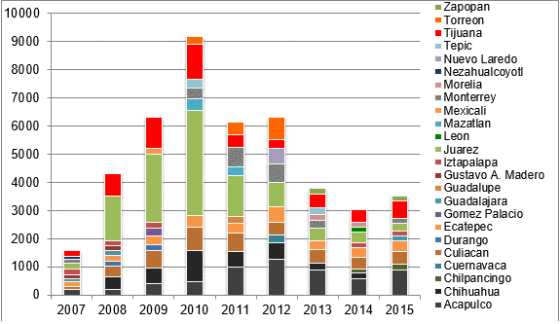
    While casual observers might assume that Mexico’s violence was widespread and pervasive throughout the country, the phenomenon was highly concentrated in certain regions and localities, primarily in the northern border region and in the country’s Pacific coastal states. In 2007, a Mexican city with more than 100 homicides could easily make it onto the country’s “top ten” list for total homicides; in fact, that same year, only Tijuana—the quintessential Mexican border city—reported more than 200 homicides (206 to be exact). Yet, just two years later, no city among the top ten most violent cities in Mexico had fewer than 200 homicides, and the top five had at least 400 homicides (as illustrated in Figure 1). Indeed, by 2010, arguably the peak of the violence, there were 18 Mexican cities with more than 200 homicides: now Mexico had many “Tijuanas.” Indeed, some of Mexico’s most violent cities—such as Acapulco, Ciudad Juárez, and Nuevo Laredo—saw rates more than triple the national homicide rate.
    Homicides Mexico data

    Figure 1: Number of Homicides in Mexico’s Top Ten Most Violent Municipalities by Year. Source INEGI.


    In a country unaccustomed to the civil wars and brutal dictatorships that plagued other parts of Latin America in the 20th century, such an explosion of violence was unexpected and previously unfathomable. The Mexican government’s apparent inability to resolve the problem triggered an international debate on the problems and limits of the Mexican state. A 2008 worst-case assessment by the U.S. Joint Forces Command named Mexico as one of two countries—along with Pakistan—that could suffer a sudden collapse into a “failed state.” Specifically, the report asserted, “In terms of worst-case scenarios for the Joint Force and indeed the world, two large and important states bear consideration for a rapid and sudden collapse: Pakistan and Mexico…”. Pronouncements by U.S. officials—including Secretary of State Hillary Clinton in 2010—asserted that Mexico’s woes were comparable to Colombia’s long-standing problems of domestic insurgency, or even on par with a civil war. Others sensationalized Mexico’s recent violence as a new hybrid threat of “criminal insurgency” or suggested that the power and infiltration of such groups had turned Mexico into a “narcostate” overrun by violence, corruption, and “narco- terrorism.”

    The merits of such assertions were quite debatable then and have proved false with time, as they tended to exaggerate and misconstrue Mexico’s current security situation. The methods and organizational forms of Mexican organized crime groups are arguably terrifying and sometimes truly mimic those of terrorists and insurgents. Yet, Mexico’s organized crime groups have shown no ambition to govern or supplant the state. They have no record or evident intention of disrupting the state’s capacity to deliver basic services. Moreover, the Mexican state maintains substantial democratic legitimacy, and has successfully deterred would-be insurgents in recent decades. Lastly, by the various measures used by the Fund for Peace to compile the Fragile States Index (formerly known as the Failed State Index), the health of the Mexican state ranks about average for Latin American countries, and its capacity is far greater than in war-torn countries like Afghanistan, Central African Republic, Iraq, Somalia, Syria, or Yemen.

    The Mexican State Response

    police mexico

    Image by Presidencia de la República Mexicana via Flickr.

    There is no doubt that Mexico’s recent security crisis presented—and continues to present—a major challenge for the Mexican state, and raises serious questions about its limits and failings. It is true that, like any other individuals who violate the law, the goal of organized crime groups is to minimize the state’s ability to detect, prevent, and/or punish their illicit activities. Yet, unlike other criminal actors, organized crime groups—and particularly drug trafficking organizations—in Mexico have demonstrated a remarkable capacity to secure protection from the state to support and sustain their criminal activities, with corrupt officials on their payrolls at all levels of government. Also, to varying degrees, such groups have at least temporarily attained a stronger presence and degree of control than the government in some limited geographic areas. Moreover, in some places, organized crime groups have capitalized on anti-government sentiments to achieve a degree of popularity or even legitimacy that seriously undermines state capacity. What, then are the sources of Mexico’s recent violence, and why have state responses failed to resolve the problem in a timely manner?

    The rise of Mexico’s most powerful organized crime groups—commonly referred to as drug trafficking organizations, or “cartels”—came amid a severe economic crisis in the 1980s. While other industries faltered, illicit drug production and trafficking enjoyed a major boom and substantial impunity, thanks in part to the complicity of government and law enforcement personnel. By the late 1990s, growing problems of crime and violence contributed to a crisis of “public insecurity,” characterized also by a feeling of widespread fear and frustration on the part of the general public due to the inability of the Mexican government to maintain order. Following a major political transition in 2000—the ouster of the PRI, Mexico’s long-time ruling party, from the presidency—the administration of Vicente Fox (2000-06) disrupted the leadership of two of the country’s four main organized crime groups.

    This tactic of arresting, extraditing, or otherwise eliminating the top leaders of major criminal organizations has been commonly referred to as the “kingpin” strategy. Fox’s successor, President Felipe Calderón (2006-12), deployed the kingpin strategy vigorously. Calderón and other proponents of the kingpin strategy argued that taking out the top leadership would help to disrupt their operations and convert a national security threat into a more localized public security problem. In some cases, at least, the government succeeded in reducing the functional capacity of some of the country’s major criminal organizations, but the unintended result was the creation of internal power vacuums and incentives for regionally based drug trafficking organizations to clash over turf and expand into rival territories. The subsequent conflicts within and among these groups were responsible for tens of thousands of organized crime-style killings that made up nearly the entire increase in homicides noted above, especially in major drug trafficking production and transit zones.

    In December 2012, a new president, Enrique Peña Nieto, took office and restored the PRI to power. His government continued to deploy the kingpin strategy, arresting high-ranking members of the Zeta and Sinaloa cartels. Remarkably, these arrests did not produce the same kind of violent aftershock that occurred under previous administrations, perhaps because of a new equilibrium among organized crime groups (there were few large cartels left standing) or perhaps more effective accommodation strategies (such as negotiations with the leaders next in line to take control of criminal operations). Whatever the reason, during 2013 and 2014, Peña Nieto’s first two full years in office, levels of homicide actually declined by around 8 and 12%, respectively (author’s own calculations from INEGI data. http://www.inegi.org.mx). However, statistics on homicide investigations for 2015 suggest that there was slight increase—about 10%—in the number of homicides nationwide, reversing the modest downward trend and provoking concerns that Mexico’s violence would ramp up again in the coming years. Final figures for 2015 likely to be released by Mexico’s national statistics agency sometime in late summer 2016, but as of mid-2016 there are troubling signs that violence is on the rise. (As this article went to press, INEGI statistics were unavailable for 2015, so the figures referenced here are Mexican law enforcement investigations into homicides tabulated by the Mexican National Public Security System – Sistema Nacional de Seguridad Pública, SNSP).

    Conclusion

    Looking toward the future, Mexico’s security situation will likely be affected by a number of important international and domestic factors. International factors could also significantly shape Mexico’s prospects. As a growing number of leaders and civic organizations push for the legally regulated production, distribution, and consumption of drugs (including the legalization of marijuana in two U.S. states in November 2012), this shift in discourse and policy could have major implications for Mexican organized crime groups. A loss of illicit revenues will likely reduce the capacity of these organizations to challenge the state, but it will also result in a painful restructuring of black market industries, pushing drug traffickers to increase exports of other drugs (like heroin) and further diversify into other violent criminal activities (e.g., kidnapping, extortion, robbery, etc.). This has already caused an abrupt increase in violence in some states, like Guerrero. In terms of drug policy, there are no quick and easy fixes to the problem of organized crime and violence in Mexico.

    However, there are some reasons for optimism in Mexico. Changing demographic trends (including a declining population of under-educated, underpaid, and underemployed young males) and an improvement of the country’s overall economic situation could facilitate a reduction of various societal ills, including both violent crime and large-scale external migration. At the same time, with the right mix of fiscal and political reforms, Mexico’s rising economic fortunes could also bolster the state’s capacity to respond more effectively to these problems, thanks to investments and reforms in the criminal justice system, as well as public education and social programs to strengthen the social fabric. Fortunately, in recent years, the Mexican government has begun to implement major economic, social and judicial sector reforms that could greatly strengthen both state and societal capacity to reduce the power of violent organized crime groups. The main question is whether these reforms will be rapid and adequate enough to substantially reduce the number of violent deaths in Mexico over the next decade.

    Dr. David A. Shirk is graduate director of the Master of Arts in International Relations program at the University of San Diego, director of Justice in Mexico, and a global fellow at the Woodrow Wilson International Center for Scholars. He is the co-author of Contemporary Mexican Politics, with Emily Edmonds-Poli.

  • Deforestation: REDD-y for peace or fuelling conflict?

    by Janani Vivekananda and Shreya Mitra

    REDD forestry efforts don’t pay enough attention to their influence on local conflict dynamics. For REDD+ to be an effective mechanism to curb deforestation and strengthen peace opportunities, it has to pay more attention to pre-existing land and forest conflicts linked to tenure, take into account the interests of the local communities and be more sensitive to the local context .

    trucks carrying logs in Gunung Lumut, Kalimantan Timur, Indonesia, November 2005. Source: CIFOR (Flickr)

    Trucks carrying logs in Gunung Lumut, Kalimantan Timur, Indonesia, November 2005. Source: CIFOR (Flickr)

    Indonesia has for the first time surpassed Brazil’s historical record of being at the forefront of deforestation suggests a new study published in the journal Nature Climate Change. Despite a government-signed moratorium in 2011 to slow down the pace of deforestation, the study reveals that Indonesia has lost virgin forests of 60,000 sq. km, an area roughly the size of Ireland, over a period of 12 years.

    The accelerated rate of deforestation raises concerns about the governance of forests in Indonesia and the effectiveness of the moratorium. It also highlights the missed opportunities to preserve the forests and bring about greater peace dividends, especially in a context where peace remains fragile and unequal forest rights remain unresolved. In conflict-affected areas, availability and access to forest resources can either make conflict worse or contribute to peace. If you accept the case, as many do, that the impacts of climate change make it harder to build peace, there is also a compelling argument that mitigating climate change by reducing deforestation, if done right, could offer significant peace opportunities by addressing inequalities and grievances of marginalised forest-dependent communities.

    REDD Programmes and Peacebuilding

    Yet despite the importance of forests to both climate change mitigation and peace, deforestation continues at an alarming rate as seen in the case of Indonesia. To combat deforestation and preserve forests as carbon sinks, the United Nations Framework Convention on Climate Change (UNFCCC) in 2005 introduced a mechanism called Reducing Emissions from Deforestation and Forest Degradation (REDD). Under REDD, more developed countries pay for programmes in less developed countries to preserve forests. Later, a ‘plus’ was added to REDD introducing the elements of conservation, sustainable forest management and enhancement of forests as carbon sinks. The financial dimensions are significant. For example, Norway as the biggest contributor has pledged over $1.4 billion to REDD+ funds. Most of the money targets Latin America and the Caribbean, sub-Saharan Africa and Asia. For Indonesia alone, $156 million of REDD+ funding has been approved.

    From a peacebuilding perspective, REDD+ and other efforts to promote sustainable forest management offer both peace opportunities and conflict risks. The conflict risks of REDD+ often have to do with land ownership and forest access. The peace opportunities associated with REDD+ are wider recognition of the multiple economic, social and cultural values of forests and a strengthening of the rights of local communities that depend on the forest. Poverty may also be reduced if the financial benefits of REDD+ are shared, and income opportunities created for local residents, who may work as forest monitors and guards.

    In 2006, in Aceh, Indonesia, initiatives by the newly formed government on forest protection and supporting smallholder plantations, as well as the social opportunities offered by REDD investment, showed real promise for building a sustainable peace in the conflict-affected region. The REDD investment fell through after investors withdrew, but this experience hints at the potential for REDD to exert a positive influence on politics and power relations in a post-conflict context.

    Short-Term Gains

    Patchwork mountain landscape of agriculture, forestry, and deforested terrain, Tianlin County, Guangxi Zhuang Autonomous Region, China. Source: CIFOR (Flickr)

    Patchwork mountain landscape of agriculture, forestry, and deforested terrain, Tianlin County, Guangxi Zhuang Autonomous Region, China. Source: CIFOR (Flickr)

    Yet given the prospect of sums of money to be gained (in the short-run at least), there is a very real risk that communities can make decisions based on short-term profit or be bought off by entrepreneurs hoping to capitalise on REDD+. This means that while community involvement is critical, it alone is not sufficient and should certainly not be viewed as a silver bullet for equitable forestry that supports peace.

    As a member of the Dhankuta District Community Forest Management committee explained during International Alert’s research in Nepal: “Forest-user groups might plant trees but don’t always protect them. How can a forest grow if you just plant trees and don’t protect them? People have begun to misuse resources. There is too much freedom and too little responsibility. Poverty is also a factor. People want an immediate return, instead of a better long-term gain.” In Papua New Guinea, many landowners are not aware of their rights, leaving them vulnerable to exploitation by ‘carbon cowboys’ who gain control of land and forests to capitalise on REDD+ funding. While REDD+ caused this problem, the mechanism also drew international attention to the issue, which in turn helped push the government to improve its policy on revenue-sharing.

    During International Alert’s research in Odisha in India, respondents reported that forest degradation is a key challenge for them. Forest conservation projects could help here to develop a forest management that is beneficial to both communities and carbon reduction. On the other hand, there is a risk that governments use REDD+ as an instrument to restrict the access of local communities to forests and thereby undermine their livelihoods. In addition, incoming finance can fuel existing corrupt structures or cause grievances if it is not shared in a transparent and balanced manner.

    Striking a balance

    Our research in Bangladesh showed that restrictions on access to the Sundarbans mangrove forest may be useful for conservation purposes but local communities perceived them as a direct obstacle to sustain their livelihood, in the short term at least. This highlights the challenge between balancing conservation and community interests. As with the case of Bangladesh, poor Indonesians dependent on forests for their livelihoods have not been provided a viable alternative source of income, which is one reason why deforestation continues.

    Compared with Indonesia, Brazil has been much more proactive on the issue of land and forest tenure and therefore better placed to manage issues of illegal logging and deforestation. Brazil has through REDD+ initiatives been recognising and delineating customary lands and creating new protected areas though these have been beset with some problems.

    For REDD+ to be an effective mechanism to curb deforestation and strengthen peace opportunities in Indonesia, Brazil and elsewhere, it has to pay more attention to pre-existing land and forest conflicts linked to tenure, take into account the interests of the local communities and be more sensitive to the local context

    Janani Vivekananda is Environment, Climate Change and Security Manager at International Alert. Her specific interests include the implications of climate change policies on peace, the links between climate change and community resilience, and opportunities for positive responses to climate and environmental change and disasters.

    Shreya Mitra Programme Officer with the Environment, Climate Change and Security team at International Alert. She previously worked as a Research Consultant for ODI, Save the Children and Social Development Direct. 

    Featured image: Patchwork mountain landscape of agriculture, forestry, and deforested terrain, Tianlin County, Guangxi Zhuang Autonomous Region, China. Source: CIFOR (Flickr)

  • The Islamic State: Caliphate Interrupted, But Not Defeated

  • The Climate Security Council?


    by Joe Thwaites

    UN Climate Change Talks Conclude with Copenhagen AccordLast Wednesday, the United Nations Security Council held its second ever debate on climate change, at the request of Germany, who holds the monthly presidency. UN Secretary General Ban Ki-Moon, Director of the UN Environment Program Achim Steiner, President of Nauru Marcus Stephen, and Australia’s Parliamentary Secretary for Pacific Island Affairs Richard Marles all addressed the Council, along with representatives of 62 member states.



    Stephen wrote powerfully in the New York Times last week about the threat rising sea levels pose to his Pacific island country’s existence, and did not hold back in the Council, usually a place of diplomatic stoicism. Speaking on behalf of the Pacific Small Island Developing States, he said they were facing “the single greatest security challenge of all – that is, our survival” and put the question: “Where would we be if the roles were reversed? What if the pollution coming from our island nations was threatening the very existence of the major emitters? What would be the nature of today’s debate under those circumstances?”

    As it happened, the nature of the debate was twofold. On the ostensible subject, “Maintenance of international peace and security: impact of climate change”, most states agreed that it would have – and in some cases already is having – profound implications for international peace and security, and that the UN had a key role to play coordinating efforts on mitigation and adaptation to climate change. But discussion on this remained secondary to complex political wrangling over the role of the Security Council in addressing the topic. Whilst this is the case for any issue before the body – in discussions on whether to mandate armed intervention into a specific country, for example, the debate focuses not just on the rights and wrongs in that instance, but also the wider precedent it may set – there were added complexities with climate change.

    China and Russia displayed their usual reticence about extending the Security Council’s competencies into new areas. They were joined by Brazil, India, and many developing countries in the G77 bloc, who opposed attempts to move the issue away from the General Assembly-mandated UN Framework Convention on Climate Change (UNFCCC), in which all member states have equal footing and decisions are made by consensus, and into the 15 member body where China, Russia, France, the UK and U.S. hold veto power, and are some of the biggest greenhouse gas emitters, on either cumulative or per capita bases. The underlying fear of developing countries was that such a move would circumvent the core principles which make the existing climate change regime palatable – namely, the recognition of states’ “common but differentiated responsibilities” to act on climate change, and the right to sustainable development.

    Indeed, if the Security Council were to take overall control of climate action, this would be a regressive step, potentially allowing developed countries off the hook for their failure to meet existing targets under the Kyoto Protocol, and removing the impetus to agree a further UNFCCC commitment period. States proposing that the Security Council address the issue (primarily the EU, U.S. and small island states) were therefore at pains to stress that it would be complementary to existing UN bodies and processes, and should not encroach upon their remits. They argued that as a major security threat, it was right that the Council afford these dimensions of climate change due consideration. But as the UN body with the most diplomatic bite – only the Security Council has the power to authorise military force – it is easy to see why there are concerns that it could dominate the issue.

    During the debate there was related apprehension about the excessive securitisation of climate change. Many states pointed out that climate change was a cross-cutting issue, as much related to sustainable development and humanitarian relief as security, and that looking at it as a security issue would not address the underlying causes of the problem. Bolivia noted that developed countries gave $10 billion in climate change finance annually, which amounted to just 1% of defence spending, and suggested the Council adopt a resolution to cut defence and security spending by 20%, using the money saved to address the impacts of climate change. Papua New Guinea echoed Nauru’s Marcus Stephen, pointing out that if the Security Council could address issues such as development and HIV/AIDs as security problems (without them becoming militarised), then why not climate change?

    The non-binding Presidential Statement which was finally agreed did not include mention of a Special Representative on Climate Change and Security, which had been one of Germany’s original proposals. Many countries remained open to the idea of a representative, but opposed them being answerable to the Security Council, instead suggesting they be appointed by the General Assembly.

    On one level, the outcome was disappointing. Russia initially vetoed adoption of the statement, later agreeing to a watered down version merely noting the “possible security implications” of climate change. Ambassador Susan Rice of the U.S. lambasted the lack of stronger action as “pathetic”, “short sighted” and “a dereliction of duty”. However, given that the first Council debate on climate change in 2007 was unable to agree any formal outcome, getting a Presidential Statement was something of a success.

    There remains wide disagreement between states over whether climate change merely exacerbates conflict, or is a distinct threat itself. Academic opinion is still divided, and the Security Council’s position often lags a good ten years behind the latest research on peacebuilding and conflict prevention, so this is not hugely surprising. It is also difficult to untangle the opposition to climate-security links on conceptual grounds from opposition for political reasons related to Security Council ‘mission creep’, as discussed above.

    In 2009, the General Assembly requested that the Secretary General produce a report on the possible security implications of climate change. A few states strongly disputed its findings on Wednesday. Nevertheless, the Presidential Statement recommended that in his regular reports to the Council, the Secretary General begin to include information on the possible influence of climate change upon conflict situations around the world. These are important first steps towards mainstreaming climate change in conflict assessments, even if we are a long way from any legally binding resolution.

    Another reason for optimism is the level of participation in the debate. I followed many Security Council meetings whilst working in the UN community last year, and never saw so many member states request to speak. Most countries took the discussion seriously, and even where they disagreed on whether the Council had a mandate to act, they spoke strongly on the devastating impacts of climate change.

    The question now is: how long will it take for states to take this rhetoric seriously; to realise the gravity of the situation, break the cycle of mistrust in international negotiations and commit to unified multilateral action to address this issue – in whatever forum they choose? The answer is unclear.
    There is one thing we can be confident about – this won’t be the last time the Security Council discusses climate change.

    Joe Thwaites is a graduate in politics from the University of York, UK. He has worked on conflict prevention at the Quaker United Nations Office and represented Friends of the Earth at the UNFCCC.

    Image Source: United Nations Photo

  • Privatised Peacekeeping?

    Over 10 years ago, the Cathedral Peak Hotel, which nestles among the peaks of South Africa’s majestic Drakensburg Mountains, played host to what was, at the time, a unique gathering. Scholars from around the globe (the United States, Britain, Switzerland, Australia, Germany, South Africa, and Israel) met with representatives of international NGOs (the International committee of the Red Cross and the Geneva Center for the Democratic Study of Armed Forces, among others) and members of the private military and security industry to discuss and debate the growing role of private contractors in contemporary conflict zones. I was the convener of that conference and co-editor of the subsequent volume of the same title, Private Military and Security Companies: Ethics, Policies and Civil-Military Relations (Routledge 2008).

    Though the modern private military company can be traced back to companies such as David Stirling’s WatchGuard International in the 1960’s, and though there was some related early scholarly research, it was the massive use of contractors by the United States in Iraq in the civil war that emerged after the 2003 invasion which ultimately sparked serious public and scholarly interest in the sector. Just a year before the conference, the killing and gruesome mutilation of four Blackwater contractors by insurgents had been a major cause of the bloody and ultimately fruitless first battle of Fallujah. Given the context, it’s particularly interesting that Doug Brooks – then the President of the largest industry body for PMSCs, the International Peace Operations Association (now the International Stability Operations Association) – chose to focus his contribution to the conference, and his co-authored contribution to the book, on peacekeeping operations.

    Brooks argued then that, with the growth of what he called ‘Westernless peacekeeping’ (i.e. UN and African Union peacekeeping operations carried out without major support from NATO and ‘NATO-class’ military forces) PMSCs should have an increasing role in peacekeeping operations, contributing capabilities not possessed by the military forces of developing world countries like Bangladesh, Ethiopia, Nepal, Indonesia and Rwanda, who contribute the bulk of peacekeepers for UN operations.  Contractors, Brooks contended, offer ‘faster, better and cheaper’ solutions to capability challenges in peacekeeping operations, operate with a smaller and less culturally sensitive footprint than equivalent military forces, and act as a force-multiplier through the provision of specialist and niche capabilities.

    private-miltary

    Private military contractors in Baghdad, Iraq. Image by Babeltravel via Flickr.

    A decade on and Iraq is still in the news, but Western boots on the ground are largely absent, and the previously booming market for contractors there and in Afghanistan has shrunk dramatically. As Molly Dunigan and Ulrich Petersohn and their collaborators show in a recent edited collection, the once-championed ‘global market for force’ has proven itself to be, in fact, a conglomeration of quite different markets for force, and it is a mistake to conflate the legitimate with the illegitimate. The United States, Britain and other nations continue to employ the services of private military contractors for lower priority tasks where doing so is (or at least appears to be) cost and manpower effective.

    The US State Department’s five-year $10.2 billion Worldwide Protective Services contract, the next phase of which was announced in mid February, is distributed largely among companies like SOC, Triple Canopy and Aegis Services which made their names during the Iraq post-invasion boom. And the old stomping ground is showing signs of a revival – according to a report by Bloomberg Business week, “Operation Inherent Resolve, the Pentagon’s anti-Islamic State initiative, employed 7,773 contractors in the second quarter of 2016, up from 5,000 in the first quarter of 2015.” Many of those contracts are for logistical, training and advisory roles in conflict and post-conflict environments in Africa and the developed world. And, quietly, the United Nations has also become a significant employer of PMSCs, as a careful reading of the UN Department of Procurement’s list of registered vendors reveals. As long ago as 2011 the Geneva Center for the Democratic Control of Armed Forces (DCAF) released a report showing that, despite the sensitivities involved, “the UN has increasingly paid private military and security companies (PMSCs) for a range of services in the areas of humanitarian affairs, peacebuilding and development.” The companies themselves have become increasingly corporatized and professional in their structures and practices, an evolutionary necessity for those companies which survived the ‘gold rush’ days of post-invasion Iraq.

    The more dramatic pronouncements by both proponents and opponents of the PMSC industry have failed to come to pass. Contractors have neither rendered state-based peacekeeping and stability operations obsolete, nor have they radically undermined the monopoly on force of the states that employ them or created greater instability in the international sphere.

    Looking to the future, what might we expect regarding the involvement of PMSCs in peacekeeping and stabilization operations? Despite their popularity as ‘bad guys’ in television dramas and Hollywood films, and an uncomfortable legacy of past serious human rights abuses committed by contractors, the evidence suggests that in the real world the use of PMSCs is increasingly becoming normalized, and that in policy circles there is a growing understanding of the potential value contractors can provide if properly employed. While there are still contractors operating in the global periphery who better fit the old ‘mercenary’ moniker, we can expect this process of normalization to lead to an increase in the employment, and more open employment, of PMSC’s in peacekeeping operations (though the term ‘PMSC’ will likely decline in usage).

    The improved clarity about the status and responsibilities of contractors in zones of armed conflict that resulted from the publication of the ICRC sponsored Montreaux Document of 2008 has played an important role in this process of normalization. Though this was unquestionably not the intended purpose of the creation of the document (which carries no legal weight but summarizes the status of contractors under international law and gives recommendations to both PMSCs and the states that contract them), the Montreaux process cleared up numerous misconceptions and provided a firm framework to which companies could attach their claims to legitimacy.

    Over the past decade there has been much debate and discussion over what functions ought to be considered by states to be ‘inherently governmental’ and which therefore ought not to be contracted out. A similar discussion will likely occur as the outsourcing of peacekeeping functions becomes more publicly acknowledge. However, it will likely be pragmatic factors which establish the limits of outsourcing.  Whatever those limits turn out to be in practice, it is certain that there will be limits. Even in today’s complex and spoiler afflicted environment, effective peacekeeping relies heavily on the perception of legitimacy, and that means blue UN helmets or the green berets of the African Union, not beards and Oakley sunglasses.

    Dr Deane-Peter Baker is a Senior Lecturer in the School of Humanities and Social Sciences at UNSW Canberra, located at the Australian Defence Force Academy. He is also a Researcher in the Australian Center for the Study of Armed Conflict and Society. His research interests include military ethics, private military and security companies, special operations, military strategy and the ethics of public policy. He is the author of Just Warriors Inc.: The Ethics of Privatized Force and Citizen Killings: Liberalism, State Policy and Moral Risk.

  • El Salvador’s gang truce: a lost opportunity?

    Colombia and Mexico: The Wrong Lessons from the War on Drugs

    As activists around the world participate in a Global Day of Action against criminalisation of drug use, evidence from the multi-billion dollar War on Drugs in Colombia suggests that militarized suppression of production and supply has displaced millions of people as well as the problem, not least to Mexico. The wrong lessons are being exported to Central America and beyond, but a groundswell of expert and popular opinion internationally is calling for alternative approaches to regulating the use and trade in drugs.

    Read Article →

    The New Insecurity in a Globalized World

    Writing exclusively for SustainableSsecurity.org, Elizabeth Wilke argues that a new conceptualization of insecurity and instability is needed in a world with greater and freer movement of goods, services and people – both legal and illicit – greater demands on weakening governments and the internationalization of local conflicts. The new insecurity is fundamentally derived from the responses of people and groups to greater uncertainty in an increasingly volatile world. Governments, and increasingly other actors need to recognize this in order to promote sustained stability in the long-term, locally and internationally.

    Read Article →

  • Sino-Russian Border Security

    Contrary to the claims of analysts and pundits, the China-Russia relationship is not as friendly as it seems and there is mistrust between Beijing and Moscow. But changes to Sino-Russian border security could help alleviate tensions between the two powers. 

    Seeking to build their own respective influence in East Asia, China and Russia have entered into an ostensible mutual embrace. For Russia, this is part of its so-called “pivot to the East”. The two sides have sought to increase their cooperation in the defense and economic realms, especially in terms of closer economic integration, joint military exercises, and coordinating responses on issues of global concern such as placing restrictions on arms proliferation and militarization. In May 2015, Russian Ambassador to China Andrei Denisov highlighted the need for a Sino-Russian relationship built on the basis of economic development and sustainable security.

    At present, the China-Russia relationship is not as profound as many analysts and pundits suggest. Such is the nature of a relationship built on oil markets and the whims of global politics. Nevertheless, no matter what shifts or weaknesses in China-Russia ties may occur, one thing that the two countries cannot escape is the reality of geographic proximity. The Russian Far East’s closeness to the economic powerhouses of China and Japan opens the region to investment from these areas. The Russian Far East’s sparse population combined with a wealth of natural resources presents Moscow with a unique quandary. For Russia, the task at hand is to develop the Russian Far East to a sufficient degree while also securitizing it from external exploitation.

    Geopolitics casts a shadow over the border

    Manzhouli_Gate_01

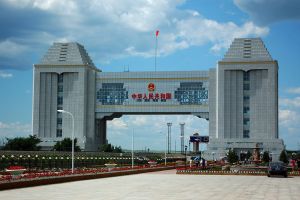
    Manzhouli Gate on Sino-Russian border. Image by Quatro Valvole via Wikimedia.

    One of the major stumbling blocks to a culture of sustainable security is persistent mistrust at the highest levels of government in Beijing and Moscow. Despite public displays of solidarity at the diplomatic level in China and Russia, the two countries remain wary of one another. Internal and external observers often view the China-Russia relationship through the lens of geopolitics, namely, that the China-Russia relationship is driven by rivalries both within their bilateral relationship, as well as outside, in terms of a desire to contain the United States’ power in global affairs.

    Much of the modern China-Russia relationship, despite the alarmism propagated by some observers, remains opportunistic for both parties. No number of agreements-neither on the energy trade nor economic initiatives such as the agreement to jointly develop China’s “New Silk Road” economic initiative with the Russia-led Eurasian Economic Union integration structure- can assuage the lingering feelings of strategic mistrust between the two countries, be it in the economic or military realm.

    Despite the post-Cold War drawdown of armed forces on the frontier, the Sino-Russian border remains militarized, exemplified by the deployment of 12,000 Chinese troops to the border in 2014, possibly in response to Russian nuclear drills near the border due to take place later that month. The failure to move beyond a geopolitical worldview in the China-Russia relationship will make sustainable security all the more difficult. Not only will persistent mistrust between China and Russia perpetuate fears based on traditional, military security, but it will also make it more difficult for the two sides to cooperate on border security. Indeed, security tensions on the Sino-Russian border are nothing new, as the two sides engaged in a border conflict that lasted throughout 1969. Despite the end of open conflict after approximately six months, the tense atmosphere on the border persisted until 1991 when the two sides finally resolved their border demarcation disagreement.

    In spite of the ostensible resolution of border disagreements between the two countries in 2001, anger arose among Chinese netizens in late 2015 when news reports highlighted the construction of border markers signifying the return of 4.7 square kilometers of land from Russia to China. The anger came from what appeared to be China’s inability to demand more land from Russia, which Chinese nationalists believe to be rightfully theirs in light of acquisition of land belonging to the Chinese Empire by the former Russian Empire in the 19th century.

    Necessity overrides high politics

    Far removed from the mechanism of high politics at the official level is the day-to-day reality of cross-border interaction between Chinese and Russians living along the border, as well as the issue of Chinese migration to the Russian Far East.  According to a report on life in the Russian Far East many Russians remain skeptical and wary of Chinese consumption of Russian land and material assets. But many locals also protest the heavy-handed and centralized nature in which Moscow conducts its governance over the Far East. The region’s increasing economic dependence on China and continuing political subjugation to Moscow means that many local residents are increasingly turning to China for their everyday needs, which includes engaging in shuttle trading and importing Chinese cars.

    Two major changes in the management of Sino-Russian border security should therefore occur. One is a move away from a strict dependence on reactive measures, to a more proactive approach, explained below. A second is to divorce the happenings of high geopolitics between the two nations’ capitals from realities on the ground, especially by building interethnic relations so as to create a culture of trust and cooperation during times of geopolitical uncertainty in the China-Russia relationship.

    Aside from regular border patrol and law enforcement activities along Russia’s Far Eastern borders, Russian security authorities also utilize the concept of Border Security Zones. Dating back to the Soviet era, these are essentially small, barely-populated areas along the Russian borders with several countries, including China and North Korea prohibited from entry without permission from the local FSB (Russia’s federal domestic security service). Nevertheless, with not only the existing and growing presence of Chinese living in Russia but also the increased trade relationship between the two countries, border security based strictly and exclusively on prevention and interception on the part of Russian law enforcement is not a viable means of border security. One solution to this problem is concentrating on developing the interrelationship between the Chinese and Russian border communities.

    Community relations in border enforcement and security

    Russian authorities could potentially pursue a border security policy based in the concept of community policing. The concept of community policing is based on the notion of building working relationships between law enforcement and local communities. Instead of trying to catch and apprehend criminals, community policing entails interaction between civilians and law enforcement as part of the latter’s patrol duties. This has been implemented with relative success in American cities with high racial tensions such as Philadelphia. Not only does it increase public trust in the police, but it makes communities more willing to be forthcoming about criminal activity in their areas.

    One particular fear for Sino-Russian border security is the potential for organized crime groups to exploit cross-border activity and border communities. It can be easy for criminal elements, ranging from petty smugglers to larger criminal enterprises to blend into local Chinese border communities. In fact, Chinese organized crime groups such as the triads have become increasingly more powerful in the Russian Far East than the traditional Russian mafiya. While that is not a problem specific to border security, a Sino-Russian boundary line that is difficult to protect can only make the jobs of criminals operating in the region easier. Many Chinese migrants in the region end up being caught up in the machinations of criminal organizations as a way of contending with racial discrimination and the possibility of deportation.

    Through members of Russian law enforcement in border areas interacting with members of the Chinese communities in Russia’s borderlands, trust between the two sides can be built. Over the long term, if mutual feelings of respect and good working relationships between law enforcement and the community are established, the ability for the two sides to cooperate on the prevention and interdiction of criminal activities such as drug smuggling and human trafficking can hopefully weather any major potential shifts in geopolitical realities. Elsewhere, Tadaatsu Mohri, writing for the Brookings Institution, asserts that Japan-Russia cooperation on combating trans-national crime can be a way of reducing the greater strategic tensions inherent in the Japan-Russia bilateral relationship due to the ongoing territorial dispute over the Kuril Islands/Northern Territories. Mohri specifically cites existing cooperation on the Sino-Russian border as a case of successful trans-boundary collaboration.

    Yet while this relative success with respect to the Chinese-Russian border may have helped to alleviate tensions on the strategic level, the distance of the common Sino-Russian border and their respective populations from officials in Beijing and Moscow necessitates an even more community-focused approach. This will require the development of language and cultural skills among members of the Russian law enforcement community. For example, Russian education officials are working to implement Chinese language study as a component of education in preparation for Russia’s United State Examination.

    The establishment of working relationships between Russian law enforcement and members of the Sino-Russian border community will take time. Yet in the long term interests of Russia’s far eastern border security, it is a worthy endeavor for Russian border security services to pursue. While political relations between states at the elite level are often unstable or at least inconsistent, ties between populations are often more stable. Given the distance between the Sino-Russian border populations and the governments in Beijing and Moscow, an approach distanced from high politics will likely provide a better solution for sustainable border security. Such an approach would entail fostering relationships between law enforcement and border communities, particularly among immigrant and ethnic minority groups on the frontier.

    Anthony V. Rinna is a specialist on Russian security policy in East Asia with the Sino-NK scholarly research group. He currently resides in South Korea.