Blog

  • Boko Haram: Can a Peace Deal be Negotiated?

    Very few insurgencies are stopped using military force alone. Data from the RAND Corporation suggests that only 7% of terrorist campaigns end through military defeat. And yet many in Nigeria still pin their hopes on a swift military victory against Boko Haram, the Islamist insurgency that has been plaguing the country since 2009. Since the Chibok abduction in April, the world has woken up to the group’s increasingly bold and dangerous tactics – and also to the Nigerian government’s failure to turn the tide.

    Lake Chad as seen from Apollo 7. The lake's drying basin is the crucible of Boko Haram's insurgency in Nigeria, Niger, Cameroon and Chad. (Source: NASA, via Wikipedia)

    Lake Chad as seen from Apollo 7 in 1968. The lake’s drying basin is the crucible of Boko Haram’s insurgency in Nigeria, Niger, Cameroon and Chad. (Source: Wikimedia)

    Realistically, Nigeria is not in a position to inflict a military defeat on Boko Haram. Like most insurgencies, Boko Haram avoids concentrating its forces. It prefers to skirmish and build its presence in lots of places at once. The security forces must therefore spread wide to protect the population and root out insurgents village-by-village. According to the orthodox counter-insurgency formula of 20 soldiers and police to every 1000 people, 200,000 soldiers and police would be required in north-east Nigeria.  This is about five times the current deployment level.

    It also assumes that such forces would be adequately equipped and trained and motivated to protect the civilian population. Even the troops that are deployed in the north-east are given little ammunition, and their weapons routinely malfunction. The air force, which gives Nigeria its one clear military advantage, has been struck by multiple equipment failures and crashes in recent months. And the strategy is also to blame. There has been too much focus on a military-only approach and not enough attention paid to the underlying drivers of the conflict.

    Yet Nigerian politicians and generals still line up to claim imminent victory, usually giving three month’s notice for Boko Haram’s projected downfall. Time after time the deadlines pass and Boko Haram is anything but defeated. In fact, the insurgency has never been stronger. Since July, Boko Haram has shifted from hit-and-run tactics to the capture and control of swathes of territory and even large towns across three states: Borno, Adamawa and Yobe.

    The obvious alternative to a military solution – a negotiated political settlement – is admittedly unpalatable. After the appalling war crimes committed by Boko Haram over the last five years, it is hard to contemplate offering them a share of power and, most likely, an amnesty. Yet if it wants to stop the violence, the government has little choice. Indeed it has shown itself willing to enter into negotiations, as the failed attempt to broker a truce through Chadian president Idriss Déby in October showed. But is such a deal even possible?

    Obstacles to a deal

    There is much that stands in the way of a deal with Boko Haram. Probably the most immediate obstacle is the insurgency’s own success. Why would Boko Haram want to do a deal when it is achieving its aims already? To force Boko Haram to the negotiating table, the military may have to retake some of the captured territory to create the impression that the momentum is with the army.
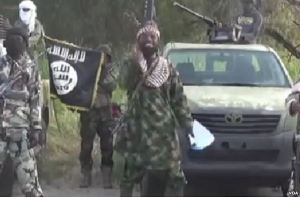
    Abubakar Shekau, leader de Boko Haram, still from an October 2014 Boko Haram video communique. (Source: VOA, via Wikipedia)

    Abubakar Shekau, leader of Boko Haram in a still from an October 2014 Boko Haram video communique. (Source: VOA, via Wikipedia)

    The second obstacle is even greater. Over the past five years, Boko Haram has become increasingly extreme and violent. It has transitioned from a menacing but peaceful movement focused on preaching, to an insurgency focused on attacking government targets, and now to a group willing to indiscriminately kill civilians.

    The insurgency’s growing extremism is a major driving force behind its violence. As Boko Haram’s leader, Abubakar Shekau, said in a recent video, “our religion and our way of worship is nothing but killings, killings and killings”. Indeed, as Ahmad Salkida, a Nigerian journalist with rare access to Boko Haram, has said, “the fuse that drives Boko Haram’s terror is the sect’s doctrine”. Their religious ideology, a form of Salafi Jihadism, focuses on purging Islam of corrupting influences and returning to the ‘pure’ Islamic practices of the distant past. Over the years, Shekau has purged Boko Haram of more moderate commanders, leading to an increasingly fanatical take on what methods are acceptable to purge Muslim society of impure elements and what constitutes an impure element. Violence has become the method of choice, and the targets include children.

    It is hard to see how this extremism and violence can be accommodated in a negotiated settlement. Is it even possible to have a meaningful dialogue with a group that seems to have gone beyond any kind of rational political or socio-economic programme?

    What does Boko Haram want?

    Yet there are discernable grievances underlying the conflict in northern Nigeria. Even if Shekau is only interested in purgative violence, many of the group’s followers and fighters are likely to have more tangible motivations and aims. They are also rumoured to be growing increasingly tired of life in the bush, so it’s possible a deal could be done if a strong enough offer were made.

    A core driver of the insurgency is an escalating cycle of grievance and revenge. Boko Haram first became violent after security forces attacked its members who were participating in a funeral procession in Maiduguri in 2009. After a series of skirmishes, its founding leader Mohammed Yusuf was arrested, detained, and summarily executed. Since then, numerous suspected Boko Haram supporters have also been murdered. On March 14 of this year, the military was accused of summarily executing 600 prisoners in response to a Boko Haram attack. The families of suspected Boko Haram members have also been targeted. Many women and children who are related to militants are believed to be in detention, including the family of Shekau, and there are rumours that female family members have been raped.

    Central to any deal must be accountability and compensation for these excesses, as politically difficult as that may be. Many imprisoned Boko Haram supporters and relatives will also have to be released.

    There are also political and socio-economic factors feeding into the conflict. North-east Nigeria is one of the most impoverished places in the world, with three-quarters of the population living below the poverty line. People there feel politically as well as economically marginalised, as northerners have been increasingly locked out of power in recent years. President Goodluck Jonathan, a southern Christian, has broken an unwritten rule by running again for the presidency in 2015. Convention on rotation of power dictates that a northern Muslim candidate should be put forward by the ruling party.

    Corruption and poor governance in the region have also played a role in promoting alienation from Nigeria’s institutions and fostering an environment ripe for insurgency. The government would do well to include measures aimed at boosting development, improving governance, and ending the region’s political marginalisation in any deal.

    An amnesty from prosecution and jobs for former insurgents must be the final element of a deal. It is unlikely insurgent leaders and fighters will come out of the bush if they believe they will be prosecuted, and jobs will be vital for re-integrating them into society. Again, this would depend on massive federal and/or private investment in the northeast, what some have called a ‘Marshall Plan’ for the northeast.

    There have been signs that the Nigerian government is willing to engage with these questions. The “soft” counter-terrorism strategy unveiled by Nigeria’s National Security Adviser in March included an emphasis on tackling under-development and other underlying drivers of the conflict. Its commitment to address social injustice, joblessness, and poverty may well be attractive to Boko Haram members who have joined the insurgency for those reasons. However, the international storm following the Chibok abduction, Boko Haram’s territorial gains, and the national elections due in February 2015 seem to have dragged momentum away from these measures.

    Talking to Shekau

    One of the major challenges of doing a deal with Boko Haram is finding a way of talking to Shekau. Since the Chibok abduction, all sorts of people have reportedly come forward claiming to be intermediaries representing the insurgents. Many of them, if not all of them, are bogus – including the one who did the supposed deal with Idriss Déby.

    The government has to find the right interlocutor. One possible option is to go through Ahmad Salkida, and the government did reportedly bring him in to discuss the Chibok abduction. He is one of very few people with a credible connection to the insurgents who may be able to advise on how to reach out to them.

    Whatever the case, and as Salkida has said himself, it will be difficult to achieve any kind of peace deal until the army is able to stem the tide of Boko Haram’s advances. The first step must be to summon the political will and train, motivate and deploy the resources necessary to adequately protect the civilian population in north-east Nigeria.

    Andrew Noakes is Coordinator of the Nigeria Security Network. He is on Twitter at @andrew_noakes 

    Image: Lake Chad as seen from Apollo 7 in 1968. Source: Wikimedia.

  • Trident – Why I Changed My Mind About the UK’s Nuclear Weapons

    Following the vote to renew the Trident nuclear programme, a former nuclear-armed submarine commander discusses why the UK needs to seriously rethink its attitude to nuclear weapons. 

    Editor’s Note: Commander Forsyth’s explanation as to why he has changed his view on the deterrence value of the now and future Trident weapon system was originally written for family members. It has been edited by the ORG with the full involvement and agreement of Commander Forsyth to be suitable for wider publication. Of particular interest is his alternative proposal for a smaller,  ‘for but not with’ and  more versatile submarine platform as a stepping stone to reducing the level of ready use weapons whilst preserving the ability to resurrect full CSD posture if required.

    In 1972 I became Executive Officer of HMS Repulse, one of the four Polaris A3 missile-carrying submarines based on the Clyde. Based on this experience I can say, without any sentiment or exaggeration, that the use of nuclear weapons during the Cold War would have threatened the existence of humanity.

    I believed that Mutually Assured Destruction (MAD) was at the centre of the UK’s deterrence policy, meaning that if the Soviets fired at us then we (as well as the USA and, latterly, France) would respond in such measure as to immediately annihilate several major cities in the Soviet Union.

    The consequential radiation effects of any nuclear detonation would largely complete the destruction and this would almost certainly have caused a ‘nuclear winter’.

    MAD and the Cold War

    forsyth

    Commander Forsyth on HMS Sceptre.

    The policy of MAD would, we were told, only have been used in retaliation to a Soviet nuclear first strike with missiles en route to Europe or the USA. We were constantly assured that under no circumstances would we fire our Polaris missiles first even if tanks were rolling across the German plain, unless the Soviets had already fired nuclear weapons at us.

    As Paul Rogers notes, the UK’s other tactical nuclear weapons could have been used against such a Soviet offensive. Yet at the time we thought that this would not necessarily start a strategic exchange. Perhaps naively, we tended to consider Polaris in isolation from the tactical battlefield and on a whole different level.

    The UK’s retaliatory only policy (assuring a second strike was possible) let us sleep easily at night during the years that we took 16 Polaris missiles to sea. As Nick Ritchie explains, each of these missiles carried two warheads with an estimated yield of 40kt. Thus, with 16 missiles per boat, just one patrolling submarine could have fired 32 40kt warheads, which would have given a potential explosive yield of 1.28 megatons—hence why we called what would happen if they were used Armageddon.

    Understanding the power of the bomb

    The US had many more submarines, aircraft and land-based missile silos. Our contribution was a gesture of togetherness against a common enemy whose declared policy was assumed to be ‘world domination by any means’.

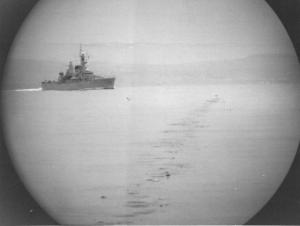
    Torpedo tracks perishot_enhanced

    Periscope pic of torpedo tracks approaching the target.

    In comparison, the atomic bomb that physically destroyed the Japanese city of Hiroshima in WWII and killed 100,000 people in the process had just a 15 kiloton yield.  So when Prime Minister Theresa May stated in parliament last July that she was prepared to press the button and kill 100,000 people, we should recognise that the number of deaths she was referring to was significantly less than that which Polaris missiles were capable of inflicting—never mind the massive collateral structural and radiation casualties which would result.

    Each Trident warhead has a yield of up to 100 kilotons, which, in terms of destructive power, is equivalent to six or seven Hiroshimas. The UK presently deploys 40 nuclear warheads and not more than eight missiles on its four submarines, meaning that the destructive power on board just one of these submarines, if used at the same time against a densely populated country, would kill considerably more than 100,000 people.

    Justifying nuclear use

    The ownership of this sort of power begs the question: what threat might justify the use of such destructive force? We also need to be clear under what circumstances and at what scale the Prime Minister might authorise a nuclear strike because she could be taking us all with her.

    Two government statements are relevant to this discussion:

    1. Then Secretary of State for Defence, Geoff Hoon, stated in 2002, prior to the invasion of Iraq, that Saddam Hussein could ‘be absolutely confident that in the right conditions we would be willing to use our nuclear weapons’.
    2. A government policy paper of 8th May 2015 stated that ‘it will not rule in or out the first use of nuclear weapons’ to ‘deter and prevent nuclear blackmail and acts of aggression against our vital interests that cannot be countered by other means’. This leaves open the option for the Prime Minister to authorise Trident’s use to deter an aggressor who may be threatening to use nuclear weapons or is using massive conventional forces which we do not have sufficient conventional force to counter. But, importantly, the government deliberately maintains ‘some ambiguity precisely when, how and at what scale we would contemplate use of our nuclear deterrent’.

    Keeping the option open of using nuclear weapons first against an adversary who you judge is threatening your ‘vital interests’ with non-nuclear force is quite different from MAD. This is what makes me question the whole basis of what we may or may not do with Trident. Formerly we would not have fired Polaris missiles until British cities had been totally destroyed by a megalomaniacal action by the Soviets. It would have been a futile gesture by us but the threat of doing so was considered to be a deterrent. Now it is ultimately a matter of the Prime Minister’s judgement as to whether we embark on a nuclear war. This raises the prospect of deliberately causing Armageddon as opposed to a reaction to one already started.

    In which case, I would argue that we have the right seriously (a) to question whether the Government should have that power and (b) if so, to constrain the circumstances in which such power can be used. As Nick Ritchie points out, the UK ‘does not dispute that international humanitarian law applies to the use of nuclear weapons and has incorporated the notion of “extreme circumstances of self-defence” into its declaratory nuclear policy statements’. Yet will all future Prime Ministers follow such guidelines in practice?

    The need to ask these questions, and decide if building a new generation of nuclear weapons is justified and will ‘keep us safe’, is particularly important given that no military case has been made for Trident’s use by its supporters—other than the vague statement that we don’t know what the future holds.

    Reference to the prospective use of nuclear weapons is nearly always qualified by adding that they are a weapon of ‘last resort’. As part of the Prime Minister’s decision making process she has therefore, at the very least, to be satisfied that all other alternative avenues have been exhausted, starting with the political and economic ones, escalating up through the increasing use of conventional military power.

    Rethinking what military capabilities the UK needs

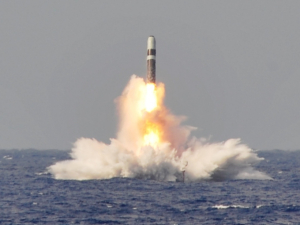
    140602-N-ZZ999-202 ATLANTIC OCEAN (June 2, 2014) A trident II D-5 ballistic missile is launched from the Ohio-class ballistic missile submarine USS West Virginia (SSBN 736) during a missile test at the Atlantic Missile Range. The test flights were part of a demonstration and shakedown operation, which the Navy uses to certify a submarine for deployment after a major overhaul. The missiles were converted into test configurations with kits containing range safety devices and flight telemetry instrumentation. The U.S. Navy supports U.S. Strategic Command's strategic deterrence missions by operating and maintaining Ohio-class ballistic missile submarines to deter regional and strategic threats. The triad, the U.S. strategic nuclear forces of ICBMs, bombers, and ballistic missile submarines, remains the primary deterrent of nuclear attacks against the U.S., our allies, and partners. (U.S. Navy photo/Released)

    Image of Trident missile via Wikimedia.

    When I was at sea in the 1960s and 1970s the UK invested in both the Polaris force and significant conventional armed military forces in all three services. The country was able to send a Task Force as far afield as the Falklands and, more importantly, the armed forces were strong and large enough to withstand the quite considerable attrition—particularly in the Navy—in fighting a full-on war.

    The services have gradually been whittled down to a level in which such a Task Force could not be assembled. By its own admission the Navy does not have enough ships and submarines to meet peacetime commitments—never mind war. The six Type 45 destroyers designed to protect the UK’s two new carriers were victims of over-design and under-funding (albeit costing £1billion each) such that they are now in harbour with major operational limitations which will take some years to be rectified.

    Meanwhile, the next generation of frigates have been delayed. When they do come they will have outdated equipment and there will still not be enough of them to give anti-submarine warfare protection to the carriers—unless they forego other roles of which there are many. The Army and Air Force also have their own tales of woe—soldiers die for lack of body armour and the correct vehicles because the military budget has to cope with the costs of Trident.

    Why is this? To some extent you can blame senior officers for lack of management ability and vision when challenged by the need to meet major commitments with a constantly reducing budget. They should perhaps have been stronger and said we are not well placed to play the role assigned in the Iraq war, be peace keepers afterwards and also embark on a new war in Afghanistan. The ‘can do’ spirit has been counter-productive.

    However, the other budgetary factor is that the cost of building four Successor submarines alone is now set to cost at least £31 billion. You can buy quite a lot of aircraft carriers, frigates and hunter killer submarines for that.

    The consequential reality is that we have very little conventional capability before the use of Trident becomes our last resort—a very dangerous situation for world peace. So who are we likely to need to use our last resort against having said that rogue states and dirty bombers are not likely targets? The answer is no one at the moment. Yes, Russia is acting aggressively, waving their nuclear weapons stick, but Russia has no grand plan for world domination. I must therefore conclude that the Royal Navy is being exploited to operate a political status symbol with no military value at the cost of other important capabilities.

    There is no threat to the UK that justifies our nuclear force

    During the Cold War the UK’s nuclear-armed submarines were at 15 minutes notice to fire. Since 1994 however, following an agreement with Russia, the UK’s nuclear weapons have been de-targeted—although this situation could be quickly reversed. The Trident submarines are lurking on standby ‘just in case’, so there is time to target and arm them if the situation escalates. Saying North Korea is a threat to the UK is not credible. Pyongyang may become a threat to US interests, but even that is unlikely and the US is more than capable of responding.

    Some may argue that now is not the time to lay down our nuclear arms because it might further destabilise our position in Europe and be seen as a further ‘weakness’ post-Brexit. But what does this mean? That the Russians will see an opportunity and seize it? I believe they know, despite the Prime Minister’s words, that we would not fire our nuclear weapons except in retaliation to a major nuclear first strike by them—which they are unlikely to launch.  But I also believe it is possible that Putin could take advantage of our regular Force’s weakness, for example, through giving covert military support and overt political support to ‘popular’ pro-Moscow uprisings in Russia’s near abroad. The calculation here would be that NATO would likely find it difficult to find an effective response to such manoeuvres.

    As for a developing intercontinental threat from elsewhere in the future, if it’s not on the drawing board now (and it’s not) then we have time to consider our options. Designing a submarine today to go to sea in 17 years’ time to counter a future undefined notional threat is really fighting yesterday’s war with yesterday’s technology. By making that decision now it becomes harder to change our posture as more and more money is poured into the Successor programme.

    Is there an alternative? Yes there is. If, despite all the above, the UK decides it needs to have a nuclear weapon system for ‘insurance’ reasons then a submarine platform is probably the best vehicle to carry it because it is considerably less vulnerable (I would not use the word invulnerable now) to counter-detection than cruise missiles, aircraft or land based weapon platforms. However, the problem with the current and future Trident submarines is that they are a single purpose platform, very big—consequentially comparatively slow—and really only have a self-defence capability. They contribute nothing to peacetime surveillance or war-fighting capability in any other area than firing strategic missiles and cost the earth.

    We have already reduced the number of missiles per boat so why not make a further reduction to say four per boat and fit a missile section into existing Astute class hunter-killer submarine hulls?[1] This option could save money, enable a dual role and, by building five, two or even three of them could be at sea at any time in either role and be a useful enhancement to the UK’s broader submarine needs.

    Furthermore, if the Government wished to demonstrate its willingness to comply with the Nuclear Non-proliferation Treaty, then missiles and warheads could be placed in ready-use store. This is justifiable on the basis that there is no threat today that requires the cost of having a submarine at sea at all times employed solely on what is known as Continuous at Sea Deterrence (CASD). Apart from anything else, the maintenance of the ‘invisibility’ of the SSBN on patrol requires additional support from ships, submarines and maritime aircraft taken off other more real time operations. Should it ever begin to become necessary, a CASD posture could, of course, be re-introduced very quickly as a clear signal of the UK’s determination to deter and as a further step up the nuclear ladder.

    Conclusion

    I believe that it is highly unlikely that the UK will ever come under nuclear attack from an enemy remotely susceptible to a threat of nuclear retaliation. I also don’t think first strike nuclear attack should ever be an option for the UK—we should not duck saying that. But if, as some may argue, that now is not the time to scrap the nuclear option because there is a remote chance we need to retain a nuclear weapons capability, then there is an option which cuts the cost significantly, allows for the restoration of our three Services to something resembling useful and still maintains the nuclear deterrent as a capability to be deployed if events ever require. Yet, of course, even this option would not prevent the government of an independent Scotland from forcing the relocation of Trident south of the border at a massive extra cost.


    [1] Trident submarines have 16 missile tubes and the Successor class is due to have 12. Each missile is capable of carrying 12 warheads. The 2010 Strategic Defence and Security Review, unilaterally downgraded the outload per submarine to a maximum of 8 missiles and 40 warheads. There are, therefore, redundant missile tubes in existing and planned submarines. Only 4 missiles are needed to carry 40 warheads.

    Commander Forsyth joined the submarine service in 1961 (aged 22). He subsequently served in conventional and nuclear powered submarines until 1980. During his career he commanded HMS Alliance (diesel powered), was Executive Officer (2nd in command) of HMS Repulse (Starboard Crew) a nuclear powered, Polaris missile firing submarine, Commanding Officer (Teacher) of the Submarine Command Course (aka ‘Perisher’) and Commanded HMS Sceptre a nuclear powered Hunter Killer submarine deployed on Cold War patrols. He created the website www.whytrident.uk with the aim of providing the wider world with answers to the obvious questions not easily obtainable elsewhere.


  • Challenges Facing Women in Peacekeeping

  • Syria’s Uneven Aid Distribution Threatens Future Peace

  • From The Great War to Drone Wars: The imperative to record casualties

    From The Great War to Drone Wars: The imperative to record casualties

    The centenary of the First World War also marks the anniversary of the practice of recording and naming casualties of war. But a century on, new forms of ‘shadow warfare’ limit the ability to record casualties of conflict and thus threaten to allow states a free hand to employ dangerous new tactics without threat of individual or international accountability. Without verifiable casualty figures, – including information on who is being killed and how – we cannot evaluate the acceptability, effectiveness or impact of ‘remote control’ tactics as they are rolled out among civilian populations.

    Read Article →

  • Carefully Managing Water Resources to Build Sustainable Peace

    Carefully Managing Water Resources to Build Sustainable Peace

    Carefully planned interventions in the water sector can be an integral part to all stages of a successful post-conflict process, from the end of conflict, through recovery and rebuilding, to […]

    Read Article →

    In Deep Water: China tests its neighbours’ patience

    Control of water, including navigation rights, resource extraction and the exploitation of shared watercourses is at the heart of today’s geopolitical tensions in Asia. China’s recent actions in the South China Sea and Himalayas have given rise to further—and at times violent—conflict over the region’s natural resources. So will water insecurity lead to greater partnership in Asia? Or will it lead to a revival of China’s traditional sense of regional dominance and undercut efforts to build a rules-based approach to growing resource conflicts?

    Read Article →

    Water Security in South Africa: The need to build social and ecological resilience

    Tackling South African water insecurity will require addressing the technical deficiencies, governance gaps and social inequality that are currently having a dangerous and environmentally devastating impact. The links between environmental health and socio-political stability are clear in South Africa, where there has been an exponential increase in violent protests over poor or privatized service delivery, social marginalization, and unequal access to water. South Africa must act to solidify the links between resilient societies and resilient ecosystems.

    Read Article →

    Bay of Bengal: a hotspot for climate insecurity

    The Bay of Bengal is uniquely vulnerable to a changing climate because of a combination of rising sea levels, changing weather patterns, and uncertain transboundary river flows. These problems combine with already existing social problems like religious strife, poverty, political uncertainty, high population density, and rapid urbanization to create a very dangerous cocktail of already security threats. Andrew Holland argues that foresight about its impacts can help the region’s leaders work together to solve a problem that knows no boundaries.

    Read Article →

  • In piaffe: multilateral nuclear disarmament dialogue in the year of the horse

    In piaffe: multilateral nuclear disarmament dialogue in the year of the horse

    Shortly after the lunar New Year, UN Secretary-General Ban Ki-moon challenged the Conference on Disarmament to run with the ‘spirit of the blue horse’ towards substantive engagement on multilateral nuclear disarmament in 2014. While the regime may not achieve this speed, there are initiatives underway this year that may well help nuclear disarmament dialogues pick up speed ahead of the 2015 NPT review conference.

    Read Article →

    Beaux Gestes and Castles in the Sand: The Militarisation of the Sahara

    Whatever the benefits for Mali, the French-led eviction of jihadist groups from northern Mali may have made the wider Sahara a less safe place, and has done little to lower the capacity of such groups to threaten European interests.. In 2014, France is implementing a major redeployment of its forces in Africa into the Sahel and Sahara. Meanwhile, the US has been quietly extending its military reach from Djibouti to Mauritania. However, as elsewhere, the western military approach to countering Islamist insurgency in the Sahel rests on very unsteady foundations and the potential to provoke wider alienation and radicalisation is strong.

    Read Article →

    Chemical Weapons Use in Syria: a Test of the Norm

    Recent events in the Syrian civil war have proved an unparalleled test of the norm against the use of chemical weapons. At its core this was a test of the willingness of countries to uphold the norm, in this case in the face of a flagrant violation, and a response that in the end stumbled upon a satisfactory conclusion—reaffirming the special category of chemical arms—but which in the process said a great deal about current attitudes to the use of military force as a means of humanitarian intervention.

    Read Article →

  • The European Union and Conflict Resolution

  • China and the Responsibility to Protect

    The Responsibility to Protect (R2P) is a significant, if controversial, development in international affairs. China has proposed its own semi-official version of R2P called “Responsible Protection”.

    Author’s Note: This article highlights issues discussed in more depth in various publications, including Andrew Garwood-Gowers, ‘China’s “Responsible Protection” Concept: Reinterpreting the Responsibility to Protect (R2P) and Military Intervention for Humanitarian Purposes’ (2016) 6 Asian Journal of International Law 89 and Andrew Garwood-Gowers, ‘R2P Ten Years after the World Summit: Explaining Ongoing Contestation over Pillar III’ (2015) 7 Global Responsibility to Protect 300.

    Introduction

    Over the last decade and a half the Responsibility to Protect (R2P) principle has emerged as a significant normative development in international efforts to prevent and respond to genocide and other mass atrocity crimes. Yet it has also been controversial, both in theory and in practice. R2P’s legal status and normative impact continue to be debated in academic and policy circles, while its implementation in Libya in 2011 reignited longstanding concerns among many non-Western states over its potential to be misused as a smokescreen for regime change. These misgivings prompted Brazil to launch its “Responsibility while Protecting” (RwP) concept as a means of complementing and tightening the existing R2P principle. China, too, has proposed its own semi-official version of R2P called “Responsible Protection” (RP). This contribution explores the key features and implications of the lesser known Chinese initiative.

    The R2P Principle

    Peacekeeping - UNAMID

    Image by UN Photo via Flickr.

    R2P first appeared in a 2001 report by the International Commission on Intervention and State Sovereignty (ICISS), a body set up by the Canadian government to consider how the international community should address intra-state humanitarian crises. However, after the initial concept proved contentious a modified version of R2P – labelled “R2P-lite” by one commentator – was unanimously endorsed by states at the 2005 World Summit. In its current form R2P consists of three mutually reinforcing pillars. The first is that each state has a responsibility to protect its populations from the four mass atrocity crimes (genocide, war crimes, crimes against humanity and ethnic cleansing). Pillar two stipulates that the international community should encourage and assist states in fulfilling their pillar one duties. Finally, pillar three provides that if a state is manifestly failing to protect its populations the international community is prepared to take collective action in a timely and decisive manner on a case-by-case basis, in accordance with Chapter VII of the UN Charter.

    Action under pillar three can encompass non-coercive tools such as diplomacy and humanitarian assistance, as well as coercive means including sanctions and the use of force. The international community’s pillar three responsibility is framed in conservative terms, creating only a duty to consider taking appropriate action, rather than a positive obligation to actually respond to a state’s manifest failure to protect. Crucially, the UN Security Council remains the only body that can authorise coercive, non-consensual measures under pillar three. R2P does not grant states a right to undertake unilateral humanitarian intervention outside the Charter’s collective security framework. Overall, R2P is best characterised as a multi-faceted political principle based on existing international law principles and mechanisms.

    The most well-known instance of pillar III action to date is the international community’s rapid and decisive response to the Libyan crisis in early 2011. The Security Council initially imposed sanctions and travel bans on members of the Gaddafi regime before passing resolution 1973 authorising the use of force to “protect civilians and civilian populated areas under threat of attack’’. China, Russia, Brazil and India each abstained on the vote to mandate military force against Libya. As the extent of NATO’s military targets and support for the Libyan rebels became apparent, many non-Western powers criticised the campaign for exceeding the terms of the Security Council resolution. For these states, the eventual removal of the Gaddafi regime confirmed their perception that R2P’s third pillar could be manipulated for the pursuit of ulterior motives such as the replacement of unfriendly governments.

    The post-Libya backlash against R2P was at least partly responsible for Security Council deadlock over Syria. Russia and China have exercised their vetoes on four separate occasions to block resolutions that sought to impose a range of non-forcible measures on the Syrian regime. At the same time, there has been renewed debate about the strengths and weaknesses of R2P’s third pillar. In late 2011 Brazil’s RwP initiative proposed a series of decision-making criteria and monitoring mechanisms to guide the implementation of coercive pillar three measures. While RwP initially attracted significant attention and discussion, Brazil’s foray into norm entrepreneurship was short-lived and R2P has remained unaltered.

    Reframing R2P as “Responsible Protection”

    China’s traditional insistence on a strict interpretation of sovereignty and non-intervention has made it uncomfortable with the coercive, non-consensual aspects of R2P’s third pillar. As a result, Beijing has consistently emphasised the primacy of pillars one and two, while downplaying the scope for pillar three action. In this respect, its decision not to veto resolution 1973 on Libya came as something of a surprise.

    China’s contribution to the post-Libya debate over R2P’s third pillar is less widely documented than Brazil’s efforts. In mid-2012 the notion of “Responsible Protection” was floated by Ruan Zongze, the Vice President of the China Institute for International Studies (CIIS),  which is the official think tank of China’s Ministry of Foreign Affairs. Although China has not explicitly adopted the concept as a formal policy statement on R2P, its implicit endorsement means it can be described as a “semi-official” initiative.

    RP is primarily concerned with R2P’s third pillar and, in particular, providing a set of guidelines to constrain the implementation of non-consensual, coercive measures. It consists of six elements or principles, which are drawn from just war theory and earlier R2P proposals such as the 2001 ICISS report and Brazil’s RwP. In this respect, RP represents a repackaging of previous ideas, rather than an entirely original initiative. However, by reframing these concepts in stricter terms it reflects a distinctive Chinese interpretation of R2P that seeks to narrow the circumstances in which non-consensual use of force can be applied for humanitarian purposes.

    The first element draws on the just war notion of “right intention”. It provides that the purpose of any intervention must be to protect civilian populations, rather than to support “specific political parties or armed forces”. This conveys Beijing’s concerns over the motives and objectives of those intervening under the banner of R2P, as expressed during the Libyan experience. Element two relates to the “right authority” criterion. It reiterates the longstanding Chinese position that only the Security Council can authorise the use of coercive measures, and that there is no right of unilateral humanitarian intervention granted to states.

    RP’s third element is based on the traditional principle that military intervention should be a “last resort”. Its call for “exhaustion of diplomatic and political means of solution” is consistent with Beijing’s broader policy preference for diplomacy and dialogue over forcible measures. However, insisting on a strict, chronological sequencing of responses may deprive the international community of the flexibility needed to ensure timely and decisive action on humanitarian crisis. For this reason, some clarification or refinement of element three may be needed. The fourth element of RP draws on aspects of the just war principles of “right intention” (like element one) and “reasonable prospects”. In relation to the latter, it provides that “it is absolutely forbidden to create greater humanitarian disasters” when carrying out international action. This stipulation reflects Beijing’s position that external intervention often exacerbates humanitarian crises and can ultimately cause more harm than good.

    Element five of RP provides that those who intervene “should be responsible for the post-intervention and post-protection reconstruction of the state concerned”. Although the notion of a responsibility to rebuild appeared in the original 2001 ICISS report it was not included in the text of the World Summit Outcome document in 2005 and therefore does not form a component of the current concept of R2P. It is unclear whether China’s RP concept is explicitly seeking to resurrect this dimension or whether this element is simply intended to emphasise Beijing’s broader perspective on peacebuilding and development in post-conflict societies. Finally, element six calls for greater supervision and accountability of those carrying out UN authorised civilian protection action. This is a similar demand to that made in Brazil’s RwP proposal, though little detail is given as to what form any such monitoring mechanism would take.

    Conclusion

    Overall, the Chinese notion of RP is an attempt to reinterpret and tighten the content of R2P’s third pillar so that it aligns more closely with Beijing’s own normative preferences and foreign policy objectives. Compared to RwP and the ICISS report, RP outlines a narrower set of circumstances in which military intervention for humanitarian purposes would be appropriate. Some aspects of the proposal would certainly benefit from clarification and refinement.

    However, it is notable that despite strongly criticising the way R2P was implemented in Libya, China has chosen to engage with, and actively shape, the future development of the norm. This illustrates the extent to which China, as a permanent member of the Security Council, is enmeshed in the ongoing debate over R2P. In fact, RP is explicitly framed as an example of China “contributing its public goods to the international community”. In the future we can expect China and other non-Western powers to play increasingly influential roles in the development of international security and global governance norms.

    Andrew Garwood-Gowers is a lecturer at the Faculty of Law at Queensland University of Technology (QUT) in Brisbane, Australia. He has written extensively on R2P and the law governing the use of military force, with publications in leading journals including Global Responsibility to Protect, the Asian Journal of International Law, Journal of Conflict and Security Law and the Melbourne Journal of International Law.

  • Chemical Weapons Use in Syria: a Test of the Norm

    Chemical Weapons Use in Syria: a Test of the Norm

    Recent events in the Syrian civil war have proved an unparalleled test of the norm against the use of chemical weapons. At its core this was a test of the willingness of countries to uphold the norm, in this case in the face of a flagrant violation, and a response that in the end stumbled upon a satisfactory conclusion—reaffirming the special category of chemical arms—but which in the process said a great deal about current attitudes to the use of military force as a means of humanitarian intervention.

    Read Article →

    Beyond crime and punishment: UK non-military options in Syria

    The defeat of the UK government’s parliamentary motion on support in principle for military action against the Syrian regime means that Britain will play no part in any direct attack on Syria. What then are its options for resolving the Syrian conflict, protecting civilians and punishing those responsible for war crimes there? This article assesses what the UK can do in terms of pushing for a negotiated peace settlement and to hold accountable those responsible for using chemical weapons and any other war crimes committed during this century’s worst humanitarian crisis.

    Read Article →