Blog

  • podcast

    Global warming is moving much more quickly than scientists thought it would. Even if the biggest current and prospective emitters – the United States, China and India – were to slam on the brakes today, the earth would continue to heat up for decades. Read more »

  • WEBSITE

    This website presents an extensive database of the latest news, analysis and information on a variety of international issues. There are currently over 2,000 articles available covering issues ranging from globalization to poverty, climate change, people power and much more.

    The objectives of Share the World’s Resources are Read more »

  • Sustainable Security

  • Sustainable Security

    Nitrogen largeWith nearly 870 million people chronically undernourished, and progress towards the Hunger Millennium Development Goal ebbing since 2008, feeding the world will continue to be a major global challenge. The limitations of arable land availability, water accessibility, and humanity’s increasing population trajectory further compound the problem. Addressing the challenges to global food security while ensuring the sustainability of the planet will require changes to the way we interact with agriculture and a clear understanding of the driving factors behind it.

    Food and Energy Price Volatility
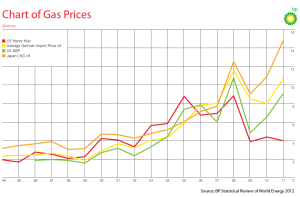
    World-Energy-PricesThe industrialisation of agriculture over the last five decades has contributed to massive gains in productivity, but it has also made food increasingly susceptible to energy supply and price fluctuations. Energy in the form of oil and gas is needed to run industrial farm equipment and to ship food around the world. Fertilizers, the driving factor behind most yield increases, are intimately tied to energy and therefore price volatility. Nitrogen fertilizers are particularly significant and are created through a process that combines natural gas and inert nitrogen from the atmosphere in a high-energy reaction to create ammonia. Fertilizer production is estimated to account for more than 50 per cent of total energy use in commercial agriculture (Woods, et al 2010). While shale gas has had a significant impact on the US natural gas market, globally, energy prices are expected to rise in the long term and become increasingly volatile, as shown by the graph to the right. Fertilizer costs will follow a similar trend, leading to variability in cost and availability. This can be especially difficult for small farmers in developing countries, whose resilience to price fluctuations is low.

    Locking Ourselves In to Volatility

    Natural means of increasing agricultural yields are possible through recycling manures and planting crops that add nutrients to the soil. However, barring a radical change in agricultural practices, globally we are locked into chemical fertilizer use, especially nitrogen fertilizers in the short and medium term. Approximately 45 per cent of the world’s food supply is grown using chemical fertilizers, and that number is growing. Meat consumption, which requires large amounts of grain for animal feed, is on the rise. Consumption of animal protein in Europe and the United states together is double the world average (FAO 2006), and is expected to grow 10 per cent between 2005 and 2030. However, demand in developing countries for animal proteins is projected to increase 60 per cent in the same period (Reay 2011). Pressure from biofuel legislation in Europe and the United States puts further pressure on land and drives up global food prices.

    Global land deals have increased dramatically in the last ten years, with an area of land eight times the size of the UK sold off globally in that time (Geary 2012). In addition to causing landlessness and poverty for local communities, the land is often used to grow large areas of single-species crops such as soy or eucalyptus, which use industrial agricultural methods requiring a high amount of chemical fertilizer, thus increasing dependence on global energy markets and locking new land into fertilizer dependence. Furthermore, nutrients and pesticides can make their way into local water supplies, degrading the environment upon which local communities depend. For example, water contamination from agricultural runoff can force communities to buy bottled or trucked water at higher prices, reducing their resilience to price fluctuations even further.

    Fertilizer as a Means of Reducing Poverty

    But fertilizers are not evil. Increasing yields (either through better access to fertilizers or implementing natural yield improvement practices) can greatly impact poverty and inequality. There are many regions of the world in which more nutrients are urgently needed in order to ensure the land is not degraded. When fertilizer is introduced to degraded soils, it can have enormous trickle down effects for poverty reduction, health, and education. In the early stages of development, when a country is primarily agrarian, the most consistently effective methods to reduce poverty and improve equality involve the agriculture sector, particularly through methods that raise small farm productivity (Berry 2010, Deininger and Byerlee 2011). For example, a recent review of coffee grower data from Mexico and Peru, published in the World Development journal, found that increasing yields are most important for growers (Barham and Weber 2011).

    Nitrogen: The Missing Link

    So where does that leave us? The very thing that reduces poverty and hunger through increasing yields can cause insecurity through energy price volatility. Add increasing pressure from consumption choices, land degradation, population pressure and climate change and we have a situation of increasing food insecurity globally.
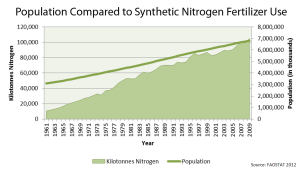
    Population-and-Fertilizer-UseThere is no silver bullet answer to this conundrum. However, the solution will likely be a combination of improving the efficiency of chemical fertilizer use and increasing the productivity and adoption of natural methods. Cross-cutting all of these solutions is the main driver of yields: nitrogen. Phosphorous and potash are also important elements of fertilizer, but nitrogen is the nutrient needed in the largest quantities. Just as a basic knowledge of how CO2 impacts climate change is important for developing solutions to the problem, so is knowledge of nitrogen important for developing solutions to food security.

    Nitrogen is critical for all plants and animals to grow. Some plants build it naturally into the soil through a symbiotic process between bacteria and their roots called ‘biological nitrogen fixation’ (beans and clover, for example), but the majority comes from chemical fertilizers and as a by-product of burning fossil fuels.

    For those that remember the nitrogen cycle from science class, we know that 78.1% of the atmosphere is inert nitrogen (N2). In the 20th century, we developed a way to convert this inert, atmospheric nitrogen into a form of nitrogen accessible to plants and animals (known as “reactive nitrogen”). This has enabled food production to roughly keep pace with the explosion of population growth over the last fifty years. Whether through fertilizers or biological fixation, nitrogen will play a key role in meeting the food needs of the future.

    When there is not enough nitrogen in the soil, loss of soil productivity and degradation occur. Because it is small farmers that often lack access to nitrogen, their yields decline year over year, reducing their annual income and thus exacerbating inequality within the global food system. This pushes them further into poverty, and in many cases can force them to purchase food when they cannot grow enough. Degraded land forces them to go in search of new, more fertile land, breaking apart families and communities.

    However, the solution is not as easy as simply adding more nitrogen in areas where there is not enough. Too much nitrogen can cause serious problems for human health and the environment. While nitrogen is required by plants in order to grow, there is a limit to how much any plant can use. Beyond this “critical load”, nutrients that cannot be absorbed by plants will leach into the water and air. Once in the environment, nitrogen can change forms over an extremely long life (average of 120 years) and detrimentally affect many different systems before finally becoming denitrified back into atmosphere. Nitrogen exacerbates climate change, depletes the ozone layer and drives biodiversity loss. It causes low-oxygen zones in water systems that weaken or kill fish and marine habitats (known as eutrophication or hypoxia). Reactive nitrogen can also be very detrimental to human health through air and water contamination. It is a major contributor to smog, which is estimated to take six months off the life expectancy of over half the population in Europe (Sutton et al 2011). It is even worse in areas like China, where the density of air particulates have registered at twice the level considered “dangerous” in metropolitan centres like Beijing. Ingesting high levels of water-borne nitrates has been associated with cancer, diabetes and adverse reproductive outcomes (Ward et al. 2005).

    The graph below shows nitrogen fertilizer application globally. In the red areas of the graph, many of the main water bodies suffer the detrimental effects of too much nitrogen, and the people that live in those areas suffer as a result of nitrogen pollution. Many of the green areas could benefit from more nitrogen to increase soil productivity.

    WorldFertilizerApplication

    The key is balance. On the one hand, improving the efficiency of fertilizer use will maintain crop yields while protecting the ecosystems humans and animals depend upon. On the other hand, developing biological nitrogen fixation methods or pro-poor fertilizer programmes to increase yields for small farmers will improve their situation economically and strengthen their resilience to price shocks and weather events. In both cases, proper nitrogen management will be a crucial part of solving our global hunger crisis while ensuring sustainability for future generations.

    Lisa Dittmar is the CEO and founder of NitrogenWise,  a website that brings together research and straightforward communication to explain the complexities of nitrogen in a meaningful and relevant way.


    Citations

    Barham, B. L., & Weber, J. G. (2011). The Economic Sustainability of Certified Coffee: Recent Evidence from Mexico and Peru. World Development, 1269-1279.

    Berry, A. (2010). What type of global governance would best lower world poverty and inequality? In J. Clapp, & R. Wilkinson, Global Governance, Poverty and Inequality (pp. 46-68). London: Routledge.

    Deininger, K., & Byerlee, D. (2011). Rising global interest in farmland. Washington DC: World Bank. Retrieved November 30, 2012, from http://siteresources.worldbank.org/INTARD/Resources/ESW_Sept7_final_final.pdf

    FAO. (2006). Livestock Report 2006. Rome: Food and Agriculture Organization of the United Nations.

    Geary, K. (2012). Our Land, Our Lives: Time out on the global land rush. Oxford: Oxfam. Retrieved November 2, 2012, from http://www.oxfam.org/sites/www.oxfam.org/files/bn-land-lives-freeze-041012-en_1.pdf

    Reay, D. S. (2011). Societal choice and communicating the European nitrogen challenge. In M. Sutton, The European Nitrogen Assessment (pp. 585-602). Cambridge: Cambridge University Press.

    Sutton, M. (2011). Too much of a good thing. Nature, 472, 159-161

    Ward, M. (2005). Workgroup report: Drinking-water nitrate and health-recent findings and research needs. Environmental Health Perspectives, 113, 1607-1614

    Woods, J., Williams, A., Hughes, J. K., Black, M., & Murphy, R. (2010). Energy and the food system. Philosophical Transactions of the Royal Society B, 2991-3006

    Front page image source: Organic Fertiliser for sugar cane – Shell

  • Sustainable Security

    The Ukraine conflict’s legacy of environmental damage and pollutants

    One year after violent conflict began, information is now emerging on the specific environmental impact of war in Ukraine’s highly industrialised Donbas region. Although obtaining accurate data is difficult, indications are that the conflict has resulted in a number of civilian health risks, and potentially long-term damage to its environment. In order to mitigate these long-term risks, international and domestic agencies will have to find ways to coordinate their efforts on documenting, assessing and addressing the damage.

    Read Article →

    The ‘High Politics’ of Sustainable Security

    If events like those in Ukraine have taught us anything it is that, despite the predictions of many, the potential for conflict between the major powers is still one of the defining characteristics of world politics. Crisis diplomacy and inter-state rivalry is back on the global agenda. But if policymakers, analysts and civil society actors are to try and come up with ways of reversing the trend towards an increasingly competitive, militarised and crisis-driven inter-state order, then thinking carefully through the implications of a sustainable security approach to great power politics would appear to be a most useful starting point.

    Read Article →

    International Dimensions of the Ukraine Crisis: Syria and Iran

    The Russian annexation of Crimea may be in direct contravention of international agreements but is popular in Russia and almost certain to hold. Given tensions within Ukrainian society and its weak transitional government, there remains some risk of further intervention in eastern Ukraine and possibly the Trans-Dniester break-away region of Moldova. Even if there is no further escalation in the crisis, the deterioration in EU/Russian and US/Russian relations is of great concern, not least in relation to two aspects of Middle East security – the Syrian civil war and the Iran nuclear negotiations.

    Read Article →

  • Sustainable Security

    Breaking the silence: Protecting civilians from toxic remnants of war

    Toxic remnants of war and their legacy of civilian harm is seriously under-explored as an area of conflict. There is a growing consensus that the current legal framework governing conflict and the environment is not fit for purpose – so how could new international norms that merge environmental protection with civilian protection come into effect?

    Read Article →

    Environment, Energy, Economy: a threefold challenge to sustainable security

    Whether it’s the economy, energy or the environment which you value most, when it comes to security, each holds equal weight. If security can be defined in terms of what is or isn’t sustainable, then it must evolve to incorporate additional elements that transcend more traditional views on geopolitics.

    Read Article →

  • The economic relationship of armed groups with displaced populations

    One of the ways that non-state armed groups get their funding is by exploiting displaced populations.


    Practically all armed groups are heavily dependent on external support. Armed groups primarily seek support from both other states and from the diasporas, displaced populations and other armed groups, in order to prevent the burden of  the war effort from falling entirely on the civil population they claim to protect, a situation that has its own political costs. States too need external support to deal with outbreaks of instability and violence; during the Cold War this was normal and it still continues today in most current armed conflicts.

    The violence, discrimination and poverty that follow armed conflicts lead to forced displacements of population that often help to maintain the original conflict. Armed groups frequently use IDP and refugee camps as a source of supply and recruitment, as well as for refuge for themselves. Although the armed groups have no legitimate power, they can depend on the refugee population on two essential fronts: fighters and income.

    Armed groups have been formed or have recruited members (voluntarily or forcibly) and resources from the IDP and refugee camps in regions and states neighbouring conflict zones. In some cases these camps have become important refuges and logistical bases for the armed conflict. Most of the Afghan armed groups originated in refugee camps in neighbouring countries. The Taliban, for example, emerged from the madrassas (Koranic schools) of the Afghan refugee population in Pakistan. The Karen refugee population – mainly on the Thai-Burma border – supports the Karen National Union armed group against the Burmese government. The Hutu and Tutsi communities that left Rwanda and Burundi during the successive waves of violence following independence in the 1960s settled in large refugee camps in Uganda, Rwanda, Burundi, the Democratic Republic of Congo and Tanzania which later spawned the insurgency that destabilised both countries. Other cases of similar effects can be seen in Ethiopia, Iraq, Turkish Kurdistan, Chechnya, Sri Lanka, Sudan, Tajikistan and elsewhere.

    The refugee populations provide support for insurgent groups as a way of establishing protection mechanisms in host countries. Without any such protection, refugee populations are frequently extremely vulnerable given the potentially hostile local population and/or state authorities, and are thus at the mercy of other armed groups and criminal gangs.

    Coercion is another important factor in eliciting contributions from the refugee population, particularly when armed groups are in control of refugee camps. The groups are easily able to take over as they are both armed and organised, whereas the displaced populations tend to be disorganised, weak and unarmed. In these circumstances it is easy for the groups to demand money, provisions and recruits from these populations, even where they are unpopular and are not supported by the populations they claim to represent.

    The most extreme example of this situation occurred following the genocide in Rwanda in 1994, when the remnants of the former Rwandan Armed Forces, officials from the previous Rwandan government and the Interahamwe militias organised resistance in the refugee camps in the former Zaire. They created a de facto government within these camps, exploiting international aid to continue their armed struggle against the new government in Rwanda, forcibly abducting and training new recruits, controlling and distributing humanitarian aid, and appointing themselves as camp managers, giving the refugee population no alternative but to let them do so.

    A similar situation is happening with the displaced populations in the Sudan region of Darfur. These people have suffered repeated attacks and abductions in recent years, becoming immersed in a spiral of militarisation by insurgent groups, pro-government militias and the Sudanese Armed Forces.

    The economy of armed groups

    There can be varying forms of economic relationship between armed groups and displaced populations. Some armed groups persuade the populations under their control to provide resources, while others force them to. The relationship between the parties may be symbiotic, parasitic or predatory, and may move from one type to another depending on how the war develops.

    In a symbioticeconomic relationship the armed group promotes certain types of activity in exchange for a share in the derived benefits. In such cases the economic development of the area and the economic well-being of the population may become dependent on the armed group for security and infrastructure; the group establishes a degree of social and economic order in the areas it controls in exchange for support and income, emulating a government and providing security, infrastructure and a rule of law that allow economic activities to continue in exchange for some form of taxation on the civilian population.

    In a parasitic arrangement the armed groups provide protection and guarantees of security in exchange for collaboration and economic retribution through extortion or the establishment of taxes and charges, charges for permission to access resources, looting of international aid, or payments known as ‘revolutionary taxes’. The degree of extortion may be more controlled and regulated if it stems from the leadership of the armed group, or it may be totally arbitrary where individual combatants establish the level of abuse and extortion.

    In a predatory economic relationship the armed groups are unconcerned by relationships with the civilian population, intimidating and terrorising them through the use of force in order to increase their power or to gain access to resources.

    Conclusions

    It is important to be aware that the relationships that emerge between armed groups and civilian populations in the economy of war do not always correspond to the standard victim-victimiser model. These relationships may be far more complex and may generate new forms of protection, authority and rights over the distribution of resources that may then play a decisive role in the outcome of the armed conflict. Understanding the economy and funding mechanisms of non-state armed groups is essential if we are to fully understand their nature. Greater understanding is needed of how these groups operate and where their funding comes from if we are to be in a position to facilitate humanitarian action in contexts of violence and to promote the respect for and fulfilment of human rights.

     is a political scientist and since 2000 has been a researcher on the Programa de Conflictos y Construcción de la Paz (Programme on Conflict and Peace-building,http://escolapau.uab.cat/) at the Escola de Cultura de Pau (Faculty of Peace Culture) in the Autonomous University of Barcelona.

    Image source: Gustavo Montes de Oca

    Article source: Forced Migration Review

  • Sustainable Security

    This concluding part of a two-part article series continues the discussion on the UK’s naval nuclear power programme and its potential impact on Britain’s energy policy. Read part 1 here.

    In Part 1, we described the intensity of UK commitments to new civil nuclear power and why this is so hard to fully explain. The proposed 16GWe of new nuclear capacity is a difficult policy to justify based on economics, energy security and conventional approaches to understanding innovation and technological transitions. There are serious problems with the UK nuclear power programme, including significant delays, rising costs, and uncertainty surrounding essential foreign investment. The UK government’s own figures show renewables, including onshore wind and solar, to be cheaper than nuclear. As the prospects of resolving underperforming nuclear plans get ever more distant and unlikely, increasingly favourable renewable projects remain ever more threatened by cut-backs. This has led to serious problems in that sector. Taken at face value, these patterns are very difficult to explain.

    What drives these counter-intuitive trends? Many factors will be at play, but, as discussed in Part 1, there is a particular major driver that remains almost entirely unexamined in analysis of UK energy policy. This concerns the pressure to sustain UK nuclear submarine infrastructures by maintaining  more general national reservoirs of specialist nuclear expertise, education, training, skills, production, design and regulatory capacities.

    Could these pressures to maintain capabilities, perceived to be necessary for the country’s naval nuclear propulsion programme, be influencing the intensity of UK commitments to new civil nuclear power? We now examine a crucial period in UK civil nuclear policy during which concerns around defence-related nuclear skills came to the fore shortly after a key policy moment when, for the first time since 1955, UK policy was considering an energy trajectory that did not include new nuclear.

    2003–2006: the unexplained nuclear ‘U-turn’

    Image credit: Thomas McDonald/Flickr.

    For a brief period between 2003 and 2006, nuclear energy seemed to fall out of high-level favour in the UK. The nuclear firm, British Energy was bailed out and brought back into state control in 2002 and nuclear privatisation was widely recognised to have failed. The UK civil nuclear industry was dogged by scandals and cases of costs overrunning. . Meanwhile, New Labour’s earlier efforts to democratise decision-making helped free one initially minor policy initiative from the shackles of bureaucratic inertia and industrial interests. For the first time, nuclear energy strategy escaped the domain of the dedicated ministry.

    Approaching energy policy by the indirect route of “resources”, the new Performance and Innovation Unit (PIU) – reporting directly to the Cabinet Office – was charged with undertaking an extensive reappraisal. This marked a significant departure from the traditional practice where energy policy assessments were closely guarded by the relevant ministry. The PIU review was staffed entirely by civil servants, with half of the review team comprised of leading independent energy analysts recruited from outside government. Freed from the incumbent pressures which constrained earlier UK energy reviews, the 2002 PIU study found that unresolved nuclear waste and economic problems meant that the UK should move towards a more decentralised electricity grid based around renewables and energy efficiency. The February 2003 White Paper Our energy future: Creating a low carbon economy upheld these recommendations. While it did not entirely rule out future investment in nuclear energy, it did find nuclear power to be economically and environmentally “unattractive” for Britain.

    What came next was one of the most abrupt policy turnarounds in UK history. For reasons never officially declared, Prime Minister Tony Blair launched another energy review in November 2005. This second review was not conducted in a transparent and independent way like the PIU process. Instead, it was undertaken by a few partially identified individuals inside the Cabinet Office under the leadership of Blair’s close personal associate, John Birt. According to nuclear advocate Simon Taylor, this involved a select group that most other civil servants in the Cabinet Office did not know even existed, working “in secret” to “re-examine” the case for nuclear energy. Managed by the former Atomic Energy Authority, the consultative part of this exercise was much shallower and shorter than before. Amid other widespread criticism, Greenpeace successfully took the Government to the High Court, where this second review was declared “unlawful” and “deeply flawed”. Yet Blair’s reaction was that this court ruling would “not affect policy at all”. With a further round of consultation, again alienating NGOs, the January 2008 White Paper Meeting the Energy Challenge duly announced a British ‘nuclear renaissance’.

    Among those questioning these events was the Parliamentary Environmental Audit Committee, which in March 2006 asked (without receiving an official answer) why a second energy review was deemed necessary so soon after such a comprehensive predecessor. Four months later, the House of Commons Trade and Industry Select Committee branded the second review a “rubber stamping” exercise designed to give legitimacy to a pre-ordained decision rather than being an ‘open’ consultation.

    It still remains unexplained what (or even who) could have driven this rethink. It is in this light that nuclear expert Steve Thomas has highlighted the ambiguities around exactly what ‘the UK nuclear lobby’ consists of.  With the UK civil nuclear engineering industry so weak and historically unsuccessful (as discussed in part 1), it is unclear where in this languishing domestic sector sufficient political-economic capital might have accumulated to force such an unprecedented and poorly justified national policy turnaround.

    Investment and skills concerns around the UK’s Naval Nuclear Propulsion Programme

    This is where the  imperatives around national submarine capabilities comes into play. It is in exactly this same critical juncture between 2003 and 2006 that an unprecedented intensification can be observed in concerns around the UK’s nuclear submarine capability. Significant problems emerged with the construction of British ‘Astute’ class of submarines. Policies related to nuclear submarines were unveiled in rapid succession – with the December 2003 Defence Review White Paper followed by the December 2006 White Paper on the Future of the UK’s nuclear deterrent, leading up to the ‘initial gate’ House of Commons vote to proceed with a replacement to the nuclear-powered Vanguard-class ballistic missile submarines in March 2007. Inconveniently, it was just prior to this marked intensification of activity on the military side, that civil nuclear power was officially acknowledged to be “unattractive”.

    One notable development emerging at the beginning of this period was an intense lobbying campaign started in March 2004. The well-funded Keep Our Future Afloat Campaign (KOFAC) emanated from the Barrow shipyards, BAE Systems’ construction site for all UK submarines. Trade unions, local councils, county councils and KOFAC relentlessly targeted politicians, party conferences and governmental consultations. Closely connected with KOFAC and lobbying in support of the submarine industry at this time was then MP for Barrow-in-Furness and close ally of Tony Blair, John Hutton, also one of the most significant supporters of civil nuclear power. KOFAC’s lobbying campaign was recognised by parliamentarians as being “one of the most effective” ever seen.  Focusing resolutely on how to protect UK nuclear submarine manufacturing interests, KOFAC highlighted the importance of supporting integrated civil and defence-related nuclear capabilities. For its part, BAE Systems was also evidently busy in other ways behind the scenes – positioning itself (rather extraordinarily) in a memorandum of understanding of 2006 with the ailing US civil reactor vendor Westinghouse to extend its own military submarine focus to a role in civil nuclear supply chains.

    Although internal government reactions to this pressure were invisible, the public response was strikingly accommodating. In 2005, the MoD funded the RAND Corporation to conduct an in-depth two-volume report: “The United Kingdom’s Nuclear Submarine Industrial Base”. The report endorsed crucial links between key skills and capabilities relevant both to submarine and civil nuclear industries. A series of Select Committee consultations and reports ensued, with influential stakeholders in the nuclear submarine supply chain raising many concerns. Lead submarine nuclear propulsion contractors, Rolls Royce, claimed that the depletion of nuclear skills in the civil sector would reduce the support network available to the military programmes. The Royal Academy of Engineering noted that “the skills required in the design, build, operation and disposal of Naval Nuclear Propulsion Plant … are in short supply and increasingly expensive… Overall, the decline of the civil nuclear programme has forced the military nuclear programme, and in particular the nuclear submarine programme, to develop and fund its own expertise and personnel in order to remain operational”.

    Recognising that links between the civil and naval sector need to be encouraged” , a key witness to a 2008 Parliamentary Innovation and Skills Select Committee inquiry noted: “The UK is not now in the position of having financial or personnel resources to develop both programmes in isolation”. In a rare acknowledgement of this relationship from the civil energy side, a detailed low-key Government consultancy report later amplified the same message: “the naval and civil reactor industries are often viewed as separate and to some extent unrelated from a government policy perspective. However, the timeline of the UK nuclear industry has clear interactions between the two, particularly from a supply chain development point of view.”  It was apparently in this crucial period 2003-2006 that this longstanding but under-appreciated industrial dependency between military and civil nuclear sectors finally commanded intense – albeit undeclared – attention at the highest political levels.

    It is remarkable that these patterns were so obvious to see on the military side of UK policy making, but so virtually invisible on the energy side. Yet this selective discretion is hardly surprising. There are strong incentives to keep these kinds of links as invisible as possible. As the National Audit Office has ominously noted of the costs of Trident: “[o]ne assumption of the future deterrent programme is that the United Kingdom submarine industry will be sustainable and that the costs of supporting it will not fall directly on the future deterrent programme.” Acknowledging this – and reflecting implied industrial practice in the military sector – a seconded BAE Systems Submarine Solutions employee writing in a 2007 report for the Royal United Services Institute, discussed the desirability and difficulty of absorbing or ‘masking’ costs of submarine construction in ostensibly civilian supply chains.   Connections between civil and military nuclear infrastructures are also sensitive internationally, with serious tensions surrounding global nuclear proliferation regimes. This is why one Parliamentary witness emphasised that civil-military nuclear links must be carefully managed to avoid the perception that they are one and the same”.

    It was arguably for such reasons that the UK Government response to the nuclear policy crisis of 2003-2006 was so fast and energetic – with the reasons well acknowledged on the defence side, but virtually invisible on the energy side. Corresponding with the unprecedented U-turn on civil nuclear power was an equally unprecedented intensification in efforts to preserve nuclear skills for the military sector. In 2006, a key suppliers group was set up by BAE Systems involving firms in both military and civil nuclear supply chains. The following year the Department of Trade and Industry expanded the National Nuclear Laboratory (NNL) and established a new National Nuclear Skills Academy.

    Since then, the UK Government has gone on to reserve key parts of the HPC contracts for Rolls Royce. BAE Systems has consolidated its interest in civil nuclear construction as well as defence. A huge programme of publicly-funded research has been announced in small modular civil power reactors to build on Rolls Royce’s experience with submarines. And most recently – against a backdrop of massive overcapacity among global nuclear power vendors in what is evidently one of the most economically perilous of sectors – Roll Royce has announced an especially remarkable initiative. Notwithstanding strong pressures for international integration in this overcrowded sector – and a national history in this field of sustained industrial failure – Rolls Royce is now seeking to lead an entirely new industrial consortium branded as distinctively British and dedicated to an untested submarine-derived civil power reactor design. Despite the acknowledged incentives for concealment, these clear linkages between submarine and civil nuclear reactor construction interests provide a key missing link to decipher the otherwise unexplained abrupt reversal in UK nuclear power policy in 2006.

    Submerged drivers of UK energy policy?

    So, what is the role of UK military nuclear commitments in driving a national low-carbon energy strategy that is manifestly more costly and less effective than it otherwise could be? The complexity and secrecy in this field inevitably makes it difficult to be definite. Nevertheless, the wealth of official documentation on the military side and the remarkable conjunction of events around and beyond the period 2003-2006 do seem to present a plausible case. The UK Government’s commitments to military nuclear capabilities do seem to be a significant (albeit undeclared) factor in civil energy strategies, and of industrial policy more generally.

    There are broader questions here over what the military influences on wider British Government policy say about the current state of the UK’s democratic system. It is not necessary to invoke simplistic “conspiracies”. Just as iron filings line up in magnetic fields, so these kinds of institutional pressures can – without any single controlling actor – instil exactly these kinds of patterns. If massive UK civil infrastructure investments really are being shaped to the degree implied by these kinds of perceived military imperatives, then the most important issue is why they are almost completely absent from any kind of discussion or scrutiny – let alone accountability – either in energy policy literatures, or in wider political and media debates. If these institutional forces are as powerful and concealed as they seem, then very serious questions are posed for the health of British democracy in general.

    Phil Johnstone is Research Fellow at the Science Policy Research Unit (SPRU),  the University of Sussex. His current research is focussed on disruptive innovation in the energy systems of Denmark, the UK and Germany. Previously Phil worked on the Discontinuity in Technological Systems (DiscGo) project and is a member of the Sussex Energy Group (SEG). 

    Andy Stirling is a professor in SPRU and co-directs the STEPS Centre at Sussex University. An interdisciplinary researcher with a background in natural and social science, he has served on many EU and UK advisory bodies on issues of around science policy and emerging technologies.

  • Sustainable Security

    Losing control over the use of force: fully autonomous weapons systems and the international movement to ban them

    Later this month, governments will meet in Geneva to discuss lethal autonomous weapons systems. Previous talks – and growing pressure from civil society – have not yet galvanised governments into action. Meanwhile the development of these so-called “killer robots” is already being considered in military roadmaps. Their prohibition is therefore an increasingly urgent task.

    Read Article →

  • Sustainable Security

    Losing control over the use of force: fully autonomous weapons systems and the international movement to ban them

    Later this month, governments will meet in Geneva to discuss lethal autonomous weapons systems. Previous talks – and growing pressure from civil society – have not yet galvanised governments into action. Meanwhile the development of these so-called “killer robots” is already being considered in military roadmaps. Their prohibition is therefore an increasingly urgent task.

    Read Article →