Blog

  • Sustainable Security

    Breaking the silence: Protecting civilians from toxic remnants of war

    Toxic remnants of war and their legacy of civilian harm is seriously under-explored as an area of conflict. There is a growing consensus that the current legal framework governing conflict and the environment is not fit for purpose – so how could new international norms that merge environmental protection with civilian protection come into effect?

    Read Article →

  • Sustainable Security

    Engendering Peace? The militarized implementation of the women, peace and security agenda

    Almost 15 years after the first resolution to address women, peace and security, the agenda’s implementation is increasingly subverted by the militarised security paradigm. Implementing UNSCR 1325 has been interpreted as being about fitting women into the current peace and security paradigm and system; rather than about assessing and redefining peace and security through a gender lens. As a result, the opportunity to create a new recipe for peace and security, based on taking women’s perspectives into account, is being lost.

    Read Article →

    No Sustainable Peace and Security Without Women

    There will be no sustainable security if we do not equally value the needs, experiences and input of men and women. A new report published by the Institute of Development Studies (IDS), funded by ActionAid and Womankind Worldwide, examines the role women play in local community peacebuilding in Afghanistan, Liberia, Nepal, Pakistan and Sierra Leone. The report states “despite the increased international attention to women’s participation in peacebuilding, the achievements and challenges facing women building peace at the local level have been largely overlooked”.

    Read Article →

  • Sustainable Security

    This article was originally published on openSecurity’s monthly Sustainable Security column on 26th February 2014. Every month, a rotating network of experts from Oxford Research Group’s Sustainable Security programme explore pertinent issues of global and regional insecurity.

    Prime Minister David Cameron visits British troops in South Afghanistan, 10 June 2010. Source: No. 10 (Flickr)

    Prime Minister David Cameron visits British troops in South Afghanistan, 10 June 2010. Source: No. 10 (Flickr)

    The 100th anniversary of the start of the First World War has kick-started a period of national self-reflection for the British public and political establishment. The timing seems almost scripted: as the country prepares to look back at the tragic events of 100 years ago, so we prepare for the first incidence of peace in a century. Following final pull-out from Afghanistan later this year, the UK should cease to be engaged in combat operations anywhere in the world for the first time since 1914.

    This “strategic pause”, as Ministry of Defence (MoD) insiders are calling it, comes on the heels of last summer’s controversial parliamentary vote against possible military intervention in Syria. Public and Parliament alike seem wearied by the diminishing returns of a “fight first, fix later” strategic approach. With national elections and scheduled reviews of defence and security strategies fast approaching, this national mood for reflection is an opportunity to reframe British thinking on national and international security – and get it right in 2015.

    Limits of military action

    The threats facing the UK today are a world away from those that instigated the First World War. A century on, a distinct lack of interstate war, the rise of global networks of terrorists and organised criminals, and the inability of many fragile states to respond to such challenges characterise an increasingly complex security landscape. There is also growing recognition of the role of a number of “non-traditional” drivers of global insecurity which act to multiply other threats. As with the localised devastation seen in the UK this winter, climate change is exacerbating economic, social and resource stresses. Thanks to the communications revolution, the world’s marginalised majority is suddenly and drastically aware of its inequality. Such risks highlight the increasing implausibility of military force being effective in tackling insecurity. What use are armies and navies in reducing the gap between elites and a disenfranchised underclass that is both local and global?  How can air forces address the myriad impacts of concentrated greenhouse gases in the atmosphere?

    As much as the global security landscape has changed, there remains an exceptional continuity in the British response to insecurity: a dogged, increasingly ineffective – and recently highly counter-productive – militarised approach. Given that, like World War I, the operation to dislodge the Taliban was originally intended to be “over by Christmas” in 2001, the war in Afghanistan is a case in point. The war has lasted 13 years, resulting in the deaths of 447 British troops, serious injury of thousands more, and costing the UK over £37bn, according to recent estimates from former Helmand adviser Frank Ledwidge.

    Moreover, Ledwidge estimates that British troops in Helmand province have killed at least 500 non-combatants and the Costs of War project estimates that at least 16,725 Afghan civilians have been killed directly by the war’s violence, not including indirect deaths from reduced access to health care, malnutrition and lack of clean drinking water that have been exacerbated in the country’s war zones. For all these costs, military action has done little to decrease Taliban influence or stabilise Afghanistan. A recent review by CNA on behalf of the Pentagon’s policy directorate predicts a sharp post-withdrawal resurgence of Taliban influence and would require far more Afghan troops and police capacity than planned for.

    Learning something from the Afghanistan and Iraq debacles, the UK has shifted towards a more streamlined version of the same interventionist thinking. This “no boots on the ground” approach, such as we saw in Libya (2011), also comes with unforeseen consequences. While NATO operations in Libya were deemed successful within the narrow definitions of the UN mandate, limited intervention there sowed the seeds of further intervention in Mali as weapons and fighters spread south, prompting the declaration of commitment by the prime minister, David Cameron, to the next “generational struggle” against Islamist terrorism.

    A similar rhetoric of limited intervention was noticeable last summer during debates on possible military action in Syria, when the prime minister assured the British public that intended air strikes would be strictly “punitive”. Again, considerations of the potential ineffectiveness and future blowback of military action – on the people of Syria as well as the UK – took a back seat to the political visibility of military action as British agency.

    Room to reflect?

    There is a clear need for more nuanced approaches to tackle insecurity in the coming decades. The struggle against violent extremism, for example, requires approaches which seek to address the conditions that allow such ideologies and instability to thrive. However, the overarching message from British leaders is that we can expect more of the same. Earlier this month, the UK Government confirmed the upcoming purchase of fourteen F-35B Joint Strike Fighter jets, with a price tag of £2.5bn, in addition to new aircraft carriers costing at least £6.2bn. Neither system will be operational before 2019, almost a decade after the last British carriers were retired. Similarly, plans to renew the Trident nuclear deterrent with a like-for-like system will cost at least £25bn, with whole-life costs of replacement exceeding £100bn.

    Decision is due in 2016. Such heavy budgetary weighting in defence spending towards nuclear deterrence and offensive force projection limit the country’s ability to assess strategic balance and diminish the opportunity to develop a wider range of security management options for the UK on the international stage. Investing over half a billion pounds on armed Reaper drones by 2015 predisposes the UK to this form of military action while the jury is still out on its legitimacy, ethics, legality and long term impact. The possibilities for constructive debate on alternatives to the current offensive defence approach are constrained by such massive forward commitments to next generation equipment that prioritises force projection.

    There is also uncertainty over the review of the National Security Strategy (NSS), which defines the threat environment that UK defence and security policy responds to through the Strategic Defence and Security Review (SDSR). Both documents are scheduled to be reviewed and updated following the May 2015 general election. While thinking on changes to the next SDSR is already underway, National Security Adviser Sir Kim Darroch indicated to the House of Commons on 11 September “no precise timetable” for the next NSS. On 30 January, Cameron told the parliamentary Joint Committee on the National Security Strategy that the NSS review process – led by his Cabinet Office – was “now beginning” but implied that the SDSR was further advanced.

    The 2010 NSS made a number of important observations about the changing nature of British security challenges – including climate change and the importance of conflict prevention – but these failed to translate into actionable policy prescriptions in the SDSR. This was in part the result of poor timing; while the SDSR should be a subsidiary document informed by the NSS, the documents were released a day apart in October 2010 after a rushed four month process.

    If the UK is to engage in meaningful debate on approaching complex security challenges and subsequently turn that debate into relevant policy options, it must avoid the mistiming of 2010 and be open to dialogue with UK civil society and foreign partners on the nature of threats and opportunities. With uncertainty over the timing and scope of the NSS review it is difficult to see what room exists for UK to develop policies that genuinely reflect changes in international security.

    Getting it right ahead of 2015

    If British approaches are to respond effectively to changing security threats, the scheduled 2015 SDSR process will need to rebalance priorities, with a shift towards conflict prevention and provision of early and non-combat security support in fragile states. Progressive thinking in the current NSS and initiatives, such as the 2011 Building Stability Overseas Strategy, must now translate into a change of priorities in British security, including spending, decisions on deterrence and intervention.

    The coinciding anniversary of the First World War and final withdrawal from Afghanistan may well provide a much overdue period of reflection on past lessons and future approaches to British security and defence. But if the UK is to learn the lessons of the past century – that unparalleled military interventionism cannot yield long term national nor global security – it must make 2014 a year of genuine consideration of the threats it faces in the next years. In turn, committing to an open process of reflection will allow the decisions of 2015-16 to positively contribute to sustainable peace and security for years to come.

    Zoë Pelter is the Research Officer of Oxford Research Group’s (ORG) Sustainable Security programme. She works on a number of projects across the programme, including ‘Rethinking UK Defence and Security Policies’ and ‘Sustainable Security and the Global South’. Zoë  co-authored ORG’s recent submission to the House of Commons Defence Select Committee inquiry ‘Towards the Next Defence and Security Review’.

  • Wikileaks reveals Arctic could be the new cold war

    Submarine explorers planting Russian flags under the North Pole. Military tension between Nato and Russia. US diplomats manoeuvring in the wings. Aircraft carriers lurking and strike fighters changing hands.

    Sound like something from a James Bond plot? Unfortunately it’s not.

    New Wikileaks releases today have shown the Arctic oil rush is not just a threat to the environment and our climate, but also to peace.

    The documents show how deadly serious the scramble for Arctic resources has become.

    And the terrible irony of it is that instead of seeing the melting of the Arctic ice cap as a spur to action on climate change, the leaders of the Arctic nations are instead investing in military hardware to fight for the oil beneath it. They’re preparing to fight to extract the very fossil fuels that caused the melting in the first place. It’s like putting out fire with petrol.

    Here are some of the main points from the leaked cables but stay tuned – there are more to come.

    Increased military threats

    The Arctic oil rush risks instability and conflict. In one of the cables, US diplomats refer to “the potential of increased military threats in the Arctic”.

    Russian Ambassador to Nato is quoted as saying “The twenty-first century will see a fight for resources, and Russia should not be defeated in this fight… Nato has sense where the wind comes from. It comes from the North.”

    In April 2008, Russian Navy head and Admiral Vladimir Vysotsky said “While in the Arctic there is peace and stability, however, one cannot exclude that in the future there will be a redistribution of power, up to armed intervention.”

    Russian flag planting is Putin party’s idea


    Russia is manoeuvring to claim ownership over huge swathes of the Arctic, as a senior Moscow source reveals that a Russian explorer’s famous expedition to plant a flag on the seabed was ordered by Vladimir Putin’s United Russia party.

    Lobbying for the Greenlanders


    The US is going to great lengths to cosy up to Greenland, amid concerns over Chinese influence. One cable said: “Our intensified outreach to the Greenlanders will encourage them to resist any false choice between the United States and Europe. It will also strengthen our relationship with Greenland vis-à-vis the Chinese, who have shown increasing interest in Greenland’s natural resource.”

    Another cable says “with Greenlandic independence glinting on the horizon, the U.S. has a unique opportunity to shape the circumstances to which an independent nation may emerge. We have real security and growing economic interests in Greenland, for which existing mechanisms may no longer be sufficient. American commercial investments, our continuing strategic military presence, and new high-level scientific and political interest in Greenland argue for establishing a small and seasonal American Presence Post in Greenland’s capital as soon as practicable.”

    Tensions in Nato


    Canadian leaders are uneasy over Nato plans to project military force in the Arctic in the face of perceived Russian aggression. Steven Harper, Canadian PM is quoted as saying that a Nato presence in the region would give non-Arctic members too much influence in an area where “they don’t belong”.

    Justifying military spending


    The Norwegian foreign minister thanked his Russian counterpart Lavrov “for making it so much easier to justify the Joint Strike Fighter purchase to the Norwegian public, given Russia’s regular military flights up and down Norway’s coast.”

    The ‘benefits’ from global warming


    Another cable states that “behind Russia’s (Arctic) policy are two potential benefits accruing from global warming: the prospect for an (even-seasonally) ice-free shipping route from Europe to Asia, and the estimated oil and gas wealth hidden beneath the Arctic sea floor.”

    Stay out and miss out


    Danish foreign minister Moeller is reported saying to US diplomats that “if you stay out” [of a key maritime convention] “then the rest of us will have more to carve up in the Arctic.”

    They go on to report that “Moeller also mused that the new shipping routes [open because of ice melt] and natural resource discoveries would eventually place the region at the centre of world politics”

    The cables were published today at on the website www.wikileaks.ch

    Watch a BBC Newsnight video about the story here.

    Article source: Greenpeace UK

    Image source: U.S. Geological Survey


  • Sustainable Security

    Drone strikes have been a core strategy of the so-called global war on terror. But there have also been many questions raised surrounding the effectiveness, transparency, legitimacy, and ethics of their use.

    Technology has fundamentally altered not only how security is defined, but also how it is sustained and even enhanced.  Nowhere is this new reality more apparent than in the so-called “global war on terror,” where there is little agreement about counterterrorism tactics and strategy.  A core part of the so-called war on terror has been the utilization of drone technology.  In the context of warfare, the drone has at least three functions: surveillance, killing, and providing targeting for another weapons system. The significance of the new technology is not so much that drone operators must decide between surveillance and firing but that they can decide.  The drone often removes the need for indirect fire (where the shooter cannot see the target).  Under such circumstances, the use of drones is a significant advantage to the side employing them.

    Analysts point to several factors indicating why targeted killings by the United States (U.S.) are likely to increase in the foreseeable future. Drone strikes put fewer American lives at risk and provides a low-cost alternative to expensive and unwieldy conventional forces, especially given projected cuts in the defense budget and a dwindling public appetite for long wars.  The reasons for the shift to combat drones are obvious:  it lessens the burdens and responsibility on a state’s taxpayers, policymakers, and military.  But drones have drawbacks, too.

    From a broad perspective, the use of armed drones in response to terrorism may actually be counterproductive.  It has at times proved detrimental and terrifying, not just to the targeted individuals but to entire populations, killing innocent civilians and fueling resentment that has fed into terrorist recruitment and radicalization, intensifying the very terrorism that the drones are intended to combat. Those fears have been made ever more real by the surging number of casualties caused by targeting high-value terrorists in Pakistan, Yemen, Somalia, Iraq, Syria, and Afghanistan.  The debate over the proper use of drone strikes abroad remains far from settled and has raised many questions about their effectiveness, transparency, legitimacy, and the ethics surrounding their use.  These issues deserve more attention.

    Legal and Moral Issues

    A Reaper Remotely Piloted Air System (RPAS) comes into land at Kandahar Airbase in Helmand, Afghanistan. Breaking new ground for the RAF, the MQ-9 Reaper has become an invaluable asset in the fight against terrorism in Afghanistan. It is able to spend great lengths of time silently observing the enemy before using a range of precision munitions to defend coalition troops and civilians from danger. This image was a runner-up in the RAF 2011 Photographic Competititon. Photographer: Fg Off Owen Cheverton Image 45153241.jpg from www.defenceimages.mod.uk For latest news visit: www.mod.uk Follow us: www.facebook.com/defenceimages www.twitter.com/defenceimages

    Image by Defence Images/Flickr

    Despite frequent condemnation of the U.S. cross-border drone strikes as patently illegal, the legality question is not so straightforward because international law is not precise.  Even though the U.N. Charter explicitly prohibits states from employing “the threat or use of force against the territorial integrity or political independence of any state” (Article 2(4)), it provides two exceptions, recognizing an “inherent right of individual or collective self-defense if an armed attack occurs against a Member of the United Nations.” (Article 51).  The other exception relates to authorization by the Security Council (Articles 39, 41, 42).  Debate over the breadth of the self-defense exception dates back to the 1950s, focusing on the “inherent” nature of the right, what constitutes an “armed attack,” and when an armed attack “occurs.”  This is the essence of the current controversy over pre-emptive self-defense, which the United States invokes to justify preventing an attack by responding to it before it actually occurs.

    The International Court of Justice (ICJ) has generally treated self-defense as a narrow exception to the prohibition on force.  In the 1985 case of Nicaragua v. United States, for example, it held that to give rise to a right of self-defense, an attack must be a significant one.  The ICJ has also upheld the principles of necessity and proportionality, finding that self-defense is not permissible even against an armed attack if the self-defense is not necessary to accomplish the purpose of defense or if it is disproportionate in terms of civilian lives or property lost.  Perhaps the court’s most important finding is that the prohibition on the use of force and the limited self-defense exception have become a part of customary international law.

    As Rosa Brooks has argued,  ambiguity and vagueness in these core legal concepts of “self-defense” and “armed attack,” as well as related doctrines of “imminence,” “proportionality,” and “necessity,” permit the U.S. to make plausible arguments for legality, while allowing other states simultaneously to condemn the attacks as unlawful.  In the absence of a single overarching international authority and judicial system to declare who is right, the answer, if it ever arrives, will depend on the development of a consensus within the international community, which could take many years to build.

    It is not even clear that use of drones against suspected terrorists is governed by the law of armed conflict (LOAC) in the first place.  If these are more appropriately regarded as law enforcement actions, as some believe, then they should be governed by law-enforcement rules and limited by international human rights law.  The intentional targeting of suspected terrorists poses vexing questions surrounding the legal principle of ‘innocent until proven guilty.’  As a matter of U.S. constitutional law and criminal law, does the executive branch, acting through the military or the intelligence community, have the right to kill a suspected terrorist whose guilt has not been adjudicated in court?  Does it violate the right to life and the prohibition of arbitrary killing, protected by, among other things, Article 6(1) of the International Covenant on Civil and Political Rights?

    In U.S. law, a drone attack, like any other targeted killing, arguably, but not necessarily, violates a ban on assassination by U.S. personnel dating back to an executive order issued by President Gerald Ford in 1976. Until 1975, many high officials inside the U.S. government, including President Ford, did not know that the Central Intelligence Agency (CIA) had ever plotted to kill foreign leaders. All that changed, however, as a result of a series of exposes published in The New York Times by investigative journalist Seymour Hersh. In early 1976, following several disclosures, investigations and public revulsion, President Ford issued the executive order banning the assassinations.  The ban on assassination is still in effect in a later executive order promulgated by President Reagan.

    Another question is how those who employ armed drones can justify ‘collateral damage’ to innocent bystanders who become unintended victims.  The LOAC allows the targeting of enemy combatants and expressly prohibits targeting civilians, but so long as reasonable steps are taken to avoid collateral injuries, and the loss of civilian lives is proportional to the military advantage, the accidental killing of civilians is not a war crime.  But this does not mean that it is morally or politically justified.  More fundamentally, international law raises questions about the right of the U.S. to target individuals without the consent of the government on whose territory the killing occurs.  Does the UN Charter’s Article 2(4) prohibition on the use or threat of force against the territorial integrity or political independence of another state even allow such attacks?

    The U.S. has argued that the attacks are permissible because the targeted state is either unwilling or unable to police its own territory and prevent the targeted individuals from carrying out terrorist acts.  The 2005 ICJ case of Congo v. Uganda appears to weaken the U.S. argument, holding that Uganda’s military incursion into Congo to stop cross-border attacks by Congo-based insurgents was unlawful.  Most scholars and most states appear to adopt the ICJ’s broad understanding of the Article 2(4) prohibition on force and narrow understanding of Article 51’s self-defense exception.  Nevertheless, the debate continues.

    Both the Bush and the Obama administrations have argued that the United States should maintain its ability to use all of the tools in its arsenal, including armed drones, to prevent terrorist organizations and groups from attacking the U.S. homeland.  On September 17, 2001, President Bush signed an executive finding that authorized the CIA to “kill or capture al-Qaeda militants around the globe.”  While some officials within the Bush administration defended the drone strikes as consistent with and conforming to international law, others emphasized their effectiveness rather than their legality, arguing that the use of drones has given the U.S. a new dimension of capability that most other nations lack.  Still, others have added that some limits must be placed on drone strikes against U.S. citizens overseas—that is, Americans should not be targeted without prior approval by a military panel or a federal judge.

    On balance, the U.S. government continues to regard the drone program in Yemen, Somalia, Afghanistan, and the border regions of Pakistan as part of the ongoing U.S. war with al-Qaeda, which has been waged pursuant to the 2001 Authorization for the Use of Military Force by which Congress authorized the president to take military action against nations, organizations, or persons involved in the 9/11 attacks.  As long as the attacks are aimed at individuals associated with al-Qaeda and are for the purpose of preventing future acts of terrorism against the United States, they appear to fall within the scope of the authorization.  The U.S. government contends that international law permits the United States to use force against al-Qaeda and its affiliates in countries where there is an extant armed conflict to which al-Qaeda or its associates are party.  If the drone strikes are part of the war with al-Qaeda, the argument goes, the law of armed conflict applies. The Obama administration has taken the view that the law of armed conflict applies to drone strikes, whether they are part of the war or are used as a separate military strategy such as counterterrorism.

    The ethical and legal issues raised by the rapidly developing drone technology pale in comparison to those presented by the Pentagon’s development of new autonomous weapons systems.  These amount to fully independent robots, guided by artificial intelligence, which can decide on their own whom and when to kill.  These projects, to which the Defense Department has committed billions of research dollars, have prompted an intensifying debate among legal scholars and ethicists:   “Can a machine be trusted with lethal force?”  “Who is at fault if a robot attacks a hospital or a school?”  “Is being killed by a machine a greater violation of human dignity than if the fatal blow is delivered by a human?”  A Pentagon directive requires that autonomous weapons use “appropriate levels of human judgment.”  Scientists and human rights experts have argued that the standard is far too broad, insisting that such weapons be subject to diligent application and “meaningful human control.”

     Transparency and effectiveness
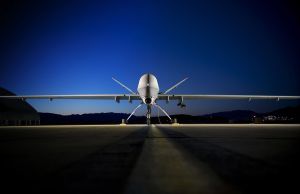
    reaper

    Reaper Drone image by Wikimedia Commons.

    Critics have argued that the U.S. drone program lacks transparency and is largely unknown to the general public and most government officials, including most members of Congress.  There is also little doubt that innocent civilians are dying in drone attacks. Some studies have demonstrated the disconnect between public statements and what researchers have discovered about civilian casualties from U.S. drone strikes. White House counterterrorism advisor John Brennan has often attributed “surgical precision” and “laser-like focus” to the drone program.  Critics argue that stressing the notion of surgical precision in the face of many civilian casualties caused by such attacks is downright misleading.  In some cases, the CIA may not even have known the identity of the people it has killed.  The presumption that all military-age males killed in drone strikes have been “militants” cannot withstand strict scrutiny.

    Several organizations or publications have informed the public debate on civilian deaths from drone strikes.  These include, among others, the New America Foundation (NAF), the Long War Journal (LWJ), the Bureau of Investigative Journalism (BIJ), the Columbia Law School Human Rights Clinic (CHRC), the International Human Rights and Conflict Resolution Clinic at Stanford Law School, and the Global Justice Clinic at the NYU School of Law, which have conducted an investigation into several aspects of the U.S. targeted killing program in Pakistan and have provided a detailed narrative about the law and the policy behind it.

    Despite Brennan’s and the CIA’s denials of unintended civilian deaths, the Bureau of Investigative Journalism in London has reported that 371 drone strikes in Pakistan killed between 2,564 and 3,567 people between 2004 and the first half of 2013.  Between 411 and 890 (12%-35% of the total) were civilians.  Fewer than one-quarter of those killed in drone strikes in Pakistan have been civilians. As of August 2016, President Obama has authorized and confirmed 506 drone strikes, killing an estimated 3,040 military combatants and 391 civilians.

    The lack of government transparency on drone strikes raises serious questions about their effectiveness and accuracy.  If the drone attacks are to be effectively utilized, critics argue, they have to be used for short-term interventions with the intention of using them rarely, selectively, transparently, and only against those who can realistically target the United States.  Absent a realistic threat against the U.S., it is difficult to justify a killing as self-defense and thus permissible under Article 51.  Otherwise it is arguably just an extrajudicial killing of an un-convicted, often unindicted, criminal suspect as well as a violation of the U.N. Charter’s prohibition on the use of force.

     Managing Risks or Seeking Long-Term Solutions

    It is time to think outside the box in which the states fighting terrorism have locked themselves, and to make the case for why the U.N. and other development organizations should be empowered and encouraged to support civic engagement, societal improvement, and low-level civil society rebuilding as a means to battle the unrest and despair that fuels terrorism.  One expert reminds us that drone strikes and the arrest of key leaders can be effective against smaller and more traditional terrorist groups, but not against most radicalized and jihadist groups.  Paradoxically, some U.S. allies, such as Pakistan, who often cooperate with Washington, provoke terrorist activities by their very authoritarian policies and practices.  The U.S. needs as many allies as possible in its military counterterrorism efforts, but some of those allies are likely to prove as problematic as drone strikes in the broader effort to prevent and contain terrorism by winning over the hearts and minds of the people.

    Mahmood Monshipouri, PhD, University of Georgia, is a professor of international relations at San Francisco State University and he is also a visiting professor at UC-Berkeley, teaching Middle Eastern Politics, and editor, most recently, of Information Politics, Protests, and Human Rights in the Digital Age (New York: Cambridge University Press, 2016).

    William V. Dunlap, MPhil, University of Cambridge; JD, Yale University, is a professor of law at the Quinnipiac University School of Law. He teaches constitutional, criminal, national security, counterterrorism, and international law. He is a former associate dean for faculty research and a former associate dean for academic affairs. He has served as chair of the Section on International Law, the Section on Admiralty and Maritime Law, and the Section 3on Internation


  • Sustainable Security

  • Climate change

    Copenhagen failed dismally to set firm targets either for greenhouse gas reductions and the aid offered to poorer countries to counter the impact of climate change was minimal. Scarcely anything was achieved other than most states accepting that the global temperature increase must be kept below 2ºC. In this article, Paul Rogers, looks at at what should have been the result of the climate change negotiations and why it failed, before turning his attention to where we go from here.

    Photo: Julie Grath 

    Read more »

  • Sustainable Security

    Momentum towards a nuclear weapons ban treaty: what does it mean for the UK?

    International momentum towards a treaty to ban nuclear weapons reached a milestone in the December 2014 Vienna conference. Even assuming that the UK does not initially sign up to such a treaty, it is subject to the pressures of a changing legal and political environment and could find its present position increasingly untenable – not least on the issue of Trident renewal.

    Read Article →

    Too Quiet on the Western Front? The Sahel-Sahara between Arab Spring and Black Spring

    While the world’s attention has been focused on the US-led military interventions in Iraq and Syria a quieter build-up of military assets has been ongoing along the newer, western front of the War on Terror as the security crises in Libya and northeast Nigeria escalate and the conflict in northern Mali proves to be far from over. In the face of revolutionary change in Burkina Faso, the efforts of outsiders to enforce an authoritarian and exclusionary status quo across the Sahel-Sahara look increasingly fragile and misdirected.

    Read Article →

    Humanitarian Consequences of Nuclear Weapons: Five Reasons for the P5 to participate in Vienna

    The ‘humanitarian dimension’ initiative highlighting the consequences of nuclear weapons has evolved and consolidated itself in the non-proliferation regime since 2010. The five nuclear weapons states (NWS or P5) under the NPT – China, France, Russia, UK and US – boycotted the first two international conferences on the humanitarian consequences of nuclear weapons. A third conference will be held in Vienna on 8-9 December 2014. This article gives five reasons why the P5 should consider participating.

    Read Article →

    Building the Case for Nuclear Disarmament: The 2014 NPT PrepCom

    The humanitarian impact of nuclear weapons, highlighted by a wide-ranging, cross-grouping, multi-aim initiative which continues to consolidate itself in the non-proliferation regime, has come to the fore in the 3rd Prepatory Committe for the 2015 NPT Review Conference. Frustrated with the lack of progress towards NPT Article VI commitments to complete nuclear disarmament, the initiative has invigorated attention to the urgency of nuclear disarmament and a need for a change in the status quo. NPT member states and civil society continue to engage actively in publicizing the humanitarian consequences of nuclear weapons as an impetus to progress towards nuclear disarmament.

    Read Article →

    Beaux Gestes and Castles in the Sand: The Militarisation of the Sahara

    Whatever the benefits for Mali, the French-led eviction of jihadist groups from northern Mali may have made the wider Sahara a less safe place, and has done little to lower the capacity of such groups to threaten European interests.. In 2014, France is implementing a major redeployment of its forces in Africa into the Sahel and Sahara. Meanwhile, the US has been quietly extending its military reach from Djibouti to Mauritania. However, as elsewhere, the western military approach to countering Islamist insurgency in the Sahel rests on very unsteady foundations and the potential to provoke wider alienation and radicalisation is strong.

    Read Article →

    Can the Nuclear Non-Proliferation Treaty outrun its double standard forever?

    The recent walkout by Egyptian negotiators at UN talks have demonstrated that, like a building with rotten foundations, the nuclear non-proliferation regime is far less stable than many believe it to be. Egypt’s actions make clear that anything less than a regime specifically geared towards addressing the reasons why some states seek nuclear weapons is a regime existing on borrowed time.

    Read Article →

  • Sustainable Security

    This post is based on Paul Rogers’ Monthly Global Security Briefings for Oxford Research Group and was originally posted  on 31 July, 2014. At the time of writing (31 July), Israeli Operation Protective Edge had exceeded the previous major operation, Cast Lead of 2008-9. Both operations have involved intensive use of air strikes combined with major ground incursions. The current war is already longer than the 2008-9 war, with no end in sight. Indeed, by the end of July, positions were hardening and prospects for anything longer than brief further humanitarian pause seemed remote. This briefing provides some context for the conflict together with a preliminary analysis of possible consequences.

    The War So Far

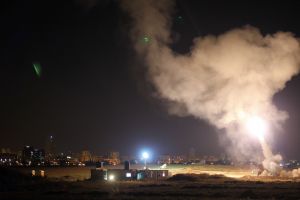
    Iron Dome in Operation Protective Edge Source: Wikipedia

    Iron Dome in Operation Protective Edge Source: Wikipedia

    The current war started on 8 July with intensive Israeli air and artillery assaults on Hamas paramilitary targets, intended primarily to destroy or greatly limit the Hamas ability to fire unguided rockets over much of Israel. In spite of the level of force used, the rocket fire continued, amidst growing concern within the Israeli Defence Forces (IDF) that paramilitaries had constructed many more infiltration tunnels than had been realised. A ground assault followed the initial air assault, with this being intended to destroy rocket launch facilities and stores and also interdict tunnels. As a consequence of this assault, the IDF suffered many casualties, including the deaths of 13 men from the elite Golani Brigade in a single day (20 July). Even after 10 days of conflict, with intensive IDF operations against the infiltration tunnels, Hamas paramilitaries managed to get under the border and in a brief attack killed five young IDF sergeants on a leadership training course. One Hamas paramilitary was killed but others appear to have returned to Gaza. Over the course of the war so far, Israeli forces have struck at over 3,700 targets in Gaza while more than 2,700 rockets have been launched by Hamas and other groups from Gaza towards Israel. The death toll among Palestinians exceeds 1,350 and is rising markedly each day. At least 6,000 people have been injured. Israel has lost 56 soldiers and three civilians, and more than 400 soldiers have been wounded. On 31 July, the 24th day of the war, Israel announced the calling up of a further 16,000 reservists, to bring the total call-up to 86,000. There has been considerable controversy over the numbers of civilian casualties in Gaza, especially the hitting of schools, hospitals and a market. UN figures indicate that at least 70% of those killed are civilians, and nongovernmental international support for Hamas has increased substantially. Public opinion in Israel remains very strongly in favour of continuing the war as a means of stopping the rockets and destroying the infiltration tunnels.

    Support for the Adversaries

    Hamas: In the past three years, Hamas has lost much of its international support from governments in the region, even though Gaza has existed in what amounts to an open prison controlled by Israel. The Egyptian government of President Sisi is strongly opposed to the Muslim Brotherhood and regards Hamas as a part of this wider movement. The consequent near-total closure of the common border with Gaza and the control of access tunnels has had a marked economic effect on Gaza, exacerbating its siege status. Furthermore, Hamas’s support for Islamist paramilitaries in Syria has lost it the support of the Assad regime in Syria and, to an extent, of the Iranian government. The recent rapprochement between Hamas and Fatah survives, if currently strained, but causes the Israeli government considerable concern. In spite of all the limitations, Hamas’s paramilitary wing has been able to assemble many thousands of rockets and mortar rounds and has also built a network of robust infiltration tunnels that has greatly exceeded Israel’s pre-war estimates. Hamas as a movement retains considerable support in Gaza, with even the impact of the Israeli air and ground assaults having little effect. Israel: Israel retains a measure of support of many western governments but there are growing concerns at the civilian losses in Gaza. The IDF and the defence industry as a whole have very close connections with their US counterparts. The key missile defence system, Iron Dome, is essentially a US-Israeli joint production, including current plans to set up a new production line in the US. Israel is also able to use US munitions stored in Israel. The US is in a position to put very heavy pressure on Israel but is deeply reluctant to do this at present, mainly because of domestic support for Israel. This support remains high but is declining

    Cast Lead and Protective Edge

    Both the 2008-09 and 2014 Israeli operations have had similar aims – to so damage Hamas that it is massively restricted as a threat to Israeli security. A comparison of the operations so far is indicative. Cast Lead lasted 23 days and ended with a ceasefire brokered largely by Egypt. During that period, Hamas and other groups launched 750 rockets and mortars, all relatively short-range. Israelis lost 13 lives, four of them to friendly fire. Israel killed 1,440 people in Gaza, claiming that half were militants, though Hamas denied this. Since the 2008-09 operation, Israel has deployed the Iron Dome system, and this has intercepted the great majority of approximately 2,700 rockets and mortars fired during Protective Edge.  Hamas has, though, hugely increased its capabilities over the past six years, in spite of its recent political isolation, and has exacted a much higher toll on IDF soldiers during the current ground assault than in 2008-09: 56 so far compared with 13 before. In this sense, the aim of Cast Lead – to substantially degrade Hamas’s crude offensive systems – was a singular failure. Even with the Iron Dome system, vulnerabilities have been demonstrated by the closure of Ben Gurion Airport to several international carriers for several days last week, following a rocket which penetrated the missile shield and landed within a mile of what is Israel’s gateway airport. The loss of so many Israeli soldiers may still seem small compared with the huge losses in Gaza, but the IDF is held in very high regard in Israel.  Indeed, support for the war has likely increased because of these losses and the partial closure of the airport. These appear to have combined to convince many Israelis that, though Hamas is weak and hugely restricted in its location, it represents such a threat to Israel that a protracted war is, if need be, fully justified. The phrase “impregnable in its insecurity” has sometimes been applied to Israel and it is useful in understanding the outlook of a very powerful country that still feels vulnerable.

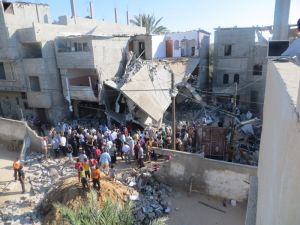
    The home of the Kware' family, bombed by IDF forces. 8 civilians, including 6 minors, were killed. Gaza, 8 July, 2014. Source: B’Tselem

    The home of the Kware’ family, bombed by IDF forces. 8 civilians, including 6 minors, were killed. Gaza, 8 July, 2014. Source: B’Tselem

    What Now?

    At the time of writing (31 July) it is possible that another humanitarian pause might be agreed and might lead to something more substantial. Assuming that this does now happen, the indications are that the IDF will continue its operations to destroy rockets and tunnels, and Hamas paramilitaries will resist. Given the IDF casualties to date, a pattern is likely to emerge in which urban counter-paramilitary operations will prove both difficult and costly, and the IDF will rely much more on its huge firepower advantage. This is very much what happened with US and coalition forces in Iraq from 2003, and even more so with the Israeli siege of West Beirut in 1982 when at least 10,000 people were killed, the great majority of them civilians. It is already evident that targeting has moved on to the more general Hamas infrastructure, but the very nature of the densely populated Gaza Strip means that the infrastructure for the whole community is also hugely affected. Given the existing impoverishment of the area, the human consequences will be severe, as UN staff have been pointing out repeatedly.

    Consequences

    In all of its operations against Hamas – Cast Lead in 2008-09, the more limited air assault in 2012, and the current war – Israel has sought to severely damage Hamas’s paramilitary capabilities, and decrease its domestic support. In the first two conflicts that objective was not achieved, and it is unlikely that Israel’s current operation will succeed this time around. In spite of Hamas’s greater international isolation, its paramilitaries have this time had a substantial impact on the IDF, and the movement retains domestic support. Moreover, international public opinion has moved heavily against Israel. One of the major changes in comparing the current war with the two previous wars is that the use of social media has hugely expanded, resulting in graphic images being distributed across the region and beyond in near-real time. One effect of this, in turn, is that the more conventional western media reporting is itself becoming more graphic. In spite of a very efficient Israeli information operation, this change is working against Israel’s interests. It also means that Islamist propagandists across the Middle East and beyond are easily able to present the war as a further example of “Zionist aggression”. Indeed, they will also relentlessly point to close US-Israel links, further developing their long-term image of a “Crusader-Zionist war on Islam”, in spite of Secretary of State Kerry’s undoubted personal commitment to achieving a ceasefire. The long-term consequences of this are difficult to read, but could give a boost to radicalisation well beyond Israel and the occupied territories. That alone is an added reason why a ceasefire at the earliest opportunity is not only desirable but essential.

  • Sustainable Security

    Many have argued that civil wars are more likely to occur along religious divisions. But evidence indicates that intrastate conflict is actually more likely within linguistic dyads than among religious ones.

    In the 1990s Samuel Huntington argued that conflict across civilizational or religious lines would replace the ideological divisions that had defined political struggles during the Cold War period. Opining that Islam has ‘bloody borders’, he believed that conflicts would be particularly prevalent between ‘Muslims’ and ‘non-Muslims’. This led Huntington to further suggest that a future clash between ‘Islamic civilization’ and the West might occur.

    Since September 11th 2001 and the subsequent proclamation of the “War on Terror,” Huntington’s thesis has gained widespread attention among political leaders and citizens around the world. In 2014, for example, Tony Blair asserted that “religious difference will fuel this century’s battles.” During the 2016 US presidential campaign, President-elect Donald Trump seemingly subscribed to Huntington’s ideas when calling for “a total and complete shutdown of Muslims” entering the country to prevent violent attacks on US citizens.

    Whereas many social scientists would agree that ideological conflict between communism and capitalism, both between and within states, has declined since the end of the Cold War, no agreement exists about what, if anything, replaced ideology. Most scholars who study internal conflict or civil war would not distinguish between linguistic, religious, and racial markers but rather classify these categories as part of the larger concept of ethnicity. Yet some conflict researchers follow Huntington and identify religious differences as particularly conflict-prone. In doing so, important alternatives such as ethno-nationalist mobilization based on linguistic identities often receive too little attention.

    Are internal conflicts mostly about religion or language?

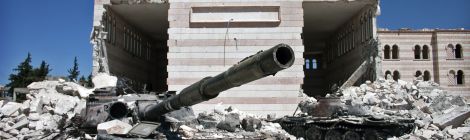
    azaz_syria

    Image by Christiaan Triebert/Flickr.

    In a study that is forthcoming in the Journal of Conflict Resolution, I and my co-authors Lars-Erik Cederman (ETH Zürich) and Manuel Vogt (Princeton University) conduct such a comparison. We analyse the probability of internal armed conflict between linguistically and religiously distinctive groups between 1946 and 2009.

    Contrary to Huntington’s thesis, linguistic differences show a strong and robust relationship with the outbreak of intrastate conflicts. In fact, we find that linguistic divisions are more conflict-prone than religious differences.

    These findings continue to hold when we focus only on the years since 1990 – the period to which Huntington’s thesis should be the most relevant. Our results further suggest that in no world region are religious differences more likely to be associated with internal armed conflict than linguistic divisions. We find the strongest support for a greater conflict-proneness of language compared to religion in Eastern Europe and Asia.

    Even in the Middle East, we find a slightly higher, if uncertain, probability of armed conflict across linguistic than religious lines. The Middle Eastern finding at least in part results from multiple Kurdish rebellions in Turkey, Iraq, and more recently Syria as well as smaller uprisings of linguistic minorities in Iran.

    When focusing only on conflicts that involve Muslim groups, we do not find substantial differences to other world religions. Although the majority of all armed internal conflicts today take place within Muslim-majority states, the majority of Muslim groups do not engage in violent rebellion. Our analyses also reject the thesis that Muslim groups disproportionately engage in conflict with non-Muslim groups.

    Why Linguistic Differences?

    Instead linguistic differences continue to be more frequently related to armed uprisings within states. While the brutal civil war in Syria captured headlines over the past years in many Western countries, destructive conflicts across linguistic lines haunt South Sudan, Burma, and Turkey.

    Of course, linguistic differences are more widespread than religious divisions. In other words, ethnic groups in any given country are more likely to be divided by language than by religion. Notwithstanding these differences in frequency, our results indicate that linguistic divisions are disproportionately more often related to armed conflict than religious distinctions.

    In our forthcoming article, we argue that it is the power of nationalism that makes linguistic divisions more conflict-prone than religious ones. Language gained political relevance in the late 18th century when the French Revolution transferred political authority from absolutist rulers to the people. About the same time that political power became vested in European peoples, the industrial revolution created incentives to further homogenize European nation-states. Mass schooling and mass newspapers laid the basis for imagined national communities.

    These developments provided both motive and opportunity for violent conflict across linguistic boundaries. Where members of ethnic groups are barred from having their children taught in their native language or experience linguistic discrimination in the job market and their interaction with the state, some of them will voluntarily assimilate into the dominant culture, but others develop grievances and may even refuse assimilation.

    The elites of such discriminated groups can voice these grievances through publications in their own language and use it to express nationalist aspirations and demands. When the host state is unable or unwilling to address these demands, violent conflict becomes more likely. These dynamics are illustrated by Sri Lanka’s decades-long civil war between Singhalese and Tamils, and recurrent Kurdish rebellions in Turkey.

    Given the link between industrial advancement and language-based nationalism it is unsurprising that we find higher rates of linguistic conflict in the relatively highly developed regions of Eastern Europe and Asia rather than in Sub-Saharan Africa. Central and Eastern Europe may even be considered as the cradle of linguistically-based nationalism.

    The multi-ethnic Austro-Hungarian and Ottoman empires did not fulfil the modern creed of “one people, one state,” and violently disintegrated during World War I. The Soviet Union and Yugoslavia followed suit in the early 1990s. To this day, Turkey has not come to terms with its Kurdish minority, and once more experiences internal conflict.

    Yet the idea of nationalism did not remain contained to Europe. A highly flexible concept, it informed the national liberation struggles of former colonial subjects against the European colonial powers. The lines of division here were usually race and language rather than religion. For decades, the Israeli-Palestinian conflict was a conflict between Hebrew-speakers of European origin and Arab speakers, who had lived in Palestine for centuries. Only in the past two decades has it taken on more religious undertones.

    Policy Solutions?

    Linguistic and religious differences will remain with us for the foreseeable future. However, very few of these fault lines can be expected to erupt in violent conflict. Whether linguistic differences transform into seemingly incompatible nationalist projects, or whether religious divisions into ostensibly intractable positions, depends on how political leaders from different groups interact with one another.

    Frequently armed rebellion emerges in politically highly exclusive and discriminatory contexts. Where political leaders with specific linguistic or religious backgrounds are barred from decision-making that affects their groups, conflict is more likely to break out than in states where they have some influence in government circles. Exclusion along ethnic lines creates clear insiders and outsiders, fosters grievances among the excluded, and suggests that there is “no other way out” but violent resistance. Zimbabwe, both under Smith and Mugabe, Iraq under Saddam Hussein, and Burma to the present day are examples of ethnically exclusionary regimes. Each of these states also experienced violent rebellion by excluded groups.

    In another joint study published in “Peace and Conflict 2016”, we show that excluding political elites with different linguistic or religious backgrounds from governmental power is pervasive in the Middle East and North Africa. So is political discrimination that denies the Palestinians in Gaza citizenship rights, keeps the Shia from voting in Qatar, or persecutes Kurds for political reasons in Turkey.

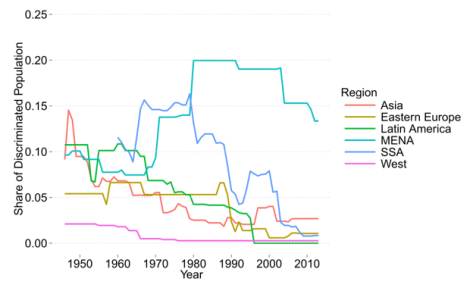
    ethnic-conflict-graph

    Figure 1 displays the average population share that experiences discrimination for different world regions and years. The data derives from the Ethnic Power Relations (EPR) dataset available at https://growup.ethz.ch/pfe.

    Figure 1 reveals that ethnic discrimination remains staggeringly high in the Middle East although the region has experienced some improvements over the past twenty years. That religious differences in the Middle East erupt into violent conflict may be less of a surprise once this context is taken into account.

    Our research thus suggests that avoiding ethnic exclusion and discrimination through power-sharing in multi-ethnic governmental coalitions will reduce the likelihood of armed conflict across both linguistic and religious lines. Elite accommodation in power-sharing coalitions has contributed to greater stability in such diverse places as Bosnia, Nigeria, Burundi, and Malaysia regardless of the type of ethnic differences. Although no panacea, power-sharing is associated with a substantial decrease in the likelihood of internal armed conflicts compared to exclusive environments.

    While there has been a trend towards ethnic accommodation since the end of the Cold War, we do not know enough about its origin. Future research needs to investigate the causes of accommodation in greater detail and pay particular attention to appropriate solutions for violent conflict across linguistic lines relative to religious differences.


    Nils-Christian Bormann is lecturer and Humanities and Social Science Fellow in the Politics Department at the University of Exeter.

    Manuel Vogt is a visiting postdoctoral research associate at Princeton University and senior researcher at ETH Zürich.

    Lars-Erik Cederman is Professor of International Conflict Research at ETH Zürich and the author of Inequality, Grievances, and Civil War (Cambridge University Press, 2013).