Category: Article

  • Afghanistan: victory talk, regional tide

     A seductive narrative of military progress in Afghanistan is spreading among United States analysts. The real story is more complicated.

    There has in March 2010 been a cautious drumbeat of optimism about the United States’s military effort in Afghanistan. A series of briefings from senior military figures has begun to suggest that real progress on the ground is being made. A number of articles from astute observers confirms the picture of a turning-point having been reached (see Fareed Zakaria, “A Victory for Obama”, Newsweek, 22 March 2010)

    The more hopeful atmosphere among American strategists and analysts in the early spring of 2010 draws in particular on two developments: the apparent expulsion of Taliban elements from the centre of Afghanistan’s southern Helmand province (which in turn anticipates a probable move to take control of the city of Kandahar city in coming months); and the Pakistani security forces’ capture on 8 February 2010 of a senior Taliban leader, Mullah Abdul Ghani Baradar, and some of his close associates.

    At first sight, these two events do indeed support the argument that the United States and its Nato/International Security Assistance Force (Isaf) partners are making significant advances. It is appropriate then to assess them in the context of the broader military picture in Afghanistan and the region.

    An embedded enemy

    The first piece of evidence for a turning tide is the steady advance of American forces on areas where Taliban militias operate in Helmand. This fuels the consistent perception that the Taliban is a both a homogenous and an “external” entity: an integrated grouping which enters a region from elsewhere to occupy territory. The argument, which underpins much of the military analysis of recent operations, generates the conclusion that Taliban units can be or are being “expelled” from parts of Helmand; and that their comrades who must have similarly moved in to take control of most of Kandahar city can and must also be evicted.

    The mindset at work here is both enduring and notably impervious to contrary evidence. Its lineage can be traced to the mid- and late-1990s, when the view took hold among western agencies that the Taliban was composed of a network of militants trained in Pakistani madrasas who had then “inflitrated” across the border. The implication is that the Taliban are not ordinary Afghans but in essence outsiders; and that the US-led coalition is engaged less in counterinsurgency than in a fight to liberate much of Afghanistan from foreign (or at least non-local) forces.

    However, both experience on the ground and what is known of the longer-term history of the Taliban make this case hard to sustain. A truer understanding of the movement needs to take into account the mujahideen struggle against the Red Army in the 1980s, a decade before the name “Taliban” emerged to describe the new formation. A valuable source here is a new Taliban “memoir” which both describes a fascinating personal trajectory and reveals the deep Islamist motivation that from the start fired the anti-Soviet campaign (see Abdul Salam Zaeef, My Life with the Taliban, C Hurst, 2010).

    The evidence of Abdul Salam Zaeef’s account is that the mujahideen may have tended to live at a certain distance from the society around them – but they belonged fully to Pashtun society and were in no way “outsiders”. By the early 1990s, as much of Afghanistan was descending into rampant and brutal warlordism, they formed the core of an expanding Taliban movement. True, some militants did join the struggle from Pakistan and elsewhere – including the nucleus of what became al-Qaida – but the Afghan Taliban were always far more “embedded” in or close to their own communities than the dominant western perception assumed.

    The point is very relevant to the current campaign in central Helmand. There, many Taliban militants have indeed been dispersed into local communities – but (rather as they retreated from Kabul in November 2001) they have not been “defeated” in the conventional sense of that term. The same logic applies to the image of Kandahar city as a Taliban stronghold which will have to be besieged and “taken”; for if Taliban elements are immersed in the city’s very social fabric, the notion of defeat and eviction makes very little sense (see “Afghanistan: from insurgency to insurrection”, 8 October 2009).

    This suggests that the apparent political willingness among some western governments to envisage negotiation and compromise with “moderate” sections of the Taliban may be a more realistic way forward than the dream of vanquishing the enemy on the battlefield – if indeed this proposal were to be accepted on the other side (see Syed Saleem Shahzad, “War and peace: A Taliban view”, Asia Times, 26 March 2010). Some respected analysts (such as those associated with the of the International Crisis Group) in any case take a different view, arguing strongly that certain designated leaders at least – such as Abdul Ghani Baradar himself – be brought before the International Criminal Court to answer war-crimes charges (see Candace Rondeaux & Nick Grono, “Prosecuting Taliban War Criminals”, International Herald Tribune, 24 March 2010).

    An interested region

    The second piece of evidence adduced for optimism about the Afghan war is the newfound activism of Pakistani security agencies against members of the Afghan Taliban. This includes the detention of leading figures in the Quetta shura in northern Balochistan, and the arrest of Mullah Abdul Ghani Baradar (see Shibil Siddiqi, “’Strategic depth’ at heart of Taliban arrests”, Asia Times, 24 March 2010).

    The Pakistani operations have been interpreted as a welcome shift by the Pakistani army and the powerful Inter-Service Intelligence agency (ISI) towards greater collaboration with US/Nato forces in the “anti-terrorist” struggle.

    Here again, as with the perception of the nature of the Taliban, there is a misunderstanding. Pakistan’s fundamental calculation is the need to maximise its political influence in a future Afghanistan (see Shaun Gregory, “Pakistan and the “AfPak” strategy”, 28 May 2009). This would give the country its much-vaunted “strategic depth” to counter the regional superpower of India, and provide a buffer against Russian and other intrusions to the north and west. The Islamabad elite is particularly concerned about the close relationship that the Hamid Karzai regime has developed with India, including enhanced links with Indian military intelligence (see Kanchan Lakshman, “India in Afghanistan: a presence under pressure”, 11 July 2008).

    Pakistan’s military worries too that the Afghan president is reaching out to elements of the Taliban, perhaps even in ways that go further than what his United States overlords would wish. A pro-Indian Karzai regime that is dealing with the Taliban is simply not something that Pakistan can accept. In this light, the real aim of Pakistan’s policing actions is not to aid the United States and far less to help Karzai: it is to gain more leverage over the Taliban.

    These considerations of national interest also cast the US-led military operations in Helmand and elsewhere in a very different light. The US and it coalition partners are – following the new strategy outlined by Barack Obama in his West Point speech on 1 December 2009 – continuing to build up their troop-strength towards a total of around 140,000 on the ground; but this “surge” will not be the real dynamic of change in Afghanistan (see “Afghanistan: new strategy, old problem”, 3 December 2009).

    Rather, Afghanistan’s future will be decided by the evolving interaction between (principally) Kabul and Islamabad, with other regional powers – Delhi certainly, but also Tehran, Beijing and even Moscow – playing a role and seeking advantage. The US/Isaf’s massive financial and military commitments lead western states naturally to regard themselves as the masters of Afghanistan’s destiny; but the hard reality is that emerging regional geopolitics are consigning the west more and more to the sidelines (see Harry Reid, “We are doing all the fighting but China will win the peace”, Herald [Glasgow], 25 March 2010).

    This regional dimension accentuates the United States’s predicament. In Afghanistan, as in Iraq, the proclamation of approaching victory in a grinding war has often been followed by further reversals. And behind the noise and smoke of combat, other interested parties are quietly reordering the “grand chessboard”. A conflict now approaching its tenth year has more surprises to come.

  • Human Security in practice

    One aspect of the global economic crisis that is rarely discussed is the hole in government budgets caused by the ongoing wars in Iraq and Afghanistan and by the mind-boggling expense of weapons systems like Trident or advanced combat aircraft or aircraft carriers. In the United States, the War on Terror enabled President Bush to double the military budget; excluding the supplemental cost of the wars in Iraq and Afghanistan. US military spending accounts for some $700 billion a year, roughly the same as Obama’s stimulus plan, and the cost of the wars may be as much as three trillion dollars. What makes this myopia worse is that conventional military spending does not appear to contribute to a sense of security, if it ever did. Indeed, conventional war-fighting in places like Iraq and Afghanistan has contributed to a cycle of violence and provided an argument for the mobilisation of young men around Islamic extremist causes. This pervasive and contagious insecurity is likely to become worse as the global economic crisis unfolds and the effects of climate change are increasingly felt.

    I use the term ‘human security’ to describe what is needed to address the every day insecurities experienced by people in different parts of the world – in violent conflicts, in mega cities riddled by criminal gangs as in Latin America, or even in seemingly safe places in Europe or North America. ‘Human Security’ offers an alternative to the binary language of allies and enemies that characterises the War on Terror. It is about the security of Afghans and Iraqis as well as the security of Americans and Europeans, about the security of individuals and not just states and borders. Human security also links the issues of violence to material deprivation and environmental risk. While my focus remains security in the traditional sense of personal safety, those traditional concerns cannot be disentangled from poverty and joblessness, or vulnerability to disease and natural or man-made disasters.

    One of the ways of thinking about human security is in terms of the extension of domestic security. We in the West are used to the idea that security at home is the result of an effective rule of law and the availability of emergency services like police, ambulances or firefighters. Indeed, these were the kind of agencies that responded to 9/11 or 7/7. Security abroad, on the other hand, is assumed to be the responsibility of military forces and to take the form of war or the threat of war. If the 9/11 suicide bombers had been American citizens, it would have been very difficult for President Bush to frame the tragedy as an attack by a foreign power on the United States and to initiate the War on Terror. In the case of 7/7 the suicide bombers were all British. It would have been very odd if the British government had responded by declaring war on, say, Huddersfield where they had all gone to school. The UN Charter prohibits war; nowadays peace should be assured by the enforcement of international law, rather than through war. So human security is about extending the way we do security at home globally.

    Read the full article here

    Image source: VinothChandar


  • Moving Beyond Crisis: Survival 2100 and Sustainable Security

    In a piece for the International Movement for a Just World, William Rees maps out a vision for what he calls ‘Survival 2100.’ The goal of such a strategy would be “to engineer the creation of a dynamic, more equitable steady-state economy that can satisfy at least the basic needs of the entire human family within the means of nature.” The alternative, Rees argues is to “succumb to more primitive emotions and survival instincts abetted by cognitive dissonance, collective denial, and global political inertia.”

    The call from Rees echoes the sentiment coming from many different – and often unusual – quarters that are responding to the major implications for security and survival of the combined ecological, political and economic crises that either characterise or are looming in the international system.

    While some of the ideas in the piece may need some further thinking through (eg. “The world community will have to agree to fund worldwide social marketing programs to ameliorate “pushback” and bring the majority of citizens on board” – ie. people will need to fund a campaign to convince themselves!), the fundamental focus is sound. Rees identifies the need for a genuinely strategic approach to the governance and management of the global environment and the global economy. Once one thinks through the real costs of inaction on issues like climate change (global insecurity and a greater potential for conflict is but one such cost), the costs that we account for in global market failures take on a different character. Rees argues that “As any good economist will acknowledge, government intervention is legitimate and necessary to correct for gross market failure. Indeed, resistance to reform makes hypocrites of those who otherwise tout the virtues of market economies. Truly efficient markets require the internalization of heretofore hidden costs so that prices tell consumers the truth.”

    Such ideas are not radical at all, simply a reflection of doing the sufficient cost-benefit analysis that planning for long-term survival requires. Therefore the message for national defence planners is clear –attempting to ‘maintain control’ over global insecurity is ultimately futile, the time to put the principles of prevention and sustainability at the heart of national security planning is now.

    The full article on the JUST website is available here.

    Image source: hundrednorth.

  • Socio-Political Factors and National Security

    National security in the traditional sense is connected with the idea of sovereignty; territorial security means freedom from risk of danger of destruction and annihilation by war, physical violence and/or aggression from outside. Traditional threats emanate from inter-state conflict and cross-border aggression. Since the nation state is supposed to have a monopoly of power for protecting the life and property of the members of the nation, they are deprived of power to defend themselves against aggression. The focus therefore previously being on external threats, state security has dominated the national security agenda.

    With progressing globalisation, borders have become increasingly irrelevant, thus reducing the probability of external aggression. Conversely threats to a country’s security emanate internally because of lack of economic development, unemployment, failing internal security because of religious, sectarian and/or ethnic strife, shifting of identities in the wake of globalisation, radicalisation of society and growing terrorism thereof being recent additions. It has not been possible in our relatively new nation state to properly work out the national identity and borders, both traditional (external) and internal security threats have started to overlap. Societal security is the prime responsibility of the state; our rulers have generally cold-shouldered this to our lasting detriment, as we can now see on graphic display.

    Societal threats undermine national cohesion and identification with the state, the resultant radicalisation and extremism results in law and order situations, rioting, rise of criminal gangs and gang wars, due to money-laundering and easy availability of weapons because of the nexus between corruption, organised crime and terrorism. A credible accountability system is missing, without proper investigation, effective prosecution and delivery of swift, untainted justice is not possible. Perjury is not only rampant but is the order of the day, credible witnesses are in short supply and even they are susceptible to influence, by use of money and/or the force of public office. Our Supreme Court (SC) has become captive to endless bureaucratic manoeuvring, fighting a losing battle against a virtual bag of administrative tricks to defy and/or frustrate their judgments and instructions. Both the NICL and Haj cases are likely to enter the “Guinness Book of Records’, sophisticated filibustering making them into an endless exercise without a likely outcome. Failure to fulfil the main function of maintaining law and order to protect lives and properties of its citizens and ensure impartial, even-handed justice hastens the deterioration of the state and its institutions.

    The failing identification with the state impacts negatively on the connection between citizen, the government and the army. This dissolution of the Pakistani identity results in growing influence of foreign interests, this spawns intervention and support for secessionist movements like in Balochistan. Duly fanned by a well-meaning but immature media, paying little attention to core national interests, the vacuum provides a robust platform for promoting radical ideas, readymade for religious exploitation by extreme elements, making an alternative form of a purely Islamic state with all its ramifications resonating with the public.

    The spread of terrorism is detrimental to economic growth, the bad investment climate and the lack of development is extremely detrimental to the economy. The diminishing value of individual lives makes killing condonable and justifiable (Karachi killing, collateral damage). Despite the so-called truce between the warring political parties within the coalition government, hundreds of people have died during the past month alone.

    The consequent ugly cycle of unemployment and high inflation leads to stagflation. There is flight of both capital and manpower from the country, weakening the economy further. The failing economy destroys jobs and incomes, creates more poverty and destabilises society leading to fuel riots, electricity riots, water riots, food riots, etc, desperation in the mass psyche of citizens, suicides, destruction of families, etc. This creates favourable conditions for criminals and terrorists, further impacting negatively on the overall security. This diverts the right amount of attention and the material support necessary for external security.

    A whole process of cataclysmic changes is taking place in the political, economic and social transformation in South Asia. The structures of governance being diversified and differentiated, only lip-service is given to poverty reduction and improving governance. In such conditions corruption is rampant. The Anna Hazare backlash we are seeing in India was waiting to happen, the more violent form being manifest in the four decades-old Maoist Naxalite movement. With an economic transition in the region, the majority of countries have inculcated globalisation to address their economic crisis. This has accelerated the process of growth but the impact of globalisation has not been accompanied by the reduction in poverty or improvement in human development through the formation of social capital. Increases in population growth is by itself a time-bomb.

    Pakistan’s security interests can be best served if elements having disruptive potential to our socio-political profile are contained, thereby giving no excuse or opportunity to our detractors and enemies to take undue and adverse advantage. Factors responsible for the declining social and human security and strengthening of extremism have to be identified. The human element remains the biggest resource for Pakistan, the government must utilise this to promote safety of the population and counter the threat of extremism engulfing this nation.

    The political leadership and all other stakeholders (who have a vital role to play) must agree to cooperate and formulate a national strategy to eradicate this menace. To cope with external threats, Pakistan has to keep up both conventional and nuclear deterrence necessary but should at the same time aim at socio-political solutions for long-term sustainable alleviation of our problems.

    The army has had increasingly to deal with internal strife instead of securing the borders. Other than drawing crucial reserves away from countering the aggressive defence postures of the Indians, they are forced to devote time and effort to burgeoning internal problems of different dimensions. Fighting against ones own population can put stress on any army in the world, raising adverse perceptions among the populace, extremely dangerous for a country that thrives on glorifying its armed forces.

    The international media is fully mobilised against Pakistan’s critical national security assets, but of more serious concern is not only the erosion of local media support, but rather an antagonistic view from some motivated sections. The compromise of the media’s integrity is extremely detrimental to the national aims and objectives. The concerted campaign against the ISI, and by extension the army, is deliberately motivated despite our sacrifices not being matched in the war against terror by all the coalition partners in Afghanistan put together.

    The unfortunate irony is that an instrument of war – the armed forces – is also the ultimate guarantor of internal peace. One can understand it not being part of the decision-making process where democracy is institutionalised, in less developed countries this is a paradox. This leaves absolute power, at least in democratic theory, in the hands of a pre-modern feudal and agrarian mindset elected through a tainted process on fraudulent votes, as the ultimate arbiters of nation security and societal society, and by default, the destiny of the nation. Who will make the change?

    (Extracts from Part-II of the Talk on ‘Linkages between Socio-Political Factors and National Security” given recently at the National Defence University (NDU), Islamabad).

    Article source: EastWest Institute

    Image source: NB77

  • Rushing Carefully in Libya

    Over the weekend the Obama administration was greeted by a chorus of commentators urging the United States to respond militarily to the situation in Libya. But the choices now facing the administration are complex and demand both speed of response and common sense.

    The negative scenarios are easily sketched out. The administration does not want a failed state, a protracted civil war, a major disruption in oil supplies, a humanitarian catastrophe, or to look feckless at a moment of great import. Nor does it want to make the hopefully democratic transitions across other parts of the Middle East more daunting.

    In foreign policy, however, it is always easy to sketch out what you don’t want to happen. Putting a positive agenda on the table is much trickier business. This explains why President Barack Obama’s National Security Council staff has been pulling some very late nights.

    We shouldn’t kid ourselves. Blowing up a runway or imposing a no-fly zone are not silver bullets. And one would hope that after the experience of both Afghanistan and Iraq—and earlier interventions such as Kosovo and Bosnia—we understand that war is a dangerous, uncertain business. This is not to minimize the brutality of Moammar Qaddafi’s attacks on his own people or to urge inaction. It is to counsel thoughtful action designed with an endgame firmly in mind.

    Consider the following questions. If we arm the opposition, what happens if some of those weapons fall into unfriendly hands? Do we really think that the situation in the Middle East requires more weapons on the ground? Or what if we impose a no-fly zone and attacks on the ground continue or escalate? Do we consider resorting to a ground offensive? Do we want the United States involved in three ground wars in three Islamic countries at the same time? Neither the rebels nor our national interest would benefit from a half-hearted intervention that does not achieve its goals.

    With this in mind, here are the things that the administration should do right now. Fortunately, they appear to be trying to work through them already:

    • Leave all options on the table. We should not immediately commit to the use of force. But we shouldn’t take it off the table, either. There are scores of options beyond a no-fly zone or arming the rebels that might be appropriate—from jamming Libya’s communications system to making clear to Libya that any further aerial attacks will mean significant parts of its air force will be destroyed on the ground. The president needs to take a hard look at the full range of options available and creatively employ the best mix likely to achieve the best results.
    • Quickly build a consensus with other nations. It is imperative that the United States find common cause with other nations about the best course of action. This might be through the United Nations, NATO, the African Union, the Arab League, or the European Union—or some combination of any of the above. There needs to be a broader umbrella of states that are vested in the outcome beyond the United States.
    • Explain the course of action. President Obama, in consultation with Congress, needs to make a clear and compelling case to the American public about what he believes to be the best option before using military force or ruling it out. He needs to articulate the potential risks and rewards of this strategy, and how this is tied to our fundamental interests as a nation and a people. We would far prefer a president who is brutally honest about the hard choices ahead than one who blithely paints a rosy scenario that evaporates in the hot desert sun.
    • Keep trying to peel away Qaddafi’s inner circle. Through every channel possible—the State Department, the Pentagon, the CIA, and beyond—the administration needs to get the message to Qaddafi’s coterie that they are on the wrong side of history and that the only way to potentially save themselves is to get out now. Further defections will further rattle the regime and help restore some of the momentum robbed from the rebels as they are bombarded with air strikes and attacks from a mad—and power mad—government.

    Given Qaddafi’s instability and absolute irresponsibility there is a chance that his forces will commit some atrocity that is so far beyond the pale—bombing a grade school or hospital, openly gunning down scores of unarmed protestors in front of an television crew—that the administration will feel that it has no choice but to act immediately regardless of the state of its planning. Let’s hope the rebels and their supporters in the outside world can find common cause and some practical plans before that happens.


    John Norris is the Executive Director of the Sustainable Security and Peacebuilding Initiative at the Center for American Progress.

    This article originally appeared on the CAP website.

  • The United States, Niger & Jamaica: Food (In)Security & Violence in a Globalised World

    The United Nations Development Programme (UNDP) defines food security as “all people at all times having both physical and economic access to the basic food they need”. However, due to a complex range of interconnected issues from climate change to misguided economic policies, political failure and social marginalisation, over 2 billion people across the world live in constant food Insecurity. It is important to take a sustainable security approach to look at the importance of “physical and economic access to basic food” by exploring the links between food insecurity and violence.

    A recent article published by the journal Conflict, Security & Development examines food riots as representations of insecurity and looks at the relationship between contentious politics and human security.

    Thomas O’Brien, author of the article, argues “the upheaval caused by a food riot can lead to lasting instability and violence as social and political structures are challenged”. Global rises in basic food prices triggered demonstrations and often violent protests in “over 30 countries across Africa, Asia, Latin America and the Middle East in 2007-08”. The article puts recent food riots and the current global food crisis in historical perspective. Food riots are about more than “just access to food”.  They represent dissatisfaction with political structures and perceived injustices.

    It is important to note that “the extreme nature of the rise in food price in the absence of much evidence of food shortages, left a sense of something unnatural about the way food markets were working”. Although poverty, weak states, ineffective civil society and lack of political freedom all contribute to food insecurity and the possibility of violent food riots, we cannot ignore to challenge underlying transnational and global power structures: “146 protests in 39 countries over the 1976-92 period were linked to the imposition of International Monetary Fund and World Bank structural adjustment policies.” Food security is fundamental to human security and needs to be approached by addressing underlying causes and drivers. A sustainable response to food insecurity would take global cooperation, justice and equity as key requirements.

    An often mentioned driver of food insecurity is climate change. Climate change already has a great impact on global security concerns and the physical, social and economic effects will undoubtedly only be exacerbated in the near future. Increasingly high temperatures and little or inconsistent rainfall have devastating effects on crop yields in places such as India, Africa’s Sahel region and the mid-western United States.

    The catastrophic food crisis in Niger in 2005 for example was largely attributed to the effects of climate change and competition over limited resources. Years of too little and too inconsistent rainfall have meant devastating droughts and diminishing harvests in this Sahel country of west Africa which has the highest birth rate in the world. Increasingly advanced desertification due to climate change means competition and potentially violent conflict, over limited resources such as water and arable land, intensifies.

    In the 2005 food crisis however, although thousands of children died of malnourishment, Niger had produced enough food to feed its population. The real issue was a food shortage in neighbouring Nigeria. Nigeria has an economy based primarily on oil exports with a significantly weakened agricultural sector. Instead of Niger feeding its own population, much of the harvest was sold to wealthier Nigeria at prices much higher than anyone in Niger could have afforded. This is a good example of why free market economy and trade liberalisation do not necessarily benefit all parties involved. Writing about the great famines of the last century, Nobel laureate Amartya Sen noted “a drought is natural but famine is man-made”. What this tells us is that although the challenges we face by climate change are serious threats, there is much that can be done to ensure more food security through political and economic policies.

    Farmers in Niger are struggling. But so are farmers in Jamaica. In contrast to Niger, Jamaica has a wealth of fruit, vegetables, fish and an abundance of fertile land. About one fifth of this island’s population is employed in the agricultural sector. Still, farmers are struggling to survive because they cannot compete with the much lower prices of subsidised agricultural imports from the USA. As cheap foreign products flood the market, Jamaican prices are driven down which makes local food production by and large unprofitable. As they rely more on foreign food imports, Jamaicans will be increasingly vulnerable to price volatility on the global marketplace. With the average Jamaican spending about half of household income on food, such vulnerability to price changes is a real danger to food security.

    Importing less foreign food products is a difficult matter for Jamaica because of the strict trade liberalisation policies imposed on the country through its debt relief agreements. One could also argue that if it is cheaper for Jamaica to import food than to produce its own, why should it still encourage its local agricultural sector? When a country is dependent on food imports, it cannot assure food security for its population.

    So far US imports have been much cheaper than local Jamaican produce. 2012 however has seen the “worst US drought in 50 years” according to last month’s Aljazeera article entitled Food riots predicted over US crop failure. “Grain prices have skyrocketed and concerns abound the resulting higher food prices will hit the world’s poor the hardest- sparking violent demonstration” says the newspaper. Corn is a primary staple in Sub-Saharan Africa, Central and South America, and prices have already gone up 60 per cent since June because “the United States accounts for 39 per cent of global trade in corn and stockpiles are now down 48 per cent” due to the drought.

    Price fluctuations on the global food market do not affect all people in the same way as “people in wealthy industrialised countries spend between 10 to 20 per cent of their income on food. Those in the developing world pay up to 80 per cent. According to Oxfam, a one per cent jump in the price of food results in 16 million more people crashing into poverty.”

    A sustainable approach to food security would address underlying forces such as climate change, economic and political policies and social marginalisation.

    Paul Rogers, expert on global conflict and consultant to the Oxford Research Group on global security, was recently featured on the BBC Radio 4 programme Costing the Earth. When asked whether free markets can help feed us, he replied:

    “It will contribute in some way, but I think it is fairly minimal. There are far more important things to consider. Look at it this way: Back in the world food crisis in the early 1970s, which was the worst for about 80 years, there were about 450 million people malnourished.  Now the figure is closer to 800 million. Now, that malnourishment and lack of food is not generally because there isn’t enough food to go around. Even at the height of that crisis there was still half the normal reserve. It is because people cannot afford to get the food or to buy the food. […]  If you are looking at the situation of poor people across the majority world, there has to be some way in which we can actually improve the production of food in and around those areas to provide greater resilience in the face of what is coming because beyond all of this is the whole issue of climate change. I think we will have a wakeup call this year in terms of what might come.” 

     
    The Conflict, Security and Development article Food riots as representations of insecurity is available for paid download here
     
    The AlJazeera article Food riots predicted over US crop failure is available here
     
    The Pulitzer Center for Crisis Reporting project Agriculture and Jamaica’s rural poor is available here
     
    Paul Rogers’ Monthly Global Security Briefings can be read and subscribed to here
     
     
    Image source: Dioversity International
  • Petroleum and its Impact on Three Wars in Africa: Angola, Nigeria and Sudan

    This article focuses on the complex role that oil has played in many conflicts on the African continent. It begins by highlighting oil’s influential role within war at a wider international level and provides a brief theoretical base from which to explore oil’s role in the African continent. Then, the article provides evidence of petroleum’s impact on violent conflicts in three African countries, namely Angola, Sudan and Nigeria, in order to highlight oil’s multi-faceted role on war in Africa.

    The full article can be accessed here.

    Image source: Maks Karochkin

  • Libya: Where Are the BRICs?

    Following the vote at the UN Security Council, the United Kingdom, France, and the United States have embarked on military action against Gaddafi’s forces in Libya. They have been careful to include a few Arab states in this new coalition of the willing. But these three countries are the driving force behind the imposition of a no-fly zone and the attacks on the government’s military positions and forces. Yet among the permanent and non-permanent member of the Council who were asked to authorize “all necessary measures” to protect civilians rebelling against the regime, the BRIC powers of Brazil, Russia, India, and China were conspicuously absent. The implications of this Security Council vote will be far greater than just what happens to the Gaddafi regime for it also tells us something about the role of the new candidates for global leadership.

    Brazil, Russia, India, and China are all represented on the Council at the moment — Brazil and India currently hold non-permanent seats — and collectively have become the face of what has been presented as the irreversible shift in global power toward a multipolar world. Goldman Sachs, for instance, has breathlessly ascribed to these four countries the ability to dramatically alter the global economic landscape over the next 50 years. If such projections are accurate, the key question is whether these new powers will seek to overturn the existing US-led order or simply join it as more equal partners. This question extends to China’s “peaceful rise,” the way that India and Brazil climb their way to the top-tier of global politics, and Russia’s re-emergence on the back of sustained high energy prices.

    China and Russia are not surprisingly reluctant to engage in Western-led military action under the principle of the “responsibility to protect.” Both countries have significant internal turmoil and both prefer to hold on to the option of responding with brute force to domestic opposition if push comes to shove. For India and Brazil the story is not quite so straight forward. Although neither country has been particularly enthusiastic about the concept of a responsibility to protect, both have spent considerable political capital to appear like responsible stakeholders and serious players on the world stage. Both would dearly love a permanent seat on the UN Security Council with its power of veto and prestige of higher social status. Both look to the United States to facilitate such a move and assist with dampening the protests of their respective regional rivals, Pakistan and Argentina. So far India has been very successful in winning U.S. and UK support, and Brazil is hoping that a visit by President Obama this past weekend will spur the United States to join France in publicly supporting a Brazilian seat.

    In the short term, however, the Brazilian and Indian abstentions on the Libya vote will not likely have helped to advance their plans for permanent membership of the Security Council. President Obama’s strategy for dealing with America’s relative decline and the rise of these new centers of power has been to try and co-opt potential challengers wherever possible into existing structures rather than set up showdowns for the decades to come. Yet this strategy is not fool-proof and leaves plenty of room for new powers to resist the liberal foundations of the U.S.-led order painstakingly constructed since 1945.

    The uprisings across the Arab world have thrown up a number of problems for Western powers. Their time-honored position of attempting to ignore the deep marginalization of large swathes of the “majority world” and to contain or manage corrupt regimes for the sake of assured energy supplies and intelligence cooperation has come apart at the seams. The brutality of the Gaddafi regime and the belated and chaotic response of rightly incensed countries such as Britain, France, and the United States have forced the hands of these reluctant interveners at the 11th hour.

    The Western response to the Libyan crisis has not addressed how this fundamental tension between a responsibility to protect vulnerable people and a global order based on the principle of national sovereignty can be resolved with the full participation of the emerging BRIC powers as well as the established trans-Atlantic ones. The people of Libya may be glad that such a large and difficult question has not been allowed to prevent outside assistance as they face down Gaddafi’s forces. But the United States and its allies will not be able to ignore this problem for long if a peaceful transition to a new global order is to be achieved in the years to come.


    Foreign Policy In Focus contributor Ben Zala manages the Sustainable Security Programme at the Oxford Research Group. He works on issues of global security and great power politics and is also a member of the editorial team of the academic journal Civil Wars (published by Routledge).


    This article originally appeared on Foreign Policy in Focus. 

  • No Sustainable Peace and Security Without Women

    There will be no sustainable security if we do not equally value the needs, experiences and input of men and women. A new report published by the Institute of Development Studies (IDS), funded by ActionAid and Womankind Worldwide, examines the role women play in local community peacebuilding in Afghanistan, Liberia, Nepal, Pakistan and Sierra Leone. The report states “despite the increased international attention to women’s participation in peacebuilding, the achievements and challenges facing women building peace at the local level have been largely overlooked”.
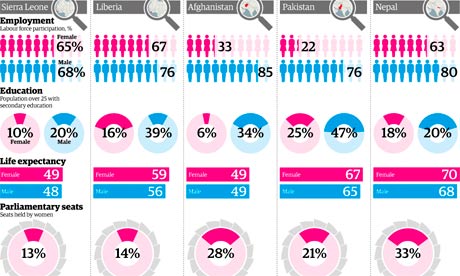
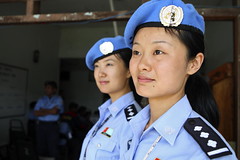
    Last week’s Guardian article entitled Who creates harmony the world over? Women. Who signs peace deals? Men points to some surprising data on female participation in official peacebuilding initiatives. “There have been no female chief mediators in UN-brokered peace talks and fewer than 10% of police officers and 2% of the soldiers sent on UN peacekeeping missions have been women”, reports the article. Furthermore, “fewer than one in 40 of the signatories of major peace agreements since 1992 have been female […] and in 17 out of 24 major accords- including Croatia, Bosnia, Sierra Leone, Burundi, Liberia, Sudan and the Democratic Republic of Congo- there was zero female participation in signing agreements”.


    An excerpt from The Guardian datablog:

    Women and peace deals - key indicators


    The IDS report found that “women are more likely than men to adopt a broad definition of peace which includes the household level and focuses on the attainment of individual rights and freedoms such as education, healthcare and freedom from violence. In contrast, men have a greater tendency to associate peace with the absence of formal conflict and the stability of formal structures such as governance and infrastructure”. It is important to include women in formal peace mediations and agreements as “peace means different things to women and men because of their unique experiences as a result of war”. 

    Additionally, the research established that women have a lot of experience, and are principal actors, when it comes to mediating and decision making within the home and the family. Women are also more likely to come together collectively to create change. However, their “experiences building trust and dialogue in their families and communities are frequently dismissed as irrelevant or are not sufficiently valued by national governments, and the international community”.

    Some barriers to women’s participation in peacebuilding include: restrictive social norms and attitudes, violence against women and girls, poverty and economic inequality and inequality in access to education. The report suggests empowering women through access to justice, creating safe spaces for women’s participation and changing attitudes towards peace and valuing women’s contribution as key elements to support women peacebuilding.

    The 2000 United Nations Security Council resolution 1325 calls for “equal participation for women in the maintenance and promotion of sustainable peace”.

    Only yesterday, Foreign Secretary William Hague called upon UN Security Council resolution 1325, announcing to the UN General Assembly that the UK  “will contribute £1 million this financial year to support the Office of the UN Secretary-General’s Special Representative on Sexual Violence in Conflict”. “It’s our purpose in gathering here this morning to ensure that preventing sexual and gender-based crime in conflict and post-conflict situations is an urgent priority for the international community”, William Hague declared, and went on to say “We are convinced in the United Kingdom that we can do more to help […] we can do it as a permanent member of the Security Council, a leading member of NATO, the European Union and the commonwealth and as a nation with one of the most extensive international development programmes in the world.”

    The IDS report states that although Security Council resolution 1325 was passed in 2000, it has since then been almost totally ignored, not least by the UN itself. Hopefully this time, the international community, including the UK government, will take serious steps towards its implementation. At the same time, it is important to commit to preventing sexual and gender-based crimes, not only in “conflict and post-conflict situations”, but also in times of “peace”.

    No sustainable peace and security will ever be possible, if women’s voices are marginalised and if women and men do not work together equally on national and international peace mediations and agreements.


    IDS, ActionAid, Womankind Worldwide report From the Ground Up can be read here.


    The Guardian, Who creates harmony the world over? Women. Who signs peace deals? Men is available here


    The Guardian, datablog Women’s participation in peace- how does it compare is available here


    Remarks by the Foreign Secretary William Hague to the UN General Assembly can be read here


    UN Security Council resolution 1325 is available here


    Image Source: United Nations Photo

  • Before the Cyberwar

    Those concerned with the issue of militarisation as a driver of global insecurity are increasingly looking at the issue of cyberwarfare as the weapons of war become ever closely associated with the digital age. Waging war in the cyber domain raises some truly momentous questions about the nature of warfare, the laws of war and even what counts as self-defence. Nuclear expert, Scott Kemp has written an article in the Bulletin of the Atomic Scientists arguing that like the missed opportunity of the dawn of the nuclear age (in which possessing nuclear weapons was viewed as more important than the consequences of proliferation), policymakers today have an important opportunity to consider the implications – both intended and unintended – of cyberweapons.

    The article argues that in the early 1940s “The United States rushed into the nuclear age eager to cement its technical superiority, disregarding warnings of key statesmen and scientists that a decades-long nuclear arms race would ensue.” Kemp believes that we currently stand on the edge of a similar military revolution to the beginning of the nuclear age and that it is not too late to think carefully about the long-term consequences of creating a new “weapon of the weak.”

    Looking to the future, Kemp argues that “For states that have little to lose on the cyber front, an offensive approach may be interesting. But for the United States and other highly developed nations whose societies are critically and deeply reliant on computers, the safe approach is to direct cyber research at purely defensive applications.” Unlike the wrong-headed approach to nuclear weapons (in which a small clique of countries believed that they could develop a huge military advantage without opening a Pandora’s Box of imitation and proliferation of that same technology), the article argues for a much more strategic and far-sighted approach to the development of cyberwarfare capabilities.

    Such an approach would be based on an understanding of one of the central problems of world politics – known in the scholarly literature as the ‘security dilemma’ – in which arming oneself in order to defend against potential threats makes others feel threatened, who then in turn respond by arming themselves, thus starting a downward spiral of insecurity. Actions aimed at making yourself more secure today can in fact make you less secure tomorrow. As Kemp writes “Though Israel and the United States may have vast resources to support sophisticated and creative cyberweapons programs, it is worth remembering that such advantage could be its disadvantage: Each new cyberattack becomes a template for other nations – or sub-national actors – looking for ideas.”

    The article is a rare piece of rational and honest analysis in an area that is fast moving up the lists of national defence priorities in countries around the world. If Kemp is right and we are at an “Acheson and Lilienthal moment of the digital age”, then such clear-headed and strategic thinking about this new domain of warfare is going to need a great deal of support.

    The full article in the Bulletin of the Atomic Scientists can be accessed here.

    Image source: WFB