Blog

  • Sustainable Security

    Environmental security in the Arctic: the ‘Great Game’ vs. sustainable security

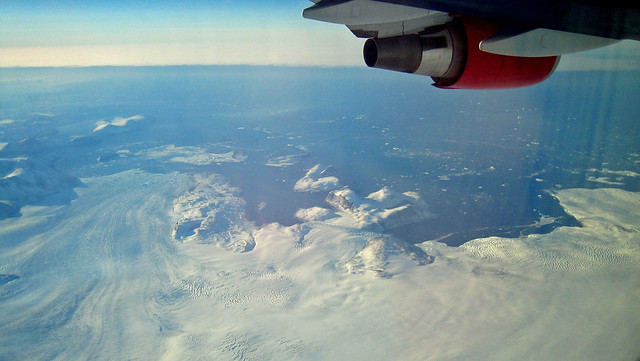
    Arctic security remains wedded to traditional, state-centric military threats despite the fact that the threat of outright conflict is as remote as the farthest reaches of the Arctic region itself. These approaches are predictable, but they will contribute little to alleviating the complex, interrelated, and underlying drivers of insecurity in the Arctic region. Cameron Harrington argues that if our understanding of both Arctic security and the Arctic environment continues to be reduced to the international scramble for untapped resources and for newly opened “shipping lanes”, it is unlikely that the hugely alarming and damaging environmental effects of climate change will ever be truly overcome.

    Read Article →

  • Climate change

    Climate change

    Climate change is high on both domestic and international political agendas as countries face up to the huge environmental challenges the world now faces. Whilst this attention is welcome, less energy is being focused on the inevitable impact climate change will have on security issues. The well-documented physical effects of climate change will have knock-on socio-economic impacts, such as loss of infrastructure, resource scarcity and the mass displacement of peoples. These in turn could produce serious security consequences that will present new challenges to governments trying to maintain stability.

    The Other Resource Wars

    Roger Howard | Exclusively written for sustainablesecurity.org | September 2010

    Issues:Climate change, Competition over resources

    Roger Howard writes, exclusively for sustainablesecurity.org, that:

    ‘The presence of valuable natural resources in the Arctic region, or even the mere possibility of finding them, poses a subtly different challenge to international peace than usually supposed. For instead of fighting over resources, governments could instead feel threatened by the heightened foreign presence that the search, or exploitation, of these resources will bring to places that are important for other, quite independent, reasons. This is potentially a recipe for international mistrust that could conceivably spill over’.

    Image Source: psd

    Read more »

    Climate Change and Natural Resources Conflicts in Africa

    Donald Anthony Mwiturubani & Jo-Ansie van Wyk | Institute for Security Studies | June 2010

    Issues:Climate change, Competition over resources

    The Human Security Report Project has published a new book exploring the links between climate change and conflicts over natural resources across Africa.

    From the book’s synopsis:

    The climate change phenomenon is a global concern, which typically threatens the sustainability of the livelihoods of the majority of the population living in the developing countries. Africa, particularly the sub-Saharan region, is likely to be negatively impacted by climate variability and change. Extreme natural occurrences such as floods and droughts are becoming increasingly frequent and severe.  Climate variability and change have further exacerbated the scarcity of natural resources on the African continent, leading to conflicts with regard to access to, and ownership and use of these resources. The scarcity of natural resources is known to trigger competition for the meagre resources available among both individuals and communities, and even institutions, thus affecting human security on the continent.

    Image source: Albert Gonzalez Farran

    Read more »

    Climate Change and Conflict: Moving Beyond the Impasse

    Jeremy Lind, Maggie Ibrahim and Katie Harris | Institute of Development Studies – In Focus Policy Briefing | May 2010

    Issue:Climate change

    A Policy Briefing from the University of Sussex’s Institute of Development Studies claims that the debate on the relationship between climate change and conflict has reached an impasse.  The paper argues that it is time for a more measured view of vulnerability to climate change and a better understanding of the causes of conflict.

    Image source: damopabe

    Read more »

    Climate change and conflict: Working paper – A framework for analysis and action

    Ivan Campbell | SAFERWORLD | July 2010

    Issue:Climate change

    This Working Paper by SAFERWORLD presents a framework for analysis that may go some way towards accommodating the complexity and variability of modelling the linkages between climate change and conflict. It does not cover all dimensions of the relationship between climate change and conflict, but focuses upon how it plays out a local level and what this means for policy and programming.

    A direct link to the summary can be found on SAFERWORLD’s website here.

    A direct link to the full report can be found on SAFERWORLD’s website here.

    Image source Caza_No_7.

    Read more »

    New Project on Regional Climate Change and Security in Bangladesh

    Issue:Climate change

    The Bangladesh Institute of Peace and Security Studies  has launched a major new research project on the security impact of climate change on Bangladesh and its regional  neighborhood, specifically India, Nepal and the Maldives. The project will establish critical linkages between these countries in addressing systemic challenges flowing from climate change, assessing the merit of the ‘river basin’ framework for triangular collaboration in mitigating and managing the consequences of climate change.

    Image source: IRRI Images.

    Read more »

    Sustainable Energy Security

    Antony Froggatt and Glada Lahn | Chatham House-Lloyd’s 360° Risk Insight White Paper | July 2010

    Issues:Climate change, Competition over resources

    Businesses which prepare for and take advantage of the new energy reality will prosper – failure to do so could be catastrophic, argues a new report from Chatham House and Lloyd’s.


    Image source: Wonderlane.

    Read more »

  • Sustainable Security

    webpost 6 louisiana large

    Hurricane Katrina and the sinking of coastal Louisiana stand as a reminder that we must address climate change, competition over resources and marginalisation as the root causes of conflict before it is too late.

    Most will remember the horrific pictures on the news in 2005 when hurricane Katrina struck New Orleans. Nearly 2,000 people died, thousands more were left homeless and displaced, the material destruction was catastrophic with damages well over $100 billion.

    The aftermath of Hurricane Katrina once again proved that marginalised people have the least resources to cope with environmental constraints and natural disasters. Nowhere in New Orleans was the devastation greater than in the Lower Ninth Ward, a predominantly poor African American neighbourhood. Most residents of the Lower Ninth Ward had fewer options of where to go, did not want to leave their homes behind and lost everything due to the damage caused by Katrina and their lack of financial resources to rebuild the community.

    Katrina was not the last and probably not the most destructive disaster to hit Louisiana. Over the past years, a significant discovery has been made: Coastal Louisiana is sinking, at a rapid rate. Some estimate that an area the size of a football field is lost roughly every half hour.

    Once again, this will affect already marginalised communities the most. Science Illustrated argues “something drastic must be done” because “the current state of affairs means that they [the affected communities] may soon be the first climate refugees in United States history”.

    CLIMATE CHANGE

    Climate change sceptics appear to be fighting a losing battle in the face of greater levels of sound scientific data. Yet, governments are still reluctant to take necessary steps like drastically cutting carbon emissions and switching to green renewable energy sources. Hopefully this will change as addressing climate change will be essential in tackling the security challenges of an increasingly interconnected world.

    At the World Economic Forum in Davos, Lord Stern, author of a 2006 UK government review on climate change, admitted he had got it wrong: “Looking back, I underestimated the risks. The planet and the atmosphere seem to be absorbing less carbon than we expected, and emissions are rising pretty strongly. Some of the effects are coming through more quickly than we thought then. This is potentially so dangerous that we have to act strongly. These risks for many people are existential”.

    The risks are indeed existential for many people living in the coastal communities of Louisiana. Rising sea levels, mainly due to melting ice caps, are threatening those who live in the Louisiana Delta.

    When interviewed by PBS, Torbjörn Törnqvist, geoscientist at Tulane University who studies Louisiana’s wetlands, said: “there is no doubt that the sinking land is a direct implication of climate change, because it actually reflects what we see worldwide. And if we go forward, we know that sea-level (rise) will continue to accelerate. The only thing there is uncertainty about is how large that continued acceleration will be. But I think the important thing we know now is that, even in the past century, accelerated sea-level rise has already contributed to the loss of these wetlands […] ultimately it [climate change] could very well become the single most important factor.”

    Although climate change and the consequent rising sea levels are an important reason why coastal Louisiana is rapidly losing land, there is more to it. To prevent flooding, extensive levees have been built (some more than 100 years ago) around the edges of the Mississippi river and channels and water ways have been carved to redirect flows. However, the levees prevent the land in that area from receiving sufficient sediments to stay above water, and the manmade channels through the wetlands have weakened the buffer zone for hurricanes and storms. So sea levels are rising and the land is sinking.

    These factors combined account for “the largest land loss currently on the planet”, says Val Marmillon, the managing director of America’s Wetland Foundation. “The massive land loss is not only threatening to destroy an entire ecosystem, including dozens of endangered animal species, but it could also severely affect local residents. Up to 2 million people are at risk of having to leave their homes.”

    DRILLING FOR OIL

    In addition to rising oceans, manmade levees and diversions, oil drilling along the coast has also contributed to rapid subsidence of the marshlands. The oil and natural gas industry, with annual revenue of approximately US $325 billion, started drilling in Louisiana in 1901. This has caused the wetlands to collapse and erode as channels are being dug for oil pipes. The process of removing oil from beneath the land is causing it to further sink, letting in salt water which destroys much of the natural habitat.

    The Sustainable Security Programme at Oxford Research Group (ORG) sees “competition over resources” as one of the main drivers of global conflict: “there will be greater scarcity of three key resources: food, water and energy. Demand for all three resources is already beyond that which can be sustained at current levels.” A recent ORG publication states that “a narrow resource base for these energy reserves is at the root of the strategic importance of the Persian Gulf and does much to explain recent and current conflicts, but the even greater global concern stems from the potential impact of climate change”.

    Oil drilling in the Gulf of Mexico off the coast of Louisiana is detrimental to the environment, impedes addressing the causes of climate change and most importantly further marginalises already disenfranchised coastal communities.

    MARGINALISATION

    The political, social and economic marginalisation of the people of New Orleans and coastal Louisiana plays a central part of this story. Frances Fox Pivan in her article Marginalization and American Politics argues that in the case of Katrina “many of the victims had been marginalized before the hurricane and the floods overwhelmed them, which is surely part of the reason that the danger of hurricane and the ensuing floods was ignored. As is amply evident, this was not simply a natural disaster.”

    She goes on to link marginalisation, poverty, the effects of natural disaster and violent crime: “Behind those images [of Katrina] was an intricate story of marginalization in the United States. The population of the city [New Orleans] was overwhelming black, and poor. The median income was only 70 percent of the national average, and poverty rates were twice the national average. The main jobs were low wage jobs in the hotels, casinos, restaurants and bars that catered to the tourist industry. Government income support programs, including welfare and food stamps and subsidized housing, that sometimes supplemented the earnings of some poor people, had been whittled away for several decades, and especially under the presidency of George W. Bush. The schools were bad, with high dropout and suspension rates, and the illiteracy rate of the city hovered at about 40 percent. Homicide rates were extraordinarily high, roughly ten times those of New York City.”

    In the current situation of the sinking wetlands, most of the 2 million people who are directly affected are also living on the margins of society. According to 2011 US Census data the poverty rate in Louisiana is the second highest in the nation at 20.4% and 9.4% are living in extreme poverty. 14.1% of the population are affected by food insecurity and over 33% are in low-wage jobs as Louisiana is one of the five US states without a minimum wage law.

    Small island communities in the Mississippi Delta, such as the Isle de Jean Charles, are inhabited by members of various Native American tribes. Some tribes do not have recognised status from the US government and hence have no access to any help from the state. Many people in the area live off the land they live on and sustain themselves through fishing and other subsistence activities. What will they do when their land disappears? Where will they go?

    Marginalised people have much fewer resources to cope with a changing environment. They do not have options. Desperate people are also more willing to turn to desperate means. The case of Louisiana exemplifies the dangerous nexus of climate change, competition over resources and marginalisation. Working towards sustainable security will mean addressing those underlying factors in order to prevent violent conflict.

    In President Obama’s second inaugural address, he put climate change centre stage as one of his top three priorities: “Some may still deny the overwhelming judgment of science, but none can avoid the devastating impact of raging fires, and crippling drought, and more powerful storms. The path towards sustainable energy sources will be long and sometimes difficult. But America cannot resist this transition; we must lead it.”

    Words will no longer be enough. We must see action, now.

    Anna Alissa Hitzemann is a Peaceworker with Quaker Peace and Social Witness, and is currently based at Oxford Research Group. She works as a Project Officer for our Sustainable Security Programme, with a focus on our ‘Marginalisation of the Majority World’ project.

    image source: Brother O’Mara

  • Global militarisation

    Global militarisation

    The current priority of the dominant security actors is maintaining international security through the vigorous use of military force combined with the development of both nuclear and conventional weapons systems. Post-Cold War nuclear developments involve the modernisation and proliferation of nuclear systems, with an increasing risk of limited nuclear-weapons use in warfare – breaking a threshold that has held for sixty years and seriously undermining multilateral attempts at disarmament. These dangerous trends will be exacerbated by developments in national missile defence, chemical and biological weapons and a race towards the weaponisation of space.

    Moving Beyond Crisis: Survival 2100 and Sustainable Security

    William Rees | Movement for a Just World | June 2012

    Issues:Climate change, Competition over resources, Global militarisation, Marginalisation

    In a piece for the International Movement for a Just World, William Rees maps out a vision for what he calls ‘Survival 2100.’ The goal of such a strategy would be “to engineer the creation of a dynamic, more equitable steady-state economy that can satisfy at least the basic needs of the entire human family within the means of nature.” The alternative, Rees argues is to “succumb to more primitive emotions and survival instincts abetted by cognitive dissonance, collective denial, and global political inertia.”

    Image source: hundrednorth.

    Read more »

    Before the Cyberwar

    R. Scott Kemp | Bulletin of the Atomic Scientists | June 2012

    Issue:Global militarisation

    Those concerned with the issue of militarisation as a driver of global insecurity are increasingly looking at the issue of cyberwarfare as the weapons of war become ever closely associated with the digital age. Waging war in the cyber domain raises some truly momentous questions about the nature of warfare, the laws of war and even what counts as self-defence. Nuclear expert, Scott Kemp has written an article in the Bulletin of the Atomic Scientists arguing that like the missed opportunity of the dawn of the nuclear age (in which possessing nuclear weapons was viewed as more important than the consequences of proliferation), policymakers today have an important opportunity to consider the implications – both intended and unintended – of cyberweapons.
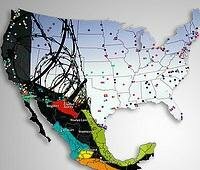

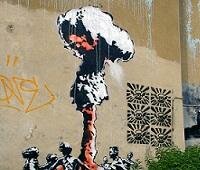
    Image source: WFB

    Read more »

    A Sustainable Security Approach to the ‘War on Drugs’

    Chris Abbott and Joel Vargas | Open Briefing | April 2012

    Issue:Global militarisation

    A new report from Open Briefing argues that the illicit drugs trade, and the militarised government responses to it, are the greatest threats to state and human security in the Americas. The report analyses the almost total failure of current strategies and outlines a sustainable security approach to address this.

    Image source: truthout.org

    Read more »

    Kony 2012 and the Militarisation of Uganda

    Adam Branch | AlJazeera | March 2012

    Issue:Global militarisation

    A piece written by Adam Branch and published by AlJazeera highlights the dangers of militarisation associated with the online campaign to make Joseph Kony ‘famous’ in 2012 spearheaded by the NGO Invisible Children. Branch asks “how often does the US government find millions of young Americans pleading that they intervene militarily in a place rich in oil and other resources?”

    Image source: debobhappy

    Read more »

    Mutually Assured Destruction: Fifty Years and Counting

    Tom de Castella | BBC News Magazine | February 2012

    Issue:Global militarisation

    Writing for the BBC, Tom de Castella explores the reasons why the fear of a nuclear exchange has receded in the public imagination. Marking the fiftieth anniversary of Robert McNamara’s speech to the American Bar Foundation that outlined the official US position on mutually assured destruction (MAD), de Castella talks to a number of experts about the continuing threat from nuclear stockpiles around the world.

    Image source: Leeks. 

    Read more »

    A Realist Argument in Favour of Non-Violent Opposition in Syria

    Daniel Serwer | The Atlantic | February 2012

    Issue:Global militarisation

    How can the state violence in Syria be stopped? Daniel Serwer argues in the Atlantic that, given the Syrian regime’s complete failure to protect its own citizens it may be morally justifiable to arm the Syrian opposition; however from a realist perspective it is neither ‘possible nor wise’ as a means to topple Assad and bring about accountable politics. A violent reaction to the state’s overwhelmingly superior violence would not only destroy the opposition’s legitimacy, but would eventually draw them into a militarised conflict that they could not win.

    Serwer strongly advocates mass-participatory non-violent approaches which use tactics that are difficult to attribute to single individuals. In the end, removing the regime’s ability to instil fear will be the surest way to ensure its downfall, as seen in the cases of Zine El Abidine Ben Ali and Hosni Mubarak, and Serwer argues that this is still possible, even now after so much bloodshed.

    Article Source: the Atlantic

    Image Source: Yunchung Lee

    Read more »

  • Competition over resources

    Competition over resources

    In the environmentally constrained but more populous world that can be expected over the course of this century, there will be greater scarcity of three key resources: food, water and energy. Demand for all three resources is already beyond that which can be sustained at current levels. Once population growth and the effects of climate change are factored in, it is clear that greater competition for such resources should be expected, both within and between countries, potentially leading in extreme cases to conflict.

    Canada’s Arctic Policy: Prospects for Cooperation in a Warming World

    Brian Karmazi | Central European Journal of International & Security Studies | April 2011

    Issues:Climate change, Competition over resources

    In 1985, Oran Young anticipated that the international community was ‘entering the age of the Arctic … in which those concerned with international peace and security will urgently need to know much more about the region and in which policy makers in the Arctic rim states will become increasingly concerned.’ Young’s insights were extremely acute and much international attention is being directed to the geographic ‘North,’ where much resource wealth lies under a rapidly thinning layer of ice.

    Image source: Vishnu V

    Article source: CEJISS

    Read more »

    Sudan all about Natural Resources Conflicts

    Debay Tadesse | The African – Blog | March 2011

    Issue:Competition over resources

    Debay Tadesse from the Institute of Security Studies, Addis Ababa, looks at the future for Sudan, and the importance of sharing natural resources in the region.

    “Another important contestation is the sharing of oil revenue. The conflict between the ethnic groups, government and militias was fuelled by the significant oil reserves developed by foreign companies.  This exacerbated the conflict because the huge potential profits increased the incentives for control of the land, resulting in all kinds of human rights violations.  The South is rich with almost 60% of the oil wells but the pipes run through the North. The South fully depends on the North to sell oil. Experts in this field argues that that for the next five years Southern Sudan will have to rent the Northern oil pipeline, refineries and facilities at Port Sudan to sell its oil. If not handled diplomatically this could trigger a wave of unrest, raids and attacks on the South.”

    Article source: TheAfrican.org blog

    Image source: expo_2020

    Read more »

    The US Navy in a Warming Arctic

    U.S. Naval Forces Naval Studies Board | National Academies Press | March 2011

    Issues:Climate change, Competition over resources

     A new report by the U.S. Naval Forces Naval Studies Board about the implications of climate change for the US Navy argues that the US should ratify the 1982 United Nations Convention on the Law of the Sea (UNCLOS). According to the report this will assist in addressing new issues around conflict and cooperation in the Arctic region arising from a changing climate. 

    Image source: U.S. Coast Guard

    Read more »

    In Asia, an Opportunity to Strengthen Long-term Relationships though Natural Resource Cooperation

    Will Rogers | Center for a New American Security | March 2011

    Issue:Competition over resources

    Writing for the CNAS Natural Security blog, Will Rogers analyses the opportunites for moving from competition to cooperation over resources, particularly between the US and China. 

    Image source: Pacific Command. 

    Read more »

    China’s drought and global food prices

    Issues:Competition over resources, Marginalisation

    What a rollercoaster ride the story of global food prices has been this year – and we’re only a month in.

    Back in January, when news emerged that food prices had reached a new record high, many analysts were relatively sanguine about the rise. As I noted in a Global Dashboard post on 6 January, the new price spike was largely driven by meat, sugar and vegetable oils, rather than, as in 2008, staples like wheat or rice.

    Governments weren’t sliding into panic measures – unlike in 2008, when over 30 of them imposed export bans, forcing prices still higher. And while the 2008 spike was marked by protests in 61 countries (with violent unrest in 23 of them), that didn’t seem to be happening this time around.

    How things can change in a month. No sooner had I published that post than Algeria erupted in rioting over high food prices – and while food prices weren’t the cause of recent events seen in Tunisia, Yemen and Egypt, they have certainly formed part of the backdrop.

    Read the full article at China Dialogue

    Image source: vivianepereiras

    Read more »

    Diplomatic shifts in the warming Arctic

    Issue:Competition over resources

    The summer of 2010 saw the third-lowest amount and extent of Arctic sea ice ever recorded. For the third year in a row both the Northwest Passage between Greenland and Alaska and the Northern Sea Route between Norway and Kamchatka were ice-free – something that had not happened before 2008 in recorded history. As the physical state of the High North is changing, so too is the diplomatic environment. 

    Article source: IISS

    Image source: IISS


    Read more »

  • Sustainable Security

    Belize: challenges and contradictions in gang policy

    Like its neighbours in the northern triangle (El Salvador, Honduras and Guatemala), Belize has a high murder rate that is closely connected to the strong presence of gangs. But the character of gang activity in Belize is quite different from its Central American neighbours. Belize has pioneered some innovative solutions to the problem it is facing. But it will need to overcome the challenges of internal resistance and an acute lack of resources in order to address the political, economic and social issues that marginalise Belize’s large youth population.

    Read Article →

    Breaking the silence: Protecting civilians from toxic remnants of war

    Toxic remnants of war and their legacy of civilian harm is seriously under-explored as an area of conflict. There is a growing consensus that the current legal framework governing conflict and the environment is not fit for purpose – so how could new international norms that merge environmental protection with civilian protection come into effect?

    Read Article →

    Security Sector Roles in Sexual and Gender-based Violence

    Democratic Republic of Congo’s sexual violence epidemic is not only a weapon of ongoing violent conflict but an expression of entrenched systemic problems. Indeed, sexual and gender-based violence (SGBV) is most commonly perpetrated by the security services in place to protect civilians. In Quartier Panzi in South Kivu province, innovative processes of security sector reform and strengthened police-civilian channels of communication may be providing an opportunity for change, argues World Bank adviser Edward Rackley.

    Read Article →

    Water Security in South Africa: The need to build social and ecological resilience

    Tackling South African water insecurity will require addressing the technical deficiencies, governance gaps and social inequality that are currently having a dangerous and environmentally devastating impact. The links between environmental health and socio-political stability are clear in South Africa, where there has been an exponential increase in violent protests over poor or privatized service delivery, social marginalization, and unequal access to water. South Africa must act to solidify the links between resilient societies and resilient ecosystems.

    Read Article →

  • Sustainable Security

  • climate change

    climate change

    Climate change is high on both domestic and international political agendas as countries face up to the huge environmental challenges the world now faces. Whilst this attention is welcome, less energy is being focused on the inevitable impact climate change will have on security issues. The well-documented physical effects of climate change will have knock-on socio-economic impacts, such as loss of infrastructure, resource scarcity and the mass displacement of peoples. These in turn could produce serious security consequences that will present new challenges to governments trying to maintain stability.

    Development in Lao PDR: The food security paradox

    Issues:Climate change, Competition over resources

    Tags:climate change, food security, human security, Lao PDR, SDC working paper

    Food security will remain out of reach for many people, especially women and children, in the Lao People’s Democratic Republic, or Laos, if the country continues to emphasize commodities and resources development at the expense of the environment and livelihoods while ignoring global trends for food and energy. Read more »

  • Sustainable Security

    Action sports are increasing in popularity in the Middle East. For youth in conflict zones, these collaborative projects provide space for local voices and means of empowerment.

    In 2001, Kofi Annan founded the United Nations Office on Sport for Development and Peace (SDP), advocating sport as having ‘an almost unmatched role to play in promoting understanding, healing wounds, mobilising support for social causes, and breaking down barriers’. Since then, the SDP movement has continued to proliferate with groups and organizations using sport and physical activity to help improve the health and well-being of individuals and communities around the world.

    Of the 1000+ organizations currently working under the SDP umbrella, many are focused in sites of war and conflict with the aim of peace building, with growing interest in the potential of sports programmes as psycho-social interventions following natural disaster.

    SDP organizations such as Football 4 Peace, Right to Play, Hoops 4 Hope, Skateistan, and Peace Players International have been acclaimed as making valuable contributions to the quality of many individual’s lives in contexts of war, conflict, and poverty.

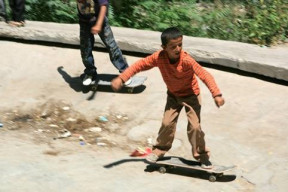
    Afghan boy on a skateboard. Image credit: Skateistan.

    Despite the best intentions, however, too many SDP programmes adopt a ‘deficit model’ that assumes poor youth in war-torn or disaster stricken contexts need ‘our’ western versions of sport for their empowerment. Sport sociologists Douglas Hartmann and Christina Kwauk, for example, are concerned that officials of sport-based intervention programmemes tend to “ignore the ways in which youth interpret and actively and creatively negotiate poverty and inequality as well as the ways in which their sport-based interventions actually commit symbolic acts of violence while reproducing conditions of marginalization”.

    Instead, they advocate a more critical alternative to youth development that pays attention to “local practices, local knowledge, the sociocultural and political-economic contexts as well as the needs and desires of communities themselves”.

    My research (funded by a three-year Marsden, Royal Society grant) has been a direct response to this call by focusing on the multiple and diverse ways youth are actively and creatively engaging with recreational, non-competitive sports in their responses to conditions of war, conflict and post-disaster. The case study of Gaza provides an interesting example of the grassroots approaches being developed by youth in contexts of conflict.

    Youth Engagement with Sport in Conflict Zones: The Case of Gaza

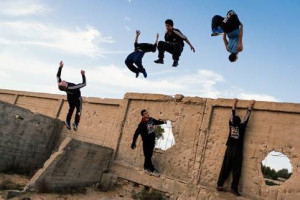
    Youths doing parkour in Gaza Strip. Image credit: PK Gaza.

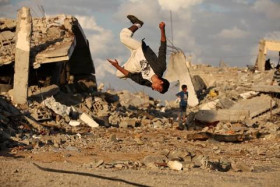
    Parkour (also known as free running)—the act of running, jumping, leaping through an urban environment as fluidly, efficiently and creatively as possible—reached Gaza in 2005 (shortly after the withdrawal of the Israeli army and the dismantling of Israeli settlements), when unemployed recent university graduate Abdullah watched the documentary Jump London on the Al-Jazeera documentary channel in his over-crowded family home in the Khan Younis refugee camp. He promptly followed this up by searching the Internet for video clips of parkour, before recruiting Mohammed to join him in learning the new sport. Continuing to develop their skills, they soon found parkour to be so much more than a sport, “it is a life philosophy” that encourages each individual to “overcome barriers in their own way”.

    To avoid conflicts with family members, local residents and police, members of PK Gaza (the name chosen by the group) sought out unpopulated spaces where they could train without interruption. Popular training areas included cemeteries, the ruined houses from the Dhraha occupation, UNRWA (United Nations Relief and Works Agency) schools, and on the sandy hills in Nusseirat, formerly an Israeli settlement now deserted in the centre of Gaza City. The latter is particularly meaningful for the youth who proclaim that by practicing parkour in the space, “we demonstrate that this land is our right”.

    As part of the younger generation of technologically savvy Gazan residents, the founders of PK Gaza are explicitly aware of the potential of the Internet for their parkour practices, and for broader political purposes. “We started filming ourselves with mobile phones and putting the videos on YouTube”, explains Mohammed, and have continued to develop more advanced filming techniques using borrowed cameras and editing the footage on a cheap computer.

    Boy doing parkour in Gaza. Image credit: PK Gaza.

    The PK Gaza Freerunning Facebook page has thousands of followers from around the world, their Instagram account has almost 3000 followers, and the group also posts regular YouTube videos that can receive upwards of tens of thousands of views. Each of Facebook, Instagram and YouTube are key spaces for interaction and dialogue with youth beyond the confines of the Gaza strip. In so doing, “we contribute very significantly to raising international awareness of what is happening in Gaza. We offer video clips, photographs and writings related to the situation in which we live in the Gaza strip and deliver the message to all the people’s that’s watching online that there are oppressed people here”, proclaimed Mohammed.

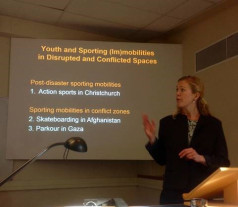
    Professor Holly Thorpe giving a presentation on research findings. Image credit: Holly Thorpe.

    As well as raising awareness of the conditions in Gaza and offering a temporary escape from the harsh realities of everyday life, the PK Gaza team strongly advocates the socio-psychological benefits of their everyday parkour experiences. They proclaim the value of parkour for their resilience and coping with the frustrations, fears, anxieties and pains of living in the Khan Younes refugee camp. As Abdullah explains, “I have witnessed war, invasion and killing. When I was a kid and I saw these things, blood and injuries, I didn’t know what it all meant … this game [parkour] makes me forget all these things”. As the following comments from Gazan psychologist, Eyad Al Sarraj (MD) suggest, some medical and health professionals also acknowledge the value of such activities for young men living in such a stressful environment:

    Many young people in Gaza are angry because they have very few opportunities and are locked in. An art and sports form such as free running gives them an important method to express their desire for freedom and allows them to overcome the barriers that society and politics have imposed on them. It literally sets them free”.

    Such observations are supported by a plethora of research that has illustrated the value of physical play and games for resilience in contexts of high risk and/or ongoing physical and psychological stress (e.g. refugee camps), and the restorative value for children and youth who have experienced traumatic events (e.g. natural disaster, war, forced migration).

    Conclusion

    To conclude, a key finding from my research to date is the need to move away from the ‘deficit model’ that assumes poor youth in developing or war-torn contexts are victims needing ‘our’ versions of sport for their empowerment. If the SDP community can begin with a recognition of the agency, creativity and needs of local youths, then we can better work with them to achieve their self-defined goals in contexts of conflict.

    Dr Holly Thorpe is Associate Professor in the Faculty of Health, Sport and Human Performance at the University of Waikato. As a sociologist of sport and physical culture, she has published widely on youth sport, action sports, and critical sport for development, including six books and over 60 journal articles and chapters. In 2016, she founded Action Sports for Development and Peace (www.actionsportsfordev.org), and gave a Ted talk ‘Action Sports for a Better World’. She continues to work on a Royal Society funded project—Sport in the Red Zone—examining the power (and politics) of sport in sites of conflict and disaster, including Afghanistan, Gaza, New Orleans and Christhcurch. She welcomes your feedback, so please feel free to get in contact:

  • How small arms and light weapons proliferation undermines security and development

    How small arms and light weapons proliferation undermines security and development

    Rachel Stohl, EJ Hodendoorn | Center for American Progress | March 2010

    Issues:Global militarisation, Marginalisation

    The proliferation of small arms and light weapons is an immediate security challenge to individuals, societies, and states around the world and an enormous hurdle to sustainable security and development. Small arms fuel civil wars, organized criminal violence, and terrorist activities. They also undermine multimillion dollar development programs and other assistance to fragile states. Fragile and failing states should be of particular strategic interest to the United States because even small insurgencies, if unchecked, can erupt into larger civil wars and possibly destabilize entire regions. In some cases fragile and failing states can also become bases for terrorist groups directly hostile to the United States.

    In many conflict zones small arms and light weapons are the weapon of choice, the main instrument of death and destruction, and are often used to forcibly displace civilians, impede humanitarian assistance, prevent or delay development projects, and hinder peace-keeping and peace-building efforts. When conflicts end or abate small arms often remain in circulation, which may lead to additional violence and suffering since fighting can resume or conflicts may erupt in neighboring regions. In nonconflict areas small arms may be used in criminal violence or may be used in homicides, suicides, and accidents. And they are frequently the primary tools of terrorists bent on sowing chaos and discord.

    The weapons can exact a staggering toll. For example, in January 2010 narco-traffickers armed with assault rifles massacred 16 people—mostly teenagers—attending a birthday party in Ciudad Juarez on the U.S. border. In November 2008 roughly two dozen terrorists from Lashkar-e-Taiba with AK-47-type assault rifles, 9 mm pistols, and grenades killed nearly 200 people and wounded 350 in Mumbai, India.

    Approximately 875 million small arms are in circulation worldwide, and only about a third are in the hands of legally constituted security forces. Because small arms are simple to use, durable, and easy to conceal they are especially prone to misuse, and their misuse directly and indirectly affects hundreds of thousands of people and severely undermines sustainable development in scores of countries around the world.

    As we’ll show in this report, the Horn of Africa exemplifies the challenges the proliferation of small arms and light weapons pose for sustainable regional security and development. Somalia is the quintessential failed state that illustrates the cost of small arms and light weapons proliferation and the challenges of recreating the conditions for sustainable development in a heavily armed environment. Despite numerous internationally sponsored peace conferences and billions of dollars in assistance, much of Somalia remains engulfed in civil war and has become a breeding ground for international terrorism.

    The insecurity also spreads across borders. In neighboring Kenya (a close ally of the United States), armed violence is common in the pastoralist areas of the northern and northeastern regions of the country. Access to guns has also exacerbated urban crime and political violence in Kenya.

    But small arms and light weapons are not only a problem for poor countries. Mexico is an example of how small arms can plague a medium-income country. Small arms are widely used there by organized criminal groups involved in the drug trade and kidnapping. Their use in Mexico has led to large numbers of homicides, undermined local authority, and greatly increased the cost of security for Mexican citizens. The violence is fed by a stream of readily available and powerful weapons from the United States—Mexico’s main source for small arms. At the same time, the U.S. government is spending hundreds of millions of dollars to help the Mexican government combat arms trafficking and criminal violence.

    A wide body of international and regional agreements and initiatives has been developed to tackle small arms proliferation, and national small arms policies, programs, and standards vary from country to country. The United States has wide-ranging small arms laws, regulations, and policies, and is often hailed as the “gold standard” for comprehensive policies and practice concerning the transfer, management, and control of small arms and light weapons produced, maintained, and exported within its borders.

    But even though the U.S. government has sophisticated laws, regulations, and controls for the legal arms trade, permissive gun ownership laws and lax supervision of certain gun markets have made the United States a significant source of illegally diverted guns, especially in Mexico and other countries in Central America.

    The Obama administration has ample opportunities to shape a new and more assertive U.S. position on small arms, but it must navigate the complex domestic political realities of small arms in the United States. A new approach should include greater engagement on small arms issues internationally and stronger domestic efforts to prevent illegal gun trafficking. The United States should actively participate in existing and proposed processes and negotiations and promote meaningful and practical approaches to countering small arms proliferation and misuse.

    The administration, Congress, and the public also need to be better educated about the costs and consequences of small arms proliferation and a commitment to develop appropriate U.S. programmatic and policy responses must be cultivated. Raising awareness would counter confusion and misinformation about efforts to address small arms proliferation and misuse and assist real and sustainable progress. Such awareness promotion would include increasing dialogue, through interagency meetings, reports, and statements, on how small arms proliferation and misuse can undermine U.S. security and development goals. This could then encourage policy initiatives and budgetary support for efforts to combat the illegal spread of small arms.

    There are four specific steps the United States can take in the short term at the national, regional, and global level to help promote strategic engagement on the small arms issue.

    First, at the national level, the United States should increase its assistance for programs that prevent the proliferation and misuse of small arms and light weapons. Export controls, responsibility, and appropriate vetting of end users are important steps, but it is equally important for the United States to ensure that surplus, obsolete, and potentially destabilizing weapons are removed from circulation. It is these weapons that are most often used in brutal conflicts in countries such as Colombia, Darfur, the Democratic Republic of the Congo, Sri Lanka, and Somalia.

    Second, at the regional level, the Senate should ratify the OAS Convention—the 1997 Inter-American Convention Against the Illicit Manufacturing of and Trafficking in Firearms, Ammunition, Explosives and other Related Materials, which aims to combat illicit small arms trafficking in the Western Hemisphere. The United States played a key role in drafting the OAS Convention and made sure it was in line with U.S. laws and regulations. But for more than a decade the convention has languished in the Senate. Ratifying it would send an important and powerful message to the Western Hemisphere that the United States is serious about halting illicit arms trafficking, and it would provide another tool to deal with the flow of weapons between the United States and Mexico.

    Third, at the global level, the United States should lead the development of a legally binding arms trade treaty that would establish common international standards at the highest level on the export of conventional weapons, including small arms. Under the Obama administration, the United States has already reversed the Bush administration’s position on small arms and demonstrated it is willing to be a constructive partner in developing a treaty and in the U.N. process to control small arms. U.S. laws and regulations comply with or exceed the vast majority of principles that have been proposed in a potential international arms trade treaty, and the United States should ensure its national arms export control system serves as an example for other states.

    Finally, the Obama administration should build small arms initiatives into development programs. When the United States undertakes programs on security sector reform and judicial sector reform, particularly in fragile states, the action plan should include steps to address small arms proliferation and misuse. General U.S. support for programs that address weapons demand is critical and requires several key integrated measures, starting with the reform of law enforcement agencies and military forces to ensure they are representative and provide security to all their citizens as well as adhere to international human rights and humanitarian laws.

    Download the full report here.

    Comments

    Post new comment