Blog

  • Sustainable Security

  • Sustainable Security

  • Sustainable Security

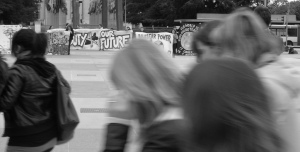
    Young people walk past an anti-nuclear weapons protest outside the NPT Review Conference, Geneva, 2008 Source: BANG (Flickr)

    Young people walk past an anti-nuclear weapons protest outside the NPT Review Conference, Geneva, 2008 Source: BANG (Flickr)

    The dropping of atomic weapons on Hiroshima and Nagasaki is now almost 70 years behind us and, current rhetoric over Ukraine aside, the Cold War ended almost a quarter-century ago. This is how we now understand nuclear weapons – as a threat of the past, more important in history class than in the headlines. But this is not the case. While we have made admirable progress on disarming and dismantling, particularly the arsenals of the US and Soviet successor states, thousands of nuclear weapons still exist and progress on disarmament is too sporadic for comfort. The threat of nuclear proliferation is high and many current nuclear weapons exist within hostile regions or on trigger alert. Nuclear risks are more prevalent than we’d like to believe. Whether we like or not, accidents can happen.

    The dramatic decrease in public awareness and engagement in the nuclear weapons debate since the 1980s poses a risk to our future, as younger generations and future policy shapers are less familiar with the challenges posed by nuclear weapons and will be as they start to take over the reins of governance. But nuclear weapons are too dangerous for a disconnect of this magnitude.

    It wasn’t always this way

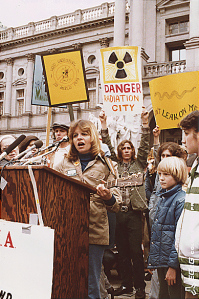
    Anti-nuclear rally outside the Pennsylvania State Capitol, 1979. Source: Wikipedia

    Anti-nuclear rally Pennsylvania, USA 1979. Source: Wikipedia

    We haven’t always been so disconnected from the bomb. US arms control expert William Hartung describes:

    There was a time when nuclear weapons were a significant part of our national conversation. Addressing the issue of potential atomic annihilation was once described by nuclear theorist Herman Kahn as “thinking about the unthinkable,” but that didn’t keep us from thinking, talking, fantasizing, worrying about it, or putting images of possible nuclear nightmares (often transmuted to invading aliens or outer space) endlessly on screen.

    Perhaps it was the imminent threat during the Cold War that compelled millions across the world to actively protest against nuclear weapons. For example, in the United Kingdom, the Greenham Common Women’s Peace Camp was established in 1981 to protest the deployment of US nuclear-armed cruise missiles at the Greenham Common Air Force base. While in June 1982 in the United States, one million people came together in New York’s Central Park to call for an end to the nuclear arms race in the “Nuclear Freeze” protest.

    The looming nuclear threat seemed to fade away after the Cold War. Progress on arms control led to complacency with the international treaties that were in place to protect us against nuclear dangers. Under the Nuclear Non-Proliferation Treaty (NPT), for example, the nuclear weapon states (UK, US, China, France, Russia) are obligated to work towards disarmament. However, as absurd as it sounds, there is no universal agreement on what that would quite look like, or how to get there.

    Moreover, we’ve witnessed three countries become overtly nuclear armed states since the Cold War: India, Pakistan and North Korea. It’s a small percentage in comparison to states that don’t have the bomb, but when it comes to nuclear weapons, even a small percentage is a terrifying one.

    International norms of non-use and the “nuclear taboo” have led us not to worry about that small percentage of states. Eric Schlosser’s recent book Command and Control, however, alarmingly points out that there have been several nuclear “near misses” in the United States alone that we as a public have little to no knowledge of. Schlosser writes:

    Right now thousands of missiles are hidden away, every one of them is an accident waiting to happen, a potential act of mass murder. They are out there waiting, soulless and mechanical, sustained by our denial – and they work.

    Is it simply that the public is in denial about nuclear weapons? A diverse range of psychological studies conducted in the 1980s – including Nuclear attitudes and reactions: Associations with depression, drug use, and quality of life; Nuclear War as a Source of Adolescent Worry; and Gender, sex roles, and attitudes toward war and nuclear weapons – demonstrate a desire to understand society’s feelings about nuclear weapons at the height of the Cold War.

    In more recent years, there have been similar studies conducted in reference to climate change, another somewhat abstract and imminent global threat. And yet, while the nuclear threat is the still around, we’re not as concerned about nuclear weapons as we were 30 years ago. It could be, as Schlosser suggests, denial. It seems that we have forgotten, don’t understand, or are simply indifferent.

    Why we should care

    Beyond the obvious threat of obliteration posed by nuclear weapons, they also undermine essential international co-operation between states and become a liability in certain situations. For example, in the recent Russian invasion of Ukraine, many media sources were keen to point out that any Western military intervention would put nuclear armed states up against each other. It could be argued that the diplomatic actions taken towards the crisis, resulting in economic sanctions and a recent shift of the G8 meeting away from Sochi, can be partly attributed to the looming presence of nuclear arsenals. As such, the continued presence of these weapons will continue to affect the cooperation and relationship between Russia and the West, for better or for worse.

    Nuclear weapons, or efforts taken to prevent their proliferation, can also affect a range of industries and economies. The threat of nuclear proliferation in Iran led to the implementation of economic sanctions that affected trade in a range of countries (including the UK, US and other European states) and a range of industries such as banking, insurance, oil, pharmaceuticals, and food. UN Resolution 1540 also calls upon states to implement export controls and regulations on materials that could be used for WMD proliferation, which affects such industries as shipping and transport, and manufacturing firms.

    It is naïve to assume that any spending on nuclear weapons or related programmes would or could be simply or entirely allocated to spending in other areas, such as healthcare or other threat reduction initiatives, but the stark contrast in the spending is noteworthy: In 2002, the World Bank estimated that $40-60 billion USD annually would be enough to meet the internationally agreed Millennium Development Goals, which range from providing universal primary education to eradicating poverty and hunger. Between FY2008 – FY2013, the US spent $77 billion to address global climate change in total, with the President’s request for $11.6 billion for FY2014. At the same time, it was estimated in 2012 that the US was on track to spend an average of $64 billion per year on nuclear weapons and related programmes over the following decade.

    Continued reliance on nuclear deterrence is a divisive issue. Whether one believes that it brings security and stability, or that the risks (and monetary costs) are too high, reliance on nuclear weapons for security is among the most pressing issues of our time and we need to be aware that the decisions we make today will have implications on the future and the uncertain threats that we will face. With public interest in nuclear issues waning, policy shapers and the emerging leaders of tomorrow are increasingly focusing their attention elsewhere. As a result, nuclear policy is being pushed back to those who have been making these decisions for decades and the circular debate rooted in Cold War perspectives continues. Fresh perspectives and a renewed interest in the nuclear debate are needed to address these security challenges of the future.

    The way forward

    Now is the time to engage the next generation on these issues if we are ever going to find a long term solution to this long term problem. The debate on nuclear weapons needs new ideas and help to shift nuclear weapons out of their isolated silo and back to the heart of security debate. This requires building a security narrative that includes nuclear weapons in a broader context, approaching them as a part of a bigger problem, and not as the problem itself. This also involves bringing in a wider range of disciplines into the nuclear weapons debate including businesses, creative communities, environmental and health groups, and social scientists, because nuclear weapons have an effect on all of us.

    If we are going to make progress on the nuclear weapons debate, we need continued engagement from all sides, along with a deeper understanding of the motivations behind what drives people to think about (or not think about) nuclear weapons. In essence, we need to reconnect with the nuclear debate and start thinking about a sustainable future.

    BASIC has launched a new Next Generation project to inspire a next generation of thinking on nuclear weapons.

    Rachel Staley is currently the Programme Manager for the British American Security Information Council (BASIC) in their London office. Since 2011, Rachel has managed the operations of the office and assisted in developing the organisation’s programmes working on nuclear non-proliferation and disarmament in the Middle East, as well as engaging directly in the Trident renewal debate in the United Kingdom. Rachel holds an MA with Distinction in Non-Proliferation and International Security from King’s College London and a BA with Honours in International Affairs and Anthropology from Northeastern University.

  • Sustainable Security

  • Sustainable Security

    This article is part of a two-part series discussing Britain’s Trident nuclear programme and the influence it may be having on the country’s energy policy. Read part 2 here.

    Following a majority vote of 355 in the House of Commons  in July 2016, the UK Government took the key decision to renew the Trident nuclear weapons system. Yet the issue remains controversial, with a wide variety of aspects persistently under scrutiny. At the forefront are debates over the costs of Trident renewal, which range from £31 billion (for the lowest estimates of submarine build costs alone) to over £200 billion when lifetime costs are considered.

    With a host of other ethical, technical and strategic issues also abounding, controversy around UK nuclear weapons policy has intensified in recent years and months, including on the future vulnerability of nuclear submarines, the growing influence that the Atomic Weapons Establishment (AWE) has over university research, the malfunction of a Trident missile test, and Theresa May’s decision to withhold this information from parliament ahead of the July 2016 vote. Not for the first time, support for Trident has come into tension with democratic transparency and accountability.

    In this two-part article we focus on another non-military sector in which developments may be strongly – but nearly invisibly – conditioned, by ambitions to renew UK strategic nuclear weapons capabilities. The issue here is a widely identified ‘puzzle’ in UK energy policy – the persistent intensity of UK Government enthusiasm for what is actually in energy terms the seriously under-performing option of civil nuclear power. Based on official defence policy documents, it seems clear that UK commitments to nuclear energy are significantly influenced by pressures to sustain the skills and expertise perceived to be necessary for the country’s naval nuclear propulsion programme. Crucially, these military connections remain almost entirely unacknowledged in energy policy literatures. The implications thus extend beyond military and energy policy alone, to raise questions about British democracy more widely.

     The ‘puzzle’ of UK energy policy

    In September 2016, after many years of setbacks, the decision was finally taken by UK Prime Minster Theresa May to give the green light for the construction of Hinkley Point C (HPC) nuclear power station in Somerset. This £24.5 billion initiative, largely financed by French and Chinese state-owned firms, constitutes one of the largest single infrastructure investments in British history. The announcement came less than a year after enactment of a “new direction” in UK energy policy, withdrawing support from several renewable and energy efficiency schemes and entrenching commitments to nuclear power. The relative scale and intensity of this British nuclear enthusiasm is a point of growing curiosity among international observers. Al Gore is “puzzled” by this and he is not the only one.

    Official UK rationales for these persistent nuclear commitments are indeed puzzling. As government analyses have repeatedly shown, nuclear power is far from being the most favourable low carbon UK energy option. Britain is blessed with what the Department for Energy and Climate Change called “the best wind, wave and tidal resources in Europe”. Official figures repeatedly show HPC to be more expensive than comparable tranches of energy from wind and solar power. Arguments over the value of “base load” generation are repudiated by the National Grid. With nuclear construction times also massively longer and relative costs dropping radically for renewables, the mismatch looks set to exacerbate by the time HPC comes online.

    Originally set for completion by Christmas 2017, HPC is now unlikely even to have started construction by then. Associated plans for a massive 16 GWe programme of new nuclear power by 2025 look even less likely. With UK renewable energy capacities in the meantime burgeoning despite a relative dearth of official support, energy security arguments would logically also favour a switch towards these “Cinderella options” to fill the gap left by nuclear delays. Yet, as prospects for resolving underperforming nuclear plans get ever more distant, increasingly favourable renewable projects remain paradoxically ever more threatened by cut-backs, leading to serious problems in that sector. Taken at face value, these patterns are difficult to explain.

    The comparative weakness of UK civil nuclear

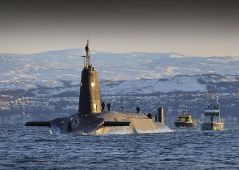
    Image credit: Defence Imagery/Wikimedia.

    Looking at key international comparators, our research has illuminated these anomalies in more detail. The scale of the planned 16 GWe UK “nuclear renaissance” relative to the existing size of the national energy system, is unsurpassed anywhere in the world. With global investments in non-hydro renewables outstripping nuclear and fossil fuels combined, authoritative observers – including a UN Chief Scientist – argue that the world is moving in one direction (towards a renewables future), whilst the UK is moving in another. As a country with an unrivalled record of success in industrial policy, Germany offers a particularly compelling contrast. Despite hosting one of the best-performing nuclear industries in the world, the German Energiewende (energy transition policy) aims entirely to phase out nuclear power by 2022. Why should a country like the UK, with a far more attractive renewable resource and a far less competitive nuclear industry, persist in the reverse strategy?

    Our research also finds that conventional theories concerning innovation and technological transitions predict, on the basis of economic and industrial considerations, Britain (not Germany), would be most expected to phase out nuclear power. Germany was a leader in nuclear innovation with German companies leading in reactor construction projects around the globe. The UK no longer has the industrial capability to construct new conventional civil nuclear reactors. German nuclear reactors have traditionally been some of the best performing in the world, while (as noted by the Environmental Audit Committee), the UK performs badly in international comparisons. The history of UK nuclear power is replete with a number of historic failures including the “major blunder” of the Advanced Gas-cooled Reactor (AGR) programme, a 15 GW new build programme announced in 1979 where only one reactor was built, and the “financial collapse” of privatised nuclear signalled by the bailing out of British Energy.

    Factors that may explain why British and German policies have pursued such counter-intuitive trajectories go well beyond energy-specific issues – involving (for instance) the relative strengths of democracy in the two countries. Disembedding an entrenched industrial system like nuclear power requires enormous political leverage. This is difficult to achieve without strongly democratic institutions and wider capacities for vigorous critical debate. German levels of participation, subsidiarity, civic responsiveness and central accountability are repeatedly rated in international surveys to surpass corresponding qualities of democracy in the UK.

    The UK as a military nuclear power

    There is, however, another key difference between these two countries which arguably helps explain this pattern: the two countries’ contrasting enthusiasm for military nuclear capabilities. Although it hosts US air-launched nuclear weapons under NATO nuclear-sharing agreements, Germany has no apparent commitments or ambitions to develop its own nuclear-armed or nuclear-powered military capabilities. Conversely, the UK has retained a remarkable industrial and technological infrastructure for maintaining a ‘continuous-at-sea-nuclear-deterrent’ since the late 1960s.  Even a cursory familiarity with UK politics shows how essential this capability is perceived to be, under a particular post-colonial vision of an ‘outsized power’ that ‘punches above its weight’ on the world stage.

    This cherished feature of elite UK national identity comes at significant cost. Nuclear-powered submarines are a particularly burdensome element of these ambitions. With their stealth, range and robustness viewed as essential to the military credibility of strategic nuclear weapons, these are among the most complex and demanding of manufactured artefacts – each comparable in complexity to the space shuttle. Yet security sensitivities preclude much of the kind of specialist outsourcing of production that is routine in other industries, as made explicit in the (still current) 2005 Defence Industrial Strategy. So despite a diminishing, ever more globally-integrated manufacturing base, Britain must somehow finance exclusive national capabilities in this most demanding of areas.

    With the sensitive nature of the military nuclear sector, obviously limiting opportunities directly to cover these costs through exports, it is becoming ever more difficult to maintain the national reservoirs of specialist expertise, education, training, skills, production, design and regulatory capacities necessary to sustain UK nuclear submarine infrastructures. It is here that even second- and third-tier roles for British submarine industry firms in parallel supply chains for civilian nuclear power, could make all the difference. Perhaps it is a particular militaristic vision of national prestige on the world stage, then, that might help explain why the UK Government is evidently so relaxed about the otherwise insupportable additional costs of civil nuclear power?

    Here, further illumination may be found in another UK energy policy puzzle: the Blair government’s unexplained ‘U-turn’ on nuclear energy policy where the technology went from being declared “unattractive” in 2003 to being firmly back on the agenda in 2006 in one of the most abrupt policy turnarounds in UK history. It is during this period that the obscure imperatives around national submarine capabilities come to the fore. We explore this critical juncture in Part 2.

    Phil Johnstone is Research Fellow at the Science Policy Research Unit (SPRU),  the University of Sussex. His current research is focussed on disruptive innovation in the energy systems of Denmark, the UK and Germany. Previously Phil worked on the Discontinuity in Technological Systems (DiscGo) project and is a member of the Sussex Energy Group (SEG). 

    Andy Stirling is a professor in SPRU and co-directs the STEPS Centre at Sussex University. An interdisciplinary researcher with a background in natural and social science, he has served on many EU and UK advisory bodies on issues of around science policy and emerging technologies.

  • Sustainable Security

    As activists around the world participate in a Global Day of Action against criminalisation of drug use, evidence from the multi-billion dollar War on Drugs in Colombia suggests that militarized suppression of production and supply has displaced millions of people as well as the problem, not least to Mexico. The wrong lessons are being exported to Central America and beyond, but a groundswell of expert and popular opinion internationally is calling for alternative approaches to regulating the use and trade in drugs.

    The arrest of the Mexican drug kingpin Joaquin ‘El Chapo’ Guzman on 22 February was cheered by US and Mexican officials as the most important success against narco-trafficking since the killing of Pablo Escobar two decades earlier. Designated in 2013 by the Chicago Crime Commission as the ‘public enemy number one’ and featured among the ‘most powerful’ by Forbes, he was the leader of the Sinaloa Federation. This is considered the most powerful drug trafficking group worldwide, responsible for around 25% of the cocaine that enters the US market and enjoying connections in various continents.
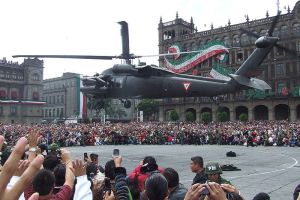
    UH-60 Black Hawk fotografiádo después del desfile militar del 15 de septiembre de 2009 en la ciudad de méxico

    Mexican UH-60 Black Hawk lands in the Zocalo, Mexico City’s main square, 15 September 2009. (Source: Wikipedia)

    If the ‘War on Drugs’ logic is followed, the event should mark the beginning of the end of drug-related violence in Mexico. But the lessons from the elimination of Pablo Escobar and the defeat of the Medellín (and later Cali) cartels in Colombia suggest otherwise. Whether El Chapo continues to run operations from jail, full leadership is assumed by the remaining commander, or the group breaks into smaller factions, the drug business is likely to survive.

    What could be reinforced is the trend to fragmentation already in place, which does not necessarily means less violence, at least in the short and medium term, and could give birth to a decentralized and networked drug business. In this sense, Mexico could well be now where Colombia was 15-20 years ago.

    Colombia’s success narrative

    Despite their different insertion into the global political economy of drugs, both countries are remarkable examples of militarized approaches to the drug war promoted by the US in Latin America (and beyond). The focus is almost entirely on the supply side: criminalization, eradication and aggressive enforcement with the aim to put a halt to the global supply of illegal drugs. The burden is mostly assumed by countries of production and transit that are evaluated on an annual basis against compliance with those prescriptions.

    The terms of the debate about this issue have until recently been limited and based on partial evidence in at least two aspects. Success is measured by the figures of crops eradication, detentions and seizures of drugs, not by net impact on the trade (drug availability and market prices). And the consequences in violence, violations of human rights, marginalization, corruption and institutional failure, have been exclusively attributed to illegal drugs and organized crime and not to the war on drugs itself. Fortunately, those terms are changing and a range of new voices, including at highest political levels, are joining a necessary and urgent discussion.

    Colombia has undertaken an amazing journey in this regard. Once criminalized in the international arena through its identification with the drug trade, in recent years it has been promoted as the brightest example of success in the drug war. The narrative of success is based on two main elements: the defeat of the big cartels in the 1990s and Plan Colombia in the 2000s.

    However, the story has critical under-reported angles. What followed the demise of Medellin and Cali was not elimination of the drug trade but the decentralization and fragmentation of the market into around 300 smaller, flatter and networked groups. The Revolutionary Armed Forces of Colombia (FARC) – and, to a lesser extent, National Liberation Army (ELN) insurgents and United Self-Defense Forces of Colombia (AUC) paramilitaries – furthered their involvement in the drug business and provided the armed ‘muscle’ in order to finance their nation-wide expansions.

    Moreover, the biggest cocaine profits shifted from Colombia to Mexico, contributing to the financial and armed power of its drug trafficking groups as the smaller rings and armed actors in Colombia lacked the power, contacts and/or will to control international logistics and operations, not to mention distribution in the US. The vacuum was filled by the Mexican cartels that established a direct buying presence in Colombia (and later Peru), logistic bases in the Caribbean and Central America for transportation, and distribution networks in the US market.

    Plan Colombia

    The largest counter-drugs programme ever launched, Plan Colombia was funded by the US with more than $7 billion to conduct massive aerial spraying of illicit crops and provide equipment and training to the Colombian armed forces.

    The focus of Plan Colombia was counter-insurgency against the FARC, particularly after the US Congress unblocked in 2002 the use of counter-drug funds for counter-terrorism. The group was weakened by increased state military power and mobility, and is currently involved in peace talks with the government. But it retains 8,000 combatants and has increasingly relied on urban militias. More importantly, despite the propaganda, the FARC was never the only (nor main) group involved in drug trafficking.

    The AUC paramilitaries had a mixed criminal-political character from their beginnings. Born out of an array of self-defence groups and narco-trafficking interests, these two ‘souls’ coexisted for years but the drug trade eventually prevailed. The demobilization of more than 31,000 AUC combatants in 2006 was immediately followed by the emergence of 30 new criminal groups that drew membership from former AUC members and mid-level commanders and sought (and eventually won) control of cultivation and trade in areas and routes formerly under paramilitary control.

    With an estimated initial membership of 4,000 members, these new criminal groups later expanded throughout the territory and are now present in 17 out of 32 departments. Those groups have never been a unified project but an array of decentralized criminal networks. Infighting and shifting alliances are the norm among them and with sectors of the FARC and the ELN also involved in drug trafficking. According to the Colombian police, they were responsible for half the total murders committed in 2010.

    Uncounted costs

    The Colombian success in the war on drugs has been partial at best and come at a high price. Taking the accumulated figures of the US International Narcotics Control Strategy Report, around 2 million hectares have been fumigated to eradicate crops since 2000. Massive herbicide spraying destroyed coca, but also livelihoods and protected natural areas, and impacted food security, health and the environment. The complex marginalization problems of rural communities that resort to coca as a livelihood strategy were addressed through securitization and criminalization (coca farmers have often been identified with the FARC). The result, for many, was forced displacement and further vulnerability. Cultivation expanded to new areas and departments, and fragmented as a result.

    The levels of violence have decreased slightly nowadays, but the homicide rate stayed at 32 for 100,000 in 2013, well above Mexico in its worst year of violence (2011, with 24 for 100,000). Also in 2013, between 140,000 and 219,000 persons (depending on the sources) were forcibly displaced in Colombia. Those figures are lower than in the past but nonetheless immense and add to a total of 6 million people forcibly displaced since 1985. The specialized agency Insight Crime interprets the current high incidence of this phenomenon in the Pacific regions and intra-urban settings as an indicator of displacement by criminal –not political- violence.

    Mexico’s War on Drugs

    Regardless of the real situation on the ground, those policies (and apparently, the high levels of popular support enjoyed by then Colombian president Alvaro Uribe) inspired President Felipe Calderón to launch an all-out war against drugs in Mexico in 2007. Around 100,000 soldiers and thousands of marines were deployed to fight the cartels in an effort to overcome the problems of corruption and ineffectiveness of the police forces, a policy later backed by the US under the Merida Initiative. The strategy got results, with relevant high and mid-level commanders of drug trafficking groups captured or killed, and seizures of illegal drugs soaring amidst the crackdown.
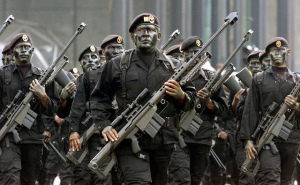
    Mexican Special Forces with Barrett M82 sniper rifles.

    Mexican Special Forces with Barrett M82 sniper rifles. (Source: Wikipedia)

    But the destabilization of the drug market triggered an escalation of violence. Violent competition for power erupted within the groups and coalitions as leaders were eliminated, coupled with fierce battles for territorial control among groups. The response against the state scaled up with the cartels creating militarized wings and using sophisticated military weaponry and tactics to fight the military and the police. The process of fragmentation and decentralization accelerated and the six big cartels of 2006 have split into around 15 today, coupled with a diversification of transnational criminal activities and soaring incidences of kidnapping and extortion. The Sinaloa Federation and the Zetas remain the most powerful cartels but have also suffered splits and setbacks.

    More than 60,000 people have died and 26,000 ‘disappeared’ in just six years. The formerly respected military have been accused of grave human rights violations including extrajudicial killings and forced disappearances. More than 4,000 complaints for human rights violations by military personnel were filed in 2006-2010 This was more than the total figure for the previous 15 years.

    Mexico has come under close scrutiny by the Inter-American Court on Human Rights and other international institutions. On June 12, the UN Special Rapporteur on extrajudicial, summary or arbitrary executions warned about unacceptable levels of violations to the right to life and impunity. Although recognizing some positive steps by the government of Enrique Peña Nieto, he warned that “a heavy-handed military approach is unlikely to improve the situation” and what is needed is “systematic, holistic and comprehensive strengthening of the rule of law”.

    As in Colombia, the Mexican victims of violence face further victimization as the government and sectors of the media dismiss them as criminals. Families and civil society groups claiming for justice may become targeted themselves. Unabated violence and institutional failure are the factors behind the emergence of armed self-defence groups, first in Michoacán and Guerrero and currently in around 10 states, as civilians take up arms to face lawlessness and fight the cartels (and sometimes corrupt authorities). This adds a new layer of armed actors whose evolution may not be easily put under control.

    Challenging the Colombian success narrative

    In Colombia, and later in Mexico, the militarized drug wars have proved ineffective in halting the drug trade but their impact is hugely negative on security and human rights, development and governance. While marginalization feeds the illegal economy, the securitized responses criminalize communities and add abuses and institutional failure to the problem of exclusion. The focus on the military also delays the hugely needed efforts to establish functioning justice systems and effective rule of law. Meanwhile, the drug business learns and adapts, moving from strict hierarchies to networked configurations.

    Despite those evidences, growing international debates about drug policies and a shifting internal public opinion, the US continues to promote a securitized approach to drugs that is most evident now in Central America. The use of Colombia as a symbol of success for Mexico and others, and as an actual ‘proxy’ to provide support in counter-narcotics and counter-insurgency to third parties including West Africa, should raise some basic questions about the premises, effectiveness and potential consequences of those policies.

    This month, the West African Commission on Drugs – an expert panel convened by Kofi Annan and chaired by former Nigerian president Olusegun Obasanjo – has called for decriminalization of drug use and to “avoid militarisation of drug policy and related counter-trafficking measures, of the kind that some Latin American countries have applied at great cost without reducing supply.”

    This potentially brings West Africa into line with the Organisation of American States, which in a report of May 2013 proposed “alternative legal and regulatory regimes” for tackling drugs, starting with cannabis”. Uruguay has already decriminalized cannabis and Colombia’s President Juan Manuel Santos, re-elected this month, has at times advocated drug policy reform. Enrique Peña Nieto has recently called on the US to start an open debate and a revision of ‘failed’ hemispheric policies whose outcome has been the rise of drug production and consumption.

    There are growing calls internationally to open a global debate over drug use and the policies needed to address it, including addressing demand in consumer countries. No less a figure than Sir William Patey, British Ambassador to Afghanistan from 2010 to 2012, has called for legalization of the heroin trade as the war on drugs in Afghanistan fails to address the complex problems at the roots of opium cultivation. Dozens of high profile British individuals and organisations, including the Prison Governors Association, have also called for decriminalization of drug use.

    The debate seems to be reaching a tipping point as the numbers and diversity of the sceptical and critical voices grow worldwide. Now it is the turn of policy makers to listen and act.

    Mabel González Bustelo is a journalist, researcher and international consultant specialized in international peace and security, with a focus on non-state actors in world politics, organized violence, conflict and peacebuilding. You can follow her at her blog The Making of War and Peace, her webpage, and Twitter (@MabelBustelo).

  • Kenyan Somali Islamist Radicalisation

    Kenyan Somali Islamist Radicalisation

    Africa Briefing N°85 | International Crisis Group | January 2012

    Issue:Marginalisation

    The following briefing from Crisis Group illustrates the Islamist radicalisation of ethnic Somalis in Kenya, and the causes behind the trend. Decades of economic marginalisation of the Somali-dominated North Eastern Province border region has combined with government and public suspicion of ethnic Somalis to produce an unpleasant climate where either Somali loyalty is questioned, or Somalis are accused of ‘taking over’ when they move into the cities or succeed in business and politics. On the other hand, this has been compounded by the shift of East African Muslims in general away from Sufism and towards the conservative strand of Wahhabi Islam that posits the Muslim umma against the secular state, thereby enabling Somalia-based Al-Shabaab to capitalise on grievances in Kenya and encourage oppositional and even irredentist tendencies. The response of the government has overwhelmingly been one of force.

    Particular forms of marginalisation have exacerbated the grievances resulting from economic underdevelopment and government violence. Until recently, poor Muslim children were often excluded from mainstream education, restricting their options to Wahhabi-dominated madrasas which promoted the radicalisation of disaffected young Muslims. The Muslim establishment itself is also frequently dismissed as elitist and tied to the government (regardless of who happens to be in power at the time). This includes the Supreme Council of Kenya Muslims (SUPKEM) which, despite its closeness to the regime, has failed to modify the heavy-handed state responses to Muslim radicalisation.

    Crisis Group recommends that the Kenyan government cease to view the issue of radicalisation purely through an anti-terrorist lens and recognise the difference between ‘radicalisation’ and ‘extremism’. It is not necessarily a given that the former lead to the latter; and by addressing the issues of marginalisation of Somalis in particular and Muslims in general, Kenya can impede the growth of Al-Shabaab style militancy within its own borders.


    Overview, 25 January 2012

    Somalia’s growing Islamist radicalism is spilling over into Kenya. The militant Al-Shabaab movement has built a cross-border presence and a clandestine support network among Muslim populations in the north east and Nairobi and on the coast, and is trying to radicalise and recruit youth from these communities, often capitalising on long-standing grievances against the central state. This problem could grow more severe with the October 2011 decision by the Kenyan government to intervene directly in Somalia. Radicalisation is a grave threat to Kenya’s security and stability. Formulating and executing sound counter-radicalisation and de-radicalisation policies before it is too late must be a priority. It would be a profound mistake, however, to view the challenge solely through a counter-terrorism lens.

    Kenya’s North Eastern Province emerged as a distinct administrative entity dominated by ethnic Somalis after independence. It is, by most accounts, the worst victim of unequal development. A history of insurgency, misrule and repression, chronic poverty, massive youth unemployment, high population growth, insecurity, poor infrastructure and lack of basic services, have combined to produce some of the country’s bleakest socio-economic and political conditions.

    Two decades of conflict in neighbouring Somalia have also had a largely negative effect on the province and Kenyan Somalis. The long and porous border is impossible to police effectively. Small arms flow across unchecked, creating a cycle of demand that fuels armed criminality and encourages clans to rearm. Somali clan-identity politics, animosities and jingoism frequently spill over into the province, poisoning its politics, undermining cohesion and triggering bloody clashes. The massive stream of refugees into overflowing camps creates an additional strain on locals and the country. Many are now also moving to major urban centres, competing with other Kenyans for jobs and business opportunities triggering a strong official and public backlash against Somalis, both from Somalia and Kenya.

    At the same time, ethnic Somalis have become a politically significant minority. Reflecting their growing clout, Somali professionals are increasingly appointed to impor­tant government positions. The coalition government has created a ministry to spearhead development in the region. A modest affirmative action policy is opening opportunities in higher education and state employment. To most Somalis this is improvement, if halting, over past neglect. But the deployment of troops to Somalia may jeopardise much of this modest progress. Al-Shabaab or sympathisers have launched small but deadly attacks against government and civilian targets in the province; there is credible fear a larger terror attack may be tried elsewhere to undermine Kenyan resolve and trigger a security crackdown that could drive more Somalis, and perhaps other Muslims, into the movement’s arms. Accordingly, the government should:

        * recognise that a blanket or draconian crackdown on Kenyan Somalis, or Kenyan Muslims in general, would radicalise more individuals and add to the threat of domestic terrorism. The security forces have increased ethnic profiling but otherwise appear relatively restrained – especially given past behaviour; still, counter-terrorism operations need to be carefully implemented and monitored, also by neutral observers;

        * develop effective, long-term counter-radicalisation and de-radicalisation strategies. A link exists between radicalisation and terrorism, but counter-terrorism tactics aimed only at stopping Al-Shabaab and other militant groups should not become the only official response. Counter-radicalisation – reducing the appeal of radicalism – and de-radicalisation – persuading people who are already in radical organisations to leave them – are long-term processes that require tact and patience.

        * allocate, along with donors, additional state and development resources to North Eastern Province and elsewhere to rectify decades of neglect and end some of the social problems that drive radicalisation;

        * study madrasas, perhaps through a local university, to learn which are most radical and influential, both to better understand the problem of their radicalisation and to moderate extremist teachings; create a Muslim Advisory Council of respected leaders, open to hardliners, but representing all Kenyan Muslims, that is responsive to the community’s concerns and aspirations, able to articulate its message to those in power and competent in formulating the reform measures needed to improve its well-being; and

        *develop a process, with community input, for selection of a Grand Mufti: Kenya, unlike many African countries, has no supreme Muslim spiritual leader whose primary function is to provide spiritual guidance, and when necessary, make binding pronouncements on vexed issues by issuing edicts (fatwa). It would be difficult, of course, to find a unifying figure, given the sectarian and regional tensions, but it should be feasible.

    Because of the policy immediacy relating to Kenya’s intervention in Somalia, this briefing focuses on Kenyan Somali radicalisation. The growth of Islamic extremism among Kenyan and Tanzanian Muslims on the coast will be the subject of a future study. The recommendations, nonetheless, apply to all of Kenya.

    Nairobi/Brussels, 25 January 2012


    To view the original Overview and download the full report, click here

    Image Source: tik_tok

  • Sustainable Security

    Award-winning reporter Jakob Sheikh talks about his work interviewing the Danes who travelled to Iraq and Syria to join the jihad. 

    Q. Since 2001, there has been much written on terrorism and more specifically the global jihadi movement, and this trend has continued with the rise of Islamic State. Your research is quite unique as it has involved interviewing those who have joined the Jihad. Why did you decide to take this approach to understanding jihadism and what did you hope to learn from talking to jihadis?

    When I started covering militant Islamism in 2012, I noticed that the great bulk of articles written on this topic dealt with jihadists quite superficially. Most often, reporters where talking about jihadists; not with jihadists. So I began building trustful relations with Danish militant Islamists. I put a lot of time and effort in meeting consistently with figures—even rather unimportant ones— in the Danish militant Islamists milieu, enabling me to get access to  otherwise unavailable sources and interview foreign fighters in Denmark, in Syria during their time with the Islamic State, and even back in Denmark when some of them had returned.

    The goal of my reporting is quite simple. In order to deal with a challenge that is generally considered a threat to national security in most Western countries, we need to understand the very nature of this challenge.

    Sadly, we often tend to simplify or generalize when it comes to foreign fighters. We alienate radical Islamists from ourselves as if they have nothing to do with our society. However, the fact is that most European foreign fighters are born—or at least raised—in Europe. They are shaped by upbringings in European societies; they attend public schools, play in the local football club and so forth. By many measures, they are products of modern Europe.

    This leads to a very important question: How does modern Europe deal with this ever-evolving problem? I hope that my reporting has shed light on the backdrop of this question.

    Q. In your research, have you noticed any common traits in the backgrounds of Denmark’s foreign fighters (age, gender, profession, geographical location) and their pathways into joining the Jihad?

    Image credit: CREST Research/Flickr.

    This is an interesting question as some of the foreign fighter traits are in fact quite counter intuitive. It’s easy to state the obvious: most foreign fighters are young men and the vast majority have family roots outside the European continent.

    But there are other interesting traits to mention. When I started collecting socioeconomic background data on Danish foreign fighters, I was expecting to find individuals from poor families who were economically and educationally marginalised. However, while the main part had struggled with social challenges of some sort—their parents’ divorce, a mental diagnosis, deaths in the near family, etc.—I discovered that a great number of Danish foreign fighters were average middle class kids, not raised at the bottom of society (one even played the cello and lived in a sumptuous villa with his well-educated parents).

    Also, I would have assumed that most foreign fighters would come from strictly conservative Muslim families. But in fact, a significant number of Danish foreign fighters with non-Western backgrounds came from families that were remarkably secular and liberal. I find this particularly interesting as it says something important about the way we deal with the notion of converts. We generally consider converts to be ethnic Danes or ethnic Swedes or ethnic Brits who suddenly converts to Islam and get radicalised—as opposed to individuals with Muslim family backgrounds. But what we see now is that most foreign fighters are in fact converts—some may just have Muslim family roots. In many ways, these converts from Muslim families share their pathway into the jihadist milieu with that of “regular” ethnic Danish converts; they do not feel strongly about religion, something happens along the way, they are socially marginalized, perhaps they enter a criminal environment, and at a certain point in time they are intrigued by Islam as a way out of their problems. Often, the radicalisation process that follows completely changes their approach to Islam—just as with the Danish converts who have no previous experience with Islam whatsoever.

    To me, this shows that we need to study the inner motivations of jihadists. Common socioeconomic traits simply doesn’t do the job when it comes to explaining why foreign fighters decide to wage jihad. Despite many so-called experts’ attempts to tell you otherwise.

    Q. In terms of the motivations of Denmark’s foreign fighters, you’ve previously stated that grievance over Denmark’s activist foreign policy has been an important driver. Yet one of the things that stands out in your interviews with foreign fighters is this idea of “the state” as a cause. What does this concept of “the state” mean to the foreign fighters you spoke to and why is it such a powerful idea that it is worth travelling many miles across the world to fight and die for? 

    As mentioned, many of the things the foreign fighters told me during interview ran counter to common assumptions. My own, at least.

    The very idea of a state was a recurrent narrative among IS fighters. In fact, several fighters consider this notion a direct motivation for joining the battlefield.

    They stress the fact that they are not just joining an insurgency; they are joining a state. As much as they see themselves as fighters, they see themselves as immigrants who want to settle down and build a future.

    As I have pointed out before, when jihadists use the term “dawla” [“state” or “nation”] they are often not referring to the group, but rather to the so-called caliphate itself. They speak of a place that represents a home to them. This also explains why foreign fighters usually are more likely to refer to propaganda videos released by IS about the daily life in IS held areas rather than brutal executions and so on.

    A Danish born Salafi with Pakistani roots named Shiraz Tariq, who is perhaps the most prominent jihadi figure in Denmark, often spoke of the state as a goal in itself.

    “My goal is to fight the infidels until the state is implemented,” he told me in an interview from Syria.

    To at least some parts of Danish foreign fighters, institutional aspects such as economic systems, schools, and legal systems are key in their justification of violent jihad. They talk about “protecting the state” rather than protecting Islam, or protecting the group.

    That said, the fall of Raqqa completely changes this motivation. In many ways, I see the fall of Raqqa as way more decisive than the fall of Mosul. It is a major blow to IS’ ability to mobilize and recruit soldiers to the local war in Syria and Iraq. Not just because of the military defeat but even more so because the defeat destroyed the notion of state building that IS offers to its followers.

    Q. How did the fighters you interviewed describe life inside the state and what sort of roles did they undertake?

    Like in many other countries, Denmark has foreign fighters in the upper ranks of IS and regular foot soldiers in the fields. I spoke to jihadists who were very close to the local “emir” or “wali” and to jihadists who were not even taking part in the fighting.

    I’ve met with returnees who’ve returned further radicalized in terms of both ideology and fighting skills. But—and this is important—I’ve also met several jihadists who’ve returned to Denmark deeply disillusioned about what they experienced in Syria and Iraq. A prominent 28 year old jihadist told me upon his return to Denmark that he’d “never seen anything that un-Islamic”. The notion of “takfir” is taken to a level where some jihadists—despite the official IS narrative about jihadists having no scruples killing non-IS-fighters—are left in deep disagreement with the strategy.

    To me, this disillusion upon return may be the best chance in terms of aiding counter-radicalisation efforts.

    Another important aspect we need to be aware of is the mindset of foreign fighters. Before and after our talks, several jihadists would often send me pictures and videos that would somewhat glorify the daily life in the caliphate. Here, we’re talking about videos of children fooling around and playing in a fountain, women shopping in the bazaar, pictures of toyshops, and so on.

    What’s striking about these pictures and videos is that they often ran counter to the actual situation and reality of life inside the IS-held territories. While IS as a group were losing ground and were severely hit by drone strikes, the propaganda spoke of harmony and almost heavenly peace.

    The question, then, is: Were the jihadists I interviewed consciously neglecting the fact that they were on the verge of losing their war? Or were they simply not aware of what was going on?

    In my opinion, the answer is none of the two. In fact, it seemed to me—though psychiatrists may need to study this further—that the “real” world and the “imaginary” world of peace and harmony existed side by side, next to each other. In the mind of a jihadist, it is not necessarily contradictive to live in a real world of fighting and a virtual world that enables you to dream about how a perfect caliphate should look like or how a new Islamic golden age should look like. These two perceptions actually seem to complement each other. The frightening thing, however, is that when the border between these two perceptions gets blurred, some jihadists don’t seem to be able to separate the two.

    Q. There has been a lot of discussion about the role of religion as a driver of the foreign fighters, including the role played by mosques. How influential have Danish mosques been in the radicalisation of foreign fighters?

    Interestingly, very few militants mention that they get their religious inspiration from the mosques. In fact, militant Islamists—at least in Denmark—are quite skeptical towards the mosques, especially mosques that are considered to be “moderate” by mainstream society. I would assume this goes for other European countries as well. This is due to widespread conspiracies that the mosques are in fact right-hand men for the Danish government or the intelligence service.

    Rather than trusting what is preached in the mosque, many Danish foreign fighters rely almost exclusively on their close friends—and certainly not open communities such as mosques where rumors are spread quickly.

    That said, I think it would be a huge mistake to underestimate the role of religion when it comes to foreign fighter mobilization. While you can argue that the social and political dimension were more prevalent driving factors during the first years of the Syria civil war, I find religion—or at least arguments rooted in Islamic texts—to play a quite decisive role today and even since early 2015.

    The fundamental ideology of IS is deeply Islamic.

    Jakob Sheikh is a multi-award-winning investigative reporter who worked as staff writer with Danish daily Politiken, one of Scandinavia’s leading newspapers. Since 2012, he has focused on radicalization and foreign fighters. In 2015, he released his book on Danish Islamic State fighters based on numerous interviews with returned and current jihadists as well as key figures in the militant Islamist environment in Scandinavia. In February 2017, he joined the Danish Ministry of Justice as a special advisor to the minister.

  • Competition over resources

    Competition over resources

    In the environmentally constrained but more populous world that can be expected over the course of this century, there will be greater scarcity of three key resources: food, water and energy. Demand for all three resources is already beyond that which can be sustained at current levels. Once population growth and the effects of climate change are factored in, it is clear that greater competition for such resources should be expected, both within and between countries, potentially leading in extreme cases to conflict.

    Climate change and conflict: lessons from community conservancies in northern Kenya

    Issues:Climate change, Competition over resources

    In November 2009, Saferworld, the Conservation Development Centre, and the International Institute for Sustainable Development launched a new report on climate change and conflict in Kenya. “The theoretical case for the connections between climate change and conflict has been well articulated, but we’re still learning how this relationship manifests itself in practice,” said Ivan Campbell, Senior Advisor on Conflict and Security at Saferworld. “This study tests that theory against realities on the ground in Kenya – and then makes practical and targeted recommendations in response to the actual policy context”.

    Read more »

    Multiple Futures Project – Navigating Towards 2030

    Issues:Competition over resources, Global militarisation, Marginalisation

    In March 2008, the Supreme Allied Commander Transformation called for NATO to consider “that different views of future worlds will strengthen our endeavor to develop a more rigorous and holistic appreciation for future security challenges and implications for the Alliance.”

    The result, a Multiple Futures Project (MFP), acknowledges that in a rapidly changing global security environment, the landscape we know may be very different in 2030. It puts forward four plausible worlds upon which structured dialogue on  risks and vulnerabilities can occur: Dark Side of Exclusivity, Deceptive Stability, Clash of Modernites, and New Power Politics.

    Read more »

    Climate Change and the Military

    Issues:Climate change, Competition over resources

    Tom Spencer, CCTM Project Coordinator The Climate Change and The Military (CCTM) Project, based on the co-operation of a group of leading think tanks, “will orchestrate a strong message from the security sector to the December 2009 climate change negotiations taking place at COP 15 in Copenhagen” according to Tom Spencer, the CCTM Project Coordinator (pictured left).

    A recent report  for the CCTM “aims to describe the state of the current debate on climate change and security, and provide a framework for discussion in which the military can play a clear role in the debate on climate change mitigation and delivering sustainable human security, while starting to address the direct impacts of climate change on its core aims of national security, regional and global stability.”

    Read more »

    The heart of India is under attack

    Arundhati Roy | guardian.co.uk | October 2009

    Issues:Climate change, Competition over resources, Marginalisation

    Odd, isn’t it, that even after the Mumbai attacks of 26/11, the government was prepared to talk with Pakistan? It’s prepared to talk to China. But when it comes to waging war against the poor, it’s playing hard

    This article was originally posted in the guardian.co.uk’s comment is free section.

    Picture: Dongria Kondh’s Sacred Mountain in Orissa (angryindian.blogspot.com)

    Read more »

    Climate Change: Impact on Agriculture and Costs of Adaptation

    Various | International Food Policy Research Institute | September 2009

    Issues:Climate change, Competition over resources

    This Food Policy Report presents research results that quantify climate-change impacts, assess the consequences for food security and estimate the investments that would offset the negative consequences for human well-being. Read more »

    Impact of Climate Change on Agriculture

    Issues:Climate change, Competition over resources

    A report published on the 30th September by the International Food Policy Research Institute (IFPRI) estimates that 25 million more children will be malnourished by 2050 due to the effects of climate change. The report predicts that climate change will lead to price increases for the most important agricultural crops: rice, wheat, maize and soybeans. Wheat prices are projected to increase globally by 170 – 191% whilst rice prices may increase by 113 – 121%.

    Photo: Bluemoose Official License

    Read more »

  • Sustainable Security and Environmental Limits

    Sustainable Security and Environmental Limits

    Rachel Tansey | Quaker Council for European Affairs | May 2011

    Issues:Climate change, Competition over resources, Global militarisation, Marginalisation

    “Sustainable security – A briefing for Friends“, has been co-produced by peace and security think tank the Oxford Research Group (ORG), Northern Friends Peace Board (NFPB) and Quaker Peace & Social Witness (QPSW) in order to stimulate discussion, reflection and action among Quakers.

    Sustainable security is a paradigm that recognises we must work to tackle the causes of insecurity, not respond to it with attempts to control, often by military means. It is about curing the disease, rather than fighting the symptoms. The briefing identifies the major trends likely to cause large scale loss of life and security over the coming decades as:

    • marginalisation of the majority world (the global South);
    • climate change;
    • competition over resources;
    • global militarisation.

    With respect to environmental limits, the briefing says the following;

    The earth, which is abundant in natural and material resources, has been used to fulfil
    the desires (some essential, some not) of the population that lives on it. Many of the
    resources which have been exploited, such as fossil fuels, cannot be replaced; the extraction of others places habitats and ecosystems in danger; others produce damaging pollutants when used.

    The treatment of the natural world by humankind has contributed towards the two
    related major trends that are likely to drive insecurity in the coming decades: climate
    change and competition over natural resources.

    Climate change is high on the international political agenda. The likely and actual physical effects of these processes are well documented; the earth will be changed. Climate change will also have dramatic social and economic impacts. For example: a loss of, or damage to, infrastructure, shifts in disease patterns (e.g. spread of diseases like malaria and dengue fever, as the mosquitoes that transmit the infection are able to inhabit new locations because of changing temperatures), human crises as a result of more frequent extreme weather events such floods, water scarcity, and the mass displacement of peoples as some regions become uninhabitable. These trends could produce serious security consequences.

    A closely related driver of insecurity is competition over resources. The planet is more heavily populated than ever, and today some populations are already consuming far more than their share of the planet’s resources. As population growth continues, there will be greater scarcity of resources including food, water and energy, particularly if consumption patterns also increase. Once major demographic changes and the effects of climate change are factored in, greater competition for such resources should be expected. This will have local and global effects, as those nations rich in natural resources become subject to competition between local populations and international corporations who wish to buy their resources for sale in other parts of the world.

    Resource-conflict is already an issue: many anti-war activists cited oil as a cause behind the invasion of Iraq (central to the Persian Gulf, an oil-rich region) in 2003; water access is an ongoing source of tension between Syria, Lebanon, Jordan and Israel and the occupied Palestinian territories around the River Jordan basin; and in the same region, there are differences in how much water Israeli settlers and Palestinian inhabitants of the West Bank are able to access. The final example will relate in future also to climate change, as the Middle East is highly likely to suffer increased occurrences of drought. Competition will make some existing conflicts worse, and produce new struggles.

    These two related environmental crises will disproportionately affect the poor, and further entrench marginalisation. The Climate Justice movement has been prominent in describing the injustice of this situation: it is the poorest that have contributed least to the greenhouse gas emissions that are catalysing climate change, yet they will suffer most because of it.

    Read the whole briefing here.

    The above illustrates the normative underpinnings of QCEA’s sustainable energy security programme, and may help people understand why Quakers, with a strong tradition in working for peace, justice and equality, are working on issues related to sustainability, and indeed, energy security. It is precisely because the issues of climate change and increased competition over resources, including energy, have such strong implications for peace, justice and equality, that they cannot be ignored. The political importance of energy (and more broadly, resource) security, at European level, is a strong driver of traditional, militaristic security concepts – where “our” security increases the insecurity of others. It is this concept that the Quaker Council for European Affairs, by emphasising sustainable energy security – a sustainability that recognises both environmental and social sustainability not just within Europe, but in the wider world – urges against.

    Article source: Quaker Council for European Affairs

    Image source: kretyen

    Comments

    Post new comment