Blog

  • The UK’s foreign fighters in Syria: rethinking the threat

    The announcement of fresh counter-terrorism powers in the UK follows assertions that returning foreign fighters present a substantial new threat to national security. But these powers may be counter-productive in the long term, risking a legacy of injustice that will only exacerbate the political tensions of the War on Terror.

    The Counter-terrorism and Security Bill announced in the UK in November includes new powers aiming to limit the flow of people travelling to train and fight with certain rebel groups in Syria and Iraq. The proposals, due to be rushed onto the statute book in January, include the extension of controversial powers to disrupt travel and strip citizenship from terrorism suspects. Life sentences for a greater range of terror offences, including training, are also proposed. The British bill follows a US-drafted UN Security Council resolution to criminalise al-Qaida or Islamic State (IS)-linked foreign fighters which was adopted in November. Similar measures are being debated in other European countries and Australia.

    The reason for this wave of legislation? On the back of reports of unprecedented numbers of foreigners travelling to fight in the Syrian conflict, there has been a near-universal consensus amongst the security and intelligence community that returnees present a heightened national security threat. Returning foreign fighters, it is feared, will be networked, skilled up, and angry. The threat of political violence is ‘inevitable’, according to senior EU counter terrorism officials.

    Despite these fears, there is little in the way of a historical precedent in the UK to indicate that returning foreign fighters do represent an increased national security threat. The lack of evidence to support these claims is one of several legal and practical difficulties. Existing laws are already being used to criminalise foreign fighters in Syria’s conflict. The overwhelming application of such laws to Muslim communities has raised concerns that the legal principle of parity before the law is at risk. There is also a lack of accountability and oversight of these cases due to the use of secret evidence.

    The long term efficacy of such measures is therefore questionable. They may be a distraction from the underlying dynamics driving political violence, which are known to relate primarily to grievances over foreign policy. The abandonment of the principles of justice and equity before the law are likely to exacerbate resentment and the perception that the West is ‘at war with Islam’. The UK’s counter-terrorism policies may be creating a legacy of injustice that risks exacerbating the underlying political antagonisms of the War on Terror.

    Threat level: Severe?

    In response to the risk posed by returning foreign fighters, the UK’s terrorism threat level was again raised to ‘severe’ in late August. Although exact figures are not known, the number of those who have travelled from the UK to fight in the Syrian conflict is estimated to be at least 500 since 2011. The extent to which the Syrian conflict has mobilised fighters from Europe is clearly significant: key to this is the ability of groups such as IS to attract recruits via its propaganda films and social media activities conducted in European languages.

    But not all those who have gone to fight are with IS. The reality of the Syrian conflict is that there are over 2,000 fighting groups in Syria, including some with affiliation to al-Qaida. Little is known about group affiliations of the UK’s foreign fighters. Even individuals that are fighting with proscribed organisations, such as Islamic State or Jabhat al-Nusra, will have varying personal affiliations. Primary source reports collected by journalists and advocacy groups indicate that the primary motivation for those going to fight is a moral duty to fight the Assad regime (See for example, ‘Blowback: Foreign Fighters and the Threat they Pose’, CAGE, July 2014; ‘Joining ISIS: My Meeting with Aseel Muthana’, Huffington Post, 25 June 2014; ‘From Portsmouth to Kobane: the British jihadis fighting for Isis’, New Statesman, 6 November 2014). The reports suggest that, partly due to practical reasons, certain larger groups with more resources such as IS have absorbed the most foreigners. One of these reasons is that some other groups’ vetting procedures present a barrier to foreigners wanting to join.

    There are also legitimate questions over the wisdom of excluding foreign fighters from their countries of residence. Following reports that disillusioned fighters have been caught ‘in limbo’ in Turkey, wanting to leave but afraid to come home, some have called for alternatives, such as pastoral re-integration programmes existing separately from criminal investigation proceedings. A programme in Denmark provides an example of how such a scheme could function.

    Context: Terrorism laws in the UK

    The latest developments have occurred in the context of an increasingly securitised response of the UK to Islamist movements globally. Since 2001, the UK has progressively increased its set of counter-terrorism powers with a succession of laws, most of which have been fast-tracked and introduced as emergency legislation only to be made permanent. The UK’s multi-pronged CONTEST strategy conceives of the battle against terrorism on four fronts: Pursue, Prevent, Protect, and Prepare. The Prime Minister has promised to increase resources to these programmes. Yet intelligence resources dedicated to countering al-Qaida-linked terrorism already dwarf those that were dedicated to countering the threat posed by the Soviet Union and its allies even at the height of the Cold War, as observed by Sir Richard Dearlove, former head of the British Secret Intelligence Services at a Royal United Services Institute talk earlier this year.

    There is nothing in the UK’s legal definitions of ‘terrorism’ that specifies Islamist activity. ‘Terrorism’ was defined in a Supreme Court judgment last year to include “any or all military attacks by a non-state armed group against any or all state or inter-governmental organisation armed forces in the context of a non-international armed conflict”. But the shadow of the 9/11 attack continues to shape the security services’ understanding of national security threats, and to shape the application of these laws, primarily to Muslims. The focus on ideology that can be linked to al-Qaida, and the search for evidence of ‘jihadist worldviews’ conflates the criminal and the non-criminal, the threatening and the non-threatening. It leads to a skewed application of laws to those whose ideas or religious beliefs can be superficially associated with those of the UK’s enemies. By comparison, the resources dedicated to tackling political violence by the far-right are minimal, and similar types of crimes attract lesser sentences. One recent example is a former British soldier who was a supporter of the English Defence League (EDL), handed a two-year sentence after nail bombs were discovered in his house. Despite the UK’s legal definition of “terrorism” that is consistently criticised for being overly broad, the soldier controversially avoided charges under terror legislation, instead he was found guilty of offences under the Explosive Substances Act.

    The Syrian conflict has prompted security services to make increasing use of counter-terrorism powers against UK residents suspected of travelling there, or planning to travel there. A series of high-profile arrests have occurred in the last years, most of which have not made their way through the judicial process. But several recent cases raise further questions over whether these powers are being applied fairly.

    There has been an inconsistent response to those understood to have fought against IS. The estimated dozens of British residents fighting with the Kurdish forces, it has been indicated, will not meet charges upon their return. The Prime Minister stated there was a “clear difference” between fighters with the Kurdish authorities and IS fighters; and stated that “highly trained border staff, police and intelligence services” would be able to distinguish between them. But one man from Derry, who explained he was also fighting against IS, but with the largest Islamic coalition was still arrested by Northern Ireland police upon his return.

    Long prison sentences for crimes under terror legislation are being handed out to returning foreign fighters. Last week, two Birmingham men, Mohammed Ahmed and Yusuf Sarwar, were convicted of engaging in preparation of terrorism acts and sentenced to 12 years in prison; they had spent several weeks in Syria in 2013. The pair were arrested upon their return to the UK in January 2014 after Sarwar’s mother reported him missing to the police. The judge concluded that the pair had not planned any attack in the UK; they received the sentence because they had joined proscribed organisation Kataib al-Muhajireen. According to former Guantanamo Bay detainee Moazzam Begg, who was a fellow inmate in Belmarsh prison, the pair were “young” and “bewildered”, and had not thought what they were doing was a crime. Two brothers were also jailed after attending a Syrian training camp for less than a month. Despite returning without having done any fighting, they were sentenced to four-and-a-half years and three years, respectively.

    Citizenship revocation powers on the grounds of national security have been increasingly deployed in recent years. In November, reports emerged that an entire family (a British-born father and three sons) had been exiled from the UK due to alleged links with al-Qaida-linked groups in Pakistan. The family deny the allegations, and are appealing the ban. A detailed investigation by the Bureau of Investigative Journalism revealed that the number of UK citizenship revocation orders on national security grounds tripled in 2013, taking the number since 2006 to twenty-seven. At least fifteen of these individuals were abroad at the time of the deprivation order.  The Foreign Office has cited the fighters joining the Syrian war as the reason for this increase.

    Where national security reasons are invoked (as they are in virtually all the cases brought under terrorism legislation), the substance of allegations is kept secret. However, police statements saying there is no immediate threat to the British public have accompanied virtually every recent Syria-related arrest (For example: Statement by Hampshire Police 14 October 2014; ‘Anti-terror police arrest five men in Dover and east London’, BBC 1 December 2014; ‘Police arrest man in Slough on suspicion of financing terrorism’ Guardian 13 November 2014; and a statement by the Head Teacher of the school where Jamshed Javeed worked ‘Teacher Jamshed Javeed admits Syria terror offences’ BBC 27 October 2014.)

    Syrian Exceptionalism

    UK citizens fighting in foreign wars are not universally criminalised. The Israeli Defence Force’s ‘Mahal’ programme enables foreign citizens to fight with the army in Israel, and these foreign fighters are not considered to be in breach of British law. The war in former Yugoslavia attracted fighters from Britain, many of whom were Muslims. After the beginning of the uprising against Muammar Gaddafi in Libya, UK nationals were known to be fighting against the regime with Islamist groups. Men who had been previously detained and investigated under counter-terrorism powers in the UK went on to fight against the Gaddafi regime – and were supported by the UK’s security services. Advocacy group CAGE reports a number of UK nationals – more than 100, by their estimates – who met no resistance from UK authorities when leaving the UK, or legal problems when they returned from Libya.
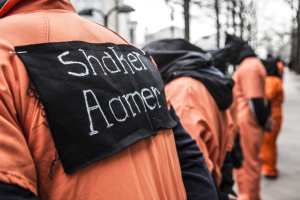
    Guantanamo Bay protest Shaker Aamer

    Protest to free Guantanamo Bay prisoners including Shaker Aaamer, the last British resident in Guantanamo Bay. Aamer has been detained without charge for over twelve years and cleared for release since 2007. Source: Flickr | shriekingtree
    The recent selective criminalisation of foreign fighters in the Syrian conflict points to a deeper flaw within broader US/UK ‘War on Terror’ era military strategy: the enemy is poorly defined. It is often noted that the US’ arming of the Afghan mujahideen rebels during their struggle against the Soviets in the 1980s was a key historical factor in the resulting al-Qaida network. In 2013 the UK was on the brink of going to war with the Assad regime, and came close to fighting on the same side as the rebel groups that it now seeks to vanquish. Fighters who left the UK at the beginning of the Syrian war have been criminalised in their absence and now face a major disincentive to returning to civilian life. The absence of a long-term strategy focused on peace and informed by an ethic of equity and justice has resulted in a confusing picture of shifting alliances.

    This militarised and reactive foreign policy results in shifting definitions of what constitutes terrorist activity at home. It is not only foreign fighters who are meeting overwrought security responses. Lawful activities such as charity work, political organising, membership of radical religious groups, and particular religious beliefs are increasingly caught up in the dragnet of counter-terror measures. The ongoing repression of Muslim charity organisations provides multiple examples of these blurred lines. The recent seven-month detention of Moazzam Begg is another.

    One lesson from the last twelve years is that injustices carried out in the name of counter-terrorism themselves have a deep, global resonance. The enduring resonance within Muslim communities of the well-documented abuse of Guantanamo Bay inmates is indicated precisely by the apparent effectiveness as a recruiting tool by Islamic State. The distinctive orange jumpsuits, as well as imagery from the abuse of Iraqi prisoners in Abu Ghraib jail, have appeared in IS’ videos, recycled as evidence of IS’ own ability to dominate. The UK, along with the US and France, is widely perceived negatively as having a ‘Crusaderist’ or imperialist project to divide and weaken the Muslim world. The selective criminalisation of foreign fighters has great potential to fuel such resentment further.


    Betsy Barkas is Oxford Research Group’s (ORG) Quaker Peace and Social Witness Peaceworker. She works as a Project Officer for ORG’s Sustainable Security programme, and co-edits sustainablesecurity.org.

    Image: Protest to free Guantanamo Bay prisoners including Shaker Aaamer, the last British resident in Guantanamo Bay. Aamer has been detained without charge for over twelve years and cleared for release since 2007. Source: Flickr | shriekingtree

  • Can the Nuclear Non-Proliferation Treaty outrun its double standard forever?

    NPT Double Standards 4President John F. Kennedy once said:
    “You cannot negotiate with people who say what’s mine is mine and what’s yours is negotiable.”

    However a small group of states (including the state of which Kennedy was President) have done just this in relation to the possession of nuclear weapons for decades. Five of them (China, France, Russia, the United Kingdom and the United States) have held the position of being the privileged few allowed to possess nuclear weapons under the terms of the 1968 Treaty on the Non-Proliferation of Nuclear Weapons (NPT)  while all others agree to forego developing the ‘ultimate weapon’ in return for access to civilian nuclear technology. Three others have refused to sign the treaty (India, Israel and Pakistan) and instead developed their own nuclear weapons (overtly in the cases of India and Pakistan after 1998 and covertly in the case of Israel from the late 1960s) happy to free-ride on the lack of global proliferation ensured by the treaty. To paraphrase Kennedy, the decision of these eight states (nine if you include North Korea from 2003 onwards) to inflict mass destruction on an adversary is theirs, but everyone else’s decision to acquire the same capability can be negotiated away.

    What is perhaps most extraordinary about the NPT ‘grand bargain’, as it is often called (although given that the five nuclear weapon states have exactly the same access to civil nuclear technology as the rest of the signatories, ‘bargain’ here really is a polite term for ‘scam’), is that it has remained largely intact for so long. For something built on such a seemingly unsustainable basis as an institutionalised double standard (particularly one that relates to the ultimate survival of nation states), the fact that its indefinite extension was negotiated in 1995 and that the treaty is still with us defies most conventional wisdoms about the ‘dog-eat-dog’ nature of self-help politics in an anarchical international system. Yes, the treaty may have been abused by some states and used as a cover to develop covert weapons programmes (Iraq, Libya, North Korea and possibly Iran) and one state has even withdrawn from the treaty under Article X (North Korea in 2003), but these are four cases in a treaty that boasts 189 signatories.

    Challenging sustainable security

    In many ways the success of the treaty regime provides one of the most robust challenges to the whole concept of sustainable security. Why bother addressing the root causes and underlying drivers of nuclear proliferation if you can effectively stem the flow of nukes by maintaining a treaty which promotes a ‘norm’ of non-proliferation as good international behaviour, and allows you to deflect charges of hypocrisy as long as you make encouraging noises about ‘eventual’ nuclear disarmament at some unspecified point in the future?

    However, like a building with rotten foundations, it may be that what has appeared to be a relatively sustainable global non-proliferation regime is far less stable than many believe it to be. Recently, Egyptian negotiators walked out of the UN talks that are held in the lead-up to each five yearly review conference of the NPT. This dramatic move from Egypt was a public expression of the long-held private frustrations of its diplomats who, after being effectively promised serious negotiations towards a Middle East Weapons of Mass Destruction Free Zone (WMDFZ), in return for their support for the indefinite extension of the Treaty in 1995 (and re-affirmed explicitly at the review conference in 2010), face the continued postponement of such talks. The problem is, Israel has no interest at all in such a zone – why would it? A combination of the NPT and Western action against would-be proliferators such as Iraq, Libya and Iran have meant that the construction of a WMDFZ in the Middle East would mean that Israel would either have to join and give up its position as the only state in the region with nuclear weapons, or be the one state in the region that refuses to join. Either way, it would also mean attracting global attention to its nuclear weapons arsenal, something Israel has managed to successfully avoid of late in all the focus on the weaponisation concerns over Iran’s civil programme.

    Calling it like it is

    Before leaving the NPT preparatory talks, Egypt’s Ambassador Hisham Badr explicitly referred to the resolution passed in 1995 that called for negotiations on a Middle Eastern WMDFZ, and called out those that thought they could get away with Egypt sticking to its side of the bargain and getting little in return. His comments challenged the idea that the double standard could be maintained indefinitely when he stated clearly that “we cannot wait forever for this resolution to be implemented.”

    Perhaps the most worrying signs here are the responses to Egypt’s move. Israeli diplomats have effectively said that with the security situation in Syria, in Egypt itself and elsewhere in the region, a WMDFZ is the least of its concerns. The United States has referred to the episode as “theatrics” and in the meantime has pushed on with negotiating a nuclear trade pact with Saudi Arabia. These trade deal talks are taking place at a time when experts are tracking an increase in the acquisition of strategic ballistic and cruise missiles by the Kingdom. The other nuclear weapons states have been conspicuously quiet throughout.

    So rather than seeing this as a sign of the potential unravelling of an unsustainable regime based on a double standard, those who have most to gain from the NPT arrangement (both inside and outside the regime), are betting on this being just another ‘NPT in crisis’ – a moment they assume will pass. Whether this storm will blow over (like a mushroom cloud over the Pacific Ocean…no, sorry that bad pun is stopping right there!) is now THE big question for those concerned about nuclear threats. If the regime falls apart and 189 states are no longer happy to give up nuclear weapons, the simple days of dealing with Iranian and North Korean nuclear ‘crises’ will be looked back upon with great fondness.

    Time for regime change?

    While the NPT regime story is one of a continuing death foretold, it is difficult to see how the all-important 2015 review conference can outrun the double standard that sits at the heart of the regime without all signatories applying some degree of what could be called a ‘sustainable security’ approach. As Egypt’s actions make clear, anything less than a regime specifically geared towards addressing the reasons why some states seek nuclear weapons  – including regional insecurity, conventional weapons imbalances and the prestige attached to nuclear arsenals by their possessors – is a regime existing on borrowed time.

    Ben Zala is a Lecturer in International Politics at the University of Leicester.

    Image source: Wikimedia

  • The Environment and Conflict in 2016: A Year in Review

    Breaking the silence: Protecting civilians from toxic remnants of war

    Toxic remnants of war and their legacy of civilian harm is seriously under-explored as an area of conflict. There is a growing consensus that the current legal framework governing conflict and the environment is not fit for purpose – so how could new international norms that merge environmental protection with civilian protection come into effect?

    Read Article →

  • A long road ahead: integrating gender perspectives into peacekeeping operations

    Engendering Peace? The militarized implementation of the women, peace and security agenda

    Almost 15 years after the first resolution to address women, peace and security, the agenda’s implementation is increasingly subverted by the militarised security paradigm. Implementing UNSCR 1325 has been interpreted as being about fitting women into the current peace and security paradigm and system; rather than about assessing and redefining peace and security through a gender lens. As a result, the opportunity to create a new recipe for peace and security, based on taking women’s perspectives into account, is being lost.

    Read Article →

    No Sustainable Peace and Security Without Women

    There will be no sustainable security if we do not equally value the needs, experiences and input of men and women. A new report published by the Institute of Development Studies (IDS), funded by ActionAid and Womankind Worldwide, examines the role women play in local community peacebuilding in Afghanistan, Liberia, Nepal, Pakistan and Sierra Leone. The report states “despite the increased international attention to women’s participation in peacebuilding, the achievements and challenges facing women building peace at the local level have been largely overlooked”.

    Read Article →

  • Russia’s Strike Against Special Forces and the UK’s ‘No Comment’ Policy

  • Boko Haram: Can a Peace Deal be Negotiated?

    Very few insurgencies are stopped using military force alone. Data from the RAND Corporation suggests that only 7% of terrorist campaigns end through military defeat. And yet many in Nigeria still pin their hopes on a swift military victory against Boko Haram, the Islamist insurgency that has been plaguing the country since 2009. Since the Chibok abduction in April, the world has woken up to the group’s increasingly bold and dangerous tactics – and also to the Nigerian government’s failure to turn the tide.

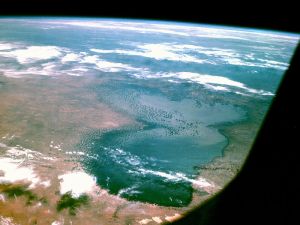
    Lake Chad as seen from Apollo 7. The lake's drying basin is the crucible of Boko Haram's insurgency in Nigeria, Niger, Cameroon and Chad. (Source: NASA, via Wikipedia)

    Lake Chad as seen from Apollo 7 in 1968. The lake’s drying basin is the crucible of Boko Haram’s insurgency in Nigeria, Niger, Cameroon and Chad. (Source: Wikimedia)

    Realistically, Nigeria is not in a position to inflict a military defeat on Boko Haram. Like most insurgencies, Boko Haram avoids concentrating its forces. It prefers to skirmish and build its presence in lots of places at once. The security forces must therefore spread wide to protect the population and root out insurgents village-by-village. According to the orthodox counter-insurgency formula of 20 soldiers and police to every 1000 people, 200,000 soldiers and police would be required in north-east Nigeria.  This is about five times the current deployment level.

    It also assumes that such forces would be adequately equipped and trained and motivated to protect the civilian population. Even the troops that are deployed in the north-east are given little ammunition, and their weapons routinely malfunction. The air force, which gives Nigeria its one clear military advantage, has been struck by multiple equipment failures and crashes in recent months. And the strategy is also to blame. There has been too much focus on a military-only approach and not enough attention paid to the underlying drivers of the conflict.

    Yet Nigerian politicians and generals still line up to claim imminent victory, usually giving three month’s notice for Boko Haram’s projected downfall. Time after time the deadlines pass and Boko Haram is anything but defeated. In fact, the insurgency has never been stronger. Since July, Boko Haram has shifted from hit-and-run tactics to the capture and control of swathes of territory and even large towns across three states: Borno, Adamawa and Yobe.

    The obvious alternative to a military solution – a negotiated political settlement – is admittedly unpalatable. After the appalling war crimes committed by Boko Haram over the last five years, it is hard to contemplate offering them a share of power and, most likely, an amnesty. Yet if it wants to stop the violence, the government has little choice. Indeed it has shown itself willing to enter into negotiations, as the failed attempt to broker a truce through Chadian president Idriss Déby in October showed. But is such a deal even possible?

    Obstacles to a deal

    There is much that stands in the way of a deal with Boko Haram. Probably the most immediate obstacle is the insurgency’s own success. Why would Boko Haram want to do a deal when it is achieving its aims already? To force Boko Haram to the negotiating table, the military may have to retake some of the captured territory to create the impression that the momentum is with the army.

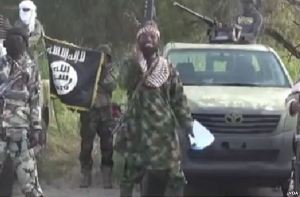
    Abubakar Shekau, leader de Boko Haram, still from an October 2014 Boko Haram video communique. (Source: VOA, via Wikipedia)

    Abubakar Shekau, leader of Boko Haram in a still from an October 2014 Boko Haram video communique. (Source: VOA, via Wikipedia)

    The second obstacle is even greater. Over the past five years, Boko Haram has become increasingly extreme and violent. It has transitioned from a menacing but peaceful movement focused on preaching, to an insurgency focused on attacking government targets, and now to a group willing to indiscriminately kill civilians.

    The insurgency’s growing extremism is a major driving force behind its violence. As Boko Haram’s leader, Abubakar Shekau, said in a recent video, “our religion and our way of worship is nothing but killings, killings and killings”. Indeed, as Ahmad Salkida, a Nigerian journalist with rare access to Boko Haram, has said, “the fuse that drives Boko Haram’s terror is the sect’s doctrine”. Their religious ideology, a form of Salafi Jihadism, focuses on purging Islam of corrupting influences and returning to the ‘pure’ Islamic practices of the distant past. Over the years, Shekau has purged Boko Haram of more moderate commanders, leading to an increasingly fanatical take on what methods are acceptable to purge Muslim society of impure elements and what constitutes an impure element. Violence has become the method of choice, and the targets include children.

    It is hard to see how this extremism and violence can be accommodated in a negotiated settlement. Is it even possible to have a meaningful dialogue with a group that seems to have gone beyond any kind of rational political or socio-economic programme?

    What does Boko Haram want?

    Yet there are discernable grievances underlying the conflict in northern Nigeria. Even if Shekau is only interested in purgative violence, many of the group’s followers and fighters are likely to have more tangible motivations and aims. They are also rumoured to be growing increasingly tired of life in the bush, so it’s possible a deal could be done if a strong enough offer were made.

    A core driver of the insurgency is an escalating cycle of grievance and revenge. Boko Haram first became violent after security forces attacked its members who were participating in a funeral procession in Maiduguri in 2009. After a series of skirmishes, its founding leader Mohammed Yusuf was arrested, detained, and summarily executed. Since then, numerous suspected Boko Haram supporters have also been murdered. On March 14 of this year, the military was accused of summarily executing 600 prisoners in response to a Boko Haram attack. The families of suspected Boko Haram members have also been targeted. Many women and children who are related to militants are believed to be in detention, including the family of Shekau, and there are rumours that female family members have been raped.

    Central to any deal must be accountability and compensation for these excesses, as politically difficult as that may be. Many imprisoned Boko Haram supporters and relatives will also have to be released.

    There are also political and socio-economic factors feeding into the conflict. North-east Nigeria is one of the most impoverished places in the world, with three-quarters of the population living below the poverty line. People there feel politically as well as economically marginalised, as northerners have been increasingly locked out of power in recent years. President Goodluck Jonathan, a southern Christian, has broken an unwritten rule by running again for the presidency in 2015. Convention on rotation of power dictates that a northern Muslim candidate should be put forward by the ruling party.

    Corruption and poor governance in the region have also played a role in promoting alienation from Nigeria’s institutions and fostering an environment ripe for insurgency. The government would do well to include measures aimed at boosting development, improving governance, and ending the region’s political marginalisation in any deal.

    An amnesty from prosecution and jobs for former insurgents must be the final element of a deal. It is unlikely insurgent leaders and fighters will come out of the bush if they believe they will be prosecuted, and jobs will be vital for re-integrating them into society. Again, this would depend on massive federal and/or private investment in the northeast, what some have called a ‘Marshall Plan’ for the northeast.

    There have been signs that the Nigerian government is willing to engage with these questions. The “soft” counter-terrorism strategy unveiled by Nigeria’s National Security Adviser in March included an emphasis on tackling under-development and other underlying drivers of the conflict. Its commitment to address social injustice, joblessness, and poverty may well be attractive to Boko Haram members who have joined the insurgency for those reasons. However, the international storm following the Chibok abduction, Boko Haram’s territorial gains, and the national elections due in February 2015 seem to have dragged momentum away from these measures.

    Talking to Shekau

    One of the major challenges of doing a deal with Boko Haram is finding a way of talking to Shekau. Since the Chibok abduction, all sorts of people have reportedly come forward claiming to be intermediaries representing the insurgents. Many of them, if not all of them, are bogus – including the one who did the supposed deal with Idriss Déby.

    The government has to find the right interlocutor. One possible option is to go through Ahmad Salkida, and the government did reportedly bring him in to discuss the Chibok abduction. He is one of very few people with a credible connection to the insurgents who may be able to advise on how to reach out to them.

    Whatever the case, and as Salkida has said himself, it will be difficult to achieve any kind of peace deal until the army is able to stem the tide of Boko Haram’s advances. The first step must be to summon the political will and train, motivate and deploy the resources necessary to adequately protect the civilian population in north-east Nigeria.

    Andrew Noakes is Coordinator of the Nigeria Security Network. He is on Twitter at @andrew_noakes 

    Image: Lake Chad as seen from Apollo 7 in 1968. Source: Wikimedia.

  • Privatising the War on Drugs: PMSCs in Colombia and Mexico

    Remote Warfare series intro – read other articles in the series.

    RC_long_logo_small_4web

    This article is part of the Remote Control Warfare series, a collaboration with Remote Control, a project of the Network for Social Change hosted by Oxford Research Group.


    Editor’s note:
    Remote Warfare and the War on Drugs mini-series: This series of articles explores how remote warfare is being used in the war on drugs. To date, much of the debate on remote warfare has focused on its use in the war on terror. However, the use of drones, private military and security companies (PMSCs), special forces and mass surveillance are all emerging trends found in the US’s other long standing war, the War on Drugs. The articles in this series seek to explore these methods in more depth, looking at what impact and long term consequences they may have on the theatre in which they’re being used.

    US drug policy has become increasingly privatised in recent years as the US government contracts private military and security companies (PMSCs) to provide intelligence, logistical support and training to state security forces in drug-producing and –transit states. As the cases of Colombia and Mexico illustrate, this privatisation strategy is having a damaging impact on these already fragile environments.

    Since the mid-1970s, the US government has invested billions of dollars in anti-drug assistance programmes. The main objective is to reduce the flow of Latin American-sourced illicit drugs to the US. At the beginning of this so-called War on Drugs, the US treated the fight against drugs as a police problem, providing equipment and supplies to civilian law enforcement for counter-narcotic efforts. Since the 1980s, however, US drug policy has been militarised and, more recently, privatised: the US government provides military-grade equipment and training to police forces and contracts private military and security companies (PMSCs) to provide intelligence, logistical support, and training to state security forces in drug-producing and -transit states, such as Colombia and Mexico.

    The privatisation of the War on Drugs has had a significant impact in countries where it is waged, adding further complexity to these already complicated environments. As states often fail to properly control PMSCs’ activities, this tends to increase the risk of human rights violations and impunity in contexts where the application of the rule of law is already uneven. The use of PMSCs in the War on Drugs often weakens the rule of law and so is counterproductive. The cases of Colombia, where the use of PMSCs takes place largely under the guise of Plan Colombia, and Mexico, where PMSCs have been used since the implementation of the Merida Initiative, illustrate these issues well.

    Colombia: Human rights violations and impunity

    Colombia is experiencing an armed conflict where the Colombian government fights against several armed groups, such as Fuerzas Armadas Revolucionarias de Colombia—Ejército del Pueblo (FARC, Revolutionary Armed Forces of Colombia) and Ejército de Liberación Nacional (ELN, National Liberation Army) that are well-organized and heavily linked with drug trafficking. Since the 1960s, the US has collaborated militarily with Colombia in the fight against those armed groups, as well as drug traffickers. In 2000, Colombia and the US agreed on a new plan of cooperation called Plan Colombia: Plan for Peace, Prosperity, and the Strengthening of the State (usually referred to as Plan Colombia).

    street art

    Image of Mexican Drug War-themed street art. Picture entitled: The Mexican Dead by Suslan Soosay via Flickr

    Although Colombia and the US had long cooperated in fighting drug trafficking, Plan Colombia represented a shift. Since its implementation, the US State and Defense Departments have contracted PMSCs to carry out activities related to US military and police aid to Colombia. For example, the 2007 Reports to Congress On Certain Counternarcotics Activities in Colombia–partly reproduced here–mention that Telford Aviation provided logistical support for reconnaissance airplanes and ITT and ARINC were responsible for operating radar stations. Furthermore, in 2006, Chenega Federal Systems was in charge of maintaining an intelligence database, and Oakley Networks was responsible for Internet surveillance. Other sources reported that Military Professional Resources Incorporated (MPRI) helped restructure the Colombian armed forces to aid their fight against drugs; Northrop Grumman, under its contract, flew over the Colombian jungle with aircraft equipped with infrared cameras in order to track illegal activities related to drugs or guerrilla movements; and DynCorp has been in charge of the fumigation of coca plants since 2000.

    The concern about human rights violations by PMSCs is particularly acute in Colombia because all US personnel, including PMSC employees, working in Colombia through Plan Colombia have been granted immunity from Colombian jurisdiction by bilateral treaty with the US.

    The lack of control and supervision has been observed on many occasions, including by US authorities. A report on contracting oversight by the United States Senate Committee on Homeland Security and Governmental Affairs concluded that the “State Department, which has awarded over $1 billion in counternarcotics contracts in Latin America to one company, DynCorp, has conducted sporadic oversight of that company.”

    There have been numerous allegations of human rights violations at the hands of PMSCs operating under Plan Colombia, but, so far, none of these violations have been brought to justice. For example, in 2004, a pornographic movie went public that included US contractors from the Colombian base Tolemaida sexually abusing minors. No investigation took place and no one was ever punished. DynCorp’s activities, particularly the fumigation of coca plants, have also caused concern. In 2008, Ecuador filed suit against Colombia at the International Court of Justice, arguing “Colombia has violated its obligations under international law by causing or allowing the deposit on the territory of Ecuador of toxic herbicides that have caused damage to human health, property and the environment.” In August 2013, the governments of Colombia and Ecuador announced an agreement ending the dispute, with Colombia paying reparations for the damage caused.

    Mexico: Increasing violence and a lack of state control

    The drug-related violence in Mexico that has captured so many headlines in recent years is not new to the country. Although drug traffickers have operated in Mexico for more than half a century, serious violence related to drug activity started around the 1990s, when the drug market became more lucrative and the centralized power of the Mexican government started to slip. Mexico is now a major supplier of all kind of illegal drugs—heroin, methamphetamine, marijuana, and cocaine—to the US drug market: the drug market between US and Mexico is estimated by US government reports as ranging between US $18 and 39 billion in profits annually.

    In 2007, following President Calderón’s lead to crack down on the drug cartels, the US and Mexico cemented a plan to cooperate in fighting drug trafficking and increasing security in the region. This plan, called the Merida Initiative: Expanding the US/Mexico Partnership (hereinafter the Merida Initiative), established full cooperation between the two countries, with the US providing an anti-crime and counter-drug assistance package to Mexico that included training and equipping Mexican forces. The provision of Merida Initiative assistance to Mexico has included contracting PMSCs to train local forces.

    As in Colombia, the human rights situation in Mexico is complicated. Militarizing the War on Drugs in Mexico has been severely criticized due to the resulting human rights abuses. For instance, Human Rights Watch (HRW) reported in 2011 “credible evidence of torture in more than 170 cases across the five states surveyed” and documented “39 ‘disappearances’ where evidence strongly suggests the participation of security forces.” HRW concluded that “rather than strengthening public security in Mexico, Calderón’s [and now Peña Nieto’s] ‘war’, has exacerbated a climate of violence, lawlessness, and fear in many parts of the country.”

    In this scenario, the activities of PMSCs, which are hired by the US, raise additional concerns about the respect of human rights. In fact, contractors have been accused of training Mexican police in torture techniques. As is the case in Colombia, the use of PMSCs by the US government to perform security tasks in another country tends to adversely affect human rights, when the purpose should be the contrary.

    A worrying (and growing) strategy

    The privatization of the “war on drugs” is one more element endangering human rights in an already complex environment. Privatization is often resorted to as a strategy when the use of public resources is seen as risky. Indeed, in both Colombia and Mexico, public forces have been involved in massive human rights violations. Given their past history of human rights violations in Colombia and Mexico, the unrestrained use of PMSCs is not the best strategy for improving security and upholding the rule of law. Unfortunately, the trend of privatizing the War on Drugs is not diminishing: following the Plan Colombia and Merida Initiative, the US government implemented the Central American Regional Security Initiative (CARSI) to fight against drugs in Central America, and PMSCs are a key actor in its execution.

    Antoine Perret is visiting research fellow at Columbia Law School. He holds an LLM and a PhD in Law from the European University Institute (Florence), an MA in International Affairs from the Universidad Externado de Colombia (Bogotá) in collaboration with Sciences Po (Paris) and Columbia University (New York), and a Licence in International Relations from the Graduate Institute of International and Development Studies (Geneva). He was a lecturer and researcher at Universidad Externado de Colombia (Bogotá) and research fellow at the Center for Latin American and Latino Studies at American University (Washington, DC). Through his work on PMSCs he has collaborated with the Geneva Center for Democratic Control of Armed Forces (DCAF), the UN Working Group on Mercenaries, and the UN Regional Centre for Peace, Disarmament and Development (UNLIREC).

  • International Dimensions of the Ukraine Crisis: Syria and Iran

    This post is taken from Paul Rogers’ Monthly Global Security Briefings and was originally posted by Oxford Research Group on 31 March, 2014.

    The Russian annexation of Crimea may be in direct contravention of international agreements but is popular in Russia and almost certain to hold. Given tensions within Ukrainian society and its weak transitional government, there remains some risk of further intervention in eastern Ukraine and possibly the Trans-Dniester break-away region of Moldova. Even if there is no further escalation in the crisis, the deterioration in EU/Russian and US/Russian relations is of great concern, not least in relation to two aspects of Middle East security – the Syrian civil war and the Iran nuclear negotiations.

    President Vladimir Putin’s recent actions have been generally popular in Russia where recent political developments in Kiev have been seen as a serious encroachment by the EU into a crucial Russian sphere of influence and a massive setback to Putin’s idea of creating a counter-weight Eurasian Union. Putin’s muscular approach to restoring Russia to its historic greatness, readily seen in the huge expenditure on the recent Winter Olympics as well as the Eurasian Union vision to reconnect former Soviet republics, is well received by many Russians.

    Whether there is further intervention depends very much on the weak government in Kiev’s capacity to limit civil disorder that might be fomented by ultra-nationalists, including around the 25 May presidential election. This will not be easy since it would be in Russia’s interest to be able to respond to just such disorder and it may well seek to encourage local militias in southern and eastern Ukraine. Understanding the perceptions of the Kremlin (and wider Russian society) towards both the rest of Europe and Ukrainian nationalism is critical in understanding how Moscow may act in the coming months.

    The Question of Perceptions

    A key issue in the crisis is the question of perceptions.  At the height of the Cold War, there were very few western analysts and politicians who were able to visualise the world from the Kremlin’s perspective. The so-called “Red Team” studies in NATO defence ministries were primarily concerned with how the Soviet Union might fight a war, not with its wider world view.  There was, for example, little understanding of the enduring impact of the Great Patriotic War on Soviet/Russian attitudes towards Germany and elements, including Ukrainian, Romanian/Moldovan and Baltic nationalists, which cooperated with its invasion of the USSR.

    While Russia sees itself as a once-great superpower that justifiably seeks to re-establish that status, there remains a deep resentment stemming from the experience of the 1990s.  The embrace of “turbo-capitalism”, the near collapse of the economy and, above all, the disdain with which Russia was treated by the West are all still deeply embedded in the political outlook, and it is this which does much to make the “tilt” of Ukraine towards the EU so unacceptable.

    The western perception of Russia, though, is also significant. Anyone over the age of forty, which includes almost the entire western political class, has deep memories of the Cold War era in which the Soviet Union was seen as the head of a hugely powerful bloc that had overwhelming military superiority in Europe, only counter-balanced by NATO’s nuclear forces.  The vision of massed tank armies deployed right into Eastern Europe was deep-seated but it also assumed that there was strength in depth within the Soviet heartland – Russia. Even now, Russia as the successor state of the Soviet Union is seen to retain some of those elements of power, but this is not supported either by its current economic strength or its conventional military capabilities.

    Russia: a Paper Bear?

    Although Russia has enjoyed reasonable economic growth over the past decade this has been from a very low base and does not bring Russia anywhere near the economic power of the United States, China, Japan or even Germany. Russian GDP is less than a seventh of that of the US, a quarter of that of China and much less than half of that of Japan. In spite of its (declining) population being more than double the size of the UK or France, its GDP matches neither country and is not even two-thirds that of Germany.

    Furthermore, much of Russia’s wealth is concentrated in and around Moscow and St Petersburg and is largely in the hands of a small elite. Most of Russia has benefited little from the growth of recent years, but control of the media by the state and its power over political processes limits the extent of the recognition of these divisions and of opposition to Putin.

    While Russia is still a substantial nuclear power, its conventional armed forces are singularly weak, as was shown by the considerable difficulties in mounting air operations against Georgia in August 2008. There is substantial spending now devoted to rebuilding Russia’s conventional armed forces but this is still at an early stage. To put it bluntly, Russia’s impressive array of forces used in Crimea and massed close to Ukraine hide a deep-seated conventional weakness in an economy which is heavily resource-dependent.

    In the short term, Putin can maintain control of Crimea and may increase Russian influence in the rest of Ukraine, but its recent actions actually militate against the development of the Eurasian Community. Furthermore, Western European states will now be far more cautious in their economic dealings with Russia and will work progressively to limit their dependence on Russian gas and oil. In the long term, the recent popular actions in Crimea are likely to damage Russia, and it is most likely that any further western sanctions will be represented by Putin as further proof of the need for Russia to be strong and independent.

    Context Implications for Syria and Iran

    Syria: The war in Syria continues to be bedevilled by the double proxy element, with regime support from Iran and Russia countered by rebel support from Saudi Arabia and the West.

    Western policy is in disarray:

    • Secular elements in the rebellion are weak and disunited, offering limited opposition to the regime.
    • Radical Islamist paramilitaries are offering much stronger resistance to the regime but are not themselves united even if some elements now control substantial territory.
    • The regime is firmly ensconced even if it is presiding over a terribly damaged country.

    Western policy seems now concentrated on providing support for the disunited rebels, especially south of Damascus, while ensuring that advanced weapons do not get into the hands of jihadist elements concentrated in the north and east. This may be so difficult that it is essentially impossible, meaning that the extent of the support will be limited. The Syrian War thus has no prospect of ending unless the major proxy players, the US and Russia, are prepared to work together. The Ukraine crisis makes this far less likely than even a month ago, when the Geneva II peace talks adjourned without progress.

    On present trends the war will continue. The main regime tactic is to use its considerable firepower advantage (in terms of artillery, rockets and air-dropped barrel bombs) to so damage rebel areas that they lose control of territory. Since the regime does not have the reliable ground forces available to hold such territory the policy is one of denial, but the human and economic costs are immense. As the regime continues with this approach, it becomes more likely that Gulf States such as Qatar and Saudi Arabia will resist US pressure and return to their policy of backing a wider range of Islamist rebels.

    Iran: The negotiations on the nuclear issue between the US and Iran are continuing, albeit at a low level, but have so far survived considerable opposition from within Iran and the US. They may be influenced by the domestic economic problems that the Rouhani government is currently experiencing and his honeymoon period is essentially over.

    US/Russian relations are less relevant here but will come to the fore if the negotiations do make progress because this may give Rouhani more room to improve relations with Saudi Arabia. Any improvement in the Saudi/Iranian relationship should be encouraged by any means possible – it is one of the few areas in the region with potential. However, if there is progress and this can serve to diminish the differences over Syria, then Russia’s influence over the Assad regime will become more significant.

    Conclusion

    The crisis that has erupted in Ukraine is an occasion for just the kind of analysis that was so missing in the Cold War period. Russian behaviour over Ukraine – and Crimea in particular – may be entirely unacceptable in the west but, given the nature of the Putin regime and its recognition of deep-seated and enduring Russian sensibilities over the loss of empire twenty years ago, it is entirely understandable. In spite of the problems it causes, there is a real need for caution, not least because Putin may prefer a continuing crisis in order to bolster domestic support. If the Ukraine crisis escalates further, the impact for European security is likely to be substantial but the limiting of prospects for any kind of progress in Syria will be an even greater human disaster.

    European policy-makers can help to mitigate the negative impacts of the crisis in three ways:

    • Urging caution on the part of NATO in response to the Ukraine crisis;
    • Encouraging in-depth analysis by European states of current Russian attitudes;
    • Endeavouring to support improvements in Iranian-Saudi relations in order to bypass the likely new deadlock in US-Russian relations over Iran and Syria.

    None is easy – all are necessary.

    Paul Rogers is Global Security Consultant to Oxford Research Group, for which he writes monthly security briefings.  He is Professor of Peace Studies at the University of Bradford and author of numerous books including ‘Beyond Terror’. Paul writes a weekly column for openDemocracy  and tweets regularly at @ProfPRogers.

    Featured image:Protester wearing Ukraine state flag colors facing the massive fire set by protesters to prevent internal forces from crossing the barricade line  Source: Wikimedia

  • Facing up to Global Insecurity: New Frameworks and New Tools


    National Guard smallMax G. Manwaring, a Professor of Military Strategy in the Strategic Studies Institute (SSI) of the U.S. Army War College has written an interesting piece on what he calls the “new security reality in which business-as-usual approaches are of little use.
    Manwaring focuses particularly on the changing nature of threats posed by non-state actors (insurgents, transnational criminal organizations, terrorists, private armies, state proxies etc.) who are able to exploit trends and circumstances such as poverty, social exclusion, environmental degradation, and political economic-social expectations for violent ends. He argues that from a US military point of view, “the enemy has now become a state or nonstate political actor that plans and implements the long-term multidimensional kinds of indirect and direct, nonmilitary and military, nonlethal and lethal, and internal and external activities that threaten a given society’s general well-being and exploits the root causes of internal and external instability.”

    Such a change in the global security environment must surely result in changes in our risk analysis and threat assessments. In a piece for the International Relations and Security Network, Myriam Dunn Cavelty writes that “In order to identify risks, elaborate scenario-based approaches combining expert-knowledge from various fields are used. The aim of these undertakings is to develop a concrete basis for political action by ranking the identified risks by their estimated probability and severity: the more likely and the more damaging, the more urgent the response.” Yet while many governments around the world have begun to place a greater emphasis on understanding the factors that drive conflict (rather than just the instances in which conflicts are expressed in forms of violence around the world), not enough is being done to bridge the gap between threat analysis and policy response. It is one thing to accurately identify new drivers of insecurity, but quite another to find ways of mitigating them through preventive public policies. Central to this must be a greater emphasis on prevention in civil service training and recruitment programmes across a number of areas.

    For example, a report by the Center for American Progress released last year noted that “While there have been a number of well-received conflict prevention trainings by and for U.S. government officials, they are too few in number and insufficiently available to all interested foreign affairs officials.”

    Of course, for militaries, the changed threat environment that Manwaring and others are pointing to means not only a need for new training but also for a cultural shift in the way they think about the utility of their traditional tool – the use of force. For Manwaring, “…power has changed. It is no longer combat firepower. Power is multidimensional, and more often than not, is nonkinetic (soft). It is directed at the causes as well as perpetrators of violence.”

    Addressing the causes of insecurity requires what groups such as Saferworld and others refer to as ‘upstream conflict prevention.’ This can easily become a catch-phrase used by governments and NGOs with little effect on actual policies, a point picked up on by Saferworld in their excellent new briefing on what upstream prevention actually looks like in practice.

    Thinking through the consequences of the changing nature of global security, both in terms of threat assessments and policy responses to those threats (military and non-military), will certainly require new approaches at the broad conceptual level. The fact that this is being touched upon by think tanks, NGOs and even army war colleges is surely a good sign – is sustainable security an idea whose time has come?

    Ben Zala is a Lecturer in International Politics at the University of Leicester.

    Image source: Utah National Guard.

  • Options for Nuclear Disarmament in a Climate of Deterrence

    Jenny Nielsen and Nathalie Osztaskina

    With geopolitics and deterrence doctrines back in the ascendant, the prospects for multilateral nuclear disarmament look worse than for a generation; many options are on the table but whether states will engage constructively and pursue any of these proposals remains an open question.

    Following the failure of the states parties to the NPT to adopt a consensus Final Document at the 2015 RevCon due to significant divisions on key issues, the voting and statements at the UN General Assembly First Committee (which deals with disarmament and threats to peace) highlighted the ‘even stronger polarisation and hardening of positions’ between the non-nuclear weapon states (NNWS) and NWS given the latter’s refusal to make meaningful progress on their disarmament obligations.

    As recently heard at the 2015 EU Non-Proliferation and Disarmament Conference, ‘the First Committee has confirmed the polarisation and also the deep mistrust that is there between nuclear-weapon states and a considerable part of the non-nuclear weapon states’. To aggravate this, no state or group of states seemed to be capable of playing ‘a bridge-building role’. As a result, the world was left without a consensus on how to begin disentangling the tight knot of nuclear politics so that NWS could move towards their NPT commitment to disarmament.

    The re-emergence of nuclear deterrence

    Following Moscow’s aggressive actions in Crimea and eastern Ukraine, the salience of nuclear weapons and the role of nuclear deterrence in security and defence doctrines is re-emerging in European political discussions, particularly regarding NATO’s posture.

    At the 2015 EU Non-Proliferation and Disarmament Conference, Russian analyst Alexei Arbatov stressed the regrettable paradox that despite the lower number of nuclear weapons since the end of the Cold War, ‘the probability of their use is now higher’. Chillingly, Arbatov added ‘it is not only higher than 25 years ago, it is probably higher than at any time since the early 1980s’.

    23128494592_6ee987a7de_k

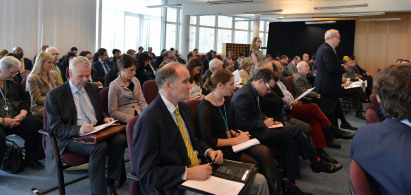
    Guests at a roundtable organised by the Vienna Center for Disarmament and Non-Proliferation (VCDNP) on November 19, 2015. Image credit: Flickr

    Based on ‘the resurgence of state-based threats’, Professor Wyn Bowen argues that the UK’s recently published 2015 Strategic Defence and Security Review (SDSR) has ‘brought deterrence back to the centre stage for the United Kingdom more than any other time since the end of the Cold War’.

    At the same time, in the UK, the recently elected leader of the Labour Party, Jeremy Corbyn — a long-standing opponent of nuclear weapons and vice president of the Campaign for Nuclear Disarmament (CND) — has stated that he would not condone the use of nuclear weapons if he were elected prime minister. Corbyn’s Trident statements have clearly ruffled feathers amongst some in the military and political establishment, with a parliamentary ‘Main Gate’ decision on renewing the UK’s nuclear weapons system confirmed for 2016.

    Despite Corbyn’s recent statements, elite debates have largely remained limited to discussions of whether the UK should build four new nuclear-armed ballistic missile submarines in order to ensure continuous at sea deterrence (CASD).

    Another key debate within NATO concerns how the alliance might re-articulate, refresh and clearly communicate its nuclear posture to reflect the current geo-strategic environment. NATO’s former Deputy Assistant Secretary General for Weapons of Mass Destruction Policy and Director for Nuclear Policy, Guy Roberts, recently argued that ‘to be fully credible, NATO’s nuclear posture and policy needs to be firmly articulated and communicated to Russia and other would-be adversaries’.

    Furthermore, it was recently argued at the 2015 EU Non-Proliferation and Disarmament Conference that ‘we no longer have a debate about the potential withdrawal of’ the 160-200 theatre nuclear weapons (TNW) still in Europe. The debate instead now focuses on the role of nuclear deterrence in the broader defence posture of the NATO alliance. Guy Roberts argues that ‘if Russia continues to use nuclear threats and intimidation tactics, then the West will need to plan deterrence, response, and escalation control options that are credible and particularly tailored to the mindset of the Russian leadership. Otherwise, Russia may see its own rhetoric as validated and NATO as weak’.

    Possible ways forward

    So, what are possible ways forward vis-à-vis multilateral nuclear disarmament goals as mandated by the NPT in the current security environment? Given the re-ascendance of perceptions of imminent state-based security threats, how can we move from increasing frustrations among NNWS and procrastination or obstruction by states towards constructive engagement? Technical, legal and normative proposals exist to further progress towards nuclear disarmament commitments by NPT member states.

    Legal Approaches

    Many NNWS that are supporting the evolving Humanitarian Initiative are pursuing a legal measure that would ultimately delegitimise nuclear weapons use and possession. Proposals exist for a group of NNWS to pursue such a legal ban on nuclear weapons even without the participation of the five NWS and the other four non-NPT nuclear possessors (Israel, India, Pakistan and North Korea). Proponents argue that by concluding a legal ban, an international norm delegitimising nuclear weapons will be established, regardless of engagement by states with nuclear arsenals. The multilateral fora addressing nuclear disarmament have been subject to intense contention given the postures on this issue.

    As voted for by 135 states at the 2015 session of the First Committee, the 2016 sessions of the Open-Ended Working Group (OEWG) could serve as a multilateral forum for discussions on nuclear disarmament. This is a measure specifically taken to avoid the polarisation that has characterised the Humanitarian Initiative and the refusal of the NWS to engage with it. Since 2009, the five NWS have been pursuing their own discussions on disarmament, known as the P5 Process, with limited results even before the NATO/Russia schisms over Ukraine. It is still unclear whether the five NWS and some NNWS under extended deterrence arrangements (i.e. the other 25 NATO members plus other allies) would participate in the OEWG.

    In 2014, the Marshall Islands initiated a different legal approach towards demanding accountability vis-à-vis nuclear disarmament progress through the Global Zero lawsuits. Whether this approach through the lawsuits filed in the International Court of Justice will bring effective results – other than grabbing headlines and elevating the issue of nuclear disarmament on the international agenda – remains to be seen.

    While a nuclear ban may be a key long-term normative and legal aim for some NNWS, the Comprehensive Nuclear-Test-Ban Treaty (CTBT) (and its sophisticated International Monitoring System) is a realistic short-term objective. The CTBT is a developed and available legal and technical step towards nuclear disarmament. With the 20th anniversary of the CTBT due in 2016, its entry into force should be a policy priority for states looking to bolster the nuclear non-proliferation regime.

    In democracies at least, civil society and disarmament advocacy groups could funnel their energy and passion to promoting the establishment of the CTBT, educating the electorate on this issue and lobbying parliamentarians. With broad declaratory support voiced by NPT states parties (and Israel) for the CTBT, further ratifications of this treaty by states with some nuclear capabilities (called ‘Annex II’, including signatories China, Egypt, Iran, Israel and the US) would significantly strengthen the non-proliferation regime and states’ commitment to disarmament. Recent declaratory support by US officials (including Kerry, Gottemoeller and Moniz) and efforts to re-energise the CTBT debate in the United States are therefore a positive development.

    Technical Approaches

    Another approach to furthering progress vis-a-vis nuclear disarmament is the US-launched International Partnership for Nuclear Disarmament Verification (IPNDV). This initiative aims at addressing the technical challenges of disarmament verification, bridging NNWS’ and NWS’ understanding of the key measures and practical issues involved in verifying disarmament agreements. At a recent Vienna Center for Disarmament and Non-Proliferation event following the IPNDV’s November meeting in Oslo, US Assistant Secretary of State Frank Rose, provided an overview of the IPNDV. The Partnership made progress in establishing three Working Groups and authorised them to move forward with their important technical assignments. Rose believes that, by concentrating on technical tasks, the Partnership ‘can make real and important progress’ in achieving multilateral cooperation and towards realising disarmament goals.

    Several other pragmatic, technical proposals exist in support of reducing nuclear salience in security doctrines, including de-alerting arsenals and reducing stocks of delivery systems. In a recent Washington Post op-ed, former Defense officials William J. Perry and Andy Weber argued against the implementation of a US nuclear-armed cruise missile system which could heighten the risk of miscalculation by an adversary.

    From entrenched postures to dialogue

    Given the current deep divides on how to move forward on nuclear disarmament goals amidst heightened strategic discontents, pragmatic and confidence-building measures, including dialogue and trust-building activities, which enjoy broad support by international actors should be pursued. Frustrations, ineffective criticism and outright obstructions need to be channelled into constructive efforts, at the core of which should be frank and respectful dialogue. This applies to both sides of the debate. Only through unpacking the core assumptions underlying the extreme postures and perspectives on the perceived value of nuclear weapons, can these social constructs begin to be appreciated.

    Effective progress towards a secure world without nuclear weapons as the ultimate security guarantee and ultimate insurance policy remains a long and arduous journey that will require open minds, constructive dialogue and a mix of various technical and legal measures at the right time. The dislodging of deeply entrenched postures and institutional cultures won’t happen in the short-term, even if a normative and legal ban is attained by a group of NNWS.

    Following the outcome of the 2015 NPT RevCon, the five NWS are faced with the challenge of soothing perceptions of their lack of commitment to their Article VI obligation to pursue “a treaty on general and complete [nuclear] disarmament”. Whether the current international tensions between Russia and the West will test the NWS’s solidarity within the NPT P5 Process, as well as bilateral arms control measures, remains to be seen.


    Jenny Nielsen is a Postdoctoral Fellow at the Vienna Center for Disarmament and Non-Proliferation (VCDNP). Previously she was a Visiting Scholar at the NATO Defence College (NDC), Postdoctoral Research Fellow at the University of Queensland (UQ), Research Analyst at the International Institute for Strategic Studies (IISS), and Programme Manager for the Defence & Security Programme at Wilton Park.

    Nathalie Osztaskina is an Intern at the VCDNP. Her research focuses on disarmament efforts and the humanitarian movement, nuclear security, and promotion of CTBT’s entry into force. She worked previously at the Geostrategic Forecasting Corporation, doing research on the Russian-Ukrainian crisis.