Blog

  • Sustainable Security

  • Paul Rogers on Development, Climate Change, Conflict and Migration

    Paul Rogers on Development, Climate Change, Conflict and Migration

    Action Aid | youtube | June 2011

    Issues:Climate change, Competition over resources, Marginalisation

    Paul Rogers, Professor of Peace Studies at Bradford University, and Oxford Research Group’s Global Security Consultant, talks to Action Aid about the issues that will dominate international security and world development over the coming decades.

    Source: youtube

    Comments

    Post new comment


  • Crude Calculation – The Continued Lack of Transparency Over Oil in Sudan

    Crude Calculation – The Continued Lack of Transparency Over Oil in Sudan

    Issue:Competition over resources

    Persistent calls for clear and transparent information on Sudan’s oil revenues have yet to yield satisfactory information, says a new report published by Global Witness today. With a referendum on independence for southern Sudan just days away, oil sector transparency is now more important than ever to preserving the fragile peace between north and south.

    Author: Global Witness

    Image source: L C Nottaasen

  • Marginalisation of the majority world

    Marginalisation of the majority world

    A complex interplay of discrimination, global poverty, inequality and deepening socio-economic divisions, together make for key elements of global insecurity. While overall global wealth has increased, the benefits of this economic growth have not been equally shared. The rich-poor divide is actually growing, with a very heavy concentration of growth in relatively few parts of the world, and poverty getting much worse in many other regions. The ‘majority world’ of Asia, Africa and Latin America feel the strongest effects of marginalisation as a result of global elites, concentrated in North America and Europe, striving to maintain political, cultural, economic and military global dominance.

    Minority Youth Bulges and the Future of Intrastate Conflict

    Richard Cincotta | The Stimson Center | November 2011

    Issue:Marginalisation

    The global distribution of intrastate conflicts is not what it used to be. During the latter half of the 20th century, the states with the most youthful populations – a median age of 25.0 years or less – were consistently the most at risk of being engaged in a civil war or in an internal conflict, where either ethnic or religious factors, or both, came into play (an ethnoreligious conflict). However, the tight relationship between demography and intrastate conflict has loosened over the past decade. Ethnoreligious conflicts have gradually, though noticeably, increased among a group of states with a median age greater than 25.0 years, including Thailand, Turkey, Sri Lanka, Indonesia, and Russia.  The salient feature of these intrastate conflicts has been an armed struggle featuring a minority group that is age-structurally more youthful than the majority populace. The difference in age-structural maturity reflects a gap in fertility between the minority and majority, either in the present or in the recent past. 

    Article Source: The Stimson Center

    Image Source: CharlesFred

    Read more »

    A Thai Perspective on Proposed Mainstream Mekong Dams

    Teerapong Pomun | The Stimson Center | September 2011

    Issues:Competition over resources, Marginalisation

    The Mekong River is very important for millions of local communities along the mainstream and its tributaries who depend heavily on the river’s natural ecosystem functions. The health of the river is the health of the communities. Changes in the river basin mean a lot to those marginalized people who too often have no voice and have limited alternatives for sustaining their livelihoods.

    Article source: Stimson Center

    Image source: Roberto Moretti

    Read more »

    Déjà vu: Famine and Crisis in Somalia

    Mary Hope Schwoebel | USIP | September 2011

    Issue:Marginalisation

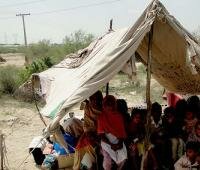
    Kenya and Ethiopia have large semi-arid regions that are also suffering from drought, but because they have governments in place and a modicum of infrastructure, and because they allow aid organizations access to populations in need, the immediate humanitarian threat is not as great. At the same time, however, these semi-arid regions are characterized by less development — and less security – and are thus more vulnerable to conflict.

    Over the past two decades, members of Somalia’s armed militias in the Horn of Africa have included violent Islamist extremists. Refugees and IDPs are particularly vulnerable to recruitment efforts by violent extremist groups and those fighting against them. And these spillover effects will continue to contribute to instability throughout the region until their root causes are addressed.

    Article source: United States Institute for Peace

    Image source: IHH Humanitarian Relief Foundation/TURKEY

    Read more »

    Socio-Political Factors and National Security

    Ikram Sehgal | East West Institute | September 2011

    Issue:Marginalisation

    National security in the traditional sense is connected with the idea of sovereignty; territorial security means freedom from risk of danger of destruction and annihilation by war, physical violence and/or aggression from outside. Traditional threats emanate from inter-state conflict and cross-border aggression. Since the nation state is supposed to have a monopoly of power for protecting the life and property of the members of the nation, they are deprived of power to defend themselves against aggression. The focus therefore previously being on external threats, state security has dominated the national security agenda. 

    With progressing globalisation, borders have become increasingly irrelevant, thus reducing the probability of external aggression. Conversely threats to a country’s security emanate internally because of lack of economic development, unemployment, failing internal security because of religious, sectarian and/or ethnic strife, shifting of identities in the wake of globalisation, radicalisation of society and growing terrorism thereof being recent additions. 

    Article source: EastWest Institute

    Image source: NB77

    Read more »

    Is it Time for Sustainable Development Goals?

    Alex Evans | Global Dashboard | September 2011

    Issue:Marginalisation

    From Millennium Development Goals to… Sustainable Development Goals? That’s one of the ideas swirling around in discussions ahead of the Rio 2012 sustainable development summit next year, writes Alex Evans for Global Dashboard. 

    Image source: UNDP. 

    Read more »

    A War Gone Badly Wrong – The War on Terror Ten Years On

    Paul Rogers | Oxford Research Group | September 2011

    Issues:Global militarisation, Marginalisation

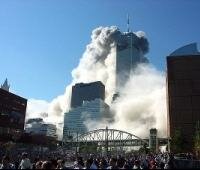
    The atrocities in New York and Washington on 11 September 2001 led to protracted wars in Afghanistan and Iraq. Ten years after the attacks, this briefing assesses the consequences of the response from the United States and its coalition partners. It questions whether the response was either appropriate or wise and whether the results so far have been counterproductive and may indicate the need for a changed security paradigm.

    Such a fundamental rethink of the way western governments respond to insecurity must go beyond the current approach in which intelligence, counterinsurgency and counter-terrorism are all beginning to merge into a seamless web of a single security posture. Such a posture is likely to be no more successful than the policies adopted in 2001.

    Photo credit: Brian Boyd

    Read more »

  • Sustainable Security

    A version of this article was originally published on openSecurity’s monthly Sustainable Security column on 18 November 2014. Every month, a rotating network of experts from Oxford Research Group’s Sustainable Security programme explore pertinent issues of global and regional insecurity.

    RC_long_logo_small_4webThis article is part of the Remote Control Warfare series, a collaboration with Remote Control, a project of the Network for Social Change hosted by Oxford Research Group.

    While the world’s attention has been focused on the US-led military interventions in Iraq and Syria a quieter build-up of military assets has been ongoing along the newer, western front of the War on Terror as the security crises in Libya and northeast Nigeria escalate and the conflict in northern Mali proves to be far from over. In the face of revolutionary change in Burkina Faso, the efforts of outsiders to enforce an authoritarian and exclusionary status quo across the Sahel-Sahara look increasingly fragile and misdirected.

    The New Frontier

    In early August, coinciding with the restructuring of French military operations in the Sahel and the US-Africa Leaders Summit, Oxford Research Group and the Remote Control Project published a comprehensive assessment of counter-terrorist operations targeting jihadist groups in the Sahel-Sahara region of north-west Africa. That report found extensive and growing evidence of combat, intelligence, surveillance and reconnaissance (ISR), training and equipment, abduction and rendition programmes on this new frontier. While France and the US were easily the most active foreign actors, the UK, Canada, the Netherlands and several other NATO states were also found to be increasingly involved in special forces and ISR operations.

    The launch coincided with the onset of air attacks on Islamic State targets, initially by the US in northern Iraq and latterly by a broad coalition of Western and Arab states in Iraq and Syria. In a context of worsening security crises in Libya, Nigeria and northern Mali and Niger since, US and UK ISR activity is increasing, French deployments in Mali have been reinforced, a new configuration of Arab states has provided impetus for foreign intervention in Libya’s civil war and a “black spring” backlash is emerging against the west’s authoritarian allies in the region.

    Libya on the frontline

    Libya is at the core of the security crisis in the Sahel-Sahara. Since the NATO-led military intervention which overthrew the Qaddafi regime in 2011, Libya has become a security and political vacuum and a major exporter of weapons and insecurity in the region. This has included the return home to the Sahel of hundreds of combatants formerly given refuge or employment by the Libyan state.

    Libya’s civil war reignited in May with the launch of “Operation Dignity” by secular forces from eastern Cyrenaica, seeking to wrest control of Benghazi and Tripoli, the two main cities, from Islamist militia. This has been largely a failure. Most diplomatic missions evacuated Libya in late July and Tripoli and its burnt-out international airport fell to militia from Misrata (Libya’s third city) and allied Islamist groups on 23 August. Benghazi has fallen increasingly into the hands of Salafist groups and the nearby city of Derna is run as an Islamic emirate by Ansar al-Shari’a. Much of the rest of Libya is dominated by local tribal leaders or armed factions, beyond any state control.
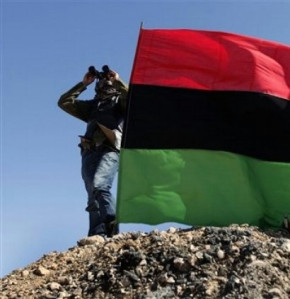
    Anti-Gaddafi rebel looks to the sky in the oil town of Ras Lanouf, eastern Libya, Sunday, March 6, 2011. Source: Cropped version of BRQ Network image (via Flickr)

    Anti-Gaddafi rebel looks to the sky in the oil town of Ras Lanouf, eastern Libya, March 6, 2011. Source: cropped version of BRQ Network image (via Flickr)

    Indeed, there are now two rival, elected Libyan governments. The one recognised internationally meets in a Tobruk hotel. It controls little beyond this Egyptian border outpost and its electoral mandate was recently invalidated by the Tripoli-based Supreme Court. The revived General National Council in Tripoli governs the capital and north-west and is dominated by an affiliate of the Muslim Brotherhood and other Islamist factions.

    Libya has thus become a new frontline in the proxy war between the international proponents and opponents of the brotherhood. Qatar and the United Arab Emirates (UAE) were the two main Arab sponsors of the anti-Qaddafi rebellion and contributed to the air attacks on Qaddafi’s forces. They now find themselves backing different sides in Libya. On 17 and 23 August, days after the Tobruk parliament called for foreign military intervention, Emirati aircraft based in and refuelled from Egypt launched unclaimed attacks on pro-Islamist militia around Tripoli airport.

    Despite official denials, it appears that air attacks on Salafist groups in Benghazi in mid-October were launched by Egyptian aircraft. Egypt and the UAE accuse Qatar, the primary sponsor of the brotherhood in Egypt, and Sudan, long ruled by a military affiliate of the brotherhood, of funnelling arms to the various Libyan Islamist militias.

    While the US has condemned all post-2011 foreign intervention in Libya, it is likely that it was aware of the movement of UAE aircraft to Egypt, given that fighters presumably left from Al-Dhafra air base in Abu Dhabi, which is shared by US and French squadrons. Emirati refuelling aircraft are based at Al-Minhad in Dubai, where the UK Royal Air Force (RAF) has an expeditionary wing. These aircraft presumably were cleared by Saudi Arabia (another great opponent of the brotherhood) to overfly its territory. The aircraft and weapons used were supplied by the US and/or France.

    France stands apart among Western allies in its advocacy of, and preparedness for, renewed military intervention in Libya. Since the fall of Tripoli, its defence minister, Jean-Yves Le Drian, has several times advocated a UN mandate for intervention against Islamist groups in Libya and hinted that France may need to act unilaterally sooner or later. Whereas Egypt is most concerned about Salafist groups in Derna and Benghazi, France is focused on al-Qaida affiliates in south-west Libya. Already this year it has opened bases near the Niger-Libya and Chad-Libya borders and revived ISR operations from its air base at Faya-Largeau in northern Chad.

    Northern Mali and Niger

    France cares about southern Libya primarily because of its security commitments to Mali, Burkina Faso, Chad and Niger, the latter hosting multi-billion-euro French investments in uranium production. Since France reorganised its forces in the Sahel from the Mali-focused Opération Serval to the pan-Sahel deployments of Opération Barkhane in mid-2014, security in northern Mali has worsened significantly. This relates partly to the decline in French troop numbers there but also to the reorganisation of regional jihadist groups and the deterioration in relations between the Malian state and local armed separatists. Twenty UN peacekeepers from the Multidimensional Integrated Stabilisation Mission in Mali (MINUSMA) have been killed in at least five jihadist attacks in the north of the country since September. In response, France has had to reinforce its deployments in Kidal district, pulling in troops and equipment from its base in Côte d’Ivoire.

    On 9 October, French forces under Barkhane mounted their first publicly acknowledged offensive action outside of Mali, attacking a convoy supposedly transporting militants and weapons from Libya through Niger towards the country. Militants apparently moving from north-eastern Mali attacked Nigerien security forces in Ouallam three weeks later, freeing dozens of Islamist prisoners and attacking a refugee camp. Citing increased activity, the huge Algerian military is also reported to have moved thousands of troops to its borders with Niger and Mali since last month.

    The US has also sought to extend its own ISR deployment in Niger, announcing in early September that it would be moving its two MQ-9 Reaper unmanned aerial vehicles from Niamey airport, where they have been deployed since early 2013, to Agadez, the main town in the desert north. As with French redeployments in 2014, the objective appears to be to bring more of southern Libya into range of ISR assets.

    Humanitarian opportunity
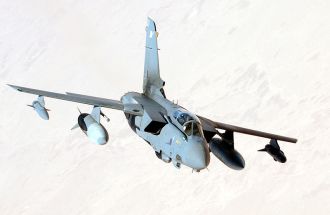
    RAF Panavia Tornado GR4 fighter over Iraq during a combat mission in support of Operation

    RAF Panavia Tornado GR4 fighter over Iraq during a combat mission in support of Operation “Iraqi Freedom”, on 16 August 2004. Source: SSgt. Lee O. Tucker – Official U.S. Air Force Photo no. DF-SD-07-05791 (via Wikipedia)

    Perhaps least analysed of recent military deployments to west Africa have been those associated ostensibly with humanitarian, rather than security, crises. In late August, following Boko Haram’s seizure of territory and declaration of its own caliphate in northern Nigeria, the RAF deployed a number (three is reported) of Tornado GR4 aircraft from the UK to the French air base in N’Djamena, Chad. This base is also used by US drones.

    Unusually, the Ministry of Defence issued almost no comment on this and refuses to disclose how many aircraft were involved, where they operated from or exactly when and why they were deployed. Officially, they were on an ISR mission in support of attempts to locate the more than 200 girls abducted by Boko Haram from a boarding school in Chibok in north-eastern Nigeria in April. All aircraft had officially returned to the UK by 15 October. While the Tornado GR4 is often deployed as a reconnaissance aircraft, it is dual use and its primary role—for example, in Iraq—is as a medium-range strike aircraft.

    Also very little reported was the US Marine Corps’ establishment during September of three new “co-operative security locations” in Senegal, Ghana and Gabon, along the west African coast. These are to be bases permanently prepared and supplied, but not necessarily manned, to support US interventions under the Obama administration’s “New Normal” doctrine, which facilitates defence or evacuation of US interests and citizens under (terrorist) attack in any country. While marines and their V-22 Osprey aircraft may continue to be based in Spain, Italy and Djibouti, these new west African bases are specifically launch pads for future US military interventions. US military contractors have been stockpiling aviation fuel at these and many other African airports for several years.

    Interestingly, the Senegal facility has been specifically referred to as an “interim staging base”—the usual terminology for a Special Purpose Marine Air-Ground Task Force base—in the context of the US military’s humanitarian mission to control the Ebola epidemic in Liberia. As with previous Obama-era deployments against the Lord’s Resistance Army in and around Uganda and in support of the Chibok abductees, the escalation of a US military presence appears to have been achieved under the cover of humanitarian imperatives and initiatives.

    Towards a Black Spring?

    All this matters because if there is one thing that we should have learned since 2001 it is that Western military interventions to oppose terrorism on foreign soil do not work: they tend to destroy the “host” country while amplifying the threat to the “far enemy”. And proxy wars between the Arab states so lavishly armed by the US, France, the UK and Russia tend to end in something worse than tears. Neither the “war on terror” nor the “Arab spring” (counter-)revolution has yet run its course.
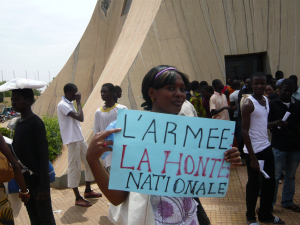
    “The Army: National Shame” caption held by protester in Mali against the 2012 coup. Source: Wikipedia

    The political crisis in Burkina Faso, in which the authoritarian president of 27 years, Blaise Compaoré, was overthrown in a popular uprising turned military coup on 31 October, provides ample warning of the toxic relationships Western states are forging in the Sahel-Sahara in the name of counter-terrorism. As in Mali in 2012, the coup leader in Burkina was an ambitious, US-trained officer. French and US special-operations forces will probably retain their semi-secret bases but their political masters have again been embarrassed by their own role as props to the hated old regime.

    Protesters in Burkina Faso—a remarkably civil, peaceful, articulate and internationalist society that belies the Sahel’s reputation for isolation—have talked up the precedent of their revolution for a “black spring” that would sweep away the Western-armed and educated tyrants whose misrule blights the south of the Sahara. They have chosen a very different path to the eschatological nihilism of Boko Haram but their hunger for change is similarly derived from generations of stultifying and systematic marginalisation under a corrupt, militarised and foreign-sponsored elite.

    Like Tunisia before it, Burkina Faso may be the clear-sighted vanguard that has the self-belief and self-discipline to manage a successful transition from autocracy. It is hard to hold such hope for the supposedly firmer pillars of western Sahel strategy, Chad and Mauritania, which have known almost nothing but rule by armed clans. Nor for Algeria—where the “printemps noir” epithet was coined during a forgotten 2001 Berber uprising—the last of whose mid-century revolutionary leaders yo-yos, paralysed and dying, between Algiers and French clinics.

    Sahara bores are wont to remind outsiders that the great desert is a crossroads, not a cul-de-sac, composed far more of enduring rock than shifting sands. The opposite can perhaps be said of the region’s militaries. Viewed within fragile states, military institutions may look rock-strong but they are built on sand and bound to fickle alliances. As in Burkina, it is society that is the bedrock with the power and permanence to anchor a sustainable strategy for peace and stability.

    Trying to contain a revolution in the Sahel-Sahara is not a long-term option but channelling it may be. Change is coming, one way or another.

    Richard Reeve is the Director of Oxford Research Group’s Sustainable Security programme. He has researched African peace and security issues since 2000, including work with ECOWAS, the AU and the Arab League.
  • Climate change

    Climate change

    Climate change is high on both domestic and international political agendas as countries face up to the huge environmental challenges the world now faces. Whilst this attention is welcome, less energy is being focused on the inevitable impact climate change will have on security issues. The well-documented physical effects of climate change will have knock-on socio-economic impacts, such as loss of infrastructure, resource scarcity and the mass displacement of peoples. These in turn could produce serious security consequences that will present new challenges to governments trying to maintain stability.

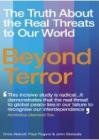
    Beyond Terror: The Truth About the Real Threats to Our World

    Chris Abbott, Paul Rogers and John Sloboda | Rider | April 2007

    Issues:Climate change, Competition over resources, Global militarisation, Marginalisation

    Tag:book

    Many leading military analysts in the United States are increasingly alert to the link between security and climate change. Is international terrorism really the single greatest threat to world security? Read more »

    Climate Wars

    Gwynne Dyer | CBC Radio One | January 2009

    Issue:Climate change

    Tag:podcast

    Global warming is moving much more quickly than scientists thought it would. Even if the biggest current and prospective emitters – the United States, China and India – were to slam on the brakes today, the earth would continue to heat up for decades. Read more »

    Tigers and Dragons: Sustainable Security in Asia and Australasia

    Chris Abbott and Sophie Marsden | Oxford Research Group | November 2008

    Issues:Climate change, Global militarisation

    Tag:report

    Asia is a region in transition, and transition creates uncertainty. The political, economic and societal landscape is shifting, with major new powers emerging and smaller states attempting to protect their interests in this changing dynamic. At the same time, climate change and the other long-term emerging threats to security will require regional responses and thus a degree of regional unity. Read more »

  • Sustainable Security

    This week marks the 69th anniversary of the Hiroshima and Nagasaki bombings, still the only two cases of nuclear weapons use. On these dates each year the media reminds the wider public about the destructive power of these inhumane weapons. The ‘humanitarian dimension’ initiative highlighting the consequences of nuclear weapons is evolving and consolidating itself in the non-proliferation regime. It has been shining a bright and constant light on the catastrophic consequences of nuclear weapons use – whether accidental or deliberate – at multilateral fora on nuclear weapons policy since the last Nuclear Non-Proliferation Treaty (NPT) Review Conference (RevCon) in 2010.

    The initiative has held two international conferences, hosted by Norway and Mexico, addressing issues relating to the impact, consequence management, and risks of nuclear weapons detonation (March 2013 in Oslo and February 2014 in Nayarit). At these conferences, the powerful testimony of the hibakusha (Japanese witnesses to nuclear bombing) served as a solemn reminder of the physical and psychological long-term effects for these survivors.

    The five nuclear weapons states (NWS or P5) under the NPT – China, France, Russia, UK and US – boycotted the first two of these international conferences. The third international Conference on the Humanitarian Consequences of Nuclear Weapons will be held in Vienna on 8-9 December 2014. Below are five reasons why the P5 should consider participating in some capacity in the Vienna conference.

    1. To improve atmospherics before the 2015 NPT RevCon

    The P5 have a vested interest in a smooth and “successful” 2015 NPT RevCon, to be convened at the UN in New York next May. After all, the NPT has conveniently served their security interests by limiting horizontal nuclear proliferation whilst designating them as the only recognized NWS. As various non-nuclear weapons states (NNWS) stressed at the April-May 2014 NPT Preparatory Committee (PrepCom), patience is running incredibly thin with the NWS and the credibility of the regime is in question. Some states starkly warned that a roll-over of the 2010 NPT RevCon Action Plan will not be acceptable at the 2015 NPT RevCon.

    So the pressure lies heavily on the P5 to engage – or at least to show a willingness to engage – more genuinely with the demands of the NNWS towards addressing disarmament commitments. One simple way to improve atmospherics in the regime would be engagement and participation in the Vienna conference by at least some of the NWS. The most detrimental behavior to the regime would be a repeat of the cartel-like approach to decision-making on participation at the Vienna conference by the P5. Such P5 solidarity, as was evidenced in bloc P5 decision-making vis-à-vis the Oslo conference would almost certainly have negative implications for the 2015 NPT RevCon.

    1. To encourage NNWS to affirm humanitarian concern as a non-proliferation pledge

    The active reaffirmations of abhorrence and concern with the catastrophic consequences of nuclear use by NNWS are of positive benefit as commitments both to disarmament and non-proliferation. These formal declarations and affirmations by states parties in the NPT review process and in the UN General Assembly can serve as confidence-building measures. Such declaratory statements could be construed to be affirmations akin to the Iranian fatwa against the development of nuclear weapons. Such formal statements in multilateral diplomatic fora could indeed serve to confirm the declaratory views of states in regard to nuclear weapons.

    1. To engage the non-NPT nuclear-armed states

    Given the cross-regional and cross-grouping support for the humanitarian initiative within both the NPT review process and the broader non-proliferation and disarmament regime, the initiative could help to forge new dialogue channels for the regime. As evidenced by India and Pakistan’s participation in the Oslo and Nayarit conferences, such fora, separate from the NPT review process, can include engagement of nuclear-armed non-NPT states on issues and dialogue relating to nuclear weapons in the broader non-proliferation and disarmament regime.

    Given the continued deadlock at the Conference on Disarmament (CD) in Geneva, processes such as these conferences can circumvent the current stalemate in the CD and facilitate dialogue on these salient issues away from the formal confines and political stages of Geneva and New York.

    1. To showcase consequence-management capabilities

    The five NPT NWS could contribute to the humanitarian impact discussions at the initiative’s conferences by sharing their technical research and insight on emergency and disaster response preparedness and capacity. Then again, these states may find it difficult to participate in conferences which may lead to uncomfortable conclusions about the inability of states or any institution to address the consequences of nuclear use and the associated risks of possession and use. Whilst considering participation options at the earlier international conferences, some NWS apparently suggested narrowing the conference agenda to addressing the consequence management of limited/small-scale nuclear exchanges.

    1. To engage the initiative and attempt to shape the discourse and pathway

    If the P5 wish to shape the discourse and the future aims and agenda of an evolving initiative with increasing momentum and sophistication, they could do so more effectively by participating in its non-binding, non-consensus-reaching international conferences. Not to do so is to miss an opportunity to steer the initiative in or at a more comfortable direction or pace. Whether the momentum and aims of the initiative are now beyond “a point of no return” and heading towards a ban treaty, could be the reality the NWS face.

    One thing is certain, dismissing the initiative and trying to discredit its activities as “diverting” from the P5 step-by-step process will only antagonize those NPT states parties already frustrated by the lack of progress on nuclear disarmament commitments. This would surely make the 2015 NPT RevCon more challenging for all parties.


    Jenny Nielsen is a Postdoctoral Research Fellow in the School of Political Science and International Studies at the University of Queensland. Previously, she was a Research Analyst with the Non-proliferation and Disarmament Programme at the International Institute for Strategic Studies (IISS), a Programme Manager for the Defence & Security Programme at Wilton Park, and a Research Assistant for the Mountbatten Centre for International Studies (MCIS) at the University of Southampton, where she co-edited the 2004-2012 editions of the NPT Briefing Book.

    Featured Image: Aftermath of the 6 August 1945 nuclear bombing of Hiroshima. Source: Wikipedia


  • Freedom in the World 2010: Erosion of Freedom Intensifies

    Freedom in the World 2010: Erosion of Freedom Intensifies

    Arch Puddington | Freedom House | October 2010

    Issue:Marginalisation

    In a year of intensified repression against human rights defenders and democratic activists by many of the world’s most powerful authoritarian regimes, Freedom House found a continued erosion of freedom worldwide, with setbacks in Latin America, Africa, the former Soviet Union, and the Middle East. For the fourth consecutive year, declines have trumped gains. This represents the longest continuous period of deterioration in the nearly 40-year history of Freedom in the World, Freedom House’s annual assessment of the state of political rights and civil liberties in every country in the world.

    In 2009, declines for freedom were registered in 40 countries, representing 20 percent of the world’s polities. In 22 of those countries, the problems were significant enough to merit downgrades in the numerical ratings for political rights or civil liberties. Six countries moved downward in their overall status designation, either from Free to Partly Free or from Partly Free to Not Free. The year also featured a drop in the number of electoral democracies from 119 to 116, the lowest figure since 1995.

    A series of disturbing events at year’s end reinforced the magnitude of the challenge to fundamental freedoms, including the violent repression of protesters on the streets of Iran, lengthy prison sentences meted out to peaceful dissidents in China, attacks on leading human rights activists in Russia, and continued terrorist and insurgent violence in Pakistan, Afghanistan, Iraq, Somalia, and Yemen.

    Read the full report at Freedom House

    Comments

    Post new comment


  • Sustainable Security

    RC_long_logo_small_4webThis article is part of the Remote Control Warfare series, a collaboration with Remote Control, a project of the Network for Social Change hosted by Oxford Research Group.

    The use of security forces to protect merchant vessels from piracy has led to a rise in ‘floating armouries’: vessels that are used for weapons storage, often moored in international waters. This growing trend raises a number of concerns over security, oversight and transparency. 

    From 2005 onwards, cargo ships traversing the seas off the coast of Somalia into the Gulf of Aden have become targets of maritime piracy.  One of the responses has been to station armed guards on the ships, or on support vessels travelling with the ships to protect them. On commercial ships these guards have generally been provided by Private Maritime Security Companies (PMSCs) with weapons owned by the PMSCs themselves or leased from governments or other PMSCs in the region.

    PMSCs need to have storage for the weapons when not in use. One option is to store them in land-based armouries, the other is to store them in ‘floating armouries’. A new report by the Omega Research Foundation commissioned by the Remote Control project examines the issue of floating armouries and offers recommendations for how they could be regulated.

    What are floating armouries and why are they used?

    Floating armouries are ships that store weapons, ammunition and other equipment such as night vision goggles and body armour for use by PMSCs engaged in vessel protection. They also provide other logistics support including accommodation, food and medical supplies storage. They are typically commercially owned vessels, and are often anchored in international waters. These vessels are not purpose built, but ships that have been converted and retrofitted.

    Due to the tightening of state regulation over the use of land based armouries, restrictions on weapons in some territorial waters, as well as the fees levied at PMSCs to move weapons through ports, PMSCs have increasingly turned towards floating armouries.

    What are the issues?

    Whilst PMSCs have dramatically reduced piracy off the coast of Somalia, the Omega Research Foundation’s report sheds light on an underexplored issue: the lack of regulation, oversight and security of floating armouries. It is not known how many floating armouries there are in operation – due to the lack of information on these vessels it is hard to verify their numbers. In 2012 a UN report detailed 18 floating armouries; other reports put the number at between 12 and 20 (See an industry newsletter and a Guardian article quoting the EU Naval Force). In September 2014 the UK Government published a list of floating armouries that UK PMSCs were licensed to use, stipulating 31 armouries. As this number only represents floating armouries licensed for use by UK companies, there may well be other armouries in operation.

    In 2012 the UN Monitoring Group on Somalia and Eritrea highlighted concerns over the safety and security of floating armouries, citing the lack of national and international regulations. The Group stated:

    This new and highly profitable business for PMSCs is uncontrolled and almost entirely unregulated, posing additional legal and security challenges for all parties involved.

    Two years on there is still no international regulation and only limited national regulation. As the floating armouries are often moored in international waters, they operate in a ‘legal grey area’ with, in some cases, the only regulation coming from the states that register the vessels (the flag states). There are at least 3 states (Djibouti, Mongolia, and St Kitts and Grenadine) that give explicit approval for vessels to operate as floating armouries. Other states do have some regulation regarding the carrying of weapons on board ships but it mainly relates to PMSCs rather than floating armouries specifically.

    Some of the vessels operating as floating armouries are flagged to countries that are on the Paris MoU or Tokyo MoU ‘black lists’. These black lists are derived from the Port State Control authority’s inspection of ships for compliance with international conventions and international law. Port State Control publishes an annual list evaluating the performance of flag states and assigning each a white, grey or black classification. The Omega Research Foundation has raised concerns that some floating armouries are flagged to states where there are serious concerns over the regulation of ships that fly under their flags.

    There are also concerns over the construction and physical security standards of the floating armouries. None of the vessels currently used as floating armouries have been purpose built for that function. Existing vessels have been adapted, which means they may not have acceptable storage facilities for arms and ammunition. As a minimum, floating armouries should have an armoury contained within the structure of the ship and should have a secure entrance. Arms and ammunition should be stored separately, and should be kept in a weatherproof, ventilated and shelved environment.

    What are the solutions?

    Whilst states can introduce legislation to regulate floating armouries operating within their jurisdiction, the most effective regulation needs to be at an international level. The International Maritime Organisation (IMO) as well as international trade bodies, such as the Security Association for the Maritime Industry (SAMI), should review current regulation and implement the necessary changes.

    As a first step there should be an international in-depth study into the number of floating armouries currently in operation and the establishment of a central registry that contains information on the vessels used as floating armouries and the companies that operate them. The IMO or another international body should also review any existing national regulations and examples of best practice. Subsequent work should focus on establishing an international regulatory framework for floating armouries and an effective monitoring and compliance mechanism.

    The Omega Research Foundation (@Omega_RF) is an independent UK-based research organisation dedicated to providing rigorous, objective, evidence-based research on the manufacture, trade in, and use of, military, security and police (MSP) technologies. Their report, ‘Floating Armouries: Implications and Risks’ is available here.

    The Remote Control project is a project of the Network for Social Change hosted by Oxford Research Group that looks at the current developments in military technology and the re-thinking of military approaches to future threats.

    Featured image: Offshore tug, the same kind of vessel used for floating armouries. Source: Flickr | Luc Van Braekel

  • A Sustainable Security Approach to the ‘War on Drugs’

    A Sustainable Security Approach to the ‘War on Drugs’

    Chris Abbott and Joel Vargas | Open Briefing | April 2012

    Issue:Global militarisation

    A new report from Open Briefing argues that the illicit drugs trade and the militarised government responses are the greatest threats to state and human security in the Americas. The report outlines the almost total failure of current strategies and calls for a sustainable security approach to address this. The report puts this failure in stark terms stating that “By focusing on ineffective supply reduction strategies, the war on drugs is destroying the countries of Latin America in order to protect those of North America.”

    The authors, Chris Abbott and Joel Vargas, conclude that decriminalising some drugs and legalising others should form the foundation of a sustainable security strategy to tackle the violent crime associated with the illicit drugs trade in the Americas. The report outlines the following integrated programmes that would constitute an effective strategy:

    • Decriminalising some drugs and legalising others in a staged process.
    • Separating the law enforcement and military elements of tackling drug-related organised crime.
    • Addressing citizen security challenges, including lack of personal safety.
    • Addressing police corruption through career-long training, supervision and assessment.
    • Disarmament, Demobilisation and Reintegration programmes for former cartel members.
    • Radically increasing funding for drug education and treatment programmes in North America.

    The report is well-timed as it comes just ahead of the Sixth Summit of the Americas on 14-15 April in Cartagena, Colombia. In fact the authors explicitly call for the Summit to allow for a proper debate on the potential legalisation of drugs so that Central American states can be “allowed to develop their own policy strategies rather than be pressured to continue strategies that only benefit others.”

    The 9-page report is available in English and Spanish here.

    Image source: truthout.org

    Comments

    Post new comment