Libyan Lessons: Bring back the Responsibility to Rebuild
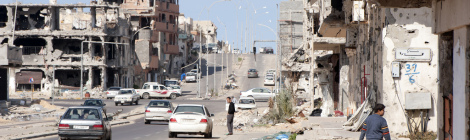
The 2011 Libyan intervention and the anarchy which ensued has highlighted an aspect of the responsibility to protect principle that has, to date, been overshadowed by the debates on the […]
The 2011 Libyan intervention and the anarchy which ensued has highlighted an aspect of the responsibility to protect principle that has, to date, been overshadowed by the debates on the […]

US drug policy has become increasingly privatised in recent years as the US government contracts private military and security companies (PMSCs) to provide intelligence, logistical support and training to state security forces in drug-producing and –transit states. As the cases of Colombia and Mexico illustrate, this privatisation strategy is having a damaging impact on these already fragile environments.
This article series shows how young people are playing a crucial role building peace in societies across the globe and explains why the international community’s empowerment of youth peacebuilding initiatives should continue.
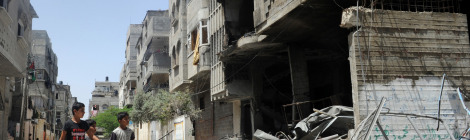
Today’s younger generations of Palestinians desperately need to become more engaged in community peacebuilding activities to end the division of Palestinian society.

The fate of Colombia’s Legión del Afecto as a government-financed peacebuilding program is uncertain, but it looks to endure as an independent social movement. Its persistence is due both to its historical development and to its emphasis on affective relationships.
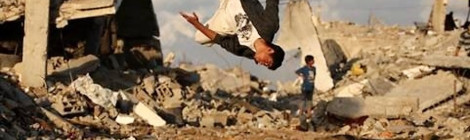
Action sports are increasing in popularity in the Middle East. For youth in conflict zones, these collaborative projects provide space for local voices and means of empowerment.

The inclusion and participation of young people in societies is a necessary condition for sustainable peace. The neglect of young people’s current needs and future livelihoods is a recipe for renewed conflict.

Young people are frequently ‘othered’ in discussions about on conflict. This is a dangerous practice as youths can play a very positive role aiding peacebuilding in societies recovering from conflict. The […]
 This article is part of the Remote Control Warfare series, a collaboration with Remote Control, a project of the Network for Social Change hosted by Oxford Research Group.
Editor’s note: Remote Warfare and the War on Drugs mini-series: This series of articles explores how remote warfare is being used in the war on drugs. To date, much of the debate on remote warfare has focused on its use in the war on terror. However, the use of drones, private military and security companies (PMSCs), special forces and mass surveillance are all emerging trends found in the US’s other long standing war, the War on Drugs. The articles in this series seek to explore these methods in more depth, looking at what impact and long term consequences they may have on the theatre in which they’re being used. Read other articles in the series.
In Latin America drones are being used as part of the War on Drugs as both regional governments and the US are using surveillance drones to monitor drug trafficking and find smuggling routes.. However, as drones are increasingly being used by drug cartels themselves to transport drugs between countries, could Latin America find itself at the forefront of emerging drone countermeasures?
In many Latin American countries, militaries operate as internal security forces because they combat drug traffickers and insurgencies. As a result, regional security agencies are constantly looking for new technologies to support security operations. Indeed, Peruvian Admiral José Cueto Aservi described purchasing drones in 2013 as necessary due to the “asymmetric war” being launched by narco-movement Shining Path that “takes advantage of the complex geography to attack” and thus “all methods” – including “technology” – are needed to defeat them.
Today, drones are regarded as potential “game changers” by regional security forces, believed to be invaluable “eyes in the sky” that will aid surveillance operations. Hence, it is no surprise that several Latin American countries have acquired them, whilst many others are producing them. At the same time, US drones are carrying out their own operations in Latin America as part of the global War on Drugs and drug cartels themselves have started using drones to smuggle drugs across international borders. As the use of drones looks set to increase, what is the likelihood of armed drones being used in this theatre and what implications could the non-state use of drones have on the region?
Drones in Latin America
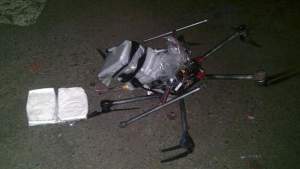
Crashed drone on Mexican border. Image by Secretaría de Seguridad Pública Tijuana.
There are currently at least 14 Latin American and Caribbean countries which have used or purchased drones. No Latin American state possesses large numbers of drones in the manner of the US military, rather, regional governments mostly operate just two or three drones of any type. Israel is the largest provider of drone technology to Latin America, having sold some $500 million worth to the region between 2005 and 2012. Latin American states have also started developing their own drones with Colombia being the first South American nation to have home-built a drone, the Iris, in 2015.
Unarmed drones carry out Intelligence, Surveillance and Reconnaissance (ISR) roles for a range of different operations in Latin America. Due to the region’s complex topography (a case in point is the Amazon, where drug traffickers from Brazil, Colombia, Bolivia and Peru operate) drones require special features like infrared cameras and have been useful for monitoring vast uninhabited spaces in the region. In Brazil, for example, drones have been used for agricultural reasons, including monitoring the Amazon rainforest. In Belize and Costa Rica too, drones have been used for conservation purposes. In Peru, a municipality police force in Lima,deployed three drones to patrol the Peruvian capital during the last Christmas season to help security officers locate emergency areas if necessary and in Mexico, drones have been used to patrol and secure sensitive areas like the facilities of the state oil company PEMEX.
Drones and the War on Drugs
Drones have also been used as part of the War on Drugs in Latin America. In Mexico, National Defense Secretariat, the Federal Police, the Procuradoría General de la República (the Attorney General’s office), as well as the Army and Air Force fly drones to gather intelligence to combat organized crime, mainly drug trafficking. In Brazil, Colombia, Panama and Trinidad and Tobago too, drones are used to monitor drug trafficking and find drug smuggling routes.
Drones are also being used by non-state actors, in the form of drug cartels, to smuggle drugs between countries. In January 2015, a drone crashed in a supermarket parking lot in Tijuana, Mexico –carrying three kilograms of crystal meth and in August 2015, two Mexican citizens were convicted of utilizing a UAV to fly 13 kilograms of heroin from Baja California, Mexico, into California.This led US authorities to deem drones an “emerging trend” employed by transnational criminal organizations to smuggle narcotics into the US.
In its long running War on Drugs, the US has also been using its own drones in Latin America. A New York Times article reported that, in 2011, in an effort to step up its involvement in Mexico’s drug war, the Obama administration begun sending its drones deep into Mexican territory to gather intelligence to help locate major traffickers. Furthermore, an official US briefing from 2011 – obtained via the Freedom of Information Act – revealed that the US Air Force is working to make its RQ-4 Global Hawk high altitude long endurance drones available to its allies in Latin America and the Caribbean in order to help “find drugs fields and helping plan offensives against rebel groups”.
US Customs and Border Protection operates 10 MQ-1 Predator drones, including two based in Cape Canaveral, Florida, that patrol a wide swatches of the Caribbean through the Bahamas and down to south of Puerto Rico as part of the drugs fight, and, in 2013, it was reported that the US Navy was testing a new type of drone that can be hand-launched from a ship’s deck to help detect, track and videotape drug smugglers in action across the Caribbean Sea.
US drones have also been used for other purposes in the region. US Customs and Border Protection have been flying surveillance drones for nearly a decade, launching them from bases in Texas, Florida, North Dakota and Arizona to detect illegal border-crossing. This activity has been called into question recently as a 2015 report from the Department of Homeland Security’s inspector general found drones to be ineffective in conducting surveillance along the border.
Towards drone countermeasures?
As for the future, we can expect drones to continue to be utilized in Latin America, as there has been an increase in the purchasing and development of drones across the region in the last few years. US companies Boeing and Aerovironment, for example, have both declared their intention to increase drone sales to Latin America, with countries like Colombia, Chile, Mexico and Peru interested in purchasing from them and the Swedish firm Unmanned System Groups (USG), showcased its F-330 drone to the Uruguayan armed forces in late 2014.
More countries in the region are also looking to develop their own drones. Following the building of Colombia’s first drone in 2015, a COHA report found that Peru, Ecuador, Argentina and Brazil are all in the process of developing their own drones. There have also been talks of developing a South American drone, which would be manufactured by the Union of South American Nations (UNASUR, which has as members all twelve South American states).
With regards to armed drones in the region, a number of states have indicated their desire for them. Peru and Colombia in particular could seek to acquire armed drones as internal security conditions worsen. However, this is unlikely to happen any time soon as countries that possess armed drones, such as the US and Israel, are unlikely to sell them to Latin America in the near future. Hence Latin American militaries would have to look to other potential suppliers, like China or Russia, or construct them themselves. Here, financial barriers, along with limited technological know-how capabilities, even amongst countries that already produce drones, would make this unlikely.
Even if armed drones are unlikely to be used in the region any time soon, there is a potential for Latin America to become a testing ground for drone technology in other ways. As drones are being increasingly utilized by drug traffickers in the region to transport drugs between countries in ever more sophisticated ways, it is likely that this will lead to regional efforts to develop increasingly advanced drone-detection and interdiction technologies to defend against this threat. At present a number of companies internationally are developing this technology, used to detect, block and destroy drones. This includes the development of early warning systems that can identify and detect drones and signal jamming technology to block drone control frequencies. As well as this, technology is also being advanced to destroy detected drones. This includes both laser and kinetic defence systems, the later using missiles, rockets and bullets capable of shooting drones down. Companies are also looking into nonlethal projectile weapons that fire blunt force rounds, such as bean bags or rubber bullets, or small portable net guns that can ensnare drones. As Latin America finds itself battling against the hostile use of drones by drug cartels it could find itself at the forefront of these emerging drone countermeasures.
Alejandro Sanchez is a regular contributor for IHS Jane’s Defense Weekly, the Center for International Maritime Security, Blouin News and Living in Peru. He focuses on geopolitics, military and cyber security issues in the Western Hemisphere. His analyses have appeared in numerous refereed journals including Small Wars and Insurgencies, Defence Studies, the Journal of Slavic Military Studies, European Security, Studies in Conflict and Terrorism and Perspectivas. Follow him on Twitter: @W_Alex_Sanchez
Issues:Climate change, Competition over resources, Global militarisation, Marginalisation
 By Oxford Research Group’s Sustainable Security Programme Manager Ben Zala
Currently Latin America and the Caribbean is a region that finds itself somewhat out of the global spotlight. The region is not at the heart of the financial crisis but instead is, on the whole, a victim of the collapse of the global economy. At the end of the first decade of the ‘global war on terror’, the region has played a marginal role in the conflict and its flashpoints in Iraq, Afghanistan and elsewhere. Even in the debates and developments in what has been termed the ‘regionalisation’ of global politics, Europe and Southeast Asia have absorbed the focus with discussion of Latin America and the Caribbean acting more as an afterthought than a key point of analysis. Yet this is unlikely to remain the case for long. In a region where poverty, militarism and environmental limits are coalescing, Latin America and the Caribbean is becoming a testing ground for responding to security challenges that are increasingly global in nature.
To address these issues, security experts, academics, journalists and civil society leaders from across Latin America and the Caribbean were brought together by ORG and the Norwegian Peacebuilding Centre (Noref) in January 2010. The meeting explored the implications of a ‘sustainable security’ framework for the region. The consultation was the fourth in a series of regional meetings held as part of ORG’s Sustainable Security Programme.
The meeting identified the regional drivers of insecurity as:
The blockages to achieving change in the region were identified as:
The report includes an integrated analysis of these issues, together with recommendations for policy-makers.
 Delicious
 Digg
Digg StumbleUpon
 Reddit
Posted on 30/09/10
Issue:Climate change
/4E18EED3C0131B39C125763800602C95/%24file/monitoring-disaster-displacement-2009-sthmb.jpg) Climate change is already increasing the frequency and intensity of natural hazards, and the numbers of natural disasters reported and people affected are rising. Although it is clear that natural disasters are one of the principal causes of forced displacement, data on disaster-related displacement has not been consistently collected and analysed. The lack of reliable baseline data on disaster-related forced displacement has prevented adequate evaluation of the scale of the phenomenon and the patterns of displacement. It also makes it difficult to extrapolate potential human mobility based on existing climate change models or scenarios, or to develop realistic assessments to be taken into account in climate
Climate change is already increasing the frequency and intensity of natural hazards, and the numbers of natural disasters reported and people affected are rising. Although it is clear that natural disasters are one of the principal causes of forced displacement, data on disaster-related displacement has not been consistently collected and analysed. The lack of reliable baseline data on disaster-related forced displacement has prevented adequate evaluation of the scale of the phenomenon and the patterns of displacement. It also makes it difficult to extrapolate potential human mobility based on existing climate change models or scenarios, or to develop realistic assessments to be taken into account in climate
change adaptation policy formation.
This study looks at natural disasters and forced displacement in the context of climate change. It has two aims: firstly, to provide an estimate of forced displacement related to disasters in 2008, specifically climate-related disasters; and secondly, to propose a methodology that could be applied to monitor disaster-related displacement on an ongoing basis. The study uses existing data sets on the impacts of natural disasters in 2008, crossreferences various sources, and individually investigates a number of events to estimate the numbers of persons displaced by disasters in 2008.
The findings show that at least 36 million people were displaced by sudden-onset natural disasters in 2008. Of those, over 20 million were displaced by sudden-onset climate-related disasters. As a reference, the total population of people living in forced displacement due to conflict, including IDPs and refugees, was 42 million in 2008, with 4.6 million having been newly internally displaced during the year. It is likely that many more are displaced due to the other climate change-related drivers, including slow-onset disasters, such as drought and sea level rise; however the study does not present an estimate of their number.
The methodology proposed in this study could be applied with relatively limited additional resources to monitor disaster-related displacement on an ongoing basis. Monitoring of disaster-related displacement could be significantly enhanced through additional steps to collect data on the duration of displacement, returns, local integration and relocation and the needs of displaced populations.
The full report can be downloaded here.
 Delicious
 Digg
Digg StumbleUpon
 Reddit
Posted on 16/11/09
Issue:Global militarisation
Dangerous pressures are pushing international warfare in the direction of the absolute, imperiling the future of mankind. Undoubtedly, the foremost of these pressures is the emergence, use, retention, and proliferation of nuclear weapons, as well as the development of biological and chemical weapons of mass destruction.
Since Hiroshima and Nagasaki there have been several close calls involving heightened dangers of nuclear war, especially during the 45 years of Cold War rivalry. None of these was more frightening than the Cuban Missile Crisis of 1962, when it took Soviet willingness to reverse their decision to deploy missiles in Cuba to avert a slide into catastrophic nuclear war.
To entrust such weaponry to the vagaries of political leadership and the whims of governmental institutions seems like a Mount Everest of human folly. Yet there is little outcry against nuclear weapons today, despite the collapse of the deterrence rationale that seemed to make reliance on the weaponry somewhat plausible during the decades of confrontation between the Soviet Union and the United States. Even under Cold War conditions, deterrence was seen by peace activists as a form of geopolitical insanity widely known by the descriptive acronym “MAD”, short for “Mutually Assured Destruction”.
Underneath the tendency of powerful governments to develop whatever weapons and tactics technology can provide are the fragmented political identities of a world divided into sovereign political actors. The inhabitants of these states of greatly varying size, capabilities, vulnerabilities, cultural and political traditions have long been indoctrinated to approve blindly of the actions of their own state. The idolatrous eyes of nationalism treat the extermination of an enemy as an acceptable goal if necessary for national security, and even desirable, if it is seen as furthering national ambitions.
Beyond this, defending the security of one’s own state is viewed as an unconditional prerogative, vindicating even a suicidal reliance on nuclear weaponry. The ideology of nationalism, nurturing the values of unquestioning patriotism and militarism in the modern West, have led to an orientation that can be described as secular fundamentalism, embodying imperial worldviews, however dysfunctional, given the risks and limits associated with continuing to seek desired political ends by relying on military superiority. The crime of treason reinforces these absolutist claims of the secular state by disallowing citizens of democratic states any right to claim conscience, law, and belief in support of their deviant behaviour.
‘Militarist frustration’ since WWII
Any objective study of international history will show that the militarily superior side has rarely prevailed in an armed conflict since the end of World War II unless it has also been able to command moral and legal legitimacy. The political failure of the colonial powers despite their military dominance provide many bloody illustrations of this recent trend toward militarist frustration, starting in the middle of the 20th century.
Because of entrenched bureaucratic and economic interests (the “military-industrial-media complex”), the evidence of the decline of hard-power geopolitics has been ignored. As a result, dysfunctional military solutions for conflicts continue to be relied upon in the West, especially by the United States, and costly and futile recourses to war are repeated over and over without lessons of restraint being learned. Experience, which might provide a rational limit on militarism, has been neglected; instead, old habits persist.
Another check on the excesses of warfare is supposedly provided by the inhibiting role of conscience, the ethical component of the human sensibility, that is supposed to be a hallmark of citizenship in liberal democracies. This sentiment was vividly expressed in a Bertolt Brecht poem, “A German War Primer”:
General, your bomber is powerful
It smashes down forests and crushes a hundred men
But it has one defect:
It needs a driver.
A driver is both a human cost, and maybe a brake on excess, as Brecht suggests a few lines later:
General, man is very useful
He can fly and he can kill
But he has one defect:
He can think.
Of course, military training and discipline are dedicated to overcoming this defect, especially when complemented with nationalist ideologies. International humanitarian law has vainly been trying to impose limits on combat behaviour in wars, but almost always yields in practice to considerations of “military necessity”.
The Nuremberg Trials decided that “superior orders” were no excuse if war crimes were committed, a breakthrough in establishing responsibility for adhering to law in relation to war, but flawed by its character as “victors’ justice”. Although beset by double standards, this Nuremberg tradition of imposing individual accountability for political and military leaders has persisted, and has recently been revived through the establishment of the International Criminal Court in 2002.
In the nuclear age, this process of dehumanising the military machine went further because the stakes were so high. I recall visiting the headquarters of the Strategic Air Command (SAC) at the height of the Cold War. SAC was responsible for the missile force that then targeted many cities in the Soviet Union. What struck me at the time was the seeming technocratic sensibility exhibited by those entrusted with operating the computers that would fire the missiles.
This amoral posture contrasted with the ideological zeal of the commanding generals who would give the orders to annihilate millions of civilians at distant locations. I was told at the time that the lower-ranked technical personnel had been tested to ensure that moral scruples would not interfere with their readiness to follow orders.
I found this mix of politically and morally driven commanders and amoral subordinates a most disturbing mix at the time, and still do, although I have not been invited back to SAC to see whether similar conditions now prevail. I suspect that they do, considering the differing requirements of the two roles. This view seems confirmed by the enthusiasm expressed for carrying on the “war on terror” in the aftermath of the 9/11 attacks. Although my remarks here are confined to the United States, I would suppose they apply to other major governmental bureaucracies dealing with national security and war/peace issues.
Use of drones dehumanises war
Now, new technological innovations in warfare are underlining these concerns. American reliance on drone attacks in Afghanistan (and elsewhere) removes the human altogether from the war theater, except in the geographically remote roles of programmer and strategic planner. And even then, reliance on algorithms for targeting removes any shred of personal responsibility. When mistakes are made, and innocent civilians are killed, it is treated as an unfortunate anomaly.
The tragic event is deprived of its human quality by being labeled “collateral damage”, and a formal apology is usually made. But nevertheless, the practice goes on: the US is investing heavily in more and better drones for future wars. Eliminating the presence of human soldiers from the battlefield is a chilling development: historically, the fact that war put soldiers’ lives at risk forced citizens to think about whether a war was morally right, or worth fighting. The anti-war sentiments of American soldiers in Vietnam exerted a powerful influence that helped over time finally to bring the war to an end.
Ultimately, what is at stake is the human spirit, which at the moment is being squeezed to near-death by technological momentum, corporate greed, militarism, and secular fundamentalism. The ultra-sophistication of the new weaponry and the accompanying military tactics create a new divide in the military sphere, giving rise to an era of virtually “casualty-free” and one-sided wars where the devastation and victimisation are shifted almost totally to the technologically inferior side. Examples include The Gulf War of 1991, the Kosovo War of 1999, and the Gaza Attacks of 2008-09. In the background, however, is the persisting threat of a use of nuclear weapons either by a state or an extremist non-state actor that could in a flash change this ratio of comparative vulnerability.
This web of historical forces continues to entrap major political actors in the world, and dims hopes for a sustainable future, even without taking into account the growing threat of climate change. Scenarios of future cyber warfare are also part of this evolving capacity to destroy distant societies without any human interaction. The cumulative effect of these developments threatens to make irrelevant the moral compass that alone provides acceptable guidance for a sustainable political future. Because international institutions remain too weak to provide global governance, reason and prudence remain the best hope to guide human destiny.
Richard Falk is Albert G. Milbank Professor Emeritus of International Law at Princeton University and Research Professor in Global and International Studies at the University of California, Santa Barbara. He has authored and edited numerous publications spanning a period of five decades, most recently editing the volume International Law and the Third World: Reshaping Justice (Routledge, 2008) and Achieving Human Rights (Routledge 2009).
He is Chair of the Board, Nuclear Age Peace Foundation and Director, Global Climate Change Project, UCSB. He is currently serving the fourth year of a six year term as a United Nations Special Rapporteur on human rights in the Occupied Palestinian Territories.
This article originally appeared on Al Jazeera’s English website.
Delicious Digg StumbleUpon RedditPosted on 3/08/11
This article was originally published on openSecurity’s monthly Sustainable Security column on 26th February 2014. Every month, a rotating network of experts from Oxford Research Group’s Sustainable Security programme explore pertinent issues of global and regional insecurity.

Prime Minister David Cameron visits British troops in South Afghanistan, 10 June 2010. Source: No. 10 (Flickr)
The 100th anniversary of the start of the First World War has kick-started a period of national self-reflection for the British public and political establishment. The timing seems almost scripted: as the country prepares to look back at the tragic events of 100 years ago, so we prepare for the first incidence of peace in a century. Following final pull-out from Afghanistan later this year, the UK should cease to be engaged in combat operations anywhere in the world for the first time since 1914.
This “strategic pause”, as Ministry of Defence (MoD) insiders are calling it, comes on the heels of last summer’s controversial parliamentary vote against possible military intervention in Syria. Public and Parliament alike seem wearied by the diminishing returns of a “fight first, fix later” strategic approach. With national elections and scheduled reviews of defence and security strategies fast approaching, this national mood for reflection is an opportunity to reframe British thinking on national and international security – and get it right in 2015.
The threats facing the UK today are a world away from those that instigated the First World War. A century on, a distinct lack of interstate war, the rise of global networks of terrorists and organised criminals, and the inability of many fragile states to respond to such challenges characterise an increasingly complex security landscape. There is also growing recognition of the role of a number of “non-traditional” drivers of global insecurity which act to multiply other threats. As with the localised devastation seen in the UK this winter, climate change is exacerbating economic, social and resource stresses. Thanks to the communications revolution, the world’s marginalised majority is suddenly and drastically aware of its inequality. Such risks highlight the increasing implausibility of military force being effective in tackling insecurity. What use are armies and navies in reducing the gap between elites and a disenfranchised underclass that is both local and global? How can air forces address the myriad impacts of concentrated greenhouse gases in the atmosphere?
As much as the global security landscape has changed, there remains an exceptional continuity in the British response to insecurity: a dogged, increasingly ineffective – and recently highly counter-productive – militarised approach. Given that, like World War I, the operation to dislodge the Taliban was originally intended to be “over by Christmas” in 2001, the war in Afghanistan is a case in point. The war has lasted 13 years, resulting in the deaths of 447 British troops, serious injury of thousands more, and costing the UK over £37bn, according to recent estimates from former Helmand adviser Frank Ledwidge.
Moreover, Ledwidge estimates that British troops in Helmand province have killed at least 500 non-combatants and the Costs of War project estimates that at least 16,725 Afghan civilians have been killed directly by the war’s violence, not including indirect deaths from reduced access to health care, malnutrition and lack of clean drinking water that have been exacerbated in the country’s war zones. For all these costs, military action has done little to decrease Taliban influence or stabilise Afghanistan. A recent review by CNA on behalf of the Pentagon’s policy directorate predicts a sharp post-withdrawal resurgence of Taliban influence and would require far more Afghan troops and police capacity than planned for.
Learning something from the Afghanistan and Iraq debacles, the UK has shifted towards a more streamlined version of the same interventionist thinking. This “no boots on the ground” approach, such as we saw in Libya (2011), also comes with unforeseen consequences. While NATO operations in Libya were deemed successful within the narrow definitions of the UN mandate, limited intervention there sowed the seeds of further intervention in Mali as weapons and fighters spread south, prompting the declaration of commitment by the prime minister, David Cameron, to the next “generational struggle” against Islamist terrorism.
A similar rhetoric of limited intervention was noticeable last summer during debates on possible military action in Syria, when the prime minister assured the British public that intended air strikes would be strictly “punitive”. Again, considerations of the potential ineffectiveness and future blowback of military action – on the people of Syria as well as the UK – took a back seat to the political visibility of military action as British agency.
There is a clear need for more nuanced approaches to tackle insecurity in the coming decades. The struggle against violent extremism, for example, requires approaches which seek to address the conditions that allow such ideologies and instability to thrive. However, the overarching message from British leaders is that we can expect more of the same. Earlier this month, the UK Government confirmed the upcoming purchase of fourteen F-35B Joint Strike Fighter jets, with a price tag of £2.5bn, in addition to new aircraft carriers costing at least £6.2bn. Neither system will be operational before 2019, almost a decade after the last British carriers were retired. Similarly, plans to renew the Trident nuclear deterrent with a like-for-like system will cost at least £25bn, with whole-life costs of replacement exceeding £100bn.
Decision is due in 2016. Such heavy budgetary weighting in defence spending towards nuclear deterrence and offensive force projection limit the country’s ability to assess strategic balance and diminish the opportunity to develop a wider range of security management options for the UK on the international stage. Investing over half a billion pounds on armed Reaper drones by 2015 predisposes the UK to this form of military action while the jury is still out on its legitimacy, ethics, legality and long term impact. The possibilities for constructive debate on alternatives to the current offensive defence approach are constrained by such massive forward commitments to next generation equipment that prioritises force projection.
There is also uncertainty over the review of the National Security Strategy (NSS), which defines the threat environment that UK defence and security policy responds to through the Strategic Defence and Security Review (SDSR). Both documents are scheduled to be reviewed and updated following the May 2015 general election. While thinking on changes to the next SDSR is already underway, National Security Adviser Sir Kim Darroch indicated to the House of Commons on 11 September “no precise timetable” for the next NSS. On 30 January, Cameron told the parliamentary Joint Committee on the National Security Strategy that the NSS review process – led by his Cabinet Office – was “now beginning” but implied that the SDSR was further advanced.
The 2010 NSS made a number of important observations about the changing nature of British security challenges – including climate change and the importance of conflict prevention – but these failed to translate into actionable policy prescriptions in the SDSR. This was in part the result of poor timing; while the SDSR should be a subsidiary document informed by the NSS, the documents were released a day apart in October 2010 after a rushed four month process.
If the UK is to engage in meaningful debate on approaching complex security challenges and subsequently turn that debate into relevant policy options, it must avoid the mistiming of 2010 and be open to dialogue with UK civil society and foreign partners on the nature of threats and opportunities. With uncertainty over the timing and scope of the NSS review it is difficult to see what room exists for UK to develop policies that genuinely reflect changes in international security.
If British approaches are to respond effectively to changing security threats, the scheduled 2015 SDSR process will need to rebalance priorities, with a shift towards conflict prevention and provision of early and non-combat security support in fragile states. Progressive thinking in the current NSS and initiatives, such as the 2011 Building Stability Overseas Strategy, must now translate into a change of priorities in British security, including spending, decisions on deterrence and intervention.
The coinciding anniversary of the First World War and final withdrawal from Afghanistan may well provide a much overdue period of reflection on past lessons and future approaches to British security and defence. But if the UK is to learn the lessons of the past century – that unparalleled military interventionism cannot yield long term national nor global security – it must make 2014 a year of genuine consideration of the threats it faces in the next years. In turn, committing to an open process of reflection will allow the decisions of 2015-16 to positively contribute to sustainable peace and security for years to come.
Zoë Pelter is the Research Officer of Oxford Research Group’s (ORG) Sustainable Security programme. She works on a number of projects across the programme, including ‘Rethinking UK Defence and Security Policies’ and ‘Sustainable Security and the Global South’. Zoë co-authored ORG’s recent submission to the House of Commons Defence Select Committee inquiry ‘Towards the Next Defence and Security Review’.


 Climate-related displacement is one of the key challenges facing South Asia in the coming decades. Although there is considerable debate about the salience of the term ‘climate refugees’ and extent to which climate change is a primary cause of forced displacement, there is no doubt that large numbers of people are already having to cope with the impact of environmental changes on their livelihoods and everyday life.
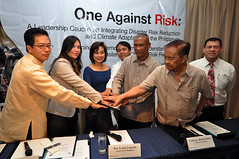 On February 25, 2009, the International Institute for Strategic Studies (IISS) launched the “Transatlantic Dialogue on Climate Change and Security”, funded by a grant from the European Commission, with the purpose of analyzing the impact of climate change on global security and stability.
 Persistent calls for clear and transparent information on Sudan’s oil revenues have yet to yield satisfactory information, says a new report published by Global Witness today. With a referendum on independence for southern Sudan just days away, oil sector transparency is now more important than ever to preserving the fragile peace between north and south.
 In the Lowy Institute’s latest Strategic Snapshot, International Security Program Associate Ashley Townshend explores the strategic dynamics between China and India in the Indian Ocean.
 In this Peace Research Institute Oslo (PRIO) Policy Brief, Kaja Borchgrevink & Kristian Berg Harpviken explore claimed links between Taliban militancy and religious education in Afghan and Pakistani madrasas.
 In this recent article, Mariano Aguirre, Director of the Norwegian Peacebuilding Centre in Oslo, examines the complex and unpredictable challenges to peace and security.
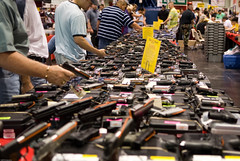 A new SIPRI report highlights the limitations of United Nations attempts to control the flows of arms into Somalia, and the role of potential arms-supplying states.
 The article investigates the inter-relation between armed conflict and natural resources and its implications for conflict resolution and peacebuilding.
Comments
Post new comment