Blog

  • Sustainable Security

  • Sustainable Security

  • Peak Oil likley to occur within the next decade

    Peak Oil likley to occur within the next decade

    Issue:Competition over resources

    In an interview with the Independent newspaper, Dr Fatih Birol, the Chief Economist at the International Energy Agency (IEA) in Paris, has warned that most governments and members of the public underestimate the rate at which the world’s oil supplies are running out. Dr Birol suggested that global production is likely to peak in around ten years – a decade earlier than most governments predict. In addition, Dr Birol highlighted the very real danger of an ‘oil-crunch’ within the next five years which could have an adverse impact on potential recovery from the current global recession.

    Dr Birol’s comments are in keeping with sustainable security analysis, which highlights competition over resources as one of the key threats to global security. “One day we will run out of oil, it is not today or tomorrow, but one day we will run out of oil and we have to leave oil before oil leaves us, and we have to prepare ourselves for that day,” Dr Birol said. “The earlier we start, the better, because all of our economic and social system is based on oil, so to change from that will take a lot of time and a lot of money and we should take this issue very seriously.”

    Comments

    Post new comment


  • Connections Between Climate and Stability: Lessons From Asia and Africa

    Connections Between Climate and Stability: Lessons From Asia and Africa

    The New Security Beat | The New Security Beat | May 2011

    Issue:Climate change

    “We, alongside this growing consensus of research institutes, analysts, and security agencies on both sides of the Atlantic, think of climate change as a risk multiplier; as something that will amplify existing social, political, and resource stressors,” said Janani Vivekananda of International Alert, speaking at the Wilson Center on May 10.

    Vivekananda, a senior climate policy officer with International Alert’s Peacebuilding Program, was joined by co-presenter Jeffrey Stark, the director of research and studies at the Foundation for Environmental Security and Sustainability (FESS), and discussant Cynthia Brady, senior conflict advisor with USAID’s Office of Conflict Management and Mitigation, to discuss the complex connections between climate change, conflict, stability, and governance. 

    A Multi-Layered Problem

    Climate change and stability represent a “double-headed problem,” said Vivekananda. Climate change, while never the only cause of conflict, can increase its risk in certain contexts. At the same time, “states which are affected by conflict will already have weakened social, economic, and political resilience, which will mean that these states and their governments will find it difficult to address the impacts of climate change on the lives of these communities,” she said.

    “In fragile states, the particular challenge is adapting the way we respond to climate change, bearing in mind the specific challenges of operating in a fragile context,” said Vivekananda. Ill-informed intervention programs run the risk of doing more harm than good, she said. 

    For example, Vivekananda said an agrarian village she visited in Nepal was suffering from an acute water shortage and tried adapting by switching from rice to corn, which is a less water-intensive crop. However, this initiative failed because the villagers lacked the necessary technical knowledge and coordination to make their efforts successful in the long term, and in the short term this effort actually further reduced water supplies and exacerbated deforestation.

    “Local responses will only be able to go so far without national-level coordination,” Vivekananda said. What is needed is a “harmony” between so-called “top-down” and “bottom-up” initiatives. “Adapting to these challenges means adapting development assistance,” she said. 

    “What we’re finding is that the qualities that help a community, or a society, or in fact a government be resilient to climate change are in fact very similar qualities to that which makes a community able to deal with conflict issues without resorting to violence,” said Vivekananda.

    No Simple, Surgical Solutions

    “The impacts of environmental change and management of natural resources are always embedded in a powerful web of social, economic, political, cultural, and historical factors,” said Stark. “We shouldn’t expect simple, surgical solutions to climate change challenges,” he said.

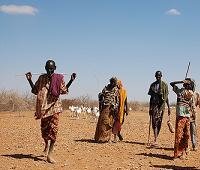
    Uganda and Ethiopia, for example, both have rich pastoralist traditions that are threatened by climate change. Increasing temperatures, drought, infrequent but intense rains, hail, and changes in seasonal patterns are threatening pasture lands and livelihoods.

    At the same time, pastoralists are confronting the effects of a rapidly growing population, expanding cultivation, forced migration, shrinking traditional grazing lands, anti-pastoralist attitudes, and ethnic tensions. As a result, “any intervention in relation to climate adaptation – whether for water, or food, or alternative livelihoods – has to be fully understood and explicitly acknowledged as mutually beneficial by all sides,” Stark said. “If it is seen in any way to be favoring one group or another it will just cause conflict, so it is a very difficult and delicate situation.”

    Yet, the challenges of climate change, said Stark, can be used “as a way to involve people who feel marginalized, empower their participation…and at the same time address some of the drivers of conflict that exist in the country.”

    Case Studies: Addressing the “Missing Middle”

    When doing climate change work in fragile states, “you have to think about your do-no-harm parameters,” said Brady. “Where are the opportunities to get additional sustainable development benefit and additional stabilization benefit out of reducing climate change vulnerability?”

    More in-depth case studies, such as the work funded by USAID and conducted by FESS in Uganda and Ethiopia, are needed to help fill the “missing middle” between broad, international climate change efforts – like those at the United Nations – and the community level, Brady said. 

    The information generated from these case studies is being eagerly awaited by USAID’s partners in the Departments of State, Defense, and Treasury, said Brady. “We are all hopeful that there will be some really significant common lessons learned, and that at a minimum, we may draw some common understanding about what climate-sensitive parameters in fragile states might mean.”

    Image source: aheavens

    Article source: The New Security Beat

    Comments

    Post new comment


  • Sustainable Security

    Many researchers have focused on how the institutions of the nation-state can help build peace. Though useful, this focus can often ignore how institutions older than those of the nation-state can contribute to peacebuilding processes.

    Can the introduction of “right” institutions facilitate peace in fragile states? Conflict researchers grappling with this question have mostly focused on the institutions of the nation-state. From this perspective, states can exit the conflict trap by introducing fair elections, capable national bureaucracies, independent judiciaries and constitutional protections against misrule. However, this state-centric perspective ignores the reality that national political institutions are far from the “only game in town” in many of the world’s most conflict prone states. Recent research suggests that institutions older than those of the nation-state can contribute to peace.

    African pre-colonial institutions

    ashanti_yam_ceremony_1817

    Image via Public Domain.

    A powerful example of how non-national political institutions contribute to peacemaking is found in the case of pre-colonial “customary” institutions in Africa.  As students of African history should know, post-colonial national institutions were layered on top of a pre-existing mosaic of kingdoms and state-like entitities, many of which have roots to the pre-colonial era.

    Consider the Ashanti Kingdom in Ghana. This political structure existed prior to colonialism, endured numerous conflicts with British colonizers, and was eventually recognized as a subnational political entity with special prerogatives. Today, after decolonization, several Ashanti institutions remain, such as the King, the customary court system and the council of elders. These institutions of the Ashanti Kingdom have served as an important platform for bargaining with the Ghanaian state, as well as in dispute resolution between conflicting parties in Ashantiland.  A similar pattern is found in the Buganda Kingdom in Uganda, where Buganda pre-colonial institutions have been incorporated into the constitution and serve as the main focal point for interactions between the Buganda ethnic group and the government.

    While some have pointed to customary institutions in Africa as a source of ethnic tension and conflict, this view is not correct. Recent research suggests that customary institutions play important roles as arbiters of conflict in state peripheries where central governments are weak. In a recent article in the Journal of Peace Research, I argue and demonstrate that this is an instance of a more general relationship. In Africa, where customary institutions are plentiful and many states have low capacity, strong pre-colonial institutions can serve as tools for peaceful bargaining and thus conflict reduction.

    To evaluate this claim, I collected data on the pre-colonial institutional affiliation of over 243 politically relevant ethnic groups as listed in the Ethnic Power Relations database. The data was collected from the ethnographic atlas, a collection of comparative ethnographic data on over 800 ethnic groups. Combining these data sources enabled a comparison of the degree to which contemporary ethnic groups inherited centralized pre-colonial political institutions such as kingdoms, chieftaincies and empires.

    Within this sample of ethnic groups, I investigated whether groups that were excluded from political power – which a decade of research suggests are the most conflict-prone ethnic groups – were less likely to experience armed conflict if they had inherited strong pre-colonial institutions. The results clearly show that ethnic groups who are excluded from power, but inherit pre-colonial institutions, are less likely to be involved in civil conflict in the period between 1945-2010. This is consistent with the claim that these groups can rely on their pre-colonial institutions to bargain with governments, avoiding armed conflict.

    Reasons for the success

    Why are ethnic groups with inherited political structures more adept at avoiding conflict? I argue that strong centralized customary institutions improve their capacity to engage in non-violent bargaining that avoids costly conflict. When groups have centralized customary institutions they can make their promises to respect agreements more credible by enshrining them in centralized political authorities, such as the Ashanti King (in Ghana). When agreements are guaranteed by a customary institution, such as a king or a traditional legislature, this raises the cost of violating the agreement, since reneging will have reputation costs for the customary institutions themselves, and since customary authorities can sanction violators. Furthermore, having strong centralized authority in customary institutions minimizes the risk of  “spoilers” to an agreement, i.e. factions of the given ethnic group that will not abide by the will of group leaders.

    For these reasons,  groups with decentralized customary institutions face greater constraints on their bargaining credibility since no preeminent authority can be used to guarantee that agreements will be respected. This is exemplified in the roles of centralized customary authorities in striking non-violent bargains with central governments in Africa. In Uganda, the institutions of the Buganda kingdom, such as the traditional authority of the King himself and the traditional Buganda legislature, have been relied on in deals made with the Ugandan regime. In Ghana, the Ashanti Kingdom has been pivotal in brokering with the Ghanean state, and has used its centralized customary court system to ratify land-rights acts and to adjudicate land-disputes in Ashantiland. In South Africa, Zulu authorities have used their customary institutions, such as the office of the Zulu king, to extract concessions from the South African government, regarding their role as traditional rulers in Kwazulu province.

    Conclusion

    This research on pre-colonial institutions has implications for how we approach the link between political institutions and peacebuilding in fragile states. First, it prompts the recognition that political institutions other than those related to national governments are vital to ensuring civil peace at the local level. Instead of seeing national institutions as the most vital to peace, we should see them as one category of a rich institutional mosaic. Crucially, in states where national institutions fail to penetrate the periphery, customary political institutions will be more central to building peace and good governance.  Second, it shows that traditional or “customary” institutions in Africa should not be seen as obsolete remnants of a forgotten era, but as vital parts of Africa’s institutional mosaic when it comes to building peace. Instead of inducing conflict and fueling ethnic antagonisms, these institutions play vital roles in containing conflict. Their local presence and importance to peace should be recognized by policymakers and scholars alike.

    Tore Wig is a post-doctoral fellow at the Department of Political Science at the University of Oslo.  He is currently affiliated with the project Disentangling the Economic Effects of Political Institutions (DEEPI), which seeks to study the historical (and contemporary) causal links between aspects of democratic institutions, economic growth and inequality.

  • Sustainable Security

    RC_long_logo_small_4webThis article is part of the Remote Control Warfare series, a collaboration with Remote Control, a project of the Network for Social Change hosted by Oxford Research Group. It originally appeared on openDemocracy on 19 June 2015.

    pakistan_tehreek-e-Insaf_protest_against_drones

    Imran Khan addressing a crowd at a Pakistan Tehreek-e-Insaf protest against drones, Peshawar, in November 2013. Source: Wikimedia

    Last Wednesday marked 11 years since the first reported US drone strike in Pakistan. Since 2004, the US has launched more than 419 strikes in the Federally Administrated Tribal Areas (FATA) as part of its global war on terror. Whilst much debate has focused on the ethics, legality and civilian costs of this new technology, little attention has been given to the broader repercussions drones have had on Pakistan as a whole and how they have shaped the country in the past decade.

    New research into the impact of drone strikes on terrorist behaviour, published this week, shows that drones are having a far wider and more damaging impact on civilian populations beyond those directly killed in the drone strikes themselves. The report, by Dr Paul Gill (UCL) commissioned by the Remote Control project, analyses data on drone strikes and terrorist attacks in Pakistan between 2004 and 2013 at the monthly, weekly and daily levels, finding that terrorist reprisals following a drone strike are disproportionally more likely to target civilians.

    This is because, although terror groups slow down their activities in the immediate aftermath of a drone strike for basic security reasons, when they do re-emerge the attack that follows will likely be one that doesn’t necessitate the lengthy planning of high value targets, due to the damage done to the terrorist group by a drone strike. The focus instead will be on “softer targets”, i.e. civilians, leading to an increase in fatality rates.  When assessing the human costs of drone warfare it is these indirect victims – those who die in terrorist reprisals – that must be factored in.

    Beyond terror attacks, drones are having a broader and more profound impact on Pakistani society in other ways too. A report last year from Dr Wali Aslam (University of Bath) found that drone strikes, whist pursuing some “high value” targets and decreasing the number of fighters in the tribal areas, has caused militants to relocate to other parts of the country, thus displacing rather than eliminating terrorists.

    In turn, this relocation has brought an increase in radicalisation, violence and crime to the regions of Pakistan where the militants have resettled, bringing increased instability to areas such as the Punjab, Karachi and Kurram Agency. Furthermore, the deeply unpopular nature of drones in Pakistan, caused by the civilian casualties, psychological damage and the infringement of sovereignty they entail, has led to growing anti-American sentiment that has provided an effective recruitment tool for extremists, fuelling rather than minimising radicalisation.

    As the UK and US increasingly rely on drones in their air campaign against Islamic State and as a growing number of states are now developing armed drones (the global export market for drones is predicted to grow nearly three-fold over the next decade), we must learn the lessons of Pakistan.

    Drones, like other forms of remote warfare, may be technologically advanced but in reality they are no more effective at ending conflict than boots on the ground were. Both seek to solve insecurity with a military solution, failing to address the root causes of conflict, or to devise any long-term strategy for what comes next. It is the covert nature of remote control warfare – operating in the shadows with minimal transparency, accountability or oversight – that make this warfare even more concerning.

    The case of Pakistan, after a decade long drone war, shows how the appeal of drones as a “cost free” form of warfare is misguided, failing to take into consideration their long term implications. In Pakistan, drones have not only been an ineffective counter-terrorism strategy but they have also had far reaching, negative repercussions on wider society.  It is these long term consequences – in many cases still largely unknown – that will prove to be the most damaging for any long-term, sustainable resolution to conflict.

    Esther Kersley is the Research and Communications Officer for the Remote Control project. Prior to joining ORG, Esther worked in Berlin for the anti-corruption NGO Transparency International as an editorial and online communications officer. She has a particular interest in counter-terrorism and conflict resolution in the Middle East, having previously worked with the Quilliam Foundation and IPCRI (Israel/Palestine Center for Research and Information), a Jerusalem based think tank.

    Featured Image: Imran Khan addressing a crowd at a Pakistan Tehreek-e-Insaf protest against drones, Peshawar, in November 2013. Source: Wikimedia

  • Climate Change, Nuclear Risks and Nuclear Disarmament: From Security Threats to Sustainable Peace

    Climate Change, Nuclear Risks and Nuclear Disarmament: From Security Threats to Sustainable Peace

    Jurgen Scheffran | World future Council | June 2011

    Issues:Climate change, Global militarisation

    On 17 May the World Future Council released its latest report entitled Climate Change, Nuclear Risks and Nuclear Disarmament: From Security Threats to Sustainable Peace. It is the outcome of groundbreaking research by Prof. Dr. Jürgen Scheffran of the University of Hamburg.

    The report examines the linkages between nuclear and climate risks, noting that these two clear threats may interfere with each other in a mutually re-enforcing way. It also acknowledges that finding solutions to one problem area could lead to solutions in the other: “Preventing the dangers of climate change and nuclear war requires an integrated set of strategies that address the causes as well as the impacts on the natural and social environment.” Prof. Dr. Scheffran offers an approach to move away from these security threats to building sustainable peace.

    The study brings to light the multidimensional interplay between climate change, nuclear risks and nuclear disarmament, and its critical implications for the strategic security environment. In addition, it explores prospects and openings to tackle these key challenges, stressing the role played by institutions to “strengthen common ecological and human security, build and reinforce conflict-resolution mechanisms and low-carbon energy alternatives, and create sustainable lifecycles that respect the capabilities of the living world.”

    Read the full report here.

    Image source: GreenDominee

    Comments

    Post new comment


  • Copenhagen: the challenge ahead

    Copenhagen: the challenge ahead

    Paul Rogers | Oxford Research Group | December 2009

    Issue:Climate change

    Copenhagen failed dismally to set firm targets either for greenhouse gas reductions and the aid offered to poorer countries to counter the impact of climate change was minimal. Scarcely anything was achieved other than most states accepting that the global temperature increase must be kept below 2ºC.


    As world leaders try to minimise the scale of the failure we have to remember that this was the biggest ever attempt to respond to the potential disaster of climate change and it needed to have resulted in:


    • Radical and legally-binding decreases in climate gas emissions, starting with the industrialised states where 40% cuts by 2020 are the absolute minimum required.

    • Agreement to limit temperature increases to a world average of just 1ºC.

    • Aid of at least $100 billion a year from 2011 to start preparing for the impact on the poorer countries of the South of climate changes that are already likely.


    These were the minimum requirements for two main reasons. One is that poorer states have very limited capabilities for combating the impact of climate change and the second is that the recent modelling of climate change demonstrates repeatedly that its impact is asymmetric.


    What is crucial here is that an average increase of 2ºC world-wide is likely to mean a much smaller increase for most of the oceans, apart from the Arctic, but very much larger increases for most of Central and South America, much of Africa and the Middle East and large parts of South and South-East Asia.


    Anticipated temperature increases above 6ºC for Amazonia will mean the destruction of the world’s largest rain forests, with massive additional releases of carbon. Similar increases for the Arctic and near-Arctic will mean loss of icecaps leading to substantial sea level rises flooding heavily populated coastal cities in the tropics and inundating of some of the most fertile croplands in the world’s great river deltas. Release of carbon from thawing Arctic permafrost vegetation will accelerate greatly if there is a 6ºC rise, making matters even worse.


    Copenhagen failed because of a lack of international leadership, determined efforts of trans-national corporations to denigrate the science of climate change and a world-wide failure to recognise that radical action is required in the next five years to prevent catastrophes in the coming decades.


    How can it all be turned round? The widespread recognition that Copenhagen failed is a start, as is the changing attitude of the United States – a McCain administration would have had little truck with the whole process. The spotlight on climate change provided by Copenhagen was also hugely welcome, and there was always the risk that a partial success might have lulled too many people into a false sense of security by covering up what really needs to be done.


    The Copenhagen outcome shows the political state of the world as it really is, and this reality must form the basis for what is going to have to be a sustained and concerted effort to make up for lost time. The first decade of this century was largely lost but the second decade offers more hope. The physical evidence of climate change is increasing by the year, growing numbers of younger activists are determined not to see the future ruined, and in think tanks and civil society groups across the world new ideas and approached are being developed.


    The blinkered political realities of Copenhagen may be discouraging but they remind us of how great the task is and we are beginning to get a clear idea of what has to be done. We have now to work intensively to make the second decade of this century the period of real change when we move decisively towards an idea of genuine security that is rooted in emancipation and environmental sustainability.


    Comments

    Post new comment


  • Sustainable Security

    Countering Militarised Public Security in Latin America: Understanding the trend in Venezuela

    Across Latin America, governments are sending their militaries into the streets to act as de facto police forces in the face of disproportionally high crime and violence rates. This trend has been going on for several years, but has accelerated in 2013. With the move to deploy over 40,000 troops for citizen security in Venezuela, President Nicolás Maduro joined a growing list of leaders throughout the region that have relied on their militaries to carry out police duties. In the first of our two-part discussion ‘Countering Militarisation of Public Security in Latin America’, Sarah Kinosian discusses the conditions that are causing the trend to thrive.

    Read Article →

  • Global militarisation

    Global militarisation

    The current priority of the dominant security actors is maintaining international security through the vigorous use of military force combined with the development of both nuclear and conventional weapons systems. Post-Cold War nuclear developments involve the modernisation and proliferation of nuclear systems, with an increasing risk of limited nuclear-weapons use in warfare – breaking a threshold that has held for sixty years and seriously undermining multilateral attempts at disarmament. These dangerous trends will be exacerbated by developments in national missile defence, chemical and biological weapons and a race towards the weaponisation of space.

    How the Competing Security Needs of Caribbean Community Members have Crystallized Through Multilateralism and Consensual Decision-Making

    Serena Joseph-Harris | Exclusively written for sustainablesecurity.org | April 2011

    Issues:Competition over resources, Global militarisation, Marginalisation

    In a paper exclusively written for sustainablesecurity.org, Serena Joseph-Harris (former High Commissioner for Trinidad and Tobago) focuses on competition over natural resources, the role of maritime routes in the Caribbean, and the importance of multilateral approaches to finding sustainable solutions in the Caribbean.

    Image source: Len@Loblolly

    Read more »

    Mano Dura: Gang Suppression in El Salvador

    Sonja Wolf | Exclusively written for sustainablesecurity.org | March 2011

    Issues:Global militarisation, Marginalisation

    Case study examining how  repressive policies against gangs in El Salvador drove gangs to further violence, heightening the cycle of militarisation.

    “In 2003 – eight months before the 2004 presidential elections – President Francisco Flores of the conservative ARENA party launched Plan Mano Dura (“Strong Hand”), ostensibly to dismantle the gangs and curb the number of homicides, most of which had been attributed to these groups. Backed by considerable media publicity, the measure entailed not only area sweeps and joint police-military patrols, but was also accompanied by a temporary anti-gang law that permitted the arrest of suspected gang members on the basis of their physical appearance alone. Both the nature and the timing of the initiative suggested that it had been designed to improve the ruling party’s electoral position rather than to ensure effective gang control.”

    Image source: VCK xD

    Read more »

    Libya: lessons in controlling the arms trade

    Pieter D. Wezeman | SIPRI | March 2011

    Issue:Global militarisation

    In the current military air strikes against Libyan forces, nations that once supported Colonel Muammar Gaddafi’s regime are now—based on sanction by the United Nations—attacking the forces they were marketing and delivering arms to only weeks before. As the violence escalates and the international community examines how to respond to internal conflict and human rights violations, arms supply should be analysed as it implicates the international community as complicit in the violence it is now trying to end.

    Image source: B.R.Q.

    Article source: SIPRI

    Read more »

    What’s the Real Mission In Libya?

    Chris Mathews | Huffington Post | March 2011

    Issues:Global militarisation, Marginalisation

    US TV News anchor Chris Mathews, writing for ther Huffington Post, asks what is the real mission in Libya? Not the no-fly zone – that’s a method. So what is the mission? How do we end this thing?

    Image source: Gumpingit. 

    Read more »

    How Food Could Determine Libya’s Future

    Christopher Albon | The Atlantic | March 2011

    Issues:Global militarisation, Marginalisation

    As Libya’s protesters-turned-rebels fight a series of hard battles with forces loyal to Muammar Qaddafi, the United States — and the much of the world — struggles to find a meaningful response to the conflict. U.S. lawmakers have proposed such aggressive options as enforcing a no-fly zone over Libya or arming anti-Qaddafi rebels, both of which the White House has kept on the table. Critics of these plans argue that they risk involving the U.S. in another military engagement. But there’s another option that the U.S. could consider, one that might give anti-Qaddafi rebels crucial help while avoiding the messy complications of direct involvement: Send food.
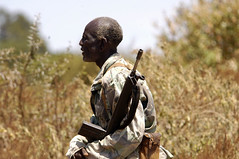
    Image source: B. R. Q.

    Read more »

    The Securitisation of Aid?

    Saferworld | Saferworld Briefing | March 2011

    Issues:Global militarisation, Marginalisation

    Poor people want to feel safe just like anyone else. Security and access to justice for poor people are development goals in their own right whether in the midst of endemic violence, such as in parts of Somalia or Afghanistan, or in more stable countries where the police and judicial services may still be inadequate, unfair or abusive. Basic security and the rule of law are also necessary for other areas of development to take root and flourish.

    Image source: Demosh

    Read more »