Blog

  • From Surveillance to Smuggling: Drones in the War on Drugs

    RC_long_logo_small_4webThis article is part of the Remote Control Warfare series, a collaboration with Remote Control, a project of the Network for Social Change hosted by Oxford Research Group.


    Editor’s note: Remote Warfare and the War on Drugs mini-series: This series of articles explores how remote warfare is being used in the war on drugs. To date, much of the debate on remote warfare has focused on its use in the war on terror. However, the use of drones, private military and security companies (PMSCs), special forces and mass surveillance are all emerging trends found in the US’s other long standing war, the War on Drugs. The articles in this series seek to explore these methods in more depth, looking at what impact and long term consequences they may have on the theatre in which they’re being used. Read other articles in the series.

    In Latin America drones are being used as part of the War on Drugs as both regional governments and the US are using surveillance drones to monitor drug trafficking and find smuggling routes.. However, as drones are increasingly being used by drug cartels themselves to transport drugs between countries, could Latin America find itself at the forefront of emerging drone countermeasures?

    In many Latin American countries, militaries operate as internal security forces because they combat drug traffickers and insurgencies. As a result, regional security agencies are constantly looking for new technologies to support security operations. Indeed, Peruvian Admiral José Cueto Aservi described purchasing drones in 2013 as necessary due to the “asymmetric war” being launched by narco-movement Shining Path that “takes advantage of the complex geography to attack” and thus “all methods” – including “technology” – are needed to defeat them.

    Today, drones are regarded as potential “game changers” by regional security forces, believed to be invaluable “eyes in the sky” that will aid surveillance operations. Hence, it is no surprise that several Latin American countries have acquired them, whilst many others are producing them. At the same time, US drones are carrying out their own operations in Latin America as part of the global War on Drugs and drug cartels themselves have started using drones to smuggle drugs across international borders. As the use of drones looks set to increase, what is the likelihood of armed drones being used in this theatre and what implications could the non-state use of drones have on the region?

    Drones in Latin America
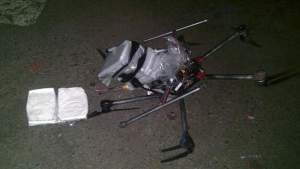
    Crahed Drone

    Crashed drone on Mexican border. Image by Secretaría de Seguridad Pública Tijuana.

    There are currently at least 14 Latin American and Caribbean countries which have used or purchased drones. No Latin American state possesses large numbers of drones in the manner of the US military, rather, regional governments mostly operate just two or three drones of any type. Israel is the largest provider of drone technology to Latin America, having sold some $500 million worth to the region between 2005 and 2012.  Latin American states have also started developing their own drones with Colombia being the first South American nation to have home-built a drone, the Iris, in 2015.

    Unarmed drones carry out Intelligence, Surveillance and Reconnaissance (ISR) roles for a range of different operations in Latin America. Due to the region’s complex topography (a case in point is the Amazon, where drug traffickers from Brazil, Colombia, Bolivia and Peru operate) drones require special features like infrared cameras and have been useful for monitoring vast uninhabited spaces in the region. In Brazil, for example, drones have been used for agricultural reasons, including monitoring the Amazon rainforest. In Belize and Costa Rica too, drones have been used for conservation purposes. In Peru, a municipality police force in Lima,deployed three drones to patrol the Peruvian capital during the last Christmas season to help security officers locate emergency areas if necessary and in Mexico, drones have been used to patrol and secure sensitive areas like the facilities of the state oil company PEMEX.

    Drones and the War on Drugs

    Drones have also been used as part of the War on Drugs in Latin America. In Mexico, National Defense Secretariat, the Federal Police, the Procuradoría General de la República (the Attorney General’s office), as well as the Army and Air Force fly drones to gather intelligence to combat organized crime, mainly drug trafficking. In Brazil, Colombia, Panama and Trinidad and Tobago too, drones are used to monitor drug trafficking and find drug smuggling routes.

    Drones are also being used by non-state actors, in the form of drug cartels, to smuggle drugs between countries. In January 2015, a drone crashed in a supermarket parking lot in Tijuana, Mexico –carrying three kilograms of crystal meth and in August 2015, two Mexican citizens were convicted of utilizing a UAV to fly 13 kilograms of heroin from Baja California, Mexico, into California.This led US authorities to deem drones an “emerging trend” employed by transnational criminal organizations to smuggle narcotics into the US.

    In its long running War on Drugs, the US has also been using its own drones in Latin America. A New York Times article reported that, in 2011, in an effort to step up its involvement in Mexico’s drug war, the Obama administration begun sending its drones deep into Mexican territory to gather intelligence to help locate major traffickers. Furthermore, an official US briefing from 2011 – obtained via the Freedom of Information Act – revealed that the US Air Force is working to make its RQ-4 Global Hawk high altitude long endurance drones available to its allies in Latin America and the Caribbean in order to help “find drugs fields and helping plan offensives against rebel groups”.

    US Customs and Border Protection operates 10 MQ-1 Predator drones, including two based in Cape Canaveral, Florida, that patrol a wide swatches of the Caribbean through the Bahamas and down to south of Puerto Rico as part of the drugs fight, and, in 2013, it was reported that the US Navy was testing a new type of drone that can be hand-launched from a ship’s deck to help detect, track and videotape drug smugglers in action across the Caribbean Sea.

    US drones have also been used for other purposes in the region. US Customs and Border Protection have been flying surveillance drones for nearly a decade, launching them from bases in Texas, Florida, North Dakota and Arizona to detect illegal border-crossing. This activity has been called into question recently as a 2015 report from the Department of Homeland Security’s inspector general found drones to be ineffective in conducting surveillance along the border.

    Towards drone countermeasures?

    As for the future, we can expect drones to continue to be utilized in Latin America, as there has been an increase in the purchasing and development of drones across the region in the last few years. US companies Boeing and Aerovironment, for example, have both declared their intention to increase drone sales to Latin America, with countries like Colombia, Chile, Mexico and Peru interested in purchasing from them and the Swedish firm Unmanned System Groups (USG), showcased its F-330 drone to the Uruguayan armed forces in late 2014.

    More countries in the region are also looking to develop their own drones. Following the building of Colombia’s first drone in 2015, a COHA report found that Peru, Ecuador, Argentina and Brazil are all in the process of developing their own drones. There have also been talks of developing a South American drone, which would be manufactured by the Union of South American Nations (UNASUR, which has as members all twelve South American states).

    With regards to armed drones in the region, a number of states have indicated their desire for them. Peru and Colombia in particular could seek to acquire armed drones as internal security conditions worsen. However, this is unlikely to happen any time soon as countries that possess armed drones, such as the US and Israel, are unlikely to sell them to Latin America in the near future. Hence Latin American militaries would have to look to other potential suppliers, like China or Russia, or construct them themselves. Here, financial barriers, along with limited technological know-how capabilities, even amongst countries that already produce drones, would make this unlikely.

    Even if armed drones are unlikely to be used in the region any time soon, there is a potential for Latin America to become a testing ground for drone technology in other ways. As drones are being increasingly utilized by drug traffickers in the region to transport drugs between countries in ever more sophisticated ways, it is likely that this will lead to regional efforts to develop increasingly advanced drone-detection and interdiction technologies to defend against this threat. At present a number of companies internationally are developing this technology, used to detect, block and destroy drones. This includes the development of early warning systems that can identify and detect drones and signal jamming technology to block drone control frequencies. As well as this, technology is also being advanced to destroy detected drones. This includes both laser and kinetic defence systems, the later using missiles, rockets and bullets capable of shooting drones down. Companies are also looking into nonlethal projectile weapons that fire blunt force rounds, such as bean bags or rubber bullets, or small portable net guns that can ensnare drones. As Latin America finds itself battling against the hostile use of drones by drug cartels it could find itself at the forefront of these emerging drone countermeasures.

    Alejandro Sanchez is a regular contributor for IHS Jane’s Defense Weekly, the Center for International Maritime Security, Blouin News and Living in Peru. He focuses on geopolitics, military and cyber security issues in the Western Hemisphere. His analyses have appeared in numerous refereed journals including Small Wars and Insurgencies, Defence Studies, the Journal of Slavic Military Studies, European Security, Studies in Conflict and Terrorism and Perspectivas. Follow him on Twitter:  @W_Alex_Sanchez
  • DU-turn? The changing political environment around toxic munitions

    By Wim Zwijnenburg and Doug Weir

    Is the US backpedalling on its use of depleted uranium (DU) rounds? There are indications that the use of these highly toxic munitions could increasingly be a political liability for the US, with countries affected by DU, like Iraq, other UN Member States, and populations in contaminated areas all expressing concerns over its use and impact. But stigmatisation, although important, is not enough on its own – in order to make sustained progress on accountability and in reducing civilian harm, a broader framework that addresses all toxic remnants of war is needed.

    A US Air Force A-10 being deployed to support Operation Inherent Resolve.

    A US Air Force A-10 being deployed to support Operation Inherent Resolve. Credit: US Air Force

    In a recent policy change, the Pentagon stated that it has not, and will not use DU in Iraq and Syria during Operation Inherent Resolve. The decision, which was cautiously welcomed by campaigners, contrasted with a statement made in October 2014, when the US announced the deployment of A-10 gunships to the conflict. The standard combat load for the A-10’s cannon includes a 30mm DU armour-piercing incendiary round, and in autumn 2014 a US Air Forces spokesperson said that the Air Force was ready to use DU again in Iraq and Syria.

    Iraq is no stranger to DU: at least 404,000kg of the radioactive and chemically toxic heavy metal was fired in the country in 1991 and 2003. The fine dust created by DU impacts presents a hazard to civilians if inhaled, and both the dust and fragments of the ammunition can contaminate soil, vehicles and buildings. As DU particles are environmentally persistent, DU’s legacy can last long after conflicts end. Exposure to DU has been linked to increases of cancers and congenital birth defects in areas of Iraq that saw heavy fighting.

    Yet despite long-running concerns voiced by Iraqi civilians and international advocates, no robust civilian health studies have ever been undertaken in Iraq to determine this link. Progress on clean-up operations has been slow, and has been hindered by the US’ refusal to provide comprehensive targeting data to UN organisations and the Iraqi government.

    The evolving use of DU

    The A-10 gunship has long been promoted as a “tank killer”, with the US arguing that DU ammunition is crucial for this function. Justifying the apparent U-turn over Inherent Resolve, a US public affairs official explained that: “The ammunition is developed to destroy tanks on a conventional battlefield. Daesh [Islamic State] does not possess large numbers of tanks.”

    While its original Cold War close air support role did primarily concern the destruction of Soviet tanks and armoured vehicles, even then there were questions over the legality of DU. As a result, a 1976 legal review undertaken by the United States Air Force of the A-10’s DU ammunition sought to ensure that it was not used in populated areas and to restrict its use to armoured targets.

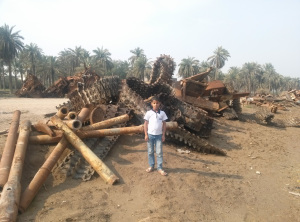
    A boy standing in front of military scrap metal in Shat’l arab, an area near Basrah.

    A boy standing in front of military scrap metal in Shat’l arab, near Basrah. Credit: Wim Zwijnenburg

    However, the role of the A-10 has evolved since the 1970s, as has its range of targets. This was clear from data from the 2003 Iraq War, acquired by PAX in 2014. It revealed DU use by A-10s against anti-aircraft guns, buildings, trucks and un-mounted troops. Data on targets from the conflicts in the Balkans painted a similar picture. With the A-10s role evolving from attacks on armour to more general close air support, aircraft were often called in for a broader range of operations, this led to DU being used against other targets, even in densely populated areas. Once loaded with the standard combat mix, a mixture of DU and high explosive rounds, it is impossible to change the type of munitions in flight for attacks against non-armoured targets of opportunity, thus heightening the risk of exposure to civilians close to other targets.

    Recently published figures on the 4,817 targets selected by US CENTCOM show that more than 120 tanks and armoured vehicles were destroyed in the first six months of the air campaign. There was therefore ample opportunity for the A-10 and its DU rounds to “kill tanks”, yet the US subsequently chose not to equip its A-10s with DU. Could this change in posture have more to do with a changing political environment, and in particular the growing stigmatisation of DU, than military calculations alone?

    Stigmatisation

    More than two decades after its first use in Kuwait and Iraq in the 1991 Gulf War, concern over the humanitarian and environmental legacy of DU has gradually increased.

    In recent years, legislation banning the weapons has been introduced in Belgium and Costa Rica. The European Parliament has also issued a number of resolutions calling for a moratorium on use and, most recently, a common EU position in favour of a ban. Since 2007, five UN General Assembly resolutions have been passed by large majorities. These have highlighted DU’s potential health risks, called for the release of targeting data to allow clean-up, for a precautionary approach to DU’s post-conflict management and, in 2014, for international assistance for states affected by DU use. This last resolution was supported by 150 states and opposed by just four, including the US. In addition to establishing soft law norms on DU, the process has also created a platform for an increasing number of states to voice their concerns over the weapons.

    Perhaps the most influential of these was from Iraq in March 2014, where its government expressed:

    [D]eep concern over the harmful effects of the use in wars and armed struggles of armaments and ammunitions containing depleted uranium, which constitute a danger to human beings and the environment.

    The Iraqi government called for the UN, its specialised agencies, member states and civil society to take a proactive approach to the issue and to condemn DU use. They also argued for:

    [A] binding and verifiable international treaty prohibiting the use, possession, transfer and trafficking of such armaments and ammunitions.

    Clearly then, the further use of DU munitions by the US in Iraq would have been viewed as unacceptable by the Iraqi government, and would have been likely to result in further criticism of the increasingly controversial munitions.

    Leaving through the back door?

    Could the changing political climate be influencing US policy on DU? The US had previously come under pressure from civil society campaign the International Coalition to Ban Uranium Weapons (ICBUW) in 2011 over fears that DU would be used against Gaddafi’s tanks in Libya. Recent evidence of DU’s international stigmatisation has come, ironically, from the Joint Strike Fighter, which is supposed to replace the ageing A-10 in its close air support role – a decision that is proving controversial in the US. During the fighter’s development, project partners including Australia, Norway and Denmark expressed concern over the US proposal that it would use a DU round, insisting that an alternative material be found. DU was eventually ruled out, as were other toxic metals such as beryllium. Elsewhere there are signs of shift away from DU in the US’s other medium-calibre ammunition.

    In 2008, just a year after the first UN General Assembly resolution, the US Army Environmental Policy Institute (AEPI) argued that alternatives were needed, stating that ‘the military should continue pursuing R&D for substitutes and be prepared for increased political pressure for current and past battlefield cleanup’. The Massachusetts Institute of Technology is one of several bodies researching less toxic materials, and in December 2014, published a new advance in manufacturing nanocrystalline tungsten alloys, which results in a material with similar properties to DU. DU’s toxicity is a key driver for this research.

    While changes in procurement policies are slow, decisions like that taken over Inherent Resolve are tangible signs that international pressure is changing DU policy. Nevertheless, the emerging threshold of acceptability for DU use remains poorly defined and it is unlikely that the US will seek to clarify it any time soon. Operation-specific factors – such as Iraq’s clear position in favour of a ban – are also likely to remain important in determining whether DU is used or not. Backlash over veteran exposure, community opposition and financial liabilities associated with former testing ranges may also influence policy within the US.

    The way forward

    Welcome as these developments are, they serve to highlight the current lack of formal obligations for post-conflict DU clearance and victim assistance. Unlike explosive remnants of war, and in spite of the soft norms developing at the UN General Assembly, accountability and assistance for past DU use is underdeveloped and requires attention from both civil society and the international community.

    As was the case with anti-personnel landmines, it will not be enough to simply stop DU being deployed. Protecting civilians requires that its legacy is also dealt with. DU remediation is costly and technically challenging, and states recovering from conflict require assistance to implement effective programmes.

    More broadly, DU is just one of a number of toxic munitions constituents, and munitions just one of a wide range of pollutants generated by conflict. These toxic remnants of war pose a threat to human and environmental health before, during and after conflict. Efforts to minimise the practices that generate them and work to ensure that their impact is properly assessed and responded to could contribute greatly to not only the protection of civilians but also of the environment upon which they depend. Tackling the causes and legacy of conflict pollution also provides a welcome opportunity to creatively merge the environment, public health, human rights and humanitarian disarmament in response to the toxic footprint of modern warfare.

    Wim Zwijnenburg works as a Program Leader Security & Disarmament for PAX, a Dutch peace organisation. He has a research program in Iraq on the impact of depleted uranium munitions, works on Toxic Remnants of War in Syria, emerging military technologies such as (armed) drones, and is supporting the Control Arms campaign in regulating the global arms trade.

    Doug Weir is the Coordinator of the International Coalition to Ban Uranium Weapons, a global coalition seeking a ban on the use of DU and for assistance to communities affected by its use. He also manages the Toxic Remnants of War Project, which explores state responsibility for the toxic legacy of military activities. 


    Featured image: A tank destroyed and contaminated with DU in 2003 near Basrah. Credit: UK Ministry of Defence

  • Nitrogen: a driver of global food insecurity?

  • Post-UNMIL Adaptation and Security in Liberia

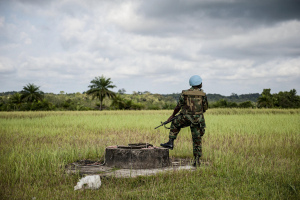
    The United Nations Mission in Liberia (UNMIL) has significantly decreased its presence in the country in 2016. The departure of much of the peacekeeping force has left the country with several security issues that it is struggling to resolve during its transition. 

    2016, an important year for Liberia, a country that has seen a steady consolidation of peace since 2003. 2016 is the year when the United Nations Mission in Liberia (UNMIL) formally left, barring a minuscule presence. This is also a time when Liberia’s security sector would be left without a big brother stationed to ward off any potential threats to security. This transition to national responsibility for security will test some key assumptions about security sector reform (SSR). First, what is the effectiveness of SSR as a policy of international development? Second, what is the utility of SSR as a tool for external influence?

    Liberia’s political and economic transition

    unmil

    Image by UN Photo via Flickr.

    UNMIL’s exit comes at a time of anticipated political contest in the upcoming elections of 2017. Given the potential for politically motivated armed mobilization of security actors in a system that is rooted in patronage and loyalty to the ruling party and elites, one could expect some election centric violence. As a run up to this uncertainty, in 2014, the ruling Unity Party fared poorly in the Senate elections, receiving only 10 % of votes. Large scale corruption, deep-rooted cronyism, and mishandling of the 2014-2015 Ebola outbreak that claimed nearly 5000 lives have turned voters against the ruling regime. It is also a time when critics of the political elite and its policies are increasingly being targeted and threatened. Arrests and politically motivated killings have created an uneasy atmosphere of fear and suspicion.

    Given this context, the prospect of a post-Ellen Sirleaf Liberia is unsettling because of the limited leadership options and a potential polarisation of domestic politics. The opposition remains divided with few serious contenders. Prince Johnson, from Nimba County, a warlord who led the Independent National Patriotic Front of Liberia (INPFL) group, and Benoni Urey, a close business associate of Charles Taylor, present less than ideal choices. Other more positive options include George Weah, a renowned international soccer star turned politician. He was recently appointed a Peace Ambassador by the President and is also the chairman of the National Reconciliation Committee. He is widely popular with the youth, who make up an overwhelming majority of the voting bloc. He might be a candidate to watch out for.

    On the economic front, Liberia has long standing problems with chronic poverty, high prevalence of informal or vulnerable forms of work and poor physical infrastructure. The Liberian economy’s decade-long dependence on international aid and primary commodity exports has presented weak growth indicators. A weak currency, high inflation and a null growth in 2015, according to the IMF, are worrying statistics. According to estimates, the prices of rubber and iron, two main export commodities have fallen more than 80 % since their peak in 2011. Widespread work layoffs, labour unrest and government instigated austerity measures due to lower revenues and drop in international donor funding have created a less than ideal economic environment for reform.

    What about security?

    A post-UNMIL security environment presents some gaps that have still to be plugged despite every effort to undertake a responsible draw-down in Liberia. The core issues of transparency, accountability, efficiency, respect for human rights, and civilian oversight will be tested in an environment where the different security agencies continue to struggle for lack of sufficient trained staff and resources.

    The Armed Forces of Liberia has witnessed a high attrition rate, and its 2000 strong force remains a token army that is for the most part confined to the barracks. In August 2014, an army scuffle with civilians in West Point, resulted in civilian injuries and some reported deaths that enhance lack of trust towards the national army.

    The Liberian National Police, and different immigration, border and intelligence agencies that had been the target of SSR efforts led by UNMIL and donors, remains poorly resourced. A mere 5000 strong force to secure a 4.4 million strong population results in low levels of police presence outside the capital region.

    Despite efforts to decentralize the security apparatus through Justice and Security Hubs, across the country, the slow response of LNP to local problems such as the mining riots in 2014, present evidence that gaps remain. There have also been allegations of police corruption in recent investigations by Human Rights Watch.

    In reality the transition from a regime centered security sector to a people-centered one is far from complete. It is likely that the security apparatus will be used by the government to intimidate opposition politicians and instigate localized violence as this has been the legacy of the past.

    Finally, an ‘unintegrated’ ex-combatant element lingers in the background of externally supported statebuilding. The UNDPled disarmament, demobilization, reintegration and rehabilitation (DDRR) programme in Liberia (2004-2009), did not absorb fighters from the different non-state groups involved in the civil war into the new security sector.

    Considerable civilian infiltration in the DDR programme, also meant that ex-combatant continues to live and work within their wartime social networks. Efforts by UNMIL to break command and control chains had limited impact due to neo-patrimonial nature of Liberian society and politics.

    Reflections on the SSR

    There has been much criticism of the SSR in Liberia. It is accused of causing:

    • high levels of dependency on UNMIL and international donors,
    • a mismatch between international policy and local practice;
    • encouraging European models of security provision in a context of low reliance on formal institutions; and
    • creating self-help forms of security in a context of low public trust/reliance on the national security and justice institutions remain.

    Core problems with physical infrastructure, weak capacity of the human resources, corruption and elite control make the prospect of delivering ‘people centered security’ challenging.  The security transition plan of the UNMIL requires nearly 38 million USD to complete the process of handover to national agencies. So far the national government has disbursed only 10 million USD, towards this effort.

    Earlier mistakes committed by international advisers on SSR, such as requiring all police officers to re-apply to be vetted for their eligibility as LNP officers has left lingering gaps. As a result, senior officers became patrol officers even though they had many years of experience.

    Such a demotion brought serious moral problems to the police. Other policy decisions such as retiring senior officers, and those found ineligible on human rights or qualifications related criteria has created dissatisfied pockets within the security sector.

    Citizen security currently remains a low priority as security efforts are geared towards replacing UNMIL duties in the area of VIP protection, aerial surveillance for border patrol and management, maritime and prison security, and bomb disposal.

    National adaptation

    Given this reality of a less than complete reform process, it will be worthwhile to observe how national models of adaptation fare compared to international or UNMIL led models such as the Justice and Security Hub (JSH) structure.

    This model of decentralisation, attempts to build five ‘hubs’ or centres where formal security and justice providers will be stationed in key provincial locations.

    To date only the Gbarnga hub is operational; while the government has committed US$1 million over 2014–16, in addition to the funds provided by the Peacebuilding Fund, to support the construction of the Harper and Zwedru hubs.

    This model of decentralization and access remains difficult to operationalize because of constraints related to finance, infrastructure and capacity (human and material). Further, the JSH concept did not address the issue of civilian oversight of security and justice institutions or the issue of legitimacy.

    In reality, most Liberians continue to trust and turn to local informal security and justice providers. National level adaptation includes setting up of the County Security Councils (CSC) structure. It is part of national peacebuilding efforts to ensure decentralization and access. The CSCs incorporate the paramount, clan and town chiefs, providing much-needed civilian input into security policy making at the sub-national level.

    President Sirleaf, the current elected Chair of the Economic Community Of West African State (ECOWAS), has also attempted to beef up the role of the Peace and Security Council apparatus to boost regional security linkages with Côte d’Ivoire, which shares borders with LIberia and has witnessed illicit cross-border farming in the Western front.

    In sum, Liberia will need to continue capacity building in a post-UNMIL environment. President Sirleaf’s efforts to gain technical assistance from Israel to train Liberian security forces is one example of this strategy. As such the true test of adaptation will come in the post 2017 election period when a remaining UN presence of nearly 2000 military and civilian staff will finally exit.

    In essence the effectiveness of SSR as policy tool remains questionable. Do the peace dividends returned from an enormous time-bound and often poorly targeted investment of resources and technical capacity building create a capable security apparatus? The answer in the case of Liberia remains far from positive.

    Sukanya Podder is a Senior Lecturer in the Defence Studies Department, King’s College, London.

  • Trump and the Prospects of an Illiberal International Order

    Donald Trump’s presidency has called into serious question the role of the US in the Paris Agreement, the direction of international cooperation on climate change, and the role of the US in the liberal international order.

    Just one year ago, the world was celebrating the adoption of the Paris Agreement as a new foundation for global cooperation on climate change. The North/South firewall that created asymmetrical obligations under the Kyoto Protocol was removed, leaving in its place, a level playing field upon which to build efficient international regulatory cooperation. As Prime Minister David Cameron remarked, “What is so special about this deal is that it puts the onus on every country to play its part.” The more optimistic among us were already discussing how the voluntary aspects of this hybrid agreement could be strengthened to advance the effectiveness of the treaty regime.

    The election of Donald Trump as the 45th President of the United States, however, has called into serious question the role of the US in the Paris Agreement, the direction of international cooperation on climate change, and moreover, the role of the US in the liberal international order and its cohesiveness moving forward. On climate change, for example, Trump and his cabinet vacillate between outright denial and “lukewarmism” (open to the possible existence of climate change but denial of its importance or the urgency of a response).

    As such, most of us who take international cooperation seriously are filled with more than a little anxiety and/or dread at the prospect of a Trump presidency but it is important to view Trump as a symptom of a systemic problem: a struggle at the heart of liberal democracy.

    The past and future of liberal democracy

    Winston Churchill’s remark that, “the best argument against democracy is a five-minute conversation with the average voter” gets to the heart of the post-Cold War rebalance between the paternalism of liberal autocracy (or undemocratic liberalism) and the recent growth of populist illiberal democracy.

    As Fareed Zakaria reminds us, “The tension between constitutional liberalism and democracy centers on the scope of governmental authority. Constitutional liberalism is about the limitation of power, democracy about its accumulation and use.” The purpose of liberalism’s controls on democracy is to create a long-term structure that is resistant to the short-term solutions of individual leaders to placate the short-term thinking of the people. The liberal international order seeks to do the same between states.

    The recent pendulum swing towards illiberal democracy reflects the shortened time horizon of the electorate in the West and their resentment of the longer time horizon of the elites necessary for a liberal international order.

    Foreign policy and the willingness of the electorate to pay for it

    donald_trump_25927764516

    Image credit: Gage Skidmore/Wikimedia.

    Trump has been able to tap into a populist resentment of the costs Americans are paying to support international public goods, in particular a global trade regime that is perceived to have benefited Mexico and China at America’s expense and “collective” security arrangements in Europe and Asia that have provided US allies a far greater peace dividend at a disproportionately lower cost than for Americans. For many Americans, ungrateful allies but also America’s challengers are free riding on an international order shouldered by the American taxpayer.

    There are, of course, virtually no benefits and considerable costs for America to withdraw from the international economic order or its security alliances, but Trump may be able to increase the cost for other states of participating in the international order secured by the US.

    The Republican Party has been trying to limit disproportionately high financial obligations to the UN since the 1980’s, but with an electorate choosing to give them control of the Presidency, Congress, and the Supreme Court, the credible threat of US isolationism has not been this great since the rejection of the League of Nations.

    By threatening to walk away from international agreements that provide others benefits reliant on American beneficence, Trump, who has made a career out of rent seeking in real estate development and personal branding, will seek to extract greater rents from the international order.

    The danger for Trump is that reduced obligations for Americans, or unreasonably high costs for free riders, create incentives for them to seek other sources of global leadership. However, there is reason to believe that Japan and South Korea see much larger costs from Chinese domination; middle-eastern allies see much higher costs than benefits from a US withdrawal; and post-modern Europe will realize it is mostly defenseless without American security guarantees.

    None of this “deal making” will improve the lives of the Americans who voted for Trump, but it will likely force US allies to come to terms with their contribution to the peace benefit they’ve enjoyed for so long.

    Paris and domestic politics

    The Trump administration has begun the process of rolling back the implementation of President Obama’s Clean Power Plan and is likely to reduce donations to international climate funds. In the short term, this will appease many in the Republican Party who feel that responsibility for addressing climate change creates short-term costs that disproportionately fall on Americans and provides benefits primarily to non-Americans. That said, these policy changes are likely to result in more coal plants outside the US than within it.

    Article 28 delays the possibility of withdrawing from the Paris Agreement for four years, but the US could repudiate the ratification of the UN Framework Convention on Climate Change, a process that would only take one year. As the Paris Agreement creates no binding mitigation obligations for the US, it is not clear what the Trump administration gains from walking away from either treaty, especially when it is clear that the US would lose a seat at the table it could use to stall the progressive development of the regime.

    With former Exxon CEO Rex Tillerson as Secretary of State, the US is likely to continue to support the transition away from fossil fuels (or decarbonization of the global economy) but work actively to slow the pace of implementation to a crawl.

    Contagion: from a domestic politics issue to an international problem

    In the West, the long-term thinking of liberal democracies facilitated increased prosperity among partners in the international order.

    And that prosperity empowered undemocratic liberal elites to expand national rights and responsibilities and translate them into international rights and responsibilities. Tacit approval for these measures, however, was reliant on continued domestic prosperity. But as that prosperity has faltered, it is unsurprising that support for liberal internationalism has declined among the electorate.

    The vote for Brexit typifies the impulse of the people to support measures described by illiberal democrats as necessary to regain control of their uncertain economic and cultural destiny. The EU’s migrant crisis and austerity measures from the financial crisis have strengthened illiberal nationalists across Europe, weakening the normative power of the liberal autocracy at the heart of supranational Europe.

    In all cases, the excesses of undemocratic liberalism, followed by reduced domestic prosperity, have eroded popular support for international cooperation where the domestic costs are perceived to exceed the benefits.

    Conclusion

    Trump’s formal repudiation of the TPP and rejection of the TTIP reflect the shortened time horizon of an electorate unwilling to invest in potential future economic gains, but these decisions don’t inherently threaten the international economic order. If, on the other hand, Trump imposes 45% tariffs on imports from China (another ill-advised campaign promise) or walks away from US security guarantees these actions would present serious systemic risks.

    It’s worth considering, however, that by painting the worst-case scenario of US withdrawal from the international order so vividly, Trump has highlighted the benefits provided by American leadership that are frequently taken for granted.

    In seeking to protect US sovereignty (by reducing what are viewed as asymmetrical obligations) Trump may reinforce the importance of reciprocity in international cooperation and diminish the desire to internationalize Western liberal values. An international criminal court with the support of the US, China, and Russia would be stronger than the current European incarnation. The UN Security Council would be stronger if each member of the P-5 paid the same proportion of UN dues, and the UN General Assembly (where two-thirds of the members collectively pay less than 2% of the total UN budget) would be more legitimate if it were unable to determine the UN budget with a two-thirds voting majority.

    Scaling back liberal excesses need not result in authoritarianism, isolationism, or gunboat diplomacy. If addressed prudently, illiberal democratic rebalancing may produce more sustainable liberal democracies and a better liberal democratic foundation for international cooperation.

    Murray Carroll is a co-founder and director of the International Court for the Environment Coalition. He has a law degree from the London School of Economics, and is a graduate student of international relations at Harvard University and international law at the University of London. Responsibility for the views expressed in this commentary rest exclusively with the author.


  • Muslim Paranoia? Ideology and the Limits of Engagement

  • Why Do Western Women Join Daesh?

  • Momentum towards a nuclear weapons ban treaty: what does it mean for the UK?

    Momentum towards a nuclear weapons ban treaty: what does it mean for the UK?

    International momentum towards a treaty to ban nuclear weapons reached a milestone in the December 2014 Vienna conference. Even assuming that the UK does not initially sign up to such a treaty, it is subject to the pressures of a changing legal and political environment and could find its present position increasingly untenable – not least on the issue of Trident renewal.

    Read Article →

  • Music and Dance in Youth Peacebuilding

    Music and dance can be useful means to engage youth in a dialogue for peace.  Music and dance can also provide many unique insights into transforming conflicts and achieving change.


    “As a musician who works for peace, “unity” holds less interest for me than “harmony.” Unity is when we all sing the same note. Harmony is when we sing different notes, and they are beautiful together.”

    – David Lamotte, musician and peace activist

    At the same time, as David goes on to say in his book World Changing 101, “Harmony is not homogeneity.” Moreover, he says, “Of course, it is also true that many notes playing together may clearly not be in harmony with one another. Creating that confluence takes attention, patience, and work. It is a beautiful thing when we achieve it, though. And it is not achieved by eliminating difference, but instead by finding ways to work together that are mutually nourishing, that honor and reveal each other’s gifts.” (LaMotte 2014: 113).

    In these ways, artistic approaches to building peace like music and dance can offer us the means to embrace pluralism through working together to co-create knowledge rather than attempting to determine one ‘right’ way upheld by those a particular society may deem to be experts.

    On Music and Peacebuilding

    Image credit: Hernan Pinera/Flickr.

    In the research for my first book, Youth Peacebuilding: Music, Gender and Change I used qualitative case comparison to explore the use of music as a tool for engaging youth in reducing and preventing violence.  More specifically, the research for that book included participant observation and semi-structured interviews with young people involved in musical peacebuilding programs in Australia and Northern Ireland, providing a uniquely deep look at young people’s experiences of everyday violence and how they approached peacebuilding in their local cultural contexts.

    In Australia this involved a peace program in a major city engaging Indigenous, non-Indigenous, and migrant and refugee background young people in a collaborative process of music making in order to build understanding across difference, challenge racism, and create safe spaces for recovering from violence already experienced. Similarly, the program in Northern Ireland shared similar goals around addressing both racism and sectarianism in its efforts at peacebuilding through participatory music practice.

    This project contributed to theoretical and practical debates and discussions around: youth political participation, the gendered landscape of conflict environments, and creative approaches to pursuing peace. In particular, I explored how music could foster peacebuilding through offering an alternative means for dialogue, helping people create and recreate identities of themselves and others, and offering a tool that could help create safe spaces for such dialogue and identity work, often in challenging circumstances.

    While my research has taken me in many directions in the decade since I began the study that underpinned that first book, I always feel drawn to return to reflections on creative approaches to peace, especially the ways they can engage youth. At present, this has taken the form of working to further analyse and share the findings from my research on dance and peacebuilding. While my earlier work dealt with dance to a degree as part of a broader range of musical practices for peacebuilding, since then I have taken up opportunities to explore dance more specifically.

    Researching Dance and Peacebuilding

     As Nicole Krauss writes in her latest book,

    “More and more it seems to me…that when I write, what I am really trying to do is dance, and because it is impossible, because dancing is free of language, I am never satisfied with writing…to dance is to make oneself available  (for pleasure, for an explosion, for stillness)…The abstract connections it provokes in its audience, of emotion with form, and the excitement from one’s world of feelings and imagination—all of this derives from its vanishing…But writing, whose goal is to achieve a timeless meaning, has to tell itself a lie about time; in essence, it has to believe in some form of immutability…” (Krauss 2017: 136).

    While recognizing these challenges, I continue to find meaning in attempting to write about dance or perhaps to dance writing. As such, during my time as a McKenzie Research Fellow at the University of Melbourne I designed and embarked on a comparative study looking at the use of dance in peacebuilding programs across a range of contexts, including Colombia (now commonly deemed a post-conflict site); the US (in inner city locations in Washington, DC and Baltimore, MD where violence is commonly seen as widespread) and in the Philippines, which, despite a peace agreement being signed, continues to face conflict in Mindanao.

    Using ethnographically informed methods, including participant observation, interviews, and document analysis, I designed the project and methodological approach and gathered data in the US and Colombia, while a research assistant gathered the data in the Philippines case. This type of intensive data gathering, which included participating in the full global training of the trainers for the program involved, as well as months of participant observation of the programs, offered rich insights into how dance and creative movement can and does engage young people in peacebuilding across a range of diverse contexts.

    While the process of writing this into a book proposal and eventually a book is ongoing, over the past several years of working on the project some key themes have started to emerge.

    The role of dance in peacebuilding

    How, if at all, did dance function as a useful way for youth to take part in peacebuilding? Firstly, participant statements indicated, “that dance can be useful in engaging youth in peacebuilding but that it must be applied in sensitive, reflexive and culturally relevant ways to appeal to and include both young men and young women.” Most if not all participants articulated one or more ways dance had been useful for peacebuilding. Some noted, for example, that dance could serve as a nonviolent means of communication and a way to connect with one’s feelings in a peace education context. Moreover, dance was seen as something that is culturally relevant and familiar, thus many youth could relate to it, and it was also something that did not require lots of expensive equipment or training. At the same time, dance was also seen as a way to release and reduce stress, an important aspect of recovering from violence already witnessed or experienced.

    Of course, participants also noted a variety of limitations to what dance could do and how, including pointing to how short term funding cycles, which are common across global peacebuilding initiatives, can at times mean short sighted programs. They also noted that without attention to access and inclusion, efforts to engage youth in dance and creative movement for peacebuilding might overlook the needs of people with disability or people who speak a different language from the one deployed in the dance programs. Still these limitations are not inherent to dance or always present, as seen by the work of VisAbility in Sri Lanka, a country recovering from conflict and where dance programming has been used to engage people with and without disabilities in coordination with a rights empowerment initiative.

    Conclusion

    Overall, it appears music and dance, when applied in thoughtful ways, can help foster peacebuilding. This is not to say they may not also be used ineffectively or to create exclusions, but when used appropriately they can have much to offer. As one facilitator in programs using dance and creative movement for peacebuilding the Washington, DC and Baltimore programs said when speaking about stepping out of one’s comfort zone to engage within a group:

    “When one person takes a positive risk, it shows the rest of us that we can take a positive risk and encourages us to do that also.  So hopefully, after a while they will be able to see that if they can just do one thing that makes them uncomfortable or kind of step outside their comfort zone that it actually helps other people to do the same and get the most out of the experience.”

    Surely such steps can be a useful means for reflecting on ways of finding harmony in the dissonance of conflict.

    Author’s Note: The research assistant involved with the Philippines work, Erica Rose Jeffrey is a fantastic scholar and dance practitioner in her own right and will soon be awarded her PhD for her own practice-led research in Fiji and the Philippines. More on her work can be found at: http://peacemoves.org

    Lesley Pruitt is a Senior Lecturer in International Relations at Monash University and a member of the Monash GPS (Gender, Peace and Security) Centre. Lesley’s research focuses on peace and conflict studies, especially recognising and enhancing youth participation in peacebuilding and advancing gender equity in peacekeeping. A Truman Scholar and Rotary Ambassadorial Scholar, Lesley received her Masters & PhD from the University of Queensland. Lesley’s books include The Women in Blue Helmets: Gender, Policing & the UN’s First All-Female Peacekeeping Unit and Youth Peacebuilding: Music, Gender & Change. She is also an author of Young People, Citizenship and Political Participation: Combatting Civic Deficit?

  • No Sustainable Peace and Security Without Women


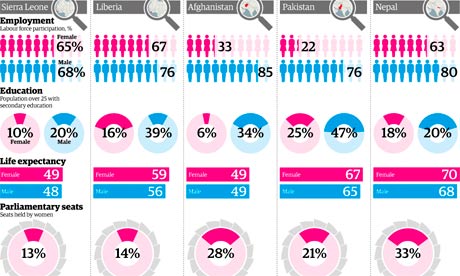
    There will be no sustainable security if we do not equally value the needs, experiences and input of men and women. A new report published by the Institute of Development Studies (IDS), funded by ActionAid and Womankind Worldwide, examines the role women play in local community peacebuilding in Afghanistan, Liberia, Nepal, Pakistan and Sierra Leone. The report states “despite the increased international attention to women’s participation in peacebuilding, the achievements and challenges facing women building peace at the local level have been largely overlooked”.

    Last week’s Guardian article entitled Who creates harmony the world over? Women. Who signs peace deals? Men points to some surprising data on female participation in official peacebuilding initiatives. “There have been no female chief mediators in UN-brokered peace talks and fewer than 10% of police officers and 2% of the soldiers sent on UN peacekeeping missions have been women”, reports the article. Furthermore, “fewer than one in 40 of the signatories of major peace agreements since 1992 have been female […] and in 17 out of 24 major accords- including Croatia, Bosnia, Sierra Leone, Burundi, Liberia, Sudan and the Democratic Republic of Congo- there was zero female participation in signing agreements”.

    An excerpt from The Guardian datablog:

    Women and peace deals - key indicators

    The IDS report found that “women are more likely than men to adopt a broad definition of peace which includes the household level and focuses on the attainment of individual rights and freedoms such as education, healthcare and freedom from violence. In contrast, men have a greater tendency to associate peace with the absence of formal conflict and the stability of formal structures such as governance and infrastructure”. It is important to include women in formal peace mediations and agreements as “peace means different things to women and men because of their unique experiences as a result of war”.

    Additionally, the research established that women have a lot of experience, and are principal actors, when it comes to mediating and decision making within the home and the family. Women are also more likely to come together collectively to create change. However, their “experiences building trust and dialogue in their families and communities are frequently dismissed as irrelevant or are not sufficiently valued by national governments, and the international community”.

    Some barriers to women’s participation in peacebuilding include: restrictive social norms and attitudes, violence against women and girls, poverty and economic inequality and inequality in access to education. The report suggests empowering women through access to justice, creating safe spaces for women’s participation and changing attitudes towards peace and valuing women’s contribution as key elements to support women peacebuilding.

    The 2000 United Nations Security Council resolution 1325 calls for “equal participation for women in the maintenance and promotion of sustainable peace”.

    Only yesterday, Foreign Secretary William Hague called upon UN Security Council resolution 1325, announcing to the UN General Assembly that the UK  “will contribute £1 million this financial year to support the Office of the UN Secretary-General’s Special Representative on Sexual Violence in Conflict”. “It’s our purpose in gathering here this morning to ensure that preventing sexual and gender-based crime in conflict and post-conflict situations is an urgent priority for the international community”, William Hague declared, and went on to say “We are convinced in the United Kingdom that we can do more to help […] we can do it as a permanent member of the Security Council, a leading member of NATO, the European Union and the commonwealth and as a nation with one of the most extensive international development programmes in the world.”

    The IDS report states that although Security Council resolution 1325 was passed in 2000, it has since then been almost totally ignored, not least by the UN itself. Hopefully this time, the international community, including the UK government, will take serious steps towards its implementation. At the same time, it is important to commit to preventing sexual and gender-based crimes, not only in “conflict and post-conflict situations”, but also in times of “peace”.

    No sustainable peace and security will ever be possible, if women’s voices are marginalised and if women and men do not work together equally on national and international peace mediations and agreements.

    Anna Alissa Hitzemann is a  Peaceworker with Quaker Peace and Social Witness. She currently works with Oxford Research Group as a Project Officer for the Sustainable Security Programme, with a focus on our ‘Marginalisation of the Majority World’ project.


    IDS, ActionAid, Womankind Worldwide report From the Ground Up can be read here.

    The Guardian, Who creates harmony the world over? Women. Who signs peace deals? Men is available here

    The Guardian, datablog Women’s participation in peace- how does it compare is available here

    Remarks by the Foreign Secretary William Hague to the UN General Assembly can be read here

    UN Security Council resolution 1325 is available here

    Image Source: UNAMID