Blog

  • Conflicts or Cooperation in Arctic Waters?

  • Geneva II: Prospects for a Negotiated Peace in Syria

    Geneva II: Prospects for a Negotiated Peace in Syria

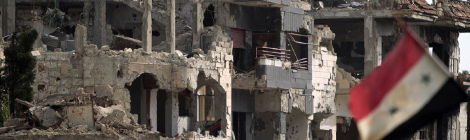
    The recent announcement that the so-called Geneva II conference would finally convene on 22 January 2014 is overdue but good news. What are the chances of it bringing peace? With an interim deal signed on Iran’s nuclear programme, Richard Reeve discusses what chance the great powers, Middle Eastern diplomats and the mediators of Geneva have as they turn their attention to ending the war in Syria.

    Read Article →

  • Trident – Why I Changed My Mind About the UK’s Nuclear Weapons

  • Strategic Thinking in a Resource-constrained World

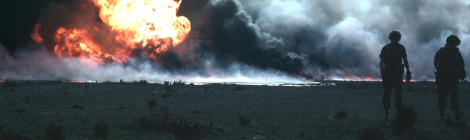
  • What the Environmental Legacy of the Gulf War Should Teach us

    The Ukraine conflict’s legacy of environmental damage and pollutants

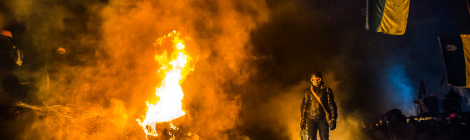
    One year after violent conflict began, information is now emerging on the specific environmental impact of war in Ukraine’s highly industrialised Donbas region. Although obtaining accurate data is difficult, indications are that the conflict has resulted in a number of civilian health risks, and potentially long-term damage to its environment. In order to mitigate these long-term risks, international and domestic agencies will have to find ways to coordinate their efforts on documenting, assessing and addressing the damage.

    Read Article →

  • Security Sector Roles in Sexual and Gender-based Violence

    Democratic Republic of Congo’s sexual violence epidemic is not only a weapon of ongoing violent conflict but an expression of entrenched systemic problems. Indeed, sexual and gender-based violence (SGBV) is most commonly perpetrated by the security services in place to protect civilians. In Quartier Panzi in South Kivu province, innovative processes of security sector reform and strengthened police-civilian channels of communication may be providing an opportunity for change.   

    Meeting of victims of sexual violence in the Walungu, South Kivu in Democratic Republic of the Congo. Source: Wikipedia

    Meeting of victims of sexual violence in South Kivu,  Democratic Republic of the Congo. Source: Wikipedia (from USAID)

    Quartier Panzi—the populous, restive neighborhood of Bukavu, South Kivu province—is renowned in international development circles as the ground zero of the Democratic Republic of Congo’s sexual violence epidemic. Rape as a weapon of war is not so much perpetrated by enemy forces but, most often, by the very parties sent by Kinshasa to protect and serve civilians. Much as Selma, Alabama was to the American civil rights movement, Panzi’s ongoing tragedy has transformed the area into a vibrant arena for grassroots opposition and international solidarity in the fight to restore women’s bodies and lives. Women’s organizations have formed to denounce continued abuses and government denial, to reverse cultural stigmas around female culpability in rape, and to demand trial for Congolese security forces suspected of sexual abuses.

    The courage and commitment of Dr. Denis Mukwege, chief gynecologist at Panzi Hospital and twice nominated for the Nobel Peace Prize, is emblematic of this resilience. International networks like V-Day and Women for Women International support these local actions and fund sanctuaries for survivors, such as the City of Joy. These innovations aim to be restorative and empowering for survivors, focusing on the crisis as experienced by women and girls, offering healing and vocational training options otherwise non-existent. However, the causes of this specific form of cruelty and degradation, rooted in violent masculinities and impunity among security actors, remain unaddressed.

    Rewiring the security sector
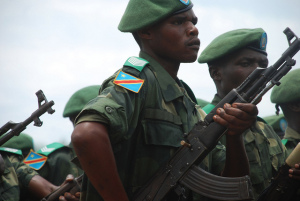
    Congolese soldiers march in Walikale, DRC, 2011. Source: ENOUGH (Flickr)

    Congolese soldiers march in Walikale, DRC, 2011. Source: ENOUGH (Flickr)

    Like any deep malaise, Congo’s rape crisis is but one expression of entrenched, systemic problems. Local witnesses, security analysts and medical professionals who treat survivors present overwhelming evidence that the primary perpetrators are uniformed Congolese security actors. A weak justice system may be responsible for the failure to discipline or punish perpetrators, but the sources of this behavior lie within the security sector itself. Accessing the security elite, Congo’s infamous ‘black box’, is notoriously difficult. As a result, very little analysis exists of the problem from the perpetrators’ perspective: analysis and evidence that deciphers the institutional culture and internal organization of the security sector, or that maps relations between senior officers, politicians and economic actors. By design, opacity reigns supreme.

    A variety of international donors support the national army and police with numerous ‘train and equip’ initiatives, an international cooperation model unchanged since the Cold War.These ‘security development’ partnerships aim to strengthen national capacity through field and classroom training and equipment upgrades; behavior change and public accountability are not part of the approach. Within the security services, there is typically an absence of civilian oversight, and widespread rent-seeking and illicit trade in protected flora, fauna and minerals, but no questions are asked by international partners, as diplomacy and formality dominate.

    Supply-side approaches such as these long pre-date the advent of ‘security sector reform’ among development actors, which does seek behavior change and greater accountability. The older aid modality remains popular with the Congolese leadership because it expressly avoids any calling to account or inculcation of security as a public service and legal right.

    There is state and donor complicity in all of this. Strength without constraint or accountability defines the DRC’s security sector today. Its predatory practices range from unchecked rape and pillage in the East to the repression of free speech and public inquiry, as witnessed by the 2010 murder in Kinshasa of prominent human rights activist, Floribert Chebeya. To placate critics, a military tribunal mounted a kangaroo court in the wake of the murder; the film documenting and exposing its empty theatrics, L’Affaire Chebeya, Un Crime d’Etat, remains banned in Congo.

    Such officially sanctioned practices and attitudes are salient features of the Congolese state since independence, and well known to all Congolese. In the early 1970s, President Mobutu Sese Seko began encouraging civil servants and security forces to ‘feed on the population’ (“Population baza bilanga ya bino). Anecdotes such as these are more than flippant asides; they explain the persistent appeal of this patrimonial compact (across four chapters of Congolese leadership: Mobutu, Kabila père, transitional government, Kabila fils) as a declaration of complicity between political elites and the entire public sector. In its truncated audacity, this single utterance reconfigures and reduces the entire means and ends of the state to elite enrichment and group impunity.

    In Panzi, armed crime and physical/sexual assault reached unprecedented levels in the aftermath of the primary war in South Kivu province. State security had long colluded with local armed gangs, and popular recourse options ranged from individual vengeance to military tribunals, as civil courts are unreliable. Mob justice is also widely practiced. The formation of neighborhood watch groups raised local hopes for improved safety (e.g. SAJECEKForces Vives). Despite their initial popularity, they soon joined local police and armed gangs in perpetrating the very crimes they first sought to oppose.

    How urban police understand this license to extort and harass the population, and the higher interests these practices serve, has been well captured and analyzed by Maria Eriksson Baaz and Ola Olsson. Transforming Congo’s security sector from inside is an elusive challenge, and donors are struggling to develop the programmatic savvy, influence and access to inspire the necessary political will.

    Demand for reform

    Community meeting in Kananga, DRC, where security officials and civilian leaders converse directly with local community leaders. Source: DAI Europe (with permission)

    Community meeting in Kananga, DRC, where security officials and civilian leaders converse directly with local community leaders. Source: DAI Europe (with permission)

    The UK’s Department for International Development (DFID) has experimented with alternative supply-and-demand models of public sector reform, and is applying these to the Congolese National Police (PNC). According to this strategy, supply-side ‘train and equip’ assistance targets weak service areas, including the prevention of and response to sexual and gender-based violence (SGBV). This is complemented by efforts to mobilize popular demand for more responsive policing at the community level.

    A particular understanding of the partner institution, the PNC, informed this theory of change. This included the hypothesis that payment of regular salaries would not end extortion and rent-seeking (’tracasseries’) by the PNC, given the scale of these rackets and the enormous sums they generate. With no compelling alternative on offer, and as long as ‘reform’ is understood to involve replacing tracasseries with ‘protecting and serving’, change will elude would-be reformers. Given that such arrangements will not change in the forseeable future, the more nuanced strategy accommodates the reality of low, irregular salaries and uniformed extortion for the foreseeable future, and seeks behavior change through increased public-police interaction. Faster paced improvements in human security and responsive policing began emerging on the demand side of the pilot sites, including Bukavu and Quartier Panzi in particular.

    Launched in Bukavu, Matadi and Kananga in 2009, the Security Sector Accountability and Police Reform Programme (SSAPR) is distinct for coupling its community policing approach with regular neighborhood meetings (forums du quartier) where locally appointed representatives voice their security concerns, identify emerging threats and suspects. It is common for community policing programs to seek a more responsive, service-oriented local police, but SSAPR is distinguished by its effort to cultivate citizen networks at the most local level to identify and articulate their fears, threats and suspicions forward to the actors most able to respond. Police officers, urban administrators, local community and neighborhood leaders then meet regularly in informal, local security councils to discuss proposals for containing a threat or resolving a violent dispute, as equipment and manpower are often lacking. Initiated entirely informally, these experiments in public relations gradually began to change expectations, reinforce collaboration and gain momentum.

    Concurrently, the National Parliament submitted a motion to formalize the Conseils Locaux pour la Sécurité de Proximité(or CLSP, finally passed in late 2013), which recognizes the right of civilian representatives to participate in official security discussions at the municipal level. Over three years, SSAPR legal advisers worked with national parliamentarians to build support and draft a bill. Given the long-standing animosity between politicians and civil society, this new décret was a highly significant opening. The platform has since been incorporated into other police reform efforts (such as the European Union’s EUPOL) that also understand SSR in the Congolese context as primarily a governance challenge requiring civilian involvement.
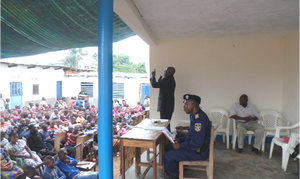
    SGBV DRC 2

    Community meeting in Kananga, DRC, where security officials and civilian leaders engage directly with local community leaders. Source: DAI Europe (with permission)

    Raising security problems through the CLSP increased dialog between communities and security officials, but who would represent the civilian side? In rough urban neighborhoods like Panzi, citizens experience a host of threats, not all of them equally or in the same way. The SSAPR helped Panzi neighborhood chiefs and community leaders coordinate an informal system whereby youth, women and men would alternately represent their community concerns first to a forum de quartier, then directly on to the CLSP. This neighborhood dynamic continues today across Bukavu’s three communes.

    Making Progress?

    These are small steps toward a more accountable security sector and restored public trust, but has sexual assault around Panzi declined as a result? Recently the SSAPR helped a women’s NGO organize a nocturnal walk through several Bukavu neighborhoods, including Panzi, to record their own safety concerns as well as those of women and girls met along the way. In a recent meeting, NGO members insisted they would never before have visited these neighborhoods, particularly at night, but that the chance to report their findings to a receptive and interested police commisariat justified the risk.

    In response, new light fixtures are planned in darkened alleys where assaults have occurred, and patrols redirected to suspicious areas noted by the NGO delegation. In another pilot city, Kananga (Kasai Occidental), assaults on women and girls who were walking long distances to fetch water, often at night, decreased dramatically after local women lobbied for regular police patrols in these areas. This, in itself, was indicative of a greater local confidence in the police as protectors.

    Community police units are involved in implementing these changes, but they represent a small minority of the PNC. It is unknown if these lower rates of sexual violence are attributable to behavior change among uniformed security or if the increased patrols and better lighting are deterring other possible assailants. Retrospective studies have been conducted, but no consensus exists on the total quantitative extent of SGBV in DRC, where just one in twenty cases is thought to be reported to authorities. Nor are cases raised with the police guaranteed to be registered or pursued. Impunity persists due to a weak national justice system, as well.

    Other insights emerge from this experience, particularly around ‘bottom-up’ approaches to renewed legitimacy in fragile states. In the DRC, where central government continues to stall on commitments to decentralization and provincial institutions exploit this limbo (enrichment via parallel markets; legal and financial opacity) leaving communities in the breach, these small successes show that by investing at the periphery—that most-local interface where citizens and public service providers meet in person—bridges of trust and respect can be built through participatory problem solving. Communities can show resilience and security services can prove they are responsive and effective.

    Edward Rackley is a Security and Governance consultant for the World Bank, based in Washington DC. He provides periodic technical and strategic advice to the SSAPR program via DAI Europe, one of the program’s managing agents. (The views expressed in this article are not necessarily those of these institutions.)

  • Conflicts or Cooperation in Arctic Waters?

  • National Security, Climate Change and the Philippine Typhoon

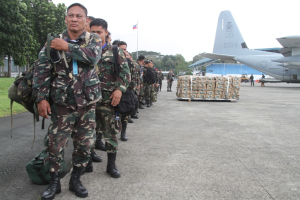
    Philippine Army servicemembers stand alongside a pallet of bottled water as they prepare to board a U.S. Marine Corps KC-130J to support victims of Super Typhoon Haiyan at Villamor Air Base, Manila, Republic of the Philippines Nov. 11. Source: U.S. Marine Corps. (Photo by Lance Cpl. Stephen D. Himes/Released)

    Philippine Army servicemembers stand alongside a pallet of bottled water as they prepare to board a U.S. Marine Corps KC-130J to support victims of Super Typhoon Haiyan at Villamor Air Base, Manila, Republic of the Philippines Nov. 11.
    Source: U.S. Marine Corps. (Photo by Lance Cpl. Stephen D. Himes/Released)

    US Defense Secretary Chuck Hagel has ordered the USS George Washington and her battle group from Hong Kong to the Philippines to provide humanitarian assistance in the aftermath of the Typhoon. Already, about 90 U.S. Marines and sailors have deployed from Okinawa to the Philippines and are on the ground providing support. UK Prime Minister David Cameron has ordered the Royal Navy’s HMS Daring to the region as well. This disaster response mission is part of the Department of Defense’s growing humanitarian response mission to help affected regions. Simply put, if the U.S. military and allies did not provide fast-acting logistical support to relief missions like this, there are no other entities that can provide the heavy lift or logistical expertise necessary to get large quantities of aid to a region in time.

    Last week, prior to the storm, in reference to Pacific Command’s disaster response mission and capability, the PACOM Commander Admiral Locklear said:

    It’s the right thing to do… Also, if something is going to happen in the Pacific that is going to create a churn in the security environment, the most likely thing will be a humanitarian disaster problem of some kind – whether it is horrific typhoons or tsunamis or floods or something else.

    He’s right. Beyond the clear threats to the human security of the residents of the affected area – loss of life, home, food, electricity, and clean water – natural disasters can act as a clear threat to national security, especially when the government is unable to respond effectively. That’s because a government failure can create the opportunity for other security threats to develop, ranging from crime and corruption to insurgency or terrorism. Unfortunately, we may already be seeing this in the Philippines; there are reports of massive looting after the storm passed over, and unverified reports that the Filipino military has engaged and killed a group from the New People’s Army, a communist rebel group in Leyte, as they tried to attack a government relief convoy.

    I’m not going to spend much time debating whether or not man-made climate change was responsible for this storm in particular.  There is an ongoing debate about whether climate change will both increase the number of tropical cyclones as well as their intensity. The latest IPCC report only expressed a ‘low confidence’ in the impact of climate change on tropical cyclones – that doesn’t mean there’s no impact, but it means we don’t know. What we do know is that the water in the Pacific has been warmer than average –and that warmer water is an important part of cyclone intensity. Phil Plait’s blog, Bad Astronomy, has a good explanation of the climate-cyclone link. Suffice it to say that climate change is another risk that must be considered when planning for security threats in the region.

    These are precisely the reasons that the U.S. Department of Defense has labeled climate change as an “accelerant of instability” in the 2010 QDR. PACOM, which has responsibility for all American forces in the Pacific region, has operationalized that guidance from the QDR to include real and significant planning for the many natural disasters that happen around the Pacific Rim. Admiral Locklear has stated that climate change “is probably the most likely thing that is going to happen . . . that will cripple the security environment, probably more likely than the other scenarios we all often talk about.”

    As ASP has determined in our Global Security Defense Index on Climate Change, the U.S. is not the only country that is planning for the security threats of climate change; over 70% of the world also deems climate change to be a security threat. The Philippines’s National Security Policy specifically gives the security forces the mission to “Help Protect the Country’s Natural Resources and Reduce the Risks of Disasters” and goes on to say that “the government must focus on establishing disaster and calamity preparedness and effective response mechanisms.” Clearly, Typhoon Haiyan has overwhelmed the ability of the Filipino security services to effectively respond to this calamity; it is appropriate for the U.S. and international community to help as much as possible.

    Climate change acts as a threat multiplier and an accelerant of instability. Whether this storm was ‘caused’ by climate change is a moot point now. Even with concerted international action to reduce greenhouse gas emissions, like those proposed at the UNFCCC negotiations in Warsaw, the Pacific will likely see these disasters for decades to come. Efforts to reduce risk should include military preparations for response, readiness that increases the capacity to prevent such harm, as well as greenhouse gas mitigation to reduce the chance of future storms. The net effect, unfortunately will be that the military is likely to have many opportunities to practice disaster response: it should be treated as a key mission.

    Andrew Holland is Senior Fellow for Energy and Climate at American Security Project, a Washington D.C based think tank. He is an expert on energy, climate change, and infrastructure policy. He has over seven years of experience working at the center of debates about how to achieve sustainable energy security and how to effectively address climate change. He tweets regularly via @TheAndyHolland.

  • Trump and the Prospects of an Illiberal International Order

    Has Paris Opened the Door for a UNSC Climate Court?

    Historically, permanent members of the UN Security Council have variously rejected the idea that it was the proper venue to address international cooperation on climate change. The notable cooperation between China and the United States to secure the Paris Agreement, however, may signal a greater openness to UNSC climate securitization, including the creation of a UNSC-enforced Climate Court.

    Read Article →

  • Beyond Privacy: The Costs and Consequences of Mass Surveillance

    RC_long_logo_small_4webThis article is part of the Remote Control Warfare series, a collaboration with Remote Control, a project of the Network for Social Change hosted by Oxford Research Group.

    Following a recent Remote Control Project briefing paper, Mass surveillance: security by ‘remote control’ – consequences and effectiveness, this piece explores the hidden costs of government mass surveillance programmes.

    Last week the new UN privacy chief said UK surveillance was “worse than [George Orwell’s novel] 1984”. In the two years since the Snowden leaks revealed the existence of bulk internet and phone surveillance by US intelligence services and their partners, including the UK, the British government continues to engage in the mass collection of citizens’ communications data.

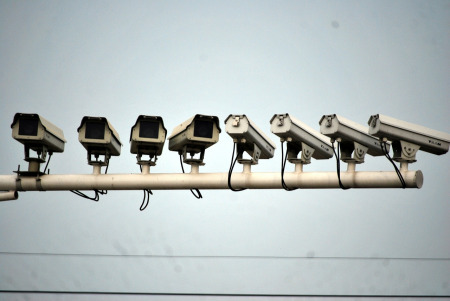
    camera-19223_1280

    Image Credit: https://pixabay.com/en/camera-cameras-traffic-watching-19223/

    Whilst the US Congress barred the National Security Agency (NSA) from collecting US phone data in bulk in June this year after the US court of appeals ruled it to be unlawful, in the UK the mass collection of communications data was found by both the parliamentary Intelligence and Security Committee and David Anderson QC, who is responsible for reviewing UK terrorism legislation, to be legal and should be maintained. Furthermore, the Investigatory Powers Bill, dubbed the “Snooper’s Charter”, which was blocked by the Liberal Democrats party three years ago, has re-emerged under the Conservative majority government. Now firmly back on the agenda, it would move to strengthen the security services’ powers for the bulk interception of communications data.

    To date, the debate around mass communications surveillance has focused primarily on the infringement of privacy it entails. But, beyond privacy implications, government mass surveillance programmes come at further costs.

    Proliferation, public trust and internet security

    A major concern with the development of mass surveillance tools is that they can be used by authoritarian regimes to suppress freedom of information and expression and track down political opponents.  There is evidence that this is already happening: Privacy International’s publicly available database on the private surveillance sector has found that surveillance companies are selling powerful and invasive surveillance technologies, with the potential for the mass interception of communications, to a number of authoritarian regimes globally, including Bahrain, Ethiopia, Libya and Pakistan. Much of this technology is at pace with the capabilities of the NSA and its UK equivalent, GCHQ, which is having clearly visible consequences. In Ethiopia, for example, mass surveillance technology was found to be used to regularly arrest and detain citizens, in particular as a tool to silence dissenting voices, targeting the ethnic Oromo population. The widespread use of torture and other ill-treatment against political detainees in Ethiopian detention centre makes the use of these technologies even more troubling.

    Another cost of mass surveillance is the weakening of public trust in national governments. An erosion of public trust in government in general (see this report from President Obama’s own Review Group on Intelligence and Communications), coupled with a weakening of trust in governments for citizens online security in particular, was found to have occurred since the Snowden leaks. The steep increase in the use of Tor (an open source network that allows users to obscure their online activity) which went from 500,000 daily users worldwide to more than 4 million following the Snowden leaks, as well as an increase in other internet privacy platforms since the leaks seem to confirm this.

    Furthermore, the weakening of internet security is another cost of mass surveillance programmes. These programmes rely on creating and maintaining vulnerabilities in communications networks that undermine the communications infrastructures that we all rely on (see this report from The Council of Europe). The creation of “back doors”, for example, along with other weaknesses in security standards and implementation could easily be exploited by non-state groups.

    In May this year, a group of tech companies, including Facebook, Google and Yahoo (as well as civil society groups and academics) signed a letter to President Obama urging him to oppose efforts that would force companies to build in ways for law enforcement to access products and services protected by encryption. The letter warned that introducing intentional vulnerabilities into secure products for the government’s use will make those products “less secure against other attackers”, including street and computer criminals, repressive or dangerous regimes and foreign intelligence agencies.

    Is mass surveillance stopping terror attacks?

    Beyond the risk of proliferation, the weakening of government trust and the threat to internet security, the UK government’s reliance on mass surveillance could also come at a cost to its citizens’ physical security. The use of data-mining and automated data-analysis techniques used to filter down the vast amounts of data acquired in mass surveillance programmes comes with a high risk of false positives. It has been suggested that data-mining for counter-terrorism in particular comes with a higher risk of false positives than when used in other settings (such as credit card fraud detection) due to the quality of data available and the rarity of terror attacks. This high number of false positives associated with counter-terrorism will, in turn, cause an overload of data, swamping analysts and thus taking resources and attention away from more appropriate counter-terrorism methods.[1]

    Recent evidence suggests that mass surveillance may not be an effective tool for foiling terror plots. A number of reports from the US, including a declassified 2009 report from the US government and a report from a review group appointed by President Obama, have shed doubt on the supposed effectiveness of mass surveillance programmes. One in particular, from Washington based think-tank New America Foundation, found traditional investigative methods played a far greater role than mass surveillance in initiating investigations into the majority of terror cases reviewed. In one case (a 2009 plot to attack the Danish newspaper Jyllands-Posten), the US government was found to have exaggerated the role mass surveillance played in thwarting the plot.

    Recent terror attacks have further exposed the limits of surveillance. In the Boston Marathon bombing in 2013, for example, it was revealed that the failure to foil the bomb plot was due to a failure in sharing and coordination of information between departments, rather than the bombers being unknown to intelligence agencies prior to the attack. Similarly, the 2014 Charlie Hebdo and French grocery store attackers in Paris were not only known to French and US authorities but one had a prior terrorism conviction and another was monitored for years by French authorities. In both cases the attackers were known to authorities and had been under surveillance.

    Security by ‘remote control’

    The use of mass surveillance programmes by government must not be seen in isolation but should be viewed as part of the trend towards maintaining security by ‘remote control’, the global shift towards countering threats at a distance without the need to deploy large military force. As technological advances have increased governments’ digital intelligence gathering capabilities, mass surveillance techniques demonstrate the interdependence between intelligence and surveillance and the growing relationship between intelligence, technology and modern combat.

    Like the use of drones, special forces and private military companies, the secretive nature of mass surveillance programmes means they operate in an accountability vacuum, with little transparency or oversight, rendering the public unable not only to hold government to account, but to assess these techniques’ perceived effectiveness. In the UK, recent Anderson, ISC and RUSI reports all stressed the need for greater transparency and oversight with regards to government mass surveillance programmes.

    Like other remote control methods, mass surveillance of citizens’ communications data is appealing as it is perceived as cost-free and plays to Western states’ technological strengths. The perceived ease of remote control has, however, blinded policy makers from considering its broader and long term implications. There is a need for greater transparency and accountability with regards to government mass surveillance in the UK, along with a robust regulatory framework for private security companies which are trading surveillance technologies globally. As well as this, far more consideration must be given to the unforeseen and long-term costs of mass surveillance in order to evaluate its utility for long-term sustainable peace and security.


    The Remote Control project recently published a briefing paper “Mass surveillance: security by ‘remote control’ – consequences and effectiveness”, read it here.

    [1] For more information please see report by the Committee on Technical and Privacy Dimensions of Information for Terrorism Prevention and Other National Goals, National Research Council, “Protecting Individual Privacy in the Struggle Against Terrorists: A framework for program assessment”, William Binney in “NSA Struggles to Make Sense of Flood of Surveillance Data”, Wall Street Journal, December 2015 http://www.wsj.com/articles/SB10001424052702304202204579252022823658850, and Bruce Schneier, “Why Mass Surveillance Can’t, Won’t, And Never Has Stopped A Terrorist”, digg, March 2015 http://digg.com/2015/why-mass-surveillance-cant-wont-and-never-has-stopped-a-terrorist


    Esther Kersley is the Research and Communications Officer for the Remote Control project. Prior to joining ORG, Esther worked in Berlin for the anti-corruption NGO Transparency International as an editorial and online communications officer. She has a particular interest in counter-terrorism and conflict resolution in the Middle East, having previously worked with the Quilliam Foundation and IPCRI (Israel/Palestine Center for Research and Information), a Jerusalem based think tank.