Blog

  • The Trump Presidency and Iran’s Nuclear Deal

  • Challenges Facing Women in Peacekeeping

    Author’s Note: This opinion peace is based on research conducted among South African Peacekeepers, published in the Journal of International Peacekeeping, 19 (2015) 227-248.

    The motivation to increase the number of women in peacekeeping is based on the assumption that women peacekeepers enhance the access of local women to services, improve community relations, reduce the incidence of sexual and gender-based violence, build the capacity of local women and break down traditional views that discriminate and marginalize women. The extent to which women are able to perform these functions needs to be interrogated, as much of this rhetoric does not reflect the realities that women face on the ground. This is reflected in the findings of a study conducted among South African male and female peacekeepers returning from missions in the Democratic Republic of Congo (DRC) and Darfur, Sudan. The findings are revealing, often countering many of the above-mentioned essentialist claims.

    While there was general consensus that women peacekeepers are generally better at interacting with the local community, especially women and children, these claims were mostly context-specific. In the DRC, the female peacekeepers felt that they could reach out to women and children more readily. This was because ‘Sousa’ (as the locals call the South African contingent) tended to interact with the local community more than other contingents because they are mostly black, and could understand Swahili. This was not the case in Darfur, Sudan. Here, it was as if the local population (especially the local women) were afraid to speak to the peacekeepers, whether men or women. What this indicates is that not only gender, but race, the ability to speak the local language, and respect for the local culture are crucial determinants in fostering relations with the local community. Similarly, their ability to serve as norm-breakers, challenging existing stereotypes was met with some misgivings, given the fact that most often their identity was concealed behind their helmets and because of their low numbers.

    In terms of improving the security of local women and children, female peacekeepers felt that locals placed more trust in male soldiers because they do not know how to judge female soldiers. Female peacekeepers also reported that they did not really know what the specific security concerns of women were, because little attention was paid to issues of gender in peacekeepers’ mission-readiness training. Thus, they had little understanding of the underlying gender power relations in the communities. Nor did they know how to address or assist victims of sexual violence. In fact, most knew very little if anything about the gender dynamics in these communities and in some cases there was a general lack of cultural awareness. This influenced their ability to identify what the specific security needs of women were, how to protect them, or where to refer them if they needed to deal with cases of sexual violence.

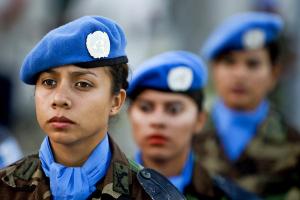
    Members of the Guatemalan contingent of the United Nations Stabilization Mission in Haiti (MINUSTAH) participate in a medal award ceremony in recognition of their service. 10/Jun/2009. Port au Prince, Haiti. UN Photo/Marco Dormino. www.unmultimedia.org/photo/

    Members of the Guatemalan contingent of the United Nations Stabilization Mission in Haiti participate in a medal award ceremony in recognition of their service. Image by UN Photo via Flickr.

    What this means is that the ability of female peacekeepers to make a difference is limited by their training, which is gender-neutral and where they are expected to act and perform functions ‘just like men’. The rationale for this is that when deployed on peace missions, all have to carry the same equipment, work in the same environment and face the same adversaries in the course of duty. This is specifically the case where they are drawn from the infantry environment and have to perform infantry-like functions. Added to this, women peacekeepers report being ‘othered’ on various levels. Physically, they are ridiculed for their lack of physical strength and endurance, especially on foot patrols. Psychologically and emotionally, the operational environment is seen to be more taxing for women, given the extreme forms of sexual violence against women. Women were also perceived to pose a ‘gendered’ security risk, especially in hyper-masculine contexts where women are seen as sexual objects, are used as weapons of war where they threaten existing gender power relations that affect male dominance.

    This results in female peacekeepers facing many different forms of gender and sexual harassment which are used to denigrate them. Some of the female peacekeepers who served in positions of authority explained how they were often not respected, ignored, undermined and faced frequent sexual advances. Such forms of gender harassment occurred often, but not considered serious enough to evoke punitive action. This was simply explained away in terms of existing patriarchal relations that could not be changed. However, in some cases this evoked open hostility towards them “because in Sudan it is considered disrespectful to their culture for women to be soldiers, carry rifles and wear trousers”. Besides this, the threat of being raped served to further erode women peacekeepers’ agency, especially where they were excluded from certain operations which were considered too dangerous by their commanders. In this way, not only were old gender stereotypes replicated, but they are used to undermine the prospect of an equal partnership between men and women.

    What this shows is that even where national armed forces espouse gender equality, the peacekeeping environment remains hostile to women. Multiple masculinities, patriarchy and sexism undermines the ability of women peacekeepers to imbue alternative ways of dealing with and resolving conflict. The only way to ‘regender’ the military is to stop privileging masculinity over femininity. This is unlikely to happen where peacekeeping remains steeped in the warrior ethos and where the ‘feminine’ is not valued, is suppressed, seen as a threat, or a liability. What is needed is for women to become less complicit and more assertive in making their voices heard. However, military women themselves typically do not embrace feminine values given the ‘nature’ of their work. They typically conform to and assimilate masculine values, norms and practices in order to be judged as capable soldiers. They have to assume what many term as a ‘militarized masculinity’, understood as the ability to ‘demonstrate an absence of emotion and a willingness to use violence’—they must excise all that is perceived to be feminine.

    This makes it difficult to achieve the ideals advocated by UNSC Resolution 1325. The aim of this resolution is not only to increase the number of women serving in the military, but to mainstream gender by bringing about a greater sensitivity to the different effect that war has on men and women. In this regard, there has been little progress as the number of military women serving on peacekeeping missions have remained around 3 per cent. Even in the South African armed forces where women now represent 26 % of uniformed personnel and up to 15% of those deployed on peacekeeping missions, there seems to be little qualitative change in bringing about a more acrogenous military culture. This necessitates a closer introspection in terms of how women are trained, deployed and supported on peacekeeping operations. It raises the question as to whether a gender-neutral approach to gender integration in the military does not in fact perpetuate gender inequality. Clearly one cannot bring about a different perspective to war and peace if women are expected to embrace masculine norms and values and where gender difference is not recognised and valued.

    Lindy Heinecken was formerly a researcher and Deputy Director of the Centre for Military Studies (CEMIS) at the South African Military Academy, where she worked for 17 years. Since 2006 she has been at the Department of Sociology and Social Anthropology, Stellenbosch University, South Africa and is currently Professor of Sociology lecturing in political and industrial sociology. The main focus of her research is in the domain of armed forces and society where she has published widely on a range of issues including military unionism, the management of diversity, gender integration, HIV/AIDS in the military and more recently on the experiences of military personnel on peace operations. She serves on numerous academic boards, including the Council of the Inter-University Seminar on Armed Forces and Society, the Board of the International Sociological Association’s (ISA) Armed Forces and Conflict Resolution Group, and the National Research Foundation (NRF). She serves on the editorial board of the journals Armed Forces and Society and Scientia Militaria: South African Journal of Military Studies. She is a NRF B rated researcher and serves as one of the pool of specialists conducting research for the South African Army.

  • Challenges Facing Women in Peacekeeping

    Author’s Note: This opinion peace is based on research conducted among South African Peacekeepers, published in the Journal of International Peacekeeping, 19 (2015) 227-248.

    The motivation to increase the number of women in peacekeeping is based on the assumption that women peacekeepers enhance the access of local women to services, improve community relations, reduce the incidence of sexual and gender-based violence, build the capacity of local women and break down traditional views that discriminate and marginalize women. The extent to which women are able to perform these functions needs to be interrogated, as much of this rhetoric does not reflect the realities that women face on the ground. This is reflected in the findings of a study conducted among South African male and female peacekeepers returning from missions in the Democratic Republic of Congo (DRC) and Darfur, Sudan. The findings are revealing, often countering many of the above-mentioned essentialist claims.

    While there was general consensus that women peacekeepers are generally better at interacting with the local community, especially women and children, these claims were mostly context-specific. In the DRC, the female peacekeepers felt that they could reach out to women and children more readily. This was because ‘Sousa’ (as the locals call the South African contingent) tended to interact with the local community more than other contingents because they are mostly black, and could understand Swahili. This was not the case in Darfur, Sudan. Here, it was as if the local population (especially the local women) were afraid to speak to the peacekeepers, whether men or women. What this indicates is that not only gender, but race, the ability to speak the local language, and respect for the local culture are crucial determinants in fostering relations with the local community. Similarly, their ability to serve as norm-breakers, challenging existing stereotypes was met with some misgivings, given the fact that most often their identity was concealed behind their helmets and because of their low numbers.

    In terms of improving the security of local women and children, female peacekeepers felt that locals placed more trust in male soldiers because they do not know how to judge female soldiers. Female peacekeepers also reported that they did not really know what the specific security concerns of women were, because little attention was paid to issues of gender in peacekeepers’ mission-readiness training. Thus, they had little understanding of the underlying gender power relations in the communities. Nor did they know how to address or assist victims of sexual violence. In fact, most knew very little if anything about the gender dynamics in these communities and in some cases there was a general lack of cultural awareness. This influenced their ability to identify what the specific security needs of women were, how to protect them, or where to refer them if they needed to deal with cases of sexual violence.

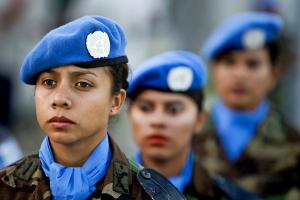
    Members of the Guatemalan contingent of the United Nations Stabilization Mission in Haiti (MINUSTAH) participate in a medal award ceremony in recognition of their service. 10/Jun/2009. Port au Prince, Haiti. UN Photo/Marco Dormino. www.unmultimedia.org/photo/

    Members of the Guatemalan contingent of the United Nations Stabilization Mission in Haiti participate in a medal award ceremony in recognition of their service. Image by UN Photo via Flickr.

    What this means is that the ability of female peacekeepers to make a difference is limited by their training, which is gender-neutral and where they are expected to act and perform functions ‘just like men’. The rationale for this is that when deployed on peace missions, all have to carry the same equipment, work in the same environment and face the same adversaries in the course of duty. This is specifically the case where they are drawn from the infantry environment and have to perform infantry-like functions. Added to this, women peacekeepers report being ‘othered’ on various levels. Physically, they are ridiculed for their lack of physical strength and endurance, especially on foot patrols. Psychologically and emotionally, the operational environment is seen to be more taxing for women, given the extreme forms of sexual violence against women. Women were also perceived to pose a ‘gendered’ security risk, especially in hyper-masculine contexts where women are seen as sexual objects, are used as weapons of war where they threaten existing gender power relations that affect male dominance.

    This results in female peacekeepers facing many different forms of gender and sexual harassment which are used to denigrate them. Some of the female peacekeepers who served in positions of authority explained how they were often not respected, ignored, undermined and faced frequent sexual advances. Such forms of gender harassment occurred often, but not considered serious enough to evoke punitive action. This was simply explained away in terms of existing patriarchal relations that could not be changed. However, in some cases this evoked open hostility towards them “because in Sudan it is considered disrespectful to their culture for women to be soldiers, carry rifles and wear trousers”. Besides this, the threat of being raped served to further erode women peacekeepers’ agency, especially where they were excluded from certain operations which were considered too dangerous by their commanders. In this way, not only were old gender stereotypes replicated, but they are used to undermine the prospect of an equal partnership between men and women.

    What this shows is that even where national armed forces espouse gender equality, the peacekeeping environment remains hostile to women. Multiple masculinities, patriarchy and sexism undermines the ability of women peacekeepers to imbue alternative ways of dealing with and resolving conflict. The only way to ‘regender’ the military is to stop privileging masculinity over femininity. This is unlikely to happen where peacekeeping remains steeped in the warrior ethos and where the ‘feminine’ is not valued, is suppressed, seen as a threat, or a liability. What is needed is for women to become less complicit and more assertive in making their voices heard. However, military women themselves typically do not embrace feminine values given the ‘nature’ of their work. They typically conform to and assimilate masculine values, norms and practices in order to be judged as capable soldiers. They have to assume what many term as a ‘militarized masculinity’, understood as the ability to ‘demonstrate an absence of emotion and a willingness to use violence’—they must excise all that is perceived to be feminine.

    This makes it difficult to achieve the ideals advocated by UNSC Resolution 1325. The aim of this resolution is not only to increase the number of women serving in the military, but to mainstream gender by bringing about a greater sensitivity to the different effect that war has on men and women. In this regard, there has been little progress as the number of military women serving on peacekeeping missions have remained around 3 per cent. Even in the South African armed forces where women now represent 26 % of uniformed personnel and up to 15% of those deployed on peacekeeping missions, there seems to be little qualitative change in bringing about a more acrogenous military culture. This necessitates a closer introspection in terms of how women are trained, deployed and supported on peacekeeping operations. It raises the question as to whether a gender-neutral approach to gender integration in the military does not in fact perpetuate gender inequality. Clearly one cannot bring about a different perspective to war and peace if women are expected to embrace masculine norms and values and where gender difference is not recognised and valued.

    Lindy Heinecken was formerly a researcher and Deputy Director of the Centre for Military Studies (CEMIS) at the South African Military Academy, where she worked for 17 years. Since 2006 she has been at the Department of Sociology and Social Anthropology, Stellenbosch University, South Africa and is currently Professor of Sociology lecturing in political and industrial sociology. The main focus of her research is in the domain of armed forces and society where she has published widely on a range of issues including military unionism, the management of diversity, gender integration, HIV/AIDS in the military and more recently on the experiences of military personnel on peace operations. She serves on numerous academic boards, including the Council of the Inter-University Seminar on Armed Forces and Society, the Board of the International Sociological Association’s (ISA) Armed Forces and Conflict Resolution Group, and the National Research Foundation (NRF). She serves on the editorial board of the journals Armed Forces and Society and Scientia Militaria: South African Journal of Military Studies. She is a NRF B rated researcher and serves as one of the pool of specialists conducting research for the South African Army.

  • Iraq: Days of Danger

    This post by Oxford Research Group’s Global Security Consultant, Paul Rogers, was originally posted by openSecurity on 3 July, 2014.

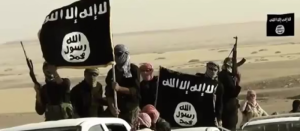
    An image grab taken from a propaganda video by jihadist group ISIL shows ISIL militants gathering Iraq. Source: Screenshot from World News Online

    An image grab taken from a propaganda video by jihadist group ISIL shows ISIL militants gathering Iraq. Source: Screenshot from World News Online

    The recharged war in Iraq that got underway in June 2014 is moving towards its second month. A remarkable feature of this phase is the formation of a largely unacknowledged coalition of four states opposed to the advance of the extremeSunni paramilitaries across much of northwestern Iraq.

    Iran’s involvement is clear enough: senior Iranian Revolutionary Guard Corps (IRGC) officers are active in Baghdad, and Iranian reconnaissance-drones are being used to aid Iraq’s troubled armed forces. Syria too is active, with Bashar al-Assad’s air-force conducting intermittent (and perhaps largely symbolic) strikes against jihadist Islamic State in Iraq and the Levant (ISIL) targets inside Iraq.

    This reflects a shift in the Assad regime’s position. As long as ISIL could be considered little more than an irritant in Syria (even if occupying substantial ground), the group had a propaganda value for Damascus, which could project an image of being steadfast in the face of radical Islam and even secure tacit acceptance by western governments in the process.

    Now that ISIL is getting stronger and more confident – symbolised in itsdeclaration of an “Islamic State” in the territory it controls – the potential challenge to Damascus’s as well as Baghdad’s security is evident. Assad may therefore continue to encourage periodic cross-border air-raids, but he will also work harder to damage ISIL within Syria.

    The late shift

    The two other states in this extraordinary anti-ISIL confluence are the United States and Russia. United States forces in the region are being steadily expanded, though it remains difficult to discern the full extent of personnel deployment in Iraq. This is partly because several thousand Americans in Iraq were already in Iraq before the new war erupted –  including diplomats, weapons-technicians and private military contractors. It is sure, however, that three further groups of military personnel are now entering Iraq.

    The first is composed of security people (probably around 300 in total) assignedto guard diplomats and civilians; the second (at least 100) to safeguard Baghdad airport, among them probably specialist helicopter-crews available to retrieve aircrew (the potential need is highlighted by the US navy’s regular F-18 reconnaissance sorties off the USS George HW Bush carrier in the Persian Gulf). The third group is troops, mostly special-forces personnel, sent to Baghdad and elsewhere to boost Iraqi government forces in their operations. The key point here is that the overall authority, US Central Command, calculates that its operation is unlikely to yield results for several weeks (see Daniel Wasserbly, “US assesses mission in Iraq, considers military options”, Jane’s Defence Weekly, 2 July 2014). US personnel may already be advising Iraqi army troops in their stalled attempt to retake the city of Tikrit, a political necessity for Nouri al-Maliki’s government to demonstrate that it was seen to be doing something to address a military disaster. But the US military is taking a longer-term view of its work in Iraq.

    Russia completes this unlikely anti-ISIS coalition. Its main involvement so far is the provision of a number of Su-25 Frogfoot ground-attack aircraft. The Su-25 is a robust if relatively slow-flying aircraft of the 1970s, roughly analogous to the US’s A-10 Warthog (though less heavily armed). It was widely deployed by the Iraqi air-force in the war with Iran (1980-88), and used by the Soviet air-force in the two Chechen wars (1994-96 and 1999-2002). Few if any survived in Iraqi air-force service after the 1991 war; so it is close to a quarter-century since any Iraqi pilots flew this aircraft – which like all ground-attack planes requires particular skills and much practice. The implication is that if Su-25s are used against ISIL and other militias in the coming weeks, it is near-certain that Russian pilots will fly them.

    Thus, both US and Russian forces are preparing to aid the Maliki government at a quite significant level, and may even cooperate more closely than either Washington or Moscow will want to acknowledge. Indeed, that may already be happening: the hundred US troops inserted to help protect Baghdad’s airport will be guarding the very same base from which Su-25s are already flying, no doubt with Russian pilots.

    The weeks ahead

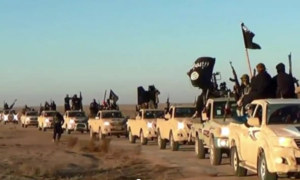
    An image grab taken from a propaganda video by the Islamic State of Iraq and the Levant shows the group travelling through Iraq. Source: World News Online (Youtube with Creative Commons license)

    An image grab taken from a propaganda video by the Islamic State of Iraq and the Levant shows the group travelling through Iraq. Source: World News Online (Youtube with Creative Commons license)

    If the war is creating strange alliances, a question of timescales may also become relevant as events unfold. Neither US and Russian support for Iraq, nor any from Iran, will have much effect on the situation until mid-July. This means that ISIL’s planners have a short window of opportunity to consolidate their recent gains. Several sources indicate that ISIL already has groups in place in western Baghdad to aid any assault on the city (see “The Iraq Crisis [Part 111]: Is Baghdad at Risk?“, 30 June 2014).

    The next two weeks, then, are an acutely dangerous period (see Borzou Daragahi, “Iraqi capital nervously awaits Isis attack“, Financial Times, 1 July 2014). The aim of any ISIS attack will not be to take control of the whole city, for Shi’a militias in the eastern Baghdad districts are strong enough to contest that; instead it will be to damage and demoralise the regime to an extent that Baghdad can’t prevent the Islamic State consolidating itself.

    That outcome would give ISIS a further lease of life. It would also be welcomed by many in the region, not least Saudi Arabia. But it would also be no more than a temporary gain in a war which may yet have far more dreadful human consequences.

    Paul Rogers is professor in the department of peace studies at Bradford University and Global Security Consultant at Oxford Research Group.  He is the author of numerous books including Why We’re Losing the War on Terror (Polity, 2007), and Losing Control: Global Security in the 21st Century (Pluto Press, 3rd edition, 2010). He is on twitter at: @ProfPRogers

  • Sustainable Security in the Trump Era

  • Swarms Over the Savannas: How Drones Are Gaining More Traction in Africa

  • Floating liabilities? Maritime armouries, risks and solutions

  • The Costs of Security Sector Reform: Questions of Affordability and Purpose

    The Costs of Security Sector Reform: Questions of Affordability and Purpose

    In considering security sector reform, questions of affordability have often been subordinated to questions of effectiveness and expediency. A recent series of reviews of security expenditures by the World Bank and other actors in Liberia, Mali, Niger and Somalia has highlighted several emerging issues around the (re)construction of security institutions in fragile and conflict-affected states.

    Read Article →

  • Security Sector Roles in Sexual and Gender-based Violence

    Democratic Republic of Congo’s sexual violence epidemic is not only a weapon of ongoing violent conflict but an expression of entrenched systemic problems. Indeed, sexual and gender-based violence (SGBV) is most commonly perpetrated by the security services in place to protect civilians. In Quartier Panzi in South Kivu province, innovative processes of security sector reform and strengthened police-civilian channels of communication may be providing an opportunity for change.   
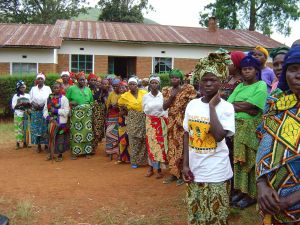
    Meeting of victims of sexual violence in the Walungu, South Kivu in Democratic Republic of the Congo. Source: Wikipedia

    Meeting of victims of sexual violence in South Kivu,  Democratic Republic of the Congo. Source: Wikipedia (from USAID)

    Quartier Panzi—the populous, restive neighborhood of Bukavu, South Kivu province—is renowned in international development circles as the ground zero of the Democratic Republic of Congo’s sexual violence epidemic. Rape as a weapon of war is not so much perpetrated by enemy forces but, most often, by the very parties sent by Kinshasa to protect and serve civilians. Much as Selma, Alabama was to the American civil rights movement, Panzi’s ongoing tragedy has transformed the area into a vibrant arena for grassroots opposition and international solidarity in the fight to restore women’s bodies and lives. Women’s organizations have formed to denounce continued abuses and government denial, to reverse cultural stigmas around female culpability in rape, and to demand trial for Congolese security forces suspected of sexual abuses.

    The courage and commitment of Dr. Denis Mukwege, chief gynecologist at Panzi Hospital and twice nominated for the Nobel Peace Prize, is emblematic of this resilience. International networks like V-Day and Women for Women International support these local actions and fund sanctuaries for survivors, such as the City of Joy. These innovations aim to be restorative and empowering for survivors, focusing on the crisis as experienced by women and girls, offering healing and vocational training options otherwise non-existent. However, the causes of this specific form of cruelty and degradation, rooted in violent masculinities and impunity among security actors, remain unaddressed.

    Rewiring the security sector
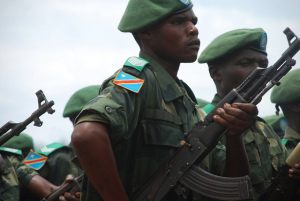
    Congolese soldiers march in Walikale, DRC, 2011. Source: ENOUGH (Flickr)

    Congolese soldiers march in Walikale, DRC, 2011. Source: ENOUGH (Flickr)

    Like any deep malaise, Congo’s rape crisis is but one expression of entrenched, systemic problems. Local witnesses, security analysts and medical professionals who treat survivors present overwhelming evidence that the primary perpetrators are uniformed Congolese security actors. A weak justice system may be responsible for the failure to discipline or punish perpetrators, but the sources of this behavior lie within the security sector itself. Accessing the security elite, Congo’s infamous ‘black box’, is notoriously difficult. As a result, very little analysis exists of the problem from the perpetrators’ perspective: analysis and evidence that deciphers the institutional culture and internal organization of the security sector, or that maps relations between senior officers, politicians and economic actors. By design, opacity reigns supreme.

    A variety of international donors support the national army and police with numerous ‘train and equip’ initiatives, an international cooperation model unchanged since the Cold War.These ‘security development’ partnerships aim to strengthen national capacity through field and classroom training and equipment upgrades; behavior change and public accountability are not part of the approach. Within the security services, there is typically an absence of civilian oversight, and widespread rent-seeking and illicit trade in protected flora, fauna and minerals, but no questions are asked by international partners, as diplomacy and formality dominate.

    Supply-side approaches such as these long pre-date the advent of ‘security sector reform’ among development actors, which does seek behavior change and greater accountability. The older aid modality remains popular with the Congolese leadership because it expressly avoids any calling to account or inculcation of security as a public service and legal right.

    There is state and donor complicity in all of this. Strength without constraint or accountability defines the DRC’s security sector today. Its predatory practices range from unchecked rape and pillage in the East to the repression of free speech and public inquiry, as witnessed by the 2010 murder in Kinshasa of prominent human rights activist, Floribert Chebeya. To placate critics, a military tribunal mounted a kangaroo court in the wake of the murder; the film documenting and exposing its empty theatrics, L’Affaire Chebeya, Un Crime d’Etat, remains banned in Congo.

    Such officially sanctioned practices and attitudes are salient features of the Congolese state since independence, and well known to all Congolese. In the early 1970s, President Mobutu Sese Seko began encouraging civil servants and security forces to ‘feed on the population’ (“Population baza bilanga ya bino). Anecdotes such as these are more than flippant asides; they explain the persistent appeal of this patrimonial compact (across four chapters of Congolese leadership: Mobutu, Kabila père, transitional government, Kabila fils) as a declaration of complicity between political elites and the entire public sector. In its truncated audacity, this single utterance reconfigures and reduces the entire means and ends of the state to elite enrichment and group impunity.

    In Panzi, armed crime and physical/sexual assault reached unprecedented levels in the aftermath of the primary war in South Kivu province. State security had long colluded with local armed gangs, and popular recourse options ranged from individual vengeance to military tribunals, as civil courts are unreliable. Mob justice is also widely practiced. The formation of neighborhood watch groups raised local hopes for improved safety (e.g. SAJECEKForces Vives). Despite their initial popularity, they soon joined local police and armed gangs in perpetrating the very crimes they first sought to oppose.

    How urban police understand this license to extort and harass the population, and the higher interests these practices serve, has been well captured and analyzed by Maria Eriksson Baaz and Ola Olsson. Transforming Congo’s security sector from inside is an elusive challenge, and donors are struggling to develop the programmatic savvy, influence and access to inspire the necessary political will.

    Demand for reform
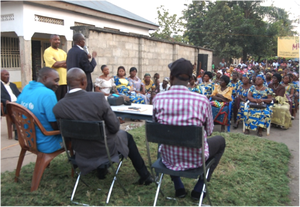
    Community meeting in Kananga, DRC, where security officials and civilian leaders converse directly with local community leaders. Source: DAI Europe (with permission)

    Community meeting in Kananga, DRC, where security officials and civilian leaders converse directly with local community leaders. Source: DAI Europe (with permission)

    The UK’s Department for International Development (DFID) has experimented with alternative supply-and-demand models of public sector reform, and is applying these to the Congolese National Police (PNC). According to this strategy, supply-side ‘train and equip’ assistance targets weak service areas, including the prevention of and response to sexual and gender-based violence (SGBV). This is complemented by efforts to mobilize popular demand for more responsive policing at the community level.

    A particular understanding of the partner institution, the PNC, informed this theory of change. This included the hypothesis that payment of regular salaries would not end extortion and rent-seeking (’tracasseries’) by the PNC, given the scale of these rackets and the enormous sums they generate. With no compelling alternative on offer, and as long as ‘reform’ is understood to involve replacing tracasseries with ‘protecting and serving’, change will elude would-be reformers. Given that such arrangements will not change in the forseeable future, the more nuanced strategy accommodates the reality of low, irregular salaries and uniformed extortion for the foreseeable future, and seeks behavior change through increased public-police interaction. Faster paced improvements in human security and responsive policing began emerging on the demand side of the pilot sites, including Bukavu and Quartier Panzi in particular.

    Launched in Bukavu, Matadi and Kananga in 2009, the Security Sector Accountability and Police Reform Programme (SSAPR) is distinct for coupling its community policing approach with regular neighborhood meetings (forums du quartier) where locally appointed representatives voice their security concerns, identify emerging threats and suspects. It is common for community policing programs to seek a more responsive, service-oriented local police, but SSAPR is distinguished by its effort to cultivate citizen networks at the most local level to identify and articulate their fears, threats and suspicions forward to the actors most able to respond. Police officers, urban administrators, local community and neighborhood leaders then meet regularly in informal, local security councils to discuss proposals for containing a threat or resolving a violent dispute, as equipment and manpower are often lacking. Initiated entirely informally, these experiments in public relations gradually began to change expectations, reinforce collaboration and gain momentum.

    Concurrently, the National Parliament submitted a motion to formalize the Conseils Locaux pour la Sécurité de Proximité(or CLSP, finally passed in late 2013), which recognizes the right of civilian representatives to participate in official security discussions at the municipal level. Over three years, SSAPR legal advisers worked with national parliamentarians to build support and draft a bill. Given the long-standing animosity between politicians and civil society, this new décret was a highly significant opening. The platform has since been incorporated into other police reform efforts (such as the European Union’s EUPOL) that also understand SSR in the Congolese context as primarily a governance challenge requiring civilian involvement.
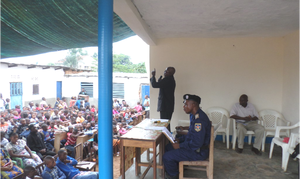
    SGBV DRC 2

    Community meeting in Kananga, DRC, where security officials and civilian leaders engage directly with local community leaders. Source: DAI Europe (with permission)

    Raising security problems through the CLSP increased dialog between communities and security officials, but who would represent the civilian side? In rough urban neighborhoods like Panzi, citizens experience a host of threats, not all of them equally or in the same way. The SSAPR helped Panzi neighborhood chiefs and community leaders coordinate an informal system whereby youth, women and men would alternately represent their community concerns first to a forum de quartier, then directly on to the CLSP. This neighborhood dynamic continues today across Bukavu’s three communes.

    Making Progress?

    These are small steps toward a more accountable security sector and restored public trust, but has sexual assault around Panzi declined as a result? Recently the SSAPR helped a women’s NGO organize a nocturnal walk through several Bukavu neighborhoods, including Panzi, to record their own safety concerns as well as those of women and girls met along the way. In a recent meeting, NGO members insisted they would never before have visited these neighborhoods, particularly at night, but that the chance to report their findings to a receptive and interested police commisariat justified the risk.

    In response, new light fixtures are planned in darkened alleys where assaults have occurred, and patrols redirected to suspicious areas noted by the NGO delegation. In another pilot city, Kananga (Kasai Occidental), assaults on women and girls who were walking long distances to fetch water, often at night, decreased dramatically after local women lobbied for regular police patrols in these areas. This, in itself, was indicative of a greater local confidence in the police as protectors.

    Community police units are involved in implementing these changes, but they represent a small minority of the PNC. It is unknown if these lower rates of sexual violence are attributable to behavior change among uniformed security or if the increased patrols and better lighting are deterring other possible assailants. Retrospective studies have been conducted, but no consensus exists on the total quantitative extent of SGBV in DRC, where just one in twenty cases is thought to be reported to authorities. Nor are cases raised with the police guaranteed to be registered or pursued. Impunity persists due to a weak national justice system, as well.

    Other insights emerge from this experience, particularly around ‘bottom-up’ approaches to renewed legitimacy in fragile states. In the DRC, where central government continues to stall on commitments to decentralization and provincial institutions exploit this limbo (enrichment via parallel markets; legal and financial opacity) leaving communities in the breach, these small successes show that by investing at the periphery—that most-local interface where citizens and public service providers meet in person—bridges of trust and respect can be built through participatory problem solving. Communities can show resilience and security services can prove they are responsive and effective.

    Edward Rackley is a Security and Governance consultant for the World Bank, based in Washington DC. He provides periodic technical and strategic advice to the SSAPR program via DAI Europe, one of the program’s managing agents. (The views expressed in this article are not necessarily those of these institutions.)

  • US Drone Strikes in Pakistan: ineffective and illegitimate

    US Drone Strikes in Pakistan: ineffective and illegitimate

    Strikes by unmanned combat air vehicles, or armed drones, have become the tactic of choice in US counterterrorism efforts in Yemen, Somalia and, the topic of current controversy, Pakistan. The lack of transparency, dubious effectiveness, civilian casualties and negative consequences for US national security being highlighted by current debate means that Washington needs to re-evaluate its approach.

    Read Article →