Blog

  • Libya: lessons in controlling the arms trade

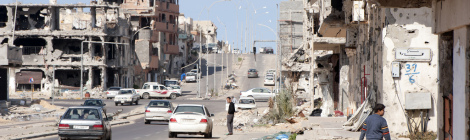
    In the current military air strikes against Libyan forces, nations that once supported Colonel Muammar Gaddafi’s regime are now—based on sanction by the United Nations—attacking the forces they were marketing and delivering arms to only weeks before. As the violence escalates and the international community examines how to respond to internal conflict and human rights violations, arms supply should be analysed as it implicates the international community as complicit in the violence it is now trying to end. 

    The United Nations Security Council has responded to the violence in Libya with remarkable speed and determination. Within two weeks of the start of the uprising in February, the Security Council unanimously denounced the gross and systematic violation of human rights by the Libyan regime and imposed sanctions, including an arms embargo. Contrary to past decisions on UN sanctions relating to internal conflicts, Russia and China did not delay in voting to support sanctions against Libya, thereby responding, in particular, to calls from regional organizations. More remarkably, in March Russia and China decided not to veto a Security Council resolution allowing the use of force to protect the civilian population, again counter to their usual votes. 

    Whatever the final impact of the UN sanction, the swiftness of the decisions and their wide international support distinguishes the Libyan response from earlier failed attempts to quickly enforce broad UN sanctions to protect civilians from political violence. For example, in 2007 and 2008 the Security Council could not agree on sanctions against Zimbabwe and Myanmar in response to human rights abuses. The key objections by Russia and China in these cases were that international sanctions were not appropriate to address internal situations. The unanimous condemnation of Gaddafi’s regime, however, contrasts starkly to the previously good relations it enjoyed with many governments. 

    Prior UN and European Union (EU) sanctions on Libya including arms embargoes were lifted in 2003 and 2004, after Libya announced that it had ended its nuclear, biological and chemical weapon programmes and had agreed to compensate the families of those who died in Libyan acts of terrorism. Libya’s return to the international community was welcomed owing to its oil resources, its geographical position as a buffer against unwanted migration from Africa to Europe and its potential role in fighting al-Qaeda related groups. 

    However, part of the process of inclusion was acceptance of Libya as a buyer of arms, which has implicated the supplier countries in the sustained oppressive military rule. After more than a decade of being cut off from arms supplies, Libya was expected to spend billions of dollars to modernize parts of its large arsenal of outdated arms. In anticipation to a lucrative market, many companies eagerly competed to supply arms to the wealthy state. In November 2010 the Libdex 2010 arms fair in Tripoli reportedly attracted 100 companies from at least 24 countries. Such sales efforts were often politically supported, with the leaders of France, Italy, Russia and the United Kingdom visiting Libya accompanied by representatives of arms companies. Competing with several EU countries, Russia laboured to sell combat aircraft and advanced S-300 long-range air defence systems and clinched deals for the overhaul of tanks and fast attack craft.

    Despite EU embargoes and arms supply restrictions having been imposed following human rights abuses in, for example, China, Myanmar and Zimbabwe, several EU states have until now seemingly overlooked Gaddafi’s 41-year track record as an authoritarian and unpredictable ruler with a well-documented lack of respect for human rights.  

    Although Italy is now a main base for operations against Libya, it had previously cornered the Libyan market for advanced border security and surveillance equipment. French President Nikolas Sarkozy was one of the first to reverse his position from actively supporting arms sales to denouncing the regime and calling for military action. This decision came immediately after the return from Libya of the last French engineers who had been working on military contracts with Libya. French Rafale combat aircraft, which France had been eagerly trying to sell to Libya, have now bombed Libyan howitzers, which an Italian company had planned to refurbish under a contract signed in 2010. The UK, also at the forefront of the military action against Libya, marketed advanced Jernas short-range air defence systems and supplied an advanced communication system for Libyan T-72 tanks which are now being targeted by UK combat aircraft. Over half of the exhibitors at Libdex 2010 were from the UK.

    Libya has also procured large quantities of small arms and light weapons. These are likely to proliferate throughout Libya, prolonging the violence, or they may leak to conflicts or armed groups elsewhere. In 2007–2008 Ukraine supplied over 100 000 rifles to Libya. Russia reportedly signed a major contract for small arms in 2010 and probably also delivered several compact Igla-S advanced anti-aircraft missiles. In 2009 an Italian company supplied about 10 000 handguns, and authorities in Belgium allowed the supply of a first small batch of high-tech rifles. The latter argued that the weapons were intended for use by Libyan troops protecting humanitarian aid convoys to Darfur. The UK did not allow an arms dealer to export 130 000 Kalashnikov rifles because of the risk that they would be diverted to Darfur, but it allowed the marketing of sniper rifles to Libya. 

    Despite the relentless sales efforts by arms companies, Libya held back on contracts for new major arms. Therefore, it is possible that restraint in supplies of major arms may not have stopped the current bloodshed. 

    However, it can also be argued that the eagerness of many states to supply weapons and so-called security equipment—symbols of power and tools of repression—signalled support of Gaddafi’s regime. Furthermore, if the violence had started later or if suppliers had succeeded earlier in convincing Gaddafi to procure advanced arms, the presence of these weapons in Libya could have complicated the decisions about and enforcement of the current UN sanctioned actions against Libya. In particular, if Russian S-300s and British Jernas Surface to Air Missile systems had been delivered, they would have been major obstacles in enforcing the no-fly zone.

    Soon after the First Gulf War, the international community reviewed their arms trade policies, realizing that supplying arms to Iraq may have strengthened Saddam Hussein’s belief that he could invade Kuwait without punishment. Guidelines for arms exports were formulated, and transparency in international arms flows increased. The role of arms supplies to Libya in the present conflict must be similarly examined. The swiftness with which an arms embargo was imposed as a first action is encouraging. However, to inform the debate on arms trade controls, a critical evaluation of arms supply policies towards Libya is paramount in order to assess how such policies risk emboldening authoritarian regimes and how commercial and national interests may blind governments to the repercussions involved in arms trade.

    Image source: B.R.Q.

    This article was originally published on SIPRI

  • Sustainable Security

    This major report was the result of an 18-month long research project examining the various threats to global security, and sustainable responses to those threats. Read more »

  • Is it Time for Sustainable Development Goals?

    From MDGs to… SDGs? That’s one of the ideas swirling around in discussions ahead of the Rio 2012 sustainable development summit next year, anyway.

    You can see the attraction. With less than a year to go, there are precious few concrete ideas on the table for what the summit might produce, especially in the area of “institutional framework for sustainable development”, one of two key themes for the event (sure, there’s much talk of a new World Environment Organisation, but colour me very unconvinced of the case for that). So might SDGs help to fill the gap?

    Well, that would depend on what they cover. The government of Colombia has set out a proposal for SDGs that would cover various sectors – atmosphere, climate resilience, land degradation, sustainable agriculture, biotech, waste and so forth. This would mainly be about ‘reaffirming’ (that awful word – who, other than diplomats, ever ‘reaffirms’ anything?) commitments made at Rio 1992. But you have to wonder: important though delivery of existing commitments undoubtedly is, is ‘reaffirmation’ of stuff agreed 20 years ago really going to set any pluses racing outside the sustainable development priesthood?

    Much more interesting, on the other hand, is the idea that SDGs could provide an institutional foundation for the nine planetary boundaries identified – and quantified – by the Stockholm Resilience Centre. The core idea in the boundaries approach is to define a ‘safe operating space for humanity’ – and, of course, the global economy. So if you’re looking for a serious synthesis of environment and economic development, this is ground zero.

    Of course, a host of questions would still need to be answered. One would be about what timeline the SDGs would span: 25 years, like the MDGs’ 1990-2015 timescale, or much longer than that?

    There’s also the small question of which countries would be covered, and how. The MDGs were basically about developing countries (Goal 8 notwithstanding) – an approach that clearly wouldn’t be possible with SDGs, given the huge sustainability impact of consumptions levels in rich countries. So would the SDGs apply globally, but not to specific countries – leaving them open to the charge that they’re rhetorical aspirations, not serious engines of change? Or would they apply to individual states – opening up the issue of how to differentiate countries’ commitments?

    Then, of course, we’d need to know how the SDGs would relate to the MDGs. Some (greens, especially) would like to see SDGs replace MDGs beyond 2015. But lots of developing countries would be deeply suspicious of any perceived dilution of focus on poverty reduction, or anything that looked like it might ‘pull the ladder up after developed countries’ by denying them space to develop – and large and influential aid donors might well agree.

    And we’d need to figure out an institutional home for the Goals, too. It would be crucial for them not to be ‘owned’ by the environment priesthood – if SDGs became seen as UNEP’s baby, they’d be stillborn at birth. Instead, it might be interesting to set up a new, independent, scientifically based international institution to monitor planetary boundaries – kind of like a global Congressional Budget Office for planetary boundaries. (Normally, I’m adamantly opposed to creating new international institutions, given how many we have already – but here, I think there’s a compelling case.)

    Finally, there’s the question of process. It’s almost certainly too late to define any set of SDGs in time for Rio. Instead, the best option now would be for Rio to provide a launch pad for a process to define a set of SDGs – perhaps leaving open, for now, how they might relate to post-2015 MDGs further down the line. This would create valuable time for some serious outreach, above all to developing countries – though not too much time, given that you’d want to have the SDGs finalised before the US slides back into Presidential election mode from 2015 onwards. 12-18 months would probably be about right – with the Goals signed off at a UN summit in, say, spring 2014.


    This article originally appeared on Global Dashboard. 

  • Yemen: Latest U.S. Battle Ground

    The United States may be on the verge of involvement in yet another counterinsurgency war which, as in Iraq and Afghanistan, may make a bad situation even worse. The attempted Christmas Day bombing of a Northwest Airlines flight by a Nigerian apparently planned in Yemen, the alleged ties between the perpetrator of the Ft. Hood massacre to a radical Yemeni cleric, and an ongoing U.S.-backed Yemeni military offensive against al-Qaeda have all focused U.S. attention on that country.

    Yemen has almost as large a population as Saudi Arabia, yet lacks much in the way of natural resources.  What little oil they have is rapidly being depleted. Indeed, it’s one of the poorest countries in the world, with a per-capita income of less than $600 per year. More than 40 percent of the population is unemployed and the economic situation has worsened for most Yemenis, as a result of a U.S.-backed structural adjustment program imposed by the International Monetary Fund. 

    The county is desperate for assistance in sustainable economic development. The vast majority of U.S. aid, however, has been military. The limited economic assistance made available has been of dubious effectiveness and has largely gone through corrupt government channels.

    Al-Qaeda’s Rise

    The United States has long been concerned about the presence of al-Qaeda operatives within Yemen’s porous borders, particularly since the recent unification of the Yemeni and Saudi branches of the terrorist network. Thousands of Yemenis participated in the U.S.-supported anti-Soviet resistance in Afghanistan during the 1980s, becoming radicalized by the experience and developing links with Osama bin Laden, a Saudi whose father comes from a Yemeni family. Various clan and tribal loyalties to bin Laden’s family have led to some support within Yemen for the exiled al-Qaeda leader, even among those who do not necessarily support his reactionary interpretation of Islam or his terrorist tactics. Hundreds of thousands of Yemenis have served as migrant laborers in neighboring Saudi Arabia. There, exposure to the hardline Wahhabi interpretation of Islam dominant in that country combined with widespread repression and discrimination has led to further radicalization.

    In October 2000, al-Qaeda terrorists attacked the U.S. Navy ship Cole in the Yemeni port of Aden, killing 17 American sailors. This led to increased cooperation between U.S. and Yemeni military and intelligence, including a series of U.S. missile attacks against suspected al-Qaeda operatives.

    Currently, hardcore al-Qaeda terrorists in Yemen — many of whom are foreigners — probably number no more than 200. But they are joined by roughly 2,000 battle-hardened Yemeni militants who have served time in Iraq fighting U.S. occupation forces. The swelling of al-Qaeda’s ranks by veterans of Abu Musab al-Zarqawi’s Iraqi insurgency has led to the rise of a substantially larger and more extreme generation of fighters, who have ended the uneasy truce between Islamic militants and the Yemeni government.

    Opponents of the 2003 U.S. invasion and occupation of Iraq correctly predicted that the inevitable insurgency would create a new generation of radical jihadists, comparable to the one that emerged following the Soviet invasion and occupation of Afghanistan. Unfortunately, the Bush administration and its congressional supporters — including then-senators Joe Biden and Hillary Clinton — believed that a U.S. takeover of Iraq was more important than avoiding the risk of creating of a hotbed of anti-American terrorism. Ironically, President Obama is relying on Biden and Clinton — as well as Secretary of Defense Robert Gates, another supporter of the U.S. invasion and occupation — to help us get out of this mess they helped create.

    Not a Failed State

    Yemen is one of the most complex societies in the world, and any kind of overreaction by the United States — particularly one that includes a strong military component — could be disastrous. Bringing in U.S. forces or increasing the number of U.S. missile strikes would likely strengthen the size and radicalization of extremist elements. Instead of recognizing the strong and longstanding Yemeni tradition of respecting tribal autonomy, U.S. officials appear to be misinterpreting this lack of central government control as evidence of a “failed state.” The U.S. approach has been to impose central control by force, through a large-scale counterinsurgency strategy.

    Such a military response could result in an ever-wider insurgency, however. Indeed, such overreach by the government is what largely prompted the Houthi rebellion in the northern part of the country, led by adherents of the Zaydi branch of Shia Islam. The United States has backed a brutal crackdown by Yemeni and Saudi forces in the Houthi region, largely accepting exaggerated claims of Iranian support for the rebellion. There is also a renewal of secessionist activity in the formerly independent south. These twin threats are largely responsible for the delay in the Yemeni government’s response to the growing al-Qaeda presence in their country.

    With the United States threatening more direct military intervention in Yemen to root out al-Qaeda, the Yemeni government’s crackdown may be less a matter of hoping for something in return for its cooperation than a fear of what may happen if it does not. The Yemeni government is in a difficult bind, however. If it doesn’t break up the terrorist cells, the likely U.S. military intervention would probably result in a greatly expanded armed resistance. If the government casts too wide a net, however, it risks tribal rebellion and other civil unrest for what will be seen as unjustifiable repression at the behest of a Western power. Either way, it would likely increase support for extremist elements, which both the U.S. and Yemeni governments want destroyed.

    For this reason, most Western experts on Yemen agree that increased U.S. intervention carries serious risks. This would not only result in a widespread armed backlash within Yemen. Such military intervention by the United States in yet another Islamic country in the name of “anti-terrorism” would likely strengthen Islamist militants elsewhere as well.

    Cold War Pawn

    As with previous U.S. military interventions, most Americans have little understanding of the targeted country or its history.

    Yemen was divided for most of the 20th century. South Yemen, which received its independence from Great Britain in 1967 after years of armed anti-colonial resistance, resulted from a merger between the British colony of Aden and the British protectorate of South Arabia. Declaring itself the People’s Democratic Republic of Yemen, it became the Arab world’s only Marxist-Leninist state and developed close ties with the Soviet Union. As many as 300,000 South Yemenis fled to the north in the years following independence.

    North Yemen, independent since the collapse of the Ottoman Empire in 1918, became embroiled in a bloody civil war during the 1960s between Saudi-backed royalist forces and Egyptian-backed republican forces. The republican forces eventually triumphed, though political instability, military coups, assassinations, and periodic armed uprisings continued.

    In both countries, ancient tribal and modern ideological divisions have made control of these disparate armed forces virtually impossible. Major segments of the national armies would periodically disintegrate, with soldiers bringing their weapons home with them. Lawlessness and chaos have been common for decades, with tribes regularly shifting loyalties in both their internal feuds and their alliances with their governments. Many tribes have been in a permanent state of war for years, and almost every male adolescent and adult routinely carries a rifle.

    In 1979, in one of the more absurd episodes of the Cold War, a minor upsurge in fighting along the former border led to a major U.S. military mobilization in response to what the Carter administration called a Soviet-sponsored act of international aggression. In March of that year, South Yemeni forces, in support of some North Yemeni guerrillas, shelled some North Yemeni government positions. In response, Carter ordered the aircraft carrier Constellation and a flotilla of warships to the Arabian Sea as a show of force. Bypassing congressional approval, the administration rushed nearly $499 million worth of modern weaponry to North Yemen, including 64 M-60 tanks, 70 armored personnel carriers, and 12 F-5E aircraft. Included were an estimated 400 American advisers and 80 Taiwanese pilots for the sophisticated warplanes that no Yemeni knew how to fly.

    This gross overreaction to a local conflict led to widespread international criticism. Indeed, the Soviets were apparently unaware of the border clashes and the fighting died down within a couple of weeks.  Development groups were particularly critical of this U.S. attempt to send such expensive high-tech weaponry to a country with some of the highest rates of infant mortality, chronic disease, and illiteracy in the world.

    The communist regime in South Yemen collapsed in the 1980s, when rival factions of the Politburo and Central Committee killed each other and their supporters by the thousands. With the southern leadership decimated, the two countries merged in May 1990. The newly united country’s democratic constitution gave Yemen one of the most genuinely representative governments in the region.

    Later in 1990, when serving as a non-permanent member of the UN Security Council, Yemen voted against the U.S.-led effort to authorize the use of force against Iraq to drive its occupation forces from Kuwait. A U.S. representative was overheard declaring to the Yemeni ambassador, “That was the most expensive ‘no’ vote you ever cast.” The United States immediately withdrew $70 million in foreign aid to Yemen while dramatically increasing aid to neighboring dictatorships that supported the U.S.-led war effort. Over the next several years, apparently upset with the dangerous precedent of a democratic Arab neighbor, the U.S.-backed regime in Saudi Arabia engaged in a series of attacks against Yemen along its disputed border.

    Renewed Violence and Repression

    In 1994, ideological and regional clan-based rivalries led to a brief civil war, with the south temporarily seceding and the government mobilizing some of the jihadist veterans of the Afghan war to fight the leftist rebellion.  

    After crushing the southern secessionists, the government of President Ali Abdullah Saleh became increasingly authoritarian. U.S. support resumed and aid increased. Unlike most U.S. allies in the region, direct elections for the president and parliament have continued, but they have hardly been free or fair. Saleh officially received an unlikely 94 percent of the vote in the 1999 election. And in the most recently election, in 2006, government and police were openly pushing for Saleh’s re-election amid widespread allegations of voter intimidation, ballot-rigging, vote-buying, and registration fraud. Just two days before the vote, Saleh announced the arrest on “terrorism” charges a campaign official of his leading opponent. Since that time, human rights abuses and political repression — including unprecedented attacks on independent media — have increased dramatically.

    Obama was elected president as the candidate who promised change, including a shift away from the foreign policy that had led to such disastrous policies in Iraq and elsewhere. In Yemen, his administration appears to be pursuing the same short-sighted tactics as its predecessors: support of a repressive and autocratic regime, pursuit of military solutions to complex social and political conflicts, and reliance on failed counterinsurgency doctrines.

    Al-Qaeda in Yemen represents a genuine threat. However, any military action should be Yemeni-led and targeted only at the most dangerous terrorist cells. We must also press the Yemeni government to become more democratic and less corrupt, in order to gain the support needed to suppress dangerous armed elements. In the long term, the United States should significantly increase desperately needed development aid for the poorest rural communities that have served as havens for radical Islamists. Such a strategy would be far more effective than drone attacks, arms transfers, and counterinsurgency.

  • Disclaimer

    This site contains copyrighted material the use of which has not always been specifically authorised by the copyright owner. SustainableSecurity.org is a non-profit site and is making such material available for educational and research purposes in order to advance understanding of the threats to global security and sustainable responses to those threats. Oxford Research Group believes this constitutes a ‘fair use’ of any such copyrighted material.

  • Debate Over the Relationship Between Climate Change and Security

    Two articles recently posted on the AlertNet Climate Conversations blog have highlighted a new framework for debating the issue of climate change. That it is a critically important issue is accepted, yet argument is now focused on the degree to which climate change is not only designated a key driver of conflict, but to what extent climate change and its impact should be defined through a security lens at all. Katie Harris of the Overseas Development Institute suggests that while the security narrative of climate change may have caught the attention of the political and security classes, it has the dangerous potential to undermine both the theoretical understanding of the complex factors underlying conflict, and any practical attempts to promote cooperation over resources in conflict-sensitive regions such as the Levant.

    Francesco Femia and Caitlin Werrell from the Center for Climate and Security broadly agree with Harris’ call for a nuanced approach to climate change and conflict, but take issue with the concept of a ‘climate-security narrative’ that interferes with specific cases of conflict-analysis. Rather than overwhelming this analysis, Femia and Werrell defend not only the sophistication of recent research into the relationship between climate change and conflict, but also its emphasis on the role of climate change as one conflict variable among many.


    Climate Conversations – Climate-security as agent provocateur
    By Katie Harris | February 18 2012

    I want to take you back to 2007. Margaret Beckett was UK Foreign Secretary and chairing a United Nations Security Council debate. Instigated by the UK, this was the first Security Council debate to link security to climate change.

    In the five years since Beckett stood before the Security Council, the topic of “climate-security” has been bounded around in all manner of debates.  It has been seized by government agencies, thinktanks, NGOs and the media. For some it is a “quick and dirty” way to grab the attention of those who are not normally interested in climate change, those who see it as a distant concern, of no concern of theirs, or simply a barrier to economic growth.

    In many ways, framing climate change as a security issue has helped to raise awareness of its critical importance. It may even have contributed to increased policy traction.

    But it is a dangerous tactic to gain popular attention. First, for those who want to identify the possible connections between a changing climate and the potential for increased violent conflict, nuance is key (as un-sexy as that may be). Second, it is unwise to promote such a narrative, given the role of perceptions in conflict. It is not, as conflict and security folk would say, “conflict sensitive”.

    Take the Levant (Syria, Lebanon, Israel, Jordan and the occupied Palestinian territory) as an example. Evidence shows that perceptions matter. As an International Institute for Sustainable Development report argues, “in the context of continuing distrust and political tension it is possible to imagine that allocations of resources could become increasingly tense. Control over them may become perceived as an increasingly key dimension of national security, and resource scarcity could be a pretext for their greater militarisation”.

    Using a play on words, Betsy Hartmann has coined the phrase “operation enduring narrative” to reflect the continued presence of the climate-security debate. Indeed, climate-security is being taken up by the UK Foreign Secretary William Hague as well as the UK’s Ministry of Defence.

    I want to stress that we must take seriously the challenges that climate change may present for security, the sharing of scarce natural resources and possible impacts on patterns of migration and food security. That said, I’m arguing that we need a more cautious approach to how we understand the role of climate change in such dynamics, and more caution in how we treat the issue overseas.

    In many parts of the world that have had the “climate-security” spotlight shone on them, climate change is unlikely to be the biggest thing affecting their immediate security. I’m referring specifically to those places currently experiencing violent conflict.

    So yes, it is important to recognise the need to act now on climate change, but we must do so in a way that helps us get a better handle on how we can support communities that are vulnerable to the impacts of climate change and conflict in ways that are positive, proactive and meaningful. As with many  other factors affecting peace and security, good governance is required to create the right institutional environment to handle tensions and conflict in peaceful ways.

    WATER SUCCESSES

    The water sector, for example, has led the way in showing how, with the right support, contested water sources can foster peace through cross-border cooperation. The Good Water Neighbors project is one such example.

    Working with 25 neighbouring communities from Israel, Jordan and the occupied Palestinian territory, the project has turned wise use of water into an entry point to promote cooperation, create trust, increase willingness to cooperate and change attitudes. While long-term sustainable change requires the support of wider governance and political systems, this has been at least a first step at the local level.

    The climate-security narrative continues to be pushed forward in 2012, without enough focus on the opportunities for collaboration, cooperation and negotiation that are vital to avoid the very doomsday scenarios that are being promoted.

    Yet, as my recent ODI report shows, it is welcome news that the UK government is maintaining its focus on the need to promote good governance, address the underlying causes of conflict and support communities at risk of climate change and conflict through the Department for International Development (DFID).

    To date, DFID funds for climate change are being delivered through the usual array of development channels, rather than being diverted to those more commonly associated with security and military interventions. Whether this will continue depends on how the climate-security narrative plays out this year – and the influence of new dialogue around issues from everything from the role of climate change in the Arab Spring to Arctic security.

    Katie Harris works on conflict and climate change issues for the London-based Overseas Development Institute.

    To read the original article, click here

    To read Katie Hariss’ ODI blog on climate change and security policy, click here


    Climate Conversations – Climate-security a reality, not a narrative
    By Francesco Femia and Caitlin Werrell | February 21 2012

    AlertNet posted an interesting piece recently titled “Climate-security as agent provocateur.” The author, Katie Harris of the London-based Overseas Development Institute, rightly calls for “nuance” in making the case for the potential security and conflict implications of climate change.

    The essence of the article is that though the “frame” or “narrative” of climate-security may have generated increased interest and action from the world’s policy-makers, it can be dangerous if done poorly. We couldn’t agree more.

    Also, as Harris states, “for those who want to identify the possible connections between a changing climate and the potential for increased violent conflict, nuance is key…” Indeed it is!

    However, despite these wise words of caution, the article omits a couple key points that may address some of the author’s concerns, including the significant evolution of climate and security scholarship in recent years, and how climate-security is actually defined in this space, specifically in relation to conflict.

    First, the climate and security discourse is evolving. More and more is being done to tease out the connections between climate change, security and conflict as additional regional and local climate data become available.

    There are too many reports to list here, but a number of recent studies from Busby et al., Hsiang et al., Mabey et al.,  Werz & Conley, and an entire special issue from the Journal of Peace Research, come to mind. In this work, “the security implications of climate change” is no mere frame, but a well-analyzed reality and probability, which factors in a number of specific human variables, in particular conflict-ridden and conflict-prone regions of the world, such as the Sahel and Central Asia.

    While more needs to be done to better incorporate non-environmental variables into such assessments (such as the numerous locale-specific social, political and economic drivers of conflict), the field has come a long way since the phrase “climate change is a security threat” was uttered late last century.

    Second, the article repeats a common misconception about the climate-security discourse which we would be remiss to not address (and which we discussed in a previous blog response to an AlertNet piece). Harris states:

    In many parts of the world that have had the ‘climate-security’ spotlight shone on them, climate change is unlikely to be the biggest thing affecting their immediate security. I’m referring specifically to those places currently experiencing violent conflict.

    This is a perfectly reasonable statement. However, the serious scholars and practitioners in the climate-security sphere rarely, if ever, refer to climate change as “the biggest thing affecting the immediate security” of people in countries experiencing, or likely to experience, conflict.

    A ‘THREAT MULTIPLIER’

    In most cases, climate change is treated as one serious variable among many, often defined as a “threat multliplier” or “accelerant of instability.” In other words, the discourse is indeed sensitive to the other drivers of conflict, despite Harris’ assertion that climate-security is not “conflict sensitive.”

    Among those who are serious about exploring the connections, climate change is a phenomenon that in many cases may exacerbate the current tensions that lead to conflict, whether it is resource scarcity, economic disparity, population mobility, or poor governance. Climate change is not an independent variable looming out there on its own (a recent panel discussion hosted by the Woodrow Wilson International Center for Scholars fleshes out this concept brilliantly).

    In this context, the assertion that climate change may be a security risk is not an alarmist tactic, by any means. It is the exploration of a very probable reality. And fully exploring this risk is a necessary prerequisite for developing solutions. As Harris states:

    The climate-security narrative continues to be pushed forward in 2012, without enough focus on the opportunities for collaboration, cooperation and negotiation that are vital to avoid the very doomsday scenarios that are being promoted.

    Once again, agreed. But in order to focus on opportunities for cooperation, it is important to fully flesh out the climate-security risks that such cooperation must address in order to avoid these so-called “doomsday scenarios.” Continued research on the climate-security nexus, more work on further incorporating the non-environmental drivers of conflict into climate-security studies, and a continued promotion of the excellent work that has already been done, will be key for devising the smart and “conflict sensitive” solutions that Harris is calling for.

    Nuance is, indeed, key.

    In short, we should not let the occasionally irresponsible use of the climate-security “frame” discredit the responsible scholarship addressing the climate-security “reality.” Harris’ article should be seen as a call to do more in this space, not less.

    Francesco Femia and Caitlin E. Werrell are founding directors of the Center for Climate and Security. This blog first appeared on the center website.

    To read the original article, click here

  • Sustainable Security

    From Surveillance to Smuggling: Drones in the War on Drugs

    In Latin America drones are being used as part of the War on Drugs as both regional governments and the US are using surveillance drones to monitor drug trafficking and find smuggling routes.. However, as drones are increasingly being used by drug cartels themselves to transport drugs between countries, could Latin America find itself at the forefront of emerging drone countermeasures?

    Read Article →

    Losing control over the use of force: fully autonomous weapons systems and the international movement to ban them

    Later this month, governments will meet in Geneva to discuss lethal autonomous weapons systems. Previous talks – and growing pressure from civil society – have not yet galvanised governments into action. Meanwhile the development of these so-called “killer robots” is already being considered in military roadmaps. Their prohibition is therefore an increasingly urgent task.

    Read Article →

    Too Quiet on the Western Front? The Sahel-Sahara between Arab Spring and Black Spring

    While the world’s attention has been focused on the US-led military interventions in Iraq and Syria a quieter build-up of military assets has been ongoing along the newer, western front of the War on Terror as the security crises in Libya and northeast Nigeria escalate and the conflict in northern Mali proves to be far from over. In the face of revolutionary change in Burkina Faso, the efforts of outsiders to enforce an authoritarian and exclusionary status quo across the Sahel-Sahara look increasingly fragile and misdirected.

    Read Article →

    The cooling wars of cyber space in a remote era

    As current discussions highlight the possibility of “major” cyber attacks causing a significant loss of life or large scale destruction, it is becoming harder to determine whether these claims are hype or are in fact justified fears. Esther Kersley, Katherine Tajer and Alberto Muti offer some clarity on the subject by assessing the major issues in cyber security today to help better inform the debate and assess what threats and challenges cyber issues really do pose to international peace and security.

    Read Article →

    Drone-tocracy? Mapping the proliferation of unmanned systems

    While the US and its allies have had a monopoly on drone technology until recently, the uptake of military and civilian drones by a much wider range of state and non-state actors shows that this playing field is quickly levelling. Current international agreements on arms control and use lack efficacy in responding to the legal, ethical, strategic and political problems with military drone proliferation. The huge expansion of this technology must push the international community to adopt strong norms on the use of drones on the battlefield.

    Read Article →

  • Sustainable Security

    In considering security sector reform, questions of affordability have often been subordinated to questions of effectiveness and expediency.  A recent series of reviews of security expenditures by the World Bank and other actors in Liberia, Mali, Niger and Somalia has highlighted several emerging issues around the (re)construction of security institutions in fragile and conflict-affected states.

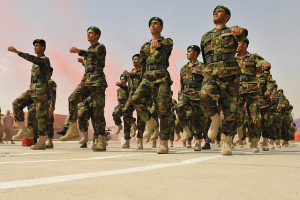
    Afghan National Army soldiers march during the 3rd term graduation oath ceremony at Ghazi Military Training Center in Kabul, Afghanistan, Sept. 6, 2010. During the ceremony 379 non-commissioned officers graduated and joined the Afghan Army. Source: ISAF Media (Flickr)

    Afghan National Army soldiers march during the 3rd term graduation oath ceremony at Ghazi Military Training Center in Kabul, Afghanistan, Sept. 6, 2010. During the ceremony 379 non-commissioned officers graduated and joined the Afghan Army. Source: ISAF Media (Flickr)

    When in late 2005 a team of international financial experts in Kabul put the numbers together on how much the Afghanistan security sector was costing they were astounded by the results. So were the Afghan government and its partners. Running at some $1.3 billion per year, or 23 % of GDP, just over three-quarters of it financed by donors, Afghan security spending (not including counter-narcotics) exceeded domestic revenues by over 500%.

    Simple number crunching put into stark focus the unsustainability of the security sector and the need to look at options for changing the posture of the military and police (the two largest spenders) and bringing costs under control. This analysis did not even touch the international costs of ongoing conflict (such as the NATO-led International Security Assistance Force – ISAF) in the country.

    Such a financial perspective is increasingly being added to emerging practice on internationally driven security sector reform (SSR) with interesting results. One particular aspect that has largely been missing from the international SSR agenda since its beginning in the 1990s has been the nexus between financial resources and security. While general aspirations for affordability are often stressed with regard to SSR, there has been little guidance supporting governments to better understand whether security sector financing is sustainable, let alone efficiently and effectively allocated.

    National budgets are, after all, the most important policy vehicle for articulating and ultimately meeting a country’s priorities within scarce public resources; it is through the budget process that competing priorities are reconciled and implemented. One of the core priorities for many countries is security and justice provision and yet to date there has not been much work on the composition of security sector budgets as well as the processes of how they are planned and managed.

    This is beginning to change for a number of possible reasons, not least that the ‘suits’ responsible for the national purse rather than those ‘in uniform’ are advocating change. A quick overview of a number of recent exercises in conflict-affected African states suggests a number of different contexts in which such scrutiny is being requested.

    Transitions and UN peacekeeping drawdowns: Liberia

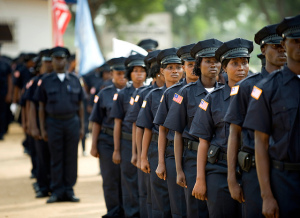
    The thirty-third class of police officers of the Liberian National Police (LNP) participate in a graduation ceremony. Source: Africa Renewal (Flickr)

    Police officers of the Liberian National Police (LNP) participate in a graduation ceremony. Source: Africa Renewal (Flickr)

    In a recent example of United Nations, World Bank and government collaboration, a public expenditure review was undertaken for Liberia in mid-2013 in order to identify the funding requirements necessary for a national security strategy to be put in place in anticipation of the gradual reduction and exit of the UN peacekeeping operation (UNMIL).

    What this immediately revealed was that there was a financing gap between domestic revenues, anticipated foreign assistance and the targets set by the national strategy. In the short term, recommendations focused upon savings through strengthening public financial management systems as well as mobilising additional resources.

    More significantly, the joint review raised questions about the effectiveness of a strategy that relied on the establishment of regional ‘law and order’ hubs which could deploy law enforcement personnel as well as extend the reach of judicial services. Was this the best way to use scarce resources? Were such regional hubs the solution to providing accessible security and justice services to a general public that held in distrust the state and particularly those in uniform? In turn, were there more effective ways to use those scarce resources to address some of the underlying structural causes of grievance and disorder, such as contestation over land and land concessions?

    The debates around those policy tensions and trade-offs continue;  but this was an interesting example of how the money question – whether a proposed security and justice model could be paid for – raised more fundamental questions about the effectiveness and ultimately the purpose of the security and justice system.

    Interestingly, an important side-question was not asked: the affordability of the national army. The review was simply focused on public order and internal security and not on the small (and largely US funded) Armed Forces of Liberia. Indeed, this omission was characteristic of the bifurcated Liberian SSR process, with US (military) and UN (police and justice) pursuing separate programmes since 2004.

    Domestic resource constraints vs existential threats: the Sahel

    Long a focus of international support to national militaries and counter-terrorist capacity, the western Sahel region suffered a major crisis in 2012 with a coup in Mali precipitating the take-over of the country’s north by regional jihadist and local Tuareg and Arab nationalist armed groups.

    As part of the return to ‘normalcy’ and seeking to address historical concerns relating to public mismanagement, the Malian transitional government requested a review of the defence sector in early 2013. This was in part to respond to grievances that had resulted in the coup, particularly relating to reports of an inflated senior officer corps and poor equipping of frontline troops. In turn, donors that had long treated Mali as an ‘aid-darling’ were becoming super sensitive to reports of public sector corruption.

    Nigerien soldiers from the 322nd Parachute Regiment march to a training site during Operation Flintlock 2007. Source: US Navy (Wikipedia)

    Nigerien soldiers from the 322nd Parachute Regiment march to a training site during Operation Flintlock 2007. Source: US Navy (Wikipedia)

    Across the border, Niger, which to date has managed its ‘northern problem’ and the Libyan ‘spillover’ by ways of political accommodation, was also seeking an expanded security sector and additional resources. In so doing, the Nigerien government realised that the quid pro quo was to conduct a review of its security sector.

    Both country reviews were undertaken by the World Bank working on its own; and for its own mandate reasons the Bank reviews were focused exclusively on the public financial management of the sector. This meant that more fundamental policy issues about the effectiveness of the respective militaries and the complementary roles played by key bilateral and multilateral (in Mali’s case) security actors were left aside. However, the reviews did serve to push for more accountable and transparent use of such resources as well as identifying resourcing gaps.

    Management of external financial flows and shaping an emerging security sector: Somalia

    Somalia in many senses confronts all of the challenges outlined above; the newly selected Federal Government (FGS) faces the existential threat posed by the al-Shabab insurgency while also hosting the African Union’s largest peacekeeping force (AMISOM) as well as a number of other onshore and offshore security interventions, such as by US and French forces. At the same time, the FGS is undergoing its own constitutional review process on how it relates to other entities within Somalia on key questions regarding the nature of the state and in particular the very scope, shape and purpose of a formal security and justice system.

    The FGS is keen to take on greater responsibility, expand its remit beyond Mogadishu, and put a variety of external financial flows into the security forces on budget. It is also conscious of the significant resources going to external security providers, such as AMISOM, and would like increasingly to take over the functions of those actors as well as some of their funding.

    For this reason it has turned to the World Bank and the UN Assistance Mission (UNSOM) for support in trying to strengthen public financial management systems, particularly but not exclusively for the Somali National Army and Somali Police Force, as well as to examine some scenarios for the sector and issues of affordability. This review is still ongoing but it is clear that Somalia faces similar questions posed in Kabul about what is a sustainable security sector, and are there alternative ‘cost-effective’ means to reach political settlement with other regional entities in Somalia while tackling an ongoing insurgency.

    Emerging Issues

    It is too early to say whether these recent government requests are turning into a systemic trend; there remain many countries for which such an opening-up of books would be out of the question. However, what this body of work does point to is a number of challenging issues particularly relating to the peace- and state-building agenda.

    Accountability of external support: While many African militaries and security forces are still receiving significant external support, little of this is being formalised within the national budget and in turn discussed with parliaments and civil society. While transparent, accountable and open government is part of the official development discourse, foreign bilateral security arrangements are still kept more often closed and off the books. Foreign governments are not speaking with one voice: foreign assistance is coupled with calls for good-governance that can often be trumped or undermined by bilateral security arrangements.

    Transparency as a process: Budget amounts to policy; it reflects what states actually do and are accountable for. Such reviews are critical entry points for the civilian side of governments to be more empowered in looking at various financing gaps and pose questions about how those gaps can be filled. Security budgets in developed countries often remain opaque and weakly scrutinised, no less than those in the developing world. There is no doubt that security expenditures can remain secret as they touch upon sensitive issues of national security; yet the sector can also harbour serious corruption, off-budget expenditure and unclear procurement practice. Transparency is therefore a bit-by-bit process. Better use of domestic resources could be one prize of greater scrutiny; another could ultimately be greater sharing of data at the regional level in order to build confidence amongst neighbours.

    Revenues, security functions and state-building: Too often, classic SSR approaches can be a Weberian analysis of what a security apparatus should look like in any given country and how external actors can support the establishment of such a system. This is often blind to the actual functions of domestic security actors and their access to resources and exaction of revenues. A political economic inquiry can obtain a better understanding of how security forces raise revenues, from large-scale exploitation of natural resources to illicit taxation, and in turn what the functions of such forces are in practice. A greater understanding of these dynamics enables a clearer policy dialogue around, first, what is affordable in relation to revenues being exacted and, second, what incentives are required to transform those functions into provision of a public good – security.

    Two examples come to mind. At the more micro-level, in 2008, a study on checkpoints in Côte d’Ivoire revealed that the military, gendarmerie and police were raising up to $100 million a year in illicit taxes on local traffic. This study enabled a more open discussion on what steps were needed to clear the checkpoints and remove the burden on commerce and public alike.

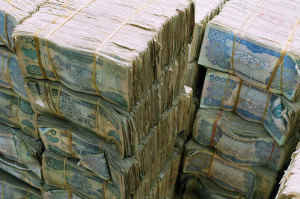
    Somaliland Shillings, Hargeisa, 2008. Source: Tristam Sparks (Flickr)

    Somaliland Shillings, Hargeisa, 2008. Source: Tristam Sparks (Flickr)

    The more meta-level example is that of Somaliland in which security sector reform without external support has ‘worked,’ in the sense of providing stability and the conditions for successful democratic transitions of power. Local business and political elites forged a co-dependent coalition in the mid-1990s that allowed sufficient funds (initially some $6m) to pay for the stand-down and demoblisation of the clan militias. To this day some 30-50% of the regular budget is estimated to be payments to these forces; the high price for peace. Analysts have remarked on the way in which domestic revenue (business donations) were utilised to pay off militias (to stand-down and secure stability) that, in turn, no-longer exacted revenues from infrastructure points such as air or seaports. This allowed the government to raise its own revenues (albeit with the largest share of expenditures to pay for the army or demobilised militia) and the business sector to flourish.

    Standards of affordability and effectiveness: ultimately this work asks questions around what is affordable and what is an effective security and justice sector. The former US Secretary for Defense (1961-68, when US military spending averaged over 8% of GDP) and President of the World Bank (1968-81), Robert McNamara, famously posited the idea of an ideal ceiling of 2% of GDP for security. Although that is a standard no longer referred to, the international financial institutions continue to discuss with client governments the size of the public sector in relation to the fiscal framework (revenues vs spending) and, in turn, the sectoral trade-offs such as those between national defence and provision of basic social services such as health or education.

    A more important question is: what is effective security? This relates to a more rigorous management of public finances, greater accountability, transparency and measures against corruption. Yet, it also points to value-for-money performance standards for security and justice providers such as the police. Ultimately, it can potentially pave the way to a more participatory discussion among end-users (citizens) and providers (the state) about how to be cost-effective, which may include sustainable approaches to violence and conflict prevention, including addressing underlying causes of grievance and disorder.

    Afghanistan is now going through another turbulent electoral cycle while donors seek some $3.5 billion to meet the costs of the Afghan army and police – now estimated at over $4 billion per year, or 20% of GDP – as the US and ISAF forces exit by the end of 2014. External security imperatives have superseded questions around affordability and effectiveness: and what is working and what is not. However, a number of African governments have at least started asking the right questions to obtain information to begin to address the challenge of creating affordable and effective security systems for citizens.

    Bernard Harborne is lead of the Violence Prevention Team in the World Bank, having joined in 2004. He has worked for over 20 years on conflict-affected countries for the UN, World Bank, NGOs and the British Government. He has a background in law, including a Masters in International Law from the LSE, and is an adjunct professor at George Washington University. Opinions expressed in this article represent his personal views and not those of the World Bank.

  • Sustainable Security

    The United Nations Integrated Mission in Timor Leste (UNMIT) represents an interesting case when discussing the impact of local peacekeeping on the overall success, or failure, of peacekeeping operations. Although not without its share of problems, this mission is a good example of the promise of local peacekeeping.

    Timorese policemen used to refer to peacekeepers as ‘really useful cabbies’ whose 4x4s could get you anywhere, which provides a stark contrast with the official United Nations (UN) version that peacekeepers had been building the capacity of the local police. The United Nations Integrated Mission in Timor Leste (UNMIT) is particularly interesting when discussing the impact of local peacekeeping on the overall success, or failure, of peacekeeping operations.  This large mission in a relatively small and, following the departure of Indonesian troops, relatively peaceful country followed an integrative approach to peacekeeping. The UN also strongly supported community policing in Timor Leste, which is a good example of the promise of local or ‘bottom-up’ peacekeeping. Generally seen as successful, the peacekeeping operation ended in December 2012. Although not without its share of problems, Timor Leste has remained relatively stable and secure.

    Local Peacekeeping

    Local peacekeeping refers to the activities of peacekeepers throughout the whole area of operations and thus corrects for a biased focus on a country’s capital and the official, internationally recognized government. It emphasizes interactions between local communities and peacekeepers and considers the improvement of local conditions as crucial to stabilizing post-conflict situations. Communities often experience specific conflict dynamics because of uncertainty about entitlements to land and property, exacerbated by the movements of internally displaced people. A common legacy of the civil conflict is the undermining of traditional authority, leading to generational conflicts, as the experience of Liberia illustrates.

    These parochial, often even partially private conflicts and grievances not only lead to increased insecurity locally, they can also have a wider impact because they are easily exploited to obstruct national peace processes. Recently, Séverine Autesserre highlighted the failures of the international community, among them UN peacekeepers, to adequately deal with such local conflict dynamics in the DRC, and it has become common to talk about the need for bottom-up peacebuilding.

    Bottom-up Peace

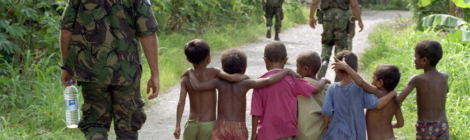
    Members of the United Nations Transitional Administration in East Timor (UNTAET) Portuguese contingent are accompanied by a group of local children as they conduct a security patrol in the Becora district of Dili. 1/Mar/2000. Dili, East Timor. UN Photo/Eskinder Debebe. www.unmultimedia.org/photo/

    Image by UN Photo via Flickr.

    Even though they are obviously related, local peacekeeping is not the same as bottom-up peacebuilding, and the differences matter when evaluating possible contributions of local peacekeeping to the overall success of missions. First of all, even when peacekeepers are deployed throughout a larger area, they may still predominantly engage with national tensions, for example, when they monitor possible military activities of the government and rebels. In such cases, local communities may simply be caught in the crossfire between the government and rebel groups, and the interaction between peacekeepers and locals will remain largely of an economic and social nature.

    Secondly, a very large peacebuilding community tends to operate in post-conflict countries, involving representatives of global organizations such as UNICEF and UNHCR, but also from international NGOs such as the Red Cross, as well as local activists and local NGOs. This community, rather than the peacekeepers, initiates and supports local peace initiatives and has more readily accepted the importance of bottom-up peacebuilding. Even when they are not directly involved, the presence of peacekeepers can still matter. for example, by guaranteeing the general security situation. Unfortunately, the record of peacekeepers to effectively protect humanitarian workers remains mixed as illustrated by recent events in South Sudan  and the DRC. To find out whether local peacekeeping works, we need to know where peacekeepers go, what they do, with whom they interact, and how locals respond to them.

    Regardless of the recent attention paid to local peacekeeping, it is important to be aware that peacekeeping remains predominantly ‘top-down’. In our research, we have found that UN peacekeeping missions in Sub-Sahara Africa report mainly on interactions with government representatives. Their collaboration is presented as essential to realizing a key goal of the UN, namely to rebuild central administration. There are not only fewer reports of engagement with rebel groups, but these reports also mention conflict more often. The picture is not uniform: relatively weak rebel groups are more cooperative towards larger UN missions, possibly because the latter are able to offer protection. Even more rare are reports of dealing with independent local authorities; in fact, there are too few to be able to say anything about the quality of the interaction.

    A Strategic Approach to Local Peacekeeping

    Currently, there is also little evidence to suggest that the UN recognizes the relevance of local peacekeeping as a strategy. Instead, peacekeeping operations deal with local violence in response to specific events and mainly at the tactical level to contain such events. Peacekeepers definitely respond to flare ups of violence and they are concerned about protecting civilians. Stories about peacekeepers hanging around hotel pools or spending their time on the beach are largely urban myths. Even though they are commonly positioned near cities, they are deployed to, and more active in, conflict zones. The lack of strategy, however, leads to considerable and systematic delays in their response to violence. Once peacekeepers arrive on the scene, they appear able to largely contain the violence but they may well have missed valuable opportunities to limit damage and save lives.

    Operations also lack high-quality information about local conditions hindering the development of an effective local peacekeeping strategy. At the local level, allegiances and antagonisms are often complex and subtle, and may shift quickly. It is not only necessary to gather intelligence about the local context prior, during and even post deployment, but also to coordinate this intelligence with ongoing operations. Stefano Costalli similarly argues that the United Nations Protection Force (UNPROFOR) failed to develop a strategy for Bosnia based on features of the terrain, warring factions and ethnic composition of the population that would have allowed them to intervene in a timely manner. He also recognizes that creating strategies is particularly difficult for multinational missions.

    Pittfalls and Prospects

    Local peacekeeping thus requires a number of difficult choices. First of all, not all peacekeepers are equally suited for local peacekeeping. Regional peacekeeping forces will often have a better understanding of local conditions, but local actors may also perceive them, rightly or wrongly, as biased. Secondly, local peacekeeping benefits from long-term commitments, allowing contingents to understand local conditions better and to be able to complete the projects they have initiated.  Peacekeeping forces, however, regularly rotate, since they often have to operate in difficult circumstances. The support for community policing in Timor Leste provides several useful lessons. Peacekeepers from New Zealand took prime responsibility for this task throughout the duration of the mission and even following its completion. They were credible because the local population, including local policemen, appreciated their commitment to and understanding of community policing. Interestingly, locals recognized the different approaches to policing taken by police officers from, for example, Portugal, Japan and New Zealand.

    Even though it is too early to say that local peacekeeping has become a strategic approach to peacekeeping, the importance of building good relations between peacekeepers and local communities is by now broadly accepted. The United Kingdom is experimenting with training for its peacekeeping mission within local communities in Malakal and Bentiu in South Sudan. This approach, if successful, can be expected to transform into a new policy looking to improve the interaction and integration of the mission within the communities. There are also initiatives within ongoing peacekeeping missions; for example, while deployed as UN police officer, Kristin Konglevoll Fjell set up a women police support network in Liberia, which created a channel for communication between local women police officers and women UN officers.

    It is important to realize that whether with or without a strategic approach to local peacekeeping, peacekeepers always have had a local impact. First of all, already a modest deployment of peacekeepers shortens the duration of conflict episodes in a particular locality. There is also evidence that it makes attacks against civilians by armed factions less likely. The ‘Blue Helmets’ provide a basic level of security in situations where insecurity is the norm rather than the exception. Peace, however, is more than the absence of conflict. Moreover, the endemic insecurity in post-conflict situations creates a dependency on peacekeepers—even while cooperation with, and appreciation of, peacekeepers declines the longer peacekeepers are present in a particular country.  The need for a peacebuilding, rather than peacekeeping, strategy seems evident, and the value of local peacekeeping may well be that it recognizes the importance of harnessing the local capacity to build peace.

    Han Dorussen (PhD, University of Texas at Austin) is Professor of Government at the University of Essex (UK). He is associate editor of the Journal of Peace Research. Current research interests include peacekeeping and the governance of post-conflict societies, the relationship between trade and conflict, and policy convergence in the European Union. Recently his research has focused on the impact of peacekeeping on local communities and on the perception of insecurity among the local population. The latter research based on fieldwork in Timor Leste. He has published in (a.o) International Organization, World Politics, Journal of Peace Research, Journal of Conflict Resolution, International Peacekeeping, and the British Journal of Political Science. 

  • Sustainable Security

    Colombia and Mexico: The Wrong Lessons from the War on Drugs

    As activists around the world participate in a Global Day of Action against criminalisation of drug use, evidence from the multi-billion dollar War on Drugs in Colombia suggests that militarized suppression of production and supply has displaced millions of people as well as the problem, not least to Mexico. The wrong lessons are being exported to Central America and beyond, but a groundswell of expert and popular opinion internationally is calling for alternative approaches to regulating the use and trade in drugs.

    Read Article →

    The United States, Niger & Jamaica: Food (In)Security & Violence in a Globalised World

    due to a complex range of interconnected issues from climate change to misguided economic policies, political failure and social marginalisation, over 2 billion people across the world live in constant food insecurity. Anna Alissa hitzemann takes a sustainable security approach to look at the importance of “physical and economic access to basic food” by exploring the links between food insecurity and violence.

    Read Article →

    Causes of Conflict: A Strategic Perspective on US–Sino Relations in the Caribbean

    Author and former High Commissioner of Trinidad and Tobago to the Court of St. James, Serena Joseph-Harris writes that China’s increasing regional profile in the Caribbean highlights the challenges now posed to American exceptionalism as Beijing defines its own course in the region. This article focuses on the potential within the Caribbean Basin for the burgeoning proceeds presently derived from increases in the legitimate investment, trade, and commerce emanating from Beijing and Washington to become entwined with illicitly derived funds generated from transnational crime activities, specifically the trafficking of drugs.

    Read Article →

    Mano Dura: Gang Suppression in El Salvador

    Widespread social exclusion makes El Salvador fertile ground for gang proliferation and, over time, gang members have resorted to greater levels of violence and drug activity. Yet, government approaches have proved spectacularly ineffective: the homicide rate escalated, and gangs have adapted to the climate of repression by toughening their entry requirements, adopting a more conventional look, and using heavier weaponry. Sonja Wolf argues for approaches which focus on prevention and rehabilitation and looks at why such approaches have been continually sidelined.

    Read Article →

  • Israeli know-how helping to combat hunger in Africa

    Israel has been a leader in developing innovative drip-irrigation systems that reduce the amount of water needed for farming.

    Most of Israel is arid, with the Negev Desert spanning 60 percent of the country. Desertification, water scarcity and soil erosion makes it increasingly difficult to farm, endangering the livelihoods of those who depend on agriculture for both food and income.

    But Israel is not alone in facing these challenges – dry lands cover 47% of the Earth’s surface. With 60% of the world’s food insecure people living in dry areas, desertification and poverty go hand in hand, particularly in sub-Saharan Africa.

    But the simplest techniques can go a long way in strengthening food security, increasing incomes and improving the livelihoods of millions of people.

    Israel has been a leader in developing innovative drip-irrigation systems that reduce the amount of water needed for farming. Today, these innovations are empowering farmers in the dry Sahel region across sub-Saharan Africa to combat problems of water scarcity.

    One such example is the Family Drip Irrigation System (FDIS), developed by the International Program for Arid Land Crops at Ben-Gurion University of the Negev, in partnership with Israeli irrigation company Netafim (owned by three kibbutzim – Hatzerim, Magal and Yiftah – and two private equity funds – Markstone Capital and Tenne).

    FDIS is a simple irrigation technology, which is combined with gravity-powered low water pressure. The Foreign Ministry is partnering with local government agencies and NGOs to introduce FDIS in countries across Africa to deliver the advantages of drip-irrigation to small farmers at low costs.

    Dov Pasternak, a professor from Ben-Gurion University, and director of the International Center for Research in the Semi-Arid Tropics, developed the Africa Market Garden concept, which provides farmers with the tools to improve their livelihoods.

    In Niger, women in Tanka village are using low-pressure drip-irrigation systems to grow okra, tomatoes, eggplant and other vegetables. The women work together in a cooperative, meeting monthly to decide how the garden should be run. They manage their own plots, but share skills, tools and water with one another. By selling their vegetables at nearby markets, these women have tripled their incomes, enabling their families to eat better and their children to attend school.

    Based on the Africa Market Garden concept, MASHAV, the Foreign Ministry’s Center for International Cooperation, has developed Techno-Agriculture Innovation for Poverty Alleviation, or TIPA, a simple, innovative technique, which it is introducing in semi-arid regions in countries, such as South Africa and Senegal. The TIPA concept consists of a cooperative of approximately 100 farmers, based in a five hectare area, where farmers manage their own plots installed with the FDIS.

    In South Africa, the Israeli Embassy has worked with Ikamba Labantu, a local NGO, to introduce TIPA in the Eastern Cape, one of the country’s poorest provinces. This system enables farmers, who were otherwise at the mercy of the region’s erratic rainfall, to plant crops four times a year, leading to a 400% increase in output. And in Senegal, the embassy is collaborating with World Vision and Green Senegal, two NGOs that have worked with Senegalese Water Services to introduce TIPA in communities in the area of Bembay and Thies.

    Israeli institutions are leading the way by showing that sharing expertise and replicating innovative strategies can be a powerful tool in helping to sustain livelihoods of small farmers in dry areas.

    In addition to international partnerships, cooperation at the farmer level also gives power to small farmers by allowing access to a larger group and a stronger voice. There are numerous innovative projects being developing by research institutions, universities, NGOs and farmers groups worldwide that are helping to guarantee stable incomes, and alleviate hunger and poverty.

    As the overuse of scarce resources continues and pressures brought about by climate change intensify, we must ensure that successful innovations are replicated and scaled-up. These simple, yet innovative techniques give small farmers the skills and tools to improve their livelihoods, and can have a significant impact on alleviating hunger and poverty.

    Danielle Nierenberg is co-director of the Worldwatch Institute’s Nourishing the Planet project. Janeen Madan is a food and agriculture research intern with Nourishing the Planet. (www.NourishingthePlanet.org)


    Article Source: WorldWatch Institute

    Image Source: GregTheBusker

  • Sustainable Security

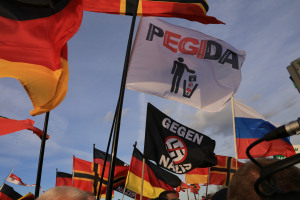
    Since October 2014, thousands of people have gathered weekly in Dresden to protest against immigration and Islam which are both perceived by them as deadly threats to German society. What is the background of this unique mobilisation known as PEGIDA and what are the drivers behind its growth?

    Since 20 October 2014, the East-German city of Dresden, capital of the state Saxony, has hosted rallies organized by a group named PEGIDA (German: Patriotische Europäer gegen die Islamisierung des Abendlandes, English: Patriotic Europeans Against the Islamisation of the West). While PEGIDA attracted some hundred supporters to its earliest rallies, numbers quickly peaked in late January 2015 with 25,000 attending. Up until the end of 2016, at least some 2,000 followers showed up week-on-week.

    With the number of refugees seeking refuge in Germany rising since 2013, the extent of anti-immigrant protest, often organised by extreme right groups such as the National Democratic Party of Germany, has increased. For example, in the Saxon town Schneeberg, mobilization brought more than 1,500 people to the streets three weeks in a row in late 2013 at the accommodation used for hosting refugees. Speakers at such rallies depicted asylum seekers as a threatening Other in xeno-racial terms by arguing that Muslims cannot adopt to ‘Western civilized standards as they are not hygienic’, and that there is a ‘jihad of births’. Following a call for action by a group named Hooligans Against Salafists, 4,500 gathered in Cologne on 26 October 2014 with a significant minority clashing heavily with the local police. While these activities remained occasional events, Dresden became the location of the most successful extra-parliamentary right-wing mobilization in post-war Germany.

    Pegida’s formation and growth

    pegida

    Image credit: Metropolico.org/Flickr.

    In Dresden, a group of close friends, some of them soccer fans, others already known for their racist and derogatory remarks on refugees, Muslims, and people from Turkey and Kurdistan on the Internet, started weekly rallies mid-October 2014. The initiators of PEGIDA, Lutz Bachmann being primus inter pares and other founding members such as Siegfried Däbritz and Thomas Tallacker, had understood that there was potential for street protests against migration, intercultural coexistence and religious diversity. Speakers again and again invoked the destruction of Germany as a result of the refugees coming to Germany, and accused the media for false reporting on the situation. They accused the government in general, but chancellor Angela Merkel especially, of being traitors to the German people. Quite often, references to ›1989‹ were made. By referring to the mass demonstrations that contributed to the overthrow of the socialist regime in the former German Democratic Republic (GDR) in 1989, PEGIDA tries to strengthen the belief that it would once again be possible to overthrow a political regime by mass action.

    Like many social movements, conflicts related to leadership, competing concepts of strategy and framing, and narcissistic behaviour started to play a role within PEGIDA effecting its unity,  capacity for mobilization and outreach. The original plan of the Dresden group to directly control the many offshoot splinter groups that appeared in many German cities did not work. By the end of 2016 there have been racist and anti-Islamic rallies in hundreds of cities and smaller towns organized by groups such as Mönchengladbach – Get up, Commitment for Germany, Eichsfeld fights back, People’s Movement North Thuringia, or Together Strong Germany. While it is true that Dresden was the only place where this right-wing mobilization reached numbers above 20,000 with an astonishing regularity, the many other rallies also contributed to spreading racist and Islamophobic hate speech, and inflaming acts of aggression not only against those belonging to minority groups but also against social workers and volunteers who supported refugees.

    The importance of Saxony

    Scientific studies and surveys show that there is a relevant minority of the German population holding hostile attitudes against asylum seekers, homeless people, Roma, and long-term unemployed. The exceptional mobilization capability of PEGIDA Dresden is the result of the specific political culture of the city and the state of Saxony. It consists of several narratives such as the belief about a unique and phenomenal cultural heritage, the beauty of the landscape, and urban cleanliness; and other stories that emphasize a distinct Saxon identity comprising of a special self-confidence, astuteness, and avant-garde action. Finally, it is argued, a strong feeling of solidarity exists among Saxons, this togetherness was demonstrated by the floods in 2002 and 2013 both of which had caused major damage in the country. The Christian Democratic Union (CDU) that has ruled the country continuously since 1990 labels itself as the Saxon Union contributing to a kind of regional nationalism and solidarity.

    It is also noteworthy that the CDU in Saxony belongs to the decidedly conservative part of the party regularly speaking up for a German patriotic self-awareness. Leading representatives of the CDU in Saxony have publicly blamed the same political forces, developments and ideas as being responsible for the decline of morals in the same way that PEGIDA speakers have. Not surprisingly, then, appeasing the far-right has a long tradition in Saxony going back into the early 1990s when Kurt Biedenkopf the then-Prime Minister in Saxony claimed, in light of pogrom-like violence in the Saxon town Hoyerswerda, that the citizens of Saxony are immune to right-wing extremism. Despite ten years of parliamentary representation of the neo-Nazi National Democratic Party of Germany (NPD) in the state parliament of Saxony, leading politicians from the Saxon CDU like Frank Kupfer, chairman of the Christian Democratic faction in the Saxon parliament, argued that people from outside Saxony cannot understand the situation, overestimate the problem and intend to purposely discredit the political course of the regional branch of the Christian Democrats.

    Another dimension which helps explain the PEGIDA phenomena is the fact that the population in Saxony played a major role in the final phase of the GDR’s fall. Leipzig and, to a lesser extent, Dresden hosted Monday demonstrations in late 1989 bringing huge numbers to the streets and contributed to the downfall of the socialist regime. Public statements of the time, especially the ones given by then chancellor Helmut Kohl on the evening of 19 December 1989 contributed to a nationalist interpretation of events. In the 1990s and 2000s, Dresden also became the site of several heavily attended neo-Nazi rallies, where the Allied bombing of the city in mid February 1945 which killed some 24,000 people was framed as another kind of holocaust. This re-framing of the Allied bombing, which was actually created by the Nazi propaganda machine in the aftermath of the bombing, was used by the former GDR government in the Cold War.

    Discourses of victimization by protest organizations exist in several variations in the city. Some lament the political and economic consequences of German reunification which caused fundamental structural and demographic changes especially in the more rural East Saxon regions. Open borders with Poland and the Czech Republic has changed the perception of crime. Rising levels of theft and burglary is attributed by many to the opening of German borders, which, some argue, allows foreign criminals to easily return after committing crimes on German territory. In both cases, the idea of ‘Germans as victims’ is given discoursive empirical evidence and fosters exclusionist interpretations.

    PEGIDA’s future

    In early January 2017, the Leipzig branch of PEGIDA declared that it had decided to not hold any more demonstrations. While relieving police forces was given as the reason, media comments and political observers widely agreed that the decreasing number of participants has been the real reason behind this decision. With only a few places left in which weekly rallies are organised, albeit with not more than a hundred people taking part, PEGIDA in Dresden is still the most important site of action. Yet, the weekly meetings have become a mere ritual with the same content of the speeches, the same faces and no idea of new impetus. With Lutz Bachmann meanwhile living in Tenerife only to fly in for the Monday rallies and growing criticism of the transparency of the use of donations, it might well be the case that PEGIDA Dresden will die a slow death toll in 2017.

    Dr. Fabian Virchow is Professor of Social Theory and Theories of Political Action at the University of Applied Sciences Düsseldorf where he also directs the Research Unit on Right Wing Extremism. He has published numerous books and articles on worldview, strategy and political action of the far right.

  • Competition over resources

    To browse a list of all of the articles EXCLUSIVELY written for sustainablesecurity.org – follow this link

    Read more »

  • Marginalisation of the majority world

    Writing for the New Security Beat, Schuyler Null discusses a recent event on creating a new national security narrative for the US held at the Woodrow Wilson Center. The event was based on a white paper by two active military officers writing under the pseudonym “Mr. Y” (echoing George Kennan’s famous “X” article). In “A National Strategic Narrative,” Captain Wayne Porter (USN) and Colonel Mark Mykleby (USMC) argue that the United States needs to move away from an outmoded 20th century model of containment, deterrence, and control towards a “strategy of sustainability.”

    Image source: LizaP.

    Read more »

  • Sustainable Security

  • Strategic Thinking in a Resource-constrained World

    Two new reports surveying the strategic trends that are likely to shape the next few decades of global politics point very clearly to the prospect of a severely resource-constrained world. Released two days apart, both the new Chatham House report on Resource Futures and the US National Intelligence Council report on Global Trends 2030: Alternative Worlds raise a number of important questions relating to conflict and security. 

    According to the Chatham House report,

    “The spectre of resource insecurity has come back with a vengeance. The world is undergoing a period of intensified resource stress, driven in part by the scale and speed of demand growth from emerging economies and a decade of tight commodity markets. Poorly designed and short-sighted policies are also making things worse, not better. Whether or not resources are actually running out, the outlook is one of supply disruptions, volatile prices, accelerated environmental degradation and rising political tensions over resource access.”

    The report outlines what the authors refer to as volatility being “the new normal.” For this reason “High and fluctuating prices are spurring new waves of resource nationalism and making unilateral and bilateral responses more attractive.” This should be cause for concern, especially in relation to the ways in which the response of governments and other actors to scarcity (or at least perceptions of scarcity) can interact with existing tensions and conflicts between and within communities. As the report highlights, “In addition to efforts to reduce demand at home, governments and other actors have moved to ensure access to affordable resources, reshaping the landscape of international politics. The return to largely protectionist and beggar-thy-neighbour manoeuvres – often in reaction to short-term supply bottlenecks or perceptions of scarcities rather than actual ones – can act as fuel to the fire.”

    As well as mapping the consumption and trade trends across a series of important resources, the report also discusses the impact of external variables such as population growth and climate change. These are “multiple stress factors” which “render countries vulnerable to different types of shocks such as environmental disasters, political unrest, violent conflict or economic crises – increasing both local and systemic risks. Such factors can create new tensions and flashpoints as well as exacerbating existing conflicts and divisions along ethnic and political lines.”

    The report includes a section on resource conflict flashpoints (p. 114) which outlines fifteen different potential flashpoints relating to territorial/economic zone disputes in resource-rich areas, shared water resources and transboundary river systems and resource-related rebellion and insurgency. The report is also linked to an interactive website that maps some of these trends and potential flashpoints.

    The day after this report was released, the US National Intelligence Council released their own on the key trends over the next twenty years that the United States will need to adapt to or try and shape in order to “think and plan for the long term so that negative futures do not occur and positive ones have a better chance of unfolding.”

    Among other so-called mega trends such as urbanisation and changing demographics, the report echoes the Chatham House research by pointing to an increasingly complex situation in terms of global resources. The report argues that,

    “We are not necessarily headed into a world of scarcities, but policymakers and their private sector partners will need to be proactive to avoid such a future. Many countries probably won’t have the wherewithal to avoid food and water shortages without massive help from outside. Tackling problems pertaining to one commodity won’t be possible without affecting supply and demand for the others.”

    The key trend or ‘tectonic shift’ as the report calls it is that “demand for food is expected to rise at least 35 percent by 2030 while demand for water is expected to rise by 40 percent. Nearly half of the world’s population will live in areas experiencing severe water stress. Fragile states in Africa and the Middle East are most at risk of experiencing food and water shortages, but China and India are also vulnerable.”

    While this may lead some towards overly pessimistic conclusions about a world defined by instability, human insecurity and geopolitical tensions, it is refreshing to see the NIC emphasising the importance of how the US can respond now. In his forward, the Council’s Chairman Christopher Kojm states that “We are at a critical juncture in human history, which could lead to widely contrasting futures. It is our contention that the future is not set in stone, but is malleable, the result of an interplay among megatrends, game-changers and, above all, human agency.” It is worth noting the deliberate use of the phrase ‘alternative worlds’ in the repo

    While some degree of adaptation to these structural trends mapped out by both Chatham House and the National Intelligence Council will undoubtedly be necessary, the importance of both of these reports is that they remind us of the need for clear and far-sighted thinking on policy responses now. The worst case scenarios that these reports discuss are not inevitable and risks can be mitigated. National security policymakers will do well to study the scenarios outlined in these two impressive reports and to try and understand the drivers and ‘tipping points’ that lead to certain pathways. Both reports offer prescriptions for current decision makers (the Chatham House recommendations on ‘targeted resource dialogues’ and ‘coalitions of the committed’ are particularly worthwhile). While volatility and uncertainty might be the ‘new normal’ in global resource politics, one thing is entirely certain – inaction and ‘business-as-usual’ when facing “a critical juncture in human history” is a recipe for disaster.

    Image source: Stayraw 

  • Sustainable Security


    South Sudan smallLast week saw the start of yet another armed anti-government revolt in South Sudan’s Jonglei state.  Reportedly led by Murle militia leader Major General David Yau Yau, there are now fears that the revolt will escalate as a result of longstanding local grievances with the army of South Sudan, the Sudan People’s Liberation Army (SPLA).

    The unrest comes as a result of a widely criticised government-led civilian disarmament campaign in Jonglei state – so-called ‘Operation Restore Peace’ – which was launched after violent clashes between Lou Nuer and Murle communities in January. Carried out by the SPLA, with an additional 15,000 soldiers and 5,000 members of the South Sudan Police Service, the campaign has been condemned by the United Nations Mission in South Sudan and groups such as Human Rights Watch for alleged human rights violations including killings; allegations of torture, simulated drowning and beatings; rape and attempted rape; and abductions. On October 3rd, Amnesty International issued a press statement calling on the government to take immediate action to end these reported human rights violations, launching a new report ‘Lethal Disarmament’ which highlights abuses in Pibor County of Jonglei State.

    Not for the first time, the Government of South Sudan’s  civilian disarmament initiative has failed to improve security in South Sudan. In 2006, as described by the Human Security Baseline Assessment at Small Arms Survey, the SPLA’s forcible civilian disarmament operation in northern Jonglei State succeeded in collecting 3,000 weapons from the local community. However, as a result of the campaign’s focus on the Lou Nuer community and martial and poorly planned approach, as well as a lack of subsequent security guarantees for the community, heavy fighting ensued and more than 1,600 people were killed.

    In 2008, Interim President  of Southern Sudan, Salva Kiir issued a decree to start a six month disarmament period across the country. Conducted by the SPLA, the aim of the operation was to get all civilians to surrender their weapons in a peaceful manner, although ‘appropriate force’ could be used. However, as operational logistics were not outlined after the decree, a lack of centralised strategy resulted in various outcomes and in many places, an increased sense of insecurity. For example, in Lakes State local police had their weapons confiscated and weapons searches became violent as reportedly drunken soldiers stole from people’s homes.

    Thus far, civilian disarmament operations in South Sudan have done little to increase long term security. After decades of war, small arms and light weapons are notoriously rife in the young country, but attempts to solve this problem by confiscating these weapons does little to deal with the root causes of insecurity and communities’ need for self-protection.  Small Arms Survey estimates that prior to the interim separation of Sudan and South Sudan after the Comprehensive Peace Agreement in 2005, there were between 1.9 and 3.2 million small arms in circulation, with about two-thirds of these in civilian hands.  While these weapons come from a number of sources – including the SPLA during the Second Civil War – it is also important to understand why civilians feel they must arm themselves.

    South Sudan’s severe underdevelopment, lack of infrastructure – with only 300km of paved road  – seasonal floods, and subsequent lack of service provision and security capacity, means that there is a considerable absence of established security services across the country.  Persistent, and often deadly, cattle raiding and escalating inter-communal armed conflict between groups such as the Lou Nuer and Murle in Jonglei State leave individuals and communities to seek ways to protect themselves and their property. Subsequently, informal community security structures are common; ranging from community initiatives to groups such as the Lou Nuer’s ‘White Army’, which was originally formed to protect cattle and now constitutes a major threat to Murle communities in Jonglei. In effect, the Government’s inability to ensure security at the community level means that groups are forced to take matters into their own hands, often challenging the state’s right to a monopoly of violence because of a lack of confidence in its ability to provide adequate protection.

    In current approaches to civilian disarmament, communities are often left in a ‘security vacuum’, without the means to protect themselves from immediate security threats but without any guarantees that even short term immediate security assistance will be provided.  This state of vulnerability in turn leads to community backlashes, rapid re-arming or attempts not to turn weapons in.

    As stated in a report by Saferworld in February 2012, ‘on its own, civilian disarmament does virtually nothing to address the factors fuelling demand and supply of these weapons, which requires a much more complex and long-term strategy.’  Reducing and managing the proliferation of civilian use of small arms and light weapons will require the Government of South Sudan to create a holistic strategy that addresses the demand for weapons as well as their supply. As has been proven in efforts until now, addressing the single issue of weapons supply without dealing with the underlying need for guns undermines attempts to decrease proliferation of small arms and light weapons. A government strategy would necessarily address structural issues, including the state’s capacity to provide professional security services that can be relied upon for protection, such that communities feel safe from immediate threats.

    In no small measure, this will involve degrees of security sector reform, particularly with focused training on civilian interaction and ethnic impartiality in operations if the army is to be used for future operations. As the latest Amnesty report demands, the Government must ‘provide security forces carrying out civilian disarmament with the necessary training and resources to enable them to have a clear understanding of how to carry out disarmament in accordance with international human rights standards’. This must also include measures to address the structural issues facilitating civilian arms possession, including sales of weapons to civilians by government security forces because of lack of pay and porous regional borders that allow illicit trade. Such augmentation of basic infrastructure and security capacity in South Sudan will take years, and so attempts to reduce proliferation must also include measures to address immediate security threats, in addition to tackling longer term structural, capacity and training issues.

    Civilian disarmament campaigns in South Sudan currently attempt to tackle one of the many symptoms of the country’s militarised post-war society. Instead, these campaigns must be seen as one aspect of an overarching and sustainable disarmament and security sector reform strategy that must be undertaken long term, while ensuring that the immediate security of communities is safeguarded and that their need for weapons to protect themselves is adequately addressed and reduced.

    Zoë Pelter is a Research Officer of Oxford Research Group’s (ORG) Sustainable Security Programme. 

    Image Source: ENOUGH Project

  • Paul Rogers on Development, Climate Change, Conflict and Migration

    Paul Rogers, Professor of Peace Studies at Bradford University, and Oxford Research Group’s Global Security Consultant, talks to Action Aid about the issues that will dominate international security and world development over the coming decades.

    Source: youtube
  • Climate change

    As reported by Agence France Presse, the UN Intergovernmental Panel on Climate Change has produced a draft summary of a report that warns of a predicted increase in the number and intensity of extreme weather events.  The 800-page report goes some way to addressing a subject largely untouched by their landmark 2007 report on climate change, and adds to the growing body of evidence outlining the potential security implications of a warmer planet.

    Article Source: AFP

    Image Source: Nasa

    Read more »

  • The Power of Nightmares: The Rise of the Politics of Fear

    A three-part BBC documentary series, written and produced by Adam Curtis. The films compare the rise of the neo-conservative movement in the United States and the radical Islamist movement, making comparisons on their origins and claiming similarities between the two.

    More controversially, it argues that the threat of radical Islamism as a massive, sinister organised force of destruction, specifically in the form of al-Qaida, is a myth perpetrated by politicians in many countries – and particularly American neo-conservatives – in an attempt to unite and inspire their people following the failure of earlier, more utopian ideologies.

    Link to three parts on Google Video:

    • Part 1: Baby It’s Cold Outside
    • Part 2: The Phantom Victory
    • Part 3: The Shadows in the Cave
  • Sustainable Security

    Author’s Note: The authors of this comment piece are involved in the scientific project called “Arctic Ocean ecosystems – Applied technology, Biological interactions and Consequences in an era of abrupt climate change” (Arctic ABC). This project is led by the Department of Arctic Marine Biology at University of Tromsø, The Arctic University of Norway, and comprises the development and operation of new technology for biological studies, as well as interdisciplinary components where researchers from the disciplines of Law of the Sea and international relations are deeply involved.

    Climate change has meant that the living resources of the Arctic Ocean have become more accessible. Will this be a source of cooperation or conflict? 

    Global warming is not only increasing temperatures on land and melting glaciers around the globe, but also resulting in rising water temperatures in the oceans. This is particularly true for the Arctic Ocean – the northernmost of the world’s oceans – where temperatures are rising more rapidly than the global average. Warmer temperatures in the Arctic have triggered a northwards expansion of boreal marine organisms, including several commercially harvested fish species. Concomitantly to an increase in Arctic temperatures, the permanent ice cap is shrinking rapidly, possibly leading to ice free summers within a few decades. As the Arctic ice cover diminishes, the resources of the Arctic Ocean become more accessible for exploration and exploitation.

    A scramble for the Arctic?

    arctic-department-state

    Image credit: US Department of State/Flickr.

    The increased accessibility to now ice-free areas has led to speculations about a new “scramble” for potential unclaimed Arctic resources. Although such reports should generally be viewed as exaggerated alarmist warnings, the “high seas” of the Arctic Ocean – defined as areas beyond 200 nautical miles from Arctic costal states northernmost shores – do indeed comprise living resources beyond any state’s national jurisdiction. According to the UN Convention on the Law of the Sea, living resources of high seas belong to no one and could hence be exploited by anyone. The potential for conflicts between states regarding resource harvesting in the Arctic is therefore real. Interstate negotiations on how to regulate living resources in the “high seas” of the Arctic Ocean have been ongoing since 2010. The five Arctic Costal states (USA, Russia, Norway, Canada and Denmark – including Greenland and the Faroe Islands) are actively participating in the negotiations, together with five additional key stakeholders (Iceland, China, South Korea, Japan and the EU) and form the so called 5+5 group. While indigenous peoples have been represented in the delegations from Denmark (Greenland), Canada and the USA, their role have in practice been rather limited as the central part of the Arctic Ocean are very far away from the areas inhabited by these people and no historic rights exists.

    The current format of state negotiations is evolving as a two-tier process, where scientists are actively involved. Because the central Arctic Ocean is, so far, permanently covered by ice and hardly accessible, knowledge of the extent and volume of marine organisms populating this area has been identified as an important data gap. Particularly, there is a need to assess the presence and abundance of both Arctic species adapted to this environment and boreal species migrating northwards. A key task in the negotiation process has therefore been to establish a joint scientific project, with the long-term goal of assessing the potential for future commercial fisheries. Discussions between scientists from the 5+5 stakeholder group have complemented meetings at the diplomatic level, demonstrating a practical example where science plays a major role in a political negotiation process.

    The main fish species known to colonize the high Arctic Ocean is the polar cod Boreogadus saida. Polar cod is a small (<40 cm) mainly benthic fish with low commercial interest and high ecological importance for the ecosystem. Adult specimens seem to be restricted to the shelf region, but younger individuals are frequently encountered in connection with sea ice in the central Arctic Ocean. Despite its relative small size, its ecological importance is great as they can channel up to 75% of the energy between zooplankton and marine birds or mammals. So far, commercial fisheries of polar cod are limited and restricted to Russian waters. Being restricted to shelf regions, it is unlikely that it will extend its distribution into the central Arctic Ocean. As such, its direct economic importance is likely to be low. However, as commercially harvested boreal species, such as Atlantic cod and halibut, expand northwards, the region could possibly become of interest for fishermen from Arctic costal states as well as from other nations with expertise in high-sea fisheries, in particular from Eastern Asia. Through ecological cascading effects, the ecological and economical role of polar cod may also be shifted, with hitherto unknown consequences and influence on future fisheries in the Arctic Ocean.

    Negotiating the Arctic Ocean’s Living resources

    Negotiations to regulate the harvesting of marine living resources in the Arctic Ocean comprise of several conflicting topics. As these negotiations involve resources with potentially significant commercial interest not owned by anyone and a geopolitically important and highly symbolic region, it appears impossible to take for granted that the process will go smoothly. However, thanks to scientific cooperation and responsible state behavior, the negotiations are taking into account ecological vulnerabilities of the region and the need for maintaining peace and stability. While not concluded yet, signals from the negotiators indicate that a common declaration or agreement can be expected soon, perhaps even in 2017.

    In a broader context, these negotiations represent an interesting first example where fisheries regulations could be implemented before harvesting takes place and where the precautionary principle could be applied. This result is also interesting as the participating state actors (+EU) have different interests, and the settlement of an agreement carries a high symbolic value. Why should for example Russia, which through sea and land possessions hold almost 50% of the Arctic, view a tiny stakeholder like Iceland, or the remote high sea fishing nations like S. Korea or China as equal legitimate participants in these negotiations? While the central part of the Arctic Ocean indeed is high seas, great powers like Russia or the US could have acted less constructive in the talks. Similarly, as different national priorities exist with respect to whether the potential resources should be utilized or protected, these obstacles have gradually have diminished. As the years of negotiations have shown, the states have concluded on a multilateral and including approach, giving scientific advice a key role, taking into account the many uncertainties and the vulnerability of the region, rather than only pushing forward narrow national interests. Obviously, further monitoring of the living resources inhabiting the “high seas” of the Arctic Ocean is critically needed to define this precautionary principle.

    Dr. Njord Wegge is Associate Professor- II, Political science, University of Tromsø, The Arctic University of Norway

    Dr. Maxime Geoffroy is Postdoctoral researcher, Department of Arctic and Marine Biology, University of Tromsø, The Arctic University of Norway.

    Dr. Jørgen Berge is Professor, Department of Arctic and Marine Biology, University of Tromsø, The Arctic University of Norway. Project leader Arctic ABC.

  • Global militarisation

    A fractious mix of violence and politics is unsettling the relationship between east African neighbours and putting more pressure on Somalis living in Kenya writes Daniel Branch for openDemocracy. The Somali militia group known as al-Shabaab is often viewed as the source of the problem. But the roots of the turmoil go deep in Kenya’s own history.

    Image source: Internews Network.

    Read more »

  • A Sustainable Security Approach to the ‘War on Drugs’

    A new report from Open Briefing argues that the illicit drugs trade and the militarised government responses are the greatest threats to state and human security in the Americas. The report outlines the almost total failure of current strategies and calls for a sustainable security approach to address this. The report puts this failure in stark terms stating that “By focusing on ineffective supply reduction strategies, the war on drugs is destroying the countries of Latin America in order to protect those of North America.”

    The authors, Chris Abbott and Joel Vargas, conclude that decriminalising some drugs and legalising others should form the foundation of a sustainable security strategy to tackle the violent crime associated with the illicit drugs trade in the Americas. The report outlines the following integrated programmes that would constitute an effective strategy:

    • Decriminalising some drugs and legalising others in a staged process.
    • Separating the law enforcement and military elements of tackling drug-related organised crime.
    • Addressing citizen security challenges, including lack of personal safety.
    • Addressing police corruption through career-long training, supervision and assessment.
    • Disarmament, Demobilisation and Reintegration programmes for former cartel members.
    • Radically increasing funding for drug education and treatment programmes in North America.

    The report is well-timed as it comes just ahead of the Sixth Summit of the Americas on 14-15 April in Cartagena, Colombia. In fact the authors explicitly call for the Summit to allow for a proper debate on the potential legalisation of drugs so that Central American states can be “allowed to develop their own policy strategies rather than be pressured to continue strategies that only benefit others.”

    The 9-page report is available in English and Spanish here.

    Image source: truthout.org

  • Sustainable Security


    East China Sea smallAs the long running tensions over the set of islands in the East China Sea appear to be coming to a head, the time for thinking through the alternatives to the militarisation of this conflict seems to be well and truly upon us.

    The conflict raises interesting issues about sovereignty claims based on offshore territories, particularly as we face a climate-constrained future as well as the increasing importance of competition over scarce resources. The latter is fast becoming one of the most important global trends if one thinks about the potential ‘drivers’ of conflict and even war.

    Spiralling naval spending in the region has been tracked by analysts for some years now, and flashpoints such as the dispute over the Senkaku/Diaoyu islands could show rampant military spending and arms racing for the dangerous trends that they are if things deteriorate rapidly. Arms racing helps to reinforce security dilemmas (the problems of interpreting the motives of potential adversaries and responding in-kind by arming yourself thus creating a spiral towards ever increasing militarisation). Arms racing also discourages the development of what Ken Booth and Nicholas Wheeler refer to as ‘security dilemma sensibility’ – the ability to “perceive the motives behind, and to show responsiveness towards, the potential complexity of the military intentions of others. In particular, it refers to the ability to understand the role that fear might play in their attitudes and behaviour, including, crucially, the role that one’s own actions may play in provoking that fear.”

    But what is particularly important to note in relation to this crisis is the interaction between the trends of increasing militarisation and competition over resources. The potential hydrocarbon resources beneath the ground around the islands as well as the rich fishing grounds in the surrounding waters gives the competing claims to sovereignty a particular strategic bite.

    Imposed on top of this is the effect of unresolved historical tensions and fierce nationalist sentiment in some quarters of both Japan and China. The coverage of the dispute in the media has been particularly important. Kevin Clements and Ria Shibata have noted that “this might be expected in China, which has a state-run media. In democratic Japan and Taiwan, however, the media have also promoted official and unofficial nationalist positions on the conflict. This has been accompanied by a marginalising or silencing of moderate voices favouring negotiated non-violent solutions to the conflict.” Interestingly, the most constructive voices calling for calm who have been able to cut through the jingoism and sabre rattling have been the business community concerned with the bigger picture issues of losing trade and tourism between China, Taiwan, Japan and South Korea.

    Clements and Shibata have outlined five initial steps that could be used to de-escalate the issue and begin the difficult but unavoidable process of a negotiated solution. In the longer-term, both regional powers and important external players will need to put addressing the inter-linked trends of militarisation and increasing competition over strategic resources at the heart of any attempts to avoid the worst case scenarios playing out.

    Ben Zala is a Lecturer in International Politics at the University of Leicester.

    Image source: Al Jazeera English.

  • Marginalisation of the majority world

    To browse a list of all of the articles EXCLUSIVELY written for sustainablesecurity.org – follow this link

    Read more »

  • Sustainable Security

    Action sports are increasing in popularity in the Middle East. For youth in conflict zones, these collaborative projects provide space for local voices and means of empowerment.

    In 2001, Kofi Annan founded the United Nations Office on Sport for Development and Peace (SDP), advocating sport as having ‘an almost unmatched role to play in promoting understanding, healing wounds, mobilising support for social causes, and breaking down barriers’. Since then, the SDP movement has continued to proliferate with groups and organizations using sport and physical activity to help improve the health and well-being of individuals and communities around the world.

    Of the 1000+ organizations currently working under the SDP umbrella, many are focused in sites of war and conflict with the aim of peace building, with growing interest in the potential of sports programmes as psycho-social interventions following natural disaster.

    SDP organizations such as Football 4 Peace, Right to Play, Hoops 4 Hope, Skateistan, and Peace Players International have been acclaimed as making valuable contributions to the quality of many individual’s lives in contexts of war, conflict, and poverty.

    Afghan boy on a skateboard. Image credit: Skateistan.

    Despite the best intentions, however, too many SDP programmes adopt a ‘deficit model’ that assumes poor youth in war-torn or disaster stricken contexts need ‘our’ western versions of sport for their empowerment. Sport sociologists Douglas Hartmann and Christina Kwauk, for example, are concerned that officials of sport-based intervention programmemes tend to “ignore the ways in which youth interpret and actively and creatively negotiate poverty and inequality as well as the ways in which their sport-based interventions actually commit symbolic acts of violence while reproducing conditions of marginalization”.

    Instead, they advocate a more critical alternative to youth development that pays attention to “local practices, local knowledge, the sociocultural and political-economic contexts as well as the needs and desires of communities themselves”.

    My research (funded by a three-year Marsden, Royal Society grant) has been a direct response to this call by focusing on the multiple and diverse ways youth are actively and creatively engaging with recreational, non-competitive sports in their responses to conditions of war, conflict and post-disaster. The case study of Gaza provides an interesting example of the grassroots approaches being developed by youth in contexts of conflict.

    Youth Engagement with Sport in Conflict Zones: The Case of Gaza

    Youths doing parkour in Gaza Strip. Image credit: PK Gaza.

    Parkour (also known as free running)—the act of running, jumping, leaping through an urban environment as fluidly, efficiently and creatively as possible—reached Gaza in 2005 (shortly after the withdrawal of the Israeli army and the dismantling of Israeli settlements), when unemployed recent university graduate Abdullah watched the documentary Jump London on the Al-Jazeera documentary channel in his over-crowded family home in the Khan Younis refugee camp. He promptly followed this up by searching the Internet for video clips of parkour, before recruiting Mohammed to join him in learning the new sport. Continuing to develop their skills, they soon found parkour to be so much more than a sport, “it is a life philosophy” that encourages each individual to “overcome barriers in their own way”.

    To avoid conflicts with family members, local residents and police, members of PK Gaza (the name chosen by the group) sought out unpopulated spaces where they could train without interruption. Popular training areas included cemeteries, the ruined houses from the Dhraha occupation, UNRWA (United Nations Relief and Works Agency) schools, and on the sandy hills in Nusseirat, formerly an Israeli settlement now deserted in the centre of Gaza City. The latter is particularly meaningful for the youth who proclaim that by practicing parkour in the space, “we demonstrate that this land is our right”.

    As part of the younger generation of technologically savvy Gazan residents, the founders of PK Gaza are explicitly aware of the potential of the Internet for their parkour practices, and for broader political purposes. “We started filming ourselves with mobile phones and putting the videos on YouTube”, explains Mohammed, and have continued to develop more advanced filming techniques using borrowed cameras and editing the footage on a cheap computer.

    Boy doing parkour in Gaza. Image credit: PK Gaza.

    The PK Gaza Freerunning Facebook page has thousands of followers from around the world, their Instagram account has almost 3000 followers, and the group also posts regular YouTube videos that can receive upwards of tens of thousands of views. Each of Facebook, Instagram and YouTube are key spaces for interaction and dialogue with youth beyond the confines of the Gaza strip. In so doing, “we contribute very significantly to raising international awareness of what is happening in Gaza. We offer video clips, photographs and writings related to the situation in which we live in the Gaza strip and deliver the message to all the people’s that’s watching online that there are oppressed people here”, proclaimed Mohammed.

    Professor Holly Thorpe giving a presentation on research findings. Image credit: Holly Thorpe.

    As well as raising awareness of the conditions in Gaza and offering a temporary escape from the harsh realities of everyday life, the PK Gaza team strongly advocates the socio-psychological benefits of their everyday parkour experiences. They proclaim the value of parkour for their resilience and coping with the frustrations, fears, anxieties and pains of living in the Khan Younes refugee camp. As Abdullah explains, “I have witnessed war, invasion and killing. When I was a kid and I saw these things, blood and injuries, I didn’t know what it all meant … this game [parkour] makes me forget all these things”. As the following comments from Gazan psychologist, Eyad Al Sarraj (MD) suggest, some medical and health professionals also acknowledge the value of such activities for young men living in such a stressful environment:

    Many young people in Gaza are angry because they have very few opportunities and are locked in. An art and sports form such as free running gives them an important method to express their desire for freedom and allows them to overcome the barriers that society and politics have imposed on them. It literally sets them free”.

    Such observations are supported by a plethora of research that has illustrated the value of physical play and games for resilience in contexts of high risk and/or ongoing physical and psychological stress (e.g. refugee camps), and the restorative value for children and youth who have experienced traumatic events (e.g. natural disaster, war, forced migration).

    Conclusion

    To conclude, a key finding from my research to date is the need to move away from the ‘deficit model’ that assumes poor youth in developing or war-torn contexts are victims needing ‘our’ versions of sport for their empowerment. If the SDP community can begin with a recognition of the agency, creativity and needs of local youths, then we can better work with them to achieve their self-defined goals in contexts of conflict.

    Dr Holly Thorpe is Associate Professor in the Faculty of Health, Sport and Human Performance at the University of Waikato. As a sociologist of sport and physical culture, she has published widely on youth sport, action sports, and critical sport for development, including six books and over 60 journal articles and chapters. In 2016, she founded Action Sports for Development and Peace (www.actionsportsfordev.org), and gave a Ted talk ‘Action Sports for a Better World’. She continues to work on a Royal Society funded project—Sport in the Red Zone—examining the power (and politics) of sport in sites of conflict and disaster, including Afghanistan, Gaza, New Orleans and Christhcurch. She welcomes your feedback, so please feel free to get in contact:

  • Sustainable Security

    In an important year for the Women, Peace and Security agenda, women’s civil society organising is increasingly being impacted by global and national counter-terrorism regimes.

    2015 is a key year for women peace activists around the world. United Nations Security Council members will convene a high-level review in October 2015 to assess progress at the global, regional and national levels in implementing Security Council Resolution (UNSCR) 1325, renew commitments, and address obstacles and constraints.

    Women, Peace and Security conference

    North Darfur Committee on Women session on the UNSCR 1325 in Dar El Salaam, Darfur, 2011 Source: Flickr | UNAMID

    Fifteen years since UNSCR 1325 was passed, there are still a lot of challenges to overcome. However, women peacemakers and activists are as resilient as ever. They continue to push the Women, Peace and Security agenda’s important message forward, in environments that can be risky, unsupportive, or outright hostile.

    However, this resilience is closely tied to the existence of a vibrant civil society space. It is therefore important to assess new challenges to the building of peace and women’s rights posed by counter-terrorism measures.  This assessment must overcome the hesitancy that many peacemakers feel about discussing their experiences openly, fearing damage to their reputation as well as other repercussions.

    To this end, in early 2015 the Women Peacemakers Program (WPP), together with Human Security Collective (HSC) contacted a selection of partners in ten countries to gain insight into the multiple ways the counter-terrorism agenda is affecting their work for peace and women’s rights.  This article is based on the perspectives of the respondents from a range of countries worldwide, who were guaranteed anonymity.

    Global framework

    Post 9/11 counter-terrorism measures have impacted on civil society’s operational and political space in several ways. Legislation, although enacted at the national level, is enacted within, and responsive to, a global framework of measures. Terrorist listing regimes and partner vetting systems may hinder peace work in a variety of complex ways.

    One of the most significant areas for peace organizations is the framework that governs the prevention of terrorism financing through the non-profit sector. The Financial Action Task Force (FATF), a highly influential global consortium established in 1989 by the G7, has developed specific recommendations for non-profit organizations (Recommendation 8 – Best Practices: Combating the Abuse of Non-Profit Organisations) in its Anti Money Laundering/Countering Financing of Terrorism standard. This standard assumes that non-profits are vulnerable to abuse for terrorism financing. To date, over 180 countries have endorsed the standard and as such are subject to a peer evaluation by the FATF every 6 to 7 years. Receiving a low FATF rating immediately influences a country’s international financial standing.

    In recent years, a number of countries have started to use the FATF standard, and specifically Recommendation 8, as a pretext to clamp down on civil society space. Although countries often deny that it is the case, evidence is growing that upcoming FATF evaluations can have a preemptive chilling effect on civil society space. This is a direct result of governments’ desire to show the FATF that they are capable of preventing terrorist financing abuse through their non-profit sectors. In addition, some states are starting to pass more restrictive non-profit laws after an FATF evaluation – as if the evaluation itself serves to legitimize the drafting of such laws.

    Shrinking space

    The WPP research indicates that as a result of these mechanisms, a growing number of women activists around the world are experiencing growing pressures on their capacity to undertake peace and human rights activism, including restrictive NGO legislation, suffocating financial regulations, intimidating surveillance practices and exhaustive reporting requirements.

    Many women peace activists engage in civil society work that is critical and political. They often operate in high-risk settings, where they face repercussions because of the very nature of their activist work, which challenges established notions and bastions of patriarchal power. Several respondents reported that their governments are trying to control, limit, or stop critical civil society work through the development and passing of new NGO legislation. This new legislation is impacting on their space to operate, for example by putting restrictions on receiving funding support. As one activist from the Middle East and North Africa (MENA) region shared:

    The Rights and Liberties Committee at the Constitution Drafting Assembly has released their suggestion for the Constitution… namely that local civil society should be banned from receiving any foreign government funds.

    A women’s organisation based in South Asia observed a difference between the difficulties experienced by various organisations:

    There is enough funding for service delivery organizations and those who follow right wing politicians. However, there is no funding for the rights-based organizations, or for those that work towards alternatives.

    Some respondents described nationwide campaigns of invasive NGO inspections undertaken by national governments, using harassment tactics such as personal intimidation and threatening activists with the closing down of their organizations. One respondent reported:

    When I received a grant from one (domestic) Foundation, I was getting calls from the intelligence bureau and had to supply them with three-years of audited statements, a list of Governing Board Members and staff members. […] They visited my home three times, to ask me questions.

    Some women’s groups also faced demanding reporting requirements because of government regulations:

    In some locations, all civil society organizations have to submit a copy of their annual report to the police, armed forces, and intelligence offices of the state.

    Better safe than sorry?

    Aside from the general worsening atmosphere for political or rights-based peace work in many contexts, the FATF standard has also had a great impact on the financial service industry, particularly on banks. Banks can be sanctioned when not abiding by the FATF standard, which may include the withdrawal of their banking license, freezing of assets, or hefty fines.

    There is a growing body of evidence that shows that banks’ risk averse behavior has resulted in the withdrawal of bank services to civil society active in conflict areas. As a result of this “better safe than sorry” attitude of the banks, a growing number of civil society organizations are experiencing great difficulties in making or receiving money transfers. Over the years, many donors have become cautious  with grants. Some donors are avoiding partners in high risk, terrorist prone areas, and a number of others are tightening their own due diligence.

    Women’s peace organizations more easily fall prey to these restrictions. This is partly because women’s organizations usually operate on small budgets, which means they often do not have the leverage to negotiate a solution with their banks, which big donor organizations and charities are often still able to do. Several respondents mentioned facing challenges with their banks, ranging from delays in receiving their funds to banks requesting additional project information before releasing the funds. Some activists reported that certain banks would no longer release foreign funds to their organizations or had refused to provide their organization with a bank account. One activist reported that another organization in her network had had its account closed by the bank. A respondent from the MENA region shared:

    Sometimes we are facing difficulties during the money transfer process, it takes a long time for us to receive the funds, and some correspondent banks reject the amount. Recently a new system has been introduced: there is a limit on the amount we can withdraw on a weekly basis from the bank. This means we cannot pay all our organizational expenses on time, such as staff salary, rent, activity expenses… Everyone is calling us for their money, and we have to promise them that we will pay them next week… Sometimes we are taking loans from other people just to cover our expenses.

    In addition, several reported that direct access to funding is getting more difficult. This is partly due to donors increasingly prefering to channel funds via large organizations capable of producing grant proposals according to their demanding guidelines, as well as able to absorb rigorous reporting and auditing requirements. An organization based in Europe reported significantly increased pressures on human resources regarding donor reporting. Staff found themselves working overtime to meet the requirements of this related additional bureacracy, and on some occasions had to seek external advice.

    Cumulative effect

    Increasingly, these complex and time-consuming requirements are clashing with the reality on the ground: that many women’s organizations are operating on very modest budgets with a combination of limited paid staff capacity and/or volunteer efforts, in a demanding environment that is at best challenging and at worst highly insecure and hostile.

    As such, counter-terrorism measures – whether subtly or bluntly – are having an impact on a number of levels that, in combination, restrict civil society space. As one respondent, whose organization had been severely impacted, summarized:

    We face an increase in expenditure (because we want to avoid targeting, we now travel in groups, which is more costly); increased surveillance of our movement and programs (officials are asking for reports and bank advices, including that of our personal bank accounts); postponing or cancelling of some of our programs or keeping low profile for some time; mental unrest of our members; impact on the reputation of our organization as our work was projected as “anti-national”, which has affected the outreach of our member organizations. Also, a few partner organizations have left the network fearing repercussions by the government.

    The cumulative effect of the range of pressures is that the enabling space for women’s civil society work is shrinking and therefore progressive and pioneering work for inclusive development, peace and women’s rights becomes frustrated. The implications for broader security concerns are worrying. When alternative civil society voices and constructive seeds of change are not provided with the soil to take root, threats to the daily security of people and communities are given free reign. As such, opportunities for actors looking to exploit these vulnerabilities increase.

    It is important for civil society to come together to exchange experiences as well as document and monitor the impact counter-terrorism measures are having on their peace and human rights work, in order to engage in collective advocacy. It is equally important for the Women, Peace and Security community to engage with the different counter-terrorism measures and stakeholders. Conversely, it is crucial to raise awareness about the importance of safeguarding critical civil society space worldwide so that women’s voices and actions for peace and human rights can continue to change the world for the better.

    Isabelle Geuskens serves as Executive Director of the Women’s Peacemakers Program (WPP), a Dutch NGO that works for the nonviolent resolution of conflict, and the inclusion of women’s voice and leadership in nonviolent conflict resolution processes. In early 2015 the WPP, together with Human Security Collective (HSC), contacted a selection of partners in the field, to gain insight into the multiple ways the counter-terrorism agenda is affecting their work for peace and women’s rights. The findings are summarised in WPP’s Policy Brief: Counterterrorism Measures and their Effects on the Implementation of the Women, Peace and Security Agenda.

    Featured Image: Women’s group in Badakhshan, Afghanistan. Source: Flickr | Canada in Afghanistan

  • Sustainable Security

  • The heart of India is under attack

    The low, flat-topped hills of south Orissa have been home to the Dongria Kondh long before there was a country called India or a state called Orissa. The hills watched over the Kondh. The Kondh watched over the hills and worshipped them as living deities. Now these hills have been sold for the bauxite they contain. For the Kondh it’s as though god had been sold. They ask how much god would go for if the god were Ram or Allah or Jesus Christ.

    Perhaps the Kondh are supposed to be grateful that their Niyamgiri hill, home to their Niyam Raja, God of Universal Law, has been sold to a company with a name like Vedanta (the branch of Hindu philosophy that teaches the Ultimate Nature of Knowledge). It’s one of the biggest mining corporations in the world and is owned by Anil Agarwal, the Indian billionaire who lives in London in a mansion that once belonged to the Shah of Iran. Vedanta is only one of the many multinational corporations closing in on Orissa.

    If the flat-topped hills are destroyed, the forests that clothe them will be destroyed, too. So will the rivers and streams that flow out of them and irrigate the plains below. So will the Dongria Kondh. So will the hundreds of thousands of tribal people who live in the forested heart of India, and whose homeland is similarly under attack.

    In our smoky, crowded cities, some people say, “So what? Someone has to pay the price of progress.” Some even say, “Let’s face it, these are people whose time has come. Look at any developed country – Europe, the US, Australia – they all have a ‘past’.” Indeed they do. So why shouldn’t “we”?

    In keeping with this line of thought, the government has announced Operation Green Hunt, a war purportedly against the “Maoist” rebels headquartered in the jungles of central India. Of course, the Maoists are by no means the only ones rebelling. There is a whole spectrum of struggles all over the country that people are engaged in–the landless, the Dalits, the homeless, workers, peasants, weavers. They’re pitted against a juggernaut of injustices, including policies that allow a wholesale corporate takeover of people’s land and resources. However, it is the Maoists that the government has singled out as being the biggest threat.

    Two years ago, when things were nowhere near as bad as they are now, the prime minister described the Maoists as the “single largest internal security threat” to the country. This will probably go down as the most popular and often repeated thing he ever said. For some reason, the comment he made on 6 January, 2009, at a meeting of state chief ministers, when he described the Maoists as having only “modest capabilities”, doesn’t seem to have had the same raw appeal. He revealed his government’s real concern on 18 June, 2009, when he told parliament: “If left-wing extremism continues to flourish in parts which have natural resources of minerals, the climate for investment would certainly be affected.”

    Who are the Maoists? They are members of the banned Communist party of India (Maoist) – CPI (Maoist) – one of the several descendants of the Communist Party of India (Marxist-Leninist), which led the 1969 Naxalite uprising and was subsequently liquidated by the Indian government. The Maoists believe that the innate, structural inequality of Indian society can only be redressed by the violent overthrow of the Indian state. In its earlier avatars as the Maoist Communist Centre (MCC) in Jharkhand and Bihar, and the People’s War Group (PWG) in Andhra Pradesh, the Maoists had tremendous popular support. (When the ban on them was briefly lifted in 2004, 1.5 million people attended their rally in Warangal.)

    But eventually their intercession in Andhra Pradesh ended badly. They left a violent legacy that turned some of their staunchest supporters into harsh critics. After a paroxysm of killing and counter-killing by the Andhra police as well as the Maoists, the PWG was decimated. Those who managed to survive fled Andhra Pradesh into neighbouring Chhattisgarh. There, deep in the heart of the forest, they joined colleagues who had already been working there for decades.

    Not many “outsiders” have any first-hand experience of the real nature of the Maoist movement in the forest. A recent interview with one of its top leaders, Comrade Ganapathy, in Open magazine, didn’t do much to change the minds of those who view the Maoists as a party with an unforgiving, totalitarian vision, which countenances no dissent whatsoever. Comrade Ganapathy said nothing that would persuade people that, were the Maoists ever to come to power, they would be equipped to properly address the almost insane diversity of India’s caste-ridden society. His casual approval of the Liberation Tigers of Tamil Eelam (LTTE) of Sri Lanka was enough to send a shiver down even the most sympathetic of spines, not just because of the brutal ways in which the LTTE chose to wage its war, but also because of the cataclysmic tragedy that has befallen the Tamil people of Sri Lanka, who it claimed to represent, and for whom it surely must take some responsibility.

    Right now in central India, the Maoists’ guerrilla army is made up almost entirely of desperately poor tribal people living in conditions of such chronic hunger that it verges on famine of the kind we only associate with sub-Saharan Africa. They are people who, even after 60 years of India’s so-called independence, have not had access to education, healthcare or legal redress. They are people who have been mercilessly exploited for decades, consistently cheated by small businessmen and moneylenders, the women raped as a matter of right by police and forest department personnel. Their journey back to a semblance of dignity is due in large part to the Maoist cadre who have lived and worked and fought by their side for decades.

    If the tribals have taken up arms, they have done so because a government which has given them nothing but violence and neglect now wants to snatch away the last thing they have – their land. Clearly, they do not believe the government when it says it only wants to “develop” their region. Clearly, they do not believe that the roads as wide and flat as aircraft runways that are being built through their forests in Dantewada by the National Mineral Development Corporation are being built for them to walk their children to school on. They believe that if they do not fight for their land, they will be annihilated. That is why they have taken up arms.

    Even if the ideologues of the Maoist movement are fighting to eventually overthrow the Indian state, right now even they know that their ragged, malnutritioned army, the bulk of whose soldiers have never seen a train or a bus or even a small town, are fighting only for survival.

    In 2008, an expert group appointed by the Planning Commission submitted a report called “Development Challenges in Extremist-Affected Areas”. It said, “the Naxalite (Maoist) movement has to be recognised as a political movement with a strong base among the landless and poor peasantry and adivasis. Its emergence and growth need to be contextualised in the social conditions and experience of people who form a part of it. The huge gap between state policy and performance is a feature of these conditions. Though its professed long-term ideology is capturing state power by force, in its day-to-day manifestation, it is to be looked upon as basically a fight for social justice, equality, protection, security and local development.” A very far cry from the “single-largest internal security threat”.

    Since the Maoist rebellion is the flavour of the week, everybody, from the sleekest fat cat to the most cynical editor of the most sold-out newspaper in this country, seems to be suddenly ready to concede that it is decades of accumulated injustice that lies at the root of the problem. But instead of addressing that problem, which would mean putting the brakes on this 21st-century gold rush, they are trying to head the debate off in a completely different direction, with a noisy outburst of pious outrage about Maoist “terrorism”. But they’re only speaking to themselves.

    The people who have taken to arms are not spending all their time watching (or performing for) TV, or reading the papers, or conducting SMS polls for the Moral Science question of the day: Is Violence Good or Bad? SMS your reply to … They’re out there. They’re fighting. They believe they have the right to defend their homes and their land. They believe that they deserve justice.

    In order to keep its better-off citizens absolutely safe from these dangerous people, the government has declared war on them. A war, which it tells us, may take between three and five years to win. Odd, isn’t it, that even after the Mumbai attacks of 26/11, the government was prepared to talk with Pakistan? It’s prepared to talk to China. But when it comes to waging war against the poor, it’s playing hard.

    It’s not enough that special police with totemic names like Greyhounds, Cobras and Scorpions are scouring the forests with a licence to kill. It’s not enough that the Central Reserve Police Force (CRPF), the Border Security Force (BSF) and the notorious Naga Battalion have already wreaked havoc and committed unconscionable atrocities in remote forest villages. It’s not enough that the government supports and arms the Salwa Judum, the “people’s militia” that has killed and raped and burned its way through the forests of Dantewada leaving 300,000 people homeless or on the run. Now the government is going to deploy the Indo-Tibetan border police and tens of thousands of paramilitary troops. It plans to set up a brigade headquarters in Bilaspur (which will displace nine villages) and an air base in Rajnandgaon (which will displace seven). Obviously, these decisions were taken a while ago. Surveys have been done, sites chosen. Interesting. War has been in the offing for a while. And now the helicopters of the Indian air force have been given the right to fire in “self-defence”, the very right that the government denies its poorest citizens.

    Fire at whom? How will the security forces be able to distinguish a Maoist from an ordinary person who is running terrified through the jungle? Will adivasis carrying the bows and arrows they have carried for centuries now count as Maoists too? Are non-combatant Maoist sympathisers valid targets? When I was in Dantewada, the superintendent of police showed me pictures of 19 “Maoists” that “his boys” had killed. I asked him how I was supposed to tell they were Maoists. He said, “See Ma’am, they have malaria medicines, Dettol bottles, all these things from outside.”

    What kind of war is Operation Green Hunt going to be? Will we ever know? Not much news comes out of the forests. Lalgarh in West Bengal has been cordoned off. Those who try to go in are being beaten and arrested. And called Maoists, of course. In Dantewada, the Vanvasi Chetana Ashram, a Gandhian ashram run by Himanshu Kumar, was bulldozed in a few hours. It was the last neutral outpost before the war zone begins, a place where journalists, activists, researchers and fact-finding teams could stay while they worked in the area.

    Meanwhile, the Indian establishment has unleashed its most potent weapon. Almost overnight, our embedded media has substituted its steady supply of planted, unsubstantiated, hysterical stories about “Islamist terrorism” with planted, unsubstantiated, hysterical stories about “Red terrorism”. In the midst of this racket, at ground zero, the cordon of silence is being inexorably tightened. The “Sri Lanka solution” could very well be on the cards. It’s not for nothing that the Indian government blocked a European move in the UN asking for an international probe into war crimes committed by the government of Sri Lanka in its recent offensive against the Tamil Tigers.

    The first move in that direction is the concerted campaign that has been orchestrated to shoehorn the myriad forms of resistance taking place in this country into a simple George Bush binary: If you are not with us, you are with the Maoists. The deliberate exaggeration of the Maoist “threat” helps the state justify militarisation. (And surely does no harm to the Maoists. Which political party would be unhappy to be singled out for such attention?) While all the oxygen is being used up by this new doppelganger of the “war on terror”, the state will use the opportunity to mop up the hundreds of other resistance movements in the sweep of its military operation, calling them all Maoist sympathisers.

    I use the future tense, but this process is well under way. The West Bengal government tried to do this in Nandigram and Singur but failed. Right now in Lalgarh, the Pulishi Santrash Birodhi Janasadharaner Committee or the People’s Committee Against Police Atrocities – which is a people’s movement that is separate from, though sympathetic to, the Maoists – is routinely referred to as an overground wing of the CPI (Maoist). Its leader, Chhatradhar Mahato, now arrested and being held without bail, is always called a “Maoist leader”. We all know the story of Dr Binayak Sen, a medical doctor and a civil liberties activist, who spent two years in jail on the absolutely facile charge of being a courier for the Maoists. While the light shines brightly on Operation Green Hunt, in other parts of India, away from the theatre of war, the assault on the rights of the poor, of workers, of the landless, of those whose lands the government wishes to acquire for “public purpose”, will pick up pace. Their suffering will deepen and it will be that much harder for them to get a hearing.

    Once the war begins, like all wars, it will develop a momentum, a logic and an economics of its own. It will become a way of life, almost impossible to reverse. The police will be expected to behave like an army, a ruthless killing machine. The paramilitary will be expected to become like the police, a corrupt, bloated administrative force. We’ve seen it happen in Nagaland, Manipur and Kashmir. The only difference in the “heartland” will be that it’ll become obvious very quickly to the security forces that they’re only a little less wretched than the people they’re fighting. In time, the divide between the people and the law enforcers will become porous. Guns and ammunition will be bought and sold. In fact, it’s already happening. Whether it’s the security forces or the Maoists or noncombatant civilians, the poorest people will die in this rich people’s war. However, if anybody believes that this war will leave them unaffected, they should think again. The resources it’ll consume will cripple the economy of this country.

    Last week, civil liberties groups from all over the country organised a series of meetings in Delhi to discuss what could be done to turn the tide and stop the war. The absence of Dr Balagopal, one of the best-known civil rights activists of Andhra Pradesh, who died two weeks ago, closed around us like a physical pain. He was one of the bravest, wisest political thinkers of our time and left us just when we needed him most. Still, I’m sure he would have been reassured to hear speaker after speaker displaying the vision, the depth, the experience, the wisdom, the political acuity and, above all, the real humanity of the community of activists, academics, lawyers, judges and a range of other people who make up the civil liberties community in India. Their presence in the capital signalled that outside the arclights of our TV studios and beyond the drumbeat of media hysteria, even among India’s middle classes, a humane heart still beats. Small wonder then that these are the people who the Union home minister recently accused of creating an “intellectual climate” that was conducive to “terrorism”. If that charge was meant to frighten people, it had the opposite effect.

    The speakers represented a range of opinion from the liberal to the radical left. Though none of those who spoke would describe themselves as Maoist, few were opposed in principle to the idea that people have a right to defend themselves against state violence. Many were uncomfortable about Maoist violence, about the “people’s courts” that delivered summary justice, about the authoritarianism that was bound to permeate an armed struggle and marginalise those who did not have arms. But even as they expressed their discomfort, they knew that people’s courts only existed because India’s courts are out of the reach of ordinary people and that the armed struggle that has broken out in the heartland is not the first, but the very last option of a desperate people pushed to the very brink of existence. The speakers were aware of the dangers of trying to extract a simple morality out of individual incidents of heinous violence, in a situation that had already begun to look very much like war. Everybody had graduated long ago from equating the structural violence of the state with the violence of the armed resistance. In fact, retired Justice PB Sawant went so far as to thank the Maoists for forcing the establishment of this country to pay attention to the egregious injustice of the system. Hargopal from Andhra Pradesh spoke of his experience as a civil rights activist through the years of the Maoist interlude in his state. He mentioned in passing the fact that in a few days in Gujarat in 2002, Hindu mobs led by the Bajrang Dal and the VHP had killed more people than the Maoists ever had even in their bloodiest days in Andhra Pradesh.

    People who had come from the war zones, from Lalgarh, Jharkhand, Chhattisgarh and Orissa, described the police repression, the arrests, the torture, the killing, the corruption, and the fact that they sometimes seemed to take orders directly from the officials who worked for the mining companies. People described the often dubious, malign role being played by certain NGOs funded by aid agencies wholly devoted to furthering corporate prospects. Again and again they spoke of how in Jharkhand and Chhattisgarh activists as well as ordinary people – anyone who was seen to be a dissenter – were being branded Maoists and imprisoned. They said that this, more than anything else, was pushing people to take up arms and join the Maoists. They asked how a government that professed its inability to resettle even a fraction of the 50 million people who had been displaced by “development” projects was suddenly able to identify 1,40,000 hectares of prime land to give to industrialists for more than 300 Special Economic Zones, India’s onshore tax havens for the rich. They asked what brand of justice the supreme court was practising when it refused to review the meaning of “public purpose” in the land acquisition act even when it knew that the government was forcibly acquiring land in the name of “public purpose” to give to private corporations. They asked why when the government says that “the writ of the state must run”, it seems to only mean that police stations must be put in place. Not schools or clinics or housing, or clean water, or a fair price for forest produce, or even being left alone and free from the fear of the police – anything that would make people’s lives a little easier. They asked why the “writ of the state” could never be taken to mean justice.

    There was a time, perhaps 10 years ago, when in meetings like these, people were still debating the model of “development” that was being thrust on them by the New Economic Policy. Now the rejection of that model is complete. It is absolute. Everyone from the Gandhians to the Maoists agree on that. The only question now is, what is the most effective way to dismantle it?

    An old college friend of a friend, a big noise in the corporate world, had come along for one of the meetings out of morbid curiosity about a world he knew very little about. Even though he had disguised himself in a Fabindia kurta, he couldn’t help looking (and smelling) expensive. At one point, he leaned across to me and said, “Someone should tell them not to bother. They won’t win this one. They have no idea what they’re up against. With the kind of money that’s involved here, these companies can buy ministers and media barons and policy wonks, they can run their own NGOs, their own militias, they can buy whole governments. They’ll even buy the Maoists. These good people here should save their breath and find something better to do.”

    When people are being brutalised, what “better” thing is there for them to do than to fight back? It’s not as though anyone’s offering them a choice, unless it’s to commit suicide, like some of the farmers caught in a spiral of debt have done. (Am I the only one who gets the feeling that the Indian establishment and its representatives in the media are far more comfortable with the idea of poor people killing themselves in despair than with the idea of them fighting back?)

    For several years, people in Chhattisgarh, Orissa, Jharkhand and West Bengal – some of them Maoists, many not – have managed to hold off the big corporations. The question now is, how will Operation Green Hunt change the nature of their struggle? What exactly are the fighting people up against?

    It’s true that, historically, mining companies have often won their battles against local people. Of all corporations, leaving aside the ones that make weapons, they probably have the most merciless past. They are cynical, battle-hardened campaigners and when people say, “Jaan denge par jameen nahin denge” (We’ll give away our lives, but never our land), it probably bounces off them like a light drizzle on a bomb shelter. They’ve heard it before, in a thousand different languages, in a hundred different countries.

    Right now in India, many of them are still in the first class arrivals lounge, ordering cocktails, blinking slowly like lazy predators, waiting for the Memorandums of Understanding (MoUs) they have signed – some as far back as 2005 – to materialise into real money. But four years in a first class lounge is enough to test the patience of even the truly tolerant: the elaborate, if increasingly empty, rituals of democratic practice: the (sometimes rigged) public hearings, the (sometimes fake) environmental impact assessments, the (often purchased) clearances from various ministries, the long drawn-out court cases. Even phony democracy is time-consuming. And time is money.

    So what kind of money are we talking about? In their seminal, soon-to-be-published work, Out of This Earth: East India Adivasis and the Aluminum Cartel, Samarendra Das and Felix Padel say that the financial value of the bauxite deposits of Orissa alone is $2.27 trillion (more than twice India’s GDP). That was at 2004 prices. At today’s prices it would be about $4 trillion.

    Of this, officially the government gets a royalty of less than 7%. Quite often, if the mining company is a known and recognised one, the chances are that, even though the ore is still in the mountain, it will have already been traded on the futures market. So, while for the adivasis the mountain is still a living deity, the fountainhead of life and faith, the keystone of the ecological health of the region, for the corporation, it’s just a cheap storage facility. Goods in storage have to be accessible. From the corporation’s point of view, the bauxite will have to come out of the mountain. Such are the pressures and the exigencies of the free market.

    That’s just the story of the bauxite in Orissa. Expand the $4 trillion to include the value of the millions of tonnes of high-quality iron ore in Chhattisgarh and Jharkhand and the 28 other precious mineral resources, including uranium, limestone, dolomite, coal, tin, granite, marble, copper, diamond, gold, quartzite, corundum, beryl, alexandrite, silica, fluorite and garnet. Add to that the power plants, the dams, the highways, the steel and cement factories, the aluminium smelters, and all the other infrastructure projects that are part of the hundreds of MoUs (more than 90 in Jharkhand alone) that have been signed. That gives us a rough outline of the scale of the operation and the desperation of the stakeholders.

    The forest once known as the Dandakaranya, which stretches from West Bengal through Jharkhand, Orissa, Chhattisgarh, parts of Andhra Pradesh and Maharashtra, is home to millions of India’s tribal people. The media has taken to calling it the Red corridor or the Maoist corridor. It could just as accurately be called the MoUist corridor. It doesn’t seem to matter at all that the fifth schedule of the constitution provides protection to adivasi people and disallows the alienation of their land. It looks as though the clause is there only to make the constitution look good – a bit of window-dressing, a slash of make-up. Scores of corporations, from relatively unknown ones to the biggest mining companies and steel manufacturers in the world, are in the fray to appropriate adivasi homelands – the Mittals, Jindals, Tata, Essar, Posco, Rio Tinto, BHP Billiton and, of course, Vedanta.

    There’s an MoU on every mountain, river and forest glade. We’re talking about social and environmental engineering on an unimaginable scale. And most of this is secret. It’s not in the public domain. Somehow I don’t think that the plans afoot that would destroy one of the world’s most pristine forests and ecosystems, as well as the people who live in it, will be discussed at the climate change conference in Copenhagen. Our 24-hour news channels that are so busy hunting for macabre stories of Maoist violence – and making them up when they run out of the real thing – seem to have no interest at all in this side of the story. I wonder why?

    Perhaps it’s because the development lobby to which they are so much in thrall says the mining industry will ratchet up the rate of GDP growth dramatically and provide employment to the people it displaces. This does not take into account the catastrophic costs of environmental damage. But even on its own narrow terms, it is simply untrue. Most of the money goes into the bank accounts of the mining corporations. Less than 10% comes to the public exchequer. A very tiny percentage of the displaced people get jobs, and those who do, earn slave-wages to do humiliating, backbreaking work. By caving in to this paroxysm of greed, we are bolstering other countries’ economies with our ecology.

    When the scale of money involved is what it is, the stakeholders are not always easy to identify. Between the CEOs in their private jets and the wretched tribal special police officers in the “people’s” militias – who for a couple of thousand rupees a month fight their own people, rape, kill and burn down whole villages in an effort to clear the ground for mining to begin – there is an entire universe of primary, secondary and tertiary stakeholders.

    These people don’t have to declare their interests, but they’re allowed to use their positions and good offices to further them. How will we ever know which political party, which ministers, which MPs, which politicians, which judges, which NGOs, which expert consultants, which police officers, have a direct or indirect stake in the booty? How will we know which newspapers reporting the latest Maoist “atrocity”, which TV channels “reporting directly from ground zero” – or, more accurately, making it a point not to report from ground zero, or even more accurately, lying blatantly from ground zero – are stakeholders?

    What is the provenance of the billions of dollars (several times more than India’s GDP) secretly stashed away by Indian citizens in Swiss bank accounts? Where did the $2bn spent on the last general elections come from? Where do the hundreds of millions of rupees that politicians and parties pay the media for the “high-end”, “low-end” and “live” pre-election “coverage packages” that P Sainath recently wrote about come from? (The next time you see a TV anchor haranguing a numb studio guest, shouting, “Why don’t the Maoists stand for elections? Why don’t they come in to the mainstream?”, do SMS the channel saying, “Because they can’t afford your rates.”)

    Too many questions about conflicts of interest and cronyism remain unanswered. What are we to make of the fact that the Union home minister, P Chidambaram, the chief of Operation Green Hunt, has, in his career as a corporate lawyer, represented several mining corporations? What are we to make of the fact that he was a non-executive director of Vedanta – a position from which he resigned the day he became finance minister in 2004? What are we to make of the fact that, when he became finance minister, one of the first clearances he gave for FDI was to Twinstar Holdings, a Mauritius-based company, to buy shares in Sterlite, a part of the Vedanta group?

    What are we to make of the fact that, when activists from Orissa filed a case against Vedanta in the supreme court, citing its violations of government guidelines and pointing out that the Norwegian Pension Fund had withdrawn its investment from the company alleging gross environmental damage and human rights violations committed by the company, Justice Kapadia suggested that Vedanta be substituted with Sterlite, a sister company of the same group? He then blithely announced in an open court that he, too, had shares in Sterlite. He gave forest clearance to Sterlite to go ahead with the mining, despite the fact that the supreme court’s own expert committee had explicitly said that permission should be denied and that mining would ruin the forests, water sources, environment and the lives and livelihoods of the thousands of tribals living there. Justice Kapadia gave this clearance without rebutting the report of the supreme court’s own committee.

    What are we to make of the fact that the Salwa Judum, the brutal ground-clearing operation disguised as a “spontaneous” people’s militia in Dantewada, was formally inaugurated in 2005, just days after the MoU with the Tatas was signed? And that the Jungle Warfare Training School in Bastar was set up just around then?

    What are we to make of the fact that two weeks ago, on 12 October, the mandatory public hearing for Tata Steel’s steel project in Lohandiguda, Dantewada, was held in a small hall inside the collectorate, cordoned off with massive security, with an audience of 50 tribal people brought in from two Bastar villages in a convoy of government jeeps? (The public hearing was declared a success and the district collector congratulated the people of Bastar for their co-operation.)

    What are we to make of the fact that just around the time the prime minister began to call the Maoists the “single largest internal security threat” (which was a signal that the government was getting ready to go after them), the share prices of many of the mining companies in the region skyrocketed?

    The mining companies desperately need this “war”. They will be the beneficiaries if the impact of the violence drives out the people who have so far managed to resist the attempts that have been made to evict them. Whether this will indeed be the outcome, or whether it’ll simply swell the ranks of the Maoists remains to be seen.

    Reversing this argument, Dr Ashok Mitra, former finance minister of West Bengal, in an article called “The Phantom Enemy”, argues that the “grisly serial murders” that the Maoists are committing are a classic tactic, learned from guerrilla warfare textbooks. He suggests that they have built and trained a guerrilla army that is now ready to take on the Indian state, and that the Maoist “rampage” is a deliberate attempt on their part to invite the wrath of a blundering, angry Indian state which the Maoists hope will commit acts of cruelty that will enrage the adivasis. That rage, Dr Mitra says, is what the Maoists hope can be harvested and transformed into an insurrection.

    This, of course, is the charge of “adventurism” that several currents of the left have always levelled at the Maoists. It suggests that Maoist ideologues are not above inviting destruction on the very people they claim to represent in order to bring about a revolution that will bring them to power. Ashok Mitra is an old Communist who had a ringside seat during the Naxalite uprising of the 60s and 70s in West Bengal. His views cannot be summarily dismissed. But it’s worth keeping in mind that the adivasi people have a long and courageous history of resistance that predates the birth of Maoism. To look upon them as brainless puppets being manipulated by a few middle-class Maoist ideologues is to do them a disservice.

    Presumably Dr Mitra is talking about the situation in Lalgarh where, up to now, there has been no talk of mineral wealth. (Lest we forget – the current uprising in Lalgarh was sparked off over the chief minister’s visit to inaugurate a Jindal Steel factory. And where there’s a steel factory, can the iron ore be very far away?) The people’s anger has to do with their desperate poverty, and the decades of suffering at the hands of the police and the Harmads, the armed militia of the Communist Party of India (Marxist) that has ruled West Bengal for more than 30 years.

    Even if, for argument’s sake, we don’t ask what tens of thousands of police and paramilitary troops are doing in Lalgarh, and we accept the theory of Maoist “adventurism”, it would still be only a very small part of the picture.

    The real problem is that the flagship of India’s miraculous “growth” story has run aground. It came at a huge social and environmental cost. And now, as the rivers dry up and forests disappear, as the water table recedes and as people realise what is being done to them, the chickens are coming home to roost. All over the country, there’s unrest, there are protests by people refusing to give up their land and their access to resources, refusing to believe false promises any more. Suddenly, it’s beginning to look as though the 10% growth rate and democracy are mutually incompatible.

    To get the bauxite out of the flat-topped hills, to get iron ore out from under the forest floor, to get 85% of India’s people off their land and into the cities (which is what Chidambaram says he’d like to see), India has to become a police state. The government has to militarise. To justify that militarisation, it needs an enemy. The Maoists are that enemy. They are to corporate fundamentalists what the Muslims are to Hindu fundamentalists. (Is there a fraternity of fundamentalists? Is that why the RSS has expressed open admiration for Chidambaram?)

    It would be a grave mistake to imagine that the paramilitary troops, the Rajnandgaon air base, the Bilaspur brigade headquarters, the unlawful activities act, the Chhattisgarh special public security act and Operation Green Hunt are all being put in place just to flush out a few thousand Maoists from the forests. In all the talk of Operation Green Hunt, whether or not Chidambaram goes ahead and “presses the button”, I detect the kernel of a coming state of emergency. (Here’s a maths question: If it takes 600,000 soldiers to hold down the tiny valley of Kashmir, how many will it take to contain the mounting rage of hundreds of millions of people?)

    Instead of narco-analysing Kobad Ghandy, the recently arrested Maoist leader, it might be a better idea to talk to him.

    In the meanwhile, will someone who’s going to the climate change conference in Copenhagen later this year please ask the only question worth asking: Can we leave the bauxite in the mountain?

  • “Mali: Another Long War?” – Sustainable security on channel 4 news

    (This piece was originally published by Channel 4 News on Tuesday 22 January 2013, and is the second of two parts)

    French soldierThere is a stark warning today the western intervention strategy in Mali is “flawed”. Part two of a special paper also says France and others are likely to be involved in the conflict “for some time”. 

    Not unlike the United States in both Afghanistan and Iraq, the French government has begun the intervention with talk of short timelines and minimal troops on the ground before quickly changing its tune, write Anna Alissa Hitzemann and Ben Zala for the Oxford Research Group. 

    The initial deployment of 800 French troops may end up numbering more than 2,500 and President François Hollande has stated France’s mission is to ensure that “when we end our intervention, Mali is safe, has legitimate authorities, an electoral process and there are no more terrorists threatening its territory”. This does not seem to tally with the earlier statement by the French Foreign Minister that the current level of French involvement in the country would last for “a matter of weeks”. 

    The latest reports are that the Islamist fighters have been preparing for this intervention by carving a network of caves and tunnels into cliff faces to house bases and supplies of fuel and ammunition. This, combined with the concerns about the roles of both the Malian security forces and a number of potential contributors to the ECOWA force in relation to the abuse of civilian populations (and the likely blowback effect of such actions), mean that stability in Mali will be almost impossible achieve with military force alone. 

    It is also far from clear whether the African states that are set to join the intervention will be able commit forces for a drawn-out insurgency. After Chad, the second biggest promised contributor of troops is Nigeria, which has pledged a contingent of 900. 

    Yet the Nigerian government itself is fighting its own Islamist-inspired insurgency with the Boko Haram group in the country’s north. Despite a relative decline in Boko Haram attacks in recent months and even the potential for Saudi-backed peace talks between the rebels and the government, fighting could easily intensify once more, in which case Nigeria is unlikely to remain involved in Mali in any significant way.     

    Without taking serious action to address the sense of marginalisation and disenfranchisement of those who were willing to join one of the rebel groups, there are few reasons to think the current intervention will produce a durable peace in Mali.

    Not only have France and its allies underestimated the difficulty of fighting the northern rebels among civilian populations in which bombing from above is of little use, there appears to be no sign of a plan as to how the factors underlying the uprising (including the original Tuareg rebellion) can be addressed. 

    Without taking serious action to address the sense of marginalisation and disenfranchisement of those who were willing to join one of the rebel groups — Tuareg, Islamist or otherwise — there are few reasons to think the current intervention will produce a durable peace in Mali.

    Ongoing conflict 

    While military force is considered the only option, feelings of resentment amongst elements of the population of northern Mali are likely to increase. Not only this, it will provide ample encouragement to other anti-Western paramilitary groups across North and Sub-Saharan Africa, the Middle East, and Central, South and Southeast Asia. 

    The central lesson of the western interventions and small-scale military operations (including Pakistan, Yemen, Somalia and elsewhere) of the post 9-11 era, has been that reacting to the symptoms of insecurity once they are deeply manifested, and few options other than military force remain, is a fundamentally flawed strategy for global security. This means that France and others are likely to now be involved in an ongoing conflict in Mali for some time. 

    Not only do the (so far conspicuously absent) plans for a post-conflict stabilisation process need to be settled between France and its coalition partners now, a serious commitment to assisting the Malian government to going much further in addressing the marginalisation of the north will be crucial. 

    Until the focus shifts from military control to working towards solving the root causes of the conflict, no viable sustainable security will be found for Mali. 

    Image source: Channel 4 News (from original article)

  • Sustainable Security

    Momentum towards a nuclear weapons ban treaty: what does it mean for the UK?

    International momentum towards a treaty to ban nuclear weapons reached a milestone in the December 2014 Vienna conference. Even assuming that the UK does not initially sign up to such a treaty, it is subject to the pressures of a changing legal and political environment and could find its present position increasingly untenable – not least on the issue of Trident renewal.

    Read Article →

    Nuclear Weapons: From Comprehensive Test Ban to Disarmament

    Despite not yet entering into force, the 1996 Comprehensive Test Ban Treaty has succeeded in almost eliminating nuclear weapons testing and in establishing a robust international monitoring and verification system. A breakthrough in its ratification by the few hold-out states could have important positive repercussions for the Nuclear Non-Proliferation Treaty or nuclear disarmament in the Middle East.

    Read Article →

    Humanitarian Consequences of Nuclear Weapons: Five Reasons for the P5 to participate in Vienna

    The ‘humanitarian dimension’ initiative highlighting the consequences of nuclear weapons has evolved and consolidated itself in the non-proliferation regime since 2010. The five nuclear weapons states (NWS or P5) under the NPT – China, France, Russia, UK and US – boycotted the first two international conferences on the humanitarian consequences of nuclear weapons. A third conference will be held in Vienna on 8-9 December 2014. This article gives five reasons why the P5 should consider participating.

    Read Article →

    Building the Case for Nuclear Disarmament: The 2014 NPT PrepCom

    The humanitarian impact of nuclear weapons, highlighted by a wide-ranging, cross-grouping, multi-aim initiative which continues to consolidate itself in the non-proliferation regime, has come to the fore in the 3rd Prepatory Committe for the 2015 NPT Review Conference. Frustrated with the lack of progress towards NPT Article VI commitments to complete nuclear disarmament, the initiative has invigorated attention to the urgency of nuclear disarmament and a need for a change in the status quo. NPT member states and civil society continue to engage actively in publicizing the humanitarian consequences of nuclear weapons as an impetus to progress towards nuclear disarmament.

    Read Article →

    The Threat of Nuclear Disconnect: Engaging the Next Generation

    The dramatic decrease in public awareness and engagement in the nuclear weapons debate since the 1980s poses a risk to our future, as younger generations and future policy shapers will be less familiar with the challenges posed by nuclear weapons when they take the helm. But nuclear weapons are too dangerous a threat for an entire generation to disconnect from. BASIC’s Rachel Staley explores the ramifications of not updating the nuclear debate.

    Read Article →

    In piaffe: multilateral nuclear disarmament dialogue in the year of the horse

    Shortly after the lunar New Year, UN Secretary-General Ban Ki-moon challenged the Conference on Disarmament to run with the ‘spirit of the blue horse’ towards substantive engagement on multilateral nuclear disarmament in 2014. While the regime may not achieve this speed, there are initiatives underway this year that may well help nuclear disarmament dialogues pick up speed ahead of the 2015 NPT review conference.

    Read Article →

    Can the Nuclear Non-Proliferation Treaty outrun its double standard forever?

    The recent walkout by Egyptian negotiators at UN talks have demonstrated that, like a building with rotten foundations, the nuclear non-proliferation regime is far less stable than many believe it to be. Egypt’s actions make clear that anything less than a regime specifically geared towards addressing the reasons why some states seek nuclear weapons is a regime existing on borrowed time.

    Read Article →

  • Sustainable Security


    There will be no sustainable security if we do not equally value the needs, experiences and input of men and women. A new report published by the Institute of Development Studies (IDS), funded by ActionAid and Womankind Worldwide, examines the role women play in local community peacebuilding in Afghanistan, Liberia, Nepal, Pakistan and Sierra Leone. The report states “despite the increased international attention to women’s participation in peacebuilding, the achievements and challenges facing women building peace at the local level have been largely overlooked”.

    Last week’s Guardian article entitled Who creates harmony the world over? Women. Who signs peace deals? Men points to some surprising data on female participation in official peacebuilding initiatives. “There have been no female chief mediators in UN-brokered peace talks and fewer than 10% of police officers and 2% of the soldiers sent on UN peacekeeping missions have been women”, reports the article. Furthermore, “fewer than one in 40 of the signatories of major peace agreements since 1992 have been female […] and in 17 out of 24 major accords- including Croatia, Bosnia, Sierra Leone, Burundi, Liberia, Sudan and the Democratic Republic of Congo- there was zero female participation in signing agreements”.

    An excerpt from The Guardian datablog:

    Women and peace deals - key indicators

    The IDS report found that “women are more likely than men to adopt a broad definition of peace which includes the household level and focuses on the attainment of individual rights and freedoms such as education, healthcare and freedom from violence. In contrast, men have a greater tendency to associate peace with the absence of formal conflict and the stability of formal structures such as governance and infrastructure”. It is important to include women in formal peace mediations and agreements as “peace means different things to women and men because of their unique experiences as a result of war”.

    Additionally, the research established that women have a lot of experience, and are principal actors, when it comes to mediating and decision making within the home and the family. Women are also more likely to come together collectively to create change. However, their “experiences building trust and dialogue in their families and communities are frequently dismissed as irrelevant or are not sufficiently valued by national governments, and the international community”.

    Some barriers to women’s participation in peacebuilding include: restrictive social norms and attitudes, violence against women and girls, poverty and economic inequality and inequality in access to education. The report suggests empowering women through access to justice, creating safe spaces for women’s participation and changing attitudes towards peace and valuing women’s contribution as key elements to support women peacebuilding.

    The 2000 United Nations Security Council resolution 1325 calls for “equal participation for women in the maintenance and promotion of sustainable peace”.

    Only yesterday, Foreign Secretary William Hague called upon UN Security Council resolution 1325, announcing to the UN General Assembly that the UK  “will contribute £1 million this financial year to support the Office of the UN Secretary-General’s Special Representative on Sexual Violence in Conflict”. “It’s our purpose in gathering here this morning to ensure that preventing sexual and gender-based crime in conflict and post-conflict situations is an urgent priority for the international community”, William Hague declared, and went on to say “We are convinced in the United Kingdom that we can do more to help […] we can do it as a permanent member of the Security Council, a leading member of NATO, the European Union and the commonwealth and as a nation with one of the most extensive international development programmes in the world.”

    The IDS report states that although Security Council resolution 1325 was passed in 2000, it has since then been almost totally ignored, not least by the UN itself. Hopefully this time, the international community, including the UK government, will take serious steps towards its implementation. At the same time, it is important to commit to preventing sexual and gender-based crimes, not only in “conflict and post-conflict situations”, but also in times of “peace”.

    No sustainable peace and security will ever be possible, if women’s voices are marginalised and if women and men do not work together equally on national and international peace mediations and agreements.

    Anna Alissa Hitzemann is a  Peaceworker with Quaker Peace and Social Witness. She currently works with Oxford Research Group as a Project Officer for the Sustainable Security Programme, with a focus on our ‘Marginalisation of the Majority World’ project.


    IDS, ActionAid, Womankind Worldwide report From the Ground Up can be read here.

    The Guardian, Who creates harmony the world over? Women. Who signs peace deals? Men is available here

    The Guardian, datablog Women’s participation in peace- how does it compare is available here

    Remarks by the Foreign Secretary William Hague to the UN General Assembly can be read here

    UN Security Council resolution 1325 is available here

    Image Source: UNAMID

  • Sustainable Security

  • Global militarisation

    Long-time and widely respected arms control watcher, Michael Krepon has written an interesting post on the Arms Control Wonk website about the perils of assuming that a negotiated outcome is always a good one. As the phrase goes, “the devil is in the detail” and looking very carefully at the relationship between militarisation and the provisions that get contained in treaties is all important.

    Image source: UN.

    Read more »

  • Assessing the Security Challenges of Climate Change

    At the outset of the twenty first century, climate change has become one of the greatest challenges to international peace and security. It is seriously affecting hundreds of millions of people today and in the coming decades those affected will likely more than double, making it the greatest emerging humanitarian and security challenge of our time. Climate change acts as a threat multiplier for instability in some of the most volatile regions of the world. Projected climate change will seriously aggravate already marginal living standards in many Asian, African, and Middle Eastern nations, causing widespread political instability and conflict.

    A crucial new quality of current climate change is its speed and extent. The matter is thus not one of individually occurring, monocausal crises and conflicts, but rather one of a great number of destabilising, mutually amplifying factors. To comprehend the danger of climate change, the CNA report on “National Security and the Threat of Climate Change” released in April 2007 has clearly stated that-

    “When climates change significantly or environmental conditions deteriorate to the point that necessary resources are not available, societies can become stressed, sometimes to the point of collapse.”

    Recent Scientific Assessment Regarding Climate Change

    The recent scientific assessment presents a worrisome picture regarding climate change. The evidence of the scientific community clearly suggests that the scale of climate change has continued to widen at an accelerated pace. According to the Fourth Assessment Report of IPCC, eleven of the last twelve years (1995-2006) rank among the twelve warmest years in the instrumental record of global surface temperature (since 1850). The report presents a statistical idea about this trend where it suggests that the 100-year linear trend (1906-2005) of 0.74 °C is larger than the corresponding trend of 0.6 °C (1901-2000) given in the Third Assessment Report (TAR). The linear warming trend over the 50 years from 1956 to 2005 (0.13 °C per decade) is nearly twice that for the 100 years from 1906 to 2005.

    The IPCC in its Fourth Assessment Report also concludes that some extreme weather events have changed in frequency and intensity over the last 50 years. It has been observed that:

    – Cold days, cold nights and frosts have become less frequent over most land areas, while hot days and hot nights have become more frequent.

    – Heat waves have become more frequent over most land areas.

    – The frequency of heavy precipitation events (or proportion of total rainfall from heavy falls) has increased over most areas.

    – The incidence of extreme high sea level has increased at a broad range of sites worldwide since 1975.

    Regarding future climate change, IPCC projected that continued Green House Gas (GHG) emissions at or above current rates would cause further warming and induce many changes in the global climate system during the 21st century that would very likely be larger than those observed during the 20th century.

    Security Implications of Climate Change

    Climate change is a very complex phenomenon that affects many aspects of international politics and acts as a stressor making situations of instability, conflict and humanitarian crises more likely and severe. Climate change presents both direct and indirect threat to the security and stability of the society and the state. This has been discussed below in detail:

    Primary threats of climate change

    Resource scarcity and conflict

    Climate induced resource scarcity always has the potential to be a contributing factor to conflict and instability. Over the past centuries there have been various instances in which climate change has exerted a highly negative influence on societies, in some cases triggering crises or aggravating conflicts and, in combination with other factors, leading to the collapse of entire societies. Some recent examples include: the 1994 genocide in Rwanda that was furthered by violence over agricultural resources; the situation in Darfur, Sudan, which had land resources at its root and which is increasingly spilling over into neighbouring Chad; the 1970s downfall of Ethiopian Emperor Haile Selassie through his government’s inability to respond to food shortages; and the 1974 Nigerian coup that resulted largely from an insufficient response to famine (CNA Report, 2009)

    Water crises

    Climate change aggravates water quality and availability in regions that are already struggling hardest with water scarcity: Africa, South Asia, the Middle East and the Mediterranean. 1.1 thousand million people are currently without access to safe drinking water (German Advisory Council on Global Change, 2008) and the situation is likely to be aggravated through climate change. This global crisis may in turn fuel existing internal or inter-state conflicts and social conflict and heighten competition among different users of the scarce water resources. The Indus water dispute is a glaring example of how water can complicate relations between states. It is predicted that unresolved water issue could trigger Indo-Pak war which would have unpredictable consequences in the international arena.

    Migration

    Large scale migration is another consequence of climate change which has deep security implications. Changes in local and regional climatic conditions in the form of sea level rise, heat stress, desertification, flooding and drought severely restrict livelihood options for large groups in developing countries. On the one hand, these changes may directly challenge basic subsistence of already disadvantaged communities in the region, thereby further increasing their vulnerability across social, economic and institutional settings. On the other hand, increasing local vulnerability could potentially trigger large-scale internal displacement and migration in search of new avenues for employment and settlement that can further lead to destabilization and violence. Such destabilization may take place at various levels: local (group vs. group), national (group vs. state) and international (state vs. state) level. For instance, an exercise at the National Defense University, published in the New York Times in August 2009, explored the potential impact of a destructive flood in Bangladesh that sent hundreds of thousands of refugees streaming into neighbouring India, touching off religious conflict, the spread of contagious diseases and vast damage to infrastructure. Indicating the severity of the problem, the Deputy assistant secretary of defenSe for strategy Amanda J. Dory commented that:  “It gets real complicated real quickly.”

    Climate shock

    Climate change is expected to increase the intensity and frequency of climatic shocks. In recent years, abrupt climatic disasters are increasing in frequency and touching the lives of more people. Such abrupt disaster which is also termed as ‘climate pearl harbour’ is reinforcing wider risks and vulnerabilities, leading to short and long-term setbacks to human security.

    Melting of Himalayan Glacier

    The fast melting of Himalayan glacier due to climate induced global warming also present severe security challenges to countries like Bangladesh. The expanding volume of water is causing higher sea levels which in turn can submerge a significant portion of land area. For instance, a rise above one metre, which could be reached by 2050, means Bangladesh could lose 15 per cent to 18 per cent of its land area, turning 30 million people into “environmental refugees”.

    Natural Disaster

    Another consequence of climate change that has the potential to undermine the security of the state and individuals is related to natural disasters. Global warming is predicted to increase the frequency and intensity of various natural disasters e.g. tropical storms, flash floods, landslides etc. For instance, according to the Bangladesh Ministry of Environment and Forests, between 1991 and 2000, 93 major disasters were recorded in Bangladesh, resulting in nearly 200,000 deaths and causing US $ 5.9 billion in damages with high losses in agriculture and infrastructure. As a result, governments and individuals are still dealing with the effect of one event when another hazard strikes. Impacts of global warming and climate change thus challenge our development efforts, our human security and our future.

    However, climate change not only leads to primary security challenges, but also presents a number of secondary threats.

    Secondary Threats of Climate Change

    Possible increase in the number of weak and fragile states

    Climate change is likely to lead to an increase in the number of weak and fragile states. Weak and fragile states have inadequate capacities to guarantee the core functions of the state, notably the state’s ability to deliver basic services and maintain public order, and therefore already pose a major challenge for the international community. The impacts of unabated climate change would hit these countries especially hard, further limiting and eventually overstretching their problem-solving capacities. This is particularly relevant to regions like South Asia (the most crisis-ridden in the world -World Bank, 2006) and Africa, whose state institutions and intergovernmental capacities are weak. It is therefore foreseeable that climate change will overwhelm political structures and will further complicate economic and social problems of these regions.

    Health Risks

    Current weather conditions heavily impact the health of poor people in developing nations, and climate change has a multiplying effect. It is estimated that the health of 235 million people a year is likely to be seriously affected by gradual environmental degradation due to climate change (Human Impact Report, Global Humanitarian Forum, 2009). This is based on the assumption that climate change will increase malnutrition, diarrhoea and malaria. Malnutrition is the biggest burden in terms of deaths. Climate change is projected to cause over 150,000 deaths annually and almost 45 million people are estimated to be malnourished because of climate change, especially due to reduced food supply and decreased income from agriculture, livestock and fisheries. (Human Impact Report, Global Humanitarian Forum, 2009).

    Threat to global economic development

    Climate change slows – and in the worst cases reverses – progress made in fighting poverty and disease, and threatens the long terms sustainability of development progress. Climate change can lead to the destruction and devaluation of economic capital, as well as the loss of skilled and productive workers through environmentally induced migration and an increase in climate-induced diseases and malnutrition. Furthermore, economic resources that would normally be channelled directly into the production process instead have to be spent on adaptation measures, e.g. preparing for extreme events, or on reconstruction or the delivery of additional health services. Unabated climate change thus results in reduced rates of growth which will increasingly limit the economic scope, at national and international level. According to the Stern Review, which was commissioned by the British government, climate change impacts could cost 5-20% of global GDP each year (Stern, 2006) which can halt progress in meeting the Millennium Development Goals.

    Increases in Poverty

    Climate change compounds existing poverty by destroying livelihoods. Specifically, rising temperatures, changing rainfall patterns, floods, droughts and other weather-related disasters destroy crops and weaken or kill livestock. The majority of the people suffering from the impacts of climate change are already extremely poor. Currently about 2.6 billion people – two thirds of them women – live in poverty (below $2 a day) with almost 1 billion living in extreme poverty (less than $1 a day). About 12 million additional people are pushed into poverty today because of climate change (Human Impact Report, Global Humanitarian Forum, 2009).

    Energy, infrastructure and transport

    In view of the predicted climate trends and their associated socio-economic processes, key infrastructures are facing new demands. Climate induced consequences negatively affect the key infrastructures and make it more vulnerable which has wide ranging security implications such as:

    – The impacts of climate change may damage key infrastructures, such as energy supply, and consequently destabilise public order.

    – Wide-ranging destruction of the coastal infrastructure may lead to mass migration movements and trigger tensions in regions of destination.

    – The decline in hydroelectric power generation may additionally reinforce competition/conflicts over fossil energy sources.

    – New supply channels may additionally increase GHG emissions and thus aggravate problems-including the drivers of conflict.

    Food crisis

    Reduced or constrained agricultural productivity is often conceived as potentially the most worrisome consequence of climate change which reduces food security – especially in the poorest part of the world where hunger is already an issue. As a result, more than 850 million people worldwide are currently undernourished (German Advisory Council on Global Change, 2008) and the situation is likely to worsen in future as a result of climate change. Such impacts are particularly severe in developing regions such as South Asia, Sub-Saharan Africa and the dry land belt that stretches across the Sahara and the Middle East. This situation can trigger regional food crisis and further undermine the economic performance of weak and unstable states, thereby encouraging or aggravating destabilization, the collapse of social systems and violent conflicts.

    Gender and climate change

    Though climate change affects everyone, it is not gender neutral. Women are, in particular, more vulnerable to the effects of climate change as they represent 70% of those living below the poverty line. Consequently, they are most likely to bear the heaviest burdens when natural disasters strike. When poor women lose their livelihoods, they slip deeper into poverty and the inequality and marginalization they suffer from because of their gender, increases. In this way, climate induced disaster presents a very specific threat to their security.

    North-South Conflict

    Climate change can fuel conflict between the industrialized north and the developing south over the sharing of burden caused by unabated climate change. Though the industrialized countries have been primarily responsible for climate change, developing countries are bearing the main burden of the rising costs associated with climate change impacts. This reality has also been reflected through the words of Kofi Annan, the former Secretary General of the UN, as he stated that: “The countries most vulnerable…contribute least to the global emissions of greenhouse gases. Without action they will pay a high price for the actions of others.”

    The unabated climate change thus herald the onset of a diplomatic freeze between the main drivers of climate change and a substantial number of developing countries that are especially hard hit by its impacts.

    Radicalization and terrorism

    Radicalization and terrorism may be increased in many developing societies due to the climate induced social and economic deprivation. Many developing countries do not have the government and social infrastructures in place to cope with the types of stressors that could be brought on by global climate change. When a government can no longer deliver services to its people, conditions are ripe for the extremists and terrorists to fill the vacuum. The radical and terrorist exploit this condition as a recruiting ground by offering various social services to the people. Lebanon’s experience with the militant group Hezbollah is a glaring example of how the central governments’ inability to provide basic services has led to the strengthening of a radical organization.

    Undermining the Conditions of Human Rights

    Climate change affects the situation of human rights adversely. Food security and access to drinking water could be challenged by the impacts of climate change in affected countries and regions, destruction caused by rising sea levels and extreme weather conditions could put people’s livelihoods at risk. In this way, climate change can endanger the human dignity to a large number of people by denying them the conditions in which they will not be able to safeguard their human rights.

    Cultural Threat

    Climate change can jeopardise the cultural heritage of people and society. As people are losing their places and livelihoods, increasing number of people are becoming climate refugees – leaving their history and tradition behind. It is predicted that some of the endangered groups in Africa which are coming under further stress due to climate impacts will be disappeared in future, thereby posing a threat to the cultural security of the society and the state.

    Limiting the prospect of international cooperation

    Climate change can also put additional stretch on international system by limiting the potential of cooperation over the management of scarce resources. When the countries come under further stress caused by climate change, they will become more insular and may take in-ward approach, thereby limiting the prospect of international cooperation in managing natural resources.

    International Legal Complications

    It is predicted that climate change could deepen the international legal complications. If the prediction of the scientific community becomes true, then countries like Maldives will be nowhere in the global Map in the foreseeable future. This could completely destabilize international maritime boundaries, and fuel tensions between maritime countries.

    Concluding thoughts

    At this juncture of history, it needs to be recognized that environmental crisis potentially has more pervasive and more security implications than any other crisis. For this reason, environmental challenges should be placed at the core of security considerations in a rapidly changing world. Hence, effective international cooperation should occur to address the unpredictable consequences of climate change.

    Finally, I would like to conclude quoting the Obama’s Noble Peace Prize acceptance speech where he clearly states that:

    ‘It is undoubtedly true that development rarely takes root without security; it is also true that security does not exist where human beings do not have access to enough food, or clean water, or the medicine they need to survive…This is why the world must come together to confront climate change. There is little scientific dispute that if we do nothing, we will face more drought, famine and mass displacement that will fuel more conflict for decades.’

    Image source: Oland0 7

    Obayedul Hoque Patwary is a graduate of the department of Peace and Conflict Studies of Dhaka University, Bangladesh. He is working as a Research Analyst at the Bangladesh Institute of Peace and Security Studies. His research mainly focuses on the issue of ‘climate change and security’ and the ‘transnational security threats’.

  • Sustainable Security


    This piece by sustainablesecurity.org’s Zoë Pelter and Richard Reeve was originally published on 5 September, 2013 on openDemocracy 

    4815774738_b9962f4875_bThe narrow defeat on 29th August of the UK government’s parliamentary motion on support in principle for military action against the Syrian regime has forced Prime Minister David Cameron to concede that Britain will play no part in any direct attack on Syria. If the UK is to play no military role in ‘punitive’ responses to the regime’s alleged use of chemical weapons, what options are open to the UK in terms of resolving the Syrian conflict, protecting civilians and punishing those responsible for war crimes there? And how does Cameron’s overt preference for the military option, with or without UN mandate, condition these non-military options?

    Pushing for peace

    The possibility of a negotiated peace in Syria should not be dismissed. Neither the regime’s military, militia and foreign allies, nor the variety of armed factions ranged against them (and, increasingly, each other) are exhausted. Nor do the Assad regime’s mid-year successes in central Syria presage any imminent likelihood of it regaining control of the north and east. The strategic stalemate that appeared to set in to the conflict in June, after pro-Assad forces retook al-Qusayr, arguably presented a breathing space for negotiations and the so-called Geneva II conference, proposed by the US and Russia, with UN and Arab League backing, the previous month. As recently as mid-August, the Geneva talks were expected to resume in September.

    But even convening these talks will now prove far harder. Expectation of Western intervention against President Bashar al-Assad, as well as their own increasing divisions, gives the Western-backed armed opposition groups an incentive to delay talks. Jihadist groups that have proved effective militarily are largely excluded. US and Russian facilitation of the Geneva process, however fraught, also tends to exclude the voices of regional actors like Turkey, Iran, Iraq and Saudi Arabia, each of which feels its interests very directly threatened in Syria and gives active support to one or more armed faction.

    This calls for a rethinking of the Geneva process, if not the 2012 transition roadmap, to bring in the full range of actors, not the abandonment of peace talks. Threat of US-led intervention and its own increasing international marginalisation, should it be proved to have launched a chemical attack on 21st August, could incline the Assad regime towards a negotiated settlement, perhaps even an exit and exile strategy.

    Cameron and PutinThis will not happen without pressure from Iran and Russia. Both have much to lose in Syria, but neither is entirely closed. Iran is still in its post-electoral opening and under severe economic pressure, looking to cut a wider deal with the West. Russia may not be comfortable with its isolated position defending the alleged user of chemical weapons. Like the US, it fears the growing influence of jihadi groups while the current stalemate continues. While there is little hope of Moscow abandoning its Security Council veto over action against Syria, it will be embarrassed if it stands almost alone defending Assad in the Council or against a General Assembly resolution. Neutrally collected and analysed evidence of Syrian regime culpability for chemical weapons attack will be crucial to shifting Russia’s position.

    Having made clear its preference for ‘punitive’ military action, and been frustrated by parliament in pursuing such action, the UK government is not ideally placed to broker negotiations. Yet the UK does have influence with Syrian opposition groups, in the Gulf States and, when it acts in concert with its less interventionist EU partners, with Russia, Turkey and Iran.

    Fighting impunity

    Again, the importance of due investigative and legal process through UN Fora is crucial. When asked on 29 August if he agreed that Assad should be prosecuted at the International Criminal Court (ICC), David Cameron replied curtly that these processes take time. Yes, the wheels of institutional responses turn slowly, not least justice institutions. Yet the most obvious response to any breach of customary international law on the use of chemical weapons (Syria is one of just five states not to have signed the 1993 Chemical Weapons Convention) is a war crimes prosecution through the ICC. It is not important that Syria has not signed the Court’s establishing Rome Statute. Assad and any responsible commanders could still be subject to international prosecution if the Security Council referred Syria formally to the ICC.

    The UN has been investigating a wide range of alleged crimes committed by both sides with a view to future prosecutions. Clearly, the presence on the Security Council of Syrian allies and a majority of non-signatories to the Rome Statute presents obstacles to referral, but the Council has overcome such obstacles before, notably China’s reluctance to see its Sudanese allies prosecuted over actions in Darfur. With France and other allies, the UK should take the lead within the Security Council in pushing to refer Syria to the ICC based on the same ‘moral minimum’ or red line that has been deployed in favour of armed intervention. This, in turn, may provide leverage to persuade pro- and anti-Assad factions alike to take peace negotiations more seriously.

    Notwithstanding the heavy shadow of its past action in Iraq, the UK’s moral standing is bolstered by commitment to legal and democratic process. The UK should take a breath, step back from punitive reaction and recommit itself to a multilateral, inclusive and legally rigorous approach to resolving the war in Syria and its many affiliated regional conflicts. No other form of intervention will effectively protect the lives and rights of Syrian civilians either in the current war or the difficult peace that must follow.

    Richard Reeve is the Director of Oxford Research Group’s Sustainable Security Programme. He works across a wide range of defence and security issues and has particular expertise in Sub-Saharan Africa, peace and conflict analysis, and the security role of regional organisations.

    Zoë Pelter is the Research Officer of Oxford Research Group’s (ORG) Sustainable Security Programme. She works on a number of projects across the programme, including Rethinking UK Defence and Security Policies and Sustainable Security and the Global South.

    Image sources:

    Image: The Prime Minister welcomes President Vladimir Putin to Downing Street ahead of the G8 Summit. Source: The Prime Minister’s Office

    Image: The Prime Minister during a joint press conference with US President Barack Obama. Source: The Prime Minister’s Office

  • Climate Change and Security Threats: Time to Call a Spade a Spade?

    When does a serious environmental problem become a security threat?

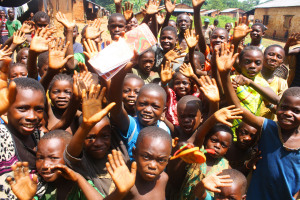
    Professor Tim Flannery, a leading scientist and public intellectual in Australia wrote a piece in the Guardian newspaper a few days ago reflecting on the links between climate change and the extreme temperatures and bushfires ravaging Australia at present. He notes that “Australians are used to hot summers. We normally love them. But the conditions prevailing now are something new. Temperature records are being broken everywhere.” What is important for thinking about the security consequences of climate change is that towards the end of the article, Flannery reflects:

    “Australia’s average temperature has increased by just 0.9 of a degree celsius over the past century. Within the next 90 years we’re on track to warm by at least another three degrees. Having seen what 0.9 of a degree has done to heatwaves and fire extremes, I dread to think about the kind of country my grandchildren will live in. Even our best agricultural land will be under threat if that future is realised. And large parts of the continent will be uninhabitable, not just by humans, but by Australia’s spectacular biodiversity as well.”

    Conditions in which large parts of the continent are threatened in such a way would appear to raise some pretty serious questions about Australia’s national security (let alone the human security of those individuals living in areas where agriculture has failed or fires threaten homes and livelihoods). Yet recently a number of commentators have become particularly concerned about the so-called ‘securitisation’ of climate change, largely due to a sense of there being “alarmist views about climate change on conflict risk.” This has led some to argue that rather than helping to raise the profile of the issue in terms of the need for urgent policy change, we in fact now need to “disconnect security and climate change.” According to Professor Betsy Hartmann of Hampshire College, “A fear of imminent doom runs deep in popular culture and, like the grim reaper, stalks the environmental movement.” This, she argues allows “security agencies and analysts” to distract us from feelings of empathy towards those affected by climate change and to instead cause us to fear them and to “turn to the military to protect us.” According to Professor Mike Hulme of the University of East Anglia,

    “What climate change means to us and means to the world is conditioned by what we do, by the way we govern, by the stories we tell. Presenting climate change as the ultimate security crisis is crudely deterministic, detached from the complexities of our world, and invites new and dangerous forms of military intervention.”

    All of this matters as the potential world in which Flannery is imagining that his grandchildren might have to live in is becoming more and more likely the longer multilateral efforts drag on. Richard Haass, the President of the Council on Foreign Relations, when asked to look ahead to the big global governance challengers for 2013 recently stated that: “It is becoming increasingly clear that efforts at mitigation are not just falling short but that the gap between what is needed and what is likely to happen is widening.”

    The whole notion of the ‘securitisation’ of climate change pre-supposes that we get to choose whether climate change is a security threat or not – it emphasises what political scientists refer to as human agency. Of course we can choose to label something as a threat or not (yes, perhaps it may even not be the end of the world if we use the dreaded T word!). But in the face of increasingly extreme weather and related natural disasters (let alone serious discussions about whether states such as Kiribati can survive within their own national borders), it does seem that we can sensibly talk about the security threats posed by climate change in the decades to come regardless of whether we can specifically link particular instances of conflict and climate change in the past.

    The point is that simply because something may pose a security threat does not mean that we have to respond in the traditional way – to throw military force at it. It’s abundantly clear that there is no military solution to climate change and that addressing the problem at source means changing (among other things) the ways we use energy. But that doesn’t mean that our current energy policies are not a fundamental security threat. They are. And why can’t we use better energy policies to ensure our security?

    Image source: HighExposure

  • Sustainable Security

  • Sustainable Security

    Young people are frequently ‘othered’ in discussions about on conflict. This is a dangerous practice as youths can play a very positive role aiding peacebuilding in societies recovering from conflict.

    The UN World Population Prospects statistics estimate that there are 1.3 billion 15-24 years olds in the world and nearly one billion live in developing countries where conflict is more likely to have taken place.

    In such demographic realities, the potential youths hold for change and positive action is the subject of growing research agenda, and this is particularly the case with the recent wave of social upheavals and humanitarian crises in different parts of the world.

    For much of human social interaction, the category called ‘youth’ has been perceived as a historically constructed social category, a relational concept, and as a group of actors that is far from homogenous. A myriad of factors make childhood and youth highly heterogeneous categories in terms of gender, class, race, ethnicity, political position as well as age.

    They also have multi-faceted roles. Youths can be heroes as well as victims, saviours and courageous in the midst of crisis, as well as criminals in the shantytowns and military entrepreneurs in the war zones. Yet, as a category, youth are often approached as a fixed group or demographic cohort.

    Youth, peace and conflict

    youth-peacebuilding

    Image by CIFOR via Flickr.

    Youths as a conceptual category are frequently ‘othered’ in the discourse on conflict. They are seen as potentially dangerous ‘subjects’ and policy approaches often regard them as ‘a problem’. Often, male youths in the age group 16-30 have been observed as the main protagonists of criminal and political violence. In other words, much of contemporary thinking on youth and conflict tends to be overly negative. It focuses on the dangers posed by disaffected youths as is evident in the negative connotations of the ‘youth bulge’ or ‘at risk youth’ concepts.

    A number of dangerous assumptions about the role, position, and contribution of youths appear to plague thinking among national and international elites driving recovery efforts within societies in transition. The majority of national and international policy pronouncements or security-related programmes in post-conflict and fragile contexts reflect a polarised discourse.

    The young vacillate between the two extremes of ‘infantilizing’ and ‘demonizing’. On the one hand, youths are viewed as vulnerable, powerless and in need of protection. On the other, they are feared as dangerous, violent, apathetic and as threats to security. Youths are subjected to stereotypical images of being angry, drugged and violent and as threat, especially those who participated in armed conflict as combatants.

    On the other hand, recent literature on youth in post-conflict societies marks a shift in thinking about youth. It underlines the agency perspective, and acknowledges the importance of making the connection between youth and peacebuilding for transforming a predominantly negative discourse on the role of youths in societies recovering from conflict.

    Youth as peacebuilders

    The positioning of youth in society has a bearing on their leadership potential and their possible role in peacebuilding. The tension between young and old has been one of the key features of inter-generational shifts pertaining to the control over power, resources and people.

    The tension lies in the palpable impatience of youth, their desire to strive for more, their willingness to be seen as responsible and capable, and the structural barriers to their social mobility. Independence from others and responsibility for others, such as taking care of a family or household, can be seen as defining markers of pre-requisites of social adulthood.

    In this sense, dependency, exclusion, and social or political marginalization become prominent sources of social contest. At the same time, it should be recognised that such societal dynamics, challenges and opportunities vary across different cultural contexts whether it is in Africa, Europe, Asia or Latin America.

    Within the challenging fluidity of post-conflict environments, which are nothing but contexts where the politics of war continue through different means, the young would need to show great ‘navigational skills’ in order to respond to such power dynamics. Their social, political and economic navigation is about their identity transformation as well as the negotiation or re-negotiation of societal norms, values and structures so that they can find a voice and place in the emerging structures of post-conflict environments.

    What needs to be underlined is that youth should be conceptualized and studied as agents of positive peace in terms of addressing not only the challenges of physical violence, but also the challenges of structural and cultural violence, and the broader social change processes to transform violent, oppressive and hierarchical structures, as well as behaviour, relationships and attitudes into more participatory and inclusive ones.

    The key point to remember is that without recognizing youths as political actors, their trajectories in peacebuilding would likely be ignored, wasted and at best, under-utilized. To recognize their agency as a political actor in peacebuilding, there needs to be a comprehensive understanding of their conflict trajectories, and this is particularly important for those young people who have taken direct participation in an armed conflict as combatants.

    To understand the engagement of youth in peacebuilding, first of all, the youth mobilization and reintegration factors such as who they are, what they did before the conflict, how they were recruited, what specific fighting roles they undertook, what they experienced physically, socio-economically and psychologically, during the armed conflict, and what ‘home’ context they will be reintegrating into will all be critical for the youth’s trajectories in peacebuilding.

    Second, the involvement of youth in non-violent politics, and from a wider perspective, the enablement of their political agency in a more positive and peace-oriented role in post-conflict environments, is likely to depend on how these trajectories are shaped by the overall political and governance context.

    Third, the enablement of youth as an active agent in peacebuilding cannot be considered without considering such challenges they tend to face due to the armed conflict such as the loss of education, a lack of employable skills and the destruction of a stable family environment. The wider socio-economic needs of youths are often ignored in post-conflict contexts as they are not seen as a ‘vulnerable’ group.

    Fourth, it is important to provide youths with training opportunities to take an active part in peacebuilding. With their youthful energy and capabilities, and ability of adaptation to new technological trends, for example, youths could act as mediators, community mobilisers, humanitarian workers and peace brokers. Like any particular conflict affected population group, the mobilisation of youths’ capacities requires a targeted and long-term approach.

    At the Centre for Trust, Peace and Social Relations, an annual event called Global Peace Workshop is held in Turkey every year. Around 70-80 young participants from across the world get together in this one-week training, networking and solidarity event, and it is incredible to see the transformation of those young people in a such a short span of time as peacebuilders and start undertaking a wide range of peacebuilding projects in their own communities, schools and work places.

    Fifth, the engagement of youth in peacebuilding in a wider perspective can be ensured through the arts, culture, tourism, sports and education. The innovativeness and creativeness of young people in those areas could be mobilised effectively by connecting them with wider peacebuilding objectives such as building bridges between divided communities and ensuring a viable process of reconciliation.

    There are many examples across the world of the contributions that the young make towards peacebuilding such as the strengthening of community cohesion and reconciliation in South Sudan, civic awareness for peaceful social relations and development programmes in Nepal,  trust-building across different ethno-religious groups in Sri Lanka, and community entrepreneurship and livelihoods programmes in Burundi. Furthermore, the UN Inter-Agency Network on Youth Development  Report entitled ‘Young People’s Participation in Peacebuilding: A Practice Note’ presents a number of policy and programme examples from different conflict affected countries that would facilitate such participation more effectively.

    Finally, in undertaking all of these objectives it is also pivotal to avoid the well-known cliché of referring to youths as the ‘future leaders’. Leadership should not be considered as a factor of age and providing appropriate governance contexts would likely enable young people to flourish as leaders today. In other words, they need to be treated as leaders today without postponing it to an elusive future whether it is in governance in general or peacebuilding programmes specifically.

    To achieve this objective there have recently been a number of critical developments such as the UN Security Council Resolution 2250 on Youth, Peace and Security of December 2015 which makes a clear recognition of positive contributions of youth to peace and sets an overall framework to support their efforts. In May 2016, the UN Peacebuilding Fund started its first Youth Promotion Initiative, which could play a key role to encourage youth leadership in peacebuilding. Therefore, the current trends show that there will be many more similar youth leadership programmes across the world in the near future, but the key point for their successes will depend on whether or not such initiatives can also respond to wider socio-economic, cultural and political barriers that young people face in their quest of becoming an active agent of positive change, peacebuilding and reconciliation.

    Professor Alpaslan Ozerdem is Co-Director of the Centre for Trust, Peace and Social Relations at Coventry University.

  • book

    Image of Al-Qaeda: The True Story of Radical Islam

    • Purchase from Amazon:
    • Al-Qaeda: The True Story of Radical Islam
    • Author: Jason Burke
    • Publisher: Penguin ()
    • Binding: Paperback, pages
    • Price: £8.99

  • Sustainable Security

    Too Quiet on the Western Front? The Sahel-Sahara between Arab Spring and Black Spring

    While the world’s attention has been focused on the US-led military interventions in Iraq and Syria a quieter build-up of military assets has been ongoing along the newer, western front of the War on Terror as the security crises in Libya and northeast Nigeria escalate and the conflict in northern Mali proves to be far from over. In the face of revolutionary change in Burkina Faso, the efforts of outsiders to enforce an authoritarian and exclusionary status quo across the Sahel-Sahara look increasingly fragile and misdirected.

    Read Article →

    Humanitarian Consequences of Nuclear Weapons: Five Reasons for the P5 to participate in Vienna

    The ‘humanitarian dimension’ initiative highlighting the consequences of nuclear weapons has evolved and consolidated itself in the non-proliferation regime since 2010. The five nuclear weapons states (NWS or P5) under the NPT – China, France, Russia, UK and US – boycotted the first two international conferences on the humanitarian consequences of nuclear weapons. A third conference will be held in Vienna on 8-9 December 2014. This article gives five reasons why the P5 should consider participating.

    Read Article →

    VIDEO – Militarisation of the Sahel: An interview with Richard Reeve

    Sustainable Security programme Director Richard Reeve discusses our latest report ‘From New Frontier to New Normal: Counter-terrorism operations in the Sahel-Sahara’. The report, commissioned by the Remote Control project, finds that 2014 is a critical year for militarisation of the Sahel-Sahara and the entrenchment of foreign powers there.

    Read Article →

    Building the Case for Nuclear Disarmament: The 2014 NPT PrepCom

    The humanitarian impact of nuclear weapons, highlighted by a wide-ranging, cross-grouping, multi-aim initiative which continues to consolidate itself in the non-proliferation regime, has come to the fore in the 3rd Prepatory Committe for the 2015 NPT Review Conference. Frustrated with the lack of progress towards NPT Article VI commitments to complete nuclear disarmament, the initiative has invigorated attention to the urgency of nuclear disarmament and a need for a change in the status quo. NPT member states and civil society continue to engage actively in publicizing the humanitarian consequences of nuclear weapons as an impetus to progress towards nuclear disarmament.

    Read Article →

    Beaux Gestes and Castles in the Sand: The Militarisation of the Sahara

    Whatever the benefits for Mali, the French-led eviction of jihadist groups from northern Mali may have made the wider Sahara a less safe place, and has done little to lower the capacity of such groups to threaten European interests.. In 2014, France is implementing a major redeployment of its forces in Africa into the Sahel and Sahara. Meanwhile, the US has been quietly extending its military reach from Djibouti to Mauritania. However, as elsewhere, the western military approach to countering Islamist insurgency in the Sahel rests on very unsteady foundations and the potential to provoke wider alienation and radicalisation is strong.

    Read Article →

    Can the Nuclear Non-Proliferation Treaty outrun its double standard forever?

    The recent walkout by Egyptian negotiators at UN talks have demonstrated that, like a building with rotten foundations, the nuclear non-proliferation regime is far less stable than many believe it to be. Egypt’s actions make clear that anything less than a regime specifically geared towards addressing the reasons why some states seek nuclear weapons is a regime existing on borrowed time.

    Read Article →

  • Sustainable Security

  • The Arab Uprising and the Implications for Western Policies

    Europeans just cannot seem to get Islam, or more properly, Islamism, out of their heads. This seems to be particularly true of Europeans who have not spent much time in the Islamic world, and whose idea of immersion journalism is to spend an afternoon wandering round an immigrant neighbourhood in the European capital city of their choice with a view to chatting up a few swarthy-looking men over a cup of mint tea.

    And even some more serious writers have ended up falling into the same trap over the last few weeks. Take Timothy Garton Ash, for instance, whose reporting of the decline of the Soviet empire in Eastern Europe in the 1980s was exemplary in its combination of in-depth research and first-hand experience. In a series of articles in The Guardian, Garton Ash has been greeting the wave of insurrections sweeping across the Arab world with a wall of worry. In his latest piece, published last week, a visit to the Calle de Tribulete in Madrid plunged him into new depths of anxiety. Despite garnering some half-hearted expressions of ill-defined hope, it was not long before he and his interlocutors were overtaken by the memories of terrorism past. He even managed to run into a young man at a bus stop spouting Wahhabi-inspired anti-semitic conspiracy theories to casual passers-by. Needless to say, the overall effect was far from encouraging.

    “Only a fool would fail to recognise that this is a moment of danger, as well as opportunity,” he concludes. “The path forward for Tunisia and Egypt is far less clear than it was for east European countries – and there is no warm, safe house of EU membership beckoning at the end of the road.”

    The leitmotiv of Garton Ash’s fears is that the threat of Islamic fundamentalism is real, however it may have been instrumentalised by western democrats and their client dictators, and that the task now falls to Europe to do something to prevent this menace from bring translated into reality. Without our help and guidance, the current upheaval in our Arab neighbours is likely to install regimes more oppressive for their citizens, and more dangerous for us than those which they have replaced.

    The problem with this scenario is not just that it depends on a faulty reading of history, one which minimises or ignores the role of the western powers in supporting the rise of Islamism in the first place, and in particular in installing a theocratic regime in Iran in order to ensure ‘stability’ and preempt a genuinely progressive revolution[1]. Even if history did agree with Garton Ash, his argument would still be undermined by the present. For it is entirely contradicted by everything we know about what is happening today in Egypt, the only one of these revolutions so far to have reached a point where, at least provisionally, the balance of power seems to have given the revolutionaries some measure of control.

    All the reports we have concur that once this particular Arab street had liberated itself, its first instinct was not to revert to some authoritarian moralistic Golden Age, the mediaeval theme park of Orientalist imagination, but rather to create an entirely new kind of society symbolised by and embodied in the occupation of Tahrir Square. The result, as Yasmine El-Rashidi has described it, was something like a cross between a vernacular religious festival (the kind of joyfully chaotic carnival which textbook Islamists generally cannot stand), and an anarchist commune. A space that was self-organising, self-securing, self-policing, self-recycling, and in which people were constantly devolving power back to one another – devout Muslims to Christians and to ‘godless’ youth[2], has-been and potential leaders to the mass of the people, and soldiers (up to fairly senior officer rank) to civilians.

    In other words, absent outside intervention, whether positive or negative, the most likely course of the Arab revolutions now in progress would be to produce creative forms of political organisation and social conviviality which, while rooted in the long histories of their indigenous cultures, and in the more recent civilisational traditions that overlay them, are as unprecedented in the experience of those now living through them as they are unpredictable for external observers.

    The problem, then, is not what Europe can do to help them, but how we Europeans can keep our governments safely out of their way, and ensure that our political and financial elites do not try to subvert these movements for their own purposes. (This is a practical problem, and it requires practical solutions – that is, things we can do, not just things we can demand that others do.) The greatest problem facing Egypt today is not the Muslim Brotherhood, or high levels of poverty and illiteracy, but the vicious co-dependency that exists between the upper echelons of the Egyptian army, the Israeli military-political complex and the bi-partisan US establishment, and of which the most obscene symbol is the US armament casings that littered the streets of Cairo after the insurrection’s blackest days[3]

    “Friends of the family”

    Led by the Egyptians and the Tunisians, the Arab world stands on the brink of inventing forms of democracy and participation that should not only destroy the dominant Orientalist image of the region once and for all, but from which the people of the US and Europe have much to learn, too. What is not clear is whether the leaders of the west, and their paranoid courtiers in the media, are ready to let us benefit from this inspiration.

    The good news, however, is that it is probably already too late for them to stop us. The people of the west have already had ample opportunity to see both what real democracy in action looks like over the last month – what it is like, that is, when people take their rights for themselves, rather than voluntarily down-converting them into “privileges” to be granted by a higher authority – and how our so-called democratic leaders react when confronted with this kind of behaviour. From Tony Blair’s description of Mubarak as “a force for good”, to Hillary Clinton’s admission that she and her husband counted the dictator of Egypt and his wife as “friends of the family”, or the revelations that half the French cabinet seems to have been relying on North African tyrants for cut-rate holidays and last-minute travel plans, we have been reminded of something that should have been obvious from the beginning. The attitude of our elected leaders towards the bullies, torturers and thieves who still continue to run a large part of the tragically misnamed “developing world” is not just one of uncomfortable tolerance. These are their friends, their allies, their co-conspirators. Though the ways in which they have risen to power may differ, the culture which that power confers upon them is essentially the same.

    The problem with Blair and Clinton is not that they are prepared to compromise their Enlightenment values for the sake of political expediency – in order to protect Israel, to ensure access to cheap energy resources, or to take advantage of a police force that is happy to torture their prisoners for them while they keep their own hands clean. The real problem with ‘our’ leaders is that they have more in common with ‘their’ leaders than they do with the vast majority of the people whom they are widely, if implausibly, supposed to ‘represent’. And that, in the end, is why we need laws: not to govern us, but to restrain them.

    Of course, the web of ties which binds together the internally violent and corrupt police states that still run most of the extractive zones of the world economy, and the externally violent and corrupt oligarchies-by-consent which are the ornament (and, increasingly, not much else) of those zones where consumption is the dominant form of oppression, is structural in nature, as well as personal. This is not just about Tony and Hillary sipping drinks by the pool with Hosni and Suzanne. Our governments and corporations sell their armies and police forces “non-lethal” weapons, and then train them in how to use them to create maximum terror among their populations. And we do this, not out of the kindness of our hearts, but precisely so that they can sell us in return their countries’ natural resources at a discount to the rate that would have to be applied if it was recognised that these resources belonged to all the people of that country, collectively and indivisibly, and not just to some tiny tyrannical minority that has managed to grab hold of the levers of former colonial power, and re-purpose them for the post-colonial era.

    In this context, David Cameron’s decision to surf the wave of people power by stopping over in Egypt on Monday looks particularly opportunistic, on the part of a man whose government has managed in the space of a few months to authorize sales of tear gas to Bahrain, crowd-control ammunition to Libya, combat helicopters to Algeria and armoured personnel carriers to Saudi Arabia. Wherever we shouldn’t have been selling weapons this winter, we have been doing it. And our role in equipping dictators and their goons seems set to continue this week at the International Defence Exhibition and Conference (IDEX), the largest arms trade exhibition in the Middle East, which opened in Abu Dhabi Sunday. The Middle East remains a ‘priority market’ for the UK industry, supported by UKTI, and one in ten of the exhibitors at IDEX are UK-based companies[4].

    Bringing Tahrir to Kensington

    One of Garton Ash’s more implausible claims is that Europe has a duty to help the Arab nations determine their path going forwards, because we have a particularly rich experience of achieving successful transitions from dictatorship to democracy. It could equally well be said, however, that our power elites have a particularly rich experience of ensuring that the transition from colonial dependency to independent state in Africa, the Middle East, Latin American and large parts of Asia, turned out entirely compatible with the continuation and intensification of the old colonial circuits of exploitation and oppression.

    Indeed, even within Europe itself, our leaders have always tried to ensure that any transition from authoritarianism to democracy, while openly welcomed, was effectively emptied of any real substance. In the process, ‘democracy’ was transformed from the real lived participation of all in the government of everyday life, into a pure spectacle – a system of propaganda that exists principally to make injustice and inequality far more ‘bearable’ than could any explicitly authoritarian regime (as Saroj Giri recently suggested, in the course of comparing the events in Egypt to the situation in India). Seen in this way, the advice of our governments on how to manage the ‘transition’ to democracy is probably something the Arab world will want to do without.

    But that does not mean that Europe and the Arab world have nothing to learn from each other. On the contrary. If the revolutions now underway across the region are indeed able to deliver on their promise of reempowering their people, without being subverted by the combined economic and military power of the USA, the EU, Israel and Saudi Arabia, then it may be that the new Arab nations which emerge from this process will need and want to share their experience with us. Indeed, they may see it as vital to their own interests to help us, the people of Europe, retake control over our own economies and our own societies, not simply in order to export their revolution, but as the minimum condition for transforming us into a good neighbour for the rest of the region, rather than the source of chronic instability and insecurity we have been over the past several centuries.

    Ongoing protests and actions in places from Madison, Wisconsin, to Central London have already appealed to the Egyptian experience, both explicitly, and symbolically. American public service workers last week brandished Egyptian flags to express their rejection of the state’s attempts to deprive them of their union rights, while British activists have called for a day of action in March to “bring Tahrir Square to Hyde Park”. While the nature of every act of human revolt is specific and, at some level, untranslatable, the energy of empowerment which it releases is by its nature infectious, and transgressive. How long before here, in the West, our own governments’ politically-motivated “austerity” programmes create the conditions in which a thousand Tahrirs can bloom? Looking back to recent events in France and Greece, we may feel that day is perhaps not so far away.

    Noam Chomsky recently claimed that what western leaders are really afraid of is not an Islamist takeover in the Arab region, but the emergence of genuinely independent and democratic Arab states which will no longer kow-tow to Washington and do its bidding. That is surely part of the story. But I believe that what they are most afraid of is not just the emergence of democracy in the Arab world. However uncomfortable and embarrassing that may be, they know they can live with it. What they are most afraid of is that, having slept through the last 60 years of democracy, their own citizens/subjects may be about to wake up again to their own power: that, having seen what it is like when a people dictate to their government what it should do for them, rather than the reverse, we might start to take our own rights back, wholesale, rather than waiting for our rulers to grant us them in homeopathic doses – or fob us off with a placebo.

    The victory of the revolutionaries of Tahrir Square, however partial and provisional, reminds us that we once started our own revolution, and that we failed to finish it. Maybe this is our time that has come again, too.

    [1] See Serge Bricianer, Une étincelle dans la nuit – Sur la révolution iranienne 1978-1979, Ab Irato, Paris, 2002, for an account of how Iranian workers’ movements were sidelined and ultimately defeated in 1979.

    [2] See Omar Kamel, “Regarding the Brotherhood…”, for a particularly moving illustration of this phenomenon.

    [3] See Pratap Chaterjee, “Egypt’s military-industrial complex”, The Guardian, 4 February 2011.

    [4] See “CAAT condemns empty words from Government as arms sale drive continues” and “UK arms sales to Middle East include tear gas and crowd control ammunition to Bahrain and Libya” for more details.

    Frederick Bowie is an independent journalist. He has spent many years living and working in the Middle East, and was a regular contributor to Al-Ahram Weekly (Cairo). The original version of this article appeared on openDemocracy. 

  • Sustainable Security

    The True Finns Party have surged to the forefront of Finnish politics and fundamentally turned the nation’s political discourse in a more nationalist direction. What are the causes of this rise in Finnish populism?

    The populist Finns Party, formerly known in English as the True Finns party (Finnish: Perussomalaiset), rushed to the surface of Finnish politics in the 2011 parliamentary election, snatching a remarkable 19 per cent of the vote. Its charismatic leader Timo Soini positioned himself on the side of the ordinary man and against corrupt elites. Referring to ethno nationalism and Christian social values, Soini emphasized Finnishness and the need to protect the national culture from being contaminated by immigrants and other foreign influences. The Party’s surge to the forefront of Finnish politics has fundamentally turned the political discourse in Finland towards a more nationalist direction. In order to gain a fuller understanding of the drivers behind this growth of Finnish populism, it is necessary to examine Finland’s recent history.

    A sense of suffering

    Traditionally, Finnish society was split on a double axis: urban and rural, landowners and peasants. Through history, it was the bloodiest area in the Nordic region. The Finnish national identity, including a sense of common suffering, was at least partly defined by being locked between powerful and often aggressive neighbours, Sweden and Russia, who repeatedly took turns in dominating Suomi, the Finnish heartland. Nationalistic movements grew strong in the nineteenth and early twentieth centuries and, though it was rather a by-product of the Bolshevik revolution, Finland finally won its independence in 1917. Authoritarian movements soon emerged; for example, the nationalist Lapua movement. Nationalist sentiments were growing fast in the interwar years, but this was also a period of internal conflict, spurring into a full-blown Civil War between authoritarian Nationalists and Social Democratic groups.

    Surviving under constant threat from its eastern neighbour, Finland aligned with Germany for a period in the Second World War. Tensions on the Finnish–Soviet border also grew leading up to the Second World War, breaking into the Winter War between the two in autumn 1939. After showing surprising fighting resilience, Finland had still lost 12 per cent of their land in the war in Karelia. When the Germans invaded Russia in 1941, the Finns fought alongside them, in what is referred to as the Continuation War, in an attempt to regain lost territories in Karelia. They were beaten back by the Soviets once again three years later and devastated by repeated conflicts. Over the course of these repeated and prolonged conflicts a militaristic mentality developed in Finland, still evident in contemporary life.

    Finland emerged humbled from the war, surely with a sense of suffering but also one of perseverance. The country was not only in dire straits economically but also firmly within the sphere of strategic influence of the Soviet Union. Finnish diplomacy revolved around appeasing their powerful eastern neighbour. The geopolitical balancing act, of constructing a Nordic liberal marked orientated welfare state while appeasing the Soviets, paid off, and Finland became a prosperous Nordic state. Crisis, however, hit once again in 1990 when the Scandinavian banking crisis coincided with loss of markets in the East when the Soviet Union dissolved in the wake of collapse of communism.

    Still, Finland emerged from the crisis with a growing self-confidence in international affairs, not only by joining the EU but also by adopting the Euro and seeking a core position with the EU. Finland was a homogeneous country with a low level of immigration. Right-wing nationalist populist politics were thus not prominent in the latter half of the twentieth century. Still, agrarian populist versions existed since the 1960s with a noteworthy support. Right-wing populist parties like those that emerged in Denmark and Norway did not, however, gain much popular support until after the Euro crisis hit in 2009.

    The Finnish Agrarian Party

    Although nationalist extreme-right politics similar to those on the European continent only became prominent in Finland with the surge of the True Finns party in the new millennium, agrarian populism had been present in Finnish politics ever since the beginning of the 1960s. The Finnish Agrarian Party (Suomen Maasedun Puolue – SMP) established in 1959 was founded in opposition to the urban elite and claimed to speak on behalf of the common man in rural Finland, those that they referred to as the ‘forgotten people’ (unohdetun kansa) in town and country, against the detached ruling class in the urban south.

    The SMP exploited the centre-periphery divide in Finland. Its greatest electoral success came in 1970, 1972 and in 1983 when the party won approximately a tenth of the vote each time. Their main appeal was with rural workers and the unemployed, who felt alienated in the fast moving post-war society. In a rapid social structural change, Finland was transformed from being predominantly agricultural to a high-tech communication-based society. The SMP ran into serious financial difficulty and a new nationalist populist party, the True Finns Party, absorbed its remains in 1995. In 2011, the party’s English name was shortened to the Finns Party.

    Timo Soini and the True Finns

    somio

    Image credit: OSCE Parliamentary Assembly/Flickr.

    In 1997 the charismatic Timo Soini took the helm of the True Finns Party. Soon, the party found increased support, rising from 1.6 per cent in the 2003 parliamentary election to 4.1 per cent in 2007. It was, though, only in wake of the international financial crisis, that the party surged, winning 19.1 per cent of the vote in the 2011 parliamentary election and becoming the third largest party in the country, behind only the right-of-centre conservative National Coalition Party (NCP) and the Social Democrats (SDP). This was also referred to as the ‘change election’ or the ‘big bomb’, when Finnish politics, to a significant degree, came to revolve around the Finns Party and its populist politics.

    The party had increased its vote five fold since the 2007 election, adding full 15 percentage points, which was the biggest ever increase of a party between elections in the Eduskunta, the Finnish Parliament. Its initial rise had, however, started two years earlier, in the European Parliament election of 2009, when the True Finns grabbed 9.8 per cent of the vote. In 2015 the party saw only limited decline in its support, clearly reaffirming its strong position in Finnish politics, and entering coalition government for the first time.

    Previously, the True Finns had been widely dismissed as a joke, a harmless protest movement, and a nuisance on the fringe of Finnish politics. Their discourse was aggressive and rude and the media mostly only saw entertainment value in them. After the 2011 election, however, it had surely become a force to be reckoned with. During the election campaign, they had clashed with the mainstream parties and called for ending of the one-truth cosy consensus politics of the established three parties. The Finns Party had now become a forceful channel for the underclass.

    Contrarily to most similar parties elsewhere, the Finns Party accepted being branded as populist. Soini, however, refused to accept that his party was extreme-right. Contrary to the progressive parties of Denmark and Norway, the Finnish populists never flirted with neo-liberal economic policies. Rather, the Finns Party inherited the centrist economic policy of the SMP. Its right wing populism was thus never socio-economic, but rather socio-cultural.

    Three themes emerged as the main political platform of the Finns Party:

    • First to resurrect the ‘forgotten people’, the ordinary man, to prominence and speaking in their name against the elite;
    • second, to fight against immigration and multiculturalism;
    • thirdly, to stem the Europeanization of Finland.

    The forgotten people

    Finland has been historically prone to polarization; for example between East/West; Socialism/Nationalism; Urban-rich/Rural-poor; Cosmopolitan/Local. Building on the SMP’s politics, the Finns Party kept exploiting the centre-periphery divide, effectively exchanging the agrarian focused populism for a more general cultural divide based on a more ethno-nationalist program. Timo Soini, for example, adopted the phrase of the ‘forgotten people’, which refers to the underprivileged ordinary man, which, he argued, the political elite had neglected.

    The political elite was continuously presented as corrupt and arrogant, having suppressed the ordinary blue-collar man. Positioning themselves against the urban Helsinki-based cosmopolitan political elite consolidated around the south coast, the Finns Party representatives claimed to speak in the name of the ‘forgotten people’, mainly working in rural areas.

    Drawing on traditional Christian values the ‘forgotten people’ were discursively depicted as pure and morally superior to the privileged elite. This sort of moralist stance was widely found in the party’s 2011 election manifesto, including claims of basing their politics on ‘honesty’, ‘fairness’, ‘humaneness’, ‘equality’, ‘respect for work and entrepreneurship’ and ‘spiritual’ concerns.

    The Finns Party was also staunchly socially-conservative on matters such as religion, morality, crime, corruption, law and order. It is thus more authoritarian than libertarian. They are surely anti-elite, but not anti-system. Indeed, it firmly supports the Finnish state, its institutions and democratic processes, including keeping the relatively strong powers of the president to name but one example.

    Finnish ethno-nationalism

    Timo Soini and his followers have offered a clear ethno-nationalist focus, strongly emphasising Finnish national cultural heritage. It was suspicious of Swedish influence, dismissive of the indigenous Sami’s heritage in Suomi – often referred to as Lapps in English – and outright suppressive in regard to the small gypsy population. In a classical populist ‘us’ versus ‘them’ style a running theme of the Finns Party’s disourse was to emphasise Finnishness by distinguishing Finns from others.

    The Finns Party promoted patriotism, strength and the unselfishness of the Finnish people and argued that the Finnish miracle should be taught in school in an heroic depiction; that is, how this poor and peripheral country suppressed by expansionist and powerful neighbours was, through internal strength and endurance, able to fight their way from under their oppressors to become a globally recognised nation of progress and wealth.

    More radical and outright xenophobic factions have also thrived within the party. Jussi Halla-aho, who became perhaps Finland’s most forceful critic of immigration and multiculturalism, led the anti-immigrant faction. He has referred to Islam as a ‘totalitarian fascist ideology’ and for example wrote on his blog in 2008 that, ‘since rapes will increase in any case [with inflow of immigrants], the appropriate people should be raped: in other words, green-leftist do-gooders and their supporters’ He went on to write that prophet Muhammad was a paedophile and that Islam as a religion sanctified paedophilia.

    Many similar examples exist. A well-known party representative, Olli Immonen, for example, posted on Facebook that he was ‘dreaming of a strong, brave nation that will defeat this nightmare called multiculturalism. This ugly bubble that our enemies live in, will soon enough burst into a million little’.

    Many other prominent populist and extreme-right associations also existed in Finland, some including semi-fascist groupings. Indeed, a few MP’s of the Finns Party belonged to the xenophobic organisation Suomen Sisu. In early 2016, in wake of the refugee crisis hitting Europe, mainly from Syria, a group calling themselves Soldiers of Odin took to patrolling the street of several Finnish towns. Dressed in black jackets, decorated with Viking symbolism and the Finnish flag, they claimed to be protecting native Finns from potential violent acts of the foreigners.

    Riding the Euro-crisis

    Finns Party’s rise was helped significantly by their opposition to the EU and the European Central Bank, who seemed powerless in dealing with the Euro-crisis. They depicted the EU as unworkable and claiming that democracy cannot work in the context of supranational EU governance, and that it favoured elites over ordinary citizens in the European countries. There was a clear demand for a EU critical party, a void the Finns Party was happy to fill because the mainstream parties then held a pro-EU stance.

    Leading up to the 2011 elections he Finns Party turned opposition to bailouts for debt-ridden Euro countries into their main issue. That also helped in securing good results in European Parliament elections in 2014, after which they joined the radical-right European Conservatives and Reformists Group (ECR) in the EP.

    After coming into government in 2015 the Finns Party found diminished support in opinion polls. Still, their influence had steadily grown and they had found much greater acceptance than before. They clearly led in the growing anti-EU discourse in the country. Soon, many of the previously pro-EU mainstream parties began to adopt their anti-EU rhetoric, and some, subsequently, also became increasingly anti-immigrant.

    Eirikur Bergmann is Professor of Politics at Bifrost University in Iceland and Visiting Professor at the University of Ljubljana in Slovenia. He is furthermore Director of the Centre for European Studies in Iceland. Professor Bergmann writes mainly on Nationalism, Populism, European Integration, Icelandic Politics and on Participatory Democracy. He has also written two novels which are published in Icelandic.

  • Sustainable Security

  • Climate Cycles Are Driving Wars, Says Study

    In the first study of its kind, researchers have linked a natural global climate cycle to periodic increases in warfare. The arrival of El Niño, which every three to seven years boosts temperatures and cuts rainfall, doubles the risk of civil wars across 90 affected tropical countries, and may help account for a fifth of worldwide conflicts during the past half-century, say the authors.

    The paper, written by an interdisciplinary team at Columbia University’s Earth Institute, appears in the current issue of the leading scientific journal Nature.

    In recent years, historians and climatologists have built evidence that past societies suffered and fell due in connection with heat or droughts that damaged agriculture and shook governments. This is the first study to make the case for such destabilization in the present day, using statistics to link global weather observations and well-documented outbreaks of violence. The study does not blame specific wars on El Niño, nor does it directly address the issue of long-term climate change. However, it raises potent questions, as many scientists think natural weather cycles will become more extreme with warming climate, and some suggest ongoing chaos in places like Somalia are already being stoked by warming climate.

    “The most important thing is that this looks at modern times, and it’s done on a global scale,” said Solomon M. Hsiang, the study’s lead author, a graduate of the Earth Institute’s Ph.D. in sustainable development. “We can speculate that a long-ago Egyptian dynasty was overthrown during a drought. That’s a specific time and place, that may be very different from today, so people might say, ‘OK, we’re immune to that now.’  This study shows a systematic pattern of global climate affecting conflict, and shows it right now.”

    The cycle known as the El Niño-Southern Oscillation, or ENSO, is a periodic warming and cooling of the tropical Pacific Ocean. This affects weather patterns across much of Africa, the Mideast, India, southeast Asia, Australia, and the Americas, where half the world’s people live. During the cool, or La Niña, phase, rain may be relatively plentiful in tropical areas; during the warmer El Niño, land temperatures rise, and rainfall declines in most affected places. Interacting with other factors including wind and temperature cycles over the other oceans, El Niño can vary dramatically in power and length. At its most intense, it brings scorching heat and multi-year droughts. (In higher latitudes, effects weaken, disappear or reverse; La Niña conditions earlier this year helped dry the U.S. Southwest and parts of east Africa.)

    The scientists tracked ENSO from 1950 to 2004 and correlated it with onsets of civil conflicts that killed more than 25 people in a given year. The data included 175 countries and 234 conflicts, over half of which each caused more than 1,000 battle-related deaths. For nations whose weather is controlled by ENSO, they found that during La Niña, the chance of civil war breaking out was about 3 percent; during El Niño, the chance doubled, to 6 percent. Countries not affected by the cycle remained at 2 percent no matter what. Overall, the team calculated that El Niño may have played a role in 21 percent of civil wars worldwide—and nearly 30 percent in those countries affected by El Niño.

    Coauthor Mark Cane, a climate scientist at Columbia’s Lamont-Doherty Earth Observatory, said that the study does not show that weather alone starts wars. “No one should take this to say that climate is our fate. Rather, this is compelling evidence that it has a measurable influence on how much people fight overall,” he said. “It is not the only factor–you have to consider politics, economics, all kinds of other things.” Cane, a climate modeler, was among the first to elucidate the mechanisms of El Niño, showing in the 1980s that its larger swings can be predicted—knowledge now used by organizations around the world to plan agriculture and relief services.

    The authors say they do not know exactly why climate feeds conflict. “But if you have social inequality, people are poor, and there are underlying tensions, it seems possible that climate can deliver the knockout punch,” said Hsiang. When crops fail, people may take up a gun simply to make a living, he said. Kyle C. Meng, a sustainable-development Ph.D. candidate and the study’s other author, pointed out that social scientists have shown that individuals often become more aggressive when temperatures rise, but he said that whether that applies to whole societies is only speculative.

    Bad weather does appear to tip poorer countries into chaos more easily; rich Australia, for instance, is controlled by ENSO, but has never seen a civil war. On the other side, Hsiang said at least two countries “jump out of the data.” In 1982, a powerful El Niño struck impoverished highland Peru, destroying crops; that year, simmering guerrilla attacks by the revolutionary Shining Path movement turned into a full-scale 20-year civil war that still sputters today. Separately, forces in southern Sudan were already facing off with the domineering north, when intense warfare broke out in the El Niño year of 1963. The insurrection abated, but flared again in 1976, another El Niño year. Then, 1983 saw a major El Niño–and the apocalyptic outbreak of more than 20 years of fighting that killed 2 million people, arguably the world’s bloodiest conflict since World War II. It culminated only this summer, when South Sudan became a separate nation; fighting continues in border areas. Hsiang said some other countries where festering conflicts have tended to blow up during El Niños include El Salvador, the Philippines and Uganda (1972); Angola, Haiti and Myanmar (1991); and Congo, Eritrea, Indonesia and Rwanda (1997).

    The idea that environment fuels violence has gained currency in the past decade, with popular books by authors like Jared Diamond, Brian Fagan and Mike Davis. Academic studies have drawn links between droughts and social collapses, including the end of the Persian Gulf’s Akkadian empire (the world’s first superpower), 6,000 years ago; the AD 800-900 fall of Mexico’s Maya civilization; centuries-long cycles of warfare within Chinese dynasties; and recent insurgencies in sub-Saharan Africa. Last year, tree-ring specialists at Lamont-Doherty Earth Observatory published a 1,000-year atlas of El Niño-related droughts; data from this pinpoints droughts coinciding with the downfall of the Angkor civilization of Cambodia around AD 1400, and the later dissolution of kingdoms in China, Vietnam, Myanmar and Thailand.

    Some scientists and historians remain unconvinced of connections between climate and violence. “The study fails to improve on our understanding of the causes of armed conflicts, as it makes no attempt to explain the reported association between ENSO cycles and conflict risk,” said Halvard Buhaug, a political scientist with the Peace Research Institute Oslo in Norway who studies the issue. “Correlation without explanation can only lead to speculation.”  Another expert, economist Marshall Burke of the University of California, Berkeley, said the authors gave “very convincing evidence” of a connection. But, he said, the question of how overall climate change might play out remains. “People may respond differently to short-run shocks than they do to longer-run changes in average temperature and precipitation,” he said. He called the study “a useful and illuminating basis for future work.”

    The Earth Institute’s Ph.D. in sustainable development program is run jointly with Columbia’s School of International and Public Affairs, and the university’s Graduate School of Arts and Sciences.

    Image source: The U.S. National Archives

    Article source: The Earth Institute

  • Sustainable Security

    The 2011 Libyan intervention and the anarchy which ensued has highlighted an aspect of the responsibility to protect principle that has, to date, been overshadowed by the debates on the use of force; the responsibility to rebuild.

    While the carnage in Syria has dominated policy agendas and newspaper headlines in the recent years, the aftermath of the 2011 Libyan intervention elicited much deserved attention following Obama’s candid review of his foreign policy legacy and, more recently, the UK Foreign Select Committee report on the government’s handling of the intervention. Obama openly accused David Cameron of having become ‘distracted’ over Libya and failing to follow through the military intervention. A similar accusation was levelled against Downing Street by the Foreign Select Committee report on Libya published in August that berated Cameron for having failed to develop a coherent plan for post-intervention Libya. This was evident in the fact that the UK government spending on reconstruction was less than half of its spending on the intervention, the report points out. The report argues further that the intervening governments, with particular focus on Britain and France as the leaders of the intervention, had a distinct responsibility to help to reconstruct the Libyan state. The failure to de-arm and de-mobilise fighters after the ousting of Gaddafi and the subsequent violence rendered the construction of political and economic institutions an impossible task.  Indeed, Libya today has made little headway to becoming a stable state; fighting between militant factions and the emergence of ISIS have left many wondering whether civilians are better off today than they were under the Gaddafi regime.

    The intervention to protect civilians in Libya was hailed by some as an example of successful realisation of the ‘responsibility to protect’ principle that sets out the joint responsibility of states and the international community to protect civilians from so-called atrocity crimes (crimes against humanity, war crimes, genocide and ethnic cleansing). Where governments fail to do so, the international community has the responsibility to assume the duty to protect. The emergence of the principle in the late 1990s and early 2000s stirred much debate. While some rejected it as a thinly-veiled attempt by Western states to legitimize use of force for political purposes, others lauded the principle as a first step in finding consensus on the contentious issue of conducting humanitarian interventions. Libya, as is well-known now, provided few answers to those seeking clarification on issues pertaining to civilian protection and responsibility to protect.

    As I have argued elsewhere, the Libyan intervention has highlighted an aspect of the responsibility to protect principle that has to date been overshadowed by the debates on the use of force; responsibility to rebuild. The responsibility to protect principle was first formulated by the Canadian government-sponsored International Commission on Intervention and State Sovereignty (ICISS). The Commission famously argued in its 2001 report that state sovereignty was no longer an irrevocable right but a responsibility to protect populations from mass atrocities such as genocide and ethnic cleansing. In its initial formulation, responsibility to protect entailed three interlinked duties; to prevent, react and rebuild. While prevention of mass atrocities was the starting point for any government endorsing the principle, rebuilding societies in the aftermath of military interventions was seen to logically follow the ‘reactive’ pillar of the principle.  The rebuilding pillar was seen to consist of providing security in post-intervention states, promoting reconciliation between former enemies and promoting economic development. These measures, it was argued, are crucial for stability and self-sustaining peace in societies targeted by protection interventions.  One of the key aims of the principle was, in other words, to ensure that the need for protection intervention would not arise again as the capacity of domestic authorities to realise their protection responsibility would be augmented through rebuilding assistance.

    This sequential conception of the principle was short-lived, however. While many Western governments were reluctant to commit to costly and often long-drawn out rebuilding missions, some in the Global South saw the notion of responsibility to rebuild as a throwback to imperialist foreign interference. In the light of these and other concerns, the R2P was refashioned along more statist lines; the rebuilding component was dropped from the framework and the responsibilities of states to protect their citizens were emphasised at the expense of the international community’s obligation to protect. This was evident in the 2005 UN World Summit Outcome Document where governments, for the first time, endorsed the R2P principle. This recalibration of the R2P was outlined in detail in the UN Secretary General’s report on the responsibility to protect in 2009. It proposed a three-pronged understanding of the principle, centred on the states’ responsibility to protect their citizens, the international commitment to capacity-building assistance and, finally, the international community’s responsibility to protect. The rebuilding component was, again, notable in its absence; the principle was largely understood in terms of the preventative responsibility of governments. Although preventative and rebuilding measures overlap to a certain extent, lack of attention to specific rebuilding tasks, such as the provision of post-intervention security, was striking in the UN Secretary General’s 2009 report and in those thereafter.

    The Future of the Responsibility to Rebuild

    libya-sirte

    Image by ECHO/DDG/Flickr.

    The Libyan experience indicates that this change in the focus of the responsibility to protect has not been a matter of mere semantics. Although Libyans, eager to take charge of their own affairs after the fall of the Gaddafi regime, rejected plans for UN peacekeepers, they requested capacity-building assistance. Some assistance was provided by the intervening governments – for example the UK government’s Security, Justice and Defence Programme – but on the whole the immediate aftermath of the intervention was marked by the policy of disengagement as Libya observers have argued. The UN reconstruction strategy and donor government policies were premised on the emphasis of domestic ownership, coupled with references to the wealth of the Libyan state that could be utilised for the reconstruction process. It was not until emergence of the ISIS threat in the region that the Libyan authorities’ appeals for assistance gained attention in the Western capitals.

    While it is of course impossible to state with certainty the effects that an alternative course of action (continued engagement in the rebuilding of Libya in the immediate aftermath of the intervention) could have had, it is not hard to see how the rebuilding measures outlined by the ICISS in its 2001 report may have helped to stabilise Libya.  In the absence of the permission to dispatch peacekeepers, more extensive assistance to the Libyan authorities in providing day to day security after the intervention would have not gone amiss. Perhaps more importantly, concentrating international efforts and resources to supporting inter-communal reconciliation would have been vital, given that the precarious security situation in the country following the fall of the Gaddafi regime has been caused by the lack of political solution on how, and by whom, the country should be governed.

    The instability and violence that has plagued Libya since the 2011 intervention suggest that if the aim of protection interventions is to generate self-sustaining peace rather than just carry out regime change operations, re-incorporating the rebuilding pillar into the current responsibility to protect framework is crucial. Doing so would not necessarily mean overhauling the entire principle: many of the measures regarded as ‘pillar II’ responsibilities provide the basis for incorporating rebuilding tasks into the framework. Pillar II, the commitment by the international community to assist the capacity and resilience-building in conflict-affected societies, refers to a range of measures such as fostering dialogue between communities and indigenous conflict resolution skills. Adding measures that address the short-term issues faced by societies in the wake of military interventions would strengthen the pillar and the framework as a whole.  This would inevitably mean increased costs and commitment on behalf of those undertaking protection interventions, something that is likely to be deeply unpopular in the context of the lengthy engagements in Iraq and Afghanistan as well as the increasing pressure on public spending. The alternative, however, as the refugee flows from Libya and the rise of ISIS in the country have shown, may mean having to face even more troublesome questions in the long run.

    Outi Keranen is Teaching Fellow in International Relations at the Department of Political Science, University College London. Her research interests are in post-conflict statebuilding and the responsibility to protect. Her monograph ‘The Contentious Politics of Statebuilding’ (Routledge) is coming out in May 2017. In addition to post-conflict statebuilding, Outi has researched and written on identity-building, symbolic politics and the responsibility to rebuild.

  • Sustainable Security

    Sustainablesecurity.org is a project of the Sustainable Security Programme at Oxford Research Group (ORG). ORG, which is now based in two offices in London, is one of the UK’s leading of advocates for alternatives to global conflict. By combining in-depth political and technical expertise and experience in promoting serious analysis, dialogue and change, we develop alternative thinking on security issues.

    With 30 years of building trust between policy-makers, military and civil society and academics,  ORG works to address the toughest security questions using detailed research and drawing on deep understanding of how human beings behave. Our consultants combine detailed knowledge of global security issues together with a deep understanding of political decision-making, and many years of expertise in facilitating constructive dialogue.

    ORG is a registered charity, and a public company limited by guarantee under English law. It was first established in 1982 by Dr. Scilla Elworthy.  ORG, and its founder, was awarded the Niwano Peace Prize in 2003. The Independent newspaper named ORG as one of the top 20 think-tanks in the UK in 2005.

    The Sustainable Security Programme

    The programme aims to develop the sustainable security concept and promote it to a wide international audience, ensure that voices from the global South play a central role in its development, and define specific options for sustainable security policies. These aims are achieved via in-depth research, dialogues with analysts and decision makers and providing new avenues for creative thinking and discussion on the real threats to global security in the 21st century.

    For more information, please click HERE

  • Global militarisation

    The ‘New START’ agreement recently signed by the US and Russia is an important first step on the road to nuclear disarmament but much of the hard work in reducing and potentially eliminating the vast stockpiles of nuclear weapons held by nations across the globe is still to be done. Before any meaningful multilateral talks and possible agreements on abolition can seriously begin, the US and Russia will need to go much further in reducing their nuclear ordinance writes Andrew Futter, exclusively for sustainablesecurity.org
    Image source: PhillipC

    Read more »

  • Climate change

    Many leading military analysts in the United States are increasingly alert to the link between security and climate change. Is international terrorism really the single greatest threat to world security? Read more »