Blog

  • Sustainable Security

  • Minority Youth Bulges and the Future of Intrastate Conflict

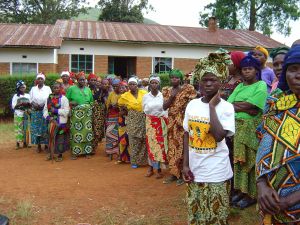
    The global distribution of intrastate conflicts is not what it used to be. During the latter half of the 20th century, the states with the most youthful populations – a median age of 25.0 years or less – were consistently the most at risk of being engaged in a civil war or in an internal conflict, where either ethnic or religious factors, or both, came into play (an ethnoreligious conflict). However, the tight relationship between demography and intrastate conflict has loosened over the past decade. Ethnoreligious conflicts have gradually, though noticeably, increased among a group of states with a median age greater than 25.0 years, including Thailand, Turkey, Sri Lanka, Indonesia, and Russia.  The salient feature of these intrastate conflicts has been an armed struggle featuring a minority group that is age-structurally more youthful than the majority populace. The difference in age-structural maturity reflects a gap in fertility between the minority and majority, either in the present or in the recent past.  

    Most social scientists are likely to explain a minority-majority gap in median age and fertility as the product of history and culture, an artifact of income differences, and/or the result of discriminatory policies or inadequate protections on the part of the state. While political demographers recognize these as contributing factors, they also argue that the political volatility and rapid population growth that are associated with youthful minorities are central features in a dynamic relationship known as the demographic security dilemma.

    The demographic security dilemma, first described by Christian Leuprecht, arises when a state permits or promotes the political, economic, and social marginalization of an ethnoreligious minority. The more states marginalize a dissonant minority, turn a blind eye to a minority’s exclusion from mainstream social and economic participation, or allow minorities to exclude themselves, the wider the majority-minority fertility gap and the more rapidly those youthful minorities grow as a proportion of the state’s population. Minority youth bulges naturally lead to political tensions. Notably, minority-state tensions do not naturally emerge out of the opposite circumstance: when the majority is youthful and the ethnoreligious minority is not.

    What can governments do to prevent the minority-majority fertility gap? Make sure that health, family planning, and educational programs are extended equitably to minorities. An absence of proactive policies to bring youthful communities into the economic, social, and political mainstream tends to strengthen radical and traditionalist religious political organizations, which often take advantage by filling in gaps in local services and governance. Typically, they restrict girls’ access to education, thwart women’s attempts to gain social and economic autonomy, restrict speech, and campaign against modernization and secularization.

    How can foreign affairs analysts forecast risks associated with youthful minorities? That’s easier said than done. Due to restrictions associated with ethnic and religious data collection and the political sensitivities surrounding conclusions drawn from these data, relatively few countries currently provide public access to data that are disaggregated by ethnic and religious affiliation. For now, analysts attempting to estimate qualities of a minority’s age structure must approximate from related measures, such as estimates of minority birth and death rates, fertility rates, and school attendance. Rather than being accessible from a central source, these are published in scattered government reports and in the international demographic and public health literature.

    Despite ongoing high fertility across sub-Saharan Africa and the Arabian Peninsula, UN demographers foresee a world in the not-too-distant future that will be dominated by states with populations near or below replacement-level fertility (just above two children per woman). In that future, analysts can expect the ethnoreligious composition of many states to be extremely sensitive to minority-majority fertility gaps.

    However, understanding the implications of minority demographic trends could hinge on the ability of researchers to gain access to sub-national ethnoreligious data. For this to happen, some governments will have to overturn laws that currently prohibit identification by ethnicity or religion, while data collectors will need to promote conditions that encourage survey participants to self-identify their ethnic and religious affiliations anonymously, and without fear.

    Article Source: The Stimson Center

    Image Source: CharlesFred

  • Sustainable Security

    Foreign fighting in Syria is not driven primarily by devotion to Islam, nor is it motivated mainly by socioeconomic grievances. Rather, foreign fighters join the Syrian civil war to defend their Muslim brethren. Framing the war as a threat to the Muslim (Sunni) community, transnational Islamist movements offer alternative identities and a sense of belonging for alienated people from across the Muslim world.

    In recent years the conflict in Syria has become a lodestone for young Muslims who travel to join the fight. According to estimates from the U.S. National Counterterrorism Center, and reports by The Soufan Group (TSG), foreign fighters from more than 90 countries have joined the Syrian civil war since its inception in 2011, and their numbers already exceed the rate of volunteers who went to Afghanistan, Pakistan, Iraq, Yemen or Somalia at any point in the last 20 years. While the actual figures of foreign fighters in these and other sources vary, and though we do not know how many of them actually engage in the fighting, there are consistent estimates of the numbers of volunteering fighters and the distribution of their countries of origin.

    To be sure, volunteering fighters join various parties in the complex war, like Hezbollah combatants who fight for the Syrian army and foreigners who fight for the Kurdish YPG forces, yet, the concept of foreign fighters relates here to those volunteers joining jihadi movements, mainly the Islamic State and Jabhat Fath al-Sham (formerly known as Jabhat al-Nusra) organizations. Special attention is afforded to the growing stream of European Muslims to these jihadi groups in Syria, and their potential extremist actions upon return to their home countries. However, most foreign volunteers have come from Muslim countries in the Middle East and North Africa. The recruitment process is generally conducted on an individual basis. Taking place across the world, the recruitment relies largely on social media, with videos and appeals produced in a range of languages, describing the caliphate as a utopian political venture, and providing young men and women with an adventurous trip. Salafi mosques and associations also seem to take an active role in recruiting and trafficking volunteers to fight the Syrian war in the name of Islam.

    Although by no means a new phenomenon, the causes of the widening spread of foreign fighting remain unclear. As most of these foreigners are utterly detached from the events in the countries to which they journey, and have little political and material benefit to gain from these wars, the opportunity to attain martyrdom in the next life appears to be a major appeal. Yet, Islam in and of itself is not the primary factor behind foreign fighters joining the jihad. Examination at the individual level indicates that many of those who choose to join extremist groups in Syria have only basic knowledge of Sharia. Islamic State entry forms leaked in early 2016, also demonstrate that while some characteristics of the volunteers (like age and marital status) can be traced, there are no discernible demographic and socioeconomic profiles of foreign fighters in Syria.

    An inspection of the foreign fighters’ countries of origin adds to this confusion, as the spate of volunteering warriors does not originate primarily in countries dominated by radical Islamist movements, nor is it confined to countries where economic and political conditions are the worst. Rather, foreign fighters join the Syrian civil war from countries with different profiles in terms of both the role of Islamism in socio-political life, and the political authority of the regime. Four countries are notable among the home countries of the foreign fighters in Syria: Tunisia, Saudi Arabia, Morocco and Jordan. Tunisia, where the “Arab Spring” revolt was initially ignited, has become the largest source of foreign fighters joining the jihadi groups in Syria, with roughly 3,000 Tunisian warriors recorded between 2011 and 2014; Saudi Arabia is next with estimates of 2,500 fighters during that period. On the other hand, countries like Egypt, Yemen and Sudan produced far fewer volunteering fighters.

    The role of identity

    Image (cropped) credit: Freedom House/Flickr.

    Why then do foreign fighters travel from the Muslim world to fight in Syria? Foreign fighters are motivated by the quest for identity and belonging. Their recruitment is based on religious sentiments, sparked by Islamist movements striving to defend cultural and religious values of the Muslim community. Alienated individuals who seek alternative identities and a sense of belonging find them in their transnational communities. The combination of these factors has stimulated the shift from nationalist identities to pan-Islamist orientations, promoted through a fear-provoking discourse.

    This process was coupled with the emergence of transnational jihadi networks, which carried out political activism aimed at defending the Muslim nation. Recruitment of Muslim fighters thus relies on established messaging practices, by which the recruiting groups frame distant civil conflicts as posing a direct threat to the larger transnational community. Interestingly, these messages are most effective in countries like Tunisia and Saudi Arabia where major Islamist movements are co-opted, taking part in negotiated relations with the ruling elite vis-à-vis implementing Islamic norms in socio-political life. In these countries, legal or semi-legal Islamist movements embrace relatively moderate discourses of sectarian identity, remaining pragmatic and non-violent toward the state. Under such restrained relationships, Islamist sentiments of alienated groups evolve into transnationalist inclinations.

    Alienated individuals then aim their rage and frustration at external enemies. That is, restrained relations between the state and Islamist movements at the national level may well explain the relatively large number of foreign fighters recruited from subnational regions that are alienated from the state, as these fighters see transnational jihad as a way to vent socio-political rage and Islamic sentiments that find limited local opportunities for expression.

    Possible solutions

    To counter the appeal of transnationalist messages, home countries need to establish civic identities and offer competing national narratives. Governments should encourage the inclusion of alienated groups in national discourses and strengthen their sense of belonging to the state. To be sure, the establishment of civic identities is conditioned by state effectiveness and legitimacy — it can be achieved only if the state reconstitutes its position as an institution that provides the needs of its citizens.

    Indeed, state ideology and policies also affect people’s choice to join foreign fighting. Preferring to allow troublesome elements to leave the country, some governments turn a blind eye to efforts to recruit their citizens to join transnational wars. Some countries even encourage the phenomenon. Consider for example the dual policy vis-à-vis Islamism which is well-embodied in the Saudi stance toward foreign fighting in the Syrian civil war. While actively involved in the regime’s domestic de-radicalization efforts, Saudi clerics offer contradicting messages about fighting jihad in foreign countries, with some of them openly calling upon the Muslim world to fight Bashar al-Assad’s supporters, including Syrian Alawites, Iran and Hezbollah. Egypt’s clerics, on the other hand, promote clear anti-jihadist ideology, with multiple campaigns launched by Al-Azhar to renounce the radical ideas spread among young people by groups like Islamic State. Directed by Egyptian President al-Sisi, Al-Azhar leaders hold talks with religious leaders in other countries in the region to thwart Islamic State ideology and to diminish the phenomenon of foreign fighters’ volunteering in the Syrian civil war.

    The policy implication from the multifaceted causes of foreign fighting in Syria is that governments in the Muslim world should not only raise the constrains on going to Syria but also take preventive measures including information campaigns aimed at radicalized and alienated young people, offering opportunities for local expression of their socio-political needs and encouraging their sense of belonging to the state.

    Meirav Mishali-Ram is a lecturer at Bar Ilan University. Her research interests focus on international conflict and civil war, particularly in the Middle East and South Asia. She is the author of many articles and a forthcoming book on the Arab-Israel and India-Pakistan protracted conflicts. Her most recent article on foreign fighting in Syria is available at Taylor and Francis Online: “Foreign Fighters and Transnational Jihad in Syria,” Studies in Conflict & Terrorism.

  • Conflict

    At the beginning of February, ISAF sources announced that a major military offensive was about to be mounted in Helmand Province in southern Afghanistan. This was Operation Moshtarak (“together”), involving 15,000 US, British and Afghan National Army troops, and would concentrate on clearing Taliban and other paramilitary groups from two areas, one of them centred on the town of Marja. The publicity given to the operation appeared designed partly to encourage civilians to evacuate areas under Taliban influence, but would also serve to highlight the capabilities of coalition forces at a time when support for the war in the United States and Britain was fragile.

    Given the size of the operation, it is likely that it will provide a major focus for western media attention for some weeks, but to get a full measure of its significance requires seeing it in the wider context of the conflicts in Iraq and Pakistan, and of the Status of the al-Qaida Movement. There have, in particular, been significant developments in both Iraq and Pakistan, with each likely to have an impact on what is now happening in Afghanistan.

    Photo courtesy of Helmandblog.

    Read more »

  • Marginalisation of the majority world

    The Middle East and North Africa is a region of great diversity. It encompasses Arab and many other ethnic populations, theocratic and secular states, democracies and authoritarian regimes. A region of immense wealth and crippling poverty; it is blessed (some might say cursed) with vast resources, not least oil, but has not always proved able to manage them for the benefit of ordinary people. Read more »

  • Sustainable Security

    RC_long_logo_small_4webThis article is part of the Remote Control Warfare series, a collaboration with Remote Control, a project of the Network for Social Change hosted by Oxford Research Group.

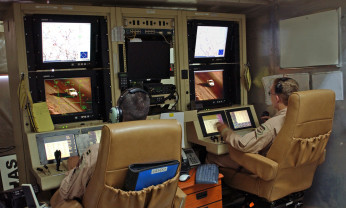
    Capt. Richard Koll, left, and Airman 1st Class Mike Eulo perform function checks after launching an MQ-1 Predator unmanned aerial vehicle Aug. 7 at Balad Air Base, Iraq. Captain Koll, the pilot, and Airman Eulo, the sensor operator, will handle the Predator in a radius of approximately 25 miles around the base before handing it off to personnel stationed in the United States to continue its mission. Both are assigned to the 46th Expeditionary Reconnaissance Squadron. https://en.wikipedia.org/wiki/General_Atomics_MQ-1_Predator#/media/File:MQ-1_Predator_controls_2007-08-07.jpg

    Drone pilots perform function checks after launching an MQ-1 Predator unmanned aerial vehicle Aug. 7 at Balad Air Base, Iraq. Source: Wikipedia

    Over-burdened in its requests for continuous surveillance of an expanding battlefield, the US military is increasingly turning to private contractors to fill key roles in its drone operations.

    In March this year, US Air Force Secretary Deborah James appeared before the Senate Armed Services Committee, looking for a $10 billion funding hike. “I can tell you the number one thing that the combatant commanders say they want from our Air Force is more ISR, ISR, ISR,” she told the committee. “That is the number one priority.”

    ISR is Intelligence, Surveillance, Reconnaissance, and encompasses a complex array of functions. It includes spyplanes and drones with special sensors and cameras, the satellites which control them, and the analysts who turn this information into “products”.  It also includes the “distributed common ground system”, an unwieldy term for the network of devices which allows personnel to access this information and the “products” derived from it.

    The volumes of data being passed back from surveillance flights is now so vast that the military can no longer deal with it in-house. So, The Bureau of Investigative Journalism (‘The Bureau’) found in a six-month investigation, the Pentagon has turned to the private sector to plug the gaps, employing contractors as imagery analysts or “screeners”.

    Screening

    The screener’s task is not a simple one. Like much of military life, it involves long spells of tedium – twelve hour shifts in front of a screen – interspersed with occasional spikes of activity. But it demands high and continuous levels of concentration. As one screener told us: “A misidentification of an enemy combatant with a weapon and a female carrying a broom can have dire consequences.”

    Screeners can have an important safety function in reducing collateral damage – the proverbial “busload of nuns” which appears out of nowhere into the field of fire. But their interpretations of video imagery – “calls”, in military parlance – can also influence drone pilots to take shots. As one screener commented, once you’ve influenced the mentality of the pilot by indicating the presence of something hostile, it’s hard to retract it.

    In one notorious incident, the crew of a MQ-1 Predator drone flying over Afghanistan’s Uruzgan province in February 2010 ignored ambiguities in their screeners’ assessments as to whether the trucks they were tracking contained combatants. As a result, at least 15 civilians were killed.

    “When you mess up,” The Bureau was told, “people die.”

    Contractors

    The companies being paid to undertake this work range from industry leviathans like BAE to specialist tech firms like Zel Technologies and Advanced Concepts Enterprises.

    Finding out who was performing this work was itself an arduous task. The Department of Defense records thousands of procurement transactions most days every year. From 2009 to the end of 2014 there have been over 8 million transactions between the Pentagon and the private sector. The Bureau analysed these transactions through its own specially constructed database, which allowed it to identify activities relating to ISR and then build up profiles of the contracts and companies carrying out those activities.

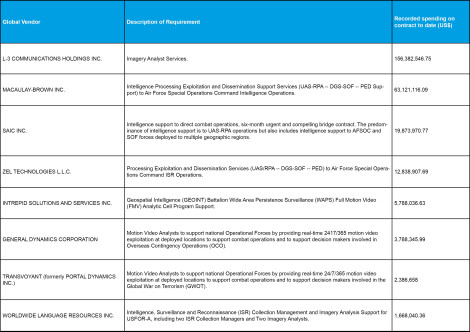
    Table: US Military Imagery Analysis Contracts since 2010 (click to enlarge)

    Data in this table is drawn from public sources including the Federal Procurement Data System (fpds.gov), Federal Business Opportunities (fbo.gov) and contractual material released under the Freedom of Information Act. Business information is taken from Bloomberg, Hoovers and Orbis. Companies named in the reporting but not included in this table are BAE, Booz Allen Hamilton and Advanced Concepts Enterprises. The Bureau has documented evidence of their involvement in ISR from sources other than contracts and transaction records. For the full dataset please see https://docs.google.com/spreadsheets/u/1/d/1WpSvDKGyraU5koQheFIgO7fUCIrSUxG5o7R9cS042_I/pubhtml

    Data in this table is drawn from public sources including the Federal Procurement Data System (fpds.gov), Federal Business Opportunities (fbo.gov) and contractual material released under the Freedom of Information Act. Business information is taken from Bloomberg, Hoovers and Orbis.
    Companies named in the reporting but not included in this table are BAE, Booz Allen Hamilton and Advanced Concepts Enterprises. The Bureau has documented evidence of their involvement in ISR from sources other than contracts and transaction records.
    Click here for the full dataset

    The Bureau identified over $260 million of screening transactions. But this is a niche market compared to the wider outsourced ISR effort. The private sector has been operating smaller surveillance drones over Afghanistan and other countries, managing communications between drones and their bases in the US and elsewhere, maintaining data collection systems and servicing sensors, to name just some functions. Procurement costs for these services run into billions of dollars.

    Questions of accountability come to the fore in this type of outsourced warfare. Following considerable pressure, the military now publishes figures of contractors on the ground in Iraq and Afghanistan. But this transparency does not extend to ISR missions conducted in those countries – or elsewhere – from behind computer screens in Florida and Nevada.

    From Screening to Targeting?

    Although contractors are so far not supposed to have their fingers on the drones’ triggers, fears have been expressed that this distinction might be harder to maintain in practice. One military outsourcing specialist, Laura Dickinson, told us that if the ratio of contractors to government personnel swells, “oversight could easily break down, and the current prohibition on contractors making targeting decisions could become meaningless.”

    Shortly after The Bureau published its investigation in The Guardian, the Pentagon announced that it would ramp up the number of ISR missions with ten new contractor-operated MQ-9 Reaper Combat Air Patrols. This puts contractors into the driving seat of large, combat-capable drones for the first time, although the Pentagon says these will be “ISR only”. The private sector’s involvement in drone warfare, it seems, is just taking off.


    Crofton Black is a researcher, journalist and writer with extensive experience of complex investigations in the field of human rights abuses and counter-terrorism. He is a leading expert on the CIA’s rendition, detention and interrogation programme and a specialist in military and intelligence corporate contracting. He has a PhD in the history of philosophy from the University of London.

    Crofton completed a report for the Remote Control Project last year on the use of contractors in US special forces operations.

  • Sustainable Security

  • Sustainable Security

    The beginning of the Arab Awakening and its mass-based social and political mobilizations has spurred a dynamic debate about whether and how the international community should support and back the revolutions across the Middle East and North Africa region. An especially thorny and controversial issue has been that of armed intervention: are there circumstances under which external parties should become militarily involved on the ground? If yes; with what goal? Debates over the legitimacy of direct external intervention have been widely discussed in the past few years; often with a specific reference to the emerging ‘responsibility to protect’ (R2P) norm.

    The concept itself began to be employed in the early 2000s as a term of reference to replace the more ambiguous and controversial ‘humanitarian intervention’ framework. The idea of R2P broadly posits that sovereignty, beyond rights, also encompasses duties; and specifically the obligation for each state to guarantee the safety and protection of its citizens. If the state is unable or unwilling to do so, the international community has a responsibility to assist it, and if these efforts also fail, outside intervention—including but by no means limited to military action—can become justifiable. Since the endorsement of the concept within the international community, first by the United Nations General Assembly and then by the UN Security Council (UNSC), the principle of R2P has been used to both stress individual countries’ obligations towards their own people, as well as to argue in favor of international intervention to uphold the principle.

    In this context, the UNSC’s authorization of the use of force in Libya is often cited as a watershed moment in the development of R2P. But did military intervention in Libya assist or hinder in the strengthening of a global ‘responsibility to protect’ norm?

    A Royal Air Force Typhoon pilot enters the cockpit as the sun sets over Gioia del Colle, southern Italy. As RAF Typhoon aircraft play a greater part in deliberate targeting operations, where targets are pre-planned, more are carrying four of the 1000lb Enhanced Paveway II bombs. The aircraft's ability to use its Litening III targeting pod to direct the highly accurate bombs means that a single Typhoon can have a devastating effect on Qadhafi regime targets. This image is available for non-commercial, high resolution download at www.defenceimages.mod.uk subject to terms and conditions. Search for image number 45152844.jpg ---------------------------------------------------------------------------- Photographer: Sgt Pete Mobbs Image 45152844.jpg from www.defenceimages.mod.uk

    Image of RAF Typhoon pilot climbing into the cockpit before a mission over Libya by Defence Images via Flickr.

    To some observers, the Libyan intervention gave R2P the boost it needed. They argue that the principle itself was invoked to support external military intervention. Accordingly, this gave R2P ‘teeth’ whilst showing its growing international legitimacy and acceptance. Yet, a closer reading of the international community’s reliance on R2P in the weeks preceding Operation Unified Protector may lead to lesser enthusiastic evaluation. On the one hand, it is true that both UNSC 1970 (2011) and 1973 (2011) urged the government of Libya ‘to meet its responsibility to protect its population’ thus openly referring to R2P. On the other hand, when it came to justifying the use of force, the UN Security Council grounded its authorization on Chapter VII of the UN Charter, after labeling the violence taking place in Libya a threat to international peace and security.

    On balance, while the period leading up to NATO’s Operation Unified Protector did show a growing role and relevance for the R2P norm in the international arena; still it would be an exaggeration to say that military intervention was grounded solely (or even predominantly) on R2P. This is the case even though it is possible to justify Operation Unified Protector according the ‘R2P’ criteria: the intervention came in response to the Qaddafi government’s manifest brutality and unwillingness to halt targeting of its population and it was encouraged not only by prominent internal defections but also backed by significant regional support. The use of force was also directly authorized by the UNSC, though Resolution 1973 (2011). Finally, the official mandate of the operation, which included employing all ‘necessary means’ to protect ‘civilians and civilian populated areas under threat of attack’ was—despite being quite broad in its scope—was similarly in line with the R2P framework.

    But whether it would be correct to state that R2P was revitalized in the discussions leading up to the beginning of Operation Unified Protector, it is important to look at both the conduct and the legacy of the intervention to make a more long term assessment of its impact on R2P.

    Here the record is decidedly mixed. Operation Unified Protector’s mandate was about civilian protection, while explicitly excluding a military occupation of Libya and reiterating the international community’s commitment to ‘Libya’s ‘sovereignty, independence, territorial integrity and national unity.’ Yet in its actual military operations it is possible to see how the military mandate was gradually stretched beyond the original (or intended) boundaries, leading to the de facto pursuing of regime change in Libya. By the spring of 2011, military sorties against the regime’s military and communication gradually went beyond merely disabling the government’s capacity to harm the civilian population and directly focused on weakening the regime’s military capabilities, in turn key to shifting the balance of power against Qaddafi. This is especially the case as NATO’s military operations, including air-cover provision for opposition forces, went hand-in-hand with coalition members, like France or the UK, active train and equip programs of rebel groups.

    While these actions were not blatantly disregarding UNSC Resolution 1973—they indeed be seen as necessary to prevent and halt targeting of the civilian population—still they certainly stretched the mandate to ‘the absolute limit’—as argued by Gareth Evans. While such ‘mission creep might have been inevitable and dictated by the changing realities on the ground, still in NATO’s gradual expansion of its operations went de facto well beyond the UNSC 1973.

    In turn, this fueled criticism from countries like Russia or China, states that were already skeptical about the merits of the R2P framework and championing a much stricter interpretation of state sovereignty and the right to non-interference. Put simply, the ‘generous’ interpretation of the mandate in Libya contributed to further curb the international enthusiasm for the emerging R2P norm. It allowed countries like China to become even more skeptical and reluctant to authorize future ‘R2P’ operations, citing the risk that the limited mandate will be then extra-judicially expanded to pursue regime change. Criticism has also come from countries lacking a strong pro-state sovereignty stance. For example, Brazil has argued for the creation of stricter guidelines and monitoring mechanisms to prevent future unauthorized expansion of the norm.

    In this context, the Libyan experience has certainly not helped making the case for R2P or strengthening its popularity on the global stage. The general skepticism towards R2P in Libya undermined the level of international consensus for the R2P norm and laid the basis for the reluctance to authorize a similar mission in Syria. At the same time, it is important not to over-emphasize the link between Libya and Syria. Geopolitics explains the lack of R2P intervention and UNSC agreement on Syria better than international law. Here factors like the Syrian regime’s better air-defense system and military apparatus, the strong economic and political interests of countries like Russia in supporting the Assad regime, the more fractionalized nature of the anti-Assad opposition, and the far less prominent direct national interests of NATO member countries in Syria all help understanding the lack of agreement and decisive strategy to deal with the protracted and blood conflict.

    Still, Operation Unified Protector did not strengthen the overall stance of R2P on the global arena, while underlining some of the pre-existing dilemma related to humanitarian intervention, including how to prevent its politicization (or whether that is possible at all); how to ensure strict adherence to the mandate and how to remain engaged in the ‘day after’—another key shortcoming of the Libyan intervention.

    Dr. Benedetta Berti is a foreign policy and security researcher, analyst, consultant, author and lecturer. Her work focuses on human security and internal conflicts, as well as on post-conflict stabilization (specifically integration of armed groups, democracy/governance and crisis management and prevention) and peacebuilding. Dr. Berti is the author of three books, including Armed Political Organizations. From Conflict to Integration (Johns Hopkins University Press, 2013) and her work and research have appeared, among others, in Al-Jazeera, Foreign Policy, Foreign Affairs, the Wall Street Journal and The New York Times. She is a fellow at INSS, a TED Senior Fellow, a FPRI Senior fellow, a Young Atlanticist Fellow, a Körber Foundation’s Munich Young Leader and a member of the UN Alliance of Civilizations “Global Experts.” In 2015 the Italian government awarded her the Order of the Star of Italy (order of Knighthood).

  • Marginalisation of the majority world

    This paper examines the context of the decision to go to war after 9/11 and the anticipated results. It goes on to analyse the actual  consequences and seeks to explain why they have been so radically different to original expectations by the United States and its closest coalition partners such as the UK. The paper then updates the analysis of the major global challenges that Oxford Research Group has previously discussed and the need for a new paradigm focused on sustainable security. It concludes by assessing how the experience of the eight years that have followed the 9/11 atrocities might make a change of paradigm more likely.

    Read more »

  • Sustainable Security

  • Sustainable Security

    This content is password protected. To view it please enter your password below:

  • Scarcity, security and institutional reform

    On 25th August Alex Evans presented a paper on scarcity issues – water, food, energy, land and climate security, to staff from the UN Department of Political Affairs as part of a three day session on security threats organised by the Geneva Centre for Security Policy. 

    Alex’s paper highlights the interconnected nature of scarcity issues and the need for the multilateral system to mitigate scarcity trends collectively.

    It goes on to highlight seven key agendas requiring focus:

    1) Improved surveillance and early warning

    2) Mitigation of unsustainable population growth

    3) Increased focus on agriculture – especially smallholder agriculture

    4) Social protection systems and safety nets

    5) Increased natural resource governance

    6) Conflict prevention

    7) Upgrade emergency response capacity 

    For more details on each of these issues you can read Alex’s excellent paper here.

    Alex Evans is a Non-Resident Fellow at the Center on International Cooperation (CIC) at New York University. This article originally appeared on Global Dashboard. 

  • Climate change

    International Alert’s Janani Vivekananda discusses how climate change will will interact with other social, economic and political stressors to drive instability.

    “Rather than climate change being this single, direct causal factor which will spark conflict at the national level,” Vivekananda said, these stressors “will shift the tipping point at which conflict might ignite.” In places that are already weakened by instability and conflict, climate change will simply be an additional challenge.

    Source: youtube 

    Read more »

  • Sustainable Security

  • Sustainable Security

  • Sustainable Security

    There are a number of pressing global problems that we need to address in order to attain sustainable security, such as climate change, increasingly scarce resources, and the surge of violence by globally interconnected non-state actors. If not dealt with, these issues will lead to increased regional instability and perpetual political violence. Although these issues are recognized as pressing concerns, we have not been able to find effective solutions. Underlying this failure is the exclusion of the majority of the global community from policy-making processes. This marginalization can lead to ineffective policies as they fail to consider the interests and values of a large part of the world’s population. Furthermore, given the results of social science research examining the role of values in decision making and in motivated action, policies that are ignorant of core values of the stakeholders will not only fail to garner popular support, they may, in fact, spark resistance and ignite violence.

    Background

    Most current approaches to negotiation and policy making assume that people make rational decisions – they weigh the benefits and costs of decisions and act in a way that maximizes their payoff. The values people try to maximize can be different for each party but they are assumed to be fungible: people may give up one value for achieving the other. Following these assumptions, policies and interventions often use incentives (e.g., tax breaks) or disincentives (e.g., sanctions) in order to influence the decision making of the stakeholders.

    This business-like approach to policy making and interventions has led to the successful resolution of many problems, even very difficult ones. For instance, the Egypt-Israel peace treaty of 1979. In general, as long as the values of the stakeholders can be identified, incentives and disincentives can be designed effectively, leading to successful policies.

    However, despite numerous attempts and the best efforts by the parties involved, this approach has been attempted in vain in an increasing number of contexts, and it has failed so frequently that some issues are now assumed to be intractable. A prime example is the Israeli-Palestinian conflict, where the majority of the people involved seem to have lost all hope: according to a 2015 poll by the Konrad-Adenauer-Stiftung, 51% of Israelis and 38% of Palestinians believe that the conflicting parties will not even return to the negotiation table. In other contexts, like the Northern Ireland or Kosovo conflicts, solutions devised with current approaches may prove to be unsustainable as they have neglected to address underlying concerns.

    Sacred Values

    The lack of success of current approaches is due to the underlying assumption that all values are in principal fungible: that they are mutually interchangeable. Social science research over the last 20 years suggests that this is not the case. Instead, people consider some values as so important or absolute that they refuse to even measure them on the same metric as material values. Consider, for instance, how parents may react were one to offer them money for selling their child. Most parents will decline the offer no matter how much money in involved. They will regard even considering the value of their child in monetary terms as immoral. Moreover, they will likely feel insulted and disgusted by the offer. One would get thrown out of the house if not directly reported to the authorities. This result is due to the fact that the offer fails to consider the duty most parents feel towards their child; business-like negotiation will not only be futile but will most likely backfire leading to moral anger and a breakdown of relationships. Such core values that seem to be resistant to tradeoffs with material values (e.g., monetary gains or job security), have been termed “sacred values”.

    As the name suggests, sacred values can be religious (e.g., holy land or sanctity of life) but they need not to be (e.g., equality or racial purity). However, religious ritual can transform material values into sacred ones. For example, when land is transformed from an agricultural and residential resource into “holy land.” This seems to be particularly the case in existential conflict between groups when people feel that their very existence is threatened, as is the case in the conflict between the Israelis and the Palestinians. Studies conducted before the Iran nuclear deal also found that under high pressure from other countries, a politically meaningful minority of Iranians (14%) have come to consider the nuclear program as a sacred right suggesting that material values can become sacralized in a relatively short time. The process of sacralization, however, is not well understood yet.

    When it comes to reasoning over sacred values, neuroscience studies show that decisions relating to sacred values are processed differently in the brain from material cost-benefit calculations. When people reason over sacred values as compared to material values, they are more concerned with the rectitude of their actions than with prospects. In other words, they are more concerned with morality and duties than with expected outcomes. If policy proposals that affect sacred values fail to consider this different mode of reasoning, the expected outcome is not only failure to achieve the intended aims but also resistance by the affected people, which can result in violence.

    Seemingly Intractable Issues

    Boy_and_soldier_in_front_of_Israeli_wall

    A Palestinian boy and Israeli soldier in front of the Israeli West Bank Barrier. Picture taken by Justin McIntosh. Image via Wikimedia Commons.

    Research shows that the core issues in a number of seemingly intractable conflicts are indeed considered sacred values by sizable parts of the populations involved, who show counterintuitive reactions to proposed solutions leading to a failure to resolve the issue. For instance, one research study on the support of peace deals in the Israeli-Palestinian conflict presented a peace proposal that required giving up core demands (e.g., the right of return for Palestinians). It found that “sweetening” deals with material incentives can actually backfire and exacerbate the situation. When presented with the peace deals, only a minority of Palestinians showed increased support when deals were sweetened with material incentives such as compensation payments in the form of development aid for a Palestinian state resulting from the agreement. However, the vast majority of Palestinians (more than 4 in 5) considered their core demands as sacred values and reacted with moral outrage when the deal included material compensation. They also predicted increased violent resistance if such a deal was to be agreed to by their leaders. This “backfire effect” of material incentives has since been demonstrated by Israeli Settlers when asked about giving up settling in Gaza and the West Bank (land they believe was promised to them by God) and in other seemingly intractable conflicts such as the Iranian nuclear ambitions (right to development of nuclear energy), the Hindu-Muslim conflict in India (Kashmir), and militant Jihad in Indonesia (Sharia law).

    In addition, across a number of different contexts, sacred values have been shown to incite strong emotions and spur extreme actions in their defense. People are willing to fight for their sacred values well beyond the prospect of success, seemingly disregarding self-interest. The concern for sacred values seems also to be a driving factor for the droves of young people who have been joining Islamists in Syria and Iraq, exchanging the relative comfort of their home countries for a war zone risking life and limb. For instance, a study among potential Jihadis in Morocco – one of the countries with the highest levels of foreign fighters leaving for Syria and Iraq – showed that people who considered Sharia law as sacred, expressed heightened support for militant Jihad and willingness to fight and die for the implementation of Sharia in Morocco.

    Achieving Sustainable Security

    The reality that sacred values are not fungible with material values and that otherwise reasonable policies and interventions can badly backfire does not mean we need to completely refrain from dealing with sacred values altogether. Conflicts over sacred values are not unsolvable. In fact, the very study that first demonstrated the backfire effect of business-like approaches in the Israeli-Palestinian conflict also found a reason for hope: people who considered the core demands in the conflict as sacred did show willingness to compromise if the other side made some painful concession relating to their deeply held sacred values. In particular, Israelis and Palestinians showed more flexibility regarding their sacred values when the deal included mutual recognition; that is, Palestinians would recognize Israel as a Jewish state and Israelis would recognize the role of Israel in the Nakba (Arabic for “catastrophe,” a term that relates to the expulsion and flight of Palestinians from what now is Israel). However, identifying these kinds of resolutions requires knowledge of the sacred values of all involved parties and thoughtful consideration of them in devising solutions. Unfortunately, our knowledge of sacred values held by communities worldwide is scarce.

    Just like the global clusters of values shown by the recurring World Value Survey, we can expect sacred values to differ considerably across communities and cultures and to change over time. At the minimum, we need to systematically assess sacred values across the world (similar to the World Value Survey), so decision-makers can have access to this knowledge. But for security to be sustainable in the long run, we will also need to bring communities with different sacred values to the table when we seek solutions to the most pressing issues we face today. The world cannot afford a policy-making process with global impact that is dominated by a small exclusive group of countries (e.g., the permanent member states of the UN security council) without regard for the multitude of cultures and values in the world. Because of this ignorance about the core concerns of large parts of the global community, our policies and interventions may not only fail to successfully address the issues at hand, but may actually badly backfire – by accidentally violating sacred values of the people they impact – and lead to more unrest and instability.

    Hammad Sheikh is an ARTIS research fellow at the New School for Social Research and a visiting scholar at the Centre for the Resolution of Intractable Conflicts (Harris Manchester College, Oxford University). He received a Psycholgie Diplom from the Free University of Berlin and a PhD in social psychology from the New School for Social Research. Prior to his studies at the New School, he conducted research at the Max-Planck-Institute for Human Development in Berlin, the University College Dublin, and the Free University of Berlin. His research focuses on the psychology of intergroup conflict, and uniquely brings together field research (e.g., interviews with combatants in war zones) with traditional psychological methods like questionnaires and cognitive experiments. He is currently examining how commitments to groups and values can lead people to become willing to make extremely costly sacrifices for a cause, including fighting and dying for it.

  • Sustainable Security

    This interview was conducted by the Remote Control project. 

    Dr. Jon Moran is Reader in Security and the School of History, Politics and International Relations at the University of Leicester. He is interested in the role of the state and military and intelligence agencies both domestically and internationally. He has conducted field research with police and security agencies and civil society activists in Western Europe, Eastern Europe, South Africa and East Asia. For three years he conducted training for the EU for security professionals on the reform of intelligence agencies as part of a programme on Security Sector Reform. He wrote a Briefing Paper on understanding and evaluating Remote Warfare in 2015 for the project. It is available here and organised a conference on remote Warfare in conjunction with the Remote Control project in February 2015.

    Dr. Moran’s last book was ‘From Northern Ireland to Iraq: British Military Intelligence Operations, Ethics and Human Rights’ which covers the role of army intelligence and special forces since the 1970s. He is currently working on a book concentrating on the use of intelligence and special forces in the most recent phase of the War on Terror.

    In this interview, Dr. Moran discusses the use of remote warfare in Libya, its effectiveness and some of the key problems yielded by the use of this tactic.

    Q. In 2011, the UK took part in the NATO military intervention in Libya which led to the overthrow of Gaddafi. Official government statements suggest that the UK’s military operations in Libya both began and ended with this campaign. Since then, however, evidence has gradually surfaced suggesting that the UK has been conducting ‘remote warfare’ in Libya. What is remote warfare and how has this tactic been used in the case of Libya?

    Remote warfare is a term used to describe a group of tactics that allow states to prosecute military activities from a distance rather than using conventional warfare. These tactics include:

    1. the use of special operations forces (SOF) either directly, or as trainers or mentors to local forces
    2. the use of airpower (including drones)
    3. the use of intelligence assets to direct forces on the ground and
    4. the use of local security forces, either official forces or militias or paramilitaries.

    One important thing to note about remote warfare is that it is a set of tactics that can be very effective. Remote warfare was employed in Libya in 2011. United Nations Resolution 1973 called for the protection of civilians against threats by the Gaddafi regime. However, the use of airpower for this purpose was then expanded by Western and other powers into remote warfare in order to overthrow the Gaddafi regime.

    In 2011 the civil war between Gaddafi and the rebels was in a stalemate. It was not just airpower that made the difference to the rebels. In addition to airpower, special forces from France, the UK and Qatar were deployed not just for forward air control, but to help the rebels become a more professional force. Special forces and UK intelligence assets were used to support the rebels as they advanced. This involved assistance to them in developing combat plans, gaining tactical skills, identifying Gaddafi forces, and supporting them with air strikes on Gaddafi forces. Foreign intelligence support was particularly important in the final operation to take Tripoli. It is my assessment that without this remote warfare support the rebels would have been unable to defeat Gaddafi.

    However, this also highlighted one problem with remote warfare. Although as a set of tactics it can be very effective, it cannot by its nature involve long term planning. Following the overthrow and execution of Gaddafi, Libya descended into chaos. This chaos, involving the development of militias, organised crime, widespread general crime and the collapse of public services led to such instability that Islamic State (IS) identified Libya as a suitable base for its operations outside Iraq and Syria. Such has been the instability in Libya since 2011 that the West is now engaging in a second round of remote warfare to defeat IS forces in Libya and promote one of the competing governments as a stable political actor. This is having success in defeating IS but it still leaves the future of Libya in doubt.

    Remote warfare can have strategic effect (in overthrowing Gaddafi and defeating IS) but it is not a strategy in itself. If it is not part of a long term strategy it may end up creating more problems than it solves.

    Q. So what are the problems that remote warfare can create?

    Remote warfare can have a short term strategic effect (e.g. in stabilising or overthrowing a regime). But by its nature it cannot have a long term strategic effect. Remote warfare involves small numbers of specialist troops (special forces, intelligence, air control) and air power which by their nature cannot be deployed over the long term and can only have a limited effect. Even if remote warfare operatives work with local security forces or militias they cannot control them over the long term since they are small in number and that is not the point of a remote warfare mission. With this is mind remote warfare can create a number of problems:

    • Long term instability. The overthrow of Gaddafi in Libya in 2011 was a classic example of a successful remote warfare operation. But the operation had no plans for the aftermath. Libya descended into political and security chaos with rival governments, militias and criminal groupings all contributing to a situation in which citizens became more insecure. By 2016 Western and other states were again engaging in remote warfare in Libya, this time to try and stabilise the area and defeat IS – aiming to solve the problems created by the first phase of remote warfare in 2011.
    • Perpetuating conflict. In places such as Yemen remote warfare may assist local forces but not in a game changing (strategic) way. It may end up creating a stalemate where no side is strong enough to prevail and ongoing conflict continues to cost civilian lives and create insecurity.

    Overall, remote warfare is no substitute for a long term commitment, either politically (though aid and diplomacy) or militarily (large scale deployment in conjunction with local forces – itself a serious decision).

    Q. Given the problems that remote warfare can create, why is the use of remote warfare by states on the rise?

    For a number of reasons. One is the lack of success of long term deployments of regular troops by Western countries in Iraq and Afghanistan. In Iraq approximately 4500 US military troops were killed and over 30,000 wounded. In Afghanistan the casualties were fewer but the conflict dragged on for a long time. Both conflicts have to be judged as a failure. Iraqi security was only evident for a period after the surge in 2007 and then the rise of Islamic State showed how weak public security was, and is, in Iraq. In Afghanistan the Taliban remain undefeated and indeed the period after 2010 saw the UK and US negotiating with the Taliban and redefining them as insurgents rather than terrorists in the global jihad against the US. Remote warfare is a way for the US to maintain its pressure on jihadist groups without necessitating massive troop deployments and long term counter insurgency operations. It saves money also – both wars cost the US perhaps $3 trillion dollars.

    For the UK, remote warfare is way of keeping up its security profile and assisting the US as its conventional power has declined. The UK military was, in a sense, exhausted after Iraq and Afghanistan and then military cuts imposed by the Coalition government further reduced its capacity for large scale deployments. Further, the UK public would not support any large scale ground force deployment for the next few years or in the absence of direct major terrorists attacks on the UK. They are more inclined to support remote warfare.

    The French have used remote warfare in Mali and Libya because again it is way to maintain a security presence without the large deployment of troops that the French public might not support even after the IS attacks in France. The French already had a crucial experience with large scale troop deployments and drawn out conflict in Indochina and Algeria in the 1950s and 1960s, and since then have often relied on airpower and paratroopers to support friendly local regimes in Africa.

    It should also be pointed out that although remote warfare by Western states has been patchy in its success, elsewhere countries are using remote warfare very effectively. The Russians have used remote warfare very effectively in Ukraine. They have used special operations forces, military advisers and local militias supported where necessary to take the Crimea and parts of eastern Ukraine under effective Russian control.  Remote warfare seems to have been a success in Syria. The Iranians developed remote warfare against the Coalition forces in Iraq after 2003 and have been involved in remote warfare in the Lebanon supporting Hezbollah for a long period.  Recently, they have joined with Russia in using local or other forces (such as Lebanese Hezbollah) and their own operatives to stabilise the Assad regime, while Russia has employed surveillance, reconnaissance and airpower to batter the rebels. These are successful operations because they have been used by Russia and Iran not as an antidote to the failure of large scale operations – they have seen what disasters this can bring and they also want to avoid direct conflict with the USA. Rather, for them, remote warfare allows them to achieve their objectives – it’s a useful way of achieving foreign policy objectives. For the West, remote warfare is often a reaction to previous failures at invasion, occupation and nation building.

    Q. So is remote warfare better at achieving political stabilisation or destabilisation?

    I think overall remote warfare is better at destabilisation. This is not to say that remote warfare cannot stabilise countries. There are examples including the US in Afghanistan (2001-02), the UK in Sierra Leone (2001), and the French in Mali (2011) where remote warfare successfully defeated local militias or terrorist groupings and prevented the further development of conflict. In Afghanistan the Taliban, never viewed as legitimate and not in full control of the country, was deposed and a fragile democracy imposed; in Sierra Leone remote warfare helped to defeat the militias who were opposed to the UN brokered peace agreement; and in Mali remote warfare prevented the overthrow of the government by a combination of insurgent and terrorist groups.

    However, remote warfare only started these processes. In all three cases extra support in the areas of security, aid, civilian assistance etc. was provided to make sure the stabilisation was secured in the longer term. In areas where remote warfare has been the start and the finish of the operation it has created far more instability. Libya is the prime example, where intervention successfully overthrew Gaddafi but left the country in anarchy. In Yemen it is also the case as is the remote warfare conducted on the Pakistan-Afghanistan border. Remote warfare operations in these two areas have ‘managed’ conflict and have not reduced it.

    Remote warfare is only the start of any process of intervention. It might be seen as useful tactic but it cannot operate in a vacuum. Russian remote warfare has been effective because the Russians have been working with strong local forces to effectively wrest parts of the Ukraine away; these territories will now need continuing Russian support (like other breakaway areas such as Transdnistria). In Syria the Russians (and Iranians) have been able to bolster Assad’s exhausted but still coherent national army. But a long term peace process will determine the future of Syria and Russia and Iran realise this – they have just used remote warfare to ensure Assad will be a big player in this and that rebel forces will not be negotiating from a position of strength. In Iraq, the rise of IS exposed the weakness of the Iraqi security forces. The US could only work with the Kurdistan Peshmerga and the reliable US-trained Iraq Special Operations Forces, assisted by Shia militias. The disparate group of local forces has been able to stop Islamic State’s advance but with far more difficulty than should have been the case. US and UK remote warfare support has allowed this but this is not any long term solution to the weakness of the Iraqi state.

    Q. Taking into consideration the mixed results of remote warfare, how do you see its use evolving in the future?

    Remote warfare will not replace conventional warfare but it is likely to be the dominant form of warfare for the next decade at least. There are differing reasons for this depending on the country involved. In the USA, the UK and France there is little public support for any large scale conventional intervention in other countries. So remote warfare remains the main way that countries such as these can maintain some sense of control. Taking into consideration the limits of remote warfare, this will probably remain reactive and have limited success. (It will remain a response to the long term problems of the West ‘Losing Control’ of international security as Paul Rogers pointed out in his book of the same name some years ago). For other countries such as Russia and Iran remote warfare has been effective and is a sign of their gaining more control as the West loses it. Russia used remote warfare effectively in Ukraine and now controls a substantial part of the east of the country and will likely use remote warfare to intervene where it feels necessary to protect its security interests. Iran effectively used remote warfare to destabilise the US intervention in Iraq after 2003 and to support the Assad regime in Syria. Other countries like Saudi Arabia and Qatar have employed remote warfare techniques in Yemen and Libya. It is possible that countries like China in its territorial disputes in Southeast Asia may use remote warfare to gain control of the islands involved.
  • Competition over resources: Drivers of insecurity and the Global South

    ‘By 2050, the global population is expected to peak at 9 billion. In an environment already constrained and changed by human activities, we can expect greater scarcity of three resources vital to the maintenance of both the economic order as it now stands, and the preservation of human life in general: energy, water and food. At current population levels, demand for some key resources is already unsustainable. As the number of people on the planet – and the number of people living “affluent” lifestyles – increases, and the effects of climate change are factored in, greater competition over resources is highly probable – affecting individuals, communities and states.’

    This paper is the first in a series of four papers written as part of the Sustainable Security and the Global South project, one each covering four likely drivers of insecurity over coming decades: competition over resources, climate change, marginalisaiton of the majority world and global militarisation.

    Each paper is the result of long-term collaboration between ORG and partners across the ‘Global South’. This collaborative network – made up of activists, analysts and academics from a range of think tanks, civil society organisation and research institutes – have recommended background reading, provided expert review and written illuminating case studies commission for each paper.

    See the full article here.

    Image source: Maks Karochkin

  • Sustainable Security

    Donald Trump has recently been critising his democratic allies, but he has been eager to revive the special relationship with the UK. Likewise, Theresa May has pledged to “renew the special relationship for this new age”. What are the drivers behind this development?

    Donald Trump has a thing for rebuking America’s democratic allies and their leaders—his latest target being Australia’s Prime Minister, Malcolm Turnbull. The UK appears to be an exception to this trend. In his first interview with the British press as president-elect, Trump explained that the UK has a “special place” in his half-Scottish heart and pledged to support a post-Brexit UK-US trade deal. Reportedly a big fan of Winston Churchill—and of Boris Johnson’s Churchill Factor—he also asked the UK government to loan him a Churchill bust that his Republican predecessor George W. Bush kept in the Oval Office.

    This got some people in the UK excited—and not just Trump’s old friends like Nigel Farage. Indeed, shortly after Trump’s inauguration, Downing Street announced that Prime Minister Theresa May would be the first world leader to visit America’s new president. On January 23, four days ahead of May’s visit, Sean Spicer, the White House press secretary, confirmed that two leaders would talk trade (of course he called May “the British head of state”) and that the US has “always had that special relationship with Britain.” He then added, with a peculiar giggle: “We can always be closer.”

    Looking at the visual images the media coverage left behind in isolation, you might think that May’s visit was a roaring success—the beginning of a beautiful Conservative-Republican friendship à la Margaret Thatcher and Ronald Reagan. Image one depicts the two leaders shaking hands against the background of Trump’s main Oval Office redecorations—the Churchill bust and the portrait of Andrew Jackson. Image two shows Trump and May holding hands while walking from the Oval Office to the press conference. Image three: a well-attended, convivial press conference.

    These images now depict a day that will live in infamy in the history of British foreign policy. A day after May left Washington—that is, on the Holocaust Remembrance Day—Trump’s “Muslim ban” came into force, causing worldwide shock and pain. Now even her supporters had to wonder: How did we ever think we could we do business with this misogynistic, racist man? And why was the prime minister prevaricating instead out outright condemning Trump’s policy?

    The standard answer is cold realpolitik. Scheduled to formally take the country outside the EU’s single market in 2019, the UK government is desperately searching for new trade deals. The U.S. market is the primary target—this was implicit in May’s Lancaster House speech (“We will continue to be reliable partners, willing allies and close friends”) and explicit in her speech at the Republican Party conference in Philadelphia (“I am delighted that the new Administration has made a trade agreement between our countries one of its earliest priorities”). Viewed from this perspective, hugging Trump close, while doing so in an extremely unedifying manner, is in Britain’s best interest—it is certainly in the best of interest of some Britons, as George Monbiot pointed out in his latest weekend column for The Guardian.

    Most Conservatives and probably at least a third of the British voters are in quiet support of staying the course. On the same day Trump’s press secretary giggled about the need for an ever closer special relationship. William Hague, former British foreign secretary and no supporter of Brexit, penned in The Daily Telegraph that the special relationship was Britain’s only “indispensable alliance.” Subsequent events did little to make him change his mind. To Hague, rather than retaliating against Trump’s policies—which is a minority demand anyway—the UK government should host the American president this summer as planned. As for the image of the queen being “within grabbing distance of America’s helmsman,” Britons would do well to recall that she has dealt with thugs before, wrote Hague on January 31.

    theresa-may-donald-trump-900

    Image (modified) by UK Home Office and Gage Skidmore.

    Bannon’s rules

    The special relationship has always been asymmetric, with the Americans acting as rule-makers and the British as rule-takers. That said, the rules have never before been made by Stephen Bannon, the American president’s “chief strategist.” Having likened himself to revolutionaries such as Lenin and Thomas Cromwell (and also figures like Darth Vader and Satan)  Bannon appears to be bent on remaking international order by moving the US away from “multilateralism”, “liberalism” and “democracy” and towards America First-styled “sovereignty” and “traditional values.” In practice, this means that the US is now openly hostile to the UN, WTO, NATO, the Five Eyes, to say nothing of the fragile global governance regimes on climate, human rights and arms control—while simultaneously being “open-minded” about Putin’s Russia and Europe’s far right.

    Related, Bannon, former executive chairman of Breitbart News, an information hub for conspiracy theorists, ultra-conservatives, authoritarians, fascists, white supremacist and other “alt-right” aficionados, seems to think of international relations are fundamentally inter-racial relations. American politics and American foreign policy textbooks cannot shed light on this particular America. A combination of Samuel Huntington, Carl Schmidt and Jared Taylor’s White Identity might.

    In every generation for the past seventy years there were those who saw the special relationship as a Faustian bargain for Britain. Their arguments usually never made it into the mainstream, however. As of last week, this has changed—compare the aforementioned Monbiot or Paul Mason in The Guardian to Gideon Rachman in The Financial Times, for example.

    As thousands of Londoners surrounded the US embassy this past Saturday under the banner “Make America Think Again,” it is worth asking where May’s Trump policy might take Britain. Among several memorable statements the prime minister made in her Philadelphia speech, one that received no media scrutiny was the claim that the UK and the US together “defined the modern world.” Not a diplomatic thing to say, but not necessarily wrong either. The British Empire, in its many forms and iterations, transformed the globe by making Britain and “Neo-Britains” rich, and those on the outside poor. Britain also never challenged the rise of the U.S. the way it challenged other imperial rivals—before the democratic peace came the Anglo-Saxon peace. And once the US moved to establish the so-called liberal international order after World War II, a special role was reserved for Britain. “Whenever we want to subvert any place, we find the British own an island within an easy reach,” said one American spook in 1952. The statement has aged well—it helps explain British foreign policy after Suez, after East-of-Suez, after the end of the Cold War and after 9/11. It may well be valid in the Trump era as well, albeit this time the island in question is likely to be Britain itself—Oceania’s “Airstrip One,” as depicted by Orwell in 1984.

    Srdjan Vucetic is Associate Professor at the Graduate School of Public and International Affairs. His research interests involve American and Canadian foreign and defence policy and international security. Prior to joining the GSPIA, Srdjan was the Randall Dillard Research Fellow in International Studies at Pembroke College, University of Cambridge.

  • Sustainable Security

    by Caroline Donnellan and Esther Kersley

    This article was originally published on openSecurity’s monthly Sustainable Security column on 22 June 2014. Every month, a rotating network of experts from Oxford Research Group’s Sustainable Security programme explore pertinent issues of global and regional insecurity.

    RC_long_logo_small_4webThis article is part of the Remote Control Warfare series, a collaboration with Remote Control, a project of the Network for Social Change hosted by Oxford Research Group.

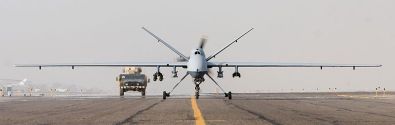
    An MQ-9 Reaper takes off on a mission from Afghanistan. Source: Wikimedia

    An MQ-9 Reaper takes off on a mission from Afghanistan. Source: Wikimedia

    The past week has marked ten years since the first reported US drone strike in Pakistan. It has also seen the resumption of strikes following a five-month pause. So how effective has the covert programme been and what impact have drones had on Pakistani society?

    Since 2004, the US has launched more than 380 strikes in the Federally Administrated Tribal Areas (FATA). As part of its “war on terror”, they were intended to eliminate mainly al-Qaeda and the Pakistani Taliban from the region. But a report by Dr Wali Aslam, commissioned by the Remote Control project, has found that drone strikes, rather than eliminating “terrorists”, have instead caused militants to leave FATA for other parts of the country to avoid being hit. Although the US deems its programme a success—indeed it has pursued some “high-value” targets and decreased the number of fighters in FATA—this is short-term at best, as drones have simply displaced the problem. In turn, this relocation has brought radicalisation, violence and crime to the regions of Pakistan where the militants have resettled.

    Unintended consequences

    Drones are deeply unpopular in Pakistan, due to the civilian casualties, psychological damage and infringement of sovereignty they entail. Growing anti-American sentiment has provided an effective recruitment tool for extremists, fuelling rather than minimising radicalisation. And relocation as a result of drone strikes has widened that recruitment pool, as militants have spread to regions with which they previously had no connection.

    In the Punjab, for example, there has been increased radicalisation among some Sunni Muslims. In Karachi, countless madrasas have provided a stream of potential recruits, undermining secular political parties such as Muttahida Qaumi Movement (MQM) and the Awami National Party (ANP). The attack on Karachi international airport on 8-9 June, in which at least 28 people were killed—supposedly in retaliation for a US drone attack—is a further example of the penetration of the Pakistani Taliban there.

    There has also been an escalation in violence more broadly in Pakistan since 2007. There have been an estimated 50,000 deaths due to suicide bombings, improvised explosive devices and gun attacks—an incidence of paramilitary activity unprecedented in the country’s history. Is this upsurge linked to US drone strikes? The Remote Control report shows a correlation between violence in Karachi, the FATA’s Kurram Agency and Punjab province since 2007 and US drone attacks in FATA during this period.

    Zooming in, in Karachi, attacks on secular parties, kidnapping and petty crime increased after 2010, coinciding with a dramatic rise in drone attacks in the same year (122, compared with 36 and 54 in 2008 and 2009 respectively). In Kurram Agency, the flight of large numbers of militants from neighbouring North Waziristan coincided with an increase in sectarian violence there (since 2007 the Turi Shia tribe has lost an estimated 2,000 members as a result). And in Punjab, an increase in attacks on Ahmadi, Shia and Christian communities since 2007 again coincided with many militants relocating from FATA.

    Of course, the Pakistan army’s own operations in parts of FATA and the north-west have contributed to the relocation of militants but the role played by US drones has been largely neglected. Yet they have exacerbated a delicate, vulnerable and complex socio-political environment.

    Remote-control warfare

    The decade-long experience can teach us important lessons. It highlights the failure of drone warfare as a “counter-terrorism” strategy and thus the limitations of remote-control methods more broadly to resolve conflict. As armed drones are increasingly used by the US in Somalia, Yemen and Afghanistan—and by the UK in Afghanistan—with more reliance also being placed globally on special forces and private military companies, so the remote-control trend spreads.

    The latest monthly briefing from the civil intelligence agency Open Briefing illustrates the proliferation of drone activity. The US is facing demands for access to drone technology from security partners—such as Algeria, Niger and Iraq—as well as intelligence, surveillance and reconnaissance capacity. Iran has unveiled its reverse-engineered version of the US drone, the RQ-170 Sentinel, and its maturing drone-development programme is benefiting from operations in Syria. Meanwhile, the Israeli Air Force has been carrying out drills to prepare pilots to shoot down more advanced potential Hezbollah and Hamas drones, expected to be faster and able to stay airborne longer.

    The volatile north-east Asia region is also seeing a rapid proliferation of unmanned technologies. The US Air Force will be deploying two Global Hawk drones from Misawa air base in Japan, for surveillance of North Korean and Chinese military activities. The Japanese Air Self-Defence Force is expected to procure three Global Hawks in 2015. South Korean officials have confirmed that drones found near the North Korean border in early April were most likely owned by North Korea. China has a vigorous armed-drone development programme, which appears to be prioritised for maritime security.

    Global insecurity

    As the military technology for remote-control warfare spreads, there is a need to question whether drones provide significant tactical advantage or whether their proliferation could lead to greater long-term global insecurity. A RAND report in April concluded that medium-range, non-stealth drones only deliver advantage in limited military contexts. Yet rapid growth is forecast in the drone market: in the same month, Forecast International predicted expansion of drone exports from $942m to $2.3 billion per year between 2013 and 2023. It estimated that, by 2017, the Aviation Industry Corporation of China would be the largest manufacturer and, by 2030, half of the aircraft fleets of some militaries could consist of drones.

    The use of drones in Pakistan has spread the threat of violence to other parts of the country and detrimentally affected Pakistani society. Rapid drone proliferation raises serious concerns as technological developments and exports widen the range of deployers. Avoiding “boots on the ground” through remote warfare appears an attractive new means of “counter-terrorism”, for obvious reasons. But the unforeseen consequences which could render this counter-productive need to be factored into the equation.

    Caroline Donnellan manages of the Remote Control project of the Network for Social Change, which examines and challenges the new ways of modern warfare, including the use of Unmanned Aerial Vehicles (UAVs), Private Security Companies, Special Forces, aspects of cyber warfare and surveillance methods. Caroline has a background in multilateral diplomacy and has worked on international security and human rights issues for a number of years. Before joining ORG, she was Senior Policy Advisor to the Ambassador, Irish Permanent Representation to the Organization for Security and Cooperation in Europe (OSCE) in Vienna. 

    Esther Kersley is the Communications Assistant for Remote Control. Prior to joining ORG, Esther worked in Berlin for the anti-corruption NGO Transparency International as an editorial and online communications officer. She has a particular interest in counter-terrorism and conflict resolution in the Middle East, having previously worked with the Quilliam Foundation and IPCRI (Israel/Palestine Center for Research and Information), a Jerusalem based think tank.

  • Sustainable Security

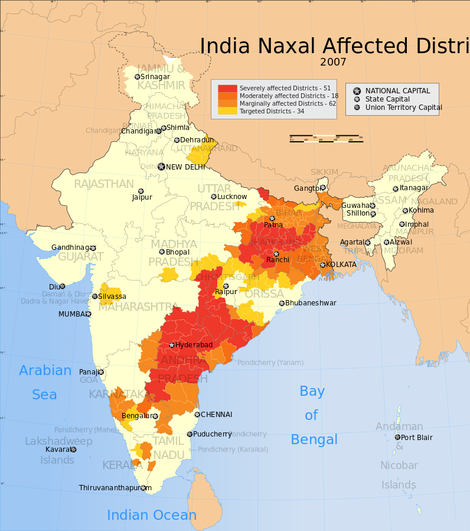
    After decades of largely unsuccessful military interventions against a long-standing Maoist insurgency, India’s large-scale labor market program MGNREGS has helped reduce conflict dramatically.

    Other than the conflict in Kashmir, Maoist violence is India’s longest-standing internal national security threat. The Maoists are predominantly active in the eastern parts of India, with strongholds in forest areas and places with substantial tribal populations who have seen little improvement in their living conditions since Indian independence 70 years ago. Over time, more than 160 districts have been affected by Maoist violence, and decades of military force by the Indian government have been largely unsuccessful. Conflict intensity escalated in the mid-2000s, but since then Maoist-related deaths have seen an unprecedented decline to reach the lowest level of violence in The number of districts severely affected by Maoist violence fell from 51 districts in 2007 to 12 districts in 2013, and the total number of Maoist-affected districts declined from 165 to 120 districts in the same time period.

    Areas with Naxalite activity in 2007. Image credit: Wikimedia.


    Areas with Naxalite activity in 2013. Image credit: Wikimedia.


    The Naxalite-Maoist insurgency in India

    The conflict started with a peasant revolt in the village of Naxalbari in the state of West Bengal in 1967, which led to a rising insurgency called the Naxalite movement. Naxalites use guerilla tactics in their fight against the government, and aim to overthrow the Indian state to create a liberated zone in central India. They wanted to improve the living conditions of the local population through redistribution of land and the revenue from mining activities.

    The intensity of the Maoist conflict rose dramatically in the mid-2000s, when previously competing Naxalite groups came together to create the Communist Party of India (Maoist). Large parts of east India were heavily affected by that violence, and the Indian government lost de facto territorial control over a number of districts. Civilians were often caught in between the Maoists and government security forces, since both sides had to rely on the local population for information and assistance in remote forest areas.

    In 2006, the Indian Prime Minister Manmohan Singh referred to the Maoist insurgency as the “single biggest internal security challenge ever faced by our country.” Maoist-related deaths rose rapidly, peaking with a large attack in 2009-10 that killed 76 policemen in Dantewada district. In recent years, fatalities have fallen to some of the lowest levels in decades, and the Maoists have been pushed out of many traditional areas of their control. According to government statistics, Naxalite deaths have risen by 65% and surrenders by 185% between 2014 and 2016. Maoist activities are now almost exclusively limited to 35 districts, although the insurgents retain a presence in 68 districts across 10 states.

    What factors explain this sharp rise and fall in violence?

    The Indian central and state governments responded to the increased violence after the creation of the Communist Party of India (Maoist) with a variety of measures. Personnel and spending on security forces were increased, and central and state paramilitary forces started operations against the Maoists that came to be referred to as Operation Green Hunt by the media. At the same time, expenditures on development programs were increased as well, with the hope of improving the living conditions of the local population and thereby the traditionally strained relationship between civilians and the government in Maoist-affected areas.

    One of the first development programs in Maoist-affected areas in this time period was MGNREGS (Mahatma Gandhi National Rural Employment Guarantee Scheme), rolled out across India between 2006 and 2008. MGNREGS guarantees 100 days of employment per year for each household at the minimum wage in public-works programs. The work projects focus on drought-proofing, irrigation and infrastructure improvements in Indian villages.

    The only eligibility criterion is that a household lives in a rural area and is prepared to work full-time in manual jobs at the minimum wage. This allows households to self-select into the program when they need it and covers about 70 percent of the population, making it the world’s largest public-works program. The annual expenditures under the scheme amount to about one percent of India’s GDP. In addition to its size, the program is unprecedented in India and worldwide because the program provides a legal guarantee for employment, which is enforceable in courts. It was rolled out in three separate phases, and the first implementation phase of the program was targeted to 200 of India’s poorest districts, many of which are in Maoist-affected areas, such as Dantewada and Bastar districts in Chattisgarh, and Anantapur district in Andhra Pradesh.

    What role did MGNREGS play in tackling Maoist violence?

    Image credit: Adam Jones/Wikimedia.

    Comparing districts that received MGNREGS to very similar districts that did not receive the program until later, in our research we find police attacks on Maoists intensified after MGNREGS came into effect. This is consistent with an improvement in the relationship of civilians with the government as a result of the program. Since civilians may have important information about the location of the Maoists, who rely on them for shelter and information on police movements, MGNREGS seems to have helped win civilians over and encourage them to share that information with the security forces. The Indian Home Ministry also attributes the increased success of catching Maoists to better intelligence gathering.

    In concurrence with the increase in police-initiated attacks, we find that the Maoists started retaliating against civilians. The rebels traditionally concentrated on attacking government forces rather than civilians, which makes this shift an important change in behavior. In leaflets and other documents, Maoists claim that the killed civilians were police informants and threaten to attack other civilians cooperating with the police.

    MGNREGS therefore appears to have contributed to the effectiveness of government forces by winning the “hearts and minds” of the local population. While this improved effectiveness lead to a short-run increase in violence as government forces become more pro-active, violence declined over time as security forces won more battles against the insurgents.

    This matches the recent substantial decline in Maoist-related violence. Up until around 2010 when MGNREGS was a relatively new program, Maoist fatalities increased substantially, and many top leaders surrendered. Since then, India has seen an impressive decline in Maoist-related deaths and areas under Maoist control. Anti-poverty programs like MGNREGS can therefore support more traditional counter-insurgency strategies if they manage to improve the local population’s relationship with the government. Since civilians take on large risks when choosing to share information on insurgents with government forces, this strategy will only be successful if civilians believe that the benefits from the program are large and long-lasting enough to be worth potential retaliation by the insurgents.

    MGNREGS was set up to be a more permanent program than other initiatives because of the legal guarantee and was enacted partly due to pressure from NGOs and social activists, who also played an important role in monitoring implementation quality. This buy-in from government and NGOs makes the program very different from similar programs elsewhere, and is likely to have contributed to its success.  Lower actual benefits than promised by the government remain a challenge in many developing countries, including India, however. If governments do not ensure a high level of implementation quality, transitory programs and broken promises will sow distrust with citizens, making future investments less effective.

    Authors’ Note: This text is based on our article “Guns and Butter? Fighting Violence with the Promise of Development”, published in the Journal of Development Economics in January 2017.

    Gaurav Khanna is an assistant professor of Economics at the School of Global Policy and Strategy, University of California – San Diego. His research focusses on conflict and the markets for education and labor in developing countries. 

    Laura Zimmermann is an assistant professor in Economics and International Affairs at the University of Georgia. Her research focuses on the labor-market and political economy impacts of government programs in developing countries, and she has worked widely on effects of MGNREGS in India.  

  • Sustainable Security

    Summary

    April has seen the inexperienced Trump Administration further escalate US military activities from Iraq and Syria to Afghanistan and Yemen. Attacking Syrian regime targets for the first time sent a clear signal of muscular change from the Obama era and suggested to President Trump a means to reverse his negative domestic approval ratings. However, it is the crisis over North Korea’s nuclear missile programme that has the greatest potential to escalate suddenly and disastrously into a conflict of global significance.

    Introduction

    Last month’s briefing, Sustainable Security in the Trump Era, discussed the outlook for the sustainable security approach in terms of the incoming Trump administration, concluding that in all three major areas of concern – economic, environmental and military – the Trump prospect was not positive. It would maintain a highly sceptical approach to climate change even if it might end up getting left behind technologically and economically, and its economic policies would do nothing to reduce the widening wealth/poverty inequalities that cleave American society.

    In terms of US security policy, the indications after two months in office were that Trump would expand the military budget and armed forces, give military commanders greater freedom of action, was willing to support an expanded global military posture and saw this as integral to “making America great again”. This briefing continues the overall theme in relation to the military outlook, the main emphasis being on the potential for a crisis involving North Korea.

    The Military Posture

    The March briefing identified a number of areas where the military posture was being expanded. These included an increased use of air power in supporting Iraqi troops attempting to take control of Mosul, the expanded use of Special Forces in Yemen, more powers for US forces to initiate action against militias in Somalia, and the deployment of additional ground troops to Iraq. In the past month there have been further indications of a military expansion.

    • In Iraq, the use of air power in Mosul has increased still further, although the so-called Islamic State (IS) remains entrenched in the western heart of the city.
    • In northern Syria, the US Air Force has been establishing an airfield between Kobane and Raqqa to support the looming offensive against this other stronghold of IS. Up to 1,000 more US troops are anticipated to join the 950 US Special Forces, Rangers and Marines already bolstering the mainly Kurdish Syrian Democratic Forces militia for this offensive.
    • In western Syria, the US Navy carried out a major sea-launched cruise missile raid on an Assad-regime air base in response to a suspected government attack on rebel-held Khan Sheikhoun that used chemical agents and killed many civilians.
    • In Yemen there have been 85 armed drone and strike aircraft attacks since President Trump’s inauguration, more than President Obama approved in 2015 and 2016 combined.
    • In Afghanistan the US Air Force used the world’s most powerful conventional bomb, the GBU-43/B Massive Ordnance Air Burst (MOAB), for the first time against an IS faction.
    • Also in Afghanistan, Trump’s National Security Advisor, General H R McMaster, arrived on a surprise visit that coincided with the deployment of several hundred US Marines to bolster the Afghan National Army, which was suffering increasing losses from attacks by Taliban and other armed opposition groups. There were calls for a further major increase in US military forces in the country at the start of the so-called “fighting season”.
    • Reports at the end of the month that the Trump administration has decided to hand more authority to the Pentagon in terms of how it conducts the wars in Iraq and Syria.
    • Trump diverted a ‘powerful armada’, including a carrier battle group and a nuclear submarine, towards North East Asia and says he fears a “major, major conflict” with North Korea.

    It is in this context that the burgeoning crisis with North Korea requires specific analysis.

    A Crisis out of Nowhere?

    During the course of the past month the issue of North Korea’s nuclear and missile development programmes has come to the fore for reasons which are not easy to pinpoint. It is true that there have been some additional tests of steadily more advanced missiles (one of which failed completely) and there is a possibility that a new nuclear test is being readied. Beyond this, though, little has changed on the North Korean side, and it is the Trump administration that has started to rethink policy, with this stemming from two factors.

    One, as already mentioned, is that Trump’s attitude to security is to focus far more on the use of military force and far less on diplomacy, in marked contrast to the Obama administration. In a sense this harks back to the George W Bush administration after the 9/11 attacks and the subsequent termination of the Taliban regime in Afghanistan. In his January 2002 State of the Union Address to Congress, Bush extended the war against al-Qaida and the Taliban to a conflict with the “axis of evil” centred on Iraq, Iran and North Korea. In the past 15 years, the Iraqi regime of Saddam Hussein has been terminated and the Trump White House is taking a harsh line over the recent Iran nuclear deal. This leaves North Korea and it is here that the second factor comes into play.

    Until a few months ago, US policy was to use sanctions and diplomacy in dealing with North Korea, not least in collaboration with China as the one state with serious influence over Pyongyang. This was based on an assessment that North Korea’s progress towards a functioning nuclear force capable of targeting the United States was still quite a few years off.

    There are credible reports that recent US intelligence analysis indicates that this is no longer the case and, specifically, that North Korea is progressing to the point where it could produce seven or eight nuclear weapons each year, compared with the previous assumption of one a year. It is also believed to be having success in shrinking the size and weight of warheads so that they can be carried by long-range missiles and that it is within a very few years of producing reliable intercontinental ballistic missiles (ICBMs) that could reach the United States. On a worst case assessment the belief is that North Korea might have up to 40 nuclear weapons by the end of President Trump’s first term, as well as being able to deploy the first of a number of ICBMs.

    The extent to which this is an exaggeration is simply not clear but that is not entirely relevant since President Trump and his advisors believe that the time to act is now. As he put it a few days ago: “People put blindfolds on for decades, and now it’s time to solve the problem”. This is because the worst case assessment is very much dependent on a very intensive programme of testing of missiles and of warheads and without this the progress of North Korea’s whole nuclear programme will be hugely limited.

    How to Act

    At the time of writing (28 April) the approach of the Trump administration appears still to be one of seeking much tougher sanctions in order to change the policies of the North Korean regime, but these will have minimal effect without severe sanctions on North Korea’s ability to import fuel. Since China is the dominant supplier, cooperation between Washington and Beijing has to be forthcoming but there are both generic and specific reasons why Beijing is not too sympathetic to putting further pressure on North Korea. The first are that any action which precipitates a collapse of the regime could lead to a war of survival by the regime, including the risk of nuclear use, it would certainly lead to a huge influx of refugees into China and even if the regime collapsed without social catastrophe, the prospect of a unified pro-Western regime on its borders does not appeal to Beijing.

    The specific reasons revolve around the manner in which the United States is using its military power in the expectation that the Pyongyang regime will change its policies, and there is a particular concern that the radar linked to the Terminal High Altitude Area Defence (THAAD) anti-missile system now being deployed in South Korea has the capacity to gain considerable intelligence on some of China’s key defence capabilities.

    China is also likely to be far more aware of the psychology of the North Korean regime and the way it sees its nuclear force as essential to state survival. Like some other states, it is only too well aware that not long after Gaddafi’s Libya gave up its WMD programme the regime was terminated with considerable NATO military support.

    In short, rapid action to effect a change in North Korea’s nuclear and missile plans has no chance of success – only longer-term careful diplomatic action may work. If not, then China, the United States and others will have to get used to the idea that a nuclear-armed North Korea will be a feature of the security of the region. It is worth noting that some leading Western military figures from the Cold War era that had experienced the dangers of the East-West nuclear confrontation ended their careers supporting the idea of global nuclear disarmament. That opportunity was lost and the world may have to get used to the consequences, at least in the case of North Korea.

    Conclusion

    Such a prospect, though, will not appeal to the Trump White House, and given that his administration is already putting far more emphasis on military thinking and options, there really is a risk that in the coming months the decision may be taken to undertake pre-emptive military action against North Korea’s warhead and missile production facilities. This is a highly unwelcome and potentially disastrous prospect but Trump has said that North Korea has to curb its ambitions. In effect he has drawn a red line and, since he criticised Mr Obama for doing so over Syrian chemical weapons and then failing to carry out his threat, President Trump may feel he can hardly afford the opprobrium that would follow should he fail to respond in this case.

    Moreover, this has a particular relevance for the UK, where the Foreign Secretary, Boris Johnson, has said that the UK would support further US action in Syria. With the Royal Air Force having conducted its first ever exercises with South Korean and US counterparts in Korea last November, this raises the issue of whether the same would apply in the case of North Korea, an interesting question at the start of a general election campaign.


    Image credit: Uri Tours/Flickr

    Paul Rogers is Global Security Consultant to Oxford Research Group and Professor of Peace Studies at the University of Bradford. His ‘Monthly Global Security Briefings’ are available from our website. His new book Irregular War: ISIS and the New Threats from the Margins will be published by I B Tauris in June 2016. These briefings are circulated free of charge for non-profit use, but please consider making a donation to ORG, if you are able to do so.

  • Sustainable Security

    by Janani Vivekananda and Shreya Mitra

    REDD forestry efforts don’t pay enough attention to their influence on local conflict dynamics. For REDD+ to be an effective mechanism to curb deforestation and strengthen peace opportunities, it has to pay more attention to pre-existing land and forest conflicts linked to tenure, take into account the interests of the local communities and be more sensitive to the local context .

    trucks carrying logs in Gunung Lumut, Kalimantan Timur, Indonesia, November 2005. Source: CIFOR (Flickr)

    Trucks carrying logs in Gunung Lumut, Kalimantan Timur, Indonesia, November 2005. Source: CIFOR (Flickr)

    Indonesia has for the first time surpassed Brazil’s historical record of being at the forefront of deforestation suggests a new study published in the journal Nature Climate Change. Despite a government-signed moratorium in 2011 to slow down the pace of deforestation, the study reveals that Indonesia has lost virgin forests of 60,000 sq. km, an area roughly the size of Ireland, over a period of 12 years.

    The accelerated rate of deforestation raises concerns about the governance of forests in Indonesia and the effectiveness of the moratorium. It also highlights the missed opportunities to preserve the forests and bring about greater peace dividends, especially in a context where peace remains fragile and unequal forest rights remain unresolved. In conflict-affected areas, availability and access to forest resources can either make conflict worse or contribute to peace. If you accept the case, as many do, that the impacts of climate change make it harder to build peace, there is also a compelling argument that mitigating climate change by reducing deforestation, if done right, could offer significant peace opportunities by addressing inequalities and grievances of marginalised forest-dependent communities.

    REDD Programmes and Peacebuilding

    Yet despite the importance of forests to both climate change mitigation and peace, deforestation continues at an alarming rate as seen in the case of Indonesia. To combat deforestation and preserve forests as carbon sinks, the United Nations Framework Convention on Climate Change (UNFCCC) in 2005 introduced a mechanism called Reducing Emissions from Deforestation and Forest Degradation (REDD). Under REDD, more developed countries pay for programmes in less developed countries to preserve forests. Later, a ‘plus’ was added to REDD introducing the elements of conservation, sustainable forest management and enhancement of forests as carbon sinks. The financial dimensions are significant. For example, Norway as the biggest contributor has pledged over $1.4 billion to REDD+ funds. Most of the money targets Latin America and the Caribbean, sub-Saharan Africa and Asia. For Indonesia alone, $156 million of REDD+ funding has been approved.

    From a peacebuilding perspective, REDD+ and other efforts to promote sustainable forest management offer both peace opportunities and conflict risks. The conflict risks of REDD+ often have to do with land ownership and forest access. The peace opportunities associated with REDD+ are wider recognition of the multiple economic, social and cultural values of forests and a strengthening of the rights of local communities that depend on the forest. Poverty may also be reduced if the financial benefits of REDD+ are shared, and income opportunities created for local residents, who may work as forest monitors and guards.

    In 2006, in Aceh, Indonesia, initiatives by the newly formed government on forest protection and supporting smallholder plantations, as well as the social opportunities offered by REDD investment, showed real promise for building a sustainable peace in the conflict-affected region. The REDD investment fell through after investors withdrew, but this experience hints at the potential for REDD to exert a positive influence on politics and power relations in a post-conflict context.

    Short-Term Gains

    Patchwork mountain landscape of agriculture, forestry, and deforested terrain, Tianlin County, Guangxi Zhuang Autonomous Region, China. Source: CIFOR (Flickr)

    Patchwork mountain landscape of agriculture, forestry, and deforested terrain, Tianlin County, Guangxi Zhuang Autonomous Region, China. Source: CIFOR (Flickr)

    Yet given the prospect of sums of money to be gained (in the short-run at least), there is a very real risk that communities can make decisions based on short-term profit or be bought off by entrepreneurs hoping to capitalise on REDD+. This means that while community involvement is critical, it alone is not sufficient and should certainly not be viewed as a silver bullet for equitable forestry that supports peace.

    As a member of the Dhankuta District Community Forest Management committee explained during International Alert’s research in Nepal: “Forest-user groups might plant trees but don’t always protect them. How can a forest grow if you just plant trees and don’t protect them? People have begun to misuse resources. There is too much freedom and too little responsibility. Poverty is also a factor. People want an immediate return, instead of a better long-term gain.” In Papua New Guinea, many landowners are not aware of their rights, leaving them vulnerable to exploitation by ‘carbon cowboys’ who gain control of land and forests to capitalise on REDD+ funding. While REDD+ caused this problem, the mechanism also drew international attention to the issue, which in turn helped push the government to improve its policy on revenue-sharing.

    During International Alert’s research in Odisha in India, respondents reported that forest degradation is a key challenge for them. Forest conservation projects could help here to develop a forest management that is beneficial to both communities and carbon reduction. On the other hand, there is a risk that governments use REDD+ as an instrument to restrict the access of local communities to forests and thereby undermine their livelihoods. In addition, incoming finance can fuel existing corrupt structures or cause grievances if it is not shared in a transparent and balanced manner.

    Striking a balance

    Our research in Bangladesh showed that restrictions on access to the Sundarbans mangrove forest may be useful for conservation purposes but local communities perceived them as a direct obstacle to sustain their livelihood, in the short term at least. This highlights the challenge between balancing conservation and community interests. As with the case of Bangladesh, poor Indonesians dependent on forests for their livelihoods have not been provided a viable alternative source of income, which is one reason why deforestation continues.

    Compared with Indonesia, Brazil has been much more proactive on the issue of land and forest tenure and therefore better placed to manage issues of illegal logging and deforestation. Brazil has through REDD+ initiatives been recognising and delineating customary lands and creating new protected areas though these have been beset with some problems.

    For REDD+ to be an effective mechanism to curb deforestation and strengthen peace opportunities in Indonesia, Brazil and elsewhere, it has to pay more attention to pre-existing land and forest conflicts linked to tenure, take into account the interests of the local communities and be more sensitive to the local context

    Janani Vivekananda is Environment, Climate Change and Security Manager at International Alert. Her specific interests include the implications of climate change policies on peace, the links between climate change and community resilience, and opportunities for positive responses to climate and environmental change and disasters.

    Shreya Mitra Programme Officer with the Environment, Climate Change and Security team at International Alert. She previously worked as a Research Consultant for ODI, Save the Children and Social Development Direct. 

    Featured image: Patchwork mountain landscape of agriculture, forestry, and deforested terrain, Tianlin County, Guangxi Zhuang Autonomous Region, China. Source: CIFOR (Flickr)

  • Sustainable Security

    DU-turn? The changing political environment around toxic munitions

    Is the US backpedalling on its use of depleted uranium (DU) rounds? There are indications that the use of these highly toxic munitions could increasingly be a political liability for the US, with countries affected by DU, like Iraq, other UN Member States, and populations in contaminated areas all expressing concerns over its use and impact. But stigmatisation, although important, is not enough on its own – in order to make sustained progress on accountability and in reducing civilian harm, a broader framework that addresses all toxic remnants of war is needed.

    Read Article →

  • Sustainable Security

    Engendering Peace? The militarized implementation of the women, peace and security agenda

    Almost 15 years after the first resolution to address women, peace and security, the agenda’s implementation is increasingly subverted by the militarised security paradigm. Implementing UNSCR 1325 has been interpreted as being about fitting women into the current peace and security paradigm and system; rather than about assessing and redefining peace and security through a gender lens. As a result, the opportunity to create a new recipe for peace and security, based on taking women’s perspectives into account, is being lost.

    Read Article →

    Security Sector Roles in Sexual and Gender-based Violence

    Democratic Republic of Congo’s sexual violence epidemic is not only a weapon of ongoing violent conflict but an expression of entrenched systemic problems. Indeed, sexual and gender-based violence (SGBV) is most commonly perpetrated by the security services in place to protect civilians. In Quartier Panzi in South Kivu province, innovative processes of security sector reform and strengthened police-civilian channels of communication may be providing an opportunity for change, argues World Bank adviser Edward Rackley.

    Read Article →

  • Sustainable Security

  • Sustainable Security

    This post by Oxford Research Group’s Global Security Consultant, Paul Rogers, was originally posted by openSecurity on 3 July, 2014.

    An image grab taken from a propaganda video by jihadist group ISIL shows ISIL militants gathering Iraq. Source: Screenshot from World News Online

    An image grab taken from a propaganda video by jihadist group ISIL shows ISIL militants gathering Iraq. Source: Screenshot from World News Online

    The recharged war in Iraq that got underway in June 2014 is moving towards its second month. A remarkable feature of this phase is the formation of a largely unacknowledged coalition of four states opposed to the advance of the extremeSunni paramilitaries across much of northwestern Iraq.

    Iran’s involvement is clear enough: senior Iranian Revolutionary Guard Corps (IRGC) officers are active in Baghdad, and Iranian reconnaissance-drones are being used to aid Iraq’s troubled armed forces. Syria too is active, with Bashar al-Assad’s air-force conducting intermittent (and perhaps largely symbolic) strikes against jihadist Islamic State in Iraq and the Levant (ISIL) targets inside Iraq.

    This reflects a shift in the Assad regime’s position. As long as ISIL could be considered little more than an irritant in Syria (even if occupying substantial ground), the group had a propaganda value for Damascus, which could project an image of being steadfast in the face of radical Islam and even secure tacit acceptance by western governments in the process.

    Now that ISIL is getting stronger and more confident – symbolised in itsdeclaration of an “Islamic State” in the territory it controls – the potential challenge to Damascus’s as well as Baghdad’s security is evident. Assad may therefore continue to encourage periodic cross-border air-raids, but he will also work harder to damage ISIL within Syria.

    The late shift

    The two other states in this extraordinary anti-ISIL confluence are the United States and Russia. United States forces in the region are being steadily expanded, though it remains difficult to discern the full extent of personnel deployment in Iraq. This is partly because several thousand Americans in Iraq were already in Iraq before the new war erupted –  including diplomats, weapons-technicians and private military contractors. It is sure, however, that three further groups of military personnel are now entering Iraq.

    The first is composed of security people (probably around 300 in total) assignedto guard diplomats and civilians; the second (at least 100) to safeguard Baghdad airport, among them probably specialist helicopter-crews available to retrieve aircrew (the potential need is highlighted by the US navy’s regular F-18 reconnaissance sorties off the USS George HW Bush carrier in the Persian Gulf). The third group is troops, mostly special-forces personnel, sent to Baghdad and elsewhere to boost Iraqi government forces in their operations. The key point here is that the overall authority, US Central Command, calculates that its operation is unlikely to yield results for several weeks (see Daniel Wasserbly, “US assesses mission in Iraq, considers military options”, Jane’s Defence Weekly, 2 July 2014). US personnel may already be advising Iraqi army troops in their stalled attempt to retake the city of Tikrit, a political necessity for Nouri al-Maliki’s government to demonstrate that it was seen to be doing something to address a military disaster. But the US military is taking a longer-term view of its work in Iraq.

    Russia completes this unlikely anti-ISIS coalition. Its main involvement so far is the provision of a number of Su-25 Frogfoot ground-attack aircraft. The Su-25 is a robust if relatively slow-flying aircraft of the 1970s, roughly analogous to the US’s A-10 Warthog (though less heavily armed). It was widely deployed by the Iraqi air-force in the war with Iran (1980-88), and used by the Soviet air-force in the two Chechen wars (1994-96 and 1999-2002). Few if any survived in Iraqi air-force service after the 1991 war; so it is close to a quarter-century since any Iraqi pilots flew this aircraft – which like all ground-attack planes requires particular skills and much practice. The implication is that if Su-25s are used against ISIL and other militias in the coming weeks, it is near-certain that Russian pilots will fly them.

    Thus, both US and Russian forces are preparing to aid the Maliki government at a quite significant level, and may even cooperate more closely than either Washington or Moscow will want to acknowledge. Indeed, that may already be happening: the hundred US troops inserted to help protect Baghdad’s airport will be guarding the very same base from which Su-25s are already flying, no doubt with Russian pilots.

    The weeks ahead

    An image grab taken from a propaganda video by the Islamic State of Iraq and the Levant shows the group travelling through Iraq. Source: World News Online (Youtube with Creative Commons license)

    An image grab taken from a propaganda video by the Islamic State of Iraq and the Levant shows the group travelling through Iraq. Source: World News Online (Youtube with Creative Commons license)

    If the war is creating strange alliances, a question of timescales may also become relevant as events unfold. Neither US and Russian support for Iraq, nor any from Iran, will have much effect on the situation until mid-July. This means that ISIL’s planners have a short window of opportunity to consolidate their recent gains. Several sources indicate that ISIL already has groups in place in western Baghdad to aid any assault on the city (see “The Iraq Crisis [Part 111]: Is Baghdad at Risk?“, 30 June 2014).

    The next two weeks, then, are an acutely dangerous period (see Borzou Daragahi, “Iraqi capital nervously awaits Isis attack“, Financial Times, 1 July 2014). The aim of any ISIS attack will not be to take control of the whole city, for Shi’a militias in the eastern Baghdad districts are strong enough to contest that; instead it will be to damage and demoralise the regime to an extent that Baghdad can’t prevent the Islamic State consolidating itself.

    That outcome would give ISIS a further lease of life. It would also be welcomed by many in the region, not least Saudi Arabia. But it would also be no more than a temporary gain in a war which may yet have far more dreadful human consequences.

    Paul Rogers is professor in the department of peace studies at Bradford University and Global Security Consultant at Oxford Research Group.  He is the author of numerous books including Why We’re Losing the War on Terror (Polity, 2007), and Losing Control: Global Security in the 21st Century (Pluto Press, 3rd edition, 2010). He is on twitter at: @ProfPRogers

  • National security and the paradox of sustainable energy systems

    Unlike economic policy, national security is rarely influenced by popular decisions taken in the public domain. While citizen-led movements in Western democracies may help to encourage or discourage a particular military intervention or diplomatic alliance, the actual coordination of efforts to mitigate major security threats rests with top tier generals, qualified analysts and skilled specialists. The public may elect leaders who will, by popular mandate, appoint experts to govern domestic and/or foreign intelligence organisations. But the actual responsibility over national security lies far beyond the public sphere, situated centrally, in the upper echelons of government. Centralised management of national security decision-making reflects the realities of a global system whereby rogue nations issue warnings by testing ‘low-intensity’ nuclear weapons, extremists pledge to murder innocent civilians en masse, cyber attackers plot to expose state secrets and organised criminals smuggle large volumes of deadly weapons into the hands of drug czars and tribal warlords. It is a system bedevilled by deadly, chaotic forces. Only experienced individuals at the highest levels of government are qualified to deal with these deadly forces and to take calculated measures designed to protect the innocent. However, even with the best and brightest at the helm, ‘success’ is not always guaranteed. Threat multipliers in the form of climate destabilisation and volatility in financial markets are further complicating matters so that the challenges of understanding and mitigating security threats in the 21st century are perhaps more daunting than they have ever been in modern history. 

    At the start of a century characterised by constrained resources, rapid population rises and the collapse of oppressive regimes – some home to high-yielding oil provinces – the need to gain access to sensitive information and the capability to process and manage sensitive information flows is of paramount importance for decision-makers whose job it is to maximise the safety of citizens. So too, is the availability of predictable fossil fuel supplies and the capacity to manage conventional supply chains, essential for ensuring the smooth functioning of day-to-day telecommunications and transportation systems. At least, for now and irrespective of whether or not they are aware of it, citizens in Western economies demand acute regularity in the functioning of electrical grids and cost effective fuel supplies for manufacturing, importing and delivering basic goods. Affordable energy keeps commerce afloat and allows for a minimal standard of living without which, most people and especially people with investment capital, would either relocate or protest. Ideally, in societies organised on the basis of industrial capitalism (which nearly all are), telecommunications and transport systems will not merely function predictably, but will prosper and grow. Attracting foreign investment and foreign companies from abroad depends on creating a stable environment for businesses to operate. 

    Steady access to affordable energy supplies also enables advanced economies to thrive by facilitating an environment in which livelihoods are not stifled by a lack of lighting, heating, refrigeration, medical equipment, clean water and sanitation. These fundamental energy and infrastructure services, once they become readily available and cost competitive, create the conditions from which innovations and new products like the Internet and renewables technologies can emerge. It could therefore be argued, that like a seed to a tree, green shoots stem from brown roots. Is it any wonder why most countries are moving rapidly ahead with business as usual? Without growth, trade and industry stagnate, inflation can rise, so too can food prices and when that happens – as we’ve witnessed in the Arab Spring – populations can revolt. Industrial growth, in a global capitalist system that is overwhelmingly dependent on oil and gas, must continue or the global economy will collapse. Alternatively, an energy transition, where fossil fuels are gradually phased out or replaced by renewable sources may be on the horizon. But whether or not a global energy system fuelled by renewables will yield economic growth on par with that of the 20th century will largely depend on the prudence of heads of state and industry in managing the transition. Meanwhile, global carbon emissions have risen by even more than previously thought, according to new a recent article published by the Guardian.

    Jeremy Rifkin, senior adviser to many European heads of state, including the European Commission has put forth a vision for a ‘Third Industrial Revolution (TIR)’ which aims to integrate smart communications technologies with distributed, renewable energy resources into an ‘energy Internet’. This energy Internet, according to Rifkin, constitutes an essential paradigm shift, which will spell an end to the old embedded top-down hierarchies of centralised governance, which the Second Industrial Revolution produced. The old top-down method of organising fossil-fuelled energy and telecommunications networks will be replaced by a new way of laterally organising renewable-fuelled energy and transnational information communication networks. The TIR has gained popular support throughout Europe at various governance scales, legitimising Rifkin’s recommendations for a complete overhaul of existing infrastructure and services delivery systems. This overhaul consists of 5 pillars: 

    • Shifting to Renewable Energy
    • Converting Buildings into Power Plants 
    • Hydrogen and Other Energy Storage Technology
    • Smart Grid Technology
    • Plug in, Electric, Hybrid, and Fuel Cell based Transportation 

    Rifkin’s optimism is a refreshing break from many of the dire forecasts we’re accustomed to hearing. His solutions-oriented approach, is aligned closely with those of some of the world’s leading industrialists as evidenced by their involvement in the TIR Global CEO Business Roundtable – a committee of TIR supporters who gather informally to discuss how to strategically implement Rifkin’s vision. At the same time, there is a missing element to Rifkin’s thesis. If national security is deeply concerned with ensuring a steady stream of access to conventional energy sources and requires a high degree of central control over sensitive information in order to mitigate 21st century threats, then Rifkin’s TIR vision, which advocates a decentralised, renewable ‘energy Internet’ leaves open the question of security as it relates to the realities of a fossil fuel industry-dependent global economy. What’s more, there is evidence that while the TIR vision has widespread support amongst heads of state and industry, governments everywhere are going to great lengths to secure access to diminishing fossil fuel reserves. A recent post by SustainableSecurity.org, ‘The Security Implications of the Current Resource Scramble,’ draws attention to the work of Michael Klare, which provides several cases in point. Klare is Defense Correspondent for The Nation magazine and has published, among other works, a book titled The Race for What’s Left, in which he outlines in great detail the efforts of the world’s most powerful nation-states, pursuing access to increasingly scarce, yet fundamental resources. This work lies in stark contrast to Rifkin’s bestseller, The Third Industrial Revolution, which paints a much rosier picture. Klare’s analysis presents us with a possible future in which governments continue to work closely with industry to protect their populations from fundamental supply shortfalls for many of the good reasons outlined above.

    The transition away from a centralised global economy built around conventional energy sources to a decentralised global economy mostly fuelled by renewable resources is one we must make for the sake of our children’s futures and that of our planet. Rifkin has outlined a game plan for smoothing the transition in a way and on a scale which powerful government decision-makers and industry leaders can support. But there needs to be another parallel conversation on what the TIR vision means for the future of national security. If, as Rifkin argues, the historical development of telecommunications, infrastructure and energy systems are interwoven, then a move to make one sustainable overhaul in one of these sectors must be reflected in both the other two sectors. Rifkin’s plan acknowledges this fact, but leaves open the question of security. If national security is at present, deeply concerned with preserving access to conventional energy, then how would national security for a decentralised renewable energy Internet be managed? Who would manage it? And what role, if any, could the public play in helping to alleviate some of the burdens of 21st century threat mitigation? 

    Phillip Bruner is Founder of the Green Investment Forum and a guest lecturer in global political economy at the University of Edinburgh


    Image source: Truthout


  • Sustainable Security

    The United States, Niger & Jamaica: Food (In)Security & Violence in a Globalised World

    due to a complex range of interconnected issues from climate change to misguided economic policies, political failure and social marginalisation, over 2 billion people across the world live in constant food insecurity. Anna Alissa hitzemann takes a sustainable security approach to look at the importance of “physical and economic access to basic food” by exploring the links between food insecurity and violence.

    Read Article →

    The Global Land Rush: Catalyst for Resource-Driven Conflict?

    Michael Kugelman of the Woodrow Wilson International Center, argues that the factors that first sparked many of the land acquisitions during the global food crisis of 2007-08 — population growth, high food prices, unpredictable commodities markets, water shortages, and above all a plummeting supply of arable land — remain firmly in place today. He writes that land-lusting nations and investors are driven by immediate needs, and they have neither the incentive nor the obligation to slow down and adjust their investments in response to the wishes of distant international bureaucrats. This, he argues, has serious consequences for global security.

    Read Article →

    Human Security and Marginalisation: A case of Pastoralists in the Mandera triangle

    This paper seeks to bring out the relevance of human security in pastoral areas of Mandera triangle and the relationships and contradictions that exist between it and national security. The “Mandera Triangle” encompasses a tri-border region of Ethiopia, Somalia, and Kenya that exemplifies, in a microcosm, both a complex and a chronic humanitarian crisis that transcends national boundaries.

    Read Article →

  • Sustainable Security

    Sustainable Finance and Energy Security

    General volatility in financial markets – fuelled by irresponsible lending and trading practices, as well as evidence of market manipulation – have had an effect on oil prices. Although the specific effects of the finance sector on oil prices requires further investigation, we can already understand that a sustainable and secure future will require the development of a wider energy mix to meet rising demand. To this end, more sustainable financial systems must be developed to service the real needs of citizens

    Read Article →

    National security and the paradox of sustainable energy systems

    The transition away from a centralised global economy built around conventional energy sources to a decentralised global economy mostly fuelled by renewable resources is one we must make for the sake of our children’s futures and that of our planet. Writing for sustainablesecurity.org, Phillip Bruner asks if national security is at present, deeply concerned with preserving access to conventional energy, then how would national security for a decentralised renewable energy Internet be managed? Who would manage it? And what role, if any, could the public play in helping to alleviate some of the burdens of 21st century threat mitigation?

    Read Article →

    Environment, Energy, Economy: a threefold challenge to sustainable security

    Whether it’s the economy, energy or the environment which you value most, when it comes to security, each holds equal weight. If security can be defined in terms of what is or isn’t sustainable, then it must evolve to incorporate additional elements that transcend more traditional views on geopolitics.

    Read Article →

  • Sustainable Security

    For various reasons, South Sudan faces serious problems of food insecurity. What are the possible solutions to this issue? 

    South Sudan faces serious problems of food insecurity due to low per capita levels of domestic food production, periodic droughts, widespread poverty, political unrest, and, since late 2013, renewed armed conflict between the central government and rebel forces led by former vice-President Riek Machar.  Moreover, large fiscal deficits and expansionary monetary policy have led to high rates of inflation, balance of payments deficits and a sharp depreciation of the South Sudanese pound. This in turn has resulted in an economic crisis that has further worsened household welfare. In this context, enhancing food security (physical, social and economic access to sufficient, safe and nutritious food for all people at all times) will require a multi-faceted set of public and private investments, sound policies and targeted interventions for especially vulnerable households.

    South Sudan’s Food Insecurity                   

    Much of South Sudan receives little rainfall and only 5 percent of the arable land is currently cultivated. Nonetheless, the country has significant potential for increased cereal production, especially in the southern regions with the highest annual rainfall. Sorghum and maize account for most of the country’s domestically produced cereal, but there is little marketable surplus due to small farm size, low productivity and weak market incentives for sales.  Accurate data on crop area and production for South Sudan are scarce, and there is considerable uncertainty in the estimates, particularly since the renewal of armed conflict. According to annual FAO/WFP supply estimates, food production increased rapidly in recent years, from 660 thousand tons in 2009/10 to nearly 900 thousand tons in 2014/15, an average growth rate of 9.6 percent per year, due mainly to expansion of area harvested by 5.5 percent per year.

    Figure 1—South Sudan Cereal Production, 2009/10 – 2014/15

    sudan-figure-1

    Source: Based on FAO/WFP data.

    Alternative estimates of production derived from the household consumption data (2009 NBHS) suggest cereal production was 21 percent higher than the 2008/90 FAO/WFP estimate. Estimates of trade flows derived from the 2009 National Baseline Household Survey consumption figures, suggest that imports were a major source of supply just prior to Independence, reaching perhaps 700 thousand tons in that year.

    Independence and the nearly complete disruption of trade with northern Sudan resulted in a major shift in the composition of cereal imports between 2009 and 2013, however. In 2009, cereal imports (mainly sorghum) totaled about 700 thousand tons, mostly from northern Sudan. By 2013, cereal imports had risen to nearly one million tons, with sorghum imports following from about 450 thousand tons to 320 thousand tons, while maize imports rose to 580 thousand tons, with imports of rice and wheat each totaling about 200 thousand tons.

    Table 1—South Sudan Estimated Cereal Production, Consumption and Imports (‘000 tons), 2009 and 2013

    Source: Adapted from Table 2 in Dorosh et al., 2016.

    Perhaps not surprisingly given the large private sector import flows, maize and sorghum prices in South Sudan are closely linked with prices in northern Uganda.

    Figure 2—South Sudan: Domestic and Import Parity Prices of Maize, 2008-15

    Notes: The exchange rate of the South Sudanese Pound (SSP) to the US Dollar in January, 2015 was 2.95. Source: Adapted from Figure 3 (Dorosh et al., 2016).

    Notes: The exchange rate of the South Sudanese Pound (SSP) to the US Dollar in January, 2015 was 2.95.
    Source: Adapted from Figure 3 (Dorosh et al., 2016).

    Consumption of maize was nearly to that of sorghum (75.1 and 78.7 kgs/capita per year, respectively), as per capita maize consumption rose by 113 percent, while per capita sorghum consumption fell by 33 percent. Rice and wheat consumption also increased sharply, from 3.2 and 2.3 kgs/capita per year, respectively, in 2009 to 21.4 and 16.8 kgs/capita per year in 2013 – a 574 percent increase in per capita rice consumption and a 647 percent increase in per capita wheat consumption. The 2009 NHBS data, still the only source for detailed information on consumption patterns in South Sudan, show significant variation in consumption patterns across households. Throughout South Sudan, sorghum and maize are generally the major cereals consumed. Sorghum is the predominant cereal in rural areas, particularly in the north, while in Juba, maize and wheat are more widely consumed.

    Figure 3—South Sudan Average Monthly Kilogram Cereal Consumption Per Person

    south-sudan-figure-3

    Source: Calculated using data from South Sudan National Baseline Household Survey, 2009.

    Livestock are also a major source of income and food consumption in South Sudan, as well as a store of wealth, but the data on livestock are even more uncertain than the cereal data. Nationally, there were an estimated 11.74 million cattle in 2009, an average of 1.34 animals per person. Ownership is higher in the northern regions than in the south (1.58 and 0.88 animals per person, respectively). In 2013, approximately 45 percent of the population lived in households that consumed dairy products; consumption per capita in the northern regions is twice that of the south.

    Looking ahead

    oxfam-south-sudan

    Image credit: Oxfam International.

    In the medium term, increasing production of both crops and livestock is essential for food security in South Sudan, not only to reduce reliance on imports, but also to raise incomes of farmers. Rapid expansion of agricultural extension services, provision of improved seeds and increased fertilizer availability have led to large increases in agricultural production in neighboring Ethiopia, and have the potential to do likewise in South Sudan. Complementary investments in rural roads and other road infrastructure are also required, along with funds for maintenance.

    In the short term, though, food aid and targeted relief programs are badly needed to reduce the high levels of malnutrition in for the country as currently 31 percent of children under five are stunted and 23 percent are wasted. A national food security reserve system that ultimately would be supplied by domestic procurement of cereals was also proposed before the recent unrest, but such a system may take years to develop.

    In addition, maintaining incentives for the private sector import trade is essential to boost availability of cereals and minimize large spikes in prices. This would require a return to macro-economic stability in terms of both domestic inflation and exchange rates, as well as availability of foreign exchange. Keeping border controls and tariffs on cereal imports to a minimum could also help minimize transactions costs. Finally, none of these policies and investments will be effective in substantially improving food security without an end to armed conflict. Food security is possible for the people of South Sudan, but only with a restoration of peace, major new investments and sound government policies.

    Paul A. Dorosh is the Division Director of IFPRI’s Development Strategy and Governance Division. His previous positions include IFPRI Senior Research Fellow and Program Leader of the Ethiopia Strategy Support Program in Addis Ababa (2008-2010), Senior Economist at the World Bank (2003-2008), senior research fellow with IFPRI in Dhaka, Bangladesh (1997-2001) and Associate Professor at Cornell University (1994-97). He holds a Ph.D. in Applied Economics from the Food Research Institute, Stanford University and a B.A. in Applied Mathematics from Harvard University, and has published research on agricultural markets, food policy, international trade, economy-wide modeling and the rural-urban transformation.

  • Sustainable Security

    Belize: challenges and contradictions in gang policy

    Like its neighbours in the northern triangle (El Salvador, Honduras and Guatemala), Belize has a high murder rate that is closely connected to the strong presence of gangs. But the character of gang activity in Belize is quite different from its Central American neighbours. Belize has pioneered some innovative solutions to the problem it is facing. But it will need to overcome the challenges of internal resistance and an acute lack of resources in order to address the political, economic and social issues that marginalise Belize’s large youth population.

    Read Article →

  • Sustainable Security

    It seems we can’t find what you’re looking for. Perhaps searching can help.

  • Security is not simply the absence of conflict

    I wrote a blog a few weeks ago on climate and security, following the discussion at the UN Security Council sponsored by the German Presidency.  Last Friday I took part in a related workshop and thought I would return to theme briefly with one comment and one message.

    Comment – At the event, the AU representative raised a legitimate question – why, when the AU sees southern Africa as a model of peace on the continent, do consultants supported by developed countries focus on the threat of climate induced instability and insecurity? Are we simply using the climate issue as a stick to beat the region again because we have a different view of governance and a more pessimistic take on the region’s political direction?

     No.  I underlined the many challenges the region was already tackling – from building sustainable growth into their economies, through creating jobs to improving health and education services. And on top of that, governments are already managing elements of climate stress today, both within countries and increasingly through co-operation at the regional level.

    What the scientific modelling makes clear is that if global temerepature continues to rise unabated, it will place significant additional stress on ALL economies, but that the emerging economies on this continent will be among the first to take real strain.  Unchecked climate change will make the poorest even more vulnerable, with related food and water stress and climate migration.   It will raise tension levels over access to diminishing resources, particularly water.

    Climate change is therefore a threat mutliplier, and governments must be alive to the potential it has to disrupt sustainable growth and stability and exacerbate tensions within and between countries.  The Hadley Centre brought out an interactive 4-degree map to demonstrate where the threats come from – I commend this to people who wonder what I am writing about.

    Now the message – the story around climate change can be relentlessly pessimistic, so I ended the workshop on two positive notes.  First is that there are strong examples of improving regional co-operation, for example on regional water management.  And second  that there is a way to avoid the more extreme climate security threats – a legally binding international framework for reducing global emissions and keeping average temperature rise under 2 degrees.

    So rather than dismiss the climate security argument, I encourage Africa to be open-minded about the real threat climate change poses to human and national security.  And then use this as a strong argument for all major emitters to come to the negotiating table with more ambition.

    John L Smith – Head, Climate Change Team

    Article source: FCO Climate change team blog

    Image source: climatesafety

  • Sustainable Security


    National Guard smallMax G. Manwaring, a Professor of Military Strategy in the Strategic Studies Institute (SSI) of the U.S. Army War College has written an interesting piece on what he calls the “new security reality in which business-as-usual approaches are of little use.

    Manwaring focuses particularly on the changing nature of threats posed by non-state actors (insurgents, transnational criminal organizations, terrorists, private armies, state proxies etc.) who are able to exploit trends and circumstances such as poverty, social exclusion, environmental degradation, and political economic-social expectations for violent ends. He argues that from a US military point of view, “the enemy has now become a state or nonstate political actor that plans and implements the long-term multidimensional kinds of indirect and direct, nonmilitary and military, nonlethal and lethal, and internal and external activities that threaten a given society’s general well-being and exploits the root causes of internal and external instability.”

    Such a change in the global security environment must surely result in changes in our risk analysis and threat assessments. In a piece for the International Relations and Security Network, Myriam Dunn Cavelty writes that “In order to identify risks, elaborate scenario-based approaches combining expert-knowledge from various fields are used. The aim of these undertakings is to develop a concrete basis for political action by ranking the identified risks by their estimated probability and severity: the more likely and the more damaging, the more urgent the response.” Yet while many governments around the world have begun to place a greater emphasis on understanding the factors that drive conflict (rather than just the instances in which conflicts are expressed in forms of violence around the world), not enough is being done to bridge the gap between threat analysis and policy response. It is one thing to accurately identify new drivers of insecurity, but quite another to find ways of mitigating them through preventive public policies. Central to this must be a greater emphasis on prevention in civil service training and recruitment programmes across a number of areas.

    For example, a report by the Center for American Progress released last year noted that “While there have been a number of well-received conflict prevention trainings by and for U.S. government officials, they are too few in number and insufficiently available to all interested foreign affairs officials.”

    Of course, for militaries, the changed threat environment that Manwaring and others are pointing to means not only a need for new training but also for a cultural shift in the way they think about the utility of their traditional tool – the use of force. For Manwaring, “…power has changed. It is no longer combat firepower. Power is multidimensional, and more often than not, is nonkinetic (soft). It is directed at the causes as well as perpetrators of violence.”

    Addressing the causes of insecurity requires what groups such as Saferworld and others refer to as ‘upstream conflict prevention.’ This can easily become a catch-phrase used by governments and NGOs with little effect on actual policies, a point picked up on by Saferworld in their excellent new briefing on what upstream prevention actually looks like in practice.

    Thinking through the consequences of the changing nature of global security, both in terms of threat assessments and policy responses to those threats (military and non-military), will certainly require new approaches at the broad conceptual level. The fact that this is being touched upon by think tanks, NGOs and even army war colleges is surely a good sign – is sustainable security an idea whose time has come?

    Ben Zala is a Lecturer in International Politics at the University of Leicester.

    Image source: Utah National Guard.

  • Marginalisation of the majority world

    Writing for SustainableSsecurity.org, Elizabeth Wilke argues that a new conceptualization of insecurity and instability is needed in a world with greater and freer movement of goods, services and people – both legal and illicit – greater demands on weakening governments and the internationalization of local conflicts. The new insecurity is fundamentally derived from the responses of people and groups to greater uncertainty in an increasingly volatile world. Governments, and increasingly other actors need to recognize this in order to promote sustained stability in the long-term, locally and internationally.

    Image source: bass_nroll

    Read more »

  • Arms Flows and the Conflict in Somalia

    A new SIPRI report highlights the limitations of United Nations attempts to control the flows of arms into Somalia, and the role of potential arms-supplying states.
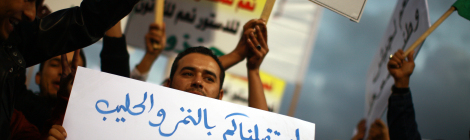
    In Somalia, the UN has imposed arms embargoes designed to prevent rebel groups from accessing arms. In addition, countries wanting to send arms and ammunition to government forces must notify specially created Sanctions Committees―which, in the case of Somalia, has the authority to block the transfer.  This report show that enforcing these embargoes has proved problematic. And even arms supplies that do not violate the embargoes can have undesirable consequences.

    ‘Arms flows and the conflict in Somalia’ examines arms supplies to Somalia and to African countries that have been involved in the conflict there: Eritrea and Ethiopia―two states that are widely believed to be fighting a proxy war in Somalia―and Burundi and Uganda, which provide peacekeepers to the African Union Mission in Somalia (AMISOM). 

    As the paper shows, there is a real risk that arms supplied to Somali government forces and the AMISOM contributors could fall into the wrong hands and could be used in human rights abuses or aggravate tensions between Eritrea and Ethiopia.


    Author: Pieter D. Wezeman

    Source: SIPRI

    Image source: Michael

     
  • Sustainable Security

  • Sustainable Security

    ‘Petropolitics’ and the price of freedom

    “As the price of oil goes down, the pace of freedom goes up… As the price of oil goes up, the pace of freedom goes down…” So says New York Times columnist Thomas Friedman, who argues that the first law of ‘petropolitics’ is that the price of oil and the pace of freedom are inversely correlated in countries “totally dependent on oil” for economic growth. However, the correlation between recent oil price spikes and anti-authoritarian action – particularly in the Arab Spring – challenges this assessment. But if this pattern of change is to continue, Western states must curb their hypocritical dependence on authoritarian oil-exporting governments by developing more sustainable sources of energy.

    Read Article →

    Sustainable Finance and Energy Security

    General volatility in financial markets – fuelled by irresponsible lending and trading practices, as well as evidence of market manipulation – have had an effect on oil prices. Although the specific effects of the finance sector on oil prices requires further investigation, we can already understand that a sustainable and secure future will require the development of a wider energy mix to meet rising demand. To this end, more sustainable financial systems must be developed to service the real needs of citizens

    Read Article →

    National security and the paradox of sustainable energy systems

    The transition away from a centralised global economy built around conventional energy sources to a decentralised global economy mostly fuelled by renewable resources is one we must make for the sake of our children’s futures and that of our planet. Writing for sustainablesecurity.org, Phillip Bruner asks if national security is at present, deeply concerned with preserving access to conventional energy, then how would national security for a decentralised renewable energy Internet be managed? Who would manage it? And what role, if any, could the public play in helping to alleviate some of the burdens of 21st century threat mitigation?

    Read Article →

    Environment, Energy, Economy: a threefold challenge to sustainable security

    Whether it’s the economy, energy or the environment which you value most, when it comes to security, each holds equal weight. If security can be defined in terms of what is or isn’t sustainable, then it must evolve to incorporate additional elements that transcend more traditional views on geopolitics.

    Read Article →

  • Oxford Research Group Director Dr. John Sloboda launches SustainablySecurity.org

     Swimming Upstream to Sustainable Security

    “Extremist violence and terrorist attacks are often the final, murderous manifestations of a long process rooted in helplessness, humiliation and hatred. Therefore, any comprehensive approach has to also address the upstream factors, the conditions that help fuel violent extremism.”  These words come, not from a left-leaning NGO, but from the mouth of John Brennan, a long-serving CIA officer, who is now President Obama’s senior advisor on counter-terrorism.   They come in a major address given last month at the Centre for Strategic and International Studies, a highly ‘establishment-linked’ Washington think-tank.

    These sentiments mark a huge shift in rhetoric and focus from the mindset of the post-9/11 Bush administration. For a spokesperson of the President to suggest that the USA is “committed to using every element of our national power to address the underlying causes and conditions that fuel so many national security threats, including violent extremism. We will take a multidimensional, multi-departmental, multinational approach” seems a million miles from George Bush’s assertion that, “You’re either with us or against us in the fight against terror.” However, sentiment alone is not enough. New thinking requires new kinds of action on the international stage, and concrete signs of such action are few and far between.

    Since 9/11 we  have seen year on year increases in military budgets, yet the dominant US-led project funded by these increases has yielded few unambiguous security gains. Despite US troops now beginning to withdraw from Iraq, the violence that has cost the lives of at least 100,000 Iraqi civilians continues; truck bombs and mortars killed 95 people on one day alone in August this year. General Stanley McChrystal, the top US Commander in Afghanistan, last week submitted a review to US and NATO commanders in which he outlined grave concerns about the failure of current strategy there.  The resurgence of the ‘Taliban’ is likely to lead to a separate request that the US administration consider allocating extra troops. For the time being, the focus is not on achieving long-term security, but rather on avoiding immediate and humiliating defeat.
     
    The war on terror has created over 4 million refugees and resulted in the detention of over 120,000 people without trial, some for more than 6 years.  Despite this, the threat of terrorism is no doubt still real; al-Qaeda’s remaining leadership, which has most likely moved across the border from Afghanistan to Pakistan, still wields influence. The Somali al-Shabaab has perhaps come under the sway of such influence and lawless Somalia represents a potential future launching point for terrorist attacks. Although previous attempts to tackle the problem may have prevented terrorist attacks in the short-term, little has been done to eliminate the long-term threat.
     
    It is being increasingly realised that to effectively tackle the security problems the world faces,  resources must be diverted away from military spending towards diplomacy and development to address the conditions that ferment radicalisation amongst the marginalised. But the specific details of how this should best be done are still some way from being articulated, let alone turned into workable policies.   The global financial crisis has meant that military budgets are now under greater scrutiny. In the UK, following the 2010 general election, the new government will hold a defence spending review. The review will provide a key opportunity to reconsider costly projects such as the replacement of trident and the building of two new Royal Navy aircraft carriers. But without clear and compelling alternatives, closely articulated in detail as well as commanding strong public support, governments may squander such opportunities and adopt a “business as usual” approach, tinkering at the margins rather than adopting a fundamentally new approach.   The disappointingly status-quo oriented governmental responses to the global banking crisis of 2008 shows what the default response is likely to be unless there is compelling and persistent encouragement to “step outside the box”.

    One task is to demonstrate in necessary detail that diverting money from defence towards diplomacy and development will be cost effective in the long run.  It needs to be established beyond any reasonable doubt that responses that attempt to control the symptoms of insecurity have proved more expensive than responses that address the root causes. For instance, in the 15 years from 1990 to 2005 conflict had an economic cost to Africa’s development of $284billion. As the IANSA, Oxfam, and Saferworld report that identified this figure states: “If this money was not lost due to armed conflict, it could solve the problems of HIV and AIDS in Africa, or it could address Africa’s needs in education, clean water and sanitation, and prevent tuberculosis and malaria.” Whilst widening social divisions, poverty and injustice exist; radical groups are always likely to find recruits amongst the marginalised.

    Even with increased resources, such issues cannot be tackled by one state alone, however powerful. Approaches to development must be collaborative. The often-uncoordinated actions of aid agencies and donor countries have at times proved counterproductive. For this reason, another task facing the world is to work out how to productively strengthen the capacity of regional and international organisations. More detailed attention needs to be given to showing how organisations such as the UN can better facilitate co-ordinated efforts of nation states to address the social, economic, and political problems that breed insecurity. Likewise, we need to examine closely how organisations such as the AU and ASEAN can be strengthened to address particular regional issues such as the absence of arms control architecture in the Asian region.

    Climate change and competition over resources represent further key challenges to global security. As with marginalisation, there is an increasing realisation that these issues can only be tackled collaboratively.  It has now been broadly accepted that the Climate Conference in Copenhagen must result in an agreement from developed countries to reduce carbon emissions by 80% by 2050, and that strong targets are agreed in the short to mid-term (40% by 2020 from a 1990 base). But even these will not be sufficient unless developing countries likewise commit to ambitious reductions in carbon emissions. Is there yet sufficient clarity about how they will be given the appropriate support to do so by their more developed counterparts? 

    We face multiple resource crises, of food, water, and energy.  The International Energy Agency has suggested that oil supplies are likely to peak as early 2020 and an ‘oil-crunch’ is likely to occur this decade.  Competition over resources may escalate and become more aggressive.  To avoid early resource conflict, ambitious proposals such as Professor John Matthews’ bio-pact need to be developed and promoted within the international system so that robust and credible solutions are to hand as the situation becomes more critical.

    If we are to avoid future global disaster on an epic scale, then the step change in security thinking that has already begun must result in the adoption of sustainable security policies that encompass the principles of collective, human and just security.  Left to follow their own momentum, governments are unlikely to fully embrace sustainable security.  When seen primarily through the lens of national interest, sustainable security concepts will tend to be appropriated (and diluted) as means to sustain the status quo and existing power relations.   If sustainable security is to become an end, with the security of humanity in its totality as the goal then community groups, faith groups, NGOs, and many other elements of civil society (including journalists) must coordinate their efforts to promote such policies. John Brenner’s call for security policies to “swim upstream” is admirable, but unless this call propels us far beyond national interest, the rapid current of realpolitik is likely to dump us all far downstream.  We hope that this new website will provide a focus for swimming strongly and persistently upstream.  


  • Competition over resources

    This major report was the result of an 18-month long research project examining the various threats to global security, and sustainable responses to those threats. Read more »

  • Marginalisation of the majority world

    Writing for the New Security Beat, Schuyler Null discusses a recent event on creating a new national security narrative for the US held at the Woodrow Wilson Center. The event was based on a white paper by two active military officers writing under the pseudonym “Mr. Y” (echoing George Kennan’s famous “X” article). In “A National Strategic Narrative,” Captain Wayne Porter (USN) and Colonel Mark Mykleby (USMC) argue that the United States needs to move away from an outmoded 20th century model of containment, deterrence, and control towards a “strategy of sustainability.”

    Image source: LizaP.

    Read more »

  • Sustainable Security


    Food insecurity small

    The United Nations Development Programme (UNDP) defines food security as “all people at all times having both physical and economic access to the basic food they need”. However, due to a complex range of interconnected issues from climate change to misguided economic policies, political failure and social marginalisation, over 2 billion people across the world live in constant food Insecurity. It is important to take a sustainable security approach to look at the importance of “physical and economic access to basic food” by exploring the links between food insecurity and violence.

    A recent article published by the journal Conflict, Security & Development examines food riots as representations of insecurity and looks at the relationship between contentious politics and human security.

    Thomas O’Brien, author of the article, argues “the upheaval caused by a food riot can lead to lasting instability and violence as social and political structures are challenged”. Global rises in basic food prices triggered demonstrations and often violent protests in “over 30 countries across Africa, Asia, Latin America and the Middle East in 2007-08”. The article puts recent food riots and the current global food crisis in historical perspective. Food riots are about more than “just access to food”.  They represent dissatisfaction with political structures and perceived injustices.

    It is important to note that “the extreme nature of the rise in food price in the absence of much evidence of food shortages, left a sense of something unnatural about the way food markets were working”. Although poverty, weak states, ineffective civil society and lack of political freedom all contribute to food insecurity and the possibility of violent food riots, we cannot ignore to challenge underlying transnational and global power structures: “146 protests in 39 countries over the 1976-92 period were linked to the imposition of International Monetary Fund and World Bank structural adjustment policies.” Food security is fundamental to human security and needs to be approached by addressing underlying causes and drivers. A sustainable response to food insecurity would take global cooperation, justice and equity as key requirements.

    An often mentioned driver of food insecurity is climate change. Climate change already has a great impact on global security concerns and the physical, social and economic effects will undoubtedly only be exacerbated in the near future. Increasingly high temperatures and little or inconsistent rainfall have devastating effects on crop yields in places such as India, Africa’s Sahel region and the mid-western United States.

    The catastrophic food crisis in Niger in 2005 for example was largely attributed to the effects of climate change and competition over limited resources. Years of too little and too inconsistent rainfall have meant devastating droughts and diminishing harvests in this Sahel country of west Africa which has the highest birth rate in the world. Increasingly advanced desertification due to climate change means competition and potentially violent conflict, over limited resources such as water and arable land, intensifies.

    In the 2005 food crisis however, although thousands of children died of malnourishment, Niger had produced enough food to feed its population. The real issue was a food shortage in neighbouring Nigeria. Nigeria has an economy based primarily on oil exports with a significantly weakened agricultural sector. Instead of Niger feeding its own population, much of the harvest was sold to wealthier Nigeria at prices much higher than anyone in Niger could have afforded. This is a good example of why free market economy and trade liberalisation do not necessarily benefit all parties involved. Writing about the great famines of the last century, Nobel laureate Amartya Sen noted “a drought is natural but famine is man-made”. What this tells us is that although the challenges we face by climate change are serious threats, there is much that can be done to ensure more food security through political and economic policies.

    Farmers in Niger are struggling. But so are farmers in Jamaica. In contrast to Niger, Jamaica has a wealth of fruit, vegetables, fish and an abundance of fertile land. About one fifth of this island’s population is employed in the agricultural sector. Still, farmers are struggling to survive because they cannot compete with the much lower prices of subsidised agricultural imports from the USA. As cheap foreign products flood the market, Jamaican prices are driven down which makes local food production by and large unprofitable. As they rely more on foreign food imports, Jamaicans will be increasingly vulnerable to price volatility on the global marketplace. With the average Jamaican spending about half of household income on food, such vulnerability to price changes is a real danger to food security.

    Importing less foreign food products is a difficult matter for Jamaica because of the strict trade liberalisation policies imposed on the country through its debt relief agreements. One could also argue that if it is cheaper for Jamaica to import food than to produce its own, why should it still encourage its local agricultural sector? When a country is dependent on food imports, it cannot assure food security for its population.

    So far US imports have been much cheaper than local Jamaican produce. 2012 however has seen the “worst US drought in 50 years” according to last month’s Aljazeera article entitled Food riots predicted over US crop failure. “Grain prices have skyrocketed and concerns abound the resulting higher food prices will hit the world’s poor the hardest- sparking violent demonstration” says the newspaper. Corn is a primary staple in Sub-Saharan Africa, Central and South America, and prices have already gone up 60 per cent since June because “the United States accounts for 39 per cent of global trade in corn and stockpiles are now down 48 per cent” due to the drought.

    Price fluctuations on the global food market do not affect all people in the same way as “people in wealthy industrialised countries spend between 10 to 20 per cent of their income on food. Those in the developing world pay up to 80 per cent. According to Oxfam, a one per cent jump in the price of food results in 16 million more people crashing into poverty.”

    A sustainable approach to food security would address underlying forces such as climate change, economic and political policies and social marginalisation.

    Paul Rogers, expert on global conflict and consultant to the Oxford Research Group on global security, was recently featured on the BBC Radio 4 programme Costing the Earth. When asked whether free markets can help feed us, he replied:

    “It will contribute in some way, but I think it is fairly minimal. There are far more important things to consider. Look at it this way: Back in the world food crisis in the early 1970s, which was the worst for about 80 years, there were about 450 million people malnourished.  Now the figure is closer to 800 million. Now, that malnourishment and lack of food is not generally because there isn’t enough food to go around. Even at the height of that crisis there was still half the normal reserve. It is because people cannot afford to get the food or to buy the food. […]  If you are looking at the situation of poor people across the majority world, there has to be some way in which we can actually improve the production of food in and around those areas to provide greater resilience in the face of what is coming because beyond all of this is the whole issue of climate change. I think we will have a wakeup call this year in terms of what might come.”

    Anna Alissa Hitzemann is a  Peaceworker with Quaker Peace and Social Witness. She currently works with Oxford Research Group as a Project Officer for the Sustainable Security Programme, with a focus on our ‘Marginalisation of the Majority World’ project.

    The Conflict, Security and Development article Food riots as representations of insecurity is available for paid download here
    The AlJazeera article Food riots predicted over US crop failure is available here
    The Pulitzer Center for Crisis Reporting project Agriculture and Jamaica’s rural poor is available here
    Paul Rogers’ Monthly Global Security Briefings can be read and subscribed to here
    Image source: Dioversity International
  • Sustainable Security

    Contributing an Article

    We are always on the lookout for new authors with new perspectives to add to the debate on the blog – especially if you think we’ve missed something!

    We aim to address a wide range of evident and emerging security issues and take a broad and integrated approach to the term ‘security’. Generally, we look for insightful pieces which seek to explore solutions for ongoing security situations and the underlying issues which drive them. While we do place an emphasis on our ‘key’ drivers (climate change, marginalisation, competition over resources and militarisation), contributors should not feel limited to these subjects alone.

    Our current contributors are academics, practitioners, researchers and analysts working on global security.

    Please note that, as a not-for-profit blog that serves as a resource for interested readers, sustainablesecurity.org does not have the resources to pay contributors.

    If you are interested in contributing an article, please get in touch with us using the form to the right.

    Guidelines

    • 1,400 words max.
    • Please fact-check your article, especially if the subject is controversial or emerging . Although we check submissions carefully, authors are ultimately responsible for the factual accuracy of their contributions.
    • We do not use footnotes or endnotes. Embedded links for information that is sourced from other websites are a great opportunity to support your argument and opinions, especially for subjects that are not common knowledge. Please be sure to include a hyperlink for specific statistics and quotations.
    • Spelling: UK or US English – we don’t mind which, as long as it is used consistently throughout your article.
    • Please avoid unnecessary jargon and explain any that is used in a clear and concise manner.
    • You are welcome to cross-post your article in other places if we are accredited as the original site of publication.
    • We do not reprint pieces published elsewhere (with the exception of Sustainable Security programme staff articles that have been featured in the media).

    Legal stuff…

    All content and downloads are licensed under a Creative Commons Attribution-NonCommercial-NoDerivs 3.0 Licence unless stated otherwise.

    We look forward to hearing from you!

    SusSec Team

  • Sustainable Security

  • Sustainable Security

    Golden Dawn, a Greek Neo-Fascist party, has gradually enjoyed greater success in Greek and European parliamentary elections. What are the drivers behind this development?

    The Greek Golden Dawn, a violent neo-Nazi party, has remained in the margins of the Greek political system for most of its political life. However, within the context of the emerging economic crisis both in Europe and in Greece, the party marked an electoral breakthrough in May and June 2012, receiving 7 per cent of the vote in May and 6.9 per cent in June, translating into 21 and 18 parliamentary seats out of 300 respectively. As the economic crisis unfolded, and societal upheaval in Greece became reinforced by the emerging migration crisis, the party retained its support in the 2014 European Parliament Elections receiving 9.38 per cent of the vote; and in the January and September 2015 general elections, when it retained third place in the party system with 6.28 and 6.99 per cent of the vote respectively.

    The ideology of Golden Dawn

    golden_dawn_members_at_rally_in_athens_2015

    Image by Wikimedia Commons.

    The Golden Dawn is unlike all other parties in the Greek parliament; and most other far right parties in Europe. While the party itself rejects the fascist label, it nonetheless espouses all core fascist- and more specifically Nazi- principles. In our book, we show the party rejects liberalism and socialism and endorses what it terms the ‘third biggest ideology in history’, i.e. nationalism, combined with support for an all-powerful state premised on ‘popular sovereignty’. In its manifesto the party states that being a member of the Golden Dawn entails the acceptance of the following principles: the establishment of the state in accordance to nationalism; the moral obligations that derive from this ideology including the rejection of any authority that perpetuates societal decline; the acceptance of nationalism as the only authentic revolution; the establishment of the popular state in which there are no inequalities on the basis of wealth; racial supremacy and more specifically the belief in the continuation of the ‘Greek race’ from antiquity to the modern day; the idea that the state must correspond and be subservient to the nation/race; and the nationalization of all institutions.

    The fascist myth of palingenetic ultra-nationalism constitutes a key ideological premise underpinning the party’s discourse. The ideology of the Golden Dawn may indeed be categorised within the ‘ethnic nationalism’ variant, emphasising blood, geneaology and the perennial nature of the Greek nation. The party emphasises ties with ancient Greece, past wars, imperial experience during the Ottoman years and invasion in the 1940s. In this context, the party makes frequent references to ancient Greece, emphasising the heroic traits of those belonging to the Greek nation. Historical figures, whether heroes of ancient Greece, Byzantium, the Greek War of Independence, the Second World War or Cyprus are glorified for their heroism, bravery and sacrifice. By referring to a very large array of officially recognised historical events, personalities and national identity traits and placing them within the ethnic election framework, the Golden Dawn successfully integrates them into its ultra-nationalist palingenetic ideology.

    The Golden Dawn seeks ‘catharsis’. The party’s key goal is to eliminate all political divisions and cleanse the nation from outsiders. Communists are identified as those internationalists that seek the annihilation of the Greek nation. Contributing to this ethnocide are also Greece’s external enemies, which include all foreigners who according to the Golden Dawn contribute to the moral and cultural decay of Greece, for example people of Jewish origin and all immigrants.

    Militarism hence is the key to both the Golden Dawn’s ideology and organizational structures. The army is the ultimate value, they claim. A value that encloses within it ‘blood, struggle and sacrifice’. The party’s members see themselves as ‘street soldiers’ fighting for the nationalist cause. This places violence at the heart of Golden Dawn’s activities and illustrates their distinctive view of democracy as a bourgeois construct only to be used as a means for achieving their ultimate goal: its abolition, as its leader Nikolaos Michaloliakos claims. It also explains the link between Golden Dawn members and army officials, as well as the organization of ‘paramilitary orders’ or ‘battalions’.

    Therefore the party should be understood as neo-Nazi, not because of its past use of Nazi paraphernalia, but rather because its ideology and organizational structures fulfil the criteria of what constitutes a neo-Nazi group. Its association with a large number of violent acts resulted in the imprisonment of the majority of its MPs including the party leader in 2013/2014. 70 defendants, which include the party leader and the party’s MPs, went on trial in Spring 2015 on charges including murder, grievous bodily harm and sustaining a criminal organization. The trial remains on-going.

    Accounting for the rise of Golden Dawn

    How may we explain the rise and sustained support for the Golden Dawn? The Golden Dawn’s electoral fortunes have coincided with both the economic and migration crises that have affected Europe as a whole. For example, in 2012 during the peak of Greece’s economic crisis, the country’s unemployment was at 24.5 per cent with youth unemployment at 55.3 per cent. In 2013 these figures increased to 27.5 and 58.3 respectively. The government deficit was -8.6, which increased in 2013 to -12.1. In addition, Greece experienced the bulk of the migration crisis as the entry point for a high number of refugees who travel from Turkey to the islands of Kos, Chios, Lesvos and Samos. For example, an estimated number of 856.723 refugees arrived by sea in 2015 and 169.459 in 2016.  It would make sense to seek causal links between the economic and migration crises on the one hand, and the rise of the Golden Dawn on the other. However, the adoption of a comparative logic suggests that this argument does not hold when subjected to empirical scrutiny. Other European countries that were also severely affected by the Eurozone and/or migration crises have not experienced a comparable rise in support for the far right. For example, Spain’s unemployment levels are second in the EU after Greece with 24.8 per cent in 2012 and 26.1 per cent in 2013. Youth unemployment in Spain is also very high at 52.9 per cent in 2012 and 55.5 in 2013. Portugal’s somewhat lower unemployment rates at 15.8 per cent in 2012 and 16.4 per cent in 2013 are still above the EU average. The same goes for the country’s youth unemployment rates at 37.9 per cent in 2012 and 38.1 in 2013.

    We posit an alternative explanation that takes into account the broader implications of the crises of Greek society. We understand the rise of the Golden Dawn as a response to a perceived breach of the social contract in Greece. Therefore, we see this rise not as question of intensity of economic and/ or migration crisis, but rather as a question of the nature of the crisis, i.e. economic and/migration versus overall crisis of democratic representation. Extreme right parties such as the Golden Dawn are more likely to experience an increase in their support when a societal crisis culminates into an overall crisis of democratic representation. This is likely to occur when severe issues of governability impact upon the ability of the state to fulfil its social contract obligations. The perceived inability of the state to mediate the effects of the crisis and to deliver services based on the redistribution of the collective goods of the state. When state capacity is limited or perceived to be limited, then the result is the delegitimization of the party system as a whole. This is because the system is perceived as incapable to address the crisis and mediate its socioeconomic effects. This breach of the social contract is accompanied by declining levels of trust in state institutions, resulting in party system collapse.

    Conclusion

    If we are right, then the Golden Dawn is a specific symptom of a broader institutional pathology. Therefore in order to contain this phenomenon, political actors should focus on institutional reform in order to restore the domestic social contract and reintegrate key social groups back into the political mainstream. More specifically:

    1. Empower the middle class: because the middle class is key to both economic prosperity and democratic stability. Weak democratic institutions and widespread corruption have resulted in the weakening of the middle ground and this is what allows extremist groups to co-opt middle-class voters. Unless we address this institutional pathology at its core, extremism will keep recurring.
    2. Welfare reform: because the appropriation of key social groups into the mainstream depends on social security. The greater the insecurity, and the broader the populace it affects, the greater the potential of extremist elements to co-opt these social groups that would otherwise support mainstream alternatives.
    3. Strengthen civil society institutions: Because civil society fosters tolerance. Greek civil Society is weak at all levels: weak structure, limited impact and limited membership. There is a wider sentiment of public distrust towards this type of organisations in Greece because of the long tradition of corruption and clientelistic relations that prevail.
    4. Reform the education system: Because education is a key means of socialisation that institutionalises political culture. The type of socialisation that occurs from an early age at the school level is the one that becomes most embedded. And, because people of a younger age are more easily moulded into violence and extremism, they tend to occupy a large portion of far right party membership. As long as the Greek education system promotes exclusion and vilifies the other through official textbooks, it will continue to offer opportunities for right-wing extremism.

    Dr Sofia Vasilopoulou is a Senior Lecturer in Politics at the University of York.

    Dr Daphne Halikiopoulou is an Associate Professor in Comparative Politics at the University of Reading.

  • Sustainable Security


    Welcome back! We’ve just re-launched with a brand new look, great new authors and, as always, lots to say!

    Sustainablesecurity.org is space to debate, discuss and develop understandings of modern insecurity within a  ‘sustainable security’ framework, which realises the interconnected underlying drivers of challenges to global security and seeks to counter them with preventive policy solutions.

    The blog is a project of the Sustainable Security programme of Oxford Research Group, originally launched in September 2009.

    Sustainablesecurity.org is space to debate, discuss and develop understandings of modern insecurity within a  ‘sustainable security’ framework, which realises the interconnected underlying drivers of challenges to global security in the 21st century. Through topical discussion pieces, we aim to explore the integrated, preventive policies that are needed to solve these threats at source.

    As well as covering a range of pertinent modern security challenges, the website highlights four key interconnected drivers of global insecurity:

    • Climate Change
    • Competition over natural resources
    • Global militarisation
    • Marginalisation

    Articles and resources are allocated to one or more of these headings, but the overall emphasis is on the interconnected nature of these threats and the need for comprehensive, multilateral approaches to them. For a wider range of topics, try our ‘Hot Topics’ tag cloud in the sidebar to the right.

    Don’t forget, you can sign up for updates about new blog posts and special features.

    We hope you enjoy exploring the new site!

    SusSec Team

    Image source: John Martinez Pavliga

  • Sustainable Security