Blog

  • Sustainable Security

    National Security, Climate Change and the Philippine Typhoon

    Super Typhoon Haiyan made landfall in the Philippines on 8 November, and is possibly the most powerful tropical cyclone on record. Beyond the immediate impact of the typhoon, the natural disaster is already proving to be a threat to national security, with reports surfacing of massive looting and military engagement following attacks on government relief convoys. As US and UK naval convoys head to support the situation, Andrew Holland discusses climate change’s impact as a threat multiplier and what plans militaries and governments must make to prevent the insecurity that will come with future disasters of this scale.

    Read Article →

    Militarised Public Security in Latin America in Venezuela

    Across Latin America, governments are sending their militaries into the streets to act as de facto police forces in the face of disproportionally high crime and violence rates. This trend has been going on for several years, but has accelerated in 2013. With the move to deploy over 40,000 troops for citizen security in Venezuela, President Nicolás Maduro joined a growing list of leaders throughout the region that have relied on their militaries to carry out police duties. In the first of our two-part discussion ‘Countering Militarisation of Public Security in Latin America’, Sarah Kinosian discusses the conditions that are causing the trend to thrive.

    Read Article →

    Countering Militarised Public Security in Latin America: Lessons from Nicaragua

    Facing a myriad of public security challenges that have provoked some of the highest indices of crime and violence in the world, authorities in Central America have followed a variety of different responses, ranging from repressive and reactive policies to grass roots prevention. Of these approaches, the Nicaraguan National Police’s Proactive Community Policing model stands out due to the results it has achieved. In the second of our two-part discussion, ‘Countering Militarisation of Public Security in Latin America’, Matt Budd explores the lessons that Latin American countries can extract from Nicaragua’s unique approach to public security.

    Read Article →

  • Sustainable Security

    Momentum towards a nuclear weapons ban treaty: what does it mean for the UK?

    International momentum towards a treaty to ban nuclear weapons reached a milestone in the December 2014 Vienna conference. Even assuming that the UK does not initially sign up to such a treaty, it is subject to the pressures of a changing legal and political environment and could find its present position increasingly untenable – not least on the issue of Trident renewal.

    Read Article →

    Nuclear Weapons: From Comprehensive Test Ban to Disarmament

    Despite not yet entering into force, the 1996 Comprehensive Test Ban Treaty has succeeded in almost eliminating nuclear weapons testing and in establishing a robust international monitoring and verification system. A breakthrough in its ratification by the few hold-out states could have important positive repercussions for the Nuclear Non-Proliferation Treaty or nuclear disarmament in the Middle East.

    Read Article →

    Humanitarian Consequences of Nuclear Weapons: Five Reasons for the P5 to participate in Vienna

    The ‘humanitarian dimension’ initiative highlighting the consequences of nuclear weapons has evolved and consolidated itself in the non-proliferation regime since 2010. The five nuclear weapons states (NWS or P5) under the NPT – China, France, Russia, UK and US – boycotted the first two international conferences on the humanitarian consequences of nuclear weapons. A third conference will be held in Vienna on 8-9 December 2014. This article gives five reasons why the P5 should consider participating.

    Read Article →

    Building the Case for Nuclear Disarmament: The 2014 NPT PrepCom

    The humanitarian impact of nuclear weapons, highlighted by a wide-ranging, cross-grouping, multi-aim initiative which continues to consolidate itself in the non-proliferation regime, has come to the fore in the 3rd Prepatory Committe for the 2015 NPT Review Conference. Frustrated with the lack of progress towards NPT Article VI commitments to complete nuclear disarmament, the initiative has invigorated attention to the urgency of nuclear disarmament and a need for a change in the status quo. NPT member states and civil society continue to engage actively in publicizing the humanitarian consequences of nuclear weapons as an impetus to progress towards nuclear disarmament.

    Read Article →

    The Threat of Nuclear Disconnect: Engaging the Next Generation

    The dramatic decrease in public awareness and engagement in the nuclear weapons debate since the 1980s poses a risk to our future, as younger generations and future policy shapers will be less familiar with the challenges posed by nuclear weapons when they take the helm. But nuclear weapons are too dangerous a threat for an entire generation to disconnect from. BASIC’s Rachel Staley explores the ramifications of not updating the nuclear debate.

    Read Article →

    In piaffe: multilateral nuclear disarmament dialogue in the year of the horse

    Shortly after the lunar New Year, UN Secretary-General Ban Ki-moon challenged the Conference on Disarmament to run with the ‘spirit of the blue horse’ towards substantive engagement on multilateral nuclear disarmament in 2014. While the regime may not achieve this speed, there are initiatives underway this year that may well help nuclear disarmament dialogues pick up speed ahead of the 2015 NPT review conference.

    Read Article →

  • Risk of extreme weather events highlighted by the Intergovernmental Panel on Climate Change

    The UN Intergovernmental Panel on Climate Change has produced a draft summary of a report that warns of a predicted increase in the number and intensity of extreme weather events.  As outlined below by Marlowe Hood for Agence France Presse, the 800-page report goes some way to addressing a subject largely untouched by their landmark 2007 report on climate change, and adds to the growing body of evidence outlining the potential security implications of a warmer planet.  Their findings, such as more frequent summer heat waves in Europe, and flooding in South Asia are supported by the findings of other climate monitors such as the UK Met Office Hadley Centre (2010).

    The report gives weight to the argument for climate change mitigation out of concern for human security, with its most troubling conclusions predicting major shocks for regions already vulnerable and ill-equipped to provide for the security of their inhabitants, such as West Africa and South Asia.  It also cites the probability of extreme weather impacts as ‘very likely’ – at 90% or greater – thereby tackling some of the uncertainty faced by security planners.


    Regions must brace for weather extremes: UN climate panel

    By Marlowe Hood (AFP)

    PARIS — Southern Europe will be gripped by fierce heatwaves, drought in North Africa will be more common, and small island states face ruinous storm surges from rising seas, according to a report by UN climate scientists.

    The assessment is the most comprehensive probe yet by the 194-nation Intergovernmental Panel on Climate Change (IPCC) into the impact of climate change on extreme weather events.

    A 20-page draft “summary for policymakers” obtained by AFP says in essence that global warming will create weather on steroids.

    It also notes that these amped-up events — cyclones, heat waves, diluvian rains, drought — will hit the world unevenly.

    Subject to modification, the draft summary will be examined by governments at a six-day IPCC meeting starting on Monday in the Ugandan capital of Kampala.

    In the worst scenario, human settlement in some areas could be wiped out, the report warns.

    “If disasters occur more frequently and/or with greater magnitude, some local areas will become increasingly marginal as places to live or in which to maintain livelihoods,” it says.

    “In such cases migration becomes permanent and could introduce new pressures in areas of relocation. For locations such as atolls, in some cases it is possible that many residents will have to relocate.”

    Three years in the making, the underlying 800-page report synthesises thousands of recent, peer-reviewed scientific studies.

    The authors expresses high confidence in some findings but stresses uncertainty in others, mainly due to lack of data.

    They also emphasise that the vulnerability of human settlements depends as much or more on exposure, preparedness and the capacity to respond as it does on the raw power of Nature’s violent outburts.

    Average global temperatures have risen by nearly 1.0 degree Celsius (1.8 degrees Fahrenheit) since pre-industrial times, with forecasts for future warming ranging between an additional 1.0 C to 5.0 C (1.8-9.0 F) by 2100.

    But these worldwide figures mask strong regional differences.

    Among the findings:

    — Western Europe is at risk from more frequent heat waves, in particular along the Mediterranean rim.

    Record-busting temperatures in 2003 responsible for some 70,000 excess deaths across Europe may become closer to average summer peaks by as early as mid-century, the report suggests.

    — The eastern and southern United States and the Caribbean will probably face hurricanes amplified by heavier rainfall and increased wind speeds.

    Greater population density in exposed areas, rising property values and inadequate infrastructure will boost vulnerability, the draft warns. Hurricane Katrina, which hit New Orleans in 2005, is seen by some scientists as an example of just such an confluence.

    — For small island states, the top threat is incursion from rising seas, which not only erodes shorelines but poisons aquifers and destroys farmland as well.

    Already measurable, these impacts are “very likely” — a 90-percent or greater probability — to become worse over time, even intolerable, the report concludes.

    “In some cases, there may be a need to consider permanent evacuation,” it says.

    — Climate models hold out the prospect of more droughts for West Africa, raising the spectre of famine in regions where daily life is already a hand-to-mouth experience for millions.

    Factor in the biggest population boom of any continent over the next half-century and the danger of food “insecurity” in Africa becomes even greater, it cautions.

    — In South Asia and Southeast Asia, computer models see a doubling in the frequency of devastating rainstorms. In East Asia, exceptional heatwaves will become hotter, and less exceptional.

    By mid-century, temperature peaks in East Asia will be around 2.0 C (3.6 F) more than today, and by 2100 some 4.0 C (7.2 F), even under scenarios that see some efforts to reduce greenhouse-gas emissions.

    The IPCC co-won the 2007 Nobel Peace Prize after publishing a landmark “assessment report” that sparked worldwide awareness about climate change and its impacts. That document made only a brief reference to extreme weather events, leaving a gap that the panel hopes to fill with the new report.

    The draft summary for policymakers will be reviewed, line-by-line, during a joint meeting of the IPCC’s Working Group I, which focuses on physical science, and Working Group II, which examines impacts. It is set to be released on Friday.

    Article Source: AFP

    Image Source: NASA

  • Sustainable Security

    This post is based on Paul Rogers’ Monthly Global Security Briefings and was originally posted by Oxford Research Group on 29 April, 2014.

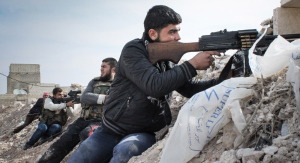
    Free Syrian Army rebels fighting Assad militias on the outskirts of the northwestern city of Maraat al-Numan, Idlib - Syria Source: Freedom House (Flickr)

    Free Syrian Army rebels fighting Assad militias on the outskirts of the northwestern city of Maraat al-Numan, Idlib – Syria Source: Freedom House (Flickr)

    The Syrian War is now in its fourth year and the indications are that the regime will survive and consolidate its position in 2014. This is radically different from early last year when many analysts thought it was under serious pressure, and it should be recalled that in mid-2011, a few months into the war, the prevailing view was that the regime would not last to the end of that year. The costs have been huge, with around 140,000 killed, twice that number injured and more than a third of the population displaced, millions of them refugees in other countries.  This article seeks to put this appalling conflict in a longer term regional context as an aid to looking at possible policy options in attempting to bring the war to an end.

    The Regional Context in 2011

    At the start of 2011 the region was struck by remarkable political upheavals as people in a number of countries reacted against autocratic rule and demanded political change. It commenced with the rapid and unexpected fall of the Ben Ali regime in Tunisia on 14 January and was followed on 11 February by the quite startling collapse of the Mubarak regime in Egypt. Across the region there were public uprisings of varying intensities in Oman, Bahrain, Yemen, Libya and Syria and political uncertainty in several countries including Kuwait, Jordan and Morocco.

    In broad terms, those political authorities that did not immediately collapse reacted in different ways that may be summarised as concession or repression or a mixture of both. In Oman, demonstrations were repressed with force but concessions were also offered and the innate wealth of the authorities was available to “buy off” resentment. In Bahrain the royal house opted for repression, aided by army and police support from Saudi Arabia and the UAE.  Saudi Arabia treated Shi’a opponents harshly but distributed many billions of dollars of resources across most of the population.

    In Morocco, King Mohammed sped up the pace of reform with some effect, and across the border in Algeria some economic concessions, including increased food subsidies, were made.  In Libya, Gaddafi used repression but western, and a few Gulf Arab, states intervened on the part of the rebels; a six-month war ended with regime collapse and Gaddafi’s lynching. This has been followed by huge insecurity, including rise of Islamist and local tribal militias.

    The Syrian regime faced extensive nonviolent demonstrations, most commonly after Friday prayers, and faced an escalation in dissent at a time when two regimes in the region had already fallen and in the same week that Saudi and Emirati forces intervened in Bahrain and the UN approved foreign intervention in Libya. The fate of Mubarak was particular striking for the Assad regime given Syria’s long-term historical relationship with Egypt, and it is probable that this meant the regime believed its only course of action was vigorous repression. It became progressively more vigorous and determined in its pursuit of control.

    Underlying Causes

    Although most of the individual anti-government actions across the Arab World were responses to persistent and long-term autocracy, these were in the context of a number of other factors:

    • Outside of a small cluster of oil-rich states, the wealth-poverty divide has become huge, often with the majority of populations marginalised.
    • Even in countries of modest wealth, much of the economic power has been concentrated in the hands of small groups of elites, often less than a tenth of the population. The world economic downturn from 2007 onwards exacerbated these socio-economic divisions.
    • The demographic transition is still in progress across much of the Middle East, meaning that a large proportion of the population is under the age of 30.
    • Although educational standards are highly variable and there is a still a marked gender gap, in most countries most people now go through high school and there is an increasing proportion of graduates among people under 30. There is frequently a serious lack of job opportunities, not least for well-educated young people. At the time of the changes in Tunisia it was reported to have 140,000 unemployed or seriously underemployed graduates out of a population of 11 million.
    • The surge in world grain prices in the late 2000s, not least following China’s harvest difficulties, added to the economic problems for many, not least in Egypt. Syria had a specific problem of drought stretching over many years, leading to an influx of the rural poor into urban areas.

    As a whole, these factors mean that there are trends across the region that point to the risk of longer-term social upheavals. These will persist and must be factored into any policy formulation that might relate primarily to Syria. Instability is highly likely to be a feature of the region in the coming years.

    Syria’s Perspective

    In the light of the regional upheavals, the Assad regime used high levels of violent repression from the start, which led to a transition from nonviolent to violent protest. From the start the regime presented itself as the guardian of stability against opponents that were essentially terrorists. This may have been a travesty of reality at that time, but in the context of the extraordinary upheavals and uncertainties across the region – as well as a keen understanding of the shared sectarian and geopolitical rivalries that tore Lebanon apart within recent memory – the need for a strong regime was more widely accepted within Syria than most diplomats and external analysts appreciated.

    The regime’s stance was aided by internal and external factors. Internally it had the strong support of the Alawi minority but most other Shi’a, Christians and Druze were also willing to accept the regime as guardian of the security of the state. In combination this represented close to a quarter of the population but there was also support from many in the Sunni business community who feared that regional upheavals would spread to Syria. By and large these elements persist, although the great majority of Syrians just want an end to the war.

    Externally, the regime has had support from three quarters. One is the Hezbollah movement in Lebanon that has long been heavily dependent on Syria for weapons and other support.  Hezbollah militias have become a crucial part of the paramilitary support base of the regime.  Second has been the continuing support of Iran, including weapons, training and supplies, and an important sub-set of this has been the increase in paramilitaries from Iraqi Shi’a communities, backed by Iran. Finally there has been the long–term relationship with Russia, with the Putin government seeing Syria as the key centre for remaining Russian influence in the Middle East.  In the past year Russia has been particularly useful in its support for repairing and upgrading military equipment, especially aircraft and related weapons systems.

    The Islamist Dimension

    In the past year, radical Islamist paramilitary groups such as ISIS, the Islamic Front and al-Nusrah have come to the fore among the rebellion, offering the strongest opposition to the regime. There has thus been an element of self-fulfilling prophecy for the regime. In 2014, internal conflicts among the Islamists have weakened them. They may still offer the strongest resistance but their relative decline is one reason why the regime is likely to survive long-term.  Western states, whatever their public stance, would now prefer to see the regime survive than lose control to al-Qaida-linked Islamists. This is clearly the case for Putin, where fear of an Islamist spill-over to the Caucasus is now considered less likely following the safe conclusion of the Winter Olympics and the internal Islamist conflicts within Syria.

    Policy Implications

    In a very pessimistic environment, there are two more positive elements. One is that relations between Iran and Saudi Arabia are showing signs of improvement, including reports of unofficial Saudi/Iranian discussions on Syria. The second is that a number of local ceasefires have been developed, not least in some parts of Damascus.  There may be scope for these to develop further, especially in parts of the country where Islamist groups are not prominent.

    The international community must seek to increase pressure on the UN to enhance multilateral processes, and specifically seek to engage Tehran and Riyadh. In addition, given that this war has many months and possibly years to run, states must commit to improve aid to refugees and to any initiatives that increase the possibility of gaining and embedding local ceasefires – not least by immediate aid for those districts where ceasefires take hold. Approaches to the region must now take a much longer-term view, based on the likely survival of the regime and the fact that the underlying elements behind changes in the region will persist.

    Paul Rogers is Global Security Consultant to Oxford Research Group and Professor of Peace Studies at the University of Bradford.

  • Iraq’s shadow over Afghanistan

    The current surge in United States military forces in Afghanistan part of a strategy designed to bring the war to an end from a position of strength. The great strains within the US military mean that the deployment of 30,000 troops to Afghanistan can be sustained only if forces can be withdrawn from Iraq at the scheduled rate: that is, all combat-forces out by August 2010 and the remaining (approximately 50,000) personnel by the end of 2011. The dynamics of violence in Iraq present a serious challenge to this strategy.

    Washington is thus engaged in a delicate balancing-act: managing disengagement from Iraq while ensuring that the United States will retain a significant military presence in the country well beyond 2011 in order to exercise a maximum degree of influence. 

    A new label

    The US forces remaining in Iraq after the substantial withdrawal of August 2010 – which follows the evacuation of troops from Iraqi cities at the end of June 2009 – are intended to perform a variety of roles. Some may be engaged in training Iraqi forces; others in guarding the huge embassy-complex in Baghdad; and still more in what will be described as support-roles at Balad and other air-bases that have acquired a distinct air of permanency. In addition to these core military contingents, there will be many US security-contractors, themselves mostly ex-military. 

    What will happen in the sixteen months between August 201o and December 2011 is pivotal. It is probable that at some point the remaining 50,000 American troops in Iraq will be designated “non-combat” – a wordplay that barely conceals the establishment by the US army of a new type of unit known as an “advise-and-assist” brigade (AAB). A new report explains their role:

    “These brigades are to have traditional strike capabilities, as well as advisory roles, the ability to augment local forces with ‘combat enablers’ and command and control (C2) tools to support its own manoeuvre units and indigenous units” (see Daniel Wasserbly, “US forces analyse future role of advise-and-assist brigades in Iraq”, Jane’s International Defence Review, January 2010).

    In effect, army units are both taking on new roles but retaining their existing and full combat-capabilities. It follows that their phased withdrawal will depend very much on the extent to which Iraq becomes a more peaceful state in which the interests of the United States and other western interests are secured.

    An evolving strategy

    The pattern of insurgent activity in Iraq suggests that this outcome is uncertain. In the course of 2009, the levels of violence across Iraq tended to stabilise after an initial decline. Around 5,000 Iraqi civilians were killed, and it was the first time since 2006 that there was no significant slump during the period (see “Civilian deaths from violence in 2009”, Iraq Body Count, 31 December 2009). 

    There were, moreover, significant changes in the types of violence. The first few months of the year were dominated by major suicide-bombing attacks on mosques or crowded markets in Shi’a areas. The intention was most likely to provoke sectarian antagonism and then encourage fearful members of the Sunni minority to see the insurgents as their defenders, leading in turn to a violent destabilisation of the government in the run-up to the Iraqi elections on 7 March 2010.

    In the second half of 2009, paramilitary groups began to target large government ministries in suicide-attacks. These naturally were located in high-security zones, but the assailants found ways of penetrating the cordons; in a series of attacks in August, October and December, five sets of government offices and ministries were hit and scores of civil servants killed (see “Iraq: the path of war”, 18 December 2009).

    These attacks in particular caused deep unease among the American and allied agencies, not least because of the levels of security that had to be breached (see Roger Hardy, “Violence returns to Iraq”, BBC News, 8 December 2009). By the end of 2009, there were serious concerns as to whether the Iraqi security forces were capable even of protecting government buildings, and deep suspicions that the insurgents had access to inside information.

    The operations extended beyond Baghdad, and they included frontal-assaults on Iraqi security forces. In Anbar’s provincial capital of Ramadi, for example, two suicide-bomb attacks in early January 2010 in a part of the city regarded as safe killed twenty-four people (mostly police-officers) and wounded around sixty, including the provincial governor Qassim Mohammed.

    Even this surge left the overall degree of violence in Iraq much lower than it had been in 2007.  In this respect, a further shift in the focus of activity in the past ten days is notable: namely, towards hitting “symbolic” targets and a return to the mass killing of Shi’a civilians.

    The biggest coordinated actions in several months were launched on 25 January 2010, when in the space of nine minutes coordinated blasts targeted three major hotels frequented by foreign visitors (and western journalists). Again despite high security, bombs were detonated close to the Ishtar Sheraton, the Babylon and the Hamra hotels, killing thirty-six people and wounding seventy-one (see Anthony Shadid & John Leland, “Baghdad Blasts Shatter Sense of Security in Capital”, New York Times, 26 January 2010). On the following day it was the turn of the Iraqi interior-ministry’s forensics offices, where at least seventeen people were killed and many more wounded.

    The hotel incidents aroused most international comment, but the interior-ministry attack caused the greatest domestic worry, especially from civil servants (see Anthony Shadid, “Latest Bombings Add New Layer of Anxiety and Suspicion in Baghdad”, New York Times, 27 January 2010). Indeed, the fact that a great escalation of security since August 2009 has had little apparent effect is creating pervasive fear among government officials (see Khalid al-Ansary & Hadeel Kamil, “Civil Servants Fear More Attacks”, Institute for War and Peace Reporting – Iraq Crisis Report 320, 21 January 2010).

    The spate of attacks on government targets has been accompanied by the targeting of Shi’a citizens – in this case, pilgrims taking part in the major religious festival centred on Karbala, 80 kilometres southwest of Baghdad. On 1 February, a female suicide-bomber killed more than forty people among a large crowd of pilgrims; and on 3 February there were three more attacks, including a huge car-bomb in Karbala itself which killed twenty-three people and injured scores more.

    A stressed project

    This combination of events and trends indicates that powerful paramilitary groups in Iraq (including al-Qaida) retain their ability to organise, plan and coordinate a deadly campaign. Their success in targeting some of the most heavily protected districts of Baghdad and other cities is a sign of a rooted influence among some sections of the Sunni population. Washington’s military and political analysts are deeply concerned that the campaign reflects a reorganisation of the insurgency that could further weaken official Iraqi security forces at the very time that US troops prepare to reduce their own role and depart the scene.

    The worry from the Pentagon’s perspective is that the forthcoming “advise-and-assist” brigades may have to do much more than these bland terms suggest: namely, remain in Iraq in large numbers and even engage in direct combat-operations against insurgents. That, in turn, implies that further stresses will be felt throughout the US military just as the surge in Afghanistan reaches its peak later in 2010. 

    Most Americans and citizens of other western countries may think that the Iraq war is more or less over, and that whatever remains of the conflict has nothing to do with Afghanistan. It seems probable that both beliefs are wrong. The implications for the United States, and other foreign powers waging the Afghanistan war, are serious.

  • Sustainable Security

  • Sustainable Security

  • Sustainable Security

  • Global militarisation

    Mineral resources have played a crucial role in fuelling protracted armed conflict in the east of the Democratic Republic of the Congo (DRC). This Policy Paper examines the the prospects for and interactions between various trade- and security-related initiatives that are aimed at demilitarizing the supply chains of key minerals. It also describes the changing context in which such initiatives operate. Finally, it offers policy recommendations for how the Congolese Government and international actors can coordinate and strengthen their responses in order to break resource–conflict links in eastern DRC.

    Article source: SIPRI

    Image source: Tim Pearce, Los Gatos

    Read more »