Blog

  • Sustainable Security

  • Sustainable Security

  • Sustainable Security

    South Sudan, the world’s newest country, currently risks slipping into a violent malaise. The crisis in South Sudan highlights very clearly some of the key problems surrounding the practical implementation of the Responsibility to Protect. 

    Five years after seceding from Sudan, South Sudan is about to collapse into its second civil war since 2013. Marauding bands of informally constituted ethnic groups contribute to a climate of vigilantism.  UN diplomats debate the utility of an arms embargo in a state awash in arms.  The threat is meant to leverage Juba’s permission to allow a four thousand peacekeeper regional protection force into the country.  But Juba’s complaint about its exclusion from negotiations, contributes to a climate of distrust about the international community and its intentions. The crisis represents a serious challenge for the Responsibility to Protect (R2P) doctrine and the international community to forestall a humanitarian disaster that is well underway.

    The Responsibility to Protect

    A 2001 report by the International Commission on Intervention and State Sovereignty introduced the idea of R2P, creating a new international norm that made the formerly autonomous allowances of absolute sovereignty contingent on each state’s responsibility to protect its population from genocide, war crimes, crimes against humanity, and ethnic cleansing.  Its controversial pillar two seized the international community with subject matter jurisdiction to intervene as the residual stop-gap agency to prevent internal abuse when states were incapable or unwilling to do the same.  Two other pillars addressed a responsibility to prevent (addressing root causes of catastrophe) and a responsibility to rebuild (to assist with reconstruction and reconciliation).

    The development of the norm has been controversial and it has been reworked, principally along lines of nurturing states to live up to their internal responsibilities and tethering it to actions of the UN Security Council.  But its proactive charge of intervention has also been embraced by scholars and norm entrepreneurs as a progressive development. In its 2007 judgment in the Prevention and Punishment of Genocide Case, the International Court of Justice (ICJ) supported the duty of states to prevent atrocity beyond their borders if they have the capacity to influence persons likely to commit such acts; the ICJ acknowledged that this obligation extended beyond the competent organs of the UN.  The International Law Commission’s 2001 Draft Articles on State Responsibility provided that states cooperate to end through lawful means serious and systematic breaches of peremptory norms.  R2P’s normative development indicates that the idea of a collective responsibility to protect now informs the legalect of international courts and tribunals, suggesting a growing receptivity to and maturation of the doctrine.

    R2P, Africa and South Sudan

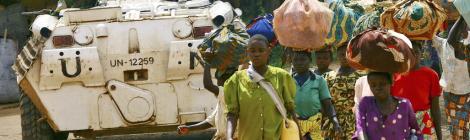
    UN Juba

    Image of peacekeepers in Juba by UN Photo via Flickr.

    Africa was the first region where the R2P was meant to be applied.  It grew out of the idea of responsible sovereignty, first articulated by Francis Deng and others in 1996.  Responsible sovereignty suggested benefits to cooperation among states.  These benefits went beyond the avoidance of international conflict or the mere ‘tending to’ of sovereign fences.  Responsible sovereignty suggested sovereignty could imply joint action and joint benefits.  It grew into the idea of R2P.

    Nowhere has R2Ps reception been stronger than in Africa, having been well received by the African Union, the Economic Community of West African States, (ECOWAS), the Southern African Development Community (SADC), and a litany of African elites, including South Africa’s Thabo Mbeki, Nigeria’s Olusegun Obasanjo, Tanzania’s Salim Ahmed Salim, South Sudan’s Francis Deng, Ghana’s former UN Secretary-General Kofi Anan, and Algeria’s Mohamed Sahnoun.  Cases within the African context indicated its time had come: The UN Security Council validated ECOWAS’ interventions in Liberia (1990/92) and Sierra Leone (1997), offering praise in the face of its own inaction to these humanitarian crises.  R2P received the unanimous support of one hundred and seventy Heads of State in two provisions of the 2005 UN World Summit final document, presaging the incorporation of the doctrine by the African Union in its 2005 Ezulwini Consensus report.

    But nowhere has its implementation been more problematic than in the world’s newest country, South Sudan.  Sudan, and now South Sudan, have been beset by internecine violence over the last sixty years.  South Sudan teetered on implosion almost immediately after achieving statehood in July 2011.  South Sudan devolved into civil war in December 2013, when its President Salva Kiir Mayardit accused former Vice President Riek Machar of plotting against the regime.  An improbable rapprochement, fortified by an internationally mediated agreement, was signed in August 2015, resulting in Machar’s much delayed return to the capital, Juba in April 2016, and the formation of a most tenuous unity government, which collapsed in July in a wave of bloodshed and atrocity in Juba.  Kiir has now rejected a US proposal to insert the four thousand peacekeepers, claiming it is an attempt to turn South Sudan into a UN protectorate.

    Kiir and Machar’s mutual distrust until the most recent violence in July was outweighed only by a common need for more money to support their factions and a mutual interest in avoiding a personal accounting of atrocities allegedly committed by their respective factions.  Interpreted alternatively as an explanation or a threat to the international community, the two allegedly wrote on the Op Ed page of the New York Times in June 2016 that any disciplinary justice meted out “even under international law” would destabilize unity efforts.  Translation:  If you try to bring us to justice, we will bring back war.  They invoked the name of the international community, calling on it to back their non-punitive plan for a mediated reconciliation.   Four days after publication, the New York Times appended an Editor’s Note to the South Sudan leaders’ world-wide call for reconciliation; Machar had disavowed the Op Ed piece, claiming his views had been fabricated. But not completely.  One month later, he and Kiir brought back bloodshed.

    The episode highlights the complexities facing South Sudan.  If the international community is to facilitate a solution to the ongoing crisis, only cosmetically concealed by an unravelling claim of unity, the fundamental normative problem of R2P must be addressed:  where in the international community does R2P reside?

    Transmuting the international community’s abstract but coercive cause of action to prevent domestic abuse into something other than high-minded rhetoric requires either a fully functioning UN Security Council or another agency with the legitimacy and authority to pierce sovereignty’s veil.  The UN Charter system created a jus ad bellum regime that placed monopoly power over all uses and threats of force (except in cases of self-defense) in the hands of the Security Council.  But that authority is often addled by inaction due to the veto-wielding interests of the big powers, exposing the fundamental weakness of the UN system and provoking the elusive international legal and political pursuit for a better or supplementary normative solution.

    Internationalists have wrestled with the poor choice between supporting the legality of the Charter system, which often stood silent in the face of atrocity, or supporting the legitimacy of humanitarian intervention, which only problematized consideration of hidden agendas pertaining to regime change, remedial secession, and self-determination.  Establishing the international community as the ex ante entity vested with such a remedial power came as something of a surprise, and, after fifteen years of ontological development, remains in dispute.  In theoretical terms, R2P marked a return to and modern expression of Christian Wolff’s eighteenth century Republican idea of the civitas maxima (a ‘grand republic’ of nations), the meta-expression of community virtue that upholds the common good, secures the pluralistic interests of the state, and protects the solidarist interests of humanity by presenting a means to prevent internal atrocity.  But even Wolff, who had no understanding of the modern state system as we know it, thought it could not function without a rector.

    Kiir and Machar embrace this much of Wolff’s eighteenth century mindset; they view the international community as a rhetorical trope that lacks a headmaster; they invoke its name to lend a fictive air of moral authority to their pieties on reconciliation, when they do not employ it as blackmail.  Much of the doctrinal disarray surrounding R2P’s non-appearance in South Sudan conforms to an uncertainty about the international community itself:  Is it an unwitting continuation of the mission civilisatrice – the persistently failed and resented attempt to make sub-Saharan Africa more European; does it embrace or dismiss African notions of community, which present a humanistic understanding different than contractarian models of liberal institutionalism (Ubuntu); is it an updated form of colonialism?  Perhaps it is an expression of Carl Schmitt’s Political Theology (1922), allowing its claimants the power to decide on the exceptions to legal rules.  Schmitt was wary of the keepers of humanity’s interests.  Paraphrasing Proudhon, he wrote:  whoever invokes humanity’s name wants to cheat.  Kiir and Machar would doubtless agree.

    Equally problematic has been locating the international community’s headmaster amid South Sudan’s turmoil.  Does the international community fundamentally reduce to a sanctions policy orchestrated by the US and its allies?  Should it claim a regional identity in the form of mediations sponsored by the Intergovernmental Authority for Development (IGAD) or IGAD-Plus (an amalgam of states associated with the African Union Peace and Security Council), or non-African agencies of the EU, the so-called Troika (US, UK, and Norway), or perhaps China?

    An Emergent Dark Side

    South Sudan’s misery teaches us something about the emergent dark side of R2P.  It reveals a heteronomous will of a fragmented international community, which, in South Sudan’s case finds expression in a variety of cross-cutting alliances.  Tensions exist within IGAD, certainly between Uganda and Sudan and possibly due to reports of Eritrean and Sudanese military support of South Sudanese opposition forces.  These tensions diminish IGAD’s mediation efforts and reputation as an honest broker.  Key sectors of South Sudan’s limited civil society (specifically Church leaders) are overlooked; an array of venues and sponsors compete for influence, contributing to complaints of forum-shopping, which allow Kiir and Machar to play components of the international community against each other.  The center of this unity government in South Sudan has not held; war is around the corner and famine is spreading.

    Conclusion

    Locating R2P within the international community would be daunting enough were questions of its authorization or operationalization in South Sudan settled matters of fact; but its non-appearance in the continuing misery of the country suggests the doctrine, fifteen years in the making, is neither thickly representative of historical process nor thinly embodied as an aspiration.  R2P, in the context of South Sudan, turns the international community into an ethical referent, a conceptual archetype that satisfies saints and sinners alike.

    Christopher Rossi has a Ph.D. in international relations from The Johns Hopkins University School of Advanced International Studies and an LL.M in public international law from the University of London.  He lectures on international law and relations at the University of Iowa College of Law.

  • A War Gone Badly Wrong – The War on Terror Ten Years On

    The atrocities in New York and Washington on 11 September 2001 led to protracted wars in Afghanistan and Iraq. Ten years after the attacks, this briefing assesses the consequences of the response from the United States and its coalition partners. It questions whether the response was either appropriate or wise and whether the results so far have been counterproductive and may indicate the need for a changed security paradigm.

    Such a fundamental rethink of the way western governments respond to insecurity must go beyond the current approach in which intelligence, counterinsurgency and counter-terrorism are all beginning to merge into a seamless web of a single security posture. Such a posture is likely to be no more successful than the policies adopted in 2001.

    The Context of 9/11

    Prior to the Bush administration being formed in January 2001, the Republican Party had become strongly influenced by neoconservative thinking, much of it embodied in the Project for the New American Century. This saw the United States playing a role of sustained world economic and political leadership in the unipolar world of the 21st Century. With the fall of the Soviet Union and with China embracing many elements of a mixed economy, the view from Washington was that free market democracy was the only way forward and that the United States had a duty to lead.

    After the election, the administration made a series of decisions that demonstrated that in foreign and defence matters there would be a strongly unilateral approach when this was considered in US interests. In the early months of 2001, it became clear that there would be no ratification of the Comprehensive Nuclear Test Ban Treaty, the United States would withdraw from the Anti-Ballistic Missile Treaty and there would be reduced support for strengthening the Biological Weapons Treaty. Caution over negotiations on preventing the weaponisation of space and establishing an International Criminal Court were evident, and, in a move that surprised many European governments, the US withdrew from the Kyoto Climate Change Protocols. By September of that year, the determination of the Bush administration to pursue the idea of a New American Century was clearly established, and there seemed little to hinder what was honestly seen as a noble aim that would benefit the world community.

    In such a context, the 9/11 attacks were particularly visceral in their impact and there was little doubt that the administration would respond with great vigour, including large-scale military action against the defined enemy of the al-Qaida movement and its Taliban hosts in Afghanistan. Those few analysts and organisations that counselled caution, including Oxford Research Group, received scant attention. Their view was that the 9/11 attacks should be seen as appalling examples of transnational criminality, the response being rooted in policing and international legal processes aimed at bringing to justice those behind the attacks. Furthermore, to see the attacks as requiring a major military response – a “war on terror” – would be assigning to the perpetrators precisely the attention that they sought, and would likely prove deeply counter-productive.

    Military Responses

    The initial intentions of the coalition military action in Afghanistan were to terminate the Taliban regime and destroy the core of the al-Qaida movement, with the Taliban leader, Mullah Omar, and the head of al-Qaida, Osama bin Laden, being key targets. While neither was killed nor captured during the successful termination of the Taliban regime, the early fall of that regime and the dispersal of al-Qaida meant that considerable success had been achieved by the end of 2001. In his first State of the Union address, in January 2002, President Bush was able to point to this success as proof of the rightness of US policy, and he went on to extend the war on terror to encompass an “Axis of Evil” of three states. These were Iraq, Iran and North Korea, with all three seen as sponsors of terrorism and seekers of weapons of mass destruction. In this address and in his graduation speech at the West Point Military Academy five months later, President Bush argued forcefully that the United States had the right to pre-empt future threats, with this even including further regime terminations.

    In March 2003, coalition operations to terminate the Saddam Hussein regime in Iraq commenced and the regime fell within three weeks. Once again, some independent analysts, including Oxford Research Group, warned of the dangers of enforced regime termination, and there was much public opposition in Europe, but the determination of the Bush administration, aided by support from some allies, notably the Blair government in Britain, ensured that the war would proceed. By 1 May 2003, the combination of the success in Afghanistan and the apparent military victory in Iraq meant that President Bush could deliver his “Mission Accomplished” speech on the flight deck of the USS Abraham Lincoln.

    War Aims

    By the middle of 2003, there were clear US policy aims in terms of the military action to respond to the 9/11 atrocities. These can be summarised as follows:

    • Maintain control in Afghanistan, including the development of two large military bases at Bagram and Kandahar.
    • Facilitate Afghanistan’s transition to a pro-western developing society while expecting most of the support for this to come from European allies.
    • Consolidate basing arrangements established during the Afghan War with Central Asian republics, ensuring a US military presence in a geo-strategically important region.
    • Continue counter-terror operations against the remnants of al-Qaida and similar movements.
    • Develop a long-term military presence in what would become a peaceful pro-Western Iraq, not least to limit Iranian influence in the region.
    • Ensure that the Coalition Provisional Authority in Iraq oversees the development of a free-market economy with wholesale privatisation of state assets, especially oil facilities, a flat-rate tax system and minimal financial regulation.

    Three elements of these aims deserve elaboration. One is that there was a confidence in Washington that the Afghan War was over, that the Taliban would not re-emerge and that European allies would bear the brunt of reconstruction and development. The second was the emphasis on creating a model free market society in Iraq, an ideological project that was seen as providing an example that would prove so successful that other states in the region would surely follow suit. The third, and possibly most important, was that by maintaining a substantial military presence in Iraq and Afghanistan and controlling the Persian Gulf and Arabian Sea through the US Navy’s Fifth Fleet, Iran would be thoroughly constrained. Given that Iran was seen as the most serious of all threats to US interests in the region, this would be a hugely positive outcome.

    The 9/11 attacks had a deep and persistent impact within the United States, and many of the subsequent actions, including regime termination in Iraq, could be presented as utterly necessary responses to the atrocities. The confidence of the administration in mid-2003 stemmed from the belief that the terrible setback for US security demonstrated by the attacks had been turned round. Indeed, the Middle East and South-West Asia were being made safe in a manner which would clearly get the New American Century back on track, an outcome that was sure to prove very positive for world security.

    Consequences

    Al-Qaida. For the first five years after 9/11, the loose affiliates clustered around the al-Qaida movement were actually far more active than in the five years before. As well as many incidents in Pakistan, Afghanistan and Iraq, the movement was involved in attacks in Istanbul, Jakarta, Bali, Sinai, Amman, Mombasa, Casablanca, Saudi Arabia, Yemen, northern Tunisia, Madrid and London. There were failed attempts at major attacks in France, Italy, the UK and the United States, and many of the actual attacks involved overseas US interests, especially hotels. The death of Osama bin Laden in May of this year was seen in the United States as marking the end of a long war, but there are still active paramilitary groups with regular attempts at attacks on western interests. Islamist paramilitaries based in Pakistan and Yemen are of particular concern, and the Mumbai attack nearly three years ago had a profound effect on Indian perceptions of security. Groups linked loosely to the al-Qaida movement have been particularly active in Iraq in recent months, and the attack on the UN offices in the Nigerian capital, Abuja, by Boko Haram paramilitaries is an indication of the growth of yet another movement, as was the attack on the Algerian Military Academy at Cherchell in August.

    Iraq. Far from seeing Iraq make a transition to a peaceful pro-western state, the outcome was a bitter seven-year insurgency combined with persistent inter-communal violence. At times during the war coalition forces had close to 200,000 troops in the country with many thousands of private security contractors also deployed. While the violence lessened in 2009 and 2010, recent reports, in mid-2011, point to a deteriorating security environment, with increased losses among US troops and the likelihood that a substantial military presence will have to be maintained. Moreover, the war has left a potent legacy of large numbers of young paramilitaries with experience of insurgency in urban environments against well-trained and well-armed professional US troops.

    Afghanistan. By 2006, Taliban and other armed opposition groups (AOG) had re-emerged and established control of substantial parts of the country, leading to a steady increase in NATO forces from a base figure of around 30,000. By mid-2010, numbers had risen to 140,000, all but 40,000 being US troops. In spite of this massive surge in troops, Taliban and other AOG paramilitaries maintained control of substantial parts of the country and, when pushed back, turned to other tactics including assassinations of Afghan government officials and security personnel. The extensive use of Special Forces in night raids and of armed drones both in Afghanistan and Pakistan became tactics of choice for the US forces. While many paramilitaries were killed or captured, both tactics were deeply controversial, not least because of civilian deaths and injuries. With the 2012 re-election campaign approaching, the Obama administration declared a willingness to negotiate with Taliban and AOG elements in order to draw down force levels, but by mid-2011 it was far from clear that the opponents were serious about such engagement. Moreover, there were reports that some senior US military commanders were critical of troop withdrawals, fearing another Taliban resurgence.

    Iran. Perhaps the most significant aspect of the post-9/11 wars has been the increased influence of Iran. Far from being constrained by US actions in Afghanistan and Iraq, the problems that arose in both countries have meant that Iran has more freedom to exert influence. While this is noticeable in western Afghanistan it is far more prominent in Iraq where the Shi’a majority has sought close links with Tehran. It is not a case of Iran dominating Iraqi politics since nationalist and other attitudes limit that. What is clear, though, is that the current Iraqi government is happy to maintain substantial economic and political relations with Iran and is almost certain to continue to do so in the coming years.

    Costs of War

    In addition to these outcomes – wholly unexpected by the wars’ architects – there is the issue of the direct human and economic costs of the wars. In mid-2011, the Eisenhower Research Project at Brown University in the United States published an assessment of these aspects of the post 9/11 conflicts. Among its conclusions were the following:

    • The overall death toll, including civilians, uniformed personnel and contractors is 225,000.
    • If the long term care of thousands of maimed US personnel is included, the wars have so far cost between $3.2 and $4.0 trillion dollars. This includes the estimated $600 to $950 billion federal obligations to veterans, a cost rarely included in other analyses.
    • There have been 7.8 million refugees created among Iraqis, Afghans and Pakistanis.
    • The wars are being funded substantially by borrowing, with $185 billion in interest already paid and another $1 trillion likely by 2020 (Source: Brown University Press Notice, 29 June 2011).

    Conclusion

    This briefing has sought to compare the original war aims of the Bush administration in the aftermath of the 9/11 attack with the actual outcomes. Only by doing that is it possible to get a clear idea of the unexpected consequences in terms of the longevity of the conflicts, the human costs, the financial implications and the political developments.

    While the original war aims may be explainable, given the horror of the attacks and the attitudes of the Bush administration, the unexpected consequences of the decisions taken have been remarkable.

    A brief war in Afghanistan is shortly to enter its second decade, seven years of war in Iraq have yet to bring a lasting peace, and Pakistan remains deeply unstable. Meanwhile, groups linked loosely with the al-Qaida movement make progress in Yemen, Nigeria, Algeria and the Horn of Africa.

    Unless a comprehensive assessment of the wars is made, along the lines of this brief review but in much greater depth, it is not at all clear that lessons will be learnt in a manner likely to increase caution in responding too readily and rapidly to difficult circumstances in the future with military force.

    It has become increasingly clear over the last decade that the United States and its partners must learn from the evident failure of the “war on terror” by paying more attention to the underlying causes of the conflicts, especially the factors motivating young paramilitaries to take extreme action.

    Such a shift in thinking about global security should lead to efforts to avert “revolts from the margins” amid a divided and ecologically constrained world at the root: via emancipatory social-economic action, and making a transition to low-carbon economies and other forms of what is now known as ‘sustainable security.’ The anniversary of the 9/11 attacks provides an important opportunity to engage in exactly this kind of honest reflection and long-term thinking.

    At present, the outlook is somewhat bleak. The United States and its coalition allies have indeed started to learn from a decade’s failures; but the lessons they are drawing show them still to be rooted in a “control paradigm”: keeping the lid on conflicts (“liddism”) rather than preventing their emergence. The control paradigm still dominates, albeit in a slightly different form. Rather than a reliance on “boots on the ground” and troop “surges”, and the sustained use of air-power and precision-guided munitions, we are likely to witness a blurring of the roles between the military and agencies such as the CIA; an assumption of paramilitary roles by intelligence agencies; and a deployment of the military’s special forces in “taking out” threats whenever and wherever they arise.

    In the context of an increasingly fragile and uncertain world, and of a situation where radical groups and individuals from marginalised communities are capable of probing the innate weaknesses of advanced industrial states, these measures are seriously misconceived in terms of finding solutions to the problems western states are facing. This new way of attempting to “control” global insecurity, exemplified in the reaction to Osama bin Laden’s death, may initially prove popular. But so, once, were the wars in Afghanistan and Iraq. It is difficult to imagine that the newer type of “transnational” warfare will be any more successful than the failed policies of the last decade.

    Paul Rogers is Professor of Peace Studies at the University of Bradford and Global Security Consultant to Oxford Research Group (ORG). His international security monthly briefings are available from www.oxfordresearchgroup.org.uk, where visitors can sign-up to receive them via email each month with the ORG newsletter. These briefings are circulated free of charge for non-profit use, but please consider making a donation to ORG, if you are able to do so.

    Photo credit: Brian Boyd

  • Sustainable Security

  • A New Military Paradigm

    The interlocking relationship between the United States’s military-led strategy in its global conflict and the violent opposition to it from al-Qaida and related groups is a persistent theme of this series. This is again evident in a number of incidents at the start of 2011, in ways that reinforce the need for fresh ways of thinking about the endless war.

    The bombers who killed twenty-one worshippers and injured scores more at a Coptic church in Alexandria early on 1 January 2011 may not be directly connected to the al-Qaida movement. But there is evidence that they, like individuals and small groups responsible for comparable attacks elsewhere, do justify their actions by invoking the enduring narrative – strongly articulated by al-Qaida – that Islam is under siege from the west.

    The most potent reference-point and driver of support today for actions such as the assault in Egypt are the United States-led wars in Afghanistan and Pakistan. The reverberations of those wars (as with the one in Iraq) are felt across the Muslim world, and decisions taken in Washington about the way they are conducted also become part of the calculations of those in other regions of “greater west Asia” and beyond.

    It is becoming ever clearer that the US military is intent on intensifying the “AfPak” wars. It is less obvious whether the core purpose is to negotiate a withdrawal from a position of strength or to demonstrate the military’s capacity to defeat the Taliban outright – but the effect is the same, a more violent campaign in which night-raids and drone-attacks are increasing.

    In Pakistan itself, the assassination on 4 January of the governor of Punjab, Salmaan Taseer, by one of his own security guards highlights the deep tensions in that country. In northern Mali and elsewhere in the Sahel, the authorities are struggling to contain al-Qaida’s influence. Somalia and Yemen are riven by deep insecurities, and the intelligence agencies in western states are in overdrive to counter threatened attacks.

    These incidents and trends suggest that – as the tenth anniversary of 9/11 approaches – the focus on military solutions to the global conflict is exhausted, and the need for different ways forward is urgent.

    A Different Mindset

    A most significant contribution in this respect is a joint study by the LSE professor (and openDemocracy’s human-security consultant) Mary Kaldor and the United States army colonel Shannon D Beebe: The Ultimate Weapon is No Weapon: Human Security and the New Rules of War and Peace (Public Affairs, 2010).

    The authors cite a remark made by Condoleezza Rice (then George W Bush’s advisor on national security) a year before 9/11 which emphasised the need for the military to concentrate on winning wars in the traditional manner, rather than engage in peacebuilding. That the latter is not “proper soldiering” was encapsulated in Rice’s memorable phrase: “We don’t need to have the 82nd Airborne escorting kids to kindergarten”.

    Shannon D Beebe and Mary Kaldor use multiple experiences drawn from the two post-war decades to argue that this kind of neo-realist attitude to security is obsolete and must be replaced by a more human-centred approach. In building a strong case for conflict-prevention, they argue that military structures and mindsets have to change radically; this will entail being prepared to engage fully in human security – and, yes, that could well mean “escorting kids to kindergarten”.

    A graphic illustration of their approach relates to the cost of the latest US strike-aircraft, the F-22 Raptor.The cost of developing this, the world’s most advanced warplane, and of manufacturing just 183 models, is nearly $70 billion. By contrast, expenditure on global peacekeeping amounts to barely 0.55% of the US defence budget – and a fraction of what this single weapon-system costs. Yet almost all the emphasis in current approaches to international security, especially within Nato in general and the US in particular, is on military power.

    What makes the Beebe-Kaldor analysis of particular interest is that it moves beyond the familiar (civilian-orientated) soft-power vs (military-focused) hard-power division. Instead, they make the case that modern-day conflicts rarely conform to traditional state-on-state models but tend to be variable and complex. Thus the military has to transform itself to cope with this reality by developing a mindset concentrated less on “winning” against an opponent and much more on human security. In turn this requires necessary adjustments in civilian engagement in peacebuilding, and integration of these elements into altogether different approaches.

    A Text for the Times

    A possible reaction is to see this analysis as a recipe for western military intervention to secure hegemonic policy objectives. The authors acknowledge the risk, but insist that the dominant security paradigm remains so stuck in the cold-war era that a radical reappraisal of current attitudes is essential.

    Shannon D Beebe and Mary Kaldor conclude:

    “The strategic Cold War algebra of counting planes and tanks and ascertaining military budgets must be swapped for a discrete calculus based on the conditions underlying instability, in which there is no smart bomb or bomber that will offer a solution, and no room to squabble over traditional roles. There is no ultimate weapon of war in twentieth-century terms that will defeat the hybrid threats of the future. The ultimate weapons of the twenty-first century are, in fact, not weapons in the military sense at all.”

    A near-certain prospect for the still-young century is that a dangerous conflation of socio-economic divisions and environmental constraints will trigger fragility, instability and conflict. To understand what is happening and to provide solutions, there is an urgent need for the kind of analysis that The Ultimate Weapon is No Weapon provides. If prophecy is indeed “suggesting the possible” then this book is a much-needed example.


    This article originally appeared on openDemocracy where Professor Paul Rogers writes a regular column on global security.  

  • Sustainable Security

  • Sustainable Security

    ‘Petropolitics’ and the price of freedom

    “As the price of oil goes down, the pace of freedom goes up… As the price of oil goes up, the pace of freedom goes down…” So says New York Times columnist Thomas Friedman, who argues that the first law of ‘petropolitics’ is that the price of oil and the pace of freedom are inversely correlated in countries “totally dependent on oil” for economic growth. However, the correlation between recent oil price spikes and anti-authoritarian action – particularly in the Arab Spring – challenges this assessment. But if this pattern of change is to continue, Western states must curb their hypocritical dependence on authoritarian oil-exporting governments by developing more sustainable sources of energy.

    Read Article →

  • Sustainable Security

    Africa is often presented as a war-ridden continent, but this depiction is becoming outdated. In the 21st century, the amount of warfare in Africa has declined dramatically, and today most Africans are more secure than ever.

    “Africa” and “conflict” are words all too often linked in Western minds. From Cold War proxy wars, to what Robert Kaplan saw as “the coming anarchy”  in the 1990s, to Boko Haram massacres today, news from Africa may seem dominated by never-ending conflict. That image is out of date. In 2002 Tony Blair was justified in describing the state of Africa as a “scar on the conscience of humanity”, but in the years since there has been an underappreciated success story in Africa. The amount of warfare in Africa has declined dramatically, and today most Africans are more secure than ever. Troubled areas remain, unfortunately, but the larger picture of receding conflict has implications for how we think about African security needs. Outside actors can help reinforce positive external and internal trends that mitigate conflict, can avoid creating new conflict zones like Libya or South Sudan, and should recognize emerging human security needs that are becoming relatively more important as armed conflict declines.

    Africa’s waning wars

    Quietly over the last 15 years, many African wars did end, to paraphrase Scott Strauss. Lingering Cold War struggles like the Angolan civil war burned out. West African nations including Liberia and Sierra Leone ceased being playgrounds for warlords and regained their status as functional, if weak, states. Eastern Congo is still violent, but far less so than during the 1990s “African World War”. Overall, 21st century Africa has seen more wars end or abate than ignite.

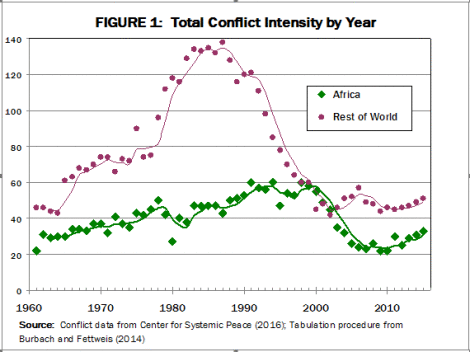
    The trend towards peace in Africa can be seen by using various datasets on armed conflict (for more on data sources, tabulation, and trend analysis, see Burbach and Fettweis 2014). The Center for Systemic Peace (CSP), for example, tracks conflicts from 1946 to the present, scoring each for the intensity of its societal impact. Figure 1 shows the yearly sum of conflict intensity assessed by CSP, for both Africa and the rest of the world. The end of the Cold War brought peace to much of the world, but African conflicts increased in the 1990s. States like Somalia and Sierra Leone collapsed into warlordism, for example. Central Africa was hit by the Rwanda genocide and bloody chaos in Eastern Congo, killing one to five million people.  At least three-fourths of the world’s total war deaths in the late 1990s took place in Africa (Burbach and Fettweis 2014, Figure 4).

    After the year 2000, the tide of war receded. Africa’s total conflict intensity as measured by CSP fell by approximately half. A similar pattern is shown by the Uppsala Conflict Data Project. Using somewhat different definitions, the Uppsala data shows that the number of conflicts in Africa resulting in 1,000 or more “battle deaths” per year declined from an average of 12 in the late 1990s to an average of 3.5 from 2010-2013. Some decades-long wars ended with formal peace accords, as with Angola in 2002; elsewhere, states gradually gained the upper hand on armed disorder. Given the unfortunate rise of warfare in the Middle East, Africa is no longer the most violent region of the world.

    africa-conflict-data

    The decline of warfare in Africa is even more dramatic in terms of individual risks. Africa’s population is growing rapidly, up 150% since 1980. Declining conflict despite a much larger population means the mortality risk from war has fallen substantially. An average of 32 people per 100,000 population were killed per year in the 1980s and 45 per 100,000 in the 1990s. In 2013, though the rate was only 8 per 100,000 (Burbach & Fettweis 2014, Figure 5). World Health Organization data shows an astonishing 95% decline in African conflict deaths from 2000 to 2012. In the 1980s, warfare killed more Africans than vehicle accidents. Today, perhaps three to six times as many Africans die in road crashes than from conflict. Many more Africans are harmed by crime or domestic violence than by warfare. Africa is still afflicted by more conflict than most ofthe world and the suffering of those involved is very real. Nevertheless, a greater proportion of Africans live free of war today than ever in the post-independence period.

    Celebrating African peace may seem premature given the civil war in South Sudan or the ravages of Boko Haram. Conflict has increased since 2011, but the level of armed conflict still remains lower than any time from 1970 – 2000. The most tragic development is the civil war in South Sudan, which the U.N. estimated had killed 50,000 as of spring 2016. Fortunately, South Sudan’s case is nearly unique: a newly created nation, devoid of physical or administrative infrastructure, with ethnically divided, soon-to-be-unemployed armed factions eyeing the lucrative oil revenues awaiting whomever could seize power. As academic panelists noted in 2011 – two years before the civil war –  predictors of conflict were flashing red in South Sudan. Few African countries contain such a combustible mix of problems anymore.

    Accounting for the decline

    Image by UN Photo via Flickr.

    Image by UN Photo via Flickr.

    There are several factors behind the ebbing of conflict in Africa. One important change is the geopolitical environment. During the Cold War, the U.S. and the Soviets armed and funded rival factions in civil wars, allowing bloody wars to fester for decades in countries like Angola, Mozambique, and Ethiopia. Then, 1990s Africa fell into turmoil as superpower-sponsored regimes collapsed. A disinterested world mostly left Africa to its fate, but continued trade in weapons and resources with warlords. In the last decade, however, the U.S., Europe, and China have all become more active in diplomacy, security assistance, and peacekeeping. The US and China are together pressing the South Sudanese factions to stop fighting, rather than choosing sides. The world has become somewhat less willing to sell arms or purchase minerals that directly fuel conflicts, admittedly with a long way to go.

    Africans themselves deserve great credit for ending the wars that plagued their continent.  Economic growth, improvements in governance, and greater space for peaceful political participation have all made state failure and internal conflict less likely. As Paul Collier among others has noted, civil wars tend to create vicious cycles that spread insecurity to whole regions. Many regions of Africa have climbed out of the conflict trap; political, security, and economic improvements are reinforcing each other. The nations of Africa increasingly work together through the institutions of the African Union to head off or resolve conflict, and to deploy peacekeepers to conflict zones. Needs still outpace available resources, but that cooperation is a marked change from 20th century Africa.

    A peaceful future?

    Whether the trend towards peace continues depends foremost on Africa’s leaders, but external actors can encourage positive trends in African security. Most directly, partners can help the AU and its member nations improve peacekeeping and conflict resolution capabilities. Likewise, the world should continue arms embargoes against combatants and regulating trade in valuable resources where exploitation appears to be a key ingredient of protracted conflict. Ongoing encouragement and incentives for democratization and governmental reform are helpful. Western countries should consider, however, that broad efforts like anticorruption programs are probably more helpful than International Criminal Court indictments of individual leaders, which can generate nationalist backlash.

    The world should especially try not to create new ground for conflict. Libya and South Sudan are Africa’s worst conflict zones today. Both were birthed through Western action – the removal by force of the Qaddafi regime, and diplomatically sponsoring South Sudan’s independence from Khartoum. While the moral cases were sound, both countries were left with non-existent governments, antagonistic armed factions, and grossly inadequate provision for disarming, demobilizing, and re-integrating fighters. American and European governments focused more on freeing people from hated regimes than on answering – let alone resourcing – the “what next?” question. Chaos followed, just as many African governments had warned at the time.

    From a humanitarian perspective, advocates should consider whether other challenges in Africa deserve relatively more attention. For example, Fearon and Hoeffler suggest that domestic violence against women and children now imposes larger human costs than warfare, and also that domestic violence can be reduced more cost-effectively than armed conflict. The ballooning toll of vehicle accident deaths in Africa may represent an opportunity for international technical or educational assistance to pay off with many saved lives. Beyond road safety, Africa is rapidly urbanizing.  Western visions of menacing rebels waving AK-47s in the bush privilege the exotic, but most Africans confront more prosaic threats to health and safety. The human security challenges Africans confront are increasingly those of city-dwellers:  crime, sanitation and utilities, safe and reliable transport, etc. Better policing, regularized urban housing, and expansion of infrastructure in megacities like Lagos and Kinshasa ought to be top priorities.

    Conclusion

    Sixteen years ago The Economist magazine suggested Africa was a “hopeless continent”. Lately The Economist has been bullish on Africa, citing the decline in warfare as a key reason for the continent’s improving business prospects. With remarkable speed, in the 21st century African conflict declined and safety improved, a hugely positive change in the welfare of Africans. Africa’s international friends should ensure their priorities respond to contemporary human security challenges, not ghosts of the past – and certainly they should avoid making things worse. Recognition of Africa’s progress itself would be a boon:  the continent’s increasingly out-of-date image as an undifferentiated war-torn anarchy retards investment and engagement from overseas. The tragedies of the moment deserve action, but we should not overlook that there is also much good news out of Africa.

    David T. Burbach is an Associate Professor of National Security Affairs at the Naval War College in Newport, RI.   Dr. Burbach received a Ph.D in Political Science from the Massachusetts Institute of Technology, and has expertise in African security, defense planning, and U.S. foreign policy.   The views expressed in this article are personal and do not represent official positions of the U.S. Navy.

  • Climate conflict: how global warming threatens security and what to do about it

    Climate change has been a key factor in the rise and fall of societies and states from prehistory to the recent fighting in the Sudanese state of Darfur. It drives instability, conflict and collapse, but also expansion and reorganisation. The ways cultures have met the climate challenge provide object lessons for how the modern world can handle the new security threats posed by unprecedented global warming.

    Combining historical precedents with current thinking on state stability, internal conflict and state failure suggests that overcoming cultural, social, political and economic barriers to successful adaptation to a changing climate is the most important factor in avoiding instability in a warming world. The countries which will face increased risk are not necessarily the most fragile, nor those which will suffer the greatest physical effects of climate change.

    The global security threat posed by fragile and failing states is well known. It is in the interest of the world’s more affluent countries to take measures both to reduce the degree of global warming and climate change and to cushion the impact in those parts of the world where climate change will increase that threat. Neither course of action will be cheap, but inaction will be costlier. Providing the right kind of assistance to the people and places it is most needed is one way of reducing the cost, and understanding how and why different societies respond to climate change is one way of making that possible. 


    ‘Dr Mazo authoritatively tackles a much overlooked, yet pivotal dimension of the broader climate change debate – the security implications of evolving climate trends. He makes a strong case, anchored in both contemporary developments and historical analysis, that climate change can serve as a “threat multiplier”, contributing to instability, exacerbating conflicts and complicating foreign-policy decision-making. This book is a must read for foreign-policy professionals.’

    Ambassador Paula J. Dobriansky, former US Under Secretary of State for Global Affairs

    Available here.