Blog

  • Sustainable Security

    A top-down approach to sustainable security: the Arms Trade Treaty

    2012 has been hailed as a potential landmark year in the push for greater regulation of the global trade in conventional arms. After more than a decade of advocacy to this end, negotiations took place throughout July towards the world’s first Arms Trade Treaty (ATT), which is intended to establish the highest possible common international standards for the transfer of conventional weapons. However, although significant progress was made during the month of intense negotiations, the ATT is not yet open for signature. In this article, Zoë Pelter explores what role a potential treaty – if reopened for further negotiation – could play in a move towards sustainable security.

    Read Article →

  • Sustainable Security

  • Sustainable Security

    This interview was conducted by the Remote Control project. 

    Sascha Dov Bachmann, Assessor Jur, LLM (Stel) LLD (UJ), is an Associate Professor in International Law (Bournemouth University, UK), Extraordinary Associate Professor in War Studies (Swedish Defence University, Sweden) and Guest Speaker at NATO School. Outside academics, he served in various capacities as Lieutenant Colonel (German Army Reserve) taking part in peacekeeping missions in operational and advisory capacities. Sascha acted as NATO’s Rule of Law Subject Matter Expert (SME) in NATO’s Hybrid Threat Experiment of 2011 and in related workshops at NATO and national level. He would like to thank Brigadier (Rtd) Anthony Paphiti, former ALS officer, for his insightful comments and discussions.

    In this interview, Dr. Bachmann discusses hybrid warfare, its use in Ukraine and Crimea by Russia, and whether NATO is adequately prepared to formulate effective responses to this method of warfare.


    Q. What is ‘hybrid warfare’?

    Hybrid warfare as a warfare concept is not new among those practising the art of war. However, contemporary events lead us to argue that today’s hybrid warfare “has the potential to transform the strategic calculations of potential belligerents [because it has become] increasingly sophisticated and deadly”.

    Hybrid war is a concept that has emerged shortly after the end of the Cold War and sums up the complexities of modern warfare, which go beyond conventional military tactics, often involving cyberwarfare, propaganda and a fluid, non-state adversary.

    The concept of hybrid warfare has been discussed by (mostly US) military writers since the beginning of the 21st century and its recognition as a theory in formal military doctrinal thinking is still not settled. Hybrid warfare may use elements from four existing methods and categories of full spectrum warfare, namely:

    • conventional warfare;
    • irregular warfare (such as terrorism and counter-insurgency);
    • related asymmetric warfare (unconventional warfare such partisan warfare);
    • and compound warfare (where irregular forces are used simultaneously against an opponent while being employed by state actors to augment their otherwise conventional warfare approach).

    Hybrid warfare builds on existing doctrinal elements and adds the following: evolving war-fighting capacities in the fifth dimension such as “cyber-warfare”; and activities in the so- called information sphere.

    Q. Who were the first actors to utilize hybrid warfare and why?

    According to Hoffman’s seminal work “Conflict in the 21st Century: The Rise of Hybrid Wars”, it was Hezbollah in its 2006 war with the IDF. Here, a non-state actor (NSA) did utilise war fighting capabilities normally not used by non-state actors such as blending conventional warfighting on the ground and activities in the information sphere. Other examples are Islamic State/Daesh which show a blend of capabilities which blur the line of traditional warfighting: such as the use of suicide bombers, improvised explosive devices, and the use of ‘ground troops’ in a conventional manoeuvre context augmented by strong propaganda/information sphere activities.

    Why: because these capabilities are available. Hezbollah (and IS) had and has a substantial potential of rockets/military hardware and is aptly using the possibilities available through social media in the information sphere unknown before. Both non-state actors are also utilising the opportunities of informing public opinion in the West thanks to a growing Muslim population in the West who have cultural and lingual access/connection to these conflicts/the nature of the conflict.

    Q. Is hybrid warfare something that states have used?

    Russia has used hybrid warfare.

    How:

    In a Keynote speech at the opening of the NATO Transformation Seminar on 25 March 2015, NATO Secretary General Jens Stoltenberg remarked:

    “Russia has used proxy soldiers, unmarked Special Forces, intimidation and propaganda, all to lay a thick fog of confusion; to obscure its true purpose in Ukraine; and to attempt deniability.  So NATO must be ready to deal with every aspect of this new reality from wherever it comes. And that means we must look closely at how we prepare for; deter; and if necessary defend against hybrid warfare.”

    Michael Kofman and Matthew Rojansky described Russia’s 2010 Military Doctrine of modern warfare:

    “…… as entailing “the integrated  utilization of military force and forces and resources of a non-military character,” and, “the prior implementation of measures of information warfare in order to achieve political objectives without the utilization of military force and, subsequently, in the interest of shaping a favourable response from the world community to the utilization of military force.”

    The employment of hybrid methods has been evident from Russia’s activities in Crimea and the Donbas region of Ukraine, with its deployment of “little green men”, namely, soldiers wearing unmarked uniforms that make direct state attribution difficult. According to Mark Galeotti, Professor of Global Affairs at New York University’s Center for Global Affairs:

    “The conflict in Ukraine has demonstrated that Moscow, in a bid to square its regional ambitions with its sharply limited resources, has assiduously and effectively developed a new style of ‘guerrilla geopolitics’ which leverages its capacity for misdirection, bluff, intelligence operations, and targeted violence to maximise its opportunities.”

    While there may be limitations to the way in which these methods were used in Ukraine, the use of non-attributable military personnel provides expert assistance to an enemy and, even if not directly engaged in hostile acts, provides advice and assistance to those who carry out such acts. Nevertheless, the seriousness of the threat posed by such forces should not be under-estimated. General Breedlove, currently Commander, US EUCOM and the Supreme Allied Commander Europe (SACEUR), is reported as saying,

    “if Russia does what it did in Crimea to a NATO state, it would be considered an act of war against the alliance.”

    In Ukraine, Russia employed a hybrid strategy by combining irregular warfare and cyber warfare to achieve its strategic objectives. Reuben F Johnson, writing in IHS Jane’s Defence Weekly, on 26 February 2015, considered that “Russia’s hybrid war in Ukraine ‘is working’.” They had combined a substantial ground force of 14,400 Russian troops supported by tanks and armoured fighting vehicles, backing up the 29,300 illegally armed formations of separatists in eastern Ukraine.

    Q. Does hybrid warfare hold military advantages for states over conventional warfare?

    Russia is winning the hybrid war in Ukraine: it has successfully annexed Crimea, and effectively turned Ukraine into a state on the brink of wider failure. In the process, Russia has successfully divided Western countries on how to respond to this act of aggression. Russia also successfully reactivated its Cold War disinformation mechanisms, successfully blurring reality and fiction for global observers. Russia has uncovered the West’s inability to find a common policy to respond to the unfolding events in Ukraine.

    Q. How does hybrid warfare relate to international law? Is this way of waging war covered in current international legal paradigms?

    Generally speaking, hybrid warfare does not change the international legal paradigms such as Article 2(4), 51 UN Charter and in the context of NATO, Article V of the NATO Treaty. Whether any form of hybrid attack, alone or cumulatively, amounts to a use of force and, if so, reaches the threshold of an “armed attack” to justify a military response under Article 51 – and what form that response would take – are very difficult questions to answer. They are situation/fact specific. Moreover, attribution may be problematic. In addition, hybrid warfare – with its possible elements of cyber, terrorism, asymmetric warfare etc. – might not reach the threshold of such an attack and hence allow affected states to ‘deny’ the existence of such warfare in order to continue with their diplomatic relations, trade  etc with the ‘aggressor’ state. Such behaviour might undermine existing alliances and weaken international comity.

    Q. How prepared, or perhaps unprepared, are NATO for formulating effective responses to hybrid warfare?

    NATO is in my opinion well prepared to formulate effective responses given its substantial work undertaken in the context of hybrid threats. NATO recognized as early as 2010 hybrid threats were a new security risk and designed a new NATO Bi-Strategic Command Capstone Concept, describing hybrid threats as emanating from an adversary who combines both conventional and unconventional – military methods to achieve its goals.

    In the two years following 2010, NATO drew up a specific threat catalogue, which identifies security-specific risks beyond conventional warfare threats: nuclear proliferation, terrorism, cybercrime and cyber-war, organized crime and its role in drugs, arms and human trafficking, migration, ethnic and religious conflicts, population conflicts due to resource scarcity and globalization.

    NATO recognized that these may amount to a concrete threat to the alliance or that it could be authorized by the United Nations, because of their capacity, to intervene. Recognizing this, NATO worked on a related global approach (Comprehensive Approach) in order to counter these risks. This approach envisaged involving state and non-state actors in a comprehensive defence strategy that combines political, diplomatic, economic, military technical and scientific initiatives. Despite intensive work on this approach as part of a “Countering Hybrid Threats” experiment in 2011, the NATO project work in 2012 had to stop due to lack of support from their members. (From our submission to the UK DC)

    Given this existing framework/ capstone on how to respond to hybrid threats and the inter-related nature of hybrid threats and warfare, I would like to argue with some confidence that NATO has the capability to formulate an effective doctrinal approach, notwithstanding the initial discontinuation of the work on the hybrid threat concept.

    Q. Do you think that hybrid warfare will be the main method of waging war in the future and how do you see the use of this form of warfare evolving?

    Hybrid warfare with its various forms such as cyber-attacks, the use and abuse of the information sphere, the use of a holistic mix of conventional and irregular warfare, the exploitation of country specific vulnerabilities, law fare etc, is here to stay due to its obvious benefits to the using power/state/actor: deniability and the possibility of staying under the threshold of an armed attack which would in a likeliness trigger a military/kinetic response. I am convinced that the elements of hybrid warfare will evolve further and will eventually be used by state and non-state actors alike. Whether the overall term “hybrid warfare” for such multi-modal forms of warfare/threats is to stay we will see. Hybrid war’s impact on international law and comity is significant and it will question some of our established doctrines/concepts.

  • Aid and the Middle Income Countries Dilemma: UK Aid to India

    The UK parliament’s development committee begins its inquiry into UK aid to India next week with a question mark over the future of UK aid to a country where there are 450 million poor people – a third of the world’s poor -living below US$1.25/day. In fact, 8 Indian states alone have more poor people than the 26 poorest African countries combined.

    This is emotional territory – on both the UK and India side – during Cameron’s autumn 2010 visit sparks flew with the Indian finance minister calling UK aid ($700m) ‘peanuts’ in an angry response to the suggestion that the UK might end aid to India.

    An Indian official’s memo leaked to the BBC largely concurred with the ‘who do you guys think you are?’ line.

    It might be that the Indians got mad because DFID signaled it wanted to direct more aid to individual states rather than the central government. More recently the idea of an emerging power, that is a foreign aid donor itself, accepting aid has raised substantial debate within India itself.

    DFID’s Secretary of State, Andrew Mitchell is said to be open to discussion either way but was persuaded so far by Cameron that the UK can’t be seen to be cutting aid to a country that British people think is a poor country even if it isn’t.

    Donors have a somewhat tangled logic on middle income countries (MICs):

    1. The mission of donors is poverty reduction

    2. 72% of the poor live in MICs

    3. Donors are withdrawing from MICs, where the poor live

    4. Oops…

    Currently, India receives about $2bn of aid/year from donors and the UK makes up about a third of this. Since 1998, India has received more UK overseas aid than any other country. Further DFID works in 27 MICs and spends about a third of bilateral programming in MICs in 2008/9. In contrast, almost a half of EU ODA is to MICS.

    The paradox is India, like many other countries was ‘graduated’ out of ‘poor country’ status by the World Bank in 2009 to middle income status (more than $1000 per person per year) but is still home to a third of the world’s poor or 450 million people. India is still IDA (World Bank) eligible but will likely graduate three years from now.

    Of course this is a good news story of India getting richer but with an underside. Recent research suggests the level of inequality in India is at ‘Latin American type levels’ but the capacity for redistribution by taxation is limited as it would mean prohibitively high levels of taxation.

    So sound like these’s still a case for UK aid?

    The debate on UK aid to India is polarised but clear enough –

    The case against UK aid to India is based on the large resources of the central government in India and that UK aid is small compared to: $300bn forex reserves; the Indian space programme and nuclear programme and India’s own aid programme estimated at at least $550m+.

    Of course Pakistan also has a nuclear programme but no one in the suggesting cutting aid to Pakistan that is also now a middle income country and home to perhaps up 90 million poor people…

    The case for continued UK aid to India is those 450 million poor people, most of whom live in India’s poor states in a decentralised system where some Indian states have been compared to fragile states in Africa.  Also the poor in India are lower caste, tribes, etc and so very marginalised – not just a bit poor but very poor. Which makes reducing poverty much harder due to entrenched marginalization.

    UK aid currently focuses on national-led level poverty programmes and 4 ‘focus states’ – Andhra Pradesh, West Bengal, Orissa and Madhya Pradesh. Of course only one of these is on the BIMARU (in hindi, sick) states group that are often thought to be the poorest states in India. By conventional reckoning Andhra Pradesh wouldn’t be poor, and West Bengal, while not poor, has certainly had some economic hard times as of late. The other two, most people would count as poor states.

    If UK aid was ended there is no guarentee that the poorest states would be ‘topped’ up central government. Central allocations to states are based on the “Gadgil formula” which the Indian central Planning Commission uses to determine the allocation of central funds to the states. This is how it goes – feel free to correct fiscal experts if I’ve got this wrong – allocations are largely (60%) based on population size, with the rest accounted for by income per capita, tax collection, irrigation and power projects and ‘special problems’. There are also transfers under centrally sponsored and central sector schemes and a third category of transfer that is known as the ad hoc transfer and is non-formulaic. In short, remove aid from the poorest states and there is no guarantee of a top up.

    What could DFID and donors do differently?

    i. Focus on poor people, not poor countries

    If the focus of aid is poor people not poor countries then the low income/middle income country way of looking at the world needs a rethink. DFID could switch its aid allocation metrics to fit DFID’s mission – ie from poor countries (low or middle income countries) to poor people. The new Oxford University and UN multidimensional poverty index (MPI) measure might be one alternative tool. But there are many others.

    ii. Think beyond traditional aid

    Maybe aid is no longer about money transfers with MICs. There is the ‘do no harm’ agenda – designing favourable and coherent development policies on remittances and migration, trade preferences, climate negotiations and climate financing, as well as tax havens – and a case for making aid increasingly about global public goods (and the importance of MICs support to these) and multilateralism, especially in middle-income countries and where aid might be channelled through the United Nations Children’s Fund, for example, or a new global fund for cash transfers to households as a direct poverty and redistributive measure.

    OR maybe MICs may not want traditional aid at all.

    iii. See equity and shared prosperity as a global and donor concern not just a domestic issue

    More equitable countries reduce poverty faster, and stubborn asset, gender or identity inequality (ie caste systems) might begin to explain persistent poverty amid wealth in MICs. This entails some thinking on what aid is for and it’s role perhaps in supporting political voice of the poor and marginalized in policy processes. Any attempt to discuss inequality will be viewed as an infringement on political sovereignty but is domestic inequality solely a domestic issue if it hinders the effectiveness of aid? And it’s not just UN agencies such as UNICEF talking about equity even the IMF thinks inequality is now real concern as it slows down poverty reduction.

    What is more of a mystery is why India accepts aid that amounts to 0.1-0.2% of GNI. Could it be:

    Path dependency – it’s always happened so why stop now?

    Or foreign policy relationship maintenance – why rock the boat?

    Or is it that aid is doing good in the poorer states so why stop even if the central government could fund it?

    Or something else?

    And a final thought, after India, what about aid to Ghana?  Which is due to graduate to middle income status next year…

    This article originally appeared on Global Dashboard. 

  • Sustainable Security

    Scarred in recent years by questionable involvements in the likes of Afghanistan and Iraq – and by the casualties they wrought – risk-averse Western governments have begun to look to others to do the shedding of blood in their ‘wars of choice’. The risky boots-on-the-ground role that was once the proud preserve of NATO armies anxious to showcase their abilities is now politically unpalatable. Proxies appear to be the answer. Biddable local allies who are of a mind to work in collaboration with Western militaries are very much in demand: the former supply the troops, the latter the training and the technological support – if not, indeed, the weapons as well. A symbiosis based on the principle that my-enemy’s-enemy-is-my-friend is the goal. This simple formula, though, is one that is not always bound to produce positive results. Proxies should always carry a health warning; they tend not to be as biddable as hoped.

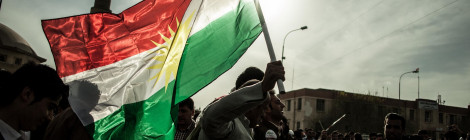
    Take the Kurds. They are an ethnic group inhabiting a region – Iraq and Syria – where suitable proxies for Western powers are very much in demand for use against Islamic State (IS). The Kurds appear to be ideal candidates as proxy fighters: they are numerous; of a warrior-caste; are politically acceptable to Western audiences, and have a natural enemy in IS. As a militant group intent on territorial expansion, IS threatens Kurdish communities. The case for synergy is thus obvious: Western militaries and the Kurds can work together for mutual benefit. Not quite so obvious, however, are the various reasons why the relationship between Kurd and Western militaries is one that has the ready capacity to go awry. The chief driver of any breakdown is that Kurdish proxies can and will have their own priorities that clash with those of their sponsors.

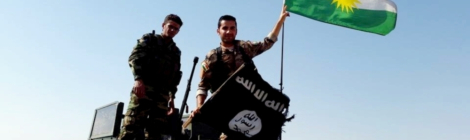
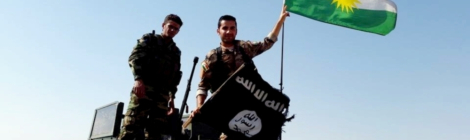
    Image of Peshmerga replacing the ISIS flag with  the Kurdish flag by Kurdishstruggle via Flickr.

    The first point to note here is that the Kurds are a people divided. A fractiousness has historically long been evident between the various clans, tribes and families that make up this nation. These differences may have now mellowed but they have never completely dissipated. And then there are the differences created by linguistic schisms – Sorani and Kurmanji – and sectarianism – Sunni and Shia. Differences also developed due to the politics of whichever state the Kurds found themselves in after the demise of the Ottoman Empire. The Kurds within Syria developed under the tutelage firstly of French colonial rulers and then under a succession of socialist governments in Damascus. Both influences – or rather impositions – shaped a Kurdish community that was very much secular in make-up. It was the same in Turkey; Kemalist policies pushed secularism. In contrast, however, in Iraq, the laissez-faire approach of British colonial masters and then the inability of Iraqi governments to penetrate and shape attitudes in its northern Kurdish region left in place a largely tribal-based, conservative structure that is still today strong on religious (Sunni) influences.

    Today, the Kurdish area of northern Iraq, known as the Kurdish Regional Government (KRG), is riven by a split between a Western region dominated by the party of President Masoud Barzani – the Kurdish Democratic Party (KDP) – and an eastern region where the party of former Iraqi president, Jalal Talabani – the Patriotic Union of Kurdistan (PUK) – holds sway. The KDP, dominated by the Barzani tribe and with strong links north to its political patron, Turkey, maintains the strings of power in the KRG. It is based in the ‘capital’ of Erbil. The PUK, more left-of-centre, modernist and leaning towards Iran, holds sway around Suleimaniyeh. These two parties, indeed, and using their peshmerga forces, fought a civil war in the 1990s. And while there is currently what might be seen as a national KRG peshmerga force, these two parties still maintain their own peshmerga units and there is thus always the possibility that tensions may lead to some renewed clashes. Moreover, with future independence in mind, one eye is constantly being kept on the need to prepare for a possible future conflict with the Iraqi army and its associated Shia militia. Here is one particular problem for the Kurds of Iraq – who is the real enemy? Is it IS; is it fellow Kurds, or is it Baghdad? This then also becomes a problem for any power that seeks to use these Iraqi Kurds as proxies against IS – as the United States and others do. Can they be made to keep their eyes focused on IS and not elsewhere? And will the training and weapons they might be supplied with be directed at IS, or could they be used against other US proxies – such as other groups of Kurds and/or the Iraqi army?

    In Iraq, for instance, any future push on IS-held Mosul will, the US military hopes, involve the KRG’s peshmerga forces supported by US artillery and air power. Washington does not want the Shia-dominated Iraqi army to be seizing, on its own, the Sunni city of Mosul. Re-occupation of the city should be leavened, ideally from the US viewpoint, by the employment of Sunni Kurds. As things stand, however, there is a reluctance on the part of Erbil to push forward. The KRG has now, to a large degree, stabilised its own ‘borders’ (including the internal one within Iraq), which they see forming the basis of a future independent Kurdistan. Assaulting the Arab city of Mosul will doubtless involve a major loss of life and of treasure (in a cash-strapped KRG) that will produce little in the way of obvious gain for the Kurds while there is a bigger prize in mind.

    Then there are the Kurds in Turkey. The Kurdistan Workers’ Party (Kurdish: Partiya Karkerên Kurdistanê‎, PKK) is a left-wing Kurdish militant group that has long been fighting for more autonomy for the Kurdish-majority region of south-east Turkey. Ankara looks upon the PKK, not unnaturally, as a terrorist group. Recently, during the IS-generated chaos in northern Iraq, battle-hardened PKK units moved across the area and have proved to be some of the best fighters against IS; certainly better than the peshmerga. So here, logically, should be the ultimate proxy of choice for the US inside Iraq – the PKK. The idea, though, that US forces should assist the PKK in any way would bring paroxysms of protest from Turkey – a NATO ally. The KDP government in Erbil (with its own allies in Ankara in mind) is itself ardently agitating to prevent the PKK from setting up any zones within Iraq that it will come to control politically (such as around Sinjar). The PUK, on the other hand, has long supported the PKK, mostly because of the commonality of their left-wing politics.

    There are also the Kurds in northern Syria to consider. There are dozens of bickering Kurdish political parties jockeying for control there. The only force there that is armed, though, is the militia – the People’s Protection Units (Kurdish: Yekîneyên Parastina Gel, YPG) – of the main party, the Democratic Union Party (Kurdish: Partiya Yekîtiya Demokrat‎, PYD). The PYD – again, avowedly secular and actively left-wing – was formed mainly from PKK members who had fled from Turkey in the 1990s. The PYD is thus looked upon by Turkey as just an offshoot of the PKK and is, therefore, also a ‘terrorist’ group. But again, its YPG militia have proved very effective – certainly more effective than US-allied Arab groups in Syria – at confronting and besting IS. The YPG have also shown a penchant for actually taking the fight to IS by moving into Arab-majority areas of Syria (something the peshmerga in Iraq are reluctant to do). Here is another proxy that seems ideal. But how is the US to support the YPG effectively without incurring the wrath of Ankara? Moreover, there will probably come a time soon when Turkey will try and seize Kurdish areas of northern Syria in order to eliminate what it sees as the PYD’s terrorist threat. The PYD’s main enemy would then be Turkey, and not IS. What would the US do then?

    And then there is the cross-border relationship between the Iraqi and Syrian Kurds. It would seem natural for the Kurds in Iraq to support their ‘compatriots’ in Syria. Beyond natural kinship would also be the fact that both are fighting IS. But the KDP in the KRG, having allied itself with Turkey and being more tribal and religiously conservative, wants no truck with the ‘communist’ PYD. Indeed, it has even tried to prevent any assistance reaching the PYD across the Euphrates. To this end, a large trench system has been built by KDP peshmerga to act as a physical barrier designed to prevent any help from the PUK – who do support the PYD (mostly, again, for ideological reasons) – being sent across the border into Syria. Thus the US military is providing assistance to two armed Kurdish groups – the YPG and the KDP’s peshmerga – who are highly likely to one day become engaged in combat with one another.

    Thus when Western military organisations look to the Kurds to provide suitable proxies against IS, problems abound. The notion of a symbiosis created by a common enemy is tempered by the fact that the Kurds, of whatever ilk, tend to have more than just one enemy. This is not a good basis for the role of reliable proxy. But apart from the Kurds, who else is there?


    Rod Thornton is a Senior Lecturer at King’s College London based in Qatar. He spent nine years in the British Army before moving into academia. His research interests focus on terrorism, low-intensity warfare and new forms of warfare – particularly, as a Russian-speaker, on Russian hybrid warfare.  He has lived in the Middle East for four years, including one year at the University of Hewler in Erbil, Kurdish region of Iraq. He is the author of many articles and a book, Asymmetric Warfare: Threat and Response in the 21st Century (Polity Press 2007).

  • Losing Control: Global Security in the Twenty-first Century

    Image of Losing Control: Global Security in the Twenty-first Century

    • Purchase from Amazon:
    • Losing Control: Global Security in the Twenty-first Century
    • Author: Paul Rogers
    • Publisher: Pluto Press ()
    • Binding: Paperback, pages
    • Price: £15.99

  • Competition over resources

    This major report was the result of an 18-month long research project examining the various threats to global security, and sustainable responses to those threats. Read more »
  • Marginalisation of the majority world

    A gap continues to exist between the international community’s rhetoric about conflict prevention and its responsibility to protect people from severe human rights violations. The record of human misery caused by violent conflict is testimony to the chronic  lack of political will to respond collectively to newand emerging threats to peace. The ineffectiveness of many global efforts at preventive diplomacy is evidence that traditional diplomatic approaches,  including the use of force, simply may not work.

    Article source: East West Institute

    Image source: AfghanistanMatters

    Read more »

  • Sustainable Security

  • Naxalite insurgency

    In an age of climate change and deepening inequality, the spreading Naxalite insurgency in India – not al-Qaida – may show the world its future.

    This article was originally posted on openDemocracy.

    Read more »