Blog

  • Drones Don’t Allow Hit and Run

    If You Use Drones You Must Confirm and Report Who They Killed, Says Legal Team

    International lawyers have identified an existing but previously unacknowledged requirement in law for those who use or authorise the use of drone strikes to record and announce who has been killed and injured in each attack.

    A new report, ‘Drone Attacks, International Law, and the Recording of Civilian Casualties of Armed Conflict’, is published on 23 June 2011 by London-based think tank Oxford Research Group (ORG).

    Speaking at the Geneva Centre for Security Policy, Dr Susan Breau, the report’s lead author and Professor of International Law at Flinders University, said:

    It is high time to implement a global casualty recording mechanism which includes civilians so that finally every casualty of every conflict is identified. The law requires it, and drones provide no exemption from that requirement.

    THE REPORT’S KEY FINDINGS

    • There is a legal requirement to identify all casualties that result from any drone use, under any and all circumstances.
    • The universal human right which specifies that no-one be “arbitrarily” deprived of his or her life depends upon the identity of the deceased being established, as do reparations or compensation for possible wrongful killing, injury and other offences.
    • The responsibility to properly record casualties is a requirement that extends to states who authorise or agree the use of drones, as well as those who launch and control them, but the legal (as well as moral) duty falls most heavily on the latter.
    • There is a legal requirement to bury the dead according to the rites of the religion to which they belonged, and this may not be in mass or unmarked graves. The site of burial must be recorded, particularly in the event that further investigation is required.
    • A particular characteristic of drone attacks is that efforts to disinter and identify the remains of the deceased may be daunting, as with any high explosive attacks on persons. However, this difficulty in no way absolves parties such as those above from their responsibility to identify all the casualties of drone attacks.
    • Another characteristic of drone attacks is that as isolated strikes, rather than part of raging battles, there is no need to delay until the cessation of hostilities before taking measures to search for, collect and evacuate the dead.

    PAKISTAN, YEMEN, AND BEYOND

    The report also provides a set of specific recommendations addressing the current situation in Pakistan and Yemen, where the issue of drone strikes by the United States and the recording of their casualties is of real and practical urgency. According to the report, while legal duties fall upon all the parties mentioned, it is the United States (as the launcher and controller of drones) which has least justification to shirk its responsibilities.

    The implications of these findings go well beyond the particularities of these weapons, these countries, and these specific uses. The legal obligations enshrined as they are in international humanitarian law, international human rights law, and domestic law, are binding on all parties at all times in relation to any form of violent killing or injury by any party.

    Elaborating on the report’s implications, Dr Breau said:

    States, individually and collectively, need to plan how to work towards conformance with these substantial bodies of law. Members of civil society, particularly those that seek the welfare of the victims of conflict, have a new opportunity to press states towards fulfilling their obligations under law.

    This is not asking for the impossible. The killing of Osama Bin Laden suggests the lengths to which states will go to confirm their targets when they believe this to be in their own interest. Had the political stakes in avoiding mistaken or disputed identity not been so high, Bin Laden (and whoever else was in his home) would almost certainly have been typical candidates for a drone attack.

    Commenting on the report, Paul Rogers, ORG’s Consultant on Global Security and Professor at Bradford University Peace Studies Department, said:

    Armed drones are fast becoming the weapons of choice by the United States and its allies in South Asia and the Middle East, yet their use raises major questions about legality which have been very largely ignored. A key and salutary finding of this report is that drone users cannot escape a legal responsibility to expose the human consequences of their attacks. This hugely important and detailed analysis addresses some of the most significant issues involved and deserves the widest coverage, not least in military, legal and political circles.

    Article source: Oxford Research Group

    Image source: Official U.S. Navy Imagery

  • Sustainable Security

  • In Asia, an Opportunity to Strengthen Long-term Relationships though Natural Resource Cooperation

    China is experiencing one of the worst droughts in 60 years experts say, in part a consequence of the Asian giant’s insatiable appetite for energy and water resources that are needed to sustain economic growth and newly accustomed standards of living. Beijing appears to be working to alleviate these conditions, spending more than a billion dollars on agricultural subsidies and farming irrigation to counter food shortages, deploying weather modification teams that cloud seed the atmosphere to generate precipitation (despite potential consequences from this and other geoengineering activities) and “moving heaven and Earth” to divert water from the south to bring it north to Beijing. But one thing Beijing should do is look for opportunities to cooperate with regional partners to help the country deal with its water woes. And with the Obama administration increasingly elevating water issues in bilateral relations with key partners around the world, Washington could use this as an opportunity to strengthen ties with Beijing.

    Last month, Circle of Blue reported on the cascading effect that China’s energy demand is having on water scarcity. “Underlying China’s new standing in the world is an increasingly fierce competition between energy and water that threatens to upend China’s progress,” Circle of Blue’s Keith Schneider wrote. As Schneider pointed out, China’s history is fraught with challenges stemming from scarce fresh water resources, writing that it is nothing new for a state where “80 percent of the rainfall and snowmelt occurs in the south, while just 20 percent of the moisture occurs in the mostly desert regions of the north and west.” But what is different, Schneider noted, is the expanding industrial sector that consumes 70 percent of the nation’s water, and the need for the government to tap into its coal reserves in the north in order to feed this growth. The problem is that mining coal and coal-fired power plants themselves are water-intensive, and according to government officials, “there is not enough water to mine, process, and consume those [coal] reserves, and still develop the modern cities and manufacturing centers that China envisions for the region.”

    In January, Schneider published a related story arguing that, with the United States experiencing similar challenges related to what he refers to as energy demand and water scarcity choke points, the United States and China have an opportunity to share technologies and policies that could help mitigate these challenges.

    Indeed, natural resources should play a more integrated role in our diplomatic relations with Beijing. The United States already cooperates with China on a range of energy security and environmental sustainability initiatives, but these initiatives could be more evenly integrated into our diplomatic relations and given greater and more sustained attention at the senior levels of policymaking. Meanwhile, water scarcity is an area that is ripe for more robust cooperation between Washington and Beijing. Secretary of State Hillary Clinton has acknowledged the potential for water and related issues to foster greater collaboration with international partners. “In the United States,” she told an audience last March, “water represents one of the great diplomatic and development opportunities of our time.”

    Of course, there are many hurdles to greater engagement on these issues, especially on the energy side where concerns regarding intellectual property may chill potential cooperation. Nevertheless, high level engagement around natural resource challenges, including on energy demand and water scarcity, could help pull these issues from the periphery and signal that these challenges merit greater attention from Washington and Beijing in foreign policy discussions, fostering a greater sense of urgency while expanding opportunities for further collaboration. Framing these issues as foreign policy and security challenges– given that the actions by one state can have consequences for regional neighbors, especially with transboundary water resources– would be a tremendous leap forward in integrating natural resources into broader foreign policy considerations rather than treating them as environmental issues that might not otherwise make it on to the radar of senior foreign policymakers. And efforts such as these should extend beyond just the United States and China. In fact, natural resources should be given greater attention in multilateral discussions with other regional actors, including Japan, as well as integrated into high level ministerial meetings at ASEAN and APEC.

    It won’t be easy to integrate natural resources into higher level foreign policy discussions, given the range of seemingly more pressing foreign policy, security, and economic challenges that plague the United States, China and other states around the region, including a nuclear North Korea and a still fragile global economy. Nevertheless, pulling these issues front and center will not only help give them the attention they deserve, but offer additional avenues to strengthen bilateral and multilateral relationship in Asia, perhaps even helping tip the U.S.-China relationship more towards long-term cooperation than competition.

    This article originally appeared on the Center for a New American Security website. 

  • Sustainable Security

  • Sustainable Security

    Belize: challenges and contradictions in gang policy

    Like its neighbours in the northern triangle (El Salvador, Honduras and Guatemala), Belize has a high murder rate that is closely connected to the strong presence of gangs. But the character of gang activity in Belize is quite different from its Central American neighbours. Belize has pioneered some innovative solutions to the problem it is facing. But it will need to overcome the challenges of internal resistance and an acute lack of resources in order to address the political, economic and social issues that marginalise Belize’s large youth population.

    Read Article →

    Colombia and Mexico: The Wrong Lessons from the War on Drugs

    As activists around the world participate in a Global Day of Action against criminalisation of drug use, evidence from the multi-billion dollar War on Drugs in Colombia suggests that militarized suppression of production and supply has displaced millions of people as well as the problem, not least to Mexico. The wrong lessons are being exported to Central America and beyond, but a groundswell of expert and popular opinion internationally is calling for alternative approaches to regulating the use and trade in drugs.

    Read Article →

    The New Insecurity in a Globalized World

    Writing exclusively for SustainableSsecurity.org, Elizabeth Wilke argues that a new conceptualization of insecurity and instability is needed in a world with greater and freer movement of goods, services and people – both legal and illicit – greater demands on weakening governments and the internationalization of local conflicts. The new insecurity is fundamentally derived from the responses of people and groups to greater uncertainty in an increasingly volatile world. Governments, and increasingly other actors need to recognize this in order to promote sustained stability in the long-term, locally and internationally.

    Read Article →

    Conflict, Poverty and Marginalisation: The case of Curvaradó and Jiguamiandó (Urabá, Colombia)

    In Colombia there are many regions where poverty and the absence, or weak presence, of the state has facilitated the emergence of violence by armed groups. Among these are the Afro-Colombian communities of the Curvaradó and Jiguamiandó in the Urabá region. Whilst the Colombian government fails to fully develop social development programs (including education, health and infrastructure) and sustainable economic development policies to assist marginalised communities, the people of Curvaradó and Jiguamiandó will remain poor, uneducated, vulnerable, and at risk of lose their territories once again.

    Read Article →

    Mano Dura: Gang Suppression in El Salvador

    Widespread social exclusion makes El Salvador fertile ground for gang proliferation and, over time, gang members have resorted to greater levels of violence and drug activity. Yet, government approaches have proved spectacularly ineffective: the homicide rate escalated, and gangs have adapted to the climate of repression by toughening their entry requirements, adopting a more conventional look, and using heavier weaponry. Sonja Wolf argues for approaches which focus on prevention and rehabilitation and looks at why such approaches have been continually sidelined.

    Read Article →

  • Sustainable Security

    The Lord’s Resistance Army is seriously depleted as a fighting force, but it still continues to exist as an armed group. This resilience is driven by several key factors.  

    The Lord’s Resistance Army (LRA) has carved a path of violence and disorder throughout East and Central Africa for nearly three decades. Led by Joseph Kony, the rebel group has directly and indirectly killed more than 100,000 civilians, has abducted upwards of 66,000 children, and has displaced hundreds of thousands more across five countries. While formidable in the past, the LRA is now a threadbare non-threat from a conventional military standpoint. With the group’s numbers at less than 200 (down from at least 5,000 active fighters in the 1990s), attacks and abductions are steadily trending downwards.

    Yet the LRA has also proven to be distinctly resilient, surviving as a collection of semi-autonomous units in sparsely populated peripheries that put up no resistance. Nevertheless, LRA fighters still pose a tangible threat as they loot and harass civilians, while Kony evades detection in Sudan’s Kafia Kinji region. While many observers describe the group’s current behavior as “survival mode,” its complex history shows this to be its modal pattern of organization and behavior based on an on-going ability of the group to adapt to shifts in its politico-military environment through distinct organizational endowments and resource acquisition strategies.

    Understanding LRA Resilience

    Most of the prevailing literature on the LRA has provided key insights into its history, organization, and behavior. However, the research that has focused on the group’s motives and the drivers of its violence has not addressed the distinct question of its resilience. The LRA’s resilience comes down to its organizational structure and shrewd resource strategies that have developed within autonomous bush sanctuaries and vis-à-vis the group’s wider political environment.

    Its organizational structure is based on a distinct combination of two factors. First, LRA recruitment and retention strategies relied on Acholi beliefs in spiritual and cultural symbols, such as viewing Kony as a medium for the “holy spirit,” and the common use of rituals. Such beliefs and practices, undergirded by violence, helped socialize Acholi youths familiar with them into fighters. Second, a more traditional military hierarchy was built around an initial committed core, which formed the basis for a flexible, decentralized structure that, while slowly degrading over time, has remained remarkably sturdy. In addition, the group’s resource acquisition strategies have adapted to periods of both abundance and scarcity. This configuration of factors has remained more-or-less intact for more than three decades as the LRA has interacted with regional geopolitical shifts and in the face of multiple challenges of maintaining an insurgency.

    LRA Resilience Over Three Phases
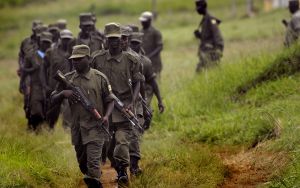
    Uganda soldiers part of the 2008–09 Garamba offensive against LRA. Image credit: Sgt. Jeremy T. Lock/Wikimedia.

    The LRA grew directly from a homegrown Ugandan People’s Democratic Army (UPDA), made up from the dominant Acholi faction of the national army overthrown by the National Resistance Army (NRA) in 1986. Led by Bazilio Olara-Okello and other military strongmen, the UPDA rebellion ended with the Pece Peace Accord of 1988. Yet senior officer Odong Latek and intransigent junior officers from the former military remained in the bush fearing criminal punishment. While this rump of the UPDA retained a military structure, it began to rely on alternative strategies for mobilization. During the UPDA’s war, head of the Holy Spirit Movement Alice Lakwena and Joseph Kony developed factions that attracted fighters with an appeal to the salvation for the Acholi people through military victory, using unorthodox military practices (e.g. believing shea butter would make fighters bullet-proof and that rocks would explode as hand grenades). Following the 1987 defeat of Lakwena’s Holy Spirit Mobile Forces (HSMF), Kony’s faction became dominant. By late 1988, Latek’s more conventional force merged with the sizable “cosmological” faction controlled by Kony, signaling the rise of his absolutist vision of Acholi society that sought to purify through violence anyone deemed government loyalists. This vision, which drew heavily on elements of elements of Acholi spiritual identity, quickly became an organizing principle and a source of resilience.

    With Latek killed in 1989, Kony asserted authority, rebranding the rebellion several times until it became the LRA in September 1993. Here the group established its organizational structure, with “Control Altar” directing its operational brigades – named Gilva, Sinia, Trinkle, and Stockree – which remained intact for years and adapted to changes in manpower and resource availability. Yet the decline of the LRA’s first phase began as the Ugandan state expanded into northern Uganda. The counterinsurgency campaign Operation North weakened the LRA while militarizing Acholiland. The government also expanded the Resistance Council (RC) administrative system while recruiting Local Defence Units (LDUs) as the RC’s coercive arm. However, when military action failed to eliminate the group, peace talks began in late 1993. These talks broke down in early 1994 amidst boycotts and accusations of dishonesty. Tired of the LRA’s mounting demands, President Museveni gave the group seven days to surrender or face a military solution. Meanwhile, Kony had used the talks to conceal clandestine negotiations with Sudanese intelligence. Following Museveni’s ultimatum, the LRA withdrew into southern Sudanese garrison towns for reorganization and training. By February 18th 1994, the group re-emerged heavily armed and newly equipped.

    Thus began the LRA’s second phase in the mid-1990s when it became part of a proxy war as the Sudanese government provided it with weapons and military training to fight the Sudan People’s Liberation Army and territorial sanctuaries from which to attack Uganda. The LRA’s experience in southern Sudan consolidated the group’s structure, hardened its fighters (largely abducted Acholi youth as young as 12), and taught them how to survive in borderlands for years of operations that kept northern Uganda in almost permanent humanitarian crisis. Yet, while Sudanese support was a decisive factor in the LRA’s military strength and the intensification of the conflict, it was not always seamless. Kony’s priorities in Uganda often put him at odds with Khartoum and this led to periodic ruptures in the LRA’s resource pipeline, and the group was often expected to fend for itself in terms of day-to-day survival. As such, the LRA developed a diversified strategy of resource acquisition – maintaining military stockpiles while creating self-sustaining agrarian communities. These experiences with intermittent access to resources promoted the LRA’s self-sufficiency and resilience.

    The decline of this period began with the December 1999 Nairobi Agreement, which committed Sudan and Uganda to end their proxy war. Attacks in northern Uganda declined, but the LRA remained in southern Sudan. At times, the group received Sudanese support. But Khartoum signaled its commitment to push the LRA from its territory in early 2002 when it authorized the UPDF to launch Operation Iron Fist, designed to dislodge the LRA from its Sudanese bush camps. While Iron Fist delivered some tactical successes, it did not deliver the desired knockout blow to the LRA. Instead, in 2003 the group re-entered Uganda and started a fresh conflict characterized by high profile violence and a humanitarian crisis that the Ugandan government largely outsourced to international aid agencies. The 2005 Comprehensive Peace Agreement (CPA) ended the civil war in Sudan and ejected the LRA while a revitalized UPDF blocked the group’s re-entry into Uganda.

    From 2005, the LRA shifted into its third phase, best described as roving banditry. Facing military threats and the geopolitical closure of northern Uganda and southern Sudan, the group shifted to DRC’s Garamba National Park. For the following two years, the Juba peace process allowed the LRA to regroup while coalescing more tightly around Kony’s security. During this period, there was a relative lull in LRA violence, limited abductions, and the suspension in abductee training. Yet while support from Khartoum had ended, the LRA’s military capacity remained intact. Juba ultimately collapsed in 2008 due to ceasefire violations, walkouts, the LRA’s refusal to gather in the assembly areas, and Kony’s repeated failure to sign the accord’s final documents of the accord. The LRA soon resumed violence in DRC as the UPDF led Operation Lightening Thunder against Kony’s Garamba hideout. Intelligence failures led to an unsuccessful operation, and UPDF ground troops arrived at an empty camp. Shortly thereafter, the LRA unleashed a series of reprisal killings against civilians.

    The LRA’s sanctuaries in DRC, CAR, and Sudan have provided permissive conditions for survival – few state institutions and a new set of resources. As such, the group has since engaged its resilience strategies in two key ways. First, the LRA has managed to maintain its hierarchy despite the outflow senior commanders, extended periods of geographical separation, and sporadic communication between units, which are expected to act independently and fend for themselves. Although this organizational structure is decentralized, core members still carry out Kony’s long-term strategic orders while maintaining an explicit LRA identity. Second, while looting remains a way of obtaining resources, the LRA has become a small player in regional illicit networks in natural resources, particularly ivory, diamonds, and gold. The group’s renewed informal relationship with Sudanese officials in the Kafia Kinji border region shelters Kony and his inner retinue and provides markets for looted items and commodities.

    Conclusion

    In sum, the LRA has survived by virtue of its organizational cohesion, resource use, and the ability to read its political terrain in order to exploit regions without state structures. However, such strategies may not be sufficient to sustain the LRA indefinitely. The Ugandan-led Regional Task Force (RTF) has killed and captured senior commanders from the battlefield and increased fighter defections. To be sure, the hunt for the LRA has been hamstrung by logistical and political difficulties. Above all, RTF operations are currently at risk of losing their logistical support from the U.S. Special Forces, which have larger consequences for regional peace and security in central and eastern Africa.

    Christopher Day is an Associate Professor at the College of Charleston. He joined the Department of Political Science in August 2012. His teaching and research interests are in Comparative Politics, with a particular emphasis on African politics, political violence, and civil wars. His research interests extend to international security, counterinsurgency, proxy warfare, and the institutional role of different armed state actors in Africa. A former disaster relief worker with Médécins Sans Frontières, he is also interested in humanitarian affairs. He offers courses on the Politics of Africa, the Model African Union, Global Political Theory, and World Politics.

  • Multiple Futures Project – Navigating Towards 2030

      The following is an excerpt from Multiple Futures Project (MFP) Findings and Recommendations:

    The Multiple  Futures  tell  the  story  of  four  plausible worlds  in  2030, and  are  constructed  to  reflect  their  underlying  logic  and  reasoning.  None of these is what the future actually will be, but each provides a common  ground  for  structured  dialogue  on  the  risks  and vulnerabilities  that  will  potentially  endanger  Alliance  populations, territorial integrity, values and ideas. 

    The  first  future  is  called Dark  Side  of  Exclusivity,  and  describes  how globalization, climate change and resource scarcity significantly affect the  capacity  of  states  outside  the  globalized  world  to  function effectively and meet the needs of their populations. Weak and failed states are sources of instability, and the states of the globalized world are faced with strategic choices on how to react. 

    The second future, called Deceptive Stability, refers to a world where advanced nations are preoccupied with  societal  change and how  to manage the coming demographic shift as native populations age and young migrants  fill  the  void.   States  in  this world of  relative benign stability are preoccupied.  They focus inward on social cohesion, legal and  illegal migration,  and  transnational  issues  related  to  diasporas.  This leaves them ill-prepared to deal with geopolitical risk. 

    Clash of Modernities, the third future, sketches a world where a strong belief  in  rationalism,  coupled  with  ingenuity  and  technological innovation,  fuels  and  promotes  horizontal  connections  between advanced  networked  societies  across  the  globe.  This  network  is challenged  from  the  outside  by  authoritarian  regimes  of  the hinterlands,  and  from within  by  a  precarious  balance  between  civil liberties and oversight by the state. 

    The  fourth  future  is  called  New  Power  Politics,  in  which  growing absolute wealth, including the widespread proliferation of WMD, has
    increased the number of major powers, between whom there  is now a  tenuous  balance.  Globalization  through  trade  integration  and
    internationally  agreed  standards  is  undermined  as  these  powers compete  for  and  impede global  access  to  resources  and  spheres of
    influence.

    Each  of  the  futures  provides  a  backdrop  for  conceptual  analysis.  Together  they present  a  canvas on which  to  evaluate  risks,  threats,
    potential  strategic  surprises,  implications  and,  of  course, opportunities.  The  study  has  yielded  a  rich  set  of  Risk  Conditions, ranging  from  ‘failed  states’  and  ‘disruption  of  access  to  critical resources,’  to  ‘increasing  ethnic  tension’  and  the  ‘challenge  of conflicting  values  and  world  views.’  When  linked  with  the  six potential  Sources  of  Threat  identified  in  the  MFP,  the  resulting Threatening Actions  or  Events  yield  33  Security  Implications  and  26 Military Implications.

    All Multiple Futures Project documents can be found here.

  • Sustainable Security

    As established by UN General Assembly resolution 64/35 of 2009, the 29th of August marked the International Day Against Nuclear Tests. This date serves to enhance public awareness about the harmful effects of nuclear weapon test explosions (of which at least 2,046 were conducted between 1945 and 1996: an average of one every nine days) on people and the environment, and reminds the international community about the importance of banning nuclear tests through the Comprehensive Test Ban Treaty (CTBT).

    CTBT: Verification outpaces Ratification

    Opened for signature in September 1996, the CTBT has yet to enter into force, pending the final eight ratifications by all of the Annex II states. These are the 44 states which participated in the negotiations on the CTBT and possessed nuclear power or research reactors at the time. Although five – China, Egypt, Iran, Israel, the US – of these final eight states have signed the Treaty, three have not: North Korea (DPRK), India and Pakistan.

    While some argue that CTBT ratification by the US would be a “game changer” and trigger a cascade of ratifications, it may rest on President Obama’s successor to invest domestic political capital and concerted engagement to shepherd through a successful ratification. With recent studies such as the 2012 National Research Council’s updated assessment of technical issues related to the CTBT serving to inform and allay previously voiced national security and verification concerns, strategic efforts to educate Congress, media and the US public could assist in highlighting the benefits of ratifying the CTBT.

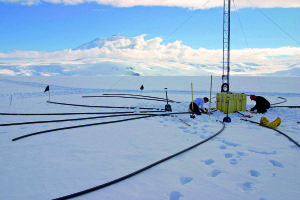
    Performing maintenance at CTBTO infrasound station IS55, Windless Bight, Antarctica

    Performing maintenance at CTBTO infrasound station IS55, Windless Bight, Antarctica. (Source: CBTBO via Wikipedia)

    Pending those eight ratifications for the CTBT entry into force, the Preparatory Commission for the CTBT Organization (CTBTO) is building up an extensive and sophisticated global International Monitoring System (IMS) which will serve to monitor and verify compliance with the Treaty. With over 85% of the IMS’ facilities in operation, the CTBT is already providing ‘a firm barrier against a qualitative and quantitative development of nuclear weapons for both nuclear weapon-capable states and then would-be possessors‘.

    Proof of the partially complete verification regime’s detection capability has been showcased by the three nuclear tests conducted since 2006 by the DPRK, the only remaining state defying the established international anti-testing norm. Since the international community unanimously condemned the 1998 round of tests by India and Pakistan, defying the non-testing norm and global de facto moratorium established by the CTBT, the two states in South Asia have implemented and observed unilateral moratoria on nuclear testing.

    Concerns about a DPRK fourth test

    The urgency of reaffirming the importance of the CTBT and re-energizing efforts to bring the Treaty into force, should be ever present with concerns about a possible fourth nuclear test as threatened by the DPRK earlier this year. The DPRK is the only state that has disregarded the testing moratorium and non-testing norm since 1998 with its three successively larger nuclear tests (in 2006, 2009 and 2013). South Korean Foreign Minister Yun Byung-se warned earlier this year that a fourth test by North Korean would be a “game changer” for the region.

    Even with the DPRK remaining a wildcard on prospects for ratification, not least given the shaky political conditions for regional resumption of dialogue on the nuclear issue while Kim Jong Un consolidates his regime, the other seven Annex II states can lead in responsibly committing to shore up their legal commitment to the non-testing norm.

    Improving regime atmospherics for the 2015 NPT Review Conference

    The CTBT and the NPT are interlinked and thus progress on the CTBT would serve to garner positive atmospherics for the NPT review process, in 2015 and beyond. The 1995 NPT Review Conference (RevCon) indefinite extension of the NPT and the 2000 NPT RevCon’s ‘13 steps’ (steps 1 and 2) called on states for action and commitment to a CTBT. More recently, five of the 64 action points in the 2010 NPT RevCon’s Action Plan stress bringing the Treaty into force. Given the growing discontent within the NPT review process due to the perceived lack of progress on disarmament commitments, a renewed and reinvigorated commitment to the CTBT by NPT states parties could ameliorate the atmosphere and help to build confidence and momentum.

    Two initiatives within the nuclear non-proliferation and disarmament regime—the Helsinki Conference for discussing the establishment of a Weapons of Mass Destruction-Free Zone (WMDFZ) in the Middle East, and the humanitarian consequences initiative concerning the impact of nuclear weapons—could provide an impetus for renewed focus to the importance of legally committing to the CTBT. Both of these initiatives, which continue to enjoy a broad divergence of views, could serve to channel attention on ratification of the CTBT as a key trust- and confidence-building measure and a foundational first-step for progress on the aims of the two initiatives.

    Given the active civil society engagement of the humanitarian initiative, some of these agents could focus efforts on promoting the entry into force of the CTBT, channelling campaigns to lobby and engage their elected parliamentarians on the importance of the CTBT.

    If any of the three remaining Annex II states from the Middle East region – Egypt, Iran and Israel – were to legally commit to refrain from nuclear testing, it would be a hugely significant political and confidence-building gesture for the high-profile efforts to convene a conference which was mandated by the 2010 NPT Review Conference to take place in 2012. Given the ongoing P5+1 talks with Iran, such a step by Iran would further serve to reassure the international community about the intent and peaceful nature of its nuclear programme.

    Multilateral initiatives

    UN High Representative for Disarmament Affairs Angela Kane encouraged states to seize the high-profile opportunity to sign or deposit their instruments of ratification at an event held on the margins of the UN General Assembly this month. As an interim step, short of signing or ratifying the CTBT, other proposals to further consolidate the anti-testing norm and moratorium include a suggested UN Security Council resolution condemning nuclear tests as a threat to international peace and security, and regional pledges committing member states to refrain from nuclear tests or even sub-critical experiments not prohibited by the CTBT.

    Notably, the Community of Latin American and Caribbean States (CELAC) endorsed such a regional commitment in its declaration on nuclear disarmament at a meeting in Buenos Aires in August 2013. Such effort could be replicated by other regions or via multilateral negotiating groupings operating in the nuclear non-proliferation regime. Regional and other groupings could pledge to highlight this issue at every nuclear-relevant forum and opportunity in efforts to cross-germinate this message.

    Annex II states particularly, as well as other states and groupings, should welcome, engage and promote the efforts of the CTBTO’s Group of Eminent Persons (GEM), comprised of high-profile experts and former officials aiming to promote the CTBT’s entry into force. Through the support of such initiatives, awareness can be raised. Further to raising awareness and educating civil society, efforts such as the CTBTO’s public training courses and NGOs’ public information and awareness efforts should be supported, promoted and even replicated regionally as force multipliers.

    J. Robert Oppenheimer recounted of those witnessing the Manhattan Project’s first atom bomb test (the 1945 Trinity test), “we knew the world would not be the same; a few people laughed; a few people cried; most people were silent.” Indeed, the world has not been the same and the proverbial nuclear genie cannot be put back in the bottle. But states can make the legal commitment to ban all nuclear tests, anywhere. 18 years after the CTBT opened for signatures, responsible states should commit efforts to facilitate the ratification of this Treaty.


    Jenny Nielsen is a Postdoctoral Research Fellow in the School of Political Science and International Studies at the University of Queensland. Previously, she was a Research Analyst with the Non-proliferation and Disarmament Programme at the International Institute for Strategic Studies (IISS), a Programme Manager for the Defence & Security Programme at Wilton Park, and a Research Assistant for the Mountbatten Centre for International Studies (MCIS) at the University of Southampton, where she co-edited the 2004-2012 editions of the NPT Briefing Book.

  • The Other Resource Wars

    At mysterious pace, and for reasons that remain hotly disputed, the ice of the Arctic Ocean appears to be steadily retreating. The latest estimates by the National Snow and Ice Data Centre at the University of Colorado, which use remote sensing data from Nasa satellites to make their findings, suggest that this year’s ice levels are well below their long-term average: in mid-August ice covered 2.30 million square miles in the Ocean, which is nearly 650,000 square miles less than the average 1979-2000 figure, even if it marginally exceeded the record-breaking lows of 2007 and 2008(1).


    Exactly when the Arctic Ocean will become ice-free for much of the year is impossible to judge, and estimates have varied widely: some experts argue that by the year 2020 trans-Arctic shipping could well be commonplace in the months of late summer, when ice reaches its annual minimum, while others think that, if present trends continue, such an eventuality is only likely to come about decades later. But what is certain is that the region is becoming much more accessible than ever before: there is now more human interaction in places, on both land and sea, that were once considered wholly remote and hostile.


    This heightening level of activity poses a very different threat to international stability than is commonly supposed. In recent years there has been speculation about growing rivalry for control over the Arctic’s natural resources, notably the large deposits of oil and natural gas that independent bodies, such as the US Geological Survey, think are located there. But there is no convincing reason why any country would want to risk open conflict over these reserves, even if they exist in such voluminous quantities: for example, there are other parts of the world where oil and natural gas can be recovered with a far greater ease, and at a far lower cost, than the Arctic region is likely to offer for decades to come. By the time the region does become more accessible, alternative fuel sources are likely to have been pioneered in any case.


    The presence of valuable natural resources in the Arctic region, or even the mere possibility of finding them, instead poses a subtly different challenge to international peace than usually supposed. For instead of fighting over resources, governments could instead feel threatened by the heightened foreign presence that the search, or exploitation, of these resources will bring to places that are important for other, quite independent, reasons. This is potentially a recipe for international mistrust that could conceivably spill over.


    One such example is Greenland. In the eyes of American military planners, this huge, frozen land mass occupies a vital strategic location whose fate cannot be ignored. This is because it would potentially make a natural vantage point for any hostile power seeking to exercise control over the trans-Atlantic sea lanes upon which the American economy heavily depends. So during the Second World War, for example, Washington was deeply concerned by Nazi efforts to establish bases along Greenland’s warmer southern coasts and deployed the US Navy to track and eliminate any putative threat. In April 1941, the exiled Danish government then signed a treaty with the Americans allowing Washington “almost unlimited rights to establish bases and military installations in Greenland”, leading to the establishment of thirteen army and four navy bases, one of which, at Thule, remains in active use today.


    Nearly seven decades on, Greenland is regarded as a very important source of highly valued natural resources, including oil, natural gas and the rare earth metals that are used in mobile phones, hybrid cars and missile guidance systems. In the years ahead, the island is certain to attract large-scale investment by foreign companies and, in the case of state-owned enterprises, their governmental sponsors.


    In some, perhaps many cases, this will lead to a series of company mergers and acquisitions that do not bring any foreign boots onto local soil, just as Chinese companies have in recent years sought to acquire stakes in companies like Unocal and Rio Tinto. But equally foreign nationals can sometimes undertake the search for, and exploitation of, some natural resources: the oilfields at Cabinda in Angola, for example, are home to thousands of expatriate Chinese workers. So it is possible to imagine mistrust, tension and destabilisation between Washington and Beijing if, for example, the Chinese should in the years ahead establish a strong presence in Greenland.


    This is a danger presented not just by the exploitation of natural resources but by the growing human interaction in parts of the world that, until recently, were too climatically hostile to be accessible. So as the waters of the Arctic Ocean steadily become more navigable, Russia and the United States may start to feel threatened by the growing presence of commercial and, more obviously, military vessels as they exercise their right, under international law, to make “innocent passage” through the territorial seas that lie adjacent to every coastal state.


    This is partly because they would be both unaccustomed to such military movements and, in all likelihood, relatively unprepared for them, even if, over the past two years, both countries have released internal documents that emphasise the need for greater defence spending on the Arctic region.(2) But their alarm would also reflect, more importantly, the strategic importance of the area: for example, Russia’s northern coasts are home to several key ports and industrial complexes, and also provide a potentially major shipping route that would link east and west


    So the presence of natural resources within existing borders, in places like Siberia and Alaska, will heighten the strategic fears of each respective country: both Russia and the United States will fear an attack on their resources as the region becomes more accessible and an increasing number of foreign ships make their way, quite legitimately, into surrounding waters. But these areas would have strategic value- as shipping routes, for example- even if they were devoid of resources.


    In other words, instead of being a prize over which competing nations will be tempted to fight, natural resources in the Arctic region will have a destabilising influence only in an indirect sense.


    Such mistrust and suspicion can only be alleviated by more international dialogue. For example, NATO ships could avoid straying into Russian territorial waters without giving Moscow prior notice, even though international law puts them under no such obligation, and large areas of the Arctic region could realistically be demilitarised.


    End notes:

    1 – ‘North by Northwest’, report by the National Snow and IceDataCenter, University of Colorado 17 August 2010

    2 – NSPD 66, January 2009; ‘Russian National Security Strategy Until 2020’, 20 February 2009


    Image Source: psd

  • Sustainable Security

    Author’s note: For further analysis on this topic, see the following publications: Kai Michael Kenkel and Cristina Stefan, “Brazil and the ‘responsibility while protecting’ initiative: norms and the timing of diplomatic support”. Global Governance, Vol 22, No. 1 (2016); pp. 41-78; and Kai Michael Kenkel and Felippe De Rosa). “Localization and Subsidiarity in Brazil’s Engagement with the Responsibility to Protect.” Global Responsibility to Protect. Vol. 7, No. 3/4 (2015); pp. 325-349.

    Since Libya, the Responsibility to Protect (R2P) has been a hotly debated concept. Previously a nation exhibiting strict non-interventionist principles, Brazil has recently contributed to the R2P debate with its Responsibility while Protecting initiative.

    Introduction

    Inspired by what it saw as the excesses of NATO’s intervention in Libya and their potentially disastrous effects on the credibility of the “Responsibility to Protect” (R2P) norm, in November 2011 Brazil launched the corollary concept of a “Responsibility while Protecting” (RwP) at the United Nations. While essentially reiterating its endorsement of key principles of R2P, Brazil admonished R2P implementing states to avoid discrediting the norm by exercising restraint while operationalizing R2P. Brazil, itself at that time a rising power seeking more global influence—and particularly participation in shaping the rules of the international system—saw the divisions created by the Libyan intervention as an opportunity to act as a norm entrepreneur. Meant to bridge the gap between R2P supporters in the North and sceptics in the South, RwP was initially criticized by both. Over time, however, certain R2P supporters began to see the concept’s value as a means of reviving R2P after Libya and as a means of attaining crucial Global South buy-in. By this time, however, Brazil—lacking experience in the role of norm entrepreneur—had backed away from its initiative. Though the specific initiative has not been taken forward, RwP has had a clear effect in structuring the contours of subsequent R2P debates at the UN.

    Rising Brazil: between beliefs and expectations     

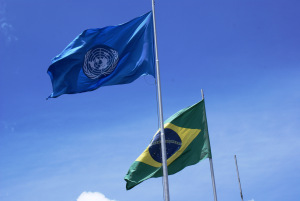
    UN brazil

    Image by Ben Tavener via Flickr.

    Under the Lula da Silva administration, Brazil began to actively seek a larger profile in international politics, ostensibly with a view to a permanent, veto-endowed seat on an eventually reformed UN Security Council. This presented the country with a conundrum: in UN praxis, particularly among established powers, there is a clear connection between global relevance, military capacity, and the willingness to use force remedially, beyond self-interest, to help those in need—as foreseen by R2P as implemented by the UN. Brazil’s historical normative commitments, however, are rooted in a combination of a highly traditional regional security culture—which equates sovereignty exclusively with non-intervention—and a healthy postcolonial scepticism of multilateral initiatives born in the North. Arguably, the most strongly held of these commitments is a profound aversion to the use of force. Faced with a choice between staying true to its original traditions and fulfilling the expectations placed on global players—as exemplified for example in R2P’s acceptance of the use of force in defence of human life—Brazil launched RwP as an attempt to reconcile these factors, remain active on the international stage, and render R2P both more relevant and less prone to misuse.

    The Libya effect

    NATO’s 2011 Libyan intervention created a trust deficit between its leaders and the BRICS countries, who had been excluded as non-permanent UNSC members from the elaboration process for its enabling Resolution 1973. These states emerged from the experience highly doubtful of Western motives, and they took as a lesson from the Libya intervention that the use of force could have an opposite effect from that intended, effectively distancing a crisis situation from a lasting solution.

    Beyond the immediate concerns related to the intervention’s mandate, the debate over the Libyan case took on contours that resonated with the larger tension between the established powers and emerging players such as the other BRICS countries and Brazil. Substantial divergences remain over R2P’s implementation and particularly its third pillar, which can be used to authorize military force. R2P’s shift in emphasis between understandings of sovereignty has become symbolic of some emerging powers’ resistance to the normative dominance of established powers, making the principle a key rallying point in the ideational skirmishes resulting from a changing global distribution of power. This expands the debate over the RwP initiative beyond its immediate link to the Libyan case and links it firmly to broader issues of global governance. The R2P debate has become a not only a key element of some emerging powers’ challenge to the established distribution of power, but a key locus for increased targeted consultation and cooperation in mounting that challenge. In addition, the intervention debates have become an important stage for emerging powers constructively to give normative content to their challenge to the established order, allowing them to move beyond what some have termed an obstructionist stance.

    The “Responsibility while Protecting” concept

    The RwP concept was launched on 9 November 2011 and floated explicitly as a touchstone for further debate within the United Nations. This targeting would become important later on, as it meant that in characterizing R2P and mobilizing its history, the note limited itself to the concept’s course within the United Nations system, referring for example to its inclusion in paragraphs 138-139 of the World Summit Outcome Document but not to the principle’s original formulation by the International Commission on Intervention and State Sovereignty (ICISS). As such the RwP note was intended less as a normative innovation than as an attempt to shape the norm in terms acceptable to the Global South.

    The primary contribution of the note was its establishment of a set of guidelines to orient the Security Council in contemplating an R2P-based intervention. These guidelines focused on two main topics: limiting the use of force, and the strict chronological sequencing of R2P’s three pillars. The RwP note posits that force should only be used as a last resort (an item already included in the 2011 ICISS Report that launched R2P), and subject to a limited and well-defined mandate implemented under conditions of complete accountability in the field. Brazilian diplomats attempted to appropriate the “do no harm” principle, known from the Hippocratic oath, even arguing that one death from an intervention is too many. These reservations were read correctly by many Western states as a reaction to the perceived excesses of NATO’s foray into Libya, and an attempt to put strict limits on the level and type of force authorizeable under R2P.

    The document’s real element of innovation, and the eventual centre of the debate it created, is its call for the strict political and chronological sequencing of R2P’s three pillars. This was viewed by Western states as too limiting, both in the field, and of the flexible diplomatic responses required of the Council in dealing with a crisis. The threat of force, it was argued, is often subjacent in making diplomatic initiatives work, and taking this option off the table could tie the international community’s hands. Indeed, the note’s Brazilian authors later replaced strict chronological sequencing with the toned-down notion of “prudential sequencing”.

    The reception of RwP

    Initially received coolly by both Western and Southern states, the RwP note nonetheless played a crucial part in both moving R2P forward normatively and in stimulating the inclusion of Southern states into the intervention debate. Despite initial strong criticism, the initiative did shape how established and rising powers interacted in the ensuing UN debates on R2P and intervention more broadly. There are four main criticisms:

    1. that the concept bears little value added, merely repeating provisions already present in the 2001 ICISS Report;
    2. that the initiative was a Trojan horse, designed to limit Western powers’ autonomy and to prevent the further institutionalization of R2P;
    3. specific elements regarding feasibility of RwP’s concrete suggestions, such as sequencing, proactive monitoring, and further limitations on the use of force;
    4. the contention that RwP’s confuses jus ad bellum (R2P’s main focus) and jus in bello (rules for conduct once war has broken out);

    Despite these criticisms and Brazil’s abandonment of its role as a norm entrepreneur, the RwP note has continued to structure global diplomatic debates on intervention, with a focus on reigning in Western action through stricter guidelines in the wake of R2P’s crisis of legitimacy after Libya. It has done so in three main areas:  advancing the importance of some form of relational sequencing of R2P’s pillars; increased restrictions on the use of force; and more proactive monitoring by the Security Council of the following of guidelines by ongoing missions.

    Brazil’s role as a norm entrepreneur on intervention issues remains tied to the RwP concept. The initiative was withdrawn after it did not elicit the desired level of support, and by the time its potential had been realized, internal changes in Brazil and its Foreign Ministry had made continued advocacy politically unviable. Despite attempts to revive a strong role for Brazil in the R2P conversation through efforts in the General Assembly in 2015-2016, crippling fiscal austerity and the paralyzing political crisis which began in April 2016 have temporarily but severely limited Brazil’s ability to proactively advance normative initiatives. Nevertheless, the desire remains to fulfill the country’s natural function as a bridge-builder between North and South on intervention issues, and Brazil is sure not to remain absent for long from the ranks of those crafting R2P’s future contours.

    Kai Michael Kenkel is Associate Professor in the Institute of International Relations at the Pontifical Catholic University of Rio de Janeiro and Associate Researcher at the German Institute of Global and Area Studies. He has published extensively on R2P, with a focus on Brazilian policy, including three edited volumes and articles in Global Governance, Global Responsibility to Protect and  International Peacekeeping.