http://www1.american.edu/ted/ICE/index.html
Delicious
Digg
StumbleUpon
Reddit
http://www1.american.edu/ted/ICE/index.html
Delicious
Digg
StumbleUpon
RedditAuthor’s Note: This opinion peace is based on research conducted among South African Peacekeepers, published in the Journal of International Peacekeeping, 19 (2015) 227-248.
The motivation to increase the number of women in peacekeeping is based on the assumption that women peacekeepers enhance the access of local women to services, improve community relations, reduce the incidence of sexual and gender-based violence, build the capacity of local women and break down traditional views that discriminate and marginalize women. The extent to which women are able to perform these functions needs to be interrogated, as much of this rhetoric does not reflect the realities that women face on the ground. This is reflected in the findings of a study conducted among South African male and female peacekeepers returning from missions in the Democratic Republic of Congo (DRC) and Darfur, Sudan. The findings are revealing, often countering many of the above-mentioned essentialist claims.
While there was general consensus that women peacekeepers are generally better at interacting with the local community, especially women and children, these claims were mostly context-specific. In the DRC, the female peacekeepers felt that they could reach out to women and children more readily. This was because ‘Sousa’ (as the locals call the South African contingent) tended to interact with the local community more than other contingents because they are mostly black, and could understand Swahili. This was not the case in Darfur, Sudan. Here, it was as if the local population (especially the local women) were afraid to speak to the peacekeepers, whether men or women. What this indicates is that not only gender, but race, the ability to speak the local language, and respect for the local culture are crucial determinants in fostering relations with the local community. Similarly, their ability to serve as norm-breakers, challenging existing stereotypes was met with some misgivings, given the fact that most often their identity was concealed behind their helmets and because of their low numbers.
In terms of improving the security of local women and children, female peacekeepers felt that locals placed more trust in male soldiers because they do not know how to judge female soldiers. Female peacekeepers also reported that they did not really know what the specific security concerns of women were, because little attention was paid to issues of gender in peacekeepers’ mission-readiness training. Thus, they had little understanding of the underlying gender power relations in the communities. Nor did they know how to address or assist victims of sexual violence. In fact, most knew very little if anything about the gender dynamics in these communities and in some cases there was a general lack of cultural awareness. This influenced their ability to identify what the specific security needs of women were, how to protect them, or where to refer them if they needed to deal with cases of sexual violence.
Members of the Guatemalan contingent of the United Nations Stabilization Mission in Haiti participate in a medal award ceremony in recognition of their service. Image by UN Photo via Flickr.
What this means is that the ability of female peacekeepers to make a difference is limited by their training, which is gender-neutral and where they are expected to act and perform functions ‘just like men’. The rationale for this is that when deployed on peace missions, all have to carry the same equipment, work in the same environment and face the same adversaries in the course of duty. This is specifically the case where they are drawn from the infantry environment and have to perform infantry-like functions. Added to this, women peacekeepers report being ‘othered’ on various levels. Physically, they are ridiculed for their lack of physical strength and endurance, especially on foot patrols. Psychologically and emotionally, the operational environment is seen to be more taxing for women, given the extreme forms of sexual violence against women. Women were also perceived to pose a ‘gendered’ security risk, especially in hyper-masculine contexts where women are seen as sexual objects, are used as weapons of war where they threaten existing gender power relations that affect male dominance.
This results in female peacekeepers facing many different forms of gender and sexual harassment which are used to denigrate them. Some of the female peacekeepers who served in positions of authority explained how they were often not respected, ignored, undermined and faced frequent sexual advances. Such forms of gender harassment occurred often, but not considered serious enough to evoke punitive action. This was simply explained away in terms of existing patriarchal relations that could not be changed. However, in some cases this evoked open hostility towards them “because in Sudan it is considered disrespectful to their culture for women to be soldiers, carry rifles and wear trousers”. Besides this, the threat of being raped served to further erode women peacekeepers’ agency, especially where they were excluded from certain operations which were considered too dangerous by their commanders. In this way, not only were old gender stereotypes replicated, but they are used to undermine the prospect of an equal partnership between men and women.
What this shows is that even where national armed forces espouse gender equality, the peacekeeping environment remains hostile to women. Multiple masculinities, patriarchy and sexism undermines the ability of women peacekeepers to imbue alternative ways of dealing with and resolving conflict. The only way to ‘regender’ the military is to stop privileging masculinity over femininity. This is unlikely to happen where peacekeeping remains steeped in the warrior ethos and where the ‘feminine’ is not valued, is suppressed, seen as a threat, or a liability. What is needed is for women to become less complicit and more assertive in making their voices heard. However, military women themselves typically do not embrace feminine values given the ‘nature’ of their work. They typically conform to and assimilate masculine values, norms and practices in order to be judged as capable soldiers. They have to assume what many term as a ‘militarized masculinity’, understood as the ability to ‘demonstrate an absence of emotion and a willingness to use violence’—they must excise all that is perceived to be feminine.
This makes it difficult to achieve the ideals advocated by UNSC Resolution 1325. The aim of this resolution is not only to increase the number of women serving in the military, but to mainstream gender by bringing about a greater sensitivity to the different effect that war has on men and women. In this regard, there has been little progress as the number of military women serving on peacekeeping missions have remained around 3 per cent. Even in the South African armed forces where women now represent 26 % of uniformed personnel and up to 15% of those deployed on peacekeeping missions, there seems to be little qualitative change in bringing about a more acrogenous military culture. This necessitates a closer introspection in terms of how women are trained, deployed and supported on peacekeeping operations. It raises the question as to whether a gender-neutral approach to gender integration in the military does not in fact perpetuate gender inequality. Clearly one cannot bring about a different perspective to war and peace if women are expected to embrace masculine norms and values and where gender difference is not recognised and valued.
Lindy Heinecken was formerly a researcher and Deputy Director of the Centre for Military Studies (CEMIS) at the South African Military Academy, where she worked for 17 years. Since 2006 she has been at the Department of Sociology and Social Anthropology, Stellenbosch University, South Africa and is currently Professor of Sociology lecturing in political and industrial sociology. The main focus of her research is in the domain of armed forces and society where she has published widely on a range of issues including military unionism, the management of diversity, gender integration, HIV/AIDS in the military and more recently on the experiences of military personnel on peace operations. She serves on numerous academic boards, including the Council of the Inter-University Seminar on Armed Forces and Society, the Board of the International Sociological Association’s (ISA) Armed Forces and Conflict Resolution Group, and the National Research Foundation (NRF). She serves on the editorial board of the journals Armed Forces and Society and Scientia Militaria: South African Journal of Military Studies. She is a NRF B rated researcher and serves as one of the pool of specialists conducting research for the South African Army.
Introduction
The acknowledgement of gender issues through the Women, Peace and Security (WPS) agenda marked a watershed moment for women’s rights. Despite this, the Responsibility to Protect (R2P) framework remains gender-blind. I argue that R2P and the WPS agenda share overlapping commitments and mutually beneficial and reinforcing protection mandates. Through three intersecting commitments – prevention and early warning systems, gender protection in peacekeeping, and women’s participation in post-conflict reconstruction – careful alignment between R2P and the WPS agenda could overcome this silence and move towards achieving more sustainable security.
The Responsibility to Protect and Women Peace and Security
Systematic human rights atrocities perpetrated against individuals based on their ethnicity, gender, and race have framed contemporary political discourses. With the international community’s inability to collectively respond to prevent mass atrocities and other severe humanitarian emergencies, former United Nations (UN) Secretary-General Kofi Annan spearheaded the challenge to create a norm permitting states to intervene in another sovereign state in the event of ‘gross and systematic violations of human rights that affect every precept of our common humanity’. Spurred on by failures of the international community to prevent genocides in Rwanda (1994) and Srebrenica (1995), the International Commission on Intervention and State Sovereignty (ICISS) was established in September 2000 to address how and when the international community should act to prevent genocide, war crimes, ethnic cleansing and crimes against humanity. The report entitled “The Responsibility to Protect” (R2P) was released in December 2001. The unanimous adoption of R2P at the World Summit in 2005 established its prominence as a normative framework within the international community. The use of R2P as rhetorical backdrop to the Libyan intervention in 2011 via UNSC Resolutions 1970 and 1973 and the inaction in responding to the crisis in Syria demonstrates the prevalence of R2P in international discourse. Furthermore, R2P is interwoven with existing international principles, obligations, and peacebuilding initiatives. UN Secretary-General Ban Ki Moon asserts that R2P rests upon three interrelated, central pillars – responsibilities of the state to protect its population from mass atrocities; international capacity building to ensure states meet their protection responsibilities and prevent mass atrocities; and collective and timely responses through diplomatic, humanitarian and political means with coercive military action as a last resort.
Female United Nations police officers of the United Nations Mission in Timor-Leste (UNMIT). Image by UN photo via Flickr.
The Women, Peace and Security (WPS) agenda gained traction on the international peace and security platform following the adoption of UN Security Council Resolution 1325 in October 2000. The WPS agenda is the most comprehensive articulation of women’s rights and gender issues in international peace and security. It establishes a nexus between conflict prevention and women’s rights, highlighting the relationship between gender inequality and conflict. Resulting from the Fourth World Conference on Women in 1995 in Beijing, and the pivotal Beijing Platform for Action which named ‘Women and Armed Conflict’ as one of twelve areas of critical concern, the NGO Working Group on Women, Peace and Security was formed to advocate a UNSC Resolution focused on women’s unique contribution and experiences of conflict. Through lobbying and advocacy, the NGO Working Group played a vital role in drafting the resolution and through UN Resolution 1325 successfully complicated the popular narratives that stereotyped women as either victims or inclusive peacebuilders. UN Resolution 1325 directs policymakers to consider all of women’s experiences in conflict and links women’s rights to international peace and security. The adoption of an additional seven resolutions builds upon 1325 and make up the WPS agenda. It rests upon a four-pillar mandate; prevention of violence and derogation of rights; protection from violence; participation in peacebuilding and post-conflict reconstruction; and relief and recovery. Laura Shepherd and Jacqui True broaden ‘relief and recovery’, to include identifying the structural social, political and economic conditions required for sustainable and lasting peace. Specifically the WPS agenda addresses sexual and gender-based violence (SGBV) in conflict, measures to ensure women’s participation in decision-making processes and post-conflict programs, gender mainstreaming in UN activities and peacekeeping operations, and gender-sensitive prevention frameworks. The WPS agenda provides basis for international engagement with gender issues. With R2P, the WPS shares a commitment to improve human security and revealing and preventing women’s human rights abuses through international engagement. Disappointingly, despite both frameworks emerging sharing similar underpinnings, R2P and its community continue to fail to address gender issues encompassed within the WPS agenda.
R2P did not embrace the central messages of Resolution 1325 nor were points of synergies explored where there was a lack of dialogue and acknowledgement towards gender issues. From the outset, gender was excluded from the original formulation of R2P with only one of the 12 commissioners being a woman and only seven of 2000 sources consulted including gender. Women within the original R2P document were framed in terms of vulnerable populations in need of protection. ‘Women’ were mentioned three times only in reference to ‘rape and sexual violence’, which was mentioned seven times, where SGBV falls under crimes against humanity, war crimes and ethnic cleansing. No reference was made of women being active participants and agents in conflict prevention, protection and post-conflict reconstruction. This is despite the transformative possibilities of including aspects of the WPS agenda. R2P disregards WPS as a paradigm for conflict prevention and its centrality to peace and security. Here, as discussed below, three common intersecting commitments could overcome this disconnect.
Intersecting Commitments
The inclusion of gender issues into existing early-warning frameworks and systems may illuminate potential and/or existing R2P situations. Studying macro- and micro-level changes to women’s lives reveals the escalation of violence and derogation of individual rights in hyper-masculinised and militarised societies. Gender-sensitive indicators include average levels of female education, impunity towards SGBV, increased kidnappings, sex work, female heads of households and domestic violence. Moreover, gender-sensitive indicators are not synonymous with women-sensitive indicators, but can monitor aggression and militarisation within a society, such as the persecution of men that do not take up arms. UN Women implemented several context-specific programs that have resulted in a comprehensive how-to guide of 85 gender-sensitive indicators that provide a holistic early warning system. Furthermore, through empirical analysis Sara Davies and Jacqui True found strong connections between systemic gender inequality and discrimination and the use of SGBV in conflict and non-conflict settings.
Despite the benefits of including gender-sensitive indicators, gaps in women’s participation in early-warning initiatives have not been overcome. The UN Office of the Special Adviser on the Prevention of Genocide and the Responsibility to Protect have not addressed the role of gender inequality or gendered violence in early warning systems. A recent framework of analysis on the prevention of R2P crimes continues to situate women in the narrative of ‘vulnerable population’ with children and the elderly, and in regards to sexual violence and reproductive rights. This is despite, as Davies and True argue, systemic and structural gender inequality is a potential early warning factor for preventing mass SGBV.
Since gender inequality increases the likelihood of R2P crimes any strategy of prevention must address gender norms that oppress and marginalise women. Gender-sensitive indicators highlight structural political, economic and social inequalities that maintain gender inequality in a given society that impacts post-conflict reconstruction and conflict protection.
The protection pillar of WPS stresses the full involvement and participation of women in the maintenance and promotion of international peace and security. This includes gender mainstreaming in all peacekeeping missions and the addition of gender units and advisers. Providing an official female presence in conflict areas, refugee and Internally Displaced Persons (IDPs) camps is essential to improve access and support for local women to communicate in an official capacity. Women can approach each other more easily in female-only settings where women may be prohibited to talk to male strangers. Moreover, SGBV is more likely to be reported between women. However, as of February 2016, only 3.34 per cent of military and 9 per cent of police were female. Although there is at least one female in every peacekeeping force, the number varies from 1 woman out of 17 deployed in the UN mission in Afghanistan to 799 women out of 17,453 deployed in the UN-African Union Mission in Darfur. Of 105,315 deployed peacekeepers, women only comprise 4.05 per cent. Although numbers have improved since the adoption of UN Resolution 1325, increases have been marginal and reflect the low number of women included in UN peace building efforts.
Furthermore, implementation of gender-sensitive protection needs to move beyond the ‘add women and stir’ policy. Rather, WPS knowledge needs to be utilised in peacekeeping operations and wider UN peacebuilding efforts. For instance, the assumption that men are heads of households and therefore assistance being distributed to mainly men does not reflect post-conflict realities. Women are often widowed during and after conflict and adopt non-traditional roles such as heads of households. Since post-conflict programs and assistance does not recognise this, women are forced to take drastic measures to support their family and may take part in exploitive aspects of peacekeeping economies, like the sex industry. The misconception could be countered through gender units, gender-awareness training on more than an ad hoc basis and extensive comprehension of WPS.
The post-conflict phase is complex with many overlaps where the WPS agenda would assist states and the international community in post-conflict responsibilities. However, here I will focus on women’s participation in peace processes. Women’s involvement in peace processes is mentioned in every resolution of the WPS agenda. Evidence suggests that the inclusion of women at the peace table as witnesses, signatories, negotiators and mediators makes it 35 per cent more likely a peace agreement will last. Nevertheless, women’s quality participation in official capacities remains insufficient. Women and gender provisions have slowly started to be incorporated into peace agreements with a textual increase since the passing of Resolution 1325.
However, by essentialising women as mothers, caregivers and victims, women are excluded from peace negotiations where, ironically, the cessation of hostilities is reliant on those who took up arms. I am not arguing that women are better peacemakers, but that their participation is vital to ensure that their experiences of conflict are acknowledged. Around the world, women lobby for participation to ensure their needs and security concerns are addressed. In Somalia, the Sixth Clan was formed in response to the five traditional Somali clans failure to include women in negotiating teams. Asha Hagi Elmi became the representative of the Sixth Clan in 2000 and in peace talks in 2002, becoming the first female signatory to a peace agreement in 2004. Peace processes must include women as more than lip service to inclusivity.
Conflict transition provides a chance to create a more equal society by transforming the gendered relationships and identities that contributed to the production of violence. Women’s participation is essential to represent half the population during peace negotiations, to ensure explicit inclusion of women’s rights and gender provisions, and could have major implications for women’s social, political and economic status, and involvement in wider post-conflict initiatives. It is imperative that women are involved during that critical post-conflict transition to be enabled to affect positive changes.
Conclusion
Despite these areas of common engagement, R2P remains silent towards analysis and discourse surrounding the WPS platform. Both frameworks emerged at similar times and share central tenets of prevention, participation and protection, however women’s involvement in R2P has been grossly deficient. I have briefly demonstrated here, and examine in depth elsewhere, three areas of common engagement between R2P and the WPS agenda. I identify three common intersecting commitments – prevention and early warning frameworks, protection and gender-sensitive peacekeeping, and women’s participation in peace processes. Implementing gender-sensitive policies, legislations and programs will highlight the different lived experiences of men and women and the insecurities that arise during conflict and post-conflict reconstruction. R2P has much to gain from the WPS agenda and vice versa, where alliance with R2P and its community could aid the WPS agenda in addressing major gaps in its implementation. Alignment, both practical and normative, could provide an inclusive and holistic protection platform and encourage sustainable peace.
Sarah Hewitt is a PhD candidate at Monash University, Australia with the Monash Gender, Peace and Security Centre. Her article, ‘Overcoming the Gender gap: The Possibilities of Alignment between the Responsibility to Protect and the Women, Peace and Security Agenda’, was recently published in the Global Responsibility to Protect Journal. Sarah has also posted on Protection Gateway.
Following President Rouhani’s success in last August’s election, relations between the United States and Tehran have improved substantially, partly because of the election result but also because the Obama administration has a more positive view of Iran. There is no guarantee that the US election in 2016 will result in an administration sympathetic to further progress. This element of uncertainty will be factored into the policy-making process of the Rouhani administration. Even so, prospects for a negotiated settlement to the nuclear issue are the best they have been for a decade and it follows that if an agreement is concluded, this is likely to have a pronounced effect on Iranian foreign policy as it finds itself in a more positive international environment.
President Luiz Inácio Lula da Silva is greeted by the President of Iran, Mahmoud Ahmadinejad. Source: Wikipedia
The flamboyance and the sometimes inflammatory rhetoric of the Ahmadinejad administration (2005-13) disguised a pragmatic foreign policy that combined a degree of confrontation on the nuclear issue with the enhancing of contacts with many countries across the global south, including left-leaning states in Latin America and numerous states in sub-Saharan Africa. It also sought to maintain reasonable links with Russia and China while limiting links with the West. While acceptable to much of the “Iranian street”, it was at odds with the liking of elements of western culture by young Iranians and the nuclear issue was deeply problematic in terms of the impact of sanctions.
While much is made of their role in bringing Rouhani to power and then to the negotiating table, the reality is rather different. Sanctions were effective, in part, because of the parallel impact of internal economic mismanagement by the Ahmadinejad government. Thus, if the Rouhani government improves the management of the economy then even the modest sanctions relief already promised will combine to enable the government to benefit through early respite from recent economic woes.
One other key factor is that Iran’s standing in the region, including the Arab world, has been damaged by its support for the Assad regime in Syria. Under Ahmadinejad, Iran saw the Assad regime as a strong and necessary ally, especially in combination with the Maliki government in Iraq. But as the war in Syria has worsened, and as the violence in Iraq degenerates towards a civil war, many states blame Iran. Regional powers such as Saudi Arabia and Egypt hold Iran partly responsible for the violent suppression of the Sunni majority in Syria, and states beyond the region believe Iran bears some responsibility not just for that but also for the possible spread of the war to Lebanon.
Hassan Rouhani speaks in Mashhad during his presidential campaign Source: Wikimedia
Rouhani’s victory was singularly impressive in that he gained an absolute majority on the first ballot against four relatively conservative opponents on a 72% poll turnout. While this has given him considerable authority, most power still lies with the Supreme Leader. However, Ayatollah Khamenei has to be aware of the popularity of Rouhani, a matter made more difficult for him by Rouhani’s preference for avoiding a personality cult. While the election gave Rouhani a clear mandate for negotiating with the US, conservative elements are regrouping.
For these elements a particular concern is the election of the Assembly of Experts – the parliamentary upper house, which selects the Supreme Leader – that are due in September this year. Their fear is of a buoyant Rouhani government that will damage conservative prospects still further following last year’s reversals. It appears to be for this reason that they have sought to persuade the Supreme Leader to expand the negotiating team at the Syria peace talks in Geneva to include more hard-line elements and to have a Majlis (parliamentary) oversight body for the whole process. This would be dominated by conservatives. Rouhani’s Deputy Foreign Minister, Seyed Abbas Araqchi, has stated officially that the negotiating group remains accountable to the Supreme National Security Council, not a Majlis body, but there are reports of more members recently being appointed to the group.
What this means is that the Rouhani government will have a strong interest in developing policies that are attractive to the domestic constituency as soon as possible. The emphasis will undoubtedly be on the nuclear issue and getting further sanctions relief which, in combination with better economic management, could ensure palpable improvements in the economy and consequent political popularity. This, though, is not enough and liberalising economic reforms such as removal of subsidies may even exacerbate short-term economic difficulties. It follows that the Rouhani government will be looking closely at ways of increasing Iran’s standing in the region and beyond.
A key aspect of the Iranian outlook is a belief in Persia’s very proud history, one that extends over thousands rather than hundreds of years, and the consequent belief that Iran has not been realising its potential as one of the world’s potential great powers. This view of historic greatness transcends religion, even if Iran sees itself also as the centre of the Shi’a Muslim world. Iran has a population of 80 million, a little less than Egypt at 85 million and Turkey at 81 million. Egypt has formidable internal problems and a weak non-oil-based economy; Turkey is far stronger in terms of economy, even if it, too, lacks significant fossil fuel reserves. Since its 2013 counter-revolution, Egypt is also increasingly reliant on Saudi Arabia, Iran’s greatest rival for influence in the Gulf and wider Middle East.
Iran has all the problems of a near-moribund economy but has remarkable potential for development given that it has close to 10% of world oil reserves and 15% of gas reserves. The latter is largely shared with Qatar because of the huge reserves under the Gulf. There have so far been few problems of delineating boundaries – indeed relations with Qatar remain quite good despite major differences on other issues such as Syria, where Qatar, with Turkey, strongly backs the anti-Assad rebellion.
Iran Foreign Minister Javad Zarif walks with EU High Representative Catherine Ashton at the EU +3 and Iran talks, November 2013. Source: EEAS (Flickr)
The issue for Iran relates largely to where it seeks to develop its economic and political alliances. To the immediate east the borders with Afghanistan and Pakistan are hugely significant, especially in the case of Afghanistan where opium and refined heroin smuggling across the border has cost the lives of hundreds of Iranian border guards. Iran has close links with the north-west parts of Afghanistan and has no liking for the Taliban. It is suspicious of Pakistan because of radical Sunni Islamist elements within the state, its long-term support for the Taliban, close security ties to Saudi Arabia and the precarious security predicament of the Pakistani Shi’a community, but still seeks to improve relations, not least through exporting gas. The originally planned Iran-Pakistan-India pipeline is going ahead as far as Pakistan. Iran will further increase its links with Afghanistan, where it has greatly increased aid in recent years, especially to projects in the north-west of the country.
India and China are both significant importers of Iranian oil and gas and China has been particularly useful to Iran in two respects. One has been long-term investment in the development of new oil and gas fields, and it remains much appreciated that China persisted with this when relations with the US were at their lowest. The other has been China’s supply of carefully selected weapons, especially shore-based anti-ship cruise missiles. Iran will maintain close links with China, but will not eschew improved relations with India, seeing it as a useful counter-balance to Pakistan.
The links with southern and eastern Asia will remain highly significant in terms of Iranian foreign policy but it is already clear that a priority will be to improve relations with neighbouring Turkey, already demonstrated by the meeting between Foreign Ministers Mohammad Javad Zarif and Ahmet Davutoglu in Tehran last November. In spite of considerable differences over Syria, the countries have good relations in other respects, and Turkey’s past role in trying to defuse the nuclear issue remains appreciated. Trade relations between Iran and Turkey have expanded greatly in the past decade.
It is highly likely that Iran will seek a much closer relationship with Turkey, seeing the two countries together comprising an axis of influence linking Europe and Asia. The Turkish attitude to this is likely to be very positive, seeing it as a useful factor in increasing Turkey’s significance for the European Union. This does mean that the Rouhani government has an added interest in seeing a scaling down of the Syrian War. It is probable that a Turkey/Iran connection is more important to Tehran than the much vaunted Lebanon/Syria/Iraq/Iran “Shi’a crescent”.
The rivalry with Saudi Arabia remains pervasive and is a crucial proxy element in the Syrian conflict but Rouhani’s personal links with Saudi diplomats in the past, combined with Iran’s need to see the war scaled down, means that even here there may be potential for progress. Further improving relations with the US will be a priority but the Rouhani government recognises the risk of sudden changes in US leadership in less than three years time. This means that European links remain useful but Iran does not look to the west to ensure its standing in the world. Turkey, China and India are more significant and this will remain as long as Rouhani is in power. Of these, Turkey is probably the most important.
Rouhani has barely a year all told to build on the considerable support he gathered last year, and this is against a background of entrenched conservative and theocratic elements that will work hard to limit his capacity. While he will give ground on nuclear issues and may work towards a Syrian settlement, if Iran is allowed to participate in Geneva ll, there is a risk that this can be presented by his opponents as a sign of weakness. Economic progress might blunt this but an additional way forward is to engage in a much more active foreign policy. One consequence of such a shift to the north and east is that Iran may not see Europe as important to its interests to the extent that Europe sees Iran. This is a reflection of more general global changes, bringing its own challenges.
Paul Rogers is Global Security Consultant to Oxford Research Group, for which he writes monthly security briefings. He is Professor of Peace Studies at the University of Bradford and author of numerous books including ‘Beyond Terror’. Paul writes a weekly column for openDemocracy and tweets regularly at @ProfPRogers.
Featured image: President Rouhani delivers remarks at the Hilton Hotel in New York City, September 2013. Source: Asia Society (Flickr)
The devastating nexus of climate change, competition over resources and marginalisation
Hurricane Katrina and the sinking of coastal Louisiana stand as a reminder that we must address climate change, competition over resources and marginalisation as the root causes of conflict before it is too late.
Most will remember the horrific pictures on the news in 2005 when Hurricane Katrina struck New Orleans. Nearly 2,000 people died, thousands more were left homeless and displaced, the material destruction was catastrophic with damages well over $100 billion.
The aftermath of Hurricane Katrina once again proved that marginalised people have the least resources to cope with environmental constraints and natural disasters. Nowhere in New Orleans was the devastation greater than in the Lower Ninth Ward, a predominantly poor African American neighbourhood. Most residents of the Lower Ninth Ward had fewer options of where to go, did not want to leave their homes behind and lost everything due to the damage caused by Katrina and their lack of financial resources to rebuild the community.
Katrina was not the last and probably not the most destructive disaster to hit Louisiana. Over the past years, a significant discovery has been made: Coastal Louisiana is sinking, at a rapid rate. Some estimate that an area the size of a football field is lost roughly every half hour.
Once again, this will affect already marginalised communities the most. Science Illustrated argues “something drastic must be done” because “the current state of affairs means that they [the affected communities] may soon be the first climate refugees in United States history”.
CLIMATE CHANGE
Climate change sceptics appear to be fighting a losing battle in the face of greater levels of sound scientific data. Yet, governments are still reluctant to take necessary steps like drastically cutting carbon emissions and switching to green renewable energy sources. Hopefully this will change as addressing climate change will be essential in tackling the security challenges of an increasingly interconnected world.
At the World Economic Forum in Davos, Lord Stern, author of a 2006 UK government review on climate change, admitted he had got it wrong: “Looking back, I underestimated the risks. The planet and the atmosphere seem to be absorbing less carbon than we expected, and emissions are rising pretty strongly. Some of the effects are coming through more quickly than we thought then. This is potentially so dangerous that we have to act strongly. These risks for many people are existential”.
The risks are indeed existential for many people living in the coastal communities of Louisiana. Rising sea levels, mainly due to melting ice caps, are threatening those who live in the Louisiana Delta.
When interviewed by PBS, Torbjörn Törnqvist, geoscientist at Tulane University who studies Louisiana’s wetlands, said: “there is no doubt that the sinking land is a direct implication of climate change, because it actually reflects what we see worldwide. And if we go forward, we know that sea-level (rise) will continue to accelerate. The only thing there is uncertainty about is how large that continued acceleration will be. But I think the important thing we know now is that, even in the past century, accelerated sea-level rise has already contributed to the loss of these wetlands […] ultimately it [climate change] could very well become the single most important factor.”
Although climate change and the consequent rising sea levels are an important reason why coastal Louisiana is rapidly losing land, there is more to it. To prevent flooding, extensive levees have been built (some more than 100 years ago) around the edges of the Mississippi river and channels and water ways have been carved to redirect flows. However, the levees prevent the land in that area from receiving sufficient sediments to stay above water, and the manmade channels through the wetlands have weakened the buffer zone for hurricanes and storms. So sea levels are rising and the land is sinking.
These factors combined account for “the largest land loss currently on the planet”, says Val Marmillon, the managing director of America’s Wetland Foundation. “The massive land loss is not only threatening to destroy an entire ecosystem, including dozens of endangered animal species, but it could also severely affect local residents. Up to 2 million people are at risk of having to leave their homes.”
DRILLING FOR OIL
In addition to rising oceans, manmade levees and diversions, oil drilling along the coast has also contributed to rapid subsidence of the marshlands. The oil and natural gas industry, with annual revenue of approximately US $325 billion, started drilling in Louisiana in 1901. This has caused the wetlands to collapse and erode as channels are being dug for oil pipes. The process of removing oil from beneath the land is causing it to further sink, letting in salt water which destroys much of the natural habitat.
The Sustainable Security Programme at Oxford Research Group (ORG) sees “competition over resources” as one of the main drivers of global conflict: “there will be greater scarcity of three key resources: food, water and energy. Demand for all three resources is already beyond that which can be sustained at current levels.” A recent ORG publication states that “a narrow resource base for these energy reserves is at the root of the strategic importance of the Persian Gulf and does much to explain recent and current conflicts, but the even greater global concern stems from the potential impact of climate change”.
Oil drilling in the Gulf of Mexico off the coast of Louisiana is detrimental to the environment, impedes addressing the causes of climate change and most importantly further marginalises already disenfranchised coastal communities.
MARGINALISATION
The political, social and economic marginalisation of the people of New Orleans and coastal Louisiana plays a central part of this story. Frances Fox Pivan in her article Marginalization and American Politics argues that in the case of Katrina “many of the victims had been marginalized before the hurricane and the floods overwhelmed them, which is surely part of the reason that the danger of hurricane and the ensuing floods was ignored. As is amply evident, this was not simply a natural disaster.”
She goes on to link marginalisation, poverty, the effects of natural disaster and violent crime: “Behind those images [of Katrina] was an intricate story of marginalization in the United States. The population of the city [New Orleans] was overwhelming black, and poor. The median income was only 70 percent of the national average, and poverty rates were twice the national average. The main jobs were low wage jobs in the hotels, casinos, restaurants and bars that catered to the tourist industry. Government income support programs, including welfare and food stamps and subsidized housing, that sometimes supplemented the earnings of some poor people, had been whittled away for several decades, and especially under the presidency of George W. Bush. The schools were bad, with high dropout and suspension rates, and the illiteracy rate of the city hovered at about 40 percent. Homicide rates were extraordinarily high, roughly ten times those of New York City.”
In the current situation of the sinking wetlands, most of the 2 million people who are directly affected are also living on the margins of society. According to 2011 US Census data the poverty rate in Louisiana is the second highest in the nation at 20.4% and 9.4% are living in extreme poverty. 14.1% of the population are affected by food insecurity and over 33% are in low-wage jobs as Louisiana is one of the five US states without a minimum wage law.
Small island communities in the Mississippi Delta, such as the Isle de Jean Charles, are inhabited by members of various Native American tribes. Some tribes do not have recognised status from the US government and hence have no access to any help from the state. Many people in the area live off the land they live on and sustain themselves through fishing and other subsistence activities. What will they do when their land disappears? Where will they go?
Marginalised people have much fewer resources to cope with a changing environment. They do not have options. Desperate people are also more willing to turn to desperate means. The case of Louisiana exemplifies the dangerous nexus of climate change, competition over resources and marginalisation. Working towards sustainable security will mean addressing those underlying factors in order to prevent violent conflict.
In President Obama’s second inaugural address, he put climate change centre stage as one of his top three priorities: “Some may still deny the overwhelming judgment of science, but none can avoid the devastating impact of raging fires, and crippling drought, and more powerful storms. The path towards sustainable energy sources will be long and sometimes difficult. But America cannot resist this transition; we must lead it.”
Words will no longer be enough. We must see action, now.
Image source: Brother O’Mara
Delicious
Digg
StumbleUpon
Reddit
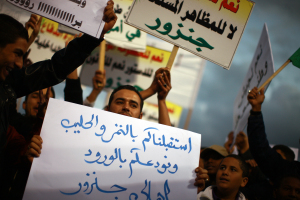
A crowd of demonstrators participating in a protest against the ongoing use of weapons by rebel militias inside Tripoli and accompanying atmosphere of lawlessness wave banners demanding disarmament and the creation of a national army. The newly-formed Libyan government is struggling to assert itself over the disparate power actors who emerged over the past year.
As the price of oil goes down, the pace of freedom goes up… As the price of oil goes up, the pace of freedom goes down…” So says New York Times columnist Thomas Friedman, who argues that the first law of ‘petropolitics’ is that the price of oil and the pace of freedom are inversely correlated in countries “totally dependent on oil” for economic growth. Friedman’s attempt to link economic oil dependency and political freedom is an interesting one, which could go some way towards explaining why many of the world’s top oil-exporting countries are governed by heavy-handed authoritarian regimes. However, the correlation between recent oil price spikes and anti-authoritarian action – particularly in the Arab Spring – challenges Friedman’s assessment.
Rather than being driven by drops in oil revenues for authoritarian regimes, popular unrest and armed resistance in countries such as Libya may in fact be correlated with the price of oil remaining high. Inward pressure caused by oil price spikes on petroleum-fuelled supply chains for basic commodities can exacerbate already harsh living conditions, galvanising rebel factions to form a unified anti-authoritarian front against a regime that can no longer ensure price stability for essential goods. This seems true of the 2011 uprising in Egypt (the world’s largest wheat importer), as bread prices rose drastically following the doubling of global wheat prices between June 2010 and February 2011. The impact of high oil prices on the production, shipping and distribution of staple commodities such as corn and wheat – both of which saw severe price escalations of near 40% in 2008 – can lead to social unrest and, in the case of Egypt, the toppling of an authoritarian regime.
Since December 2010, when mass protests began gathering steam in Tunisia, oil prices have remained consistently high, hovering at $82 per barrel. Is it a coincidence that in September 2011, when rebels overtook the coastal town of Bani Walid, one of Colonel Gaddafi’s last strongholds, oil was just above $82 per barrel and the FAO food price index had reached a ten-year high? While oil revenues may be a temporary source of political stability for some authoritarian regimes, the pressure of increasing price volatility on supply chains, due to scarcity in supply, can convert to instability downstream as oil prices have a compounding impact on food prices. Indeed, in December 2010 just a week before the self-immolation of Tunisian food vendor Mohamed Bouazizi, New England Complex Systems Institute a Cambridge-based organisation comprised of faculty from Harvard, MIT and Brandeis, warned the US government that global food prices were about to cross a socially dangerous threshold. If anti-authoritarian action is any indication of freedom ‘on the rise’ then high oil prices in oil-dependent states are at least one major factor.
Of those countries mentioned in the International Energy Agency’s 2011 list of top oil exporters, ten out of fifteen are classed by Freedom House as ‘Not Free’. Freedom House, ‘an independent watchdog organisation dedicated to the expansion of freedom around the world’, base their rankings on two broad categories: political rights and civil liberties. The former they define by a country’s electoral process, degree of political pluralism and level of participation/ functioning of government; the latter by degree of freedom of expression and belief, associational and organisational rights, rule of law, and personal autonomy and individual rights. The irony, according to Friedman, is that Western dependence on oil imports from countries which are ‘Not Free’ has channelled revenues to authoritarian regimes that oppose freedom. This paradox undermines Western credibility as champions of democracy. In a post-9/11 world, where militant extremists reportedly seek safe harbour in oil-exporting states like Saudi Arabia, the consequences of Western oil dependency undermine the West’s long-term security goals. But, when it comes to Friedman’s equation for ‘petropolitics’, the reverse may actually be true. Recent events such as the Arab Spring demonstrate that as the price of oil rises, impacting staple commodity prices, so too does the need for change – change that is blocked by Western dependence on remaining regimes.
Western countries reliant on fossil fuel imports from nations ruled by authoritarian regimes are suffering from a crisis of legitimacy – a crisis which could render us more insecure in the long term. In Algeria, where the Arab Spring has not resulted in full on revolution, violent extremists recently made their presence felt at the ‘In Amenas’ gas plant, brutally murdering 37 expatriate workers. The plant, which is jointly operated by BP, Norway’s Statoil and Algerian state oil and gas company Sonatrach, is a major supply source for Western markets. Algeria is responsible for roughly 12.2 billion barrels of crude oil reserves. 85% of Algeria’s oil exports are destined for European and North American markets. Under the leadership of Abdelaziz Bouteflika, whose five year executive terms are renewable indefinitely, Algeria certainly does not rate highly on the list of Freedom House ‘Freedom Ratings’. Military and intelligence services strictly monitor and interfere with open elections. But the Arab Spring may not ever reach Algeria precisely because of the stability brought to the country by a Western-funded heavy-handed regime, which goes to great lengths to protect the general population from militant Islamist extremists and pro-democracy activists alike. Saudi Arabia and UAE are governed by similarly oppressive regimes; regimes which subvert democracy in favour of ‘stability’. Both supply oil and gas to the West. Both benefit from revenues gained through Western dependence in spite of their heavy-handedness.
The Arab Spring has been full of unfortunate surprises linking former and current administrations to corrupt leaders. Photos of a smiling Tony Blair, getting up close and personal with much maligned Colonel Gaddafi, were a hit in the mainstream press as well as online following the collapse of his regime. Not long before that, the Bush Family’s close ties to the Saudi royal family did little to lend credence to their Middle East pro-democracy campaigns in the early 90s and 2000s.
Germany is in a similarly awkward position as the the largest energy consumer in Europe, with oil making up 38% of Europe’s overall consumption in 2011. Germany is Russian state-controlled energy giant Gazprom’s biggest European customer with 34% of total sales volume of Russian ‘blue fuel’ destined for German markets last year. There was therefore more than a hint of hypocrisy in Angela Merkel’s recent remarks during a visit by Vladimir Putin to a trade fair in Hanover that Russia ‘needs more NGOs’. The statement was made in regards to a Russian law passed last year requiring all NGOs that receive overseas funding to register as ‘foreign agents’. Topless Ukrainian activists from the pro women’s rights group ‘Femen’ made their presence felt at the trade fair, drawing attention to Russia’s crackdown on civil society groups and independent media organisations. Russia’s authoritarianism is a key element of the Putin government, but the issue arguably receives little mainstream coverage in the West compared to the Middle East.
Germany and, by extension, Europe’s de facto dependence on Gazprom to meet their energy needs provides yet another example of why Western countries need to seek develop a more sustainable energy security strategy. It is difficult to legitimately champion broad concerns about upholding civil protections, when some of your largest business partners engage in the shadowy practice of denying basic freedoms to their own citizens.
In light of the above we can welcome new approaches to energy security, which are aimed at reducing dependence on fossil fuel imports from authoritarian states. The Obama Administration’s ‘All of the Above’ energy strategy, as well as the pragmatism which the European Union, led by Germany, has shown in pushing forward a low carbon agenda are both steps in the right direction. Obama has pledged to double American energy efficiency by 2030, setting aside $2 billion over 10 years to support research into ‘a range of cost-effective technologies’, including electric vehicles, domestically-sourced biofuels, fuel cells, and domestically-produced natural gas. The plan also includes scope for reducing oil imports, while boosting renewable electricity generation from wind, solar and geothermal sources. Although Obama’s plan is far from low carbon, it shows promise. By comparison the UK Government, which at one time pledged to be the ‘greenest government ever’, has attempted to push forward its nationwide low carbon transition through the establishment of a Green Investment Bank. However, fairly recent public squabbles in the UK between Ed Davey, Secretary of State for Energy and Climate Change and Chancellor George Osborne the UK’s finance minister, have called that agenda into question.
Friedman’s claim of an inverse correlation between high oil prices and authoritarianism is flawed. But his point about ‘petropolitics’ is still crucial to security, not only because he tries to link oil price fluctuations to authoritarian politics, but also because he highlights how Western dependence on foreign oil provides significant revenue streams on which remaining authoritarian governments can rely. It is also important to point out that as the global price of oil becomes more volatile due to price instability (see: ‘peaky behaviour’) the economic stability of authoritarian regimes that have consolidated their power bases around fossil fuels will almost certainly erode. Moreover, as the impact of oil prices continue to destabilise staple commodity prices, authoritarian regimes will almost certainly come under increasing pressure from their own populations to step down. Western countries that have formed dubious partnerships with these regimes in order to meet their energy security needs will risk further embarrassment when these regimes are toppled by the inevitable anti-authoritarian movements. Western leaders might then stand by and wait to pick a winner – a dubious strategy at best – in order to ensure that supply shipments are not further destabilised. But is this sustainable?
Renewable energy is not the most obvious factor for bolstering the strength of nations. But it is fast becoming clear that Western dependency on fossil fuel imports from countries governed by heavy-handed regimes cannot go on. The International Energy Agency has recently announced that power generation from renewable sources worldwide will exceed that from gas and be twice that from nuclear by 2016. That’s a positive sign. As for oil, we will have to wait and see. But if the restoration of Western legitimacy as champions of the “free world” is a top priority for Western leaders, then more support for domestic renewable energy growth is essential.
Phillip Bruner is Founder of the Green Investment Forum and a guest lecturer in global political economy at the University of Edinburgh
Image source: United Nations Photo
The military campaign now being waged in the Afghan province of Helmand is being described in much of the world’s media as the biggest such operation since the one which secured “regime-change” in Kabul in October-November 2001. A coordinated military assault involving 15,000 troops – from the United States, Britain and Afghanistan itself – aims to seize the town of Marjah and surrounding areas, which are described as the Taliban’s last stronghold in Helmand.
Operation Moshtarak (the word means “together” in the Dari language), even before its launch, has been the subject of a series of high-profile news stories with an almost uniformly positive “spin”. Their consistent core is that the operation’s purpose is to curb Taliban influence over Helmand as a whole; that the province is, alongside neighbouring Kandahar, the pivot of Taliban power in Afghanistan; and, therefore, that victory would be likely to turn the whole course of the war in Afghanistan in favour of the Nato/Isaf project.
The herald of success
The task of reaching an accurate assessment of the real state of the conflict must look beyond such public-relations campaigns from military sources. The starting-point here is to acknowledge that after a long process of internal deliberation the Barack Obama administration has embarked on a policy markedly different from its predecessor. Washington’s new approach combines a readiness to negotiate and compromise (even with significant elements of the Taliban leadership) in order to end the war with a belief that it needs to do so from a position of clear military strength. Operation Moshtarak is the first major step in this military-diplomatic process.
Why, though, is the assault getting so much advance publicity? At first sight this seems puzzling, for it evidently gives Taliban strategists detailed warnings of what they are about to face. The rationale is fourfold: to intimidate some militants into abandoning the fight; to encourage civilians to evacuate the area (thereby reducing casualties); to make the best of the fact that the Afghan security services are so penetrated by Taliban sympathisers that it is pointless to keep operations secret; and – a crucial domestic consideration in the United States and Britain – to wring some positive publicity from a situation of diminishing popular support for the war. For Nato’s military planners and their political overlords, it is essential to demonstrate that the war can be won; what better way than to depict Operation Moshtarak as the instrument that breaks Taliban control of a key province?
The problem is that this narrative of anticipatory semi-triumphalism in no way corresponds to current signals from elsewhere in Afghanistan, including Helmand. For example, a new report from the Center for A New American Security co-authored by Major-General Michael T Flynn (Isaf’s director of intelligence) highlights the remarkable capabilities of the Taliban and is very cautious about progress (see Fixing Intel: A Blueprint for Making Intelligence Relevant in Afghanistan, 4 January 2010). A number of other recent reports similarly point to a versatile and resilient opponent (see CJ Chivers, “As Marines Move In, Taliban Fight a Shadowy War”, New York Times, 1 February 2010).
Two senior military officers – Major-General Andrew Mackay, a former commander of Britain’s task-force in Helmand, and Steve Tatham – make an especially potent criticism of the country’s war-fighting approach. They argue that “a fresh ‘hearts and minds’ strategy is required which focuses less on winning bloody battles against the enemy, and more on understanding their culture, economy and psychology” (see Eddie Barnes, “MoD ‘is not capable’ of winning war”, Scotland on Sunday, 3 January 2010).
Such critical, topical and ground-level analyses at least suggest that the intense and positive publicity devoted to Moshtarak is more a public-relations exercise than a realistic estimate of the current situation. In this respect, the experience of an earlier military operation of comparable scale – the attempt to send a giant turbine to the Kajaki dam in northern Helmand in August-September 2008 – casts an interesting light.
What comes after
This operation received huge publicity in the British media, most of which hailed it as one of the great successes of the war. The plan was to supplement the dam’s already working turbine with another that would be divided into seven large sections (of over twenty tonnes each), then carried by road from Kandahar airbase to Kajaki through 280 kilometres of largely hostile territory. No less than 5,000 troops were involved to ensure the safe transfer of the turbine: from Britain (3,000), the United States, Australia, Denmark and Canada (a total of 1,000), and Afghanistan (1,000).
The logistics were enormous: a 4-kilometre convoy of 100 vehicles – supported by fifty Viking armoured vehicles and constant air-cover from British, American, French and Dutch planes and American drones – took six days to travel the route, deliver the turbine, and (again over six days) return to secure bases. Along the way, one Canadian soldier and a reported 200 Taliban were killed. The way was now ready to import Chinese technicians to instal the turbine (which was a Chinese design), and for Nato/Isaf to bask in the secure knowledge that this part of Helmand province had been made safe and was on the development path.
The British ministry of defence (MoD) was upbeat about the result:
“With the delivery of the turbine complete, work can now begin on its installation and the much larger programme of the rejuvenation of the electrical distribution network needed to pass the extra power to the areas of Sangin, Musa Qaleh, Kandahar and the provincial capital of Helmand, Lashkar Gah. The new turbine is capable of producing 18.5MW of economically viable, renewable energy, which will be in addition to the dam’s current 16.5MW output”
“The additional electricity it will eventually provide will light up classrooms, allowing Afghans across southern Afghanistan to learn to read and write in evening classes; farmers to store their produce in chilled storage, allowing greater export opportunities for the booming wheat markets; and clinics to provide improved health services” (see “Kajaki dam troops return to base”, Military Operations [Ministry of Defence, 8 September 2008]).
The MoD concluded its report on the successful operation by quoting George Wilder, a contractor working on the USAID contract to upgrade the power- plant:
“There’s still a lot to do, but I’ve been waiting for this for a long time. It’s a great day for Afghanistan and it feels like my birthday.”
The entire operation was portrayed both as a success in itself and as the start of a process that would have a ripple-effect across much of southern Afghanistan. It could, it was claimed, be a turning-point in the war.
What happened next? By March 2009, six months on, there were reports that the turbine was still waiting to be unpacked (yet alone installed); and that security concerns were delaying progress in the work. Now the whole project has been abandoned (see “US postpones Afghan dam project”, BBC News, 14 December 2009).
The immediate trigger of the decision was that the Chinese contractor charged with installing the turbines withdrew overnight because of poor security. The job was always going to be huge; it would have involved the deployment of several hundred tonnes of cement and other supplies, and the mobilisation of a large team of engineers, technicians and labourers. At last, USAID has accepted that a further operation on this scale across land still controlled by the Taliban is unfeasible. It has reluctantly arranged for the turbine sections to be put into storage, and is now seeking energy projects elsewhere in Afghanistan in which it can invest.
A complex reality
The Kajaki power-plant experience has implications, direct and indirect, for Operation Moshtarak. First, it reveals the possibility of Nato using its huge firepower advantages to push Taliban paramilitaries out of larger towns – but being unable to prevent the Taliban from retaining control of many rural areas, to the degree that the movement can prevent the completion of an important infrastructure project.
Second, what might come after the impending operation is likely to be much more significant than what happens during it. As Moshtarak unfolds, it is almost certain that the Taliban will be evicted from Marjah and the surrounding areas; indeed, there may even be relatively little fighting as local Taliban commanders avoid localised conflicts that they cannot win. The great risk then is that Taliban rule will be replaced by regional governance of a kind that is all too typical of the Hamid Karzai regime’s record elsewhere: corrupt, dysfunctional, incompetent, with a police force that may be be infiltrated by Taliban sympathisers.
This is not to denigrate the efforts of defence ministries and departments yet again to represent the current operation as a decisive turning-point. Such efforts are, from their perspective, a necessary part of their work that becomes especially important at a time when support for the war is diminishing.
But it has always to be remembered is that the official representation of Afghanistan’s condition is just one part of a much wider picture; and that any worthwhile assessment of what is happening in the country must take into account many other factors. In this respect, the dismaying outcome of the Kajaki operation may be a more accurate reflection of Afghan realities than the publicity accompanying Operation Moshtarak.
The Climate Change and The Military (CCTM) project initially consists of two elements. The first is the recent report Climate Change and The Military: The State of Debate.

“It is the belief of the authors of this text that recent evidence of abrupt climate change and threatening tipping points has brought the challenge of climate change into the urgent timescale of military contingency planning. Climate change is a common security problem that requires global co-operation in which the defence and security community have an important role to play. It is our fear that if COP 15 fails to deliver an effective, predictable and institutionally robust climate protection system, that preserving security and stability at current levels will become increasingly difficult.
It is clear to us that on issues of climate change and security, the past is not an adequate guide to the future. The broader climate policy making world needs to hear from the defence and security community about the concerns of the military. If the military were to be excluded from the discussion at this stage on the spurious grounds that they would be “securitising” the debate, we should not be surprised if individual national militaries developed separate and potentially conflicting approaches to the subject.
This paper aims to describe the state of the current debate on climate change and security, and provide a framework for discussion in which the military can play a clear role in the debate on climate change mitigation and delivering sustainable human security, while starting to address the direct impacts of climate change on its core aims of national security, regional and global stability.”
The full full report is available here.
The second element, a statement by the Project Military Advisory Council calling for effective action at Copenhagen, is avaiable here.
Delicious
Digg
StumbleUpon
RedditDrone strikes have been a core strategy of the so-called global war on terror. But there have also been many questions raised surrounding the effectiveness, transparency, legitimacy, and ethics of […]
In an important year for the Women, Peace and Security agenda, women’s civil society organising is increasingly being impacted by global and national counter-terrorism regimes.
The announcement of fresh counter-terrorism powers in the UK follows assertions that returning foreign fighters present a substantial new threat to national security. But these powers may be counter-productive in the long term, risking a legacy of injustice that will only exacerbate the political tensions of the War on Terror.
While the world’s attention has been focused on the US-led military interventions in Iraq and Syria a quieter build-up of military assets has been ongoing along the newer, western front of the War on Terror as the security crises in Libya and northeast Nigeria escalate and the conflict in northern Mali proves to be far from over. In the face of revolutionary change in Burkina Faso, the efforts of outsiders to enforce an authoritarian and exclusionary status quo across the Sahel-Sahara look increasingly fragile and misdirected.
Barack Obama’s new strategy against the Islamic State commits the United States to further long-term conflict. It involves a great forgetting of the recent war in Iraq.
Despite the crumbling façade of its interventions in Iraq and Afghanistan, the US is preparing for a new century of ‘light footprint’ warfare, using Africa as its laboratory.
Sustainable Security programme Director Richard Reeve discusses our latest report ‘From New Frontier to New Normal: Counter-terrorism operations in the Sahel-Sahara’. The report, commissioned by the Remote Control project, finds that 2014 is a critical year for militarisation of the Sahel-Sahara and the entrenchment of foreign powers there.
An unlikely alliance of four states – Iran, Syria, the United States and Russia – is coalescing to oppose the ISIS advance in Iraq. Is military intervention in Iraq imminent?
This week marks 10 years since the first reported US drone strike in Pakistan. It has also seen the resumption of US drone strikes in the country following a five-month pause. Considering the length of time the CIA-led programme has been running, a number of questions deserve consideration: namely, how effective has the decade long covert drone programme been in Pakistan and what impact have drones had on wider Pakistani society? As the military technology for remote-control warfare spreads, there is a need to question whether drones provide significant tactical advantage or whether their proliferation could lead to greater long-term global insecurity.
The recent walkout by Egyptian negotiators at UN talks have demonstrated that, like a building with rotten foundations, the nuclear non-proliferation regime is far less stable than many believe it to be. Egypt’s actions make clear that anything less than a regime specifically geared towards addressing the reasons why some states seek nuclear weapons is a regime existing on borrowed time.
The defeat of the UK government’s parliamentary motion on support in principle for military action against the Syrian regime means that Britain will play no part in any direct attack on Syria. What then are its options for resolving the Syrian conflict, protecting civilians and punishing those responsible for war crimes there? This article assesses what the UK can do in terms of pushing for a negotiated peace settlement and to hold accountable those responsible for using chemical weapons and any other war crimes committed during this century’s worst humanitarian crisis.
Regular sustainablesecurity.org contributor and former Director of the Sustainable Security programme at Oxford Research Group, Dr Ben Zala, provides a brief overview of some of the main security implications of climate change. In this video, he stresses that policymakers must be careful not to militarise the issue.