Blog

  • Sustainable Security

    It’s hard to deny the fact that turning to essay writing services online is always stressful as one trusts certain academic challenges and research to another person willing to offer help. As the majority of British students these days are forced to study remotely or combine physical and online education, the role of academic assistance online became more important than ever. It also brings up certain security concerns among students and educators as one focuses on data privacy and academic integrity issues as the assistance is being provided. Aiming to provide assistance in the field of academic development, writing services, and online safety in general, Sustainablesecurity.org belongs to those unique campaigns where you can debate, discuss, and develop your skills as you deal with modern insecurities. Choosing writing services UK, we strive to help you create a sustainable security framework that can help you approach global security issues differently as you know how to choose what’s safe and reliable.

    Understanding Security Matters

    Before you continue reading our blog related to the Sustainable Security programme that has been made possible with the help of Oxford Research Group, first starting in 2009, and then rebranded in 2013, you should understand that we provide you with a special environment where you can discuss your concerns, take part in debates, and help develop a much better understanding of security concerns. Our aim is to create a sustainable security framework together when you bring your academic or essay writing challenges online. For example, when you are looking for a custom essay service, our interconnected actions and unity will help you to determine what can be considered as a custom essay writing service and what factors make it safe. Knowing global security challenges in the 21st century, you will be able to deal with numerous issues that pose an importance today, including:

    • Online (Remote) Learning Challenges and Accessibility.
    • Climate Change Concerns.
    • Competition Over Natural Resources.
    • A Negative Impact of Technology.
    • Global Militarisation.
    • Poverty and Marginalisation.

    As you can see, we strive for solving the global threats at the source by focusing on numerous issues. When you are looking for a reliable essay writing website, you also approach it all from technology to personal safety issues. Just share your concerns by contacting our specialists and we shall guide you towards the most efficient solutions!

    How to Write a Quality Essay In The UK? 5 Helpful Steps.

    Learn Your Service Provider.

    When looking for a reliable university essay writing service, you should remember that starting with a safe option that you know well will help you to avoid mistakes, late delivery, payment issues, or lack of refunds when things go wrong. We provide you with safe methods and experts that will help you write a quality essay from scratch, thus avoiding plagiarism risks.

    Aim For Direct Communication With Your Writer.

    Another important step is looking for a custom essay writing service that makes it possible to talk to your expert directly by discussing your thoughts and making sure that a person understands the subject and has good writing skills. It’s one of those security framework tips you should always consider. We are happy to offer direct contact with a chosen expert as you place your order.

    Focus On Grading Rubric Analysis.

    Remember that it’s not possible to write a quality essay without prior analysis and study of the grading rubric. The majority of instructions already have the answers or prompts to most questions, which is the starting point to good essay writing.

    Sources and Originality.

    Every good essay will contain well-documented sources that act as evidence and proof that you have done a clever synthesis of available information. The same relates to originality issues and the formatting of your sources according to a specified style. Our writing service has access to the latest databases, which will play an essential role in your academic success.

    Professional Proofreading and Editing.

    It’s what helps to tell a weak piece of academic research from the one that is perfect as it contains no grammar, style, formatting, or readability issues. Always take your time to proofread your written content!

    The Factors That Make Our Academic Assistance Research Services Safe

    Regardless of whether you are looking for an essay writing service in UK or would like to receive consulting services regarding one of the global security issues, we are happy to offer professional assistance that will meet your vision and professional requirements. As a team of trained experts and British natives, we work hard to address every security issue and offer safe academic services for educational, business, research, or personal purposes.

    The factors worth mentioning regarding our academic research services and creation of the sustainability safety framework include:

    • Always working from scratch, which helps to avoid plagiarism in your works.
    • Direct communication with a chosen expert helps to eliminate misunderstanding or any other issues.
    • Our college essay writing service will help you to find the safest and most reliable solutions based on the current security standards as you research various academic subjects with our help.
    • A great platform that focuses on global security threats and solutions.
    • 24/7 customer support and refunds in case you are not happy with the final results.

    Still, we are certain that you will be pleased with our platform and will add to the number of satisfied clients and our colleagues.

    We provide you with articles and resources to help you research your subject and discuss things with fellow specialists in the UK and beyond. As we help to eliminate global security threats and provide every member of society with safety in all regards, helping you learn in a safe environment is one of our top priorities. Therefore, our online essay writing service is based on online safety and academic integrity principles, which means that you are working only with native speakers with verified academic credentials and experience in every relevant field. We care for your safety as we work towards global security together!

  • National Security And The Threat of Climate Change

    CNA Corporation, a US Department for Defense funded think-tank, published this report in April 2007. The report was produced by CNA’s writers and researchers under the guidence of a Military Advisory Board (MAB) consisting of retired admirals and generals. 

    The report includes several formal findings:

    ►Projected climate change poses a serious threat to America’s national security.

    ►Climate change acts as a threat multiplier for instability in some of the most volatile regions of the world.

    ►Projected climate change will add to tensions even in stable regions of the world.

    ►Climate change, national security and energy dependence are a related set of global challenges.

    Download as PDF

  • Sustainable Security

  • Sustainable Security

  • Sustainable Security

  • Competition over resources

    Writing for the New Security Beat, Schuyler Null discusses a recent event on creating a new national security narrative for the US held at the Woodrow Wilson Center. The event was based on a white paper by two active military officers writing under the pseudonym “Mr. Y” (echoing George Kennan’s famous “X” article). In “A National Strategic Narrative,” Captain Wayne Porter (USN) and Colonel Mark Mykleby (USMC) argue that the United States needs to move away from an outmoded 20th century model of containment, deterrence, and control towards a “strategy of sustainability.”

    Image source: LizaP.

    Read more »

  • Sustainable Security

    Young people walk past an anti-nuclear weapons protest outside the NPT Review Conference, Geneva, 2008 Source: BANG (Flickr)

    Young people walk past an anti-nuclear weapons protest outside the NPT Review Conference, Geneva, 2008 Source: BANG (Flickr)

    The dropping of atomic weapons on Hiroshima and Nagasaki is now almost 70 years behind us and, current rhetoric over Ukraine aside, the Cold War ended almost a quarter-century ago. This is how we now understand nuclear weapons – as a threat of the past, more important in history class than in the headlines. But this is not the case. While we have made admirable progress on disarming and dismantling, particularly the arsenals of the US and Soviet successor states, thousands of nuclear weapons still exist and progress on disarmament is too sporadic for comfort. The threat of nuclear proliferation is high and many current nuclear weapons exist within hostile regions or on trigger alert. Nuclear risks are more prevalent than we’d like to believe. Whether we like or not, accidents can happen.

    The dramatic decrease in public awareness and engagement in the nuclear weapons debate since the 1980s poses a risk to our future, as younger generations and future policy shapers are less familiar with the challenges posed by nuclear weapons and will be as they start to take over the reins of governance. But nuclear weapons are too dangerous for a disconnect of this magnitude.

    It wasn’t always this way

    Anti-nuclear rally outside the Pennsylvania State Capitol, 1979. Source: Wikipedia

    Anti-nuclear rally Pennsylvania, USA 1979. Source: Wikipedia

    We haven’t always been so disconnected from the bomb. US arms control expert William Hartung describes:

    There was a time when nuclear weapons were a significant part of our national conversation. Addressing the issue of potential atomic annihilation was once described by nuclear theorist Herman Kahn as “thinking about the unthinkable,” but that didn’t keep us from thinking, talking, fantasizing, worrying about it, or putting images of possible nuclear nightmares (often transmuted to invading aliens or outer space) endlessly on screen.

    Perhaps it was the imminent threat during the Cold War that compelled millions across the world to actively protest against nuclear weapons. For example, in the United Kingdom, the Greenham Common Women’s Peace Camp was established in 1981 to protest the deployment of US nuclear-armed cruise missiles at the Greenham Common Air Force base. While in June 1982 in the United States, one million people came together in New York’s Central Park to call for an end to the nuclear arms race in the “Nuclear Freeze” protest.

    The looming nuclear threat seemed to fade away after the Cold War. Progress on arms control led to complacency with the international treaties that were in place to protect us against nuclear dangers. Under the Nuclear Non-Proliferation Treaty (NPT), for example, the nuclear weapon states (UK, US, China, France, Russia) are obligated to work towards disarmament. However, as absurd as it sounds, there is no universal agreement on what that would quite look like, or how to get there.

    Moreover, we’ve witnessed three countries become overtly nuclear armed states since the Cold War: India, Pakistan and North Korea. It’s a small percentage in comparison to states that don’t have the bomb, but when it comes to nuclear weapons, even a small percentage is a terrifying one.

    International norms of non-use and the “nuclear taboo” have led us not to worry about that small percentage of states. Eric Schlosser’s recent book Command and Control, however, alarmingly points out that there have been several nuclear “near misses” in the United States alone that we as a public have little to no knowledge of. Schlosser writes:

    Right now thousands of missiles are hidden away, every one of them is an accident waiting to happen, a potential act of mass murder. They are out there waiting, soulless and mechanical, sustained by our denial – and they work.

    Is it simply that the public is in denial about nuclear weapons? A diverse range of psychological studies conducted in the 1980s – including Nuclear attitudes and reactions: Associations with depression, drug use, and quality of life; Nuclear War as a Source of Adolescent Worry; and Gender, sex roles, and attitudes toward war and nuclear weapons – demonstrate a desire to understand society’s feelings about nuclear weapons at the height of the Cold War.

    In more recent years, there have been similar studies conducted in reference to climate change, another somewhat abstract and imminent global threat. And yet, while the nuclear threat is the still around, we’re not as concerned about nuclear weapons as we were 30 years ago. It could be, as Schlosser suggests, denial. It seems that we have forgotten, don’t understand, or are simply indifferent.

    Why we should care

    Beyond the obvious threat of obliteration posed by nuclear weapons, they also undermine essential international co-operation between states and become a liability in certain situations. For example, in the recent Russian invasion of Ukraine, many media sources were keen to point out that any Western military intervention would put nuclear armed states up against each other. It could be argued that the diplomatic actions taken towards the crisis, resulting in economic sanctions and a recent shift of the G8 meeting away from Sochi, can be partly attributed to the looming presence of nuclear arsenals. As such, the continued presence of these weapons will continue to affect the cooperation and relationship between Russia and the West, for better or for worse.

    Nuclear weapons, or efforts taken to prevent their proliferation, can also affect a range of industries and economies. The threat of nuclear proliferation in Iran led to the implementation of economic sanctions that affected trade in a range of countries (including the UK, US and other European states) and a range of industries such as banking, insurance, oil, pharmaceuticals, and food. UN Resolution 1540 also calls upon states to implement export controls and regulations on materials that could be used for WMD proliferation, which affects such industries as shipping and transport, and manufacturing firms.

    It is naïve to assume that any spending on nuclear weapons or related programmes would or could be simply or entirely allocated to spending in other areas, such as healthcare or other threat reduction initiatives, but the stark contrast in the spending is noteworthy: In 2002, the World Bank estimated that $40-60 billion USD annually would be enough to meet the internationally agreed Millennium Development Goals, which range from providing universal primary education to eradicating poverty and hunger. Between FY2008 – FY2013, the US spent $77 billion to address global climate change in total, with the President’s request for $11.6 billion for FY2014. At the same time, it was estimated in 2012 that the US was on track to spend an average of $64 billion per year on nuclear weapons and related programmes over the following decade.

    Continued reliance on nuclear deterrence is a divisive issue. Whether one believes that it brings security and stability, or that the risks (and monetary costs) are too high, reliance on nuclear weapons for security is among the most pressing issues of our time and we need to be aware that the decisions we make today will have implications on the future and the uncertain threats that we will face. With public interest in nuclear issues waning, policy shapers and the emerging leaders of tomorrow are increasingly focusing their attention elsewhere. As a result, nuclear policy is being pushed back to those who have been making these decisions for decades and the circular debate rooted in Cold War perspectives continues. Fresh perspectives and a renewed interest in the nuclear debate are needed to address these security challenges of the future.

    The way forward

    Now is the time to engage the next generation on these issues if we are ever going to find a long term solution to this long term problem. The debate on nuclear weapons needs new ideas and help to shift nuclear weapons out of their isolated silo and back to the heart of security debate. This requires building a security narrative that includes nuclear weapons in a broader context, approaching them as a part of a bigger problem, and not as the problem itself. This also involves bringing in a wider range of disciplines into the nuclear weapons debate including businesses, creative communities, environmental and health groups, and social scientists, because nuclear weapons have an effect on all of us.

    If we are going to make progress on the nuclear weapons debate, we need continued engagement from all sides, along with a deeper understanding of the motivations behind what drives people to think about (or not think about) nuclear weapons. In essence, we need to reconnect with the nuclear debate and start thinking about a sustainable future.

    BASIC has launched a new Next Generation project to inspire a next generation of thinking on nuclear weapons.

    Rachel Staley is currently the Programme Manager for the British American Security Information Council (BASIC) in their London office. Since 2011, Rachel has managed the operations of the office and assisted in developing the organisation’s programmes working on nuclear non-proliferation and disarmament in the Middle East, as well as engaging directly in the Trident renewal debate in the United Kingdom. Rachel holds an MA with Distinction in Non-Proliferation and International Security from King’s College London and a BA with Honours in International Affairs and Anthropology from Northeastern University.

  • Sustainable Security

  • Sustainable Security

    Contrary to the claims of analysts and pundits, the China-Russia relationship is not as friendly as it seems and there is mistrust between Beijing and Moscow. But changes to Sino-Russian border security could help alleviate tensions between the two powers. 

    Seeking to build their own respective influence in East Asia, China and Russia have entered into an ostensible mutual embrace. For Russia, this is part of its so-called “pivot to the East”. The two sides have sought to increase their cooperation in the defense and economic realms, especially in terms of closer economic integration, joint military exercises, and coordinating responses on issues of global concern such as placing restrictions on arms proliferation and militarization. In May 2015, Russian Ambassador to China Andrei Denisov highlighted the need for a Sino-Russian relationship built on the basis of economic development and sustainable security.

    At present, the China-Russia relationship is not as profound as many analysts and pundits suggest. Such is the nature of a relationship built on oil markets and the whims of global politics. Nevertheless, no matter what shifts or weaknesses in China-Russia ties may occur, one thing that the two countries cannot escape is the reality of geographic proximity. The Russian Far East’s closeness to the economic powerhouses of China and Japan opens the region to investment from these areas. The Russian Far East’s sparse population combined with a wealth of natural resources presents Moscow with a unique quandary. For Russia, the task at hand is to develop the Russian Far East to a sufficient degree while also securitizing it from external exploitation.

    Geopolitics casts a shadow over the border

    Manzhouli_Gate_01

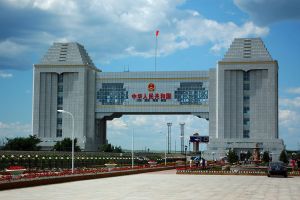
    Manzhouli Gate on Sino-Russian border. Image by Quatro Valvole via Wikimedia.

    One of the major stumbling blocks to a culture of sustainable security is persistent mistrust at the highest levels of government in Beijing and Moscow. Despite public displays of solidarity at the diplomatic level in China and Russia, the two countries remain wary of one another. Internal and external observers often view the China-Russia relationship through the lens of geopolitics, namely, that the China-Russia relationship is driven by rivalries both within their bilateral relationship, as well as outside, in terms of a desire to contain the United States’ power in global affairs.

    Much of the modern China-Russia relationship, despite the alarmism propagated by some observers, remains opportunistic for both parties. No number of agreements-neither on the energy trade nor economic initiatives such as the agreement to jointly develop China’s “New Silk Road” economic initiative with the Russia-led Eurasian Economic Union integration structure- can assuage the lingering feelings of strategic mistrust between the two countries, be it in the economic or military realm.

    Despite the post-Cold War drawdown of armed forces on the frontier, the Sino-Russian border remains militarized, exemplified by the deployment of 12,000 Chinese troops to the border in 2014, possibly in response to Russian nuclear drills near the border due to take place later that month. The failure to move beyond a geopolitical worldview in the China-Russia relationship will make sustainable security all the more difficult. Not only will persistent mistrust between China and Russia perpetuate fears based on traditional, military security, but it will also make it more difficult for the two sides to cooperate on border security. Indeed, security tensions on the Sino-Russian border are nothing new, as the two sides engaged in a border conflict that lasted throughout 1969. Despite the end of open conflict after approximately six months, the tense atmosphere on the border persisted until 1991 when the two sides finally resolved their border demarcation disagreement.

    In spite of the ostensible resolution of border disagreements between the two countries in 2001, anger arose among Chinese netizens in late 2015 when news reports highlighted the construction of border markers signifying the return of 4.7 square kilometers of land from Russia to China. The anger came from what appeared to be China’s inability to demand more land from Russia, which Chinese nationalists believe to be rightfully theirs in light of acquisition of land belonging to the Chinese Empire by the former Russian Empire in the 19th century.

    Necessity overrides high politics

    Far removed from the mechanism of high politics at the official level is the day-to-day reality of cross-border interaction between Chinese and Russians living along the border, as well as the issue of Chinese migration to the Russian Far East.  According to a report on life in the Russian Far East many Russians remain skeptical and wary of Chinese consumption of Russian land and material assets. But many locals also protest the heavy-handed and centralized nature in which Moscow conducts its governance over the Far East. The region’s increasing economic dependence on China and continuing political subjugation to Moscow means that many local residents are increasingly turning to China for their everyday needs, which includes engaging in shuttle trading and importing Chinese cars.

    Two major changes in the management of Sino-Russian border security should therefore occur. One is a move away from a strict dependence on reactive measures, to a more proactive approach, explained below. A second is to divorce the happenings of high geopolitics between the two nations’ capitals from realities on the ground, especially by building interethnic relations so as to create a culture of trust and cooperation during times of geopolitical uncertainty in the China-Russia relationship.

    Aside from regular border patrol and law enforcement activities along Russia’s Far Eastern borders, Russian security authorities also utilize the concept of Border Security Zones. Dating back to the Soviet era, these are essentially small, barely-populated areas along the Russian borders with several countries, including China and North Korea prohibited from entry without permission from the local FSB (Russia’s federal domestic security service). Nevertheless, with not only the existing and growing presence of Chinese living in Russia but also the increased trade relationship between the two countries, border security based strictly and exclusively on prevention and interception on the part of Russian law enforcement is not a viable means of border security. One solution to this problem is concentrating on developing the interrelationship between the Chinese and Russian border communities.

    Community relations in border enforcement and security

    Russian authorities could potentially pursue a border security policy based in the concept of community policing. The concept of community policing is based on the notion of building working relationships between law enforcement and local communities. Instead of trying to catch and apprehend criminals, community policing entails interaction between civilians and law enforcement as part of the latter’s patrol duties. This has been implemented with relative success in American cities with high racial tensions such as Philadelphia. Not only does it increase public trust in the police, but it makes communities more willing to be forthcoming about criminal activity in their areas.

    One particular fear for Sino-Russian border security is the potential for organized crime groups to exploit cross-border activity and border communities. It can be easy for criminal elements, ranging from petty smugglers to larger criminal enterprises to blend into local Chinese border communities. In fact, Chinese organized crime groups such as the triads have become increasingly more powerful in the Russian Far East than the traditional Russian mafiya. While that is not a problem specific to border security, a Sino-Russian boundary line that is difficult to protect can only make the jobs of criminals operating in the region easier. Many Chinese migrants in the region end up being caught up in the machinations of criminal organizations as a way of contending with racial discrimination and the possibility of deportation.

    Through members of Russian law enforcement in border areas interacting with members of the Chinese communities in Russia’s borderlands, trust between the two sides can be built. Over the long term, if mutual feelings of respect and good working relationships between law enforcement and the community are established, the ability for the two sides to cooperate on the prevention and interdiction of criminal activities such as drug smuggling and human trafficking can hopefully weather any major potential shifts in geopolitical realities. Elsewhere, Tadaatsu Mohri, writing for the Brookings Institution, asserts that Japan-Russia cooperation on combating trans-national crime can be a way of reducing the greater strategic tensions inherent in the Japan-Russia bilateral relationship due to the ongoing territorial dispute over the Kuril Islands/Northern Territories. Mohri specifically cites existing cooperation on the Sino-Russian border as a case of successful trans-boundary collaboration.

    Yet while this relative success with respect to the Chinese-Russian border may have helped to alleviate tensions on the strategic level, the distance of the common Sino-Russian border and their respective populations from officials in Beijing and Moscow necessitates an even more community-focused approach. This will require the development of language and cultural skills among members of the Russian law enforcement community. For example, Russian education officials are working to implement Chinese language study as a component of education in preparation for Russia’s United State Examination.

    The establishment of working relationships between Russian law enforcement and members of the Sino-Russian border community will take time. Yet in the long term interests of Russia’s far eastern border security, it is a worthy endeavor for Russian border security services to pursue. While political relations between states at the elite level are often unstable or at least inconsistent, ties between populations are often more stable. Given the distance between the Sino-Russian border populations and the governments in Beijing and Moscow, an approach distanced from high politics will likely provide a better solution for sustainable border security. Such an approach would entail fostering relationships between law enforcement and border communities, particularly among immigrant and ethnic minority groups on the frontier.

    Anthony V. Rinna is a specialist on Russian security policy in East Asia with the Sino-NK scholarly research group. He currently resides in South Korea. 

  • Sustainable Security

    The announcement of fresh counter-terrorism powers in the UK follows assertions that returning foreign fighters present a substantial new threat to national security. But these powers may be counter-productive in the long term, risking a legacy of injustice that will only exacerbate the political tensions of the War on Terror.

    The Counter-terrorism and Security Bill announced in the UK in November includes new powers aiming to limit the flow of people travelling to train and fight with certain rebel groups in Syria and Iraq. The proposals, due to be rushed onto the statute book in January, include the extension of controversial powers to disrupt travel and strip citizenship from terrorism suspects. Life sentences for a greater range of terror offences, including training, are also proposed. The British bill follows a US-drafted UN Security Council resolution to criminalise al-Qaida or Islamic State (IS)-linked foreign fighters which was adopted in November. Similar measures are being debated in other European countries and Australia.

    The reason for this wave of legislation? On the back of reports of unprecedented numbers of foreigners travelling to fight in the Syrian conflict, there has been a near-universal consensus amongst the security and intelligence community that returnees present a heightened national security threat. Returning foreign fighters, it is feared, will be networked, skilled up, and angry. The threat of political violence is ‘inevitable’, according to senior EU counter terrorism officials.

    Despite these fears, there is little in the way of a historical precedent in the UK to indicate that returning foreign fighters do represent an increased national security threat. The lack of evidence to support these claims is one of several legal and practical difficulties. Existing laws are already being used to criminalise foreign fighters in Syria’s conflict. The overwhelming application of such laws to Muslim communities has raised concerns that the legal principle of parity before the law is at risk. There is also a lack of accountability and oversight of these cases due to the use of secret evidence.

    The long term efficacy of such measures is therefore questionable. They may be a distraction from the underlying dynamics driving political violence, which are known to relate primarily to grievances over foreign policy. The abandonment of the principles of justice and equity before the law are likely to exacerbate resentment and the perception that the West is ‘at war with Islam’. The UK’s counter-terrorism policies may be creating a legacy of injustice that risks exacerbating the underlying political antagonisms of the War on Terror.

    Threat level: Severe?

    In response to the risk posed by returning foreign fighters, the UK’s terrorism threat level was again raised to ‘severe’ in late August. Although exact figures are not known, the number of those who have travelled from the UK to fight in the Syrian conflict is estimated to be at least 500 since 2011. The extent to which the Syrian conflict has mobilised fighters from Europe is clearly significant: key to this is the ability of groups such as IS to attract recruits via its propaganda films and social media activities conducted in European languages.

    But not all those who have gone to fight are with IS. The reality of the Syrian conflict is that there are over 2,000 fighting groups in Syria, including some with affiliation to al-Qaida. Little is known about group affiliations of the UK’s foreign fighters. Even individuals that are fighting with proscribed organisations, such as Islamic State or Jabhat al-Nusra, will have varying personal affiliations. Primary source reports collected by journalists and advocacy groups indicate that the primary motivation for those going to fight is a moral duty to fight the Assad regime (See for example, ‘Blowback: Foreign Fighters and the Threat they Pose’, CAGE, July 2014; ‘Joining ISIS: My Meeting with Aseel Muthana’, Huffington Post, 25 June 2014; ‘From Portsmouth to Kobane: the British jihadis fighting for Isis’, New Statesman, 6 November 2014). The reports suggest that, partly due to practical reasons, certain larger groups with more resources such as IS have absorbed the most foreigners. One of these reasons is that some other groups’ vetting procedures present a barrier to foreigners wanting to join.

    There are also legitimate questions over the wisdom of excluding foreign fighters from their countries of residence. Following reports that disillusioned fighters have been caught ‘in limbo’ in Turkey, wanting to leave but afraid to come home, some have called for alternatives, such as pastoral re-integration programmes existing separately from criminal investigation proceedings. A programme in Denmark provides an example of how such a scheme could function.

    Context: Terrorism laws in the UK

    The latest developments have occurred in the context of an increasingly securitised response of the UK to Islamist movements globally. Since 2001, the UK has progressively increased its set of counter-terrorism powers with a succession of laws, most of which have been fast-tracked and introduced as emergency legislation only to be made permanent. The UK’s multi-pronged CONTEST strategy conceives of the battle against terrorism on four fronts: Pursue, Prevent, Protect, and Prepare. The Prime Minister has promised to increase resources to these programmes. Yet intelligence resources dedicated to countering al-Qaida-linked terrorism already dwarf those that were dedicated to countering the threat posed by the Soviet Union and its allies even at the height of the Cold War, as observed by Sir Richard Dearlove, former head of the British Secret Intelligence Services at a Royal United Services Institute talk earlier this year.

    There is nothing in the UK’s legal definitions of ‘terrorism’ that specifies Islamist activity. ‘Terrorism’ was defined in a Supreme Court judgment last year to include “any or all military attacks by a non-state armed group against any or all state or inter-governmental organisation armed forces in the context of a non-international armed conflict”. But the shadow of the 9/11 attack continues to shape the security services’ understanding of national security threats, and to shape the application of these laws, primarily to Muslims. The focus on ideology that can be linked to al-Qaida, and the search for evidence of ‘jihadist worldviews’ conflates the criminal and the non-criminal, the threatening and the non-threatening. It leads to a skewed application of laws to those whose ideas or religious beliefs can be superficially associated with those of the UK’s enemies. By comparison, the resources dedicated to tackling political violence by the far-right are minimal, and similar types of crimes attract lesser sentences. One recent example is a former British soldier who was a supporter of the English Defence League (EDL), handed a two-year sentence after nail bombs were discovered in his house. Despite the UK’s legal definition of “terrorism” that is consistently criticised for being overly broad, the soldier controversially avoided charges under terror legislation, instead he was found guilty of offences under the Explosive Substances Act.

    The Syrian conflict has prompted security services to make increasing use of counter-terrorism powers against UK residents suspected of travelling there, or planning to travel there. A series of high-profile arrests have occurred in the last years, most of which have not made their way through the judicial process. But several recent cases raise further questions over whether these powers are being applied fairly.

    There has been an inconsistent response to those understood to have fought against IS. The estimated dozens of British residents fighting with the Kurdish forces, it has been indicated, will not meet charges upon their return. The Prime Minister stated there was a “clear difference” between fighters with the Kurdish authorities and IS fighters; and stated that “highly trained border staff, police and intelligence services” would be able to distinguish between them. But one man from Derry, who explained he was also fighting against IS, but with the largest Islamic coalition was still arrested by Northern Ireland police upon his return.

    Long prison sentences for crimes under terror legislation are being handed out to returning foreign fighters. Last week, two Birmingham men, Mohammed Ahmed and Yusuf Sarwar, were convicted of engaging in preparation of terrorism acts and sentenced to 12 years in prison; they had spent several weeks in Syria in 2013. The pair were arrested upon their return to the UK in January 2014 after Sarwar’s mother reported him missing to the police. The judge concluded that the pair had not planned any attack in the UK; they received the sentence because they had joined proscribed organisation Kataib al-Muhajireen. According to former Guantanamo Bay detainee Moazzam Begg, who was a fellow inmate in Belmarsh prison, the pair were “young” and “bewildered”, and had not thought what they were doing was a crime. Two brothers were also jailed after attending a Syrian training camp for less than a month. Despite returning without having done any fighting, they were sentenced to four-and-a-half years and three years, respectively.

    Citizenship revocation powers on the grounds of national security have been increasingly deployed in recent years. In November, reports emerged that an entire family (a British-born father and three sons) had been exiled from the UK due to alleged links with al-Qaida-linked groups in Pakistan. The family deny the allegations, and are appealing the ban. A detailed investigation by the Bureau of Investigative Journalism revealed that the number of UK citizenship revocation orders on national security grounds tripled in 2013, taking the number since 2006 to twenty-seven. At least fifteen of these individuals were abroad at the time of the deprivation order.  The Foreign Office has cited the fighters joining the Syrian war as the reason for this increase.

    Where national security reasons are invoked (as they are in virtually all the cases brought under terrorism legislation), the substance of allegations is kept secret. However, police statements saying there is no immediate threat to the British public have accompanied virtually every recent Syria-related arrest (For example: Statement by Hampshire Police 14 October 2014; ‘Anti-terror police arrest five men in Dover and east London’, BBC 1 December 2014; ‘Police arrest man in Slough on suspicion of financing terrorism’ Guardian 13 November 2014; and a statement by the Head Teacher of the school where Jamshed Javeed worked ‘Teacher Jamshed Javeed admits Syria terror offences’ BBC 27 October 2014.)

    Syrian Exceptionalism

    UK citizens fighting in foreign wars are not universally criminalised. The Israeli Defence Force’s ‘Mahal’ programme enables foreign citizens to fight with the army in Israel, and these foreign fighters are not considered to be in breach of British law. The war in former Yugoslavia attracted fighters from Britain, many of whom were Muslims. After the beginning of the uprising against Muammar Gaddafi in Libya, UK nationals were known to be fighting against the regime with Islamist groups. Men who had been previously detained and investigated under counter-terrorism powers in the UK went on to fight against the Gaddafi regime – and were supported by the UK’s security services. Advocacy group CAGE reports a number of UK nationals – more than 100, by their estimates – who met no resistance from UK authorities when leaving the UK, or legal problems when they returned from Libya.

    Guantanamo Bay protest Shaker Aamer

    Protest to free Guantanamo Bay prisoners including Shaker Aaamer, the last British resident in Guantanamo Bay. Aamer has been detained without charge for over twelve years and cleared for release since 2007. Source: Flickr | shriekingtree
    The recent selective criminalisation of foreign fighters in the Syrian conflict points to a deeper flaw within broader US/UK ‘War on Terror’ era military strategy: the enemy is poorly defined. It is often noted that the US’ arming of the Afghan mujahideen rebels during their struggle against the Soviets in the 1980s was a key historical factor in the resulting al-Qaida network. In 2013 the UK was on the brink of going to war with the Assad regime, and came close to fighting on the same side as the rebel groups that it now seeks to vanquish. Fighters who left the UK at the beginning of the Syrian war have been criminalised in their absence and now face a major disincentive to returning to civilian life. The absence of a long-term strategy focused on peace and informed by an ethic of equity and justice has resulted in a confusing picture of shifting alliances.

    This militarised and reactive foreign policy results in shifting definitions of what constitutes terrorist activity at home. It is not only foreign fighters who are meeting overwrought security responses. Lawful activities such as charity work, political organising, membership of radical religious groups, and particular religious beliefs are increasingly caught up in the dragnet of counter-terror measures. The ongoing repression of Muslim charity organisations provides multiple examples of these blurred lines. The recent seven-month detention of Moazzam Begg is another.

    One lesson from the last twelve years is that injustices carried out in the name of counter-terrorism themselves have a deep, global resonance. The enduring resonance within Muslim communities of the well-documented abuse of Guantanamo Bay inmates is indicated precisely by the apparent effectiveness as a recruiting tool by Islamic State. The distinctive orange jumpsuits, as well as imagery from the abuse of Iraqi prisoners in Abu Ghraib jail, have appeared in IS’ videos, recycled as evidence of IS’ own ability to dominate. The UK, along with the US and France, is widely perceived negatively as having a ‘Crusaderist’ or imperialist project to divide and weaken the Muslim world. The selective criminalisation of foreign fighters has great potential to fuel such resentment further.


    Betsy Barkas is Oxford Research Group’s (ORG) Quaker Peace and Social Witness Peaceworker. She works as a Project Officer for ORG’s Sustainable Security programme, and co-edits sustainablesecurity.org.

    Image: Protest to free Guantanamo Bay prisoners including Shaker Aaamer, the last British resident in Guantanamo Bay. Aamer has been detained without charge for over twelve years and cleared for release since 2007. Source: Flickr | shriekingtree